


Zimbabwe Visa Guide 2026: Types, Requirements, Documents and Application Steps
Last checked: 29 November 2026. This guide is for Pakistani passport holders living in Vietnam. The short answer is good news: Zimbabwe runs a fully online e-visa system, and Pakistanis apply for it before travel at evisa.gov.zw — there is no need to visit an embassy to get a tourist visa — and there is no Zimbabwean embassy in Vietnam in any case. The single-entry e-visa costs USD 30, takes about seven working days on average, and is valid for three months from the date of issue, with a stay of up to 30 days on each entry. Visa rules change without notice — always confirm the live rules on the official e-visa portal before paying any fee or booking a non-refundable ticket.
Introduction
Zimbabwe is one of southern Africa's great travel destinations, and for a Pakistani passport holder it is also one of the more straightforward African visas to obtain — provided you understand one fact before anything else. Zimbabwe sorts every nationality into three categories. Category A countries need no visa at all. Category B countries can buy a visa on arrival at the airport or land border, or apply online in advance. Category C countries must apply, pay and obtain the visa online before travelling. Pakistan is in Category C, alongside Bangladesh, Nepal, Nigeria, the Philippines, Saudi Arabia, Sri Lanka, Thailand and Vietnam itself. That single classification decides the whole journey: you cannot turn up at Harare airport and buy a visa, and no airline should let you board a flight to Zimbabwe without an approved e-visa in hand.
Do Pakistani Passport Holders Need a Visa for Zimbabwe?
Yes. Pakistani ordinary passport holders need a visa to enter Zimbabwe, and the visa must be obtained online before travelling. Zimbabwe's Department of Immigration places Pakistan in Category C — the list of countries whose nationals are required to obtain their visa before travelling to Zimbabwe. The same list is published in the Department's visa-regime document, which names Pakistan explicitly, and it is repeated by the Embassy of Zimbabwe in Washington and by the University of Zimbabwe's guidance for international students. There is no visa exemption for Pakistani ordinary passport holders, no visa-free entry, and no published arrangement under which a Pakistani can enter Zimbabwe without a visa.
The distinction between the categories matters because it is the source of the most common confusion about this visa. Category B nationals — including citizens of the United States, the United Kingdom, Canada, Australia, Germany, Japan and China — can obtain a visa on arrival at Harare, Bulawayo or Victoria Falls airport, or at a land border, by paying the fee at the counter. Several general travel websites describe that visa on arrival as if it applied to everyone, and at least one Pakistan-focused guide, Travel Visa Stack, states that Pakistani citizens can obtain a visa on arrival at major ports. That is wrong for a Pakistani passport, and the controlling source is the Department of Immigration's own category list: Category C nationals must apply, pay and obtain the visa before travelling. The official e-visa portal says the same thing in its own words. Do not plan around a visa on arrival. An airline can refuse boarding if you do not hold an approved visa.
Your passport itself must meet the standard conditions. The UK Foreign, Commonwealth and Development Office (FCDO) states that to enter Zimbabwe your passport must have an expiry date at least six months after the date you arrive, and three blank pages — the three pages matter in case you need to enter Zimbabwe and exit through one of the neighbouring countries, or need to leave at short notice. The e-visa guides agree on six months' validity from the date of arrival. Carry a passport with at least six months' validity beyond your planned return and at least three blank pages, and check the expiry date before you start the application, because an e-visa issued against a passport that is about to expire will not help you.
On health, the rule is conditional rather than universal, and it is worth stating exactly. The FCDO states that to enter Zimbabwe you must have a certificate proving you have had a yellow fever vaccination if you are coming from a country listed as a transmission risk. Neither Pakistan nor Vietnam is a yellow fever transmission-risk country, so a traveller flying directly from Vietnam or Pakistan to Zimbabwe is not caught by that rule on the wording as published. But if your routing takes you through, or you have recently been in, a country listed as a transmission risk — several African transit hubs are on the list — the certificate becomes a condition of entry, and the immigration officer can ask for it. The safe course is to carry your yellow fever certificate if you have one, and to check the current transmission-risk list against your exact routing before you travel. The vaccination must be given at least ten days before travel to be valid, so it cannot be arranged at the last minute.

Types of Zimbabwe Visas for Pakistani Passport Holders
Zimbabwe's visitor visas are all applied for through the same online system at evisa.gov.zw, and the choice you make on the portal is mainly about how many entries you need and how long the visa stays valid. The categories below are the e-visa types the Department of Immigration lists, plus the joint KAZA UniVisa and the separate residence permits that cover study, work and family settlement. A visitor e-visa never carries a right to work or study: those need a residence permit, dealt with in sections 10 and 11.
Single-entry e-visa
The single-entry e-visa is the standard tourist and family-visit visa, and it is the right choice for most Pakistani travellers. It costs USD 30, it is valid for three months from the date of issue, and it allows one entry. You may enter on any date within that three-month validity window — the official frequently asked questions confirm that you do not need to enter on the date you specified in your application, because the validity period begins from the specified date and entry is allowed on any date inside it. The stay granted on entry is usually up to 30 days. If you leave Zimbabwe, the visa is spent, and you need a new one to come back. Choose this visa if your trip is one visit with no side trip out of the country.
Double-entry e-visa
The double-entry e-visa costs USD 45 and is valid for six months from the date of issue. It allows two entries, which makes it the practical choice if your itinerary takes you out of Zimbabwe and back in — for example, a trip that starts at Victoria Falls, crosses into Zambia or Botswana for a few days, and returns to Zimbabwe to fly home from Harare. The stay on each entry is usually up to 30 days, and the total stay across the visa is commonly described as up to 90 days, which reflects the in-country extension practice described in section 6 rather than a second automatic grant at the border. Do not assume the second entry is guaranteed: the immigration officer at the border decides the stay on each entry.
Multiple-entry e-visa
The multiple-entry e-visa costs USD 55 and is valid for six months from the date of issue, with any number of entries inside that window. It is the right choice for a traveller making several trips to Zimbabwe in a half-year — a business visitor with repeat meetings, or a tourist combining Zimbabwe with several neighbouring countries. The stay on each entry is usually up to 30 days. The multiple-entry visa on arrival, by contrast, is offered only to British, American and Canadian nationals, which is another reason a Pakistani should not plan on buying anything at the border: the online multiple-entry e-visa is your route.
KAZA UniVisa
The KAZA UniVisa is a joint visa for Zimbabwe and Zambia, covering travel between the two countries and day trips into Botswana through the Kazungula border. It costs USD 50, it is valid for three months from the date of issue, and it allows multiple crossings between Zimbabwe and Zambia for up to 30 days. It is sold at Harare, Bulawayo and Victoria Falls airports and at the Victoria Falls and Kazungula land borders, according to the FCDO. For a visitor to Victoria Falls who wants to see the falls from both banks, it is the visa the guidebooks recommend — but for a Pakistani passport holder it comes with a serious warning, set out in full in the conflict box in section 5. In short: several Pakistan-focused sources say Pakistanis cannot buy the KAZA UniVisa because Pakistan is absent from the eligible-nationalities list, while other sources say to clear the standard Zimbabwe e-visa first and treat the KAZA as a counter bonus. The safe course is to hold a valid Zimbabwe e-visa and a separate Zambia e-visa before you travel, and to treat the KAZA UniVisa as something you may be offered at the border, never as the plan. One hard rule applies to everyone: if you spend a night in Botswana, the UniVisa dies, and you will need fresh visas.
Visa Comparison Table
| Visa type | Fee (USD) | Validity from issue | Entries | Usual stay per entry |
|---|---|---|---|---|
| Single-entry e-visa | 30 | 3 months | One | Up to 30 days |
| Double-entry e-visa | 45 | 6 months | Two | Up to 30 days |
| Multiple-entry e-visa | 55 | 6 months | Multiple | Up to 30 days |
| KAZA UniVisa (Zimbabwe + Zambia) | 50 | 3 months | Multiple crossings between the two countries | Up to 30 days in total |
| Emergency online visa | 100 | Not published | Not published | Not published |
| Business visit e-visa | 30 / 45 / 55 by entries | 3 or 6 months by type | As chosen | Up to 30 days |
| Student (study) permit | 200 | Usually 1 year, renewable | As issued | Duration of studies |
| Temporary Employment Permit | 500 reported, + 300 per dependant | Up to 12 months | As issued | Duration of employment |
Visa Fees: What Each Route Costs
The fees in this section are the Department of Immigration's own published fees, as shown on its fee page and repeated across the 2026 guides that checked it. The ordinary single-entry visa is USD 30, the double-entry visa is USD 45, the multiple-entry visa is USD 55, the KAZA UniVisa is USD 50, and the emergency online visa is USD 100. British citizens pay a separate online rate — USD 55 for a single entry and USD 70 for a double entry — and Chinese citizens pay USD 60 for a single entry online. Those nationality-specific rates do not apply to a Pakistani passport: your rate is the ordinary rate, USD 30 for a single entry. At November 2026 rates, USD 30 is about PKR 8,400 — but the fee is charged in US dollars, so check the final dollar amount on the application page before you pay.
Two cautions about the fee. First, the e-visa portal states that the actual cost will be stated in your approval response, and that the Department may change the visa type during processing, which may change the cost. In practice that means the published fee is the fee you apply under, and the approval letter states the fee you have paid — read the approval letter when it arrives and check that the visa type and fee on it match what you applied for. Second, one Pakistan-focused agency site, VisaFromPakistan.com, states the e-visa fee as USD 55 for a tourist e-visa. That figure matches the multiple-entry fee, not the single-entry fee, and it conflicts with the Department's fee list and with the other Pakistan-focused guides, which all put the single-entry fee at USD 30. Treat the USD 55 figure as an error or as the multiple-entry price quoted without labelling it, and rely on the Department's list: USD 30 single, USD 45 double, USD 55 multiple.
The KAZA UniVisa conflict — read this before you pay USD 50 for it. The KAZA UniVisa costs USD 50, and the FCDO states that it is available at Harare, Bulawayo and Victoria Falls airports and at the Victoria Falls and Kazungula land borders, valid for 30 days for travel between Zimbabwe and Zambia and day trips into Botswana. But whether a Pakistani passport holder can actually buy it is disputed. The Huzi blog on Victoria Falls from Pakistan states plainly that the KAZA UniVisa is not available to Pakistani passports because Pakistan is absent from the eligible-nationalities list, and advises filing two separate visas instead — a Zimbabwe e-visa and a Zambia e-visa. AMG Visa's KAZA guide, by contrast, presents the UniVisa as the route for Pakistanis visiting both sides of the falls, and HTG Travel advises clearing the standard Zimbabwe e-visa online first and treating the KAZA as a counter bonus, never the plan. The controlling fact is the Category C rule: a Pakistani must hold a visa approved before travel, and the KAZA is sold at the border. A border-sold visa is, by definition, not a visa approved before travel. Until the Department of Immigration or the Zimbabwean embassy confirms in writing that a Pakistani holding a pre-approved e-visa can be issued a KAZA UniVisa at the border, the safe course is to hold both a Zimbabwe e-visa and a Zambia e-visa — the Zambia single-entry e-visa cost USD 50 after Zambia doubled its fees on 1 January 2026, from USD 25. If you do want to see the Zambian side for a single day without an overnight stay, Zambia also publishes a day-tripper visa at USD 10 for an under-24-hour visit exiting through the same port, which several Pakistan-focused guides report as still published by the Zambian immigration department. Confirm that figure with Zambia before relying on it.
Fees are paid online by debit or credit card on the e-visa portal, in US dollars. The payment is for processing and does not guarantee approval, and the official frequently asked questions state that no refunds are issued for unused e-visas — the same applies if the application is refused. Agency service fees are separate from the government fee. You do not need an agent to apply — the portal is designed for the traveller to use directly — and no agent can guarantee approval. Pay only on evisa.gov.zw, the only official portal, and never pay a lookalike site: unofficial sites using similar names exist, and only evisa.gov.zw is operated by the Department of Immigration.
| Item | Fee (USD) | Source and note |
|---|---|---|
| Single-entry e-visa (ordinary rate) | 30 | Department of Immigration fee list |
| Double-entry e-visa | 45 | Department of Immigration fee list |
| Multiple-entry e-visa | 55 | Department of Immigration fee list |
| KAZA UniVisa | 50 | Department of Immigration fee list; FCDO confirms USD 50 and 30 days |
| Emergency online visa | 100 | Department of Immigration fee list; qualifying conditions not published |
| Student (study) permit application | 200 | University of Zimbabwe; Harare Institute of Technology — non-refundable |
| Student permit extension / renewal | 200 | University of Zimbabwe — non-refundable |
| Temporary Employment Permit | 500 reported, + 300 per dependant | Commercial guides citing the Department's schedule — confirm in writing |
| Zambia single-entry e-visa (if visiting Livingstone) | 50 | Zambia doubled its fee from USD 25 on 1 January 2026 |
Processing Times
The official e-visa frequently asked questions give the processing time plainly: on average, seven working days, with the caution that the duration may vary due to various factors. The same page advises applying at least three weeks before your travel date. That is the timetable to plan around — apply three weeks ahead, expect about seven working days, and do not book a non-refundable ticket until the approval letter arrives. Some commercial guides report three to five business days for the standard e-visa, and one visa service advertises approval in as fast as three days, but those are commercial claims about their own handling, not the government's figure. The government's figure is seven working days on average, and it is the one to trust.
One Pakistan-focused guide, HTG Travel, reports approvals taking three to four weeks in ordinary weeks for Pakistani applicants, and advises filing well before flights. That is longer than the official average, and it may reflect Category C applications receiving closer scrutiny, or simply a cautious agency advising its clients. The two figures are not necessarily in conflict — an average of seven working days is compatible with some applications taking longer — but the difference matters for planning. The safe course is to apply four weeks before travel if you can, and never less than three weeks before. If your approval has not arrived after ten working days, contact the Department of Immigration through the portal's contact route and ask for the status in writing; do not assume silence means approval, and do not travel without the approval letter.
Two features of the e-visa make early application especially important. First, an e-visa cannot be amended if your travel dates change: the official frequently asked questions state that no amendment is possible and a new e-visa must be obtained. Second, if the information on your e-visa does not match your travel document, the e-visa is invalid, and you must contact the Immigration Office for amendments. Both rules mean the same thing in practice: check the passport number, the spelling of your name and the dates three times before you pay, because a mistake costs you a second fee and a second seven working days. The validity window gives you some flexibility — a single-entry visa is valid for three months from issue, so you can enter on any date inside that window — but a date change outside the window, or an error in the passport details, means starting again.
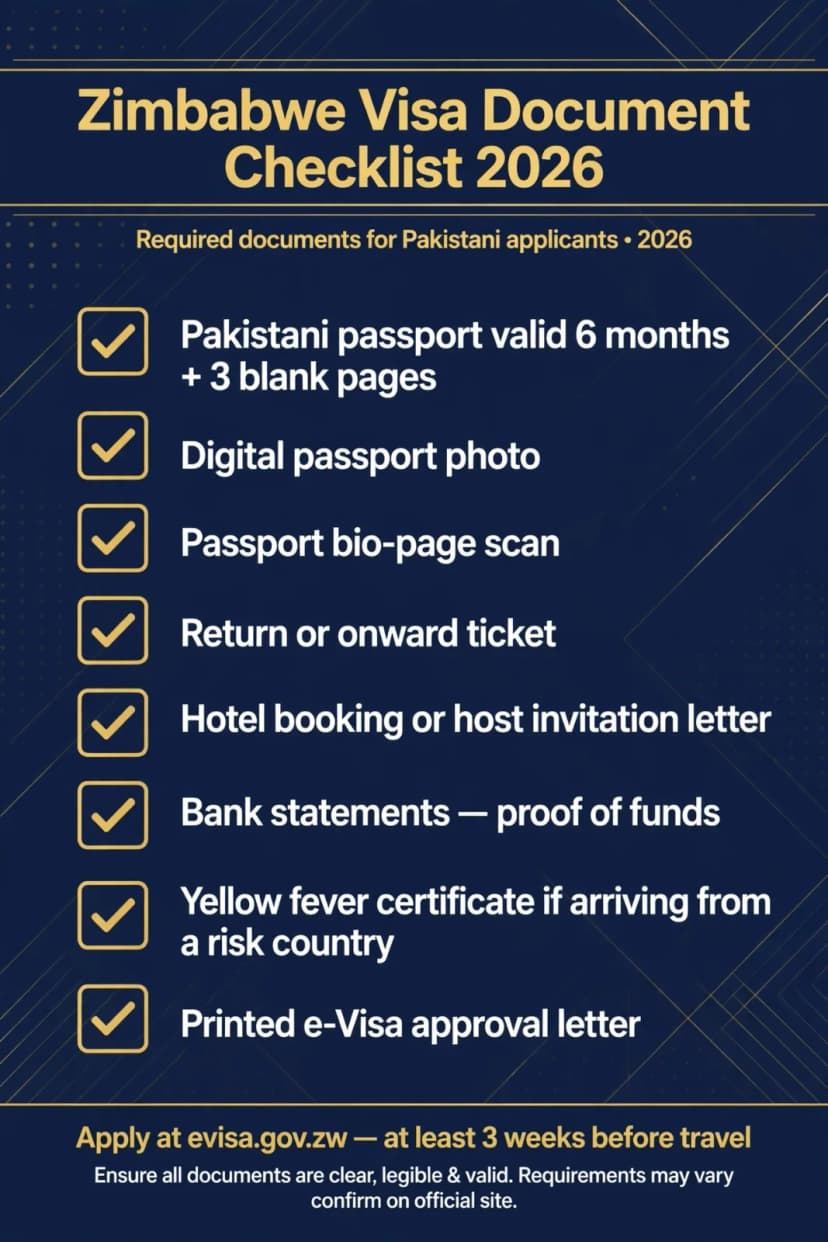
Complete Document Checklists
No single official checklist for Pakistani applicants is published on the e-visa portal's public pages, so the lists below combine the documents the portal and the guides describe — a passport scan, a digital photograph, and accommodation and itinerary details — with the documents the universities and the work-permit guides name for the permit routes. The e-visa file is short, and that is part of its appeal: there is no sponsor's letter, no invitation and no bank-balance threshold published for a tourist e-visa. Take the full file anyway, and carry printed copies of everything with you, because the immigration officer at Harare or Victoria Falls airport can ask for any of it.
All applicants — core documents
- Original Pakistani passport, valid at least six months after the date you arrive, with at least three blank pages
- A clear scan of the passport bio-data page, for upload to the portal
- One recent digital passport-size photograph, meeting the portal's format and size requirements
- Completed online application on evisa.gov.zw, with every name and number matching the passport exactly
- Confirmed return or onward flight ticket, or a flight itinerary showing you will leave Zimbabwe
- Proof of accommodation for the whole stay — hotel bookings, or a host's invitation letter giving their full name, address and contact details
- Proof of sufficient funds for the trip — bank statements for the last three to six months are the usual evidence; no official minimum balance is published for the e-visa, and agency figures of PKR 400,000 or PKR 800,000 to PKR 1,800,000 are agency estimates, not official requirements, so carry statements that honestly show you can pay for the trip
- Yellow fever vaccination certificate, if your routing passes through or you have recently been in a country listed as a transmission risk
- Travel and medical insurance — strongly recommended; medical evacuation cover is worth having, because serious cases in Zimbabwe are routinely evacuated to South Africa
- Copy of your Vietnam temporary residence card or visa, showing your legal residence in Vietnam
- The printed e-visa approval letter, carried with the passport — do not rely on showing it on a phone
- The completed Immigration Declaration Form, completed online before travel
Tourist e-visa — additional documents
- Hotel bookings or a host's invitation letter covering the whole stay
- Evidence of the funds to cover the stay, in cash or card terms — Zimbabwe uses the Zimbabwe Gold (ZiG) currency introduced in April 2024, but US dollars are widely accepted, and you should carry enough US dollars in small notes for the visa fees, park entries and tips that are priced in dollars
Business visit e-visa — additional documents
- Invitation letter from the Zimbabwean company or organisation, giving the purpose of the visit, the dates and who is paying
- Letter from your own employer in Vietnam or Pakistan confirming the purpose of the visit and that you will return to your job
Student permit — additional documents
- Residence Permit application form IF5, fully completed and attested by a Commissioner of Oaths
- Letter of acceptance from the university or college
- Proof of accommodation, such as an undertaking by the institution to provide accommodation
- Proof of payment of fees
- Copy of your birth certificate or passport bio-data page
- Chest X-ray report (radiological certificate)
- Two passport-size photographs
- Police clearance from your country of residence, not older than six months — required by the Harare Institute of Technology and Midlands State University, and by Solusi University
- Application letter requesting the permit, addressed to the Chief Director of Immigration
- Proof of funds to support yourself during your studies
- Non-refundable fee of USD 200
Work permit — additional documents
- Residence Permit application form IF5, completed in duplicate, with a covering letter addressed to the Chief Director of Immigration
- Contract of employment with a Zimbabwe-registered entity
- Advertisement of the post in a local newspaper, with the CVs and contact details of the shortlisted local candidates — the labour-market test is a document you hand in, not a box you tick
- Notarised academic and professional certificates, and a curriculum vitae
- Police clearance from your country of origin or last permanent residence, not older than six months
- Radiological certificate (chest X-ray)
- Certified passport bio-data page and two passport photographs certified as a true likeness
- Company documents from the employer: certificate of incorporation, entity summary, ZIDA licence and a ZIMRA tax clearance
Family visit e-visa — additional documents
- Invitation letter from your relative in Zimbabwe, with their full name, address and contact details
- Proof of relationship — family registration documents, marriage certificate or birth certificate as applicable
- Copy of the host's Zimbabwean identity document or residence permit, where asked for
Children travelling with you — additional documents
- The child's own passport, with at least six months' validity and three blank pages
- The child's own e-visa, applied for in the same way as an adult's — there is no published provision for children travelling on a parent's visa
- Birth certificate showing the parents' names
- If the child is travelling with only one parent, a consent letter from the other parent is strongly advisable, even though no Zimbabwe-specific consent rule is published — immigration officers worldwide ask for it, and a notarised letter costs little
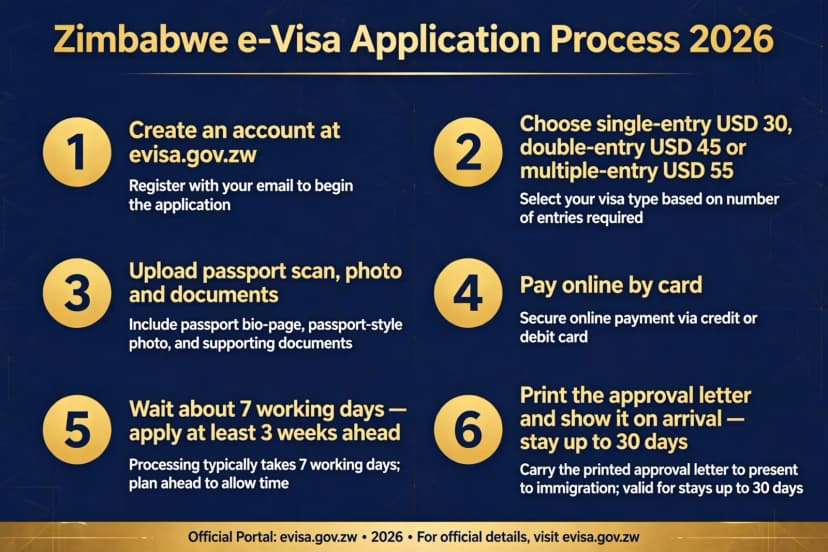
How to Apply: Step-by-Step
E-visa — step by step
Step 1 — Check your passport and your dates. Confirm the passport is valid at least six months after your arrival date and has three blank pages. Decide your entry type: single entry for one visit, double entry if you will leave and come back once, multiple entry for several trips in six months. Remember the validity windows — three months for a single entry or a KAZA UniVisa, six months for a double or multiple entry, counted from the date of issue — and that you can enter on any date inside the window. If your trip is more than three months away, wait before applying for a single-entry visa, or the visa may expire before you travel.
Step 2 — Prepare your documents and your payment card. Scan the passport bio-data page clearly, prepare a digital passport photograph in the format the portal asks for, and gather your flight itinerary, accommodation bookings and bank statements. Make sure you have an international debit or credit card that works for online payments in US dollars — a Pakistani or Vietnamese card that blocks foreign-currency online payments is the commonest reason an application stalls at the payment step, so test the card with your bank before you start. Have an email address you check daily, because the approval letter comes by email.
Step 3 — Open the official portal and create an account. Go to evisa.gov.zw — the only official portal, operated by the Department of Immigration — and create an account. Do not use a lookalike site: unofficial sites with similar names exist, and only evisa.gov.zw is official. Create the account in your own name and with your own email address, not an agent's, so that the approval letter and any queries come to you.
Step 4 — Complete the online form. Choose the visa type, enter your personal details exactly as they appear in the passport, and enter your travel dates and accommodation details. Check the passport number, the spelling of every name and the dates three times: if the e-visa information does not match your travel document, the e-visa is invalid, and a change of travel dates after issue means a new e-visa, not an amendment. Upload the passport scan, the photograph and the supporting documents the portal asks for.
Step 5 — Pay the fee online. Pay by card on the portal: USD 30 for a single entry, USD 45 for a double entry, USD 55 for a multiple entry, or USD 50 for the KAZA UniVisa if you are applying for it. The portal states the actual cost in the approval response, so check the amount before you confirm the payment, and keep the payment receipt and the application reference number. The fee is not refundable, even if the application is refused or you do not use the visa.
Step 6 — Wait for the decision. The official average processing time is seven working days, and the portal advises applying at least three weeks before travel. Plan on four weeks for a Category C application if you can. Do not book a non-refundable ticket while you wait. If ten working days pass without an answer, contact the Department of Immigration through the portal and ask for the status in writing.
Step 7 — Print the approval letter and check it. When the approval arrives by email, print it, and check the name spelling, the passport number, the visa type, the validity dates and the number of entries against your passport. If anything is wrong, contact the Immigration Office before you travel — do not try to travel on an approval letter that does not match your passport, because it is invalid.
Step 8 — Complete the Immigration Declaration Form online before you fly. All visitors must complete the declaration, even those who do not need a visa. Pre-filling it online makes the airport arrival a stamp rather than an interview, and it is one less thing to do in a queue after a long flight.
Step 9 — Fly and present your documents on arrival. Carry the passport, the printed approval letter, the return ticket, the accommodation proof and the bank statements in your hand luggage, not in checked baggage. At immigration, the officer will check the e-visa against the passport and decide the stay — usually up to 30 days. Answer the questions about your purpose and your accommodation plainly and consistently with the application. Keep the entry stamp and the approval letter safe for the whole trip. If you need longer than 30 days, apply in person at the Department of Immigration in Harare or Bulawayo before your stay expires — visitors can generally reach up to 90 days in six months through local extensions, but an extension is granted by the officer, not by right. Do not overstay: it can mean a fine, detention or a ban on re-entry.
Student and work permits — step by step
Permits are not e-visas, and the route is different. For a study permit, first secure admission to a registered university or college and get the letter of acceptance; then apply for the study permit at the Zimbabwean embassy or mission nearest to you before leaving your country of origin, using Form IF5, with the documents listed in section 7 and the USD 200 non-refundable fee. The University of Zimbabwe strongly recommends securing the permit before departure, and warns that without one you may be refused entry and the university may not register you. The Immigration Department can, at its discretion, let you enter on a temporary permit and apply within a set time, but that is discretionary, not a right — do not rely on it. For a work permit, the employer starts the process: the employer advertises the post locally, proves no suitably qualified Zimbabwean candidate was available, and files the Temporary Employment Permit application with the Department of Immigration with the contract and the company documents. You do not apply for a work permit on your own and then look for a job; the job and the sponsor come first.
Applying from Vietnam and Pakistan — No Zimbabwean Embassy in Hanoi
There is no Zimbabwean embassy in Vietnam, and for a tourist e-visa that does not matter at all, because the whole application is online. You apply from your home in Vietnam, pay online, and receive the approval by email. You do not need to visit any mission, post any documents, or attend any interview for a visitor e-visa. That is the single biggest practical advantage of the Zimbabwe route for a Pakistani living in Vietnam: the visa comes to your inbox, not from a consulate counter.
For anything that does need a mission — a study permit, a work permit, or a question the portal cannot answer — the map is as follows. Zimbabwe's embassy in Kuala Lumpur, Malaysia, is concurrently accredited for Vietnam, as well as for Brunei, Cambodia, the Philippines and Thailand. That makes Kuala Lumpur the mission responsible for Vietnam, and it is the mission to contact if you need consular help or a permit that cannot be filed online. Its address is listed in directories as Lot 124, Jalan 9, Taman Ampang Utama, 68000 Ampang, Kuala Lumpur, and a second listing gives 124 Jalan Sembilan, Taman Ampang Utama, Ampang, 68000 Kuala Lumpur — two versions of the same address, so confirm the current address and telephone number before travelling or posting anything. Whether the Kuala Lumpur embassy accepts permit applications from a Pakistani national resident in Vietnam, rather than from a Malaysian resident, is not confirmed by any official source found for this guide; ask the embassy directly, by email or telephone, before you travel.
Option 1 — Apply in Pakistan through the Zimbabwean Embassy in Islamabad
Zimbabwe does have an embassy in Islamabad, and its official website — hosted on Zimbabwe's gov.zw domain — welcomes the diaspora community working, studying and living in Pakistan and lists visa information among its consular services. The embassy is listed at House 5, Street 22, Sector F-7/2, Islamabad, with telephone +92 51 8901445, and office hours Monday to Thursday 09:00 to 16:00 and Friday 09:00 to 12:30. For a Pakistani who is in Pakistan, this is the natural mission for a study permit, a work permit, or any question about the e-visa. One caution: the list of Zimbabwe's diplomatic missions also shows the Embassy of Zimbabwe in Tehran as concurrently accredited for Pakistan, alongside Afghanistan, Armenia and Tajikistan. That listing sits awkwardly beside a functioning embassy in Islamabad with its own gov.zw website, and it may be stale. Treat Islamabad as the mission for Pakistan, and telephone it to confirm its address, hours and whether it handles your permit type before travelling.
Option 2 — Apply through the Zimbabwean Embassy in Kuala Lumpur
For a Pakistani living in Vietnam, Kuala Lumpur is the nearest mission with responsibility for Vietnam. It is the mission to contact for a study or work permit, or for any problem with an e-visa that the portal cannot resolve. Flights from Ho Chi Minh City to Kuala Lumpur are short and frequent, and a Malaysian e-visa or visa-free entry for a Pakistani is a separate question to settle before you book — do not assume you can enter Malaysia without checking that first. As with Islamabad, confirm by email or telephone that the embassy will accept your application before you travel.
Student Route: Studying in Zimbabwe
Zimbabwe's universities teach in English, and the country has a long-established higher-education system: the University of Zimbabwe in Harare, founded in 1955, is the oldest, alongside the National University of Science and Technology in Bulawayo, Midlands State University, the Harare Institute of Technology, Solusi University and others. The Ministry of Higher and Tertiary Education lists 21 universities, public and private, plus polytechnics and teachers' colleges. For a Pakistani student, the attraction is real but narrow: English-medium teaching, low tuition by international standards — a study permit system that is published in detail by the universities themselves. But a visitor e-visa is not enough to study: you need a study permit, also called a student permit, from the Department of Immigration.
The permit procedure is unusually well documented, because the universities publish it. The University of Zimbabwe advises international students to apply for the study permit at the Zimbabwean embassy or mission nearest to them before leaving their country of origin, and warns that without one you may be refused entry and the university may not register you. The documents are listed in section 7: Form IF5 attested by a Commissioner of Oaths, the letter of acceptance, proof of accommodation, proof of fee payment, a copy of the birth certificate or passport bio-data page, a chest X-ray report, two passport photographs, and a non-refundable fee of USD 200. The Harare Institute of Technology adds a police clearance from the country of residence, not older than six months, and a letter of acceptance from the college or university, plus a timetable confirming at least 29 lessons per week. Solusi University also asks for police clearance. The University of Zimbabwe's own application fee for international students is USD 70, separate from the permit fee, and accepted students must prove they can support themselves financially before they are allowed into the country.
The permit is normally granted for one year and must be renewed before it expires. The University of Zimbabwe says it must be renewed within 30 days prior to expiry, for a further USD 200; the Harare Institute of Technology says extensions should be done three months prior to expiry, and Midlands State University says the permit is renewed every year, with a late renewal costing a USD 100 fine. Those three timings conflict, and the safe course is the earliest one: start the renewal three months before expiry, and never let the permit lapse, because the law requires international students to hold a valid study permit at all times, and a university will not register a student without one. The reported processing time for a student permit is about four weeks to one month — a commercial figure, not an official one — so apply well before the semester starts.
Two limits matter. First, the official pages checked describe no work rights on a study permit and no post-study work route: work during study is strictly prohibited, on the published guidance, and there is no described route from a study permit into a work permit after graduation. Second, foreign qualifications need checking: the University of Zimbabwe checks foreign qualifications for equivalency. If your Pakistani qualification is a two-year BA, ask the university early whether it meets the entry requirement for your chosen programme.
Work Route: Jobs, Business and Work Permits
Zimbabwe is not a general jobs market for foreign workers, and this guide does not present it as one. The economy is small, formal employment is scarce, and the immigration system is built around a labour-market test: an employer must advertise the post locally and prove that no suitably qualified Zimbabwean candidate was available before a foreign worker can be hired. A Pakistani who travels to Zimbabwe on a visitor e-visa looking for general employment will find no route from that visa into a job, and working on a visitor e-visa is strictly forbidden. The work route that exists is the sponsored one, and it starts with a job offer, not with a visa application.
The standard route is the Temporary Employment Permit, known as the TEP. It is for employment lasting up to 12 months, and commercial guides describe it as renewable, with extensions up to five years in some accounts, though secondary sources disagree on whether it can be renewed inside Zimbabwe — ask the Department of Immigration for the current rule in writing before you accept a contract that depends on renewal. The long-term work permit is for employment lasting longer than a year, renewable up to five years, after which permanent residence may be possible. The investor's residence permit is for entrepreneurs and investors starting or managing a business in Zimbabwe, and requires proof of investment and business registration. A spouse residence permit is available to the spouse of a Zimbabwean citizen or permanent resident, and may include work authorisation — if it does not, a separate work permit is needed.
The documents for a work permit are listed in section 7, and they show how document-heavy the process is: Form IF5 in duplicate, a covering letter to the Chief Director of Immigration, the employment contract, the newspaper advertisement with the shortlisted local candidates' CVs, notarised certificates, a police clearance not older than six months, a radiological certificate, and the employer's incorporation documents, ZIDA licence and ZIMRA tax clearance. The reported statutory fee is USD 500 for the applicant plus USD 300 for each dependant, cited by commercial guides from the Department's schedule — confirm the current fee in writing. Reported processing times are four to eight weeks, with no official figure confirmed.
Short business visits are the exception that proves the rule: a foreigner attending meetings, a conference or a site visit for 30 days or less can use a business e-visa instead of a work permit, but that does not allow employment by a local company or earning a salary in Zimbabwe. Short-term volunteers and missionaries also use a business visa for assignments of a month or less; longer assignments need a work permit or Temporary Employment Permit from the sponsoring organisation. If an employer or agent in Pakistan or Vietnam offers you a Zimbabwean job and asks you to pay for the work permit yourself, treat it as a warning sign: the employer sponsors the permit, and any fee should be confirmed with the Department of Immigration before you pay anything to anyone.
Family Visits and Permanent Residence
Family visits are the simplest long-distance reason to use the e-visa: a relative in Zimbabwe invites you, you apply online for a single-entry e-visa at USD 30, and you stay for up to 30 days. The invitation letter should give the host's full name, address and contact details, and you should carry proof of the relationship — a family registration document, a marriage certificate or a birth certificate — because the immigration officer can ask how you know your host. There is no separate family-visit e-visa category with its own fee; the ordinary visitor e-visa covers it.
For a longer family stay, the route is a residence permit, not an extended e-visa. A spouse of a Zimbabwean citizen or permanent resident can apply for a spouse residence permit, which allows residence and, in some cases, work. Dependants of a work-permit holder are covered under the dependant provisions, with a reported fee of USD 300 per dependant. No official document list for a spouse or dependant permit was found in the sources consulted for this guide, so ask the Department of Immigration or the nearest Zimbabwean mission for the current list before you file.
Permanent residence is a separate application with its own fee — USD 500 for a non-investor and USD 1,000 for an investor, according to the commercial guide that cites the Department's published schedule. It is reported to take about six to twelve months or longer. After five years on a long-term work permit, a worker may qualify to apply for permanent residence, on the commercial guides' account. None of those figures or timelines was confirmed from an official source for this guide, and permanent residence is not a route to plan a first trip around: it is the end of a long lawful stay, not the beginning of one. Do not pay any agent who offers to sell you permanent residence in Zimbabwe, and do not assume a visit visa can be converted into residence inside the country — the permits are applied for through the proper channel, and the visitor e-visa is for visiting.
Common Mistakes to Avoid
Mistake 1 — Turning up without an e-visa and expecting a visa on arrival. Pakistan is Category C. The visa must be applied for, paid for and obtained online before travel. The visa-on-arrival descriptions on general travel sites apply to Category B nationalities, not to you, and one Pakistan-focused guide repeats the error. Apply at evisa.gov.zw and wait for the approval letter.
Mistake 2 — Using a lookalike website instead of evisa.gov.zw. Unofficial sites with similar names exist, and some charge service fees for what the official portal does for the government fee alone. The only official portal is evisa.gov.zw, operated by the Department of Immigration. Check the address bar before you enter your passport details or your card number.
Mistake 3 — Applying for a single-entry visa and then crossing to Zambia and back. A single entry is spent when you leave Zimbabwe. If your itinerary includes Livingstone, a day trip to Botswana, or any exit and re-entry, you need a double-entry or multiple-entry e-visa — or a KAZA UniVisa, if you can obtain one, and the KAZA question for Pakistanis is unresolved, as section 5 explains. Buy the right entries before you fly.
Mistake 5 — Applying too late, or for the wrong validity window. The official advice is to apply at least three weeks before travel, and the average processing time is seven working days. A single-entry visa is valid for three months from issue, so applying six months before a trip can also fail — the visa may expire before you travel. Apply three to four weeks before departure.
Mistake 6 — Making a mistake in the passport number or the name spelling. If the e-visa information does not match your travel document, the e-visa is invalid, and a change of travel dates means a new e-visa, not an amendment. Check every field before you pay, because a correction costs a second fee and a second wait.
Mistake 7 — Routing through Johannesburg without a South African transit visa. Pakistani passport holders have required a South African transit visa even for airside transits since a directive in force from 2022, with processing reported at up to ten working days. If your routing goes through Johannesburg, settle the South African transit visa first, or route through Dubai, Doha, Nairobi or Addis Ababa instead — and check the transit rules for each of those hubs against a Pakistani passport before you book.
Mistake 8 — Assuming a visit visa lets you work or study. Working on an e-visa is strictly forbidden, and studying needs a study permit applied for before travel. A job offer or a university place does not convert a visitor e-visa into a right to work or study.
Mistake 9 — Overstaying the 30 days. The stay granted on entry is usually up to 30 days. If you need longer, apply for an extension in person at the Department of Immigration before the stay expires. Overstaying can mean a fine, detention or a ban on re-entry.
Mistake 10 — Carrying no cash, or too much cash. Zimbabwe uses the Zimbabwe Gold (ZiG), introduced in April 2024, but US dollars are widely accepted and many tourist prices are in dollars. Carry enough US dollars in small notes for park entries, tips and transport. Declare cash of USD 10,000 or more on arrival and keep the declaration safe.
Mistake 11 — Paying an agent who guarantees approval. No agent can guarantee a Zimbabwean e-visa, because the decision is made by the Department of Immigration. The portal is designed for the traveller to use directly, and the government fee is USD 30 for a single entry. An agent who quotes USD 55 for a single entry, or who promises a KAZA UniVisa to a Pakistani without qualification, is either mistaken or selling you something you may not be able to use.
Reasons for Refusal
No official Zimbabwean refusal list is published, so the reasons below are drawn from the conditions the official sources do state and from the structure of the Category C system.
Applying in the wrong category, or arriving without a pre-approved visa. A Category C national who arrives without an approved e-visa will be refused entry. There is no discretion at the border to issue a visa to a Pakistani who has not applied in advance.
Passport validity or blank pages. A passport with less than six months' validity after the date of arrival, or without three blank pages, fails the entry condition stated by the FCDO.
Details on the e-visa that do not match the passport. A misspelt name, a wrong passport number or a wrong date of birth makes the e-visa invalid, and the officer at the border has no power to correct it there.
No return ticket, no accommodation, or no proof of funds. The immigration officer decides the stay on entry, and can refuse entry if the traveller cannot show where they will stay, how they will leave, or how they will pay for the trip. Carry the return ticket, the hotel bookings or host letter, and bank statements that honestly show the funds for the trip.
Inconsistent purpose of travel. A traveller who applies as a tourist but tells the officer they are coming to look for work, or who cannot explain the itinerary on the application, risks refusal. Working on a visitor e-visa is forbidden, and the officer will be watching for it.
Security and admissibility concerns. Any adverse record, or any inconsistency between the application and the documents, can lead to refusal. There is no published appeal route for a refused e-visa; the payment is for processing and is not refunded, and the practical remedy is to fix the named problem and apply again. If the portal gives a reason for the refusal, address that reason directly in the new application rather than reapplying unchanged.
Frequently Asked Questions
1. Do Pakistani citizens need a visa for Zimbabwe?
Yes. Pakistani ordinary passport holders need a visa, and Pakistan is in Category C, which means the visa must be applied for, paid for and obtained online at evisa.gov.zw before travelling. There is no visa exemption and no visa-free entry for Pakistani ordinary passports.
2. Can Pakistani citizens get a visa on arrival in Zimbabwe?
No — do not plan on it. Visa on arrival is for Category B nationalities such as the United States, the United Kingdom, Canada and Australia. Pakistan is Category C, and the Department of Immigration requires Category C nationals to obtain the visa before travel. One Pakistan-focused guide states that Pakistanis can get a visa on arrival, but that conflicts with the Department's own category list, which is the controlling source.
3. How much does a Zimbabwe e-visa cost for a Pakistani passport?
USD 30 for a single-entry e-visa, USD 45 for a double-entry e-visa, USD 55 for a multiple-entry e-visa, USD 50 for the KAZA UniVisa and USD 100 for an emergency online visa, on the Department of Immigration's published fee list. At November 2026 rates, USD 30 is about PKR 8,400.
4. How long does a Zimbabwe e-visa take to process?
On average seven working days, according to the official e-visa frequently asked questions, which advise applying at least three weeks before your travel date. One Pakistan-focused guide reports three to four weeks for Pakistani applicants, so applying four weeks ahead is the safe course. Commercial claims of three to five days are not the government's figure.
5. How long is the e-visa valid, and how long can I stay?
A single-entry e-visa is valid for three months from the date of issue, a KAZA UniVisa for three months, and a double-entry or multiple-entry e-visa for six months. You can enter on any date inside the validity window. The stay granted on entry is usually up to 30 days, and visitors can generally reach a total of up to 90 days within six months through extensions applied for in person at the Department of Immigration before the stay expires.
6. Can I get the KAZA UniVisa with a Pakistani passport?
This is unresolved, and you should not rely on it. The KAZA UniVisa costs USD 50, is valid for 30 days, and covers Zimbabwe and Zambia plus day trips into Botswana. But several Pakistan-focused sources say Pakistanis cannot buy it because Pakistan is absent from the eligible-nationalities list, while others say to clear the standard e-visa first and treat the KAZA as a counter bonus. The safe course is to hold a Zimbabwe e-visa and a separate Zambia e-visa before you travel.
7. Is there a Zimbabwean embassy in Vietnam?
No. There is no Zimbabwean embassy in Vietnam, and none is needed for a tourist e-visa, which is entirely online. For matters that need a mission, Zimbabwe's embassy in Kuala Lumpur is concurrently accredited for Vietnam. Zimbabwe does have an embassy in Islamabad, at House 5, Street 22, Sector F-7/2, telephone +92 51 8901445.
8. What is the official Zimbabwe e-visa website?
evisa.gov.zw, operated by the Department of Immigration. It is the only official portal. Unofficial sites with similar names exist — some call themselves zimbabwe-evisa.org or similar — and they are not the government portal. Apply only at evisa.gov.zw and pay only there.
9. Can I change my travel dates after the e-visa is issued?
No amendment is possible: the official frequently asked questions state that if your travel dates change, a new e-visa must be obtained. But you can enter on any date inside the validity window — three months for a single entry, six months for a double or multiple entry — so a shift inside the window needs no change. A shift outside the window, or an error in the passport details, means a new application and a new fee.
10. Is the e-visa fee refundable if I don't travel or am refused?
No. The official frequently asked questions state that no refunds are issued for unused e-visas, and the payment is for processing, not a guarantee of approval, so a refused application is not refunded either. Do not pay until every detail is checked, and do not book a non-refundable ticket until the approval letter arrives.
11. Do I need a yellow fever certificate for Zimbabwe?
Only if you are coming from a country listed as a yellow fever transmission risk. The FCDO states that a certificate is required if you are arriving from a listed risk country. Neither Pakistan nor Vietnam is on that list, so a direct traveller from Vietnam is not caught by the rule — but if your routing passes through a risk country, carry the certificate, given at least ten days before travel.
12. Can I work or study in Zimbabwe on an e-visa?
No. Working on a visitor e-visa is strictly forbidden. Study needs a study permit — Form IF5, a letter of acceptance, a chest X-ray, police clearance and a non-refundable fee of USD 200 — applied for at a Zimbabwean mission before travel. Work needs a Temporary Employment Permit sponsored by a Zimbabwean employer, with a reported fee of USD 500 plus USD 300 per dependant.
13. How do I get from Vietnam to Zimbabwe?
There is no direct flight. The usual routings are through Dubai, Doha, Nairobi, Addis Ababa or Johannesburg, into Harare's Robert Gabriel Mugabe International Airport or Victoria Falls Airport. If you route through Johannesburg, note that Pakistani passport holders have required a South African transit visa even for airside transits since 2022 — check that before you book, or choose a Gulf or East African routing instead.
14. Can I extend my stay in Zimbabwe?
Yes, in person. Visit a Department of Immigration office in Harare or Bulawayo before your current stay expires and apply for an extension — the FCDO confirms extensions are handled in person at the Immigration Department. Visitors can generally reach a total of up to 90 days within six months through local extensions, but the extension is granted by the officer, not by right, and no official extension fee was published in the sources consulted for this guide. Do not overstay.
15. What happens if my Zimbabwe e-visa is refused?
The fee is not refunded, and there is no published appeal route. The practical remedy is to find out the reason — most commonly a mismatch between the application and the passport, a passport-validity problem, or missing documents — fix it, and apply again with a new fee. Do not pay any agent who promises to overturn a refusal for a fee, and do not reapply unchanged: the same application will get the same answer.
Official Immigration Websites
| Organisation | What it is | Website |
|---|---|---|
| Zimbabwe Department of Immigration — eVisa portal | The official e-visa portal: applications, fees, frequently asked questions (7 working days, apply 3 weeks ahead, validity windows) | https://www.evisa.gov.zw |
| Zimbabwe Department of Immigration — eVisa FAQs | Official frequently asked questions: processing time, validity, amendments, refunds | https://www.evisa.gov.zw/faq.html |
| Zimbabwe Department of Immigration | Department home page: visa categories A, B and C, fee list, residence permits | https://www.zimimmigration.gov.zw |
| UK Foreign, Commonwealth and Development Office | Zimbabwe travel advice — entry requirements, passport validity, KAZA UniVisa USD 50, yellow fever, extensions (updated 15 July 2026) | https://www.gov.uk/foreign-travel-advice/zimbabwe/print |
| US Department of State | Zimbabwe Travel Advisory — Level 2, Exercise Increased Caution (reissued after periodic review; country information updated 20 August 2026) | https://travel.state.gov/en/international-travel/travel-advisories/zimbabwe.html |
| Embassy of Zimbabwe in the United States | Visa regime categories A, B and C, in force from 15 February 2018 | https://www.zimbabwe-embassy.us/contact.html |
| Embassy of the Republic of Zimbabwe in Islamabad | Official embassy website (gov.zw): consular services, visa information, House 5, Street 22, F-7/2, Islamabad | https://testdomain30.gov.zw/?shopdetail/2597560 |
| University of Zimbabwe | Study permit (student visa) requirements: Form IF5, USD 200 fee, chest X-ray, renewal rules | https://www.uz.ac.zw/index.php?option=com_content&view=article&id=411:undergraduate-courses&catid=96:social-programmes&Itemid=38 |
| Harare Institute of Technology | International application procedure and student permit documents, including police clearance and USD 200 fee | http://www.hit.ac.zw/international-application-procedure/ |
| Wikipedia — Visa policy of Zimbabwe | Visa categories, KAZA UniVisa, entry conditions | https://en.wikipedia.org/wiki/Visa_policy_of_Zimbabwe |
| Wikipedia — List of diplomatic missions of Zimbabwe | Current Zimbabwean missions abroad, including Kuala Lumpur (accredited for Vietnam), Islamabad, Beijing and New Delhi | https://en.wikipedia.org/wiki/List_of_diplomatic_missions_of_Zimbabwe |
| Wikipedia — List of diplomatic missions in Zimbabwe | Foreign missions in Harare, including the Embassy of Pakistan | https://en.wikipedia.org/wiki/List_of_diplomatic_missions_in_Zimbabwe |
Final Checklist and Conclusion
Before you spend any money, work through this list in order. If you cannot tick the first three boxes, do not proceed.
- Your passport is valid at least six months after your arrival date and has at least three blank pages.
- You have chosen the right entry type: single entry (USD 30) for one visit, double entry (USD 45) if you will leave and come back once, multiple entry (USD 55) for several trips in six months.
- You have an international card that works for online payments in US dollars, and an email address you check daily.
- You have applied at evisa.gov.zw — the only official portal — at least three weeks before travel, and four weeks ahead if you can.
- Every name, number and date on the application matches the passport exactly, and you have checked them three times before paying.
- You have printed the e-visa approval letter and checked the visa type, validity dates and entries against your passport.
- You have completed the Immigration Declaration Form online before you fly.
- You have a return or onward ticket, accommodation bookings for the whole stay, bank statements showing you can pay for the trip, and travel insurance with medical evacuation cover.
- If you plan to see the Zambian side of Victoria Falls, you hold a separate Zambia e-visa (USD 50) as well as your Zimbabwe e-visa, and you are not relying on the KAZA UniVisa.
- If your routing goes through Johannesburg, you have settled the South African transit visa; if it passes through a yellow fever risk country, you carry the certificate.
- You have saved the contact details of Pakistan's embassy in Harare and your insurer's emergency number, and a copy of your passport and approval letter is stored separately from the originals.
- You have not booked a non-refundable ticket before the approval letter arrived, and you know the fee is not refundable if the application is refused or unused.
Zimbabwe is a generous destination for a traveller who arrives prepared, and the visa itself is one of the simpler African e-visas — online, USD 30, about seven working days, no embassy visit. The two things that undo travellers are both avoidable: arriving without a pre-approved visa because a website described a visa on arrival that does not apply to a Pakistani passport, and planning a two-country Victoria Falls trip around a KAZA UniVisa that may not be sold to a Pakistani at the border. Get the e-visa first, get the Zambia visa separately if you need it, and the rest of the trip is the easy part.
This guide was checked on 29 November 2026. Visa rules change without notice. Always confirm the live rules at evisa.gov.zw before paying any fee or booking a non-refundable ticket. Nothing in this guide is immigration advice; the Zimbabwean authorities set and enforce the entry rules, and the immigration officer at the airport or border makes the final decision. This guide is educational information only and does not guarantee visa approval or entry.


