


Trinidad and Tobago Visa Guide 2026: Types, Requirements, Documents and Application Steps
Introduction
Trinidad and Tobago is a twin-island Caribbean nation off the north-east coast of Venezuela, best known for Port of Spain, Carnival, steelpan music, Maracas Beach, the Pitch Lake and the calmer island of Tobago. For a Pakistani passport holder living in Vietnam, it is one of the easier Caribbean destinations on paper: Pakistan is on the official visa-free list, so there is no visa to apply for, no visa fee and no embassy visit for an ordinary tourist trip. The real work is proving at the border that you are a genuine visitor, filing the mandatory online Arrival and Departure Card, and planning a long journey from Vietnam to Piarco International Airport.
This guide is written for Pakistani passport holders who live in Vietnam, whether on a work permit, a temporary residence card or a long-stay visa. It covers the visa-free rule and its limits, the visa types that do exist for other purposes, the fees that apply when a fee applies at all, the documents to carry, the step-by-step journey from Vietnam, extensions, work and study permits, transit, and the mistakes that most often cause trouble at check-in or at the border. Every fee, stay length, processing time and application route in this guide was checked against official Trinidad and Tobago sources on 29 November 2026, and wherever official sources disagree with each other or with widely repeated secondary sources, the disagreement is stated openly and the controlling source is named. Re-check the official pages before you pay or book.
One warning belongs at the top. Visa-free entry is not a right to enter. The immigration officer at Piarco International Airport or at A.N.R. Robinson International Airport in Tobago decides whether you are admitted, for how long, and on what conditions. A return ticket, a hotel booking and proof of funds do not guarantee admission, and this guide does not guarantee visa approval or entry. What they do is make a refusal much less likely, because they answer the exact questions the officer is required to ask.
Key Facts at a Glance
| Question | Answer for Pakistani passport holders |
|---|---|
| Do Pakistanis need a visa to visit? | No. Pakistan is on the Immigration Division's official list of countries whose citizens do not require a visa for entry into Trinidad and Tobago. Fee: TT$0. |
| How long can you stay? | No fixed limit is stated on the official visa-free list. The immigration officer sets your stay and stamps the date in your passport. Secondary sources commonly say 90 days — see the conflict note in the stay section. |
| Is there an eVisa for Pakistanis? | No eVisa is needed. The eVisa portal is for nationals who require a visa. Its current multiple-entry fee is TT$800, but that fee does not apply to a visa-free Pakistani visitor. |
| Arrival card | Yes, mandatory for everyone since 17 March 2026. Free online Arrival and Departure Card at travel.gov.tt, filed within 72 hours before arrival and again before departure. Keep the QR-code receipt. |
| Passport validity | At least 6 months beyond arrival is the stated requirement on the eVisa pages and the figure airlines enforce. Carry 6 months or more. |
| Where to apply from Vietnam | Nowhere in Vietnam. There is no Trinidad and Tobago mission in Vietnam or in Pakistan. The Embassy in Beijing is accredited to Vietnam; for entry questions the Immigration Division answers at immigration.visas@gov.tt. |
| Extension of stay | Possible in country. A permitted entrant without a work or student permit may be granted an extension up to 6 months from the date of entry, subject to the Chief Immigration Officer's approval. Apply at least 2 weeks before your stamp expires. Current fee for a variation beyond 90 days: TT$200. |
| Work | Not allowed on a visitor entry. A work permit is employer-sponsored: application TT$1,200 plus TT$900 per month, minimum TT$2,700. Processing time is not published. |
| Study | A student permit is required for study. Current fee TT$400 under the 2026 fee regulations. Apply through the eStudent Permit portal before travel. |
| Safety advice | US State Department: Level 3, Reconsider Travel (13 April 2026), with a nationwide State of Emergency declared 2 March 2026. UK FCDO: does not advise against travel to any part of Trinidad and Tobago (updated 11 November 2026). Canada: exercise a high degree of caution. |
| Emergency numbers | Police 999, fire 990, ambulance 811. |
| Currency | Trinidad and Tobago dollar (TT$). About TT$6.8 to US$1 at late-2026 rates; check the rate on the day you pay anything. |
Do Pakistani Passport Holders Need a Visa?
No. Pakistani passport holders do not need a visa to enter Trinidad and Tobago as visitors. The Immigration Division of the Ministry of Homeland Security publishes a list headed "Citizens of the countries listed below do not require visas for entry into Trinidad and Tobago", and Pakistan is on that list. The list is dated 19 September 2024 and was still the published list when this guide was checked on 29 November 2026. Pakistan and Trinidad and Tobago are both members of the Commonwealth, and many Commonwealth passports appear on the list, but Commonwealth membership is not the rule — the published list is the rule, and Pakistan is named on it.
That single fact changes the whole shape of the trip. There is no visa application form to complete for a tourist visit, no visa interview, no visa fee, no waiting time for a visa decision and no visa sticker in your passport. You travel as a visa-free visitor and your entry is decided at the border. This is confirmed from more than one direction: the Immigration Division's own visa-free list, the Ministry of Foreign and CARICOM Affairs' country-by-country visa table, and the Wikipedia summary of the visa policy, which lists Pakistan among the nationalities that may enter without a visa.
Three limits apply, and they matter more than the headline. First, visa-free entry covers visits — tourism, visiting family or friends, and short business visits such as meetings. It does not cover work, study or long-term residence. If you intend to work or to enrol in a course, you need the permit for that purpose before you travel, and those routes are covered later in this guide. Second, the ordinary border conditions still apply: a valid passport, a return or onward ticket, proof of accommodation and proof of funds. Third, the length of your stay is not fixed in advance. The officer decides it and stamps it in your passport, and that stamp is the only date that counts.
Your residence in Vietnam does not change the visa rule. Trinidad and Tobago's visa requirement is based on your passport, not on where you live. Living in Vietnam, holding a Vietnamese temporary residence card or a Vietnamese work permit, does not add a visa requirement and does not remove one. What your Vietnam residence does change is practical: there is no Trinidad and Tobago mission in Vietnam, so any question you cannot answer from the official websites goes by email to the Immigration Division in Port of Spain, and your return to Vietnam depends on your Vietnamese visa or residence card still being valid when you come back, which you should check before you leave.
One more distinction is worth making early, because it confuses many travellers. Trinidad and Tobago does have an eVisa system, launched by the Immigration Division in April 2024, and it does have visa fees. Neither applies to you as a visa-free Pakistani visitor. The eVisa exists for nationals who require a visa. If a website, an agent or a social-media post tries to sell you a Trinidad and Tobago eVisa, a visa on arrival or a visa-waiver payment as a Pakistani passport holder, that is a service you do not need. The only mandatory online step for you is the free Arrival and Departure Card, which is not a visa and grants no right to enter.

Types of Trinidad and Tobago Visas for Pakistani Passport Holders
Because Pakistanis are visa-free for visits, the "types of visa" picture looks different from most countries in this series. There is no tourist visa to choose between. Instead there is one visa-free visitor route, one eVisa route that exists for other nationalities but not for you, and a set of permits for work, study and longer stays. This section sets out each route, who it is for, and what it costs, so you can see at a glance which one matches your purpose and avoid paying for the wrong one.
1. Visa-free visitor entry — the route almost every Pakistani traveller uses
This is the default route for tourism, visiting family or friends, and short business visits such as meetings, conferences or site visits. There is no application before travel, no fee and no visa document. You present your passport at immigration, answer questions about your trip, and the officer stamps your permitted stay in your passport. A visitor entry does not allow employment, study or staying beyond the stamped date without an approved extension.
2. Multiple-entry eVisa — for nationals who require a visa, not for Pakistanis
The eVisa is the online visa for nationals who are not on the visa-free list. It is issued through the Immigration Division's eVisa portal, paid online by Visa or Mastercard, and delivered by email. Because it does not apply to Pakistani passport holders, this guide does not give a step-by-step eVisa application for Pakistanis. The figures are included here because they are the most commonly misquoted numbers in online guides, and because they matter if you are travelling with a companion who holds a different passport. The current multiple-entry eVisa fee is TT$800, non-refundable, under the Immigration (Amendment) (No. 2) Regulations 2025, Legal Notice No. 493 of 2025, which took effect on 1 January 2026. The official Immigration Division requirements sheet states that it takes 14 business days after payment to process the visa. Older material quoted TT$200 single-entry and TT$400 multiple-entry; those figures were superseded on 1 January 2026. If a companion needs an eVisa, use the current portal figure and allow at least 14 business days after payment, and longer if documents are incomplete.
3. Visa waiver on arrival — a limited category that does not apply to Pakistanis
4. Work permit — employer-sponsored, applied for before you work
Any non-national who wants to work in Trinidad and Tobago, whether for pay or not, needs a work permit, and the employer normally sponsors it. The 2026 fee regulations set the work permit application fee at TT$1,200, plus TT$900 per month for the duration of the permit, subject to a minimum of TT$2,700. A permit of up to 30 days of gainful work in 12 months may be exempt in limited circumstances, but that is a narrow exception, not a way to take a job. No official processing time for a work permit is published; secondary sources variously suggest two to six months, which this guide does not present as fact. The work permit route is covered in detail later in this guide.
5. Student permit — required for study
All foreign nationals except residents of Trinidad and Tobago need a student permit for the full duration of their studies, applied for through the eStudent Permit portal. The current fee under the 2026 regulations is TT$400. Older material quoted TT$100 for CARICOM nationals and TT$200 for non-CARICOM nationals, and the ttconnect service page still shows those older figures; the 2026 Legal Notice is the controlling source, so TT$400 is the figure to budget for, and you should confirm it in writing before paying. Registered full-time UWI St Augustine students should check whether a different process applies to them.
6. Extension of stay — not a visa, but the way a visit gets longer
If you are already in Trinidad and Tobago as a permitted visitor and need more time, you apply for an extension of stay to the Chief Immigration Officer. A permitted entrant who does not hold a work permit, a student permit or a missionary permit, and is not awaiting a decision on permanent residence, may be granted an extension of up to six months from the date of entry, subject to the Chief Immigration Officer's approval. The fee for a variation beyond 90 days is TT$200 under the 2026 regulations; older schedules quoted TT$100. Extensions are covered later in this guide.
7. Transit — no separate transit visa for Pakistanis
Trinidad and Tobago does not operate a separate short-term transit visa category. A Pakistani passport holder transiting through Piarco International Airport is covered by the same visa-free rule as a visitor, provided you pass through immigration. If you remain airside on a direct connection without passing through immigration, you do not enter the country at all. The practical transit questions — baggage, terminal changes and onward tickets — are covered in the flights and transit section.
8. Residence and citizenship — long-term routes, not visitor routes
Permanent residence and naturalisation are long-term routes with their own requirements, including a period of continuous residence. The certificate of residence fee under the 2026 regulations is TT$2,000 for non-CARICOM nationals and TT$800 for CARICOM nationals. This guide does not cover them in detail; take professional advice before making any long-term commitment.
How Long Can You Stay? The 90-Day Question
This is the one point in this guide where the sources genuinely disagree, and you need to see the disagreement rather than a smoothed-over answer. The Immigration Division's official visa-free list, which is the controlling source, states that Pakistanis do not require a visa for entry. It does not state a number of days. The stay is therefore set by the immigration officer at the border and stamped in your passport, and that stamp is the only authoritative answer for your trip. Do not assume a longer period, and do not plan a return flight after the stamped date.
Against that, many secondary sources state a fixed figure. Wikipedia's visa policy summary places Pakistan in the group of nationalities that may enter without a visa for 90 days. Several visa-information websites repeat "up to 90 days" for Pakistani passport holders. The UK Foreign Office advice for British citizens, who are on the same visa-free list, says they can visit without a visa for up to 90 days, with an onward or return ticket and proof of funds. These are real, reputable statements, and 90 days is the figure most travellers will hear. But none of them is the Immigration Division's visa-free list itself, and none of them overrides the stamp in your passport.
The honest way to plan is to treat 90 days as the commonly cited maximum and the stamped date as the actual permission. Book your return flight within 90 days of arrival, keep your trip short enough that the officer has no reason to cut it shorter, and check the stamp before you leave the immigration desk. If the stamp gives you fewer days than your ticket, go back to the desk immediately and ask — do not discover the problem at your hotel. If you need longer than the stamp allows, apply for an extension at least two weeks before the stamp expires; do not simply stay on and hope. Overstaying can lead to detention, removal and difficulty entering in future.
Fees in 2026: What You Actually Pay
The most important fee figure in this guide is zero. A Pakistani visitor pays no visa fee, because no visa is required. The other figures in this section exist for two reasons: so that you are not charged a fee you do not owe, and so that you can budget correctly if your purpose is work, study or a longer stay. All fees are in Trinidad and Tobago dollars (TT$), taken from Legal Notice No. 493 of 2025, effective 1 January 2026, or from the Immigration Division's published requirements.
| Item | Fee in 2026 | Who pays it |
|---|---|---|
| Visitor entry (visa-free, Pakistani passport) | TT$0 | Not payable — no visa required |
| Online Arrival and Departure Card | Free | Every traveller, at travel.gov.tt |
| Multiple-entry eVisa (visa-required nationals only) | TT$800, non-refundable | Not payable by visa-free Pakistanis; relevant only to a companion on another passport |
| Extension of stay, variation beyond 90 days from arrival | TT$200 | Visitor who extends beyond 90 days |
| Student permit | TT$400 | Foreign student, before or for the duration of study |
| Work permit application | TT$1,200 | Employer-sponsored applicant |
| Work permit, duration charge | TT$900 per month, minimum TT$2,700 | Work permit holder, in addition to the application fee |
| Certificate of residence (non-CARICOM) | TT$2,000 | Long-term residence applicant, not a visitor |
| Visa waiver (where applicable) | TT$800 | Visa-required nationals only, not Pakistanis |
| Change of status | TT$200 | Person changing immigration status in country |
To put those figures in familiar terms, at late-2026 rates of about TT$6.8 to US$1, TT$800 is about US$118, TT$400 is about US$59, TT$200 is about US$29, TT$1,200 is about US$176, TT$900 is about US$132 and TT$2,700 is about US$397. Treat these as planning approximations. Pay online by Visa or Mastercard, keep the receipt, and note that fees are generally non-refundable.
Two fee conflicts deserve a clear statement, because you will meet the older figures online. First, the eVisa: the Immigration Division's older requirements sheet and its April 2024 launch notice quoted TT$200 for a single-entry visa and TT$400 for a multiple-entry visa, and many guides still repeat those numbers. The 2026 regulations replaced them, and the current eVisa portal shows a multiple-entry eVisa at TT$800. The TT$800 figure is the one to use. Second, the student permit: the 2024 launch notice quoted TT$100 for CARICOM nationals and TT$200 for non-CARICOM nationals, and the ttconnect service page still shows those figures. The 2026 regulations list the student's permit at TT$400, without a CARICOM distinction in that line. Until the Immigration Division confirms otherwise in writing, budget TT$400 and ask the Division to confirm before you pay. The same applies to the extension fee: older schedules quoted TT$100 for non-CARICOM nationals; the 2026 figure is TT$200.
Processing times are equally uneven. The only official processing time this guide can state as fact is the eVisa one: the Immigration Division's requirements sheet says it takes 14 business days after payment to process the visa. Secondary sources describe 10 to 14 business days, consistent with the official figure. No official processing time is published for work permits, student permits or extensions, although extension applicants are asked to apply at least two weeks before their stamp expires. For a visa-free visitor there is no processing time; the decision is made at the border. Start any permit application at least two to three months before travel.

Complete Document Checklists
The checklists below are built from the Immigration Division's published requirements and the ordinary border conditions that apply to visa-free visitors. The official pages do not publish a single checklist for visa-free visitors, so the visitor checklist is assembled from what the officer is entitled to ask for. Carry originals, keep a second set as photographs on your phone, and do not hand your passport to anyone except an immigration officer, an airline official or a police officer.
Checklist A: Visa-free visitor — tourism or visiting family and friends
- Pakistani passport, valid for at least 6 months beyond your arrival date, with at least one blank page for the entry stamp.
- Return or onward ticket to a country you are entitled to enter. A one-way ticket can be a reason for refusal; buy a changeable return ticket instead.
- Proof of accommodation for the whole stay: a hotel booking, a confirmed rental, or the full name, address and telephone number of your host in Trinidad and Tobago, with a letter of invitation if you are staying in a private home.
- Proof of funds for the trip: recent bank statements, ideally for the last three months, showing regular income or savings that cover the flights, accommodation and daily costs. There is no published minimum; the test is whether the money is real and proportionate to the stay.
- Online Arrival and Departure Card receipt with QR code, filed at travel.gov.tt within 72 hours before arrival. Print it and save it on your phone.
- Travel insurance certificate, covering medical care and repatriation.
- Evidence of ties to Vietnam or Pakistan that show you intend to return: your Vietnamese temporary residence card or visa, your employment contract or employer letter, a university enrolment letter, or family ties.
- Polio vaccination certificate from NADRA if you are departing from Pakistan. Pakistan requires it for exit and airlines check it; carry it if you have one.
- Yellow fever vaccination certificate if you have recently been in a country with a risk of yellow fever transmission, or if you have transited for more than 12 hours through such a country. Pakistan and Vietnam are not yellow fever risk countries, so this does not normally apply on this journey.
- For children travelling with you: the child's own passport, birth certificate showing the parents' names, and, if only one parent is travelling, a written consent letter from the other parent with a copy of that parent's passport or national identity card.
- For a business visit: an invitation letter from the company or organisation in Trinidad and Tobago, stating the purpose, the dates and who is paying, plus your employer's letter confirming your job, your leave and your return to work.
Checklist B: Extension of stay (apply in country, before your stamp expires)
- Completed application form for extension of stay, addressed to the Chief Immigration Officer.
- Valid passport, with the entry stamp and any previous extension stamp.
- Valid reason for the extension, stated in writing, with supporting evidence such as a medical letter, a family event, or a change of flight.
- Valid return ticket or evidence of a security deposit or landing deposit, if applicable.
- Proof of sufficient funds for the additional period.
- Proof of legitimate lodging for the additional period.
- Proof of marriage if married, and proof of parentage for minors travelling with you.
- Proof of work, student or missionary permit where applicable; if you hold one of these, the six-month ceiling does not apply in the same way.
- Fee of TT$200 for a variation beyond 90 days from arrival, payable as the Immigration Division directs at the time of application. Confirm the payment method before your appointment, because cash handling at the counter has changed over time.
Checklist C: Work permit (employer-sponsored, before you work)
- Job offer and employment contract from the employer in Trinidad and Tobago.
- Employer's evidence that the post could not be filled locally, as the Immigration Division requires.
- Passport, valid for at least 6 months, with a blank page.
- Educational certificates, professional qualifications and a detailed CV, with translations into English if the originals are in another language.
- Police certificate of character from Pakistan and from Vietnam, if you have lived in Vietnam for a significant period.
- Medical certificate if the Division requests one.
- Passport-sized photographs meeting the Division's specification, recent and on a plain background.
- Application fee TT$1,200 and the duration charge of TT$900 per month, minimum TT$2,700, payable as directed. Confirm the total in writing before paying, because the duration charge depends on the length of the permit.
Checklist D: Student permit (before you travel to study)
- Letter of acceptance from a registered educational institution in Trinidad and Tobago.
- Passport, valid for at least 6 months, with a blank page.
- Digital passport-sized photograph in JPEG format, recent and on a plain background.
- Evidence of funds to pay tuition and living costs, such as bank statements and a sponsorship letter if someone else is paying.
- Evidence of accommodation in Trinidad and Tobago.
- Police certificate of character if requested.
- Medical certificate if requested.
- Student permit fee TT$400 under the 2026 regulations, payable online by Visa or Mastercard. Confirm the figure in writing before paying, because older pages still show TT$100 and TT$200.
Checklist E: Companion who needs an eVisa (different passport)
- Passport, valid for at least 6 months.
- Digital passport-sized photograph in JPEG format, at least 480 by 640 pixels, recent and on a plain background.
- Passport biodata page and supporting documents as PDF files of 450 KB or less each, up to 20 files.
- Travel itinerary and proof of accommodation.
- Bank statements, ideally for the last three months.
- Valid email address for the decision and the eVisa itself.
- Visa or Mastercard for the TT$800 multiple-entry fee, non-refundable.
- Application number and payment receipt, kept until after the trip.
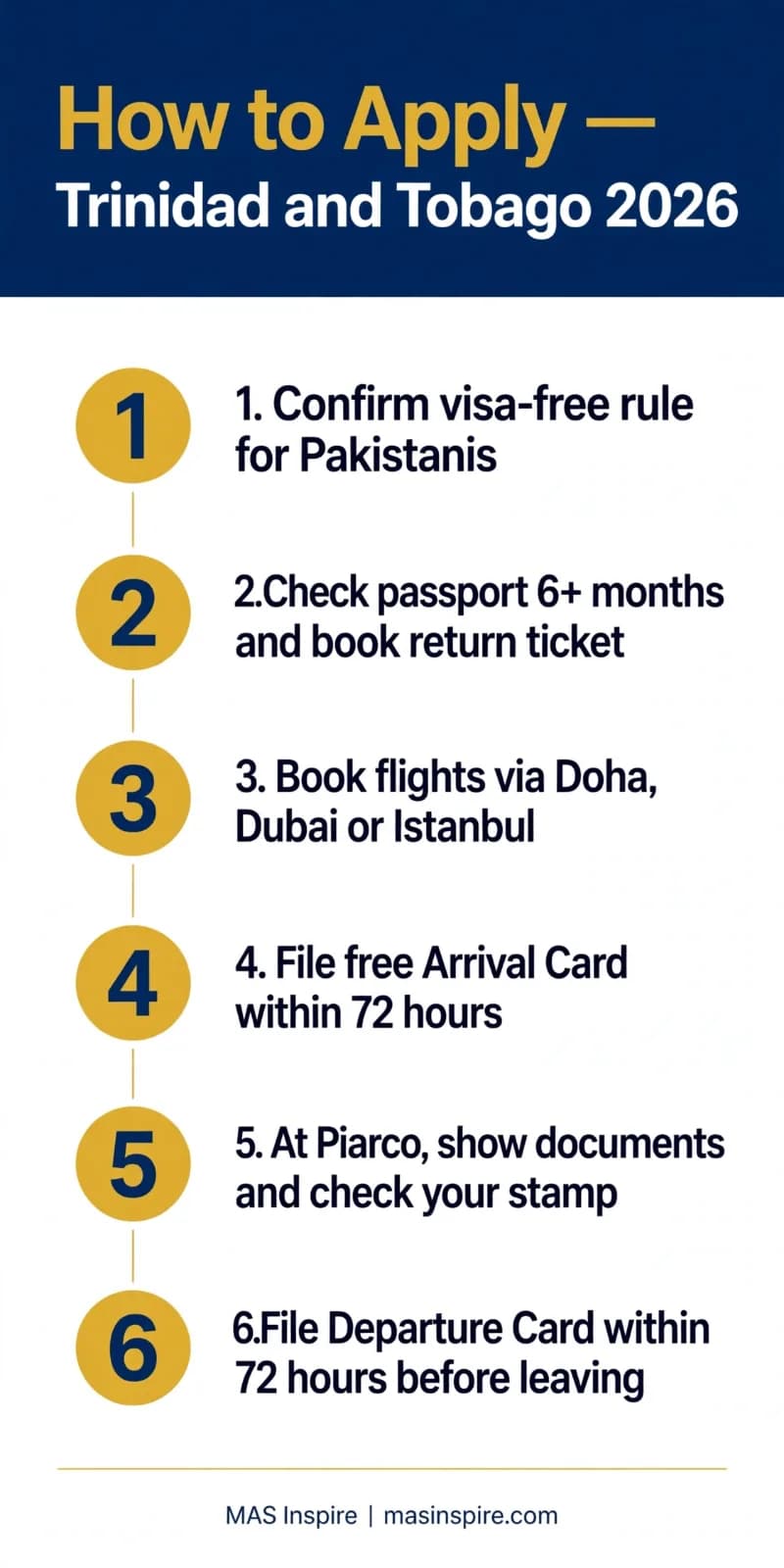
How to Apply: Step-by-Step
For a Pakistani visitor, "how to apply" is a short process, because there is no visa application. The steps below are the complete journey from Vietnam to Trinidad and Tobago and back, in order. If your purpose is work or study, the permit steps are added at the point where they belong, and you should complete them before you book a non-refundable flight.
Step 1: Confirm the rule for your passport and your purpose. Check the Immigration Division's visa-free list and confirm that Pakistan is on it and that your purpose is a visit. If your purpose is work, study or residence, stop here and follow the permit route instead. Write down the date you checked and keep a screenshot of the list; it is useful if an airline agent questions you at check-in.
Step 2: Check your passport. Make sure it is valid for at least 6 months beyond your arrival date and has a blank page. If it does not, renew it in Vietnam through the Pakistan Embassy in Hanoi or in Pakistan before you travel. Do not travel on a passport that expires during your trip.
Step 3: Check your right to return to Vietnam. Make sure your Vietnamese temporary residence card, work permit or visa is valid for your return date, with enough margin for a delay. If it expires while you are away, you may not be able to re-enter Vietnam, and that is a separate problem from Trinidad and Tobago immigration. Renew it before you leave if it is close to expiry.
Step 4: Plan the route and check transit visas. There is no direct flight from Vietnam to Trinidad and Tobago. Choose a route, usually through Doha, Dubai, Istanbul, London, Amsterdam or Toronto, and check the transit visa rules for every transit country on your ticket, including whether you need to collect baggage or change airports. A transit visa refusal can strand you mid-journey even though Trinidad and Tobago itself is visa-free for you.
Step 5: Book a return ticket and accommodation. Book a return or onward ticket and accommodation for the whole stay. Keep the bookings in a form you can show on your phone and on paper. If you are staying with family or friends, ask them for a signed invitation letter with their full address and telephone number.
Step 6: Gather your funds evidence. Save recent bank statements and make sure your card works abroad; tell your bank you are travelling.
Step 7: Get your health documents in order. If you are departing from Pakistan, get the NADRA polio vaccination certificate. Consider yellow fever vaccination if you plan to visit densely forested areas of Trinidad, on the advice of a doctor, even though it is not an entry requirement on the Vietnam route. Take out travel insurance.
Step 8: File the Arrival and Departure Card. Within 72 hours before your flight to Trinidad and Tobago, complete the free online Arrival and Departure Card at travel.gov.tt and save the receipt with the QR code, printed and on your phone. The portal does not open earlier than 72 hours before arrival, so do not try to do this weeks in advance. Remember that a separate departure card is required within 72 hours before you leave Trinidad and Tobago, and the government sends no reminder about it.
Step 9: Fly and pass through immigration. At check-in, show your passport, your return ticket and your Arrival Card receipt. On the flight, keep your documents accessible. At immigration in Port of Spain or Tobago, answer the officer's questions honestly and briefly, present your return ticket, accommodation and funds evidence if asked, and check the stamp in your passport before you leave the desk. The stamped date is the last day you may stay.
Step 10: If you need more time, apply for an extension early. Email the extension office nearest you at least two weeks before your stamp expires, with your full name, passport number, date of entry, expiry date and reason, then attend the appointment in person with your passport and supporting documents.
Step 11: Before you leave, file the departure card. Within 72 hours before your departure from Trinidad and Tobago, complete the online Departure Card at travel.gov.tt and keep the QR-code receipt. Show it at immigration and customs on departure.
Step 12: Keep records after the trip. Keep your boarding passes, your entry stamp photograph, your Arrival and Departure Card receipts and your hotel invoices for at least a year. They are useful if a future visa application asks for your travel history, and they are your proof of lawful entry and departure if any question arises later.
The Online Arrival and Departure Card
Since 17 March 2026, every traveller arriving in or departing from Trinidad and Tobago must complete an online Arrival and Departure Card. Paper immigration and customs forms handed out on the aircraft have been discontinued. The card is free, it is filed on the official Online Immigration and Customs Portal at travel.gov.tt, and it produces a receipt with a QR code that you show to immigration and customs officers. It is mandatory for everyone and separate from any visa: it grants no visa, sets no length of stay and replaces no permit.
The most important practical fact is the time window. The portal opens 72 hours before your scheduled arrival or departure, and not earlier. You cannot complete the arrival card weeks in advance alongside your flight booking, and you cannot complete the departure card when you first arrive. Set two reminders, one for each flight. The government sends no reminder about the departure card.
To complete the card you need a valid email address, your flight details, a passport valid for at least 6 months, and a copy of your passport biodata page. The form also asks for health and customs information, including recent travel history and the items you are declaring. One submission covers immigration and customs together and returns a QR-code receipt. Print it and save it on your phone.
There is one exception worth knowing. If you are in simple airport transit, remaining in the international transit area without passing through immigration to take a direct connecting flight, the card is not required. If you need to collect your baggage, pass through immigration to change flights or change airports, the card becomes mandatory. If in doubt, file it; it is free, and filing it when you did not need it costs you nothing, while not filing it when you did need it can delay you.
Applying from Vietnam: Missions, Email and Practical Steps
There is no Trinidad and Tobago embassy, high commission or consulate in Vietnam, and there is none in Pakistan either. That sounds like a problem, but for a visa-free visitor it is not, because there is nothing to apply for in person. The practical consequence is that any question you cannot answer from the official websites must be asked by email, and any permit application must be made online or by email to the Immigration Division, not at a counter in Hanoi or Ho Chi Minh City.
For Vietnam, the nearest Trinidad and Tobago mission is the Embassy in Beijing, China, which is accredited to Vietnam as well as to China, Brunei, Cambodia, Malaysia, the Philippines, South Korea and Thailand. The Embassy is at Villa 04-03, Section C, Liang Ma Qiao Diplomatic Compound, No. 7 Bei Xiao Jie, Liang Ma Qiao, Chaoyang District, Beijing 100600, China, telephone +86 10 8532 3432. Confirm that address and number before relying on them; accreditation does not mean it issues visas to Pakistani visitors — you do not need one. Diplomatic relations between Trinidad and Tobago and Vietnam were only established on 1 February 2023, and the Beijing accreditation is the current arrangement for Vietnam.
For Pakistan, the position is thinner. The High Commission in New Delhi is accredited to Bangladesh, Indonesia, Japan, Singapore and Sri Lanka; Pakistan is not on its list. No Trinidad and Tobago mission is published as accredited to Pakistan, and a VisaHQ-style listing that describes an embassy in Islamabad is not supported by the official mission directory and should not be relied on. If you are in Pakistan and need an answer, the correct contact is the Immigration Division in Port of Spain, not a mission that does not exist.
The contact that matters most is therefore the Immigration Division itself. Its head office is at 3-9 Richmond Street, Port of Spain, Trinidad and Tobago, telephone +1 868 225-4664. For visa questions, email immigration.visas@gov.tt. For general immigration information, email immigration.information@gov.tt. For an extension of stay, use the office emails: extensions.north@gov.tt for Port of Spain, extensions.south@gov.tt for San Fernando, and extensions.tobago@gov.tt for Tobago. When you email, include your full name as in your passport, passport number, date of entry, current expiry date and your question. Keep the reply; it is the strongest evidence you can carry.
From Vietnam, the practical steps are: first, check the official websites listed at the end of this guide; second, if the answer is not there, email the Immigration Division with the details above and wait for a written reply before you pay for anything; third, if you need a permit, use the online portal for that permit rather than travelling to Beijing; fourth, keep every email, receipt and reference number.
Flights and Transit: Getting There from Vietnam
There is no direct flight from Vietnam to Trinidad and Tobago, and the journey is long. From Ho Chi Minh City or Hanoi you will normally fly east or west through one or two hubs, and the total travelling time, including connections, is usually between 24 and 36 hours. The most common routings are through Doha with Qatar Airways, through Dubai with Emirates, through Istanbul with Turkish Airlines, through London with British Airways, through Amsterdam with KLM, or through Toronto with a Canadian connection. All end at Piarco International Airport (POS) near Port of Spain; for Tobago, take a short domestic flight to A.N.R. Robinson International Airport (TAB) or the ferry.
The transit country is where most Vietnam-based travellers get into trouble, not Trinidad and Tobago. Your Trinidad and Tobago visa-free status does not give you a right to transit through Qatar, the United Arab Emirates, Türkiye, the United Kingdom, the Netherlands or Canada, and each of those countries has its own transit rules for Pakistani passport holders. Airside transit in Doha or Dubai is normally straightforward, but London or Toronto may require a transit visa even without leaving the airport. Check the transit rules for every country on your ticket, including the return journey, before you pay for the ticket, and leave at least three hours between connecting flights. A missed connection in a country where you cannot legally enter is a serious problem.
At check-in in Vietnam, the airline will check three things before it lets you board: that your passport is valid, that you have a return or onward ticket, and that you meet the entry requirements of your destination and of every transit country. Have your passport, your return ticket, your hotel booking and your Arrival Card receipt ready, and have a screenshot of the Immigration Division's visa-free list on your phone. If the airline refuses to board you, ask for the reason in writing and for a supervisor and the airline's Timatic check.
On arrival at Piarco, the process is the same as at any international airport: immigration first, then baggage, then customs. Have your passport, your Arrival Card QR receipt and your supporting documents accessible, not buried in your checked luggage. The immigration officer will ask about the purpose of your visit, where you are staying and how long you intend to stay. Answer briefly and truthfully, and offer documents only if asked — but have them ready. After immigration, collect your bags and pass through customs, where you may be asked about the goods you are carrying. Currency up to TT$20,000 or its equivalent must be declared; check current customs allowances before you travel.
Extending Your Stay
If your plans change after you arrive and you need more time, you can apply for an extension of stay. You must apply before your current stamp expires, and the Immigration Division asks you to apply at least two weeks before that date. An extension is not automatic, it is not a right, and it is decided by the Chief Immigration Officer. Do not book a longer stay in the hope that an extension will be granted, and do not overstay while you wait for a decision without having applied in time.
The steps are: email the Immigration Division office for the area where you are staying — extensions.north@gov.tt for Port of Spain, extensions.south@gov.tt for San Fernando, extensions.tobago@gov.tt for Tobago — with your full name, your passport number, your date of entry into Trinidad and Tobago, the current expiry date of your stay, and your reason for requesting an extension. Attend the appointment in person with your passport, application form, evidence of your reason, a return ticket, proof of funds and lodging, and any permit you hold.
The limit to understand is the six-month ceiling. A permitted entrant who does not hold a work permit, a student permit or a missionary permit, and who is not awaiting a decision on permanent residence, may be granted an extension of stay up to six months from the date of entry, subject to the Chief Immigration Officer's approval. If you hold one of those permits, or if you are awaiting a residence decision, an extension beyond six months may be granted. The fee for a variation of an extension of landing certificate beyond ninety days from the date of arrival is TT$200 under the 2026 regulations. Older schedules quoted TT$100 for non-CARICOM nationals and TT$50 for CARICOM nationals; those figures are superseded.
If your extension is refused, you must leave by the date on your current stamp. If you have already overstayed, seek advice from the Immigration Division immediately rather than waiting to be found; the consequences of overstaying can include detention, removal, a fine and a record that affects future travel, and the exact outcome depends on the circumstances and on the discretion of the authorities. No fixed overstay fine was found in the official sources checked, so this guide states none. If you have overstayed, contact the Immigration Division immediately.
Working in Trinidad and Tobago
You cannot work in Trinidad and Tobago on a visitor entry. That rule is absolute for a tourist: a visa-free stamp allows you to visit, not to take a job, to be paid for work, or to run a business. Working without a permit can lead to removal, a fine and a ban on re-entry, and it can also cause trouble for the employer. If you are offered a job, the work permit must be in place before you start work, and in most cases before you travel for that job.
The work permit route is employer-sponsored. The employer in Trinidad and Tobago applies to the Immigration Division, and the application is assessed on the basis of the job, the employer's evidence and your qualifications. The employer must show the post could not reasonably be filled locally. CARICOM nationals use a Skills Certificate instead; that route does not apply to a Pakistani national.
The fees are set by the 2026 regulations: TT$1,200 on application for the grant of a work permit, plus TT$900 per month for the duration of the permit, subject to a minimum of TT$2,700. That means a one-year permit costs TT$1,200 plus TT$10,800 in duration charges, a total of TT$12,000 in government fees, before any legal, translation or travel costs. Confirm the total in writing before paying, because the duration charge depends on the length granted.
No official processing time for a work permit is published. Secondary sources variously suggest two to four months for a standard application and three to six months in more complex cases, and the Immigration Division's own guidance says work permit applications should be submitted no later than three months before the employee's planned arrival. Allow at least three months from a complete application. Do not resign in Vietnam or book a flight on a promised start date until the permit is granted.
Studying in Trinidad and Tobago
If you want to study in Trinidad and Tobago, you need a student permit. All foreign nationals except residents of Trinidad and Tobago need a student permit for the full duration of their studies, and the permit is applied for through the Immigration Division's eStudent Permit portal, which was launched alongside the eVisa portal in April 2024. Do not travel as a visitor and enrol on arrival in the hope of converting your status; apply for the student permit before you travel, and travel only after it is issued.
The main institutions are the University of the West Indies, St Augustine Campus, the University of Trinidad and Tobago, the University of the Southern Caribbean, and a range of technical and vocational institutes. Registered full-time students of the University of the West Indies, St Augustine Campus, are treated differently under the Division's guidance; check with the university's international office if admitted there.
To apply, you need a letter of acceptance from a registered institution, a passport valid for at least 6 months, a digital passport-sized photograph in JPEG format, evidence of funds to pay tuition and living costs, evidence of accommodation, and a police certificate or medical certificate if the Division asks for one. The fee under the 2026 regulations is TT$400; older pages still show TT$100 and TT$200, but the 2026 Legal Notice controls, so confirm it in writing before paying. Payment is online by Visa or Mastercard. No official processing time is published, so apply early and do not book a non-refundable flight until the permit is in your hand.
Studying does not automatically give you a right to work. A student permit allows study; whether it allows part-time work, and under what conditions, is a separate question that you should confirm with the Immigration Division and with your institution before you rely on it. Do not take a job on a student permit without written confirmation that it is allowed.
Common Mistakes, Safety, Health and Money
Most problems that Pakistani visitors have with Trinidad and Tobago are avoidable, and they follow the same patterns every year. The first is paying an agent for a visa that does not exist. The second is believing visa-free means no rules: the officer can refuse entry or cut a stay short, and a traveller with a one-way ticket, no accommodation and no funds evidence invites that outcome.
The third is the Arrival and Departure Card: travellers do not know it exists, try to file it weeks early, or forget the departure card. File within 72 hours before arrival and again before departure. The fourth is the stamped date: photograph it on arrival and set a reminder a week before it expires.
The fifth is transit: a cheap ticket through London or Toronto can be the most expensive you ever buy if it needs a transit visa you do not have. The sixth is overstaying: apply for an extension at least two weeks before the stamp expires.
The seventh is working or studying on a visitor entry: a visitor stamp is not a work or student permit, so get the permit first. The eighth is financial: carry two payment methods and keep your bank statements where you can show them.
On safety, the picture is mixed and you should read the official advice in full before you travel. The US State Department rates Trinidad and Tobago at Level 3, Reconsider Travel, as updated on 13 April 2026, citing crime, health and terrorism, and notes that a nationwide State of Emergency was declared on 2 March 2026. It lists areas of Port of Spain that US government employees may not visit, including Laventille, Beetham and Sea Lots. The UK Foreign, Commonwealth and Development Office does not advise against travel to any part of Trinidad and Tobago, as updated on 11 November 2026, and its advice focuses on violent crime, including gang-related crime and murder, and on taking precautions. Canada advises travellers to exercise a high degree of caution, with regional advisories for specific areas. Tobago is generally considered considerably safer than Trinidad. The practical advice is consistent across all three governments: avoid isolated areas, avoid travelling alone late at night, do not display valuables, use licensed taxis or hotel transport, and stay in well-known areas. Read the full US and UK advisories shortly before you travel, because a State of Emergency can change the rules on movement and on police powers, and because the situation can change quickly.
On local law, three points catch visitors out. It is an offence for anyone, including children, to wear camouflage clothing or to bring camouflage clothing into the country, so do not pack it. Cannabis possession of up to 30 grams has been decriminalised, but that is not a licence to buy, sell or carry it freely. In March 2025, consensual same-sex activity was reinstated as a crime punishable by up to five years' imprisonment, according to the UK Foreign Office advice; LGBT travellers should read that advice in full and take it seriously. Drug trafficking carries very severe penalties. If you are in trouble with the law, ask to contact your embassy and a lawyer, and do not make statements you do not understand.
On health, there is no COVID-19 test or vaccination requirement for entry, and those requirements were lifted from 1 July 2022. Yellow fever is the disease to understand. Trinidad, as distinct from Tobago, has areas where there is a risk of yellow fever transmission, and the World Health Organization lists Trinidad and Tobago as a country that requires proof of yellow fever vaccination from travellers arriving from countries with a risk of transmission, for travellers aged one year and over. Pakistan and Vietnam are not countries with a risk of yellow fever transmission, so a traveller arriving from Vietnam does not normally need a yellow fever certificate. The CDC recommends yellow fever vaccination for travellers aged nine months and over visiting densely forested areas of Trinidad. That is a health recommendation, not an entry condition. Carry regular medication in its original packaging with a prescription.
The currency is the Trinidad and Tobago dollar, TT$. Cash and cards are both widely used in Port of Spain and tourist areas. The duty-free allowance for travellers aged 17 and over includes 200 cigarettes, 50 cigars or 250 grams of tobacco, and currency up to TT$20,000 must be declared.
Official Websites
| Organisation | What it is for | Website |
|---|---|---|
| Immigration Division, Ministry of Homeland Security | Visa-free list, eVisa portal, student permits, extensions, work permits | https://homelandsecurity.gov.tt/divisions/immigrationdivision/evisa-online/ |
| Ministry of Homeland Security (formerly National Security) | Immigration Division home, media releases on the eVisa and eStudent portals | https://nationalsecurity.gov.tt/ |
| Immigration Division — Visa Application Requirements | Official requirements sheet: fees, 14 business days after payment, email application route | https://nationalsecurity.gov.tt/wp-content/uploads/2023/10/Visa-Application-Requirements-Form.pdf |
| Immigration (Amendment) (No. 2) Regulations 2025, Legal Notice No. 493 | 2026 fee schedule: eVisa TT$800, student permit TT$400, work permit TT$1,200 plus TT$900 per month, extension TT$200 | https://nationalsecurity.gov.tt/wp-content/uploads/2026/01/Legal_Notice_No._493_of_2025.pdf |
| Online Immigration and Customs Portal | Free mandatory Arrival and Departure Card, within 72 hours of travel | https://travel.gov.tt/en |
| ttconnect — Visa and Student Permit | Government service guide for eVisa and student permit applications | https://ttconnect.gov.tt/visa-student-permit/ |
| Ministry of Foreign and CARICOM Affairs | Visa services, country-by-country visa requirements, missions abroad | https://foreign.gov.tt/services/visas/ |
| Ministry of Foreign and CARICOM Affairs — Missions Abroad | Embassy in Beijing accredited to Vietnam, High Commission in New Delhi | https://foreign.gov.tt/missions-consuls/tt-missions-abroad/diplomatic-missions/embassy-beijing-china/ |
| Ministry of Foreign and CARICOM Affairs — High Commission New Delhi | Accreditation: India, Bangladesh, Indonesia, Japan, Singapore, Sri Lanka (not Pakistan) | https://foreign.gov.tt/missions-consuls/tt-missions-abroad/diplomatic-missions/high-commission-new-delhi-india/ |
| UK Foreign, Commonwealth and Development Office | Travel advice for Trinidad and Tobago, entry requirements and safety | https://www.gov.uk/foreign-travel-advice/trinidad-and-tobago |
| US Department of State | Travel advisory Level 3, Reconsider Travel, and State of Emergency information | https://travel.state.gov/content/travel/en/traveladvisories/traveladvisories/trinidad-and-tobago-travel-advisory.html |
| Government of Canada — Travel Advice | Exercise a high degree of caution, regional advisories | https://travel.gc.ca/destinations/trinidad-and-tobago |
| US Centers for Disease Control and Prevention | Health information for travellers, yellow fever recommendation for forested Trinidad | https://wwwnc.cdc.gov/travel/destinations/traveler/none/trinidad-and-tobago |
| World Health Organization | Countries with risk of yellow fever transmission and vaccination requirements | https://www.who.int/docs/default-source/travel-and-health/countries-with-risk-of-yellow-fever-transmission.pdf |
| Trinidad and Tobago Airports Authority | Visa requirements for travellers arriving at Piarco and Tobago airports | https://tntairports.com/travel/before-you-fly/visa-requirements/ |
| Visit Trinidad and Tobago (tourism) | Tourism information, Carnival, beaches and practical visitor guidance | https://www.visittnt.com/ |
Frequently Asked Questions
Do Pakistani passport holders need a visa for Trinidad and Tobago?
No. Pakistan is on the Immigration Division's official list of countries whose citizens do not require a visa for entry into Trinidad and Tobago. You travel as a visa-free visitor, you pay no visa fee, and there is no visa application to make. You still need a valid passport, a return or onward ticket, proof of accommodation and proof of funds, and you must file the free online Arrival and Departure Card.
How long can a Pakistani visitor stay in Trinidad and Tobago?
The official visa-free list does not state a fixed number of days. The immigration officer sets your stay and stamps the date in your passport, and that stamp is the only date that counts. Many secondary sources say up to 90 days; treat that as a planning maximum, not a guarantee.
Is there a visa fee for Pakistanis?
No. The visa fee for a Pakistani visitor is TT$0, because no visa is required. The only government fees that could apply to you are for an extension of stay (TT$200 for a variation beyond 90 days), a student permit (TT$400) or a work permit (TT$1,200 plus TT$900 per month), and only if you use those routes. Do not pay anyone who tries to charge you a tourist visa fee.
Do I need an eVisa as a Pakistani passport holder?
No. The eVisa portal is for nationals who require a visa. Its current multiple-entry fee is TT$800, but that fee does not apply to you. If you are travelling with a companion who holds a passport that does require a visa, that companion should apply through the eVisa portal, allow 14 business days after payment, and keep the application number and the emailed eVisa.
What is the online Arrival and Departure Card, and is it really mandatory?
Yes, it is mandatory for everyone since 17 March 2026. It is a free online immigration and customs declaration at travel.gov.tt, filed within 72 hours before arrival and again within 72 hours before departure. It produces a receipt with a QR code that you show to immigration and customs officers. It is not a visa, and it does not set your length of stay.
How long does a visa or permit take to process?
For a visa-free visitor, there is no processing time, because there is no application; the decision is made at the border. For an eVisa, the Immigration Division states 14 business days after payment. No official processing time is published for work permits or student permits, so allow at least three months for a work permit and apply for a student permit as early as your acceptance letter allows.
Where do I apply from Vietnam? Is there an embassy in Hanoi or Ho Chi Minh City?
There is no Trinidad and Tobago mission in Vietnam. The Embassy in Beijing is accredited to Vietnam, but as a visa-free visitor you do not need to visit it. For entry questions, email the Immigration Division at immigration.visas@gov.tt, and for permits use the online portals. There is also no Trinidad and Tobago mission accredited to Pakistan; the High Commission in New Delhi does not cover Pakistan.
Can I extend my stay in Trinidad and Tobago?
Yes. Email the Immigration Division at least two weeks before your stamp expires, attend an appointment in person with your passport and supporting documents, and pay the fee as directed. A permitted entrant without a work, student or missionary permit may be granted an extension up to six months from the date of entry, subject to the Chief Immigration Officer's approval. The fee for a variation beyond 90 days is TT$200 under the 2026 regulations.
Can I work in Trinidad and Tobago on a visitor entry?
No. A visitor entry does not allow work of any kind, paid or unpaid. You need an employer-sponsored work permit before you start work. The application fee is TT$1,200 plus TT$900 per month, minimum TT$2,700. Do not travel as a visitor to take up a job and "sort out the permit later".
Can I study in Trinidad and Tobago?
Yes, with a student permit. Apply through the eStudent Permit portal before you travel, with your letter of acceptance, funds evidence and other supporting documents. The fee under the 2026 regulations is TT$400. Registered full-time students of the University of the West Indies, St Augustine Campus, should check with the university whether a modified process applies to them.
Do I need a transit visa if I change planes on the way to Trinidad and Tobago?
Trinidad and Tobago itself does not require a separate transit visa from Pakistanis. The transit visa question is about the countries you pass through — Doha, Dubai, Istanbul, London, Amsterdam or Toronto, for example — and each has its own rules for Pakistani passport holders. Check every transit country before you buy your ticket, and leave at least three hours between flights.
Do I need a yellow fever certificate?
Not normally on a journey from Vietnam. Trinidad and Tobago requires proof of yellow fever vaccination from travellers arriving from countries with a risk of yellow fever transmission, and neither Pakistan nor Vietnam is such a country. The CDC recommends the vaccine for travellers aged nine months and over who visit densely forested areas of Trinidad, so discuss it with a doctor if that is your plan. If you depart from Pakistan, carry your NADRA polio vaccination certificate, which Pakistan requires for exit.
What documents should I carry for the border?
Your passport valid for at least 6 months, your return or onward ticket, proof of accommodation, proof of funds such as three months of bank statements, your Arrival Card QR receipt, travel insurance, and evidence of ties to Vietnam or Pakistan showing you intend to return. For children, carry birth certificates and, if only one parent travels, a consent letter from the other parent.
Is Trinidad and Tobago safe for tourists?
The advice is mixed. The US State Department rates the country Level 3, Reconsider Travel, and notes a nationwide State of Emergency declared on 2 March 2026. The UK Foreign Office does not advise against travel to any part of the country but warns about violent, gang-related crime. Canada advises a high degree of caution. Tobago is generally considered safer than Trinidad. Read the full US and UK advisories before you travel, stay in well-known areas, avoid travelling alone late at night, and use licensed taxis.
What happens if I overstay my stamped entry?
Overstaying can lead to detention, removal, a fine and difficulty entering Trinidad and Tobago or other countries in future. No fixed overstay fine for visitors was found in the official sources checked, so this guide does not invent one. If your stamp is about to expire, apply for an extension at least two weeks beforehand. If you have already overstayed, contact the Immigration Division immediately and take local legal advice rather than waiting to be found.
This guide was checked on 29 November 2026 against the Immigration Division's visa-free list, the Immigration (Amendment) (No. 2) Regulations 2025, the Immigration Division's published visa requirements, the online Arrival and Departure Card portal, and the current US, UK and Canadian travel advisories. Rules, fees and advice can change without notice, so re-check the official sources and get any unusual point confirmed in writing before you pay for travel. The good news is simple: no visa, no visa fee, and a straightforward border process if your documents are in order. Respect the date stamped in your passport, file the Arrival and Departure Card on time, and travel with proof that you are a genuine visitor who intends to return. The immigration officer makes the final decision on entry, and this guide does not guarantee visa approval or entry.


