


Turks and Caicos Islands Visa Guide 2026: Types, Requirements, Documents and Application Steps
Last checked: 29 November 2026. This guide is for Pakistani passport holders living in Vietnam. Visa rules change without notice. Always confirm the live rules with the Turks and Caicos Islands Border Force and the Turks and Caicos Islands Immigration Department, and with your airline, before paying any fee or booking a non-refundable ticket.
Introduction
The Turks and Caicos Islands are a British Overseas Territory in the Caribbean, just south-east of the Bahamas and about 90 minutes by air from Miami. The main island for visitors is Providenciales, home to Grace Bay Beach, and almost all international flights land at Providenciales International Airport (PLS), also called Howard Hamilton International Airport. The territory uses the US dollar, English is the official language, and cars drive on the left. It is a small, expensive, high-end beach destination, and it is not a place you can visit on a whim from Vietnam. For a Pakistani passport holder, this trip needs real planning, because the visa rules are unusual in three ways.
First, Pakistan is not on the Turks and Caicos Islands visa-exempt list, so you need a visa before you travel. There is no visa on arrival and no online visa. Second, the visa application asks for something most countries never ask for: a surety, a person who lives legally in the Turks and Caicos Islands and who applies on your behalf. If you know nobody on the islands, that single requirement is the hardest part of the whole trip. Third, the application route changed in 2026. Until recently, the standard advice was to apply through the nearest British High Commission or Embassy. That route is now closed: the UK government confirmed on 30 March 2026 that it no longer processes applications on behalf of the Turks and Caicos Islands, and on 9 July 2026 that UK Visas and Immigration no longer accepts visa applications for British Overseas Territories or Commonwealth countries at all. Many websites, including the territory's own tourist board page, still carry the old British mission wording. This guide explains the current route, names the conflict clearly, and tells you exactly what to confirm in writing before you spend any money.
This guide is written for a Pakistani citizen living in Vietnam. Where no official figure is published, this guide says so instead of guessing. Read the whole guide before you book anything, and start at least two months before your planned travel date.
Do Pakistani Passport Holders Need a Visa for Turks and Caicos Islands?
Yes. Pakistani passport holders need a visa to enter the Turks and Caicos Islands. Pakistan is not on the Turks and Caicos Islands Border Force visa-exempt list, and the Border Force states plainly that citizens of countries not on the exempt list must obtain a visa before entering. The list was last changed on 22 July 2022, when Russia and Ukraine were removed from it. Pakistan has never been on it.
There are only two ways around the visa requirement. The first is to hold a valid visa for, or be a lawful resident of, the United Kingdom, the United States or Canada. If you hold any of those, you can enter the Turks and Caicos Islands without a separate TCI visa. This is the single most important fact in this guide for a Pakistani living in Vietnam, because a US B1/B2 visitor visa, a UK Standard Visitor visa or a Canadian visitor visa does double duty: it lets you transit through that country and it exempts you from the TCI visa itself. The second way is to hold a passport of a visa-exempt country in addition to your Pakistani passport.
Do not confuse the Turks and Caicos Islands with the United Kingdom. A UK visa does not automatically give you entry to the islands, and a TCI visa does not give you entry to the UK. The islands set and enforce their own entry rules; the UK Foreign, Commonwealth and Development Office says exactly that in its travel advice, and points travellers to the Turks and Caicos Islands Government London Office. The UK ETA, the Electronic Travel Authorisation that the UK now requires for many visitors to Britain, does not apply to the Turks and Caicos Islands. Travellers who need a TCI visa still need a paper visa as before. There is no eTA and no eVisa for the islands.
Your passport must be valid for at least six months beyond your intended departure date. That is the rule the Border Force and the tourist board state for all nationalities other than US, UK and Canadian passport holders, whose passports need only be valid for the duration of their stay. The US State Department, writing for US citizens, advises three months of validity beyond departure and two blank pages for the entry stamp. For a Pakistani passport holder, follow the stricter six-month rule, because that is the rule the Border Force applies to you, and keep at least two blank pages free.
Every traveller, including babies and children, must carry their own valid passport. On arrival, every person completes a paper immigration form, handed out on the flight or in the arrivals hall and completed in black or blue ink. Home-printed copies are not accepted. You must also hold a return or onward ticket, and you may be asked where you are staying.
The 2026 Change: The UK No Longer Processes Turks and Caicos Visas
The old rule, repeated for years on the tourist board website and in travel guides, was that applications for a TCI visa are made to either the nearest British High Commission or Embassy, or directly to the local Director of Immigration. That was true until 2026. It is no longer true for the British mission half of that sentence.
On 30 March 2026, the UK government updated its official guidance, "Apply for a British Overseas Territory or Commonwealth country visa", to record that the UK no longer processes applications on behalf of the Turks and Caicos Islands. On 9 July 2026, the same page was updated again to reflect that UK Visas and Immigration no longer accepts visa applications for British Overseas Territories or Commonwealth countries. Those two updates are the controlling facts. The British Embassy in Hanoi and the British Consulate General in Ho Chi Minh City do not process TCI visa applications, and the VFS Global centres in Vietnam that handle UK visa applications do not handle TCI applications either.
The conflict is this: the Turks and Caicos Islands Tourist Board page on entry requirements still says applications are made to the nearest British High Commission or Embassy or directly to the local Director of Immigration, and several travel websites repeat that wording. The GOV.UK guidance, updated in 2026, says the UK no longer processes these applications, and the GOV.UK guidance controls, because it is the UK government's own statement about what its own visa service does. The part of the old advice that still stands is the second half: apply directly to the Director of Immigration in Grand Turk, or through the Turks and Caicos Islands representative office in London or New York.
What this means in practice for you in Vietnam is that there is no walk-in counter and no online portal in your country. You will be applying by correspondence with the Immigration Department in the Turks and Caicos Islands, or through the territory's London office, and you should expect the process to be slower and less standardised than a normal embassy application. Get the current application form and the current submission instructions in writing from the Immigration Department before you prepare documents, and do not pay any agent who claims they can lodge a TCI visa through the British Embassy in Hanoi or through VFS in Vietnam. That route no longer exists.
The UK, US and Canada Visa Exemption
The Border Force states that if you are a lawful resident of the United Kingdom, the United States of America or Canada, or hold a valid visa for travel to any of these three countries, you can enter the Turks and Caicos Islands without a visa. The tourist board gives the same rule in plainer terms: you do not need a visa if you have a valid US tourist or resident visa, including an H-1B work visa or a green card, a valid UK tourist or resident visa, or a valid Canadian tourist or resident visa.
Three points about this exemption deserve care. First, the visa must be valid when you enter the Turks and Caicos Islands; an expired US, UK or Canadian visa does not exempt you. Second, the exemption covers the visa requirement only. You still need a passport valid for at least six months beyond your intended departure, a return or onward ticket, and enough money for your stay, and the Border Force officer still makes the final decision at the border. Being allowed to board your flight does not mean you will be allowed to enter. Third, the exemption does not give you the right to work. Employment is prohibited on a tourist entry, and a separate work permit is required for any paid work.
For a Pakistani living in Vietnam, think this through before you choose your route. Almost every flight from Vietnam to the Turks and Caicos Islands passes through the United States, usually Miami or New York, or through Canada, the UK or the Bahamas, and transiting the United States requires a US visa in its own right. If you already hold a valid US B1/B2 visa, you solve two problems at once: the US transit and the TCI visa exemption. If you do not hold one, applying for a US B1/B2 visa from Vietnam is a separate, substantial process with its own interview, and it should not be treated as a shortcut. Do not apply for a US, UK or Canadian visa purely to visit the Turks and Caicos Islands unless the trip is worth that effort and cost. For most travellers, the direct TCI visitor visa is the honest route, even though it is slower and needs a surety.

Types of Turks and Caicos Islands Visas for Pakistani Passport Holders
The Turks and Caicos Islands do not publish a menu of visa categories the way a large country does. The system is small and paper-based, and the categories below are the ones that exist in practice for a Pakistani visitor. The visitor visa is the route for almost everyone reading this guide. The other routes are permits rather than visas, decided by different parts of the TCI government.
The single-entry visitor visa is the standard tourist visa: a paper visa issued before travel, for one entry to the islands for tourism, visiting family or friends, or a short private visit. The government fee is a non-refundable US$100 administrative fee plus a further US$150 payable on approval, a total of US$250 if the visa is granted. On arrival you are normally given 30 days, with a maximum possible stay of 90 days. The visa itself must still be valid on the day you enter.
The multiple-entry visitor visa is the second option on the official visitor visa form, which provides for both single-entry and multiple-entry applications. A one-year multiple-entry visa is reported by a secondary visa database at a fee of US$100 non-refundable plus US$500 on approval. That figure is not confirmed on any official TCI page this guide could verify, so treat it as unverified and confirm it in writing with the Immigration Department before you apply on that basis. A multiple-entry visa suits someone who needs to enter the islands more than once in a year. It does not extend the length of any single stay beyond the normal 90-day maximum.
The business visitor route covers short business trips such as meetings, conferences and negotiations. There is no separate published business visa fee; a business visitor applies for a visitor visa and states the business purpose, with an invitation letter from the TCI business. For repeated short business trips, the territory offers a Business Visitors Permit, applied for annually by the employer, allowing visits of up to seven days per visit. If your trip involves doing actual work for a TCI business, even for a few days, you need a work permit route instead, not a visitor visa.
The work permit is not a visa. If you plan to work in the Turks and Caicos Islands, you need a work permit, and your employer usually handles the application. The Border Force lists the requirements as a job offer from a local employer, a valid passport, proof of the job offer and a health certificate. Processing time varies, so apply well in advance. A Temporary Work Permit covers gainful occupation or commercial activity for up to ten calendar days, and you can either hold it before arrival or collect it at the airport.
The student route is a student visa or student permit for study on the islands. The Government of Canada travel advice lists a student visa as required. There is no published student visa fee or processing time for a Pakistani applicant, and the territory has only a small number of schools and no university. If you are considering study, contact the Immigration Department directly for the requirements in writing, including whether the school must sponsor you in the same way a visitor visa needs a surety.
The residence permit route covers people who want to live on the islands without working, for example retirees and homeowners. A Homeowner's Permit is available to a non-resident who owns a home in the islands valued at no less than US$300,000, is typically valid for five years and can be extended or renewed, and requires proof that you can support yourself and your dependants. It does not allow gainful occupation. A general residence permit without the right to work is reported by the tourist board's digital nomad guide at around US$2,000 per year, with substantial paperwork including proof of funds and a full medical evaluation. That figure is a guide figure, not a published fee schedule, so confirm it before relying on it. There is no dedicated digital nomad visa for the Turks and Caicos Islands.
Finally, transit is not a separate visa category. There is no transit visa for the Turks and Caicos Islands. Because almost all international flights land at Providenciales and you must clear immigration and customs to board a connecting flight, the same visa rules apply to transit as to entry. If you need a visa to enter, you need a visa to transit. Do not book a flight that connects through Providenciales unless you already hold the visa or the exemption that lets you enter.
Visa Comparison Table
| Route | Who it is for | Government fee | Usual stay | Apply through |
|---|---|---|---|---|
| Single-entry visitor visa | Tourists, family visits, short private visits | US$100 non-refundable plus US$150 on approval, total US$250 | Normally 30 days, maximum 90 days | Director of Immigration, Grand Turk, or TCI London or New York office |
| Multiple-entry visitor visa (one year) | Repeat visitors, family with ties on the islands | Reported US$100 plus US$500 on approval, unverified | Normally 30 days per entry, maximum 90 days | Director of Immigration, Grand Turk, or TCI London or New York office |
| UK, US or Canada visa exemption | Pakistanis holding a valid UK, US or Canadian visa or residence | No TCI fee | Normally 30 days, maximum 90 days | No TCI application, carry the valid visa or residence permit |
| Business visitor | Meetings, conferences, negotiations | Same visitor visa fee, US$250 total if approved | Normally 30 days, maximum 90 days | Director of Immigration, with a TCI business invitation |
| Business Visitors Permit | Employers sending staff repeatedly | Not published | Maximum 7 days per visit | Employer applies annually |
| Temporary Work Permit | Short paid work up to 10 calendar days | Not published | Up to 10 calendar days | Employer or sponsor, in hand or collected at the airport |
| Work permit | Employment on the islands | Not published, varies | Length of the permit | Employer applies to the TCI government |
| Student visa or permit | Study on the islands | Not published | Length of the course | Immigration Department, school sponsorship likely |
| Homeowner's Permit | Non-residents owning a home worth at least US$300,000 | Not published | Typically 5 years, renewable | Immigration Department |
Visa Fees: What Each Route Costs
The visitor visa fee is one of the few figures in this guide that is published clearly and consistently. The Turks and Caicos Islands Tourist Board, which reproduces the government's own visa requirements, states an administrative fee of US$100, non-refundable, and a further payment of US$150 on approval. That is a total of US$250 if your visa is granted, and US$100 lost if it is refused. The fee is charged in US dollars, which is the currency of the islands, so a Pakistani applicant pays in dollars or the equivalent, not in rupees or dong, unless the office you apply through tells you otherwise in writing. Get the payment method confirmed before you send money. The official sources do not publish an account number, a payment link or a card payment route for visa fees, and you should never send a fee to a personal account or through an agent you have not verified.
Two other fee figures appear in secondary sources and must be treated with care. The first is the one-year multiple-entry visitor visa at US$100 plus US$500 on approval, a total of US$600. That figure comes from a visa database, not from an official TCI page, and this guide could not verify it. Do not budget on it until the Immigration Department confirms it in writing. The second is a figure of US$250 quoted as a single total by a visa requirements website for Pakistani citizens, which is the same official fee expressed as one number, not a different fee.
No official fee is published for several things you will need to budget for. The fee for extending a visitor stay at the Immigration Department is not published on any official page this guide could verify; the tourist board and the Border Force both say only that stays can be extended by visiting an Immigration Department office and paying for an extension. Work permit fees, Temporary Work Permit fees and Business Visitors Permit fees are not published either. The residence permit figure of around US$2,000 per year comes from the tourist board's digital nomad guide and is a guide figure, not a fee schedule. If any fee is unpublished, the rule is simple: ask the Immigration Department for the current fee in writing before you pay or book, and keep the written reply with your records.
Beyond the government fee, budget for police certificates from Pakistan and Vietnam, certified photographs and copies, translations of any document not in English, and courier costs to send originals to Grand Turk or London. The trip itself is the biggest cost: the Turks and Caicos Islands are one of the most expensive destinations in the Caribbean, with high hotel, food and transport prices, and no cheap flights from Vietnam. A realistic budget for a one-week trip, excluding the visa fee, runs into several thousand US dollars. Do not book non-refundable flights or hotels before the visa is in your hand.
Be careful with agents. Because the TCI visa has a surety requirement and no online portal, some agents advertise a TCI visa through the British Embassy or through VFS, which no longer exists as a route. No agent can guarantee a visa, and no agent can waive the surety requirement. If you use an agent, ask for their full name, their business registration, their address in the Turks and Caicos Islands, and references you can check. Pay by a traceable method, get a written receipt, and never hand over your original passport to a stranger.
Processing Times
No processing time is published on the Turks and Caicos Islands Border Force website itself. That absence is itself a fact worth stating plainly, because it means there is no official service standard you can hold the Immigration Department to. The best available figure comes from the official visitor visa application form, as summarised in a 2026 visa database that cites the form directly: a visitor visa application can take up to three weeks from receipt by the Immigration Department, and where no interview and no additional documents or information are required, the published time to a final decision is two weeks. Treat that as the working figure: plan on three weeks from the day the Immigration Department receives a complete application, and two weeks in the simplest case.
In practice, plan on longer. Your application starts in Vietnam, not in Grand Turk. You need time to obtain police certificates from Pakistan and Vietnam, to get photographs certified, to arrange a surety in the Turks and Caicos Islands, and to send originals by courier to the other side of the world. Courier delivery from Ho Chi Minh City to Grand Turk or London takes days, and any missing document restarts the clock. A realistic timeline from the day you start is six to eight weeks, and you should not book travel until the visa is issued. If the Immigration Department asks for an interview or for extra documents, the time extends further, and there is no published figure for how long that takes.
There is no priority or express service published for TCI visitor visas, and no online tracking. You cannot pay extra to speed the decision up, and any agent who promises a guaranteed processing time is promising something the government has not published. The only way to keep the process short is to submit a complete, well-organised application the first time: every document on the checklist, every copy certified where certification is required, every translation attached, and the surety's documents complete. A single missing item is the most common cause of delay, and it is entirely avoidable.
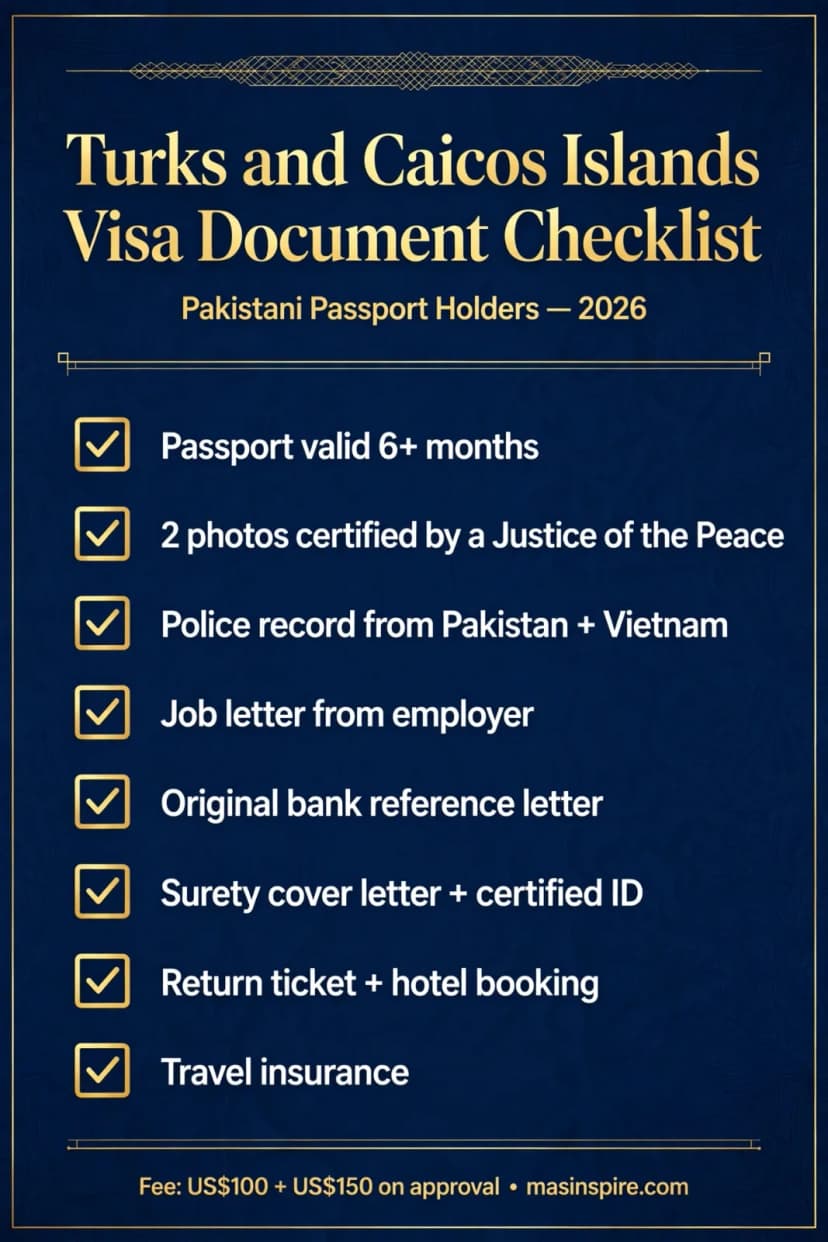
Complete Document Checklists
The document list below follows the Turks and Caicos Islands Tourist Board's published visa requirements, which reproduce the government's own list, and the Border Force's statement that an applicant must furnish correct information about their criminal record, their surety and proof of vaccination for applicants over the age of 12. The surety documents are the part most applicants underestimate. Read the list twice and tick each item off before you send anything.
Visitor visa checklist: your documents
- Completed visa application form, obtained from the Immigration Department or the TCI representative office. Fill it in fully and sign it. Do not leave questions blank; write "not applicable" where a question does not apply to you.
- Your Pakistani passport, valid for at least six months beyond your intended departure date, with at least two blank pages. Include a clear copy of the photo page and of every page with a visa or stamp.
- Two recent passport-sized photographs, certified by a Justice of the Peace, who signs and stamps the back of each photograph to confirm it is a true likeness of you. There is no Justice of the Peace in Ho Chi Minh City, so ask the Immigration Department in writing what certification they will accept from a person living abroad. A notary public or a Pakistani embassy certification may be accepted, but confirm first.
- A current police record from your country of origin, translated into English if it is not in English. For you, that means a Police Clearance Certificate from Pakistan. Because you live in Vietnam, also obtain a Vietnamese criminal record certificate, the Phieu ly lich tu phap, from the Department of Justice in Ho Chi Minh City, because the Immigration Department may ask for a record from every country where you have lived. Apply for both early; the Vietnamese certificate typically takes ten to fifteen working days.
- Job letter from your employer in Vietnam, on company letterhead, stating your position, salary, length of employment and approved leave dates. If you are self-employed, provide proof of your company business licence instead, plus evidence of your income.
- Original bank reference letter on your behalf, from your bank, confirming your account and your balance. The official list asks for an original letter on bank letterhead, not just printed statements. Also carry recent bank statements for the last three to six months to show a stable balance.
- Proof of vaccination for applicants over the age of 12. The Border Force states that a visa applicant must furnish proof of vaccination. There is no published list of which vaccinations, and there is no COVID-19 vaccine requirement for entry. Ask the Immigration Department in writing which vaccination proof they require, and carry your vaccination record with you.
- Return or onward flight reservation, showing your departure from the islands. Do not buy a non-refundable ticket before the visa is issued; a reservation or a refundable booking is enough at the application stage.
- Hotel reservation or proof of accommodation in the Turks and Caicos Islands for the full stay, or an invitation letter from your host, with the host's name, address and telephone number.
- Travel itinerary showing your dates, your flights and where you will stay.
- Travel insurance covering medical emergencies and repatriation for the full stay. Medical care on the islands is limited and expensive, and evacuation to the United States or the Bahamas can cost tens of thousands of dollars.
Visitor visa checklist: the surety's documents
- Cover letter from the surety, applying for a visa on your behalf. The surety is a person who lives legally in the Turks and Caicos Islands and who vouches for you. The letter should state who the surety is, how they know you, why you are visiting, where you will stay, and that they accept responsibility for you during your stay.
- Copy of the surety's identification, certified. This is normally the surety's passport or national identity document, certified as a true copy.
- Evidence of the surety's legal status in the Turks and Caicos Islands, for example a TCI passport, an Islander Status card, a Permanent Resident Certificate, a residence permit or a work permit.
- Proof of the surety's address on the islands, such as a utility bill or a tenancy agreement, so the Immigration Department can contact them.
The surety is the hardest requirement for a tourist who knows nobody in the Turks and Caicos Islands. There is no published way to apply without one. If you are visiting family or friends on the islands, they are your surety. If you are visiting as a pure tourist with no contacts, ask your hotel, a licensed tour operator or a TCI-based immigration agent whether they can act as surety, and confirm the answer with the Immigration Department. Do not invent a surety or submit a false cover letter; a false statement can lead to refusal and to a ban on future applications.
Checklist for children and students
- Original school letter for a child applicant, confirming enrolment and approved absence dates.
- Parents' legal status in the country where the applicant resides, with copies of the parents' passports and residence permits or visas.
- Consent letter from the custodial parent or legal guardian if a child travels without both parents, giving the parent's full name, address and telephone number, and permission for the child to travel with the named adult.
- Birth certificate of the child, showing the parents' names.
Checklist for business visitors
- Invitation letter from the business in the Turks and Caicos Islands, on company letterhead, stating the purpose of the visit, the dates, who will meet you, and whether the host will cover any costs.
- Letter from your own employer confirming the business purpose, your position and your salary.
- Company registration or business licence of the inviting TCI business, if the Immigration Department asks for it.
Checklist for work permit applicants
- Written job offer from a local TCI employer.
- Valid passport.
- Health certificate, as required by the Immigration Department and the Labour Department.
- Police clearance certificate.
- Qualifications and references for the job, as the employer advises.
Your employer normally submits the work permit application on your behalf, so follow their instructions and provide documents promptly. Never pay an employer or an agent for a job offer. A genuine employer does not charge you for the offer itself, and a job offer that you have paid for is a strong sign of a scam.
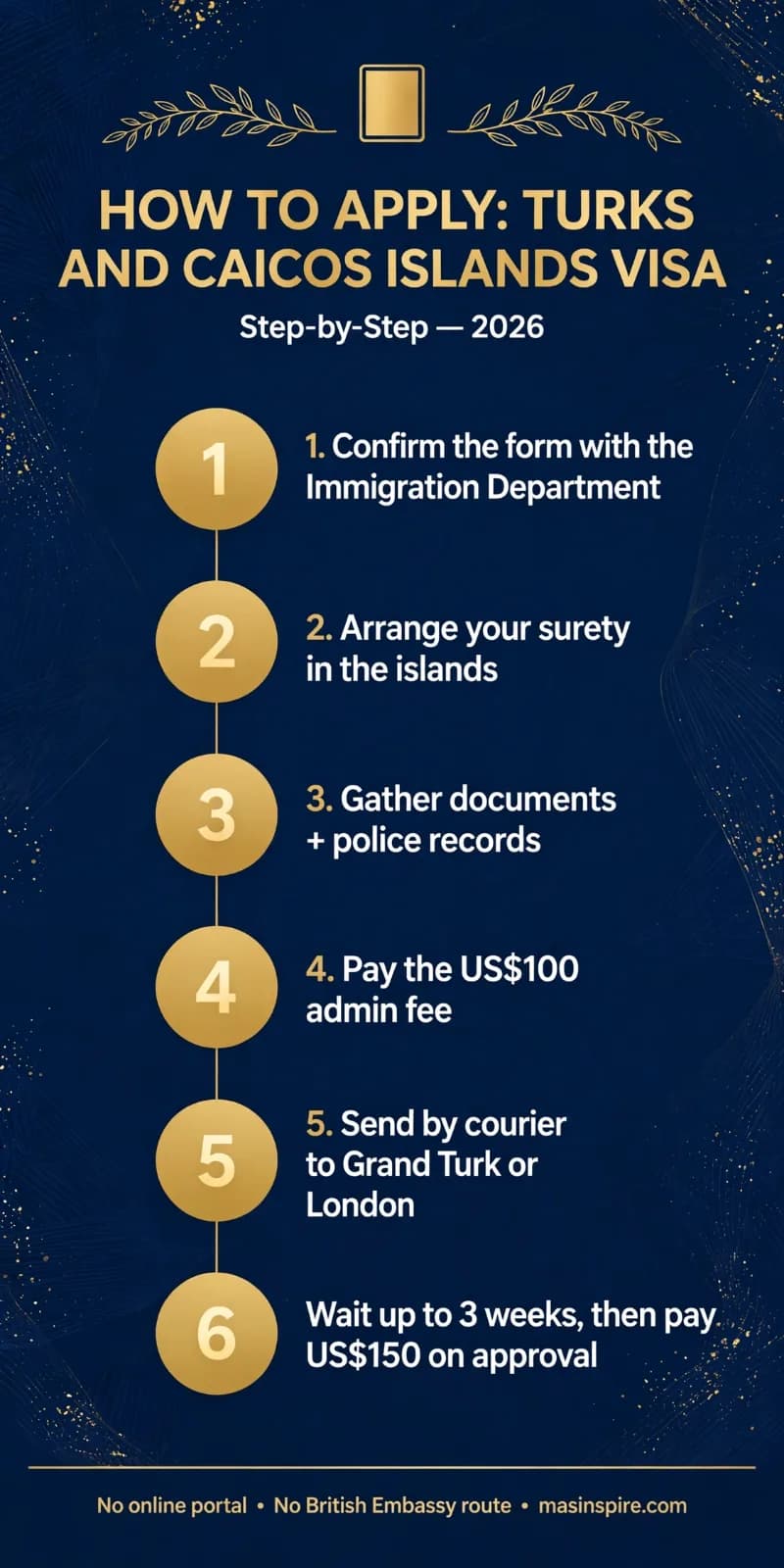
How to Apply: Step-by-Step
There is no online portal and no walk-in counter in Vietnam for a Turks and Caicos Islands visa. The process below is the direct route to the Immigration Department, and it is the route that remains open after the UK stopped processing these applications in 2026. Follow the steps in order and do not skip the first one, because the form and the submission instructions are the foundation of everything else.
Step 1: Confirm the current form and submission route in writing. Email the Turks and Caicos Islands Immigration Department, through the Border Force contact channels on borderforce.gov.tc, and the Turks and Caicos Islands Government London Office, and ask for the current visitor visa application form, the document list, the fee and payment method, and the address to send the application to. State that you are a Pakistani passport holder living in Vietnam. Keep the written reply; if it differs from this guide, follow the reply.
Step 2: Check the exemption first. Before you spend anything, check whether you hold a valid UK, US or Canadian visa or residence permit. If you do, you do not need a TCI visa at all, and the rest of this process does not apply. Check the expiry date carefully and make sure the visa will still be valid on the day you enter the islands and on the day you leave.
Step 3: Arrange your surety. Contact the person in the Turks and Caicos Islands who will act as your surety, and ask them to prepare the cover letter, the certified copy of their identification and the evidence of their legal status. If you have no surety, contact your hotel or a licensed TCI immigration agent and ask whether they can act as surety. Do not proceed until the surety is confirmed, because an application without a surety is likely to be refused or returned.
Step 4: Gather your documents. Work through the checklist in the previous section. Apply for the Pakistani Police Clearance Certificate and the Vietnamese criminal record certificate first, because they take the longest. Ask your bank for the original bank reference letter and your employer for the job letter with your leave dates. Get your photographs taken and certified.
Step 5: Complete the application form. Fill in every section, sign it, and check every date and spelling against your passport. Your name must match your passport exactly, including the order of your given names and surname. Any difference between the form and the passport is a reason for delay or refusal.
Step 6: Pay the US$100 administrative fee by the method the Immigration Department confirmed in writing. Keep the receipt or proof of payment with the application. Do not pay the US$150 approval fee yet; it is payable only if the visa is approved. Never pay a fee to a personal bank account or through an unverified agent.
Step 7: Send the application by a traceable courier to the address the Immigration Department gave you, whether that is the Director of Immigration in Grand Turk or the TCI representative office in London or New York. Keep copies of every document, keep the courier tracking number, and note the date the Immigration Department received it, because the processing time runs from receipt, not from the day you posted it.
Step 8: Wait, and respond promptly to any request. The working figure is up to three weeks from receipt, and two weeks if no interview or extra documents are needed. If the Immigration Department asks for more information or an interview, reply quickly and completely. There is no online tracking, so if you hear nothing after three weeks, follow up by email with your name, date of birth, passport number and the date your application was received.
Step 9: Pay the US$150 approval fee if the visa is approved, by the method the Immigration Department specifies, and arrange delivery of the visa. Confirm how the visa will be issued to you, whether as a paper visa sticker in your passport, which would require sending your passport, or as a separate document. Never send your original passport by untraceable post.
Step 10: Book your travel only after the visa is in your hand. Book refundable or flexible flights and hotels until then. Once the visa is issued, check the validity dates and the number of entries on it, and make sure they cover your planned trip. Then arrange travel insurance and print your accommodation confirmation.
Applying from Vietnam: No Turks and Caicos Mission in Vietnam
There is no Turks and Caicos Islands embassy, consulate or visa office in Vietnam, and there is no Pakistani mission on the islands either. The nearest British mission to you, the British Embassy in Hanoi and the British Consulate General in Ho Chi Minh City, does not process TCI visa applications, following the UK government's 2026 change. The VFS Global centres in Vietnam handle UK visa applications, not TCI applications. This section explains what that means for each practical question you will face.
For the application itself, you apply by correspondence with the Immigration Department in Grand Turk, or through the TCI Government London Office or the representative office in New York. The London office is the contact the UK Foreign Office itself points British travellers to when they are unsure about TCI entry rules, and it is the most practical first contact for an applicant outside the Caribbean. Email is your main channel. Write in clear English, give your full name, date of birth, passport number and nationality, state that you live in Vietnam, and ask for the current form, the document list, the fee, the payment method and the postal address. Keep every reply.
For documents issued in Vietnam, you will need a Vietnamese criminal record certificate from the Department of Justice, and your employer's job letter from your school or company in Ho Chi Minh City. If any document is in Vietnamese, get it translated into English by a certified translator and attach the translation. The official visa list requires a police record to be translated if it is not in English, and the same principle applies to every supporting document. For documents issued in Pakistan, such as the Police Clearance Certificate, you can apply through the police in your home district or through a family member acting on your behalf with an authorisation letter, and you should allow extra time for the certificate to reach you in Vietnam.
For certification of photographs and copies, the official list asks for certification by a Justice of the Peace. There is no Justice of the Peace in Vietnam. Ask the Immigration Department in writing what they will accept instead: a notary public in Ho Chi Minh City, certification by the Pakistan Embassy in Hanoi, or certification by a British consular official. Do not assume. A photograph certified by the wrong authority is a wasted step, and it is one of the easiest mistakes to avoid by asking first.
For help in an emergency while you are on the islands, there is no Pakistani embassy in the Turks and Caicos Islands and no British embassy either, because the territory is a British Overseas Territory and the TCI government supports visitors who need help. The nearest Pakistani missions are the Embassy of Pakistan in Washington DC and the High Commission of Pakistan in London. Before you travel, save the contact details of the Pakistan Embassy in Hanoi, your own mission as a Pakistani living in Vietnam, and of the TCI Government and the Governor's Office. In a genuine emergency, contact the TCI police and the local authorities first, then your embassy.
For your return to Vietnam, check your Vietnamese visa or temporary residence card before you leave. Make sure it is valid for your return date and allows re-entry, because a single-entry Vietnamese visa will not let you back in after you leave. If your temporary residence card expires while you are away, renew it before you travel.
Getting There: Flights, Transit and the US Visa Question
There are no direct flights from Vietnam to the Turks and Caicos Islands, and the journey is long. The usual route is Ho Chi Minh City to the United States, then a flight to Providenciales, which takes about ninety minutes from Miami. Other routes go through Toronto, London, Nassau in the Bahamas, Kingston in Jamaica or Santo Domingo in the Dominican Republic. All international flights land at Providenciales International Airport, and from there you take a domestic flight or a ferry to the other islands, such as Grand Turk, the capital island.
The transit question catches many travellers out. Transiting through the United States requires a US visa, even if you never leave the airport, because the United States does not have sterile international transit. If you hold a valid US B1/B2 visa, that same visa also exempts you from the TCI visa requirement. If you do not hold a US visa, you must either apply for one, which involves an interview at the US Consulate General in Ho Chi Minh City, or choose a route that avoids the United States. Transiting through the United Kingdom also requires a transit visa for many nationalities, and a UK transit visa does not exempt you from the TCI visa. Transiting through Canada requires a Canadian transit visa or a valid Canadian visa, and a valid Canadian visa does exempt you from the TCI visa. Transiting through the Bahamas or Jamaica has its own visa rules for Pakistani passport holders, which you must check separately. Check the transit rules for every country on your itinerary, not just the destination.
Book your flights only after your visa or exemption is confirmed. Check that your passport will be valid for at least six months beyond your departure from the islands, that your return or onward ticket is booked, and that your Vietnamese residence document allows you to return. Allow generous connection times, because a missed connection in Miami or Toronto can strand you. Carry your visa or exemption evidence, your hotel confirmation and your travel insurance in your hand luggage, not in your checked bag.
The cost of the journey is high. Return flights from Ho Chi Minh City to Providenciales commonly cost well over US$1,500 in economy, and often much more. Accommodation on Providenciales is expensive, with mid-range hotels commonly charging several hundred US dollars per night, and food, car hire and activities are priced in US dollars at resort levels. Budget carefully: this is a luxury holiday, not a budget Caribbean break.
Arrival, Stay Length and Extensions
On arrival at Providenciales International Airport, you will present your passport, your visa or your exemption evidence, your completed paper immigration form and your return or onward ticket to a Border Force officer. The officer may ask where you are staying, how long you plan to stay, how you will support yourself, and whether you know anyone on the islands. Answer honestly and briefly, and carry your hotel confirmation, travel insurance and bank statements in your hand luggage so you can show them if asked. The officer makes the final decision on entry, and a valid visa does not guarantee entry.
Visitors may be granted entry for up to 90 days, but entry is normally granted for 30 days only, even if your return ticket is dated further in the future. That is the consistent statement of the tourist board, the Border Force and the Government of Canada travel advice. Your passport will be stamped with your departure date, and that stamp is the date you must leave by, not the date on your ticket. If you were granted 30 days but planned to stay 60, you must apply for an extension before the 30 days run out. Plan your trip around 30 days unless you are prepared to extend.
To extend your stay, visit an office of the Immigration Department before your current stay expires and pay for an extension. The Border Force advises starting before your permit expires, and warns that late applications may result in penalties. The extension fee is not published on any official page this guide could verify, so ask at the Immigration Department office when you arrive, and apply early rather than in the last few days. Extensions are usually granted for genuine tourists, according to the tourist board's digital nomad guide, but an extension is a decision, not a right.
Overstaying is a serious offence in the Turks and Caicos Islands. Under the Immigration Ordinance 2018, it is an offence to remain beyond the time permitted by an immigration officer, and a person convicted can be fined up to US$10,000 or imprisoned for up to two years, or both, with a further fine of up to US$100 for every day the offence continues. The TCI government has also announced enforcement of visa bonds against sponsors of visitors who overstay, so your surety can face consequences too. Do not overstay, even by a day. If your flight is cancelled or you fall ill, go to the Immigration Department immediately and explain, with evidence, before your stay expires.
At customs, you may bring in up to US$1,000 of goods duty-free, and you must declare cash or other forms of payment worth more than US$10,000 when you bring it into or take it out of the islands. You only need a customs form if you exceed your allowance or carry something restricted. Firearms and ammunition, including a single stray bullet in your luggage, are strictly prohibited without the written approval of the Commissioner of Police, and breaches have led to arrests and prison sentences of up to 12 years. Check every pocket of every bag before you pack. The US State Department's travel advisory, dated 17 September 2026, is Level 2, exercise increased caution, because of crime, particularly in Providenciales. Use licensed transport, do not walk alone at night in unfamiliar areas, and keep your valuables secure.
There are no COVID-19 travel requirements for the Turks and Caicos Islands. No vaccine, testing or insurance requirement applies at the border. That is different from the visa application, where the Border Force requires proof of vaccination for applicants over the age of 12, so do not confuse the two. The islands have limited hospital facilities, and serious medical cases are evacuated to the United States or the Bahamas. Travel insurance that covers medical evacuation is not optional; it is essential.
Work Route: Jobs, Work Permits and Business Visits
You cannot work in the Turks and Caicos Islands on a visitor visa or a tourist entry. Employment is prohibited on a tourist stamp, and you need a work permit for any paid work on the islands. The work permit system is employer-led, which means the employer applies, not you. The Border Force states the requirements as a job offer from a local employer, a valid passport, proof of the job offer and a health certificate, and it advises applying well in advance because processing time varies.
The realistic route to a job is to secure an offer from a TCI employer first, usually in tourism and hospitality, construction, healthcare or education, and then let the employer handle the work permit application with the Labour Department and the Immigration Department. The employer must show that the job cannot easily be filled locally, and the process involves labour clearance. Be very careful with job offers that arrive by email or social media, especially offers that ask you to pay for the work permit, the visa or the job itself. A genuine employer does not charge you for the offer, and any offer that demands payment upfront is almost certainly a scam. Never send money to an employer or an agent for a job, and verify the employer independently before you send documents.
For short paid work, the Temporary Work Permit covers gainful occupation or commercial activity for up to ten calendar days. You can hold the permit before arrival or collect it at the airport. It suits visiting specialists, technicians, performers and consultants. For repeated short business visits, the Business Visitors Permit is an annual application by the employer, allowing visits of up to seven days per visit, and it is not granted to people who are ineligible for a work permit. Neither permit is a substitute for a full work permit for longer employment.
Self-employment is possible but expensive. The tourist board's digital nomad guide reports a self-employed work permit at around US$9,500 per year, requiring you to set up a local TCI business. That figure is a guide figure, not a published fee schedule, so confirm it before relying on it. Remote work for an overseas employer while visiting as a tourist is not a recognised category in TCI immigration law, and you should not plan a long stay around working remotely without a proper permit. A teaching job would still need a work permit and a local employer.
Frequently Asked Questions
Do Pakistani passport holders need a visa for the Turks and Caicos Islands?
Yes. Pakistan is not on the Turks and Caicos Islands Border Force visa-exempt list, so a Pakistani passport holder must obtain a visa before travelling. There is no visa on arrival and no online visa. The only exception is if you hold a valid visa for, or are a lawful resident of, the United Kingdom, the United States or Canada.
How much does a Turks and Caicos Islands visitor visa cost for a Pakistani citizen?
The official government fee is a non-refundable US$100 administrative fee plus a further US$150 payable on approval, a total of US$250 if the visa is granted. If the visa is refused, you lose the US$100. A one-year multiple-entry visa is reported at US$100 plus US$500 on approval, but that figure is unverified and should be confirmed in writing with the Immigration Department before you rely on it.
Can I apply for a Turks and Caicos Islands visa through the British Embassy in Vietnam?
No. The UK government confirmed on 30 March 2026 that it no longer processes applications on behalf of the Turks and Caicos Islands, and on 9 July 2026 that UK Visas and Immigration no longer accepts visa applications for British Overseas Territories. The British Embassy in Hanoi and the British Consulate General in Ho Chi Minh City do not handle TCI applications, and VFS Global in Vietnam does not either. Apply directly to the Director of Immigration in Grand Turk, or through the TCI Government London Office.
Is there an eVisa or an online application for the Turks and Caicos Islands?
No. There is no eVisa, no eTA and no online application portal for the Turks and Caicos Islands. The visa is a paper visa, applied for by correspondence with the Immigration Department. The UK ETA does not apply to the Turks and Caicos Islands, and a UK ETA does not give you entry to the islands.
How long does a Turks and Caicos Islands visa take to process?
No processing time is published on the Border Force website. The official visitor visa form, as summarised in a 2026 visa database, states up to three weeks from receipt by the Immigration Department, and two weeks where no interview or additional documents are required. In practice, allow six to eight weeks from the day you start, because you need time to obtain police certificates, arrange a surety and send documents by courier.
What is a surety, and do I really need one?
A surety is a person who lives legally in the Turks and Caicos Islands and applies for the visa on your behalf, providing a cover letter, a certified copy of their identification and evidence of their legal status on the islands. The official document list requires the surety's documents, and there is no published way to apply without one. If you are visiting family or friends, they are your surety. If you know nobody on the islands, ask your hotel, a licensed tour operator or a TCI-based immigration agent whether they can act as surety, and confirm the answer with the Immigration Department.
How long can I stay in the Turks and Caicos Islands as a tourist?
Visitors may be granted entry for up to 90 days, but entry is normally granted for 30 days only, even if your return ticket is dated later. The date stamped in your passport is the date you must leave by. You can apply for an extension at an Immigration Department office before your stay expires, and the extension carries a fee, but the fee is not published and you should ask for it in writing.
Can I transit through the Turks and Caicos Islands without a visa?
No. There is no transit visa and no sterile transit at Providenciales International Airport. You must clear immigration and customs to board a connecting flight, so the same visa rules apply to transit as to entry. If you need a visa to enter, you need a visa to transit.
Do I need a US visa to travel to the Turks and Caicos Islands from Vietnam?
Not necessarily for the islands themselves, but very likely for the journey. Almost every flight from Vietnam to Providenciales passes through the United States, and transiting the United States requires a US visa. If you hold a valid US B1/B2 visa, it also exempts you from the TCI visa requirement. If you do not hold one, either apply for a US visa or choose a route through a country whose transit rules you can meet, such as Canada, the UK, the Bahamas or Jamaica, and check those rules separately.
Can I work in the Turks and Caicos Islands on a visitor visa?
No. Employment is prohibited on a tourist entry, and you need a work permit for any paid work. Your employer usually applies for the work permit on your behalf. A Temporary Work Permit covers paid work of up to ten calendar days, and a Business Visitors Permit covers visits of up to seven days per visit for employees of a company. Never pay an employer or an agent for a job offer.
What happens if I overstay in the Turks and Caicos Islands?
Overstaying is an offence under the Immigration Ordinance 2018. You can be fined up to US$10,000 or imprisoned for up to two years, or both, with a further fine of up to US$100 for every day the offence continues. The government also enforces visa bonds against sponsors of visitors who overstay, so your surety can face consequences too. Always apply for an extension before your stay expires, and never overstay even by a day.
How long must my Pakistani passport be valid to enter the Turks and Caicos Islands?
Your passport must be valid for at least six months beyond your intended departure date, with at least two blank pages for stamps. That is the rule the Border Force applies to nationalities other than US, UK and Canadian passport holders. Renew your passport in Vietnam or Pakistan before you apply if it has less than six months left.
Do I need travel insurance for the Turks and Caicos Islands?
Yes, and it is essential even though it is not named on the official visa document list. Medical facilities on the islands are limited, and evacuation to the United States or the Bahamas can cost tens of thousands of dollars. Get insurance that covers medical emergencies, hospital treatment, medical evacuation and repatriation for the full length of your stay.
Can I study in the Turks and Caicos Islands as a Pakistani student?
A student visa or student permit is required, and you should contact the Immigration Department directly for the current requirements, including whether the school must sponsor you in the same way a visitor visa needs a surety. There is no published student visa fee or processing time, and the territory has only a small number of schools and no university, so study is a niche route that needs direct confirmation before you make any plans.
Is the Turks and Caicos Islands safe for tourists?
The US State Department's travel advisory, dated 17 September 2026, is Level 2, exercise increased caution, because of crime, particularly in Providenciales. Most visits are trouble-free, but take normal precautions: use licensed transport, avoid walking alone at night in unfamiliar areas, keep valuables secure, and do not carry firearms or ammunition, which are strictly prohibited and have led to arrests and long prison sentences. Check the current advisory before you travel.
Official Websites
| Source | What it covers | Website |
|---|---|---|
| Turks and Caicos Islands Border Force, Entry Requirements | Visa-exempt list, passport validity, UK, US and Canada exemption, children travelling | https://borderforce.gov.tc/entry-requirements |
| Turks and Caicos Islands Border Force, Visas and Permits | Work permits, Temporary Work Permits, Business Visitors Permits, Homeowner's Permits, visa extensions | https://borderforce.gov.tc/visas-permits |
| Turks and Caicos Islands Border Force, Forms | Immigration forms including visa, residence and work permit forms | https://borderforce.gov.tc/forms |
| Visit Turks and Caicos Islands, Entry Requirements, Visas, Passports | Visa document list, US$100 plus US$150 fee, stay of up to 90 days, normally 30 days, transit rule | http://www.visittci.com/travel-info/entry-requirements |
| GOV.UK, Apply for a British Overseas Territory or Commonwealth country visa | UK no longer processes TCI applications from 30 March 2026, UKVI no longer accepts BOT applications from 9 July 2026 | https://www.gov.uk/government/publications/apply-for-a-british-overseas-territory-or-commonwealth-country-visa |
| GOV.UK, Turks and Caicos Islands travel advice | Entry rules set by TCI authorities, TCI Government London Office, work permit requirement, customs rules | https://www.gov.uk/foreign-travel-advice/turks-and-caicos-islands/print |
| GOV.UK, British embassy or high commission in Vietnam | British Embassy Hanoi and British Consulate General Ho Chi Minh City contact details | https://www.gov.uk/world/british-embassy-or-high-commission-vietnam |
| GOV.UK, Find a visa application centre | Turks and Caicos Islands listed as having no visa application centre of its own | https://www.gov.uk/find-a-visa-application-centre |
| US Department of State, Turks and Caicos Islands | Entry requirements, Level 2 travel advisory dated 17 September 2026, safety and health information | https://travel.state.gov/en/international-travel/travel-advisories/turks-and-caicos-islands.html |
| Government of Canada, Turks and Caicos Islands travel advice | Tourist, business, work and student visa requirements, stay of up to 90 days and extensions | https://travel.gc.ca/destinations/turks-and-caicos-islands |
| Turks and Caicos Islands Government, Immigration Department services | Visitor visas, visitor visa extensions, residence permits, enforcement | https://www.gov.tc/bordercontrol/services |
| Turks and Caicos Islands Government, Departure of Persons | Overstay penalties under the Immigration Ordinance 2018, fine up to US$10,000 or two years imprisonment | https://www.gov.tc/bordercontrol/component/content/article/departure-of-persons-from-the-turks-and-caicos-islands?catid=2&Itemid=101 |
| Visit Turks and Caicos Islands, Guide for Digital Nomads | Residence permits around US$2,000 per year, self-employed work permit around US$9,500 per year, no digital nomad visa | https://www.visittci.com/life-and-business/living-and-working/guide-for-digital-nomads |
| Wikipedia, Visa policy of the Turks and Caicos Islands | Visa-exempt countries and the UK, US and Canada visa and residence exemption | https://en.wikipedia.org/wiki/Visa_policy_of_the_Turks_and_Caicos_Islands |
| Providenciales International Airport, Visa and Entry Requirements | Visa rules, stay of up to 90 days, normally 30 days, paper arrival form | https://providenciales-airport.com/visa/ |
| VisaRequirements.info, Turks and Caicos Islands visa requirements for Pakistani citizens | Embassy visa route, US$250 fee, police record and surety documents | https://visarequirements.info/countries/pakistan/turks-and-caicos-islands/ |
| VisaList.io, Turks and Caicos Islands visa for citizens of Pakistan | Sticker visa, one-month stay, five documents listed | https://visalist.io/turks-and-caicos-islands/visa-requirements/pakistan |
| MoveNavi, Turks and Caicos Islands tourism programme | Visitor visa form, up to three weeks processing, two weeks without interview, London and New York offices | https://test.movenavi.com/local-uat/v101/programs/turks-and-caicos-islands--tourism?locale=en&stay=short&from=countries&directoryQ= |
| LoopholeDB, Turks and Caicos Travel Visas | Single-entry US$100 plus US$150, one-year multiple-entry US$100 plus US$500, surety requirement | https://www.loopholedb.com/visas/turks-and-caicos |
| TCI Insider, Before You Go visitor guide | Passport validity, visa exemption for US, UK, Canadian and EU holders, blank pages | https://tciinsider.com/visit/before-you-go/ |
Final Checklist and Conclusion
Before you spend any money, work through this final checklist. Check whether you hold a valid UK, US or Canadian visa or residence permit, because that exempts you from the TCI visa entirely. If you do not, email the Immigration Department and the TCI Government London Office for the current visitor visa form, the document list, the fee and the payment method, and keep the written reply. Confirm your surety before you gather any other document. Apply for your Pakistani Police Clearance Certificate and your Vietnamese criminal record certificate early. Get your photographs certified by an authority the Immigration Department has confirmed in writing. Ask your bank for an original bank reference letter and your employer for a job letter with your leave dates. Check that your passport is valid for at least six months beyond your departure date and has two blank pages, and that your Vietnamese residence document allows you to return. Do not book non-refundable flights or hotels until the visa is in your hand.
The Turks and Caicos Islands are a beautiful destination, and a Pakistani passport holder living in Vietnam can visit them, but this is not a straightforward visa. The paper application, the surety requirement, the 2026 closure of the British mission route and the long journey through a transit country all add difficulty that a normal beach holiday does not have. The travellers who succeed are the ones who start early, get everything in writing from the Immigration Department, and treat the surety and the transit visa as seriously as the TCI visa itself. If the surety cannot be arranged, or if the transit route cannot be made to work, it is better to choose a different destination than to submit an incomplete application.
This guide was checked on 29 November 2026 against the Turks and Caicos Islands Border Force, the Turks and Caicos Islands Tourist Board, GOV.UK, the US Department of State and the Government of Canada. Visa rules change without notice, so confirm the live rules with the Immigration Department before you travel. The immigration officer makes the final decision on entry, and this guide does not guarantee visa approval or entry.


