


Tuvalu Visa Guide 2026: Types, Requirements, Documents and Application Steps
Tuvalu is one of the smallest and least visited countries in the world, a nation of nine low-lying atolls in the South Pacific with a population of about 11,000 people. For a Pakistani passport holder living in Vietnam, it is also one of the most unusual trips you can plan: there is no Tuvalu embassy in Vietnam and none in Pakistan, no e-visa portal, no visa application centre, and no direct flight from anywhere in Asia. Yet the entry system itself is simple. Pakistanis do not need to apply for a visa in advance. You receive a visitor permit on arrival at Funafuti International Airport, valid for up to 30 days, for a fee of AUD 100.
The part that catches most travellers out is not Tuvalu at all. It is Fiji. Every practical route to Tuvalu passes through Fiji, and Pakistanis need a Fiji visa before they travel, even for many transits. If you sort out the Fiji side first, the Tuvalu side is straightforward. If you ignore it, you can be refused boarding before you ever leave Vietnam. This guide explains the whole journey in order: the Tuvalu permit, the fees, the documents, the Fiji visa, the flights, and what happens when you land.
Tuvalu at a Glance: Key Facts for Pakistanis
Tuvalu is a Polynesian island nation in the Pacific Ocean, about halfway between Hawaii and Australia. Its capital is Funafuti, which is both the main atoll and the place where almost everything happens: the international airport, the government offices, the only hospital, the banks, and most of the accommodation. The country covers only about 26 square kilometres of land spread across nine atolls, and most visitors spend their whole trip on Funafuti itself. English and Tuvaluan are the official languages, so a Pakistani visitor who speaks English will have no language barrier with immigration officers, hotel staff, or officials.
The currency is the Australian dollar (AUD). Tuvalu also issues its own Tuvaluan dollar coins, which are pegged one to one with the Australian dollar, but Australian banknotes are what you will use. There are no ATMs in Tuvalu, according to the United States Department of State, and card payment is not reliable. That single fact shapes the whole trip: you must bring enough Australian dollars in cash to cover the AUD 100 permit fee, the AUD 30 departure tax, your accommodation, food, and a reserve for emergencies. The State Department also notes a cash declaration threshold of AUD 3,000 on entry and on exit, so if you carry more than that, declare it.
| Item | Detail for Pakistani passport holders |
|---|---|
| Visa needed in advance | No. Visitor permit issued on arrival. |
| Where the permit is issued | Funafuti International Airport (FUN), on arrival. |
| Fee | AUD 100, payable in cash on arrival. |
| Maximum stay on arrival | Up to 30 days (one month). |
| Extension | Up to 30 more days from the Immigration Office in Funafuti, fee AUD 100. |
| Passport validity | At least 6 months from the date of arrival, with at least one blank page. |
| Onward ticket | Required. A confirmed return or onward ticket is checked. |
| Nearest Tuvalu mission | High Commission in Suva, Fiji. |
| Main flight route | Fiji Airways from Suva or Nadi (Fiji) to Funafuti. |
| Currency | Australian dollar (AUD). Cash only in practice. |
| Departure tax | AUD 30 per departing passenger (check whether your ticket includes it). |
Do Pakistani Passport Holders Need a Visa for Tuvalu?
No, Pakistani passport holders do not need to apply for a visa before travelling to Tuvalu. You do not need to visit an embassy, fill in an online visa form, or wait for an approval letter. Tuvalu issues entry permits on arrival to visitors of almost every nationality, and Pakistan is in that group. The Tuvalu Permanent Mission to the United Nations states the rule plainly: entry permits for a maximum one-month stay are issued on arrival, provided you have a valid passport with at least six months of validity from the date of arrival, sufficient funds, proof of accommodation, and a return or onward ticket.
That does not mean entry is automatic. The permit is issued by the immigration officer at Funafuti Airport, and the officer decides whether you meet the conditions. The distinction matters. A visa issued in advance is a decision made before you travel. A permit on arrival is a decision made at the counter, and the officer can refuse it if your passport is short on validity, if you have no ticket out, if you cannot show where you will stay, or if you cannot show that you can pay for the trip. In practice a well-prepared traveller is routinely admitted, but never treat the permit as guaranteed and never book a non-refundable trip on that assumption.
There is a second confusion to clear up. Some nationalities enter Tuvalu without any permit at all: citizens of the European Union and Schengen states can stay for up to 90 days in any 180-day period, and citizens of Taiwan can stay for up to 90 days. Pakistan is not in either group. Some other nationalities get the same permit on arrival as Pakistanis but pay no fee, because their countries are listed in Schedule 1 of the Tuvalu Immigration Regulations 2014. Pakistan is not on that fee-free list either. So the rule for a Pakistani passport is simple: permit on arrival, up to 30 days, fee AUD 100.
Finally, note the Falepili visa, because the name appears in almost every search about Tuvalu visas in 2026. The Falepili Mobility Pathway is an Australian visa for Tuvaluan citizens to live and work in Australia. It has nothing to do with Pakistanis visiting Tuvalu, and it cannot be used by a Pakistani passport holder in either direction. If an agent mentions Falepili to you as a way into Tuvalu, walk away.
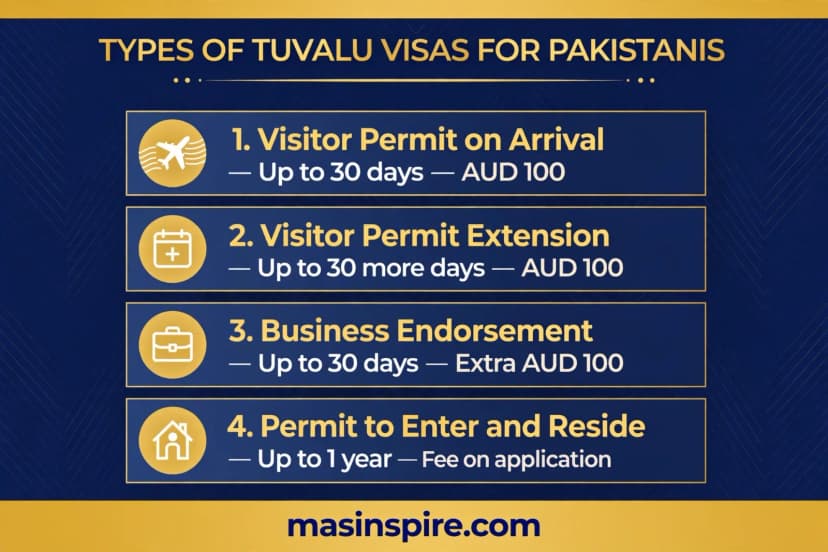
Types of Tuvalu Visas for Pakistani Passport Holders
Tuvalu does not have a long menu of visa categories the way larger countries do. There are four routes that matter for a Pakistani passport holder, and they cover every realistic purpose of travel. The first three are versions of the visitor permit; the fourth is the long-stay permit. There is no separate tourist visa, transit visa, or digital nomad visa.
Visitor permit on arrival
This is the permit almost every Pakistani traveller will use. It is issued at Funafuti International Airport when you land, it allows tourism, general visits, and visiting family or friends, and it is valid for up to 30 days. The fee is AUD 100. It does not allow work, business activity, study, or proselytising. Those activities need a different permission, explained below. You cannot apply for this permit in advance, and you do not need to. You simply arrive with the required documents and the fee.
Visitor permit extension
If you are already in Tuvalu on a visitor permit and you want more time, you can apply to the Immigration Office in Funafuti for an extension of up to 30 more days, for a further fee of AUD 100. You must apply before your first permit expires. The extension is not automatic: the immigration officer considers your reason, your funds, and your accommodation, and can refuse. Some travel websites say extensions can run to three months in total at AUD 50 per month. That conflicts with the regulation-based figure, which this guide treats as controlling. Do not plan a stay longer than 60 days on the longer figure; ask the Immigration Office in writing first.
Visitor permit with a business endorsement
A visitor who needs to carry out limited business activity, such as attending meetings, can ask the Principal Immigration Officer for a special endorsement on the visitor permit. The endorsement costs a further AUD 100 on top of the AUD 100 permit fee, so AUD 200 in total, and the stay remains limited to a maximum of 30 days. It is not a work permit and does not allow you to take a job or run a business in Tuvalu. You should carry an invitation letter from the Tuvaluan organisation you are visiting, with a named contact and a telephone number, and you should be ready to explain exactly what you will do and when you will leave.
Permit to enter and reside
This is the long-stay permit for anyone who intends to live in Tuvalu for more than a short visit: for work, for business, for study, for research, for a religious mission, or for another purpose approved by the minister responsible for immigration. It is issued for a maximum of one year at first, and it can be renewed up to three times within a five-year period. The application is made on a prescribed form, in English or Tuvaluan, and it is submitted to an immigration officer with supporting documents. For work the employer must sponsor the application; for study the institution must provide a letter of acceptance. This permit is not issued at the airport counter to a walk-in visitor. It is a formal application, it takes weeks or months, and it must be arranged before you plan your life around it.
| Permit type | Who it is for | Maximum stay | Fee for Pakistanis | Where it is issued |
|---|---|---|---|---|
| Visitor permit on arrival | Tourists and family visitors | Up to 30 days | AUD 100 | Funafuti Airport, on arrival |
| Visitor permit extension | Visitors already in Tuvalu | Up to 30 more days | AUD 100 | Immigration Office, Funafuti |
| Business endorsement | Visitors with limited business activity | Up to 30 days | Extra AUD 100 (AUD 200 total) | On arrival, by the Principal Immigration Officer |
| Permit to enter and reside | Work, study, business, research, mission | Up to 1 year, renewable | Confirm in writing | Formal application to Immigration |
Tuvalu Visa Fees for Pakistanis in 2026
The fee system for Tuvalu is short, and that is good news: there are very few charges, and none of them is hidden. The controlling source is the Tuvalu Immigration Regulations 2014. Under those regulations, citizens of the countries listed in Schedule 1 pay no fee for a visitor permit on arrival. Pakistan is not listed in Schedule 1, so a Pakistani visitor pays AUD 100. The same regulations provide for an extension fee of AUD 100 and a business endorsement fee of AUD 100. All amounts are in Australian dollars, which is the currency of Tuvalu.
Some travel websites quote the fee as a range, typically AUD 100 to AUD 120, or convert it to about USD 65 to USD 80. The range appears to come from rounding, from exchange-rate conversion, or from older figures being carried forward. The regulation states a flat AUD 100, and that is the figure this guide uses everywhere. If an officer asks for more than AUD 100 for a standard visitor permit, ask politely for the reason and for a receipt.
There is no application fee, e-visa fee, or visa centre fee for the Tuvalu permit. If anyone charges you for submitting a Tuvalu visa application, they are charging for a service that does not exist. The only other compulsory charge connected with the trip is the departure tax of AUD 30, which is payable when you leave Tuvalu. That tax comes from the Funafuti Airport (Departure Tax) Regulations, which set the tax at 30 dollars per passenger departing Funafuti Airport for a destination outside Tuvalu. Some travel websites quote AUD 20 to AUD 30, and one quotes AUD 50. The regulation says 30 dollars, and this guide treats that as controlling. Ask your airline whether the tax is already included in your ticket. If it is not, keep AUD 30 in cash for your last day and do not spend it.
Overstay fines are the one fee area where sources genuinely conflict: one set of travel guides reports AUD 100 per day, another reports AUD 20 per day with a maximum cap. Neither figure could be confirmed against a published official penalty schedule, so this guide states no settled amount. Overstaying can also lead to detention until the next flight, deportation at your own expense, and difficulty entering Tuvalu or other Pacific countries later. Leave, or extend, before your permit expires.
Budget in Australian dollars. A realistic minimum is the AUD 100 permit fee, the AUD 30 departure tax, your accommodation, and at least AUD 100 to AUD 150 per day for food, transport, and activities. There is no ATM to rescue you if you run short, so bring more than you think you need and keep the permit fee and departure tax separate from your spending money.
| Charge | Amount | When you pay | Source and status |
|---|---|---|---|
| Visitor permit on arrival | AUD 100 | At Funafuti Airport, on arrival | Immigration Regulations 2014. Verified. |
| Visitor permit extension | AUD 100 | At the Immigration Office, before expiry | Immigration Regulations 2014. Verified. |
| Business endorsement | Extra AUD 100 (AUD 200 total) | On arrival | Immigration Regulations 2014. Verified. |
| Departure tax | AUD 30 | On departure from Funafuti | Funafuti Airport (Departure Tax) Regulations. Verified. |
| Overstay fine | Unverified: AUD 20 or AUD 100 per day reported | If you overstay | Conflict between secondary sources. Not verified. |
| Permit to enter and reside | Confirm in writing | On application | Figures of AUD 600 / AUD 1,200 unverified. |
| E-visa or application fee | None | Not applicable | No e-visa system exists. |
AUD 100 was worth roughly USD 65 in late 2026, but the rate moves, so this guide fixes no dong or rupee equivalent. Check the rate on the day you buy your Australian dollars in Ho Chi Minh City, and do not rely on changing money in Fiji or Tuvalu.
How Long Can You Stay in Tuvalu?
A Pakistani visitor permit on arrival is valid for up to 30 days. The words up to matter. The immigration officer writes the permitted stay in your passport, and the officer can grant fewer than 30 days if your return ticket is earlier, if your funds cover a shorter trip, or if your plans are unclear. In practice, a visitor with a return ticket three weeks away and enough money for three weeks is normally given the full period up to the ticket date. Check the date written in your passport before you leave the counter. That handwritten date is your legal limit, not the 30-day maximum in this guide, and not the date on your ticket.
Your permitted stay is counted from the day you arrive. There is no grace period after the date in your passport. If your flight out is delayed, go to the Immigration Office immediately and explain the situation; do not simply stay and hope the delay is understood. If you need more time for a genuine reason, apply for the extension described in the next section of this guide before your permit expires, not after. An application made after expiry is an overstay with an excuse attached, and it is treated far less kindly than an application made in good time.
The total stay on a visitor permit, including one extension, is up to 60 days: 30 days on arrival plus up to 30 more days on extension. Some travel websites describe extensions running to three months in total, but that conflicts with the regulation-based figure, which this guide treats as controlling. If you need more than 60 days, write to the Immigration Office in Funafuti before you travel and ask for the current maximum stay in writing.
There is no published rule about how soon you can return after a visit, and no limit such as 90 days in 180 days for Pakistani visitors. A pattern of repeated back-to-back visits would still attract questions, so carry the full document set on a second trip and be ready to explain its purpose.
Your stay is also limited by your flights. Fiji Airways flies to Funafuti only a few times a week, so book a departure that falls inside your permitted stay. Do not count 30 days from arrival and then discover the next flight out is two days after your permit expires.
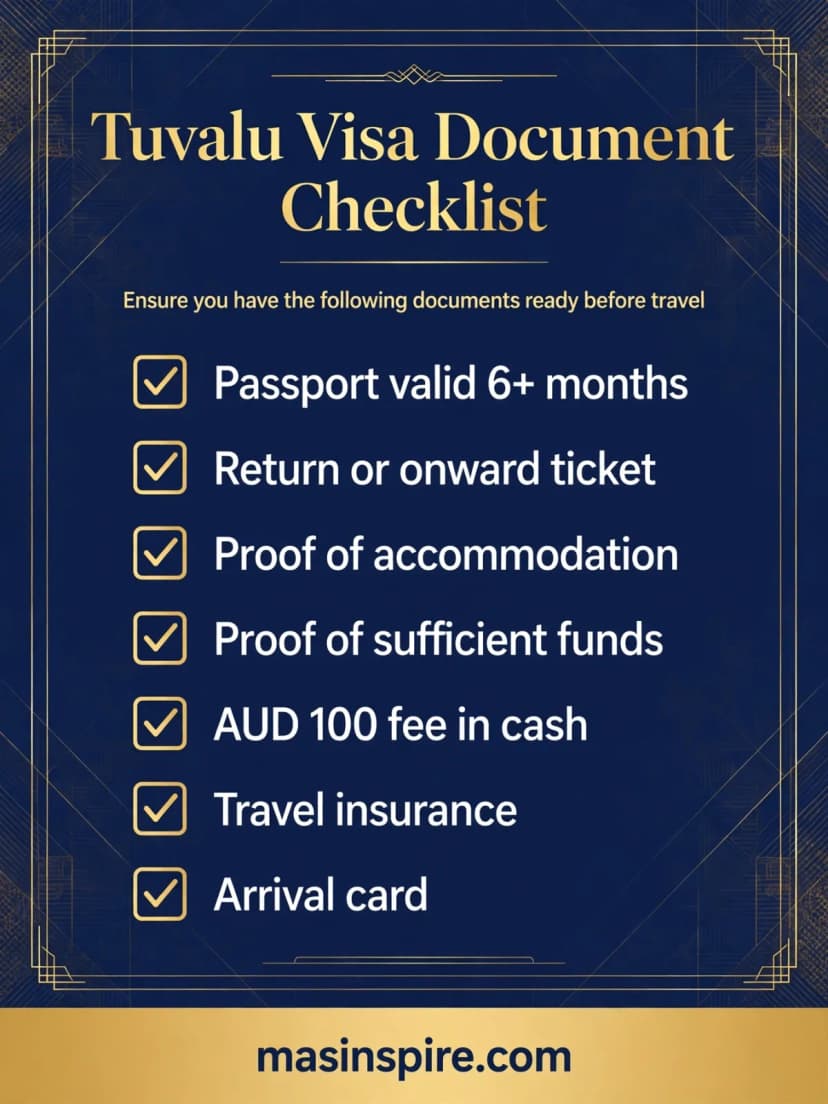
Complete Document Checklists
Tuvalu publishes no long formal checklist and no online form for visitor permits. The lists below are drawn from the Tuvalu Permanent Mission statement of entry conditions, the United States Department of State, and the Immigration Regulations. Keep originals with you, keep copies separately, and keep the set in a folder you can open at the counter.
Checklist 1: Visitor permit on arrival
- Pakistani passport, valid for at least 6 months from the date of arrival, with at least one blank page for the permit stamp. Check the expiry date now, not the week before you fly.
- Completed arrival card, given to you on the flight or at the airport. Fill it in fully and honestly.
- Confirmed return or onward ticket out of Tuvalu, printed or on your phone, showing the date and flight number.
- Proof of accommodation for every night of your stay: a hotel or guesthouse booking with the name, address, and telephone number, or a letter from your host in Tuvalu with their full name, address, and telephone number.
- Proof of sufficient funds: recent bank statements, a bank balance certificate, or cash in Australian dollars. There is no published minimum amount.
- AUD 100 in cash for the permit fee, kept separate from your spending money.
- AUD 30 in cash for the departure tax, or confirmation that it is included in your ticket.
- Travel insurance documents, including medical evacuation cover, with the policy number and the emergency telephone number. Insurance is essential in a country with one small hospital.
- Your Vietnam residence document: your temporary residence card or valid Vietnam visa, so you can prove you can return to Vietnam. Check that it is valid beyond your return date.
- Your Fiji visa, or proof of your Fiji transit arrangement, because you will need it to reach Tuvalu at all. See the Fiji section of this guide.
Checklist 2: Visitor permit with a business endorsement
- Everything in Checklist 1.
- An invitation letter from the Tuvaluan organisation or business you are visiting, on their letterhead, naming you, stating the purpose and dates of the visit, and giving a contact name and telephone number.
- Evidence of your own employment or business in Vietnam or Pakistan, such as an employment letter or business registration, so the officer can see why the meetings are genuine.
- An extra AUD 100 in cash for the endorsement fee, making AUD 200 in total for the permit and the endorsement.
- A clear, short explanation of what you will do in Tuvalu, day by day, and a clear statement that you will not take employment.
Checklist 3: Permit to enter and reside (work, study, or long stay)
- Pakistani passport valid for at least 6 months beyond the intended stay, with blank pages.
- The prescribed application form, completed in English or Tuvaluan and signed by you, or by a parent or guardian if you are under 18.
- Two passport-size photographs, head and shoulders, recent.
- Proof of financial means, such as bank statements, or a sponsor form completed by your sponsor in Tuvalu.
- For work: a signed employment contract and a sponsorship form from the Tuvaluan employer, with evidence that the employer tried to recruit locally.
- For study: a letter of acceptance from the institution in Tuvalu and evidence of funds for tuition and living costs.
- For longer stays: a medical examination and chest X-ray, and police clearance certificates from every country where you have lived in the past five years. For a Pakistani living in Vietnam, that normally means one clearance from Pakistan and one from Vietnam.
- Certified copies of your degrees and qualifications, with English translations if the originals are not in English.
- The current fee, confirmed in writing by the Immigration Office or the High Commission in Suva before you pay. Do not pay on the basis of a figure from a website.
A note on polio vaccination: Pakistan requires a polio vaccination certificate for Pakistani nationals departing Pakistan, issued through NADRA. If you fly directly from Vietnam without entering Pakistan, that rule does not apply to your departure. Tuvalu itself requires no vaccination for entry, and yellow fever vaccination is only relevant if you arrive from a risk country, which Vietnam and Fiji are not.
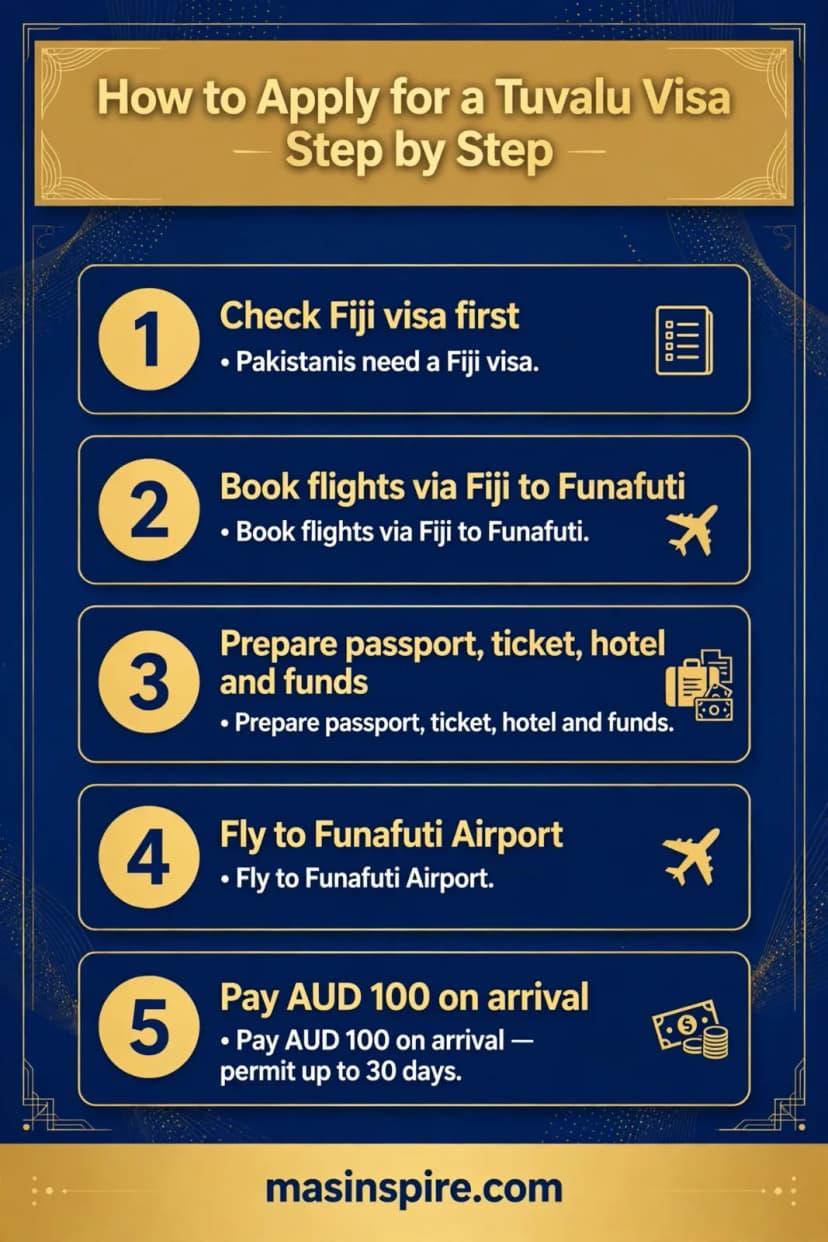
How to Apply: Step-by-Step
There is no online application for a Tuvalu visitor permit, and that surprises many travellers. The whole process is done in person, in the right order, and the order matters more than any single document. The steps below assume you are a Pakistani passport holder living in Ho Chi Minh City. If you are in Pakistan when you read this, the steps are the same, except that you would deal with the Fiji visa from Pakistan rather than from Vietnam.
- Check your passport and your Vietnam residence first. Confirm that your Pakistani passport is valid for at least six months beyond your planned arrival date in Tuvalu and has at least one blank page. Then check your Vietnam temporary residence card or visa: it must still be valid when you return to Vietnam. If it expires while you are away, renew it before you travel. A traveller who cannot re-enter Vietnam has a serious problem at the end of the trip.
- Sort out the Fiji visa before anything else. Pakistanis need a visa for Fiji, the only practical gateway to Tuvalu. Apply online through the Fiji Immigration portal, or through the nearest Fiji mission, and wait for the decision before booking non-refundable flights or hotels. Fiji visitor visas are reported to take about 14 working days.
- Book your flights around the Fiji Airways timetable. Fly from Ho Chi Minh City to Fiji, normally via Singapore, Kuala Lumpur, or Bangkok to Nadi, then Fiji Airways from Nadi or Suva to Funafuti. Check the current schedule on the Fiji Airways website and book the Funafuti flights first. Make sure your departure flight falls inside the 30 days of your visitor permit.
- Book accommodation for every night. Tuvalu has a small number of hotels and guesthouses, mostly on Funafuti, and they can be full. Book early, get written confirmation with the name, address, and telephone number, and print it. If you are staying with a host, ask them for a signed invitation letter with their full name, address, and telephone number, and keep their phone number in your phone.
- Buy Australian dollars in cash in Vietnam. Get enough AUD to cover the AUD 100 permit fee, the AUD 30 departure tax, and your daily costs, with a reserve. Keep the permit fee and departure tax in a separate envelope. Your Vietnamese bank card may not work in Tuvalu at all.
- Buy travel insurance with medical evacuation cover. Check that the policy covers Tuvalu by name, covers medical evacuation to Fiji or Australia, and covers trip cancellation and missed connections. Keep the policy number and emergency number on paper as well as on your phone.
- Prepare your document folder. Put together everything in the checklist for your type of trip: passport, return ticket, accommodation proof, bank statements, Fiji visa, insurance, and the cash. Make photocopies and keep them in a separate bag. Tell someone at home your flight numbers and your hotel details.
- Fly to Fiji, then to Funafuti. At each airport, keep your documents where you can reach them. Airlines check your Fiji visa before boarding the Fiji flight, and they may check your onward ticket to Tuvalu. On the Fiji Airways flight to Funafuti, fill in the Tuvalu arrival card carefully.
- At Funafuti Airport, go to the immigration counter. Hand over your passport, arrival card, return ticket, and accommodation proof. Answer the officer's questions simply and honestly. Pay the AUD 100 fee in cash and get a receipt. Check the date written in your passport before you leave the counter, and make sure it matches your departure flight.
The process at Funafuti Airport is normally quick, often a matter of minutes, because the aircraft is small and few passengers arrive at once. Quick does not mean careless: the officer is doing a real check, and your preparation decides how smooth it is.
Where to Apply from Vietnam: The Nearest Tuvalu Mission
There is no Tuvalu embassy or consulate in Vietnam, and there is no Tuvalu embassy in Pakistan. That is normal for Tuvalu, which has only six resident diplomatic missions in the whole world. For a visitor permit, you do not need a mission at all, because the permit is issued on arrival. You only need a mission in two situations: if you want to ask a question before you travel, or if you are applying for a long-stay permit to enter and reside.
The nearest and most practical mission for a traveller in Vietnam is the Tuvalu High Commission in Suva, Fiji. Suva is on your route anyway, because every flight to Tuvalu passes through Fiji. The High Commission is at Tuvalu House, 16 Gorrie Street, Suva, Fiji, postal address P.O. Box 14449, Suva, Fiji, telephone +679 3301355. The High Commission has been Tuvalu's mission in Fiji since 1976, and it is the mission most likely to be able to answer a practical question about entry, extensions, or long-stay permits. Contact it well before you travel and keep any answer you receive.
Tuvalu's other missions are the Embassy in Taipei, Taiwan; the High Commission in Wellington, New Zealand; the Embassy in Abu Dhabi, United Arab Emirates; the High Commission in Canberra, Australia, which opened in 2025; and the Permanent Mission to the United Nations in New York, which also serves as the Embassy of Tuvalu to the United States and Cuba. The Taipei embassy is at 9th Floor, No. 9-1, Lane 62, Tianmu West Road, Shilin District, Taipei, telephone +886 2 2876 7606. For a traveller living in Vietnam, Taipei is geographically closer than Suva, and it is a real alternative if you need to contact a Tuvalu mission. But Suva is the better first choice, because it sits on the flight route and because the staff there deal with travellers arriving through Fiji every week.
Two warnings about mission information. First, the Brussels embassy closed in 2022, and Tuvalu's accreditation to the European Union and Belgium is now managed from the embassy in Abu Dhabi. Older websites and directories still list Brussels as an open embassy. Do not write to Brussels. Second, several older directories list email addresses for the Suva High Commission that are personal Yahoo addresses from many years ago. This guide does not repeat them, because they may no longer be monitored. Telephone the High Commission, or write to it by post, or ask the Tuvalu Permanent Mission in New York for the current contact details if you cannot reach Suva. The Permanent Mission's consular services page is listed in the Official Websites section of this guide.
Pakistan has no embassy or consulate in Tuvalu, and neither Australia's High Commission nor Taiwan's embassy in Funafuti can provide consular help to a Pakistani citizen as of right. Your practical safety net is your travel insurance emergency number, your hotel, and the Tuvalu police, emergency number 911. Save all three in your phone before you fly.
Getting There: Flights from Vietnam via Fiji
There is no direct flight from Vietnam to Tuvalu, and there is no direct flight from anywhere in Asia to Tuvalu. The only international airport in Tuvalu is Funafuti International Airport, and the only airline flying scheduled passenger services there is Fiji Airways, operating as Fiji Link with ATR 72-600 turboprop aircraft. Every journey to Tuvalu therefore has two parts: a long-haul flight from Vietnam to Fiji, and a short regional flight from Fiji to Funafuti.
The usual route from Ho Chi Minh City is to fly to Nadi International Airport in Fiji, via Singapore, Kuala Lumpur, or Bangkok. Singapore Airlines, Vietnam Airlines, Malaysia Airlines, and Thai Airways all serve routes that connect onwards to Fiji Airways services to Nadi. From Nadi, you connect to Fiji Airways to Funafuti, either directly from Nadi or via Suva. The Suva to Funafuti flight takes about two and a half hours. The whole journey from Ho Chi Minh City to Funafuti typically takes between 20 and 30 hours including connections.
Fiji Airways flies between Fiji and Funafuti only a few times a week, and the timetable is the single most important planning constraint after the Fiji visa. For most of 2026 the pattern was three flights a week between Suva and Funafuti, on Tuesdays, Thursdays, and Saturdays, plus flights from Nadi on Mondays. From 12 December 2026, Fiji Airways redistributed the service: Nadi to Funafuti increased to three flights a week, and Suva to Funafuti reduced to two flights a week, with the total number of weekly flights between Fiji and Tuvalu unchanged at five. That change was announced in advance, but it shows how quickly the timetable can move. Do not plan from a timetable you read months ago. Check the Fiji Airways website for the exact days and times for your dates, and book the Funafuti flights before you book anything else.
Because the flights are so infrequent, a missed connection can cost you days, not hours. If your flight into Nadi is delayed and you miss the Funafuti flight, the next one may be two or three days later. Build at least one spare night in Fiji into your plan in each direction, and choose travel insurance that covers missed connections. On the way home, the same logic applies: if you miss your flight out of Funafuti, you may have to wait days for the next one, and your permit may expire while you wait. Keep the Immigration Office informed if a delay affects your permitted stay.
Funafuti Airport is small: no jet bridges, no large shops, daytime flights only. The runway doubles as a public space when no aircraft is expected. Arrive in good time, keep your departure tax money ready, and let your hotel arrange transport.
Finally, a practical point about luggage. The ATR 72-600 is a small aircraft with limited baggage allowance. Check the Fiji Airways baggage limit for the Funafuti flight when you book, because it may be lower than the allowance on your long-haul flight from Vietnam. Pack light, keep your documents and your Australian dollars in your hand luggage, and do not put anything you need on arrival in checked baggage.
Fiji Transit and the Fiji Visa: The Step Most Pakistanis Miss
This is the most important section in the guide, because it is the step that most often goes wrong. Tuvalu is easy to enter. Fiji is not, for a Pakistani passport holder. Pakistan is not on Fiji's visa-exempt list, so Pakistanis must obtain a Fiji visa before travelling to Fiji, including for many transits. If you arrive in Fiji without the right permission, the airline can refuse to let you board in Vietnam, or Fiji immigration can refuse you entry on arrival. Either way, your Tuvalu trip ends before it begins.
Fiji's visa-exempt list covers more than 110 nationalities, including the United States, the United Kingdom, the European Union, Australia, New Zealand, Canada, and Japan. Pakistan is not on it. The Fiji Ministry of Foreign Affairs states that nationals of countries not on the list must apply for a visitor visa before entering Fiji. There is no visa on arrival for a Pakistani passport. The Fiji visitor visa is applied for online through the Fiji Immigration IMMIHUB portal, or through the nearest Fiji embassy or high commission. The single-entry visitor visa is reported to cost FJD 93, and the multiple-entry visitor visa FJD 185, The single-entry visa is valid for three months for one journey; the multiple-entry visa is valid for twelve months, each stay up to four months. Processing is reported to take about 14 working days from the day the visa officer receives the application. Those fee and processing figures come from Fiji Immigration material quoted in secondary sources, and the Fiji Ministry of Foreign Affairs pages themselves do not state the fee or the processing time in every version. Confirm both figures on the IMMIHUB portal at the time you apply, and do not treat them as fixed.
Transit is where the confusion is greatest. Fiji allows a narrow no-visa transit exemption: a traveller whose onward flight departs within three hours may transit without a visa. That is a very short window. If your connection in Fiji is longer than three hours, if you need to change airports between Nadi and Suva, if you need to stay overnight, or if you want to leave the airport, you need a Fiji visa. Many itineraries from Vietnam to Funafuti involve an overnight stay in Fiji or a change of airport, because the long-haul flight arrives in Nadi and the Funafuti flight leaves from Suva, or because the connection times do not line up within three hours. Some guides describe up to six hours airside; this guide treats the three-hour figure as controlling. The safe rule is simple: unless your onward flight departs within three hours and you stay airside, get a Fiji visa.
The documents for a Fiji visitor visa are similar to any visitor visa: a passport valid for more than six months, a completed form, two recent passport-size photographs, a hotel booking or host letter, a confirmed return ticket, and proof of funds. Apply at least a month before travel, because 14 working days is three calendar weeks, and do not book non-refundable travel until the visa is granted.
There is a second transit question that matters on the way home. Your return journey also passes through Fiji, so your Fiji visa must still be valid when you come back through, and it must cover the number of entries your itinerary requires. A single-entry Fiji visa used on the way out may not cover the way back. Check the entries on your Fiji visa against your itinerary before you leave Vietnam. If your itinerary needs two entries into Fiji, get a multiple-entry visa or two single-entry visas, as the Fiji system allows.
Airlines check all of this before boarding, using the Timatic database, which is the system airlines use to check entry requirements. Carry printed copies of your Fiji visa, hotel booking, and return ticket for check-in.
Processing Time: What to Expect
The Tuvalu visitor permit has no processing time in the usual sense, because it is issued at the airport when you arrive. There is no waiting period, no online status check, and no approval letter to wait for. The time it takes is the time you spend at the immigration counter, which is normally a matter of minutes. That is the whole point of a permit on arrival, and it is why Tuvalu is one of the simplest countries in the world to enter, once you have reached it.
But the journey as a whole has three waiting times, and you must plan for all of them. The first is the Fiji visa, which takes about 14 working days. That is the longest wait and the one that sets your earliest travel date. The second is the permit to enter and reside, if you need one, which takes several weeks to a few months, because it is a formal application that must be considered by the Immigration Department in Funafuti and, for work, by the employer and the ministry. There is no published processing time for that permit, and this guide does not invent one. The third is the extension of a visitor permit inside Tuvalu, which is decided by the Immigration Office in Funafuti. Some sources say complex permits can take five to ten business days for a referral. Apply for an extension at least a week before your current permit expires, and do not book a departure flight that depends on the extension being granted on the last day.
There is no express or priority service for the Tuvalu visitor permit, because there is nothing to prioritise. Anyone who offers to sell you an express Tuvalu visa service is selling a service that does not exist. There is also no appointment system for the visitor permit. You do not book a slot at the airport. You arrive, you queue, and you are seen.
A practical timeline: six to eight weeks before travel, check your passport and Vietnam residence and start the Fiji visa application. Once the Fiji visa is granted, book flights and accommodation. Two weeks before travel, buy Australian dollars and insurance and prepare your document folder. In the last week, re-check the Fiji Airways timetable and confirm your hotel.
| Step | Processing time | Notes |
|---|---|---|
| Tuvalu visitor permit on arrival | Minutes, at the airport counter | No advance application. Issued on arrival. |
| Fiji visitor visa (single entry) | About 14 working days | Apply online via IMMIHUB. Confirm the current time on the portal. |
| Visitor permit extension in Tuvalu | Decided by the Immigration Office; allow at least a week | Apply before your current permit expires. |
| Permit to enter and reside | Several weeks to a few months | No published processing time. Apply well in advance. |
| Business endorsement | On arrival, at the counter | Ask the Principal Immigration Officer. Carry an invitation letter. |
Extending Your Stay in Tuvalu
If you are in Tuvalu on a visitor permit and you want to stay longer, go to the Immigration Office in Funafuti before your permit expires. The office is in the Government Building in Vaiaku, on Funafuti. Ask for an extension of your visitor permit, explain your reason, and bring your passport, your return or onward ticket showing your new departure date, proof of accommodation for the extra nights, and proof that you can pay for the extra days. The extension fee is AUD 100, and the extension, if granted, is for up to 30 more days.
Apply early, not on the last day of your permit. The Immigration Office is small, and Sundays are observed as a day of rest, when many services close. Bring cash for the fee, keep the receipt, and check the new date in your passport before you leave.
An extension is a decision, not a right. The officer can refuse for insufficient funds, no accommodation for the extra nights, no onward ticket, or a reason that looks like an attempt to live in Tuvalu. A clear, honest reason helps: a delayed flight, a family event, or a research visit needing a few more days.
If your extension is refused, you must leave by the date on your original permit. Do not argue at the counter, and do not overstay to make a point. Leave, and if you want to come back, apply again from outside with a clearer plan. If your extension is granted, remember that it is for up to 30 days, not for as long as you like, and that the new date in your passport is your new legal limit. There is no second routine extension described in the regulation-based sources. If you need more than 60 days in total, you should have applied for a permit to enter and reside before you travelled, not a visitor permit extension after you arrived.
If your flight out of Funafuti is cancelled or delayed beyond your permit date for reasons outside your control, go to the Immigration Office immediately with evidence of the cancellation and your hotel booking for the extra nights. Do not assume the delay is automatically excused.
Arriving at Funafuti Airport: What Happens on Arrival
Your aircraft will land at Funafuti International Airport, a small airport on Fongafale islet, the main islet of Funafuti atoll. The flight is a daytime flight, and the arrival is normally calm and unhurried. You will walk from the aircraft to the terminal, where you will complete or hand in your arrival card, and then go to the immigration counter. There is no separate visa counter, because there is no visa to buy in advance. The immigration officer is the person who issues your visitor permit.
At the counter, hand over your passport and arrival card first, with your return ticket and accommodation booking ready in your hand. The officer may ask why you are visiting, how long you will stay, where you will stay, and how you will pay. Answer in short, direct sentences. Do not mention work or a business plan unless you are applying for a business endorsement with the documents to support it.
You will then pay the AUD 100 fee in cash. Have the exact amount ready if you can. The officer will stamp or endorse your passport with the visitor permit and write the permitted stay date. Check that date before you leave the counter. If it is wrong, or if it is shorter than your return ticket, raise it politely at once. It is much harder to correct after you have left the airport. Keep the receipt for the fee with your passport.
After immigration you pass through customs. Declare anything that may be prohibited or subject to duty, and declare cash over AUD 3,000. Marijuana, cannabis, CBD products, and firearms may not be brought in without a special licence. The duty-free allowance for travellers over 18 is reported as 200 cigarettes and one litre of spirits or wine; confirm the current allowance before you travel.
Once through customs, your hotel or host will normally meet you. There is no public bus system; Funafuti is small, and many visitors walk or cycle. Keep your passport and cash secure at your hotel and carry a photocopy when you go out.
Work, Study and Business in Tuvalu
A visitor permit does not allow work. That is stated explicitly in the Tuvalu Immigration Regulations, and it is worth repeating, because it is the rule that most often causes trouble. On a visitor permit, you may not take a job, you may not start or manage a business, you may not study at an educational institution, and you may not carry out proselytising activities. The only exception is the limited business endorsement described earlier, which allows very limited business activity, such as meetings, for a maximum of 30 days, for an extra AUD 100. Even with that endorsement, you may not be employed in Tuvalu.
To work in Tuvalu you need a work permit and a permit to enter and reside, both depending on a Tuvaluan employer who must offer you a job, sponsor your application, and show no qualified Tuvaluan was available. The application goes to the Immigration Department in Funafuti, and it normally requires a signed employment contract, police clearance certificates from the countries where you have lived, a medical examination, and evidence of your qualifications. Permits are normally issued for one year at first and can be renewed. The foreign worker population in Tuvalu is very small, concentrated in government, aid, and fisheries work, and there is no realistic prospect of arriving as a visitor and finding a job. Do not travel to Tuvalu to look for work. You will not be allowed to work, and you may be refused entry if the officer believes that is your purpose.
Study follows the same logic. There is no student visa issued on arrival. To study in Tuvalu, you need a permit to enter and reside for study, supported by a letter of acceptance from the institution and evidence that you can pay your tuition and living costs. The main institution is the University of the South Pacific campus on Funafuti, which offers a limited range of courses. If you are a teacher, an English teacher in Vietnam for example, and you are interested in teaching in Tuvalu, you would need a job offer from a school or the ministry, a work permit, and a residence permit, arranged before you travel. A visitor permit is not a route into a teaching job.
Business is similarly limited. Tuvalu is a tiny market with a population of about 11,000, limited infrastructure, and high import costs. Foreigners cannot simply arrive and open a shop. A business visit on a visitor permit with a business endorsement is for meetings, inspections, and discussions. Setting up and running a business requires a permit to enter and reside for business purposes, approval from the relevant authorities, and compliance with Tuvaluan business and investment rules. Treat any offer that starts with arriving on a visitor permit and sorting out business paperwork later with great caution.
Money, Health, Safety and Common Mistakes
Money first, because it causes more failed trips than any other practical issue. Tuvalu uses the Australian dollar, there are no ATMs, and card payments are not reliable. Bring all the cash you need in Australian dollars, in a mix of notes, and keep it secure. Prices are high, because almost everything is imported by ship or by air. Budget at least AUD 100 to AUD 150 per day for accommodation, food, and transport, and more if you plan to visit the outer islands or to hire a boat.
Health care in Tuvalu is very limited. The only hospital is Princess Margaret Hospital on Funafuti, and it has limited facilities, limited supplies, and limited specialist care. Serious cases are evacuated to Fiji or Australia, and evacuation is expensive. Travel insurance with medical evacuation cover is not optional for Tuvalu; it is the single most important purchase after your flights. No vaccinations are required for entry, according to the United States Department of State. Make sure your routine vaccinations are up to date and discuss the trip with a doctor in Ho Chi Minh City before you travel, especially if you take regular medication. Bring all medication for the whole trip, in original packaging with a prescription, because pharmacies have limited stock.
Tuvalu is at risk of tropical cyclones between November and April, which covers the Christmas and New Year period when many people travel. Check the weather forecast before you travel, keep your insurance active, and keep enough cash and medication to cope with a delay of several days. Tap water is often not safe to drink; drink bottled or treated water.
Tuvalu is a deeply Christian and conservative society. Dress modestly, ask before photographing people, and respect Sunday observance, when many shops and services close. Same-sex sexual activity between men is illegal in Tuvalu under the Penal Code, and travellers should be aware of that law and behave accordingly. The United States rates Tuvalu Level 1, exercise normal precautions, and the United Kingdom issues no warning against travel, but normal precautions still apply: keep your passport and cash secure, share your itinerary with someone at home, and save the emergency number 911 in your phone.
Common mistakes and how to avoid them
- Forgetting the Fiji visa. This is the biggest mistake. A Pakistani traveller who books flights to Tuvalu without a Fiji visa can be refused boarding in Vietnam. Apply for the Fiji visa first, and do not book non-refundable travel until it is granted.
- Assuming a long transit is visa-free. The no-visa transit exemption in Fiji covers an onward departure within three hours only. A longer transit, an overnight stay, or a change of airport needs a Fiji visa.
- Booking flights that do not match the permit. Fiji Airways flies to Funafuti only a few times a week. Make sure your departure flight falls inside your 30-day permit, and do not count on an extension.
- Arriving without enough cash. There are no ATMs in Tuvalu; arriving with only a bank card or only US dollars leaves you unable to pay the permit fee or buy food.
- Spending the permit fee or the departure tax. Keep AUD 100 for the permit and AUD 30 for the departure tax in a separate envelope from the day you leave Vietnam.
- Letting your Vietnam residence expire. Check your temporary residence card or Vietnam visa before you travel, and renew it if it expires while you are away. You need it to return to Vietnam.
- Paying an agent for a Tuvalu e-visa. There is no Tuvalu e-visa. Any payment for one is wasted money.
- Treating the permit as a right. The immigration officer decides. Carry the full document set, answer questions honestly, and check the date written in your passport before you leave the counter.
- Planning to work on a visitor permit. Work, study, and business activity are not allowed on a visitor permit. Do not travel to Tuvalu to look for a job.
- Trusting a single secondary source for a fee. Fees are reported differently by different websites; confirm any flagged figure in writing with the High Commission in Suva or the Immigration Office before you pay or book.
Official Websites
Use the official sources below to confirm every figure in this guide before you book or travel. The Immigration Regulations 2014 control the permit, stay length, and fees; Fiji Immigration controls the Fiji visa; Fiji Airways controls the flight timetable. Secondary sources follow the official ones.
| Source | Website | What it covers |
|---|---|---|
| Tuvalu Permanent Mission to the UN: Consular Services | https://www.un.int/tuvalu/tuvalu/consular-services | Official statement of the entry permit rule for visitors. |
| Tuvalu Permanent Mission to the UN: Embassies | https://www.un.int/tuvalu/tuvalu/embassies | Official list of Tuvalu missions and honorary consulates. |
| Tuvalu Immigration Regulations 2014 | https://www.refworld.org/sites/default/files/legacy-pdf/en/2014-0/6062d0404.pdf | Controlling law: visitor permit, Schedule 1 fee-free list, fees, residence permits. |
| UK Foreign, Commonwealth and Development Office: Tuvalu Travel Advice | https://www.gov.uk/foreign-travel-advice/tuvalu/print | Passport validity, visa rules for British citizens, safety, money, health. |
| United States Department of State: Tuvalu Travel Advisory | http://travel.state.gov/content/passports/en/country/tuvalu.html | Entry requirements, passport validity, cash limits, no ATMs, health. |
| Fiji Airways: Tuvalu Flights | https://www.fijiairways.com/en-tv/flights-tuvalu-to-fiji-airfare-deals | Flights between Fiji and Funafuti, fares, schedules. |
| Fiji Immigration: IMMIHUB Visa Portal | https://immihub.immigration.gov.fj/ | Online Fiji visitor visa applications for Pakistani passport holders. |
| Taiwan Ministry of Foreign Affairs: Tuvalu | https://en.mofa.gov.tw/CountryInfoEn.aspx?CASN=5&n=1287&sms=0&s=11&tabs=08617EE9DB3C61E3 | Embassy of Tuvalu in Taipei and Embassy of Taiwan in Funafuti. |
| Funafuti Airport (Departure Tax) Regulations | http://www.paclii.org/tv/legis/consol_act_2008/caafatr605/?stem=&synonyms=&query=mspo1975468 | Departure tax of 30 dollars per departing passenger. |
| Visa Policy of Tuvalu | https://en.wikipedia.org/wiki/Visa_policy_of_Tuvalu | Summary of visa-free, fee-free, and visa-on-arrival categories. |
| List of Diplomatic Missions of Tuvalu | https://en.wikipedia.org/wiki/List_of_diplomatic_missions_of_Tuvalu | Tuvalu missions abroad, including Suva, Taipei, Wellington, Abu Dhabi, Canberra. |
| UrduPoint: Tuvalu Visa for Pakistanis | https://www.urdupoint.com/travel/visa/tuvalu.html | Secondary source: AUD 100 fee, 30-day stay, extension, departure tax. |
| UrduPoint: Fiji Visa for Pakistanis | https://www.urdupoint.com/travel/visa/fiji.html | Secondary source: Fiji visa requirement, FJD 93 / FJD 185 fees, 3-hour transit rule. |
| Travel Visa Stack: Tuvalu Visa for Pakistan Citizens | https://www.travelvisastack.com/visa-guide/pakistan/tuvalu | Secondary source: permit on arrival, documents, cash payment. |
| VisaVerge: Tuvalu Visa Requirements 2026 | https://www.visaverge.com/questions/guide-to-getting-a-visa-for-tuvalu/ | Secondary source: AUD 100 fee, 30-day permit, overstay fines. |
| Passport Index: Tuvalu Destination Dashboard | https://www.passportindex.org/country/tuvalu/ | Secondary source: visa on arrival for Pakistani passport holders, 30 days. |
| 123Embassy: Tuvalu High Commission in Suva | https://www.123embassy.com/Embassy/13349/Tuvalu-in-Suva | Secondary source: Suva High Commission address, telephone, hours. |
| Wise: Tuvalu Visa Requirements | http://wise.com/gb/hub/visa-checker/tuvalu/visa-requirement | Secondary source: visa on arrival for Pakistan, passport validity, documents. |
| Visas.guide: Pakistan to Fiji Visa Requirements | https://visas.guide/visa-requirements/pakistan-to-fiji | Secondary source: Fiji visa requirement, 4-month stay, extension. |
| iExplore: Tuvalu Visas and Vaccinations | https://www.iexplore.com/articles/travel-guides/australia-and-south-pacific/tuvalu/visas-and-vaccinations | Secondary source: 30-day stay, extension to three months claim, vaccinations. |
Frequently Asked Questions About the Tuvalu Visa for Pakistanis
Do Pakistanis need a visa for Tuvalu?
No. Pakistani passport holders do not need a visa in advance. You receive a visitor permit on arrival at Funafuti International Airport, valid for up to 30 days, provided your passport is valid for at least six months and you have a return ticket, accommodation proof, and proof of funds. The officer makes the final decision.
How much is the Tuvalu visitor permit for Pakistanis?
AUD 100, payable in cash on arrival at Funafuti Airport. Pakistan is not on the fee-free list in Schedule 1 of the Tuvalu Immigration Regulations 2014, so the fee applies. Some websites quote AUD 100 to AUD 120, but the regulation states a flat AUD 100. Keep the receipt.
How long can Pakistanis stay in Tuvalu?
Up to 30 days on a visitor permit on arrival. The immigration officer writes the permitted stay in your passport, and that date is your legal limit. It can be shorter than 30 days if your return ticket is earlier or your funds cover a shorter trip, so check the date before you leave the counter.
Can I extend my stay in Tuvalu?
Yes, by up to 30 more days. Apply to the Immigration Office in Funafuti before your first permit expires, with your passport, a new onward ticket, accommodation proof, and proof of funds. The extension fee is AUD 100. The extension is not automatic. Longer extensions reported online are unverified; do not plan on them.
Is there a Tuvalu embassy in Vietnam or Pakistan?
No. Tuvalu has no mission in Vietnam or Pakistan. The nearest practical mission is the Tuvalu High Commission in Suva, Fiji, at Tuvalu House, 16 Gorrie Street, Suva, telephone +679 3301355. You do not need a mission for a visitor permit, which is issued on arrival, but you can contact Suva with questions or for a long-stay permit.
Do I need a Fiji visa to travel to Tuvalu?
Almost certainly yes. Pakistanis need a Fiji visa before travelling, because Pakistan is not on Fiji's visa-exempt list. The only no-visa transit is for an onward flight departing within three hours. A longer connection, an overnight stay, or a change of airport between Nadi and Suva needs a Fiji visitor visa, applied for online through the IMMIHUB portal.
Is there an e-visa for Tuvalu?
No. Tuvalu does not run an e-visa portal, and there is no online visa application for a visitor permit. The permit is issued on arrival at Funafuti Airport. Any website or agent charging for a Tuvalu e-visa is selling something that does not exist.
What documents do I need on arrival in Tuvalu?
A Pakistani passport valid for at least six months with a blank page, a completed arrival card, a confirmed return or onward ticket, proof of accommodation, proof of sufficient funds, AUD 100 in cash for the permit fee, and travel insurance with medical evacuation cover. Also carry your Fiji visa and your Vietnam residence document.
How do I get to Tuvalu from Vietnam?
Fly from Ho Chi Minh City to Nadi in Fiji, via Singapore, Kuala Lumpur, or Bangkok, then Fiji Airways from Nadi or Suva to Funafuti. Fiji Airways is the only airline flying to Tuvalu, a few times a week, and the Suva to Funafuti flight takes about two and a half hours. Book the Funafuti flights first.
Can I work in Tuvalu on a visitor permit?
No. A visitor permit does not allow work, business activity, study, or proselytising. To work you need a work permit and a permit to enter and reside, sponsored by a Tuvaluan employer who has shown no qualified Tuvaluan was available. Do not travel to Tuvalu to look for work.
Can I study in Tuvalu on a visitor permit?
No. Study requires a permit to enter and reside for study, supported by a letter of acceptance from the institution and evidence of funds. The visitor permit is for tourism and family visits only. Arrange any study permit before you travel.
Is there a departure tax when leaving Tuvalu?
Yes. The Funafuti Airport (Departure Tax) Regulations set a departure tax of 30 dollars per passenger leaving Funafuti for a destination outside Tuvalu. Ask your airline whether the tax is already included in your ticket. If it is not, keep AUD 30 in cash for your last day.
What happens if I overstay in Tuvalu?
Overstaying is penalised with a daily fine, and it can lead to detention until the next available flight, deportation at your own expense, and difficulty entering Tuvalu or other Pacific countries later. The exact daily amount is disputed between secondary sources, with AUD 20 and AUD 100 per day both reported, so this guide does not state a settled figure. Always leave or extend before your permit expires.
Do I need travel insurance for Tuvalu?
Yes, and it should include medical evacuation cover. Tuvalu has one small hospital on Funafuti with limited facilities, and serious cases are evacuated to Fiji or Australia at great cost. Check that your policy covers Tuvalu by name, covers evacuation, and covers missed connections, because flights to Funafuti run only a few times a week.
Can I visit Tuvalu with my family, including children?
Yes. Each child needs a separate passport valid for at least six months, a return or onward ticket, and accommodation covering the whole family. Carry each child's birth certificate, and if only one parent is travelling, a written consent letter from the other parent with a copy of their passport. Budget the AUD 100 permit fee for each traveller, including each child, unless the Immigration Office confirms otherwise in writing.
This guide was checked on 29 November 2026 against the Tuvalu Immigration Regulations 2014, the Tuvalu Permanent Mission to the United Nations, the United Kingdom Foreign, Commonwealth and Development Office, the United States Department of State, Fiji Immigration, and Fiji Airways. Fees, timetables, and entry rules can change without notice, and where sources conflict this guide has disclosed the conflict and named the source it treats as controlling, but no guide can replace a written confirmation from the Tuvalu High Commission in Suva or the Immigration Office in Funafuti. Confirm the permit fee, the Fiji visa, and your flight dates in writing before you pay for anything that cannot be refunded, and keep your documents and your cash ready for the immigration officer at Funafuti Airport. The immigration officer makes the final decision, and this guide does not guarantee visa approval or entry.


