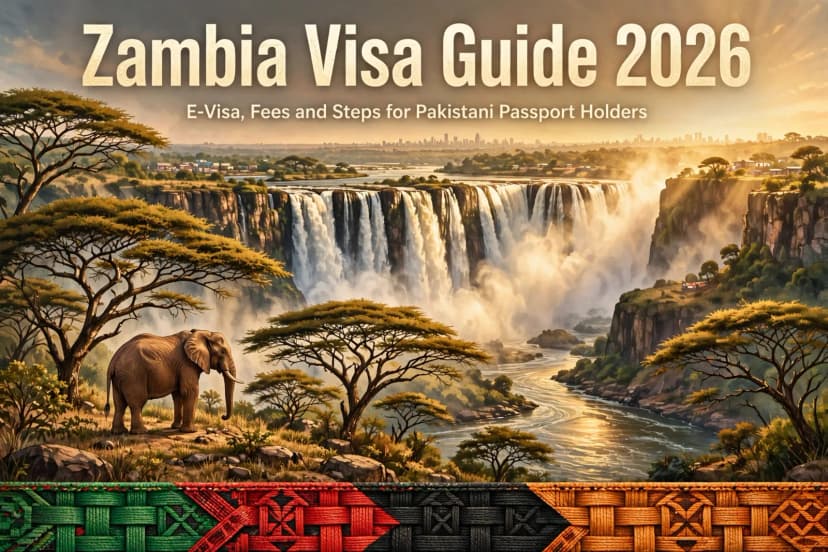
Zambia Visa Guide 2026: Types, Requirements, Documents and Application Steps
Last checked: 29 November 2026. This guide is for Pakistani passport holders living in Vietnam. Zambia is one of southern Africa's most rewarding destinations — Victoria Falls at Livingstone, walking safaris in South Luangwa, the Lower Zambezi, and the copper-belt cities of Lusaka and the Copperbelt — and for a Pakistani passport holder the door is open, but only through one route: an online e-visa with prior approval from Zambia's Director General of Immigration, obtained before you travel. There is no visa on arrival for Pakistanis, no visa-free entry, and no Zambian embassy in Vietnam or in Pakistan to walk into. This guide gives you the full mechanics — the fees as they changed on 1 January 2026, the documents, the step-by-step online application, and every point where the sources disagree — so you can apply once and apply correctly. Visa rules change without notice — always confirm the live rules on the official eServices portal before paying any fee or booking a non-refundable ticket.
Introduction
Zambia is a landlocked country in southern Africa that rewards the traveller who plans properly. Its headline attraction is Victoria Falls — Mosi-oa-Tunya, "the Smoke that Thunders" — which Zambia shares with Zimbabwe at Livingstone, and which is at its most powerful between February and May, when the Zambezi is in full flood. Beyond the Falls there is South Luangwa National Park, the birthplace of the walking safari; the Lower Zambezi, where elephants wade past riverside lodges; Kafue National Park, one of Africa's largest; and the capital Lusaka, where most Pakistani visitors will land at Kenneth Kaunda International Airport. English is the official language, the currency is the Zambian kwacha (ZMW), and the country is generally regarded as one of the more stable and welcoming in the region — the British Foreign Office calls travel in the larger cities and major game parks generally safe in daylight, while warning of serious crime, fatal road crashes and dangerous wildlife.
For a Pakistani living in Vietnam, Zambia is also a trip that needs more planning than a holiday to Thailand or Malaysia. There is no direct flight from Ho Chi Minh City or Islamabad to Lusaka: realistic routings run through Doha, Dubai, Addis Ababa, Nairobi or Johannesburg. There is no Zambian embassy in Vietnam and none in Pakistan, so there is no counter to visit and no visa sticker to collect. And, most importantly, Pakistan sits in the strictest of Zambia's three nationality categories. Zambia divides foreign nationals into three groups: those who need no visa at all (167 nationalities since 1 January 2025, including the United States, the United Kingdom, Canada, Australia, China, Japan and most of Europe); those who can get a visa on arrival, at a mission, or online (including Russia, Brazil, Mexico, Thailand and Ghana); and those who need a visa before travel with advance clearance — a group that includes India, Pakistan, Bangladesh, Nigeria, Egypt, the Philippines, Vietnam, Cambodia and Macau. If you hold a Pakistani passport, you are in that third group, and the clearance step is the whole trip: you apply online through the Department of Immigration's eServices portal, your application is vetted by the Director General of Immigration in Lusaka, and you must hold the approval letter in your hand before you board the plane. The receipt for your payment is not permission to enter, and no officer at Lusaka airport can fix a missing approval on the spot.
The good news is that the system, once understood, is straightforward and entirely online. You register an account, fill in Form 16, upload a small set of documents, pay by card, and wait for the approval letter by email. The fee changed on 1 January 2026 — a single-entry visa now costs USD 50, double and multiple entry USD 80 — and the approval letter is valid for 90 days from issue. The stay granted on arrival is separate from the visa's validity, and the sources disagree on it, as section 6 explains. This guide names the source behind every figure it quotes, and where the sources contradict each other it says so plainly.
Do Pakistani Passport Holders Need a Visa for Zambia?
Yes. Pakistani passport holders need a visa before travelling to Zambia, and it must be obtained online in advance. Zambia's Department of Immigration lists Pakistan among the nationals requiring a visa prior to travel. Pakistan is not on the visa-exempt list of 167 nationalities that travel visa-free under Statutory Instrument No. 78 of 2024, and it is not on the visa-on-arrival list either. The rule for Pakistan is the strictest Zambia operates: a "referred visa", or Category 3 visa, requiring individual vetting and security clearance by the Director General before arrival. The document you receive is not a visa sticker but an Electronic Visa Approval Letter, issued online, which you print and present with your passport at the port of entry. The airline will ask for it before boarding, and the officer at Lusaka or Livingstone will ask for it again on arrival.
Three consequences follow from the referred-visa status, and each of them matters for planning. First, the approval must be in hand before you fly — the Department's own wording is that nationals in this category must apply to the Director General of Immigration before arrival and receive a letter of approval before travelling. Second, the decision is made in Lusaka, not at a Zambian mission abroad, so there is no embassy that can speed it up for you. Third, the approval letter is valid for 90 days from the date it is issued, so you should time your application to leave enough room for a decision while still leaving your travel dates inside that 90-day window. Apply two to four weeks before departure: early enough for a slow decision, late enough that the 90-day validity still covers your trip.
Your passport must be valid for at least six months from the date of entry, and the Department requires at least three full blank pages for entry stamps. The British Foreign Office states the same six months but lists two blank pages — a direct conflict. The Department runs the border, so carry three. Your passport must also remain valid for the whole of your stay, and if you arrive by air you must hold a valid return or onward ticket; by land or water, you must show enough funds for your stay and departure.
Children are not exempt. Every traveller, including a child travelling on their own passport, needs their own visa and their own approval letter, with the same documents uploaded for the child. A child travelling with one parent should carry the other parent's written consent and the child's birth certificate, in case the officer asks for evidence of the relationship and permission to travel.
One more point of honesty: the approval letter is not a guarantee of entry. The Department states that a visa is an endorsement granting permission to enter subject to examination by an immigration officer at the port of entry, and the visa's validity is the window for entering Zambia, not the length of your stay. The officer decides how many days to stamp, checks your return ticket and funds, and can refuse entry even to a traveller holding a valid approval letter.

Types of Zambia Visas for Pakistani Passport Holders
Zambia's entry visas for a Pakistani applicant are all applied for through the same online route — the eServices portal, Form 16, prior approval by the Director General — and differ by purpose, number of entries and stay allowed. Longer stays, work and study use a separate permit system after entry, covered in sections 10 and 11, and a visit visa never carries a right to work or study.
Tourist visa
The tourist visa is the standard short-visit visa for a holiday, a safari, or a trip to Victoria Falls, and it is the category most readers will apply for. It is issued as a single-entry, double-entry or multiple-entry e-visa, and the approval letter is valid for 90 days from the date of issue. The stay granted on arrival for an ordinary visitor or tourist is up to 90 days in any period of 12 months, counted from the day of first entry — that is the Department of Immigration's published position, repeated by the British Foreign Office. One caution: the officer may stamp only 30 days even where you are entitled to 90; the remaining days can be added at the nearest immigration office free of charge, so read the stamp before you leave the desk. A separate secondary source reports 30 days initially, extendable to 90 — that conflicts with the Department's 90-day position, and this guide follows the Department as the controlling source.
Visit visa — family and friends
The visit visa covers visiting family or friends in Zambia. It is applied for through the same e-visa route and at the same fee as the tourist visa, but the supporting documents are different: instead of a hotel booking, you provide a signed letter from your host in Zambia giving their full address and telephone number, plus a copy of the host's national registration card or Zambian immigration permit. Give the host's details exactly as they appear on their documents, and make sure your host knows you have named them, because the Department may contact them during vetting.
Business visa
The business visa covers meetings, conferences, trade discussions and other short business activity. It is applied for through the same e-visa route at the same fee, with a cover letter on your company's letterhead, an invitation from the host company in Zambia, and a certified copy of the host company's certificate of incorporation. The stay for a business visitor is capped at 30 days in any 12-month period — not 90 — under the Department's published rules for visa-exempt business visitors, and the same 30-day cap is the figure independent guides apply to business, student and volunteer visits generally. A business visa does not authorise paid work in Zambia; if you will be employed or paid locally, you need a work permit, covered in section 11.
Transit visa
The transit visa covers passing through Zambia to a third country, for example by land from Zimbabwe or Tanzania, or a longer stopover in Lusaka between flights. It costs USD 25 under the fee schedule in force from 1 January 2026 and allows a stay of up to 7 days. Apply through the same e-visa portal before travel, and carry the visa for your final destination as well. If your stopover is only a few hours and you do not leave the airport, check with your airline whether a transit visa is needed — but do not assume it is not.
Day tripper permit
The day tripper permit costs USD 10 and covers a visit of under 24 hours that exits through the same port — the classic case is a visitor staying on the Zimbabwe side of Victoria Falls who crosses the bridge to Livingstone for an afternoon and returns the same day. It is issued at the border only, not online, and it is a stamp for that single day, not a visa. A Pakistani passport holder should not assume they can buy one at the border without prior approval: confirm with the Department in writing whether the day tripper stamp is available to you before planning a same-day crossing around it.
KAZA Univisa — Zambia and Zimbabwe
The KAZA Univisa is a single joint tourist visa for Zambia and Zimbabwe, named for the Kavango Zambezi Transfrontier Conservation Area. It costs USD 50, is valid for up to 30 days in any 12-month period as long as the holder remains within Zambia and Zimbabwe, allows multiple crossings between the two countries during that window, and also covers day trips into Botswana through the Kazungula border post, returning the same day. On the Zambian side it is issued at exactly four places: Kenneth Kaunda International Airport in Lusaka, Harry Mwaanga Nkumbula International Airport in Livingstone, the Victoria Falls border post, and the Kazungula border post. It is also available online as an e-visa. An overnight stay in Botswana, or leaving the two countries for a third country, ends it, even if some of the 30 days are left.
Here is the catch for a Pakistani passport holder: Pakistan is not on the KAZA Univisa's published list of eligible nationalities. The list includes the United States, the United Kingdom, Canada, Australia, New Zealand, Japan, South Korea, Brazil and most European Union states, while China and India are not on it — and neither is Pakistan, according to the Pakistan-focused reporting on this route. That means you cannot buy a KAZA Univisa as a Pakistani passport holder. A Falls trip covering both countries needs two separate visas instead: a Zambian e-visa and a Zimbabwean e-visa, each applied for in advance — Zimbabwe also places Pakistan in a category requiring approval before flying. The USD 50 KAZA fee is confirmed by the Department's own KAZA page, checked 27 November 2026, so the figure is solid — it is the eligibility that excludes you.
No visa on arrival, and no visa-free route for Pakistanis
To be explicit: Pakistanis are strictly ineligible for visa-free entry and for visa-on-arrival facilities at Zambian border points. Every Pakistani national must submit an online application and receive an official Electronic Visa Approval Letter before boarding any flight to Zambia. Websites and agents that offer a "Zambia visa on arrival" for a Pakistani passport are selling something that does not exist for your nationality, and any payment made to them is money lost. The only official portal is eservices.zambiaimmigration.gov.zm, run by the Department of Immigration, and the only official domain for the Department itself is zambiaimmigration.gov.zm. Look-alike sites with similar names charge extra fees and deliver nothing the Department will honour.
Visa Comparison Table
| Visa type | Entry | Fee (from 1 Jan 2026) | Validity of approval | Stay granted | How to get it |
|---|---|---|---|---|---|
| Tourist e-visa, single entry | Single entry | USD 50 | 90 days from issue | Up to 90 days in any 12 months | eServices portal, Form 16, prior approval |
| Tourist e-visa, double entry | Double entry | USD 80 | 90 days from issue | Up to 90 days in any 12 months | eServices portal, Form 16, prior approval |
| Tourist e-visa, multiple entry | Multiple entry | USD 80 | 90 days from issue | Up to 90 days in any 12 months | eServices portal, Form 16, prior approval; issued only by Immigration Headquarters |
| Visit visa (family and friends) | Single entry as standard | USD 50 | 90 days from issue | Up to 90 days in any 12 months | eServices portal, Form 16, host letter required |
| Business visa | Single entry as standard | USD 50 | 90 days from issue | Up to 30 days in any 12 months | eServices portal, Form 16, host company invitation required |
| Transit visa | Single entry | USD 25 | 90 days from issue | Up to 7 days | eServices portal, Form 16, prior approval |
| Day tripper permit | Same-port exit within 24 hours | USD 10 | Single day | Under 24 hours | At the border only; confirm availability for Pakistanis in writing first |
| KAZA Univisa | Multiple crossings Zambia and Zimbabwe | USD 50 | Up to 30 days in any 12 months | Up to 30 days within Zambia and Zimbabwe | Not available to Pakistani passports; use separate Zambia and Zimbabwe e-visas |
Visa Fees: What Each Route Costs
Zambia's visa fees changed on 1 January 2026, and that change is the single most important fact in this section, because most older guides — and some of the Department of Immigration's own pages — still show the old figures. Under Statutory Instrument No. 99 of 2025, in force from 1 January 2026, a single-entry visa costs USD 50, a double-entry visa costs USD 80, and a multiple-entry visa costs USD 80. A transit visa costs USD 25, the KAZA Univisa costs USD 50, and the day tripper permit costs USD 10. Those are the figures to budget on.
The conflict is real and must be stated plainly. The Department's visitors page and its public notice of August 2024 list a single-entry visa at USD 25, double entry at USD 40 and multiple entry at USD 75 — the old schedule. The Department's separate Fees page lists single entry at USD 50 and double and multiple entry at USD 80, plus a small card fee. Some secondary sources still quote the old USD 25 figure as if it were current. The controlling source is the fee regulation in force from 1 January 2026 and the amount the portal itself displays when you pay: the portal shows the exact amount before you confirm payment, and published examples put a single entry at about USD 50.50 by card, double or multiple entry at about USD 80.80, transit at about USD 25.28 and a day tripper at about USD 10.10 — the small extra being the card administration charge. If the portal displays a different amount from the figures in this guide, stop and verify with the Department before paying, because the portal amount is the amount you will actually be charged.
There is no published express or priority fee, and no official fee for a faster decision. One agency-style source quotes an average fee of around USD 61 for a Pakistani applicant — that appears to bundle the official fee with a service charge, and it is not an official fee. Pay only through the official portal, by card, and keep the receipt and case number: the receipt is proof of payment, not permission to enter. Visa fees are not refundable if the visa is refused. Never pay any person or website that claims to sell a Zambia visa outside the official portal.
Two further charges apply at departure: international departures carry a charge equivalent to USD 25, and domestic departures a USD 3 security charge, according to the independent guides. They are normally included in the ticket — check with your airline whether they are already in your fare.
| Item | Fee (from 1 Jan 2026) | Note |
|---|---|---|
| Single-entry e-visa | USD 50 (about USD 50.50 by card) | Approval valid 90 days from issue |
| Double-entry e-visa | USD 80 (about USD 80.80 by card) | One re-entry within the validity period |
| Multiple-entry e-visa | USD 80 (about USD 80.80 by card) | Issued only by Immigration Headquarters through the e-visa facility |
| Transit visa | USD 25 (about USD 25.28 by card) | Up to 7 days |
| Day tripper permit | USD 10 (about USD 10.10 by card) | Under 24 hours, same-port exit, border only |
| KAZA Univisa | USD 50 (about USD 50.50 by card) | 30 days, Zambia and Zimbabwe; not available to Pakistani passports |
| Older schedule (pre-2026, now superseded) | USD 25 single, USD 40 double, USD 75 multiple | Still shown on some official pages; do not budget on these figures |
| International departure charge | Equivalent of USD 25 | Departure charge, often included in the ticket |
| Domestic departure security charge | USD 3 | Departure charge, often included in the ticket |
Processing Times
The Department of Immigration does not publish a guaranteed processing time for a referred e-visa. No official service standard appears on the Department's website or the eServices portal, so everything below is reported time, not official time, and the honest planning figure is the longest one.
The commonly reported window is 3 to 5 business days for a standard e-visa decision, quoted by the Pakistan-focused Travel Visa Stack guide updated 21 October 2026, which advises applying at least 7 to 10 days before travel to leave room beyond that window. A second source, the Pakistan-focused Zambia immigration site, reports 5 to 10 working days for a referred Pakistani application, with the vetting done at the Department's headquarters in Lusaka — a longer window that reflects the extra clearance step for Category 3 nationalities. A third source reports about 3 to 7 business days. The figures conflict because a referred visa is not an automated grant: the time depends on the vetting queue in Lusaka, on whether the Department asks follow-up questions, and on whether your host is contacted.
Plan on the longer figure. Apply at least two weeks before departure, and three to four weeks ahead if your dates are fixed. Do not book a non-refundable ticket or pay a non-refundable safari deposit until the approval letter is in your inbox. If the portal still shows your application pending close to travel, contact the Department of Immigration in Lusaka — the Pakistan-focused guides list +260 211 255282 and the contact centre +260 211 428800 — and quote your case number. Do not pay any agent who promises to speed up a decision; there is no published fast-track.
Complete Document Checklists
No single official checklist is published for Pakistani applicants, but the documents below are the ones named across the Department's published arrival conditions and the Pakistan-focused guides that track the portal's requirements. Upload clear, legible scans as JPG, PNG or TIFF files, and keep the originals with you when you travel.
All applicants — core documents
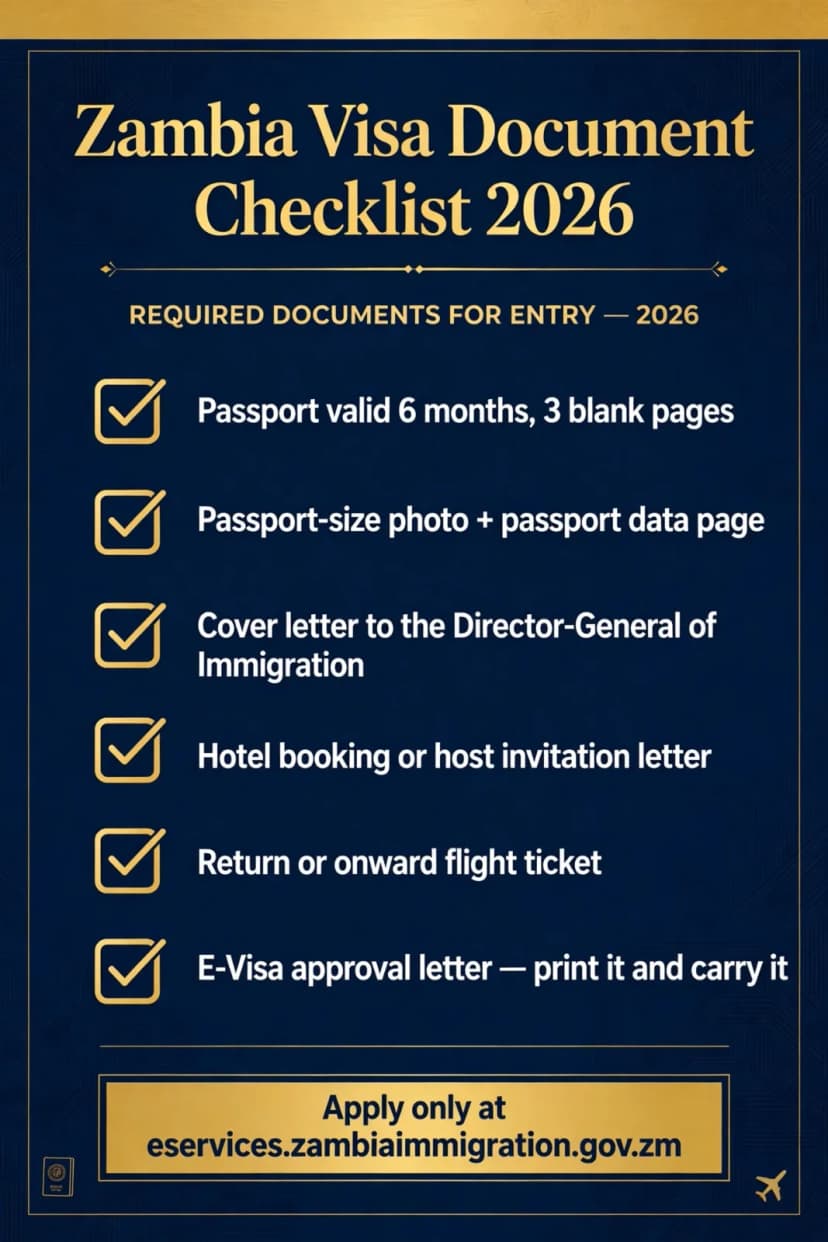
- Original Pakistani passport, valid at least six months from the date you enter Zambia, with at least three full blank pages (the Department requires three; the British Foreign Office says two — carry three)
- Scanned copy of the passport's bio-data page, uploaded to the portal
- Recent colour passport-size photograph against a plain white background, following standard ICAO guidelines
- Cover letter signed by you, addressed to the Director General of Immigration, stating your travel dates, purpose of visit, and contact information
- Confirmed return or onward flight ticket — required for arrival by air
- Proof of accommodation in Zambia: a hotel booking for the whole stay, or a host invitation letter (see the visit-visa list below)
- Proof of sufficient funds — bank statements for the last three to six months are the usual evidence; no official minimum is published
- A valid email address that you can access while travelling, because the approval letter arrives by email
- A bank card that works for international online payments in USD, for the portal fee
- Copy of your CNIC — requested in Pakistan-focused guides for applications made from Pakistan
- Copy of your Vietnam temporary residence card or visa — for applications made from Vietnam, to show your legal residence there
- Yellow fever vaccination certificate, only if arriving from or transiting more than 12 hours through a risk country (see section 13); a direct journey from Pakistan or Vietnam does not trigger this
- Polio vaccination certificate from NADRA — needed to leave Pakistan, according to the Pakistan-focused guides, if you are travelling from Pakistan rather than from Vietnam
- Travel and medical insurance — strongly recommended; medical facilities outside Lusaka are basic, and the British Foreign Office advises adequate cover for treatment and repatriation
Tourist visa — additional documents
- Hotel bookings covering the whole stay, with the hotel's name, address and telephone number
- A simple day-by-day itinerary — Livingstone and Victoria Falls, South Luangwa, the Lower Zambezi — so the purpose of the trip is clear to the vetting officer
- Safari or tour bookings, if you have them, with the operator's details
Family or friends visit visa — additional documents
- Signed letter from your host in Zambia, giving their full name, full address and telephone number, and the dates and purpose of your visit
- Copy of the host's Zambian national registration card or Zambian immigration permit
- Proof of the relationship — family registration documents, marriage certificate or birth certificate as applicable
Business visa — additional documents
- Cover letter on your own company's letterhead, stating the purpose and dates of the visit
- Invitation letter from the host company in Zambia
- Certified copy of the host company's certificate of incorporation
- Your company's registration or NTN documents, where the portal asks for them
Student visa — additional documents
- Admission letter from the Zambian institution
- Evidence of funds for tuition and living costs — no official amount is published
- Academic certificates, as requested by the institution and the portal
Work visa — additional documents
- Employment contract or letter of appointment from the Zambian employer
- Letter from the employer justifying the hire of a foreign national
- Curriculum vitae and certified copies of your qualifications, translated into English where needed
- Police clearance certificate from your country of residence
- Medical report — for a long-term employment permit, from a Zambian government medical facility
Children travelling with you — additional documents
- The child's own passport, valid at least six months from entry, with blank pages
- The child's own e-visa application and approval letter — every traveller needs one, including children on their own passports
- The child's birth certificate, showing the parents' names
- Written consent from the parent who is not travelling, where only one parent is travelling with the child
How to Apply: Step-by-Step
E-visa — step by step
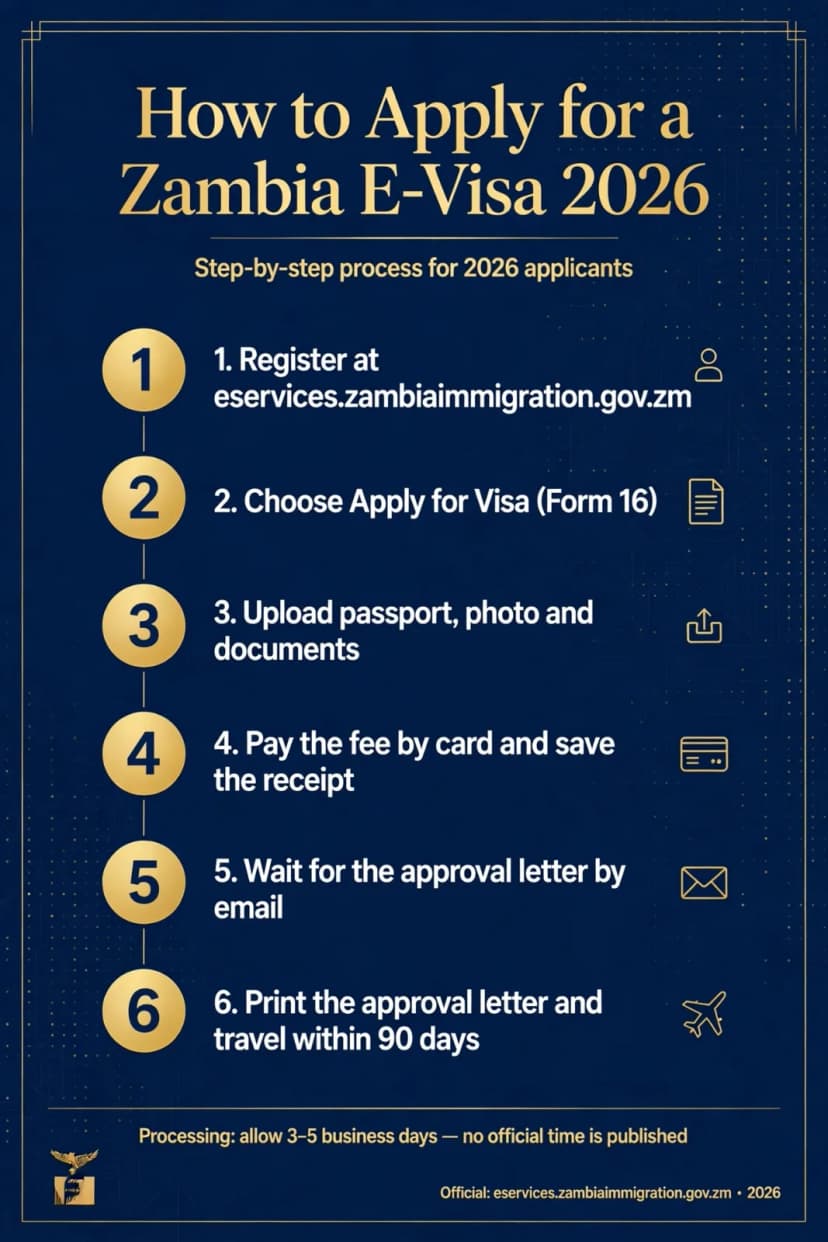
Step 1 — Check your passport and your dates. Confirm your passport is valid for at least six months from the date you will enter Zambia and has at least three full blank pages. Fix your travel dates: the approval letter is valid for 90 days from issue, so apply two to four weeks before departure. Have your return ticket and hotel booking or host letter ready, because the portal asks for them.
Step 2 — Open the official portal and register an account. Go to eservices.zambiaimmigration.gov.zm and register an account with an email address you can access while travelling. Use only this address: look-alike domains charge extra fees and are not the Department. If the portal is slow, try again later rather than switching to an agent site.
Step 3 — Log in and choose Apply for Visa (Form 16). After logging in, go to My Workplace and choose Apply for Visa (Form 16). Select the visa type that matches your purpose — tourist, visit, business or transit — and the number of entries you need. A single entry is enough for most trips; choose double or multiple entry only if your itinerary genuinely leaves and re-enters Zambia, because it costs USD 80 and a multiple-entry visa is issued only by Immigration Headquarters.
Step 4 — Fill in the form and upload your documents. Enter your details exactly as they appear in your passport. Upload the passport bio-data page, the photograph, the signed cover letter to the Director General, the hotel booking or host letter, the return ticket, and the category documents from section 7, as JPG, PNG or TIFF files. Check every upload is legible — a blurred passport scan is a common reason for a query or refusal.
Step 5 — Check the preview, pay the fee by card, and save the receipt and case number. Review the whole application on the preview screen before submitting — a mistake after payment is much harder to fix. Pay the fee by card (USD 50 single, USD 80 double or multiple, USD 25 transit) and note the exact amount the portal displays, including the small card charge (about USD 50.50 for a single entry). Save the payment receipt and case number where you can find them from your phone as well as your laptop.
Step 6 — Wait for the approval letter by email. The Department vets the application in Lusaka and sends the approval letter to your email; you can also download it from your account. The receipt is not permission to enter, and the case number is not the approval. Do not travel until the letter itself has arrived.
Step 7 — Print the approval letter and check it. Print the approval letter and check the name spelling, passport number, visa type, entries and validity dates — it is valid for 90 days from issue, so confirm your travel falls inside that window. Carry the printed letter with your passport, and keep a copy on your phone. If anything is wrong, contact the Department before you travel.
Step 8 — Fly to Lusaka or Livingstone. The main gateway is Kenneth Kaunda International Airport in Lusaka. For a Falls-centred trip, Harry Mwaanga Nkumbula International Airport in Livingstone is closer. Carry the approval letter, return ticket, hotel or host details and proof of funds in your hand luggage, not in checked baggage.
Step 9 — Present your documents at the border and read your stamp. At the desk, show your passport and the printed approval letter, and be ready to show your return ticket, accommodation details and proof of funds. Read the stamp before you leave the desk: the entitlement is up to 90 days in any 12 months, but the officer may stamp only 30 days, and that stamped number is what you must not overstay. If it is shorter than your itinerary, raise it there and then.
Step 10 — If you need longer, extend before the stamp expires. Extensions go through an immigration office or the eServices platform; the remaining days of a 90-day entitlement can be added at the nearest immigration office free of charge. Apply well before your stamped stay runs out: overstaying can mean a fine, arrest, imprisonment or deportation, and will damage any future application.
What not to do
Do not apply for a visa on arrival, because Pakistanis cannot get one. Do not pay any agent or website other than the official portal. Do not book a non-refundable ticket or pay a non-refundable safari deposit before the approval letter arrives. Do not travel on the assumption that a KAZA Univisa will be sold to you at the Victoria Falls border, because Pakistan is not on the eligible list. And do not treat the payment receipt as permission to travel — only the approval letter is.
Applying from Vietnam and Pakistan — No Zambian Embassy in Either Country
This section contains the finding most readers will find surprising: there is no Zambian embassy in Vietnam, and there is no Zambian embassy in Pakistan either — and for a Pakistani applicant, that does not matter, because the whole application is online.
Zambia's diplomatic network in Asia is small. In the region it has an embassy in Beijing, a High Commission in New Delhi, a High Commission in Kuala Lumpur, and an embassy in Tokyo, among others. The High Commission in Kuala Lumpur is the mission with concurrent accreditation for Vietnam — its published accreditation covers Brunei, Cambodia, Indonesia, Laos, the Philippines, Thailand and Vietnam — so if you need consular contact while you are in Vietnam, Kuala Lumpur is the mission that covers you. For Pakistan, the nearest Zambian mission is the High Commission in New Delhi, and the Pakistan-focused guides direct Pakistani applicants to New Delhi for consular enquiries. But neither mission issues your visa: as a Category 3 referred-visa national, you apply online through the eServices portal, and the decision is made by the Director General of Immigration in Lusaka. You do not need to visit any embassy, in any country, at any point in the process. That is the practical advantage of the referred e-visa system — the mission map does not block you.
Two cautions follow. First, some directories and agent sites claim there is a Zambian embassy in Islamabad. There is not: the Pakistan-focused Zambia immigration site states plainly that at the moment there is no Zambia Embassy in Pakistan. Do not send documents or money to any Islamabad address claiming to be one. Second, if you need help while in Zambia, your own country's mission is the one to call: Pakistan's embassy in Harare, Zimbabwe, is accredited to Zambia. Save its details before you travel, along with the Department's Lusaka numbers — +260 211 255282 and the contact centre +260 211 428800, as reported in the Pakistan-focused guides.
The practical route for a reader in Ho Chi Minh City is simple. Apply from home in Vietnam, on the portal, with your Vietnam temporary residence card as proof of where you live. Pay by a card that works for international USD payments — check with your bank first, because a declined card can leave an application half-submitted. Travel via Doha, Dubai, Addis Ababa, Nairobi or Johannesburg to Lusaka or Livingstone, carrying the printed approval letter with your passport. If you apply from Pakistan, the process is identical, with two additions: a CNIC copy in the file, and the polio vaccination certificate from NADRA, which the Pakistan-focused guides list as needed to leave Pakistan.
Student Route: Studying in Zambia
Zambia has a real higher-education sector — the University of Zambia in Lusaka is the largest public university, with Copperbelt University and private colleges in Lusaka, Kitwe and Ndola — and a Pakistani student with an admission offer can study there. The route has two stages, and the visa is only the first.
Stage one is the entry visa. A student applies for an entry visa through the same e-visa portal, Form 16, with prior approval by the Director General, and the supporting documents are the admission letter from the Zambian institution, evidence of funds for tuition and living costs, and the standard core documents from section 7. No official student-visa fee separate from the standard e-visa fee was found, so budget on USD 50 and confirm the fee the portal displays. The stay for a student or volunteer visit is capped at 30 days on the entry visa — that is the entry stamp, not the course — and the right to remain for the course comes from stage two.
Stage two is the study permit, applied for after arrival through the Department of Immigration. The permit is issued for the duration of the course and is renewable. Secondary sources report a study permit issuance fee of about ZMW 6,750 (roughly USD 337) with renewal at about ZMW 9,000, and a processing time of 30 to 60 days — but those figures come from a single secondary guide, not from the Department, so treat them as reported rather than verified, and confirm the current fee with the Department or your institution before you budget on them. What is verified is the structure: the institution sponsors the permit, you apply with the admission letter and proof of funds, and you must hold the permit before your entry stamp expires. Do not arrive on a tourist visa intending to sort out study later without an admission letter: the Department can refuse entry to a traveller whose stated purpose does not match their documents.
Two further notes. First, a new law is coming: Zambia enacted the Immigration Control Act, 2026 in April 2026, intended to replace the Immigration and Deportation Act of 2010, with a revised permit framework. Until the Act is brought into operation by Statutory Instrument, the current framework applies — but if your course starts in 2027, check whether the new Act has commenced, because permit names, fees and procedures may change. Second, there is no published official figure for the funds a student must show, and no scholarship route for a Pakistani student was found in the sources consulted. Do not pay any agent who claims a confirmed student visa allocation or a guaranteed scholarship.
Work Route: Jobs, Business and Work Permits
Zambia is not a general jobs market for foreign workers. The economy is built on copper mining, agriculture and a growing services sector in Lusaka, and an employer must show no qualified Zambian is available for the role — evidenced by press advertisements in two leading newspapers, in A5 size — before an employment permit is approved. A tourist or business visa does not authorise work, even for a short engagement, and working on a visit visa risks refusal of entry, a fine, deportation and a future ban.
The work route that does exist is the sponsored one, and it has three rungs. The first is the Temporary Employment Permit, which covers business visitors staying longer than 30 days and short-term assignments, capped at six months within any 12-month period; secondary sources report a fee of about USD 500 and a processing time of 1 to 2 weeks for a short-term work permit of up to 3 months, renewable once to a maximum of 6 months. The second is the Employment Permit, the standard long-term work authorisation for employment exceeding six months, issued for 2 years and renewable in 2-year increments up to a maximum of 10 years; only the employer, a practising lawyer or a registered immigration consultant can apply for it on your behalf — you cannot apply for your own employment permit. The third is the Investor's Permit, for a person investing in a Zambian business, reported at about USD 600 with a stay of 2 to 5 years.
The fees for these permits are reported, not verified, and the sources conflict. One employer guide reports the Employment Permit issuance fee for the private sector at ZMW 24,000, the Temporary Employment Permit at ZMW 18,000 and a Visiting Permit at ZMW 6,667, with reduced rates for NGOs and government bodies. Another source reports the Employment Permit at USD 900 to 1,000, citing ZMW 18,000 for issuance and ZMW 21,000 for renewal. Neither comes from the Department itself, so get the current fee in writing from the Department or the employer's immigration consultant before accepting a job offer. What is consistent is the process: the employer applies and justifies the hire, supplying the contract, the press advertisements and a succession plan showing how a Zambian understudy will be trained, and the Department inspects and decides — typically in 4 to 6 weeks for an employment permit.
For a Pakistani reader in Vietnam, the honest assessment is this: Zambia is realistic for a specific sponsored role — a mining engineer, a teacher at an international school, a specialist with a multinational, a humanitarian posting — and not for general job-seeking. Do not travel on a tourist visa to look for work, and do not pay any agent who promises a work permit or a guaranteed job. If you have a genuine offer, the employer does the permit work; your part is the entry visa through the portal, backed by the employer's letter and contract.
Family Visits and Permanent Residence
Family visits are the most straightforward long reason to travel to Zambia, and the route is the visit visa described in section 3: your host in Zambia invites you, provides their full address and telephone number and a copy of their national registration card or immigration permit, and you apply through the portal with the invitation letter and proof of the relationship. There is no separate family-reunification visa class published, so the visit visa is the route, applied for in the same two-to-four-week window as a tourist visa. If the visit is long, say so in the cover letter and show funds for the whole stay, because the officer decides the stamped stay, and a 30-day stamp on a 60-day plan means a trip to an immigration office.
Permanent residence is a separate, long-term matter, not something a first-time visitor should plan around. The permit framework includes a Residence Permit, and secondary sources report a fee of about USD 750 (ZMW 15,000) and 30 to 60 days' processing, open to people who have held an Employment Permit for 10 years or more, an Investor's Permit for 3 years or more, a Spouse Permit for 5 years or more, dependants aged 21 or below of a permit holder, people born to a citizen, and retirees with proof of sufficient funds — with a reported monthly income requirement of about USD 2,110. Those figures are reported, not verified, and describe a status reached after years of lawful residence, not a visa applied for from abroad. A visit visa cannot be converted into permanent residence at the airport. If you are married to a Zambian citizen or have lived in Zambia for many years on permits, ask the Department directly which permit applies to you, and get the answer in writing.
Common Mistakes to Avoid
Mistake 1 — Arriving without the approval letter. Pakistanis must hold the Electronic Visa Approval Letter before boarding. The payment receipt is not the approval, the case number is not the approval, and no officer at Lusaka airport can issue one on arrival. If the letter has not arrived, do not fly.
Mistake 2 — Budgeting on the old fee. The fee changed on 1 January 2026: single entry is now USD 50, not USD 25, and double or multiple entry is USD 80, not USD 40 or USD 75. Older guides and some official pages still show the old figures. Budget on USD 50 and check the amount the portal displays before you pay.
Mistake 3 — Assuming the KAZA Univisa is available to you. It costs USD 50 and covers Zambia and Zimbabwe for 30 days, but Pakistan is not on the eligible-nationalities list. A Falls trip covering both countries needs a Zambian e-visa and a separate Zimbabwean e-visa, each applied for in advance.
Mistake 4 — Using an agent site instead of the official portal. The only official portal is eservices.zambiaimmigration.gov.zm. Look-alike sites charge extra fees and deliver nothing the Department will honour. Apply yourself, on the official portal, and pay only there.
Mistake 5 — Applying too late, or too early. The Department publishes no processing time, and reported times run from 3 to 5 business days to 5 to 10 working days. Apply two to four weeks before departure: late enough that the 90-day approval validity still covers your trip, early enough that a slow decision does not cancel it.
Mistake 6 — Carrying a passport with two blank pages. The British Foreign Office says two blank pages are enough; the Department of Immigration says three full blank pages are required. The Department runs the border. Carry three.
Mistake 7 — Travelling on a business visa for a two-month trip. Business, student and volunteer visits are capped at 30 days, not 90. Plan the trip inside the cap, or apply for the right category.
Mistake 8 — Working on a visit visa. A tourist or business visa does not authorise paid work, even for a short engagement. Work needs a permit applied for by the employer. Working on a visit visa risks deportation and a future ban.
Mistake 9 — Not reading the entry stamp. The officer may stamp 30 days even where you are entitled to 90. The stamped number is what you must not overstay. Read it before you leave the desk, and raise a short stamp there and then.
Mistake 10 — Forgetting the yellow fever rule on a multi-country trip. Zambia itself is not a yellow fever risk country, and a direct journey from Pakistan or Vietnam does not trigger the requirement. But if you arrive from, or transit for more than 12 hours through, a risk country — Angola, the Democratic Republic of Congo, Kenya, Nigeria, Ethiopia or others — you must show a valid certificate, effective from the tenth day after vaccination. A long transit through Addis Ababa or Nairobi can trigger this, so check your routing.
Mistake 11 — Travelling without insurance or without a return ticket. A valid return or onward ticket is a published arrival condition for air arrivals, and medical facilities outside Lusaka are basic. Carry the ticket, carry proof of funds, and carry insurance that covers medical treatment and repatriation.
Reasons for Refusal
No official Zambian refusal list is published, so the reasons below are drawn from the referred-visa system and the conditions the official sources state.
No prior approval, or an application made at the border. A Pakistani who arrives without an approval letter will be refused entry, and the airline may refuse to carry you in the first place.
Passport validity or blank pages. A passport with less than six months' validity from entry, or without three full blank pages, fails the Department's published entry condition.
Missing or inconsistent documents. A blurred passport scan, a cover letter that does not match the stated purpose, a hotel booking that does not cover the dates, or a host letter without the host's address or permit copy can all cause a query or a refusal. The vetting officer in Lusaka cannot see you; the file is all they have.
No return ticket or no proof of funds. A valid return or onward ticket is required for air arrivals, and arrivals by land or water must show enough funds for the stay and departure. An applicant who cannot show either looks like a person who does not intend to leave.
Purpose does not match the visa. A traveller who says "tourist" but carries a work contract, or who says "business meeting" but has no host company invitation, will be refused. Apply for the category that matches what you will actually do.
Adverse vetting or an adverse record. A referred visa involves security clearance by the Director General. An adverse record, a previous overstay, or an inconsistency found during vetting can lead to refusal. There is no published appeal route; the remedy is to find out the reason, fix it, and reapply with a complete file and a fresh fee.
Health conditions. If you arrive from a yellow fever risk country without a valid certificate, you risk refusal at the border even if the visa was issued. The certificate becomes valid on the tenth day after vaccination, so get it at least ten days before travel.
Frequently Asked Questions
1. Do Pakistani citizens need a visa for Zambia?
Yes. Pakistani ordinary passport holders must obtain an e-visa in advance through the Department of Immigration's eServices portal, with prior approval by the Director General of Immigration. Pakistan is in the Category 3 referred-visa group: no visa-free entry, no visa on arrival, and no approval means no boarding.
2. How much does a Zambia e-visa cost for a Pakistani passport?
Under the fee schedule in force from 1 January 2026, a single-entry e-visa costs USD 50, a double-entry or multiple-entry e-visa costs USD 80, and a transit visa costs USD 25. Card payments add a small administration charge — about USD 50.50 for a single entry. Older pages still list USD 25, USD 40 and USD 75; those are the superseded pre-2026 figures.
3. How long does a Zambia e-visa take to process?
No official processing time is published. Reported times are 3 to 5 business days in one Pakistan-focused guide and 5 to 10 working days in another, reflecting the extra vetting for referred nationalities. Apply at least two weeks before departure, and three to four weeks ahead if your dates are fixed.
4. How long can I stay in Zambia on a tourist visa?
An ordinary visitor or tourist may spend up to 90 days in any 12-month period, counted from the day of first entry, according to the Department of Immigration. The officer at the desk may stamp only 30 days; the remaining days can be added at the nearest immigration office free of charge. Business, student and volunteer visits are capped at 30 days. One secondary source reports 30 days initially, extendable to 90 — this guide follows the Department's 90-day position.
5. How long is the e-visa approval letter valid?
The approval letter is valid for 90 days from the date it is issued. Travel inside that window. The 90 days is the window for entering Zambia, not the length of your stay — the stay is the number of days stamped in your passport on arrival.
6. Can I get a visa on arrival in Zambia?
No. Pakistani passport holders are strictly ineligible for visa on arrival. You must apply online and receive the approval letter before you fly. Any website or agent offering a Zambia visa on arrival for a Pakistani passport is not selling a real route.
7. Is there a Zambian embassy in Vietnam or Pakistan?
No, neither country has a Zambian mission. Zambia's High Commission in Kuala Lumpur is accredited to Vietnam, and the High Commission in New Delhi is the nearest mission for Pakistanis. It does not matter for the visa, because the whole application is online through the eServices portal and the decision is made in Lusaka.
8. Can I buy a KAZA Univisa as a Pakistani passport holder?
No. The KAZA Univisa costs USD 50 and covers Zambia and Zimbabwe for up to 30 days, plus day trips into Botswana through Kazungula, but Pakistan is not on its published list of eligible nationalities. For a Victoria Falls trip covering both countries, get a Zambian e-visa and a separate Zimbabwean e-visa, each in advance.
9. What is the official website to apply for a Zambia e-visa?
The official portal is eservices.zambiaimmigration.gov.zm, run by the Zambia Department of Immigration. Register an account, go to My Workplace, choose Apply for Visa (Form 16), upload your documents, pay by card, and wait for the approval letter by email. The Department's own site is zambiaimmigration.gov.zm. Use no other site.
10. Do I need a yellow fever certificate for Zambia?
Only if you arrive from, or transit for more than 12 hours through, a country with a risk of yellow fever transmission. Zambia itself is not a risk country, and neither Pakistan nor Vietnam is on the risk list, so a direct journey from either country does not trigger the requirement. The certificate is valid for life and becomes effective on the tenth day after vaccination.
11. How many blank passport pages does Zambia require?
Carry three full blank pages. The Department of Immigration requires at least three; the British Foreign Office says two. The Department runs the border, so three is the safe figure. Your passport must also be valid for at least six months from the date you enter Zambia.
12. Can I work in Zambia on a tourist or business visa?
No. A visit visa never carries a right to work. Paid work needs an Employment Permit, applied for by the employer, a practising lawyer or a registered immigration consultant — not by you — after the employer shows no qualified Zambian is available for the role. Short assignments use a Temporary Employment Permit, capped at six months in any 12 months.
13. Can I study in Zambia?
Yes, with an admission letter from a Zambian institution. Apply for the entry visa through the portal with the admission letter and proof of funds, then apply for a study permit after arrival for the duration of the course. The entry stamp for a student visit is capped at 30 days, so the study permit is what lets you stay for the course. No official student fee was found; secondary sources report about ZMW 6,750 for issuance.
14. What happens if my Zambia visa is refused?
There is no published appeal route, and the fee is not refundable. The practical remedy is to find out the reason — most commonly a missing approval step, a passport problem, an inconsistent file, or no return ticket or proof of funds — fix it, and reapply with a complete file and a fresh fee. Do not pay any agent who promises to overturn a refusal for a fee.
15. Is Zambia safe to visit in 2026?
Zambia is generally regarded as one of the more stable countries in the region, and the British Foreign Office describes travel in larger cities and major game parks as generally safe during daylight hours. It warns about serious crime, frequent fatal road crashes, demonstrations in Lusaka that can become violent, and wild animals that are unpredictable and do kill. Malaria is present all year, including in the main safari areas, so take prophylaxis on a travel clinic's advice, and carry travel health insurance that covers treatment and repatriation.
Official Immigration Websites
| Organisation | What it is | Website |
|---|---|---|
| Zambia Department of Immigration — eServices portal | The official e-visa portal: register, Form 16, upload, pay, approval letter (eservices.zambiaimmigration.gov.zm) | https://eservices.zambiaimmigration.gov.zm |
| Zambia Department of Immigration | The Department's own site: visa categories, nationals requiring a visa prior to travel, fees, KAZA Univisa (zambiaimmigration.gov.zm) | https://www.zambiaimmigration.gov.zm |
| UK Foreign, Commonwealth and Development Office | Zambia travel advice — entry requirements, passport validity, yellow fever, safety, health | https://www.gov.uk/foreign-travel-advice/zambia/entry-requirements |
| Government of Canada | Zambia travel advice — entry and exit requirements, stay limits, health, safety | https://travel.gc.ca/destinations/zambia |
| US Department of State | Zambia International Travel Information — entry, passport, health, local law | https://travel.state.gov/content/travel/en/international-travel/International-Travel-Country-Information-Pages/Zambia.html |
| Wikipedia — List of diplomatic missions of Zambia | Current Zambian missions abroad, including Kuala Lumpur (accredited to Vietnam) and New Delhi | https://en.wikipedia.org/wiki/List_of_diplomatic_missions_of_Zambia |
| Wikipedia — Visa policy of Zambia | Visa-exempt, visa-on-arrival and prior-approval nationality lists; KAZA Univisa eligibility | https://en.wikipedia.org/wiki/Visa_policy_of_Zambia |
| UrduPoint — Zambia Visa for Pakistanis 2026 | Pakistan-focused guide checked 19 November 2026: prior approval, fees conflict, Form 16 steps, Lusaka contacts | https://www.urdupoint.com/travel/visa/zambia.html |
| Travel Visa Stack — Zambia Visa for Pakistan Citizens 2026 | Pakistan-focused guide updated 21 October 2026: USD 50 / USD 80 fees, 3–5 business days reported processing | https://travelvisastack.com/visa-guide/pakistan/zambia |
Final Checklist and Conclusion
Before you spend any money, work through this list in order. If you cannot tick the first three boxes, do not proceed.
- Your passport is valid at least six months from the date you will enter Zambia and has at least three full blank pages.
- You have registered on the official portal — eservices.zambiaimmigration.gov.zm — and no other site, and you have a card that works for international USD payments.
- Your file is complete: passport bio-data page, passport-size photograph, signed cover letter to the Director General of Immigration, hotel booking or host invitation letter, return or onward ticket, proof of funds, CNIC copy, and Vietnam residence proof if you are applying from Vietnam.
- You have applied two to four weeks before departure, so the 90-day approval validity covers your trip and a slow decision does not cancel it.
- You have the approval letter itself — printed, with the name, passport number, visa type and dates checked — and not just the payment receipt or case number.
- You have budgeted on the 2026 fees: USD 50 for a single entry, USD 80 for double or multiple entry, USD 25 for transit, plus the small card charge the portal displays.
- You have not planned around a KAZA Univisa or a visa on arrival, because neither is available to a Pakistani passport holder.
- If your trip crosses into Zimbabwe, you have applied for a Zimbabwean e-visa separately, in advance.
- If your routing passes through a yellow fever risk country for more than 12 hours, your vaccination certificate is in hand and was given at least ten days before travel.
- You have travel health insurance, malaria prophylaxis on a travel clinic's advice, and a return ticket and proof of funds in your hand luggage.
- You have saved the contact details for Pakistan's embassy in Harare, which is accredited to Zambia, and for the Department of Immigration in Lusaka.
- You have not booked a non-refundable ticket or paid a non-refundable safari deposit before the approval letter arrived.
Zambia rewards the traveller who does the paperwork first. The system is not difficult — one portal, one form, one fee, one approval letter — but it is strict: prior approval before travel, no visa on arrival, no KAZA Univisa, and a fee that doubled on 1 January 2026. Get the approval letter, print it, read your entry stamp, and the country opens up: the Falls at Livingstone, the walking safaris of South Luangwa, the elephants of the Lower Zambezi, and a capital where English is the language of business. Where this guide found a conflict — the old fee against the new one, three blank pages against two, 90 days against 30 — it reported both sides and named the source to trust. Confirm every live detail on the official portal before you pay, and travel with the letter in your hand.
This guide was checked on 29 November 2026. Visa rules and fees change without notice. Always confirm the live rules on the official eServices portal and with the Zambia Department of Immigration before paying any fee or booking a non-refundable ticket. Nothing in this guide is immigration advice; the Zambian authorities set and enforce the entry rules, and the immigration officer at the port of entry makes the final decision. This guide is educational information only and does not guarantee visa approval or entry.