Yemen Visa Guide 2026: Types, Requirements, Documents and Application Steps
Last checked: 29 November 2026. This guide is for Pakistani passport holders living in Vietnam. Read the security warning first: the United States rates Yemen Level 4 — Do Not Travel — and the United Kingdom advises against all travel to Yemen, including the island of Socotra. This guide explains the visa rules for the small number of people who still have a genuine, essential reason to go — family, humanitarian work, or official business — and it does not present tourism to Yemen as currently viable. Visa rules change without notice — always confirm the live rules with a Yemeni embassy before paying any fee or booking a non-refundable ticket.
Introduction
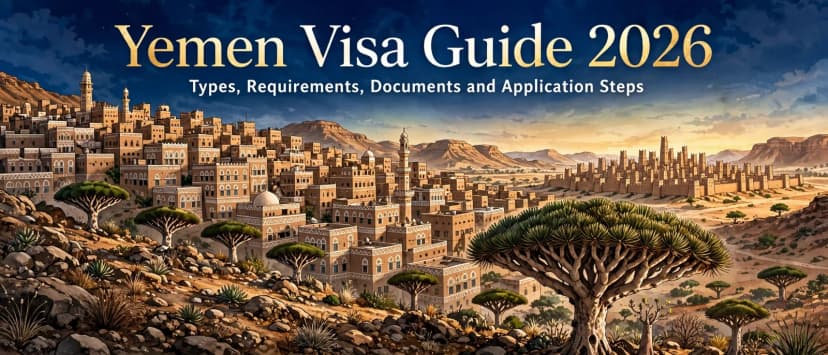
Yemen is a country of extraordinary history — the mud-brick tower houses of Old Sanaa, the "Manhattan of the desert" at Shibam, and the alien landscape of Socotra Island with its dragon's blood trees. It is also, in November 2026, a country in the middle of a war that has lasted more than a decade, split between two rival authorities, with no functioning tourist industry on the mainland and no consular safety net waiting for a visitor if things go wrong. The United States rates Yemen Level 4 — Do Not Travel — and renewed that advisory on 10 October 2026, explicitly extending it to Socotra Island. The United Kingdom advises against all travel to the whole of Yemen and tells British nationals already there to leave immediately. The United States Embassy in Sanaa suspended operations in February 2015, and British Embassy services in Sanaa are suspended with all diplomatic and consular staff withdrawn.
That security picture is the first fact of this guide, and it shapes everything else in it. There are no package holidays to mainland Yemen in 2026, no reliable tourist infrastructure, and no evacuation plan: the FCDO says plainly that the United Kingdom government cannot help British nationals leaving Yemen, and the United States government says it cannot offer emergency services to its citizens in Yemen. If you are a Pakistani living in Vietnam reading this because you have family in Yemen, a humanitarian posting, or an official assignment, this guide gives you the visa mechanics honestly — including every point where the sources disagree or where no official figure exists. If you are reading it because you want a holiday, the honest answer is to wait until the war ends and the advisories change. Socotra looks like an exception in travel photography, and a small number of tour operators do run trips there — but the United States advisory of 10 October 2026 expressly rejects any geographical carve-out for the island.
There is a second fact that shapes the whole visa picture: Yemen is governed by two rival authorities. The internationally recognised government, led by the Presidential Leadership Council under President Rashad al-Alimi, is based in Aden. The Houthi movement, Ansar Allah, controls Sanaa and the north. The visa system in this guide — the embassies abroad, the e-visa portal, and the Immigration, Passports and Nationality Authority (IPNA) — belongs to the Aden-based government, and its visa is the visa for entry through Aden, Seiyun and Socotra. Sanaa airport, in Houthi-controlled territory, runs only limited and restricted flights and was damaged by airstrikes in 2025. Do not assume a visa, flight or permit valid in one part of Yemen is valid in the other: the two authorities run separate checkpoints and separate rules.
The visa system itself is sponsor-driven and old-fashioned, with one new element. A Pakistani ordinary passport holder must obtain a visa in advance from a Yemeni embassy, and in practice the application needs a sponsor inside Yemen — a relative, a company, a humanitarian organisation, or an accredited tour operator — who obtains security clearance for the visit. The new element is the official electronic visa portal, yemenevisa.org, launched on 24 June 2025 by the IPNA in Aden with support from the International Organization for Migration. But the portal does not work like most e-visa portals: as of November 2026 it takes only group-tourism applications from agencies accredited by Yemen's General Authority for Tourism, for groups of at least ten, and an approved e-visa must still be collected as a sticker visa from a Yemeni embassy. There is no individual online application and no online payment: fees are paid in cash in United States dollars. For a reader in Vietnam there is a further shock: Yemen's embassy in Hanoi closed in 1993, and there is no Yemeni mission in Vietnam at all. The Yemeni Embassy in Kuala Lumpur is accredited for Vietnam, and the Yemeni Embassy in Islamabad is the mission in your country of nationality; section 9 works through each option.
Do Pakistani Passport Holders Need a Visa for Yemen?
Yes. Pakistani ordinary passport holders need a visa before travelling to Yemen, and you should not plan around a visa on arrival. The visa policy of Yemen, as recorded in Timatic — the database airlines use to check entry requirements — lists Pakistan under "visa required": visitors must obtain a visa from one of the Yemeni diplomatic missions unless they come from one of the small number of countries whose citizens may obtain a visa on arrival. Pakistan is not one of them. The visa-on-arrival list for ordinary passports is short: Algeria (one month, only if arriving from Algeria), Bahrain, Egypt (only if arriving from Egypt), Jordan, Kuwait, Malaysia, Oman, Qatar, Saudi Arabia, Syria and the United Arab Emirates, with a maximum stay of three months unless otherwise stated. The only visa-free entries are holders of Hong Kong Special Administrative Region passports, for 30 days, and people of Yemeni origin holding a genuine Yemeni identification document or other proof of Yemeni origin.
There is one narrow exception that matters to a small number of readers. Holders of diplomatic, official, service or special Pakistani passports can obtain a visa on arrival in Yemen for a stay of up to three months, under the same Timatic rule that covers diplomatic and official passport holders of Cuba, Mauritania, Morocco and Turkey. That exception does not cover the ordinary green Pakistani passport most readers hold. If you hold a diplomatic or official passport, confirm the rule with the issuing embassy before travel: it is recorded in Timatic, not published on any Yemeni government page this guide could open.
The FCDO says the same: "You must have a visa to enter Yemen." There is no published transit-without-visa arrangement beyond the airside rule in section 3, and no published provision for obtaining a visa at Aden or Seiyun airport as a Pakistani without prior approval. Arriving without a visa and hoping for one at the border is not a plan.
Your passport must meet the standard conditions. The FCDO states that to enter Yemen your passport must have an expiry date at least six months after the date you arrive, and Wise's visa checker, updated 6 November 2026, lists at least two blank passport pages alongside the six-month rule. The safe course is a passport valid at least six months beyond your planned return, with at least two blank pages — renew it in Vietnam or Pakistan before you apply if it is running short.
One more passport condition is specific to Yemen. Timatic records that visitors holding Israeli passports, visas or other Israeli entry documents may be refused entry or transit into Yemen, even if not leaving the aircraft and proceeding by the same flight. That bar covers transit as well as entry, and Israeli entry documents, not only an Israeli passport. If your passport carries any Israeli visa or entry stamp, get a written answer from the issuing embassy, or renew the passport first.
Timatic also records an entry restriction worth knowing: citizens of Libya, Sudan and Tunisia must begin their journey in their home countries before arriving in Yemen, or they will not be allowed to enter, though they may still transit. That rule does not name Pakistan, so it does not directly restrict a Pakistani travelling from Vietnam — but it shows Yemen's entry rules are enforced at the level of the individual journey, not only the passport. Citizens of Comoros need prior approval from the Director of Immigration at Sanaa airport before entering.

Types of Yemen Visas for Pakistani Passport Holders
Yemen does not publish a single consolidated visa-type list. The categories below are drawn from the official e-visa portal, Yemeni embassy procedures, and the Pakistan-focused guides, and every category rests on the same foundation: a sponsor in Yemen obtains security clearance for the visit, and the embassy issues the visa once that clearance reaches it. The e-visa portal lists group tourism, business, diplomatic, work and transit categories — but as of November 2026 it accepts only group-tourism applications, so the other categories are categories on paper, not routes you can file online.
Tourist visa
The tourist visa is the standard short-visit visa issued by a Yemeni embassy, and it is the category most readers will ask about first — and the one least likely to be issued in 2026. Pakistan-focused guides describe it as requiring a passport, a completed form, photographs, an invitation or sponsor, proof of funds, a flight itinerary and hotel bookings. But Travel Visa Stack, updated 21 October 2026, states plainly that the tourist visa technically exists but is rarely issued at present, and that most embassies are not processing routine tourist applications. VisaCross, reviewed June 2026, is blunter: the only practical route is a pre-arranged entry visa obtained through an accredited tour operator. The typical short stay reported is 30 days, and VisaCross gives a maximum stay of 90 days per entry with a visa validity of 180 days from issue — figures that conflict with each other, as section 6 explains. In practice, a genuine independent tourist visa for mainland Yemen is very hard to obtain in 2026.
Group tourist visa through the e-visa portal
This is the only visa route that runs through the official e-visa portal, yemenevisa.org, launched on 24 June 2025 by the IPNA in Aden. It is open only to tourist groups of at least ten members, travelling on round-trip tickets, through a Yemeni agency accredited by the General Authority for Tourism, with an accredited overseas agency letter and a tourism-authority letter and programme. The agency files the application; the e-visa is issued by email within roughly three to five working days after a complete file is received; and the approved visa must still be collected as a sticker visa from a Yemeni embassy or consulate. Online payment is not yet available, so the fee is paid in cash in United States dollars. A single traveller, a couple, or a family of four cannot use this route — the ten-person minimum is a hard condition.
Socotra tourist visa through a licensed operator
Socotra is the one part of Yemen where tourist travel actually happens in 2026, and it runs on its own system. You cannot apply for a Socotra visa yourself at an embassy or at the border. A licensed Socotri tour operator arranges it from a scan of your passport, as part of a tour package covering the flight, transport, accommodation and guides — independent travel on the island is not permitted, and the local government requires all foreign travellers to enter with a Socotra guide. The visa is typically issued shortly before travel, is valid for a 30-day stay, and an emailed copy is shown at check-in; operators report the cost at roughly USD 70 to USD 150, with one 2026 guide putting it at about USD 150. One limit matters: a Socotra visa does not allow travel to mainland Yemen, and a mainland visa does not automatically cover Socotra. The flight is Yemenia Airways from Jeddah to Socotra Airport, on Tuesdays and Thursdays in the 2026–27 season, at roughly USD 1,100 to USD 1,300 return — and it cannot be booked online; the operator books it. Do not mistake the existence of this route for safety: the United States advisory of 10 October 2026 expressly includes Socotra in the Level 4 warning.
Business visa
The business visa covers meetings, contracts, trade and investment, and it is, with the humanitarian route, the most commonly issued category under current conditions. It needs an invitation from a Yemeni company, which acts as your sponsor and obtains the security clearance, plus a letter from your own employer. Travel Visa Stack describes the business visa as the most commonly issued category at present. No official fee, validity or stay length for a business visa was published on any Yemeni government page consulted; agency guides report USD 150 to USD 200 for a multiple-entry business visa with a 90-day validity, but those are agency figures, not official ones. A Pakistani businessman in Vietnam would normally apply through Islamabad if in Pakistan, or through Kuala Lumpur or Beijing if applying from Vietnam — and in either case the Yemeni company does half the work before the embassy sees the file.
Work visa
A work category exists on paper — it is listed on the official e-visa portal — but there is no clearly defined, reliably functioning standalone work-visa procedure for ordinary foreign nationals in 2026. A foreigner intending to work would typically need an in-country employer invitation plus prior approval from Yemen's immigration authority and the Ministry of Foreign Affairs, followed by a Ministry of Labour work permit — but the process is heavily disrupted by the conflict, and no official source publishes a defined fee schedule or timeline. Do not travel to Yemen in 2026 looking for general employment, and do not pay any agent who claims to hold a confirmed Yemeni work visa or job allocation.
Family and private visit visa
The family or private visit visa covers visiting relatives in Yemen, backed by an invitation letter from the relative and proof of the relationship. For a Pakistani in Vietnam with family in Yemen, this is likely the most relevant category after the humanitarian route. The relative acts as your sponsor and obtains the security clearance; you apply at an embassy with the invitation letter and proof of relationship. No official fee, validity or processing time for a family visit visa was published on any Yemeni government page consulted, and no separate family-reunification visa class was found. Do not assume a visit visa can simply be extended: no official extension procedure or fee was found.
Transit visa
A transit visa is listed on the official e-visa portal and by Pakistan-focused guides. No official source found for this guide publishes its documents, fee, or maximum transit stay. There is, however, a Timatic airside transit rule: passengers can transit without a visa with a confirmed onward ticket for a flight to a third country within 24 hours, provided they stay in the international transit area and hold the documents required for their next destination. If you need to leave the airport — for example, for an overnight connection in Aden on the Cairo to Socotra route — you need a visa.
Visa Comparison Table
| Visa type | Entry | Typical stay or validity | Sponsor needed? | Main backing document |
|---|---|---|---|---|
| Tourist visa (embassy) | Single entry | 30 days typical stay; up to 90 days reported | Yes — sponsor | Invitation; security clearance from Yemen |
| Group tourist eVisa (yemenevisa.org) | Single entry | 30 days typical stay | Yes — accredited agency (min. 10) | Agency programme; tourism-authority letter |
| Socotra tourist visa (operator) | Socotra only | 30 days | Yes — licensed Socotri operator | Passport scan; tour package |
| Business visa | Single or multiple entry | Not published | Yes — Yemeni company | Company invitation; security clearance |
| Work visa | Single entry | Not published | Yes — employer in Yemen | Sponsor invitation; prior approval; work permit |
| Family / private visit visa | Single entry | Not published | Yes — relative in Yemen | Invitation letter; proof of relationship |
| Student visa | Single entry | Not published | Yes — institution or sponsor | Admission letter; security clearance |
| Transit visa | Single entry | Airside transit without visa: 24 hours | Not confirmed | Onward ticket; visa for final destination |
| Diplomatic / official visa | Visa on arrival for diplomatic, official, service and special Pakistani passports | Up to 3 months on arrival for those passports | Government or organisation assignment | Official note; assignment letter |
Visa Fees: What Each Route Costs
There is no single official Yemen visa fee, and — the most important sentence in this section — no official fee for a Pakistani passport holder applying at any Yemeni embassy was found on any Yemeni government page consulted for this guide. The Yemeni government publishes no fee schedule for its embassies, and the e-visa portal publishes no fee: it states only that online payment is not yet available and that fees are paid in cash in United States dollars. Every figure below is therefore a reported figure, with the source named in every case, and the fee you will actually pay is the fee charged by the mission where you apply. Ask the embassy for its current fee in writing before paying anything.
Most reported figures fall between USD 40 and USD 100. VisaFromPakistan, a Pakistan-focused guide, puts the tourist visa fee at USD 40, with a service charge of PKR 1,500 on top, and a total cost of PKR 6,180. AMG Visa, verified 28 October 2026, reports official consular and e-visa rates of about USD 50 to USD 100, or about PKR 14,000 to PKR 28,000. VisaCross, reviewed June 2026, puts the tourist visa application fee at about USD 70. Travel Visa Stack, updated 21 October 2026, reports a wider range of USD 30 to USD 100 depending on visa category and the issuing mission — its lower end of USD 30 sits below the USD 40 to USD 100 band the other guides report, and no source settles which is right. One agency guide quotes a certified bank balance of PKR 1,000,000 to PKR 2,000,000 as a requirement, and a minimum closing balance of PKR 400,000 to PKR 1,000,000 — those are funds you must show, not fees you pay, and they are agency requirements, not an official Yemeni rule.
Other categories carry their own reported figures, all of them agency estimates. VisaCross reports a work visa fee of about USD 250, and notes that embassies quote a general single-entry visa fee of roughly USD 50 to USD 65, or EUR 50, for a three-month visa, with expedited processing adding about USD 30. A general Yemen visa guide reports single-entry tourist visas at USD 80 to USD 100, multiple-entry business visas at USD 150 to USD 200, and transit visas at USD 40 to USD 60. None of these is an official Yemeni fee. The Socotra operator visa is priced by the operator, not the government: reports put it at roughly USD 70 to USD 150 as part of a tour package.
Fees are normally paid at the embassy when you submit, or in cash in United States dollars at the IPNA centre in Aden for the e-visa route, and are not refundable if the visa is refused. No official Yemeni source publishes a refund policy, an appeal route, or a fee-waiver provision. Pay only at the embassy counter or through the payment route the embassy itself directs you to, and never pay a third-party website that claims to sell a Yemen visa online. Budget separately for the costs around the visa: the Jeddah to Socotra return flight alone runs to roughly USD 1,100 to USD 1,300, and a Saudi visa for the Jeddah routing costs around USD 130 to USD 140 per person.
| Source | Fee reported | What it covers |
|---|---|---|
| Yemeni government / any Yemeni embassy | Not published — unverified | Ask the mission directly |
| VisaFromPakistan (Pakistan guide) | USD 40, plus PKR 1,500 service charge | Tourist visa, estimate only |
| AMG Visa (verified 28 Oct 2026) | About USD 50–100 (about PKR 14,000–28,000) | Consular / e-visa rates, estimate only |
| VisaCross (reviewed June 2026) | About USD 70 | Tourist visa application fee, estimate only |
| Travel Visa Stack (updated 21 Oct 2026) | USD 30–100 | Visa fee by category and mission, estimate only |
| VisaCross (work visa, June 2026) | About USD 250 | Work visa, estimate only |
| General Yemen visa guide (MyWay2Abroad) | USD 80–100 tourist; USD 150–200 multiple-entry business; USD 40–60 transit | Agency figures, not official |
| Socotra tour operators (2026 guides) | About USD 70–150 | Socotra visa, part of tour package |
| e-visa portal (yemenevisa.org) | No fee published; cash USD only | Group tourist eVisa; cash USD only |
Processing Times
Processing times are as unsettled as the fees, because the decisive step — the security clearance inside Yemen — happens before the embassy stage, and its timing is not published. The figures below are mission and agency reports, not a single official timetable, and the honest planning figure is the longest one: start at least two months before travel.
AMG Visa, verified 28 October 2026, reports standard processing of four to eight weeks for a Yemen visa from Pakistan. VisaCross reports 13 to 28 business days for a tourist visa, and 34 to 103 business days for a work visa — a range so wide that it is effectively a warning rather than a timetable. VisaFromPakistan reports seven to 21 business days for a tourist visa. Travel Visa Stack reports that processing is highly variable, from a few weeks to significantly longer, due to limited embassy operations. A general Yemen visa guide reports 10 to 30 business days depending on visa type and the current situation, and notes that security clearance is typically required.
The one fast figure belongs to the group e-visa route: the e-visa is issued by email within roughly three to five working days after a complete file is received — but only once the accredited agency has assembled the group file, and only after the fee is paid in cash, since online payment is not available. The Socotra operator visa is also fast once the operator has your passport scan: operators report one to two days. Neither fast figure helps an individual applying at an embassy, where the security clearance is the bottleneck.
The structure of the delay is worth understanding. Step one is the sponsor's application for security clearance inside Yemen; the embassy cannot act until that clearance reaches it. Step two is the embassy's own processing once the clearance has arrived. Neither step has a published service standard, and both are subject to disruption — several Yemeni embassies state that entry-visa requests are currently on hold. Build in slack for both steps, do not book a non-refundable ticket until the visa is in your passport, and treat any agent who guarantees a date as unreliable.
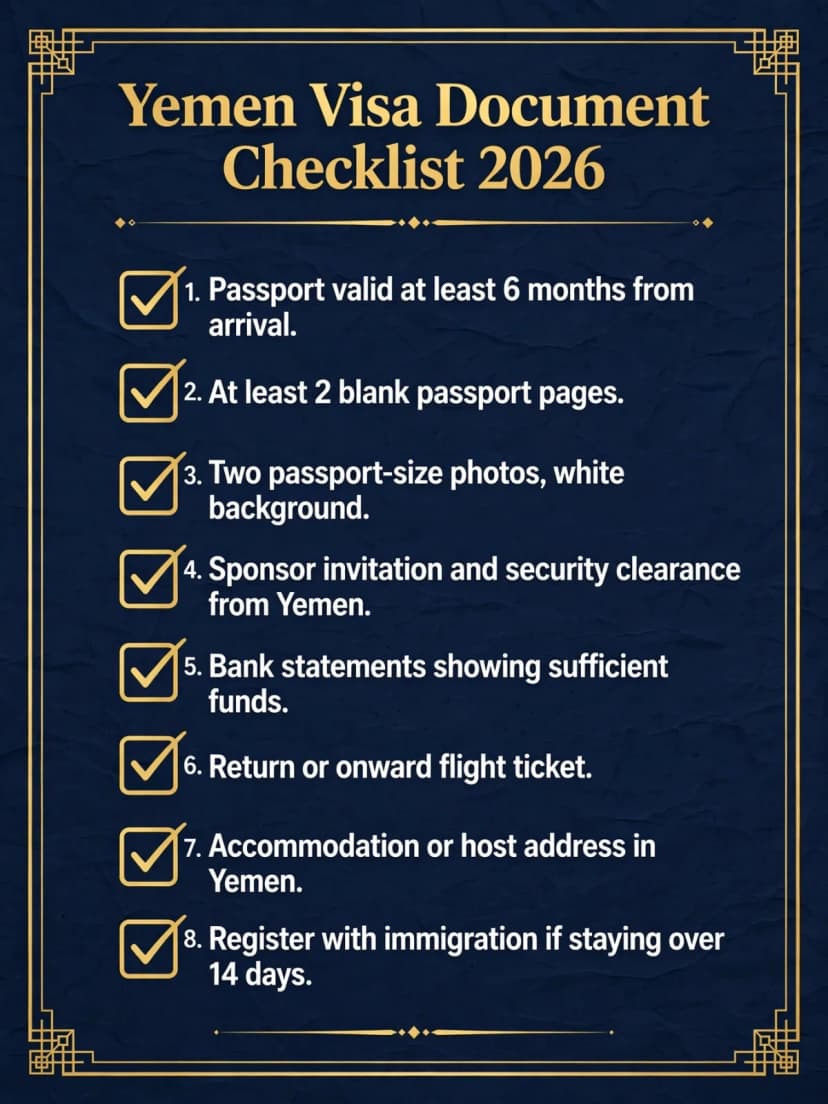
Complete Document Checklists
No single official Yemeni checklist for Pakistani applicants was found. The lists below combine the documents named across the Pakistan-focused guides, the e-visa portal's group requirements, and the standard conditions stated by the FCDO and in Timatic. Take the full file to the embassy — Yemeni missions are described across the guides as strict about paperwork — and expect the embassy to ask for more on a case-by-case basis. Get every document the mission asks for in writing before you travel to submit, because the requirements differ between missions.
All applicants — core documents
- Original Pakistani passport, valid at least six months beyond the date of arrival, with at least two blank pages
- Completed Yemeni visa application form, signed — the form comes from the embassy where you apply; forms differ between missions
- Two recent passport-size photographs, white background
- Invitation letter from a host or sponsoring organisation in Yemen — described as often required given current conditions
- Security clearance from inside Yemen, obtained by your sponsor — this is the document the whole application turns on
- Cover letter explaining your purpose, dates and sponsor, signed by you
- Confirmed return or onward flight itinerary — in 2026 this means a routing into Aden or Seiyun, normally via Cairo, Jeddah, Amman or Djibouti, or into Socotra via Jeddah
- Proof of accommodation in Yemen, or the invitation letter from your host giving their address
- Proof of sufficient funds — bank statements for the last six months are the usual request, with an Account Maintenance Certificate; one agency guide reports a closing balance of PKR 1,000,000 to PKR 2,000,000, but no official minimum balance is published
- Travel and medical evacuation insurance — strongly recommended given the security and health situation; the FCDO warns that travelling against its advice may invalidate ordinary travel insurance, so check the policy wording before buying
- Copy of your CNIC — requested in Pakistan-focused guides for applications made in Pakistan
- Copy of your Vietnam temporary residence card or visa, to show your legal residence there
- Polio, hepatitis A and B, typhoid, tetanus and cholera vaccination records — recommended, not mandatory for entry; see section 13
- Children travelling with you: the child's passport and birth certificate, plus written parental consent where the embassy asks for it
Group tourist e-visa — additional documents
- Accredited overseas agency letter and a Yemeni agency accredited by the General Authority for Tourism
- Tourism-authority letter and agency programme for the group
- Round-trip (return) tickets for all group members — the group must have at least ten members
- Passport copies for all group members, filed by the agency through yemenevisa.org
Business visa — additional documents
- Invitation letter from the Yemeni company, which applies for the security clearance
- Letter from your own employer in Vietnam or Pakistan confirming the purpose of the visit
- Business contract or proof of the commercial purpose, where the embassy asks for it
- Company registration or NTN/business documents, where the embassy asks for them
Work visa — additional documents
- Letter from the sponsoring employer or organisation stating the job, the length of stay and who bears the costs
- Employment contract or assignment letter
- Prior approval from Yemen's immigration authority and the Ministry of Foreign Affairs
- Ministry of Labour work permit, arranged after the entry approval
- Medical checks and police clearance, where the embassy or employer asks for them — no official list is published
Family or private visit visa — additional documents
- Invitation letter from the relative in Yemen, with their full name, address and contact details
- Proof of relationship — family registration documents, marriage certificate or birth certificate as applicable
- Copy of the host's Yemeni identity document, where the embassy asks for it
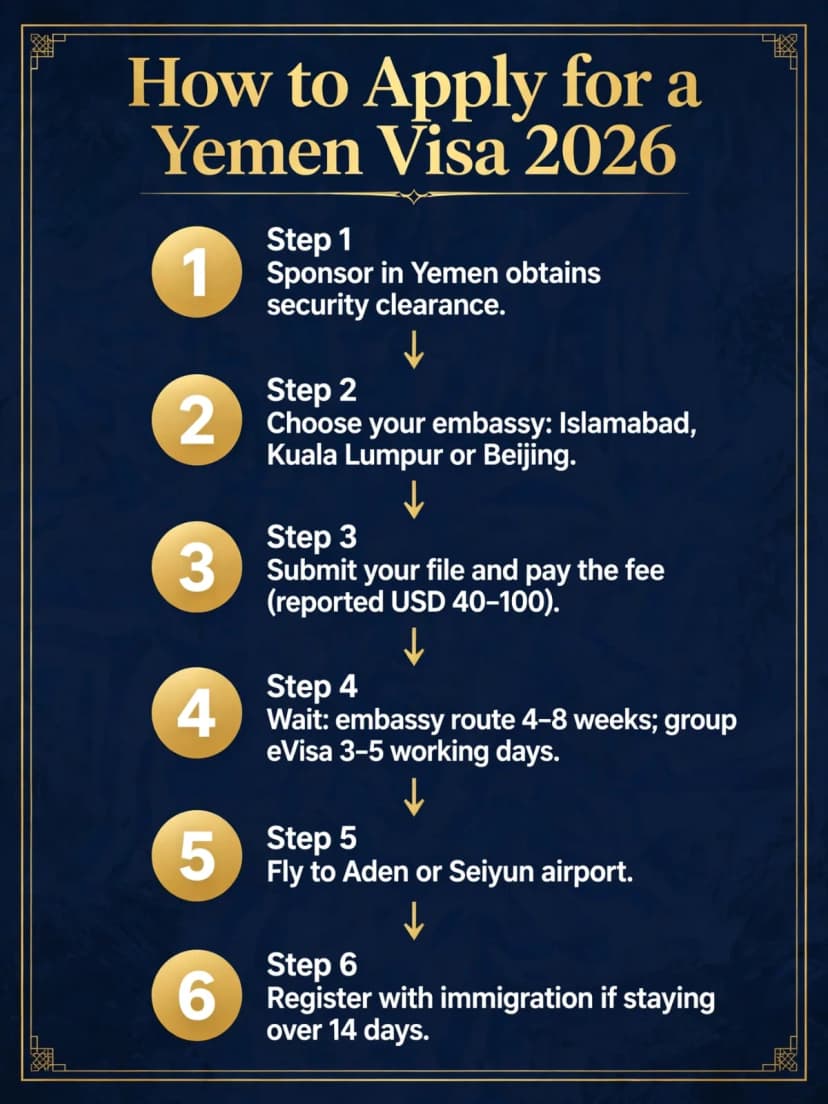
How to Apply: Step-by-Step
Embassy visa — step by step
Step 1 — Decide whether you have a genuine, essential reason to travel. Read the United States Level 4 advisory and the FCDO advice in full. If your reason is tourism, stop here: tourism to mainland Yemen is not currently viable, and no sponsor, no tour operator and no visa can make it viable. If your reason is family, humanitarian work or an official assignment, continue — and keep a written evacuation plan that does not depend on any government's help, because the United States government states plainly that it cannot offer emergency services to its citizens in Yemen, and the British Embassy in Sanaa is closed.
Step 2 — Find your sponsor in Yemen and start the security clearance. Your sponsor — a relative, a Yemeni company, a humanitarian organisation or an accredited tour operator — obtains security clearance for your visit from the Yemeni authorities. This is the first step, not a formality at the end: several Yemeni embassies state that entry-visa requests are currently on hold except for people with a sponsor's clearance, and the embassy cannot issue a visa until the clearance reaches it. Give the sponsor a clear copy of your passport data page and your planned dates, and ask for written confirmation when the clearance has been issued.
Step 3 — Choose the embassy and confirm it is accepting applications. The realistic options for a Pakistani living in Vietnam are set out in section 9. Whichever mission you choose, telephone or email it before travelling or posting anything, and confirm three things: that it is accepting visa applications from a Pakistani resident of Vietnam, what its current fee is, and whether it wants the application in person or by post.
Step 4 — Assemble the file. Use the checklist in section 7 for your category. Get the recommended vaccinations at least four to six weeks before travel and keep the records with your passport. Make photocopies of everything, including the security clearance, and keep a set separate from the originals.
Step 5 — Complete the application form. Use the form from the embassy where you are applying — forms differ between missions. Enter the sponsor's details and the clearance reference exactly as issued. Pakistan-focused guides state that applications from Pakistan are submitted in person at the Yemeni Embassy in Islamabad.
Step 6 — Submit, pay and wait. Submit the file at the embassy, pay the fee the mission charges — in cash in United States dollars where the mission asks for it — and keep the receipt. Do not book a non-refundable ticket until the visa is issued. Expect the process to take weeks, not days, and longer if the file is referred inside Yemen.
Step 7 — Check the visa when it is issued. Confirm the name spelling, the passport number, the validity dates, the number of entries (normally single entry), the permitted stay, and any conditions stamped on it. A Socotra visa does not cover the mainland. Ask the embassy to state the permitted stay in writing, because the published figures conflict between 30 and 90 days.
Step 8 — Fly to Aden or Seiyun, not Sanaa, unless your sponsor advises otherwise. Aden International Airport (ADE) is the main gateway to government-held territory, and Seiyun Airport (GXF) in Hadhramaut is the eastern gateway, with Yemenia services to Aden, Cairo and Jeddah after operations resumed on 11 January 2026. Sanaa airport operates only limited and restricted flights under Houthi control, was damaged by airstrikes in 2025, and has been repeatedly shut; Aden airport itself was hit in October 2026, when two missiles landed about 500 metres from a Yemenia plane preparing to take off for Cairo. Confirm the live flight position with your airline before departure, and have a sponsor-arranged plan for the journey from the airport to your accommodation. Do not travel overland between regions without your sponsor's advice: the road from Sanaa to Aden takes about 14 hours and crosses dozens of checkpoints.
Step 9 — Register if you stay more than 14 days. The FCDO states that if you visit Yemen for more than 14 days, you must register your passport with the Yemen immigration authorities after you arrive. Note the conflict in section 13: another guide states that all arrivals must register with local police within 48 hours. Registering on arrival satisfies both readings and is the safe course — ask your sponsor or hotel how registration is done where you are staying, and keep the receipt.
Step 10 — Watch the exit rules before you leave. Timatic records that an exit visa is required for stays over 30 days. That rule is recorded in Timatic and not confirmed by the FCDO or the United States State Department, so ask your sponsor and the immigration authorities about it early in your stay, not on your departure day. Movement between governorates often requires permits from the security authorities, and travellers without permission risk arrest and detention.
Group e-visa — step by step
Step 1 — Join a group of at least ten people organised by an accredited agency. The agency must be accredited by Yemen's General Authority for Tourism, and it must have an accredited overseas agency partner. You cannot file this route yourself.
Step 2 — Give the agency your passport copy and round-trip ticket details. The agency files the group application through yemenevisa.org, with the tourism-authority letter and the agency programme.
Step 3 — Wait for the e-visa by email, roughly three to five working days after a complete file is received. Pay the fee in cash in United States dollars as the agency or the IPNA directs — online payment is not available.
Step 4 — Collect the sticker visa from a Yemeni embassy or consulate. The emailed approval is not the end of the process: the approved visa must still be collected as a sticker visa from a Yemeni embassy or consulate before travel.
Socotra visa — step by step
Step 1 — Choose your dates and book with a licensed Socotri tour operator. The operator handles the flight booking from Jeddah, the visa approval, transport, accommodation and guides as one package. Do not book international flights around an unconfirmed Socotra flight — let the operator confirm the island flight first.
Step 2 — Send the operator a scan of your passport. The operator arranges the visa approval; the visa is typically issued shortly before travel, valid for a 30-day stay, and an emailed copy is shown at check-in.
Step 3 — Fly Yemenia Airways from Jeddah to Socotra. The 2026–27 season service runs on Tuesdays and Thursdays, and the return flight is about USD 1,100 to USD 1,300. You will need a Saudi visa to transit Jeddah, at around USD 130 to USD 140 per person. The Cairo via Aden routing exists as a backup but involves an overnight stay in Aden and an extra transit visa.
Applying from Vietnam and Pakistan — No Yemeni Embassy in Hanoi
This section is the one most readers will need: there is no Yemeni embassy in Vietnam.
Yemen's embassy in Hanoi closed in 1993. That is recorded in the list of diplomatic missions in Vietnam, which places Yemen in its table of closed missions with the year 1993, and in the list of diplomatic missions of Yemen. There is no Yemeni mission in Hanoi or in Ho Chi Minh City, and no honorary consulate listed. Do not send documents or money to any old Hanoi contact details that appear in directories. Vietnam also has no embassy in Yemen: the Vietnamese Embassy in Sanaa closed in 1995.
Option 1 — Apply in Pakistan through the Yemeni Embassy in Islamabad
For most Pakistani readers this is the most straightforward route, because it is the mission in your country of nationality and the one the Pakistan-focused guides direct applicants to. The Yemeni Embassy in Islamabad is listed at House No. 90, Main Margalla Road, F-6/2, Islamabad, with Post Office Box 1523 and telephone (+92) 51 260 1684 and (+92) 51 260 1686, and email addresses yem.emb.isb@hotmail.com and yem.emb.isb@gmail.com. The ambassador is Mohammed Motaher Alashabi, who was interviewed about Pakistan–Yemen relations in September 2026 and whose embassy posted publicly for Pakistan's Independence Day in August 2026 — the mission is active. Two cautions apply. First, the address is reported inconsistently across directories: older listings give House No. 138, Street No. 14, E-7, with telephone 051-2821146/47, and House No. 220, Street 21, E-7. The F-6/2 address is the most consistently repeated current listing, but telephone the embassy and confirm the address and opening hours before travelling. Second, no official fee for a Pakistani applicant at Islamabad was found; ask the fee, the form, and whether the application must be made in person when you call.
Option 2 — Apply through the Yemeni Embassy in Kuala Lumpur
The Yemeni Embassy in Kuala Lumpur is the mission accredited for Vietnam. The list of diplomatic missions of Yemen records the Kuala Lumpur embassy as concurrently accredited for Cambodia, the Philippines, Thailand and Vietnam, and its ambassador, Dr. Adel Mohamed Ali Ba Hamid, was active in Kuala Lumpur through November 2026. Its chancery is at No. 7, Jalan Kedondong, off Jalan Ampang Hilir, 55000 Kuala Lumpur, Malaysia, telephone +60 3 4251 1793, website yemenembassykl.com. Kuala Lumpur is the nearest Yemeni mission to Vietnam that holds formal accreditation for Vietnam. What is not verified is whether it accepts visa applications from a Pakistani national who is resident in Vietnam rather than in Malaysia, and what fee it charges a Pakistani applicant. You must ask Kuala Lumpur directly — by telephone or email — before booking any travel to Malaysia, and get the answer in writing if you can.
Option 3 — Apply through the Yemeni Embassy in Beijing
Yemen maintains an embassy in Beijing, listed at 5 Dong San Jie, San Li Tun, Beijing 100600. Beijing is a realistic option only if you are already travelling to China, and only after the embassy confirms it will take your application. Whether Beijing accepts applications from a Pakistani resident of Vietnam is unverified, and what fee it charges a Pakistani applicant is not published.
Option 4 — Apply through the Yemeni Embassy in New Delhi
Yemen maintains an embassy in New Delhi, listed at D2/5 Vasant Vihar, New Delhi 110057, with the website yemeninindia.com. No visa procedure or fee for New Delhi was verified from an official source for this guide, and whether New Delhi accepts applications from a Pakistani resident of Vietnam is unverified. New Delhi is a realistic option only if you are already travelling to India, and only after the embassy confirms it will take your application.
Option 5 — Apply through the Yemeni Embassy in London or Washington
London and Washington are included because they are the missions whose contact details are most completely published: London at 57 Cromwell Road, London SW7 2ED, website yemenembassy.org.uk, and Washington at 2319 Wyoming Avenue NW, Washington DC 20008, website yemenembassy.org. Neither is a practical option for most readers in Vietnam — each would mean travelling to the United Kingdom or the United States to apply — but a reader who happens to be in either country should contact the mission there.
Which option should you choose?
If you can travel to Pakistan, Islamabad is the natural first choice: it is your national mission, and it is the one the Pakistan-focused guides are written around. If you cannot leave Vietnam, Kuala Lumpur is the nearest mission and the one formally accredited for Vietnam — but only after it confirms it will accept your application. In either case, the sponsor's security clearance comes first, and the embassy stage comes second.
Student Route: Studying in Yemen
There is no verified, functioning student-visa route to Yemen in 2026 that this guide can recommend. A student visa is listed as a category by Pakistan-focused guides, which describe it as requiring an admission letter, a passport and financial proof. But no official Yemeni source found for this guide publishes a student-specific document list, fee, processing time, or residence-permit procedure, and no Yemeni university is operating a normal admissions route for foreign students during the war. Yemeni students, by contrast, do study in Pakistan: the Yemeni ambassador to Pakistan thanked the Pakistani government in September 2026 for supporting Yemeni students studying in Pakistan on scholarships and self-finance. The flow of students runs the other way.
The practical position is therefore simple: do not plan to study in Yemen in 2026, and do not pay any agent who claims to hold a confirmed Yemeni student visa or university place. If you have a genuine academic reason to go — for example, a research affiliation with a Yemeni institution — treat it as a sponsored visit: the institution acts as your sponsor, obtains the security clearance, and you apply for the entry visa at an embassy on that basis. Ask the embassy which visa category it will issue for that purpose, because the category determines the documents, and get the answer before you pay anything.
Work Route: Jobs, Business and Work Permits
Yemen is not a jobs market for foreign workers in 2026, and this guide does not present it as one. The economy runs largely on cash, foreign bank cards are unreliable, medical services are extremely limited, and the United States State Department warns that the government cannot offer emergency services to its citizens in Yemen. No Pakistani should travel to Yemen in 2026 looking for general employment.
The work route that does exist is the sponsored one: a specific employer or organisation in Yemen — in practice, a humanitarian organisation, a United Nations agency, or a company with an established Yemen operation — sponsors your entry visa, states the job, the length of stay and who bears the costs in its letter, and obtains the security clearance and prior approval from the immigration authority and the Ministry of Foreign Affairs. A Ministry of Labour work permit follows after the entry approval. No official fee, document list or processing time for a work permit was found for this guide, and VisaCross reports a work-visa processing range of 34 to 103 business days — a range that is effectively a warning. The sponsor must confirm the current procedure, and you must have the entry visa before you travel.
Business travel is different from seeking a job, and it is the more realistic of the two. A Pakistani businessman with a Yemeni counterpart company can apply for a business visa on the company's invitation, with the company obtaining the clearance. Keep the business purpose documented — contracts, correspondence, and the invitation letter — because the stated purpose of the visit is checked against the invitation, and any inconsistency can lead to refusal.
Family Visits and Permanent Residence
Family visits are, with humanitarian work, the most genuine reason a Pakistani in Vietnam might need a Yemen visa in 2026. The route is the family or private visit visa: a relative in Yemen invites you, acts as your sponsor, obtains the security clearance, and you apply at an embassy with the invitation letter and proof of the relationship. Start the sponsor's clearance application at least two months — and preferably three — before any planned travel date, because the clearance is the slow step and no service standard is published for it.
Keep the family's documents together — invitation letter, proof of relationship, the clearance reference, and copies of the host's Yemeni identity document — and carry copies separately from the originals. If you are of Yemeni origin yourself, check the exemption in section 2: a visa is not required for those of Yemeni origin holding a genuine Yemeni identification document or other proof of Yemeni origin. That exemption is recorded in Timatic; confirm with the embassy whether it applies to your documents before relying on it.
No published permanent-residence route, timeline or fee for foreign nationals was found. Residence permits are handled by the immigration authorities, but they publish no procedure, fee or timeline that could be quoted here. Do not assume a visit visa can simply be extended: no official extension procedure or fee was found, and Timatic records that an exit visa is required for stays over 30 days — so a long stay needs to be planned with the immigration authorities from the start, not improvised at the end.
Common Mistakes to Avoid
Mistake 1 — Treating Yemen as a tourist destination in 2026. Do not plan a holiday on the mainland, do not book a tour, and do not assume that a visa makes travel safe. The United States says "Do not travel to Yemen for any reason," including Socotra. The FCDO advises against all travel, and insurance bought for a trip against FCDO advice may be invalid.
Mistake 2 — Applying for an individual Yemen e-visa online. The official portal, yemenevisa.org, takes group-tourism applications only, from accredited agencies, for groups of at least ten members. There is no individual online application and no online payment. Websites selling an individual Yemen e-visa are not official channels.
Mistake 3 — Applying at the embassy before the sponsor has the security clearance. The clearance comes first. An application submitted without it will wait or be refused.
Mistake 4 — Going to Hanoi expecting an embassy. The Yemeni Embassy in Hanoi closed in 1993. There is no Yemeni mission in Vietnam. The mission accredited for Vietnam is in Kuala Lumpur.
Mistake 5 — Arriving without a visa and hoping for a visa on arrival. Pakistan is not on Yemen's visa-on-arrival list for ordinary passports. Only diplomatic, official, service and special Pakistani passports can obtain a visa on arrival, for up to three months. Arriving on an ordinary passport without a visa means relying on the discretion of border officers in a war zone.
Mistake 6 — Travelling on a passport with an Israeli visa or stamp without checking. Timatic records that holders of Israeli passports, visas or other Israeli entry documents may be refused entry or transit into Yemen. Get a written answer from the issuing embassy, or renew the passport first.
Mistake 7 — Assuming a Socotra visa covers the mainland, or a mainland visa covers Socotra. A Socotra visa does not allow travel to mainland Yemen, and the island runs on its own operator-arranged system. A mainland visa does not automatically cover Socotra.
Mistake 8 — Forgetting to register after arrival. The FCDO states that stays over 14 days require registration with the immigration authorities. Register on arrival and keep the receipt.
Mistake 9 — Travelling outside the area your visa and sponsor cover. Movement between governorates often requires permits from the security authorities, and travellers without permission risk arrest and detention.
Mistake 10 — Carrying cards instead of cash, or carrying too much cash. Foreign bank cards are unreliable in Yemen and the economy runs largely on cash. At the same time, importing or exporting Yemeni currency is illegal, and foreign currency over USD 3,000 must be declared on entry.
Mistake 11 — Paying an agent for a guaranteed visa, job or student place. No agent can guarantee a Yemeni visa, because the decision turns on the security clearance issued inside Yemen.
Reasons for Refusal
No official Yemeni refusal list is published, so the reasons below are drawn from the structure of the system and the conditions the official sources do state.
No sponsor and no security clearance. This is the commonest reason. Without a sponsor in Yemen who has obtained security clearance, the embassy has nothing to issue a visa against.
Passport validity or blank pages. A passport with less than six months' validity beyond arrival, or without two blank pages, fails the entry condition.
Israeli passport, visa or entry stamp. Timatic records that holders of Israeli passports, visas or other Israeli entry documents may be refused entry or transit into Yemen.
Missing or inconsistent documents. Yemeni missions are described as strict about paperwork. A missing invitation letter, an unsigned form, a wrong photograph, or dates that do not match between the cover letter, the invitation and the itinerary can all cause a refusal.
No proof of funds. Pakistan-focused guides require six months of bank statements with an Account Maintenance Certificate. An application that cannot show sufficient funds risks refusal.
Tourism as the stated purpose without a tour operator. Routine tourist applications are rarely processed at present. An application that states tourism but has no accredited operator or sponsor behind it is unlikely to succeed.
Security and admissibility concerns. Yemen is in an armed conflict, and the authorities control entry tightly. Any inconsistency in the stated purpose of travel, any suggestion that the visit is not what the invitation describes, or any adverse record can lead to refusal. There is no published appeal route; the remedy is to fix the named problem and reapply.
Frequently Asked Questions
1. Do Pakistani citizens need a visa for Yemen?
Yes. Pakistani ordinary passport holders must obtain a visa in advance from a Yemeni embassy. Pakistan is not on Yemen's visa-exempt list and not on its visa-on-arrival list for ordinary passports. Only holders of diplomatic, official, service or special Pakistani passports can obtain a visa on arrival, for up to three months.
2. Is there a Yemen e-visa I can apply for online?
Not as an individual. The official portal, yemenevisa.org, launched on 24 June 2025 and run by the Immigration, Passports and Nationality Authority in Aden, processes only group-tourism applications submitted by agencies accredited by Yemen's General Authority for Tourism, for groups of at least ten members with round-trip tickets. An approved e-visa must still be collected as a sticker visa from a Yemeni embassy or consulate, and online payment is not available.
3. How much does a Yemen visa cost for a Pakistani passport?
There is no official fee published by the Yemeni government or any Yemeni embassy, so no figure in this guide is an official fee. Most reported figures fall between USD 40 and USD 100: VisaFromPakistan reports USD 40, AMG Visa reports about USD 50 to USD 100, and VisaCross reports about USD 70. Travel Visa Stack reports a wider range of USD 30 to USD 100. Ask the mission where you apply for its current fee before paying.
4. How long does a Yemen visa take to process?
There is no published official timetable. AMG Visa reports four to eight weeks, VisaCross reports 13 to 28 business days for a tourist visa, and VisaFromPakistan reports seven to 21 business days. Travel Visa Stack reports that processing is highly variable, from a few weeks to significantly longer. Plan on at least two months from the start of the sponsor's clearance application.
5. How long can I stay in Yemen on a tourist visa?
This is unresolved. The typical short stay reported for a tourist visa is 30 days. VisaCross gives a maximum stay of 90 days per entry, with a visa validity of 180 days from issue. No official source settles whether the permitted stay is 30 or 90 days. Ask the issuing embassy to state the permitted stay in writing on the visa.
6. What is the security clearance and how do I get one?
It is the approval for your visit obtained inside Yemen by your sponsor — a relative, a Yemeni company, a humanitarian organisation or an accredited tour operator — from the Yemeni authorities, before the embassy can issue your visa. You cannot obtain it yourself from outside Yemen. Without it, there is normally no visa, and several embassies state that entry-visa requests are currently on hold without it.
7. Is there a Yemeni embassy in Vietnam?
No. Yemen's embassy in Hanoi closed in 1993, and there is no Yemeni mission in Vietnam. The Yemeni Embassy in Kuala Lumpur is accredited for Vietnam, at No. 7, Jalan Kedondong, off Jalan Ampang Hilir, 55000 Kuala Lumpur, telephone +60 3 4251 1793. Whether it accepts applications from a Pakistani resident of Vietnam is unverified and must be asked directly.
8. Can I get a visa on arrival in Yemen?
Not on an ordinary Pakistani passport. Pakistan is not on Yemen's visa-on-arrival list for ordinary passports, which covers a short list of Arab and Asian states. Only holders of diplomatic, official, service or special Pakistani passports can obtain a visa on arrival, for up to three months. The safe route for an ordinary passport holder is the embassy visa obtained in advance.
9. Is it safe to travel to Yemen in 2026?
No government advises it. The United States rates Yemen Level 4 — Do Not Travel — renewed 10 October 2026, citing terrorism, unrest, crime, health risks, kidnapping and landmines, and the advisory expressly includes Socotra Island. The United Kingdom advises against all travel to the whole of Yemen. The United States Embassy in Sanaa has been suspended since February 2015, British Embassy services in Sanaa are suspended, and there is no evacuation plan.
10. Can I visit Socotra even though the mainland is at war?
Tour operators do run trips to Socotra, and the island has barely felt the mainland conflict — but the United States advisory of 10 October 2026 expressly rejects any geographical carve-out for Socotra, and this guide does not present it as safe. If you go, you must travel through a licensed Socotri operator, which arranges the visa (about USD 70 to USD 150, 30-day stay) and the Yemenia flight from Jeddah (Tuesdays and Thursdays, about USD 1,100 to USD 1,300 return).
11. Do I need to register after arriving in Yemen?
Yes, on the FCDO's account: if you visit Yemen for more than 14 days, you must register your passport with the Yemen immigration authorities after you arrive. Another guide states that all arrivals must register with local police within 48 hours. Register on arrival to satisfy both readings, and keep the receipt.
12. Do I need an exit visa to leave Yemen?
Possibly. Timatic records that an exit visa is required for stays over 30 days. That rule is not confirmed by the FCDO or the United States State Department, so ask your sponsor and the immigration authorities about it early in your stay.
13. Do I need any vaccinations for Yemen?
No vaccination is mandatory for entry: the United States CDC records that a yellow fever certificate is not required for Yemen. Vaccinations are, however, strongly recommended — hepatitis A and B, typhoid, polio, tetanus and cholera — because cholera is presumed present in Yemen and there is an active cholera outbreak, alongside dengue and malaria. See a travel clinic four to six weeks before departure.
14. Can I work or study in Yemen on a visit visa?
No. A visit visa does not carry a right to work or study. Work requires an employer sponsor, prior approval from the immigration authority and the Ministry of Foreign Affairs, and a Ministry of Labour work permit. Study requires an admission letter and a sponsor's clearance, and no functioning student route was verified for 2026. Do not travel to Yemen looking for general employment.
15. What happens if my Yemen visa is refused?
There is no published appeal route. Visa fees are not refundable. The practical remedy is to find out the reason — most commonly a missing security clearance or incomplete documents — fix it, and reapply. Do not pay any agent who promises to overturn a refusal for a fee.
Official Immigration Websites
| Organisation | What it is | Website |
|---|---|---|
| UK Foreign, Commonwealth and Development Office | Yemen travel advice — entry requirements, safety, registration | https://www.gov.uk/foreign-travel-advice/yemen/entry-requirements |
| US Department of State | Yemen Travel Advisory — Level 4, Do Not Travel | https://travel.state.gov/content/travel/en/traveladvisories/traveladvisories/yemen-travel-advisory.html |
| US Department of State | Yemen country information — visa, passport, health | https://travel.state.gov/content/travel/en/international-travel/International-Travel-Country-Information-Pages/Yemen.html |
| Republic of Yemen — eVisa portal (IPNA, Aden) | Official e-visa portal, yemenevisa.org — group tourism only | https://yemenevisa.org |
| Embassy of the Republic of Yemen, Kuala Lumpur | Embassy accredited for Vietnam | https://yemenembassykl.com |
| Embassy of the Republic of Yemen, London | Yemeni Embassy in the UK | https://www.yemenembassy.org.uk |
| Embassy of the Republic of Yemen, Washington | Yemeni Embassy in the US | https://www.yemenembassy.org |
| Embassy of Yemen, New Delhi | Yemeni Embassy in India | https://www.yemeninindia.com |
| Wikipedia — Visa policy of Yemen | Visa-exempt and visa-on-arrival lists; e-visa; transit; admission restrictions | https://en.wikipedia.org/wiki/Visa_policy_of_Yemen |
| Wikipedia — List of diplomatic missions of Yemen | Current Yemeni missions abroad, including Kuala Lumpur, Islamabad, Beijing and New Delhi | https://en.wikipedia.org/wiki/List_of_diplomatic_missions_of_Yemen |
| Wikipedia — List of diplomatic missions in Vietnam | Records the Yemeni Embassy in Hanoi as closed in 1993 | https://en.wikipedia.org/wiki/List_of_diplomatic_missions_in_Vietnam |
| Wikipedia — List of diplomatic missions in Yemen | Embassies in Sanaa and Aden; Pakistan's Sanaa embassy listed | https://en.wikipedia.org/wiki/List_of_diplomatic_missions_in_Yemen |
Final Checklist and Conclusion
Before you spend any money, work through this list in order. If you cannot tick the first three boxes, do not proceed.
- You have a genuine, essential reason to travel — family, humanitarian work or an official assignment — not tourism.
- You have read the United States Level 4 advisory and the FCDO advice in full, and you have a written evacuation plan that does not depend on government help.
- You have a named sponsor in Yemen who has agreed to obtain security clearance for your visit.
- Your passport is valid at least six months beyond your planned return and has at least two blank pages, with no Israeli visa or entry stamp unless the issuing embassy has confirmed in writing that it is acceptable.
- You have confirmed by telephone that the embassy you will use — Islamabad, Kuala Lumpur or Beijing — is open, is accepting applications from a Pakistani resident of Vietnam, and has told you its current fee.
- Your file is complete: signed form, two photographs, invitation letter, security clearance, cover letter, flight itinerary, accommodation, proof of funds, insurance with medical evacuation cover, CNIC copy, and Vietnam residence proof.
- You have not booked a non-refundable ticket, and you have budgeted for the visa fee in cash in United States dollars — no official fee is published, and reported figures run from USD 40 to USD 100.
- You have a sponsor-arranged plan for the journey from Aden or Seiyun airport to your accommodation, and a communication plan with your family.
- You have registered with the immigration authorities if you stay more than 14 days, and asked about the exit visa for stays over 30 days.
This guide was checked on 29 November 2026. Visa rules change without notice. Always confirm the live rules with the Yemeni embassy that will issue your visa — Islamabad, Kuala Lumpur or Beijing — before paying any fee or booking a non-refundable ticket. Nothing in this guide is immigration advice; the Yemeni authorities set and enforce the entry rules, and the immigration officer at the airport makes the final decision. This guide is educational information only and does not guarantee visa approval or entry.