U.S. Virgin Islands Visa Guide 2026: Types, Requirements, Documents and Application Steps
Last checked: 29 November 2026. This guide is for Pakistani passport holders living in Vietnam. The single most important fact is in the first paragraph: there is no separate U.S. Virgin Islands visa. The U.S. Virgin Islands (USVI) is a territory of the United States, US immigration law applies there in full, and a Pakistani passport holder enters the islands on exactly the same US visa that would admit them to New York or Miami — in practice, a US B-1/B-2 visitor visa obtained before travel. Pakistan is not a Visa Waiver Program country, so the ESTA route is not open to you. Visa rules change without notice — always confirm the live rules on travel.state.gov and with the US Consulate General in Ho Chi Minh City before paying any fee or booking a non-refundable ticket.
Introduction
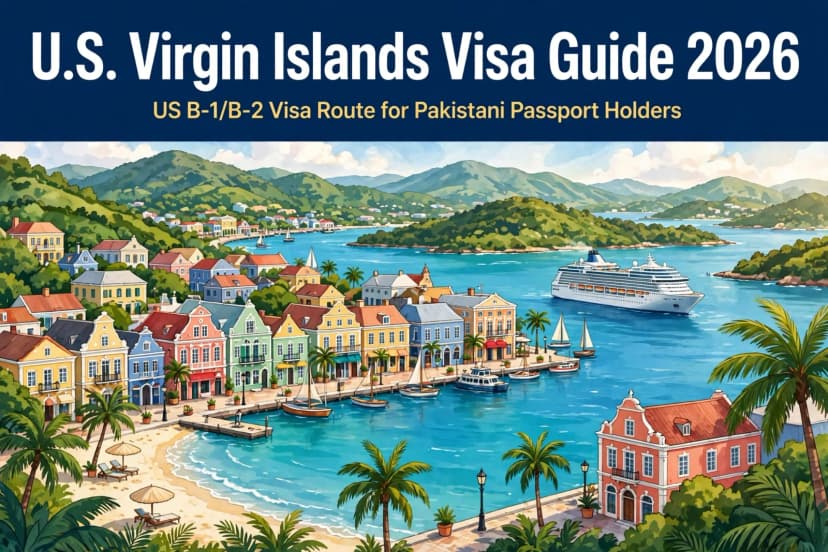
The U.S. Virgin Islands — St. Thomas, St. John and St. Croix, plus about fifty smaller islets and cays — sit in the Caribbean east of Puerto Rico, and they are marketed as "America's Paradise": white-sand beaches, the snorkelling trails of Trunk Bay, two-thirds of St. John protected as Virgin Islands National Park, and the historic harbour town of Charlotte Amalie. The currency is the US dollar, the language is English, cars drive on the left (a legacy of the islands' Danish past), and the temperature sits between about 25 and 31 degrees Celsius all year. For a Pakistani living in Ho Chi Minh City, the islands are a long journey — there are no direct flights from Vietnam, and every routing goes through the United States mainland or San Juan, Puerto Rico — but the visa question itself is simple.
The U.S. Virgin Islands is an unincorporated territory of the United States, purchased from Denmark in 1917 and governed since then by US federal immigration law. US Customs and Border Protection (CBP) handles immigration at the islands' airports and seaports, and the entry rules are identical to entering the mainland United States — Wikipedia's visa policy of the United States states directly that the same rules apply to all US states, Washington DC, Puerto Rico and the U.S. Virgin Islands. There is no USVI embassy, no USVI consulate, no USVI e-visa portal and no USVI visa stamp. If a website offers to sell you a "US Virgin Islands visa" or a "USVI e-visa", it is not selling anything official. The document you need is a US nonimmigrant visa in the category that matches your purpose — for almost every reader, the B-1/B-2 visitor visa — obtained from a US embassy or consulate before you travel.
One warning belongs in the introduction because it catches travellers out every year: do not confuse the U.S. Virgin Islands with the British Virgin Islands. They are neighbouring island groups a short ferry ride apart, but they are different countries with different entry rules. Tortola and Virgin Gorda are British territory; St. Thomas, St. John and St. Croix are American. A ferry day trip from St. Thomas to Tortola is an international crossing, and your US visa does not automatically cover it.
Do Pakistani Passport Holders Need a Visa for the U.S. Virgin Islands?
Yes. Pakistani passport holders need a valid US visa before travelling to the U.S. Virgin Islands, and there is no visa on arrival and no visa-free entry for you. The rule follows from two facts that are both settled on official sources. First, the USVI applies US immigration law in full, so the entry requirement is the US entry requirement. Second, Pakistan is not a Visa Waiver Program country, so the ESTA route — the electronic authorisation that lets citizens of about forty countries visit the United States for up to 90 days without a visa — is not available to a Pakistani passport holder. The US State Department's visitor visa page states the general rule plainly: generally, a citizen of a foreign country who wishes to travel to the United States must first obtain a visa. The visa policy of the United States, as recorded in the standard reference sources, confirms that the same rules apply to the U.S. Virgin Islands as to the mainland, and lists Pakistan among the nationalities that need a visa applied for in advance.
What that means in practice is that you need a US B-1/B-2 visitor visa — B-1 for business, B-2 for tourism, family visits and medical treatment, usually issued together as a combined B-1/B-2 — before you board a flight to St. Thomas or St. Croix. The visa is issued by the US Department of State through its embassies and consulates, not by any USVI authority, and the USVI government has no visa-issuing role. If you already hold a valid US B-1/B-2 visa — for example, one issued for an earlier trip to the mainland — that same visa admits you to the USVI without any additional document, provided it is still valid and has remaining entries. A valid US visa in an expired passport is still valid, according to the State Department: you travel with both passports. The same applies if you hold US lawful permanent residence (a Green Card) or another valid US status that permits entry.
Your passport itself must meet the standard US condition. The State Department requires a passport valid for travel to the United States, valid for at least six months beyond your period of stay, unless a country-specific agreement exempts your nationality — and no such exemption applies to Pakistan. Each person who needs a visa must submit a separate application, including children. The six-month rule is measured beyond your intended stay, not beyond your arrival date, so check the expiry date against your return date.
There are only three narrow situations in which a Pakistani passport holder might enter the USVI without a fresh B-1/B-2 application. First, if you already hold a valid US visa in another category that covers your purpose — a student visa, a work visa, a transit visa for a same-day connection — that visa governs your entry. Second, if you are a lawful permanent resident of the United States, your Green Card is your entry document. Third, if you are travelling as a crewmember, the D visa applies instead. There is no general exemption, no visa-on-arrival desk at Cyril E. King Airport, and no provision for obtaining a visa at the port of entry.
Cruise passengers should read this section with particular care. A cruise that calls at Charlotte Amalie, St. Thomas, does not exempt a foreign national from US visa requirements, and the closed-loop cruise rules that let US citizens travel on some Caribbean cruises with a birth certificate and photo ID do not apply to Pakistani passport holders. If your cruise embarks in the United States or calls at a US port including St. Thomas, you need a valid US visa — normally a B-1/B-2, or a C-1/D combination visa if you are crew. Check with the cruise line in writing before booking. The same applies to private vessels: all nationalities except US, Canadian and Bermudian citizens must hold a valid US visa to enter by private vessel, even if they would normally use ESTA on a flight.

Types of U.S. Virgin Islands Visas for Pakistani Passport Holders
Because the USVI has no visa system of its own, the "types of USVI visa" are the US nonimmigrant visa categories, and the category you need depends entirely on your purpose. Every category is applied for in the same way — DS-160 form, fee, interview at a US consulate — but the fee, the supporting documents and the conditions differ, and using the wrong category is one of the commonest reasons for refusal.
B-1/B-2 visitor visa — tourism, family and business
This is the visa almost every reader needs, and it is the only category this guide covers in full depth. The B-2 covers tourism, holidays, visiting friends or relatives, medical treatment, and participation in amateur sporting or musical events without pay. The B-1 covers business: consulting with business associates, attending a scientific, educational, professional or business convention or conference, settling an estate, and negotiating a contract. The two are usually issued together as a combined B-1/B-2 visa on a single foil in your passport. The State Department's reciprocity schedule for Pakistan lists B-1, B-2 and combined B-1/B-2 visas as multiple-entry with a validity period of up to 60 months — five years — and no additional reciprocity (issuance) fee. That five-year validity is the period during which you may travel to a US port of entry and ask to be admitted; it is not permission to stay for five years. Each stay is decided separately by CBP on arrival and is recorded on your I-94 record — see section 6.
C-1 transit visa
The C-1 visa is for a traveller passing through the United States to a third country. It matters here because almost every routing from Vietnam to St. Thomas or St. Croix transits the US mainland or San Juan, Puerto Rico — and Puerto Rico is US territory, so a connection there is a US entry, not an international transit. In practice, a traveller who needs a B-1/B-2 for the USVI does not also need a C-1: the B-1/B-2 covers transit as well. Do not apply for a C-1 when your destination is the USVI; apply for the B-1/B-2.
F-1 student visa and J-1 exchange visitor visa
The F-1 visa is for full-time study at a US institution, including the University of the Virgin Islands, and the J-1 is for exchange programmes. Both require sponsorship first: an I-20 form from a Student and Exchange Visitor Program (SEVP)-certified school for the F-1, or a DS-2019 form from a designated sponsor for the J-1. The application fee for both is USD 185, plus the SEVIS I-901 fee, whose amount is set on the official I-901 fee schedule. Section 10 covers the student route. A B-1/B-2 visa does not permit study, except for a short recreational course not for credit toward a degree, such as a two-day cooking class while on holiday.
H-1B, L-1 and O-1 work visas
Work in the USVI requires a petition-based work visa, applied for by a US employer through US Citizenship and Immigration Services (USCIS) before you can apply at a consulate. The H-1B is for specialty occupations, the L-1 for intra-company transfers, and the O-1 for individuals of extraordinary ability. The consular application fee for petition-based visas is USD 205. A B-1/B-2 visa does not permit employment in the United States — the State Department states this explicitly — and working on a visitor visa is a violation that can lead to removal and future visa ineligibility. Section 11 covers the work route, including the honest position that general employment in the USVI is not a realistic route for most Pakistani applicants.
No separate USVI visa, no USVI e-visa, and no ESTA for Pakistanis
To be explicit, because this is the point on which the most money is lost to scams: there is no separate US Virgin Islands visa, no USVI e-visa, no USVI visa-on-arrival, and no USVI embassy or consulate that issues visas. The United States operates no e-visa system for general visitors; the online process is the DS-160 form followed by an in-person interview. And the Visa Waiver Program, which lets citizens of about forty countries enter the United States with an ESTA authorisation instead of a visa, does not include Pakistan. Any website offering a "USVI e-visa", a "USVI visa on arrival" or an "ESTA for Pakistanis" is not an official channel. The only official application route is the DS-160 on the Consular Electronic Application Center, the fee paid through the official appointment service for Vietnam, and the interview at the US Consulate General in Ho Chi Minh City or the US Embassy in Hanoi.
Visa Comparison Table
| Visa type | Purpose | Application fee | Validity for Pakistanis | Stay per entry | Work allowed? |
|---|---|---|---|---|---|
| B-1/B-2 visitor | Tourism, family visits, medical treatment, business meetings and conferences | USD 185 | Up to 60 months (5 years), multiple entry | Up to 6 months, set by CBP on the I-94 | No |
| C-1 transit | Passing through the US to a third country (not needed if you hold a B-1/B-2) | USD 185 | Set by the consulate | Time needed for transit only | No |
| F-1 student | Full-time study, including at the University of the Virgin Islands | USD 185 + SEVIS I-901 fee | Duration of study, multiple entry | Duration of status (D/S) | Limited on-campus work only |
| J-1 exchange visitor | Exchange programmes, research, teaching, training | USD 185 + SEVIS I-901 fee | Duration of programme | Duration of status (D/S) | Only as the programme permits |
| H-1B specialty worker | Specialty-occupation employment with a US employer | USD 205 | As petitioned, up to 3 years initially | As petitioned | Yes, for the petitioning employer |
| L-1 intra-company transfer | Transfer within a multinational company | USD 205 | As petitioned | As petitioned | Yes, for the petitioning employer |
| O-1 extraordinary ability | Work for individuals of extraordinary ability | USD 205 | As petitioned, up to 3 years initially | As petitioned | Yes, for the petitioning employer |
| D crewmember | Crew on commercial ships and aircraft, including cruise ships | USD 185 | As issued | Up to 29 days (longer for lightering crew) | Only on the vessel or aircraft |
Visa Fees: What Each Route Costs
Unlike many countries, the United States publishes a single, flat fee schedule for nonimmigrant visas, and the figures in this section are official State Department figures, not agency estimates. The fee that matters for almost every reader is the B-1/B-2 application fee — the Machine Readable Visa (MRV) fee — of USD 185 per applicant, including children. It is non-refundable, even if the visa is refused, and the payment receipt is valid for 365 days for scheduling an interview, although the interview itself may fall later. You pay it through the official US visa appointment service for Vietnam before you can book the interview, and you must bring the payment receipt to the interview. Pay only through that official channel: the State Department warns against third-party websites that claim to collect US visa fees.
There is no additional reciprocity (issuance) fee for Pakistani B-1/B-2 applicants. The State Department's reciprocity schedule for Pakistan lists B-1, B-2 and B-1/B-2 visas at no issuance fee, multiple entries, and up to 60 months' validity — so the USD 185 MRV fee is the whole US government fee for the visa itself, with no second payment on approval. At November 2026 rates, USD 185 is about PKR 51,000–52,000 and about VND 4.9 million, but pay in the currency and by the method the Vietnam appointment service specifies.
One further fee requires a careful disclosure, because the sources conflict on it. A 2025 US law, Public Law 119-21, created a "visa integrity fee" of USD 250, charged when a nonimmigrant visa is issued, with the possibility of a refund later for visitors who comply with the terms of their visa. As of September and October 2026, the State Department's official fee schedule did not list the integrity fee, and multiple legal and advisory sources reported that it was not being collected at most embassies and that no official payment or refund procedure had been published — while other sources reported that collection had begun at different posts at different times. The position on 29 November 2026: budget for a possible additional USD 250 at issuance, but do not pay it to anyone in advance, and confirm on the day you apply whether the Ho Chi Minh City consulate is collecting it.
Other fees apply only to other categories. Petition-based work visas (H-1B, L-1, O-1) carry a USD 205 application fee, and the employer pays the USCIS petition fees separately. Student and exchange visas carry the USD 185 application fee plus the SEVIS I-901 fee, paid online before the interview. Extending your stay once inside the United States, on USCIS Form I-539, costs USD 420 online or USD 470 on paper, according to October 2026 reporting — confirm the figure on the USCIS fee schedule before filing. A USD 750 expedited-interview pilot reported in 2026 covers a small number of posts in Canada, Mexico and Latin America, not Ho Chi Minh City.
Two further costs are not government fees but will dominate your budget: flights and accommodation. There are no direct flights from Vietnam to the USVI. A routing from Ho Chi Minh City to St. Thomas normally runs via Taipei, Seoul, Tokyo or Hong Kong, then to a US gateway such as Los Angeles, New York or Miami, then onward to St. Thomas — or via San Juan, Puerto Rico. Expect a journey of 24 to 36 hours each way; December to April is peak season, with the highest hotel prices. Budget in US dollars throughout: the US dollar is the official currency of the USVI, and Vietnamese bank cards work at ATMs and card terminals there.
| Fee | Amount | Who pays / when |
|---|---|---|
| B-1/B-2, F-1, J-1, C-1, D application (MRV) fee | USD 185 per applicant | Before the interview, through the official appointment service; non-refundable |
| Reciprocity (issuance) fee for Pakistani B-1/B-2 | None | No second payment on approval |
| Visa integrity fee | USD 250 if collected at issuance | Created by Public Law 119-21; not on the State Department fee schedule as of Oct 2026 — confirm at the consulate |
| Petition-based work visa (H-1B, L-1, O-1) application fee | USD 205 | Before the interview; employer pays USCIS petition fees separately |
| SEVIS I-901 fee (F-1, J-1) | See the official I-901 fee schedule | Online, before the interview |
| Extension of stay, Form I-539 | USD 420 online / USD 470 paper (reported Oct 2026) | To USCIS, before the I-94 date expires |
Processing Times
There is no single published processing time for a US visa, because the process has two separate clocks: the wait for an interview appointment, and the time after the interview before the visa is issued. Both vary by post and by applicant, and this section gives you the published figures for each, with the date of each reading, so you can plan honestly.
The interview wait is the good news for a reader in Vietnam. The State Department's Global Visa Wait Times table, updated 21 October 2026 and 24 November 2026, listed the next available B-1/B-2 interview in Ho Chi Minh City at under 0.5 month — about 15 days — and the same for Hanoi. Independent trackers reading the same official table reported 15 days for Ho Chi Minh City in October and November 2026, against a worldwide median of 15 days. The interview-waiver (dropbox) route, for the small number of applicants who qualify for renewal without an interview, was listed at 2 to 3 days. Treat the 15-day figure as a snapshot, not a guarantee. The contrast with Pakistan is stark: the same 21 October 2026 table showed the next available B-1/B-2 interview at about 12.5 months in Islamabad and about 7.5 months in Karachi. A Pakistani resident of Vietnam who flies home to apply would wait the better part of a year for an interview; the same person applying in Ho Chi Minh City waits about two weeks.
That contrast is reinforced by a State Department rule published on 15 July 2026: nonimmigrant visa applicants should book their interview at a US embassy or consulate in their country of nationality or residence, and where residence is the reason for applying at a post, applicants must be able to show they live in that country. Applying elsewhere may make the visa more difficult to qualify for, the fee is not refunded or transferred, and applicants should expect a much longer wait for an appointment. As a Pakistani holding a Vietnamese temporary residence card and living and working in Ho Chi Minh City, you are squarely in the category this rule is written for: apply in Ho Chi Minh City, bring your residence card, and do not apply in Islamabad or Karachi unless you have a specific reason and accept the wait.
The second clock — the time after the interview — is where the honest answer is "it depends, and it can be long". If the officer approves the visa at the interview, the passport is normally returned with the visa within about a week. But the officer may instead require further administrative processing, known as a 221(g) refusal pending processing, and the State Department's visitor visa page says the officer will inform you if this is required. Administrative processing has no published timetable: Pakistan-focused guides report 30 to 90 days or longer, and Pakistani applicants historically face additional scrutiny. The wait-time figures above do not include it. Start the DS-160 at least three months before travel, and do not book a non-refundable ticket or hotel until the visa is in your passport.
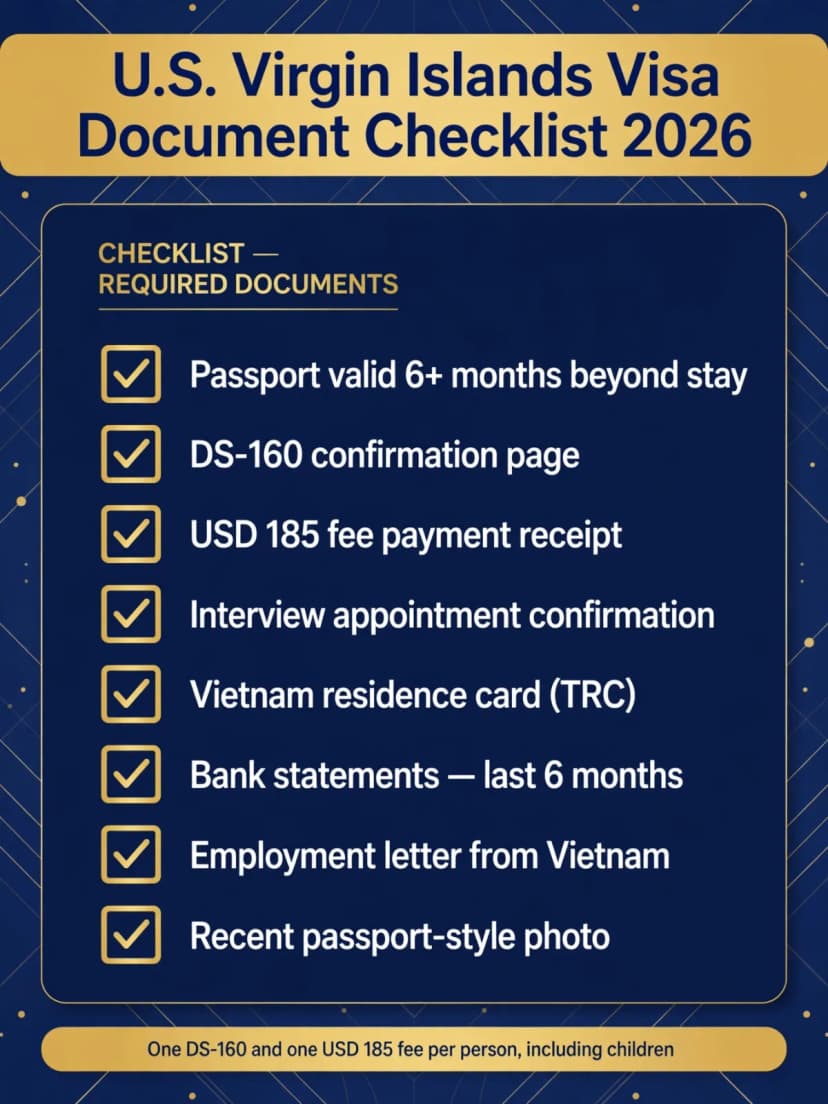
Complete Document Checklists
The State Department lists only a short set of required documents for a visitor visa — passport, DS-160 confirmation page, fee payment receipt, and photo — and then says additional documents may be requested to establish the purpose of the trip, the intent to depart afterwards, and the ability to pay all costs. In practice, the interview is decided on the supporting evidence, and a thin file is the commonest avoidable cause of refusal. Bring originals and one photocopy of each; the officer keeps the copies and returns the originals.
All applicants — core documents
- Original Pakistani passport, valid at least six months beyond your intended stay in the United States, with at least one blank page for the visa foil
- Printed Form DS-160 confirmation page, with the barcode — one form per person, including each child
- Visa application fee payment receipt (USD 185), paid through the official appointment service for Vietnam
- Interview appointment confirmation letter
- One recent passport-style photograph meeting US visa photo requirements, uploaded with the DS-160 — bring a printed copy as well in case the upload failed
- Your Vietnamese temporary residence card (TRC) or valid Vietnamese visa, plus a copy — this proves you live in Vietnam and are applying in your country of residence
- Your CNIC (national identity card), original and copy
- Travel itinerary: flight reservations or a planned routing, and hotel bookings or the address where you will stay in the USVI
- Evidence of the purpose of the trip: for tourism, a day-by-day plan of the islands you will visit; for a family visit, the inviter's details; for business, the conference registration or meeting invitation
Proof of ties to Vietnam and Pakistan
- Employment letter from your employer in Vietnam, on letterhead, stating your position, salary, date you started, and approved leave dates — with the employer's contact details
- Employment contract and recent salary slips, normally for the last three to six months
- Bank statements for the last six months, showing a stable balance sufficient to cover the trip — the officer wants to see regular income, not a single large deposit made the week before the interview
- Tax returns or tax payment records, where available
- Property documents in Pakistan or Vietnam — house, land or shop ownership, or a rental agreement for your home in Ho Chi Minh City
- Family ties: marriage certificate if married, children's birth certificates, and evidence of family living in Vietnam or Pakistan
Tourist visa — additional documents
- Hotel bookings in the USVI for the whole stay, or the name and address of your host
- A realistic daily budget for the trip — accommodation, food, transport and activities — that matches the funds in your bank statements
- Travel insurance covering medical care in the United States, where a hospital visit can cost thousands of dollars — not a visa requirement, but officers view it favourably and it protects you
- Return flight booking or a confirmed onward ticket out of the United States
Business visa — additional documents
- Invitation letter from the US or USVI company, stating the purpose, dates and who bears the costs
- Letter from your own employer confirming the business purpose and that you will return to your job
- Conference or trade-fair registration, agenda or programme
- Your business registration or NTN documents, if you are self-employed
Children travelling with you — additional documents
- The child's own passport, valid at least six months beyond the stay, with a separate DS-160 and a separate USD 185 fee
- The child's birth certificate showing both parents' names
- If only one parent is travelling with the child, a notarised consent letter from the other parent, with a copy of that parent's CNIC or passport — US officers routinely ask for this, and it avoids a difficult conversation at the interview and at the airport
- School enrolment letter for the child, showing they are expected back in Vietnam or Pakistan
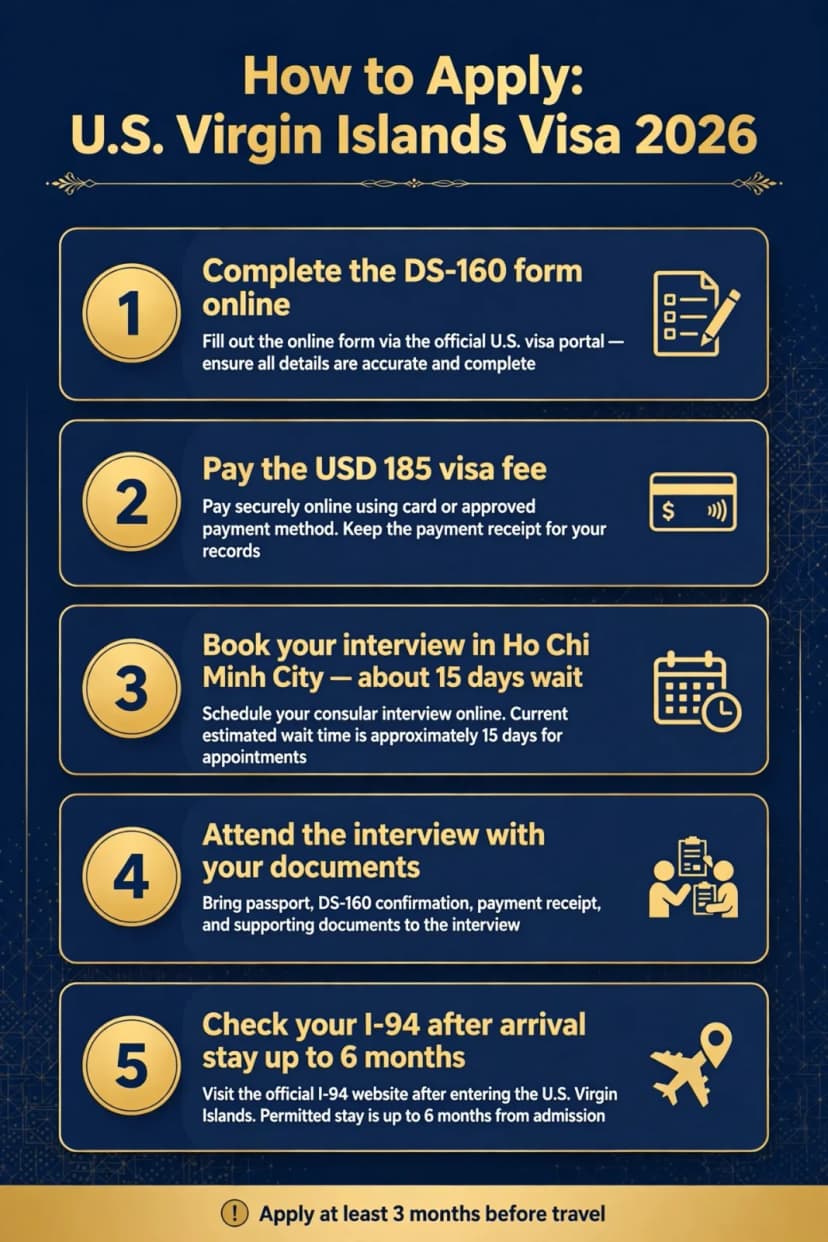
How to Apply: Step-by-Step
B-1/B-2 visitor visa — step by step
Step 1 — Decide your travel dates and check your passport. Confirm your passport is valid at least six months beyond your intended stay and has a blank page. If it expires sooner, renew it first through the Pakistani embassy or consulate. Fix your rough travel dates now, because the DS-160 asks for them; they need not be final, but they must be realistic.
Step 2 — Complete the DS-160 online. Go to the Consular Electronic Application Center at ceac.state.gov and complete the Online Nonimmigrant Visa Application, Form DS-160, selecting the US Consulate General in Ho Chi Minh City as the post where you will apply. The form takes about 90 minutes and times out after 20 minutes of inactivity, losing unsaved work, so save frequently and note your application ID. Answer every question truthfully and consistently with your documents and any previous US visa applications — the form asks for five years of travel history, work and education history, and social media identifiers used in the preceding five years. Upload a digital photo meeting the official requirements, then print the confirmation page with its barcode: you need it to book the interview and to attend it. There is no paper alternative to the DS-160 and no fee for the form itself.
Step 3 — Pay the USD 185 fee and book the interview. Create an account on the official US visa appointment service for Vietnam (US Travel Docs), pay the USD 185 MRV fee by the method it specifies, and keep the receipt — it is valid for 365 days for scheduling. Then book the interview at the US Consulate General in Ho Chi Minh City, at 4 Le Duan Boulevard, District 1. At the last published reading the next available B-1/B-2 appointment was about 15 days away. Choose a date that leaves at least three months before your travel. Print the appointment confirmation.
Step 4 — Assemble the file. Use the checklists in section 7. Gather originals and one photocopy of each document. Prepare a short, honest account of your trip: where you will stay, what you will do, how long you will stay, how you will pay for it, and why you will return to Vietnam. Get the employer's leave letter on letterhead now, not the week of the interview. Do not book a non-refundable flight or hotel yet.
Step 5 — Attend the interview. Arrive on time with your passport, DS-160 confirmation page, fee receipt, appointment confirmation and supporting documents. Ink-free digital fingerprint scans are taken during the process. The consular officer will interview you to determine whether you qualify under US law. Expect direct questions: why are you going to the US Virgin Islands, how long will you stay, what do you do in Vietnam, how much do you earn, who is paying, and what ties you to Vietnam. Answer briefly, truthfully and consistently with your documents. The State Department states that a letter of invitation or an affidavit of support is not needed to apply for a visitor visa and is not one of the factors used in the decision — what matters is your own ties and circumstances.
Step 6 — Wait for the decision. The officer may approve the visa at the interview, refuse it, or place it in administrative processing under section 221(g). If approved, your passport is normally returned by courier within about a week. If administrative processing is required, the officer will tell you, and there is no published timetable; Pakistan-focused guides report 30 to 90 days or longer. Do not book travel while processing is pending. If refused under section 214(b) — the finding that you did not demonstrate sufficient ties abroad — there is no appeal, and the fee is not refunded; the remedy is to reapply when your circumstances have genuinely changed, with a stronger file.
Step 7 — Check the visa when it arrives. Confirm the name spelling, passport number, visa class (B1/B2), validity dates, number of entries (multiple for Pakistanis), and any annotation. A valid US visa in an expired passport remains valid, so keep the old passport with the new one if you renew later.
Step 8 — Book flights and travel. Only now book non-refundable flights and hotels. Fly via a US mainland gateway or San Juan, Puerto Rico, onward to Cyril E. King Airport (STT) on St. Thomas or Henry E. Rohlsen Airport (STX) on St. Croix. For St. John, fly to St. Thomas and take the ferry — there is no airport on St. John. Carry your passport with the visa, your return ticket, your hotel confirmations, and your travel insurance documents in your hand luggage.
Step 9 — Clear CBP on arrival and check your I-94. At the airport, the CBP officer decides whether to admit you and for how long. The visa does not guarantee entry: the State Department states this explicitly, and CBP has the authority to permit or deny admission. After arrival, retrieve your electronic I-94 record from the CBP I-94 website and note the "admit until" date — that date, not the visa expiry date, is the last day you may lawfully stay. For a B-2 visitor the admission is typically up to six months.
Step 10 — Travel onward and depart on time. Moving between the USVI and the US mainland is domestic travel for immigration purposes, but CBP inspects departing passengers from the USVI to the mainland, and foreign nationals must show a valid passport and evidence of lawful status. Keep your I-94 record and return ticket accessible. Leave by the "admit until" date: overstaying voids your visa automatically under section 222(g), and an overstay of more than 180 days followed by departure triggers a three-year bar on returning, and of one year or more a ten-year bar.
Applying from Vietnam — the Ho Chi Minh City Route
For a Pakistani living in Vietnam, the route is straightforward, and it is the best route available to you anywhere in the world for this visa. You apply at the US Consulate General in Ho Chi Minh City, at 4 Le Duan Boulevard, District 1 — the post that serves southern Vietnam — or at the US Embassy in Hanoi if you live in the north. The State Department's rule, published on 15 July 2026, is that nonimmigrant visa applicants should book their interview in their country of nationality or residence, and must be able to show they live in that country where residence is the reason for applying there. Your Vietnamese temporary residence card is the document that proves it: bring the original and a copy, and make sure it is valid on the interview date and will remain valid when you travel.
The practical advantage is the wait time. The State Department's Global Visa Wait Times table, updated 21 October 2026 and 24 November 2026, listed the next available B-1/B-2 interview in Ho Chi Minh City at under 0.5 month — about 15 days — and the same for Hanoi. The same table showed about 12.5 months in Islamabad and about 7.5 months in Karachi. In other words, the identical visa, for the identical applicant, takes about two weeks to reach an interview in Ho Chi Minh City and the better part of a year in Pakistan. There is no lawful shortcut around the Pakistan queue, and paying an agent cannot move you up it. Apply where you live.
A second advantage is that your life in Vietnam is itself your strongest evidence. The officer's central question under section 214(b) is whether you will return after your visit, and a Pakistani teacher with a job, a residence card, a home and a salary in Ho Chi Minh City has a concrete answer — provided the documents prove it. Bring the employment letter, the contract, salary slips, bank statements showing regular salary credits, and the residence card. A bank statement showing a salary paid monthly into a Vietnamese account is worth more than a property document in Pakistan that the officer cannot verify. If your residence card is close to expiry, renew it before applying: a card expiring before your planned return weakens the very tie you are relying on.
If you are in Pakistan when you decide to travel, the route is the US Embassy in Islamabad or the Consulate General in Karachi, booked through the official appointment service for Pakistan, with the same USD 185 fee and the same DS-160. But be clear-eyed about the wait: at the last published reading, Islamabad was about 12.5 months and Karachi about 7.5 months for the next available B-1/B-2 interview. If you are resident in Vietnam, there is no reason to accept that wait. One further caution: the MRV fee is not refunded or transferred if you pay at one post and then decide to interview at another, so pay through the appointment service for the country where you will actually interview.
One more Vietnam-specific point: your flight to the USVI will almost certainly transit a third country — Taipei, Seoul, Tokyo, Hong Kong or Singapore. Check the transit visa rules of every transit country on your routing as well as the US rules: a Pakistani passport holder transiting Taiwan, South Korea or Japan may need a transit visa depending on the routing and the ticket. Do not assume a through-ticket means no transit visa is needed.
Student Route: Studying in the U.S. Virgin Islands
The U.S. Virgin Islands has one university — the University of the Virgin Islands (UVI), with campuses on St. Thomas and St. Croix — and a small number of other institutions offering short courses. Studying there follows the ordinary US student-visa route, and it is a genuine option for a Pakistani student who secures admission and funding, but it is not a shortcut to the United States, and it should not be presented as one.
The route is: first, apply to UVI or another SEVP-certified school and secure admission; second, receive the Form I-20 from the school; third, pay the SEVIS I-901 fee online and keep the receipt; fourth, complete the DS-160, pay the USD 185 application fee, and attend the interview at the US Consulate General in Ho Chi Minh City. At the interview you must show that you are a genuine student, that you can pay the tuition and living costs, and that you intend to return to Vietnam or Pakistan after your studies. The financial evidence matters more for a student visa than for a visitor visa: a shortfall against the cost of the programme is a common reason for refusal.
Two cautions are specific to 2026. First, the US student-visa environment tightened during 2025 and 2026: interviews are required for almost all applicants, the interview-waiver route was narrowed from 1 October 2025, and social media screening is part of the process — the DS-160 asks for social media identifiers used in the preceding five years. Second, the cost is high: USVI tuition is US tuition, and living costs on an island where almost everything is imported are higher than on the mainland. Get the full cost of attendance from the university in writing before committing, and compare it with the funds you can actually show. Do not pay an agent who promises admission or a visa for a fee.
A B-1/B-2 visa does not permit study, with one narrow exception: enrolment in a short recreational course of study, not for credit toward a degree — the State Department gives the example of a two-day cooking class while on vacation. If you intend to study full-time, apply for the F-1. Arriving on a visitor visa and then trying to change status to a student inside the United States is possible in some circumstances through USCIS, but it is slow, uncertain, and the subject of frequent policy change; do not plan a trip around it.
Work Route: Jobs, Business and Work Permits
The honest position first: the U.S. Virgin Islands is not a realistic jobs market for a Pakistani worker applying from Vietnam, and this guide does not present it as one. The islands have a small economy built on tourism, government and a modest services sector, a population of about 100,000 across the three main islands, and unemployment that runs higher than the US mainland average. There is no general work visa for the USVI, no points system, and no route for an unskilled worker to apply for a job from abroad. The work routes that exist are the ordinary US petition-based routes, and they are employer-driven: a US employer must want you specifically and petition USCIS for you before you can apply at a consulate.
The H-1B visa is for specialty occupations — jobs that require at least a bachelor's degree in a specific field — and it is subject to an annual cap and a lottery, with an application fee of USD 205 at the consulate and the employer's petition fees on top. The L-1 is for a transfer within a multinational company that employs you abroad and moves you to its US operation. The O-1 is for individuals of extraordinary ability in science, education, business, athletics or the arts. Each requires a US sponsor and a petition; none can be obtained by applying to a consulate on your own initiative. If a recruiter or agent tells you they can arrange a USVI work visa for a fee without a named US employer and an approved petition, that is a scam.
Business travel is different, and it is realistic. A B-1 visa covers consulting with business associates, attending a conference or trade event, negotiating a contract, and settling an estate. If you run a business in Vietnam and have a genuine business reason to meet a supplier, a customer or a partner in the USVI or the US mainland, the B-1 (usually issued together with the B-2) is the right visa, and the invitation letter from the US company is the key supporting document. What the B-1 does not cover is working for a US employer, receiving a salary from a US source, or running a business inside the United States. The State Department states that a person on a visitor visa is not permitted to accept employment in the United States, and working on a visitor visa can lead to removal and a bar on future visas.
Family Visits and Permanent Residence
Visiting family in the USVI is one of the commonest genuine reasons for a B-2 visa, and the procedure is the ordinary visitor-visa procedure in section 8 — there is no separate family-visit visa. At the interview, the officer will want to know who you are visiting, how they are related to you, what their status in the United States is, and where you will stay. Bring the inviter's full name, address and contact details, and evidence of the relationship. Note the State Department's own advice: a letter of invitation or an affidavit of support is not needed to apply for a visitor visa, and it is not one of the factors used in the decision. The decision turns on your ties and circumstances, not on your relative's assurances.
Permanent residence — a Green Card — is an entirely different matter, and it is not something you apply for at a consulate on your own initiative. The routes are family sponsorship by a US citizen or lawful permanent resident relative, employment sponsorship by a US employer, the diversity visa lottery (for which Pakistan is not an eligible country), asylum, or another specific statutory route. Each runs through USCIS and the National Visa Center and takes months or years. A B-1/B-2 visa is temporary: it requires you to show that you intend to depart after your trip, and applying for a visitor visa while plainly intending to immigrate is a ground for refusal. If a relative offers to sponsor you for a Green Card, that process starts with a petition filed in the United States, and you should take advice from a licensed US immigration attorney before spending money on it.
One point that matters for families: each person needs a separate visa, including children, and each pays the USD 185 fee. A child listed in a parent's passport still needs a separate DS-160 and a separate interview appointment, although children under 14 are often exempt from the in-person interview requirement at the consulate's discretion. If only one parent travels with a child, carry a notarised consent letter from the other parent — US officers and CBP officers both ask for it, and it prevents a difficult delay at the airport.
Common Mistakes to Avoid
Mistake 1 — Paying for a "USVI visa" or a "USVI e-visa". There is no such document. The only visa is a US visa, obtained through the DS-160 and an interview at a US consulate. Any website selling a USVI visa is a scam, and any money paid to it is lost.
Mistake 2 — Applying for ESTA. Pakistan is not a Visa Waiver Program country. An ESTA application from a Pakistani passport holder will be refused, and the fee is wasted. You need a B-1/B-2 visa.
Mistake 3 — Confusing the U.S. Virgin Islands with the British Virgin Islands. They are different jurisdictions a short ferry ride apart. A US visa does not admit you to Tortola or Virgin Gorda. Check the British Virgin Islands' entry rules separately before boarding the ferry.
Mistake 4 — Applying in Pakistan instead of Vietnam. If you live in Ho Chi Minh City, apply in Ho Chi Minh City. The next available B-1/B-2 interview was about 15 days there against about 12.5 months in Islamabad and 7.5 months in Karachi, and the State Department's July 2026 rule directs applicants to apply in their country of residence. The fee is not refunded or transferred if you pay at one post and interview at another.
Mistake 5 — Booking non-refundable travel before the visa is issued. The State Department says it plainly: do not make final travel plans or buy tickets until you have a visa. Administrative processing can add weeks or months, and a refused applicant loses both the fee and the ticket.
Mistake 6 — Treating the five-year visa as a five-year stay. The visa's validity is the period in which you may travel to a US port of entry and ask to be admitted. Each stay is set by CBP on your I-94, typically up to six months. Overstaying voids the visa automatically under section 222(g) and can trigger a three-year or ten-year bar.
Mistake 7 — Arriving with a thin file. The required documents are only the passport, the DS-160 confirmation, the fee receipt and a photo. The decision is made on the supporting evidence: employment, salary, bank statements, residence card, travel history and the purpose of the trip. A file with no evidence of ties to Vietnam is the commonest avoidable refusal.
Mistake 8 — A sudden large deposit in your bank statements. Officers look for regular income, not a single large deposit made the week before the interview. A lump sum with no explanation looks like borrowed money. Show six months of genuine statements.
Mistake 9 — Inconsistency between the DS-160 and the interview. Any answer that contradicts your documents or a previous application will be noticed. Fill in the form yourself, or check every answer an agent enters for you.
Mistake 10 — Working on a visitor visa. A B-1/B-2 does not permit employment. Taking a job, even a casual one in a hotel or restaurant on St. Thomas, is a violation that can lead to removal and future ineligibility.
Mistake 11 — Forgetting the transit countries. Your routing from Vietnam to the USVI transits at least one third country, and sometimes two. Check the transit rules of every country on the ticket for a Pakistani passport holder, not just the US rules.
Mistake 12 — Travelling in hurricane season without insurance. Hurricane season runs from early May to late November, peaking from August to October. Buy travel insurance covering trip cancellation and medical evacuation, and check your hotel's hurricane policy before booking in those months.
Reasons for Refusal
US visa refusals are issued under specific sections of the Immigration and Nationality Act, and the officer will tell you which section applies. The reasons below are the ones that matter for a Pakistani applicant in Ho Chi Minh City, drawn from the State Department's own guidance and the published experience of Pakistani applicants.
Section 214(b) — failure to demonstrate ties abroad. This is by far the commonest reason for a B-1/B-2 refusal. US law presumes that every visitor-visa applicant intends to immigrate, and the burden is on you to show otherwise. Weak employment evidence, no residence card, no property, no family in Vietnam, a vague travel plan, or an income that does not support the trip all point the same way. The remedy is a stronger file: a stable job, regular salary credits, a valid residence card, and a trip plan that matches your finances. There is no appeal against a 214(b) refusal, and no fee refund; you may reapply when your circumstances have genuinely changed.
Section 221(g) — administrative processing. This is not a final refusal but a hold while the application is checked further. The officer will tell you if it applies. It is common for Pakistani applicants, and it can take 30 to 90 days or longer, with no published timetable and no way to speed it up. Do not reapply while a 221(g) case is pending, and do not book travel.
Fraud or misrepresentation — section 212(a)(6)(C). A false statement on the DS-160, a forged document, or a material fact withheld can lead to a permanent refusal — including an altered bank statement or an employment letter from a company that does not employ you. The consequence is far worse than a 214(b) refusal, and it follows you to every future application. Never let an agent submit a document you have not read.
Previous overstay or violation. If you have previously overstayed a US visa, worked without authorisation, or been removed, the officer will see it on your record. An overstay of more than 180 days followed by departure triggers a three-year bar; one year or more triggers a ten-year bar. Disclose previous travel honestly on the DS-160 — the record exists whether you mention it or not.
Security and admissibility grounds. Certain criminal convictions, previous immigration violations, and security-related grounds can make an applicant ineligible. The State Department's visa denials page explains the ineligibilities and the waiver process. If any of these may apply to you, take advice from a licensed US immigration attorney before applying, because a refused application creates a record that affects future applications.
Wrong visa category. Applying for a B-1/B-2 when your real purpose is study or work, or for a student visa without an I-20, leads to refusal and a wasted fee.
Health-related grounds. The United States requires a medical examination only for immigrant visas, not for a B-1/B-2. No vaccination is required for entry to the USVI as a visitor, and there is no yellow fever requirement for travellers arriving from Vietnam. But travel insurance is strongly recommended: medical care in the United States is extremely expensive.
Frequently Asked Questions
1. Do Pakistani citizens need a visa for the U.S. Virgin Islands?
Yes. Pakistani ordinary passport holders need a valid US visa before travelling to the US Virgin Islands. There is no separate USVI visa, no visa on arrival and no visa-free entry. In practice you need a US B-1/B-2 visitor visa, obtained from a US consulate before travel, because the USVI applies US immigration law in full and Pakistan is not a Visa Waiver Program country.
2. Is there a separate U.S. Virgin Islands visa or a USVI e-visa?
No. There is no separate USVI visa, no USVI e-visa portal, no USVI embassy and no USVI consulate, and the United States operates no e-visa system for general visitors. The only official route is the DS-160 form, the USD 185 fee, and an interview at a US embassy or consulate. Any website selling a "USVI e-visa" is not an official channel.
3. Can I use ESTA to visit the U.S. Virgin Islands?
No. ESTA is the authorisation for citizens of Visa Waiver Program countries only, and Pakistan is not a Visa Waiver Program country. A Pakistani passport holder cannot use ESTA for the USVI or for the US mainland, and must hold a US visa instead.
4. How much does the visa cost for a Pakistani passport holder?
USD 185 per applicant, including children, as the non-refundable MRV application fee for a B-1/B-2 visa. Pakistanis pay no additional reciprocity (issuance) fee. A USD 250 visa integrity fee was created by a 2025 US law and is charged at issuance once implemented, but as of October 2026 it was not on the State Department fee schedule and was not being collected at most posts — confirm at the Ho Chi Minh City consulate whether it applies to you.
5. How long does the visa take to get in Ho Chi Minh City?
The next available B-1/B-2 interview in Ho Chi Minh City was about 15 days at the State Department's 21 October 2026 and 24 November 2026 readings, and the same for Hanoi. After the interview, an approved visa is normally returned within about a week, but administrative processing (221(g)) can add 30 to 90 days or longer. Apply at least three months before travel.
6. How long can I stay in the U.S. Virgin Islands?
Each stay is decided by the CBP officer at the airport and recorded on your I-94 record — typically up to six months for a B-2 visitor. The five-year validity of the visa is not permission to stay for five years: it is the period during which you may travel to a US port of entry and ask to be admitted. Check your I-94 "admit until" date after arrival and leave by that date.
7. Can I apply for the US visa in Ho Chi Minh City if I am Pakistani?
Yes. The State Department's rule, published 15 July 2026, is that nonimmigrant visa applicants should apply in their country of nationality or residence, and a Pakistani holding a Vietnamese temporary residence card and living and working in Ho Chi Minh City applies at the US Consulate General there. Bring your residence card. The wait was about 15 days in Ho Chi Minh City against about 12.5 months in Islamabad and 7.5 months in Karachi.
8. What is the US visa interview like?
It is a short, direct interview, usually a few minutes, with digital fingerprint scans. Expect questions about why you are going to the US Virgin Islands, how long you will stay, what you do in Vietnam, how much you earn, who is paying, and what ties you to Vietnam. Answer briefly, truthfully and consistently with your documents. A letter of invitation is not one of the factors used in the decision — your own ties and circumstances are.
9. Can I visit the British Virgin Islands on my US visa?
Not automatically. The British Virgin Islands — Tortola, Virgin Gorda and the other islands — are a separate British territory with their own entry rules, and a ferry trip from St. Thomas to Tortola is an international crossing with its own immigration control. Check their entry requirements for Pakistani passport holders before boarding the ferry.
10. Do I need a visa if I only transit through the US to the USVI?
Yes, in practice. Every routing from Vietnam to the USVI passes through the US mainland or San Juan, Puerto Rico, which is US territory — so the transit is a US entry, not an international transit, and you need the B-1/B-2 visa for the trip itself. A C-1 transit visa is for travellers passing through the US to a third country without stopping, and it is not a substitute for the visitor visa when the USVI is your destination.
11. Can I work in the U.S. Virgin Islands on a visitor visa?
No. A B-1/B-2 visa does not permit employment or work in the United States. Working on a visitor visa can lead to removal and future visa ineligibility. Work requires a petition-based visa such as the H-1B, L-1 or O-1, applied for by a US employer through USCIS before you apply at a consulate.
12. Can I study in the U.S. Virgin Islands on a visitor visa?
No, except for a short recreational course not for credit toward a degree, such as a two-day cooking class while on holiday. Full-time study requires an F-1 student visa, which needs an I-20 form from a SEVP-certified school — including the University of the Virgin Islands — plus the SEVIS I-901 fee, the USD 185 application fee, and an interview.
13. What happens if my visa is refused?
The USD 185 fee is not refunded, and there is no appeal against the commonest refusal, section 214(b) — failure to demonstrate ties abroad. The officer will tell you the section under which you were refused. For a 214(b) refusal, the remedy is to reapply when your circumstances have genuinely changed, with a stronger file. For a 221(g) hold, wait: it is not a final refusal, and there is no published timetable. Never pay an agent who promises to overturn a refusal for a fee.
14. Do I need travel insurance or vaccinations for the USVI?
No vaccination is required for entry to the USVI as a visitor arriving from Vietnam, and there is no yellow fever requirement on this routing. Travel insurance is not a visa requirement, but it is strongly recommended: medical care in the United States is extremely expensive, and hurricane season runs from early May to late November, peaking from August to October.
15. Which islands should I visit, and how do I get between them?
Most visitors fly into Cyril E. King Airport (STT) on St. Thomas, the main gateway, and take the ferry to St. John, which has no airport — two-thirds of St. John is Virgin Islands National Park, and its beaches, including Trunk Bay, are the islands' best-known attraction. St. Croix, served by Henry E. Rohlsen Airport (STX), is quieter and about 40 miles south, reached by a short flight or the inter-island ferry. Cars drive on the left, the currency is the US dollar, and December to April is peak season.
Official Immigration Websites
| Organisation | What it is | Website |
|---|---|---|
| US Department of State | Visitor Visa (B-1/B-2) — how to apply, DS-160, documents, interview, entry and extensions | https://travel.state.gov/content/travel/en/us-visas/tourism-visit/visitor.html/vis |
| US Department of State | Global Visa Wait Times — next available interview appointment by post, including Ho Chi Minh City (updated 24 Nov 2026) | https://travel.state.gov/content/travel/en/us-visas/visa-information-resources/global-visa-wait-times.html |
| Wikipedia — Visa policy of the United States | Confirms the same rules apply to the U.S. Virgin Islands as to the mainland; Pakistan visa-required, not Visa Waiver | https://en.wikipedia.org/w/index.php?title=Visa_policy_of_the_United_States&oldid=1372836283 |
| One Visa Center | US Virgin Islands visa requirements — no separate USVI visa; US visa or ESTA rules apply | https://onevisacenter.com/us-virgin-islands-visa-requirements-for-non-us-citizens/ |
| VisaFromPakistan.com | US Virgin Islands tourist visa for Pakistanis — B-1/B-2 route, USD 185 fee, documents and steps | https://visafrompakistan.com/visa/united-states-virgin-islands/tourist-visa |
| VisaFromPakistan.com | US Virgin Islands business visa for Pakistanis — B-1/B-2 business route | https://visafrompakistan.com/visa/united-states-virgin-islands/business-visa |
| VisaFromPakistan.com | US Virgin Islands visa guide for Pakistani passport holders — overview of the US visa route | https://visafrompakistan.com/visa/united-states-virgin-islands |
| ImmigrationOK | Pakistan to United States visa requirements — visa required, B-1/B-2, not a Visa Waiver country | https://www.immigrationok.com/visa-requirements/pakistan-to-united-states |
| Relocate.lawyer | US visa costs 2026 — USD 185 MRV fee; USD 250 visa integrity fee not yet collected as of Sep 2026 | https://relocate.lawyer/en/usa/how-much-does-a-us-visa-cost/ |
Final Checklist and Conclusion
Before you spend any money, work through this list in order. If you cannot tick the first three boxes, do not proceed.
- You understand that there is no separate USVI visa: the document you need is a US B-1/B-2 visitor visa, and Pakistan is not eligible for ESTA.
- Your passport is valid at least six months beyond your intended stay and has a blank page for the visa foil.
- Your Vietnamese temporary residence card is valid and will remain valid when you travel.
- You have completed the DS-160 truthfully, saved the application ID, and printed the confirmation page with its barcode.
- You have paid the USD 185 MRV fee through the official appointment service for Vietnam and kept the receipt.
- You have booked the interview at the US Consulate General in Ho Chi Minh City, leaving at least three months before travel for administrative processing.
- Your file is complete: employment letter and contract, salary slips, six months of bank statements, property and family evidence, travel history, itinerary and accommodation plan.
- You have not booked a non-refundable flight or hotel, and you have budgeted for the possibility of a USD 250 visa integrity fee at issuance.
- You have checked the transit visa rules of every country on your flight routing, and you know the British Virgin Islands is a separate jurisdiction.
- You have travel insurance covering medical care in the United States, and you have checked your I-94 "admit until" date after arrival and will leave by it.
The U.S. Virgin Islands is one of the simplest destinations in this guide series to understand and one of the hardest visas to obtain — and both facts have the same cause. The visa question is simple because there is no USVI visa at all: the islands are American territory, US immigration law applies, and a Pakistani passport holder needs the same B-1/B-2 visa that would admit them to the mainland, applied for in Ho Chi Minh City for USD 185, with an interview wait of about 15 days at the last published reading. The visa is hard because the United States decides visitor visas on ties, finances and travel history, and Pakistani applicants face close scrutiny, a high refusal rate and the possibility of months of administrative processing. The way through is the same as for any US visa: a truthful DS-160, a complete file, a clear purpose, evidence of a life in Vietnam that you will return to, and an application made early enough that the timetable works.
*This guide was checked on 29 November 2026. Visa rules change without notice. Always confirm the live rules with the US Department of State at travel.state.gov and with the US Consulate General in Ho Chi Minh City before paying any fee or booking a non-refundable ticket. Nothing in this guide is immigration advice. The US consular officer decides whether a visa is issued, and the immigration officer at the port of entry makes the final decision on admission. This guide is educational information only and does not guarantee visa approval or entry.