Venezuela Visa Guide 2026: Types, Requirements, Documents and Application Steps
Last checked: 29 November 2026. This guide is for Pakistani passport holders living in Vietnam. Read the security warning first: the United States rates Venezuela Level 3 — Reconsider Travel — with Level 4 areas, the United Kingdom advises against all but essential travel, and Canada advises against all travel. This guide explains the visa rules honestly, including every point where the sources disagree or where no official figure exists, and it does not present tourism to Venezuela as a low-risk trip. Visa rules change without notice — always confirm the live rules with the Venezuelan Embassy in Hanoi or through the official Cancillería Digital portal before paying any fee or booking a non-refundable ticket.
Introduction
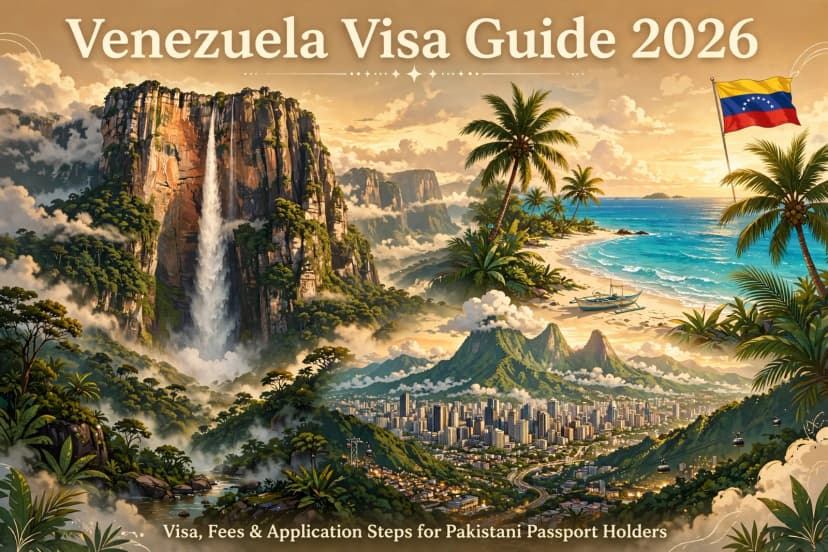
Venezuela is a country of extraordinary landscapes — Angel Falls, the tallest waterfall in the world, dropping from a tepui in Canaima National Park; the Caribbean beaches of Los Roques; the Andes around Mérida; and Caracas, a capital city in a valley beneath El Ávila mountain. It is also, in November 2026, a country under the strictest travel warnings of the major English-speaking governments, after a political and security situation that changed sharply during 2026. On 3 January 2026 military strikes hit sites in Caracas and the states of Miranda, Aragua and La Guaira, the Venezuelan authorities declared a state of external commotion, and the then-president Nicolás Maduro was detained by United States forces and transferred to the United States. Pakistan's Foreign Office stated on 4 January 2026 that it was closely monitoring developments and engaged in ensuring the safety of the Pakistani community in Venezuela. On 24 June 2026 two earthquakes of magnitude 7.2 and 7.5 caused significant damage in La Guaira, parts of Caracas and elsewhere.
That security picture is the first fact of this guide, and it shapes everything else in it. The United States State Department rates Venezuela Level 3 — Reconsider Travel — updated 27 June 2026, after downgrading it from Level 4 on 19 March 2026, with Level 4 still applying to the Colombia border region, Amazonas, Apure, Táchira, Guárico, Aragua outside Maracay and rural Bolívar. The United Kingdom's Foreign, Commonwealth and Development Office, updated 18 November 2026, advises against all but essential travel to the rest of Venezuela and against all travel to the border areas, Amazonas state, the Orinoco Mining Arc, Delta Amacuro south of the Orinoco and Zulia state. Canada, updated 13 October 2026, advises against all travel to Venezuela. There is no consular safety net: the United States Embassy in Caracas suspended operations in March 2019, and although one specialist source reports it formally reopened on 30 March 2026, that reopening is not confirmed by the sources this guide could open directly. If you are a Pakistani living in Vietnam with family in Venezuela, a genuine business reason, or an official assignment, this guide gives you the visa mechanics honestly. If you are reading it for a holiday, weigh the advisories carefully and consider waiting until they ease.
The visa system changed in 2026 in a way that helps applicants. In April 2026 Venezuela launched a fully online electronic visa through the Cancillería Digital portal of the Ministry of People's Power for Foreign Affairs (MPPRE), at cancilleriadigital.mppre.gob.ve. It was mandatory for United States nationals from 6 April 2026 and opened to applicants from all countries by the end of that month. For a Pakistani passport holder, this is the single most important development in the guide: where older guides routed every Pakistani applicant through a distant embassy, the online route now exists in principle — although, as section 5 explains, whether a Pakistani applicant is accepted through the portal, and at what fee, is not settled by any official public source, and the embassy route remains the fallback. A second piece of good news for a reader in Vietnam is the mission map: Venezuela does have an embassy in Hanoi, the natural first point of contact for a Pakistani resident of Vietnam. Section 9 works through the Hanoi, New Delhi and Abu Dhabi options.
There is no visa on arrival in Venezuela for any nationality that needs a visa. Canada's travel advice states this plainly: you must obtain a visa before travelling, visas are not available on arrival, and the penalties for entering without a valid visa are severe, including potentially lengthy detention or imprisonment. Do not plan on obtaining anything at Simón Bolívar International Airport in Maiquetía. The only safe assumption for a Pakistani passport holder is a visa obtained in advance — online through Cancillería Digital, or stamped by a Venezuelan embassy.
Do Pakistani Passport Holders Need a Visa for Venezuela?
Yes. Pakistani passport holders need a visa before travelling to Venezuela. Pakistan is not on Venezuela's tourist visa-exemption list, and every Pakistan-focused guide consulted for this guide — Travel Visa Stack, updated 21 October 2026; VisaCross, verified June 2026; Varioline Traveller, updated 4 September 2026; DestiBird, checked 30 September 2026 — agrees on this point. The visa-exempt list covers roughly sixty nationalities, including most European Union states plus Argentina, Australia, Brazil, Japan, Mexico and Russia, who enter visa-free for tourism for up to 90 days on a tourist card issued on arrival. Pakistan is not among them, and the United States and Canada, whose visa waivers were cancelled in March 2015 and July 2019 respectively, must also obtain an electronic visa in advance.
The route for a Pakistani applicant is the electronic visa. The portal is described across the specialist sources as open to nationals of all countries, and the current Pakistan entry in the standard reference sources reads "e-Visa" rather than the older "visa required" at an embassy. One secondary directory, embassies.net, still lists the e-visa as "not available" for Pakistani citizens, which directly conflicts with the newer sources. No official Venezuelan source consulted for this guide names Pakistan specifically as an accepted e-visa nationality, and the specialist site Caracas Research advises Pakistani applicants to confirm whether Cancillería Digital accepts them online before paying. Treat the e-visa as the first route to try and the embassy as the fallback, and get the answer in writing from the Hanoi embassy before you pay the fee.
Your passport must meet the standard conditions. The FCDO states that to enter Venezuela your passport must have an expiry date at least six months after the date you plan to leave. The New Delhi embassy's published requirements ask for a passport valid for at least six months at the time of application. One official consular source, the Venezuelan Consulate in France as quoted by OneTimeLivin, states only that the passport must have a validity of more than three months from the date of entry. These sources conflict. The safe course is the stricter one: a passport valid for at least six months beyond your planned departure, with at least two blank pages. The two-blank-pages rule is reported in the e-visa document lists but is not confirmed on United Kingdom or United States government guidance.
Two further entry conditions catch people out. First, the authorities may ask to see a return or onward ticket and proof of sufficient funds, and travellers without a return or onward ticket may be refused entry. Turkish Airlines states that visa-required nationals must show a fully prepaid hotel reservation for the entire stay or a notarised invitation letter, plus a confirmed return ticket, with a maximum stay of 90 days, and warns that passengers who do not meet these requirements may be processed as inadmissible. Second, children travelling unaccompanied, with a guardian, or with one parent must provide a travel permit from the non-travelling parent or parents, obtainable from the nearest Venezuelan embassy or consulate. A child without that permit may be denied exit from Venezuela.
Dual nationality matters too. If you also hold Venezuelan citizenship, you must enter and leave Venezuela using your Venezuelan identity documents, and the authorities may not allow you to depart if you are not in possession of a valid Venezuelan passport. This does not apply to a Pakistani-only passport holder, but if it applies to a family member travelling with you, sort it out before departure, not at the airport.

Types of Venezuela Visas for Pakistani Passport Holders
Venezuela's visa system has two layers. The first is the short-stay visa issued through embassies and consulates, or since April 2026 through the Cancillería Digital portal: the tourist visa (T) and the transit visa (V-T). The second is the transeúnte, or temporary resident, family of visas — business (TR-N), entrepreneur and industrialist (TR-E-I), investor (TR-I), student (TR-E), worker (TR-L), family (TR-F, TR-F-V, TR-F-M-P), rentista (TR-R) and religious worker (TR-REL). First-time transeúnte visas are requested from the embassy or consulate responsible for your place of residence, and renewals go through SAIME, the Administrative Service of Identification, Migration and Foreigners, inside Venezuela. The portal handles the tourist and business categories; the others still run through a mission.
Tourist visa (T)
The tourist visa is the standard short-visit visa, issued for recreation, leisure, health, or other activities that involve no pay or profit. Through the Cancillería Digital portal it is issued as an electronic visa valid for one year with multiple entries, allowing a stay of up to 90 days per entry, at the discretion of the immigration officer. The French consulate's published requirements, quoted by OneTimeLivin, give the same figures. A stay may be extended once for a further 90 days by applying and paying at a SAIME office before the tourist card and entry stamp expire, according to the FCDO; nationals of Bolivia and Colombia cannot extend. Overstaying is not a paperwork matter: the FCDO states that if you overstay, you may be arrested and fined when trying to leave Venezuela.
Business visa (TR-N)
The business transeúnte visa covers traders, executives and representatives of enterprises and industries travelling to Venezuela for commercial and financial transactions or other lucrative activity related to their business. It is the second category handled by the Cancillería Digital portal, with the same headline terms as the tourist e-visa: one year, multiple entries, up to 90 days per stay. It needs an invitation letter from a Venezuelan company, plus the applicant's or sending company's letter, commercial registration and a letter from the relevant chamber of commerce or industry association. A non-commercial, non-remunerated conference may fall under the tourist visa; a commercial conference should be assessed under TR-N.
Transit visa (V-T)
The transit visa is for non-migrant travellers whose itinerary includes a stop in Venezuela, or who cross Venezuelan territory on their way to another country. It is only for nationals who need a tourist visa, which includes Pakistanis, and published guides describe it as valid for 72 hours per entry. One practical fact matters more than the visa itself: there is no airside transit procedure at Caracas airport (CCS). Turkish Airlines states that passengers with connecting flights after arriving at CCS must collect their baggage, clear immigration into the country, and check in again, and that check-in counters close two hours before departure. A transit through Caracas is therefore not a transit in the usual sense — you enter Venezuela, and you need the visa to do it. Do not book a connection through Caracas without a transit or tourist visa in hand.
Student visa (TR-E)
The student transeúnte visa is granted to non-migrants who want to enter Venezuela for higher, technical or university studies, for specialisation, or for internships in their field. Consular guidance describes it as issued for one year with multiple entries and the same period of stay, extendable if there is proof that studies continue. Renewals go through SAIME, which asks for up-to-date proof of studies. Section 10 covers what is known and what is not.
Work visa (TR-L)
The work transeúnte visa is authorised by the Ministry of People's Power for Interior Relations, Justice and Peace after the Ministry of People's Power for the Social Process of Labour has given its approval. Consular guidance describes it as valid for one year with multiple entries and permission to remain for the same period, and SAIME's renewal requirements ask for the labour authorisation issued by the competent ministry. Section 11 covers the route in detail. A tourist or business visa does not carry any right to work, paid or unpaid — the FCDO lists work of any nature, including NGO work, journalism, documentary work and volunteering, as needing a visa related to the purpose of the stay.
Family visas (TR-F, TR-F-V, TR-F-M-P)
Family transeúnte visas are granted to close relatives of Venezuelans and of foreigners who hold permanent migrant status. TR-F-V covers the foreign spouse, unmarried children under 18, parents and parents-in-law of a Venezuelan national; TR-F covers dependants of a foreign resident; TR-F-M-P covers dependants of a permanent resident. Family visas are generally issued as multiple-entry visas valid for one year. If a marriage took place abroad, it must be registered with a Venezuelan consulate, and the resulting consular marriage certificate must be submitted. Section 12 covers the route.
Investor, entrepreneur, rentista and religious visas
The investor transeúnte visa (TR-I) is granted to individuals or company representatives who show with reliable documents that their investment has been accepted by the relevant Venezuelan official bodies. The entrepreneur and industrialist visa (TR-E-I) covers company or industry owners. The rentista visa (TR-R) is for people who live on lawful income from rents or a pension; SAIME's renewal requirements ask for certification of income equivalent to USD 1,200 a month. The religious worker visa (TR-REL) needs a current authorisation of worship from the interior ministry. No consular fee specific to any of these categories was published; the requirements ask for proof of payment without stating the amount.
No visa on arrival, and no visa-free route for Pakistanis
To be explicit: there is no visa on arrival in Venezuela for a Pakistani passport holder, and there is no visa-free entry. The visa-exempt nationalities enter on a tourist card issued on arrival at the airport; that card is not available to Pakistanis. The electronic visa must be approved before travel and presented, printed, to the airline and to immigration. Canada's advice warns that the penalties for entering without a valid visa are severe, including potentially lengthy detention or imprisonment. A separate "Visa de cortesía" exists for special guests of the government and diplomats; it is not a route for an ordinary traveller, and no agent can sell you one.
Visa Comparison Table
| Visa type | Entry | Validity | Stay per entry | Where to apply |
|---|---|---|---|---|
| Tourist visa (T) | Multiple entry | 1 year | Up to 90 days | Cancillería Digital portal; or embassy |
| Business visa (TR-N) | Multiple entry | 1 year | Up to 90 days | Cancillería Digital portal; or embassy |
| Transit visa (V-T) | Single entry as standard | Not published | 72 hours per entry (reported) | Embassy or consulate |
| Student visa (TR-E) | Multiple entry | 1 year | 1 year, extendable with proof of studies | Embassy or consulate; renewals via SAIME |
| Work visa (TR-L) | Multiple entry | 1 year | 1 year, with labour ministry approval | Embassy or consulate; renewals via SAIME |
| Family visa (TR-F / TR-F-V / TR-F-M-P) | Multiple entry | 1 year | 1 year | Embassy or consulate; renewals via SAIME |
| Investor visa (TR-I) | Multiple entry | 1 year (reported) | Not published | Embassy or consulate |
| Rentista visa (TR-R) | Multiple entry | 1 year (reported) | 1 year; income USD 1,200 a month | Embassy or consulate; renewals via SAIME |
| Religious worker visa (TR-REL) | Multiple entry | 1 year (reported) | 1 year | Embassy or consulate; renewals via SAIME |
Visa Fees: What Each Route Costs
There is no single official Venezuela visa fee that this guide can quote as settled, and the published figures conflict sharply. The figures below name the source behind every number. Do not pay any figure until you have confirmed it inside the portal or in writing from the mission where you apply.
The headline figure for the electronic visa is USD 180. The specialist sources are consistent: Visamundi, corroborating with Fragomen, reports an expected fee of about USD 180, up from the previous USD 60; Caracas Research states the fee is USD 180, raised from USD 60 in 2025, paid digitally inside the portal; the Visa Experts put the tourist e-visa at USD 180, valid 12 months, multiple entry, up to 90 days per stay, non-refundable regardless of outcome. But the increase is not officially confirmed on any public MPPRE page this guide could open, and VisaCross notes that some April 2026 reports even indicated the e-visa was temporarily free at launch. The fee you will actually pay is the fee the portal shows you at the payment step. Check it before you pay; the fee is non-refundable even if the application is refused.
The embassy counter tells a different story. The New Delhi embassy's published schedule, as reproduced by HiAce Travel, lists the tourist visa at USD 30 and the business visa at USD 60, payable in Indian rupees. Travel Visa Stack, updated 21 October 2026, puts the tourist visa fee for a Pakistani applicant at approximately USD 30–80 depending on the mission, plus courier fees of USD 20–40, for a total realistic budget of USD 60–130. VisaFromPakistan lists USD 30 (PKR 8,700) plus a service charge of PKR 2,000. VisaCross reports the fee averaging around USD 70. AMG Visa, verified 28 October 2026, names no figure and describes the fee as "Official Consular Fee per Embassy Schedule". The honest reading is that USD 180 belongs to the online portal and USD 30–60 belongs to the older embassy counter schedule, and the two have not been reconciled in any public source. If you apply online, budget USD 180. If you apply at an embassy, ask for its current schedule in writing, and do not assume the portal fee applies at the counter or the counter fee applies in the portal.
Three further costs sit outside the visa fee. First, the documents: a criminal record certificate, a medical certificate, translations into Spanish where required, and travel insurance with at least EUR 30,000 of cover. Second, the journey: there are no direct flights from Vietnam or Pakistan to Caracas, so the routing runs through Istanbul, Doha, Dubai or Panama City, and the ticket is the largest single cost of the trip. Third, the extension: a further 90 days at a SAIME office carries a fee, and no published amount was found. Pay only inside the official portal or at the embassy counter. Never pay a third-party website that claims to sell a Venezuela visa online, and never pay an agent who promises a visa for a fee: the decision is made by the Venezuelan authorities, not by the person who takes your money.
| Source | Fee reported | What it covers |
|---|---|---|
| Cancillería Digital portal (Visamundi / Fragomen; Caracas Research) | USD 180 | Tourist (T) or business (TR-N) e-visa; raised from USD 60 in 2025; non-refundable; not officially confirmed on a public MPPRE page |
| Embassy in New Delhi, published schedule (via HiAce Travel) | USD 30 | Tourist visa at the counter, payable in Indian rupees |
| Embassy in New Delhi, published schedule (via HiAce Travel) | USD 60 | Business visa at the counter, payable in Indian rupees |
| Travel Visa Stack, updated 21 Oct 2026 | About USD 30–80 | Tourist visa fee for a Pakistani applicant, by mission and category; plus USD 20–40 courier fees |
| VisaCross, verified Jun 2026 | About USD 70 average | Tourist visa application fee |
| VisaFromPakistan | USD 30 (PKR 8,700) + PKR 2,000 service charge | Tourist e-visa fee as listed; service charge is the site's own |
| SAIME extension inside Venezuela | Not published | Fee for a further 90-day extension; ask at the SAIME office |
| Transeúnte categories (TR-E, TR-L, TR-F and others) | Not published | Published requirements ask for proof of payment without stating the amount; ask the mission |
Processing Times
Processing times are as unsettled as the fees, because the electronic visa is new and the embassy route runs on mission practice rather than a published timetable. The figures below are the reported times, with the source named in every case, and the honest planning figure is the longest one: start four to eight weeks before travel.
For the electronic visa, Visamundi, corroborating with Fragomen, reports an advertised processing time of about 15 days, down from six weeks under the old system. Caracas Research reports approval typically in around 15 days, with a real-world range of 7–30 days. VisaCross estimates roughly 15–30 days and notes that no official processing timeframe has been formally published. Varioline Traveller, updated 4 September 2026, reports something different again: the June 2026 Cancillería Digital tourist visa manual states that the electronic document will be approved and signed in approximately 72 hours. These cannot all describe the same step. The likely reading is that 72 hours is the manual's figure for approval and signature once the file is complete, while 15 days is the advertised end-to-end time and 7–30 days is what applicants actually experience. Plan on 15–30 days and treat 72 hours as a best case, not a promise.
For the embassy route, Travel Visa Stack reports two to three weeks, and VisaCross reports 12–26 business days for a Pakistani tourist visa application. AMG Visa, verified 28 October 2026, reports two to six weeks. DestiBird advises starting four to eight weeks ahead and checking whether an appointment is needed. The transeúnte categories take longer, because the work visa needs labour ministry approval; no published processing time exists for any of them. The portal is reported to suffer periods of downtime, and one Pakistan-focused guide warns that Venezuelan government services may be unavailable at times because of infrastructure problems — another reason to apply well in advance. Do not book a non-refundable ticket until the visa is in your hands, and treat any agent who guarantees a date as unreliable.
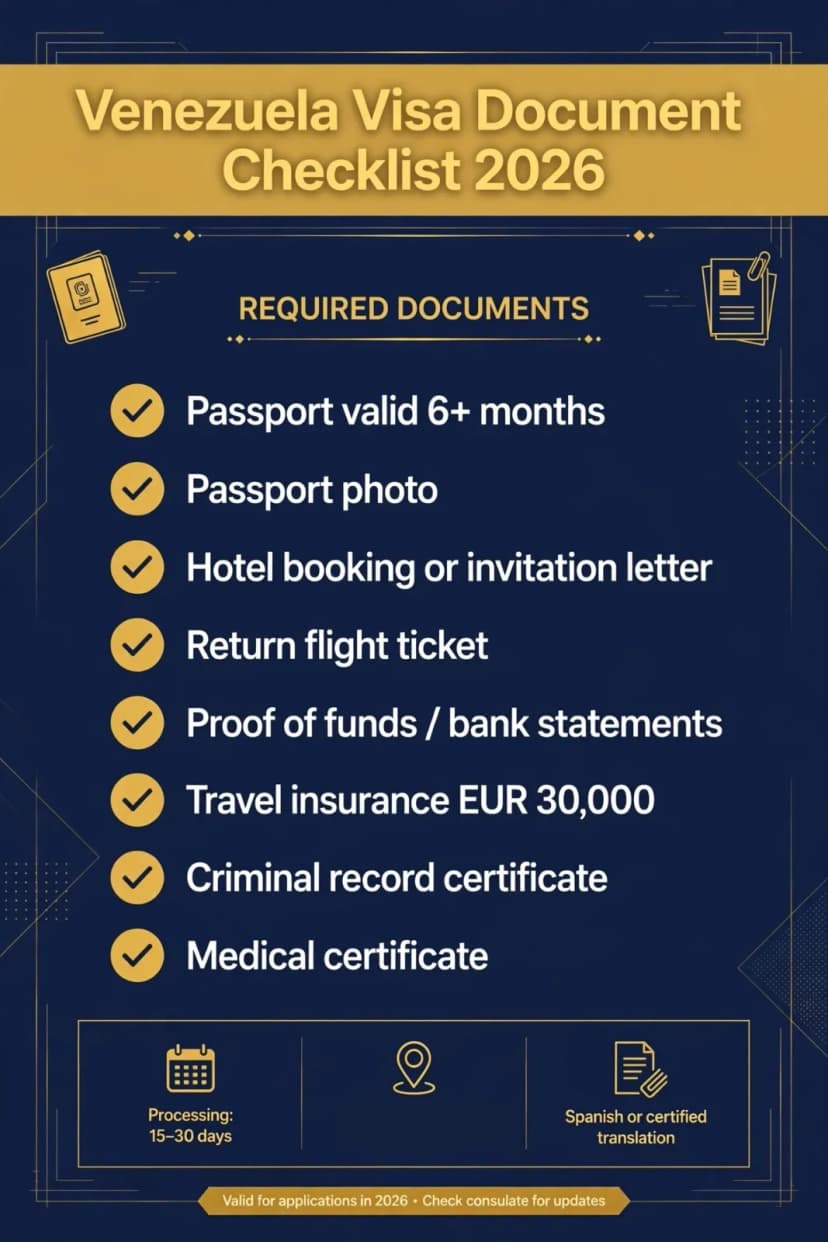
Complete Document Checklists
No single official checklist for Pakistani applicants was found on a public Venezuelan government page. The lists below combine the documents named across the Cancillería Digital e-visa lists, the French consulate's published tourist requirements as quoted by OneTimeLivin, the New Delhi embassy's published requirements, and the Pakistan-focused guides. Take the full file — Venezuelan missions are described as strict about paperwork — and expect the mission to ask for more on a case-by-case basis. Documents in English or Urdu should be translated into Spanish, because the portal and the consular forms are in Spanish.
All applicants — core documents
- Original Pakistani passport, valid at least six months beyond your planned departure, with at least two blank pages (see the conflict note in section 2)
- Scanned copy of the passport bio-data page, for upload to Cancillería Digital
- Recent passport-size photograph, white background, meeting the official specifications
- Completed visa application form — online through Cancillería Digital for the tourist and business e-visa, or the paper form from the embassy for other categories
- Confirmed return or onward flight ticket
- Hotel booking confirmation, fully prepaid for the entire stay, or a notarised invitation letter from a host in Venezuela — for a private stay, the FCDO notes the invitation is issued via SAREN (Servicio Autónomo de Registros y Notarías)
- Proof of sufficient funds for the stay — bank statements for the last three to six months are the usual request, and the New Delhi requirements ask for a bank letter; no official minimum balance is published
- Travel and medical insurance covering hospitalisation and repatriation, with at least EUR 30,000 of cover (French consulate requirement quoted by OneTimeLivin)
- Medical certificate (listed in the Varioline checklist for Pakistani applicants)
- Criminal record certificate issued less than three months before applying (French consulate requirement quoted by OneTimeLivin)
- Employment letter, or business documents if self-employed (Varioline checklist)
- Proof of residence in the country where you are applying — for a Pakistani living in Vietnam, a copy of your Vietnam temporary residence card or visa
- Copy of your CNIC — requested in Pakistan-focused guides for applications made from Pakistan
- Proof of payment of the consular fee — the published requirements ask for this without stating the amount
- Valid email address for e-visa correspondence and delivery
Tourist visa — additional documents
- Hotel reservation or notarised invitation letter, as above
- Evidence of the funds to cover the stay, in cash terms — United States dollars are widely accepted in Venezuela, but carry the proof, not just the cash
- Yellow fever vaccination certificate if arriving from, or transiting through, a country where yellow fever is a risk — see section 13
Business visa — additional documents
- Invitation letter from the Venezuelan company
- Letter from your own employer or your company in Vietnam or Pakistan confirming the purpose of the visit
- Commercial registration of the Venezuelan company, and a letter from the relevant chamber of commerce or industry association
- Company registration or NTN and business documents, where the embassy asks for them
Student visa — additional documents
- Admission letter from the Venezuelan institution
- Evidence of funds for tuition and living costs — no official amount is published
- Academic documents as requested by the embassy
- Proof that studies continue, for renewals through SAIME
Work visa — additional documents
- Employment contract or assignment letter from the Venezuelan employer
- Labour ministry approval, obtained before the visa is authorised
- Letter from the sponsoring employer stating the job, the length of stay and who bears the costs
- Labour authorisation from the competent ministry, for renewals through SAIME
Family visa — additional documents
- Invitation letter from the relative in Venezuela, with their full name, address and contact details
- Proof of relationship — family registration documents, marriage certificate or birth certificate as applicable
- Consular marriage certificate, if the marriage took place abroad and must be registered with a Venezuelan consulate
- Copy of the host's Venezuelan identity document, where the embassy asks for it
Children travelling with you — additional documents
- The child's passport, with at least six months' validity
- Travel permit from the non-travelling parent or parents, obtainable from the nearest Venezuelan embassy or consulate — required by the FCDO for children travelling unaccompanied, with a guardian, or with one parent
- The child's birth certificate or other evidence of the legal relationship
- The child's own visa, where the embassy requires a separate application
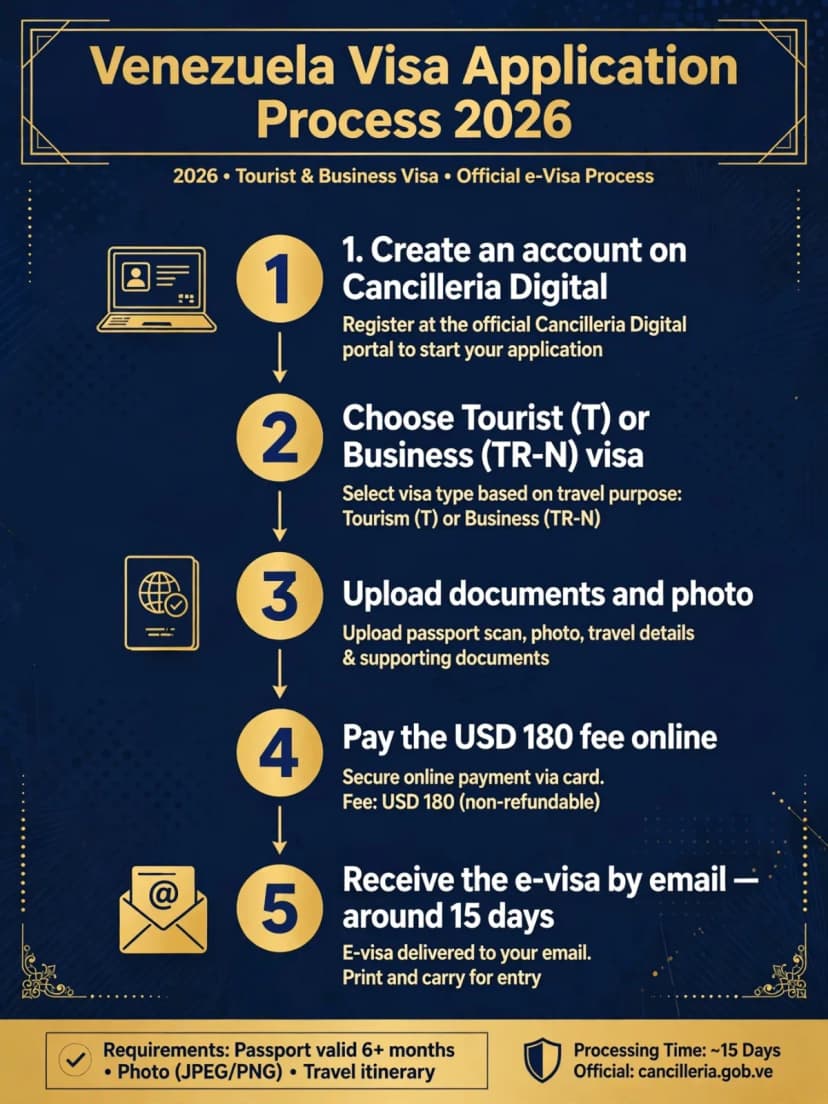
How to Apply: Step-by-Step
Electronic visa — step by step
Step 1 — Read the travel advisories in full and decide whether to travel. Read the United States Level 3 advisory, the FCDO advice updated 18 November 2026, and Canada's advice, and check your travel insurance: the FCDO warns that travelling against its advice may invalidate ordinary travel insurance. If your reason is tourism, weigh the advisories carefully. If it is family, business or an official assignment, continue — and keep a written plan for leaving the country at short notice.
Step 2 — Confirm the route with the Venezuelan Embassy in Hanoi. Before you pay anything, contact the embassy in Hanoi (section 9) and confirm three things: that a Pakistani national resident in Vietnam can apply through Cancillería Digital, what the current fee is, and whether the embassy wants any part of the file in person. The portal is new and the rules for Pakistani applicants are not published — a five-minute call can save a refused fee and a wasted application.
Step 3 — Assemble the file. Use the checklist in section 7 for your category. Get the criminal record certificate early, because it must be less than three months old when you apply. Arrange the travel insurance with at least EUR 30,000 of cover for hospitalisation and repatriation, and get the medical certificate. Scan the passport bio-data page and the photograph in the format the portal asks for, and translate documents into Spanish where needed. Keep photocopies of everything.
Step 4 — Create an account on Cancillería Digital. Go to the official portal at cancilleriadigital.mppre.gob.ve and register. The email address becomes your dossier identifier, so use an address you control and can check while travelling, not a shared mailbox. The portal is in Spanish and the English module is incomplete — keep a translator open if Spanish is not your strong suit, and budget 60–90 minutes for the form.
Step 5 — Create the visa request and choose the category. Select Tourist (T) or Business (TR-N), enter your intended dates of travel, and upload the documents: passport scan, photograph, hotel reservation or invitation letter, return flight itinerary, and proof of funds. The portal's official guides and a short screen recording of the request process are published at mppre.gob.ve/cancilleria-digital. Proofread the form twice before submitting: a wrong date or a misspelt name is the commonest avoidable cause of delay.
Step 6 — Pay the fee inside the portal. The reported fee is USD 180; confirm the amount the portal shows before you pay, because it is the controlling figure. Some card issuers automatically block payments to Venezuela, so pre-clear the transaction with your bank and keep the receipt. The fee is non-refundable even if the application is refused.
Step 7 — Wait, and watch your email. The advertised processing time is around 15 days, with a real-world range of 7–30 days, and the June 2026 manual states the document will be approved and signed in approximately 72 hours once the file is complete. Do not book a non-refundable ticket until the approval arrives. If the portal asks for more documents, answer promptly.
Step 8 — Print the e-visa and carry it. The approval is delivered as a downloadable PDF with an embedded QR code, sent by email. Print it and carry it with your passport: you must present it to the airline before boarding and to immigration on arrival. Keep a digital copy on your phone as well, and keep the approval email.
Step 9 — Fly to Caracas, and clear immigration as a visa holder. The international gateway is Simón Bolívar International Airport (CCS) at Maiquetía. On arrival, show the e-visa, the passport, the return ticket, the hotel booking or invitation letter, and proof of funds. Make sure you receive an entrance stamp in your passport from the immigration office at the port of entry — Canada's advice stresses this, and the stamp is your proof of lawful entry.
Step 10 — Extend before the stay expires, if you need longer. If you need more than 90 days, apply for a further 90 days at any SAIME office before your tourist card and entry stamp expire, and pay the fee there. Do not overstay: the FCDO states you may be arrested and fined when trying to leave.
Embassy visa — step by step
If the portal does not accept your application, or if you are applying for a transeúnte category the portal does not handle, the embassy route applies. Contact the mission first — Hanoi for a resident of Vietnam, New Delhi or Abu Dhabi if you are applying from Pakistan — and confirm that it is accepting applications from you, what its current fee is, whether it wants the application in person or by courier, and which form it uses. Complete the form, assemble the file from section 7, submit it with the fee, and keep the receipt. Visa submission at New Delhi, on the older published schedule, runs Monday to Thursday, 09:30 to 13:00, with collection 09:30 to 17:00 — confirm the current hours before travelling. When the visa is issued, check the name spelling, the passport number, the validity dates, the number of entries and any conditions on it before you leave the counter.
Applying from Vietnam and Pakistan — Venezuelan Embassy in Hanoi
This section is the one most readers will need, and it contains the best news in the guide: there is a Venezuelan embassy in Vietnam, in Hanoi, and it is the natural first point of contact for a Pakistani resident of Vietnam.
Option 1 — Apply in Vietnam through the Venezuelan Embassy in Hanoi
Venezuela has maintained an embassy in Hanoi since diplomatic relations with Vietnam were established on 18 December 1989, and it is listed in the 2026 Hanoi directory at D6B-01, Vuon Dao Area, 675 Lac Long Quan Road, Tay Ho Ward, Hanoi. The foreign ministry's own directory gives the website as vietnam.embajada.gob.ve and the email as embve.vnhan@mppre.gob.ve, and the embassy is concurrently accredited to Cambodia, Laos and Myanmar. Older directories list a previous address at 111 Trich Sai Street, Tay Ho District, with telephone (84-4) 3759 2788 and email embavenezhanoi@yahoo.com. The D6B-01 address is the current listing, but confirm the address and hours before travelling to Hanoi, and confirm that it handles visa applications from a Pakistani national resident in Vietnam. No Venezuelan consulate in Ho Chi Minh City was found, so a reader there should expect to deal with Hanoi by email, telephone, or in person.
Hanoi is the right first call for three reasons. It is the mission in your country of residence, which is where Venezuelan consular guidance says first-time visas are requested. It can answer, in writing, whether a Pakistani applicant is accepted through Cancillería Digital and at what fee. And it can tell you whether any part of your file — the original passport, the fee payment, or an identity check — needs to be done in person. Do not assume the whole process is online until Hanoi confirms it: the Varioline research, updated 4 September 2026, describes the method as online initiation and upload through Cancillería Digital "with consular-mission involvement", and notes that the mission may require an appointment for originals, fee payment, identity verification or passport processing.
Option 2 — Apply in Pakistan through the Venezuelan Embassy in New Delhi
There is no Venezuelan embassy in Pakistan. The nearest accredited mission for a Pakistani applicant is the Embassy of Venezuela in New Delhi, and it is the mission the Pakistan-focused guides direct applicants to. The consular section is listed at E-106, Malcha Marg, Chanakyapuri, New Delhi 110021, with telephone +91 11 4168 0218 and +91 11 4168 0219, and email embavene_india@yahoo.co.in. Two cautions apply. First, the address is reported inconsistently: India's Ministry of External Affairs protocol registry lists the mission office at C-6/11 Vasant Vihar, New Delhi 110057, with the same telephone number, while the consular listings give E-106 Malcha Marg. Confirm the address before travelling. Second, a Pakistani applicant travelling to India needs an Indian visa of his own, and whether New Delhi accepts applications from a Pakistani resident of Vietnam is unverified and must be asked directly. The published schedule lists the tourist visa at USD 30 and the business visa at USD 60, payable in Indian rupees, with submission Monday to Thursday 09:30 to 13:00. Those figures are older and conflict with the portal's USD 180, so ask for the current schedule in writing.
Option 3 — Apply through the Venezuelan Embassy in Abu Dhabi
Venezuela maintains an embassy in Abu Dhabi, and Travel Visa Stack lists Abu Dhabi alongside New Delhi as a routing option for Pakistani applicants. No address, telephone number or visa procedure for Abu Dhabi was verified from an official source for this guide, and whether it accepts applications from a Pakistani resident of Vietnam is unverified. Abu Dhabi is realistic only if you are already travelling to the Gulf, and only after the embassy confirms it will take your application.
Option 4 — Apply through the Venezuelan Embassy in Tehran
Venezuela maintains an embassy in Tehran, and two Pakistan-focused sources — AMG Visa and embassies.net — name Tehran alongside Riyadh as a processing mission for Pakistani applicants. No address, telephone number or visa procedure for Tehran was verified from an official source, and whether it accepts applications from a Pakistani resident of Vietnam is unverified. Treat Tehran as a fallback to be confirmed by telephone, not as a default.
Which option should you choose?
If you live in Vietnam, Hanoi is the natural first choice: it is the mission in your country of residence, and it is the one that can confirm the online route for you. If you are in Pakistan, try the Cancillería Digital portal first and use New Delhi as the fallback, after confirming it will accept your application and after arranging your own Indian visa. In every case, confirm the mission is open, accepting applications from you, and charging the fee it states, before you spend money on travel or tickets. And in every case, do not pay any fee — online or at a counter — until you know which fee applies to your route.
Student Route: Studying in Venezuela
There is a real student visa category — the transeúnte estudiantil (TR-E) — but no verified, functioning student route this guide can recommend without reservations in 2026. The category covers higher, technical or university studies, specialisation, or internships, and consular guidance describes it as issued for one year with multiple entries, extendable with proof that studies continue. Renewals go through SAIME, which asks for up-to-date proof of studies. What was not found in any source consulted is a published student-specific document list, fee, processing time, or list of Venezuelan institutions currently admitting foreign students.
The practical position is cautious. Do not pay any agent who claims to hold a confirmed Venezuelan student visa or university place for 2026, and do not pay tuition or fees to any institution until the embassy has confirmed which visa category it will issue. If you have a genuine academic reason to go — an admission letter from a Venezuelan university or a research affiliation — obtain the letter, assemble the file in section 7, contact the Hanoi embassy, and ask which category it will issue and what it needs. Students already in Venezuela should keep their registration current with SAIME and their proof of studies up to date. A tourist visa does not carry a right to study, and the FCDO states plainly that coming to Venezuela to study or for an internship needs a visa for that purpose.
Work Route: Jobs, Business and Work Permits
Venezuela is not a jobs market for foreign workers in 2026, and this guide does not present it as one. The economy is under severe strain, the security advisories are at their highest levels, medical services are limited, and the United States State Department cites poor health infrastructure as one of the reasons for its Level 3 advisory. No Pakistani should travel to Venezuela in 2026 looking for general employment, and no agent can offer a Venezuelan job that comes with a guaranteed visa.
The work route that exists is the sponsored one: a specific employer in Venezuela sponsors your transeúnte laboral (TR-L) visa, the labour ministry gives its approval, and the interior ministry authorises the visa. Consular guidance describes the TR-L as valid for one year with multiple entries, and SAIME's renewal requirements ask for the labour authorisation. The business route is separate and more accessible: the TR-N business visa, handled through Cancillería Digital, covers meetings, contracts and commercial transactions, needs a Venezuelan company invitation, and is the right category for a short business trip. It does not carry a right to take up employment in Venezuela. The rentista route (TR-R) is for people who live on lawful income from rents or a pension, with SAIME asking for certification of income equivalent to USD 1,200 a month. The investor route (TR-I) needs proof that the investment has been accepted by the relevant Venezuelan official bodies. If an employer or agent asks you to pay for a Venezuelan work permit, treat it as a warning sign: the approval comes from the labour ministry, not from a payment.
Family Visits and Permanent Residence
Family visits are, with business, the most genuine reason a Pakistani in Vietnam might need a Venezuela visa in 2026. The route is the family transeúnte visa: a relative in Venezuela invites you, and you apply at an embassy with the invitation letter and proof of the relationship. TR-F-V covers the foreign spouse, unmarried children under 18, parents and parents-in-law of a Venezuelan national; TR-F covers dependants of a foreign resident; TR-F-M-P covers dependants of a permanent resident. Family visas are generally issued as multiple-entry visas valid for one year, and renewals go through SAIME with a document proving the family tie.
Children travelling for a family visit need the travel permit described in section 2, from the non-travelling parent or parents, obtainable from the nearest Venezuelan embassy or consulate. Keep the family's documents together — invitation letter, proof of relationship, the consular marriage certificate if the marriage took place abroad, and the children's permits — and carry copies separately from the originals. No published permanent-residence route, timeline or fee for a foreign national arriving on a family visa was found, and no family-reunification class separate from the transeúnte family visas was found. Do not assume a visit visa can simply be converted into residence: residence questions are handled by SAIME inside Venezuela, and the issuing mission is the authority to ask before you travel.
Common Mistakes to Avoid
Mistake 1 — Treating Venezuela as an ordinary holiday destination in 2026. The security situation overrides every other fact. The United States rates the country Level 3 with Level 4 areas, the United Kingdom advises against all but essential travel, and Canada advises against all travel. Read the advisories in full, check that your insurance is valid for a trip against FCDO advice, and keep a plan for leaving at short notice.
Mistake 2 — Arriving without a visa and hoping for one on arrival. There is no visa on arrival in Venezuela. Canada's advice warns that the penalties for entering without a valid visa are severe, including potentially lengthy detention or imprisonment. The visa must be approved before you board the flight.
Mistake 3 — Paying the wrong fee. The portal's reported fee is USD 180 and the New Delhi counter's older published schedule is USD 30 for a tourist visa and USD 60 for a business visa. They are different routes with different fees. Confirm which fee applies to your route before you pay, and remember the portal fee is non-refundable.
Mistake 4 — Using a lookalike portal. The only official place to apply for the e-visa is Cancillería Digital at cancilleriadigital.mppre.gob.ve, the Ministry of Foreign Affairs portal. Any other website claiming to sell a Venezuela e-visa is not an official channel. Check the address in the browser bar before you create an account or enter card details.
Mistake 5 — Booking a connection through Caracas without a visa. There is no airside transit procedure at Caracas airport. Passengers with connecting flights must collect their baggage, clear immigration into the country, and check in again, with counters closing two hours before departure. A transit through Caracas needs a transit or tourist visa.
Mistake 6 — Travelling on a passport with less than six months' validity. One consular source says three months is enough; the FCDO says six months after the planned departure. Follow the stricter figure: six months, with two blank pages.
Mistake 7 — Forgetting the criminal record certificate or the insurance. The e-visa document list includes a criminal record certificate less than three months old and medical insurance covering hospitalisation and repatriation with at least EUR 30,000 of cover. Both take time to arrange; start them before you open the portal.
Mistake 8 — Letting the card payment fail. Card payments to Venezuela are routinely blocked by some issuers. Pre-clear the transaction with your bank before you pay the USD 180, and keep the receipt — a failed payment can stall the file for weeks.
Mistake 9 — Overstaying the 90 days. A stay may be extended once for a further 90 days at a SAIME office before the first period expires. Overstaying risks arrest and a fine when you try to leave.
Mistake 10 — Carrying the wrong money, or too much of it. You must declare cash or travellers cheques worth USD 10,000 or more when entering Venezuela, and you must pay tax on the excess. United States dollars are widely accepted and some card machines do not work with international cards, so carry usable cash and declare what you must.
Mistake 11 — Travelling with children without the travel permit. Children travelling unaccompanied, with a guardian, or with one parent need a travel permit from the non-travelling parent or parents. A child without it may be denied exit.
Mistake 12 — Paying an agent for a guaranteed visa, job or student place. No agent can guarantee a Venezuelan visa, because the decision is made by the Venezuelan authorities. The work visa needs labour ministry approval, the student visa needs a genuine admission, and the e-visa needs the portal's approval.
Reasons for Refusal
No official Venezuelan refusal list is published, so the reasons below are drawn from the entry conditions the official sources state and from the structure of the system.
Passport validity or blank pages. A passport with less than six months' validity beyond the planned departure, or without blank pages, fails the entry condition stated by the Foreign, Commonwealth and Development Office.
Missing or inconsistent documents. Venezuelan missions are described as strict about paperwork. A missing invitation letter or hotel booking, an unsigned form, a photograph that does not meet the requirement, a criminal record certificate older than three months, or dates that do not match between the application, the invitation and the flight itinerary can all cause a refusal or a referral that takes weeks.
No return or onward ticket, or no proof of funds. The authorities may ask for both on arrival, and travellers without a return or onward ticket may be refused entry. Turkish Airlines warns that visa-required nationals who cannot show a fully prepaid hotel booking or a notarised invitation letter, plus a confirmed return ticket, may be processed as inadmissible.
No or inadequate insurance. The published e-visa requirements ask for medical insurance covering hospitalisation and repatriation with at least EUR 30,000 of cover. A policy that does not cover Venezuela, or that excludes repatriation, fails the requirement.
Wrong visa category. A tourist visa does not cover work of any nature, paid or unpaid, including NGO work, journalism, documentary work and volunteering, and it does not cover study or an internship. Applying in the wrong category is a refusal waiting to happen.
Security and admissibility concerns. Venezuela enforces its entry requirements strictly, and the authorities may stop a traveller whose stated purpose does not match the documents. Any inconsistency in the stated purpose of travel, or any adverse record, can lead to refusal. There is no published appeal route for a refused Venezuelan visa; the practical remedy is to find out the reason, fix it, and reapply.
Frequently Asked Questions
1. Do Pakistani citizens need a visa for Venezuela?
Yes. Pakistani ordinary passport holders must obtain a visa before travelling to Venezuela. Pakistan is not on Venezuela's tourist visa-exemption list, and the route is the electronic visa through the Cancillería Digital portal, with the embassy as the fallback. There is no visa on arrival and no visa-free entry for Pakistanis.
2. How do I apply for a Venezuela e-visa from Vietnam?
Create an account on the official Cancillería Digital portal at cancilleriadigital.mppre.gob.ve, choose the tourist (T) or business (TR-N) visa, upload your documents, and pay the fee inside the portal. Before you pay, confirm with the Venezuelan Embassy in Hanoi that a Pakistani national resident in Vietnam is accepted through the portal — no official source names Pakistan specifically as an accepted e-visa nationality.
3. How much does a Venezuela visa cost for a Pakistani passport?
There is no single settled figure. The reported fee for the online e-visa is USD 180, raised from USD 60 in 2025, but the increase is not officially confirmed on any public MPPRE page. The New Delhi embassy's older published schedule lists USD 30 for a tourist visa and USD 60 for a business visa, and agency estimates run from USD 30 to USD 80. Confirm the fee for your route — portal or counter — before you pay, and remember the portal fee is non-refundable.
4. How long does a Venezuela visa take to process?
There is no published official timetable. The advertised time for the e-visa is around 15 days, with a real-world range of 7–30 days, and the June 2026 portal manual states the document will be approved and signed in approximately 72 hours once the file is complete. The embassy route is reported at two to three weeks, or 12–26 business days. Plan on four to eight weeks.
5. How long can I stay in Venezuela on a tourist visa?
Up to 90 days per entry, on a visa valid for one year with multiple entries. You may apply for one further 90-day extension at a SAIME office before your first period expires. Overstaying risks arrest and a fine when you try to leave.
6. Is there a Venezuelan embassy in Vietnam?
Yes. Venezuela has an embassy in Hanoi, listed in the 2026 directory at D6B-01, Vuon Dao Area, 675 Lac Long Quan Road, Tay Ho Ward, Hanoi, with the website vietnam.embajada.gob.ve and email embve.vnhan@mppre.gob.ve. No Venezuelan consulate in Ho Chi Minh City was found. Confirm the address and hours by telephone or email before travelling to Hanoi.
7. Is there a Venezuelan embassy in Pakistan?
No. There is no Venezuelan embassy in Pakistan. The nearest accredited mission for a Pakistani applicant is the Embassy of Venezuela in New Delhi, and Abu Dhabi and Tehran are also named as routing options in the Pakistan-focused guides. A Pakistani applicant travelling to India needs an Indian visa of his own.
8. Can I get a visa on arrival in Venezuela?
No. There is no visa on arrival in Venezuela for any nationality that needs a visa. Canada's travel advice states that you must obtain a visa before travelling, that visas are not available on arrival, and that the penalties for entering without a valid visa are severe, including potentially lengthy detention or imprisonment.
9. Can I transit through Caracas airport without a visa?
No. There is no airside transit procedure at Caracas airport (CCS). Passengers with connecting flights must collect their baggage, clear immigration into the country, and check in again, with counters closing two hours before departure. You need a transit visa (V-T) or a tourist visa to pass through Caracas.
10. Is it safe to travel to Venezuela in 2026?
No government advises it as safe. The United States rates Venezuela Level 3 — Reconsider Travel — updated 27 June 2026, with Level 4 for the Colombia border region, Amazonas, Apure, Táchira, Guárico, Aragua outside Maracay and rural Bolívar. The United Kingdom advises against all but essential travel, and against all travel to the border areas, Amazonas, the Orinoco Mining Arc, Delta Amacuro south of the Orinoco and Zulia. Canada advises against all travel.
11. Do I need a yellow fever certificate for Venezuela?
It depends on your route. The FCDO states that to enter Venezuela from Brazil you must have a certificate proving yellow fever vaccination. Pakistan-focused guides add that a certificate is needed if arriving from or transiting through a country where yellow fever is a risk. If your routing passes through Brazil or another at-risk country, carry the certificate; if it does not, the requirement does not appear to apply — but check the live rule with the embassy before travel.
12. What documents do I need for the Venezuela e-visa?
A passport valid for at least six months, a passport-size photograph, a hotel booking or notarised invitation letter, a return flight ticket, proof of funds, travel insurance covering hospitalisation and repatriation with at least EUR 30,000 of cover, a medical certificate, a criminal record certificate issued less than three months before applying, an employment letter, and proof of residence in the country where you apply.
13. Can I work or study in Venezuela on a tourist visa?
No. A tourist visa does not carry a right to work or study. Work needs the transeúnte laboral visa (TR-L) with labour ministry approval, and study needs the transeúnte estudiantil visa (TR-E) with an admission letter. The FCDO states that work of any nature, including NGO work, journalism and volunteering, and study or an internship, all need a visa for that purpose.
14. Can I extend my stay in Venezuela?
Yes, once. You may apply for a further 90 days at any SAIME office before your tourist card and entry stamp expire, and pay the fee there. Apply before the first 90 days run out — overstaying risks arrest and a fine when you try to leave.
15. What happens if my Venezuela visa is refused?
There is no published appeal route. Visa fees are not refundable. The practical remedy is to find out the reason — most commonly a missing or inconsistent document, an expired criminal record certificate, no return ticket, or the wrong visa category — fix it, and reapply. Do not pay any agent who promises to overturn a refusal for a fee.
Official Immigration Websites
| Organisation | What it is | Website |
|---|---|---|
| Venezuela, Ministry of People's Power for Foreign Affairs (MPPRE) | Cancillería Digital — the official e-visa portal (in Spanish) | https://cancilleriadigital.mppre.gob.ve/ |
| Venezuela, Ministry of People's Power for Foreign Affairs (MPPRE) | Cancillería Digital guides and the screen recording of the request process | https://mppre.gob.ve/cancilleria-digital |
| Embassy of Venezuela in Vietnam | Embassy website for the Hanoi mission (vietnam.embajada.gob.ve) | https://vietnam.embajada.gob.ve/ |
| SAIME | Administrative Service of Identification, Migration and Foreigners — extensions and renewals inside Venezuela (in Spanish) | https://www.saime.gob.ve/ |
| UK Foreign, Commonwealth and Development Office | Venezuela travel advice — entry requirements, safety, extensions, overstaying (updated 18 November 2026) | https://www.gov.uk/foreign-travel-advice/venezuela/entry-requirements |
| US Department of State | Venezuela Travel Advisory — Level 3, Reconsider Travel (updated 27 June 2026), with Level 4 areas | https://travel.state.gov/content/travel/en/traveladvisories/traveladvisories/venezuela-travel-advisory.html |
| Government of Canada | Venezuela travel advice — avoid all travel; visa required, no visa on arrival (updated 13 October 2026) | https://travel.gc.ca/destinations/venezuela |
| Pakistan, Ministry of Foreign Affairs | Statement on the situation in Venezuela and the safety of Pakistanis (4 January 2026) | https://mofa.gov.pk/press-releases/situation-in-venezuela |
| Wikipedia — Visa policy of Venezuela | Visa-exempt list, tourist card, and the electronic visa | https://en.wikipedia.org/wiki/Visa_policy_of_Venezuela |
| Wikipedia — List of diplomatic missions of Venezuela | Current Venezuelan missions abroad, including Hanoi, New Delhi, Abu Dhabi and Tehran | https://en.wikipedia.org/wiki/List_of_diplomatic_missions_of_Venezuela |
Final Checklist and Conclusion
Before you spend any money, work through this list in order. If you cannot tick the first three boxes, do not proceed.
- You have read the United States Level 3 advisory, the FCDO advice and Canada's advice in full, and you have a written plan for leaving Venezuela at short notice.
- You have a genuine reason to travel — family, business or an official assignment — and you have weighed the advisories honestly if the reason is tourism.
- You have confirmed with the Venezuelan Embassy in Hanoi that a Pakistani national resident in Vietnam can apply through Cancillería Digital, and you know which fee applies to your route.
- Your passport is valid at least six months beyond your planned departure and has at least two blank pages.
- Your file is complete: passport scan, photograph, hotel booking or notarised invitation letter, return flight ticket, proof of funds, insurance with at least EUR 30,000 of cover, medical certificate, criminal record certificate less than three months old, employment letter, and proof of your residence in Vietnam.
- You have pre-cleared the card payment with your bank, so the fee payment inside the portal does not fail.
- You have not booked a non-refundable ticket, and you have budgeted for the fee, the documents, the translations and the routing through Istanbul, Doha, Dubai or Panama City.
- If children are travelling, the travel permit from the non-travelling parent or parents is in hand.
- You have printed the e-visa approval with its QR code, and you carry it with your passport, the return ticket, the hotel booking or invitation letter, and proof of funds.
- You know that Caracas airport has no airside transit, that you must clear immigration even to connect, and that you must get an entrance stamp in your passport.
This guide was checked on 29 November 2026. Visa rules change without notice. Always confirm the live rules with the Venezuelan Embassy in Hanoi or through the official Cancillería Digital portal before paying any fee or booking a non-refundable ticket. Nothing in this guide is immigration advice; the Venezuelan authorities set and enforce the entry rules, and the immigration officer at Simón Bolívar International Airport makes the final decision. This guide is educational information only and does not guarantee visa approval or entry.