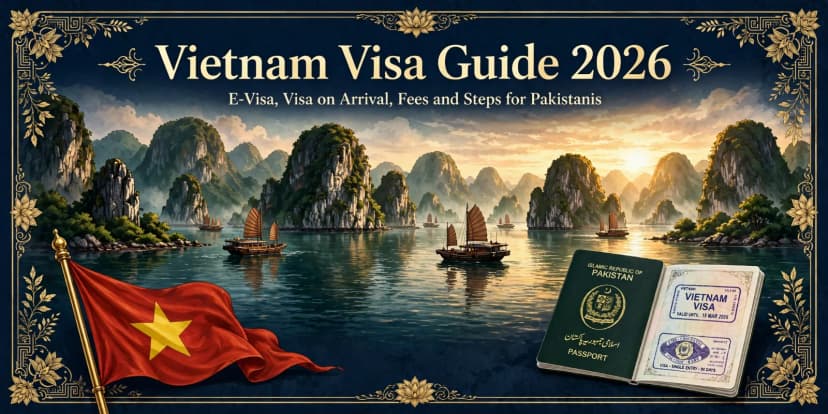
Vietnam Visa Guide 2026: Types, Requirements, Documents and Application Steps
Last checked: 29 November 2026. This guide is written for a Pakistani passport holder who lives in Vietnam and needs a Vietnamese visa — a fresh e-visa to re-enter after a trip abroad, a visa for a family member travelling from Pakistan, or the longer-term routes (extension, work permit and temporary residence card) that keep you living here lawfully. It is not a guide to applying for a third country's visa from Vietnam. Visa rules change without notice — always confirm the live rules on the official e-visa portal or with the Vietnam Immigration Department before paying any fee or booking a non-refundable ticket.
Introduction
Vietnam has one of the simplest visa systems in Southeast Asia — and for a Pakistani living in Ho Chi Minh City, Hanoi or Da Nang, that simplicity is the whole story. Since 15 August 2023 the e-visa has been open to citizens of every country and territory, including Pakistan. There is no invitation letter, no embassy queue and no interview: you apply online, pay USD 25 single or USD 50 multiple, and the visa is valid for up to 90 days. For most Pakistani passport holders, that is the entire visa process.
But "simple" is not the same as "without traps". If you already hold a temporary residence card or a work permit, you need renewals, not visas. If you are here on an e-visa and it is about to expire, you cannot extend it yourself: only a sponsor can ask for an extension. If you travel home to Pakistan and come back, you need a fresh e-visa or a valid multiple-entry one. If your family visits from Lahore or Karachi, they apply the same way you did, for the same USD 25 fee. And if you overstay, the fines changed on 15 December 2025 under Decree 282/2025/ND-CP — a careless month can now cost more than a year of visas.
Two things that look like shortcuts are not. The visa on arrival is real, but it only works if you already hold an approval letter issued by the Immigration Department before you fly — and in 2026 the agencies disagree about how long it now lasts, one leading agency saying 15 days, single entry, for tourism only, while others still sell one- to three-month letters. This guide reports that conflict rather than picking a side. And the copycat websites charging USD 55 to USD 100 or more for an "e-visa service" are not the government: the official portals are evisa.gov.vn and thithucdientu.gov.vn, run by the Immigration Department, and every dollar above USD 25 or USD 50 is a service fee you chose to pay.
Do Pakistani Passport Holders Need a Visa for Vietnam?
Yes, with an ordinary Pakistani passport. Pakistan is not on Vietnam's unilateral visa-exemption list, so an ordinary (green) passport holder needs a visa for every entry, for any purpose and any length of stay. There is no visa-free tourist entry for Pakistanis, no visa on arrival without prior approval, and no confirmed transit-without-visa arrangement for Pakistani nationals passing through a Vietnamese airport.
The one exemption is narrow and does not cover most readers. Under the bilateral agreement on visa exemption for holders of diplomatic and official passports — signed on 31 January 2007 and in force since 2 March 2007 — holders of Pakistani diplomatic and official (service) passports may enter Vietnam without a visa and stay for up to 90 days. Pakistan's Foreign Ministry lists Vietnam on the same terms: three months, diplomatic and official passport holders only. If you hold an ordinary passport, this agreement makes no difference to you. If you hold a diplomatic or official passport, confirm the exemption with the Vietnamese mission before travel: airline check-in staff sometimes apply the ordinary-passport rule to every Pakistani passport they see.
Vietnam requires a passport valid for at least six months from the date of arrival, with at least two blank pages for the visa sticker and the entry stamp. The e-visa portal will reject a short passport, and a border officer can refuse entry on the same ground even if a visa was issued. Renew before you apply if you have less than six months left — and remember that a temporary residence card must expire at least 30 days before your passport does, so a short passport shortens any card you hold.
When you arrive, the officer stamps a permitted stay into your passport. Check that date before you leave the immigration desk: if the expiry date written in your passport is wrong, you can be accused of overstaying later even though the mistake was the officer's. The United Kingdom's travel advice warns about exactly this. Raise a wrong stamp on arrival day, not on departure day, when it is too late to fix without a fine.
Children need their own visa: every traveller, including an infant, needs a passport and a visa of their own — a child cannot travel on a parent's e-visa. The portal takes one application at a time, so a family of four means four applications and four fees.

Types of Vietnam Visas for Pakistani Passport Holders
Vietnam's visa system uses short codes printed on the visa — DL for tourist, DN1 and DN2 for business, LĐ1 and LĐ2 for work, DH for study, TT for family, ĐT1 to ĐT4 for investors. The categories below are the ones that matter to a Pakistani passport holder, in the order you are most likely to use them.
E-visa (DL tourist visa)
The e-visa is the default route and the one this guide recommends first. It has been open to citizens of all countries and territories since 15 August 2023, under Law 23/2023/QH15, which extended the maximum stay from 30 days to 90 days. It covers tourism and short visits, including short business meetings, and it is issued entirely online: apply on evisa.gov.vn or thithucdientu.gov.vn, upload a portrait photo and a scan of your passport data page, pay by card, and receive the e-visa by email. It is valid for up to 90 days from the start date you choose, single or multiple entry, and you may enter at any of 83 designated ports of entry — 17 airports, 27 land borders and 39 seaports, after Resolution 389/NQ-CP added 41 checkpoints on 2 December 2025. The fee is USD 25 single or USD 50 multiple, not refunded if the visa is refused. Official processing is not more than three working days from a complete application and the fee; in practice most straightforward applications take three to five working days. Multiple entry buys you more entries, not more time — both are capped at the same 90 days, which run from the start date on the e-visa, not from your first entry.
Visa on arrival (with an approval letter)
The visa on arrival is a real second route, but not one you can simply collect at the airport. Before you fly, a licensed Vietnamese travel company acting as your sponsor applies to the Immigration Department for a visa approval letter (Công văn nhập cảnh) in your name. The letter is emailed to you as a PDF; you print it, show it at check-in so the airline lets you board, and on landing you go to the visa-on-arrival counter before passport control with the letter, your passport, two passport photos and the completed entry-exit form (Form NA1), and pay the stamping fee in cash — USD 25 single or USD 50 multiple. The route works for air arrivals only — a letter is useless at a land border or a seaport. Standard letters take two to three working days, urgent letters four to eight hours, and emergency letters one to two hours for Hanoi and Ho Chi Minh City arrivals. The agency fee for the letter is separate (about USD 18 for a one-month single-entry letter and about USD 43 for a three-month multiple-entry letter at standard speed in September 2026).
There is a genuine conflict about this route in 2026. One established agency, evisa-vietnam.com, states that the visa on arrival is now issued for 15 days, single entry, for tourism only. Others continue to advertise one- to three-month letters, with the same USD 25 and USD 50 stamping fees. No official Immigration Department statement settling the question was found for this guide, and the Department is the controlling source. Until it publishes a clear rule, treat the 15-day figure as a live possibility: if you need more than 15 days, use the e-visa, and if you do use a visa on arrival, get the validity and entries confirmed in writing by the agency before you pay.
Embassy visa (loose-leaf visa)
The third route is a visa issued by a Vietnamese embassy — for a Pakistani reader, the Embassy of Vietnam in Islamabad. It issues a loose-leaf visa, valid for one to three months, single or multiple entry, and you apply in person with your original passport, a completed form and photographs. It matters mainly for family in Pakistan whose trip does not fit the e-visa — for example certain work or study stays — and for anyone who prefers a visa stamped before departure. The embassy sets its own document list and fee, and no official fee for a Pakistani applicant was found; section 8 gives the details and the questions to ask it.
Business visa (DN1 and DN2)
The business visa is for a foreigner who comes to work with an enterprise or organisation in Vietnam. DN1 covers working with enterprises and organisations that have legal status in Vietnam; DN2 covers offering services, setting up a commercial presence, or other business activities. It is valid for up to 12 months, multiple entry, and it requires a real Vietnamese company to sponsor you — the company applies to the Immigration Department for an approval letter, and you collect the visa on arrival or at an embassy. You cannot sponsor yourself. A business visa is not a work permit: it lets you attend meetings and do business, not take up employment, and taking a job on a DN visa without a work permit can end your stay. (Stamping fees are in section 4.)
Work visa (LĐ1 and LĐ2)
The work visa is the entry visa for a foreigner who will work in Vietnam: LĐ2 for those who must hold a work permit, LĐ1 for those confirmed exempt. It is issued on the employer's sponsorship and is valid for up to two years, matching the work permit it rests on. Once you are here with a work visa and a work permit, your employer applies for a temporary residence card, which replaces the visa entirely. Section 10 covers the permit and the card in full.
Student visa (DH)
The student visa is for a foreigner who comes to study or do an internship at a school or educational institution in Vietnam. The school sponsors the visa; it is valid for up to 12 months at a time in practice, and a DH visa holder can be issued a temporary residence card. Section 11 covers the student route.
Family visa (TT)
The TT visa is for the spouse or a child under 18 of a Vietnamese citizen, or of a foreigner holding a temporary residence card or a long-term visa. It lets a Pakistani teacher's spouse and children live with him in Vietnam, and it leads to a TT temporary residence card valid for up to three years. Section 12 covers it.
Investor visa (ĐT1 to ĐT4)
Investor visas are graded by investment size: ĐT1 for capital of VND 100 billion (about USD 3.9 million) or more, or investment in a priority sector; ĐT2 for the middle tier; ĐT3 for the lower tier; ĐT4 for investments below VND 3 billion. They can lead to a residence card of up to 10 years for ĐT1, five years for ĐT2 and three years for ĐT3; a ĐT4 visa does not lead to a card. The route is only relevant to a reader genuinely investing in Vietnam. From 1 July 2026, Law 118/2025/QH15 added two new preferential symbols, UĐ1 and UĐ2, for high-quality digital-technology workers and other preferred cases, with cards of up to 10 years. If you think you qualify, ask a licensed adviser: the category is new and its criteria were not fully published in the sources consulted for this guide.
Visa exemption — diplomatic and official passports only
Diplomatic and official passport holders are exempt for up to 90 days under the 2007 agreement (section 2); ordinary passport holders are not. Vietnam's unilateral 45-day exemption covers 12 countries — Pakistan is not among them — and a special five-year exemption card under Decree 221/2025/ND-CP is granted case by case to selected investors, scientists, executives and cultural figures, not to ordinary applicants.
Visa Comparison Table
| Visa type | Entry | Maximum stay / validity | Sponsor needed? | Government fee |
|---|---|---|---|---|
| E-visa (DL) | Single or multiple | Up to 90 days | No — apply yourself | USD 25 single; USD 50 multiple |
| Visa on arrival | Single or multiple (see conflict note) | 15 days (one agency); 1–3 months (others) | Yes — licensed agency | USD 25 / 50 stamping fee, cash |
| Embassy visa (loose-leaf) | Single or multiple | 1–3 months | No for tourist; yes for business | Set by the embassy — unpublished |
| Business (DN1 / DN2) | Multiple | Up to 12 months | Yes — Vietnamese company | USD 25 / 50 / 95 / 135 by length |
| Work (LĐ1 / LĐ2) | Single or multiple | Up to 2 years | Yes — employer | By visa length; TRC follows |
| Student (DH) | Single or multiple | Up to 12 months at a time | Yes — school | By visa length; TRC follows |
| Family (TT) | Single or multiple | Up to 3 years (TRC) | Yes — spouse or parent | By visa length; TRC follows |
| Investor (ĐT1–ĐT4) | Multiple | Up to 10 years (TRC, ĐT1) | Yes — invested company | By visa length |
| Diplomatic / official passport | Multiple | 90 days visa-free | No | None |
Visa Fees: What Each Route Costs
Vietnam's government visa fees are unusually transparent — your best protection against overpaying. The official e-visa fee is USD 25 single or USD 50 multiple, published on the e-visa portal. That is the whole cost of the visa when you apply yourself; anything above it is a service fee, and you should know exactly what you are paying for.
Agency prices are a different world. An e-visa filed through a private agency typically costs USD 55 single or USD 83 multiple at standard speed — the government fee plus a USD 30 or USD 33 service fee — and faster speeds climb steeply: published agency prices in November 2026 ran from USD 69 for three working days to USD 239 for a 90-minute emergency service. A visa-on-arrival letter costs about USD 18 for a one-month single-entry letter and about USD 43 for a three-month multiple-entry letter at standard speed, plus the USD 25 or USD 50 stamping fee in cash at the airport. None of these agency prices is a government fee. The government fee schedule for visas issued on arrival or at an embassy, in force since 1 April 2026, is USD 25 single, USD 50 multiple up to 90 days, USD 95 multiple over 90 days up to 180 days, and USD 135 multiple up to one year.
Three further government fees matter to a resident. A stay extension applied for by a sponsor costs USD 10 under Circular 28/2026/TT-BTC, while a new visa issued in the same procedure costs the ordinary rates — USD 25, USD 50 or USD 95. A temporary residence card costs USD 145 for up to two years, USD 155 for over two to five years, and USD 165 for over five to ten years, under the fee schedule in force from 1 April 2026. A replacement visa, or a change of visa category inside Vietnam, is charged at the ordinary visa rates.
Two fees have no official figure and must be asked directly. The Embassy of Vietnam in Islamabad sets its own visa fee, and no official fee for a Pakistani applicant was found in any source consulted for this guide — older agency pages quote USD 25 to USD 155 depending on the visa type, but that is a reported range, not an embassy price list. Telephone the embassy and ask for its current fee in writing before you travel there. The second is the cost of a work permit and its related documents: there is no single published fee, because the cost sits in the criminal-record check, the health check, the notarisation and translation of your degree and the employer's filing — budget for those as a package and ask your employer what it covers.
Fees are paid by card on the e-visa portal, in cash at the airport visa counter, and at the embassy counter or by the route the embassy directs. E-visa fees are not refunded if the visa is refused — the strongest reason to get the application right the first time, since a refusal costs you USD 25 or USD 50 and the days you waited. Never pay a third-party website that claims to be the official portal: the only official portals are evisa.gov.vn and thithucdientu.gov.vn, and any site with a different address that charges you for an "e-visa" is a private agency, however official its design looks.
| Route or service | Government fee | What it covers |
|---|---|---|
| E-visa, single entry | USD 25 | Up to 90 days; apply yourself online |
| E-visa, multiple entry | USD 50 | Up to 90 days; re-enter within validity |
| Visa on arrival, stamping fee (single) | USD 25 cash at airport | Stamped on arrival with approval letter |
| Visa on arrival, stamping fee (multiple) | USD 50 cash at airport | Stamped on arrival with approval letter |
| Visa on arrival, agency letter (standard) | About USD 18–43 (agency fee) | Letter only; stamping fee extra |
| Business visa, multiple entry | USD 25 / 50 / 95 / 135 | By length: to 90 days, 180 days, 1 year |
| Embassy visa, Islamabad | Not published — unverified | Ask the embassy directly before paying |
| Stay extension (sponsor files, Form NA5) | USD 10 | Extension of stay; new visa USD 25 / 50 / 95 |
| Temporary residence card | USD 145 / 155 / 165 | Up to 2 years / over 2–5 years / over 5–10 years |
| E-visa through a private agency (standard) | About USD 55 single; USD 83 multiple | Fee included; rest is service fee |
Processing Times
The official e-visa processing time is short and specific: not more than three working days from the date the Immigration Department receives a complete application and the fee. In practice, straightforward applications for Pakistani passport holders usually take three to five working days, and several agencies advise allowing at least seven Vietnamese working days before you travel. The gap is where weekends, public holidays and any query on your file live — and Tet is the longest closure: in 2027 the civil-service break runs from 4 to 10 February.
Apply at least two weeks before your flight, and a month before if you are travelling around Tet or another major holiday. The portal accepts applications from Monday to Saturday morning, and results are issued Monday to Friday. A wrong photo, a blurred passport scan, a name spelled differently from the passport, or a start date in the past will stop the clock: the portal returns the application for correction, and the three working days start again when you resubmit. Check the status on the portal with your registration code rather than waiting for the email alone — it can be delayed or land in spam.
Other routes run on different clocks. A visa-on-arrival approval letter takes two to three working days at standard speed, four to eight hours urgent, and one to two hours in an emergency for Hanoi and Ho Chi Minh City arrivals. An embassy visa in Islamabad is reported at three to five working days, but that figure comes from agency guides, not the embassy, and must be confirmed with it. A stay extension or a new visa applied for by a sponsor inside Vietnam is decided within five working days of a complete file. A temporary residence card is issued within five working days once the file is complete and paid, and a work permit within ten working days of a complete file. None of these clocks runs while your file is incomplete, and none counts weekends or public holidays.
Complete Document Checklists
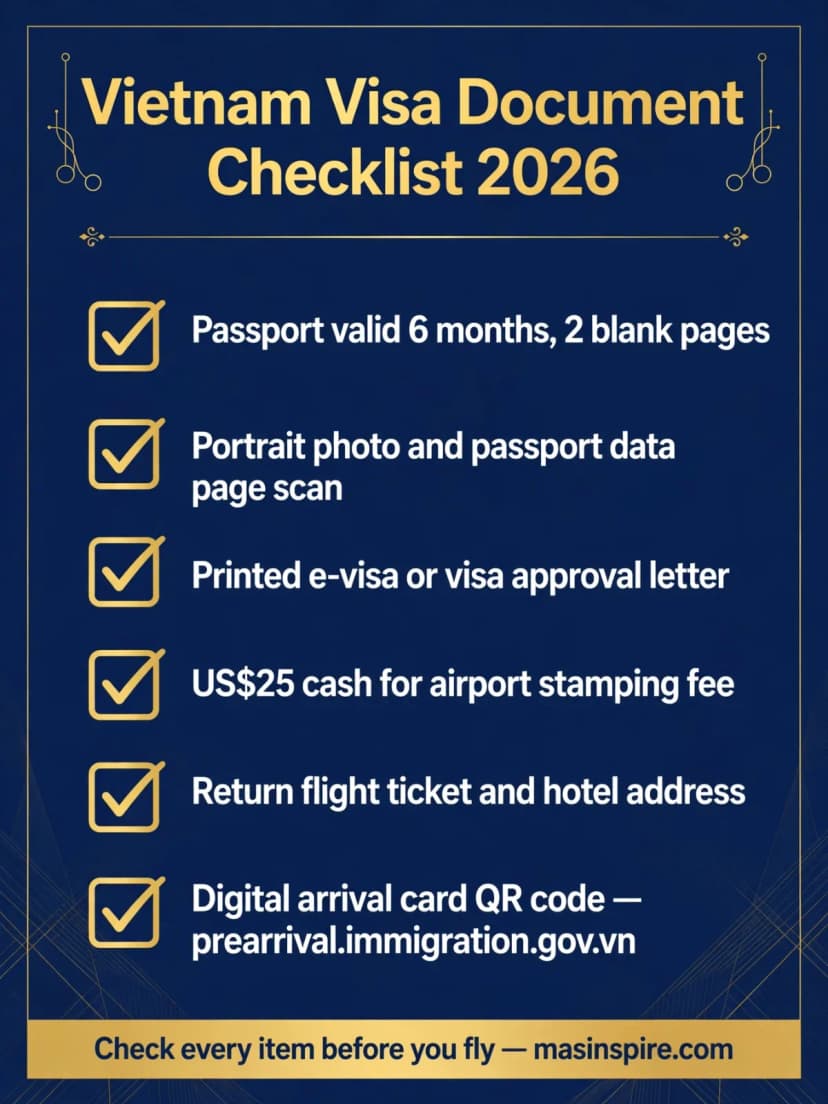
The e-visa asks for very little, and that is part of its appeal — but the rest of your journey asks for more, and the checklists below cover both. Keep a printed copy of your e-visa or approval letter with your passport at all times: phone screens fail, batteries die, and an officer is entitled to ask for paper.
E-visa — core documents
- Original Pakistani passport, valid at least six months from arrival, with at least two blank pages
- A clear colour scan of the passport data page — photo, name, date of birth and passport number; sharp, uncropped and in colour
- One recent portrait photograph — front-facing, plain background, no hat or sunglasses; a phone photo against a white wall usually passes if the lighting is even
- The e-visa form on evisa.gov.vn or thithucdientu.gov.vn, completed in English with your name exactly as in your passport
- A payment card for the USD 25 or USD 50 fee; the fee is not refunded if the visa is refused
- Your intended entry date, port of entry and first-night address in Vietnam — have your hotel or home address ready before you start
- A printed copy of the approved e-visa, plus the registration code the portal gives you to check the status online
- Return or onward flight ticket and proof of accommodation — not always asked for on the form, but routinely asked for by airlines at check-in and sometimes by the border officer
How to Apply: Step-by-Step
E-visa — step by step
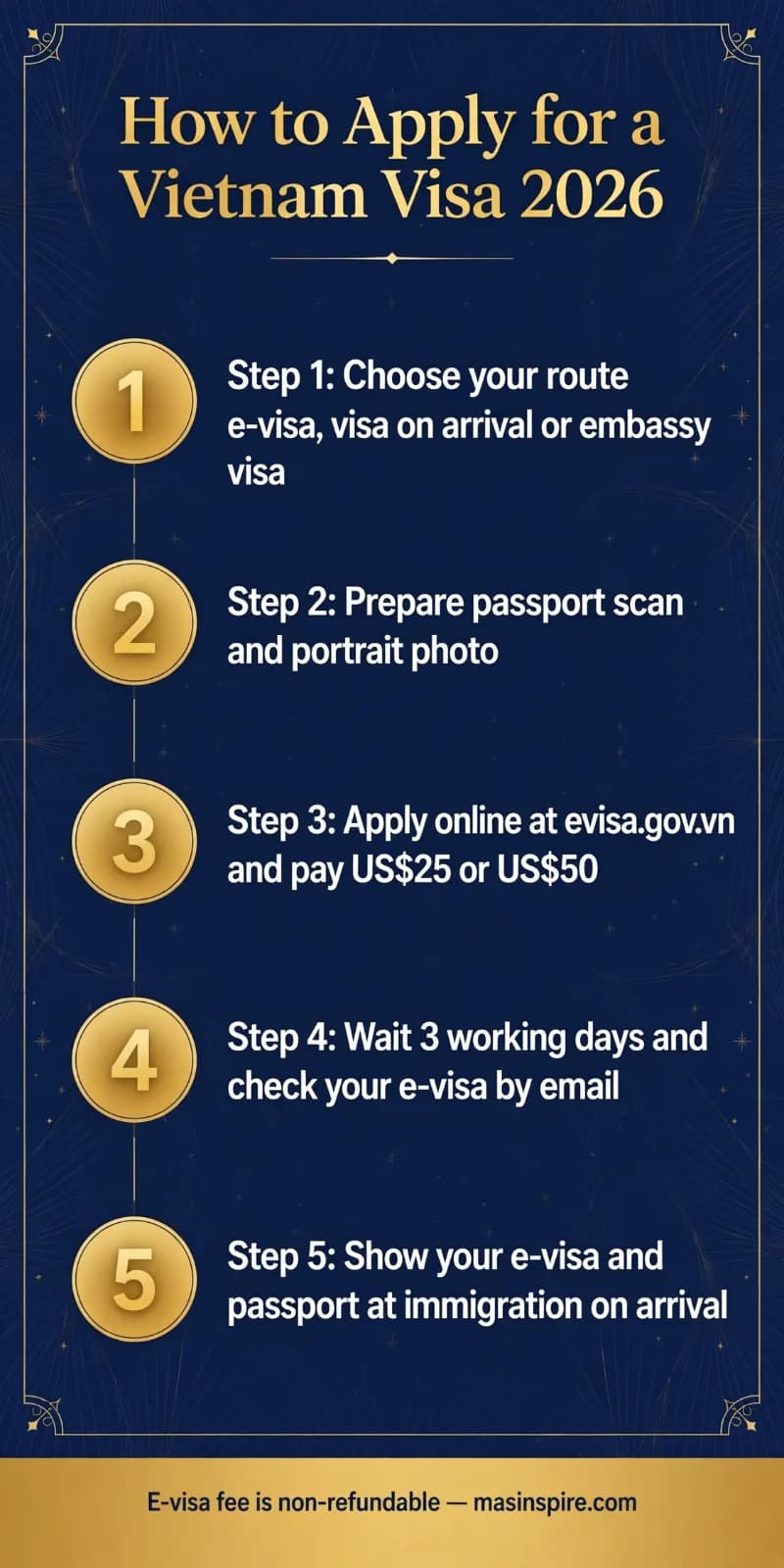
Step 1 — Prepare your two files. Take a clear colour scan of your passport data page and a recent portrait photo against a plain background. Check both files on a full screen before you upload them: blurred edges, cut-off corners and shadows are the commonest reasons an application is sent back.
Step 2 — Go to the official portal only. Open evisa.gov.vn or thithucdientu.gov.vn — the two domains the Immigration Department announced as the portal's addresses from 11 November 2024. Any other domain is an agency. Choose "For foreigners", enter your details exactly as in your passport, pick your entry date and port of entry, and upload the two files.
Step 3 — Pay and save the code. Pay USD 25 single or USD 50 multiple by card. Save the registration code the portal gives you — the only way to check your application's status — and keep the payment receipt. The fee is not refunded if the visa is refused.
Step 4 — Wait and check. Officially not more than three working days from a complete application and the fee; allow three to five in practice, and longer around Tet. Check the status on the portal with your registration code. If the portal asks for a correction, fix it the same day: the clock restarts when you resubmit.
Step 5 — Print the e-visa. When it is approved, the e-visa arrives by email and is downloadable from the portal. Print at least two copies: one with your passport, one in your luggage. Check every field — name spelling, passport number, dates, single or multiple entry, and the port of entry — before you fly. If anything is wrong, contact the Immigration Department through the portal's support channel rather than travelling on a faulty visa.
Step 6 — Submit the digital arrival card. Within 72 hours before landing, fill in the free pre-arrival declaration at prearrival.immigration.gov.vn and save the QR code it generates. It is in use at Tan Son Nhat, Noi Bai, Da Nang, Cam Ranh and Phu Quoc airports — see the conflict note in section 9, and submit it anyway.
Step 7 — Arrive and check the stamp. At immigration, present your passport and your printed e-visa. Check the permitted-stay date the officer stamps into your passport before you leave the desk, and raise any error at once.
Visa on arrival — step by step
Step 1 — Choose a licensed agency. Pick a Vietnamese travel company with a published address and a track record, and confirm in writing what the letter will say: validity, entries, airport, and total price including the stamping fee. Remember the 15-day conflict in section 3 — if you need more than 15 days, use the e-visa.
Step 2 — Send your passport details. The agency needs a clear scan of your passport data page, your arrival date and airport. It submits these to the Immigration Department, which issues the approval letter.
Step 3 — Receive and print the letter. The agency emails you the approval letter as a PDF, signed and red-stamped by the Immigration Department. Print it: without it, the airline should not let you board in Pakistan.
Step 4 — Prepare the airport file. Pack the printed letter, your passport, two passport photos, the completed Form NA1, and USD 25 or USD 50 in cash for the stamping fee.
Step 5 — Stamp the visa at the airport. On landing, go to the visa-on-arrival counter before passport control — at Tan Son Nhat and Da Nang it is on the left of the immigration hall; at Noi Bai it faces the passport-control booths. Hand over the file, wait to be called, pay the cash stamping fee, and collect your passport with the visa sticker inside.
Applying from Vietnam and Pakistan — the Embassy Route
For a Pakistani living in Vietnam, the embassy is almost never the first choice — the e-visa is faster, cheaper and available from your own home. The embassy matters in two situations: when you are in Pakistan and your trip does not fit the e-visa, and when a family member in Pakistan needs a visa the e-visa does not cover.
Option 1 — The e-visa, from wherever you are
Whether you are in Ho Chi Minh City or in Lahore, the e-visa works the same way: online, in English, for USD 25 or USD 50. If you are in Vietnam and planning a trip abroad — home to Pakistan, a holiday in Thailand, a conference in Singapore — apply for your next e-visa before you leave, or from abroad while you are away, so your re-entry is already covered. A multiple-entry e-visa suits anyone leaving and coming back more than once inside the same 90 days — but the 90 days run from the start date on the e-visa, not from your first entry, so do not buy one months before you need it.
Option 2 — The Embassy of Vietnam in Islamabad
Vietnam's only mission in Pakistan is the Embassy of Vietnam in Islamabad, at House 117, Street 11, Sector E-7, Islamabad, telephone +92 51 265 5785 and +92 51 265 5787, fax +92 51 265 5783, website vnembassy-islamabad.mofa.gov.vn. There are no Vietnamese consulates elsewhere in Pakistan, so the embassy handles consular matters for the whole country. It opens Monday to Friday, 9:00 a.m. to 5:00 p.m. as listed, and closes on Pakistani and Vietnamese public holidays, including Tet. The visa it issues is a loose-leaf visa, valid from one to three months, single or multiple entry, and processing is reported at three to five working days. The fee is set by the embassy and was not published in any official source consulted for this guide — telephone first and get it in writing. Older agency pages quote USD 25 to USD 155 depending on the visa type, but that is a reported range, not an embassy price list, and it should not be relied on.
Living in Vietnam: Extensions, Visa Runs, Overstay Rules and Residence Registration
This section matters most to a reader who already lives in Vietnam, because the rules for staying are different from the rules for entering — and the commonest mistake residents make is to treat them as the same.
Extending your stay — the sponsor rule
An e-visa cannot be extended by the traveller alone. There is no online form, no counter and no fee you can pay yourself to add days to an e-visa. Under Vietnam's law on foreigners' residence, as amended, it is the inviting or sponsoring organisation or person who asks the Immigration Department to extend your permitted stay — the period the border officer stamped into your passport on arrival. That sponsor can be a Vietnamese company, an organisation, a school, or a Vietnamese relative. A tourist who applied alone has no sponsor on file, so there is no form to extend an e-visa yourself. The sponsor files Form NA5, in the version in force since 1 July 2026, with your passport and proof of the purpose of the stay, at the Immigration Department in Hanoi (69 Mac Thai To) or Ho Chi Minh City (333–335–337 Nguyen Trai), or at the provincial immigration office where the sponsor is registered. The decision comes within five working days of a complete file. The government fee is USD 10 for each extension of stay, while a new visa issued in the same procedure costs the ordinary rates: USD 25 single, USD 50 multiple up to 90 days, and USD 95 multiple over 90 days up to 180 days. Agencies advertising extensions for tourists depend on a sponsor they arrange, and the result can be refused — do not pay until the agency names the sponsor in writing.
The visa run
What almost everyone actually does instead is the visa run: apply for a brand-new e-visa, leave Vietnam before the old one expires, and re-enter on the new one. Apply for the new e-visa before you leave, or as soon as you land somewhere else — USD 25 single or USD 50 multiple, about three working days at standard speed. Popular run destinations from Ho Chi Minh City are Bangkok, Phnom Penh, Singapore and Kuala Lumpur; from Hanoi, Bangkok, Vientiane and Nanning. If you already hold a multiple-entry e-visa still inside its validity window, you may not need a new application for one extra exit and re-entry — check the dates printed on your approved e-visa first. A visa run is lawful, and it is how many long-stay foreigners manage their status, but it is not a residence plan: repeated back-to-back e-visas do not lead to a residence card, and they leave you with no right to work. If Vietnam is your home, the work permit and the temporary residence card in section 10 are the route to settle the question properly.
Overstay fines — Decree 282/2025
Overstaying became materially more expensive on 15 December 2025, when Decree 282/2025/ND-CP replaced Decree 144/2021/ND-CP. It doubled the maximum fine for an individual overstay from VND 20 million to VND 40 million (about USD 1,520), added two new fine brackets for long overstays, and set deportation reviews to begin at just 16 days past the visa expiry. Even a single day of overstay is a formally recorded immigration violation, and the fine is set per overstay, not per day — so per-day figures quoted on some travel sites are wrong.
| Days overstayed | Fine (VND) | Deportation risk |
|---|---|---|
| Under 16 days | 500,000 – 2,000,000 | No |
| 16 to under 30 days | 5,000,000 – 10,000,000 | Possible |
| 30 to under 60 days | 10,000,000 – 15,000,000 | Possible |
| 60 to under 90 days | 15,000,000 – 20,000,000 | Possible |
| 90 to under 180 days | 20,000,000 – 25,000,000 | High |
| 180 days to under 1 year | 25,000,000 – 30,000,000 | Very high |
| 1 year or more | 30,000,000 – 40,000,000 | Near certain |
An organisation such as an employer that allowed the violation is fined twice the individual amount. The single most important number is 16: below 16 days the fine is relatively small, but on day 16 the minimum fine jumps to VND 5 million — more than double the maximum for 15 days — and deportation enters the picture. If you have already overstayed, do not try to leave quietly and hope the airport does not notice: settle it with the immigration authorities before you exit, in person at the immigration office for the area where you live, and allow extra time at the airport or border. The US Embassy's guidance says the same — foreigners extending a visa or resolving an overstay must appear in person at the immigration office. A long overstay can also mean a re-entry ban, and a record of overstaying will count against any future visa application.
Temporary residence registration — where you sleep
Every foreign national staying overnight in Vietnam must have a registered place of stay, filed not by you but by whoever runs the place where you sleep — the hotel front desk, the landlord, or the friend hosting you. Under Article 33 of Law 47/2014/QH13, the declaration goes to the ward or commune police, and the deadline is 12 hours after you arrive, or 24 hours in remote, mountainous or island areas. Since 21 May 2026, one national website — tbltkbtt.bocongan.gov.vn — handles these declarations, and since 24 July 2026 short-term accommodation providers must file through the Ministry of Public Security's online system under Circular 87/2026/TT-BCA. Online declaration is free and open 24 hours a day. If you sleep at a friend's home, the household head must send the overnight-guest notification to the police before 11 p.m. on the day you arrive. In practice a hotel registers you automatically at check-in and you need do nothing — but in an Airbnb, a serviced apartment or a friend's home, ask your host for the registration slip or a screenshot of the declaration, because you carry the consequences if the host never files: hosts face fines of VND 3–5 million under Decree 282, and guests have been asked for proof of registration at airport exit. Since 1 July 2026, when Law 118/2025/QH15 took effect, this duty has been enforced more aggressively, and the checks are now routine.
The digital arrival card
Vietnam's pre-arrival declaration — the digital arrival card, or PAI — is a free online form at prearrival.immigration.gov.vn that collects your passport, visa, flight and accommodation details before you reach the immigration counter, and generates a QR code you show on arrival. It began as a pilot at Tan Son Nhat on 15 April 2026, and by June 2026 it was in use at five airports: Tan Son Nhat, Phu Quoc, Noi Bai, Da Nang and Cam Ranh. You can only submit it within 72 hours of arrival, and it takes about five minutes with your passport, flight number and first-night hotel address ready. There is a conflict about whether it is mandatory: the Ho Chi Minh City Immigration Office presents it as a requirement at Tan Son Nhat, while the Immigration Department still describes it as a pilot it officially encourages, because the immigration law does not yet oblige foreigners to declare before entry. The controlling position is the Immigration Department's — the pilot is voluntary in law — but the practical advice is the same either way: submit it before every flight into one of the five airports, because officers there ask for the QR code, and any website that charges you a fee to submit it is a middleman, not the government. The card is not a visa: you still need a valid visa, e-visa or exemption to be allowed in.
Work Route: Jobs, Work Permits and the Temporary Residence Card
For a Pakistani English teacher living in Vietnam, this is the section that turns a 90-day visa into a life. The structure has three layers — the job, the work permit, and the temporary residence card — and each depends on the one below it. Your employer does most of the work, but you need to understand the sequence, because a gap between the layers is where people fall out of status.
The work permit — Decree 219/2025
Foreigners who work in Vietnam need a work permit, or a certificate confirming exemption, obtained by their employer. The rules were rewritten by Decree 219/2025/ND-CP, in force since 7 August 2025. The employer applies, not the employee. Since the new decree, the provincial People's Committees issue, extend and revoke work permits — in Ho Chi Minh City, the city authorities — and must decide within ten working days of a complete file. A permit is valid for up to two years and can be extended once, for up to two more years. To qualify as an expert or technical worker, you generally need a degree or professional qualification and several years of relevant experience — usually a bachelor's degree with at least three years in the field, or a technical certificate with at least five years — plus a criminal-record check, a health check and a notarised translation of your qualifications. English teachers additionally need a teaching certificate such as a TESOL, TEFL or CELTA, and schools commonly ask for it before they will sponsor a permit at all.
Decree 219/2025 also lists the exempt cases, confirmed by a certificate that can itself be extended once for up to two years. The most commonly used exemption for short assignments is for managers, executives, experts or technical workers working in Vietnam for less than 90 days in a calendar year. Do not treat an exemption as a way to work long term without a permit: the 90 days are counted per calendar year, and exceeding them without a permit is a violation for you and for the employer.
The temporary residence card (TRC)
With a work permit in hand, your employer applies for your temporary residence card (thẻ tạm trú), which replaces your visa for the length of the card and lets you leave and re-enter Vietnam freely, without a new visa each time. You cannot apply for a TRC yourself: every application is made by a sponsor in Vietnam — the employing company, the company you have invested in, a representative office, or a Vietnamese or resident family member — filed where the sponsor has its head office, or, for an individual sponsor, where that person resides. The card carries the same symbol as the visa you qualified under: an LĐ2 work visa becomes an LĐ2 card, a TT family visa becomes a TT card. The government fee is USD 145 for up to two years, USD 155 for over two to five years, and USD 165 for over five to ten years, and the office has five working days once the file is complete and paid. Two caps apply to every card: it must expire at least 30 days before your passport does, and for employees it cannot outlast the work permit.
| TRC symbol | Who it is for | Maximum validity |
|---|---|---|
| LĐ1, LĐ2 | Workers with a work permit or an exemption | 2 years |
| ĐT1 | Investors with capital of VND 100 billion or more, or in a priority sector | 10 years |
| ĐT2 | Investors, middle tier | 5 years |
| ĐT3 | Investors, lower tier | 3 years |
| TT | Spouses and children under 18 of TRC holders, or of Vietnamese citizens | 3 years |
You cannot get a TRC on a tourist visa, a business visa, a small-investor ĐT4 visa or an e-visa itself, and Vietnam has no retirement visa and no digital-nomad visa that leads to one. The e-visa is a tourist visa: working on it sits in a legal grey area, because the law does not explicitly authorise remote work for a foreign employer on a tourist visa. If you are teaching, or doing any work for a Vietnamese employer, do it on a work permit and a TRC — not on an e-visa, and not on a business visa. When a TRC expires, your sponsor applies for a new card before the expiry date; do not let it lapse into overstay, because the fines in section 9 apply to TRC holders as well as visa holders. If you leave your job, the employer notifies Immigration, and you will need a new sponsor or a new visa to stay lawfully.
Student Route: Studying in Vietnam
Vietnam is a realistic study destination, and the route is sponsor-led like everything else. You apply to a Vietnamese school, university or language institution; it issues an admission letter and sponsors your DH student visa; you apply at a Vietnamese embassy or on arrival with an approval letter, or — for a short course — on an e-visa; once here, the institution sponsors your residence card. The student visa is normally issued for up to 12 months at a time, and the student TRC is reported at up to five years, matching the course length.
No official minimum funds figure is published, so the school and the mission will tell you what evidence they want — typically bank statements showing you can cover tuition and living costs. Tuition at Vietnamese public universities is far lower than in Europe or Australia, but confirm the full cost of the course, the language of instruction and the recognition of the degree in Pakistan before you pay any deposit. A student visa does not carry a general right to work: part-time work during study is restricted, and any employment needs a work permit or an exemption through an employer. Do not pay any agent who claims to hold a confirmed student visa or university place without an admission letter from a named, verifiable institution — verify the institution first. If you are already in Vietnam and want to switch from an e-visa to a student visa, the school sponsors the change of status through the Immigration Department; the e-visa itself cannot be converted by the student alone.
Family Visits and Permanent Residence
If you live in Vietnam and your family is in Pakistan, there are two journeys to plan: a visit, and a move. A visit is simple: your parents, spouse or siblings apply for an e-visa exactly as you did — online, USD 25 single or USD 50 multiple, up to 90 days — and fly in. Each person needs their own passport and e-visa, including children. Give them a printed copy of your residence card and your address to show at check-in and immigration if asked who they are visiting, and make sure their return ticket is booked before they travel: airlines check it, and officers sometimes ask for it.
A move is the TT family route. If you hold a temporary residence card, your spouse and children under 18 can be issued TT visas and then TT residence cards valid for up to three years, sponsored by you. If you are married to a Vietnamese citizen, your spouse sponsors your TT visa and card on the same terms, and a foreign spouse of a Vietnamese citizen can also apply for a five-year visa-exemption certificate — allowing multiple entries and stays of up to 180 days at a time — through the Vietnamese embassy or the Immigration Department. You will need proof of the relationship (marriage or birth certificate, legalised or apostilled), a copy of your passport and residence card, and proof of your address.
Permanent residence exists, but it is not a route most foreign residents reach. It is granted case by case, generally after years of continuous lawful residence with a sponsor, often in connection with a Vietnamese spouse, a Vietnamese child, or a significant contribution to Vietnam. No straightforward application route, timeline or fee for an ordinary foreign worker was found in the sources consulted for this guide, and this guide does not invent one. If permanent residence is your goal, ask a licensed immigration lawyer to assess your history. What is certain is the path that keeps you lawful while you build it — a work permit, renewed on time, and a temporary residence card, renewed before it expires.
Common Mistakes to Avoid
Mistake 1 — Applying on a copycat website. The official e-visa portals are evisa.gov.vn and thithucdientu.gov.vn. Any other website that takes your money for a "Vietnam e-visa" is a private agency. Some agencies are legitimate and useful; none of them is the government, and the USD 25 or USD 50 government fee is the same whichever way you apply. If a site charges USD 55, USD 83 or USD 100, know the difference is a service fee before you pay it.
Mistake 2 — Flying for a visa on arrival without the approval letter. There is no visa on arrival for a traveller who simply turns up. Without the printed approval letter, the airline should not let you board in Pakistan, and the airport counter cannot issue you a visa. Get the letter first, print it, and carry it.
Mistake 3 — Trying to extend an e-visa yourself. There is no self-service extension. Only a sponsor can ask for one, on Form NA5, and a tourist who applied alone has no sponsor. If your e-visa is running out and you have no sponsor, the lawful option is a visa run: leave before it expires and re-enter on a new e-visa.
Mistake 4 — Overstaying, even by a day. Since 15 December 2025, even one day is a recorded violation, and from day 16 the fine jumps to at least VND 5 million and deportation enters the picture. Set a reminder for a week before your permitted stay ends, and act on it.
Mistake 5 — Working on a tourist e-visa or a business visa. Neither carries a right to work. Teaching or any other employment needs a work permit or an exemption, then a temporary residence card. Working without one risks a fine, deportation and a re-entry ban for you, and a fine for the employer.
Mistake 6 — Arriving at the airport without cash for the stamping fee. The visa-on-arrival counter takes cash only. Bring USD 25 or USD 50 in clean notes, because there is no ATM in the visa area and cards are not accepted.
Mistake 7 — Not checking the stamp in your passport. The officer's handwritten expiry date is the date your stay is measured against. Check it before you leave the desk, and raise an error at once — not at departure, when it looks like an overstay.
Mistake 8 — Assuming your hotel registered you. Hotels usually do, but Airbnb hosts, serviced apartments and friends hosting you must file the declaration within 12 hours — a duty enforced more aggressively since 1 July 2026. Ask for the registration slip or a screenshot, and keep it.
Mistake 9 — Paying an agent for a guaranteed visa, job or residence card. No agent can guarantee an Immigration Department decision: the e-visa is decided by the Immigration Department, the work permit by the provincial People's Committee, and the residence card by the Immigration Department. Anyone who promises a result for a fee is selling a promise they cannot keep.
Reasons for Refusal
No official refusal list is published; the reasons below follow from the entry conditions the official sources state.
Passport validity or blank pages. A passport with less than six months' validity from arrival, or without two blank pages, fails the entry condition and the portal will reject the application.
A blurred or incorrect upload. A passport scan that is cut off, out of focus or in black and white, a portrait photo that does not meet the requirement, or a name spelled differently from the passport are the commonest reasons an e-visa is returned for correction — and a second submission restarts the three-working-day clock.
Inconsistent purpose of travel. A business visa used for employment, a tourist visa used for work, or documents whose dates do not match between the application, the invitation letter and the flight ticket can all lead to refusal. The officer decides on the file in front of them.
Previous overstay or immigration violation. A recorded overstay, a deportation, or a previous refusal is held against a new application. The fines under Decree 282/2025 are not the end of the matter: the record travels with you.
Security and admissibility concerns. Any adverse record, any suggestion that the stated purpose of travel is not the real one, or any failure to meet the entry conditions in the Law on Entry, Exit, Transit and Residence of Foreigners can lead to refusal. There is no published appeal route; the remedy is to fix the named problem and reapply, paying the fee again, because the fee is not refunded.
Frequently Asked Questions
1. Do Pakistani citizens need a visa for Vietnam?
Yes, with an ordinary Pakistani passport: Pakistan is not on Vietnam's visa-exemption list, so you need a visa for every entry. Only diplomatic and official passport holders are exempt, for up to 90 days, under the bilateral agreement in force since 2 March 2007. The simplest route is the e-visa: USD 25 single or USD 50 multiple, valid for up to 90 days.
2. How much does a Vietnam e-visa cost for a Pakistani passport?
USD 25 single or USD 50 multiple, paid by card on the official portal evisa.gov.vn or thithucdientu.gov.vn. That is the whole government fee when you apply yourself, and it is not refunded if the visa is refused. Agencies charge more — typically about USD 55 single and USD 83 multiple at standard speed — and the difference is their service fee.
3. How long does a Vietnam e-visa take to process?
Officially not more than three working days from a complete application and the fee. In practice, allow three to five working days, and at least seven Vietnamese working days before your flight. Weekends and public holidays do not count; Tet is the longest closure, running 4 to 10 February in 2027.
4. How long can I stay in Vietnam on an e-visa?
Up to 90 days, for both single-entry and multiple-entry e-visas. Multiple entry buys you more entries, not more time: the 90 days run from the start date printed on the e-visa, not from your first entry. A single-entry e-visa ends the moment you leave Vietnam.
5. Can I get a visa on arrival in Vietnam?
Yes, but only with a visa approval letter issued by the Immigration Department before you fly, arranged through a licensed Vietnamese travel company. On landing you go to the visa counter before passport control and pay the stamping fee in cash — USD 25 single or USD 50 multiple. It works for air arrivals only. There is a live conflict in 2026 about how long it lasts: one agency says 15 days, single entry, for tourism only, while others still advertise one- to three-month letters. If you need more than 15 days, use the e-visa.
6. Can I extend my Vietnam e-visa while I am in Vietnam?
Not by yourself. Only a sponsor in Vietnam — a company, organisation, school or Vietnamese relative — can ask the Immigration Department to extend your permitted stay, on Form NA5, decided within five working days for USD 10. A tourist who applied alone has no sponsor and therefore no extension route. The usual alternative is a visa run: leave before the e-visa expires and re-enter on a new one.
7. What happens if I overstay my visa in Vietnam?
You will be fined under Decree 282/2025/ND-CP, in force since 15 December 2025. Under 16 days the fine is VND 500,000 to 2,000,000; from 16 days it jumps to VND 5,000,000 to 10,000,000 and deportation becomes possible; at one year or more it is VND 30,000,000 to 40,000,000 with deportation near certain. Settle an overstay with the immigration office before you try to leave, and allow extra time at the airport.
8. I live in Vietnam — do I still need a visa?
Not while you hold a valid temporary residence card: the card replaces your visa and lets you leave and re-enter freely for its whole validity. You need a visa again only if your card has expired, or if you are in Vietnam on an e-visa rather than a card. If you travel abroad, check your card is still valid for your return date — and that your passport still has at least 30 days beyond the card's expiry.
9. How do I get a temporary residence card (TRC) in Vietnam?
Your sponsor applies for it — usually your employer, once you hold a work permit. A work TRC (LĐ1 or LĐ2) lasts up to two years; a family TRC (TT) up to three years; an investor TRC up to ten years for the largest tier. The fee is USD 145 for up to two years, USD 155 for over two to five years and USD 165 for over five to ten years, decided within five working days of a complete file. You cannot get a TRC on an e-visa or a tourist visa.
10. How long does a work permit take, and how long does it last?
Your employer applies to the provincial People's Committee, which must decide within ten working days of a complete file under Decree 219/2025/ND-CP, in force since 7 August 2025. A permit is valid for up to two years and can be extended once, for up to two more years. Managers, experts and technical workers on assignments under 90 days in a calendar year may be exempt, confirmed by a certificate.
11. Where do I apply for a Vietnam visa from Pakistan?
Online, for the e-visa — no visit to any office is needed. If your trip needs an embassy visa, the Embassy of Vietnam in Islamabad is at House 117, Street 11, Sector E-7, Islamabad, telephone +92 51 265 5785 or +92 51 265 5787. It issues a loose-leaf visa valid for one to three months. Its fee is not published: telephone the embassy and ask for it in writing before you travel there.
12. Do I need to fill in the digital arrival card before flying to Vietnam?
Submit it anyway. The free pre-arrival declaration at prearrival.immigration.gov.vn gives you a QR code to show at immigration, and it is in use at Tan Son Nhat, Noi Bai, Da Nang, Cam Ranh and Phu Quoc airports. Whether it is strictly mandatory is disputed — the Ho Chi Minh City Immigration Office presents it as a requirement at Tan Son Nhat, while the Immigration Department describes it as a voluntary pilot — but officers at those five airports ask for the QR code. Submit it within 72 hours before landing; it is free, and any site charging for it is a middleman.
13. Can my family visit me or live with me in Vietnam?
For a visit, each family member applies for their own e-visa — USD 25 or USD 50, up to 90 days — exactly as you did. To live with you, your spouse and children under 18 can be issued TT visas and then TT residence cards valid for up to three years, sponsored by you. If you are married to a Vietnamese citizen, your spouse sponsors your TT visa and card, and a foreign spouse of a Vietnamese citizen can also apply for a five-year visa-exemption certificate.
14. Can I work in Vietnam on an e-visa or a business visa?
No. An e-visa is a tourist visa, and a business (DN) visa is for meetings and business activities, not employment. Working on either is a violation that can lead to a fine, deportation and a re-entry ban. To work lawfully you need a work permit or an exemption certificate, obtained by your employer, and then a temporary residence card. Vietnam has no digital-nomad visa, and remote work for a foreign employer on a tourist visa sits in a legal grey area.
15. What should I do if my Vietnam visa is refused?
There is no published appeal route, and the e-visa fee is not refunded. Find out the reason — most commonly a passport-validity problem, a blurred upload, a name that does not match the passport, or wrong dates — fix it, and reapply, paying the fee again. If the refusal was at the border, ask the officer for the reason in writing if you can, and do not try to re-enter the same day without fixing the underlying problem. Never pay an agent who promises to overturn a refusal for a fee.
Official Immigration Websites
| Organisation | What it is | Website |
|---|---|---|
| Vietnam Immigration Department, Ministry of Public Security | Official e-visa portal — apply, pay, check status | https://evisa.gov.vn/ |
| Vietnam Immigration Department, Ministry of Public Security | Official e-visa portal, twin domain | https://thithucdientu.gov.vn/ |
| Vietnam Immigration Department, Ministry of Public Security | Public service portal of the Ministry of Public Security | https://dichvucong.bocongan.gov.vn/ |
| Vietnam Immigration Department, Ministry of Public Security | Digital arrival card (free, within 72 hours of arrival) | https://prearrival.immigration.gov.vn/ |
| Ministry of Public Security | Temporary residence declaration system for hosts and landlords | https://tbltkbtt.bocongan.gov.vn/ |
| Ministry of Foreign Affairs of Vietnam | Vietnam's visa exemption list by country and passport type | https://lanhsuvietnam.gov.vn/ |
| Embassy of Vietnam in Islamabad | Vietnam's only mission in Pakistan (E-7, Islamabad) | https://vnembassy-islamabad.mofa.gov.vn/ |
| Ministry of Foreign Affairs of Pakistan | Pakistan's visa-abolition agreements, including Vietnam (diplomatic and official, three months) | https://mofa.gov.pk/tabs/higher-education-commission |
| UK Foreign, Commonwealth and Development Office | Vietnam travel advice — entry requirements | https://www.gov.uk/foreign-travel-advice/vietnam/entry-requirements |
| US Department of State | Vietnam travel information — entry, exit, overstay, local law | https://travel.state.gov/content/travel/en/international-travel/International-Travel-Country-Information-Pages/Vietnam.html |
Final Checklist and Conclusion
Before you spend any money, work through this list in order. If you cannot tick the first three boxes, do not proceed.
- Your passport is valid at least six months from arrival and has at least two blank pages.
- You have chosen the right route: e-visa for a visit or re-entry, visa on arrival only with a printed approval letter, embassy visa only for a trip the e-visa does not cover.
- You are applying on the official portal — evisa.gov.vn or thithucdientu.gov.vn — fee USD 25 or USD 50, non-refundable.
- Your passport scan and portrait photo are clear, in colour and uncropped, and your name is spelled exactly as in your passport.
- Your entry date, port of entry and first-night address are correct, and you applied at least two weeks before your flight — a month before if travelling around Tet.
- You have USD 25 or USD 50 in cash if you are using the visa on arrival, and two passport photos for the airport counter.
- You have submitted the free digital arrival card within 72 hours before landing, if flying into Tan Son Nhat, Noi Bai, Da Nang, Cam Ranh or Phu Quoc.
- If you live in Vietnam: your residence card and work permit are in date, your host has filed your temporary residence declaration, and you have a reminder set a week before your permitted stay ends.
- You have not booked a non-refundable ticket until the visa is in hand, and you have not paid any agent who promised a guaranteed result.
Vietnam's visa system rewards the traveller who uses the official channel and reads the dates. For a Pakistani passport holder, the e-visa is genuinely one of the easiest visas in Asia: USD 25, three working days, 90 days, no embassy, no interview. The complications begin only when you stay — the sponsor rule for extensions, the work permit and the residence card, the 12-hour registration your host must file, and the overstay fines that doubled in December 2025. Get those right and a work permit and a residence card, both renewed on time, will carry you through years here without a single border run. Where this guide found a conflict it reported both sides; where it found no official figure — above all the Islamabad embassy's fee — it said so. Confirm every live detail on the official portal or with the Immigration Department, and keep your passport, your visa and your residence card in date.
This guide was checked on 29 November 2026. Visa rules change without notice. Always confirm the live rules on the official e-visa portal or with the Vietnam Immigration Department before paying any fee or booking a non-refundable ticket. Nothing in this guide is immigration advice; the Vietnamese authorities set and enforce the entry rules, and the immigration officer at the border makes the final decision. This guide is educational information only and does not guarantee visa approval or entry.