

Uzbekistan Visa Guide 2026: Types, Requirements, Documents and Application Steps
Written for Pakistani passport holders living in Vietnam — checked on 29 November 2026.
Uzbekistan is one of Central Asia's most rewarding destinations: the turquoise domes of Samarkand's Registan, the old city of Bukhara, the walled town of Khiva, and the modern capital Tashkent sit on the old Silk Road, and they are now easier to reach from Vietnam than ever before. But for a Pakistani passport holder, the visa rules for Uzbekistan are not the simple online process that many travel websites describe. This guide gives you the honest, checked position: Pakistanis need a visa, the popular e-visa does not currently cover Pakistani passports, and the working route is an invitation-backed sticker visa from an Uzbek embassy. Read the whole guide before you pay anyone or book a non-refundable flight, because the single most expensive mistake a Pakistani traveller can make on this route is believing the USD 20 e-visa story and paying a third-party website for a visa that the official portal will never issue.
Everything in this guide is written for your exact situation: a Pakistani citizen holding a Pakistani passport and living in Vietnam, most likely in Ho Chi Minh City or Hanoi, on a Vietnamese temporary residence card or a work permit. Where the rules depend on where you apply from, this guide explains both options — the Uzbek Embassy in Hanoi and the Uzbek Embassy in Islamabad — and it is blunt about what is still unverified, so you can confirm it in writing before you spend money.
Do Pakistanis Need a Visa for Uzbekistan?
Yes. A Pakistani ordinary passport holder needs a visa to enter Uzbekistan. There is no visa-free entry for Pakistanis, no visa on arrival for Pakistanis, and — as Section 2 explains in full — no e-visa for Pakistani passports under the current official eligibility list. You must hold a valid Uzbek visa before you travel, and you must present it together with your passport at the border. Airlines will check it before boarding, because Uzbekistan does not issue visas at Tashkent airport to Pakistani nationals, and being refused boarding in Ho Chi Minh City or at a transit airport is a far more expensive lesson than a refused visa application.
The rule is nationality-based, not residence-based. Living in Vietnam, holding a Vietnamese temporary residence card, or holding a valid visa for another country does not change the Uzbek requirement for your Pakistani passport. Your Vietnamese residence helps you in one practical way only: it may allow you to apply at the Uzbek Embassy in Hanoi instead of travelling to Islamabad, but that is a question of where the application is lodged, not whether a visa is needed. The requirement itself is fixed by your passport.
Children are not exempt. Every traveller needs their own visa, with one narrow exception reported by the Embassy of Uzbekistan in Qatar: a child under 16 travelling with a parent or guardian who holds a valid visa may travel without a separate visa, for a stay up to the guardian's visa validity and no more than 90 days. That exception is reported by one Uzbek embassy page and has not been confirmed for Pakistani children applying from Vietnam, so do not rely on it. Ask the mission where you apply, in writing, before you travel with a child, and budget for a separate child visa unless the embassy confirms otherwise in writing.
Your passport must be valid for at least six months from your date of entry, with at least two blank pages. The six-month figure is the standard cited by Pakistan-facing visa guides and by the Uzbek embassy application guidance; the UK Foreign Office's general entry rule for British citizens is three months after arrival, but that lower figure is for British passports and is not the safe standard for a Pakistani application. Renew your passport first if it has less than six months left, because a short-validity passport is one of the most common reasons for a visa file to be returned unprocessed.
The E-Visa Question: Why Pakistanis Cannot Use e-visa.gov.uz
This is the most important section in the guide, because it is where most Pakistani travellers lose money. The official Uzbekistan e-visa portal is e-visa.gov.uz, run by the Ministry of Foreign Affairs of Uzbekistan. It is a real portal, it works well, and for eligible nationalities it issues a tourist or business e-visa for USD 20 (single entry), USD 35 (double entry), or USD 50 (multiple entry), valid for 90 days with a stay of up to 30 days per entry and processing in about two to three business days. The problem is the eligibility list: Pakistan is not on it.
The Uzbek Foreign Ministry's e-visa country list covers roughly 70 to 77 nationalities, including India, Bangladesh, Vietnam, Thailand, Egypt, Iran, Saudi Arabia, and many African and Latin American countries. Pakistan is absent from every published version of that list that we checked, including the list as reproduced in November 2026 and the list as it stood in October 2026 and in the March 2025 update. The Ministry's own visa-free and e-visa country tables, as reproduced by independent travel sources in November 2026, place Pakistan explicitly in the group that must apply for a visa at an Uzbek embassy, alongside Afghanistan, Iraq, Nigeria, Sudan, Syria, and Yemen. Two Pakistan-focused checks in October 2026 reached the same conclusion: the e-visa portal's eligibility screen does not offer Pakistan as a citizenship option.
Against that, a large number of commercial travel websites state flatly that Pakistanis can get a Uzbekistan e-visa for USD 20, and some quote fees of USD 50 to USD 75 for a Pakistani e-visa with three to seven business days of processing. This is a genuine conflict in the sources, and this guide discloses it rather than hiding it. The controlling source is the official portal itself and the Foreign Ministry's eligibility list, not a commercial visa site. No commercial site can issue an Uzbek e-visa; only e-visa.gov.uz can, and if Pakistan is not a citizenship option on that portal, no agent can change that by charging you a fee. Some of the commercial pages appear to have copied the general e-visa fee table and applied it to every nationality without checking eligibility, and some are describing the embassy fee scale rather than an e-visa. Treat any website, agent, or social media post that offers you a Uzbekistan e-visa on a Pakistani passport as a warning sign until you have checked the official portal yourself.
There is a simple test you can do in two minutes, and you should do it before you pay anyone. Open e-visa.gov.uz, start an application, and look for Pakistan in the nationality or citizenship list. If Pakistan appears, the position has changed, and you should screenshot the page, note the date, and apply through the portal — the e-visa would then be faster and cheaper than the embassy route, at USD 20 for a single entry. If Pakistan does not appear, the embassy route in this guide is the correct one, and anyone offering you an e-visa is selling something the portal does not sell. Pakistani media reported in 2025 that an e-visa for Pakistanis was being worked on, so the list may change in future; but as checked on 29 November 2026, it has not changed, and you must plan on the embassy route.

Types of Uzbekistan Visas for Pakistani Passport Holders
Uzbekistan issues visas by purpose, and the category you apply for must match what you will actually do. Applying for a tourist visa and then working, or applying for a business visa and then studying, can lead to a fine, deportation, and a future entry ban. The main categories for Pakistani applicants are set out below. The fee figures are the official consular scale published by Uzbek embassies, including the Embassy of Uzbekistan in Qatar and the Embassy of Uzbekistan in Islamabad, and are repeated in the fees section.
The tourist visa is the category most Pakistani travellers from Vietnam will use. It covers holidays, sightseeing, cultural visits, and visiting friends or relatives for tourism purposes. A single-entry tourist visa is normally issued for a stay of up to 30 days, and the consular fee for that band is USD 60. Tourist visas are issued on the basis of an invitation from a licensed Uzbek tour operator or hotel, which is the single most important document in the file. You cannot simply book a hotel on a booking website and expect that to replace the invitation; the invitation is a separate, formal document arranged on the Uzbek side, and Section 8 explains exactly how it works.
The business visa covers meetings, trade visits, conferences, negotiations, and short professional visits. For a short business trip the fee scale is the same as for a tourist visa — USD 60 for a single entry of up to 30 days — but the invitation must come from a registered Uzbek company or organisation, lodged with the Consular and Legal Department of the Ministry of Foreign Affairs, rather than from a tour operator. A business visa does not give you the right to take up employment in Uzbekistan; it covers business activity only. Longer business visas, up to one year, are available on the same fee scale, at USD 160 for a single entry of up to one year, and multiple-entry business visas cost USD 150 to USD 250 depending on validity.
The private or family visit visa is for visiting relatives or friends who live in Uzbekistan. It is issued on an invitation from an Uzbek citizen or a foreign resident of Uzbekistan, and it can be issued for up to one year. This is the category to use if your host is a person rather than a company or a tour operator. The invitation for a private visa is filed by your host with the Uzbek migration authorities, and it takes longer to arrange than a tourist invitation, so start it earlier. The fee follows the same validity scale: USD 60 for up to 30 days, rising to USD 160 for up to one year for a single entry.
The transit visa is for passing through Uzbekistan on the way to a third country. A single transit visa is valid for up to 72 hours and costs USD 40; a double transit visa costs USD 50. You need a confirmed onward ticket and, where relevant, a visa for your final destination. Pakistanis are not eligible for the separate five-day visa-free transit scheme, which is limited to citizens of listed countries travelling on Uzbekistan Airways, so do not plan a stopover on that basis. Section 13 covers transit in detail.
Uzbekistan Visa Fees for Pakistanis in 2026
Uzbekistan's consular fees for embassy-issued visas are set by validity and by number of entries, not by nationality. The same scale applies to Pakistani applicants as to any other nationality applying at an embassy. The figures below are the official consular fee scale as published by Uzbek embassies, including the Islamabad and Qatar missions, and confirmed by multiple Pakistan-facing sources in October and November 2026. They are government fees only. An agent, tour operator, or invitation provider will charge separately for their own service, and the embassy may charge a small service or bank charge on top; ask the mission for the exact total in writing before you pay.
For a single-entry visa, the fee is USD 40 for a stay of up to 7 days, USD 50 for up to 15 days, USD 60 for up to 30 days, USD 80 for up to 3 months, USD 120 for up to 6 months, and USD 160 for up to 1 year. For a multiple-entry visa, the fee is USD 150 to USD 250 depending on validity, with the six-month multiple-entry visa at the lower end of that range and the one-year multiple-entry visa at the upper end. A transit visa costs USD 40 for up to 72 hours for a single transit, and USD 50 for a double transit. A group tourist visa for a group of ten or more travellers costs USD 15 per person for 15 days and USD 25 per person for 30 days.
For most readers of this guide, the figure that matters is USD 60. That is the fee for the standard single-entry tourist visa for a stay of up to 30 days, which is the trip most Pakistani visitors from Vietnam will make. If you are offered a shorter trip, the 7-day fee of USD 40 or the 15-day fee of USD 50 may apply, but the saving is small and the shorter visa leaves no room for a delayed flight or an extra day, so most travellers choose the 30-day band. Do not pay a higher fee than the scale says for the validity you are getting, and do not pay any fee before the embassy has confirmed the amount and the payment method in writing.
The e-visa fees of USD 20 for a single entry, USD 35 for a double entry, and USD 50 for a multiple entry are real fees — but they apply only to nationalities on the e-visa list, and Pakistan is not on that list. If an agent quotes you USD 20 for a Uzbekistan visa on a Pakistani passport, they are quoting the e-visa fee for a product you cannot buy. The honest comparison is USD 60 at the embassy for 30 days, plus the cost of the invitation, versus USD 20 online for nationalities that are eligible. Some commercial websites quote USD 50 to USD 75 for a Pakistani tourist visa; those figures do not match the official consular scale, and you should ask any agent quoting them to show you the official fee table they are using.
How Long Can You Stay? Validity and Stay Length
Validity and stay length are two different things, and confusing them is one of the most common mistakes on this route. Validity is the window during which you can use the visa to enter Uzbekistan. Stay length is the number of days you may remain inside the country on each entry. For the standard tourist visa, the stay is up to 30 days. The visa itself may be valid for a longer period — for example, a visa valid for three months that allows a single stay of up to 30 days — but you must still leave within 30 days of entry, and you must enter before the visa's expiry date.
For embassy-issued visas, the stay length follows the fee band you paid for. A visa issued for up to 7 days allows a stay of up to 7 days; up to 15 days allows 15 days; up to 30 days allows 30 days; up to 3 months, 6 months, or 1 year allows a longer stay on the terms printed on the visa sticker. Always read the sticker the day you collect your passport: check the "valid from" and "valid until" dates, the number of entries allowed, and the permitted duration of stay. If any of those figures does not match what you applied for, raise it with the embassy immediately, before you travel, because a mistake on the sticker is far easier to fix at the mission than at the airport in Tashkent.
The e-visa, for eligible nationalities, is valid for 90 days from the date of issue and allows a stay of up to 30 days per entry. Those figures are often quoted in general guides about Uzbekistan, and they are correct for the e-visa — but they do not apply to a Pakistani embassy visa, whose validity and stay are set by the fee band and the sticker. Do not plan a 90-day trip on the basis of the e-visa validity figure if you hold an embassy visa for 30 days.
Your stay is counted from the day you cross the border, and the day of entry counts. Border guards check the entry stamp when you leave, and even a one-day overstay can lead to a fine, detention while the fine is processed, and a record that affects future applications. Plan your return flight at least one full day before your permitted stay ends, so that a cancelled or delayed flight does not turn into an overstay. If your flight is cancelled while you are inside Uzbekistan, go to the migration office immediately with the airline's written confirmation, and do not simply wait for the next flight.
Where to Apply from Vietnam: Hanoi Embassy or Islamabad?
There is an Embassy of Uzbekistan in Hanoi, and that is good news for a Pakistani living in Vietnam — but it comes with an important unverified point that this guide flags openly. The embassy is at 22/9 Dao Tan Street, Ba Dinh District, Hanoi, and its telephone number is (024) 3766 5203. It is the Uzbek mission responsible for Vietnam. In principle, a foreign resident of Vietnam should be able to apply for an Uzbek visa there, and Vietnamese citizens themselves apply for Uzbek visas through the Hanoi mission or online. Whether the Hanoi embassy accepts visa applications from third-country nationals — a Pakistani passport holder resident in Vietnam — has not been confirmed by an official published source that we could verify as of 29 November 2026. That is the single most important open question in this guide, and it is listed first in the flags in the package file.
Your first step, before you spend money on an invitation or a flight, is to contact the Hanoi embassy directly, in writing, and ask three questions: first, does the embassy accept Uzbek visa applications from Pakistani passport holders who are legally resident in Vietnam; second, what is the full document list for a Pakistani tourist visa, and what is the current fee and payment method; third, must you apply in person in Hanoi, or can you apply by post or through an authorised representative. Keep the reply, because it is the only authority that matters for your application. If the embassy replies that it does not accept third-country applications, or does not reply at all after two attempts, do not keep waiting — move to the Islamabad route below.
The confirmed alternative is the Embassy of Uzbekistan in Islamabad, which definitely handles Pakistani passport holders. Its consular section is at House 40, Khayaban-e-Iqbal Road, Sector F-8/3, Islamabad, telephone +92 51 226 4746, and it receives visa applications on Monday, Wednesday, and Friday mornings from 9.30 to 12.00. The visa application form is filled in online at evisa.mfa.uz, then printed and signed — note that this is the embassy's paper application form hosted on an MFA domain, not the e-visa portal, and completing it does not make you an e-visa applicant. The Islamabad fee scale is the official scale in Section 4, and fees there have been paid into the embassy's account at Dubai Islamic Bank, F-10 Markaz branch, Islamabad, on the consular section's direction.
Applying in Islamabad from Vietnam has obvious practical costs: a flight to Pakistan, time away from work in Vietnam, and the need to be in Islamabad on a Monday, Wednesday, or Friday morning. Some travellers in this situation ask a family member in Pakistan to submit the file, or use a travel agent in Islamabad to lodge it. Whether the Islamabad embassy accepts applications lodged by a representative, and whether it requires the applicant's personal appearance or fingerprints, is not published in a source we could verify, so confirm that with the consular section before you book a flight to Pakistan. If personal appearance is required, there is no shortcut: you will need to travel. Budget for that possibility from the start, and do not let an agent promise you a submission without your presence until the embassy has confirmed it.
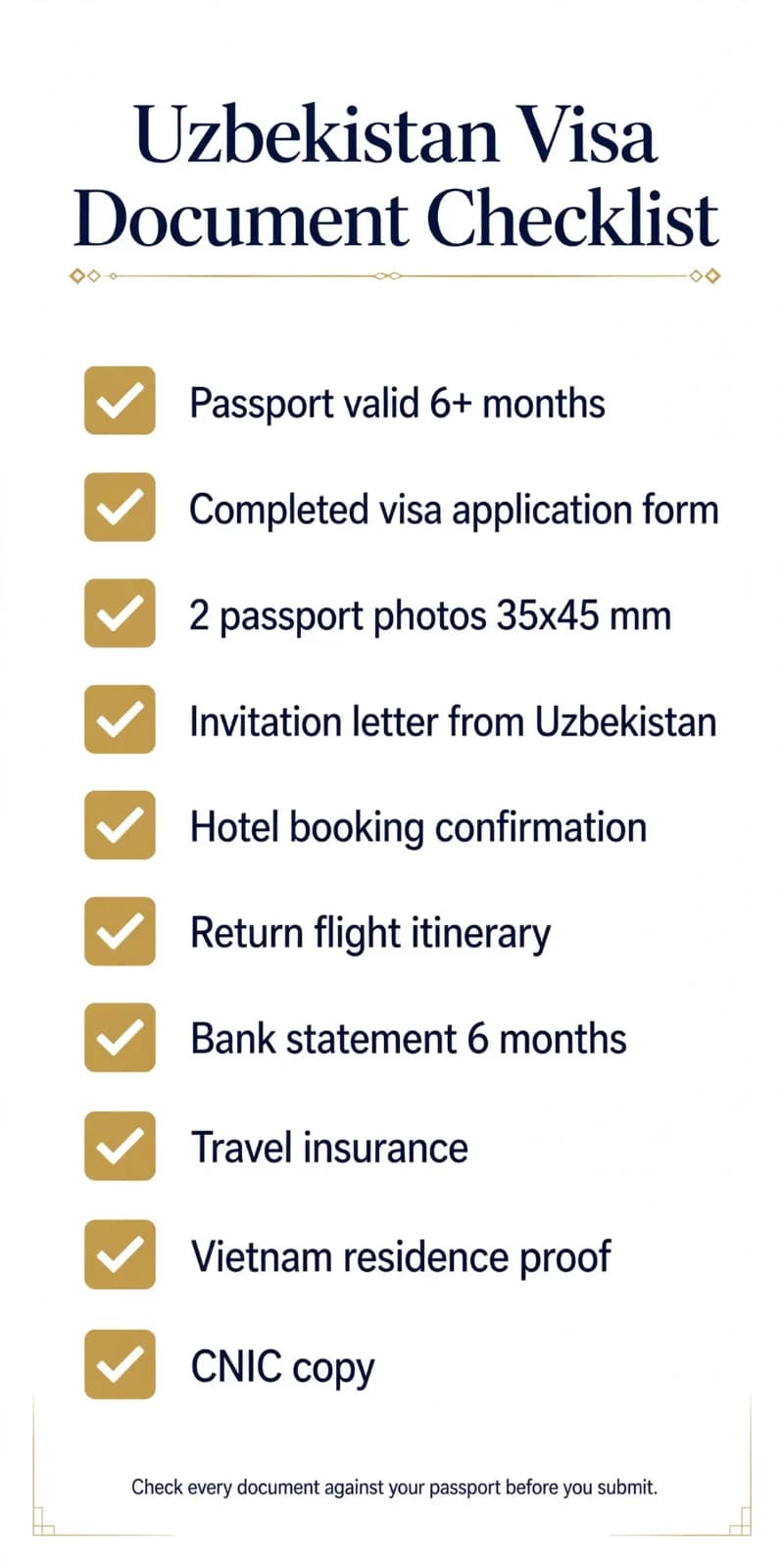
Complete Document Checklists
The checklists below are the complete document set for the main application routes. The core checklist applies to every Pakistani applicant. The additional checklists add the documents for business, private visit, student, work, and transit applications, and for applying from Vietnam. Tick each item off against your passport before you submit, because a single mismatch — a name spelled one way on the invitation and another way on the passport — can cost you the whole application.
Core checklist: every applicant
Your passport, valid for at least six months from your date of entry, with at least two blank pages, plus a clear photocopy of the bio-data page. The completed visa application form, filled in online at evisa.mfa.uz, printed, and signed — check that every entry matches your passport exactly, including the spelling of your name, your date and place of birth, and your passport number. Two recent colour passport photographs, 35 by 45 millimetres, on a plain white background, taken within the last six months, with your face clearly visible and no head covering except for religious reasons. The original invitation letter, or the letter of invitation approval, arranged on the Uzbek side — see Section 8. A hotel booking confirmation for every night of your stay, matching the dates on your invitation and your flight itinerary. A confirmed return or onward flight itinerary. A bank statement for the last six months, stamped by your bank, showing that you can afford the trip — Pakistan-facing guides cite a closing balance in the range of PKR 800,000 to PKR 2,000,000, but there is no published official minimum balance, so treat that range as a guide from agents rather than a rule, and show a stable, genuine balance rather than a single large deposit made the week before you apply. Travel and medical insurance valid in Uzbekistan for the full trip. A photocopy of your CNIC. The visa fee, paid exactly as the embassy directs, with the receipt kept in the file.
Applying from Vietnam: extra documents
Your Vietnamese temporary residence card (TRC) or valid Vietnamese visa, plus a photocopy. Proof of your address in Vietnam, such as a rental contract or a residence confirmation from your ward police. Proof of your employment or income in Vietnam, such as an employment contract, a salary statement, or a letter from your employer confirming your job and your approved leave dates. A Vietnamese bank statement, if your funds are held in Vietnam rather than in Pakistan, showing the same six-month history. If you apply in Hanoi, the embassy may ask for a Vietnamese translation or a notarised copy of some documents — ask in your first email so you are not sent away to arrange translations on the day.
Business visa: extra documents
A business invitation from a registered Uzbek company or organisation, lodged with the Consular and Legal Department of the Ministry of Foreign Affairs. A letter from your own employer or business in Vietnam or Pakistan, on company letterhead, stating the purpose of the visit, the Uzbek company you will meet, and who is paying for the trip. Your company registration or business documents, if you are self-employed. The conference or trade fair registration, if that is the purpose of the visit.
Private or family visit visa: extra documents
An invitation from your Uzbek host, filed by the host with the Uzbek migration authorities. Proof of your relationship to the host, such as a marriage certificate or birth certificate, legalised and translated if the embassy requires it. A copy of your host's Uzbek passport or residence document. Your host's address and telephone number in Uzbekistan.
Student visa: extra documents
An official admission letter from the Uzbek educational institution. Proof of payment of tuition fees or a scholarship award letter. Evidence of funds to cover living costs for the study period. Educational certificates and transcripts, legalised as the embassy requires. A medical certificate, if the institution or the embassy asks for one.
Work visa: extra documents
A work permit issued by the Uzbek authorities for your employer. An employment contract with the Uzbek employer. The employer's invitation and company registration documents. Evidence of your qualifications for the job, such as degree certificates and professional references.
Transit visa: extra documents
A confirmed onward ticket to a third country. A valid visa for your final destination, if one is required. Proof of your flight out of Uzbekistan within 72 hours. Note that a transit visa is for transit only — you may not use it to tour Uzbekistan beyond the transit period, and you may not extend it as a tourist visa.
Travelling with children
The Invitation Letter: The Document That Decides Your Application
For a Pakistani applicant, the invitation letter is the document that decides the application. The embassy will not process a tourist or business visa without one, and a weak or unverifiable invitation is the most common reason for delay or refusal. Understanding how it works before you pay for one is the best money you will save on this trip.
For a tourist visa, the invitation is arranged by a licensed Uzbek tour operator or hotel. You contact the operator, agree on your itinerary and dates, and the operator applies to the Uzbek Ministry of Foreign Affairs for a letter of invitation, sometimes called visa support or a letter of invitation approval. The Ministry issues the approval, and the operator sends you the letter or its reference number. The embassy then checks that approval against the Ministry's records. The process is not instant: allow at least five to seven working days for the invitation to be arranged, and longer if the operator is busy or the Ministry asks questions. Build that time into your planning before you count the embassy's own processing time.
For a business visa, the invitation is arranged by your Uzbek business partner, who files an invitation application with the Consular and Legal Department of the Ministry of Foreign Affairs. For a private visit, your Uzbek host files the invitation with the migration authorities. In both cases the invitation is a formal, official process, not a letter your host writes on personal letterhead. A personal letter from a friend in Tashkent, however warm, is not an invitation for visa purposes unless it has been through the official channel.
Choose your operator carefully. A genuine licensed tour operator will have a real website, a verifiable address in Uzbekistan, reviews from past travellers, a written contract, and a clear price for the invitation service quoted before you pay. They will ask for a scan of your passport bio-data page and your travel dates, and they will give you the invitation reference and the name of the Ministry approval. They will not ask for your original passport, your bank password, or payment by cryptocurrency. Be very cautious of operators found only through social media messages, operators who promise a visa in 24 hours, and operators who charge the full trip cost upfront before any invitation exists. Pay the invitation fee by a traceable method, keep the receipt, and keep every email.

How to Apply: Step-by-Step
Step one: decide where you will apply, and confirm it in writing. Email the Uzbek Embassy in Hanoi first, using the three questions in Section 6, and wait for a written reply. If Hanoi accepts Pakistani residents of Vietnam, that is your route, and it saves you a flight to Pakistan. If Hanoi declines or does not reply after two attempts, plan on Islamabad, and confirm with the Islamabad consular section whether you must appear in person or whether a representative can lodge the file. Do not pay for an invitation until you know where the file will be lodged, because the invitation and the embassy must match.
Step two: arrange your invitation. Contact a licensed Uzbek tour operator for a tourist visa, or your Uzbek business partner or host for a business or private visa. Send a clear scan of your passport bio-data page and your planned dates, agree the price in writing, and allow five to seven working days for the Ministry approval. While you wait, gather the rest of your documents so you are not starting from zero when the invitation arrives.
Step three: complete the visa application form online at evisa.mfa.uz, then print it and sign it. Fill in every field exactly as it appears on your passport, including the spelling of your name and your place of birth. Use the same dates on the form as on your invitation, your hotel bookings, and your flight itinerary — inconsistent dates across documents are one of the most common reasons for a file to be returned. Check the form twice before you print it, and keep a photocopy for yourself.
Step four: assemble your file in order, using the checklist in Section 7. Put the form on top, then the invitation, then your passport copy, photographs, hotel bookings, flight itinerary, bank statement, insurance, CNIC copy, and your Vietnam residence documents. Paperclip, do not staple, the photographs to the form unless the embassy tells you otherwise. Make a complete photocopy of the whole file for yourself before you submit it, because you will need the same details again at the border and for any future application.
Step five: submit the file at the embassy and pay the fee. In Islamabad, the consular section receives applications on Monday, Wednesday, and Friday from 9.30 to 12.00 — arrive early, because the window is short. In Hanoi, confirm the reception hours in your first email, because they are not published in a source we could verify. Pay the fee exactly as the embassy directs, keep the receipt, and get a written acknowledgement of your submission with a collection date or a reference number. Ask, before you leave the counter, how you will be told the decision, and whether you will collect the passport in person or whether it will be returned by post.
Step six: wait, and do not book non-refundable travel while you wait. The embassy's processing time is up to 10 working days, and it can be longer in busy periods — see Section 10. Use the waiting time to book refundable or flexible flights and hotels, to buy insurance, and to prepare your arrival documents. If the embassy contacts you for extra documents or an interview, respond the same day; a slow reply can push your application to the back of the queue.
Processing Time: How Long to Wait
For an embassy-issued visa, the processing time is up to 10 working days from the day the complete file is submitted. That is the figure given by the Islamabad-focused sources and by Pakistan-facing guides, and it is the figure you should plan on. Some guides give a wider range of 10 to 14 working days, and a few report 5 to 15 working days depending on the visa type and the season. The honest summary is this: plan on 10 working days, allow 14 working days, and do not assume it will be faster. Working days means Monday to Friday, excluding Uzbek and local public holidays in the country where you apply, and the count starts from the day after submission, not the day you hand the file in.
The 10-working-day figure is for a complete, correct file with a valid invitation already approved by the Ministry of Foreign Affairs. It does not include the time to arrange the invitation, which takes five to seven working days before you can even submit. It does not include the time to gather documents, to get a bank statement stamped, or to travel to the embassy. A realistic total timeline from the day you start to the day you hold your passport with the visa sticker is three to four weeks, and five weeks is safer if you are applying in a busy season or if any document needs correcting. Apply at least four weeks before your planned departure, and six weeks before if you are applying in Islamabad and need to travel to Pakistan to lodge the file.
The e-visa processing time of two to three business days, often quoted in general guides, does not apply to Pakistani applicants, because Pakistanis cannot use the e-visa. Do not plan your trip around a two-day turnaround. Similarly, do not believe any agent who promises a visa in 24 or 48 hours on a Pakistani passport. The embassy process has a Ministry approval step and a consular checking step, and neither can be skipped by paying more. An agent who promises speed is either describing a different nationality's process or is not telling you the truth.
Plan your flights around the visa, not the other way around. Book a refundable or flexible flight, or wait until the visa is in your passport before you pay for a non-refundable ticket. The same applies to hotels: book with free cancellation until the visa is issued. The money you save by booking early is lost many times over if the visa is delayed and the booking cannot be changed.
Registration After Arrival: The 3-Day E-Mehmon Rule
Getting the visa is only half the job. Once you arrive in Uzbekistan, you must be registered at your place of stay within three working days of entry, and your registration must cover every night of your stay without gaps. This rule catches more visitors than any other, because it is separate from the visa, it is enforced at the border when you leave, and many travellers have never heard of it until a border guard asks for their registration slips.
The rule works like this. The law on registration, Law ZRU-1074 of 10 July 2025, in force since 12 October 2025, requires foreign citizens to be registered at their place of stay within three working days of arrival. Hotels, guesthouses, and other licensed accommodation register their guests automatically through the E-mehmon electronic system, usually at check-in, and give you a registration slip, often with a QR code. If you stay in a private home, your host must register you — either online through E-mehmon or in person at the local migration and citizenship office — and the host, not you, carries the legal duty, although you carry the consequences if it is not done. If you move to a new city or a new address, you must be registered at the new address within three days. If you stay three days or less in total, registration is not required, but for any longer trip it is essential.
Keep every registration slip from every place you stay, and keep them until you have left Uzbekistan. Border guards can ask to see them when you depart, and a gap in registration — even a single night without a slip — can lead to questions, a fine, and a delay at the border. Take a photograph of each slip as a backup, and keep the paper originals in your passport wallet. When you check in to a hotel, ask at the desk whether you have been registered, and ask for the slip before you leave. If a hotel says registration is not needed, ask again, and if you are staying in a private home, agree with your host before you arrive who will do the registration and by when.
The fines for breaking the registration rules are set by Article 225 of the Administrative Code, and they are charged in multiples of the base calculation amount. The base calculation amount has been 440,000 Uzbek soums since 1 September 2026. Here the sources conflict, and this guide discloses the conflict. One official summary, reflected in the UK travel advice index, puts the fine at five base amounts for a violation of up to 10 days, ten base amounts for 11 to 30 days, and twenty base amounts beyond 30 days — which, at 440,000 soums, is about 2,200,000 soums, 4,400,000 soums, and 8,800,000 soums. Another detailed 2026 source puts the scale at five, fifteen, and twenty-five base amounts, or about 2,200,000, 6,600,000, and 11,000,000 soums. The controlling source is the Administrative Code itself and the Interior Ministry notice, and the lower set of figures is the one most often cited in official summaries, so this guide uses five, ten, and twenty base amounts as the working figures and flags the higher figures as the alternative reading. Either way, the fine is large, and an unpaid fine can lead to expulsion and an entry ban of one year, or three years for a second violation within a year. Visitors under 18 are not fined. Do not test the system: register on time, every time.
Extending Your Stay and What Happens If You Overstay
The short answer is: do not plan to extend a tourist visa inside Uzbekistan. Plan to leave before your permitted stay ends, and treat any extension as a bonus you cannot count on. The reason for that blunt advice is a direct conflict in the sources, which this guide discloses in full.
On one side, several commercial guides describe an online visa extension system through the Unified Portal of Interactive Government Services at my.gov.uz, run by the Department of Migration and Personalization under the Ministry of Internal Affairs. Under that account, you apply at least 10 days before your current visa expires, the review takes up to 15 working days, you pay a state fee based on the extension period, and you present your passport to get an extension sticker — a process of about three to four weeks in total. On the other side, the US Embassy in Tashkent states plainly on its official registration page: "A tourist visa cannot be extended in Uzbekistan." That is the controlling source for a tourist, because it is the advice of a government embassy on the ground, and it is consistent with the separate official statement that the e-visa is not extendable inside Uzbekistan.
How do you reconcile those two accounts? The most likely explanation is that some longer-stay visa categories — private visit, business, student, and work visas — can be extended through the migration authorities, while the short tourist visa cannot, and commercial guides have blurred that distinction. It is also possible that extensions are granted in exceptional cases, such as a medical emergency, at the discretion of the migration office. Either way, a tourist should not buy a 30-day visa and plan to extend it to 60 days. If you think you may need more than 30 days, apply for the longer validity band from the start — a single-entry visa for up to 3 months costs USD 80, and for up to 6 months costs USD 120 — and get the longer stay printed on your sticker before you travel.
Overstaying is expensive and can affect your future travel. The same Article 225 fine scale that applies to late registration applies to overstaying, and an unpaid fine leads to expulsion and a one-year entry ban, or a three-year ban for a second violation within a year. A record of overstaying in Uzbekistan can also be raised by other countries when you apply for their visas, because visa forms often ask whether you have ever overstayed or been deported. The safest rule is simple: your return flight should leave at least one full day before your permitted stay ends, and if your flight is cancelled, go to the migration office the same day with the airline's written confirmation.
Transit Through Uzbekistan
Uzbekistan is a natural transit point between South Asia, Southeast Asia, and Europe, and Tashkent airport handles many connecting passengers. For a Pakistani passport holder, the transit rules are narrower than for many other nationalities, so check them before you book a connecting flight.
First, the five-day visa-free transit scheme does not apply to Pakistanis. That scheme allows citizens of listed countries to transit through an Uzbek international airport for up to five days without a visa, provided they hold a confirmed ticket to a third country on Uzbekistan Airways and remain within the five-day limit. Pakistan is not on the listed-countries table for that scheme. The same applies to the visa-free transit that some sources describe for passengers whose airline sends passenger data to the border guards in advance — again, the scheme is limited to listed nationalities, and Pakistan is not among them. Do not book a multi-day stopover in Tashkent on the assumption that you can enter visa-free.
What you can do is apply for a transit visa before you travel. A single transit visa is valid for up to 72 hours and costs USD 40; a double transit visa costs USD 50. You need a confirmed onward ticket to a third country and, where relevant, a visa for your final destination. The transit visa is issued through the same embassy route as a tourist visa, and it needs an application of its own — you cannot convert a transit visa into a tourist visa after you arrive, and you cannot use it to stay beyond 72 hours. If your connection is under 24 hours and you do not leave the international transit area of the airport, check with the airline whether a transit visa is needed at all for your specific routing, because the requirement depends on the airport, the airline, and whether you need to collect and re-check baggage. Get the airline's answer in writing before you travel, and if there is any doubt, apply for the transit visa — it is cheaper than a missed connection.
If you do have a transit visa and a stopover of a day or two, the same registration rule applies: if your stay in Uzbekistan is longer than three days, you must register, but a 72-hour transit is within the three-day window, so registration is not required for a short transit stay. Keep your onward boarding pass and your transit visa together, and keep your passport stamped on entry and on exit, because the border guards will check the entry stamp against the 72-hour limit when you leave.
Work, Study and Business Trips
A tourist visa does not allow you to work or to study in Uzbekistan. That rule is stated on every official source, and breaking it can lead to a fine, deportation, and a ban on future entry. If your purpose is work, study, or a long business assignment, you need the correct visa category from the start, and you need to allow much more time for it.
For work, you need a job offer from an Uzbek employer, a work permit issued by the Uzbek authorities, and an employment contract. The employer normally arranges the work permit and the invitation, and you then apply for a work visa at the embassy with those documents, plus your qualifications and your passport. The work visa is issued for the duration of the contract, and the fee follows the validity scale in Section 4, up to USD 160 for a single entry of up to one year, or USD 150 to USD 250 for a multiple-entry visa. There is no Uzbek job-seeker visa, and you cannot arrive on a tourist visa and look for work, or convert a tourist visa into a work visa inside the country. If you are an English teacher, note that Uzbekistan's language schools do hire foreign teachers, but the employer must arrange the permit before you travel, and you should verify the employer's registration and the contract terms before you resign from your job in Vietnam.
For study, you need an admission letter from a recognised Uzbek university or institution, proof that you have paid tuition fees or hold a scholarship, evidence of funds to cover living costs, and your educational certificates. The student visa is issued for the duration of the course, and the fee follows the same validity scale. Some universities in Tashkent and Samarkand run programmes in English, particularly in medicine, engineering, and international relations, but check the language of instruction, the recognition of the degree in Pakistan and Vietnam, and the total cost before you apply. A student visa does not automatically give you the right to work part-time; ask the institution and the embassy what work, if any, is permitted on a student visa.
For a business trip, the key document is the business invitation from your Uzbek counterpart, lodged with the Consular and Legal Department of the Ministry of Foreign Affairs. Short business visits of up to 30 days use the same USD 60 single-entry band as a tourist visa, and the application is otherwise the same. Longer or repeated business travel may justify a multiple-entry business visa at USD 150 to USD 250. A business visa covers meetings, negotiations, conferences, and trade visits; it does not cover taking up a salaried job, signing an employment contract, or running a business in Uzbekistan. If your trip mixes business and tourism — a conference followed by a few days in Samarkand — a business visa covers both, provided the business purpose is the main one and the invitation reflects it.
Money, Flights and Travel Planning from Vietnam
There are no non-stop flights from Ho Chi Minh City or Hanoi to Tashkent as of October 2026, so every journey from Vietnam to Uzbekistan involves at least one connection. The most convenient connections are through Bangkok, where Uzbekistan Airways and Centrum Air fly non-stop to Tashkent several times a week in the winter timetable, and through Kuala Lumpur, where Uzbekistan Airways flies non-stop to Tashkent four times a week. Other workable connections are through Delhi, Guangzhou, Istanbul, and Dubai. The total journey time from Ho Chi Minh City is typically 10 to 13 hours or more including the connection, and on some routings it can be much longer, so check the total time, not just the headline fare, and leave at least two to three hours for the connection. Uzbekistan Airways also flies from Cam Ranh, the airport for Nha Trang, to Tashkent in about seven and a half hours on some dates, which can be a useful option if you live in central Vietnam or can reach Cam Ranh cheaply.
Tashkent is on UTC plus five hours all year, which is two hours behind Vietnam. That matters when you book connecting flights and when you calculate your visa dates: your arrival date in Uzbekistan is the date on the entry stamp, and your 30-day stay is counted from that date in Uzbek time. Book your return flight for at least one full day before your permitted stay ends, and remember that a flight that leaves Tashkent late at night still counts as departing on that calendar day.
The currency of Uzbekistan is the Uzbek soum, abbreviated UZS. US dollars are the easiest foreign currency to exchange, and you should bring clean, undamaged dollar notes issued in 2013 or later, because older notes are often refused. Exchange money only at official exchange booths, banks, and hotels, and keep the receipts, because you cannot leave Uzbekistan with more foreign currency than you brought in, and you may be asked to show the declaration. If you bring in USD 10,000 or more in cash, or precious metals and gemstones over 65 grams, you must declare them on arrival on the customs form, in two copies, and get both copies stamped. Keep one stamped copy for your departure. International cards work in Tashkent's larger hotels and shops, but cash is still king outside the capital, so carry enough soums for trains, taxis, and smaller towns.
Trains are the best way to travel between Tashkent, Samarkand, and Bukhara. The high-speed Afrosiyob train covers Tashkent to Samarkand in about two hours, and tickets go on sale 60 days before departure at 10.00 Tashkent time. You need your passport to book train tickets, so have it with you, and book early for weekend travel. Domestic flights to Khiva, through Urgench airport, are also available. For city travel, use marked taxis or a ride-hailing app, agree the fare before you get in if there is no meter, and keep your passport with you at all times, because the police can ask to see it and it is a legal requirement to carry it.
Health and safety are straightforward. The US State Department rates Uzbekistan Level 1, "Exercise normal precautions", in its advisory issued on 26 January 2026, its lowest level, and the UK Foreign, Commonwealth and Development Office does not advise against travel to any part of Uzbekistan. Petty crime such as pickpocketing happens in bazaars and on public transport, so keep your bag in front of you and do not carry your passport and all your cash in the same pocket. The FCDO advises caution near the Afghanistan border, and some areas there need local permission or an organised tour group, so do not travel to the border region independently. Check the FCDO and US State Department advisories again in the week before you travel, because advice can change. No vaccination is required for entry from Vietnam, but make sure your routine vaccinations are up to date and carry any prescription medicine in its original packaging with the prescription, because some medicines, including codeine, can cause problems at the border.
Official Websites
Check the official sources below before you apply, and check them again in the week before you travel. Where an official source and a commercial website disagree, the official source is the one that counts. The commercial Pakistan-focused guides are listed because they checked the official eligibility list and the Islamabad fee scale in October and November 2026, not because they can issue a visa.
| Source | Website |
|---|---|
| Uzbekistan e-Visa Portal (MFA) | https://e-visa.gov.uz/ |
| Ministry of Foreign Affairs of Uzbekistan | https://www.gov.uz/en/mfa |
| US State Department — Uzbekistan Travel Advisory | https://travel.state.gov/content/travel/en/international-travel/International-Travel-Country-Information-Pages/Uzbekistan.html |
| UK FCDO — Uzbekistan Travel Advice | https://www.gov.uk/foreign-travel-advice/uzbekistan |
| US Embassy Tashkent — Registration in Uzbekistan | https://uz.usembassy.gov/registration-in-uzbekistan/ |
| Embassy of Uzbekistan in Qatar — Visa Page | https://uzembassy-qatar.org/en/page/visa/ |
| Embassy of Uzbekistan in Hanoi — Address and Contacts | https://www.vietnamimmigration.com/embassies-in-vietnam/uzbekistan-embassy-office-in-vietnam/ |
| Unified Portal of Interactive Government Services (my.gov.uz) | https://my.gov.uz/ |
| E-Mehmon Registration System | https://emehmon.uz/ |
| Advantour — Uzbekistan E-Visa and Visa Regulations | https://www.advantour.com/uzbekistan/visa.htm |
| Central Asia Travel — Visas to Uzbekistan | https://www.centralasia-travel.com/en/countries/uzbekistan/visas |
| Turkestan Travel — Uzbekistan Visa Regulations | https://www.turkestantravel.com/en/visa-regulations-uzbekistan/ |
| Sky Raah — Uzbekistan Visit Visa from Pakistan 2026 | https://www.skyraah.com/uzbekistan-visit-visa |
| HTG Travel — Uzbekistan Visa for Pakistanis | https://htg.com.pk/blog/uzbekistan-visa-guide-pakistan/ |
| AMG Visa — Uzbekistan Visa from Pakistan 2026 | https://www.amgvisa.com/countries/uzbekistan |
| Travel Visa Stack — Uzbekistan Visa for Pakistan Citizens | https://www.travelvisastack.com/visa-guide/pakistan/uzbekistan |
| Trips.pk — Uzbekistan Visa from Pakistan 2026 | https://www.trips.pk/visa/uzbekistan |
| Uzbekistan eVisa Fee Guide 2026 | https://evisa-uzbekistan.info/uzbekistan-evisa-fee/ |
| Uzbekistan Visa Extension Guide | https://evisa-uzbekistan.info/uzbekistan-visa-extension/ |
| Oxus Road — Uzbekistan Visa and Registration 2026 | https://oxusroad.com/en/travel-guide/visa-and-registration/ |
Frequently Asked Questions
Do Pakistani passport holders need a visa for Uzbekistan?
Yes. Pakistani ordinary passport holders need a visa before travelling to Uzbekistan. There is no visa-free entry and no visa on arrival for Pakistani passports. You must apply at an Uzbek embassy with an invitation letter, as explained in Sections 6 to 9.
Can Pakistanis apply for the Uzbekistan e-visa at e-visa.gov.uz?
No, not under the current official eligibility list. Pakistan is not on the Foreign Ministry's e-visa country list as checked on 29 November 2026. Many commercial websites claim otherwise, but the controlling source is the portal itself: if Pakistan is not a citizenship option there, no agent can issue you an e-visa.
How much is the Uzbekistan tourist visa fee for Pakistanis?
The official consular fee for a single-entry tourist visa for up to 30 days is USD 60. Shorter bands cost USD 40 for up to 7 days and USD 50 for up to 15 days. Longer single-entry visas cost USD 80 for up to 3 months, USD 120 for up to 6 months, and USD 160 for up to 1 year. Multiple-entry visas cost USD 150 to USD 250.
How long does the Uzbekistan visa take for a Pakistani applicant?
Plan on up to 10 working days after you submit a complete file at the embassy, and allow 14 working days to be safe. The invitation takes another five to seven working days to arrange before you can submit. A realistic total timeline from starting the process to holding your passport with the visa sticker is three to four weeks.
How long can I stay in Uzbekistan on a tourist visa?
Up to 30 days on the standard single-entry tourist visa. Longer stays are possible only if you applied and paid for a longer validity band and the longer stay is printed on your visa sticker. Your stay is counted from the day you cross the border, and even a one-day overstay can lead to a fine.
Can I apply for the Uzbekistan visa from Vietnam, or must I go to Pakistan?
There is an Uzbek Embassy in Hanoi, at 22/9 Dao Tan Street, Ba Dinh District, telephone (024) 3766 5203, and you should ask it in writing first whether it accepts applications from Pakistani residents of Vietnam. That point is still unverified. If Hanoi declines, the confirmed route is the Embassy of Uzbekistan in Islamabad.
What is the invitation letter, and why do I need one?
The invitation is a formal document arranged on the Uzbek side — by a licensed tour operator for a tourist visa, by a registered company for a business visa, or by your host for a private visit — and approved by the Ministry of Foreign Affairs. The embassy will not process your visa without it. A personal letter from a friend is not a substitute unless it has been through the official channel.
What documents do I need for the Uzbekistan visa?
A passport valid for at least six months, the completed application form, two 35 by 45 millimetre photographs, the invitation letter, hotel bookings, a return flight itinerary, a six-month bank statement, travel insurance, a CNIC copy, and, if you apply from Vietnam, your Vietnamese residence card and proof of address and employment. The full checklists are in Section 7.
Is there a visa on arrival in Uzbekistan for Pakistanis?
No. Pakistanis cannot get a visa on arrival at Tashkent airport or at any land border. You must hold the visa before you travel, and airlines will check it before boarding. Anyone offering a visa on arrival for a Pakistani passport is not describing the official rule.
Can I transit through Uzbekistan without a visa?
No, not as a Pakistani passport holder. The five-day visa-free transit scheme is limited to listed nationalities travelling on Uzbekistan Airways, and Pakistan is not on that list. For a stopover you need a transit visa in advance: USD 40 for up to 72 hours for a single transit, or USD 50 for a double transit.
Do I need to register after I arrive in Uzbekistan?
Yes, if your stay is longer than three days. You must be registered at your place of stay within three working days of arrival. Hotels register you automatically through the E-mehmon system; in a private home your host must register you. Keep every registration slip until you have left the country.
Can I extend my tourist visa inside Uzbekistan?
Do not plan on it. The US Embassy in Tashkent states that a tourist visa cannot be extended in Uzbekistan, although some commercial guides describe an online extension process for other visa categories. The safe plan is to apply for the longer validity band before you travel if you may need more than 30 days.
Can I work in Uzbekistan on a tourist visa?
No. A tourist visa does not allow you to work or to study. You need a work visa with a work permit arranged by your Uzbek employer, or a student visa with an admission letter from a recognised institution. Working on a tourist visa can lead to a fine, deportation, and a future entry ban.
How much money should I show in my bank statement?
There is no published official minimum balance for a Pakistani applicant. Pakistan-facing guides cite a closing balance in the range of PKR 800,000 to PKR 2,000,000, but that is guidance from agents, not a rule. Show a genuine, stable six-month balance that covers your flights, hotels, and daily costs, and avoid a single large deposit just before you apply.
Is Uzbekistan safe for Pakistani tourists?
Yes, by the official measures. The US State Department rates Uzbekistan Level 1, "Exercise normal precautions", its lowest level, in an advisory issued on 26 January 2026, and the UK Foreign Office does not advise against travel to any part of Uzbekistan. Take normal precautions against pickpocketing in bazaars and on public transport, carry your passport at all times, and avoid the Afghanistan border area without local guidance.
This guide was checked on 29 November 2026 against the official Uzbekistan e-visa portal, the Uzbek Foreign Ministry's eligibility lists, Uzbek embassy fee scales, the US State Department advisory, and UK Foreign Office advice, with conflicts between sources disclosed where they exist. Visa rules can change without notice, so confirm the current fee, the document list, and whether the Hanoi embassy accepts Pakistani residents of Vietnam in writing with the mission before you pay or book. The invitation, the fee, and the processing time in this guide are the figures verified on the checking date, and they may change. The final decision on any visa application, and on entry into Uzbekistan, rests entirely with the Uzbek immigration officer at the border, and this guide does not guarantee visa approval or entry.


