


Uruguay Visa Guide 2026: Types, Requirements, Documents and Application Steps
Last checked: 29 November 2026. This guide is for Pakistani passport holders living in Vietnam. Visa rules change without notice — always confirm the live rules with the Embassy of Uruguay in Hanoi and on the official Uruguayan government portal (gub.uy) before paying any fee or booking a non-refundable ticket.
Introduction
Uruguay is South America's quiet achiever: a small, stable country of about 3.4 million people between Argentina and Brazil, with the elegant capital Montevideo, the beach resort of Punta del Este, the colonial old town of Colonia del Sacramento, rolling farmland, and some of the best beef and wine on the continent. It is also one of the region's most expensive countries for visitors, and one of the most orderly — which is good news for a visa applicant, because the rules are written down in law, even if they are not always easy to find in English.
For a Pakistani passport holder living in Vietnam, Uruguay is unusual in one very helpful way: Uruguay actually has a resident embassy in Hanoi. You do not need to send your passport to Beijing, New Delhi or Abu Dhabi, as you would for many South American countries. The bad news is that there is no online application, no eVisa and no visa on arrival for Pakistanis. Every application is a paper consular visa that must be approved in advance by the National Migration Directorate (Direccion Nacional de Migracion, or DNM) in Montevideo, and that approval takes time — at least 20 working days, and often longer. Plan two months ahead and you will be fine; plan two weeks ahead and you will almost certainly miss your flight.
This guide covers the visa requirement first, then the seven visa types created by Decree 356/018, the fees (where two official figures disagree, and which one to trust), the processing times, the full document checklists for tourists, business travellers, workers, students and families, the step-by-step application from Vietnam, extensions, transit, work and study notes, the digital nomad permit, common mistakes, and what to do if you are refused. Every fee, stay length and processing time in this guide names its source, and where sources conflict the conflict is stated in the open rather than hidden.
Do Pakistani Passport Holders Need a Visa for Uruguay?
Yes. Pakistani ordinary passport holders need a visa for Uruguay for any stay, even a short tourist visit. Uruguay's Ministry of the Interior lists Pakistan among the nationalities whose ordinary passport holders need a visa with prior authorisation. There is no visa-free entry, no visa on arrival and no eVisa for Pakistani passport holders.
The visa is a consular visa with prior authorisation. That means two separate steps happen before you travel: the Uruguayan embassy or consulate that receives your application checks your documents, and then it forwards your file to the National Migration Directorate (DNM) in Montevideo, which approves or refuses it. You cannot board a flight to Uruguay until that approval has been given and the visa has been stamped in your passport.
Holding a valid visa or residence permit for the United States, the United Kingdom, the Schengen area, Canada or a Gulf country does not exempt a Pakistani passport holder from the Uruguay visa. Uruguay does give visa exemptions to holders of certain other visas, but only for a small list of nationalities, and Pakistan is not among them. Do not assume that a US or Schengen visa in your passport will get you into Uruguay — it will not.
Your passport must be valid for at least six months after your planned arrival in Uruguay and must be in good condition. The United States Department of State's Uruguay country information page asks for at least one blank page per entry stamp; several visa guides advise carrying two blank pages. This guide advises two blank pages, because it satisfies both readings and costs you nothing.
There is one more document point that catches Pakistani travellers out. If you are travelling from Pakistan rather than from Vietnam, you need a polio vaccination certificate from NADRA to leave Pakistan. That is a Pakistani exit requirement, not a Uruguayan entry requirement, but it has stopped travellers at Pakistani airports before. If you fly out of Ho Chi Minh City or Hanoi, it does not apply to your departure from Vietnam — but keep the certificate with your travel documents anyway if you hold one, because it is cheap insurance.
Uruguay itself does not require yellow fever vaccination for entry, according to the United States Centers for Disease Control and Prevention (CDC). Yellow fever vaccination is required if you arrive in Uruguay from a country with a risk of yellow fever transmission, and it must have been given within the five days before arrival in that case. If your route takes you through Brazil or another yellow fever area, carry your yellow fever certificate. The CDC also recommends that travellers be up to date on routine vaccines, including MMR, and recommends hepatitis A for unvaccinated travellers and hepatitis B for unvaccinated travellers of all ages. None of these is a visa requirement, but a travel clinic visit a month before departure is sensible.
Types of Uruguay Visas for Pakistani Passport Holders
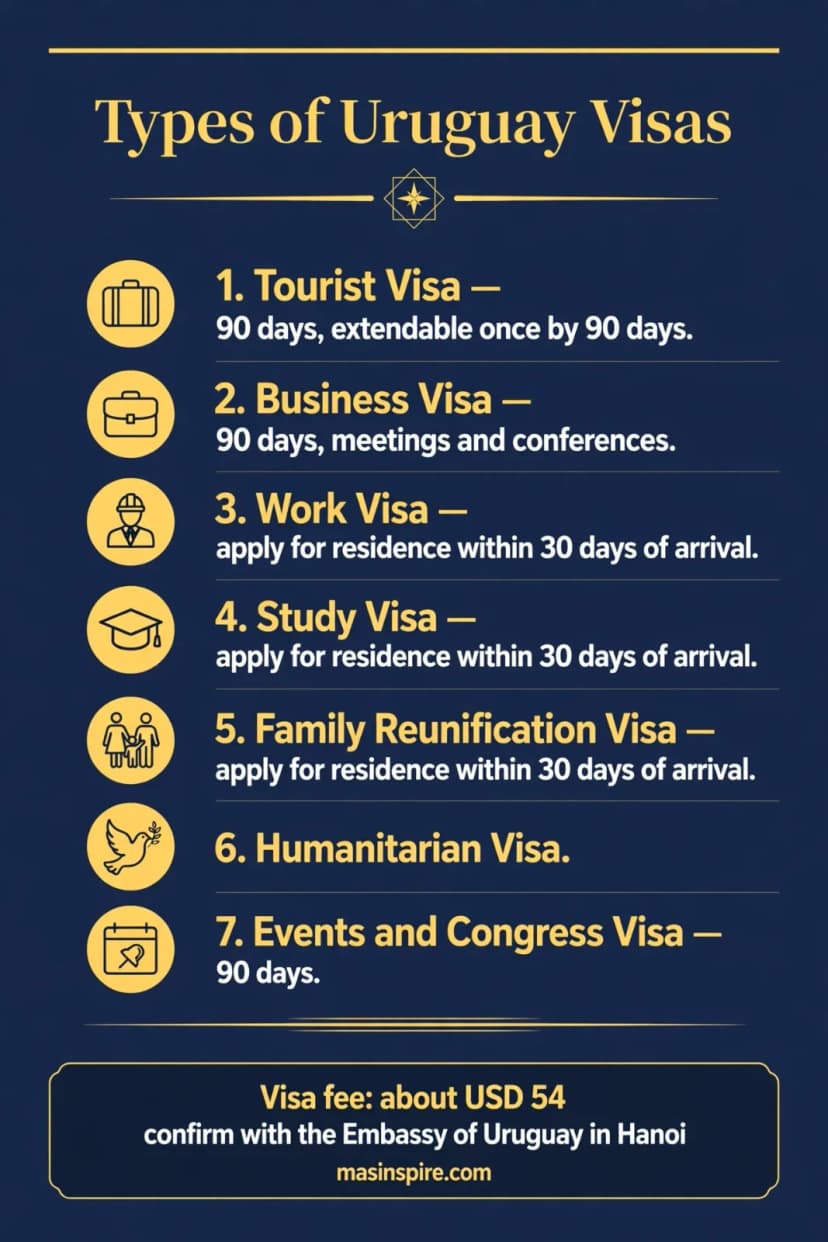
Uruguay's consular visas come from Decree 356/018, which creates seven visa types. Every one of them is applied for at a Uruguayan embassy or consulate abroad, and every one of them needs prior authorisation from the National Migration Directorate in Montevideo. The seven types are tourism, business, work, study, family reunification, humanitarian, and events (congresses, conventions and seminars). There is no separate published transit visa among the seven types — transit is covered in its own section later in this guide, because it is an open point you must confirm with the Hanoi embassy before booking a connection through Montevideo.
The tourist visa is the one most Pakistani readers of this guide will apply for. It covers holidays, sightseeing, visiting friends, and short private visits. Tourist visas are multiple entry and allow a stay of up to 90 days, which can be extended once for a further 90 days inside Uruguay. The visa itself is valid for 180 days from the date it is issued, under Decree 356/018, which means you have six months from the issue date to enter Uruguay. An older official visa form, still reproduced by some consulates, says instead that you have 60 days from the approval date to get the visa stamped and then 60 days from stamping to enter. Those two readings conflict. This guide follows the decree — 180 days from issue — because a decree outranks a form, and because the current Pretoria mission page also states 180 days. But the conflict is real, and you should ask the Hanoi embassy in writing which validity period will be printed on your visa before you book flights.
The business visa covers meetings, negotiations, trade visits, investment discussions and attending conferences as a business visitor. Like the tourist visa it allows a stay of up to 90 days, extendable once by 90 days, and it is multiple entry. The key difference from the tourist visa is the supporting paperwork: you need an invitation letter from the Uruguayan company or organisation you are visiting, stating the purpose, the dates and who pays. Business visitors may negotiate, invest and attend meetings, but they may not take local employment in Uruguay outside their visa category. If a Uruguayan company wants to employ you, that is a work visa, not a business visa.
The work visa is for a person who has a job offer or employment contract in Uruguay. It is not a job-seeker visa: you cannot apply for a work visa without an employer and a contract. After you arrive in Uruguay on a work visa, you have 30 days to file for residence with the National Migration Directorate. Do not treat the work visa as the end of the process — it is the entry document, and the residence filing after arrival is what lets you stay and work legally.
The study visa is for a person enrolled in a course at a recognised Uruguayan educational institution. You need an enrolment letter or acceptance letter, proof of funds for the course and your living costs, and the usual core documents. Like the work visa, the study visa gives you 30 days after arrival to file for residence. There is no published student-visa fee different from the standard consular fee, and no published processing time specific to students — the same DNM authorisation timeline applies.
The family reunification visa is for joining a close family member who is legally resident in Uruguay. You need proof of the relationship (marriage certificate, birth certificate, or equivalent, usually legalised or apostilled), proof of the family member's legal residence in Uruguay, and evidence that the family member can support you or that you can support yourself. After arrival you have 30 days to file for residence, the same as work and study visas.
The humanitarian visa is for people in exceptional humanitarian situations. It is granted case by case, and there is no published checklist or fee for it. If you believe your situation qualifies, contact the Hanoi embassy directly and explain the circumstances in writing — do not apply under another category and hope for the best.
The events visa covers congresses, conventions, seminars and similar gatherings, whether national or international. It allows a stay of up to 90 days and is multiple entry. You need the invitation or registration from the event organiser, proof of the event, and the usual core documents. Sportspeople, performers and media professionals travelling for a specific event generally fall under this category or the business category, depending on what the inviting organisation states.
The table below summarises the seven visa types.
| Visa type | Who it is for | Stay allowed | Entry | After arrival |
|---|---|---|---|---|
| Tourist | Holidays, sightseeing, private visits | Up to 90 days, extendable once by 90 days | Multiple entry | Leave before the stay expires or extend in time |
| Business | Meetings, negotiations, trade, conferences | Up to 90 days, extendable once by 90 days | Multiple entry | No local employment |
| Work | Person with a Uruguayan job offer and contract | As granted, then residence | As issued | File for residence within 30 days |
| Study | Enrolled student at a recognised institution | As granted, then residence | As issued | File for residence within 30 days |
| Family reunification | Joining a close family member resident in Uruguay | As granted, then residence | As issued | File for residence within 30 days |
| Humanitarian | Exceptional humanitarian cases, decided case by case | As granted | As issued | As directed by the DNM |
| Events and congresses | Congresses, conventions, seminars, invited participants | Up to 90 days | Multiple entry | Leave before the stay expires or extend in time |
Two things in that table deserve emphasis. First, the 90-day stay for tourist, business and events visas is the stay allowed after entry, not the validity of the visa itself — the visa is valid for 180 days from issue, and the 90 days start when you enter Uruguay. Second, the 30-day residence filing deadline for work, study and family visas is a hard deadline in the decree. Missing it can turn a legal arrival into an overstay problem, so put the date in your diary the day you land.
Visa Fees: What Each Route Costs
Here is the honest position on the Uruguay visa fee, because two official Uruguayan sources give two different figures and this guide will not pretend otherwise. The central procedures page on the official government portal gub.uy states the fee as 3 consular pesos, equal to USD 42, and says it is charged only if the visa is granted. That page was last updated in 2020, and consular fees in Uruguay change every 1 January. The current mission pages tell a different story: the Consulate General in Guangzhou states USD 54, the Embassy in Pretoria states USD 54, the Embassy in Stockholm states about USD 54, the Consulate General in Sydney states AUD 84 (which is about USD 54 at current rates), and the Consulate General in Hong Kong states HKD 423 (also about USD 54). Five current missions agreeing on the same amount is strong evidence that USD 54 is the fee missions actually charge in 2026.
This guide therefore reports the fee as about USD 54, and treats the USD 42 figure as the older central-page figure that has not been updated. The controlling source for your application is the Embassy of Uruguay in Hanoi, because it is the mission that will take your money. Email the embassy before you pay anything and ask for the current fee in writing, the currency, the payment method, and whether the fee is charged at filing or only if the visa is granted. That last point matters: the older central page says the fee is charged only if the visa is granted, while the Guangzhou mission page says the USD 54 fee covers the initiation of the application and the stamping of the visa and is therefore non-refundable if the visa is denied. Those two rules cannot both apply to the same application, so get Hanoi's rule in writing and keep the email.
There is no published expedited or priority service for Uruguay visas, and no published fee for one. If an agent offers you a faster Uruguay visa for an extra payment, that is not an official service — it is a private promise the embassy has not published, and you should treat it with caution.
Other costs you should budget for are separate from the visa fee. There is no visa application centre and no service fee in Vietnam, because you apply directly to the embassy. You may need to pay for document translation into Spanish or English, for legalisation or apostille of civil documents such as marriage or birth certificates, for travel insurance, and for travel to Hanoi if you live in Ho Chi Minh City or elsewhere in Vietnam. The extension of stay inside Uruguay is a separate published fee: UI 225.60 (about USD 37) if you file before your stay expires, and UI 345 (about USD 57) if you file after it has lapsed. UI means Unidad Indexada, an indexed unit whose peso value moves with inflation, so the US dollar figure is approximate and changes — the DNM procedure sheet sets the fee in UI, not in dollars.
Uruguay is one of South America's more expensive destinations. Third-party travel estimates put a mid-range hotel night at roughly USD 75 and food at roughly USD 28 per day, but those are third-party estimates, not official figures, and prices in Punta del Este in summer are far higher than in Montevideo in winter. Budget generously, keep your bank statements honest, and do not invent a bank balance — the embassy checks the pattern of your statements, not just the final number, and a large deposit made the week before you apply is the oldest red flag in visa work.
No official page publishes a minimum bank balance for a Uruguay visa. Agency guides aimed at Pakistani applicants quote a certified six-month bank statement with a closing balance of PKR 1,000,000 to PKR 2,000,000 as a requirement. That figure is an agency's advice, not a government rule, and this guide does not repeat it as a rule. What the embassy actually asks for is proof of sufficient funds for the trip — recent bank statements showing regular income and a balance that credibly covers your flights, accommodation and daily costs. A teacher's salary statements from Vietnam, plus a Vietnamese residence card and an employment letter, are far more convincing than a borrowed lump sum.
Processing Times
Uruguay does not publish a single processing time, and you should plan around the slowest credible figure rather than the fastest. The authorisation by the National Migration Directorate in Montevideo usually takes at least 20 working days — that is the figure the official procedures page and the Pakistan-focused guides agree on. Some mission pages say authorisation can take up to 60 days. Another mission reports that assessment commonly takes 20 to 30 working days after the interview. All three figures describe the same DNM step, and the honest summary is: expect 20 to 30 working days, and allow up to 60 days.
The missions' own advice is consistent on when to start. The Sydney and Hong Kong mission pages say the visa application must be submitted at least 40 days before your travel date. The Guangzhou mission page says applicants are advised to initiate the application at least 50 days before the intended date of travel. This guide's advice is to start 60 days before travel and to have your complete file with the embassy at least 40 days before your flight. If you start later than that, you are relying on luck, and luck is not a visa strategy.
The interview, where one is held, happens at the embassy after your documents are checked, and the DNM clock runs after that. Some missions accept the first contact by email with scanned documents, then call you for an in-person appointment to submit originals and attend an interview. Others want you in person from the start. Hanoi's exact sequence is an open point in this guide — email the embassy first and ask whether it wants scans by email or an in-person visit first, and do not assume it works like the Guangzhou or Sydney missions, because each Uruguayan mission runs its own front desk.
Once the DNM approves your application, the visa must be stamped in your passport. Under the decree the visa is then valid for 180 days from issue, as explained in the visa types section — but remember the older form's 60-day reading, and confirm the validity printed on your visa when you collect your passport. Check the visa sticker before you leave the embassy: your name, passport number, dates and number of entries. A mistake found in Hanoi is a five-minute fix; a mistake found at Carrasco International Airport in Montevideo is a refused entry.
Complete Document Checklists
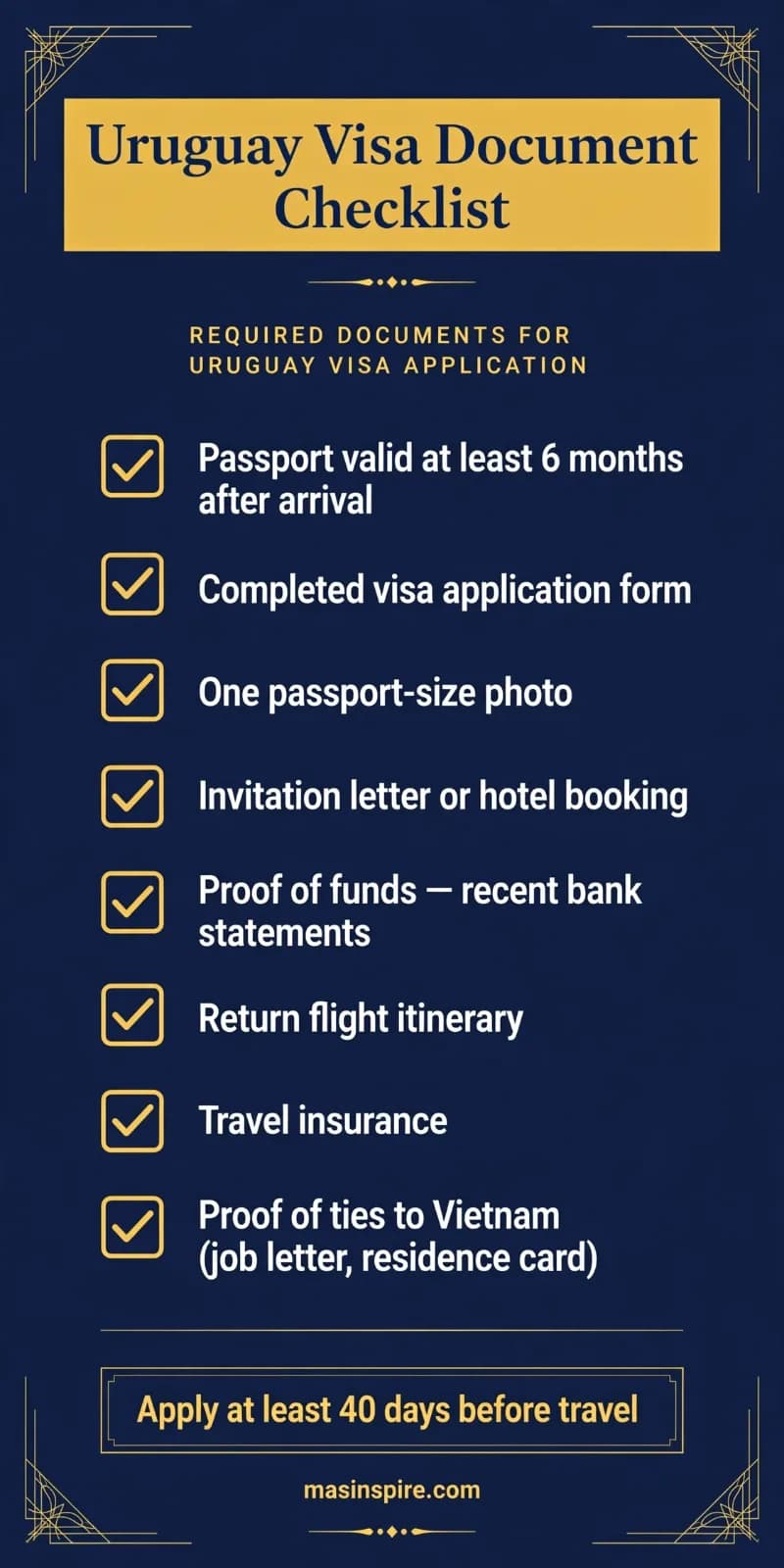
Uruguay does not publish one single global checklist. Each mission publishes its own list, and the lists agree on the core documents and differ on the extras. The checklists below combine the core documents that appear on the official mission pages with the extras that missions commonly ask Pakistani applicants for. Treat the core list as mandatory and the extras as items to have ready. Always confirm the final list with the Hanoi embassy, because its list is the one that decides your case.
Core documents for every applicant: a Pakistani passport valid for at least six months after your planned arrival in Uruguay, in good condition, with at least two blank pages; the completed and signed Uruguay visa application form, downloaded from the mission page or collected from the embassy; one recent passport-size photograph (some missions ask for two, so take two); a cover letter explaining the purpose of your trip, your dates, and your ties to Vietnam; proof of accommodation, which is either a hotel booking for your whole stay or an invitation letter from your host in Uruguay with their full name, address and telephone number; a return or onward flight itinerary (a reservation, not a paid non-refundable ticket, until the visa is granted); proof of sufficient funds, usually bank statements for the last three to six months; and travel insurance covering the whole stay. Some missions also ask for a police clearance certificate, so have one ready.
Tourist checklist: all core documents, plus a day-by-day travel plan for Uruguay (Montevideo, Colonia del Sacramento, Punta del Este, and any other stops), hotel bookings matching the plan, and proof of your ties to Vietnam — your Vietnamese temporary residence card, your employment contract or employer letter from your school or company, and your recent salary slips. The ties documents are the most important part of a tourist application for a Pakistani living in Vietnam, because they answer the question the DNM is really asking: will this person go home? A teacher with a job, a residence card and a return ticket is a much easier approval than a tourist with no ties on paper.
Business checklist: all core documents, plus an invitation letter from the Uruguayan company or organisation, on its letterhead, stating the purpose of the visit, the dates, the meetings planned, and who pays for the trip; a letter from your own employer or business in Vietnam confirming your job, your salary and the business purpose; and your company's business registration if you are self-employed. If the Uruguayan host is paying, its letter should say so explicitly and include evidence that it can pay.
Work checklist: all core documents, plus the signed employment contract from the Uruguayan employer; a letter from the employer explaining the job, the salary and the duration; and any professional certificates or qualifications the job requires. Remember that the work visa is only the entry document — after arrival you have 30 days to file for residence with the DNM, and your employer should be ready to help with that filing.
Study checklist: all core documents, plus the acceptance or enrolment letter from the recognised Uruguayan institution; proof of payment of fees or a payment plan; proof of funds for tuition and living costs for the whole course; and your previous educational certificates. Students should also carry evidence of accommodation in Uruguay, whether university housing or a private rental.
Family reunification checklist: all core documents, plus proof of the relationship to the family member in Uruguay (marriage certificate, birth certificate, or equivalent), legalised or apostilled; proof of the family member's legal residence in Uruguay, such as their residence card or cedula; and proof of the family member's address and means of support. Documents in Urdu must be translated into Spanish or English by a certified translator, and civil documents usually need legalisation or an apostille — ask the embassy which it requires, because the answer varies by document.
Children travelling with you need their own application, their own passport, and the consent of both parents shown at the consulate. If only one parent is travelling with a child, carry the other parent's written consent and a copy of their identity document. This is standard practice at Uruguayan missions, and it is checked.
Document tips that apply to every category: make every copy clear and complete; translate anything not in Spanish or English; keep the originals and the copies in the same order as the embassy's list; and never submit a document you cannot explain. If your bank statement shows a large unexplained deposit, write one sentence in your cover letter explaining it. If your hotel booking is cancellable, say so — the embassy prefers an honest cancellable booking to a fake confirmed one.
How to Apply: Step-by-Step
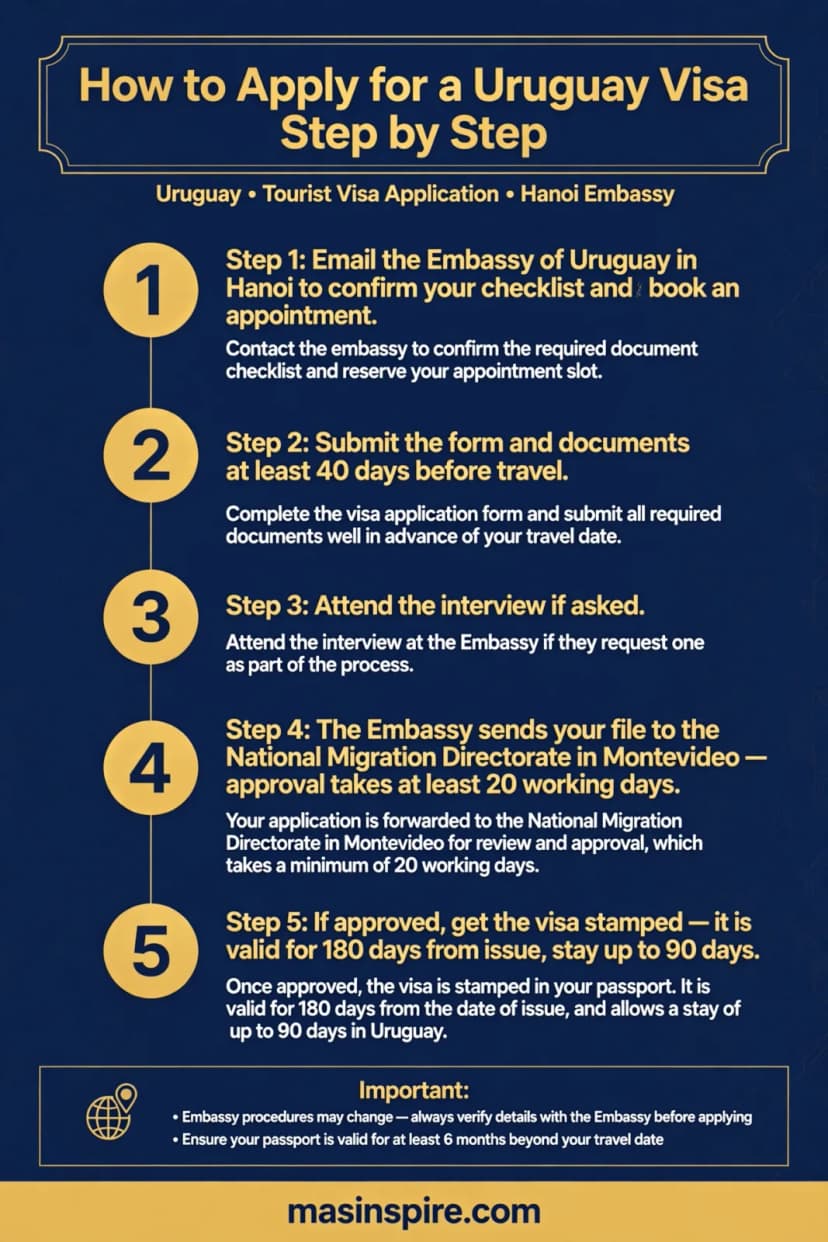
Step 1: Confirm the route by email. Write to the Embassy of Uruguay in Hanoi at uruvietnam@mrree.gub.uy. Introduce yourself as a Pakistani passport holder resident in Vietnam, state the visa type you need and your travel dates, and ask for the current application form, the exact document checklist, the current fee and payment method, and whether the first step is an email submission or an in-person appointment. Keep the reply — it is your controlling source for everything that follows. If you do not get a reply within a week, telephone the embassy on +84 24 3718 8047 during working hours.
Step 2: Gather your documents. Work through the checklist for your visa type in the section above. Get your bank statements stamped by your bank, get your employment letter on your employer's letterhead, book cancellable hotels, and hold a flight reservation without paying for a non-refundable ticket. Start this step at least 60 days before travel.
Step 3: Complete the visa application form. Download the form from the mission page or use the one the embassy sends you. Fill it in completely, in block capitals or typed, and sign it. Every question needs an answer — write "not applicable" where a question does not apply to you, rather than leaving it blank, because a blank looks like a question you forgot.
Step 4: Submit your file and book the appointment. Follow the embassy's instruction: either email the completed form and scanned documents first and wait for an appointment, or attend in person with the originals. Bring originals and one full set of photocopies. Pay the fee only as the embassy instructs, and keep the payment receipt.
Step 5: Attend the interview if you are called. Interviews are held at the embassy, in person or sometimes by video call. Expect questions about the purpose of your trip, your job in Vietnam, your income, your travel history, your host or hotel in Uruguay, and your plans after the trip. Answer briefly, truthfully and consistently with your documents. Do not memorise a script — officers notice it — and do not exaggerate your plans.
Step 6: Wait for the DNM authorisation. The embassy forwards your file to the National Migration Directorate in Montevideo. This is the long step: at least 20 working days, commonly 20 to 30 working days, and up to 60 days in some cases. Do not book non-refundable travel during this wait, and do not telephone the embassy every day — a single polite email after 30 working days is reasonable if you have heard nothing.
Step 7: Get the visa stamped and check it. When the embassy tells you the visa is approved, take your passport in for stamping. Check the sticker before you leave: your full name as in your passport, the passport number, the validity dates, and the number of entries. Ask the embassy to confirm in writing the last date by which you must enter Uruguay, because of the validity conflict described earlier in this guide.
Step 8: Prepare for arrival. Carry the same documents you used for the application in your hand luggage — passport, visa, return ticket, hotel bookings or invitation letter, travel insurance, and proof of funds. Immigration officers at Carrasco International Airport can ask for them, and the visa in your passport is permission to travel to the border, not a guarantee of entry. The officer at the border makes the final decision.
Applying from Vietnam: The Hanoi Embassy
The good news first: Uruguay has a resident embassy in Hanoi, opened in 2011, and Vietnam and Uruguay have had diplomatic relations since 11 August 1993. A Pakistani living in Vietnam applies in Vietnam — there is no need to send a passport abroad, and no need to use a third-country mission. The embassy's email is uruvietnam@mrree.gub.uy, and that email address is the most reliable contact detail in this guide, because it appears consistently across the directories. Use email as your first contact, and keep every reply.
The embassy's street address is an open conflict in this guide, and you must check it before you travel to Hanoi. Older directories, including a Hanoi embassy listing verified in November 2024, give 407 Au Co Street, Tay Ho District, Hanoi, with telephone +84 24 3718 8047 and fax +84 24 3718 8049. A 2026 list of embassies in Hanoi gives a different address: 61 Ly Thuong Kiet Street, Cua Nam Ward. A second telephone number, +84 24 3718 5747, also appears in one directory. This guide lists both addresses and both numbers and tells you plainly that they conflict — do not travel to either address without confirming it by email first, and do not be surprised if the embassy has moved. Embassies in Hanoi do move, and directory pages go stale.
Uruguay also has an Honorary Consulate in Ho Chi Minh City, opened on Hai Ba Trung Street in District 1 in January 2016. An honorary consulate is not the same as an embassy: it promotes trade and helps with general enquiries, but it normally cannot issue visas. If you live in Ho Chi Minh City, the honorary consulate may be able to point you to the right person in Hanoi, but do not assume it can take your visa application. Confirm with Hanoi whether any part of the process can be done in Ho Chi Minh City — as of this guide's check, no such arrangement is published.
Applying from Vietnam has one practical advantage beyond the embassy's location: your Vietnamese residence is itself strong evidence for your application. Your temporary residence card, your work permit or employment contract, your salary slips and your Vietnamese bank statements all show that you live lawfully in Vietnam and have a life to return to. Include them. The DNM is far more interested in your ties to Vietnam than in your ties to Pakistan, because Vietnam is where you will return to after the trip.
If you are in Pakistan rather than Vietnam when you apply, the route is different and harder: Uruguay has no mission in Pakistan. Pakistani applicants in Pakistan have historically applied through the Uruguayan embassy in New Delhi, or through missions in Tehran, Riyadh or Abu Dhabi, depending on the case — and the correct mission depends on consular jurisdiction, which only the Uruguayan Foreign Ministry can confirm. If you are reading this guide from Pakistan, email the Hanoi embassy anyway if you hold Vietnamese residence, or email the Uruguayan Foreign Ministry's consular map service at mapaconsular.mrree.gub.uy to find which mission covers Pakistan. Do not pay any agent who claims to be the only route.
There is no visa application centre for Uruguay in Vietnam and no online portal. You deal directly with the embassy. That is slower than an online system, but it is also cheaper — there is no service fee on top of the visa fee — and it means the person who answers your email is the person who will handle your file.
If your Spanish is limited, write to the embassy in English and keep your sentences short and clear. Uruguayan missions work in Spanish and English, and a short, precise email in English will be understood. Do not use machine translation for your cover letter or your documents without reading the result carefully — a mistranslated job title or date creates exactly the kind of inconsistency that slows an application down. If a document needs a certified translation, use a certified translator in Hanoi or Ho Chi Minh City and keep the translator's stamp and contact details with the translation.
Student Route: Studying in Uruguay
Uruguay's public university, the University of the Republic (Universidad de la Republica) in Montevideo, is free for students, including foreign students, and it is the main reason a Pakistani student would consider Uruguay. Private universities charge fees. Either way, the visa route is the same: a study visa from the Hanoi embassy, with prior DNM authorisation, followed by a residence filing within 30 days of arrival.
You will need the acceptance or enrolment letter from the institution, proof of funds for the course and your living costs, your previous educational certificates (your BA degree and transcripts, translated and legalised as the embassy requires), and the core documents in the checklist section. There is no published minimum funds figure for students, and no published student-specific fee — the standard consular fee applies. Start early: university semesters in Uruguay generally begin in March and August, and a visa process that takes 20 to 60 working days does not fit a last-minute admission.
Spanish is the language of instruction at almost every Uruguayan institution. If your course is in Spanish, evidence of Spanish ability strengthens your application, even though no official page publishes a language requirement for the study visa. If your course is in English, carry the institution's written confirmation that the course is taught in English. Do not claim Spanish ability you do not have — the interview may be conducted partly in Spanish, and an interpreter is your right if you need one.
Students should note the work rule: a study visa is for study, not for employment. Part-time work rights depend on your residence status after arrival, and you should confirm them with the DNM when you file for residence. Do not plan your finances around a Uruguayan part-time job that you have not confirmed in writing.
Work Route: Jobs, Business and Work Permits
A Uruguay work visa starts with a job, not with a visa application. You need a signed employment contract from a Uruguayan employer before the embassy can do anything for you. There is no Uruguay job-seeker visa, and there is no published route for arriving in Uruguay to look for work. If an agent offers you a Uruguay work visa without an employer, that is not a real route.
Once you have the contract, the route is the work visa from the Hanoi embassy, with DNM authorisation, and then a residence filing within 30 days of arrival. Your employer should be involved in the residence filing, because it usually requires the employer's registration and documents as well as yours. Ask your employer before you travel who will handle the filing and what it costs — there is no published fee for the residence filing in the sources used for this guide, and you should not discover the cost after you arrive.
Business visitors are different from workers. A business visa lets you attend meetings, negotiate, invest and go to conferences, but it does not let you take a job with a Uruguayan employer. If you are invited to Uruguay to discuss a job, a business visa is the right category for the discussion trip, and the work visa follows only after a contract is signed. Do not work on a business visa, and do not attend a job interview on a tourist visa and then start work — the categories are enforced.
One route that deserves a clear warning is the digital nomad permit. Uruguay has a genuine remote-work permit, the Hoja de Identidad Provisoria in the digital nomad category, created by Decree 238/022 in 2022. It lasts up to 180 days and can be renewed once for a further 180 days, so up to 360 days in total. There is no minimum income threshold — you sign a sworn declaration that you work remotely for clients or an employer outside Uruguay and that you can support yourself. The fee is 55.71 Unidades Indexadas, which is a small amount, though published reports of the dollar figure vary from under USD 10 to about USD 34, and this guide does not present any single dollar figure as verified. The critical point for a Pakistani reader is that the permit is not a visa: it is applied for online only from inside Uruguay, after a lawful entry, and the fee cannot be paid from abroad. You still need the entry visa from Hanoi first. The permit also does not allow employment on a Uruguayan payroll — only remote work for employers or clients outside Uruguay. It does not lead to residence by itself, and after the single renewal you must either leave or apply for an ordinary residence category. If you work online for foreign clients and want a year in Uruguay, this is a real and unusually cheap route — but only after the entry visa.
Family Visits and Permanent Residence
Visiting family in Uruguay is covered by the tourist visa if the visit is short, and by the family reunification visa if you are joining a close family member to live with them. For a short visit, an invitation letter from your family member in Uruguay — with their full name, address, telephone number, residence status and the relationship to you — plus your own proof of funds and ties to Vietnam, is the core of the application. For reunification, you need the legalised proof of relationship and proof of the family member's legal residence, as set out in the checklists section.
Uruguay is unusual in that a foreigner can apply for permanent residence directly, without first holding temporary residence for years, and citizenship is possible after five years of residence, or three years if you have a family established in the country. Those are the published outlines, not a step-by-step process, and this guide does not present them as a simple path: permanent residence applications are filed with the DNM in Montevideo, they require criminal record certificates, proof of means and health documents, and the timelines are not published. If permanent residence is your goal, treat the tourist or family visa as the first step and get proper advice in Montevideo after arrival — do not plan your life around a timeline no official page publishes.
Pakistan has an honorary consulate in Montevideo, at Parana 736, which can be a useful contact point if you need help while you are in Uruguay. It is an honorary consulate, not an embassy, so its services are limited — but knowing it exists before you travel is better than discovering it in an emergency.
Transit Through Uruguay and Neighbouring Countries
There is no direct flight from Vietnam to Uruguay. Every route connects, usually through Doha, Dubai, Istanbul, Paris, Frankfurt, Amsterdam or Sao Paulo, and many travellers arrive in Montevideo's Carrasco International Airport after a connection in Sao Paulo or Buenos Aires. That makes transit rules important, and this is the section where this guide is most careful, because the published information is thin.
Uruguay's seven consular visa types under Decree 356/018 do not include a separate transit visa category. No official page found for this guide publishes a transit-visa checklist, fee or processing time for Uruguay. That does not mean transit without a visa is allowed — it means the question is unpublished, and you must ask the Hanoi embassy in writing before booking any itinerary that connects through Montevideo. Do not assume that staying airside, or that a short layover, exempts you from the visa requirement. If your connection is through Sao Paulo, check Brazil's transit rules for Pakistani passport holders separately; if it is through Buenos Aires, check Argentina's rules separately, and remember that the Buquebus ferry between Buenos Aires and Montevideo is a popular route that involves two border crossings, not one.
One practical point: if you plan to visit both Uruguay and Argentina, or Uruguay and Brazil, on one trip, apply for each country's visa separately and carry both. A Uruguay visa does not give you entry to Argentina or Brazil, and an Argentina visa does not give you entry to Uruguay. Each border is a fresh decision by that country's immigration officer.
Common Mistakes to Avoid
The most common mistake is applying too late. The DNM authorisation takes at least 20 working days, missions advise applying at least 40 days before travel, and some advise 50 days. An application submitted three weeks before a flight is not a brave application — it is a refused-by-calendar application, and the embassy cannot speed up Montevideo. Start 60 days before travel.
The second mistake is paying for a non-refundable ticket before the visa is granted. Book a cancellable hotel and hold a flight reservation. A paid ticket does not strengthen your application — it weakens your finances if the visa is refused, and it puts pressure on you to travel on dates the visa may not cover.
The third mistake is a weak cover letter, or no cover letter at all. Your cover letter is the one place where you explain, in your own words, why you are going, what you will do, and why you will return to Vietnam. One page is enough. Say what your job is, how long you have held it, what you earn, where you will stay, and what ties you to Vietnam. An application with no story is an application the officer has to guess about, and officers do not guess in your favour.
The fourth mistake is unexplained money. A bank statement with a sudden large deposit and no explanation is the single most damaging document in a visa file. If the money is genuine — a salary bonus, a sale, a family gift — write one sentence explaining it and attach the evidence. If the money is borrowed for the application, do not submit it that way: the pattern of the statements matters more than the final balance, and a borrowed balance is easy to spot.
The fifth mistake is using the wrong fee figure. This guide reports about USD 54 as the fee current missions publish, with USD 42 as the older central-page figure. Do not pay USD 42 because an old page said so, and do not pay any other figure an agent quotes you. Get Hanoi's fee in writing, pay exactly that, by the method the embassy instructs, and keep the receipt.
The sixth mistake is assuming a US, UK, Schengen or Gulf visa exempts you. It does not, for a Pakistani passport holder. Uruguay's exemptions for holders of other visas apply to a small list of nationalities that does not include Pakistan. Apply for the Uruguay visa itself.
The seventh mistake is forgetting the 30-day residence deadline on work, study and family visas. The visa gets you into Uruguay; the residence filing keeps you there legally. Put the deadline in your diary on the day you land, and ask your employer, university or family member to help you file it.
The eighth mistake is overstaying. A tourist stay is 90 days, extendable once by 90 days, and the extension must be filed with the DNM at least 15 days before your stay expires. The in-time extension fee is UI 225.60 (about USD 37); once the stay has lapsed, the fee rises to UI 345 (about USD 57), and you are in overstay territory with consequences for future visas. File early, in person, at the DNM in Montevideo, and keep the receipt.
Reasons for Refusal and What to Do Next
Uruguay does not publish refusal statistics or a list of refusal reasons, so this section is based on how the consular system works and on the reasons that commonly cause refusals for this kind of visa. The most common reason is weak ties to the country of residence — an applicant who cannot show a job, a residence card, income or a reason to return to Vietnam. The second is insufficient or unexplained funds. The third is an unclear purpose of travel — a tourist application with no plan, no hotel and no host. The fourth is inconsistent information between the form, the cover letter and the supporting documents. The fifth is a previous overstay or visa problem in any country, which the DNM can see from your travel history.
No published appeal route for a refused Uruguay consular visa was found for this guide. That does not mean a refusal is final forever — it means there is no published appeal form or tribunal to apply to. The practical route after a refusal is to find out the reason, fix it, and reapply with a stronger file. Ask the embassy politely, in writing, for the reason for the refusal. If the reason was funds, wait until your statements show a genuine pattern and reapply. If the reason was ties to Vietnam, wait until your employment and residence are stronger. If the reason was an unclear purpose, rewrite the cover letter and the travel plan properly. Do not reapply the next day with the same file and hope for a different officer — the DNM keeps records, and a second identical application is likely to get the same answer.
If you believe the refusal was based on a factual error — a wrong date, a misread document — write to the embassy pointing out the error calmly, with the evidence attached, and ask for the file to be reviewed. Keep every email, receipt and letter. And remember that a refusal of a Uruguay visa does not automatically affect other visa applications, but you must declare it honestly if another country's form asks whether you have ever been refused a visa. Lying about a refusal is a far worse problem than the refusal itself.
Frequently Asked Questions
Do Pakistani passport holders need a visa for Uruguay?
Yes. Pakistani ordinary passport holders need a consular visa with prior authorisation from the National Migration Directorate in Montevideo, for any stay, even a short tourist visit. There is no visa-free entry, no visa on arrival and no eVisa for Pakistanis.
Where do I apply for a Uruguay visa from Vietnam?
At the Embassy of Uruguay in Hanoi. Email uruvietnam@mrree.gub.uy first to confirm the current form, checklist, fee and appointment process. Uruguay also has an Honorary Consulate in Ho Chi Minh City, but it normally cannot issue visas — confirm with Hanoi whether any step can be done there.
How much is the Uruguay visa fee for Pakistanis?
About USD 54, according to the fee published by current Uruguayan missions in Guangzhou, Pretoria and Stockholm, and the equivalent amounts in Sydney (AUD 84) and Hong Kong (HKD 423). The older central procedures page on gub.uy lists USD 42 (3 consular pesos), last updated in 2020. Confirm the exact fee, currency and payment method with the Hanoi embassy in writing before paying, because the two figures conflict and the fee changes every 1 January.
How long does a Uruguay visa take to process?
Authorisation by the National Migration Directorate usually takes at least 20 working days, commonly 20 to 30 working days, and up to 60 days in some cases. Missions advise submitting the application at least 40 days before travel, and Guangzhou advises 50 days. Start 60 days before your flight.
How long can I stay in Uruguay on a tourist visa?
Up to 90 days, extendable once for a further 90 days inside Uruguay, making a maximum of 180 days. File the extension with the DNM at least 15 days before your stay expires. The visa itself is valid for 180 days from the date it is issued, under Decree 356/018, though an older official form gives a 60-day reading — confirm the validity printed on your visa with the Hanoi embassy.
Is there an eVisa or visa on arrival for Uruguay?
No. Uruguay has no eVisa system and no visa on arrival for Pakistani passport holders. You must apply in advance at a Uruguayan embassy or consulate and wait for DNM authorisation before travelling.
Does a US, UK or Schengen visa exempt Pakistanis from the Uruguay visa?
No. Uruguay's exemptions for holders of certain other visas apply only to a small list of nationalities, and Pakistan is not among them. A valid US, UK, Schengen, Canadian or Gulf visa does not waive the Uruguay visa requirement for a Pakistani passport holder.
What documents do I need for a Uruguay tourist visa?
A passport valid at least six months after arrival, the completed application form, a passport-size photo, a cover letter, hotel bookings or an invitation letter from a host in Uruguay, a return flight itinerary, bank statements for the last three to six months, travel insurance, and proof of your ties to Vietnam such as your residence card, employment letter and salary slips. Confirm the final list with the Hanoi embassy.
Can I extend my stay in Uruguay?
Yes, once, for a further 90 days, by applying to the National Migration Directorate in Montevideo at least 15 days before your stay expires. The fee is UI 225.60 (about USD 37) if filed in time, and UI 345 (about USD 57) if filed after the stay has lapsed.
Do I need yellow fever vaccination for Uruguay?
Uruguay itself does not require yellow fever vaccination for entry, according to the CDC. You do need a yellow fever certificate if you arrive from a country with a risk of yellow fever transmission. If you travel from Pakistan, you also need a polio vaccination certificate from NADRA to leave Pakistan.
Can I work in Uruguay on a tourist or business visa?
No. A tourist visa is for visiting, and a business visa is for meetings, negotiations and conferences. Neither allows local employment. To work in Uruguay you need a work visa based on a signed employment contract, and you must file for residence within 30 days of arrival.
What is the Uruguay digital nomad permit, and can Pakistanis use it?
It is the Hoja de Identidad Provisoria in the digital nomad category, for people who work remotely for employers or clients outside Uruguay. It lasts up to 180 days, renewable once for a further 180 days, with no minimum income threshold and a small fee of 55.71 Unidades Indexadas. But it is not a visa: you apply online only from inside Uruguay after a lawful entry, so a Pakistani passport holder still needs the entry visa from Hanoi first, and the permit does not allow work for a Uruguayan employer.
Do I need a transit visa to connect through Montevideo?
No separate transit visa category is published among Uruguay's seven consular visa types, and no transit checklist or fee is published. Ask the Hanoi embassy in writing before booking any itinerary that connects through Montevideo, and check the transit rules of every other country on your route, such as Brazil or Argentina, separately.
What happens if my Uruguay visa is refused?
No published appeal route was found for this guide. Ask the embassy in writing for the reason, fix the problem — usually funds, ties to Vietnam or an unclear purpose of travel — and reapply with a stronger file. Do not reapply immediately with the same documents. Always declare a past refusal honestly if another country's visa form asks about it.
Is Uruguay safe for visitors?
Uruguay is generally stable and orderly, but the United States Department of State raised its advisory to Level 2, Exercise Increased Caution, on 13 August 2026, because of crime, including armed robbery and carjacking, concentrated in Montevideo, Canelones, Maldonado and Rivera. Take normal big-city precautions, avoid poorly lit areas at night, and keep valuables out of sight. The advisory is a caution, not a travel ban.
Official Websites
| Source | Website |
|---|---|
| Uruguay Ministry of Foreign Affairs — Consulate General in Guangzhou, visa pages (official) | https://www.gub.uy/ministerio-relaciones-exteriores/en/consulate-general-in-guangzhou/consular-services/visas |
| Uruguay Ministry of Foreign Affairs — Consulate General in Sydney, visa pages (official) | https://www.gub.uy/ministerio-relaciones-exteriores/en/consulate-general-of-the-oriental-republic-of-uruguay-in-sydney/tramites-servicios/visas |
| Uruguay Ministry of Foreign Affairs — Embassy in Pretoria, tourist visa (official) | https://www.gub.uy/ministerio-relaciones-exteriores/en/embassy-uruguay-south-africa/consular-section/tourist-visa |
| Uruguay Ministry of Foreign Affairs — Consulate General in Hong Kong, visa pages (official) | https://www.gub.uy/ministerio-relaciones-exteriores/en/consulate-general-of-the-oriental-republic-of-uruguay-in-hong-kong/consular-services/visas |
| Uruguay Ministry of Foreign Affairs — Embassy in Sweden, business visa (official) | https://www.gub.uy/ministerio-relaciones-exteriores/en/embassy-of-uruguay-in-sweden/business-visa |
| United States Department of State — Uruguay travel advisory and country information (issued 13 August 2026) | https://travel.state.gov/content/travel/en/international-travel/International-Travel-Country-Information-Pages/Uruguay.html |
| Embassy of Uruguay in Hanoi — address, telephone and email directory listing | https://eta-travel.it.com/embassy/uruguayan-embassy-in-hanoi-vietnam/ |
| Uruguay–Vietnam relations — embassy history and resident missions | https://en.wikipedia.org/wiki/Uruguay%E2%80%93Vietnam_relations |
| List of diplomatic missions of Uruguay — Hanoi embassy jurisdiction | https://en.wikipedia.org/wiki/List_of_diplomatic_missions_of_Uruguay |
| Uruguay consulate opens in Ho Chi Minh City — VietnamNet (January 2016) | https://vietnamnet.vn/en/uruguay-consulate-opens-in-hcm-city-E171223.html |
| United States CDC — health advice for Uruguay (yellow fever and routine vaccines) | https://www.southamerica.travel/uruguay/travel-info/staying-healthy/ |
| Uruguay visa rules for Pakistanis — fee, prior authorisation and 20 working days (checked 19 November 2026) | https://www.urdupoint.com/travel/visa/uruguay.html |
| Uruguay visa types, 90 plus 90 day stays and extension fees — Decree 356/018 (verified 27 October 2026) | https://latamthread.com/country/uruguay/guide/immigration/visas-and-business-visitors/ |
| Uruguay digital nomad permit — Hoja de Identidad Provisoria, 180 plus 180 days | https://www.nomadzine.com/visa/uruguay |
Final Checklist and Conclusion
Before you apply, run through this final checklist. You have emailed the Hanoi embassy and kept its reply with the current form, checklist, fee and appointment method. Your passport is valid for at least six months after arrival and has two blank pages. Your cover letter explains your purpose, your dates and your ties to Vietnam in one page. Your hotel bookings are cancellable and match your travel plan. Your flight itinerary is a reservation, not a non-refundable ticket. Your bank statements show a genuine pattern of income. Your travel insurance covers the whole stay. You have started at least 60 days before travel, with the complete file at the embassy at least 40 days before your flight. And you have confirmed the fee in writing, because the published figures disagree.
Uruguay rewards the traveller who plans properly. It is not a country you can visit on a whim from Vietnam — the consular visa, the DNM authorisation and the 20 to 60 working days of waiting see to that — but it is a country with clear written rules, a resident embassy in Hanoi, and a straightforward process for an applicant who is honest, organised and early. The hardest part of the whole trip is the wait in step six. Everything else is paperwork, and paperwork is a skill you already have.
This guide was checked on 29 November 2026 against the official Uruguayan government portal (gub.uy) mission pages in Guangzhou, Sydney, Pretoria, Hong Kong and Stockholm, the United States Department of State Uruguay advisory issued on 13 August 2026, the CDC health guidance for Uruguay, and the published readings of Decree 356/018 and Decree 238/022. Where those sources disagreed — on the visa fee, on the validity period of the visa, and on the Hanoi embassy's street address — this guide has said so in the open and named the source it followed, and it tells you to confirm the live figure with the Embassy of Uruguay in Hanoi before paying or booking. Rules change, fees change every 1 January, and no guide can replace the embassy's written word for your own application. The immigration officer at the border makes the final decision on entry, and this guide does not guarantee visa approval or entry into Uruguay.


