


Uganda Visa Guide 2026: Types, Requirements, Documents and Application Steps
Uganda is the East African country of mountain gorillas, the source of the Nile, Lake Victoria and wide savanna parks, and it is one of the most rewarding trips a Pakistani traveller can plan from Vietnam. It is also a trip that needs careful paperwork, because Uganda does not hand out visas at the airport to Pakistani passport holders. Every visa must be arranged online before you travel, and the approval letter you receive by email is the document that gets you through the border at Entebbe International Airport. This guide explains the whole process for a Pakistani passport holder living in Vietnam: which visa to choose, what it costs, which documents to prepare, how long it takes, how long you can stay, and what to do if something goes wrong. It was written for readers who will apply from Ho Chi Minh City or Hanoi, pay with a card issued in Vietnam or Pakistan, and fly to Uganda through a hub such as Dubai, Doha, Addis Ababa or Nairobi. Fees, stay lengths and processing times are given only where an official Ugandan source or a named secondary source publishes them, and every place where sources disagree is flagged in the text so you can check the controlling source yourself before you pay or book.
1. Do Pakistanis Need a Visa for Uganda?
Yes. A Pakistani ordinary passport holder needs a visa to enter Uganda, and the visa must be obtained online before travel. Pakistan is not on Uganda's list of visa-exempt nationalities. That list is dominated by East African Community member states such as Kenya, Tanzania, Rwanda, Burundi, South Sudan and the Democratic Republic of Congo, plus a group of other African countries and a small number of non-African states and territories including Ireland, Cyprus, Malta, Singapore, Malaysia, Hong Kong and the United Arab Emirates, following an expansion reported in March 2026. Pakistan is not among them, and no separate visa-free arrangement for Pakistani ordinary passports was found in any official Ugandan source checked for this guide. The rule applies whether you live in Pakistan or in Vietnam: it is your passport, not your place of residence, that decides whether you need a visa. Living in Vietnam changes where you apply from and which flights you take, but it does not change the visa requirement itself, and it does not give you access to any Vietnamese passport privilege. Your Vietnamese temporary residence card is useful as proof of where you live and as a document for your return to Vietnam, but it is not a substitute for a Uganda visa.
Uganda's Directorate of Citizenship and Immigration Control states in its official guidance that all persons intending to travel to Uganda for holiday, tourism, business, study, a family visit or medical treatment are required to apply for and obtain a visa online. The application is made through the official e-visa portal, visas.immigration.go.ug, and the outcome is an approval letter sent by email. You print that letter and present it on arrival, where an immigration officer checks it, captures your fingerprints and photograph, and issues the visa itself. The approval letter is therefore not the visa, and the visa is not guaranteed until the officer at the border is satisfied. This two-step design confuses some first-time travellers, so it is worth stating plainly: the online approval lets you board the plane and present yourself at the border, and the officer at the border makes the final decision on entry.
There is no visa on arrival for Pakistani passport holders. Older travel articles and some safari company pages still describe paying for a visa at Entebbe International Airport, but Uganda's immigration authority has said plainly that no visas are issued on arrival, and its current guidance directs all visa-required travellers to the online portal. A small number of recent commercial pages continue to claim that a visa on arrival is available for most nationalities. That claim conflicts with the official position, and the official position controls: plan on the basis that you must hold an approval letter before you leave Vietnam, and treat any promise of a visa at the airport as unreliable. The same caution applies to anyone who offers to arrange a visa for you in Vietnam for a large fee. There is no authorised Uganda visa centre in Vietnam that this guide could verify, and no visa application centre or outsourcing partner is named on the official portal for applicants in Vietnam. The normal route is the online portal, completed by you, from your own home.
If you hold a second passport, the rules for that passport apply when you travel on it, so check the requirement for the passport you will actually carry. If you hold a diplomatic or official passport, different arrangements may apply, and you should confirm them with the nearest Ugandan mission in writing. This guide covers ordinary Pakistani passports only. Children travelling on their own Pakistani passport need their own visa and their own approval letter. Finally, remember that a Uganda visa does not give you the right to enter Kenya, Rwanda or any other country, and a Kenyan or Rwandan visa does not give you the right to enter Uganda. The only exception is the East Africa Tourist Visa, which is a single joint visa for the three countries and is explained in section 4.
2. Uganda Visa at a Glance
This section gathers the key facts in one place so you can plan quickly, and the sections that follow explain each fact in detail, including where sources disagree. A Pakistani ordinary passport holder needs an e-visa obtained online before travel from visas.immigration.go.ug. The standard single-entry tourist visa costs USD 50, and the East Africa Tourist Visa covering Uganda, Kenya and Rwanda costs USD 100. A multiple-entry visa costs USD 100 for six to twelve months under the official fee schedule. The approval for a single-entry visa is valid for 90 days from the date it is issued, and the stay granted on entry can be up to 90 days. Processing usually takes two to three working days according to Uganda's immigration authority, although other published estimates run to five working days and the East Africa Tourist Visa can take longer. The passport you travel on must be valid for at least six months after your date of arrival in Uganda, and you should have at least one blank page for the entry stamp. There is no visa on arrival. The initial stay can be extended by a further 60 days in two intervals, while the East Africa Tourist Visa cannot be extended.
| Item | What applies to Pakistani passport holders |
|---|---|
| Visa required? | Yes, e-visa before travel; Pakistan is not visa-exempt |
| Where to apply | Online only, at visas.immigration.go.ug |
| Single-entry tourist visa fee | USD 50 (plus card payment charges) |
| East Africa Tourist Visa fee | USD 100, 90 days, multiple entry across Uganda, Kenya and Rwanda |
| Multiple-entry visa, 6 to 12 months | USD 100 under the official fee schedule |
| Transit visa fee | USD 50 under the official fee schedule; stay up to 7 days |
| Approval validity | 90 days from the date of issue; use it or apply again |
| Maximum stay, tourist visa | Up to 90 days, as granted at the border |
| Processing time | Usually 2 to 3 working days; apply at least 10 days before travel |
| Extension | Single-entry stay extendable by 60 days in two intervals; East Africa Tourist Visa not extendable |
| Passport validity | At least 6 months after arrival, plus at least one blank page |
| Visa on arrival | No; do not travel without an approval letter |
| Yellow fever certificate | No longer mandatory for entry since 2 October 2026; vaccination still recommended |
| Main airport | Entebbe International Airport, about 40 kilometres from Kampala |

3. Types of Uganda Visas for Pakistani Passport Holders
Uganda's e-visa portal offers several visa categories, and choosing the wrong one is one of the most common reasons for delay. The categories most relevant to a Pakistani traveller are the single-entry tourist visa, the East Africa Tourist Visa, the multiple-entry visa, the transit visa, the business visa, the family visit visa and the student pass. Work and residence permits are separate categories handled through a different process, and they are covered in section 14. Each category has its own fee, its own supporting documents and its own conditions, and the portal will ask you to select the category before it shows you the document list. Choose the category that matches the real main purpose of your trip, not the cheapest one, because an immigration officer who finds a tourist visa holder attending business meetings or starting a job can refuse entry or cancel the visa.
The single-entry tourist visa, sometimes called the ordinary visa, is the standard choice for a holiday, a safari or a short family visit to Uganda only. It costs USD 50, it is valid for a single entry, and the stay granted can be up to 90 days. The approval letter is valid for 90 days from issue, so you must enter within that window. Once you leave Uganda, the visa is used up, even if days remain on the stay you were granted. A day trip across the border into Kenya or Rwanda therefore ends a single-entry visa, and you would need a new approval to come back. That is the single most misunderstood rule in this guide, and it is the reason the East Africa Tourist Visa exists. If your trip stays inside Uganda, the single-entry visa is the cheapest and simplest option, and there is no reason to pay more.
The business visa is also a single-entry visa costing USD 50 under the official fee schedule, and it covers short business meetings, conferences and trade visits. It is not a work visa. The key extra document is an invitation letter from the Ugandan company or organisation you are visiting, and the portal may also ask for the inviting company's registration details. If you are travelling to explore a business opportunity, attend a conference or meet a supplier, apply for the business visa and carry the invitation letter with you. If you are travelling only for tourism, do not apply for a business visa in the hope that it looks more serious; it does not, and the extra document can slow your application. The family visit visa is likewise a single-entry visa at USD 50, for visiting a relative or friend who lives in Uganda. Its key extra document is an invitation letter from your host in Uganda, together with evidence of the host's status in Uganda and the address where you will stay. If you are staying in a hotel rather than with a host, the tourist visa is the right category, and a hotel booking is the document you upload.
The multiple-entry visa is for travellers who need to enter Uganda repeatedly over a longer period, for example a business traveller with several trips in a year. Under the official fee schedule published by the immigration authority, a multiple-entry visa costs USD 100 for six to twelve months, USD 150 for 24 months and USD 200 for 36 months. This category is not issued as a matter of routine to first-time tourists, and the portal or the reviewing officer may ask for supporting records such as previous Uganda visas, evidence of the repeated travel need, and, for the longer versions, police clearance certificates. The transit visa is covered in detail in section 11: it costs USD 50 under the official fee schedule, it allows a stay of up to seven days, and it is for travellers passing through Uganda to a third country. The student pass is for a course of study in Uganda and requires an admission letter from the Ugandan institution; it is not a tourist visa, and its fee is set by category, so confirm the current figure on the portal before you pay, because published secondary sources do not agree on a single student-pass fee and this guide does not invent one.
4. East Africa Tourist Visa: Uganda, Kenya and Rwanda
The East Africa Tourist Visa is a joint tourist visa issued under a regional agreement between Uganda, Kenya and Rwanda, and it is the best option for any Pakistani traveller whose trip crosses from one of those three countries into another. It costs USD 100 per person, it is valid for 90 days from the date of issue, and it allows multiple entries between the three countries during that period. It is for tourism only, it cannot be extended, and it becomes invalid if you leave the three-country area altogether, for example by flying to Tanzania, Ethiopia or the United Arab Emirates, even if days remain on the 90-day validity. Tanzania and Burundi are not part of the scheme, so a side trip to Tanzania needs a separate Tanzanian visa and ends the East Africa Tourist Visa. That last point surprises many travellers who assume that all East African Community members are covered, so check your itinerary country by country before you choose this visa.
The most important rule of the East Africa Tourist Visa is the first-entry rule: you must apply through the country you will enter first, and you must then enter that country first. If you land in Entebbe, apply through Uganda on visas.immigration.go.ug. If you land in Nairobi, apply through Kenya. If you land in Kigali, apply through Rwanda. An East Africa Tourist Visa issued by Uganda will not help you if your first landing is in Nairobi, and an immigration officer can refuse to honour it. For a Pakistani traveller flying from Vietnam, the usual routing is through a Gulf hub to Entebbe, so Uganda is normally the issuing country and the first entry. If your itinerary starts in Kenya, for example a safari in the Maasai Mara followed by gorilla trekking in Bwindi, apply through Kenya instead, and make sure the Kenyan-issued visa is the one you travel on. Whichever country issues it, the fee is the same USD 100, and the conditions are the same.
5. Visa Fees in 2026
All Uganda visa fees are charged in United States dollars, and the fee is non-refundable, even if your application is refused. That rule makes accuracy important: a refused application costs you the fee and the time, and you must pay again if you reapply. The official fee schedule published by the Directorate of Citizenship and Immigration Control, as reported from the immigration authority's own pages, is set out in the table below. These are the figures to budget on, and they are the figures the portal will show you at checkout. If the portal shows a different figure when you apply, the portal figure is the one that applies, and you should not pay any other amount to any other website.
| Visa type | Fee (USD) | Entries and validity |
|---|---|---|
| Single-entry tourist visa | 50 | Single entry; approval valid 90 days; stay up to 90 days |
| Business visa | 50 | Single entry; stay up to 90 days |
| Family visit visa | 50 | Single entry; stay up to 90 days |
| East Africa Tourist Visa | 100 | Multiple entry across Uganda, Kenya and Rwanda; 90 days; not extendable |
| Multiple-entry visa, 6 to 12 months | 100 | Multiple entry; requires evidence of repeated travel |
| Multiple-entry visa, 24 months | 150 | Multiple entry; see the conflict note below |
| Multiple-entry visa, 36 months | 200 | Multiple entry; see the conflict note below |
| Transit visa | 50 | Stay up to 7 days; see the conflict note below |
| Student pass | Not published as a single figure | Fee set by category; confirm on the portal before paying |
Two fee figures in this table carry a published conflict, and this guide discloses both rather than picking one silently. The first concerns the 24-month multiple-entry visa. The official fee schedule as reported in November 2026 lists USD 150 for 24 months and USD 200 for 36 months. Several secondary sources, including safari and visa guide sites, list USD 200 for a 24-month multiple-entry visa, and one lists USD 200 for 24 to 36 months as a single band. The controlling source is the fee schedule shown on the official portal at the moment you apply, and you should read the figure the portal shows for the exact validity you select before you pay. The second conflict concerns the transit visa. The official fee schedule lists the transit visa at USD 50, and most secondary sources agree, but at least one published guide lists USD 30 for transit. Again, the portal figure at checkout controls. The transit fee matters less to most readers than the tourist fee, because few Pakistani travellers from Vietnam will need a transit visa, but the conflict is recorded here so that a reader who sees USD 30 quoted elsewhere is not surprised.
On top of the government fee, the portal adds a small card payment charge. Published reports describe this as a 3 percent surcharge on online card payments, and some reports describe a USD 1.50 administration charge on a USD 50 visa, which is consistent with a 3 percent charge. Your bank in Vietnam or Pakistan may also add its own foreign-currency or cross-border fee, and the exchange rate applied will be your bank's rate on the day of payment, not the rate shown on a travel website. A single-entry tourist visa therefore costs USD 50 plus roughly USD 1.50 in portal charges, plus whatever your own bank adds, so budget about USD 52 to USD 55 in total for the visa itself, and about USD 103 to USD 106 for an East Africa Tourist Visa.
The gorilla permit is not a visa fee, but it is the largest single cost of most Uganda trips, so it belongs in any honest budget. A standard gorilla trekking permit for a foreign non-resident costs USD 800 per person under the Uganda Wildlife Authority tariff in force since July 2024, with a reduced rate of USD 600 in the low-season months of April, May and November, and a reduced rate of USD 700 for foreign residents. The permit is for one trek, one hour with a habituated gorilla family, and it must be booked for a named person, date and sector of Bwindi Impenetrable National Park or Mgahinga Gorilla National Park. Since 1 March 2026 the Uganda Wildlife Authority has required full payment at the time of booking to confirm a permit. Confirm the exact permit price for your trek date with the Uganda Wildlife Authority or your licensed tour operator before paying, because tariffs are revised from period to period. The permit price is separate from the visa fee, and neither one includes the other.
6. How Long Can You Stay? Validity and Extensions
Uganda's visa system uses two different clocks, and confusing them is the most common planning mistake after choosing the wrong visa type. The first clock is the validity of the approval letter: 90 days from the date of issue. The second clock is the length of stay granted when you enter: up to 90 days from your date of entry, as decided by the immigration officer at the border. The approval clock starts when the immigration authority approves your application, not when you apply and not when you travel. If your approval is issued on 1 December, you must enter Uganda on or before about 1 March, and if you do not, the approval is automatically cancelled and you must apply again and pay again. The stay clock starts when you arrive. If you arrive on 15 January and the officer grants you 90 days, you must leave by about 15 April, unless you obtain an extension. The officer can grant a shorter stay than 90 days, so read the stamp or entry endorsement in your passport carefully before you leave the airport, and if the period granted is shorter than you expected, ask the officer to confirm it while you are still at the desk.
The initial period granted at entry for a single-entry visa can be extended for a further 60 days, in two intervals, which several secondary sources describe as two intervals of 30 days each. You can request an extension online through the e-visa portal or in person at the immigration headquarters in Kampala, on Jinja Road, or at a regional immigration office. Apply for an extension at least two weeks before your current stay expires, and do not leave the application to the last day, because an extension is not automatic and the officer reviewing it can ask for documents or refuse it. The total stay, including extensions, can reach about six months, according to published guidance. The fee for an extension is not published as a single figure in the sources checked for this guide, so this guide does not invent one: ask the portal or the immigration office for the current extension fee in writing before you apply, and keep the receipt. The East Africa Tourist Visa is different and cannot be extended at all, once you are in the region or once it expires, so a traveller who wants more than 90 days in the region must plan a different visa route.
Overstaying is treated seriously. Secondary sources report that a traveller who overstays a Uganda visa may be fined USD 30 for each day of overstay and may face detention or deportation, and that an overstay can affect future visa applications. This guide could not verify the USD 30 daily figure against an official Ugandan source, so treat it as a secondary report rather than a confirmed official penalty. What is certain is that overstaying is an offence under Ugandan immigration law, that it can lead to detention and removal, and that it can make a future application harder. If your stay is running out and your extension has not been decided, go to the immigration office in person and ask for written advice rather than simply staying on and hoping. The sensible window is two to four weeks before departure for a single-entry visa, and at least three weeks for an East Africa Tourist Visa.
7. Processing Time: How Long Does a Uganda Visa Take?
Uganda's immigration authority states that a visa application is usually reviewed within two to three working days. That is the figure to plan on, and it is the figure given on the immigration authority's own pages. Other published estimates are longer: several secondary guides say two to five working days, one says five to ten working days, and the East Africa Tourist Visa is reported to take three to fourteen business days because it requires coordination between three countries. These figures do not necessarily contradict each other. A straightforward tourist application with clean documents can be decided in two to three working days, while an application that needs extra verification, a multiple-entry application, or an East Africa Tourist Visa can take longer. The honest summary is that most single-entry tourist applications are decided within two to three working days, that you should allow up to five working days before you start worrying, and that an East Africa Tourist Visa should be allowed up to two weeks. The controlling source for your own application is the portal itself, which will show the status of your file.
Working days in Uganda are normally Monday to Friday, excluding Ugandan public holidays, so an application submitted on a Friday evening may not be looked at until Monday, and an application submitted before a long holiday weekend can sit for several days without any decision. Plan around that. If you apply on a Friday and fly on a Monday, you have not allowed two to three working days at all; you have allowed none. Count working days from the first full working day after you submit, and add a margin for a query. The reviewing officer can ask for an extra document, a clearer scan, or a corrected detail, and the clock effectively pauses while you respond. A common query is a passport scan that is blurred or cropped, a photograph that does not meet the specification, or a tour plan that is too vague. Respond to a query the same day if you can, because a slow response is the most common reason a straightforward application drifts past five working days.
8. Where and How to Apply from Vietnam
For a Pakistani passport holder living in Vietnam, the application route is entirely online, and there is no need to visit an embassy, a consulate or a visa application centre in Vietnam. You apply on visas.immigration.go.ug from your home in Ho Chi Minh City, Hanoi or anywhere else in Vietnam, you pay by card through the portal, and you receive the approval letter by email. There is no authorised Uganda visa centre in Vietnam that this guide could verify, and no in-person appointment, interview or biometrics appointment is required before travel. Your fingerprints and photograph are taken at the border when you arrive in Uganda, not in Vietnam. That is good news for a traveller in Vietnam, because the whole process can be completed without taking time off work or travelling to another city, provided you have a reliable internet connection, a scanner or a good phone camera, and a card that works for international online payments in United States dollars.
The question of the nearest Ugandan mission still matters, because there are times when an online applicant needs human help: a refused application, a lost approval letter, a query the portal cannot answer, or an emergency while in Uganda. Here the position is less tidy than the online route, and this guide says so plainly. Uganda and Vietnam have no resident embassies in each other's capitals: Uganda's president visited Hanoi in November 2022, the two countries signed agreements including a visa exemption for diplomatic and service passport holders, and reporting at the time noted that the two sides had no resident embassies between them, with the nearest Vietnamese embassy to Kampala being in Dar es Salaam. This guide could not verify a current, resident Ugandan embassy or high commission in Vietnam, nor a single named Ugandan mission formally accredited to Vietnam with a published address and telephone number, from the official sources checked. Do not therefore assume that there is a Ugandan embassy in Hanoi or Ho Chi Minh City that you can walk into. The practical route for help before travel is the Directorate of Citizenship and Immigration Control itself, through the contact details published on immigration.go.ug and the portal, and the telephone number published for the directorate in Kampala is +256 417 102 600. Ask for any important answer in writing by email, and keep the reply.
9. How to Apply: Step-by-Step
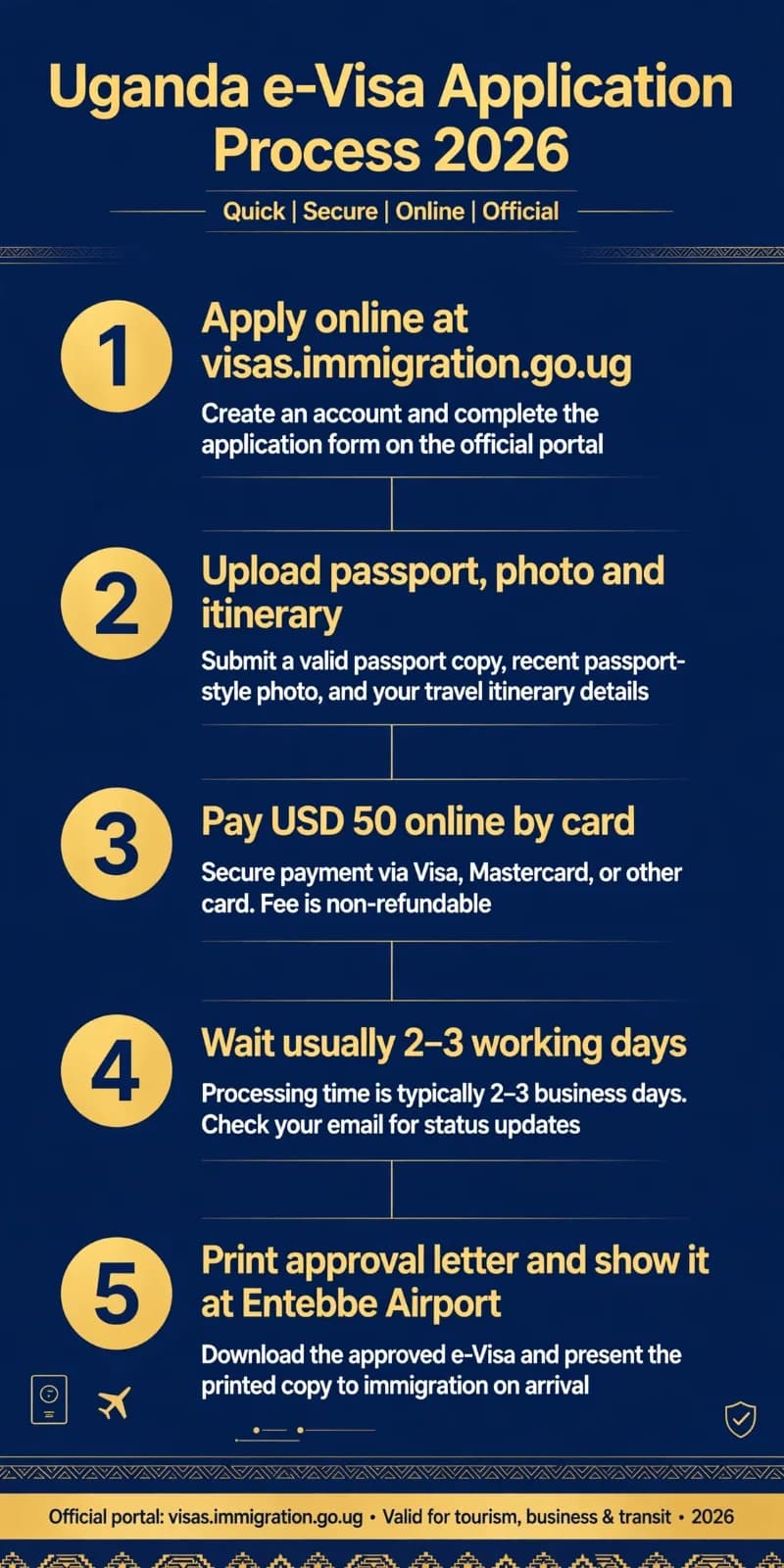
Step one is preparation. Gather every document in section 10 before you open the portal, and scan or photograph each one cleanly. The passport bio-data page must show your photograph, your name, your date of birth, your passport number and the expiry date, and it must not be cut off at the edges or blurred. The passport photograph must be recent, taken against a plain background, and it must look like you now, not like you ten years ago. The tour plan and the travel itinerary should name the places you will visit and the dates, and the hotel booking should name the hotel, the dates and the address. Save each file in the format the portal asks for, and keep the file sizes within the portal's limits. If a file is too large, reduce it with a proper tool rather than photographing a screen, because a photograph of a screen is almost always rejected as unreadable. Check that your passport is valid for at least six months after your arrival date before you start; if it is not, renew it first, because an application made on a short-validity passport will be refused.
Step two is creating an account on the portal. Use an email address that you check every day, because the approval letter, any query and the payment receipt will all go to that address. Use the same email address for the whole application, and do not use an agent's email address, because the approval letter sent to an agent is an approval letter you do not control. Choose a password you will remember, and keep the account details safe. The portal will ask you to select the visa category first, so decide the category before you log in: tourist for a holiday, business for meetings, family visit for staying with a relative, East Africa Tourist Visa for a regional trip, or transit for a short pass through Uganda. If you select the wrong category, the document list will be wrong, and you may have to start again.
Step three is completing the electronic form. Enter your name exactly as it appears on your passport, including the order of your given names and surname, and enter your passport number, date of birth, nationality and place of birth exactly as they appear on the passport. Enter your travel dates, your point of entry, which will usually be Entebbe International Airport, and your address in Uganda, which will usually be your first hotel. Answer every question honestly, including any question about previous visas, previous travel and previous refusals. A wrong date of birth, a transposed passport number or a name spelled differently from the passport are the most common reasons for a delay, and a false statement can lead to a refusal and a record that affects future applications. Check the whole form twice before you submit it, and compare each field against the passport itself rather than against your memory.
Step four is uploading the documents and paying. Upload each document against the correct label on the portal, and check that each upload has actually attached before you move on. A document uploaded against the wrong label can be treated as missing. Pay the fee by card through the portal's payment page, and keep the payment receipt and the application reference number. The fee is non-refundable, so do not pay twice for the same application unless the portal tells you the first payment failed. If the payment page fails, wait, check with your bank whether the payment went through, and log in to the portal to check the application status before you try again. A card issued in Vietnam should work for an international online payment in United States dollars, but tell your bank in advance that you are making an international payment, and make sure the card is enabled for online and cross-border transactions. If your Vietnamese card is refused, a Pakistani card or a second card may work, but do not use a card belonging to another person without their permission.
Step five is waiting for the decision and then preparing for travel. The portal will show the status of your application, and the approval letter will arrive by email when the application is approved. Print the letter, keep a copy on your phone, and keep the payment receipt and the application reference number with it. Check the letter as soon as it arrives: your name, passport number and dates must match your passport, and the barcode must be clear. If any detail is wrong, contact the Directorate of Citizenship and Immigration Control immediately and do not travel on a letter with a wrong passport number. If the application is refused, the portal or the email will usually give a reason, and you can correct the problem and reapply, paying the fee again. If no decision arrives within five working days, log in and check the status, and look for a query waiting for your reply. Do not book non-refundable internal flights, gorilla permits or lodges that cannot be changed until the approval letter is in your hands, unless you accept the risk of losing the money.
10. Complete Document Checklists
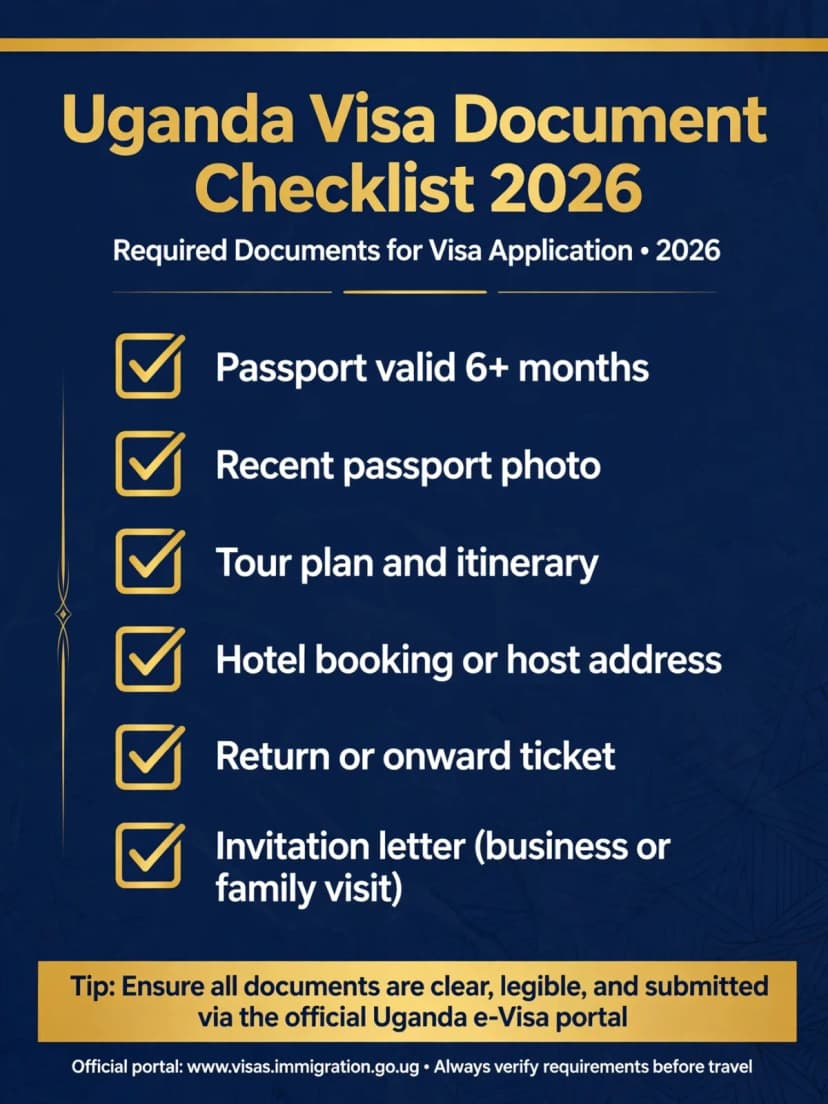
The document list depends on the visa category you choose, and the portal will show you the list for your category when you apply. The checklists below are drawn from the lists published by Uganda's immigration authority for each category, and they are written for a Pakistani passport holder applying from Vietnam. Prepare the originals and clean scans of each document, and keep a printed set in your hand luggage as well as the uploads on the portal. The officer at the border can ask to see any of these documents again, and an applicant who cannot produce the hotel booking or the return ticket that was uploaded can be delayed or refused entry. A document that is not in English should be translated into English, and the translation should be certified if the portal asks for it.
The tourist visa checklist is the one most readers will use. You need a valid Pakistani passport with at least six months' validity after your arrival date and at least one blank page, a recent passport-sized photograph, a tour plan naming the places you will visit and the dates, a travel itinerary or flight booking showing your arrival and departure, and a hotel booking or reservation showing the name, address and dates of your accommodation. You should also be ready to show proof of funds for your trip, such as a recent bank statement, and your return or onward ticket. The immigration authority's published tourist visa list names the passport, the photograph, the tour plan, the travel itinerary and the hotel booking as the core documents, and it no longer lists a yellow fever certificate among them, following the notice of 2 October 2026. A bank statement is not always requested on the portal for a tourist visa, but it is sensible to have a recent statement ready, because an officer who doubts that you can pay for your trip can ask for it at the border.
The business visa checklist adds an invitation letter from the Ugandan company or organisation you are visiting. The letter should be on the company's letterhead, it should name you, state the purpose and dates of your visit, and give the company's address and contact details. You should also carry the company's registration details if the portal asks for them, and your own employment details in Vietnam, such as a letter from your employer confirming your job and your leave. The family visit visa checklist adds an invitation letter from your host in Uganda, together with evidence of the host's identity and status in Uganda, for example a copy of the host's passport or residence permit, and the address where you will stay. The East Africa Tourist Visa checklist is the same as the tourist checklist, with the addition of an itinerary that shows the regional route and the country of first entry, because the officer needs to see that you will enter the issuing country first. The transit visa checklist is shorter: a valid passport, a recent photograph, a ticket showing your onward journey to a third country, and any visa you need for that third country.
| Document | Tourist | Business | Family visit | East Africa Tourist Visa | Transit |
|---|---|---|---|---|---|
| Passport, 6+ months validity, blank page | Yes | Yes | Yes | Yes | Yes |
| Recent passport photograph | Yes | Yes | Yes | Yes | Yes |
| Tour plan | Yes | Yes | No | Yes | No |
| Travel itinerary or flight booking | Yes | Yes | Yes | Yes, showing first entry | Yes, onward ticket |
| Hotel booking or host address | Yes | Yes | Host address | Yes | No |
| Invitation letter | No | Yes, from Ugandan company | Yes, from host | No | No |
| Return or onward ticket | Yes | Yes | Yes | Yes | Yes, to third country |
| Proof of funds, bank statement | Have ready | Have ready | Have ready | Have ready | Have ready |
| Yellow fever certificate | No longer required | No longer required | No longer required | No longer required | No longer required |
11. Transit Through Uganda
A transit visa is for a traveller who passes through Uganda on the way to a third country and who needs to leave the airport or stay in Uganda for a short time during the journey. The transit visa allows a stay of up to seven days, it costs USD 50 under the official fee schedule, and it does not permit an extension. The application is made online through the same portal, visas.immigration.go.ug, and the key documents are a valid passport, a recent photograph, a ticket showing the onward journey to the third country, and any visa required for that third country. If you are flying from Vietnam to a third country through Entebbe and you will not leave the airport transit area, check with your airline whether a transit visa is required at all, because the requirement can depend on the airport layout and the airline's own rules. If you will leave the airport, stay overnight in Uganda, or change airports, assume that you need a transit visa and apply for one before travel.
12. Yellow Fever and Health Requirements
The yellow fever rule changed in 2026, and many travel websites have not caught up, so this section states the change carefully and names the conflict. On 2 October 2026, Uganda's National Citizenship and Immigration Control published an official notice stating that a yellow fever vaccination certificate is no longer a mandatory requirement for entry into Uganda. The notice says the requirement is not listed on the e-visa application portal or on the immigration authority's website, and it concludes that travellers to Uganda do not require a yellow fever vaccination certificate for entry. The notice was also published by Uganda's embassy in Washington, and it followed a letter dated 27 August 2026 from the immigration authority to the Uganda Tourism Board clarifying the same point. The controlling source for entry into Uganda is therefore the Ugandan immigration authority's own notice of 2 October 2026, and this guide follows it: you do not need a yellow fever certificate to enter Uganda.
The conflict is that older official pages still say the opposite. The United States Centers for Disease Control and Prevention page for Uganda, with an entry rule dated 23 April 2025, and the World Health Organization's country list, with a Uganda entry dated 2018, both still state that Uganda requires a yellow fever certificate from arrivals aged one year and older. The United Kingdom's Foreign, Commonwealth and Development Office travel advice for Uganda has also been reported as still advising travellers to carry a yellow fever certificate. Those pages were written before the notice of 2 October 2026, and they have not been updated to reflect it. The United Kingdom's travel health service, TravelHealthPro, has updated its Uganda page to record that there is no certificate requirement as of October 2026. When an older foreign government page and a current Ugandan immigration notice disagree about Uganda's own border rule, the Ugandan notice controls, because Uganda sets its own entry rules. Even so, a traveller who already holds a yellow fever certificate should carry it, because it costs nothing to carry and it removes any argument at a border post where an officer has not yet seen the new notice.
Removing the document requirement does not remove the disease. Yellow fever is present in Uganda, and the World Health Organization continues to recommend yellow fever vaccination for all travellers aged nine months and older who visit areas where there is a risk of transmission, subject to medical advice. The United States Centers for Disease Control and Prevention likewise recommends the vaccine for travellers to Uganda. The vaccine should be given at least ten days before travel, and it is normally a single dose that gives long-lasting protection. Talk to a doctor in Vietnam before you travel, especially if you are pregnant, if you have a weakened immune system, or if you are over sixty, because the vaccine is not suitable for everyone and a doctor can advise on alternatives. Other health precautions for Uganda include malaria prevention, because malaria is a risk throughout the country, and routine vaccinations such as hepatitis A, typhoid and tetanus, together with measles vaccination, which the United States Centers for Disease Control and Prevention has flagged for Uganda.
13. Arriving in Uganda: Entebbe and the Border
Almost every Pakistani traveller from Vietnam will arrive at Entebbe International Airport, Uganda's main international gateway, which sits on the shore of Lake Victoria about 40 kilometres from Kampala. The flight from Vietnam will normally route through a Gulf hub such as Dubai or Doha, or through Addis Ababa or Nairobi, and the final leg lands at Entebbe. Keep your passport, your printed approval letter, your payment receipt, your return ticket and your hotel booking in your hand luggage, not in checked baggage, because you will need them at the immigration desk before you collect your luggage.
At the immigration desk, the officer will scan the barcode on your approval letter, check your passport and your documents, capture your fingerprints and take your photograph, and then issue the visa and place an entry stamp in your passport. Answer the officer's questions simply and honestly, and have the address of your first hotel ready. The officer can ask how long you will stay, where you will stay, how you will pay for the trip, and when you will leave. A traveller who cannot name a hotel, cannot show a return ticket, or cannot explain the purpose of the visit is more likely to be questioned further. If the officer grants a stay shorter than the 90 days you expected, read the stamp before you leave the desk and ask the officer to confirm the date by which you must leave. Keep the entry stamp safe: it is the legal record of your stay, and you will need it when you leave and if you apply for an extension.
14. Work, Study and Business: What a Tourist Visa Does Not Cover
A tourist visa is for tourism, and it does not authorise work, study or long-term residence in Uganda. If you take a job, start a business that requires you to work in Uganda, or enrol in a course, you need the correct permit, and a tourist visa will not protect you. Working on a tourist visa can lead to the visa being cancelled, a fine, detention, deportation and a ban on future entry, and it can also cause trouble for the employer. The same applies to the East Africa Tourist Visa, which is for tourism only across the three countries. If an employer in Uganda offers you a job, the employer must normally obtain a work permit for you before you start work, and you should not travel on a tourist visa with the intention of converting it into a work permit after arrival. Ask the employer to confirm the work permit process in writing, and check the permit categories and fees on the immigration portal before you accept any offer or pay any fee.
Study in Uganda requires a student pass, which is applied for online through the same portal. The key document is an admission letter from the Ugandan school, college or university, together with evidence that you can pay the fees and support yourself. The student pass fee is set by category and is not published as a single figure in the sources checked for this guide, so confirm it on the portal before you pay. If you are a teacher in Vietnam considering a teaching post in Uganda, check the work permit route rather than the tourist route, and be aware that schools in Uganda may ask for attested degree certificates and police clearance. Short business visits, such as meetings, conferences and trade visits, are covered by the business visa described in section 3, which costs USD 50 and requires an invitation letter. A business visa is not a work permit, and it does not allow you to take employment in Uganda. Volunteering can also require a specific permit, depending on the nature and length of the placement, so check with the organisation and the immigration authority before you travel. If you are unsure whether your planned activity counts as work, ask the Directorate of Citizenship and Immigration Control in writing before you apply, and keep the answer.
15. Money, Flights and Practical Planning from Vietnam
There are no direct flights from Vietnam to Uganda, so every journey routes through at least one hub. The most common routings from Ho Chi Minh City or Hanoi are through Dubai, Doha or Addis Ababa, with a final leg to Entebbe, or through Nairobi with a short onward flight to Entebbe. Total journey time is usually between 14 and 20 hours including the connection, and the return journey is similar. Book a routing with a comfortable connection time, because a missed connection can cost a day, and check whether your transit airport requires a transit visa for a Pakistani passport holder: the Gulf hubs normally allow airside transit without a visa, but confirm this with the airline for your exact routing and ticket, because the rules depend on the airport, the airline and whether you need to change terminals or collect luggage. Keep your Uganda approval letter accessible during the whole journey, because the airline at your departure airport in Vietnam will check it before boarding, and a transit airport can ask to see it as well.
Uganda's currency is the Ugandan shilling, and United States dollars are widely accepted for larger payments such as hotels, safaris and gorilla permits, although change is often given in shillings. Carry some United States dollars in clean, undamaged notes, because torn or old notes can be refused, and carry some shillings for small purchases, transport and tips. Cards are accepted in larger hotels and restaurants in Kampala and Entebbe, but cash is still essential outside the main towns, and ATMs can be unreliable in remote areas. Tell your bank in Vietnam or Pakistan that you will be travelling to Uganda so that your card is not blocked, and keep a second payment method available. Budget honestly: a mid-range safari with a gorilla permit, lodges, transport and park fees can cost several thousand United States dollars per person, while a simple city trip to Kampala and Entebbe can be done far more cheaply. The visa fee is a small part of the total cost, so do not let a cheap-looking visa offer distract you from the real budget.
Common mistakes are worth listing together, because each one has caused a refused or delayed application. The first is applying on a commercial website instead of the official portal and paying USD 99 or USD 199 for a USD 50 visa. The second is applying for the wrong visa type, most often a single-entry visa for a trip that crosses into Kenya or Rwanda, which ends the visa at the first border. The third is uploading a blurred or cropped passport scan, or a photograph that does not meet the specification. The fourth is entering a name or passport number that does not match the passport exactly. The fifth is applying too early, so the approval expires before travel, or too late, so a query cannot be answered in time. The sixth is booking non-refundable flights, permits and lodges before the approval letter arrives. The seventh is travelling without a printed approval letter, a return ticket or a hotel booking. The eighth is assuming that a yellow fever certificate is still required, or that a visa on arrival is available. Avoid all eight, and your application has the best chance of a smooth decision. While you are in Uganda, the Pakistan High Commission in Kampala is the mission that assists Pakistani nationals, so note its contact details before you travel. Finally, check that your Vietnamese residence card or visa is valid for your return date before you leave Vietnam, and carry it with your passport.
16. Official Websites
| Source | What it is for | Website |
|---|---|---|
| Uganda e-visa portal | Apply for all Uganda visas; pay the fee; check status | visas.immigration.go.ug |
| Directorate of Citizenship and Immigration Control | Official visa information, fees, notices and contact details | immigration.go.ug |
| Uganda Ministry of Foreign Affairs | List of Uganda missions abroad | mofa.go.ug |
| Uganda Ministry of Foreign Affairs, Washington | Official notice of 2 October 2026 on yellow fever | washington.mofa.go.ug |
| Uganda Wildlife Authority | Gorilla permit prices and bookings | ugandawildlife.org |
| Visit Uganda, Uganda Tourism Board | Tourism information, parks and travel planning | visituganda.com |
| UK Foreign, Commonwealth and Development Office | Travel advice, entry requirements and safety | gov.uk/foreign-travel-advice/uganda |
| US State Department | Travel advisory and entry information for Uganda | travel.state.gov |
| US Centers for Disease Control and Prevention | Health advice and vaccination recommendations | wwwnc.cdc.gov/travel/destinations/traveler/none/uganda |
| TravelHealthPro, UK | Travel health guidance for Uganda | travelhealthpro.org.uk/country/229/uganda |
| World Health Organization | Yellow fever and country health information | who.int |
| IATA Travel Centre | Airline entry and document requirements | iatatravelcentre.com |
| Kenya eTA and e-visa portal | Kenya entry for East Africa Tourist Visa trips starting in Nairobi | etakenya.go.ke |
| Rwanda Irembo portal | Rwanda entry for East Africa Tourist Visa trips starting in Kigali | irembo.gov.rw |
| Pakistan High Commission, Kampala | Consular help for Pakistani nationals in Uganda | mofa.gov.pk |
Check the first two rows before you pay anything or book anything, because the portal and the immigration authority's website are the controlling sources for fees, documents and processing times. The other rows are for cross-checking health, safety and onward travel, and for planning a regional trip. If any website in this table disagrees with the portal about a fee or a requirement, follow the portal and ask the Directorate of Citizenship and Immigration Control for the answer in writing.
17. Frequently Asked Questions
Do Pakistani passport holders need a visa for Uganda?
Yes. Pakistani ordinary passport holders need a visa for Uganda, and Pakistan is not on Uganda's visa-exempt list. The visa is an e-visa applied for online before travel at visas.immigration.go.ug. There is no visa on arrival for Pakistani passport holders, and you must hold the emailed approval letter before you leave Vietnam.
How much does a Uganda tourist visa cost for Pakistanis?
The official fee for a single-entry tourist visa is USD 50, plus a card payment charge of about 3 percent, roughly USD 1.50. The East Africa Tourist Visa costs USD 100. Fees are non-refundable. Commercial websites that charge USD 99 or USD 199 for the same visas are adding their own service charge, so apply only on the official portal.
How long does a Uganda e-visa take to process?
Uganda's immigration authority says a visa is usually reviewed within two to three working days. Allow up to five working days for a straightforward tourist application, and up to two weeks for an East Africa Tourist Visa. Apply at least ten days before departure, and ideally two to four weeks before, and answer any query from the reviewing officer the same day.
Can I get a visa on arrival in Uganda?
No. Uganda's immigration authority says no visas are issued on arrival, and all visa-required travellers must apply online and hold an approval letter before travel. Do not travel to Entebbe without one: airlines check the letter before boarding, and travellers without it have been detained or turned away.
How long can I stay in Uganda on a tourist visa?
The stay granted on entry can be up to 90 days, as decided by the immigration officer at the border. The approval letter itself is valid for 90 days from the date of issue, so you must enter within that window. A single-entry stay can be extended by a further 60 days in two intervals, while the East Africa Tourist Visa cannot be extended.
What is the East Africa Tourist Visa and is it worth it?
It is a joint USD 100 visa for Uganda, Kenya and Rwanda, valid for 90 days with multiple entries between the three countries. You must apply through the country you enter first. It is worth it if you visit two or three of the countries, because separate visas would cost about USD 151. It is not worth it for a Uganda-only trip.
Can I apply for a Uganda visa from Vietnam without visiting an embassy?
Yes. The whole process is online at visas.immigration.go.ug: apply, upload documents, pay by card, and receive the approval letter by email. There is no authorised Uganda visa centre in Vietnam that this guide could verify, and no embassy visit, interview or pre-travel biometrics appointment is required. Biometrics are captured at the border on arrival.
Is a yellow fever certificate required for Uganda in 2026?
No, not for entry. On 2 October 2026 Uganda's National Citizenship and Immigration Control announced that a yellow fever certificate is no longer a mandatory entry requirement. Older CDC, WHO and FCDO pages still say it is required, but those were written before the notice, and the Ugandan notice controls. Vaccination is still recommended on health grounds, so talk to a doctor before you travel.
Can I extend my Uganda visa while I am in the country?
Yes, for a single-entry visa. The stay granted at entry can be extended for a further 60 days in two intervals, online through the portal or in person at the immigration headquarters in Kampala or a regional office. Apply at least two weeks before your stay expires. The East Africa Tourist Visa cannot be extended.
What documents do Pakistanis need for a Uganda visa?
A passport valid for at least six months after arrival with a blank page, a recent passport photograph, a tour plan, a travel itinerary or flight booking, and a hotel booking or host address. Business visas add an invitation letter from the Ugandan company; family visit visas add an invitation from the host. Keep a bank statement and your return ticket ready.
Do I need a transit visa for a layover in Uganda?
It depends on whether you leave the airport. A transit visa allows a stay of up to seven days and costs USD 50 under the official fee schedule. If you stay airside and do not leave the transit area, check with your airline whether a visa is needed. If you leave the airport or stay overnight, apply for a transit visa online before travel.
Can I work in Uganda on a tourist visa?
No. A tourist visa does not authorise work, study or long-term residence. Working on a tourist visa can lead to cancellation, a fine, detention, deportation and a future entry ban. If you are offered a job in Uganda, your employer must normally obtain a work permit for you first, and study requires a student pass.
How much does a gorilla permit cost in Uganda?
A standard gorilla trekking permit for a foreign non-resident costs USD 800 per person under the Uganda Wildlife Authority tariff in force since July 2024, with a reduced rate of USD 600 in the low-season months of April, May and November. The permit is for one trek and one hour with a gorilla family, and full payment has been required at booking since 1 March 2026.
What happens if my Uganda visa application is refused?
The fee is non-refundable, so a refused application costs you the USD 50 or USD 100 fee. The portal or email will usually give a reason. Correct the problem, for example a blurred passport scan, a wrong date or a missing invitation letter, and reapply, paying the fee again. A false statement can lead to a refusal and a record that affects future applications, so always answer honestly.
Is Uganda safe to visit in 2026?
Uganda is a popular safari destination and most trips run smoothly, but the security picture needs checking before every trip. The UK Foreign Office judges terrorist attacks to be very likely and advises against travel to some areas, including parts of the west near the Democratic Republic of Congo border. The US State Department has also issued a high-level advisory for Uganda. Read the current FCDO and US State Department advice, check the Ebola situation at the DRC border, buy travel insurance that covers medical evacuation, and follow local advice while you are there.
This guide was checked on 29 November 2026 against the official Uganda e-visa portal, the Directorate of Citizenship and Immigration Control, the UK Foreign, Commonwealth and Development Office and the US State Department, with the fee and processing-time figures cross-checked against the sources listed in section 16. Visa rules, fees and health requirements can change at short notice, so confirm the current fee and document list on visas.immigration.go.ug and ask the Directorate of Citizenship and Immigration Control for any important answer in writing before you pay or book. The immigration officer at the border makes the final decision on entry, and this guide does not guarantee visa approval or entry into Uganda.


