

Turkmenistan Visa Guide 2026: Types, Requirements, Documents and Application Steps
Turkmenistan is one of the hardest countries in the world to visit. It is also one of the most rewarding: the white marble avenues of Ashgabat, the burning Darvaza gas crater in the Karakum desert, the Silk Road ruins of Merv and the markets of Turkmenbashi are unlike anywhere else in Central Asia. For a Pakistani passport holder living in Vietnam, the trip is possible, but it cannot be arranged at the last minute. Every ordinary Pakistani passport holder needs a visa, and for most purposes that visa still starts with an invitation approved inside Turkmenistan. Since 1 October 2026 there is also a new electronic visa for tourists, but it does not work the way most e-visas work: you cannot apply for it yourself. A licensed Turkmen tour agency or event organiser must sponsor it for you.
This guide is written for Pakistani passport holders who live in Vietnam. It covers the visa requirement, visa types, fees, documents, where and how to apply from Vietnam, processing time, stay length, extensions, transit, work and study, and the mistakes that most often cause a refusal. Every fee, stay length and processing time was checked against official and official-adjacent sources on 29 November 2026. Where sources disagree, the guide says so and names the source that should control your decision. Confirm the current figure in writing with the mission or agency before you pay or book a non-refundable flight.
1. Do Pakistanis Need a Visa for Turkmenistan?
Yes. A Pakistani citizen holding an ordinary passport needs a visa for Turkmenistan for every kind of trip: tourism, business, a private visit, transit, work and study. There is no visa-free entry for ordinary Pakistani passport holders, and there is no visa on arrival without prior paperwork. The only people who can enter without a visa are holders of diplomatic passports of Pakistan, who are exempt for up to 30 days under Turkmenistan's visa policy, and holders of a United Nations Laissez-Passer. If you hold an ordinary green Pakistani passport, that exemption does not apply to you.
The visa requirement has two layers, and confusing them is the most common planning error. First, for most purposes, you need a letter of invitation (LOI) approved by the State Migration Service of Turkmenistan. Second, with that invitation, you obtain the visa itself, either from a Turkmen embassy or on arrival at Ashgabat International Airport or a land border. Since 1 October 2026, tourists have a second route: the electronic visa (e-visa). Under the e-visa system, the separate paper LOI is replaced by an online application made by your sponsoring tour agency. The e-visa covers tourism, business and humanitarian travel, but the UK Foreign, Commonwealth and Development Office (FCDO) states clearly that tourists cannot apply directly: the tour agency or event organiser acts as sponsor. For any other purpose, the FCDO says, you still need a letter of invitation from a sponsoring organisation, and with it you apply at an embassy or on arrival.
Your residence in Vietnam does not change the visa requirement. Turkmenistan's rules depend on your passport, not on where you live. Living in Vietnam changes only where you file the application and how you reach the mission, which is covered in section 10. Your Vietnamese residence permit or visa matters for a different reason: you must be able to return to Vietnam after the trip, so check that your Vietnamese visa or temporary residence card is still valid on your planned return date before you leave.
Do not trust any website, agent or social media post that offers a Turkmenistan visa without an invitation or a sponsor. Turkmenistan is consistently described by the FCDO, the US State Department and travel researchers as one of the world's most restrictive visa regimes. Tourists travel with a licensed agency and a guide, and the itinerary is part of the visa paperwork. Anyone who promises a guaranteed visa, a visa on arrival with no prior approval, or a same-day tourist visa is either mistaken or selling a scam. The real process takes weeks, and the invitation takes the longest.
2. Types of Turkmenistan Visas for Pakistani Passport Holders
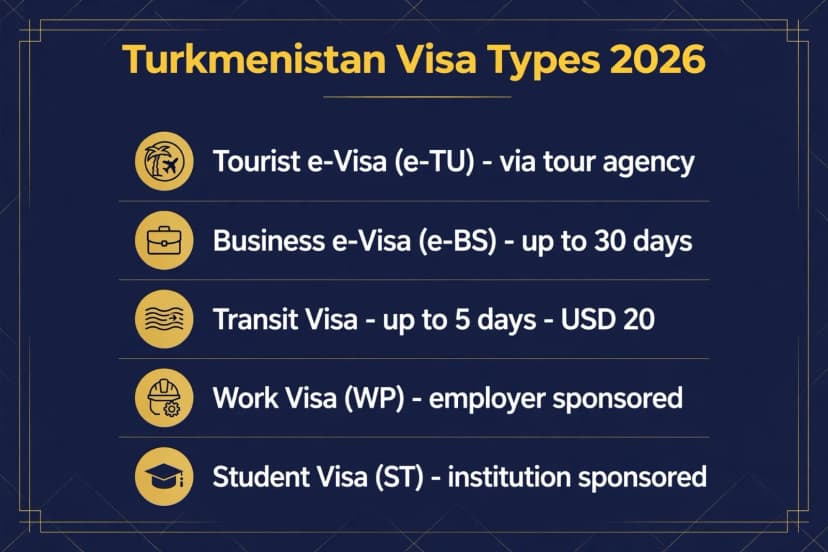
Turkmenistan issues visas by purpose, and each purpose has its own sponsor and its own invitation route. The table below gives the types that matter to a Pakistani applicant. Stay lengths are set by the invitation and the visa itself, not by a fixed rule, so treat the figures as the normal range and always read the dates printed on your own visa.
| Visa type | Purpose | Who sponsors it | Normal stay |
|---|---|---|---|
| Tourist visa (TU) / tourist e-visa (e-TU) | Sightseeing with a licensed tour agency | Turkmen national tourism agency | As stated in the invitation or e-visa; most tours run 5 to 10 days |
| Business visa (BS) / business e-visa (e-BS) | Meetings, conferences, commercial visits | Inviting company or event organiser in Turkmenistan | Up to 30 days for the e-BS category |
| Humanitarian e-visa (e-HM) | Humanitarian purposes and government-backed international conferences and exhibitions | Event organiser or host organisation | As issued |
| Private visit visa | Visiting family or friends in Turkmenistan | The private host in Turkmenistan | As stated in the invitation |
| Transit visa | Crossing Turkmenistan by land or air on the way to another country | The State Migration Service is the sole sponsor | Up to 5 days per entry |
| Work visa (WP) | Employment with a Turkmen employer | The employing company | Length of the contract and work permit |
| Student visa (ST) | Study at a Turkmen educational institution | The educational institution | Length of the course, extended through the institution |
| Service / official visa (OF) | Official and service travel | The receiving government body or organisation | As issued |
The tourist visa is the type almost every Pakistani reader of this guide will use. It is a single-entry visa in most cases, and a double-entry visa is possible if your itinerary leaves and re-enters Turkmenistan, for example on a combined tour. Tell your agency about every border crossing before it applies, because the crossings you will use are written into the paperwork, and you must enter and leave through the crossings named there.
The business visa suits a short commercial trip, a trade fair or a conference. Since 1 October 2026 the business e-visa (e-BS) covers stays of up to 30 days. A business visa does not allow you to work in Turkmenistan, and you cannot convert it into a work visa inside the country. If an employer wants to hire you, it must sponsor a work visa and a work permit before you travel.
The private visit visa is for visiting a person, not a company. Your host in Turkmenistan applies for the invitation on your behalf. This route is slower than a tour, and the host must document the relationship and the invitation. Do not use a tourist agency to pretend a private visit is a tour, or a private invitation to pretend a holiday is a family visit: the sponsor's details are checked, and a mismatch is a common reason for delay.
The transit visa is the only type that lets you cross the country without a guide, but it is narrow and, in practice, hard to obtain; it is covered in section 11. Work and study visas are covered in section 14. If your purpose does not fit any row of this table, ask the mission or your sponsor which category fits, because the wrong category is one of the fastest ways to lose the application fee.
3. The New e-Visa System Since 1 October 2026
On 1 October 2026 Turkmenistan launched an electronic visa system run by the State Migration Service. The official portal is evisa.migration.gov.tm, and it is available in English, Russian and Turkmen. The portal lists three categories: e-TU for tourism, e-BS for business (up to 30 days) and e-HM for humanitarian travel. The FCDO's travel advice confirms the launch date and adds that the system covers tourists and people visiting for international conferences and exhibitions backed by the Government of Turkmenistan.
The most important fact about the e-visa is also the most misunderstood: you cannot apply for it yourself. The portal is open to event organisers and tour agencies, who act as sponsor. The agency submits the application on your behalf, and the agency is the party the State Migration Service deals with. Several Turkmen tour operators report that in the first weeks after launch the portal did not even offer a sign-up option for new individual applicants, and that the agency files the application and pays the fee, sometimes after an identity check. If you find a website that invites you to apply for a Turkmenistan e-visa directly as an individual tourist, check the address carefully: the official address always ends in migration.gov.tm, and look-alike sites exist.
For tourists, the e-visa replaces the old two-step process of a paper letter of invitation followed by a visa sticker in the passport. Your travel agency still acts as your sponsor, and you still travel on an organised tour with a guide. What changes is the paperwork: there is no separate LOI to carry, and the visa is issued electronically. For business and humanitarian travel, the organiser likewise sponsors the application. For every other purpose, including a private visit, work and study, the FCDO says the old invitation route still applies.
Whether Pakistani passports are accepted on the e-visa portal is an open point. No published official list of eligible nationalities was available when this guide was checked on 29 November 2026, and secondary sources disagree: some list the e-visa as available to Pakistani passport holders, while others list it as not available and direct Pakistanis to the embassy route. The portal itself calculates the fee during the application, so eligibility and price can only be confirmed by starting a real application through a licensed agency. Do not pay any agency that cannot show you, before payment, whether your Pakistani passport is accepted on the portal and what fee the portal calculates for it.
The e-visa fee has no published official price list. The portal calculates it during the application, depending on nationality and processing speed, and it is paid online in US dollars. Operators report that guests have paid about USD 15 to USD 20 with a Japanese passport, USD 25 to USD 40 with most European passports, and USD 80 (regular) or USD 100 (urgent) with a Russian passport. Others quote USD 40 standard and USD 80 urgent, with double-entry at USD 60 standard and USD 120 express. These figures conflict because there is no public tariff: the portal's calculation controls, and an operator's quote is only an estimate. No confirmed e-visa fee for a Pakistani passport has been published, so this guide does not state one. Ask your agency to confirm the portal-calculated fee for a Pakistani passport in writing before you pay.
Processing times for the e-visa also show an official figure and a practical figure, and both are given here. The portal states 7 working days for regular processing, 3 working days for urgent processing and 24 hours for super-urgent processing. Tour operators report longer real times: about 10 to 14 business days for a standard e-visa and about 5 to 7 business days for an urgent one, with one operator quoting 9 business days standard and 5 business days express. One operator notes that super-urgent processing was not available in practice in the first weeks. Plan on the practical time, not the portal's headline time: send your documents to the agency at least three weeks before travel, and six weeks if you can.
4. The Letter of Invitation (LOI) Explained
The letter of invitation, known as the LOI, is the document that makes a Turkmenistan visa possible. It is not a letter your friend writes on ordinary paper. It is an approval issued by the State Migration Service of Turkmenistan after your host or sponsor applies for it inside the country. The host sends the request with a copy of your passport data page, and the State Migration Service checks it and certifies the invitation. Pakistan's own Ministry of Foreign Affairs confirms the same sequence: a person who intends to visit Turkmenistan for any purpose first needs an invitation letter issued by the State Migration Service, and only once it is issued can the visitor process the visa from the Embassy of Turkmenistan in Islamabad or receive it at the airport or border point.
For a tourist, the inviting party is a Turkmen national tourism agency: you book the tour first, and the agency arranges the invitation as part of it. For business, the inviting company applies; for a private visit, the person you are visiting applies. For a transit visa, the State Migration Service itself is the sole sponsor, which is why transit invitations take longer. For work, the employer applies; for study, the institution applies. In every case the sponsor must be a real, registered party in Turkmenistan.
The invitation is valid for three months from certification. Apply for the visa promptly once it is approved, and make sure your travel dates fall inside its validity: an expired invitation cannot be used, and a new one means starting the wait again. Keep a copy with you when you travel, and carry the original if the mission or agency gives you one.
Allow at least 15 working days for the invitation to be approved, and up to 20 working days or about a month overall. The FCDO states that a transit invitation can take up to a month. Tour operators report 10 to 12 working days for a normal LOI and 4 to 5 working days for an express one, but those are operator times for straightforward bookings, not a guarantee. Because the invitation comes before the visa, your total planning time is the invitation time plus the visa processing time. For a first trip, start at least six to eight weeks before departure.
The invitation stage is also where the documents listed by Pakistan's Ministry of Foreign Affairs are needed: a colour copy of your passport, a passport-size photograph with a white background, and a colour copy of your polio vaccination card. Your sponsor will tell you exactly what it needs and in what format. Send clean, legible scans: a blurred passport copy is one of the most common causes of an invitation delay, and the sponsor cannot fix a bad scan for you.
5. Fees: What a Turkmenistan Visa Costs in 2026
Turkmenistan's visa fees depend on the length of stay, the number of entries and whether you apply at an embassy or on arrival. There are two fee systems in play in 2026: the embassy tariff and the new e-visa calculation. They are not the same, and you will pay one or the other, not both, for the visa itself. Arrival charges are separate and are paid in cash at the border.
The embassy tariff below is the one published for the Embassy of Turkmenistan in Islamabad, as reported in November 2026. It is the tariff that applies if you take the classic LOI route and collect the visa from the Islamabad mission. It is the most detailed published tariff available, and it is the controlling figure for the embassy route until the mission publishes a new one.
| Visa validity | Single entry | Multiple entry |
|---|---|---|
| Up to 10 days | USD 35 | USD 75 |
| Up to 1 month | USD 55 | USD 75 |
| Up to 3 months | USD 115 | USD 155 |
| Up to 12 months | USD 385 | USD 515 |
Urgent visas cost more. The reported example is USD 55 instead of USD 35 for a single-entry visa of up to 10 days. A visa issued at Ashgabat airport costs USD 50 extra on top of the visa fee. At about PKR 280 per US dollar in November 2026, the cheapest embassy visa, USD 35, is about PKR 9,800, but pay in the currency the mission asks for and at the rate it applies on the day; do not rely on a conversion done weeks earlier.
There is a conflict in the published embassy figures that you should know about. A second source reporting the same Islamabad tariff lists USD 35 for up to 10 days, USD 45 for up to 20 days and USD 55 for up to 1 month, with expedited fees of USD 55, USD 75 and USD 95 for the same bands. The two versions agree on the 10-day and 1-month single-entry figures but differ on the middle band. The table above follows the fuller tariff (10 days, 1 month, 3 months, 12 months) because it is the version with single and multiple entry prices for every band. Confirm the exact fee for your validity in writing with the mission before you pay, and keep the written reply with your application.
The State Migration Service also publishes its own fee schedule for visas issued inside Turkmenistan or on arrival, and it is lower than the embassy tariff: an ordinary visa costs USD 20 for up to 10 days, USD 30 for up to 20 days and USD 30 for each further month up to one month. A transit visa costs USD 20 for a single entry of up to 5 days and USD 40 for a double entry. The FCDO adds that visas on arrival attract an additional fee of USD 50. These are different charges for different issue points, not a contradiction: the embassy charges its tariff, the border charges the migration service fee plus the USD 50 airport surcharge. Ask your sponsor which fee applies to your route so you carry the right amount in cash.
On top of the visa fee, budget for the arrival charges. The figures conflict between sources. The State Migration Service's own site states a registration fee of USD 10, with children aged 7 to 16 paying half and children under 7 exempt. The FCDO states the migration fee on arrival is USD 14 plus a tourism tax of USD 2 per day. Older US State Department information mentions USD 12 and USD 29 in different passages. Operators in November 2026 report about USD 49 per person in cash at the border for registration and the medical check combined, with a PCR or COVID-19 test fee of about USD 31 to USD 35. Carry at least USD 60 to USD 80 in small, clean US dollar notes for arrival charges, on top of your visa fee, and keep every receipt.
Other costs are charged by your sponsor, not by the government. A tour agency charges for the tour, the invitation and its service; a business host may charge an invitation handling fee. Those commercial charges vary widely and are not government fees. Get an itemised quote in writing that separates the government visa fee from the agency's service charge, and never pay a government fee to a personal bank account or through an informal channel. The e-visa fee, where it applies, is non-refundable even if the visa is refused, and the same is true of most embassy fees. A refusal does not return your money.
6. Processing Time: How Long to Allow
Processing time for Turkmenistan has three parts, and only the last one is the visa itself. First comes the invitation, then the consular action, then any e-visa processing if you use that route. Add the parts together when you plan, and do not book a non-refundable flight until the visa is in your hand or the e-visa is approved.
The invitation takes the longest. Allow at least 15 working days, and realistically up to 20 working days or about a month. Transit invitations can take up to a month, according to the FCDO. Tour operators report 10 to 12 working days for a normal tourist LOI and 4 to 5 working days for an express one, but those are best-case times for a straightforward booking. The invitation is valid for three months once certified, so there is no penalty for starting early.
The consular stage is shorter. Turkmenistan's Ministry of Foreign Affairs states that consular actions take up to 10 calendar days. Other missions publish 10 working days for ordinary processing, with expedited processing in 1 to 3 business days where the paperwork is in order. The Islamabad tariff's urgent example, USD 55 instead of USD 35 for a 10-day single-entry visa, shows that an urgent service exists at the embassy, but the exact urgent timescale at each mission is not published. Ask the mission you will use what its current ordinary and urgent times are, in writing.
For the e-visa, the portal states 7 working days (regular), 3 working days (urgent) and 24 hours (super urgent). In practice, operators report about 10 to 14 business days for a standard e-visa and about 5 to 7 business days for an urgent one, with one operator quoting 9 business days standard and 5 business days express. Super-urgent processing was not available in practice in the first weeks after launch, according to one operator. Treat the portal's figures as the official target and the operators' figures as the planning time.
Put together, a realistic total for a first tourist trip is three to four weeks from the day your agency submits the invitation request to the day you hold the visa, and six weeks is safer. For a transit visa, allow a month for the invitation alone. For work or study, allow longer still, because the employer's or institution's own approvals come first.
7. How Long You Can Stay and Visa Validity
There is no single fixed stay length for a Turkmenistan visa. Your stay is the stay written on your invitation and your visa, and it is set by the purpose of your trip. A tourist visa normally covers the length of your booked tour, most often 5 to 10 days. A business e-visa covers up to 30 days. A transit visa covers up to 5 days per entry. A private visit visa covers the period in the invitation. A work or student visa covers the period of the contract or course. Read the dates on your visa the moment you receive it, and check that the entry and exit dates, the number of entries and the border crossings all match your itinerary. An error found at the airport is far harder to fix than one found at the mission.
Visa validity and permitted stay are not the same thing. Validity is the window in which you may enter; stay is how long you may remain after entry. The invitation is valid for three months from certification, and the visa's validity is set when it is issued. A visa valid for up to 10 days, 1 month, 3 months or 12 months, as in the embassy fee table, describes the validity band you paid for, not a promise that you may stay for the whole band. Your permitted stay is the period stated on the visa itself. Do not assume that a 1-month visa lets you stay for 30 days unless the visa says so.
Multiple-entry visas exist for the longer validity bands, at the higher fees in the table in section 5. A multiple-entry visa suits a trip that leaves Turkmenistan and comes back, for example a tour that crosses into Uzbekistan and returns. A single-entry visa ends when you leave, even if days remain on it. If your itinerary includes a re-entry, say so before the invitation is requested, because the number of entries is fixed when the visa is issued and cannot be changed at the border.
Overstaying is a serious matter in Turkmenistan. The US State Department warns that if your visa expires, you face fines and possible arrest or deportation, and that a deportation can bar your return for up to five years. Do not treat the expiry date as flexible, and do not assume that a hotel or a guide can extend your stay informally. Extensions are a formal process through the State Migration Service, covered in section 13, and they must be started before the visa expires.

8. Complete Document Checklists
Use the checklist for your visa type and do not mix checklists between types. A missing document for your type will delay or stop the application. Bring originals and copies, and keep a full copy set at home in Vietnam and a digital copy on your phone.
Checklist A: Tourist visa or tourist e-visa
- Pakistani passport, signed, valid for at least 6 months after the date you plan to leave Turkmenistan, with at least two blank pages. The FCDO states the 6-month rule from the planned departure date; Canadian advice states it from the date on the letter of invitation. Meet the stricter reading.
- Photocopy of the passport data page, signed as identical to the original, where the mission asks for it.
- Completed visa application form, with a passport photograph glued on, not stapled. Some missions ask for three copies of the form, so prepare three.
- Two recent passport-size photographs, white background, 3 by 4 cm or 5 by 6 cm as the mission specifies. Do not reuse an old photograph.
- Letter of invitation certified by the State Migration Service, arranged by your Turkmen tour agency, or, for the e-visa route, the agency's sponsorship and the documents it requests, normally a passport scan and a photograph.
- Proof of identity, such as your CNIC, with a clear copy.
- Confirmed tour booking and itinerary from the licensed Turkmen agency, showing your hotels and border crossings.
- Confirmed return or onward flight ticket, or a verifiable flight itinerary, as the mission requires.
- Proof of accommodation for every night, normally supplied by the agency as part of the tour.
- Travel health insurance, strongly recommended even where it is not listed as a formal requirement, with cover for medical treatment abroad and repatriation.
- Polio vaccination certificate: a colour copy of the polio card is listed by Pakistan's Ministry of Foreign Affairs among the documents for the invitation, and the WHO recommends a polio dose between 4 weeks and 12 months before departure for residents and long-term visitors leaving Pakistan. Carry the NADRA or NIMS certificate if you have one.
- Visa fee, paid in the form the mission specifies, often by money order. Confirm the payment method in writing before you pay.
- Your Vietnamese residence proof: your temporary residence card or Vietnamese visa, so you can show you live in Vietnam and can return there. Keep it valid past your return date.
Checklist B: Business visa or business e-visa
- All items in Checklist A for the passport, photographs, form, identity proof and fee.
- Letter of invitation from the inviting company or government agency in Turkmenistan, certified by the State Migration Service.
- Letter of request from the inviting company, and documents proving the inviting company's main business.
- A letter from your own employer or business in Vietnam explaining the purpose of the trip, if the mission asks for it.
- Conference or exhibition registration, where the trip is for an event, and the organiser's sponsorship details for the e-HM or e-BS route.
- Confirmed flights and accommodation, and travel health insurance.
Checklist C: Private visit visa
- All items in Checklist A for the passport, photographs, form, identity proof and fee.
- Letter of invitation from your host in Turkmenistan, certified by the State Migration Service.
- Evidence of your relationship with the host and of the host's address in Turkmenistan, as the mission requires.
- Confirmed flights and accommodation, or the host's address where you will stay, and travel health insurance.
Checklist D: Transit visa
- Pakistani passport valid for at least 6 months after departure, with a signed copy of the data page.
- Completed visa application form with a glued photograph.
- Visa for your onward destination, already in your passport, and a confirmed onward ticket.
- The transit invitation approved by the State Migration Service, which is the sole sponsor of transit visas. Allow up to a month for it.
- Details of the border crossings you will enter and leave through, exactly as named in the invitation.
- Transit visa fee: USD 20 for a single entry of up to 5 days, or USD 40 for a double entry, under the State Migration Service fee schedule. Confirm the fee with the mission, because embassy tariffs may differ.
- Travel health insurance and enough cash in US dollars for the arrival charges.
Checklist E: Work visa
- All items in Checklist A for the passport, photographs, form, identity proof and fee.
- Letter of request from the sponsoring company or government agency in Turkmenistan.
- Documents proving the inviting company's main business and its ability to sponsor you.
- Copy of your work contract, and proof of your qualifications, translated and sealed as the mission requires.
- Your health certificate, as the mission specifies.
- List of the names of all employees in the company, where the mission asks for it.
- Work permit or work authorisation arranged by the employer through the State Migration Service before you travel.
Checklist F: Student visa
- All items in Checklist A for the passport, photographs, form, identity proof and fee.
- Written letter of request by the educational institution in Turkmenistan, with the invitation it obtains from the State Migration Service.
- Certificate of admission or documents confirming your enrolment.
- Medical certificate and an HIV-negative test result, mandatory for intended stays of 3 months or longer.
- Proof of funds to support yourself during your studies, as the institution or mission requires.
- Confirmed accommodation arranged through the institution, and travel health insurance.
Two notes apply to every checklist. All documents should be in English, or translated into English where the mission requires it. The mission may also ask for extra documents beyond this list: the sponsor and the mission set the requirements for your case, and their written list controls over any general guide, including this one.

9. How to Apply: Step-by-Step
The steps below describe the classic LOI route, which is still the route for private visits, work, study and transit, and then the e-visa route for tourists. Follow the route that matches your purpose; do not start the embassy step before the invitation step is finished.
Classic LOI route
Step 1. Fix your purpose and your sponsor. For tourism, choose a licensed Turkmen tour agency and agree the tour, the dates, the hotels and the border crossings. For business, confirm the inviting company. For a private visit, confirm your host. For work or study, confirm the employer or institution. Do not pay in full before you have the sponsor's written confirmation of what it will arrange and what it charges.
Step 2. Send the sponsor clean copies of the documents it needs for the invitation: a colour copy of your passport data page, a white-background passport photograph and a colour copy of your polio vaccination card, plus any other document the sponsor lists. Check every scan for legibility before you send it.
Step 3. Wait for the State Migration Service to approve and certify the invitation. Allow at least 15 working days, and up to a month for transit. The invitation is valid for three months from certification.
Step 4. When the invitation is approved, complete the visa application form, glue on the photograph, and assemble the full checklist for your visa type from section 8. Prepare three copies of the form if the mission asks for three.
Step 5. Submit the application in person at the Turkmen mission that will take it, with your original passport and the fee in the form the mission specifies. For a Pakistani living in Vietnam, the practical choices are the Embassy of Turkmenistan in Beijing, which is accredited to Vietnam, or the Embassy of Turkmenistan in Islamabad if you are in Pakistan. Confirm in writing that the mission accepts your application before you travel to it. The Islamabad mission no longer accepts documents by email.
Step 6. Wait for the consular decision, up to 10 calendar days for ordinary processing, or 1 to 3 business days for an expedited application where that service is offered. Do not book a non-refundable flight until the visa is issued.
Step 7. Check the visa the moment you receive it: your name, passport number, dates, number of entries, visa type and border crossings. Report any error to the mission at once.
Step 8. Alternatively, with an approved invitation, you may receive the visa on arrival at Ashgabat International Airport or a land border. This costs USD 50 extra at the airport, and you must carry the invitation and the fee in cash. Confirm with your sponsor and your airline that on-arrival issue is available for your nationality and entry point before you rely on it.
E-visa route for tourists
Step 1. Book your tour with a licensed Turkmen agency and confirm in writing that it will sponsor your e-visa, that Pakistani passports are accepted on the portal, and what fee the portal calculates for a Pakistani passport.
Step 2. Send the agency the documents it requests, normally a passport scan and a photograph, at least three weeks before travel and six weeks if you can.
Step 3. The agency submits the application on the portal. The official processing time is 7 working days for a regular application, 3 working days for urgent and 24 hours for super urgent, but plan on about 10 to 14 business days in practice for a standard application.
Step 4. When the e-visa is approved, check the details against your passport and itinerary, print a copy, and carry a digital copy as well. The e-visa fee is non-refundable even if the application is refused.
Step 5. Travel on the tour as booked, with your guide, and register on arrival as described in section 12.
10. Applying from Vietnam: Beijing, Islamabad or Online
Turkmenistan has no embassy or consulate in Vietnam. That is the single most important practical fact for a Pakistani living in Vietnam, and it shapes every route in this guide. There are three realistic ways to apply, and each has a different cost, travel burden and uncertainty.
Route 1, the e-visa through a Turkmen tour agency, is the simplest from Vietnam because it needs no embassy visit. You deal with the agency online, the agency sponsors the application on the portal, and you travel once the e-visa is approved. This is the route to try first for tourism. Its open points are the two flagged in section 3: whether Pakistani passports are accepted on the portal, and what fee the portal calculates for them. Both can only be settled by a real application through a licensed agency, so ask the agency to confirm both in writing before you pay anything beyond a small, clearly stated service charge.
Route 2, the Embassy of Turkmenistan in Beijing, is the accredited mission for Vietnam. Turkmenistan's ambassador in Beijing is accredited to Vietnam and presented credentials in Hanoi in June 2024. The embassy's address is Kings Garden Villa D-1, 18 Xiaoyun Road, Beijing, China, with telephone +86 10 6532 6975. This is the nearest Turkmen mission to Vietnam, and Vietnamese travellers are routinely directed to Beijing. For a Pakistani resident in Vietnam, however, one point is not confirmed: whether the Beijing mission accepts visa applications from third-country nationals who live in Vietnam, and whether it accepts the LOI route for a Pakistani passport. The mission's acceptance must be confirmed in writing, by email or telephone, before you book a flight to Beijing or post your passport anywhere. Never post your original passport to a mission without its written instruction to do so, and never hand your passport to an intermediary who cannot name the mission officer or channel it will use.
Route 3, the Embassy of Turkmenistan in Islamabad, is the mission for Pakistan. Its address is 1-A Parveen Shakir Road, Street 25, F-7/2, Islamabad, telephone +92 51 2609775. If you are already in Pakistan, this is the natural mission: it publishes the tariff in section 5, it takes applications in person, and it handles the LOI route for Pakistani passports as a matter of routine. From Vietnam, this route means a trip to Pakistan first, which only makes sense if you are travelling there anyway. The Islamabad mission no longer accepts documents by email, so a postal application from Vietnam is not a realistic option.
Whichever route you choose, check your Vietnamese residence status before you leave. Make sure your Vietnamese visa or temporary residence card remains valid on your planned return date, and carry proof of your address in Ho Chi Minh City and your employment in Vietnam. If your Vietnamese residence is close to expiry, renew it before the trip, not after.
Flights from Vietnam are limited. Turkmenistan Airlines has flown non-stop from Ashgabat to Ho Chi Minh City since March 2024, which is the most direct option when it operates on your dates. Otherwise, routings run through Istanbul, Dubai or another Gulf or Central Asian hub, then to Ashgabat. Airlines check visas before boarding, and a passenger without a visa or an approved invitation faces refusal at check-in. Confirm the boarding requirement with the airline in writing before you pay for the ticket.
11. Transit Through Turkmenistan
A transit visa lets you cross Turkmenistan on your way to another country, by land or by air, without a tourist guide. It is the only visa type that allows unguided overland travel, and it is also one of the hardest to obtain in practice. Plan for it as a separate project, not as a shortcut around the tourist visa.
The rules are strict. A transit visa is valid for up to 5 days per entry. A single-entry transit visa costs USD 20 and a double-entry transit visa costs USD 40 under the State Migration Service fee schedule. The State Migration Service is the sole sponsor of transit visas, so the invitation must come through it, and the FCDO states that it can take up to a month for the invitation to issue. You must secure the invitation before you travel, and it can then be converted into a transit visa at a land border checkpoint. You must enter and leave Turkmenistan using the border crossings specified in the invitation, and you cannot change a transit visa into a tourist visa once you are inside the country.
Two warnings matter. First, you cannot buy a transit visa at Baku seaport, so do not plan a Caspian Sea crossing on the assumption that a visa will be sold at the port. Second, transit visas have become very rare in practice: travel researchers report knowing of nobody who obtained one in 2026. If your journey depends on crossing Turkmenistan, hold a confirmed alternative routing, and do not book non-refundable onward travel that depends on the transit visa being granted.
For air transit, the rule is simpler. A transit visa is not needed for a layover flight where you remain airside and do not leave the airport. If your connection requires you to leave the airport, pass through immigration, or stay overnight outside the transit area, you need a visa. Confirm with your airline whether your connection is airside, and get that confirmation in writing, because a missed connection that forces you landside without a visa is a serious problem.
Driving through Turkmenistan adds its own charges. The FCDO states that you will be charged up to USD 150 to bring a car into Turkmenistan by land or sea. That charge is separate from the visa fee and the arrival charges, and it must be paid at the border. If you plan to drive, confirm the vehicle charge, the required vehicle documents and the permitted route with the mission before you set out, because border crossings can close without notice, including around public holidays.
12. After You Arrive: Registration, Fees and Rules
Arrival in Turkmenistan is not the end of the paperwork. Three duties start the moment you land: registration, payment of the arrival charges, and obeying the travel rules that apply to foreigners. Missing the registration deadline is one of the most common ways a lawful trip turns into a fine, an arrest or a deportation.
Registration is mandatory if you stay more than 3 working days. Register with the State Migration Service within 3 working days of arrival, not counting the day you arrive. Your hotel or sponsor usually does this, but the duty is yours: confirm on arrival that it is done, and keep the proof. Register your departure 1 day before you leave, at the same office. The US State Department warns that failure to register can result in fines, arrest or deportation, and a deportation can bar your return for up to five years. Inform the State Migration Service in advance of travel outside the city where you are registered. Visits to border zones must be declared in advance, and special permits from the Ministry of Foreign Affairs are required before arrival for certain areas, including Atamurat, Cheleken, Dashoguz, Serhas and Serhetabat.
The arrival charges are paid in cash at the border or at Ashgabat airport. As set out in section 5, the figures conflict: the State Migration Service states USD 10, the FCDO states USD 14 plus USD 2 per day, and operators report about USD 49 per person for registration and the medical check combined, with a test fee of about USD 31 to USD 35. The FCDO's October 2026 advice states that all arrivals still pay for a COVID-19 test, at USD 31. Carry small, clean US dollar notes, keep every receipt, and do not rely on a card.
On arrival you will also complete a migration card and go through customs. The duty-free position reported for Turkmenistan includes 1 kg of jewellery and 60 kg of personal baggage, and cash above USD 10,000 must be declared. Do not photograph government buildings, military sites, airports, border posts or police, and ask your guide before photographing anything official. Turkmenistan enforces its laws strictly and, as the US State Department notes, arbitrarily at times. Its advisory was reissued on 3 September 2026, so check the current advisory and the FCDO advice before you travel.
Medical facilities are limited outside Ashgabat. The FCDO advises having adequate travel health insurance and accessible funds for medical treatment abroad and repatriation. Carry regular medicines in original packaging with a prescription, and carry the polio certificate from section 8. No COVID-19 vaccination or pre-departure PCR requirement is published for 2026, but the on-arrival test is still reported as a requirement, so budget for it in cash.
13. Extending Your Stay
Visa extensions are handled by the State Migration Service in Ashgabat, and they must be applied for before your visa expires. The US State Department states the rule plainly: register and apply for visa extensions with the State Migration Service in Ashgabat, and if your visa expires you face fines and possible arrest or deportation. Do not wait until the last day.
The extension process runs through your sponsor. For a tourist, the tour agency applies with a letter confirming the reason for the extension, normally a change to the tour. For a worker, the employer applies with a letter from the company. For a student, the university applies. The documents normally required are your passport with the valid visa, a written application for renewal, and confirmation of the purpose of the extension, such as a letter from your employer or travel company. One operator source states that a visa can be extended for up to 30 days depending on the type of visa, but no official extension tariff or guaranteed extension period is published, so treat 30 days as the reported maximum, not a promise.
A transit visa cannot be extended into a tourist visa, and the US State Department describes it as very short and difficult to extend. If you entered on a transit visa, plan to leave within the 5 days. If you entered on a tourist visa and want to stay longer, start the extension through your agency several working days before expiry, and do not make onward bookings that depend on it until it is granted.
If an extension is refused, or if you realise you cannot extend in time, leave before the visa expires. An overstay is not a small administrative matter in Turkmenistan: it can mean a fine, detention, deportation and a re-entry bar of up to five years. Keep your departure registration, described in section 12, in mind as well: register your departure 1 day before you leave, at the same State Migration Service office where you registered on arrival.
14. Work and Study in Turkmenistan
A tourist or business visa does not allow you to work in Turkmenistan, and a student visa does not allow you to take a local job. Work and study each need their own visa, their own sponsor and their own permission, arranged before you travel. Do not enter on a tourist visa intending to find work and then change status: there is no published route for that, and working without permission risks arrest, deportation and a re-entry bar.
For work, the route is the work visa (WP). The employer sponsors you: it applies for the invitation through the State Migration Service and arranges the work permit. The employer must supply a letter of request, documents proving the company's business and its ability to sponsor you, a copy of your work contract, your health certificate, proof of your qualifications translated and sealed, and, where asked, a list of all employees. Migration law separately requires work authorisation and an application by the receiving party, so a job offer alone is not enough. Agree salary, contract length, currency, accommodation and the return flight in writing before the employer starts the invitation. This guide states no salary figure, because no official salary scale for foreign workers is published.
For study, the route is the student visa (ST). The educational institution in Turkmenistan applies on your behalf to the State Migration Service for the invitation, and the invitation remains valid for three months from issue. You then apply at a Turkmen mission with the admission certificate, a medical certificate and, for intended stays of 3 months or longer, an HIV-negative test result. Your passport must be valid for at least 6 months beyond your scheduled departure date. If your studies continue beyond the first visa, the university supports your extension through the State Migration Service. Student visa holders are, in principle, strictly prohibited from paid labour or part-time work. To work lawfully, you must obtain an employer's invitation, a work permit from the State Migration Service and work visa status. Do not accept an agent's promise of a student visa with part-time work included: the published rule says the opposite.
For both work and study, verify the sponsor. A real employer or university will give its full registered name, its address, a named contact and a written invitation process. A recruiter who asks for a large upfront fee, cannot name the employer, or promises a visa before the invitation exists should be treated as a risk. No one outside the State Migration Service and the mission can guarantee approval.
15. Money, Flights and Travel Practicalities
Cash is king in Turkmenistan. International bank cards are not reliable, ATMs are scarce and may not accept foreign cards, and the border charges in sections 5 and 12 are paid in cash in US dollars. Bring small, clean notes: torn, marked or old-series notes can be refused. Budget for the visa fee, at least USD 60 to USD 80 in arrival charges, the USD 2 per day tourism tax, the USD 50 airport surcharge if your visa is issued on arrival, and up to USD 150 if you bring a car in by land or sea. Keep cash in more than one place, keep every receipt, and declare cash above USD 10,000.
Flights need the same care as the visa. Turkmenistan Airlines has flown non-stop between Ashgabat and Ho Chi Minh City since March 2024, which is the most direct option from Vietnam when it operates on your dates. Other routings go through Istanbul, Dubai or another hub. Schedules on this route change, so check the airline's current timetable close to booking, and confirm with the airline whether it requires the visa to be issued before boarding. Most airlines will not board a passenger for Ashgabat without a visa or an approved invitation, and a refused boarding is not refunded by the airline.
Inside Turkmenistan, tourists travel with a guide and a driver arranged by the agency. Independent travel is not permitted for tourists, and travel outside the city where you are registered must be notified to the State Migration Service in advance. Your itinerary, hotels and border crossings are fixed in your visa paperwork, so a last-minute change needs the agency's help and sometimes a new approval. Pack for the Karakum desert climate: very hot in summer, cold in winter, dry all year. Dress modestly outside Ashgabat's hotels, carry a headscarf for mosque visits, and keep your passport, visa and registration proof with you at all times, because police checks are common.
Communication is limited. The internet is restricted and slow, some messaging and social media services are blocked, and a local SIM card is not a substitute for your own arrangements. Tell family in Pakistan and Vietnam your itinerary and your agency's contact details before you leave, and agree a check-in schedule. If you hold a second nationality, disclose it to the mission before you apply: Turkmenistan does not recognise dual citizenship for its own citizens, and a US-Turkmen dual citizen can be denied departure until the Turkmen citizenship is renounced, a process that can take six months to a year or more.
16. Official Websites
| Source | Website | What it is for |
|---|---|---|
| State Migration Service e-Visa portal | https://evisa.migration.gov.tm | Official e-visa portal; fee and document requirements; only agencies and organisers apply |
| State Migration Service e-Visa requirements | https://evisa.migration.gov.tm/web/visa-requirements | Official e-visa fees and document requirements page quoted in this guide |
| Turkmenistan Ministry of Foreign Affairs | https://mfa.gov.tm | Foreign ministry; consular actions and missions |
| State Migration Service | https://migration.gov.tm | Migration service; invitations, registration and extensions |
| Embassy of Turkmenistan in Pakistan | https://pakistan.tmembassy.gov.tm | Islamabad mission; visa applications from Pakistan |
| UK FCDO travel advice: Turkmenistan | https://www.gov.uk/foreign-travel-advice/turkmenistan/print | Entry requirements, e-visa launch, transit and registration |
| US State Department: Turkmenistan advisory | https://travel.state.gov/content/travel/en/traveladvisories/traveladvisories/turkmenistan-travel-advisory.html | Visa, registration, extension and safety advice |
| Pakistan Ministry of Foreign Affairs | https://mofa.gov.pk | Pakistan government guidance on the invitation letter for Turkmenistan |
| WHO polio travel guidance (via End Polio Pakistan) | https://www.endpolio.com.pk/faqs-for-travellers-from-polio-infected-countries | Polio vaccination rules for travellers leaving Pakistan |
| Central Asia Guide: Turkmenistan visa | https://central-asia.guide/turkmenistan/turkmenistan-visa-information/ | Independent reporting on the e-visa launch and practice |
Use only the official portal address ending in migration.gov.tm for the e-visa. Any other site offering a Turkmenistan e-visa is not the official portal. If a link in this table stops working, search for the organisation's name rather than following a link sent by an agent or an advertisement.
17. Frequently Asked Questions
Do Pakistani passport holders need a visa for Turkmenistan?
Yes. Ordinary Pakistani passport holders need a visa for every purpose: tourism, business, a private visit, transit, work and study. There is no visa-free entry and no visa on arrival without prior paperwork. Only holders of Pakistani diplomatic passports are exempt, for up to 30 days. You need an invitation approved by the State Migration Service, or a sponsored e-visa for tourism, business or humanitarian travel.
Can I apply for the Turkmenistan e-visa myself online?
No. The portal is open to tour agencies and event organisers, who act as sponsor and submit the application for you. The FCDO states that tourists cannot apply directly. You book a tour with a licensed Turkmen agency, the agency files the e-visa, and you travel on the organised tour.
Is a Pakistani passport accepted on the e-visa portal?
That is not confirmed by a published official list. No official list of eligible nationalities was available when this guide was checked on 29 November 2026, and secondary sources disagree. Ask a licensed agency to confirm in writing whether your Pakistani passport is accepted on the portal before you pay.
How much does a Turkmenistan visa cost for a Pakistani?
At the Embassy of Turkmenistan in Islamabad, a single-entry visa costs USD 35 for up to 10 days, USD 55 for up to 1 month, USD 115 for up to 3 months and USD 385 for up to 12 months, with higher multiple-entry fees and an urgent surcharge. A visa issued at Ashgabat airport costs USD 50 extra. For the e-visa there is no published price list: the portal calculates the fee, and operators report about USD 40 standard and USD 80 urgent for a single entry, but no confirmed fee for a Pakistani passport has been published.
How long does a Turkmenistan visa take?
Allow three to four weeks in total for a first tourist trip, and six weeks if you can. The invitation takes at least 15 working days and up to a month, the consular stage takes up to 10 calendar days, and the e-visa takes 7 working days officially but about 10 to 14 business days in practice. A transit invitation alone can take up to a month.
How long can I stay in Turkmenistan?
Your stay is the stay written on your visa and invitation. Most tourist trips run 5 to 10 days, a business e-visa covers up to 30 days, and a transit visa covers up to 5 days per entry. A longer validity band, such as 1 month or 3 months, does not by itself allow a longer stay.
Where do I apply if I live in Vietnam?
Turkmenistan has no mission in Vietnam. The three realistic routes are the e-visa through a licensed Turkmen tour agency, which needs no embassy visit; the Embassy of Turkmenistan in Beijing, whose ambassador is accredited to Vietnam, after confirming in writing that it accepts your application; or the Embassy of Turkmenistan in Islamabad if you are in Pakistan.
Do I still need a letter of invitation in 2026?
For most purposes, yes. The invitation approved by the State Migration Service is still required for private visits, work, study and transit, and for any tourist who does not use the e-visa. For tourists using the e-visa, the separate paper invitation is replaced by the agency's sponsored online application.
Can I get a visa on arrival at Ashgabat airport?
Only with an approved invitation. With one, you can apply for the visa at Ashgabat airport on arrival, but it costs USD 50 extra, and you must confirm with your sponsor and your airline that on-arrival issue is available for your nationality and entry point before you rely on it. Without an approved invitation, there is no visa on arrival.
What is a transit visa, and how long is it valid?
A transit visa lets you cross Turkmenistan on the way to another country, by land or by air, for up to 5 days per entry. A single entry costs USD 20 and a double entry USD 40 under the State Migration Service fee schedule. The State Migration Service is the sole sponsor, the invitation can take up to a month, you must use the border crossings named in the invitation, and you cannot change a transit visa into a tourist visa. No transit visa is needed for an airside layover.
Must I register after I arrive in Turkmenistan?
Yes, if you stay more than 3 working days. Register with the State Migration Service within 3 working days of arrival, not counting the day you arrive, and register your departure 1 day before you leave, at the same office. Your hotel or sponsor usually arranges registration, but the duty is yours. Failure to register can lead to fines, arrest or deportation, and a deportation can bar your return for up to five years.
Can I extend my Turkmenistan visa?
Yes, through the State Migration Service in Ashgabat, and only before your visa expires. Your sponsor applies with your passport, a written application and a letter confirming the reason. One operator source reports extensions of up to 30 days depending on the visa type, but no official extension tariff is published. A transit visa is very difficult to extend and cannot be changed into a tourist visa.
Can I work in Turkmenistan on a tourist or business visa?
No. A tourist or business visa does not allow you to work. To work lawfully you need a work visa (WP) and a work permit, sponsored by the employer before you travel. A student visa likewise does not allow part-time work in principle: you need an employer's invitation, a work permit and work visa status to take a local job.
Do I need a polio vaccination certificate?
Carry one. Pakistan's Ministry of Foreign Affairs lists a colour copy of the polio vaccination card among the documents for the invitation letter, and the WHO recommends a polio dose between 4 weeks and 12 months before departure for residents and long-term visitors leaving Pakistan. Get the dose recorded through the NIMS or NADRA system and carry the certificate.
What should I carry in cash for Turkmenistan?
Carry small, clean US dollar notes. Budget for the visa fee, at least USD 60 to USD 80 for the arrival charges, the tourism tax of USD 2 per day, the USD 50 airport surcharge if your visa is issued on arrival, and up to USD 150 if you bring a car in by land or sea. Cards are not reliable in Turkmenistan, and the arrival charges are paid in cash.
This guide was checked on 29 November 2026 against the sources listed in section 16, including the UK FCDO travel advice, the US State Department advisory, the State Migration Service e-visa portal and the Embassy of Turkmenistan in Islamabad tariff as reported in November 2026. Visa rules, fees and processing times for Turkmenistan change without notice, and the e-visa system is still new, so confirm the current requirements in writing with the mission or your licensed agency before you pay or book. The final decision on any visa, and on entry itself, rests with the Turkmen immigration officer at the border: this guide does not guarantee visa approval or entry, and no agent, agency or website can guarantee it either.


