


Tunisia Visa Guide 2026: Types, Requirements, Documents and Application Steps
Tunisia is one of North Africa's most rewarding trips: the blue and white lanes of Sidi Bou Said, the old medina of Tunis, the Roman stones of Carthage and Dougga, the beaches of Hammamet and Djerba, and the great sand sea of the Sahara. For a Pakistani passport holder living in Vietnam, the trip is very doable, but it needs care at one point above all others: the visa. Pakistanis need a visa before they travel, there is no official e-visa to apply for online, and there is no Tunisian embassy in Vietnam. This guide explains the only route that works, what it costs, how long it takes, and what to prepare, with every uncertain figure flagged honestly instead of guessed.
The single most important fact in this guide is simple. Tunisia does not run a general e-visa system. An international tender to build a national e-visa platform was launched in September 2024 and declared unsuccessful in August 2025, after every bid failed to meet the required standards. That means a visa-required traveller still has to apply at a Tunisian embassy or consulate. Any website that offers you a quick online Tunisia e-visa, a visa on arrival for an ordinary Pakistani passport, or a guaranteed approval for a fee is not the Tunisian government. Do not pay it, and do not upload your passport to it.
1. At a Glance: Tunisia Visa for Pakistanis in 2026
If you only read one section, read this one. It holds the whole answer in one place, and every figure in it is explained and sourced in the sections that follow.
| Question | Answer for a Pakistani passport holder living in Vietnam |
|---|---|
| Do I need a visa? | Yes. An ordinary Pakistani passport is not on Tunisia's visa-free list. You need a visa before you travel. |
| Is there an e-visa? | No. Tunisia has no general official e-visa portal. The 2024 tender to build one failed in August 2025. |
| Visa on arrival? | No, not for an ordinary Pakistani passport. Do not fly without a visa and hope to buy one at the airport. |
| Where do I apply from Vietnam? | The Embassy of Tunisia in Beijing, which is concurrently accredited for Vietnam. There is no Tunisian embassy in Hanoi. Confirm in writing whether it accepts your file by post or needs you in person. |
| Where do I apply from Pakistan? | The Embassy of Tunisia in Islamabad, at 50 Main Margalla Road, Sector F-7/2. |
| Visa fee | Not published officially for the Beijing or Islamabad missions for Pakistanis. Get the fee in writing from the mission before you pay. See Section 4 for the conflicting figures in circulation. |
| Processing time | Not published officially as one fixed figure. Third-party and mission sources range from about 1 to 6 weeks. Apply at least 6 weeks before travel. |
| Stay allowed | Up to 90 days is the figure most often cited for a short-stay visa, but the stay printed on your visa sticker is the only figure that counts. Some sources say 30 days for a tourist visa. Check the sticker before you fly. |
| Passport needed | Valid for at least 6 months beyond your arrival date, with at least 2 blank pages. The US State Department asks for 6 months; the UK asks only for validity for the stay, but 6 months is the safe rule for a Pakistani applicant. |
| Main documents | Passport, visa form, 2 photos, hotel booking or invitation letter, return flight booking, 6-month bank statement, travel insurance, and proof of your legal residence in Vietnam. |
| Can I work on a tourist visa? | No. Paid work needs a work visa, an approved employment contract and a residence card. Working on a tourist visa can lead to a fine, deportation and a future ban. |
| Overstay | Do not overstay. Pakistan's own embassy in Tunis warns that overstaying can lead to heavy fines, and the UK advice confirms a fine on departure. |
2. Do Pakistani Passport Holders Need a Visa for Tunisia?
Yes. If you hold an ordinary Pakistani passport, you need a visa for Tunisia, and you must get it before you travel. Pakistan is not on Tunisia's visa-free list. That list covers roughly 100 nationalities, including citizens of the United States, Canada, the United Kingdom, most European Union states, Japan, China, Australia, New Zealand, and the Gulf states, who may visit for up to 90 days without a visa. It does not cover Pakistan. The Embassy of Pakistan in Tunis says the same thing in its own guidance to Pakistanis: travel with a valid passport and visa, and keep your paperwork complete for the whole stay.
The rule follows your passport, not your place of residence. Living in Vietnam does not change it. Holding a Vietnamese temporary residence card, a Vietnamese work permit, or a long-stay Vietnamese visa does not make you visa-free for Tunisia, and it does not create a shortcut. Your Vietnamese residence matters for a different reason: it decides which Tunisian mission should take your file, and it is one of the documents you will need to show. But the visa requirement itself comes from your Pakistani passport, and only a Tunisian visa in that passport will satisfy it.
There are two narrow exceptions, and neither helps most readers. First, holders of Pakistani diplomatic passports are visa-exempt for Tunisia for up to 90 days. That covers diplomats, not ordinary passport holders, and it does not extend to a family member travelling on an ordinary passport. Second, citizens of a small group of countries may enter visa-free if they travel on an organised tour and hold a hotel voucher, but Pakistan is not in that group either. If you hold an ordinary Pakistani passport, plan on a full embassy visa.
One more change matters for every nationality, and it is easy to miss. Since 1 January 2025, every visitor to Tunisia needs a passport. National identity cards are no longer accepted for entry, even for nationalities that used to enter on an identity card with a hotel booking and a return ticket. That rule does not change your visa position, but it does mean you must travel on your Pakistani passport itself, in good condition, with the visa inside it, and you should carry it with you during your stay.
3. Types of Tunisia Visas for Pakistani Passport Holders
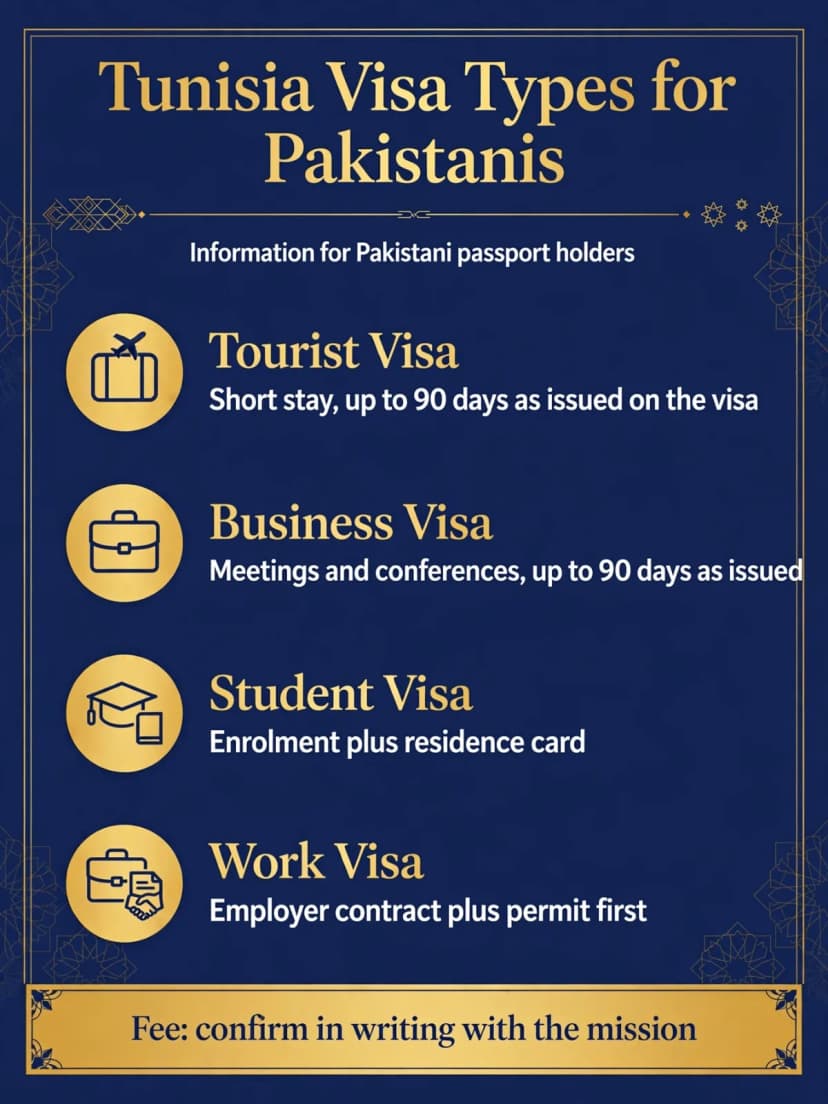
Tunisia issues visas by purpose, not by a single tourist label. The short-stay visa, often called a court séjour visa, is the umbrella for most visits of up to 90 days, and the purpose written on it, tourism, business, family visit, is what the border officer will expect your trip to match. Long-stay visas are a separate track for people who intend to live in Tunisia for work, study or family reunion, and they lead to a residence card, the carte de séjour, issued inside Tunisia. Choosing the wrong purpose is one of the most common reasons for delay, so match the visa to the real reason for your trip and carry proof of that reason.
The tourist visa is the right choice for a holiday: sightseeing in Tunis, Sidi Bou Said, Carthage, Hammamet, Sousse, Djerba, Kairouan, Dougga, Tozeur and the Sahara. It is a single-entry visa in most cases, valid for a fixed period from the date of issue, with the stay allowed printed on the sticker. Third-party sources disagree on the exact stay, and we flag that conflict openly in Section 6: some say the tourist visa allows up to 90 days, others say 30 days. Either way, the visa does not allow paid work, and it does not allow you to enrol in a long course or take a job. If your trip is a holiday and nothing else, this is your visa.
The business visa covers meetings, conferences, contract talks, trade fairs and short professional visits. It uses the same short-stay framework as the tourist visa, usually single or multiple entry, with a stay of up to 90 days as issued. The difference is the sponsor document: a business visa needs an official invitation letter from a Tunisian company or organisation, on its letterhead, naming you, the purpose, the dates and who pays. A hotel booking alone is not enough for a business trip. If you are self-employed in Vietnam, bring your business registration and a letter from your own company too, so the officer can see both sides of the visit.
The family visit visa is for visiting a spouse, parent, child or other close relative who lives legally in Tunisia. It also sits under the short-stay umbrella, and its key document is the invitation from your relative, with proof of their legal residence in Tunisia and proof of your relationship. A family visit is not a way to move to Tunisia. If you intend to live with your family there, you need the long-stay family route and a residence card, not a short visit visa that you then overstay.
The student visa is for a course of study at a recognised Tunisian institution. It starts with an enrolment letter or admission certificate from the institution, and it leads to a residence card once you are in Tunisia. Do not travel on a tourist visa and plan to enrol in a long course after arrival. Schools and universities need the right visa category for registration, and the immigration office needs it for your residence card. If your course is a short language course of a few weeks with no enrolment for a degree, ask the mission whether a tourist visa is enough, and get the answer in writing.
The work visa is the most demanding category, and the one where a shortcut is most likely to hurt you. You cannot get a Tunisian work visa by finding a job after you arrive on a tourist visa. The employer in Tunisia must first obtain approval for your employment contract from the ministry in charge of employment, and the work authorisation must be in place before the visa is issued. Only then do you apply at the mission, and only then do you apply for a residence card after arrival. Section 15 explains this in full, including the online portal the employer uses.
The transit visa is for passing through Tunisia on the way to a third country. It is a short-validity visa, and it matters only if you leave the airport transit area or your connection is long enough to need entry. If your bags are checked through and you stay airside, you may not need one, but you must confirm that with the airline and the mission, because the rule depends on the airport, the airline and your onward visa. A transit visa is not a cheap way to see Tunis for a day. If you want to leave the airport, apply for a tourist visa instead.
4. Tunisia Visa Fees in 2026: What We Could and Could Not Verify
This is the section where honesty matters more than a neat number. No official Tunisian source we could read publishes a single visa fee for a Pakistani passport holder applying at the Beijing or Islamabad mission. The Ministry of Foreign Affairs website, diplomatie.gov.tn, does not carry a public fee table for Pakistanis. The Beijing and Islamabad missions do not publish a fee on a page we could open and verify. The most recent careful check of this question, published in November 2026, reached the same conclusion: the fee is not published officially, and the applicant must ask the embassy. This guide therefore does not state a fee as a fact. It reports the figures that are in circulation, explains why they conflict, and tells you how to get the one figure that counts.
Here are the conflicting figures, with their sources, so you can see the size of the disagreement. The Embassy of Tunisia in Washington publishes USD 90 for a single-entry visa and USD 180 for a multiple-entry visa, payable by money order only, and the same amounts for a transit visa. That is a real published figure from a real Tunisian mission, but it is the Washington mission's local collection rate, not a global fee. A separate research source reports Tunisia's national consular tariff as 120 Tunisian dinars for one entry and 240 dinars for multiple entries for a stay of 1 to 90 days, which converts to roughly USD 40 at November 2026 rates, and notes that the Washington amounts are higher than the national tariff. Other third-party guides quote very different numbers again: about USD 20 to USD 35 for a tourist visa, about USD 60 for a tourist visa, and USD 50 for a student visa and USD 80 for a business visa. One guide quotes a fee in dinars of 10 to 30, which looks far out of date. The range, from about USD 20 to USD 180, is too wide to plan on.
That has practical consequences. Do not send money to any account, agent or website before the mission confirms the fee in writing. Do not pay an agent who quotes a fee without showing you the mission's written reply. Do not assume the fee is refundable if the visa is refused. Washington states plainly that its fee is non-refundable, and that is the normal rule for consular fees everywhere: you pay for the processing, not for the approval. Budget as if the fee will not come back, and keep the payment receipt with your file.
Here is the exact email to send, before you book anything. Write to the mission that will take your file, in English, and keep the reply. Ask these five questions in one message: what is the visa fee for a Pakistani passport holder applying for a short-stay tourist visa, single entry, and for multiple entry? In what currency must I pay, and by what method? Must I apply in person, or can I apply by post or through an authorised representative? What is the current document list for a Pakistani resident in Vietnam, and is there a current application form I should use? And what is the current processing time from submission to passport return? Ask for the answer in writing, save the email, and print it for your file. If the mission replies with a fee, that reply is your fee. If it does not reply, do not guess. Try again, try the phone, and if you still have no answer, consider applying through the Islamabad mission if you will be in Pakistan, where you can ask in person.
5. Processing Time and When to Apply
Like the fee, the processing time for a Tunisian visa is not published as one fixed official figure for Pakistanis applying from Vietnam. What we have instead is a set of mission and third-party estimates that point in the same direction but differ in the details, and the honest way to plan is to take the longest of them. Tunisia's e-Consulate guidance says to allow at least 20 days from submission. The Washington mission tells its applicants to allow up to 21 business days. Third-party guides report 1 to 3 weeks, 2 to 6 weeks, 5 to 10 business days, 10 to 15 business days, and 12 to 26 business days. The spread is wide, but the message is consistent: this is not a fast visa, and it is not a visa you can leave to the last week.
Our advice is to apply at least 6 weeks before your planned departure, and 8 weeks if you can. That gives the mission time to ask for an extra document, to seek approval from the Ministry of the Interior in Tunis if your case needs it, and to return your passport without forcing you to change your flights. Some applications need Interior Ministry approval, and that step is outside the embassy's control and can add days or weeks. First-time applicants, and applicants whose travel history is thin, should expect the longer end of the range. An interview may be requested, and that too adds time.
If the mission asks for an extra document, reply the same day. A slow reply is the most common reason a straightforward application becomes a slow one. Keep a copy of everything you submit, keep the mission's emails, and keep a simple log: date submitted, receipt number if one is given, date of any request, date you replied, and date the passport was returned. That log is your evidence if anything goes wrong, and it is the first thing you will need if you have to ask the mission for an update.
6. How Long Can You Stay? Validity, Entries and Extensions
Short-stay visas for Tunisia are generally framed as up to 90 days, but the exact stay you are allowed is the one printed on your visa sticker, and that sticker is the only figure that counts at the border. This section explains the 90-day figure, the conflicting 30-day figure, and what to do if you need longer.
The 90-day figure is the one most often cited, and it has the strongest official support. Visa-free visitors, including British, American and most European citizens, may stay for up to 90 days. The short-stay visa for visa-required nationals is built on the same framework: a stay of 1 to 90 days, single or multiple entry, with the exact number of days set by the mission. The Tunisian national tariff itself is priced for an entry and stay of 1 to 90 days. If your visa says 90 days, you may stay for up to 90 days from the date of entry, and you must leave on or before the last day printed on the visa.
Against that, some third-party guides written for Pakistanis say the tourist visa allows a maximum stay of 30 days, valid for 3 months from the date of issue. That may reflect what a particular mission issued to a particular applicant, or it may reflect an older practice. We could not verify a 30-day rule in any official source, and we do not state it as a fact. What it tells you is that missions do issue shorter stays, and that you cannot assume 90 days until you see the sticker. If your visa says 30 days, your allowed stay is 30 days, even if another traveller's visa said 90.
Validity and stay are two different things, and confusing them causes overstays. Validity is the window in which you may enter Tunisia, for example 3 months or 6 months from the date of issue. Stay is the number of days you may remain after you enter. A visa valid for 6 months with a 30-day stay does not let you stay for 6 months. It lets you enter at any point in those 6 months and stay for up to 30 days from the day you arrive. Read both dates on the sticker before you fly, write them down, and set a reminder for two days before the last day of your stay.
If you need to stay longer than your visa allows, do not simply stay. Apply for an extension before your current stay expires. Extensions are handled inside Tunisia by the Ministry of the Interior and the local police, through the district police station for your place of residence, and you should apply well before the expiry date. Some sources say to apply at least 15 days before expiry. The extension is not guaranteed, and you will need a reason, proof of accommodation, proof of funds, and your passport with its entry stamp. If the extension is refused, leave before your visa expires.
Overstaying has real consequences. The UK travel advice is plain: border officials stamp your passport on arrival and check the length of your stay on departure, and if you overstay the 90-day period without a valid reason, you will have to pay a fine. Pakistan's embassy in Tunis warns Pakistanis that overstaying can lead to heavy fines. Some sources cite a fine of up to 50 dinars per day, but we could not verify that figure in an official source, so we do not state it as a fact. What is certain is that an overstay can mean a fine, a delay at the airport, and a record that makes a future visa harder to get. If you realise you will overstay, go to the police station before the expiry date, explain the situation, and ask for an extension or for permission to leave. Do not wait until you are at the airport.
7. Where to Apply from Vietnam: The Nearest Tunisian Mission
There is no Tunisian embassy or consulate in Vietnam. That is the fact that shapes everything else in this guide, and it is the reason you must plan the application as a project, not as a form you fill in online. The mission responsible for Vietnam is the Embassy of Tunisia in Beijing, which is listed as concurrently accredited for Vietnam, Cambodia, Laos, Mongolia and North Korea. A non-resident Tunisian ambassador to Vietnam has also been received in Hanoi, which confirms the accreditation but does not create an office you can visit in Vietnam.
The Beijing mission's published contact details, as listed in embassy directories, are: No. 1, San Li Tun Dong Jie, Chaoyang District, Beijing 100600, China; telephone +86 10 6532 2435, with further lines +86 10 6532 2436, +86 10 6532 7688 and +86 10 6532 5688; fax +86 10 6532 5818; visa office telephone +86 10 6532 5044; email at_beijing@netchina.com.cn, also listed as at.pekin@diplomatie.gov.tn; and the mission page on the Ministry of Foreign Affairs website, diplomatie.gov.tn. Office hours are generally Monday to Friday, 9:00 to 12:00 and 13:30 to 17:00, but you must confirm the current hours and whether an appointment is needed before you travel. Embassy details change, and a directory listing is not a guarantee that a phone number or email still works.
Before you do anything else, email the Beijing mission and ask the five questions from Section 4, plus one more that matters most from Vietnam: does the mission accept visa applications from a Pakistani citizen who is legally resident in Vietnam, and if so, must I appear in person in Beijing, or can I apply by post, by courier, or through an authorised representative? The answer decides whether you need a trip to China, a Chinese visa for that trip, and the cost that goes with it. Do not assume that concurrent accreditation means postal applications are accepted. Many embassies are accredited for a country but still require in-person submission, fingerprints and an interview. Others accept postal files from residents of the accredited country. Only Beijing can tell you which rule applies to you.
The alternative route is the Embassy of Tunisia in Islamabad, if you will be in Pakistan. Its address is 50 Main Margalla Road, Sector F-7/2, Islamabad, telephone +92 51 2652781. This is the mission that handles Pakistani applicants who live in Pakistan, and it is the natural choice if you are visiting family in Pakistan before your Tunisia trip. It is not a shortcut from Vietnam: you would need to be in Pakistan to apply there, and you would need to show that you are applying from your country of nationality, which is straightforward if you are there. If you live in Vietnam and are not planning a Pakistan trip, Islamabad is not a practical alternative, and you should not fly to Pakistan only to apply for a Tunisia visa unless Beijing has refused to take your file.
One more practical point. Keep the Pakistan Embassy in Tunis in your contacts for the trip itself, not for the visa. Its chancery is at Avenue Habib Achour, Place Tahar Hadded, B.P. 56-1053, Les Berges du Lac I, Tunis, telephone +216 71 860286 and +216 71 860404, email pareptunis@mofa.gov.pk. It cannot issue you a Tunisian visa, and it cannot override a Tunisian immigration decision, but it can help if you lose your passport, need emergency help, or face a legal problem in Tunisia. Save its number in your phone before you fly, and keep a copy of your passport and visa separate from the originals.
8. How to Apply: Step-by-Step
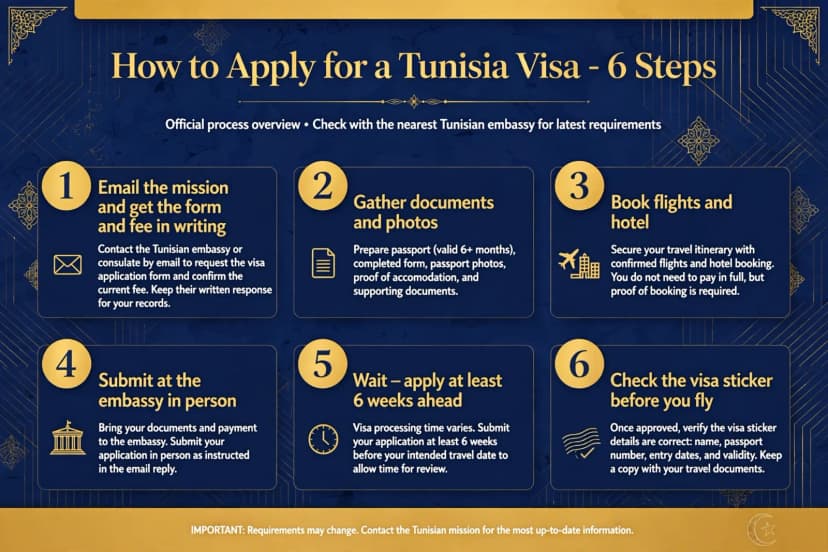
The application follows the same shape as most embassy visas, but the order matters more than usual for Tunisia, because the fee, the form and the submission method are all set by the mission, not by a website. Follow the steps in this order, and do not skip the first one.
Step 1: Email the mission. Write to the Embassy of Tunisia in Beijing, or to Islamabad if you will apply from Pakistan, and ask for the current application form, the current document list, the fee and payment method, the processing time, and whether you must appear in person. Use a clear subject line, such as "Visa application enquiry — Pakistani passport holder resident in Vietnam". Give your full name as in your passport, your passport number, your Vietnamese residence status, your planned travel dates, and the purpose of your trip. Keep the reply. It is the most important document in your file, because it is the only written source for the fee and the submission method.
Step 2: Get the form and fill it in. The Tunisian visa form is a bilingual French and Arabic form, known as the Demande de Visa, and some missions provide an English version or an English guide. Fill it in by hand in clear block letters, or type it if the mission allows, and sign it yourself. Use your name exactly as it appears in your passport, including the spelling and the order of your names. Give your current address in Vietnam, your employer or school in Vietnam, your travel dates, and the address of your hotel or host in Tunisia. If a question does not apply to you, write "not applicable" rather than leaving it blank. A blank field looks like a forgotten field, and a forgotten field is a reason to send the file back.
Step 3: Gather your documents. Use the checklists in Section 9 and Section 10. Get your passport photos taken to the mission's specification, usually two recent colour photos on a white background, and do not reuse an old photo. Ask your bank for a stamped statement, ask your employer for a letter if you are employed, and ask your hotel for a booking confirmation that shows your name, the dates and the address. Make a photocopy of every document, and keep the copies separate from the originals. If any document is in Urdu, get it translated into English, French or Arabic, and ask the mission whether the translation needs to be certified.
Step 4: Book your travel, but keep it flexible. Make a flight booking that shows your name, the route and the dates, and a hotel booking that shows your name and the address in Tunisia. A booking is usually enough; a paid, non-refundable ticket is not required at the application stage, and you should not buy one. If the mission asks for a confirmed ticket, ask whether a reservation or a held booking is enough, and get the answer in writing. The same applies to the hotel: a booking you can cancel is better than a prepaid room you cannot get back if the visa is delayed.
Step 5: Submit the file. Go to the mission in person if that is what it requires, with your passport, the form, the photos, the documents and the fee, in the exact payment method the mission specified. Arrive early, dress neatly, and bring the originals and the copies. If the mission accepts postal applications, send the file by a tracked courier, include a prepaid tracked return envelope, and keep the tracking number. Do not send your original passport by ordinary post. If the mission takes fingerprints, expect them to be taken at submission. If it asks for an interview, answer in English or French, state the purpose of your trip plainly, and do not add details that are not in your file.
Step 6: Wait, and reply fast. Do not chase the mission every day. Wait for the time it quoted, then ask once, politely, by email, giving your name, passport number and date of submission. If the mission asks for an extra document, send it the same day, by the method it asks for. If the mission asks for an interview, attend on the date given. A missed interview or a slow reply is the easiest way to turn a straightforward application into a refusal.
Step 7: Check the visa before you fly. When your passport comes back, check the sticker before you leave the mission or before you open the courier parcel at home. Check your name, your passport number, the dates of validity, the number of entries, and the number of days allowed. If anything is wrong, tell the mission at once. A mistake on the sticker is far easier to fix before you fly than at the airport in Tunis. Photocopy the sticker, keep a photo of it on your phone, and carry the original passport with the visa inside it for the whole trip.

9. Complete Document Checklists
The mission sets the final list, and it may ask for more than this guide lists. Treat these checklists as the complete starting point, and add anything the mission asks for in writing. Prepare originals and one photocopy of each document, and keep the copies in a separate folder.
Tourist visa checklist
- Pakistani passport, valid for at least 6 months beyond your arrival date, with at least 2 blank pages, plus a photocopy of the data page and of any previous visas.
- Completed and signed Tunisian visa application form, the Demande de Visa, in the version the mission gave you.
- Two recent colour passport photos, white background, taken within the last 6 months, with your full face visible and no glasses that hide your eyes.
- Hotel booking confirmation in Tunisia, showing your name, the hotel address, and the dates of your stay, for the whole trip.
- Return or onward flight booking, showing your name, the route and the dates.
- Bank statement for the last 6 months, stamped by the bank, showing a stable balance and regular income, plus an account maintenance certificate if the mission asks for one.
- Travel insurance covering medical treatment and emergency return, for the whole trip, with the policy number and the insurer's contact details.
- Proof of your legal residence in Vietnam: your temporary residence card, or your long-term Vietnamese visa and your work permit or employment letter, plus a photocopy.
- Proof of employment or study in Vietnam: an employer letter stating your job, your salary, your leave dates and that you will return to work, or a student enrolment letter if you are a student.
- CNIC, your Pakistani national identity card, or a photocopy, if the mission asks for it. Some missions ask for it as proof of identity and nationality.
- Visa fee, in the exact amount, currency and payment method the mission confirmed in writing.
- Prepaid tracked return envelope, if you apply by post and the mission asks for one.
Business visa checklist
- Everything in the tourist checklist above.
- Official invitation letter from the Tunisian company or organisation, on its letterhead, naming you, the purpose of the visit, the dates, the places you will visit, and who will pay for the trip.
- Letter from your employer or your own company in Vietnam, stating your job, the purpose of the trip, and that you will return to Vietnam.
- Business registration or trade licence for your company in Vietnam, if you are self-employed or the owner of the business.
- Evidence of the business relationship, such as past emails, contracts, invoices or a trade fair registration, if you have them.
Family visit visa checklist
- Everything in the tourist checklist above.
- Invitation letter from your relative in Tunisia, with their full name, address, telephone number, and their legal status in Tunisia.
- Photocopy of your relative's Tunisian identity card or residence card, and proof of their address in Tunisia.
- Proof of your relationship, such as a marriage certificate, birth certificate or NADRA family registration certificate, with a translation if it is in Urdu.
- If your relative will pay for your stay, a letter from them saying so, with proof of their income or bank statement.
Student visa checklist
- Everything in the tourist checklist above.
- Admission or enrolment letter from the recognised Tunisian institution, stating the course, the start and end dates, and the fees.
- Proof that you have paid the tuition fee or part of it, or a scholarship letter if you hold one.
- Proof of funds for the course and for living costs in Tunisia, in your name or in your sponsor's name, with a sponsorship letter if a parent or relative is paying.
- Your educational certificates, such as your degree or school certificates, with translations if needed.
- Police clearance certificate, if the mission or the institution asks for one.
Work visa checklist
- Everything in the tourist checklist above.
- Employment contract approved by the Tunisian ministry in charge of employment, with the approval reference.
- Work authorisation from the ministry, obtained by your employer in Tunisia before you apply.
- Letter from the employer stating your job, your salary, your place of work, and the length of the contract.
- Your qualifications and work certificates, with translations if needed.
- Police clearance certificate, if the mission asks for one.
10. Documents for Children and Family Applications
Children need their own visa, even if they travel on a parent's passport or are listed in it. Each child needs a separate application form, separate photos, and a separate fee, if the mission charges one for children. Do not assume a child can travel on your visa. Apply for the whole family at the same time, and submit the files together, so the mission can see that you are travelling as a family.
For each child, prepare the child's own passport if the child holds one, or the page of the parent's passport where the child is listed, with a photocopy. Prepare the child's birth certificate, with a translation if it is in Urdu, and the parents' passports and CNICs. If only one parent is travelling with the child, prepare a written consent letter from the other parent, signed and dated, stating that the child may travel to Tunisia with the travelling parent, on the dates given, with a photocopy of the other parent's passport or CNIC attached. If the other parent is deceased, bring the death certificate. If you are the child's legal guardian and not a parent, bring the court order or guardianship document that proves it.
Families should also prepare a single travel plan that covers everyone: the same flights, the same hotel, and the same dates. If the hotel booking lists only one adult, ask the hotel to add the children's names, or to confirm in writing that children are included in the booking. A hotel booking that does not mention the children can cause a delay, because the officer cannot see where the children will stay.
11. Money, Bank Statements and Proof of Funds
Tunisia does not publish a fixed amount of money you must show, and this guide does not invent one. What the mission wants to see is that you can pay for your trip and return home without working illegally or running out of money. That is judged from your bank statement, your income, and the length and cost of your trip, taken together. A short trip with a modest hotel and a return ticket needs less money than a long trip with a luxury hotel, and the statement should match the trip you have planned.
Prepare a bank statement for the last 6 months, stamped and signed by your bank, showing your name, your account number, and a stable balance. The statement should show regular income, such as a salary coming in each month, and regular spending, not a single large deposit made the week before you apply. A large deposit with no explanation looks like borrowed money, and the mission may ask where it came from. If you received a genuine large payment, such as a bonus or a sale, bring proof of it: a salary slip, a sale contract, or a letter from your employer.
Some guides for Pakistanis quote a closing balance of 1,000,000 to 2,000,000 Pakistani rupees, or 800,000 to 1,800,000 rupees, with an account maintenance certificate. Those figures come from agents and third-party guides, not from an official Tunisian source, and they are written for applicants in Pakistan, in rupees. If you live in Vietnam and earn in dong or dollars, your statement will be in that currency, and the mission will judge it in that currency. Do not convert your balance into rupees to match a figure from a blog. Show the real statement, in the real currency, and let the mission judge it.
Carry enough money for the trip itself. Tunisia's currency is the Tunisian dinar, and you cannot take dinars into the country: the import of Tunisian currency is prohibited. Bring euros, US dollars or another major currency, and exchange it at a bank or an authorised exchange office after arrival. You must declare cash above 10,000 dinars or the equivalent in foreign currency on arrival, and you must declare amounts above 5,000 dinars if you wish to take that amount out again on departure. Keep your exchange receipts, because you can re-exchange up to 3,000 dinars into foreign currency on departure with the original receipt. Do not change money on the street, and do not carry more cash than you need.
12. Flights, Hotels and Travel Insurance
There is no direct flight from Vietnam to Tunisia. The usual routes from Ho Chi Minh City or Hanoi go through Istanbul with Turkish Airlines, through Doha with Qatar Airways, through Dubai with Emirates, or through Paris or Frankfurt with a European carrier. The flight takes about 16 to 20 hours including the connection, and the price depends on the season, the route and how early you book. Summer and the Eid holidays are the most expensive times. Book a route with a single connection if you can, and leave at least 3 hours between flights, so a delay on the first leg does not make you miss the second.
Check the transit rules for your connection airport before you book. A connection through Istanbul, Doha or Dubai on a single ticket, staying airside, does not normally need a transit visa for a Pakistani passport holder, but the rule depends on the airport, the airline and whether you need to collect and re-check your bags. A connection through Paris, Frankfurt or another Schengen airport may need an airport transit visa, even if you stay airside, depending on your passport and your onward visa. Ask the airline in writing, and if the airline says you need a transit visa, get it before you fly. Do not assume that a transit through Europe is free of paperwork.
For the visa file, your hotel booking must show your name, the hotel address, the check-in and check-out dates, and the number of guests. A booking for the whole trip is best. If you plan to stay in more than one place, show a booking for each place, in date order, so the officer can follow your trip from arrival to departure. If you will stay with a friend or relative, the invitation letter replaces the hotel booking, but it must give the host's full address and telephone number, and the host should attach proof of their address.
Travel insurance is not a formality. It should cover medical treatment, hospital stay and emergency return to Vietnam or Pakistan, for the whole trip, with a minimum cover that the mission accepts. Ask the mission whether it sets a minimum amount, and buy a policy that clearly exceeds it. Keep the policy certificate in English, with the policy number, the insurer's name, and a 24-hour emergency telephone number. Carry a printed copy in your hand luggage and a photo of it on your phone. If you need medical care in Tunisia, the insurer's emergency line is the first number to call, not the hotel reception.
13. Arrival in Tunisia: Immigration, Stamps and Customs
On arrival at Tunis-Carthage or your airport of entry, you will go through immigration, then baggage collection, then customs. Have your passport open at the visa page, and your hotel booking and return flight booking ready on paper or on your phone. The officer may ask for your contact details in Tunisia, your onward or return ticket, and proof of your hotel booking or other accommodation. Those are the three things the UK travel advice says officers have the right to ask for, and they are the three things you should have ready. Answer in English or French, state the purpose of your trip as it is written on your visa, and do not offer extra information the officer has not asked for.
Make sure your passport is stamped. The UK advice is explicit on this point: get your passport stamped on arrival, because officials check the length of your stay on departure. If the officer does not stamp it, ask politely for the stamp before you leave the desk. The stamp is your proof of the date you entered, and without it you may face questions, a fine or a delay when you leave. Check the stamp before you walk away: the date should be the date of arrival, and it should be legible.
Customs rules are straightforward but strict. The import of Tunisian dinars is prohibited, so do not bring dinars with you. Declare cash above 10,000 dinars or the equivalent in foreign currency. Do not bring more cash than you need, and keep the declaration form if you are given one. On departure, the export of Tunisian dinars is also prohibited, and you may only take out up to 5,000 dinars or the equivalent in foreign currency if you declared that amount on arrival. Keep your exchange receipts for the whole trip, and re-exchange your leftover dinars before you leave, up to 3,000 dinars with the original receipt.
Safety in Tunisia needs a calm, honest note. The US travel advice for Tunisia is Level 2, Exercise Increased Caution, because of terrorism, with higher-risk areas near the borders with Libya and Algeria, in the mountainous west, and in the desert south of Remada, which is a military zone. The UK advice gives the same regional warnings. The tourist areas of Tunis, Hammamet, Sousse, Monastir and Djerba are visited by millions of people each year without incident, but you should still take the normal precautions: keep your passport and money secure, do not photograph government buildings, police or military sites, ask before photographing people, and follow the advice of your hotel and your tour guide in the south. Register your trip with your embassy if it offers a registration service, and keep the Pakistan Embassy number in Tunis in your phone.
14. Transit Through Tunisia
Most readers will not need a transit visa, because they will fly into Tunisia as their destination. A transit visa matters in two cases: when you change planes in Tunisia on the way to a third country, and when you enter Tunisia by land or sea on the way to somewhere else. In both cases, the rule depends on whether you leave the transit area, and on how long you stay.
If you fly into Tunis-Carthage on one ticket and out on another, with your bags checked through and without leaving the transit area, you may not need a transit visa. But you must confirm that with the airline before you book, because the rule depends on the airport, the airline, and whether the two flights are on the same booking. If you need to collect your bags, change terminal, or pass through immigration to check in for the next flight, you will need a visa, and a transit visa may be the right one. If your connection is longer than a few hours and you want to leave the airport to see Tunis, apply for a tourist visa instead, because a transit visa is not meant for sightseeing.
15. Working, Studying and Living Longer in Tunisia
A tourist visa does not allow you to work in Tunisia, and it does not allow you to take a long course of study or to live there. This section explains what is allowed, what is not, and how the legal routes work, so you do not lose a future visa by breaking a rule you did not know existed.
Paid work in Tunisia needs three things, in this order: a job offer from a Tunisian employer, an approved employment contract, and a work visa followed by a residence card. The employer starts the process. It submits your contract for approval to the ministry in charge of employment, and the approval is filed through the ministry's online portal or through the Directorate-General for Foreign Placement and Foreign Labour in Tunis. Only when the contract is approved and the work authorisation is issued do you apply for a work visa at the mission. Only after you arrive do you apply for a residence card at the local police station. If an employer tells you to come on a tourist visa and it will sort the paperwork after you arrive, do not accept. That is not how the system works, and it leaves you working illegally, without a contract, without insurance, and at risk of a fine, deportation and a future ban.
Study in Tunisia follows a similar shape. You apply to a recognised institution, you receive an admission or enrolment letter, you apply for a student visa at the mission, and after arrival you apply for a residence card. The institution should be able to tell you which documents it needs, and whether it will help with the residence card. If you are coming for a short course of a few weeks, ask the mission whether a tourist visa is enough, and get the answer in writing. If you are coming for a degree, a diploma or a course of more than three months, a student visa and a residence card are the route. Do not pay tuition fees to an institution you have not verified, and do not send money to a personal account. Pay the institution through its official account, and keep the receipt.
For any long stay, the residence card is the document that makes your stay legal after the first three months. It is applied for at the police station for your place of residence, and the file usually includes your passport with its entry stamp, recent photos, proof of accommodation, the document that justifies your stay, and a revenue stamp. The authorities may ask for translations into Arabic or French, or for legalised copies. The process can take several weeks, and you may receive a temporary certificate while the card is being made. Renew the card before it expires, with an updated file, and keep a copy of every renewal. A gap in your residence record is hard to explain later.
16. Official Websites
| Source | Website |
|---|---|
| Tunisia Ministry of Foreign Affairs | https://www.diplomatie.gov.tn/ |
| Tunisia Ministry of the Interior — visa page | https://www.interieur.gov.tn/en/visa |
| Embassy of Tunisia in Beijing (MFA mission page) | https://www.diplomatie.gov.tn/en/nc/mission/etranger/ambassade-de-tunisie-a-pekin-chine/ |
| Embassy of Tunisia in Washington — visa services | https://www.tunisianembassy.org/visa-services |
| US State Department — Tunisia travel information | https://travel.state.gov/content/travel/en/international-travel/International-Travel-Country-Information-Pages/Tunisia.html |
| UK FCDO — Tunisia entry requirements | https://www.gov.uk/foreign-travel-advice/tunisia/entry-requirements |
| UK FCDO — Tunisia travel advice | https://www.gov.uk/foreign-travel-advice/tunisia |
| Pakistan Ministry of Foreign Affairs — Tunis contact | https://mofa.gov.pk/tunis-contact-us |
| Pakistan MOFA — Do's and Don'ts for Pakistanis in Tunisia | https://mofa.gov.pk/press-releases/dos-and-donts-for-pakistani-nationals-in-tunisia?mission=Tunis+Embassy+Posts |
| Pakistan MOFA — Legal requirements in Tunisia | https://mofa.gov.pk/press-releases/legal-requirements-for-visit-work-marriage-in-tunisia |
| Tunisia National Tourist Office | https://www.discovertunisia.com/en |
| TravelHealthPro — Tunisia health advice | https://travelhealthpro.org.uk/country/229/tunisia |
| IATA Travel Centre — Tunisia entry rules | https://www.iatatravelcentre.com/TN-Tunisia-customs-currency-and-airport-tax-regulations.htm |
| Embassy of Tunisia in Islamabad — directory listing | https://www.embassypages.com/tunisia-embassy-islamabad-pakistan |
| Wikipedia — Visa policy of Tunisia | https://en.wikipedia.org/wiki/Visa_policy_of_Tunisia |
| Wikipedia — List of diplomatic missions of Tunisia | https://en.wikipedia.org/wiki/List_of_diplomatic_missions_of_Tunisia |
| UrduPoint — Tunisia visa for Pakistanis 2026 | https://www.urdupoint.com/travel/visa/tunisia.html |
| VisaCross — Pakistan to Tunisia tourist visa | https://visacross.com/visa/pakistan-to-tunisia/tourist-visa |
| Travel Visa Stack — Tunisia visa for Pakistan citizens | https://www.travelvisastack.com/visa-guide/pakistan/tunisia |
| Compass Relocation — Residence permits in Tunisia | https://compassrelocation.tn/news/expat-residence-permits-tunisia/ |
17. Frequently Asked Questions
Do Pakistani passport holders need a visa for Tunisia?
Yes. An ordinary Pakistani passport is not on Tunisia's visa-free list, so you need a visa before you travel. You must apply at a Tunisian embassy or consulate, because there is no official e-visa and no general visa on arrival for an ordinary Pakistani passport. Holders of Pakistani diplomatic passports are visa-exempt for up to 90 days, but that does not cover ordinary passport holders.
Is there a Tunisia e-visa for Pakistanis?
No. Tunisia does not operate a general official e-visa portal. A tender to build a national e-visa platform was launched in September 2024 and declared unsuccessful in August 2025. Any website that offers you a Tunisia e-visa online is not the Tunisian government. Apply at the embassy, and do not pay or upload your passport to an e-visa site.
Can I get a visa on arrival in Tunis?
No, not on an ordinary Pakistani passport. Tunisia has no general visa-on-arrival programme for tourism or business. The only visa-on-arrival rule we found is a narrow one for holders of a valid Gulf residence permit, for up to 15 days, and it does not apply to a Pakistani resident in Vietnam who holds no Gulf permit. Do not fly without a visa and hope to buy one at the airport.
Where do I apply for a Tunisia visa if I live in Vietnam?
There is no Tunisian embassy in Vietnam. The Embassy of Tunisia in Beijing is concurrently accredited for Vietnam, so it is the mission to contact first. Its address is No. 1, San Li Tun Dong Jie, Chaoyang District, Beijing, telephone +86 10 6532 2435, email at_beijing@netchina.com.cn. Email it before anything else and ask whether it accepts your file by post or needs you in person, and what fee it charges.
Can I apply at the Embassy of Tunisia in Islamabad instead?
Yes, if you are in Pakistan. The Islamabad mission, at 50 Main Margalla Road, Sector F-7/2, telephone +92 51 2652781, handles applicants who live in Pakistan. It is the natural choice if you are visiting Pakistan before your trip. It is not a practical alternative from Vietnam unless you are already planning to be in Pakistan, because you would need to travel there to apply.
How much is the Tunisia visa fee for Pakistanis?
There is no officially published fee for Pakistanis at the Beijing or Islamabad mission that we could verify, so this guide does not state one as a fact. The Washington mission publishes USD 90 for a single entry and USD 180 for multiple entries, and a national tariff of 120 dinars for one entry and 240 dinars for multiple entries is also reported, while third-party guides quote USD 20 to USD 60. Those figures conflict because fees vary by mission and nationality. Get the fee in writing from the mission that takes your file, in the currency and by the method it specifies, before you pay.
How long does a Tunisia visa take to process?
There is no single officially published processing time. Tunisia's e-Consulate guidance says to allow at least 20 days, the Washington mission says up to 21 business days, and third-party guides report 1 to 3 weeks, 2 to 6 weeks, or 12 to 26 business days. Plan on the longest of these and apply at least 6 weeks before travel, or 8 weeks if you can. Some cases need approval from the Ministry of the Interior in Tunis, which can add time.
How long can I stay in Tunisia on a tourist visa?
Most sources say a short-stay visa allows up to 90 days, and the national tariff is priced for a stay of 1 to 90 days. Some guides written for Pakistanis say the tourist visa allows 30 days. The figure that counts is the one printed on your visa sticker: the number of days allowed and the dates of validity. Read the sticker before you fly, and do not stay a single day beyond it without an extension.
How long must my passport be valid for Tunisia?
Carry a passport valid for at least 6 months beyond your arrival date, with at least 2 blank pages. The US State Department asks for 6 months, and several guides for Pakistanis ask for 6 months and 2 blank pages. The UK advice asks only for validity for the duration of the stay, but 6 months is the safe rule, and it is the rule the mission is most likely to apply to a Pakistani applicant.
What documents do I need for a Tunisia tourist visa?
Your passport, the completed visa form, two recent photos, a hotel booking or an invitation letter, a return flight booking, a 6-month bank statement, travel insurance, and proof of your legal residence in Vietnam, such as your residence card or long-term visa and work permit. If you are employed, add an employer letter. If you are visiting family, add the invitation and proof of relationship. The mission may ask for more, so treat its written list as final.
Do I need a bank statement, and how much money should I show?
Yes, a bank statement for the last 6 months, stamped by your bank, is a standard requirement. Tunisia does not publish a fixed amount you must show, so do not chase a figure from a blog. Show a stable balance and regular income that match the length and cost of your trip, and explain any large deposit. If someone else is paying, bring their sponsorship letter and bank statement as well.
Can I work in Tunisia on a tourist visa?
No. A tourist visa does not allow paid work of any kind. To work legally, your Tunisian employer must first get your employment contract approved by the ministry in charge of employment, then you apply for a work visa, and after arrival you apply for a residence card. Working on a tourist visa can lead to a fine, deportation and a ban on future entry.
Can I extend my stay once I am in Tunisia?
Yes, you can apply for an extension before your current stay expires, through the Ministry of the Interior and the local police station for your place of residence. Apply well before the expiry date, with your passport, proof of accommodation, proof of funds and a reason for the extension. For a stay beyond three months, you need a residence card, the carte de séjour, not just an extension. An extension is not guaranteed.
What happens if I overstay my Tunisia visa?
You will have to pay a fine, and you may face a delay at the airport and a record that makes a future visa harder to get. Pakistan's embassy in Tunis warns that overstaying can lead to heavy fines, and the UK advice confirms a fine on departure. If you realise you will overstay, go to the police station before your visa expires and ask for an extension or for permission to leave. Do not wait until you are at the airport.
Do I need travel insurance and a polio certificate for Tunisia?
Travel insurance is a standard requirement for the visa file, and you should carry it for the whole trip, covering medical treatment and emergency return. There is no mandatory vaccine for entry to Tunisia, and no polio certificate is required by Tunisia itself. But if you leave Pakistan, Pakistan requires proof of polio vaccination for travellers departing the country, so carry your NADRA polio certificate if your journey starts in Pakistan.
This guide was checked on 29 November 2026 against the official and third-party sources listed in Section 16, and the fee and processing time were deliberately left as "confirm in writing with the mission" because no official source publishes them for a Pakistani passport holder applying from Vietnam. Visa rules change without notice, the mission that takes your file sets the final fee, document list and processing time, and the immigration officer at the airport makes the final decision on whether you may enter Tunisia. This guide does not guarantee visa approval or entry, and no fee paid to any embassy, agent or website can buy a guarantee. Check the official sources again before you book, get the mission's reply in writing, and travel only with a valid visa in a valid passport.


