


Togo Visa Guide 2026: Types, Requirements, Documents and Application Steps
Last checked: 29 November 2026. This guide is for Pakistani passport holders living in Vietnam. Visa rules change without notice — always confirm the live rules on the official Togo Voyage portal (voyage.gouv.tg) and the UK Foreign, Commonwealth and Development Office (FCDO) Togo travel advice page before paying any fee or booking a non-refundable ticket.
Introduction
Togo is a small West African country on the Gulf of Guinea, squeezed between Ghana to the west and Benin to the east, with Burkina Faso to the north and just 56 kilometres of Atlantic coastline. Its capital, Lomé, sits right on the Ghanaian border and is the country's main gateway: most visitors arrive at Lomé–Tokoin International Airport, officially Gnassingbé Eyadéma International Airport (LFW). Beyond the capital, Togo offers the colourful Grand Marché, the lagoon town of Togoville, the green coffee hills and waterfalls around Kpalimé, and the UNESCO-listed earth tower-houses of Koutammakou in the north — although the far north is currently covered by government travel warnings, which this guide covers in the safety notes below.
For a Pakistani passport holder living in Vietnam, the headline is simple and good news: Togo runs a genuine online e-visa system, and you do not need to visit an embassy to get a short-stay visa. The whole application happens on the official Togo Voyage platform at voyage.gouv.tg, you pay online by card, and the approved e-visa arrives by email as a document to print. The fee depends on how long you want to stay and whether you want single or multiple entry, starting at 25,000 West African CFA francs (XOF) for a 1–15 day single-entry visa — about US$40 according to the US Department of State. Processing takes a maximum of five working days, and you must apply at least five working days before you arrive.
The details matter more than the headline, though. Togo no longer issues visas on arrival, so arriving without an approved e-visa means being turned back. A yellow fever vaccination certificate is mandatory for every traveller over one year old, with no exceptions reported. Every traveller, visa holder or not, must also complete an online registration certificate before arrival and again before departure. And several sources disagree on the finer points — how early to apply, how much passport validity you need, and which portal address is current — so this guide names each conflict, says which source controls, and tells you the safest reading. Nothing in this guide is invented: where no official fee or time limit is published, the guide says so plainly and tells you to confirm it in writing before you pay or book.
Do Pakistani Passport Holders Need a Visa for Togo?
Yes. Pakistani passport holders need a visa to enter Togo. Pakistan is not on any Togolese visa-exemption list, and there is no visa-free or visa-on-arrival route for a Pakistani ordinary passport. The rule on the official Togo Voyage platform is that, as a general rule, all foreigners need a visa to enter Togo unless they are exempt, and the exemptions do not cover Pakistan.
The exemptions that do exist are worth knowing so you are not misled by a general travel website. Citizens of ECOWAS member states — Benin, Burkina Faso, Cape Verde, Côte d'Ivoire, The Gambia, Ghana, Guinea, Guinea-Bissau, Liberia, Mali, Niger, Nigeria, Senegal, Sierra Leone and Togo itself — enter without a visa. Since 18 May 2026, all other African Union member states have also been granted visa-free entry for up to 30 days, and Morocco has a bilateral 90-day exemption. Pakistan is not an African Union member, so none of this helps a Pakistani passport holder. If a website tells you Togo is visa-free or visa-on-arrival for Pakistanis, it is out of date or wrong: several older lists still show Togo as visa-on-arrival for Pakistan, because that was the position before the e-visa system replaced arrival visas. Do not rely on those lists, and do not book a flight expecting to buy a visa at Lomé airport.
The visa you need is an e-visa, applied for and approved online before you travel. The UK FCDO states it plainly for its own citizens, and the same system applies to Pakistanis: you must have a visa to visit Togo, you must apply for an e-visa at least five working days before you plan to arrive, and you cannot get a visa on arrival. The US Department of State says the same thing in its Togo country information: a visa is required, and you must apply through Togo's e-visa system before you arrive in Togo.
Your passport itself must be in order before you start. The FCDO requires your passport to have an expiry date at least three months after the date you plan to leave Togo. The US Department of State goes further and says your passport must have six months' validity beyond your arrival date, plus two blank pages for entry stamps. Some Togo-focused guides say three months beyond the expiry of the visa. These three measurements conflict, and no single official Togolese page settles the question for Pakistani applicants. The controlling sources for this guide are the FCDO and the US State Department, and the safest reading that satisfies both is to travel with a passport valid for at least six months beyond your planned return date and with at least two blank pages. If your passport has less than six months left, renew it in Vietnam or Pakistan before you apply — a short-validity passport is one of the easiest refusals to avoid.
Types of Togo Visas for Pakistani Passport Holders
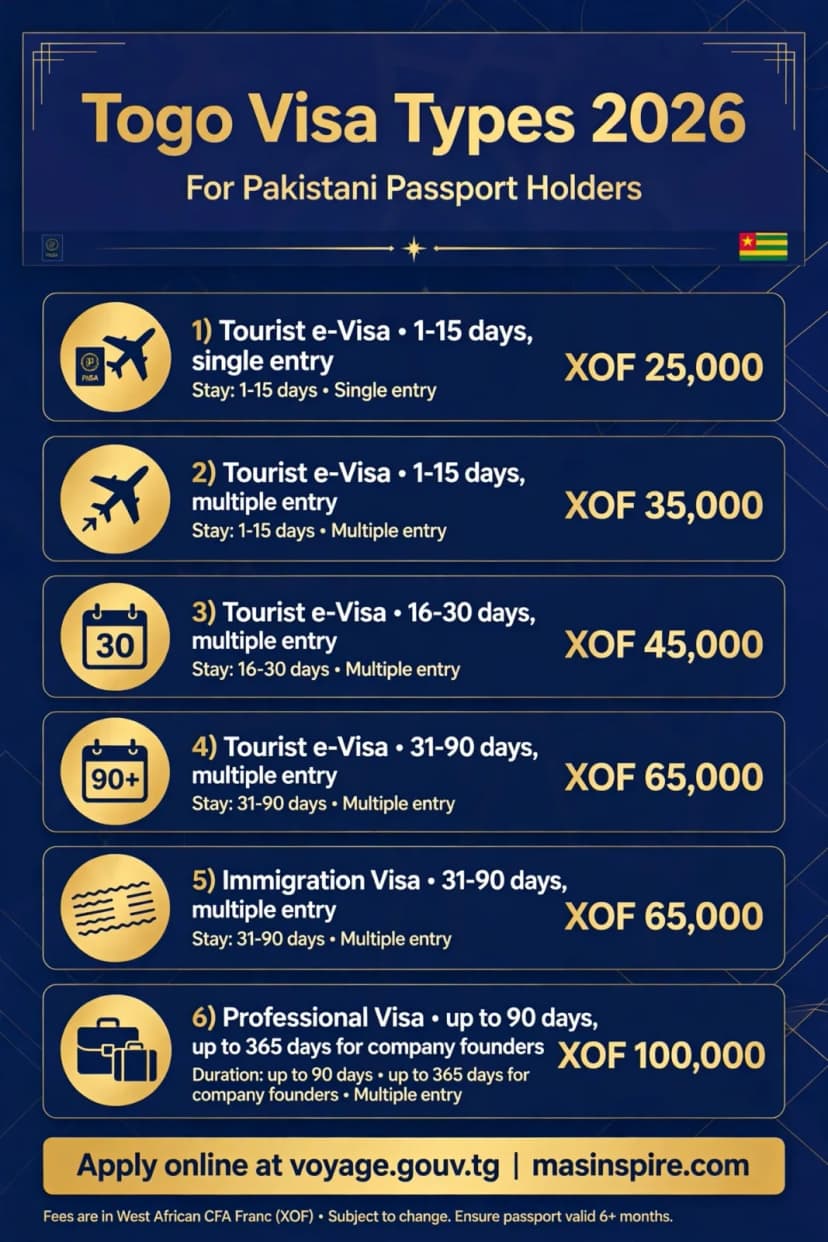
Togo offers four visa types on its official platform: tourist, immigration, professional and courtesy. For a Pakistani living in Vietnam, the tourist e-visa covers almost every short visit — holidays, visiting friends or family, and business meetings that do not involve paid work in Togo. The immigration visa is the route for settling in Togo for work, study or family reunification. The professional visa covers longer business assignments. The courtesy visa is a free multiple-entry visa for official representatives, which will not apply to most readers and is included here only so you recognise it if you see it listed. There is no separate published transit-visa fee, no published family-visit visa class distinct from the tourist visa, and no digital-nomad visa for Togo — if an agent offers you one of those, ask to see it on voyage.gouv.tg before paying anything.
The tourist e-visa is the visa most readers will apply for. It is issued for 1–15 days, 16–30 days or 31–90 days, and the fee rises with the length of stay and with multiple entry. A 1–15 day single-entry tourist e-visa costs 25,000 XOF. The same 1–15 day stay with multiple entry costs 35,000 XOF. A 16–30 day multiple-entry tourist e-visa costs 45,000 XOF, and a 31–90 day multiple-entry tourist e-visa costs 65,000 XOF. The FCDO's short summary mentions only the single-entry tourist visa valid for 15 days, which is the most common grant, but the portal's own fee table lists all four tiers, and the portal is the controlling source for fees because it is the system that actually charges you. Choose the tier that honestly covers your planned stay: a 15-day visa does not become a 30-day visa because your plans changed, and overstaying a short visa to save 20,000 XOF is a false economy.
The immigration visa is the visa for anyone who intends to settle in Togo — for work, for study, or to join family. It lasts 31–90 days, is multiple entry, costs 65,000 XOF, and can be renewed once. The key point is that it is an entry visa, not a residence permit: once you arrive on an immigration visa, you must start the residence-card (carte de séjour) formalities at the Direction Générale de la Documentation Nationale (DGDN) in Lomé. If you arrive on a tourist e-visa and then decide to stay and work, you cannot simply convert it — you would need to leave and apply properly, or regularise through the DGDN, which is slow, uncertain and entirely at the discretion of the Togolese authorities. Apply for the immigration visa from the start if settlement is your plan.
The professional visa is for business people who need more than a short meeting trip. It is normally granted for up to 90 days, and it can be granted for up to 365 days for certain company founders or people with regular professional activity in Togo — for example, a foreign promoter of a company under Togolese law. The fee for a multiple-entry professional visa for 91–365 days is 100,000 XOF. The shorter professional tiers use the same fee table as the tourist visa (25,000 to 65,000 XOF depending on duration and entries), and the exact fee for your case is generated by the portal's visa assistant when you enter your purpose, duration and entry type. A professional visa is not a work permit: it lets you attend meetings, negotiate, supervise a project or set up a business, but paid employment in Togo needs a separate entry authorisation from the Ministry of Security and then a residence card. The work section of this guide explains that chain in full.
Visa Comparison Table
The table below summarises the four visa types, their stay lengths, entries and fees, all in West African CFA francs (XOF), as published on the Togo Voyage fee table and confirmed by the 2026 guides that quote it. The portal's own checkout figure is the final word on the day you pay: if the table below and the portal disagree, trust the portal, screenshot the difference, and do not pay until you understand it.
| Visa type | Stay | Entries | Fee (XOF) | Best for |
|---|---|---|---|---|
| Tourist e-Visa | 1–15 days | Single | 25,000 | Short holiday or family visit |
| Tourist e-Visa | 1–15 days | Multiple | 35,000 | Short trip with a side trip out and back |
| Tourist e-Visa | 16–30 days | Multiple | 45,000 | Longer holiday or business trip |
| Tourist e-Visa | 31–90 days | Multiple | 65,000 | Extended stay up to three months |
| Immigration Visa | 31–90 days | Multiple | 65,000 | Settling for work, study or family |
| Professional Visa | Up to 90 days | Multiple | 25,000–65,000 | Business assignments up to three months |
| Professional Visa | 91–365 days | Multiple | 100,000 | Company founders, regular professional activity |
| Courtesy Visa | As granted | Multiple | Free | Official representatives only |
Read the table with two cautions. The professional visa fee for stays up to 90 days is not a single figure: it follows the same duration-and-entry table as the tourist visa, so a short professional trip costs the same as the equivalent tourist tier and a 31–90 day professional visa costs 65,000 XOF. And the 100,000 XOF professional tier is not available to everyone who asks for it — it is for company founders and people with regular professional activity in Togo, and the portal will ask for evidence. If you select a 365-day professional visa without that evidence, expect a refusal or a downgrade, not a bargain. Finally, the portal's visa assistant decides your fee and your document list from the answers you give — your passport country, your purpose, your intended duration, single or multiple entry, and your current residence status — so two applicants for the "same" visa can legitimately be quoted different document lists. Treat the checklists in this guide as the full standard set and let the portal confirm or narrow them.
Visa Fees: What Each Route Costs
The government fee for a Togo e-visa is charged in West African CFA francs (XOF) and is paid online on the Togo Voyage portal. The fee table below is the table published by the portal and quoted consistently across the 2026 guides that reproduce it. There is no separate VFS, BLS or visa-centre fee, because there is no visa centre involved: you apply directly to the Togolese government, and the only money you pay is the portal fee plus whatever your own bank charges for an international card payment.
| Duration of stay | Entries | Fee (XOF) | Approximate US dollars |
|---|---|---|---|
| 1–15 days | Single | 25,000 | About US$40 |
| 1–15 days | Multiple | 35,000 | About US$56 |
| 16–30 days | Multiple | 45,000 | About US$72 |
| 31–90 days | Multiple | 65,000 | About US$104 |
| 91–365 days (professional only) | Multiple | 100,000 | About US$160 |
The US-dollar figures need a clear warning. Only the first figure is anchored in an official source: the US Department of State lists 25,000 CFA francs, about US$40, for a single-entry tourist visa valid for up to 15 days. The other dollar figures in the table are conversions of the XOF fee at roughly 625 XOF to the dollar, and they will move with the exchange rate. The XOF fee is the real fee — that is what the portal charges — and the dollar figure is only a budgeting aid.
Three further fee points matter. First, fees are non-refundable. No official source publishes a refund policy for a refused or withdrawn e-visa, and the consistent reporting across the 2026 guides is that a refused application does not get its fee back. Treat the fee as spent the moment you pay it, and make sure the application is correct before you submit it. Second, there is a late-application surcharge. The official guidance is that applications made less than six days before arrival cost more — a rule in force since 31 December 2023 — but no official source publishes the amount of the surcharge, and the 2026 guides that mention it do not quote a figure either. This guide therefore cannot give you a surcharge amount: if the portal quotes you a higher figure than the table above because you applied late, that is the surcharge, and the lesson is to apply early rather than to dispute it. Third, payment is online only, by Visa or Mastercard bank card or by Flooz and TMoney mobile money. From Vietnam, the realistic route is an international Visa or Mastercard: Flooz and TMoney are West African mobile-money services that a traveller in Vietnam will not normally have. Make sure your card is enabled for international online payments in XOF before you start, and keep the payment receipt and the application reference number.
Processing Times
Standard processing for a Togo e-visa takes a maximum of five working days. That is the figure on the official Togo Voyage platform, repeated by the FCDO and the US Department of State, and it is the number this guide treats as controlling. The FCDO updated its Togo advice on 4 November 2026 to say you must apply for your e-visa at least five working days before you plan to arrive. The US Department of State says you must submit visa applications at least five days in advance of travel. Those two agree, and five working days is the minimum lead time you should plan around.
There is a conflict in the sources, and it matters for your planning. The portal's information page asks you to apply at least six working days before arrival, and its FAQ section recommends at least seven working days before your flight. The FCDO previously said at least six days and changed it to five on 4 November 2026, which suggests the Togolese authorities themselves moved the official minimum. This guide follows the FCDO's current five-working-day figure as the hard minimum, but it recommends that you apply at least fourteen days before travel — two full weeks — for three reasons. First, the portal's own pages still disagree with each other, and the safest reading is the longest one. Second, "five working days" excludes weekends and Togolese public holidays, so five working days can easily be seven or eight calendar days. Third, if the portal asks for an extra document or a clearer scan, the clock does not stop for you: a correction request on day four leaves you no room at all. Apply two weeks ahead and the conflict disappears as a practical problem.
Two other timing rules are worth knowing. You cannot apply earlier than 90 days before your planned date of entry — the system will not accept an earlier application — so the application window is between 90 days and five working days before arrival, with two weeks as the sensible target. And there is no published express or urgent service. Some older guides mention an "express visa" or a 24-hour service, and the portal used to offer an express visa on arrival at double the normal fee, but the current guidance is that visa-on-arrival and express visas are suspended until further notice. Do not pay anyone who promises a 24-hour Togo visa: there is no official express route in 2026, and a promise of one is a warning sign, not a service. If five working days pass with no decision, contact the DGDN on +228 22 50 78 56 or contact@dgdn.gouv.tg with your application reference number, and do not book a flight that depends on the visa arriving on a particular day.

Complete Document Checklists
The portal's visa assistant generates a personalised document list from your answers, so the list you see on screen may be shorter than the full list below. Treat the list below as the standard set: prepare all of it before you start, and if the portal does not ask for a particular item, you lose nothing by having it ready. Upload clear colour scans, not photographs of a screen, and check every file opens correctly before you submit.
Core documents — every applicant
- Pakistani passport, valid for at least six months beyond your planned return date, with at least two blank pages. The portal asks for a scan of the first three pages of the passport.
- One recent passport-style photograph, taken within the last six months, against a plain white background, face forward, no hat or sunglasses. The public-services visa page lists a valid passport and two passport photographs among the basic documents, so have two printed photos as well as the digital file.
- Completed online application form on voyage.gouv.tg, with your personal details, passport details, travel dates, purpose of travel and accommodation details matching your supporting documents exactly. Spelling differences between the form and the passport are a classic refusal cause.
- Return or onward flight ticket or booking showing when you will leave Togo. A one-way ticket with no onward travel is a red flag: the officer needs to see that you intend to leave.
- Proof of accommodation in Togo: a hotel booking confirmation for the whole stay, or a notarised invitation letter from a host in Togo giving their full name, address and telephone number, plus a copy of their identity document or residence permit if they are a foreign resident.
- Proof of sufficient funds for the stay: a bank statement, normally for the last three months, showing a balance that credibly covers your trip. No official page publishes a minimum bank balance for a Togo visa, and this guide will not invent one. Bring a statement that honestly shows regular income and enough money for flights, hotels and daily costs, and make sure the name on the statement matches the passport exactly.
- Travel health insurance covering the period of stay in Togo, including medical treatment and emergency evacuation. Togo's health infrastructure is limited outside Lomé, and the FCDO and the US State Department both advise insurance that covers local treatment and medical evacuation.
- Yellow fever vaccination certificate (the WHO yellow card), mandatory for every traveller over one year old. The vaccine must have been given at least ten days before arrival, and the certificate is valid for life. Carry the original card, not a photocopy: the US State Department warns that travellers are turned away without the required WHO yellow card.
- Payment method: an international Visa or Mastercard for the online fee, or Flooz or TMoney mobile money if you have access to it. Keep the payment receipt.
- Proof of your residence in Vietnam: your Vietnamese temporary residence card (TRC) or your current Vietnamese visa and entry stamp, plus a recent utility bill or rental contract in your name if you have one. The portal asks about your current residence status, and an officer at the border may ask where you live.
Business and professional applicants — add these
- Invitation letter from the Togolese business partner or host company, on company letterhead, stating the purpose, dates and who pays the costs, with the company's registration details and a contact telephone number.
- Letter from your employer in Vietnam (or your own business registration if you are self-employed) confirming your job, your salary or income, your approved leave dates and that you will return to your job.
- Conference or seminar registration, trade-fair invitation or meeting agenda, if that is the purpose of the trip.
- For the 91–365 day professional visa: evidence of the company you founded or promote under Togolese law, or evidence of regular professional activity in Togo, such as contracts, company registration or tax documents.
Immigration visa applicants (work, study, family) — add these
- For work: an entry authorisation issued by the Ministry of Security. Without it, a work-based immigration visa will not be granted.
- For study: a certificate of enrolment from an approved Togolese institution, or an internship certificate, plus your academic transcripts and diplomas.
- For family reunification: an invitation letter from the family member in Togo and a copy of their residence permit if they are a foreign resident, plus proof of the family relationship (marriage certificate, birth certificate) attested as required.
- For all immigration-visa applicants: be ready to start residence-card formalities at the DGDN immediately after arrival, and carry the documents that process needs — a home-country police clearance certificate less than three months old, a medical certificate, proof of funds and proof of enrolment or employment, as applicable.
Children and family applicants — add these
- Each child needs their own e-visa application and their own fee, even if the child is listed in a parent's passport. Apply for children in the same session so the applications travel together.
- Birth certificate showing the parents' names, and a consent letter from any parent or legal guardian who is not travelling, with a copy of that parent's identity document.
- Yellow fever certificate for every child over one year old — the requirement has no age exception above one year.
Documents from the Pakistan side — if you travel via Pakistan
- Polio vaccination certificate from NADRA, needed to leave Pakistan. This is a Pakistan exit requirement, not a Togo entry requirement, but if your journey starts in Pakistan you will be asked for it at the Pakistani airport. Get it before you travel, not at the airport.
- If any of your documents are in Urdu, carry a certified English or French translation. French is Togo's official language, and a French translation of an invitation or a civil document is never a disadvantage.
How to Apply: Step-by-Step
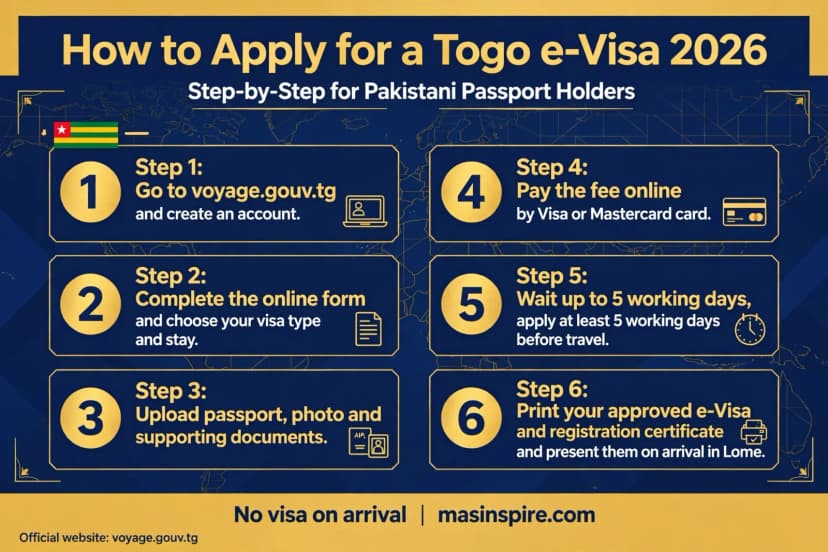
The whole process is online, and there is no embassy visit for a standard tourist, business or professional e-visa. Work through the steps in order, and do not pay for a flight until the e-visa is in your inbox.
Step 1: Check your passport and your yellow fever certificate. Confirm your passport is valid for at least six months beyond your planned return and has two blank pages. Confirm your yellow fever vaccination was given at least ten days before your planned arrival and that you hold the original WHO yellow card. If either fails, fix it now — the portal will not fix it for you.
Step 2: Gather your documents. Use the checklist above. Scan the first three pages of your passport in colour, prepare a recent passport photo, and have your flight booking, hotel booking or invitation letter, bank statement and insurance policy as clear PDF or image files. Name each file clearly so you can find it during the upload step.
Step 3: Open the official portal. Go to voyage.gouv.tg — the Togo Voyage platform run by the Togolese government. Type the address yourself rather than clicking a search result: lookalike sites exist, and the official portal is a .gouv.tg address. Older guides give different addresses — visa.gouv.tg, evisa.gouv.tg and beta.voyage.gouv.tg — and those addresses still appear on agency sites and in older articles. The current official platform is voyage.gouv.tg, and this guide treats it as controlling: if another address asks you to pay, stop and re-check. A private site called togoevisa.com also exists; it says plainly that it is an independent assistance service and not the Government of Togo, so use the government portal directly and pay the government fee only.
Step 4: Use the visa assistant and create an account. The portal's visa assistant asks for your passport country, purpose of travel, duration of stay, single or multiple entry, and current residence status, and it then tells you whether you need a visa, which type applies, what documents to provide and what fee applies. As a Pakistani passport holder it will tell you that you need a visa. Create a personal account with a valid email address and a phone number you can actually receive messages on, and keep the login details: you will need them to track the application and to complete the registration certificate later.
Step 5: Complete the online form. Fill in the immigration and visa form completely and carefully. Enter your name exactly as it appears in your passport, including the exact spelling and order of your given names and surname. Enter your passport number, dates and travel details without guessing: if you are unsure of a date, check the document rather than typing from memory. Select the visa type and duration that honestly match your trip — a 15-day visa for a 20-day trip will not be stretched at the border.
Step 6: Upload your documents. Upload the passport scan, the photo and the supporting documents the assistant listed for your case. Check each upload preview: a blurry, cropped or upside-down scan is a common reason for a delay or a refusal. If a document is in Urdu, upload the certified English or French translation alongside it.
Step 7: Pay the fee online. Pay by Visa or Mastercard bank card, or by Flooz or TMoney mobile money if you have it. The fee is charged in XOF, and the portal shows the exact amount before you confirm. Save the payment receipt and the application reference number, and take a screenshot of the confirmation page. If the amount shown is higher than the fee table in this guide, read the note on the screen before paying: a late application (less than six days before arrival) attracts a surcharge, and that may be what you are seeing.
Step 8: Wait and track the application. Standard processing takes up to five working days. The portal sends tracking notifications to your email, and the approved e-visa is delivered by email, normally as a PDF with a QR code, which you must print and present at airline check-in and at border control in Lomé. Do not reapply while an application is pending: a duplicate application does not speed anything up and can confuse the file.
Step 9: Receive the e-visa and print it. The approved e-visa is delivered by email. Print it in colour if you can, and also save a copy on your phone. Check every detail on the visa the moment it arrives — name spelling, passport number, validity dates, number of entries and permitted stay. If anything is wrong, contact the DGDN immediately rather than travelling on a visa with an error in it.
Step 10: Complete the online registration certificate. Before you travel, complete the immigration registration on the Togo Voyage platform and print the confirmation slip. The FCDO states that you must fill in a registration certificate online before you arrive in and depart from Togo, and it applies to every traveller, visa holder or not. Keep it with your printed e-visa and your yellow fever card.
Step 11: Present your documents on arrival. At airline check-in and at border control at Lomé–Tokoin International Airport, present your passport, your printed e-visa, your printed registration-certificate confirmation and your original yellow fever card. The officer may also ask for your return ticket, your hotel booking and proof of funds, so keep those in your hand luggage, not in checked baggage.
Applying from Vietnam — No Togolese Mission in Vietnam
There is no Togolese embassy or consulate in Vietnam, and there is no Togolese embassy in Pakistan either. For a short-stay visa that does not matter, because the e-visa is entirely online and no mission visit is required at any point. You apply from Ho Chi Minh City or Hanoi exactly as you would apply from anywhere else: on voyage.gouv.tg, with a card payment, and the visa arrives by email. Do not let anyone sell you a "mission appointment" for a Togo tourist visa — there is no appointment to buy.
If you ever do need a Togolese mission — for a long-stay or immigration visa query, for an attestation, or for help while you are in Togo — the nearest practical options are the Embassy of Togo in Beijing and the High Commission of Togo in New Delhi. The Beijing embassy is at No. 11, Dongzhimenwai Dajie, Chaoyang District, Beijing 100600, telephone +86 10 6532 2202, email ambatogochine@yahoo.fr, open Monday to Friday, 09:00 to 12:00 and 14:00 to 17:00. The New Delhi High Commission is the mission accredited to Pakistan (along with Bangladesh, Indonesia and Sri Lanka), so a question that concerns your Pakistani passport is properly directed there, while a question that concerns your residence in Vietnam or your travel from Asia is most conveniently directed to Beijing. Neither mission needs to be visited for a standard e-visa, and this guide lists them for exceptional cases only. Confirm any telephone number or email address before you call or travel: mission contact details change, and the directories that list them do not always agree.
Getting to Togo from Vietnam takes planning, because there is no direct flight. The usual routings from Ho Chi Minh City or Hanoi go through Istanbul (Turkish Airlines), Addis Ababa (Ethiopian Airlines), Paris (Air France) or Doha or Dubai connecting onward through Accra, where ASKY Airlines operates the short hop to Lomé. Many travellers also fly to Accra in Ghana and continue to Lomé by air or by road across the Aflao border, which sits at the edge of Lomé itself. Whichever routing you choose, check the transit-visa rules for every country you change planes in: a transit through a country whose visa you do not hold can strand you mid-journey, and the airline will check your Togo e-visa before it lets you board. Keep your printed e-visa, your yellow fever card and your registration-certificate confirmation in your hand luggage for every leg.
Two Vietnam-specific points deserve attention. First, your Vietnamese residence status matters to the application: the portal asks about your current residence status, and you should answer truthfully as a resident of Vietnam, giving your TRC or visa details. If your Vietnamese visa or TRC expires while you are in Togo, you may have trouble re-entering Vietnam, so check your Vietnam expiry date before you leave and renew it first if it is close. Second, if your trip starts in Pakistan rather than Vietnam — for example, if you fly home to visit family and then continue to Lomé — remember the polio certificate: Pakistan requires a polio vaccination certificate from NADRA to leave the country, and you will be asked for it at the Pakistani airport. It is not a Togo requirement, but it will still stop your journey if you do not have it.
Stay Length, Extensions and Residence Cards
Your permitted stay is the stay shown on your issued e-visa, not the stay you hoped for. A 1–15 day single-entry visa permits up to 15 days. A 16–30 day multiple-entry visa permits up to 30 days. A 31–90 day multiple-entry visa permits up to 90 days. The visa's validity — the window in which you may enter — is a separate question from the permitted stay, so read both dates on the visa when it arrives. Do not assume that a 90-day visa lets you stay 90 days from the day you arrive if the visa itself says otherwise: the printed visa controls, and the officer at the border controls how it is applied.
If you need to stay longer than your visa allows, you must apply for an extension before your current visa expires, through the DGDN in Lomé. The portal's FAQ states that once in Togo you can extend your visa at the DGDN offices, bringing your travel document and the slip with your visa references, and there is an online extension service on the DGDN platform. Apply well before expiry — not on the last day — and do not overstay while you wait for a decision unless the DGDN has told you in writing that your stay is covered. This guide cannot give you an extension fee or an extension processing time, because no official source publishes either figure: a fee of about US$50 and a processing time of one to three working days circulate in some guides, but neither figure appears on an official Togolese page, so both are treated here as unverified reports, not facts. Ask the DGDN for the fee in writing before you apply, and keep the receipt.
There is a similar gap on overstaying. No official Togolese source found for this guide publishes an overstay fine for Togo, and the figures that circulate for other West African countries do not apply here. This guide will not invent a fine. What is certain is that overstaying is an offence under Togolese immigration law, that it can lead to a fine, detention or removal, and that it will damage any future Togo visa application. The only safe course is to extend before expiry or leave on time.
For stays beyond a short visit, Togo's system moves from visas to residence cards. Under the 2022 law on the policing of foreigners (Loi n° 2022-005), any foreigner who stays in Togo for six months without a break, or for six months in total in one year, must hold a residence card (carte de séjour), and immigration-visa holders staying past 90 days must be able to justify holding one. The DGDN is the single point of contact, and the application starts online through the public-services portal at service-public.gouv.tg, after which you lodge the printed file in person at the DGDN in Lomé.
The residence-card fees published on the public-services portal are: a one-year temporary card, 200,000 XOF; a three-year ordinary card, 500,000 XOF; and a five-year privileged card, 800,000 XOF, for investors, highly qualified professionals, temporary workers and their families. Students pay 100,000 XOF for a one-year card or 250,000 XOF for a three-year card. Processing takes 30 to 45 days. The portal warns that prices and validity periods may change as the regulations evolve, so confirm the fee on service-public.gouv.tg at the time you apply. The reported penalty for failing to hold a residence card when one is required is a fine of 1,000,000 XOF, and a late renewal is reported to cost 300,000 XOF — both figures come from summaries of the 2022 law rather than from a DGDN fee page, so this guide reports them as the law's stated penalties, not as figures verified on the DGDN website. The immigration visa itself can be renewed once, for a further period up to 90 days, and after that you must hold a residence card or leave.
One address conflict needs flagging. The DGDN's address is given in different sources as Klikamé, Rue de la chance, Lomé, and as the Agbalépédo district, GTA, 322 R.P.T., Lomé, between the National Social Security Fund (CNSS) and the GTA-C2A insurance company. Both descriptions appear in 2026 sources, and the DGDN's own site lists the Agbalépédo location in its more recent material. This guide gives the telephone number (+228 22 50 78 56), the email (contact@dgdn.gouv.tg), the postal address (BP 4871, Lomé) and the office hours (Monday to Friday, 7:30 to 12:00 and 14:30 to 16:30) as the stable contact details, and advises you to confirm the street address by telephone before you travel to the office.
Transit Through Togo
You must get a visa if you are travelling through Togo, even if you do not intend to leave the airport. The FCDO states this directly, and adds that for layovers in Togo's airports it is advisable to check with the airline whether a transit visa is required. In practice, that means a Pakistani passport holder whose flight connects through Lomé–Tokoin International Airport should hold a valid Togo e-visa for the transit, unless the airline confirms in writing that the particular connection does not require one — for example, a same-terminal airside connection where you do not pass through Togolese immigration. Do not assume that staying airside exempts you: the FCDO's advice is to check, and the airline's answer is the one that decides whether you are allowed to board.
There is no published separate transit-visa fee on the Togo Voyage fee table, and no published transit-visa category distinct from the tourist e-visa. The portal's visa assistant determines the applicable visa from your travel details, so a transit traveller should enter the transit honestly in the application and let the assistant assign the category and fee — in practice, most transit travellers are issued a short-stay tourist e-visa tier. If an agent offers you a special "transit visa" for a fixed price, ask to see it on voyage.gouv.tg before paying. The safest and simplest course for a connection through Lomé is to apply for the 1–15 day single-entry tourist e-visa at 25,000 XOF, which covers a transit and any short delay, and to carry your onward ticket and your visa for your next destination. If your onward flight from Lomé is delayed or cancelled, you are already in Togo on a visa that permits your stay, so a short delay is not an overstay — but a delay that pushes you past your visa's expiry still needs an extension from the DGDN.
Student Route: Studying in Togo
Togo is not a major study destination for Pakistani students — the Université de Lomé counted 73,291 students in 2023–24, of whom only 565 were foreign nationals — but the route exists and it is clearly documented. For study, the portal lists the immigration visa for study or internship (visa d'immigration pour des fins d'étude ou de stage). It lasts up to 90 days, is multiple entry, can be renewed once, costs 65,000 XOF, and requires a certificate of enrolment from an approved Togolese institution or an internship certificate. Processing takes up to five working days, and you should apply at least six working days before arrival — the portal's own study guidance uses six days, which is one more reason to apply two weeks ahead as this guide recommends.
Once you arrive on an immigration visa for study, you apply for a student residence card (carte de séjour) through the public-services portal, and then lodge the file at the DGDN. The student card costs 100,000 XOF for one year or 250,000 XOF for three years, with processing in 30 to 45 days. The documents include a home-country police clearance certificate less than three months old, a medical certificate, proof of funds and proof of enrolment. Before you leave Pakistan or Vietnam, have your diplomas and transcripts recognised: the recognition process runs through the DAAS certification division, with transcripts, a CV and a fee of 3,000 XOF reported in October 2026. Confirm that fee on the day you apply, because it is a small figure from a single 2026 source rather than a DGDN-published price.
On work while studying, the DGDN's residence-permit guidance says the one-year student card allows part-time work on campus, and the three-year card allows part-time work with a work permit. The three-year student card does not entitle you to settle in Togo after your studies unless you qualify for another residence permit, and no post-study work route was found in the sources for this guide. Do not enrol in Togo on the assumption of a post-study job: if that is your plan, you need a separate work route. French is the language of instruction at Togolese universities, so a student who does not speak French should confirm the language of their programme in writing before enrolling — an English-taught programme is the exception, not the rule.
Work Route: Jobs, Business and Work Permits
A tourist e-visa does not authorise paid employment in Togo. A professional visa lets you attend meetings, negotiate, supervise a project or set up a business, but it does not by itself authorise you to take a salaried job. The chain for lawful work is: an entry authorisation issued by the Ministry of Security, then an immigration visa, then a residence card from the DGDN. Each step depends on the one before it, and you should not travel to Togo to start a job until the entry authorisation is in hand. An employer who tells you to arrive on a tourist visa and "sort the papers later" is asking you to break Togolese immigration law.
For the immigration visa for work, you need the Ministry of Security entry authorisation, the employment contract or job offer, and the standard documents in the checklist section. The immigration visa lasts 31–90 days, is multiple entry, costs 65,000 XOF and can be renewed once. Once in Togo, you complete the residence-card formalities at the DGDN or on service-public.gouv.tg. The residence-card tiers are the one-year temporary card at 200,000 XOF, the three-year ordinary card at 500,000 XOF, and the five-year privileged card at 800,000 XOF for investors, highly qualified professionals, temporary workers and their families. Processing takes 30 to 45 days, and you must hold a residence card once you reach six months in Togo. Holders of a residence card may leave and re-enter Togo without a fresh visa while the card is valid.
Business visitors should note the professional visa's long tier: it can be granted for up to 365 days, at 100,000 XOF, for a foreign promoter of a company under Togolese law or a person with regular professional activity in the country. That is the route for someone who is building a business in Togo rather than taking a job. It still requires evidence — company registration, contracts or tax documents — and it still does not replace the residence card once you pass six months in the country. There is no published fee or processing time for the Ministry of Security entry authorisation itself, and this guide does not invent one: your employer or sponsor in Togo must obtain it and tell you what it cost and how long it took. Equally, there is no digital-nomad visa for Togo, and no published route for remote workers to live in Lomé on foreign employment.
Common Mistakes to Avoid
Most Togo e-visa refusals and delays come from avoidable errors, not from the applicant's nationality. The mistakes below are the ones that appear again and again in the 2026 guides and in the official guidance.
Arriving without an e-visa. The single most serious mistake is believing that a visa on arrival is still available. It is not. Togo no longer issues visas on arrival, and the express visa on arrival is suspended. Anyone arriving at the border without an official document giving the right of entry will simply be turned back, and the airline may refuse to board you in the first place. Apply online and wait for the approval email before you travel.
Using the wrong website. The official portal is voyage.gouv.tg. Older addresses (visa.gouv.tg, evisa.gouv.tg, beta.voyage.gouv.tg) and private assistance sites still rank in search results, and some charge multiples of the government fee. One private site, togoevisa.com, honestly says it is not the government; others are less clear. Type voyage.gouv.tg yourself, check the address bar before you enter card details, and never pay a visa fee by bank transfer, cryptocurrency or a personal account.
Applying too late. The minimum is five working days before arrival, the portal's own pages say six or seven, and this guide recommends fourteen days. A late application attracts a surcharge of an unpublished amount, and a correction request in the last few days can make the trip impossible. Apply two weeks ahead, and never book a non-refundable ticket before the e-visa arrives.
Forgetting the yellow fever certificate. The yellow fever certificate is mandatory for every traveller over one year old, the vaccine must be given at least ten days before arrival, and the original WHO yellow card must be carried. Travellers are turned away without it, and no embassy will intervene. Get the vaccine at least eight weeks before travel if you can, so the ten-day rule is never in doubt.
Forgetting the registration certificate. The online registration certificate is a separate formality from the visa, and it must be completed before arrival and again before departure. Travellers who complete the visa and forget the registration can be delayed at check-in or at the border. Print both confirmations.
Name and date errors. Your name, passport number and dates on the form must match your passport exactly. A different spelling of your name, a transposed passport digit or a wrong date of birth will delay or kill the application. Check the form against the passport, not from memory, and check the issued e-visa the moment it arrives.
Choosing the wrong stay length. A 15-day visa for a 20-day trip is not a saving: it is an overstay. Choose the tier that covers your real itinerary, including any delay. If you are unsure, the 16–30 day tier at 45,000 XOF is often the sensible middle choice for a two- or three-week trip.
Ignoring the north. The FCDO advises against all travel to within 30 kilometres of the Burkina Faso border, except the city of Dapaong and the N1 highway leading to it from the south, and against all but essential travel to the rest of the Savanes region. The US State Department rates the northern border region and everything north of Kandé as Level 4, Do Not Travel. Lomé and the south are not covered by these warnings, but a trip to the north — including the Koutammakou UNESCO site, which sits at the edge of the warned area — should be planned against the current advice, not against a guidebook.
Frequently Asked Questions
Do Pakistani passport holders need a visa for Togo?
Yes. Pakistani passport holders need a visa to enter Togo, and Pakistan is not on any Togolese visa-exemption list. The exemptions cover ECOWAS citizens, other African Union nationals for up to 30 days, and Morocco for 90 days. None of those applies to a Pakistani ordinary passport, so you must hold an approved e-visa before you travel.
Where do I apply for a Togo e-visa?
Apply on the official Togo Voyage platform at voyage.gouv.tg. It is the Togolese government's own portal, run by the Direction Générale de la Documentation Nationale (DGDN). Older addresses such as visa.gouv.tg, evisa.gouv.tg and beta.voyage.gouv.tg still appear in search results and in older guides, but voyage.gouv.tg is the current official platform. Use it directly and pay the government fee only.
How much is the Togo e-visa fee for Pakistanis?
The fee is charged in West African CFA francs (XOF) and depends on stay length and entries: 25,000 XOF for 1–15 days single entry (about US$40), 35,000 XOF for 1–15 days multiple entry, 45,000 XOF for 16–30 days multiple entry, and 65,000 XOF for 31–90 days multiple entry. A professional visa for 91–365 days costs 100,000 XOF, and an immigration visa for 31–90 days costs 65,000 XOF. The fee is paid online by Visa or Mastercard card, or by Flooz or TMoney mobile money.
How long does a Togo e-visa take to process?
Standard processing takes a maximum of five working days. The FCDO says you must apply at least five working days before arrival, while the portal's own information page says six working days and its FAQ says seven. This guide recommends applying at least fourteen days before travel, so that a request for an extra document does not ruin your trip. You cannot apply earlier than 90 days before your planned entry date.
How long can I stay in Togo on an e-visa?
Your permitted stay is the stay shown on your issued e-visa: up to 15 days on a 1–15 day visa, up to 30 days on a 16–30 day visa, and up to 90 days on a 31–90 day visa. A tourist e-visa does not become a longer stay because your plans changed. If you need longer, apply for an extension at the DGDN in Lomé before your visa expires, or apply for the correct tier from the start.
Can I get a visa on arrival at Lomé airport?
No. Togo no longer issues visas on arrival, and the express visa on arrival is suspended until further notice. Anyone arriving without an approved e-visa will be turned back, and the airline may refuse to board you. Older lists that still show Togo as visa-on-arrival for Pakistanis are out of date.
Is a yellow fever vaccination mandatory for Togo?
Yes, without exception for travellers over one year old. You must hold the original WHO yellow card proving a yellow fever vaccination, given at least ten days before arrival. The US Department of State warns that travellers are turned away without the required yellow card. The certificate is valid for life. Also get advice on malaria prevention, typhoid and hepatitis vaccinations from a travel clinic at least four to eight weeks before you travel.
What is the online registration certificate for Togo?
It is an online immigration registration that every traveller must complete before arriving in and departing from Togo, separate from the visa itself. It is completed on the Togo Voyage platform, and you should print the confirmation slip and carry it with your e-visa and your yellow fever certificate. Visa-exempt travellers must complete it too.
How much passport validity do I need for Togo?
The sources conflict. The FCDO requires three months beyond your planned departure date, while the US Department of State requires six months beyond your arrival date plus two blank pages. The safest reading that satisfies both is a passport valid for at least six months beyond your planned return date, with at least two blank pages. Renew your passport first if it falls short.
Can I extend my Togo visa after I arrive?
Yes, through the DGDN in Lomé, using the online extension service and bringing your travel document and the slip with your visa references. Apply before your current visa expires. No official source publishes the extension fee or processing time, so ask the DGDN for the fee in writing before you apply. An immigration visa can be renewed once, for up to a further 90 days, after which you need a residence card or must leave.
Can I transit through Lomé without a visa?
No, not as a Pakistani passport holder. The FCDO states that you must get a visa if you are travelling through Togo, and advises checking with your airline whether a transit visa is required for a layover. The simplest course is to hold a 1–15 day single-entry tourist e-visa at 25,000 XOF for the transit. There is no published separate transit-visa fee.
Can I work in Togo on a tourist e-visa?
No. A tourist e-visa does not authorise paid employment, and a professional visa covers business meetings and assignments, not a salaried job. Lawful work needs an entry authorisation from the Ministry of Security, then an immigration visa, then a residence card from the DGDN. Do not travel to start a job until the entry authorisation is in hand.
How do I apply from Vietnam, and is there a Togo embassy in Vietnam?
There is no Togolese embassy or consulate in Vietnam, and none in Pakistan either, but you do not need one: the e-visa is entirely online on voyage.gouv.tg, and the visa arrives by email. If you ever need a mission, the nearest practical options are the Embassy of Togo in Beijing (+86 10 6532 2202) and the High Commission of Togo in New Delhi, which is accredited to Pakistan. There is no direct flight from Vietnam to Lomé; the usual routings go through Istanbul, Addis Ababa, Paris or Accra.
What should I do if my Togo e-visa is refused?
First, read the refusal notice carefully: it normally names the problem, such as a blurry passport scan, a mismatched name, an unclear photo or a missing document. Fees are non-refundable, and no official appeal route for e-visa refusals was found for this guide, so the practical course is to fix the named problem and submit a fresh application with the correct documents. If the refusal gives no reason, contact the DGDN on +228 22 50 78 56 or contact@dgdn.gouv.tg with your application reference number before you reapply. Do not pay an agent who promises to "guarantee" approval: no agent can guarantee a visa decision.
Is Togo safe to visit in 2026?
Lomé and the south of Togo are not covered by the current travel warnings, but the north is. The US Department of State rates Togo Level 2, Exercise Increased Caution, for crime, terrorism, unrest, kidnapping and health (advisory dated 30 July 2026), with Level 4, Do Not Travel, for the northern border region and everything north of Kandé. The FCDO advises against all travel to within 30 kilometres of the Burkina Faso border, except the city of Dapaong and the N1 highway leading to it, and against all but essential travel to the rest of the Savanes region, which is under a state of emergency. Check the current FCDO and US State Department advice before you book and again before you leave.
Official Websites
The table below lists the official and authoritative sources used for this guide. The first three are Togolese government platforms: they are the controlling sources for the visa, the fee and the residence card. The FCDO and US State Department pages are the controlling sources for entry requirements and safety advice. Check the live pages before you pay or book, because a guide — including this one — is only a snapshot of the rules on the day it was checked.
| Website | What it is for |
|---|---|
| voyage.gouv.tg | Togo Voyage — the official e-visa portal and online registration certificates |
| dgdn.gouv.tg | Direction Générale de la Documentation Nationale (DGDN) — visas, extensions and residence cards in Lomé |
| service-public.gouv.tg | Togo public-services portal — residence-card applications and official fee information |
| gov.uk — FCDO Togo entry requirements | UK government entry requirements, passport validity and safety advice for Togo |
| travel.state.gov — Togo Travel Advisory | US Department of State travel advisory for Togo, Level 2 with Level 4 areas |
| travel.state.gov — Togo International Travel Information | US Department of State entry, exit and visa requirements, yellow fever and passport validity |
| CDC — Togo travel health | US Centers for Disease Control and Prevention health information for travellers to Togo |
| Wikipedia — Visa policy of Togo | Reference summary of Togo's visa policy, exemptions and the e-visa fee table |
| Wikipedia — List of diplomatic missions of Togo | Reference list of Togolese missions, including Beijing and New Delhi |
| ambatogochine.com | Embassy of Togo in Beijing — the nearest Togolese mission to Vietnam |
Final Checklist and Conclusion
Before you submit your application, run through this final checklist. Passport valid for at least six months beyond your planned return, with two blank pages, and the first three pages scanned in colour. Yellow fever vaccination given at least ten days before arrival, with the original WHO yellow card in your hand luggage. Recent passport photo against a white background. Return or onward ticket, hotel booking or host invitation letter, three-month bank statement, and travel insurance covering treatment and evacuation. Visa type and stay length chosen honestly for your real itinerary. Application completed on voyage.gouv.tg at least fourteen days before travel, fee paid by Visa or Mastercard, receipt and reference number saved. Approved e-visa received by email, printed, and every detail checked against your passport. Online registration certificate completed for arrival and for departure, confirmations printed. And your Vietnam residence document — TRC or visa — valid for your return to Vietnam, plus a polio certificate from NADRA if your journey starts in Pakistan.
Togo rewards the traveller who prepares properly: Lomé's markets and beaches, the lagoon at Togoville, the hills of Kpalimé and the warmth of a small country that sees far fewer visitors than its neighbours are all within easy reach once the paperwork is done. The paperwork itself is straightforward — an online form, a card payment and an emailed visa — but it is also unforgiving of the traveller who arrives without it. Apply early, use only the official portal, carry the original yellow fever card, and keep the printed e-visa and registration confirmation where you can reach them at every checkpoint. Togo is also a largely cash-based society, so bring enough cash to cover your visit, and make sure your travel insurance covers local treatment and medical evacuation, because facilities outside Lomé are limited.
This guide was checked on 29 November 2026 against the official Togo Voyage portal, the DGDN and Togo public-services websites, the UK FCDO Togo entry-requirements page, the US Department of State Togo travel advisory and country-information pages, and the 2026 guides that quote the portal's fee table. Where those sources disagreed — on how early to apply, on passport validity, on the DGDN's street address, and on fees that no official page publishes — this guide has said so in the text rather than choosing a number silently. Visa rules, fees and safety advice can change without notice, so confirm the live rules on voyage.gouv.tg before you pay any fee or book a non-refundable ticket. The final decision on any visa application and on entry into Togo rests with the Togolese immigration officer, and this guide does not guarantee visa approval or entry.


