


Timor-Leste Visa Guide 2026: Types, Requirements, Documents and Application Steps
Timor-Leste, also known as East Timor, is one of Asia's youngest countries and one of its least visited, which is exactly why it appeals to travellers who want coral reefs without crowds, mountain villages without tour buses, and a capital, Dili, where life still moves at a walking pace. For a Pakistani passport holder living in Vietnam, the most important fact is a simple one: you do not need to apply for a visa weeks in advance for an ordinary tourist trip. Timor-Leste issues a tourist visa on arrival to travellers of all nationalities who are not covered by a separate visa exemption, provided they meet the criteria set by the Migration Service. That includes Pakistani ordinary passport holders. The visa costs USD 30, paid in United States dollar cash at the border, and it allows a single entry and a stay of 30 days. It can normally be extended once, for another 30 days, at the Migration Service headquarters in Dili, for a fee of USD 40.
That short answer is not the whole story. The visa on arrival is a decision made at the border, not a right, and the immigration officer who meets you at Presidente Nicolau Lobato International Airport in Dili makes the final decision on whether you enter. You must arrive with a passport valid for at least six months, a completed arrival declaration, a return or onward ticket, proof of where you will stay, and enough money to support yourself under a funds rule that is stricter than many travellers expect: USD 100 for each entry plus USD 50 for each day of your stay, unless a sponsor in Timor-Leste guarantees your food and accommodation. If you have previously been refused entry, removed or excluded from Timor-Leste, or if you have unpaid immigration fines, you cannot use the visa on arrival at all and must obtain a visa before you travel from a Timor-Leste embassy or consulate abroad. There is no Timor-Leste embassy in Vietnam, and there is no official Timor-Leste e-visa, so anyone who offers to sell you one online is not selling an official product.
This guide is written for Pakistani passport holders who live in Vietnam, whether you hold a Vietnamese temporary residence card, a work permit, a business visa or a tourist visa in Vietnam. It explains every visa type the Migration Service lists, the exact documents for each route, the step-by-step process from Ho Chi Minh City or Hanoi to Dili, the money you must carry, how to extend your stay, what happens if you overstay, and the separate rules for work, study and business. It also discloses, honestly, the points where official sources disagree with each other or where a fee or processing time is not published, so that you can confirm those points in writing with the Migration Service or a Timor-Leste mission before you spend money on a ticket. Fees, stay lengths and processing times in this guide were checked against the Migration Service of Timor-Leste, the Timor-Leste Customs Authority and the official Timor-Leste tourism website on 29 November 2026. Visa rules change, and a guide is never a substitute for a written confirmation from the authority that will stamp your passport.
At a Glance: Timor-Leste Visa for Pakistanis in Vietnam
If you only have two minutes, this is the whole trip in one table. Read the rest of the guide before you book, because the details behind each line matter, but no Pakistani traveller living in Vietnam needs to feel lost about the basic route: for tourism, you fly to Dili, you pay USD 30 in cash at the airport, and you receive a 30-day single-entry tourist visa, provided you meet the conditions and the officer is satisfied with your documents.
| Question | Answer for a Pakistani ordinary passport holder |
|---|---|
| Do I need a visa? | Yes, but for tourism you normally get it on arrival. |
| Tourist visa fee | USD 30, paid in US dollar cash only. Cards are not accepted at the immigration desk. |
| Tourist visa stay | 30 days, single entry. |
| Extension | Once, for a further 30 days, fee USD 40, in person in Dili. Maximum tourist stay 60 days. |
| Passport validity | At least 6 months from the date of entry, with at least one whole blank page for the visa sticker. |
| Arrival declaration | Complete the online e-Declaration before departure and keep the QR code. |
| Proof of funds | USD 100 per entry plus USD 50 per day of stay, unless sponsored in Timor-Leste. |
| Transit visa | USD 20, single entry, maximum 72 hours. |
| Business Class 1 | USD 100, up to 60 days, multiple entry. |
| Business Class 2 | USD 150, initially 6 months, extendable. |
| Work visa | USD 100, up to 1 year, multiple entry. Processing up to 30 working days. |
| Temporary stay visa | USD 50, for study, specialist activity or volunteering. |
| Visa to establish residence | USD 50, single entry, stay up to 6 months. |
| Official e-visa | There is no official e-visa. Do not pay any website that claims to sell one. |
| Timor-Leste embassy in Vietnam | None. Nearest missions are in Bangkok, Jakarta and Kuala Lumpur. |
| Main airport | Presidente Nicolau Lobato International Airport, Dili (DIL). |
| Direct flights from Vietnam | None. Fly via Singapore, Bali (Denpasar), Kuala Lumpur, Jakarta or Bangkok. |
| Currency | US dollar. Bring cash; USD 1 notes are reported as not accepted at some counters. |
| Language | Tetun and Portuguese are official; Indonesian is widely understood; English is spoken in Dili hotels. |
Do Pakistani Passport Holders Need a Visa for Timor-Leste?
Yes. A Pakistani ordinary passport holder needs a visa to enter Timor-Leste. Pakistan is not on any Timor-Leste visa exemption list, and there is no bilateral visa waiver between Pakistan and Timor-Leste that would allow visa-free entry. That is the starting point, and it is not a reason to worry: needing a visa and needing to apply in advance are two different things, and for an ordinary tourist trip Pakistanis fall into the second category only in special cases.
The Migration Service of Timor-Leste states, on its official tourist visa page, that travellers of all nationalities, except for nationalities covered by a separate visa waiver or exemption arrangement, may apply for and, if they satisfy the criteria, obtain a tourist visa on arrival. The exemption arrangements cover two groups only. The first is citizens of Schengen Area countries, plus Iceland, Liechtenstein, Norway and Switzerland, who may enter without a visa for up to 90 days in any 180-day period. The second is citizens of Indonesia, Malaysia, Singapore and Thailand, who may enter without a visa for up to 30 days for tourism. The official tourism website also lists Laos and Cabo Verde as exempt, and that difference between the two official sources is disclosed later in this guide. Neither list includes Pakistan, and neither list includes Vietnam, so your residence in Vietnam does not change the rule: it is your Pakistani passport, not your Vietnamese address, that decides which visa rule applies to you.
There are three situations in which you must obtain a visa before you travel, and they are stated clearly on the Migration Service website. If you have previously been refused entry to Timor-Leste, or removed or excluded from the country, you must apply for and obtain the visa before seeking entry. If you have outstanding immigration fines, the same rule applies. And if you are crossing by land from Indonesia, several official and government travel advisories disagree about whether a visa on arrival is available at the land border, so the safe course is to obtain a visa or a Visa Application Authorisation in advance; that land-border conflict is explained in the advance application section. If none of those situations applies to you, the visa on arrival is the normal route, and applying in advance through an embassy is an option rather than a requirement.
Holding a Vietnamese temporary residence card, a Vietnamese work permit or a long-term Vietnamese visa does not change the visa category or the fee, but it can help in two practical ways. First, it is evidence of a stable life and a genuine reason to return: when the immigration officer asks why you will leave Timor-Leste after 30 days, a job, a home and a valid residence permission in Vietnam are strong ties to return to, and you should be ready to show them. Second, it protects your return journey, because you will need a valid Vietnamese permission to re-enter Vietnam after your trip. Carry your Vietnamese temporary residence card or your Vietnamese visa with your passport, keep a photocopy and a photograph of it on your phone, and check its expiry date before you book anything. If your Vietnamese permission expires while you are in Timor-Leste, you may face a separate problem on the way home that has nothing to do with Timor-Leste immigration.
Types of Timor-Leste Visas for Pakistani Passport Holders
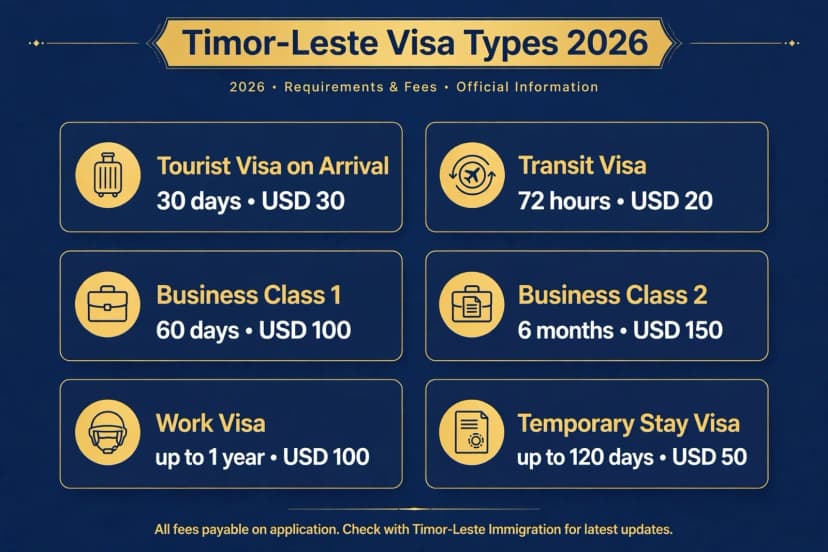
Timor-Leste's visa system is set out in the Law on Migration and Asylum, Law 11/2017, as amended by Law 10/2021, and in the visa pages published by the Migration Service. Most short visits are handled by the same two or three visa classes, and the longer visas are applied for either at a Timor-Leste mission abroad or in person at the Migration Service headquarters in Dili. Every fee in this table was checked against the Migration Service pages or, where the Migration Service does not publish a fee, against the most recent official or government-adjacent source available; where a fee is not published, this guide says so instead of inventing a number.
| Visa type | Who it is for | Stay | Entries | Fee |
|---|---|---|---|---|
| Tourist visa | Tourism, visiting family and friends | 30 days, extendable once for 30 days | Single entry; multiple entry may be allowed for travel to Oecusse if you tell the officer | USD 30 cash |
| Transit visa | Passing through Timor-Leste to another country | Maximum 72 hours | Single entry | USD 20 cash |
| Business Class 1 | Exploring business opportunities or investment prospecting | Up to 60 days | Multiple entry | USD 100 |
| Business Class 2 | Member or administrator of a company registered or to be registered in Timor-Leste, staying more than 183 days per year | Initially 6 months, extendable in periods of up to 2 years | Multiple entry | USD 150 |
| Work visa | Employment or service contract, or volunteering for more than 120 days a year | Up to 1 year, extendable for equal periods | Multiple entry | USD 100 |
| Temporary stay visa | Study, cultural, scientific, sporting, research, journalism or highly skilled specialist activity, or volunteering up to 120 days | For the duration of the study or assignment, up to 1 year for specialist activity; study visa for the study period, extendable in 6-month periods | Multiple entry | USD 50 |
| Visa to establish residence | Entering to take up residence in Timor-Leste | Up to 6 months | Single entry | USD 50 |
| Special Stay Authorisation | Staff under contract to Timorese government institutions, the United Nations, accredited international organisations, bilateral cooperation programmes or registered non-governmental organisations | For the contract, up to 1 year | As stated on the authorisation | No fee |
The tourist visa is the visa almost every Pakistani reader of this guide will use, and it is the only visa that is routinely issued on arrival without any prior application. If you are travelling for a holiday, to see the reefs at Atauro Island, to trek Mount Ramelau, to visit family or friends, or to look around Dili before deciding on a longer plan, the tourist visa is the correct choice. Do not try to use it for anything else. The Migration Service states plainly that a tourist visa holder may not undertake any professional activity or employment, paid or unpaid, and doing so can lead to a fine and to removal from the country. The fine range reported for unauthorised work is USD 200 to USD 1,000, and that figure should be treated as a warning rather than a price: the real cost is a refused future visa and a record that follows you.
Tourist Visa on Arrival in Detail
The tourist visa is intended for foreigners who wish to travel to Timor-Leste for tourism, or to visit family and friends. It is valid for a single entry and a stay of 30 days, and it may be extended once for the same period, giving a maximum tourist stay of 60 days. In the case of travellers to Oecusse, the Timorese exclave surrounded by Indonesian territory, multiple entries may be allowed where this is made known to the visa processing officer, so tell the officer at the border if you intend to travel to Oecusse and back. The visa may be applied for and obtained on arrival where the criteria are satisfied, at all official border posts, by air, land or sea, that are open to foreign nationals and that have a presence of the Migration Service. The fee is USD 30, paid in US dollar cash. There is no card facility at the immigration desk, and there may be no ATM or money-changing facility before the counter, so you should always carry the USD 30 with you before you travel.
To be granted the visa, you must satisfy the decision-maker on five points. You must intend a genuine visit for tourism or to visit friends and family. You must not engage in employment or professional activity. You must have complied with the conditions of any previous visas or visa exemptions. You must comply with any other visa decisions, including the stay period. And you must be of good character and health. These are not formalities: the officer can ask you questions about your trip, your hotel, your funds and your plans, and your answers, together with your documents, are the evidence. Answer clearly, in simple English, and do not volunteer a different purpose from the one on your booking. If you say you are a tourist, your hotel booking, your return ticket and your itinerary should all say tourist.
You must also be able to demonstrate sufficient funds: Article 15 of the Law on Migration and Asylum sets the amount at USD 100 for each entry plus USD 50 for each day of stay. For a 30-day trip that is USD 1,600; for a 10-day trip it is USD 600. Show it if asked, in cash, in a bank statement, or both. The requirement may be waived if you present a term of responsibility, a sponsorship guaranteeing your food and accommodation, from a Timorese citizen, a residence permit holder, a work or business visa holder, or a registered company in Timor-Leste.
The conditions attached to the tourist visa are short and strict. The stay period is 30 days. The holder may not undertake professional activity or employment, paid or unpaid. The visa is single entry, unless you tell the issuing officer that you intend to travel to Oecusse, in which case multiple entry may be granted. And it may be extended once only after entry, unless exceptional circumstances apply. A further extension beyond that one extension is generally not permitted unless exceptional circumstances apply, such as serious medical or humanitarian reasons, or genuine transport problems that were not caused by you.
Two conflicts between sources need disclosure. First, the arrival declaration window: the official tourism website says up to 5 days before departure, while other sources following the Migration Service and Customs pages say up to 3 days, and one reading found the form accepted arrival dates up to 4 days ahead. Complete the declaration within 3 days of departure and keep the QR code printed and on your phone: that satisfies the strictest reading and the 5-day reading. Second, blank passport pages: the Customs Authority requires at least one whole unused page for the visa sticker, while the United Kingdom government advises at least two. The controlling rule is the Migration Service's, one whole unused page, but if your passport has only one blank page left, consider renewing it before you travel.
Applying in Advance Through an Embassy or Consulate
Most Pakistani tourists will never need this section, because the visa on arrival covers them. Read it anyway if any of the following applies to you: you have previously been refused entry, removed or excluded from Timor-Leste; you have unpaid immigration fines; you want a visa that allows a stay of up to 90 days, or a multiple-entry visa, rather than the 30-day single-entry visa on arrival; you are crossing into Timor-Leste by land from Indonesia and want certainty before you reach the border; or you are applying for a business, work, study or residence visa that must be obtained before you travel. In all of those cases, you must apply in advance, and you must do so through a Timor-Leste embassy or consulate abroad, because there is no Timor-Leste embassy in Vietnam and no online visa application portal for these visas.
There is no Timor-Leste embassy or consulate in Vietnam. That fact has been checked against the published lists of Timor-Leste missions abroad, and no mission in Hanoi or Ho Chi Minh City appears on them. The nearest Timor-Leste missions to Vietnam are the Embassy of Timor-Leste in Bangkok, Thailand, the Embassy of Timor-Leste in Jakarta, Indonesia, and the Embassy of Timor-Leste in Kuala Lumpur, Malaysia. The Bangkok embassy is listed at 1550 New Petchburi Road, Thanapoom Tower, 7th floor, Makassan-Ratthewi, Bangkok 10400, Thailand, with the contact email embrdtl.bkk@gmail.com. The Jakarta embassy is listed at Mayapada Tower, 19th floor, Jl. Jend. Sudirman Kav. 28, Jakarta 12920, Indonesia, with the contact email tljkt@yahoo.com. Consulates are also listed in Indonesia, in Denpasar in Bali, in Kupang and in Atambua, which matter if you are already in Indonesia and need a visa or a Visa Application Authorisation before crossing by land. Addresses, emails and opening hours change, and this guide does not publish telephone numbers for these missions because they were not verified against an official source on the date of checking; always confirm the current address, hours and appointment system by email before you travel to a mission, and get the document list and the fee in writing.
If you apply for a tourist visa in advance at an embassy or consulate, the Migration Service lists the following documents. A completed and signed application form, which is available on the Migration Service website and from the mission. An acceptable travel document and a copy, valid for at least six months from the date of entry. A colour photograph, 3 by 4 centimetres, on a plain background. Evidence of sufficient funds to support your stay, or family sponsorship. Evidence of accommodation arrangements, or family sponsorship. Evidence of departure arrangements, such as an onward transport ticket or booking. And any other evidence justifying the grant of the visa, if applicable. The fee for a tourist visa obtained in advance is also USD 30, paid in US dollar cash, according to the Migration Service. Note the difference from the visa on arrival: the advance application requires the photograph and the signed form, and it requires you to produce the funds and accommodation evidence as part of the application, not merely if requested at the border.
For land entry, take special care. The Migration Service states that a tourist visa may be obtained on arrival at all official border posts, including land posts, so the main crossing at Batugade (Mota'ain) should issue visas on arrival. However, the Australian and Canadian travel advisories, both updated in 2026, say land arrivals need a visa or a Visa Application Authorisation in advance, while the United Kingdom advice says you can buy a visa at Batugade. Treat the conflict as unresolved: if you plan to cross by land, obtain a Visa Application Authorisation or a visa in advance from a Timor-Leste mission or the Consular Affairs unit in Dili, and carry the written authorisation. Confirm the document list with the mission before you submit it.
Complete Document Checklists
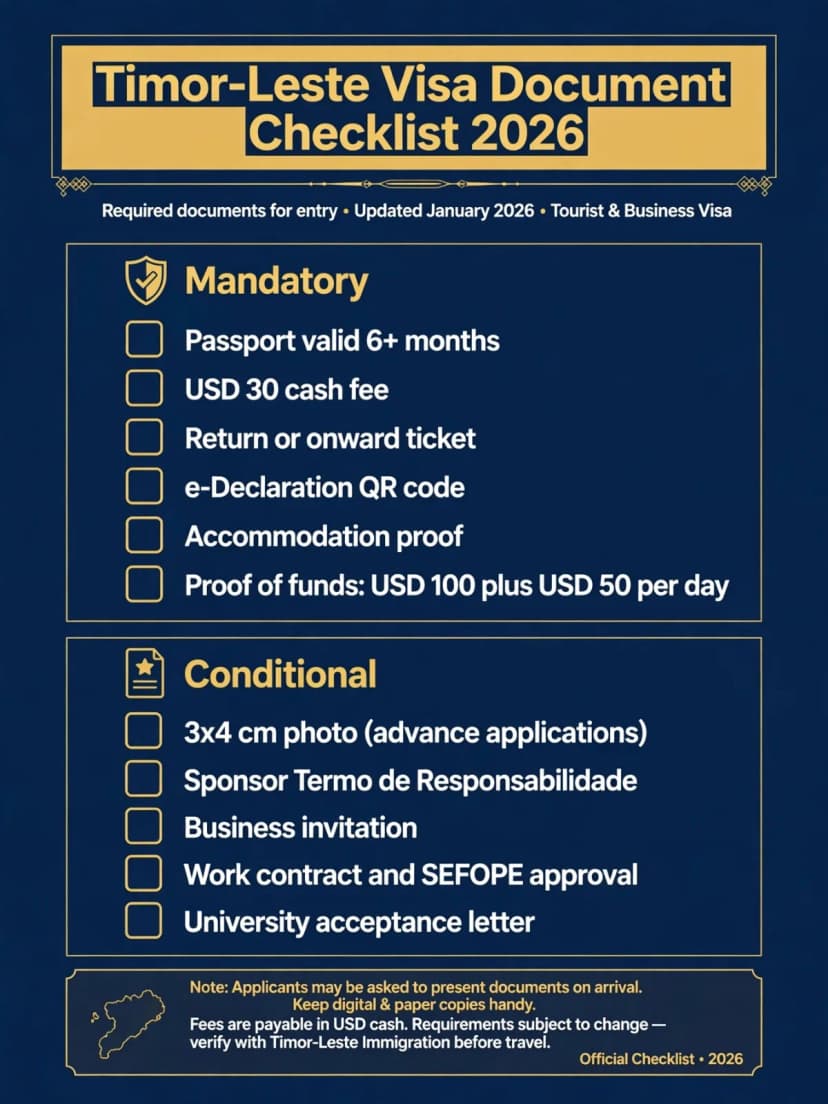
This section is the heart of the guide. Print it, or save it on your phone, and work through it item by item before you leave Vietnam. The checklists are divided into mandatory documents, which every Pakistani tourist should carry, and conditional documents, which you need only if they apply to your trip. A document that is listed as mandatory here is mandatory in the sense that the Migration Service either requires it or may ask for it, and you must have it ready; the guide does not invent requirements, and where the official wording is if requested, this guide says so.
Tourist visa on arrival: mandatory documents. Your Pakistani passport, valid for at least six months from the date of entry into Timor-Leste, with at least one whole blank page for the visa sticker. Check the expiry date now, not the week before you fly. If your passport expires in less than six months from your intended entry date, renew it before you travel, because the six-month rule is applied at the date of entry and there is no discretion at the border. Carry a photocopy of the biographical data page and a photograph of it on your phone, kept separately from the passport itself.
USD 30 in US dollar cash, in clean notes, for the visa fee. Do not rely on a card, do not rely on an ATM at Dili airport, and do not rely on changing money at the airport, because the fee is payable in cash and the facilities before the immigration desk are limited or absent. Carry the USD 30 separately from your other cash, for example in a small envelope in your passport wallet, so that you can hand it over without counting through your spending money at the counter. Note that the official tourism website reports that USD 1 notes are not accepted in Timor-Leste, so carry the fee in larger notes, for example a USD 20 note and a USD 10 note, and check that the notes are clean and undamaged.
Proof of sufficient funds, under the rule of USD 100 per entry plus USD 50 per day of stay. For a 10-day trip that is USD 600; for a 30-day trip it is USD 1,600. Carry a recent bank statement, printed and on your phone, showing a balance that covers the amount for your planned stay, plus the cash you are carrying. A bank statement from a Vietnamese bank is acceptable, and a statement from a Pakistani bank is also acceptable, but it should be recent, it should be in your name, and it should be in English or accompanied by a simple English summary. If you are sponsored in Timor-Leste, carry the term of responsibility, the sponsorship form, instead of, or in addition to, your own bank statement. The officer may not ask to see your funds evidence, but the guide lists it as mandatory because the law requires you to be able to demonstrate it, and you cannot demonstrate it from memory.
Advance application: additional mandatory documents. If you are applying in advance at an embassy or consulate, add the following to the list above. A completed and signed visa application form, from the Migration Service website or from the mission. A colour photograph, 3 by 4 centimetres, on a plain background, recent and of the standard passport-photo type. A copy of your passport's biographical data page, in addition to the original passport. Evidence of sufficient funds, produced as part of the application, not merely if requested. Evidence of accommodation, produced as part of the application. And any other evidence justifying the grant of the visa, such as an invitation letter, a business letter or a family letter, depending on your purpose. Keep a complete photocopy of everything you submit to the mission, and keep the receipt for the fee.
Conditional documents: only if they apply to you. A sponsor's term of responsibility, if a person or a registered company in Timor-Leste is guaranteeing your food and accommodation. Ask the sponsor to complete the form before you travel, and carry the original. A business invitation or business letter, if you are travelling on a Business Class 1 or Class 2 visa, stating the name of the inviting company, the purpose of the visit, the dates, and who will pay for the trip. A work contract and SEFOPE approval, if you are travelling on a work visa; do not travel on a tourist visa and expect to convert it to a work visa at the border. A university or school acceptance or enrolment letter, if you are travelling on a temporary stay visa for study, together with a health report and a criminal record certificate. A volunteer agreement with the host organisation, if you are travelling on a temporary stay visa for volunteering, together with a health report and a criminal record certificate if requested. Evidence of previous compliance, if you have visited Timor-Leste before, including copies of previous visas and entry and exit stamps; if you have an unpaid fine, do not travel on a visa on arrival, but apply in advance and settle the fine first. A yellow fever certificate, if you are arriving from an area where yellow fever is endemic; this applies to travellers arriving from an endemic area, not to travellers flying directly from Vietnam. A letter explaining travel to Oecusse, if you intend to visit the Oecusse exclave and want multiple entry on your tourist visa; tell the visa processing officer at the border that you intend to travel to Oecusse.
How to organise your documents. Keep the originals in a single folder in your hand luggage. Keep a complete set of photocopies in a separate bag. Keep photographs of every document on your phone, and keep a copy in your email or in cloud storage that you can open without your phone. Do not put your passport, your USD 30 fee or your arrival declaration QR code in your checked luggage. When you reach the immigration desk, have your passport open at the photograph page, your arrival declaration QR code ready, and your USD 30 fee in your hand. Answer questions in short, clear sentences. If you do not understand a question, say so politely and ask the officer to repeat it, rather than guessing at an answer.
How to Apply: Step-by-Step
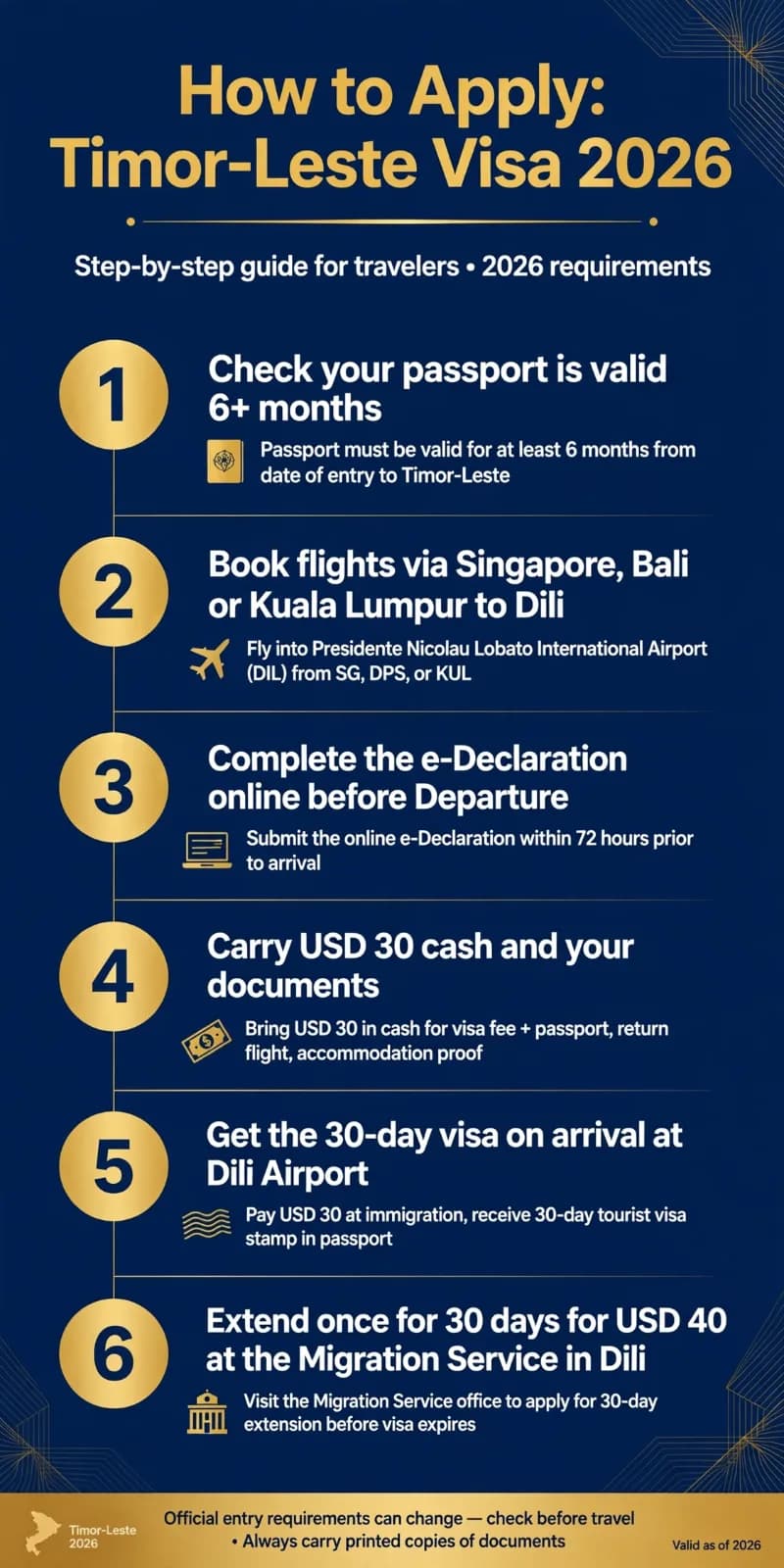
There are two ways to get a Timor-Leste tourist visa: on arrival, which is the route for almost every Pakistani tourist, and in advance, which is the route for the special cases listed earlier. This section gives you both processes, step by step, in the order you will follow them. Do not skip steps, and do not book a non-refundable ticket until you have completed the step that confirms you can travel.
Route A: tourist visa on arrival. Step 1: check your passport. Make sure your Pakistani passport is valid for at least six months from the date you intend to enter Timor-Leste, and that it has at least one whole blank page for the visa sticker. If it does not, renew it before you do anything else. While you are checking, confirm that your Vietnamese residence permission will still be valid on the date you return to Vietnam, and renew or extend it first if it will expire while you are away.
Step 3: prepare your money. Work out the funds you must be able to show, using the rule of USD 100 per entry plus USD 50 per day of stay. For a 14-day trip, that is USD 100 plus USD 700, which is USD 800. For a 30-day trip, it is USD 1,600. Make sure your bank balance covers that amount, and print a recent bank statement. Separately, obtain USD 30 in clean US dollar cash for the visa fee, in notes larger than USD 1, and keep it in your passport wallet. Also carry enough US dollars in cash for your first days in Timor-Leste, because ATMs are limited outside Dili and card acceptance is limited.
Step 6: fly to Dili. Check in for your flight to Dili, and be ready to show your passport and your return ticket at check-in and at each transit airport. Some airlines will ask to see evidence that you can enter Timor-Leste, and your passport, your return ticket and your arrival declaration are the evidence. Keep your document folder with you on the plane, not in the overhead locker where you cannot reach it.
Step 7: at Dili airport, go to immigration. On arrival at Presidente Nicolau Lobato International Airport, follow the signs to immigration. Present your passport, your completed arrival declaration, and your USD 30 fee in cash. Answer the officer's questions about the purpose of your visit, where you will stay and how long you will stay. If the officer asks for evidence of funds, accommodation or departure, produce it from your folder. The officer will issue the tourist visa, normally as a full-page sticker in your passport, valid for a single entry and a stay of 30 days. Check the sticker before you leave the desk: check the dates, check that it says 30 days, and if you asked for multiple entry for travel to Oecusse, check that it says so. If anything is wrong, raise it politely at the desk, because it is much harder to correct after you have left the airport.
Step 8: pass through customs and start your trip. After immigration, collect your luggage and pass through customs, where the same arrival declaration is used. Keep your passport and your visa safe for the whole trip, and note the date your 30 days expire. If you want to stay longer, you must apply for an extension at least 15 days before your visa expires, as explained in the extension section. The visa on arrival is issued at the border, and there is no published processing time for it beyond the time you spend at the desk. Allow extra time for a queue, particularly if several flights arrive at once, and do not book a tight onward connection out of Dili on the same day you arrive.
Route B: applying in advance at an embassy or consulate. Step 1: confirm that you need to apply in advance. You need this route if you have been refused entry, removed or excluded, if you have unpaid fines, if you are crossing by land, if you want a stay of up to 90 days or a multiple-entry visa, or if you are applying for a business, work, study, residence or temporary stay visa. If none of those applies, use Route A.
Step 2: choose the nearest mission and contact it in writing. The nearest Timor-Leste missions to Vietnam are in Bangkok, Jakarta and Kuala Lumpur. Email the mission, explain that you are a Pakistani passport holder living in Vietnam, state the visa you want and the dates of your trip, and ask for the current application form, the document list, the fee, the processing time and the appointment system. Do not travel to the mission until you have that reply, because the mission may require an appointment or may accept applications by post.
Step 5: wait for the decision, then check the visa. When the visa is issued, check it before you leave the mission or before you travel: check the name, the passport number, the dates, the number of entries and the stay period. If anything is wrong, ask for it to be corrected at once. Only then book a non-refundable flight, and only then complete the arrival declaration within 3 days of departure, as in Route A.
If you are refused a visa or refused entry. If a mission refuses your advance application, ask for the reason in writing, and ask what you would need to change before you could apply again. If you are refused entry at Dili airport, stay calm, ask politely for the reason, and do not argue with the officer. You will normally be returned on the next available flight, and you may be liable for the cost. A refusal is not the end of your travel plans, but it is a record, and you must declare it on future applications. If you believe a mistake has been made, the proper course is to contact the Migration Service in writing after you return, or to seek advice from the Embassy of Pakistan in Jakarta, which is accredited to Timor-Leste, rather than to try to re-enter on the same trip.
Getting There from Vietnam: Flights, Transit and Return
There is no direct flight from Vietnam to Timor-Leste, and there was no direct flight on the date this guide was checked. Every journey from Vietnam to Dili involves at least one stop, and most involve a change of airline as well as a change of plane. That is not a problem, but it does mean that you must plan the journey as a whole, including the transit visa rules of the country where you change planes, the time between your flights, and whether you need to collect and re-check your luggage.
The most commonly used routes from Ho Chi Minh City to Dili are via Singapore, via Bali (Denpasar), via Kuala Lumpur, via Jakarta and via Bangkok. From Hanoi, the same hubs apply, with an additional domestic flight to Ho Chi Minh City or a connection through Singapore or Kuala Lumpur. The airlines that fly into Dili include Aero Dili, Citilink, Batik Air Malaysia and AirAsia, together with connections on Vietnam Airlines, Singapore Airlines, Malaysia Airlines and VietJet Air for the first leg. The flight from Bali to Dili takes about 1 hour and 52 minutes. The flight from Kuala Lumpur to Dili takes about 4 hours and 15 minutes. The flight from Singapore to Dili takes about 4 hours and 26 minutes. The total journey from Ho Chi Minh City to Dili, including the stop, is typically 17 to 22 hours, depending on the connection, and the cheapest one-way fares seen in late November 2026 were about USD 319, with round trips from about USD 649. Those fares are indicative only, from fare tracking in November 2026, and they change by the hour: this guide does not quote a fare as a fixed price, and you must check the live price for your dates before you book.
Arrival at Dili Airport and the e-Declaration
Presidente Nicolau Lobato International Airport, airport code DIL, is the main international gateway to Timor-Leste. It is a small airport by the standards of Tan Son Nhat in Ho Chi Minh City or Noi Bai in Hanoi, and that is an advantage: the distances are short, the signs are clear, and the process is straightforward if you arrive prepared. The airport serves flights from Bali, Singapore, Kuala Lumpur, Jakarta, Darwin and Bangkok, and it is the place where most Pakistani visitors will first meet Timorese immigration.
Before you board your flight to Dili, you must complete the arrival declaration. Every incoming passenger must complete the Timor-Leste e-Declaration form online before departure, and a QR code is generated that you should print or have ready on your device for immigration and customs on arrival. The declaration is filed through the Customs Authority's Trade Single Window, and the same record is shared with customs, quarantine and biosecurity, the Ministry of Health and the Central Bank. The declaration is free. It asks for your passport details, your flight details, your accommodation address and a customs declaration about what you are bringing into the country. Complete it carefully, because the details must match your passport and your ticket. If you make a mistake, complete it again and use the newest QR code.
The window for completing the declaration is one of the conflicts disclosed in this guide: the official tourism website says up to 5 days before departure, while other sources say up to 3 days. Complete it within 3 days of departure and keep the QR code printed and on your phone.
On arrival at Dili airport, the order of events is immigration first, then luggage collection, then customs. At immigration, present your passport, your arrival declaration QR code, and your USD 30 fee in cash. The officer will check your passport, check that it is valid for at least six months, check your declaration, and ask you about your visit. Answer in simple, clear English. The officer may ask to see your return ticket, your hotel booking or your proof of funds. Produce them from your folder without delay. If the officer is satisfied, the visa will be issued as a full-page sticker in your passport, and you will be admitted for 30 days. Check the sticker before you leave the desk.
The ATMs at Dili airport are located after the immigration desk, which is why this guide repeats the warning to carry the USD 30 fee with you. Once you are through immigration and customs, you can use an ATM in the arrivals area, but you should not rely on it for your first expenses. Taxis are available at the airport, and the official tourism website reports that taxis in Dili cost about USD 3 to USD 6 during the day, with blue metered taxis running 24 hours. Agree the fare before you get in, or use a metered taxi, and have your hotel address written down to show the driver. If your hotel offers a transfer, use it: it is the simplest arrival of all. If you arrive by sea, the same rules apply at Dili Port and Tibar Bay Port: the tourist visa on arrival is issued at the seaport where the Migration Service is present, for the same fee of USD 30 and the same stay of 30 days.
Money, Proof of Funds and Cash to Carry
Timor-Leste uses the US dollar as its official currency, and Timorese centavo coins circulate alongside US banknotes. That makes the money side of a trip simpler than in many countries, because you do not need to change money on arrival, but it also makes it more demanding, because the visa fee, the extension fee and the funds rule are all stated in US dollars, and cash is king outside Dili. The official tourism website notes that USD 1 notes are not accepted, so carry your money in USD 5, USD 10, USD 20 and USD 50 notes, check that the notes are clean and undamaged, and avoid torn or heavily worn notes, which may be refused.
The funds rule is the part of the money chapter that most travellers underestimate. Article 15 of the Law on Migration and Asylum requires a foreigner entering Timor-Leste to show USD 100 for each entry, plus USD 50 for each day of stay. That is not a suggestion, and it is not a figure that the officer will always ask you to prove, but it is the legal standard, and you must be able to meet it if you are asked. Work out your amount before you travel, and make sure you can show it. For a 7-day trip, the amount is USD 100 plus 7 times USD 50, which is USD 450. For a 14-day trip, it is USD 800. For a 21-day trip, it is USD 1,150. For a 30-day trip, it is USD 1,600. If you are travelling as a family, the amount applies per person, so a family of four on a 14-day trip must be able to show USD 3,200, unless a sponsor in Timor-Leste guarantees their food and accommodation. That is a large sum, and it is the reason this guide tells you to carry a recent bank statement as well as cash: you do not need to carry the whole amount in cash, but you do need to be able to show that you have it.
Extending Your Stay in Timor-Leste
A tourist visa can be extended once, for a further stay of 30 days, giving a maximum tourist stay of 60 days. That is the rule stated by the Migration Service, and it is the rule you should plan around. If you want to stay longer than 60 days, you need a different class of visa, such as a temporary stay visa, a work visa or a business visa, and you should apply for that visa before your tourist visa expires, or leave the country and apply from outside.
The extension is applied for in person at the Migration Service headquarters in Dili, on Avenida Vila Verde, in the Vila Verde area of Dili, inside the Ministry of the Interior. The public counter serves the public from 09:00 to 12:00 and again from 14:00 to 16:00. The telephone number published for enquiries is +670 331 0369, and the email address is informacao@migracao.gov.tl. Aim for the morning session, arrive early, and bring your passport, your visa, your completed extension application form, and the fee of USD 40 in cash. The Migration Service states that the processing time for an extension is up to 15 days, so apply early, and do not leave the application to the last week.
The timing rule matters most. If you apply more than 15 days before your visa expires, the counting of your visa validity is suspended while the application is processed. If you apply with less than 15 days left, the clock keeps running, and your visa may expire before the extension is granted. Apply at least 15 days before expiry, preferably in the first week of your trip.
There is a conflict about the extension fee that must be disclosed. The Migration Service's current tourist visa page states that the extension fee is USD 40. Older sources give different figures: a 2003 ministerial instrument set the extension fee at USD 30 for each 30-day extension, and some secondary sources, including older travel guides, report USD 35 for a 30-day extension or USD 75 for a 60-day extension. The controlling source is the Migration Service's current page, and this guide therefore states the fee as USD 40. But because the older figures are still circulating on the internet, you should confirm the fee in writing with the Migration Service, or ask at the counter when you lodge the application, and carry USD 40 in cash plus a small amount extra in case the fee has changed. If the fee has changed since this guide was checked, the amount charged at the counter is the amount that applies, and this guide does not guarantee the fee.
Overstaying, Fines and Refusal of Entry
Overstaying a visa in Timor-Leste is expensive, and it has consequences that last longer than the fine itself. The fines are set by Article 141 of the Law on Migration and Asylum, Law 11/2017, and the Migration Service publishes them on its questions and fines page. The fines are per person, and they are based on how long you have overstayed. For an overstay of up to 30 days, the fine is USD 150 to USD 230. For an overstay of more than 30 days but less than 90 days, the fine is USD 230 to USD 350. For an overstay of more than 90 days, the fine is USD 350 to USD 580. You will receive a fine notice, and you can pay the minimum amount or lodge an appeal within 10 calendar days. An overstay does not prevent you from leaving the country, but you cannot re-enter Timor-Leste, extend your visa or obtain a new visa until the fine is paid. That is the practical consequence that matters most: a short overstay can mean that your next trip to Timor-Leste is refused, or that you are refused a visa at a mission abroad.
There is a conflict about the overstay fines that must be disclosed, because older figures are still widely quoted. A 2003 ministerial instrument set the fines at USD 50 for each 30-day period of excess stay, and some older news reports quote fines of USD 70 to USD 150 for up to 30 days, USD 150 to USD 270 for 30 to 90 days, and USD 270 to USD 500 for more than 90 days. Those are the figures under the old law. The controlling figures are the current ones under Law 11/2017, USD 150 to USD 230, USD 230 to USD 350 and USD 350 to USD 580, as published by the Migration Service. This guide states the current figures and discloses the older figures so that you are not confused if you see them elsewhere. If you are fined, the amount on the fine notice is the amount that applies, and you should pay the minimum or appeal within 10 days, as the notice states.
Work, Study, Business and Long Stays
This section is for readers whose purpose is not tourism. It explains the longer visas in enough detail for you to know which one to ask about, and it states clearly what this guide does not cover. This guide is a visa guide only. It does not cover teaching jobs, recruitment, salaries or employment contracts in Timor-Leste, and it does not recommend any employer or any job. If you are offered a job in Timor-Leste, treat the offer as a separate matter from the visa: check the employer, check the contract, and make sure the visa matches the job before you travel.
A work visa is required if you are going to be employed in Timor-Leste, or if you are going to volunteer for more than 120 days a year. The work visa lasts for up to one year, it can be extended for equal periods, it allows multiple entries, and it costs USD 100 for the initial visa and for an extension. You may only work for the named employer in the named role. The processing time is up to 30 working days, of which about 15 working days are spent at SEFOPE, the Secretariat of State for Vocational Training and Employment, which must certify that the terms of the job meet Timorese employment law. The documents include a certified copy of the employment or service contract, the employing company's tax payment certificate, your qualifications or evidence of professional skills, a medical certificate, and a criminal record certificate from your country of origin and from any country where you have lived for more than a year. For a Pakistani living in Vietnam, that may mean a criminal record certificate from Pakistan and one from Vietnam, and each takes time to obtain. Start early, and do not book a flight until the visa is granted. Do not work on a tourist visa, and do not accept a job that tells you to enter as a tourist and sort the work visa later.
A temporary stay visa is required for study, for cultural, scientific, sporting, research, journalism or highly skilled specialist activity, and for volunteering of up to 120 days. The fee is USD 50, and the visa is multiple entry. For study, the visa is issued for the study period and may be extended in six-month periods. For specialist activity, it may be valid for the duration of the assignment or contract, up to a maximum of one year. For volunteering up to 120 days, a volunteer agreement with the host organisation is required. The documents include an acceptance or enrolment declaration from the school or university for study, an approved employment or service contract and professional qualification certificate for specialist activity, a health report and a criminal record certificate, and evidence of the tax status of the affiliated organisation where applicable. If you are coming to study, ask the school or university to confirm in writing that it is recognised by the Timorese authorities and that it will support your visa application, and do not pay full course fees before the visa is granted.
Family Travel, Health, Safety and Practical Tips
Travelling to Timor-Leste with family, with children, or as an older traveller is possible and rewarding, but it needs more preparation than a solo trip to a larger country, because health services are limited outside Dili, transport is basic, and the infrastructure is still developing.
For health, see your doctor in Vietnam before you travel, check that your routine vaccinations are up to date, and ask about vaccinations for travel to Timor-Leste, including hepatitis A and B, typhoid and tetanus, and whether you need a yellow fever certificate if your route passes through an endemic area. Timor-Leste was certified malaria-free by the World Health Organization in July 2025, but dengue remains a risk, so use insect repellent, cover your arms and legs in the evening, and sleep under a mosquito net if your accommodation provides one. Drink bottled or filtered water only, and be careful with ice and street food outside reputable restaurants in Dili. Bring a good medical kit, including any prescription medicines you need, plus medicines for diarrhoea, rehydration salts, pain relief and insect bites. Health services are limited outside Dili, and a medical emergency is likely to mean evacuation to Australia or Singapore, so comprehensive travel insurance with medical evacuation cover is essential, not optional. Keep the insurer's emergency number in your phone and on paper.
Official Websites
The table below lists the official sources used for this guide, and the sources you should check yourself before you travel. The Migration Service of Timor-Leste is the controlling source for visa rules, fees and extensions. If any other source, including this guide, disagrees with the Migration Service, follow the Migration Service and confirm the point in writing. The official tourism website is the controlling source for travel practicalities, and the Customs Authority is the controlling source for the arrival declaration.
| Source | What it covers | Website |
|---|---|---|
| Migration Service of Timor-Leste, Tourist Visa | Tourist visa on arrival, fee USD 30, 30 days, extension USD 40 | https://migracao.gov.tl/wp/tourist-visa/ |
| Migration Service of Timor-Leste, Business Visa | Business Class 1 USD 100, Business Class 2 USD 150, documents | https://migracao.gov.tl/wp/business-visa/ |
| Migration Service of Timor-Leste, Transit Visa | Transit visa USD 20, 72 hours, single entry | https://migracao.gov.tl/wp/transit-visa/ |
| Migration Service of Timor-Leste, home page | Visa pages, forms, overseas offices, contact details | https://migracao.gov.tl/ |
| Timor-Leste Customs Authority, Obtaining a Visa | General visa requirements, passport validity, funds, arrival card | https://customs.gov.tl/travelers/obtaining-a-visa/ |
| Timor-Leste Customs Authority, e-Declaration | Online arrival and departure declaration, Trade Single Window | https://tilesw.customs.gov.tl/ |
| Official Tourism Website of Timor-Leste, Plan Your Trip | Visa on arrival, e-Declaration, flights, money, health, safety | https://timorleste.tl/plan-your-trip |
| Government of Timor-Leste, visa fees instrument | Older fee instrument, Ministerial Instrument No. 1/2003, for the disclosed fee conflicts | https://timor-leste.gov.tl/wp-content/uploads/2010/03/DM_2003_1_Fees_visa_extension_applications_.pdf |
| Visit East Timor, Visa Requirements by Nationality | Visa on arrival by nationality, including Pakistan, checked October 2026 | https://visiteasttimor.com/plan/visa-immigration/ |
| S.O.T. Stays of Timor, Visas and Entry | Visa on arrival, extension, land border, overstay fines, checked November 2026 | https://stays.oftimor.com/tips/visa/ |
| S.O.T. Stays of Timor, Travel Questions Answered | Extension office hours, telephone, overstay fines | https://stays.oftimor.com/plan/questions/ |
| Voyagewindow, Visa on Arrival at Dili Airport | Tourist visa page, extension, e-Declaration, checked 7 November 2026 | https://www.voyagewindow.com/destinations/timor-leste/dili/guides/timor-leste-visa-on-arrival-dili-airport/ |
Frequently Asked Questions
Do Pakistani passport holders need a visa for Timor-Leste?
Yes. A Pakistani ordinary passport holder needs a visa to enter Timor-Leste, but for tourism you normally obtain it on arrival rather than applying in advance. The tourist visa on arrival costs USD 30 in cash, allows a single entry and a stay of 30 days, and can be extended once for another 30 days. You must apply in advance if you have previously been refused entry, removed or excluded, or if you have unpaid immigration fines.
Can I get a visa on arrival in Timor-Leste with a Pakistani passport?
Yes, provided you meet the Migration Service criteria. The Migration Service states that travellers of all nationalities, except those covered by a separate visa exemption, may apply for and obtain a tourist visa on arrival if they satisfy the criteria. Pakistan is not visa exempt, so the visa on arrival is the normal route for a Pakistani tourist. You must have a passport valid for at least six months, a completed arrival declaration, a return or onward ticket, proof of accommodation, and proof of funds.
How much is the Timor-Leste visa fee for Pakistanis?
The tourist visa fee is USD 30, paid in US dollar cash at the border or at the embassy if you apply in advance. The transit visa fee is USD 20 in cash. The extension fee for a tourist visa is USD 40 in cash. Business Class 1 is USD 100, Business Class 2 is USD 150, a work visa is USD 100, a temporary stay visa is USD 50, and a visa to establish residence is USD 50. These are government fees published by the Migration Service.
How long can I stay in Timor-Leste on a tourist visa?
You can stay for 30 days on a tourist visa on arrival. You can extend it once, for a further 30 days, at the Migration Service headquarters in Dili, for a fee of USD 40, giving a maximum tourist stay of 60 days. Apply for the extension at least 15 days before your visa expires, because an application lodged more than 15 days before expiry suspends the counting of your visa validity while it is processed.
Is there a Timor-Leste embassy in Vietnam?
No. There is no Timor-Leste embassy or consulate in Vietnam. The nearest Timor-Leste missions to Vietnam are the embassy in Bangkok, Thailand, the embassy in Jakarta, Indonesia, and the embassy in Kuala Lumpur, Malaysia. For most tourist trips you do not need to visit a mission, because you obtain the visa on arrival. If you need a visa in advance, contact the nearest mission by email first.
Is there an e-visa for Timor-Leste?
No. There is no official Timor-Leste e-visa. The only online form you must complete before travel is the arrival declaration, the e-Declaration, which is free and is filed through the Customs Authority's Trade Single Window. Do not pay any website that claims to sell a Timor-Leste e-visa, and do not send your passport details or payment to a commercial visa website.
What documents do I need for the visa on arrival?
You need a Pakistani passport valid for at least six months with at least one whole blank page, a completed arrival declaration with the QR code, USD 30 in US dollar cash, a return or onward ticket, proof of accommodation, and proof of funds of USD 100 per entry plus USD 50 per day of stay, unless you are sponsored in Timor-Leste. The officer may ask to see your funds, accommodation and departure evidence, so carry them in your hand luggage.
Do I need a return ticket to enter Timor-Leste?
Yes, in practice. The Migration Service lists evidence of departure arrangements, such as an onward transport ticket or booking, as a requirement for the visa on arrival. A confirmed return ticket to Vietnam, or an onward ticket to a third country, is the strongest evidence. A one-way ticket to Dili with no onward booking is a risk, because the officer is entitled to ask how you will leave the country.
How do I get from Vietnam to Dili?
There is no direct flight from Vietnam to Dili. Fly from Ho Chi Minh City or Hanoi via Singapore, Bali (Denpasar), Kuala Lumpur, Jakarta or Bangkok, and then to Presidente Nicolau Lobato International Airport in Dili. The total journey is typically 17 to 22 hours including the stop, and the cheapest one-way fares seen in late November 2026 were about USD 319, with round trips from about USD 649. Check the live price for your dates and whether you need a visa for the transit country.
Can I work in Timor-Leste on a tourist visa?
No. A tourist visa holder may not undertake any professional activity or employment, paid or unpaid. If you want to work in Timor-Leste, you need a work visa, which costs USD 100, lasts for up to one year, and takes up to 30 working days to process, including certification by SEFOPE. Volunteering for more than 120 days a year also requires a work visa, while volunteering for up to 120 days requires a temporary stay visa.
What happens if I overstay my visa in Timor-Leste?
You will be fined per person under Article 141 of the Law on Migration and Asylum. The fine is USD 150 to USD 230 for an overstay of up to 30 days, USD 230 to USD 350 for more than 30 but less than 90 days, and USD 350 to USD 580 for more than 90 days. You can pay the minimum or appeal within 10 calendar days. An overstay does not prevent you from leaving, but you cannot re-enter, extend or obtain a new visa until the fine is paid.
Can I extend my tourist visa more than once?
No, not normally. A tourist visa can be extended once only, for a further 30 days. A further extension is generally not permitted unless exceptional circumstances apply, such as serious medical or humanitarian reasons, or genuine transport problems that were not caused by you. If you want to stay longer than 60 days, you need a different class of visa, and you should apply for it before your tourist visa expires.
Do I need travel insurance for Timor-Leste?
Travel insurance is not listed by the Migration Service as a visa requirement, but the official tourism website describes comprehensive travel insurance with medical evacuation cover as essential, and this guide strongly recommends it. Health services are limited outside Dili, and a medical emergency is likely to mean evacuation to Australia or Singapore, which is very expensive without insurance. Carry your policy number and the insurer's emergency telephone number with you.
Can I enter Timor-Leste by land from Indonesia?
The official position is not settled, and you should not rely on a visa on arrival at a land border without written confirmation. The Migration Service states that a tourist visa may be obtained on arrival at all official border posts, including land posts, but the Australian and Canadian travel advisories say land arrivals need a visa or a Visa Application Authorisation in advance, and the United Kingdom advice says you can buy a visa at Batugade. The safe course is to obtain a visa or a Visa Application Authorisation in advance before you cross by land.
What should I do if my visa is refused?
If a mission refuses your advance application, ask for the reason in writing and ask what you would need to change before applying again. If you are refused entry at Dili airport, stay calm, ask politely for the reason, keep any document you are given, and do not try to re-enter on the same trip. You must declare the refusal on future applications. For help as a Pakistani citizen, you can contact the Embassy of Pakistan in Jakarta, which is accredited to Timor-Leste, after confirming its current contact details.
This guide was checked on 29 November 2026 against the Migration Service of Timor-Leste, the Timor-Leste Customs Authority and the official Timor-Leste tourism website, and the fees, stay lengths and procedures in it are the figures those sources published on that date. Visa rules, fees and procedures can change without notice, so confirm the visa on arrival, the USD 30 fee, the e-Declaration window and the extension rules in writing with the Migration Service or with the nearest Timor-Leste mission before you book a non-refundable ticket, and carry the written confirmation with your travel documents. The immigration officer at the border makes the final decision on entry, and this guide does not guarantee visa approval or entry.


