

By MAS Inspire | Last reviewed: 27 November 2026 (key figures re-verified 27 November 2026)
On this page
- Introduction
- Why people visit, study and work
- Visa types
- Visa comparison
- Eligibility
- Document checklists
- Application steps
- Fees and finances
- Processing times
- Pakistan and Vietnam
- Student guide
- Work and jobs
- Family and residence
- Mistakes
- Refusals
- FAQs
- Official websites
- Final checklist
Introduction
Thailand is a popular destination for international tourists, students, business professionals, entrepreneurs, remote workers and retirees. Its relatively affordable living costs, established tourism industry, international universities and growing technology sector attract visitors from around the world.
However, Thailand has different immigration requirements depending on an applicant's nationality, travel purpose, financial circumstances and intended duration of stay. In 2026, understanding these distinctions is particularly important because Thailand revised its visa exemption and Visa on Arrival arrangements effective 15 September 2026.
Whether you are planning a holiday in Phuket, studying in Bangkok, accepting a job offer, joining your family or working remotely from Chiang Mai, choosing the correct immigration category is essential. This guide also includes specific guidance for Pakistani passport holders legally residing or working in Vietnam.
Educational disclaimer: MAS Inspire is an independent educational information resource, not a Thai immigration authority. Visa decisions are made by the relevant government authorities. Always confirm current requirements before submitting an application.
Why People Visit, Study, and Work in Thailand
Tourism and culture: Thailand offers tropical beaches, historical temples, regional cuisine, national parks and internationally recognized tourist destinations.
International education: Students can explore English-taught university programmes, postgraduate research, language courses and academic exchanges.
Employment and business: Thailand has established industries in manufacturing, automotive engineering, hospitality, healthcare, logistics and technology.
Remote working: Eligible freelancers and overseas employees can explore the Destination Thailand Visa, while applicants meeting more demanding professional criteria may qualify for an LTR visa.
Each activity requires the appropriate immigration permission. A tourist visa should not be treated as a substitute for employment authorization.

Types of Thailand Visas
Thailand's Ministry of Foreign Affairs maintains official visa categories through the Thai e-Visa portal.
Visa exemption and Visa on Arrival
Visa exemption permits eligible passport holders to enter without obtaining a regular visa beforehand. Following the September 2026 reforms, the previous 60-day arrangement was discontinued. A revised 30-day scheme applies to 60 countries and territories, a 15-day scheme to two, and Visa on Arrival eligibility was reduced to three. Separate bilateral arrangements may apply.
Nationality eligibility must be checked against current official lists. Pakistani ordinary passport holders should plan to obtain an appropriate visa before travelling rather than rely on visa-free entry. A Vietnam residence card does not change passport nationality. Official MFA announcement.
Travellers relying on the 30-day exemption who enter through a land border checkpoint may do so no more than twice per calendar year (Royal Gazette, 31 August 2026) — check the current rule before travelling. (Note added 27 November 2026.)
Tourist Visa (TR)
A tourist visa is intended for temporary recreational visits, sightseeing and other approved visitor activities. Applicants generally need a valid passport, photographs, travel information, accommodation evidence and any financial documentation required by their processing mission. Common arrangements include single-entry and multiple-entry visas. A standard single-entry tourist visa generally permits a stay of up to 60 days, subject to the immigration officer's decision. Multiple-entry validity does not amount to continuous permission to live in Thailand.
Ordinary employment is not permitted. A host invitation may be relevant for private visits. Fees depend on the issuing mission. Apply through the official e-Visa system from an eligible overseas location. HCMC publishes USD 40 for single entry and USD 200 for multiple entries, with three- and six-month visa validity respectively. The standard Thai fee schedule lists THB 1,000 for a single-entry tourist visa and THB 5,000 for a multiple-entry visa; missions may charge the local-currency equivalent. Its older tourist page still describes the superseded exemption policy. HCMC tourist visa.
Business Visitor Visa (Non-Immigrant B)
Foreign nationals travelling for legitimate business activities may need a Non-Immigrant B visa. Typical purposes include business meetings, negotiations, trade-related visits and other approved commercial activities. The applicant may need an invitation from a Thai company, a letter from an overseas employer, company registration records and evidence explaining the proposed visit.
An initial single-entry Non-Immigrant visa commonly permits a stay of up to 90 days. Longer arrangements depend on the individual category and immigration approval. A business visa does not automatically authorize taking employment. Productive work may require separate authorization. Thai e-Visa.
Student Visa (Non-Immigrant ED and ED Plus)
The Non-Immigrant ED category covers qualifying study and educational activities, including university education, approved language study, exchanges and training. Applicants normally require acceptance from an eligible Thai educational institution and supporting institutional documents.
ED Plus is an additional arrangement for qualifying international students in higher education. Eligible graduates may benefit from opportunities to remain temporarily after completing their studies to seek employment. Confirm applicability with your university and immigration authorities. Students should not assume automatic part-time employment rights. Ministry of Foreign Affairs.
Employment Visa (Non-Immigrant B)
Foreign professionals accepting employment with Thai organizations generally require an appropriate Non-Immigrant B visa and employment authorization. The employer plays an important role by preparing employment records, corporate documentation and relevant labour approvals.
Typical occupations include engineering, software development, teaching and management where foreign employment is permitted. Some occupations are restricted under Thai law. Applicants must confirm their proposed profession is open to foreign nationals. An employment-related visa does not replace a work permit unless a specific statutory exemption applies. Department of Employment.
Destination Thailand Visa (DTV)
The DTV is designed for eligible long-stay visitors participating in approved activities: overseas remote employees and freelancers; participants in approved cultural, sporting, medical or related activities; and spouses and children under 20 of DTV holders.
| Condition | Published HCMC requirement |
|---|---|
| Visa validity | Five years |
| Stay per entry | Up to 180 days |
| Financial evidence | THB 500,000 |
| Fee | USD 340 |
| Extension | Up to another 180 days, subject to approval |
Remote workers must demonstrate a genuine overseas employment or freelance arrangement. Participants need documentary evidence of the activity. The DTV is not unrestricted permission to accept local Thai employment. Additional residence and criminal clearance requirements apply in HCMC following the August 2026 changes. Official DTV checklist.
Long-Term Resident Visa (LTR)
Thailand's Board of Investment administers the LTR programme for Wealthy Global Citizens, Wealthy Pensioners, Work-from-Thailand Professionals and Highly Skilled Professionals. Eligible dependants may also apply. The programme provides a potential ten-year arrangement, initially granted for up to five years and renewable for another five if conditions are met.
The issuance charge in Thailand is THB 50,000 per person. Overseas issuance charges can differ. Local employment may require a digital work permit. Work-from-Thailand professionals must comply with their specific category conditions. Income, investment, employer eligibility and health coverage requirements vary. BOI LTR.
SMART Visa — Startup Entrepreneurs
Thailand revised SMART in 2025 to focus on startup entrepreneurs and avoid duplication with LTR. Older websites may still describe SMART Talent, Investor and Executive categories; do not assume they remain open to new applications. The official programme emphasizes SMART S and eligible SMART O dependants.
For the two-year SMART S route, published requirements include an eligible established technology startup, director status or at least 25% shareholding, THB 600,000 deposited for at least three months, additional THB 180,000 per dependant under applicable conditions, and health insurance. Eligible holders can work within their endorsed business without a conventional work permit under specific programme privileges. Qualification endorsement precedes visa issuance. SMART S requirements.
Investor and Entrepreneur Visas
Entrepreneurs establishing or operating conventional companies may explore Non-Immigrant B, subject to company and employment requirements. High-value investors may qualify for LTR or another recognized investment arrangement. Technology startup founders should examine SMART S. Registering a company, purchasing property or investing does not independently guarantee immigration status or work authorization. Distinguish business registration, foreign ownership and immigration rules. BOI.
Family and Spouse Visa (Non-Immigrant O)
Foreign nationals joining eligible family members may qualify for Non-Immigrant O. This includes certain spouses of Thai citizens, parents, dependent children and family members of eligible foreign residents. Applicants must demonstrate a genuine qualifying relationship through marriage or birth certificates, sponsor identification and immigration status or Thai nationality. Additional financial evidence may apply, particularly for extensions. Marriage does not automatically grant permanent residence, citizenship or unrestricted employment rights. Immigration Bureau.
Retirement Visas
Thailand provides retirement-related Non-Immigrant O, O-A and O-X arrangements subject to eligibility, generally for applicants aged 50 or above. Routes differ in nationality eligibility, financial requirements, insurance obligations and permitted stay. O-A commonly involves a one-year arrangement; O-X offers a longer arrangement for citizens of specified countries who satisfy additional conditions. Retirement permission does not grant ordinary employment rights. Use the checklist for your particular category. Thai e-Visa.
Thailand Privilege Visa
Thailand Privilege is a paid membership programme associated with long-term immigration privileges. Costs and benefits depend on the selected package and current conditions. It is not permanent residence, citizenship or an unrestricted work visa. Review official terms and immigration eligibility before paying. Thailand Privilege.
Transit Visa (TS)
A transit visa may apply to travellers passing through Thailand, approved sports participants and certain transport crew members. A standard transit stay may be permitted for up to 30 days depending on applicable conditions. Passengers remaining in an international transit area should confirm requirements for their passport, itinerary and airline policies. An onward ticket alone does not establish entitlement to enter Thailand. Thai e-Visa.
Exchange, Internship and Training Visas
Participants in educational exchanges, academic training and qualifying internships may use ED or another suitable Non-Immigrant category. The correct route depends partly on employment, compensation and academic requirements. Documents may include an exchange agreement, training plan, institutional invitation and funding confirmation. Ask the host organization whether work authorization is necessary.
Researcher and Academic Visas
Research and scientific activities may fall under Non-Immigrant RS where appropriate. Researchers may also qualify through employment, academic or LTR pathways. Supporting documentation normally includes an institutional invitation, research proposal, appointment information and relevant approval.
Other Specialized Visas
| Category | Purpose |
|---|---|
| Non-Immigrant M | Approved journalism, media and film activities |
| Non-Immigrant R | Eligible religious activities |
| Medical treatment | Approved medical visits and relevant longer-term treatment categories |
| Diplomatic | Official diplomatic assignments |
| Official | Qualifying governmental duties |
| Courtesy | Eligible official or special visitors |
These may require authorization or sponsorship from designated institutions, government bodies or hospitals.
Job Seeker Visa
Thailand does not offer a general standalone job seeker visa comparable to certain European systems. Qualifying graduates may have limited post-study opportunities through ED Plus, but applicants seeking employment generally need a qualifying offer and appropriate immigration and labour authorization.
Permanent Residence
Permanent residence is a separate process administered by Thai immigration authorities, subject to statutory qualifications, documentary evidence, government consideration and annual nationality quotas. DTV, LTR and Thailand Privilege do not automatically establish entitlement.
Humanitarian Protection
Thailand operates a National Screening Mechanism for individuals seeking protected-person recognition, separate from conventional visa pathways. Seek specialist legal or humanitarian assistance, particularly if immigration status is uncertain. Contacting the mechanism does not automatically eliminate enforcement risks. UNHCR Thailand.
Visa Comparison Table
| Permission | Purpose | Duration or validity | Work authorization |
|---|---|---|---|
| Exemption | Tourism | 30 or 15 days; bilateral rules vary | No ordinary employment |
| Visa on Arrival | Tourism | Check scheme | No |
| TR | Tourism | Commonly 60 days per entry | No |
| Non-B business | Business | Commonly initial 90 days | Separate rules |
| Non-B employment | Employment | Varies | Work permit normally required |
| ED / ED Plus | Education | Programme dependent | No automatic rights |
| DTV | Remote work, approved activities | Five years; 180 days per entry | Limited to permitted activities |
| LTR | Long-term residence | Up to ten years | Category dependent |
| SMART S | Technology startup | Up to two years under cited route | Endorsed activities |
| Non-O | Family | Varies | Separate authorization |
| O-A | Retirement | Generally one year | No |
| O-X | Retirement | Up to ten years subject to conditions | No |
| Privilege | Membership visits | Package dependent | No automatic rights |
| TS | Transit | Commonly up to 30 days | No ordinary employment |
| RS | Research | Varies | Activity dependent |
| PR | Settlement | Permanent status subject to law | Labour rules apply |
Visa validity determines when a visa can be used. Permitted stay determines how long a person is authorized to remain after entry.
Eligibility Requirements
Review nationality, current residence, purpose, financial capacity and sponsorship. Passport nationality determines exemption eligibility and additional screening. Overseas missions may accept only applicants physically present and eligible within their jurisdiction. The intended activity must match the visa. Demonstrate adequate resources where prescribed. Employment, education, research and family applications may need institutional or family support. Insurance, criminal clearance, medical certificates and government endorsement are category-specific, not universal.
Complete Document Checklists
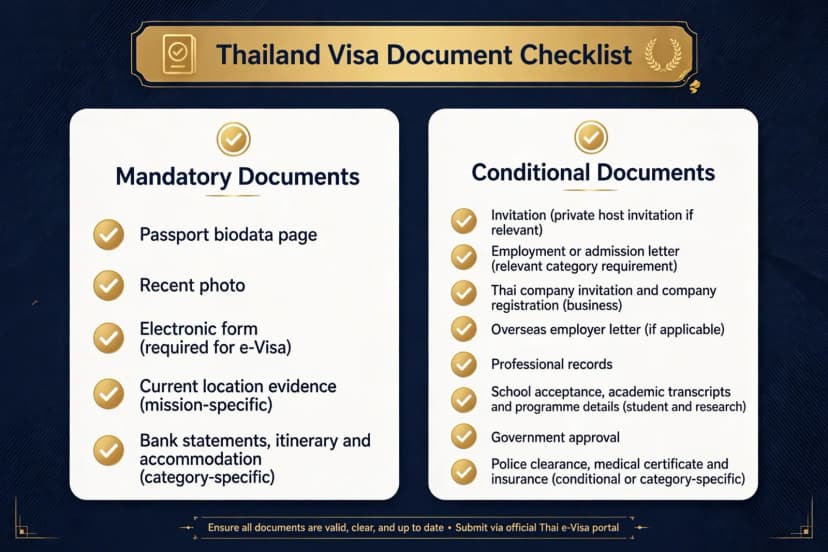
Confirm the exact requirements before applying. Supporting records may become mandatory in individual cases.
| General document | Classification |
|---|---|
| Passport biodata page | Core |
| Recent photo | Core |
| Electronic form | Required for e-Visa |
| Current location evidence | Mission-specific |
| Bank statements, itinerary, accommodation | Category-specific |
| Invitation | Conditional |
| Employment or admission letter | Relevant category requirement |
| Police clearance, medical certificate, insurance | Conditional or category-specific |
| Tourist | Business |
|---|---|
| Passport and photo | Passport and photo |
| Itinerary | Business purpose |
| Accommodation | Thai company invitation |
| Required financial evidence | Company registration |
| Residence evidence if required | Overseas employer letter if applicable |
| Private host invitation if relevant | Professional records |
| Student and research core evidence | Conditional evidence |
|---|---|
| School acceptance | Academic transcripts |
| Programme details | Government approval |
| Institution letter | Scholarship confirmation |
| Required financial documents | Sponsor records |
| Research invitation if relevant | Research plan or special authorization |
| Employment core evidence | Conditional evidence |
|---|---|
| Employment offer or contract | Professional licence |
| Employer letter | Qualifications and experience |
| Company documentation | Labour approval |
| Employment authorization records | Police or medical clearance |
| Passport and application | Corporate tax records |
| DTV HCMC requirement | Details |
|---|---|
| Passport | At least six months' validity |
| Photograph | Within previous six months |
| Residence | Foreign applicants: Vietnamese TRC or PRC |
| Financial evidence | At least THB 500,000 |
| Criminal clearance | Nationality country or Vietnam certificate No. 2 |
| Activity evidence | Overseas employment records, freelance portfolio or approved activity |
| Relationship evidence | Eligible dependants |
Vietnamese temporary residence registration is not accepted as a substitute for a TRC or PRC for HCMC DTV applications. Documents must be in Thai or English or translated. HCMC DTV checklist.
| Family and settlement core evidence | Conditional evidence |
|---|---|
| Marriage or birth certificate | Shared residence proof |
| Sponsor identification | Financial evidence |
| Sponsor immigration status | Employment and tax documents |
| Passport | Translation or legalization |
| Relationship documentation | PR medical and background checks |
How to Apply: Step-by-Step
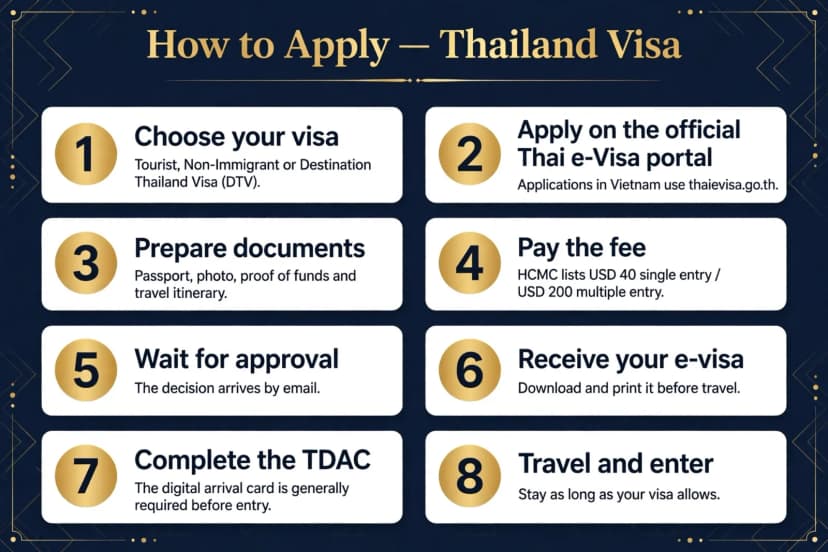
The standard overseas visa application is electronic. LTR, SMART and permanent residence have additional or separate procedures.
- Choose the correct visa. Visit the e-Visa portal and match the visa to intended activities.
- Confirm eligibility and jurisdiction. Check nationality, physical location, residence evidence and responsible mission. Overseas e-Visa applications are made outside Thailand.
- Prepare documents. Gather readable files and required translations or certifications before starting.
- Create an account. Use thaievisa.go.th and an email address you regularly access.
- Complete the application. Enter personal details exactly as shown on your passport and select the correct purpose and location.
- Upload documents and pay. Follow the portal sequence. Missions in Vietnam publish card-payment requirements. Fees are generally non-refundable.
- Complete additional checks if requested. Routine embassy appointments are not required for standard e-Visa applications in Vietnam, but interviews or further documents may be requested. Biometrics are not a universal advance requirement.
- Finalize submission. Save your reference and payment confirmation. Check all details before final submission.
- Monitor your application. Review your portal account and registered email regularly; respond promptly to requests.
- Receive the decision and prepare for travel. Print your approved electronic confirmation. Standard e-Visa applicants generally retain their passports. Complete applicable TDAC registration and present documents at the border. A visa does not guarantee admission; immigration officials determine entry and stay.
Visa Fees and Financial Requirements
Fees depend on visa type, entries, location and currency. A fee in one country does not necessarily apply elsewhere.
| Route | Fee | Financial requirement |
|---|---|---|
| Exemption | No visa application fee | Entry evidence may apply |
| Visa on Arrival | Check scheme | Check rules |
| TR HCMC | USD 40 single / USD 200 multiple | Mission-specific |
| Non-B | Mission-specific | Purpose-dependent |
| ED / ED Plus | Mission-specific | Varies |
| DTV HCMC | USD 340 | THB 500,000 |
| LTR issued in Thailand | THB 50,000 | Category-specific |
| SMART S | Check BOI | THB 600,000 under cited route |
| SMART dependant | Check authority | Additional THB 180,000 |
| Family | Mission-specific | Category and extension dependent |
| Retirement | Mission-specific | Category dependent |
| Privilege | Membership-dependent | Programme-dependent |
| PR | THB 7,600 application + THB 191,400 on approval (THB 95,700 spouse/child of Thai national or PR holder) | Qualification-dependent |
Financial evidence is separate from processing charges. For example, two HCMC DTV applicants paying the same fee would pay USD 680 in visa fees; two LTR applicants paying the domestic issuance fee would pay THB 100,000. These examples exclude insurance, translations, work permits and other costs. LTR issuance.
Visa Processing Times
| Authority | Published timeline |
|---|---|
| Hanoi | Five working days (reconfirm current notice) |
| HCMC | Five working days |
| HCMC DTV | Five working days, subject to checks |
| LTR endorsement | Approximately 20 working days after complete documentation |
| SMART | Check programme instructions |
| Pakistan | Confirm mission timeline |
| PR | No fixed universal completion time verified |
These are administrative estimates, not promises. HCMC advises applying at least two weeks before travel. Additional document requests can restart processing. Avoid non-refundable travel purchases until authorization is confirmed where possible.
Applying from Pakistan or Vietnam
Pakistani applicants in Pakistan
Pakistani ordinary passport holders should obtain an appropriate visa before travel. Confirm jurisdiction, fees and documentary requirements with the Royal Thai Embassy in Islamabad or Thai consular authority in Karachi. Use the e-Visa portal as instructed. Do not infer Pakistan fees by converting Vietnam fees into Pakistani rupees.
Pakistani applicants legally residing in Vietnam
Pakistani nationals may be eligible to apply through a Thai mission in Vietnam if they meet its circumstances and requirements. Lawful presence is not automatic eligibility. Older official instructions identify Pakistani applicants among nationalities subject to residence-related conditions or additional documentation.
Vietnam's e-Visa system has operated since October 2024, replacing routine in-person passport submission. Use the current online process rather than older paper instructions. Confirm jurisdiction with the Royal Thai Embassy in Hanoi or Royal Thai Consulate-General in HCMC, particularly following provincial administrative changes.
| Additional document | Importance |
|---|---|
| Pakistani passport | Essential |
| Vietnamese TRC or PRC | Long-term residence evidence |
| Vietnamese work permit | Where relevant |
| Employer confirmation and contract | Supporting evidence |
| Bank statements | According to visa checklist |
| Criminal clearance | Mandatory for cited HCMC DTV route |
| Travel or activity details | Purpose-specific |
Important DTV rule introduced in 2026
Foreign nationals applying for DTV through HCMC must provide a Vietnamese Temporary Residence Card or Permanent Residence Card. Temporary residence registration or other residence confirmations do not meet this particular requirement. A Pakistani applicant with a Vietnamese work permit but no TRC or PRC should not assume eligibility. From 31 August 2026, criminal clearance also became required. Contact the mission before paying if eligibility is unclear.
Official references: Hanoi additional requirements, Hanoi e-Visa procedure, HCMC DTV announcement.
Student Visa Guide
Thailand offers international degree programmes, language education and research opportunities. Institutions to explore include Chulalongkorn University, Mahidol University, Asian Institute of Technology, Thammasat University and Chiang Mai University.
Before applying, obtain admission to a genuine institution that can issue immigration documentation. The admission letter should identify the course and institution. Depending on the programme, further registration or government approval evidence may be needed. Budget for tuition, accommodation, food, transport, insurance and immigration expenses.
Thailand does not provide a universal automatic 20-hour-per-week work entitlement comparable to certain other destinations. Students wishing to undertake employment or paid internships should seek guidance from their institution and relevant labour authority. Graduates should consult their university about ED Plus eligibility and employment transition arrangements.
Work Visa and Job Opportunities
Major employment sectors include digital technology, manufacturing, international education, tourism, automotive production, logistics and professional services. Assess potential employers carefully. A genuine offer should identify the hiring company, job position, salary and employment conditions.
A typical pathway involves employer company documents, an appropriate Non-Immigrant visa or status and required work authorization. Once in Thailand, comply with restrictions and reporting conditions. Specialized professionals should assess LTR; startup founders may consider SMART S. Avoid paid employment on tourist status or starting work before authorization is effective. Department of Employment.
Family Immigration and Permanent Residence
Foreign spouses and eligible dependants can explore family-based routes. Prepare legally recognized marriage documents, sponsor identification and any required financial evidence. Foreign residents sponsoring dependants must demonstrate qualifying immigration status and relationship.
Permanent residence generally requires a substantial history of qualifying lawful residence and supporting evidence. Published guidance refers to at least three consecutive years of relevant Non-Immigrant status, with the precise extension history and other criteria determined by applicable rules. The process includes Form TM.9. The application fee is THB 7,600 per person; on approval the residence certificate costs THB 191,400 (THB 95,700 for the spouse or child under 20 of a Thai national or residence holder).
For the 2025 quota cycle, applications were accepted from 9 March to 3 April 2026, with 100 applicants per nationality and 50 stateless persons. That window has closed. Wait for the new announcement. Immigration Bureau PR announcement.
Common Application Mistakes
Common errors include choosing a visa that does not authorize intended activities, misunderstanding September 2026 exemption changes, applying through the wrong mission and relying on outdated checklists. Avoid financial records that do not satisfy the category, assuming a Vietnam work permit is enough, overlooking criminal clearance or entering inaccurate passport details. Never submit altered bank statements, fabricated employment records or false invitations. Keep accurate copies of documents and communications.
Reasons for Visa Refusal
A Thai visa can be refused for insufficient or inconsistent documents, ineligibility, inadequate financial evidence, incorrect personal information or concerns about stated purpose. The mission may request further documents or an interview. Prior immigration violations, security considerations or false declarations may affect an application. Fees are generally non-refundable even if refused. Review information provided by the authority and address genuine deficiencies before reapplying. Repeated submission does not guarantee a different outcome.
Frequently Asked Questions
1. Do Pakistani passport holders need a Thailand visa in 2026?
Pakistani ordinary passport holders should obtain an appropriate visa before travelling. Verify the latest nationality-specific requirements through the Thai e-Visa portal.
2. Can Pakistani citizens apply for a Thai visa from Vietnam?
Potentially, if they satisfy the residence, jurisdiction and category-specific requirements of the responsible Thai mission.
3. Is a Vietnamese work permit sufficient for a DTV?
Not by itself under the published HCMC DTV checklist. Foreign applicants must provide a qualifying Vietnamese TRC or PRC.
4. Does Thailand still provide 60-day visa-free entry?
The previous 60-day visa exemption scheme was revoked effective 15 September 2026. Other arrangements depend on nationality.
5. How much does the Thailand DTV cost in Vietnam?
The Ho Chi Minh City mission publishes a USD 340 processing fee. Confirm the applicable fee before submission.
6. How much money is required for a DTV?
The cited HCMC requirements specify financial evidence of at least THB 500,000.
7. Can I work in Thailand with a tourist visa?
A tourist visa does not authorize ordinary employment.
8. Can international students work part-time in Thailand?
There is no universal automatic part-time employment entitlement associated with student status. Separate authorization may be necessary.
9. Does Thailand offer a digital nomad visa?
Yes. The Destination Thailand Visa is available to qualifying remote workers, freelancers and other specified applicants.
10. How long does visa processing take in Vietnam?
The Thai missions in Hanoi and HCMC publish a standard five-working-day timeline, although individual cases may take longer.
11. Is the Thailand Digital Arrival Card a visa?
No. TDAC is an arrival registration system and does not replace any required visa or immigration permission.
12. Can a foreigner obtain permanent residence in Thailand?
Yes, subject to eligibility, quotas, application periods and government approval.
13. Does marriage to a Thai citizen grant citizenship automatically?
No. Family immigration, permanent residence and citizenship involve separate legal processes.
14. Does Thailand have a general job seeker visa?
No general standalone route was identified. Certain eligible graduates may have post-study options under ED Plus.
15. Can a Thai visa application be refused after payment?
Yes. Payment does not guarantee approval, and fees are generally non-refundable.
Official Immigration Websites
| Authority | Website |
|---|---|
| Thai e-Visa | https://www.thaievisa.go.th/ |
| Ministry of Foreign Affairs | https://www.mfa.go.th/en/ |
| Department of Consular Affairs | https://consular.mfa.go.th/ |
| Immigration Bureau | https://www.immigration.go.th/ |
| TDAC | https://tdac.immigration.go.th/ |
| BOI LTR | https://ltr.boi.go.th/ |
| SMART | https://smart-visa.boi.go.th/smart/ |
| Department of Employment | https://www.doe.go.th/ |
| Hanoi | https://rtehanoi.thaiembassy.org/ |
| HCMC | https://hochiminh.thaiembassy.org/en/ |
| Islamabad | https://islamabad.thaiembassy.org/ |
Final Checklist and Conclusion
Before applying, confirm visa category, passport validity, jurisdiction, financial requirements and additional nationality-related documentation. Check the selected category permits all intended activities. Obtain employer authorization, educational sponsorship or family documents where required. Apply through genuine government websites and monitor your application. Once approved, review conditions, complete applicable arrival registration and retain evidence of authorized stay.
Thailand offers diverse opportunities for international visitors and residents. Careful preparation, accurate documentation and adherence to current immigration requirements can help reduce avoidable delays. For Pakistani nationals living in Vietnam, the most important preliminary step is confirming eligibility with the relevant Thai mission before paying a visa fee.
MAS Inspire — International Education and Immigration Information | https://masinspire.com/


