North Macedonia Visa Guide 2026: Types, Requirements, Documents and Application Steps
Last checked: 27 November 2026. This guide is for Pakistani passport holders living in Vietnam. Visa rules change without notice — always confirm the live rules on the North Macedonia Ministry of Foreign Affairs and Foreign Trade website (mfa.gov.mk) and with the competent Macedonian mission before paying any fee or booking a non-refundable ticket.
Table of Contents
- Introduction
- Do Pakistani Passport Holders Need a Visa for North Macedonia?
- The 15-Day Exemption: Schengen, US, UK and Canadian Visas
- Types of North Macedonia Visas for Pakistani Passport Holders
- Visa Fees and Financial Requirements
- Processing Times
- Complete Document Checklists
- How to Apply: Step-by-Step
- Applying from Vietnam — the Embassy in Beijing
- Work and Study Routes
- Family Reunion and Permanent Residence
- Transit, Flights and Money: Practical Notes
- Arrival, Registration and Staying Legal
- Common Application Mistakes and Reasons for Refusal
- Frequently Asked Questions
- Official Immigration Websites
Introduction
North Macedonia is the small, landlocked Balkan country that most Pakistani travellers have never seriously considered — and that is a pity, because it is one of the most affordable and rewarding corners of Europe. Skopje, the capital, mixes Ottoman bazaars, Byzantine churches and a rebuilt neoclassical centre along the Vardar river. Beyond it lies Lake Ohrid, one of Europe's oldest and deepest lakes and a UNESCO World Heritage site, the mountain town of Mavrovo, the wine region around Tikvesh, and the old towns of Bitola and Prilep. The country is an EU candidate, uses the Macedonian denar, and is a genuine budget destination by European standards — which is why it attracts backpackers, remote workers passing through the Balkans, and students drawn by low tuition fees at its state universities.
For a Pakistani passport holder, North Macedonia is also one of the more interesting visa cases in this series, because the answer to "do I need a visa?" is not a simple yes. Yes, you need a visa on your Pakistani passport alone. But if you hold a valid multiple-entry Schengen visa, an EU or Schengen residence permit, or — under a temporary decision that runs only until 31 December 2026 — a valid multiple-entry US, UK or Canadian visa, you can enter without a Macedonian visa at all, for up to 15 days per entry. That single rule changes the whole plan for many readers, and it is the first thing to check before you spend money on an application.
The second thing to know is that North Macedonia has no e-visa and no visa on arrival. If you need a visa, you apply in person at a Macedonian embassy or consulate — and there is no Macedonian mission in Vietnam, and none in Pakistan either. For a Pakistani living in Vietnam, the competent mission is the Embassy of North Macedonia in Beijing, which represents North Macedonia in Vietnam. That means a trip to China to lodge the application, unless the Ministry's Visa Centre in Skopje directs you elsewhere.
Do Pakistani Passport Holders Need a Visa for North Macedonia?
Yes. Holders of ordinary Pakistani passports need a visa before travelling to North Macedonia. The Ministry of Foreign Affairs and Foreign Trade's own visa checker lists Pakistan as "visa needed", confirmed by an archived copy of the Ministry's page dated 29 October 2026 and checked again on 17 November 2026. No source found for this guide suggests otherwise, and Pakistan appears on every nationality table as an embassy-visa country.
The rule follows your passport, not where you live. Living in Vietnam, holding a Vietnamese temporary residence card (TRC), holding a Gulf residence visa, or having lived in the Gulf does not remove the visa requirement. A Vietnamese residence permit is not an EU or Schengen residence permit, and it gives no visa-free entry to North Macedonia. A UAE or other Gulf residence permit does not give visa-free entry either. If a travel agent tells you that a Gulf residence visa or a Vietnamese TRC makes North Macedonia visa-free for you, ask them to show the official rule: none was found.
There is also no visa on arrival and no electronic visa to fall back on. Multiple 2026 guides confirm that North Macedonia has no general tourist e-visa: a visitor who needs a visa files a signed application in person at the responsible Macedonian mission, and the file is decided by the Visa Centre of the Ministry of Foreign Affairs in Skopje. The Ministry's own visa procedure page says the same thing in plain language: "The foreigner is obligated to secure his/her visa prior to entering the Republic of North Macedonia." Do not fly to Skopje hoping to buy a visa at the airport — there is no such facility for Pakistani passports.
The passport rule is set by the Ministry and by the Law on Foreigners. Your travel document must be valid for at least three months beyond the validity of the visa, must have been issued within the previous 10 years, and must have at least two empty pages for visa purposes. The Law on Foreigners phrases the validity rule as at least three months after the planned date of departure. Some commercial guides say six months instead — that is a conflict this guide flags below, in the fees and documents sections. The safe course is to meet the stricter six-month standard if you can: renew your passport in Vietnam or Pakistan before you apply if it is anywhere near the limit, because a visa cannot be issued into a passport that will fail the validity test on arrival.
The 15-Day Exemption: Schengen, US, UK and Canadian Visas
This is the most valuable section of the guide for many readers, because it can remove the whole visa application. Under the Ministry's visa regime, third-country nationals who would otherwise need a visa may enter North Macedonia without a visa for short stays if they hold one of the following:
A temporary or permanent residence permit of an EU member state or a Schengen state. You may stay up to 15 days on every entry, within a total of 90 days in any 180-day period. This is the standing rule, not a temporary one.
A valid multiple-entry Schengen visa (type C), valid at least five days beyond your intended stay. The same limit applies: up to 15 days per entry, within 90 days in any 180 days. The visa must be multiple-entry — a single-entry Schengen visa does not qualify — and it must still be valid at least five days after your planned stay in North Macedonia ends.
A valid multiple-entry British, American or Canadian visa, physically inserted in your passport and valid at least five days beyond your intended stay. This is a temporary decision valid from 1 January to 31 December 2026 only, and it also allows up to 15 days per entry. This is the single most time-sensitive fact in this guide: if you are travelling in 2027, do not assume this exemption still exists. Check with the Ministry or the Beijing embassy whether the decision has been renewed before you travel. Residence permits of the US, UK or Canada are not named in this temporary decision — only visas physically in the passport — and a UK digital visa (eVisa) with no sticker in the passport may not be accepted at the border, a warning raised by at least one 2026 guide.
Three warnings apply to all three routes. First, the 15-day limit is per entry, not per trip: you cannot stay 15 days, step across the border and restart the clock, because the 90-days-in-180 ceiling still applies. Second, the exemption covers short stays only — tourism, visiting friends and family, and short business trips. It does not give you the right to work, study or live in North Macedonia, and it does not replace a long-stay D visa. Third, the exemption is decided at the border: carry the qualifying visa or residence permit itself, make sure it is valid at least five days beyond your stay, and carry the same supporting evidence a visa applicant would carry — return ticket, accommodation proof and proof of funds — because the border officer can still ask for them.
If you hold none of these, the rest of this guide is your route: a short-stay C visa or a long-stay D visa from a Macedonian mission, applied for in person.
Types of North Macedonia Visas for Pakistani Passport Holders
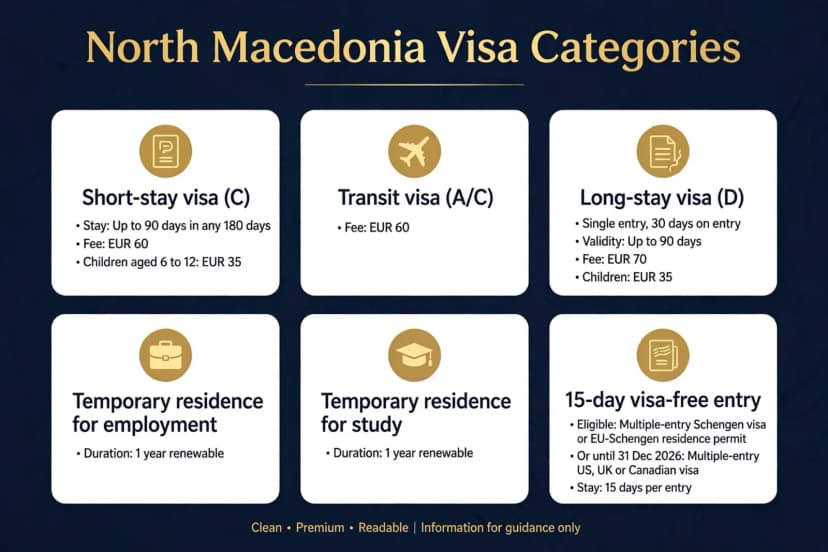
North Macedonia's visa system is set by the Law on Foreigners and administered by the Ministry of Foreign Affairs and Foreign Trade through its Visa Centre, with the Ministry of Interior (MVR) handling residence permits inside the country. The categories below are the ones a Pakistani passport holder living in Vietnam is realistically likely to use. There is no separate tourist-visa category with its own name: tourism, business visits, family visits and transit all travel on the short-stay C visa, and the purpose is declared in the application.
Short-stay visa (C visa) — tourism, business and family visits
The standard visa for stays of up to 90 days in any 180-day period. It covers sightseeing, visiting friends and family, business meetings, conferences and short private visits. It is issued with a validity of up to one year, and by exception up to two years, and may be single or multiple entry at the mission's discretion. A C visa does not allow paid work of any kind, and it cannot be used to take up employment or to enrol for a long course of study. It may be extended once, only for reasons of force majeure or humanitarian reasons — not because you simply want a longer holiday.
Transit visa (A and C visas)
For passing through North Macedonia to a third country, including transit through the international transit zone at Skopje airport. The Ministry's procedure page treats transit as one of the purposes for which a visa is issued, and the fee schedule charges the same EUR 60 for A and C visas. In practice most Pakistani travellers from Vietnam will not need a Macedonian transit visa at all, because the realistic routings to Skopje transit through Istanbul, Vienna, Dubai or Doha rather than through North Macedonia itself — but if your itinerary does route you through Skopje to somewhere else, get the transit visa from the mission first. One commercial guide quotes a lower transit fee of around EUR 30–35; that figure conflicts with the published tariff and is flagged in the fees section.
Long-stay visa (D visa) — work, study and family
The entry visa for anyone intending to stay longer than 90 days: employment, study, family reunification, research and other long-term purposes. It is a single-entry visa issued with a validity of up to 90 days, and the permitted stay on entry is 30 days — within which you must apply for a temporary residence permit at the Ministry of Interior. The D visa is only the entry document: the residence permit is what lets you actually live in the country, and the two must not be confused. The fee is EUR 70, or EUR 35 for children aged 6 to 12, confirmed on the Ministry's own procedure page.
Work route — temporary residence for employment
There is no standalone "work visa" sticker you can buy. A foreign national who wants to work in North Macedonia obtains a temporary residence permit on the grounds of employment. The sequence is: a Macedonian employer offers you a job and secures a positive opinion or work authorisation from the Employment Agency (Agencija za vrabotuvanje, av.gov.mk); you then obtain a long-stay D visa from a Macedonian mission abroad; and after entry you complete the temporary residence-and-work permit procedure at the Ministry of Interior. The permit is typically issued for one year and is renewable. The legal framework was significantly updated by amendments to the Law on Foreigners that entered into force on 26 September 2025, which simplified documentation and created a fast-track for strategic projects. The full sequence is set out in the work section below. Never travel on a C visa intending to convert it into a work permit on arrival.
Student route — temporary residence for study
For studies at a recognised Macedonian institution. You enter on a D visa and then obtain a temporary residence permit for study, issued for one year and renewable for the duration of the programme. The institution's enrolment certificate is the foundational document, and foreign diplomas must go through nostrification (recognition) by the Ministry of Education and Science, with apostilled documents translated by a court translator. North Macedonia is a low-cost study destination by European standards, and every university must offer at least two first-cycle and two second-cycle programmes in English. Details are in the work and study section below.
Family reunification and temporary residence
Close family members of a person legally resident in North Macedonia can obtain temporary residence on the grounds of family reunification. The main holder's status is the foundation of the application, so file together where possible and carry the marriage or birth certificates that prove the relationship. Residence permits are also available on other grounds in the Law on Foreigners, including self-employment, property ownership and humanitarian grounds — but each ground has its own evidence requirements, and none of them is a shortcut around the D visa.
What does not exist: a digital nomad visa
North Macedonia has no digital nomad visa and no residence category for remote workers. A proposal was floated in 2021 and never passed parliament, and the Law on Foreigners does not list remote work for a foreign employer among the grounds for temporary residence. Remote workers who want a longer stay use the general framework instead — most commonly by registering as a sole trader or forming a company, or through employment with a Macedonian employer. Do not pay any agent who offers you a "North Macedonia digital nomad visa": no such visa exists.
| Visa or permit | Typical stay | Entries | Where to apply | Allows work? |
|---|---|---|---|---|
| Short-stay C visa | Up to 90 days in 180 | Single or multiple, as issued | Macedonian mission, in person | No |
| Transit visa (A/C) | Short transit | As issued | Macedonian mission, in person | No |
| Long-stay D visa | 30 days on entry; validity up to 90 days | Single | Macedonian mission, in person | No — entry document only |
| Temporary residence — employment | Typically 1 year, renewable | — | MVR, after D visa entry | Yes, for the sponsoring employer |
| Temporary residence — study | 1 year, renewable for the programme | — | MVR, after D visa entry | No (limited rights only — confirm with MVR) |
| Temporary residence — family | As issued, tied to main holder | — | MVR, after D visa entry | Depends on the ground — confirm with MVR |
| 15-day visa-free entry | 15 days per entry, 90 in 180 | Multiple | At the border, with a qualifying visa or permit | No |
Visa Fees and Financial Requirements
The fee picture for North Macedonia is unusually clear on the two main visas and unusually muddy on everything around them. The two figures below are the ones this guide treats as verified, because one of them is published on the Ministry's own procedure page and both are attributed to the same official tariff — Tariff No. 135 of the Law on Administrative Fees.
| Item | Fee | Source and status |
|---|---|---|
| Short-stay and transit visa (C visa) | EUR 60; EUR 35 for children aged 6–12 | Tariff No. 135, as reported by two 2026 guides citing the Ministry |
| Long-stay visa (D visa) | EUR 70; EUR 35 for children aged 6–12 | Ministry's own visa procedure page (mfa.gov.mk) |
| Temporary residence permit, first issuance | EUR 60 | MVR administrative fee, as reported by a 2026 work-visa guide — third-party, not verified on an MVR page |
| Temporary residence permit, renewal | EUR 30 | Same third-party report — not verified on an MVR page |
| Student residence permit issuance | MKD 3,000–6,000 reported | Third-party immigration guide, plus notarisation, translation and apostille costs — not verified on an MVR page |
| Visa-free 15-day entry | No fee | Ministry visa regime — no application, no fee |
Conflict — a EUR 90 fee. One commercial Pakistan-focused guide quotes an official government fee of EUR 90 for a North Macedonia tourist visa, with standard processing of three to six weeks. No other source found for this guide supports EUR 90, and it contradicts the EUR 60 tariff figure reported by two independent 2026 guides and the EUR 70 D-visa figure published by the Ministry itself. This guide uses EUR 60 for the C visa and EUR 70 for the D visa, and treats EUR 90 as unverified. Get the fee in writing from the mission before you pay, and pay only the amount the mission itself states.
Conflict — a EUR 30–35 transit fee. One commercial guide quotes a transit visa fee of around EUR 30–35. A fee comparison citing official sources lists the visa application processing fee for A and C visas as EUR 60. This guide uses EUR 60 for transit as well, because the tariff makes no separate lower transit charge, and flags the lower figure as unverified.
Financial requirements. There is no officially published minimum bank balance for a North Macedonia visa. The Ministry requires documents proving means of subsistence to cover the stay and the return journey, and the Law on Foreigners says the Government sets the amount of means required, which may be assessed on the basis of cash, traveller's cheques and credit cards. No figure was found in any official source read for this guide. One commercial guide advises a closing balance of PKR 1,800,000 to 3,000,000 for Pakistani applicants — that is an agency benchmark, not an official requirement, and this guide does not adopt it. Show recent bank statements that genuinely cover your trip, your accommodation and your return, and carry a credit card as backup.
Travel medical insurance. Proof of travel medical insurance is a mandatory visa document: the Ministry requires adequate and valid insurance covering expenses during the stay, repatriation for medical reasons, urgent medical attention and emergency hospital treatment, for the entire duration of the stay. No official minimum coverage sum was found in any source read for this guide. Commercial guides commonly quote EUR 30,000, which is the Schengen figure — it is a sensible amount to buy, but it is not verified as a Macedonian requirement, and this guide says so plainly. Buy a policy that covers the full stay and medical evacuation, and carry the certificate with your application.
Processing Times
The Ministry does not publish a single processing time on its visa procedure page, and the sources disagree about what to expect. The figures below are reported in the order of their authority, and this guide's planning advice follows the most cautious of them.
| Route | Time reported | Source |
|---|---|---|
| C visa — statutory decision time | Within 15 calendar days of a complete application; extendable to 30 days, and to 60 days where additional documents or prior consent are needed | Law on Foreigners, as reported by a 2026 guide citing the official gazette |
| C visa — commonly cited | About 3–10 working days | VisaCross, June 2026, flagged as low confidence by that guide itself |
| C visa — commercial estimate | 15 calendar days | Travel Visa Stack, October 2026 |
| C visa — commercial estimate | 3–6 weeks | AMG Visa, October 2026 (the same guide that quotes the unverified EUR 90 fee) |
| D visa (study) | About 45–60 days, with an in-person interview | Third-party study guide — conflicts with the 15-day statutory figure; treat as a planning figure, not a rule |
| Student residence permit (after arrival) | 30–60 days from complete submission | Third-party immigration guide |
| Temporary residence and work permit | Typically 1–3 months from submission | VisaCross work-visa guide, June 2026 |
What to plan on. The statutory rule is the only one with legal force: a decision is due within 15 calendar days of a complete application, extendable to 30 and in some cases to 60 days. But the Ministry also requires you to apply no earlier than six months and no later than 15 days before your trip, and the 15-day minimum tells you something important — a complete application filed 15 days before travel is the latest the system contemplates, not a comfortable margin. Plan on four to six weeks for a C visa from the day you lodge in Beijing, longer for a D visa, and longer still if the mission needs to seek prior consent from Skopje.
Complete Document Checklists
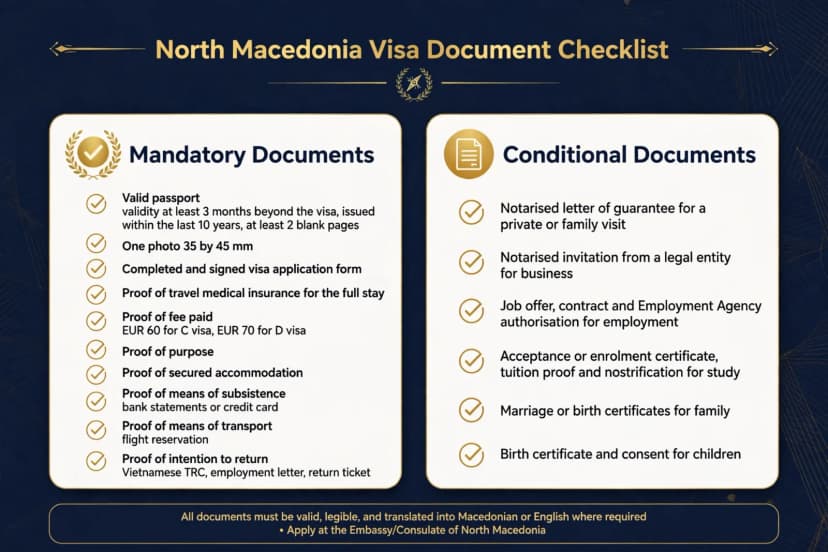
The Ministry's procedure page lists the documents every visa applicant must enclose. The checklists below follow that page, and separate the mandatory documents from the conditional and recommended ones. Do not claim a fixed number of required documents: the Ministry's list is a set of categories, and the mission can ask for more.
Mandatory documents — every visa application
| Document | Detail |
|---|---|
| Valid travel document | Passport valid at least 3 months beyond the visa validity (Law on Foreigners: 3 months after planned departure); issued within the last 10 years; at least 2 empty pages for visa purposes |
| Photograph | One photograph, size 35 x 45 mm |
| Completed visa application form | Downloadable from the Ministry's visa application page; signed in person at the mission |
| Proof of travel medical insurance | Adequate and valid for the entire duration of the stay, covering medical expenses, repatriation, urgent care and emergency hospital treatment |
| Proof of fees paid | Receipt for the visa fee (EUR 60 C visa / EUR 70 D visa) |
| Proof of purpose of visit | Documents proving why you are travelling — tourism, business, family visit, study or work |
| Proof of secured accommodation | Hotel booking, or a letter of guarantee / invitation covering accommodation |
| Proof of means of subsistence | Bank statements and/or credit card showing you can cover the stay and the return journey |
| Proof of means of transport | Flight reservation or other transport booking |
| Proof of intention to return | Evidence you will return to Vietnam (or Pakistan) or travel on to a third country — your Vietnamese TRC, employment letter and return ticket |
Conditional documents — add for your purpose
| Your situation | Extra documents |
|---|---|
| Private or family visit | Letter of guarantee from a Macedonian citizen or a foreigner legally resident in North Macedonia, certified by a notary public; it may cover accommodation and costs if the guarantor states they will provide them |
| Business visit | Invitation letter from a legal entity registered in North Macedonia, certified by a notary public (not required if issued by a state administrative body); the inviting company's details |
| Employment | Job offer and contract from a Macedonian employer; positive opinion / work authorisation from the Employment Agency; then D visa, then MVR residence permit |
| Study | Acceptance / enrolment certificate from a recognised institution; proof of tuition payment or scholarship; nostrification of your previous diploma; proof of funds for the academic year; criminal record certificate (reported by third-party guides) |
| Family reunification | Marriage or birth certificates proving the relationship; the main holder's residence permit; proof of accommodation and means |
| Children travelling with you | The child's own passport and visa application, submitted in person by a parent or guardian; birth certificate; consent documents if only one parent travels (confirm the exact requirement with the mission) |
| Visa-free 15-day entry | No application — but carry the qualifying multiple-entry visa or residence permit, valid at least 5 days beyond your stay, plus return ticket, accommodation proof and proof of funds for the border check |
Documents from Pakistan. Educational certificates and civil documents issued in Pakistan will generally need to be apostilled or legalised and translated by a court translator before a Macedonian authority accepts them — nostrification of a Pakistani diploma is a known slow step that takes several weeks, and one third-party guide puts it at 60 to 90 days. Start it before you apply for the visa, not after. Keep originals and certified copies separate, and carry the originals when you lodge.
How to Apply: Step-by-Step
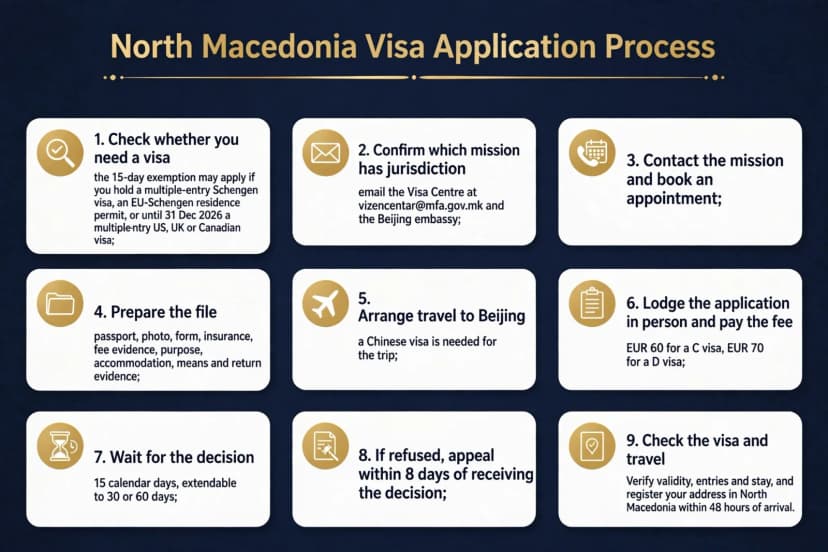
There is no online application. Every step below happens in person at a Macedonian mission, except the first two checks, which you do yourself. The Ministry's procedure page is the controlling source for this sequence.
Step 1 — Check whether you need a visa at all. Use the Ministry's "Do you need a visa?" checker on mfa.gov.mk and select Pakistan. Then check the 15-day exemption: do you hold a multiple-entry Schengen C visa, an EU/Schengen residence permit, or a multiple-entry US, UK or Canadian visa valid at least five days beyond your stay? If yes, and your stay is 15 days or less, you need no application — but remember the US/UK/Canada decision expires on 31 December 2026 and must be confirmed for 2027 travel.
Step 2 — Confirm which mission has jurisdiction over you. Email the Ministry's Visa Centre at vizencentar@mfa.gov.mk (telephone +389 2 3115 266) and ask which mission accepts applications from Pakistani nationals resident in Vietnam. The expected answer is the Embassy of North Macedonia in Beijing, which represents North Macedonia in Vietnam — but get it confirmed in writing, because jurisdiction is the one thing you cannot afford to get wrong, and no source found for this guide states in the Ministry's own words that Beijing accepts applications from residents of Vietnam.
Step 3 — Contact the mission and book your appointment. Contact the Beijing embassy (details in the next section) to confirm the appointment system, the current fee and how it must be paid, the form to use, and whether you must appear in person. Applications are submitted in person; the only exceptions the Ministry names are for a disabled applicant or a well-known person with no doubt about their bona fide intentions, who may use an authorised proxy. A minor's application is submitted in person by a parent or guardian.
Step 4 — Prepare the file. Work through the checklists above. Download the visa application form from the Ministry's visa application page, complete it, and sign it. Arrange travel medical insurance for the full stay, a flight reservation, accommodation or a notarised guarantee or invitation letter, and recent bank statements. If you are visiting family or travelling for business, get the notarised letter early — notarisation in North Macedonia takes time and cannot be rushed from Vietnam.
Step 5 — Arrange your travel to Beijing. You will need to enter China to lodge in person. Check the Chinese visa rules for Pakistani passport holders and apply for a Chinese visa in Vietnam in good time — do not assume you can enter China visa-free. Book refundable or changeable travel until the Macedonian visa is in your passport.
Step 6 — Lodge the application and pay the fee. Attend the embassy in person with the originals and copies, the signed form, the photograph and the fee. Keep the receipt and any filing reference the embassy gives you. Ask how long the embassy will hold your passport, how the decision will be communicated, and whether collection is in person or by post.
Step 7 — Wait for the decision. The statutory decision time is 15 calendar days from a complete application, extendable to 30 and in some cases to 60 days. Do not book non-refundable travel inside that window. If the mission asks for additional documents, supply them quickly — the clock can run from the complete file.
Step 8 — If refused, decide on an appeal. You have the right to appeal a refusal within eight days of receiving the decision, to the State Commission for Decision-Making in Administrative Procedure and Labour Relation Procedures in the Second Instance. The appeal is filed in writing, using the Macedonian Cyrillic alphabet, with the administrative fee prescribed by law. The appeal does not delay the enforcement of the decision — so a refusal still stands while you appeal, and you should not travel on the strength of a pending appeal.
Step 9 — Check the visa and travel. When the visa is issued, check every detail on the sticker before you leave the embassy: your name, passport number, validity dates, number of entries and permitted stay. A C visa is valid for up to one year but the stay is capped at 90 days in 180; a D visa is single entry with a 30-day stay on entry. Carry your insurance certificate, return ticket, accommodation proof and proof of funds for the border check, and register your presence within 48 hours of arrival (see the arrival section).
Applying from Vietnam — the Embassy in Beijing
This is the section that matters most for the audience of this guide, and it is also the section with the most that could not be fully verified — so read the warnings as carefully as the addresses.
There is no Macedonian mission in Vietnam. North Macedonia is represented in Vietnam through its embassy in Beijing, China — Beijing and New Delhi are its only embassies in Asia. Vietnam is represented in North Macedonia through its embassy in Sofia, Bulgaria.
The Embassy of North Macedonia in Beijing. The embassy's contact details as reported by multiple listings are: telephone +86 10 6532 7846, fax +86 10 6532 7847, email beijing@mfa.gov.mk. The ambassador is Sashko Nasev, in post since 16 February 2024. The embassy's website is listed as beijing.mfa.gov.mk.
Conflict — the street address. The embassy's address is reported differently by different sources, and this guide cannot resolve the difference from the sources available. TravelChinaGuide and a November 2026 social-media screenshot give "No. 1-32, San Li Tun Diplomatic Compound, Chaoyang District, Beijing 100600". Other listings give "3-2-21, Sun Li Tun Diplomatic Compound, Beijing 100600", and one older listing gives "5-2-22, Sanlitun Diplomatic Apartments, 100600". All three point to the same Sanlitun diplomatic compound in Chaoyang District, and the difference is most likely a building or apartment numbering change over time — but do not navigate to any of them without confirming the current address by email or telephone first. Confirm the address, the opening hours and the appointment rules before you travel to Beijing.
What is not verified. No source found for this guide states, in the Ministry's own words, that the Beijing embassy accepts visa applications from Pakistani nationals who are resident in Vietnam rather than in China. The general rule is that you apply to the competent resident or non-resident mission for your place of residence, and Beijing is the mission that represents North Macedonia in Vietnam — but "represents in Vietnam" and "accepts visa applications from Vietnamese residents" are not quite the same thing, and the only way to settle it is to ask. Email vizencentar@mfa.gov.mk and beijing@mfa.gov.mk before you book any travel, and ask three questions in writing: does the Beijing embassy accept applications from Pakistani nationals resident in Vietnam; what is the current fee and payment method; and must the applicant appear in person in Beijing, or is there any other filing route? Keep the reply — it is the document that settles the question.
Other missions sometimes named. For Pakistani applicants based in Pakistan, commercial guides name the embassies in Ankara and Abu Dhabi as the filing channel, and the embassy in New Delhi is the other Asian mission. None of those is the mission for a resident of Vietnam, and this guide does not recommend applying through them unless the Visa Centre directs you to one in writing. There is no Macedonian mission in Pakistan, so a trip abroad to lodge is unavoidable for Pakistan-based applicants too.
The practical cost of the Beijing route. Be realistic about what this route costs in time and money: a Chinese visa for yourself, return travel from Ho Chi Minh City to Beijing, accommodation in Beijing, the EUR 60 or EUR 70 Macedonian fee, and the possibility of a second trip — or a wait in Beijing — while your passport is held. That is why the 15-day exemption is worth checking first: a multiple-entry Schengen, US, UK or Canadian visa, or an EU/Schengen residence permit, can save the entire Beijing trip. It is also why you should not book non-refundable flights to Skopje until the Macedonian visa is in your passport.
Applying from Pakistan instead. If you happen to be in Pakistan when you apply, the position is the same in substance — a visa is required, there is no mission in Pakistan, and you apply in person at a competent mission abroad — but the competent mission may differ, and the Visa Centre is again the authority to ask. A Pakistani residence does not change the fee or the document list, and a Gulf residence visa does not exempt you.
Work and Study Routes
Work and study in North Macedonia both run through the same two-stage system: a D visa to enter, then a temporary residence permit from the Ministry of Interior after arrival. Neither stage can be skipped, and neither is quick.
Working in North Macedonia
The employer comes first. A Macedonian employer that wants to hire you must apply to the Employment Agency for a positive opinion or work authorisation for the post. Only then do you apply for a long-stay D visa (EUR 70) at a Macedonian mission, and only after entry do you complete the temporary residence-and-work permit at the Ministry of Interior. The permit is typically issued for one year and is renewable. The administrative fee for the residence permit is reported as EUR 60 for first issuance and EUR 30 for renewal — those figures come from a third-party guide citing MVR, not from an MVR page read for this guide, so confirm them with the mission.
The 2025 amendments to the Law on Foreigners, in force from 26 September 2025, simplified the documentation for employment-based residence and created a fast-track for strategic projects. One 2026 guide reports that proof of financial means and health insurance are no longer required for employment-based residence under those amendments, though a mission may still ask for insurance and a bank statement at the consular stage. That claim could not be verified against the official consolidated text of the law for this guide, so this guide reports it as a third-party claim and advises you to prepare the insurance and bank statement anyway — an extra document never hurt an application, and a missing one can delay it.
Typical processing for the residence-and-work permit is reported as one to three months from submission, with both the Ministry of Interior and the Employment Agency reviewing the file. Treat that figure as a planning estimate from a single third-party guide, not an official timeline.
There is no job-seeker visa in North Macedonia. You cannot enter on a C visa, look for work, and convert it into a work permit. The job and the employer's authorisation must exist before you apply for the D visa. Citizens of Serbia and Albania have a privileged route under the Open Balkan initiative, with free access to each other's labour markets — that route does not apply to Pakistani nationals. Be wary of any agent who offers a North Macedonian work permit without a named employer and a real job offer: the employer's authorisation is the foundation of the whole process, and without it there is no permit.
Studying in North Macedonia
North Macedonia is one of Europe's cheapest study destinations, with state-university tuition reported at roughly EUR 500 to 1,500 per semester and private universities higher, at roughly EUR 7,000 to 10,000 a year. The largest university is Ss. Cyril and Methodius University in Skopje; South East European University is notably multilingual, and there are state universities in Bitola, Stip and Tetovo, plus private universities including the International Balkan University. Every university must offer at least two first-cycle and two second-cycle programmes in English, and many programmes accept a medium-of-instruction letter instead of IELTS — confirm that with the university itself, because it varies by programme.
The sequence for a Pakistani student is: apply directly to the university (there is no national application portal); get your secondary-school diploma or previous degree recognised through nostrification by the Ministry of Education and Science, with apostilled documents translated by a court translator — a step one guide puts at 60 to 90 days, so start it early; obtain the enrolment certificate; apply for a D visa at the mission with the acceptance letter, proof of funds, accommodation proof, health insurance and the visa fee; and after arrival, apply for the temporary residence permit for study at the Ministry of Interior. The student permit is issued for one year and renewable for the duration of the programme, with processing reported at 30 to 60 days — a third-party figure, not an MVR publication.
Students should apply as early as the six-month window allows. One study guide puts D-visa processing for students at 45 to 60 days with an in-person interview, which conflicts with the 15-day statutory decision time; the safest reading is that student files take longer in practice, and the six-month window exists precisely for cases like this.
Family Reunion and Permanent Residence
Family reunification is a recognised ground for temporary residence under the Law on Foreigners. Close family members of a person legally resident in North Macedonia — a spouse and minor children in the usual case — can obtain temporary residence tied to the main holder's status. File together where possible, carry the marriage or birth certificates that prove the relationship, and expect the mission to ask for proof of the main holder's residence permit, accommodation and means. Family members enter on D visas and complete their residence permits at the Ministry of Interior after arrival, on the same two-stage pattern as work and study.
Temporary residence permits are issued for a defined period — typically one year for employment and study — and are renewable from inside the country. Under the 2025 amendments, the extension window runs from 90 days to 5 days before expiry, and extensions must be filed before the permit expires, never after. Do not let a permit lapse while you are deciding whether to renew: an expired permit is a different and much harder problem than a renewal.
Permanent residence exists in the Law on Foreigners as the step after extended lawful temporary residence, and it is the route to long-term settlement. The exact qualifying period and conditions were not verified against an official source in the research for this guide, so this guide does not state a number of years or a list of conditions — confirm both with the Ministry of Interior before making any long-term plan. What is certain is that permanent residence is not available on arrival, not available on a C visa, and not something any agent can sell you in advance.
There is no investment or "golden visa" route in North Macedonia that this guide could verify, and no citizenship-by-investment programme. Do not treat a property purchase as a visa route without written confirmation from the Ministry of Interior.
Transit, Flights and Money: Practical Notes
Flights. There are no direct flights from Vietnam or Pakistan to North Macedonia. The realistic routings from Ho Chi Minh City are via Istanbul (Turkish Airlines), Vienna (Austrian Airlines), Dubai or Doha, into Skopje International Airport (SKP). Check the transit-visa rules for your transit country as well: a Pakistani passport holder transiting Istanbul, Vienna, Dubai or Doha airside on a single ticket normally needs no transit visa for a straightforward connection, but confirm it with the airline for your exact itinerary, because the rules depend on the airport, the terminal and whether you need to collect and re-check baggage.
Money. The currency is the Macedonian denar (MKD). Denars cannot be changed outside North Macedonia, and British banks do not exchange them, so do not buy denars before you travel — bring euros or US dollars and change them at banks or official exchanges in Skopje, never through street dealers. Major hotels and most shops accept credit cards, but smaller shops and green markets are cash-only, and most banks in towns and cities have ATMs that accept international cards. Cash of EUR 10,000 or more must be declared to customs on entry or exit.
Costs. North Macedonia is one of the cheapest countries in the Balkans. Budget guides put a one-bedroom apartment in Skopje at roughly EUR 300 to 450 a month, and daily costs well below Western European levels. That matters for your proof of funds: the amount you need to show is the cost of your actual trip, not a fixed official minimum, and a realistic budget with bookings to match it is more convincing than a large unexplained balance.
Health and safety. No vaccination certificate is required for entry according to the sources read for this guide. Tap water is not recommended for drinking — use bottled water. Air pollution can be severe in Skopje in winter, and forest fires are common in summer. Attacks on foreign nationals are extremely rare, but pickpocketing and bag-snatching in shopping and entertainment areas late at night are reported. Emergency numbers are police 192, fire 193, ambulance 194. Power plugs are types C and F, 230V, 50Hz. The time zone is UTC+1, UTC+2 in summer.
Arrival, Registration and Staying Legal
Registration is the rule most visitors break without realising it, and the fines are real. Every foreigner must register their presence after arrival. If you stay in a hotel or other paid accommodation, the provider must report your stay to the Ministry of Internal Affairs within 12 hours. If you stay with a private host, the host must report it within 48 hours. If you use neither — for example, you stay in your own property — you must register yourself within 48 hours of crossing the border, and report any change of address within 48 hours. Registration is possible online in Macedonian, and hotels normally do it for guests at check-in. Keep the registration document with you until you leave: you may be asked for it when you depart.
Failing to register is fined at EUR 25 to 250 in denar equivalent. Staying beyond your permitted stay is a separate offence: unlawful stay is fined at EUR 50 to 250 in denar equivalent, and the additional sanction of expulsion may also be imposed. A ban on re-entry cannot exceed five years, and after an expulsion decision it is at least six months. The 90-days-in-180 ceiling applies to every short stay, with or without a visa, counted back from each day of the stay — leaving and re-entering does not start a fresh allowance, and both the arrival and departure days count.
A C visa can be extended once, only for force majeure or humanitarian reasons. If you fall ill, or a genuine emergency prevents your departure, contact the Ministry of Interior before the visa expires and bring the evidence. "I want a longer holiday" is not a ground for extension, and an overstay is not a way to extend a trip — it is a fine, a possible expulsion and a stamp that will follow every future visa application you make.
Common Application Mistakes and Reasons for Refusal
Most refusals in this route are avoidable, and most of them come from the same short list. The Ministry's procedure page does not publish a list of refusal reasons, so this section is drawn from the requirements themselves and from the patterns reported across the 2026 guides.
Assuming a Schengen, US, UK or Canadian visa is enough — without checking the conditions. The exemption needs a multiple-entry visa, valid at least five days beyond your stay, and the US/UK/Canada decision expires on 31 December 2026. A single-entry Schengen visa, a visa that expires during your trip, or a UK eVisa with no sticker in the passport may not qualify. Check the conditions, not just the visa.
Applying too late. The deadline is 15 days before travel, and the statutory decision time is 15 calendar days — those two numbers leave no margin at all. Add the Beijing trip, the Chinese visa and the possibility of a request for more documents, and the real deadline is six to eight weeks before travel.
Applying to the wrong mission. There is no mission in Vietnam and none in Pakistan. Do not file with a mission that has no jurisdiction over you, and do not pay an agent who promises to file in Islamabad or Hanoi. Ask the Visa Centre in writing which mission is competent for you.
Weak proof of funds or of the return. The two things the mission must be satisfied about are that you can pay for the trip and that you will leave. A bank statement that does not cover the trip, no return ticket, no accommodation proof, and no evidence of your life in Vietnam — TRC, employment letter, family ties — is the classic weak file. Your Vietnamese TRC is not a visa exemption, but it is valuable evidence that you live in Vietnam and will return there.
A passport that fails the validity test. Issued more than 10 years ago, valid less than three months beyond the visa, or without two blank pages. Renew first, then apply.
An un-notarised guarantee or invitation letter. A letter of guarantee from a private person and an invitation from a company must both be certified by a notary public — the only exception is an invitation issued by a state administrative body. An ordinary signed letter without notarisation does not meet the requirement.
Working on the wrong visa. A C visa does not allow work, and the 15-day exemption does not allow work either. Taking a job on either one can mean refusal of future applications and expulsion. The work route starts with the employer and the Employment Agency, not with a tourist visa.
Believing a "digital nomad visa" or a "golden visa" offer. Neither exists in North Macedonia. Any agent selling one is selling a fiction.
Missing the appeal deadline. If you are refused, you have eight days from receipt of the decision to appeal, in writing, in the Macedonian Cyrillic alphabet, to the State Commission. Eight days is short, and the appeal does not suspend the refusal. If you intend to appeal, start on the day the refusal arrives.
Frequently Asked Questions
1. Do Pakistani citizens need a visa for North Macedonia?
Yes. Ordinary Pakistani passports need a visa before travel. The Ministry of Foreign Affairs and Foreign Trade's visa checker lists Pakistan as "visa needed", confirmed by an archived copy of the Ministry's page dated 29 October 2026. The only exceptions are the 15-day visa-free routes described in this guide — a multiple-entry Schengen visa, an EU/Schengen residence permit, or (until 31 December 2026) a multiple-entry US, UK or Canadian visa.
2. Can I enter North Macedonia with a Schengen visa instead of a Macedonian visa?
Yes, if it is a multiple-entry Schengen type C visa valid at least five days beyond your intended stay. You may then stay up to 15 days per entry, within 90 days in any 180-day period. A single-entry Schengen visa does not qualify, and the exemption covers short stays only — not work, study or residence.
3. Can I enter with a US, UK or Canadian visa?
Yes, under a temporary decision valid from 1 January to 31 December 2026: a valid multiple-entry British, American or Canadian visa physically inserted in your passport, valid at least five days beyond your stay, allows up to 15 days per entry. This decision expires on 31 December 2026 and its renewal for 2027 had not been confirmed when this guide was checked on 27 November 2026 — confirm it with the Ministry or the Beijing embassy before travelling in 2027. A UK digital visa with no sticker may not be accepted.
4. Is there a North Macedonia e-visa or visa on arrival?
No. North Macedonia has no general tourist e-visa and no visa on arrival for Pakistani passports. You must obtain your visa before travel, in person, at a competent Macedonian embassy or consulate. The Ministry's procedure page states that a foreigner is obligated to secure the visa prior to entering the country.
5. How much does a North Macedonia visa cost?
A short-stay C visa costs EUR 60, or EUR 35 for children aged 6 to 12. A long-stay D visa costs EUR 70, or EUR 35 for children aged 6 to 12 — the D-visa fee is published on the Ministry's own procedure page, and both fees are attributed to Tariff No. 135 of the Law on Administrative Fees. One commercial guide quotes EUR 90, but no other source supports that figure and this guide treats it as unverified. Get the fee in writing from the mission before you pay.
6. How long does the visa take?
The Law on Foreigners requires a decision within 15 calendar days of a complete application, extendable to 30 days and in some cases to 60 days. Commercial guides quote 3 to 10 working days, 15 calendar days, and 3 to 6 weeks. Plan on four to six weeks for a C visa from the day you lodge, longer for a D visa, and apply no later than 15 days before travel — the latest the rules allow, not a comfortable margin.
7. Is there an embassy of North Macedonia in Vietnam?
No. North Macedonia is represented in Vietnam through its embassy in Beijing, China. The embassy's reported contact details are telephone +86 10 6532 7846, fax +86 10 6532 7847, email beijing@mfa.gov.mk. Its street address is reported differently by different sources — "1-32" and "3-2-21" San Li Tun Diplomatic Compound are both in circulation — so confirm the current address by email or telephone before travelling to Beijing. Also confirm in writing that Beijing accepts applications from Pakistani nationals resident in Vietnam, and remember you will need a Chinese visa to enter China to lodge.
8. What documents do I need for a North Macedonia visa?
A passport valid at least three months beyond the visa, issued within the last 10 years, with at least two blank pages; one 35 x 45 mm photograph; the completed and signed application form; proof of travel medical insurance for the whole stay; proof of the fee paid; and documents proving the purpose of your visit, secured accommodation, means of subsistence, means of transport, and your intention to return to Vietnam or travel on to a third country. Family visits add a notarised letter of guarantee; business visits add a notarised company invitation. The full checklists are in the document section above.
9. Does my Vietnamese residence card (TRC) help me?
It helps as evidence, but it does not exempt you from the visa. A Vietnamese TRC is not an EU or Schengen residence permit, so it gives no visa-free entry. What it does do is strengthen your application: it proves you live legally in Vietnam, and with an employment letter and a return ticket it helps show you will return there after your trip.
10. Can I work in North Macedonia on a tourist visa?
No. A C visa does not allow paid work, and neither does the 15-day visa-free entry. To work, your Macedonian employer must first obtain a positive opinion or work authorisation from the Employment Agency, you then obtain a D visa from a mission, and after arrival you complete a temporary residence-and-work permit at the Ministry of Interior, typically issued for one year and renewable. There is no job-seeker visa.
11. Can I study in North Macedonia?
Yes. Apply directly to a recognised university, get your previous diploma recognised through nostrification, obtain the enrolment certificate, enter on a D visa (EUR 70) and then obtain a temporary residence permit for study at the Ministry of Interior, issued for one year and renewable for the duration of the programme. State-university tuition is reported at roughly EUR 500 to 1,500 per semester, and many programmes accept a medium-of-instruction letter instead of IELTS — confirm both with the university.
12. Is there a digital nomad visa for North Macedonia?
No. North Macedonia has no digital nomad visa and no residence category for remote workers. A proposal was floated in 2021 and never became law. Remote workers who want to stay longer than a short visit use the general framework — most commonly employment, self-employment through a registered company, or another ground in the Law on Foreigners.
13. What happens if I overstay my visa?
Unlawful stay is fined at EUR 50 to 250 in denar equivalent, and expulsion may also be imposed, with a re-entry ban of up to five years (at least six months after an expulsion decision). A C visa can be extended only once, and only for force majeure or humanitarian reasons. If an emergency prevents your departure, contact the Ministry of Interior before the visa expires.
14. Do I need to register when I arrive?
Yes. Your hotel must report your stay within 12 hours; a private host must report it within 48 hours; if you stay in neither, you must register yourself within 48 hours of crossing the border. Keep the registration document until you leave. Failing to register is fined at EUR 25 to 250 in denar equivalent.
15. Are there direct flights from Vietnam to North Macedonia?
No. The realistic routings from Ho Chi Minh City are via Istanbul, Vienna, Dubai or Doha into Skopje International Airport (SKP). Confirm the transit rules for your transit airport with the airline, especially if you need to collect and re-check baggage or change terminals.
Official Immigration Websites
Check these sources directly before you apply. The Ministry's procedure page is the controlling source for the application process and the D-visa fee; the Ministry's visa checker is the controlling source for whether Pakistan needs a visa; the Visa Centre in Skopje is the controlling source for which mission has jurisdiction over you; and the Beijing embassy is the controlling source for its own address, fee, appointment system and opening hours.
| Website | What it is | Link |
|---|---|---|
| Ministry of Foreign Affairs and Foreign Trade — Visa Application Procedure | Official procedure: in-person filing, 6-month to 15-day window, document list, D-visa fee EUR 70, guarantee letters, insurance, 8-day appeal | mfa.gov.mk — Visa Application Procedure |
| Ministry of Foreign Affairs and Foreign Trade | Official ministry site: visa checker ("Do you need a visa?"), mission list, Visa Centre contact vizencentar@mfa.gov.mk, +389 2 3115 266 | mfa.gov.mk |
| Ministry of Interior (MVR) | Residence permits, registration of foreigners and stay rules inside North Macedonia | mvr.gov.mk |
| Employment Agency of North Macedonia | Work authorisation / positive opinion that an employer must obtain before a work-based D visa | av.gov.mk |
| Embassy of North Macedonia, Beijing | Nearest mission for residents of Vietnam — tel +86 10 6532 7846, email beijing@mfa.gov.mk; address disputed between sources, confirm before travelling | travelchinaguide.com — Macedonia Embassy, Beijing |
| UrduPoint — North Macedonia Visa for Pakistanis 2026 | Pakistan-focused guide: EUR 60 C-visa fee, 15-day exemption rules, US/UK/Canada decision to 31 December 2026, checked 19 November 2026 | urdupoint.com/travel/visa/north-macedonia |
| TravelRequirements.info — North Macedonia | Verified-against-official-sources guide: fees, 15/30/60-day decision rule, registration fines, overstay fines, Law on Foreigners citations | travelrequirements.info — North Macedonia |
| OneTimeLivin — North Macedonia visa rules for Pakistan | Archived MFA visa checker (29 October 2026): Pakistan "visa needed", with the exemption conditions quoted | onetimelivin.com — North Macedonia visa rules |
| VisaRun — Macedonia visa requirements 2026 | Guide confirming no general tourist e-visa, C visa EUR 60, D visa EUR 70, in-person filing | visarun.ai — Macedonia visa requirements |
| VisaCross — North Macedonia work visa | Work route: Employment Agency authorisation, D visa, MVR permit, reported fees and timelines | visacross.com — North Macedonia work visa |
| immigration.mk — Student Residence Permit | Student permit: 1 year renewable, enrolment certificate, 30–60 day processing reported, MKD 3,000–6,000 issuance reported | immigration.mk — Student Residence Permit |
| LB Law — Digital Nomad and Remote Worker in North Macedonia | Skopje law-firm guide confirming there is no digital nomad visa and explaining the general residence framework | lblaw.com.mk — Digital Nomad in North Macedonia |
| Wikipedia — List of diplomatic missions of North Macedonia | Mission list: Beijing and New Delhi are the only embassies in Asia; no mission in Vietnam or Pakistan | en.wikipedia.org — Diplomatic missions of North Macedonia |
| Wikipedia — Foreign relations of North Macedonia | Records that North Macedonia is represented in Vietnam through its embassy in Beijing | en.wikipedia.org — Foreign relations of North Macedonia |
This guide was checked on 27 November 2026. Visa rules change without notice. Always confirm the live rules on mfa.gov.mk and with the competent Macedonian mission before paying any fee or booking a non-refundable ticket. The temporary US/UK/Canada visa exemption expires on 31 December 2026 — check whether it has been renewed before travelling in 2027. Nothing in this guide is immigration advice; the Macedonian authorities set and enforce the entry rules, and the immigration officer at Skopje makes the final decision.