

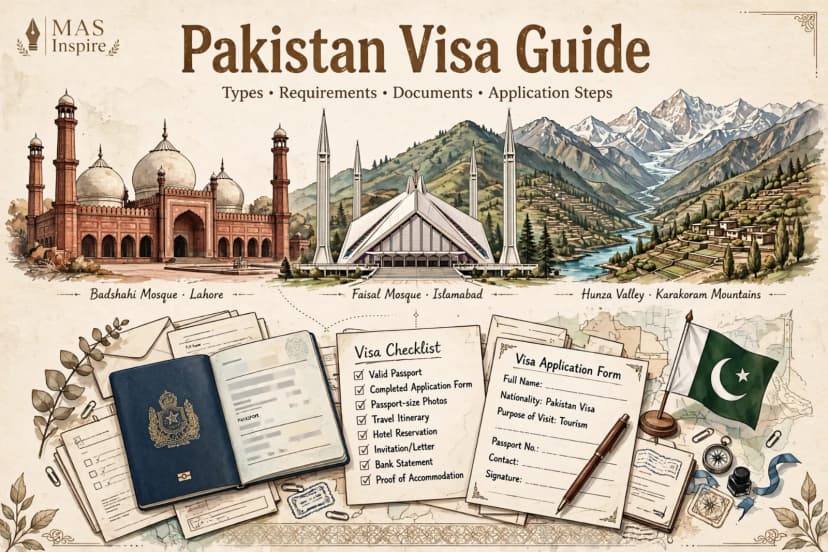
Pakistan Visa Guide 2026: Types, Requirements, Documents and Application Steps
Last checked: 28 November 2026. This guide is for Pakistani passport holders living in Vietnam who are travelling home to Pakistan — and for the foreign spouses and family members travelling with them. The rules for a Pakistani citizen going home are completely different from the rules for a foreign visitor, and most visa guides mix the two up. Visa rules change without notice — always confirm the live rules on the official Pak Visa portal (visa.nadra.gov.pk) and with the Embassy of Pakistan in Hanoi before paying any fee or booking a non-refundable ticket.
Introduction
Going home to Pakistan from Vietnam is one of the simplest journeys a Pakistani passport holder can make — and one of the most confusing to research, because almost every guide on the internet is written for a foreigner visiting Pakistan, not for a Pakistani going home. Search "Pakistan visa" and you will be told about e-visas, fees of USD 20 to USD 60, processing times of 7 to 10 working days, and a free visa scheme suspended on 1 January 2026. Almost none of that applies to you. As a Pakistani citizen on a valid Pakistani passport, you need no visa to enter your own country. What you need is a passport with enough validity left, a ticket, and — since September 2026 — attention to a new vaccination-certificate rule for the journey back out of Pakistan. The rest of this guide is about getting those three things right, and about the group travelling with you for whom the visa rules do matter: your foreign spouse, your foreign-born children, and any non-Pakistani family member.
The rules also changed sharply at the start of 2026, and most of the internet has not caught up. On 1 January 2026 Pakistan quietly suspended its free Visa Prior to Arrival (VPA) scheme, which had let citizens of 126 countries get a no-fee, multiple-entry visa approved in about 24 to 48 hours, and suspended visa on arrival alongside it. There was no press release; travellers worked it out when the VPA option simply vanished from the portal. Every one of those 126 nationalities must now apply for a standard paid e-visa in advance at visa.nadra.gov.pk. If a guide tells you a Pakistan tourist visa is free, arrives in 24 to 48 hours, or is issued on arrival for 126 countries, it was written before January 2026. That matters twice over: a spouse holding a British, American, Canadian, Australian or European passport now needs a paid e-visa approved before boarding — and so does a spouse holding a Vietnamese passport.
There is also a quieter trap that catches overseas Pakistanis every year: the documents that prove who you are abroad. A Pakistani citizen living in Vietnam should hold a NICOP, and a foreign spouse of Pakistani origin should hold a POC. Both cards give visa-free entry to Pakistan on a foreign passport while valid — but since 17 July 2026 airlines have been told to refuse boarding on an expired or cancelled NICOP, and an expired card is the commonest reason a home trip falls apart at check-in. This guide gives the current NADRA fees for both cards, the passport renewal fees from the DGIP portal, and the conflicts between the sources that publish those fees.
Do Pakistani Passport Holders Need a Visa to Enter Pakistan?
No. A Pakistani citizen travelling on a valid Pakistani passport does not need a visa — of any kind, from any portal, at any fee — to enter Pakistan. Pakistan does not issue visas to its own citizens, and there is no arrival form, no e-visa and no visa-on-arrival lane for you at Lahore, Karachi or Islamabad airport. You present your Pakistani passport at immigration, it is stamped, and you walk through. The rule follows your passport, not where you live: holding a Vietnamese temporary residence card (TRC) or a Vietnamese work permit changes nothing about your right to enter Pakistan, and no Pakistani mission will issue you a visa for your own country.
What can stop you is not a visa but a passport problem, and that is where most home trips actually fail. Pakistan does not impose the six-months-validity rule on its own returning citizens, but airlines do apply their own document checks, and a passport with days rather than months left invites a refusal at check-in in Ho Chi Minh City. Do not travel home on a passport with less than six months' validity; renew it from Vietnam first, online at onlinemrp.dgip.gov.pk or in person at the Embassy of Pakistan in Hanoi (fees and steps are in the passport section below). A lost passport is a different problem: you cannot board without a travel document, and the embassy in Hanoi issues emergency certificates — contact it before you book anything.
The visa question only becomes real when someone travelling with you does not hold a Pakistani passport. Three groups matter. First, a foreign spouse who has never held Pakistani citizenship needs a visa or a POC; a spouse-based POC is valid for five years and gives visa-free entry and indefinite stay while valid. Second, a foreign-born child of a Pakistani parent who has never been registered as a Pakistani citizen needs a visa or a POC (seven years for origin-based cards), unless the child holds a Pakistani passport or a NICOP-linked child registration. Third, a dual national on a foreign passport needs a valid NICOP to enter visa-free; without it, the foreign passport needs a visa like any other. If everyone in your party holds a valid Pakistani passport, skip the visa half of this guide.
One more distinction: the "visa-free" lists in Pakistan visa guides are lists of foreign nationalities, not of Pakistanis — eight nationalities enter without a visa (the six Gulf states for 90 days, Maldives for 90 days, Nepal for 30 days). None of that helps a Vietnamese spouse: Vietnam is on no visa-free, fee-exempt or surviving visa-on-arrival list, so a Vietnamese passport holder travelling with you needs a paid e-visa approved before boarding, applied for on visa.nadra.gov.pk.
The Pak Visa Portal: What It Is (and Is Not) For You
The Pakistan Online Visa System — the Pak Visa portal at visa.nadra.gov.pk — is the single official platform for Pakistan visas, run by NADRA for the Ministry of Interior. It is the only official route: the Ministry of Foreign Affairs and DGIP have both stated that they have no collaboration with any private agency or third-party visa-processing website, and every lookalike site that charges a service fee on top of the government fee is a reseller, not the government. Type the address yourself; do not follow a link from an agent's advertisement.
For you, the Pakistani passport holder, the portal has exactly one use: it is where your foreign family members apply. Do not create an account and file a tourist application in your own name — the system is built for foreign nationals, and a Pakistani citizen applying for a visa to their own country will at best waste the fee and at worst create a confusing record. The portal lists eleven visa categories, from tourist and family visit to business, work, study, religious tourism, medical, NGO and official visas; the ones that matter to a family travelling home are tourist, family visit and business.
For your foreign spouse or family member, the portal works like this. They create an account with an email address they check daily — clarification requests arrive by email with a seven-day response window, and an application is cancelled if not resubmitted within seven days. They choose their passport country and visa category; the fee calculator shows the exact fee for their nationality before payment, set on a reciprocal basis, so what they pay roughly mirrors what their country charges Pakistanis. They upload a photograph (up to 350 KB), a passport scan and the category documents, pay by Visa or Mastercard, and wait. An approved application produces a Visa Grant Notice, which is the visa itself. Some categories also produce an Electronic Travel Authorisation (ETA) — and the portal is explicit that an ETA is not a visa; it only lets the traveller board and ask for a visa at the counter.
Two portal facts are disputed between sources and are disclosed here rather than settled. First, how many countries the portal covers: its own pages say 191 or 192, DGIP lists 190 for tourist visas, and one guide says around 190. The only number that matters is whether your family member's passport country appears on the eligible list when they check — Vietnam, the United Kingdom, the United States, Canada, Australia and the whole of the EU all appear. Second, the portal is reported to be for nationals of listed countries who live in that same country — worth checking if your spouse is a third-country national living in Vietnam. The portal is closed to holders of Indian, Israeli and Taiwanese passports, who must go through a consulate or a separate process; the Pakistani mission is the only source if your spouse holds one of those passports.
Nobody in your party can now fly to Pakistan and sort out a visa at the airport, and nobody gets a free 48-hour approval any more. Apply and pay in advance, and allow the full processing time below.
Types of Pakistan Visas for Pakistani Passport Holders
A tourist visa does not convert into a work visa on arrival, so a foreign spouse who wants to work or study in Pakistan needs the right category from the start.
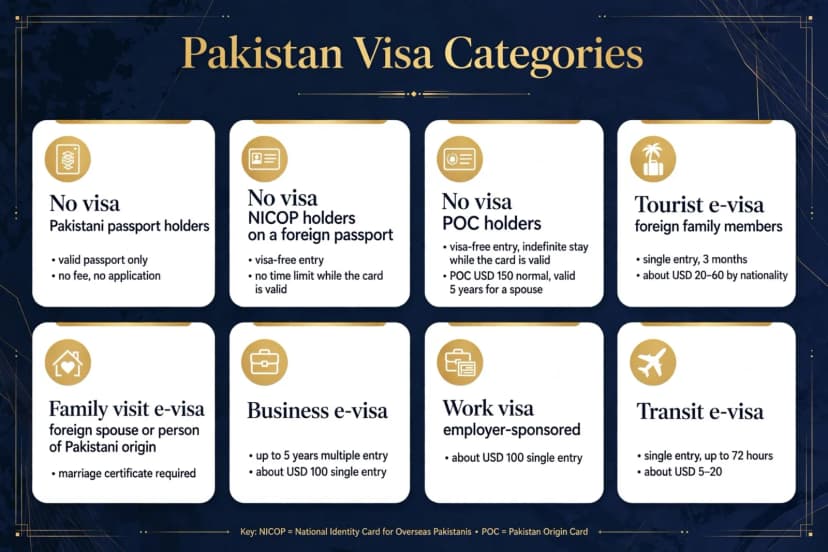
No visa — Pakistani passport holders
Entry on a valid Pakistani passport: no fee, no application, no portal. Children holding Pakistani passports enter the same way. The only conditions are a valid passport and, for the return journey out of Pakistan, the polio vaccination certificate discussed in the health section if the stay exceeds four weeks. An expired Pakistani passport does not get you on the aircraft — renew it before you fly.
No visa — NICOP and POC holders on a foreign passport
A dual national on a foreign passport enters visa-free with a valid NICOP — no time limit on the stay, no police reporting. A foreign national of Pakistani origin, including a former Pakistani and a foreign spouse, enters visa-free with a valid POC, with indefinite stay while the card is valid. The card must be in date: since 17 July 2026 airlines have been told to refuse boarding on an expired or cancelled NICOP. Full fees and validity are in the passport section below.
Tourist e-visa (foreign family members)
The standard short-stay visa for sightseeing and visiting friends and family. A single-entry tourist e-visa is usually valid for three months, with an allowed stay of 30 to 90 days; multiple-entry versions up to one year and beyond exist at higher fees. The portal's own document list is short: a photograph, a passport, and hotel booking details — an invitation letter is required only if the traveller stays with a host, which is the usual case for a spouse staying with your family, so prepare a host invitation letter with the host's CNIC details instead. All visas are valid for entry for six months from the date of issue, and an unused visa lapses after that, according to the portal as reported in October 2026.
Family visit e-visa (foreign spouses and people of Pakistan origin)
The right lane for a foreign spouse or a person of Pakistani origin who does not hold a POC, reported as available since an October 2026 update to the portal's categories. It needs the same core documents as the tourist visa plus proof of the family relationship — a marriage certificate for a spouse, or birth and parentage documents for a person of Pakistani origin — and the sponsor's CNIC. If your spouse qualifies for a POC, that is usually better: it costs more once but gives visa-free entry for five years (spouse-based) without a fresh application for every trip.
Business e-visa (foreign family members travelling for business)
For business executives, trade delegates and investors. Validity up to five years with multiple entry, 30 to 90 days allowed per visit. It needs an invitation letter from a Pakistani company, and the fee is higher than the tourist fee — about USD 100 for a single entry for most nationalities on the DGIP fee table, with a reported range of about USD 25 to USD 120. A business visa does not allow taking up employment in Pakistan; it is for meetings, trade and investment visits.
Work visa (foreign family members)
For a foreigner taking up employment in Pakistan. It needs a sponsoring Pakistani employer, a contract and security clearance, and the fee on the DGIP table is about USD 100 for a single entry for most nationalities. A foreign spouse who intends to work in Pakistan should not travel on a tourist visa intending to convert it; apply for the work visa before travel. A POC holder may take a job in Pakistan without a work visa — one more reason the POC suits a spouse who plans to live and work there.
| Who is travelling | Document needed | Fee | Where to apply |
|---|---|---|---|
| Pakistani citizen on a Pakistani passport | Valid passport only — no visa | None | Nowhere — just travel |
| Dual national on a foreign passport | Valid NICOP (visa-free) | NICOP fee — see passport section | PakID app / NADRA / mission |
| Foreign spouse / person of Pakistani origin | Valid POC (visa-free) or family visit e-visa | POC USD 150–250; e-visa per nationality | PakID app / visa.nadra.gov.pk |
| Foreign family member (tourist) | Tourist e-visa, single entry, 3 months | About USD 20–60 by nationality | visa.nadra.gov.pk |
| Foreign family member (business) | Business e-visa, up to 5 years multiple entry | About USD 25–120 by nationality | visa.nadra.gov.pk |
| Foreign family member (transit) | Transit e-visa, single entry, up to 72 hours | About USD 5–20 | visa.nadra.gov.pk |
| Foreign family member (work) | Work visa, employer-sponsored | About USD 100 single entry | Portal or mission |
| Foreign family member (study) | Student visa, institution-sponsored | Per nationality — portal calculator | Portal or mission |
E-Visa Fees: What Your Foreign Family Members Pay
There is no single published fee schedule for Pakistan e-visas. Pakistan sets visa fees on a reciprocal basis, so the fee depends on the passport the traveller holds, and the exact figure appears inside the portal — in the fee calculator — after the nationality and category are chosen. Every figure below is therefore reported, not official, and the portal checkout is the controlling figure. Do not pay any agent a figure the portal itself does not show.
| Visa / item | Figure reported | Source |
|---|---|---|
| Tourist e-visa, single entry (US, UK, Canada) | About USD 60 | Multiple 2026 guides; DGIP fee table (Australia USD 60 single entry) |
| Tourist e-visa, single entry (EU / Schengen) | About USD 35 | 2026 tourist guide, November 2026 |
| Tourist e-visa, single entry (general range) | About USD 20–60 | Go With Guide; Roamistan; 3musafir (USD 35–75) |
| Tourist e-visa, single entry (low end, some nationalities) | From about USD 5–20 | Pakistan Info Hub (USD 5–60 range); DGIP fee table |
| Tourist e-visa, multiple entry up to 1 year | About USD 90 (Australia on DGIP table) | DGIP fee table as reported |
| Tourist e-visa, multiple entry over 1 year | About USD 120 (Australia on DGIP table) | DGIP fee table as reported |
| Business e-visa, single entry | About USD 100 (most nationalities) | DGIP fee table as reported; Go With Guide |
| Business e-visa (range) | About USD 25–120 | Pakistan Info Hub |
| Transit e-visa, single entry, up to 72 hours | About USD 5–20 | Pakistan Info Hub |
| Visa extension (foreign nationals, in Pakistan) | USD 20 reported | DGIP fee page, dated 4 October 2023 — stale, confirm at the office |
| Fee-exempt nationalities (visa still required) | USD 0 | Malaysia, China, Japan, UAE, Saudi Arabia, Iceland, Slovakia, Afghanistan, North Korea (reported) |
| Visa-free nationalities | USD 0, no visa | BH, KW, OM, QA, SA, AE (90 days); Maldives (90 days); Nepal (30 days) |
The figures that conflict. The tourist fee range is reported as USD 20–60 by two November 2026 guides, USD 35–75 by a third, and USD 5–60 by a fourth — different summaries of the same reciprocal schedule, with different low ends — so no guide, including this one, can give a single exact fee for your spouse's passport. The DGIP fee table gives one concrete anchor: Australia USD 60 single entry, USD 90 multiple entry up to one year, USD 120 multiple entry over one year, and the work and business rate USD 100 for a single entry for most countries. Use those as the order of magnitude, then read the portal's calculator for the exact figure.
Two warnings about money. First, the fee-exempt list is reported, not confirmed on an official page found for this guide: Malaysia, China, Japan, UAE, Saudi Arabia, Iceland, Slovakia, Afghanistan and North Korea are reported as paying no fee while still needing the visa, and Afghanistan and China also appear as "Free" on the DGIP fee table — but the list has moved before, so confirm it in the portal before assuming a zero fee. Second, visa fees are generally non-refundable, including if an application is refused, and the portal cancels an application not resubmitted within seven days of a clarification request.
Processing Times
For your foreign family members, the portal states 7 to 10 working days for a standard tourist or business e-visa. That is the official figure — but 2026 applicants report waits stretching to 20 working days, and one guide advises applying four to six weeks before departure. Apply at least four weeks before travel, and six if the application involves a family visit, a business invitation, or a nationality that gets extra scrutiny. Passport holders of Afghanistan and Somalia are given four weeks on the portal itself.
An extension inside Pakistan takes about two weeks, according to the portal as reported in October 2026 — so a family member who wants to stay longer should apply well before the visa expires. The Punjab Home Department advises applying online at least 30 days before expiry. For your own documents the timelines are longer: a NICOP or POC takes 31 days normal, 23 urgent, or 9 executive, counted from fee payment; a passport renewal online takes 5 working days urgent or 21 normal for delivery after processing, not counting courier time to a mission abroad.
Planning rule. Work backwards from the flight: a foreign spouse's e-visa six weeks before departure; your own passport or NICOP two months before departure on normal processing, or pay for urgent or executive service. An approved e-visa is valid for entry for six months from the date of issue, and an unused visa lapses after that — so do not apply absurdly early either.
Complete Document Checklists
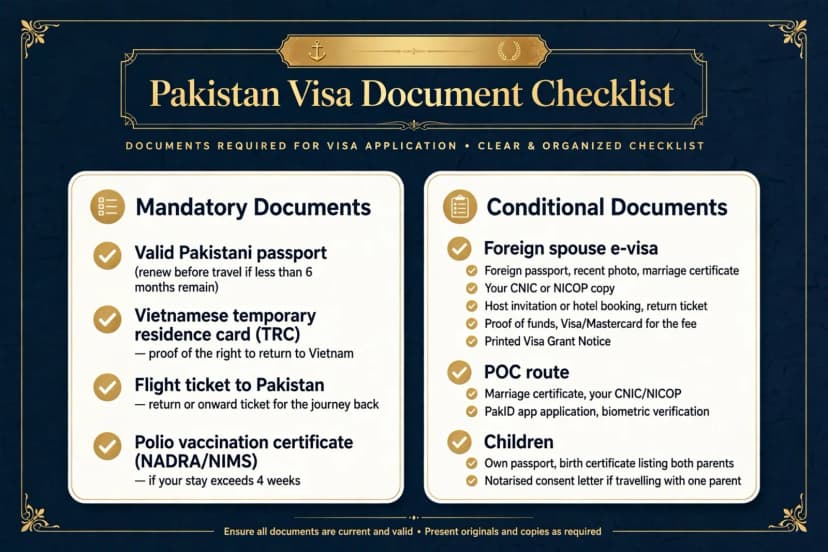
No single official document list for a whole family was published on a page found for this guide, so the checklists below combine what the portal asks of e-visa applicants and what DGIP asks for passport and NICOP/POC applications. The portal's own list governs your family member's application — confirm it on visa.nadra.gov.pk before submitting. Prepare originals and clean scans; a blurry passport scan is the commonest reason an online application stalls.
You — the Pakistani passport holder going home
- Valid Pakistani passport — renew before travel if less than six months' validity remains
- Vietnamese temporary residence card (TRC) — proof of the right to return to Vietnam; carry it with your passport
- NICOP, if you hold one — keep it valid; an expired NICOP can mean refused boarding for a dual national on a foreign passport
- Flight ticket to Pakistan (return or onward ticket for the journey back to Vietnam)
- Polio vaccination certificate (NADRA/NIMS) if your stay in Pakistan will exceed four weeks
- Cash and cards; a record of your CNIC/NICOP number for banks and property matters in Pakistan
Foreign spouse — family visit e-visa route
- Valid foreign passport, at least six months' validity
- Recent digital passport photograph (white background, up to 350 KB)
- Completed online application on visa.nadra.gov.pk, name exactly as on the passport
- Marriage certificate (Nikah Nama or civil certificate) proving the relationship to you
- Your CNIC or NICOP copy as the sponsoring spouse
- Invitation letter from your family in Pakistan as host, or a hotel booking
- Confirmed return or onward ticket or itinerary
- Proof of sufficient funds — recent bank statements
- Payment card (Visa or Mastercard) for the online fee, in the applicant's name
- Printed Visa Grant Notice for boarding and arrival
Foreign spouse — POC route (instead of a visa)
- Valid foreign passport
- Marriage certificate proving marriage to a Pakistani citizen
- Your CNIC or NICOP as the Pakistani spouse
- Application through the PakID app, normally made by a blood relative from their own PakID account
- Biometric verification, usually in person at a NADRA centre or mission
- Fee USD 150 normal / USD 200 urgent / USD 250 executive; valid five years for a spouse-based POC
Foreign-born children travelling with you
- Each child needs their own passport and their own visa or POC
- Birth certificate listing both parents; if the child holds a Pakistani passport, that passport is the entry document
- If a child travels with one parent only, carry a notarised consent letter from the other parent — officers do ask for it
- For a child of Pakistani origin without Pakistani citizenship: a POC (seven-year validity) or a family visit e-visa
Foreign family member — tourist e-visa route
- Valid foreign passport, six months' validity
- Recent digital passport photograph (white background)
- Completed online application on visa.nadra.gov.pk
- Hotel booking details for the whole stay, or an invitation letter from a host in Pakistan
- Confirmed return or onward ticket
- Proof of sufficient funds
- Printed Visa Grant Notice for boarding and arrival
How to Apply: Step-by-Step
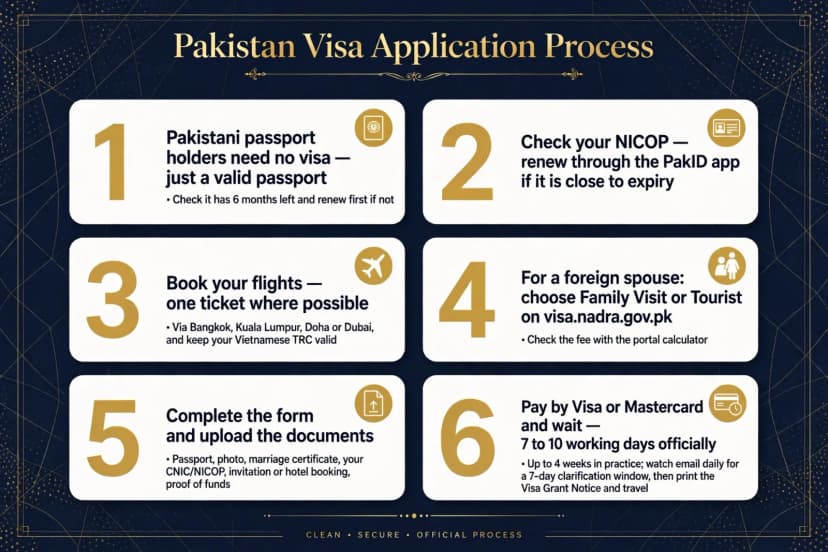
You — going home on a Pakistani passport
Step 1 — Check the passport. If less than six months remain, renew now through onlinemrp.dgip.gov.pk or at the Embassy of Pakistan in Hanoi. Do not book a non-refundable ticket until the renewed passport is in your hand.
Step 2 — Check the NICOP. Renew through the PakID app if it is close to expiry — an expired NICOP has meant refused boarding since 17 July 2026 for dual nationals on a foreign passport, and a NICOP takes 31 days on normal processing.
Step 3 — Book the flights. Book the whole journey on one ticket where you can, via Bangkok, Kuala Lumpur, Doha or Dubai. Keep your Vietnamese TRC valid for the whole trip — it is your proof of the right to return to Vietnam.
Step 4 — Prepare for the return. If your stay in Pakistan will exceed four weeks, arrange the polio vaccination and the NADRA/NIMS certificate before you leave Pakistan, not at the airport. The certificate costs PKR 100 from nims.nadra.gov.pk once the dose is recorded against your CNIC.
Foreign spouse — e-visa step by step
Step 1 — Choose the category. On visa.nadra.gov.pk, create an account and choose Family Visit (for a spouse) or Tourist/Visit, Individual, less than three months. Family visit is the right lane for a spouse; tourist is the fallback if the portal does not offer family visit for that nationality.
Step 2 — Check the fee. Use the portal's fee calculator for the exact fee for your spouse's passport before paying. The figure at checkout is the only one that counts.
Step 3 — Complete the form. Fill in personal details exactly as on the passport. Enter travel dates, the host address in Pakistan, and contact details in Vietnam. A name mismatch is one of the commonest reasons for delay.
Step 4 — Upload the documents. Upload the passport scan, photograph, marriage certificate, your CNIC/NICOP copy, the host invitation or hotel booking, and proof of funds. Check each scan is legible before submitting.
Step 5 — Pay and wait. Pay by Visa or Mastercard and keep the receipt and reference number. Plan on 7 to 10 working days officially, up to four weeks in practice. Watch the application email daily — a clarification request carries a seven-day window, and the application is cancelled if not resubmitted in time.
Step 6 — Print everything and travel. Print the Visa Grant Notice, return ticket, host invitation or hotel booking, and proof of funds, and carry them in hand luggage. Airlines check the visa at boarding, and immigration officers may ask for the supporting documents again.
Foreign spouse — POC step by step
Step 1 — Decide whether the POC is worth it. If your spouse will visit Pakistan more than once in five years, the POC (USD 150 normal) is cheaper and simpler than a fresh e-visa for every trip, and it gives indefinite stay and the right to work. For a single trip, the e-visa is faster.
Step 2 — Apply through the PakID app. A blood relative applies on your spouse's behalf from their own PakID account, with the marriage certificate and your CNIC/NICOP. NADRA now steers overseas applicants to the PakID app; the old Pak-Identity web address redirects to the NADRA home page.
Step 3 — Biometrics. Biometric verification usually needs an in-person visit to a NADRA centre or a mission — the step that most often delays a POC.
Step 4 — Wait and check the card. Normal processing is 31 days from payment, urgent 23, executive 9. When the card arrives, check the name, dates and validity: a spouse-based POC lasts five years.
Applying from Vietnam — the Embassy in Hanoi and the Consulate in Ho Chi Minh City
The Embassy of Pakistan in Hanoi is at Villa 44/2, Van Bao Street, Van Phuc Diplomatic Compound, Ba Dinh District, Hanoi, telephone +84 24 3726 2251 / 2252, fax +84 24 3726 2253, email parephanoi@mofa.gov.pk, office hours Monday to Friday 9:00 a.m. to 5:00 p.m. The address and telephone are confirmed by the Ministry of Foreign Affairs' own contact page. There is also a Consulate General in Ho Chi Minh City, telephone (028) 3945 3939 — the office you will actually use if you live in the south, for passport matters, attestations and emergency certificates.
One conflict to disclose before you travel to either office: the consulate's Ho Chi Minh City address is given differently by different sources — 5B Ton Duc Thang Street, District 1, in one guide, and Khanh Hoi Building 2, 360A Ben Van Don Street, Ward 1, District 4, in another. Both agree on the telephone number, (028) 3945 3939. Telephone the consulate and confirm the address before you go. A second, smaller conflict: some listings give the Hanoi telephone as +84 24 3726 2051 instead of 2251. The MOFA contact page gives 3726 2251/52, and that is the number this guide uses; if it does not answer, try the other.
What the mission can do: passport renewal and related services, NICOP matters, attestation of documents (including the marriage certificate and educational documents your family may need in Pakistan), emergency certificates if a passport is lost or stolen, and help if anything goes wrong while you are applying or travelling. What it cannot do: issue you a visa for Pakistan (you do not need one), or override a portal decision for your spouse's e-visa — that decision sits with the Ministry of Interior and NADRA in Islamabad. If your spouse's e-visa is delayed, the embassy can advise and sometimes follow up, but it cannot approve the visa itself.
Keep your Vietnamese temporary residence card valid for the whole trip and carry it with your passport — it is your proof of the right to return to Vietnam. If your TRC is close to expiry, renew it before you travel: a TRC that expires while you are in Pakistan can leave you needing a fresh Vietnam e-visa to come back.
| Mission | Address | Telephone | Note |
|---|---|---|---|
| Embassy of Pakistan, Hanoi | Villa 44/2, Van Bao Street, Van Phuc Diplomatic Compound, Ba Dinh District, Hanoi | +84 24 3726 2251 / 2252 | parephanoi@mofa.gov.pk; Mon–Fri 9:00–17:00; also accredited to Laos |
| Consulate General of Pakistan, Ho Chi Minh City | 5B Ton Duc Thang Street, District 1 — or Khanh Hoi Building 2, 360A Ben Van Don Street, District 4 (sources conflict) | (028) 3945 3939 | Confirm the address by phone before visiting |
Passport Renewal, NICOP and POC: The Three Documents That Decide Your Trip
Pakistani passport renewal from abroad
You can renew your Pakistani passport online, from Pakistan or from abroad, on DGIP's official portal at onlinemrp.dgip.gov.pk. Online renewal is available if your passport has expired or has 12 months or less validity remaining, and your details must match exactly what is on your previous passport and in NADRA's records. Fingerprint capture is now done through the PakID mobile app for many applicants. Home delivery is available for overseas Pakistanis in a limited number of countries; collection from a passport office or mission is free. DGIP's fee is non-refundable and non-transferable once submitted, so check every field before you pay. A first passport, and most changes other than a simple renewal, still need an in-person visit to the mission.
The fee conflict — read this before you pay. Two sets of figures circulate for the same renewal, and they do not agree. The DGIP online portal's fee table, checked 24 October 2026, gives the totals in the table below for applications from abroad, including the Rs 2,500 service charge but excluding taxes. Against that, a second guide quoting DGIP's e-passport fees gives 36 pages, 10 years, normal Rs 13,500 and urgent Rs 22,500 — the inland e-passport fee. The two tables appear to describe different products: the portal's table looks like the older machine-readable passport fee, while the higher figures are the e-passport fee now issued on renewal, and every renewal now produces an e-passport. This guide reports both and names the portal checkout as controlling: read the total on the payment screen before you pay. Delivery after processing is 5 working days urgent or 21 normal, not counting courier time to a mission abroad.
| Passport (applying from abroad, online) | 5 years, normal | 5 years, urgent | 10 years, normal | 10 years, urgent |
|---|---|---|---|---|
| 36 pages | Rs 7,000 | Rs 10,000 | Rs 9,200 | Rs 13,700 |
| 72 pages | Rs 10,700 | Rs 16,000 | Rs 14,900 | Rs 22,700 |
| 100 pages | Rs 11,500 | Rs 20,500 | Rs 16,000 | Rs 29,500 |
Figures from the DGIP online portal fee table, checked 24 October 2026, including the Rs 2,500 service charge, excluding taxes and delivery. The e-passport figures quoted elsewhere (36 pages, 10 years: Rs 13,500 normal / Rs 22,500 urgent inland) are higher — confirm on the portal checkout. A lost passport costs double the fee the first time: Rs 27,000 for 36 pages and 10 years on normal, on the inland e-passport scale.
NICOP — the card for overseas Pakistanis
The NICOP (National Identity Card for Overseas Pakistanis) is NADRA's identity card for Pakistani citizens living abroad, including dual nationals where the other country allows it. It proves who you are abroad, and it lets a dual national enter Pakistan visa-free on a foreign passport, stay with no time limit, and keep the Pakistani passport and the right to vote. It is not a visa and not a replacement for a foreign passport. Apply through the PakID mobile app, at a NADRA Registration Centre abroad, or at a Pakistani mission. NADRA's fee structure, checked in November 2026, gives the same fee for a new card, renewal, modification and duplicate, and the clock starts after payment: normal 31 days, urgent 23, executive 9.
| Smart NICOP | Normal (31 days) | Urgent (23 days) | Executive (9 days) |
|---|---|---|---|
| Zone A — USA and Europe | USD 39 | USD 57 | USD 75 |
| Zone B — Middle East and Africa | USD 20 | USD 30 | USD 40 |
Two warnings. First, NADRA's published zones name only the USA and Europe (Zone A) and the Middle East and Africa (Zone B); countries outside those regions are not listed, so the PakID app shows your zone when you apply — this guide could not verify which zone Vietnam falls in, so confirm the fee in the app before paying. Second, NADRA's schedule lists one anomaly: an executive Smart NICOP duplicate in Zone B appears once as USD 140 and once as USD 40. Every other source treats USD 40 as the figure and USD 140 as a typing mistake; expect USD 40 and confirm in the app. A NICOP for an adult is valid for 10 years, and since 17 July 2026 airlines have been told to refuse boarding on an expired or cancelled NICOP — check the expiry date before you book.
POC — the card for foreign nationals of Pakistani origin
The POC (Pakistan Origin Card) is for foreign nationals of Pakistani origin who are not Pakistani citizens: former Pakistanis who now hold only a foreign nationality, foreign spouses of Pakistanis, and the children or grandchildren of Pakistanis. It gives visa-free entry and stay while valid, exemption from foreigner registration, and the right to open bank accounts, buy and sell property, and take a job. It does not give the right to vote. A POC is valid for seven years, or five years if based on marriage. NADRA's FAQ says a NICOP holder cannot apply for a POC — if you are still a Pakistani citizen, including a dual national, your card is the NICOP, not the POC — and citizens of India, Israel and countries Pakistan does not recognise cannot apply. Apply through the PakID app, normally by a blood relative from their own PakID account; biometric verification usually needs an in-person visit.
| POC service | Normal (31 days) | Urgent (23 days) | Executive (9 days) |
|---|---|---|---|
| New POC or POC renewal | USD 150 | USD 200 | USD 250 |
| POC modification or duplicate | USD 200 | USD 250 | USD 300 |
Dual nationality — the rule that catches people out
Pakistan permits dual nationality with 22 designated countries under Section 14(3) of the Pakistan Citizenship Act 1951: the United Kingdom, Ireland, France, Germany, Italy, Belgium, Netherlands, Switzerland, Sweden, Norway, Denmark, Finland, Iceland and Luxembourg in Europe; the United States and Canada; Australia and New Zealand; and Egypt, Jordan, Syria and Bahrain. A Pakistani who naturalises in one of those countries does not lose Pakistani citizenship. A Pakistani who naturalises anywhere else — including Vietnam, which is not on the list, and the UAE, Saudi Arabia, China and India, which are also not on it — very likely ceases to be a Pakistani citizen under Section 14(1), and would then need a POC rather than a NICOP. Germany is covered only for children of Pakistani parents who acquired German nationality by birth in Germany. Check the current 22-country list on the DGIP or NADRA site before you naturalise — it is updated by Gazette notification, and getting it wrong is not fixable at the airport. Dual nationals cannot sit in Parliament or be recruited into the armed forces unless they first renounce the foreign nationality.
Entry Points, Immigration and Customs on Arrival
Pakistan's three main international gateways are Jinnah International Airport, Karachi (KHI); Allama Iqbal International Airport, Lahore (LHE); and Islamabad International Airport (ISB). Most flights from Southeast Asia arrive at one of the three: Lahore is the usual choice for a family from Punjab, Karachi for Sindh, Islamabad for the capital and the north. Smaller international airports — Peshawar, Multan, Faisalabad, Sialkot and Quetta — also receive international flights, mostly from the Gulf. Choose the airport closest to your family home, not the cheapest ticket.
At immigration, a Pakistani passport holder presents the passport and is stamped in. A foreign family member presents the foreign passport with the Visa Grant Notice, or the foreign passport with a valid NICOP or POC. Keep the whole family's documents together in hand luggage: the immigration officer makes the final decision in every case, whatever document you hold, and may ask for the host invitation letter, the return ticket and proof of funds for a foreign family member. Check the entry stamp in every passport before you walk away from the desk — the stamp is your proof of the date you entered and the length of stay you were given.
Customs. The rules that matter to a returning resident are the currency declaration and the baggage allowance, both set by the Federal Board of Revenue under the Baggage Rules 2006. An incoming passenger carrying foreign currency worth more than USD 10,000 or its equivalent, in any mix of currencies, must file a declaration on the customs form (Appendix-C) — below USD 10,000, no declaration is needed for cash. The same form asks about gold, jewellery and precious stones, and about prohibited or restricted goods such as arms, narcotics and satellite phones. The declaration can be filed electronically through WeBOC or the PassTrack app, or manually at the airport. On the way out, the rule is stricter: FBR's notification SRO 2201(I)/2022 of 12 December 2022 requires anyone taking foreign currency out of Pakistan, in any amount, to file the same declaration before departure, and the State Bank's limits for adults leaving Pakistan are USD 5,000 in foreign currency per visit and USD 30,000 a year. The two outbound figures — "declare any amount" and "up to USD 5,000 per visit" — come from different instruments and are not the same rule; declare before you leave and keep the receipt. A returning passenger can bring personal wearing apparel and one laptop computer into Pakistan duty-free on any visit; a foreign national or tourist entering Pakistan is allowed personal wearing apparel plus other items, excluding mobile phones, up to a reported USD 800 in value — reported rather than confirmed on an official page found for this guide, so treat it as a planning figure.
Extending a Stay and Overstay Rules
Extensions. A tourist visa can be extended by three months, for a total of six months including the first visa, with one or two re-entries, at a Regional Passport Office — in Islamabad, Lahore, Peshawar, Quetta and Karachi (Saddar). The extension takes about two weeks, and the Punjab Home Department advises applying online at least 30 days before the visa expires. The portal's extension needs a valid visa, a hotel booking, a sponsor letter, the sponsor's CNIC, the entry stamp page and the last visa page. The extension fee is reported as USD 20 on the DGIP fee page — but that page is dated 4 October 2023, so treat the figure as reported and confirm it at the office; fees are charged on a reciprocal basis, so the amount may differ by nationality. Pay any fee in the bank: DGIP says cash must not be handed to staff. A business visa can be extended up to six months with double re-entries, including the first visa — but DGIP's policy page prints a second, different line saying up to one year with multiple entries, and no source found for this guide says which is current. Ask the office which one it applies. A student visa is granted on a yearly basis.
Overstay surcharges. DGIP publishes a surcharge table for foreigners who stay past their visa expiry, and states there will be no condonation of overstay charges. For foreign nationals: up to two weeks of overstay carries no surcharge; two weeks to one month, USD 50; one month to three months, USD 200; three months to one year, USD 400 per year. For foreigners of Pakistan origin: up to one week, no surcharge; one month to six months, USD 40; six months to one year, USD 80; beyond one year, USD 200 per year. Indian nationals pay a flat Rs 40 per day. Two gaps are worth noting: the Pakistan-origin scale jumps from "up to one week" to "one month to six months" with no stated figure for the second, third and fourth weeks, and one DGIP page separately says a Regional Passport Office can condone overstay of up to 15 days for a tourist on payment of a minimum of USD 10 — which sits uneasily beside the "no condonation" statement. Do not treat any grace period as permission to overstay: the US government warns that overstay can lead to detention, arrest, fines or imprisonment. Extend before expiry, or leave on time.
| Overstay period | Surcharge — foreign nationals | Surcharge — foreigners of Pakistan origin |
|---|---|---|
| Up to 1 week | None | None |
| Up to 2 weeks | None | Not stated in the table |
| 2 weeks to 1 month | USD 50 | Not stated in the table |
| 1 month to 3 months | USD 200 | USD 40 (1–6 months) |
| 3 months to 1 year | USD 400 per year | USD 80 (6–12 months) |
| Beyond 1 year | USD 400 per year | USD 200 per year |
Transit, Flights and Money: Practical Notes
Flights. There are no direct non-stop commercial flights between Pakistan and Vietnam, in either direction. The journey from Ho Chi Minh City to Lahore, Karachi or Islamabad takes 9 to 14 hours depending on the layover, and the practical corridors are four: Bangkok, Kuala Lumpur, Doha and Dubai. Thai Airways via Bangkok is usually the fastest, at 9 to 11 hours; Malaysia Airlines or Batik Air via Kuala Lumpur takes 10 to 12 hours; Qatar Airways via Doha takes 12 to 14 hours; Emirates and flydubai via Dubai take 13 to 15 hours. PIA flies Bangkok to Islamabad, and Bangkok to Karachi and Lahore by codeshare, and it has a Special Prorate Agreement with Malaysia Airlines that lets it sell through-tickets to Ho Chi Minh City via Kuala Lumpur — so a PIA ticket from Lahore or Karachi can in principle carry you all the way to Ho Chi Minh City on one booking. Book the whole journey on one ticket where you can, so a missed connection is the airline's problem.
Money. The currency is the Pakistani rupee (PKR). US dollars in cash are widely useful on arrival for taxis and the first day's expenses, and exchange counters and ATMs sit in the international arrivals halls. International cards work at major hotels and in the cities, but carry cash for small towns and family visits. If you are carrying more than USD 10,000 in foreign currency into Pakistan, declare it on the Appendix-C customs form (see the customs section). Keep your Vietnamese bank cards and your TRC with you: you will need the TRC to re-enter Vietnam, and a card that works in Vietnam may not work at every ATM in Pakistan. There is no published minimum bank balance for a family member's e-visa: carry recent statements that plainly cover the trip.
Coming back to Vietnam. This is the part of the trip that catches returning residents out, so plan it before you leave Ho Chi Minh City. Your Vietnamese temporary residence card is your re-entry document: as long as it is valid, you re-enter Vietnam on the TRC without a fresh visa. If your TRC expires while you are in Pakistan, or you do not hold one, you will need a Vietnam e-visa to come back — applied for on the Immigration Department's portal at evisa.gov.vn, open to all nationalities including Pakistan since 15 August 2023, valid for up to 90 days, single entry USD 25 or multiple entry USD 50, paid by card on the portal and non-refundable if refused, with an official decision time of three working days. Apply at least a week before you fly back. One exception: Phu Quoc island lets any foreign passport holder, Pakistanis included, enter without a visa and stay up to 30 days, as long as you fly or sail into Phu Quoc directly from abroad and stay only on the island — but that does not help you get back to Ho Chi Minh City. The Embassy of Vietnam in Islamabad (House 117, Street No. 11, Sector E-7, telephone +92 51 2655785 / 2655787) can help with Vietnam visa questions while you are in Pakistan.
Safety, Health and Arrival Checks
Security. The UK Foreign, Commonwealth and Development Office updated its Pakistan travel advice on 18 November 2026, and it is blunt. It advises against all travel to Balochistan Province, to much of Khyber Pakhtunkhwa Province — including Peshawar city and Swat — to within 10 miles of the border with Afghanistan, and to within 10 miles of the Line of Control; and against all but essential travel to Azad Jammu and Kashmir, to all areas of Sindh north of and including Nawabshah, and to Dera Ghazi Khan in Punjab. Emergency measures and Governor's Rule were introduced in Khyber Pakhtunkhwa on 11 October 2026, with road closures, disruption to public transport, increased security presence and disruption to internet services, and demonstrations in Azad Jammu and Kashmir have caused road closures, suspension of mobile and internet services, and clashes with reports of injuries and loss of life. Regional tensions have also caused sudden airspace closures — during May 2025 sustained closures suspended flights and restricted domestic travel. As a Pakistani going home you know your own city and family area far better than any foreign office, and the FCDO advice is written for British nationals, not for Pakistanis — but read it before you travel, and be prepared to rearrange your departure at short notice. Travel insurance could be invalidated if you travel against FCDO advice — relevant for a foreign spouse on a British or European passport.
Health — the polio certificate is the rule that matters most on this trip. Pakistan is one of two countries in the world where wild poliovirus still circulates, and the World Health Organization's International Health Regulations ask departing residents to carry proof of a polio dose. In practice: if you live in Pakistan and are travelling internationally, or if you are a foreign national or visitor who has stayed in Pakistan longer than four weeks, you need a polio vaccination certificate showing a dose given between four weeks and twelve months before international travel. Short visitors who spent under four weeks fall outside the WHO recommendation, but airlines still apply their own document checks at the gate. The certificate comes through NADRA's National Immunization Management System at nims.nadra.gov.pk: take the dose, make sure it is entered in NIMS against your CNIC, then pay PKR 100 and download the PDF — usually the same day, often within minutes. The helpline is 1166 (Sehat Tahaffuz, toll-free).
One further development must be disclosed as unverified: it comes from a single commercial source and could not be confirmed against an official page for this guide. A September 2026 Airport Health Department directive (reference F.18-4/2014-AHK/631, dated 7 September 2026) is reported to require all international travellers departing Pakistan to present a NADRA-integrated vaccination sheet covering polio, measles, yellow fever and influenza, with boarding denied without it, enforced from 14 September 2026 — with vaccination counters in departure areas and advice to reach the airport at least six hours early if a dose is still needed. Enforcement is reported to have begun with Umrah passengers at Karachi. This guide cannot confirm from an official source whether the four-vaccine sheet applies to every departing passenger or only to some categories, so treat it as a warning, not a settled rule: get the polio dose and the NIMS certificate sorted well before your departure from Pakistan, ask your airline before travel day whether it requires the wider sheet, and arrive at the airport early. Pakistan itself has no yellow fever risk; a yellow fever certificate is required only if you are arriving from a country with yellow fever transmission risk, including transiting through one for more than 12 hours.
Frequently Asked Questions
1. Do I need a visa to go home to Pakistan?
No. A Pakistani citizen on a valid Pakistani passport needs no visa of any kind to enter Pakistan — no e-visa, no visa on arrival, no fee. The visa rules in this guide apply to the foreign spouses and family members travelling with you, not to you.
2. My spouse holds a foreign passport. What do they need to enter Pakistan?
Either a visa or a POC: a family visit e-visa from visa.nadra.gov.pk (apply four to six weeks ahead; official processing is 7 to 10 working days), or a Pakistan Origin Card — valid five years for a spouse-based POC, giving visa-free entry, indefinite stay and the right to work. For a single trip the e-visa is faster; for repeated visits the POC is better.
3. Is the free Pakistan visa (Visa Prior to Arrival) still available?
No. The free Visa Prior to Arrival scheme for 126 nationalities, and visa on arrival alongside it, was suspended on 1 January 2026 without a press release and without an announced return date. Every foreign visitor who relied on it must now apply for a standard paid e-visa in advance.
4. How much does a Pakistan e-visa cost for my spouse?
It depends on their passport, because Pakistan sets fees reciprocally: about USD 60 for US, UK and Canadian passports, about USD 35 for EU passports, and a general range of about USD 20 to USD 60 for a single-entry tourist visa; business is about USD 100 single entry. The exact fee appears in the portal's fee calculator at checkout — that figure is the only one that counts.
5. How long does the Pakistan e-visa take?
Officially 7 to 10 working days; in practice in 2026, applicants report waits of up to 20 working days, and passport holders of Afghanistan and Somalia are given four weeks on the portal itself. Apply at least four weeks before travel, six if the case is complicated, and watch the application email daily — a clarification request carries a seven-day window, and the application is cancelled if not resubmitted in time.
6. Can my family get a visa on arrival at Lahore or Karachi airport?
No — not since 1 January 2026, when visa on arrival was suspended for most nationalities along with the Visa Prior to Arrival scheme. The only reported exception is for Gulf nationals, and even that continuation has no official notice confirming it. Your family members need an approved e-visa, NICOP or POC before boarding.
7. What is a NICOP, and do I need one?
The NICOP is NADRA's identity card for Pakistani citizens living abroad. If you hold only a Pakistani passport, you do not need one to enter Pakistan — but if you are a dual national travelling on a foreign passport, the NICOP is your visa-free entry document, and since 17 July 2026 airlines have been told to refuse boarding on an expired or cancelled NICOP. Fees are USD 39 normal in Zone A (USA and Europe) or USD 20 in Zone B (Middle East and Africa); processing is 31 days normal, 23 urgent, 9 executive.
8. What is a POC, and who should get one?
The Pakistan Origin Card is for foreign nationals of Pakistani origin who are not Pakistani citizens — former Pakistanis, foreign spouses, and children or grandchildren of Pakistanis. It gives visa-free entry and indefinite stay, plus the right to work, open bank accounts and own property. A new POC costs USD 150 normal, USD 200 urgent or USD 250 executive, and is valid seven years (five years if based on marriage).
9. How do I renew my Pakistani passport from Vietnam?
Online at onlinemrp.dgip.gov.pk, if your passport has expired or has 12 months or less left and your details match NADRA's records, or in person at the Embassy of Pakistan in Hanoi. The portal's overseas fee table gives 36 pages, 10 years, normal Rs 9,200 and urgent Rs 13,700 — but a second source quotes the e-passport fee of Rs 13,500 normal, so confirm the total on the portal checkout before you pay.
10. I hold a Vietnamese passport as well as a Pakistani one. Is that a problem?
Potentially a serious one. Pakistan allows dual nationality with only 22 designated countries, and Vietnam is not one of them. Under Section 14(1) of the Pakistan Citizenship Act 1951, a Pakistani who naturalises outside the list very likely ceases to be a Pakistani citizen, and would then need a POC rather than a NICOP.
11. How much cash can I bring into Pakistan, and do I have to declare it?
You can bring foreign currency in without limit, but more than USD 10,000 or its equivalent must be declared on the customs form (Appendix-C) on arrival. Gold, jewellery and precious stones go on the same form. On the way out, file the same declaration for any foreign currency you take out; the State Bank's limits for adults are USD 5,000 per visit and USD 30,000 a year.
12. Can my foreign spouse extend their stay in Pakistan?
Yes. A tourist visa can be extended by three months, for a total of six months including the first visa, with one or two re-entries, at a Regional Passport Office in Islamabad, Lahore, Peshawar, Quetta or Karachi. Apply online at least 30 days before expiry; the extension takes about two weeks. The reported fee is USD 20, from a DGIP page dated October 2023 — confirm it at the office.
13. What happens if my spouse overstays their Pakistan visa?
DGIP charges a surcharge and states there will be no condonation: for foreign nationals, no surcharge up to two weeks, USD 50 for two weeks to one month, USD 200 for one to three months, and USD 400 per year for three months to one year. Foreigners of Pakistan origin pay a lower scale (USD 40 for one to six months, USD 80 for six months to one year). The US government warns overstay can lead to detention, arrest, fines or imprisonment — extend before expiry or leave on time.
14. Do I need a polio certificate to leave Pakistan?
If your stay exceeds four weeks, yes: the WHO asks for a polio dose given between four weeks and twelve months before international travel, proved by a NADRA/NIMS certificate costing PKR 100 from nims.nadra.gov.pk. A September 2026 Airport Health Department directive is also reported to require a wider NADRA-integrated vaccination sheet (polio, measles, yellow fever, influenza) for all departing passengers — that wider requirement could not be confirmed against an official source for this guide, so get the polio certificate sorted early and ask your airline before travel day.
15. How do I get back to Vietnam after my trip home?
On your Vietnamese temporary residence card, if it is still valid — keep it valid for the whole trip. If it expires while you are in Pakistan, or you do not hold one, apply for a Vietnam e-visa on evisa.gov.vn before flying back: USD 25 single entry or USD 50 multiple entry, valid up to 90 days, decision time three working days. Apply at least a week before you fly.
Official Immigration Websites
| Website | What it is | Link |
|---|---|---|
| Pakistan Online Visa System (Pak Visa) | Official e-visa portal (NADRA / Ministry of Interior) — applications, fee calculator, Visa Grant Notice | visa.nadra.gov.pk |
| DGIP online passport portal | Online passport renewal for Pakistanis abroad — fees, fingerprint via PakID app | onlinemrp.dgip.gov.pk |
| UK FCDO — Pakistan travel advice | Entry requirements, safety advice, health — updated 18 November 2026 | gov.uk/foreign-travel-advice/pakistan |
| Embassy of Pakistan, Hanoi (MOFA) | Your mission in Vietnam — Villa 44/2 Van Bao Street, Hanoi; +84 24 3726 2251/52 | mofa.gov.pk/hanoi-contact-us |
| NADRA fee structure (via fee guide) | NICOP Zone A/B and POC fees as published by NADRA, checked November 2026 | pakcitizenguide.com — NADRA Fees 2026 |
| NIMS polio certificate portal | NIMS — polio vaccination certificate, PKR 100 | endpolio.com.pk — vaccination certificate |
| Vietnam e-visa portal | Vietnam Immigration Department — e-visa for the return leg, USD 25 / USD 50, up to 90 days | pakera.pk — Vietnam e-visa for Pakistanis |
| 3musafir — Pakistan e-Visa 2027 | November 2026 guide: VPA suspension, fees USD 35–60 | 3musafir.com — Pakistan e-Visa 2027 |
| Go With Guide — Pakistan Tourist Visa 2026/27 | Updated 4 Nov 2026: VPA suspension, fees USD 20–60 | gowithguide.pk — Pakistan Tourist Visa 2026/27 |
| Roamistan — Pakistan Tourist Visa 2026 | VPA and visa-on-arrival suspension, fees USD 20–60 | roamistan.com — Pakistan Tourist Visa 2026 |
| Pakera — Pakistan e-visa for foreigners | Portal categories, 7–10 working days, 6-month entry validity, ETA vs visa | pakera.pk — Pakistan e-visa for foreigners |
| Pakera — NICOP and POC | NICOP vs POC, zone fees, validity, expired-NICOP boarding rule from 17 July 2026 | pakera.pk — NICOP and POC |
| Pakera — overstay surcharge | DGIP overstay surcharge table: USD 50 / 200 / 400; Pakistan-origin scale | pakera.pk — overstay surcharge |
| Pakera — customs baggage allowance | FBR Baggage Rules, USD 10,000 arrival declaration, SRO 2201(I)/2022 | pakera.pk — customs baggage allowance |
| OnePakistan — passport renewal online | DGIP online portal fee tables for applications from abroad, checked 24 Oct 2026 | onepakistan.com.pk — renew passport online |
| Consular LinkedPK — passport | Passport renewal fees and processing (5 days urgent / 21 normal) | consular.linked.pk — passport |
| LegalPK — dual nationality | The 22 permitted dual-nationality countries, Citizenship Act 1951 s.14(3) | legalpk.com — dual nationality Pakistan |
| Trek.pk — visa and permits | NOC rules for KP and Gilgit-Baltistan, NICOP/POC entry, polio exit certificate | trek.pk — visa and permits |
| AMG Visa — mandatory vaccination 2026 | Airport Health Department directive F.18-4/2014-AHK/631 (7 Sep 2026) — single-source report | amgvisa.com — mandatory vaccination |
| Vietnam Original Travel — Pakistan to Vietnam | No direct flights; Bangkok, Kuala Lumpur, Doha, Dubai routings, 9–14 hours | vietnamoriginal-travel.com — travel to Vietnam from Pakistan |
This guide was checked on 28 November 2026. Visa rules change without notice. Always confirm the live rules on visa.nadra.gov.pk and with the Embassy of Pakistan in Hanoi before paying any fee or booking a non-refundable ticket. Nothing in this guide is immigration advice; the Pakistani authorities set and enforce the entry rules, and the immigration officer at the airport makes the final decision.


