Palau Visa Guide 2026: Types, Requirements, Documents and Application Steps
Last checked: 28 November 2026. This guide is for Pakistani passport holders living in Vietnam. Visa rules change without notice — always confirm the live rules with Palau's Bureau of Customs and Border Protection (bcbp.pw) and with the Embassy of Palau in Manila before paying any fee or booking a non-refundable ticket.
Introduction
Palau is a small Pacific island nation of about 340 islands, roughly 1,500 kilometres east of the Philippines, and one of the easiest countries in the world for a Pakistani passport holder to enter. There is no advance visa, no embassy appointment and no online visa portal: you fly in, fill in one online form before departure, and immigration at Roman Tmetuchl International Airport stamps a 30-day tourist visa into your passport. That is the whole system — provided you understand the three things that catch travellers out: the online entry form that must be submitted within 72 hours of departure, the USD 100 environmental fee already inside your ticket price, and the transit rules of the country you fly through, which are a bigger obstacle for a Pakistani passport than Palau's own rules ever will be.
Palau is famous for two things: the Rock Islands Southern Lagoon, a UNESCO World Heritage site of limestone islands rising out of turquoise water, and Jellyfish Lake, home to millions of stingless jellyfish; and the Palau Pledge, the world's first conservation pledge stamped into visitors' passports. English is an official language alongside Palauan, the currency is the US dollar, and Koror, the main town, has about 11,000 people. It is a diving and snorkelling destination first and a business destination a distant second: the tourist route gets the most space here, and the work routes are covered honestly, including the fact that Palau's labour market is tightly protected.
The one development that changes the picture in 2026 is Executive Order 499. On 11 February 2026 the President of Palau signed an order that, from 30 March 2026, stripped visa-on-arrival access from nationals of 12 designated countries and made them get written pre-clearance from the Bureau of Customs and Border Protection before boarding. Pakistan is not one of those 12 — the list is Bangladesh, Cambodia, Cameroon, Ghana, Haiti, Iran, Myanmar, Nigeria, North Korea, Saint Kitts and Nevis, Sri Lanka and Vanuatu — and that is the single most important fact in this guide. But the order matters to you: airlines now check clearance documents at check-in, and it shows Palau's rules can change in a single month — confirm the live rules before you travel. This guide names the controlling source for every fee figure, and where the sources disagree — about the visa-on-arrival fee, the departure tax, the Rock Islands permit and the overstay fine — it says so plainly instead of inventing a number.
Do Pakistani Passport Holders Need a Visa for Palau?
No — not in advance. Palau's Bureau of Customs and Border Protection (BCBP) states that a tourist visa "may be issued upon arrival for those short-term travelers with a genuine intention of visiting the country for tourism, leisure, or social visits and not to perform work", and its published guidance lists only Myanmar and Bangladesh as nationalities that must hold a pre-approved visa before travel. Every other nationality, Pakistan included, is issued the visa at the airport. Multiple sources agree: the Passport Index lists Pakistan as "visa on arrival 30" for Palau, Wise's visa checker lists Pakistan as visa on arrival, and a Pakistan-focused guide checked on 19 November 2026 reaches the same conclusion — Pakistan is on neither the pre-approved-visa list nor the 12-country pre-clearance list.
The rule follows your passport, not where you live. Living in Vietnam, holding a Vietnamese temporary residence card (TRC), or holding a US, UK or Schengen visa does not change it. The only thing your Vietnamese residence changes is practical: it is your proof of the right to return to Vietnam, so keep your TRC valid for the whole trip and carry it with your passport. If your TRC is close to expiry, renew it before you travel.
Only three nationalities need no visa at all for Palau: citizens of the United States, the Federated States of Micronesia and the Republic of the Marshall Islands, exempt under the Compact of Free Association and a 2022 Palauan law. Citizens of European Union states get 90 days visa-free under a 2015 waiver agreement, Russians get 30 days under a 2018 agreement, and Taiwanese nationals get visa-free entry under an arrangement in force since 1 December 2018. None of those exemptions covers a Pakistani passport — there is no e-visa system for Palau, no visa-waiver agreement with Pakistan, and no agent's "eTA" or "e-visa" to buy. If anyone offers you one, they are selling you something Palau does not issue.
What you do need, instead of a visa, is a small set of entry conditions the officer checks at the desk: a passport valid for at least six months at entry, a return or onward ticket, proof of sufficient funds, a Palau Entry Form submitted online within 72 hours of departure, and your signature on the Palau Pledge. Each is covered below, because each has a detail that can go wrong.
Visa on Arrival: What Pakistanis Actually Get at Koror Airport
The visa you receive at Roman Tmetuchl International Airport (ROR), on Babeldaob about 25 kilometres from Koror, is a 30-day tourist visa or business visa stamped into your passport. The BCBP says the process "is simple and quick": you present your passport and the documents in the checklist section, "the processing is completed within minutes and you will get your passport back with the visa stamped in it." No interview, no biometrics, and no form at the airport beyond the entry form you already submitted online.
The tourist visa covers tourism, leisure and social visits, including visiting friends or family and attending meetings or conferences; the business visa covers meetings, negotiating contracts or exploring business opportunities. Both are valid for 30 days, extendable twice by 30 days (90 days maximum). Neither allows you to work: the tourist visa "strictly prohibits visitors from engaging in commercial, employment, or business activities", and the business visa likewise does not permit employment in Palau. If you want to work, you need a labour permit first (see the work section), and the Director of Immigration may revoke your visa at any time if you fail to meet its conditions.
Two conditions deserve emphasis. First, you must not sell, exchange or otherwise give away the return ticket you used as proof of onward travel without the written permission of the Director. Second, immigration can ask you to post a bond as proof of onward travel, and can require proof that you have sufficient support and will not become a public charge; the BCBP says adequate support "shall be determined on a case-by-case basis by the Director", so there is no published minimum balance — carry bank statements that plainly cover the trip. The often-quoted figure of USD 200 per week comes from commercial guides, not from the BCBP, and is a rule of thumb, not an official threshold. Exemptions from the return-ticket requirement exist (accredited diplomats, holders of a presidential or Director's exemption letter, valid visa or work-permit holders) but none is likely to apply to you.
Executive Order 499: The 12-Country Pre-Clearance List — Pakistan Is Not on It
Executive Order 499 is the most important change to Palau's entry rules in years. Issued by President Surangel Whipps Jr. on 11 February 2026 and effective 30 March 2026, it created a Pre-Clearance Protocol for travellers from 12 designated "flagged" countries, who must obtain written pre-clearance approval from the Bureau of Customs and Border Protection before travelling; airlines must verify it before boarding, and travellers without it can be refused boarding or refused entry.
The 12 countries, as published by the BCBP itself, are: Bangladesh, Cambodia, Cameroon, Ghana, Haiti, Iran, Myanmar (Union of Myanmar), Nigeria, North Korea, Saint Kitts and Nevis, Sri Lanka and Vanuatu. Pakistan is not on the list. That is confirmed three ways: by the BCBP's own published list, by the Island Times report of 12 February 2026, and by a Pakistan-focused guide checked on 19 November 2026. Before this order, only Myanmar and Bangladesh needed a visa in advance; the order widened that group to 12. The BCBP's older immigration page still says, in one place, that "nationals of Bangladesh and Myanmar" need to apply before travel — that is the pre-2026 position, and the 12-country list is the current one.
If you were a national of one of the 12, the process would be: complete the pre-clearance form, attach the entry-form QR code, passport bio-page, non-refundable return ticket, accommodation confirmation, proof of funds and invitation letter if applicable, and email everything to immtravelapproval@bcbp.pw at least five working days before travel. Emergency applications within 24 hours are considered only for diplomatic missions, medical emergencies and government-invited delegations, and approval is limited to the return-ticket date, up to 30 days. None of that applies to you — but it explains why check-in staff may ask about clearance documents, and a travelling companion from one of the 12 countries would need pre-clearance even if you do not. Dual nationals of one of the 12 should travel on their Pakistani passport: the list is applied by nationality as shown on the passport presented. One caution: the list can change, so check the BCBP's pre-clearance page in the week before you travel and confirm Pakistan is still absent from it.
Types of Palau Visas for Pakistani Passport Holders
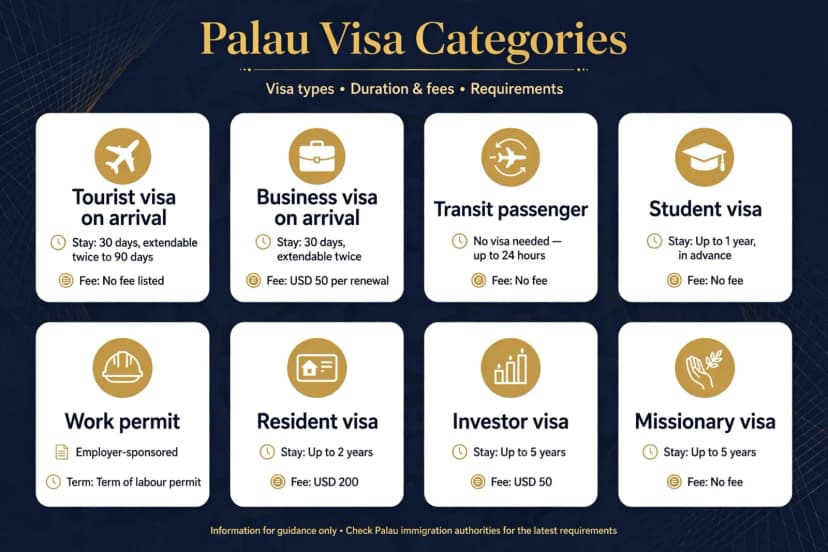
Palau's immigration law is Title 13 of the Palau National Code, with the Immigration Regulations of 2006 and Executive Order 450. The categories below are published by the BCBP's Division of Immigration. The first two are issued on arrival; the rest must be applied for in advance, at the Division of Immigration in Koror or by e-mail to immigration@bcbp.pw — the BCBP states plainly that these are "NOT AVAILABLE ON ARRIVAL" — and generally take 5 to 10 working days.
Tourist visa — on arrival
The standard short-stay visa for tourism, leisure and social visits, including visiting friends or family and attending meetings or conferences. Valid for 30 days, extendable twice by 30 days (90 days maximum). No fee is listed by the BCBP for the visa itself (see the fees section). It does not allow any work.
Business visa — on arrival
For meetings or conferences, negotiating contracts or exploring business opportunities. Valid for 30 days, extendable twice by 30 days, with a USD 50 fee for each renewal. It does not permit employment in Palau.
Transit passenger — no visa, no fee
No transit visa is required for Palau. A transit passenger stays in the airport terminal or transit area for a maximum of 24 hours. You may be allowed to leave the airport during the stopover, but you must depart Palau within 24 hours, and a delayed flight that pushes the layover past 24 hours ends your transit status. No fee, and no change of status or extension is possible.
Temporary visa — no fee
Issued by the Director when it is in the best interests of Palau or for humanitarian reasons, for example to a carrier entering in distress. Valid for no more than 30 days, no fee, and the holder may not work unless expressly exempted in writing by the Director. This is not a route you apply for as a tourist.
Student visa — no fee
For a full-time student at a school in Palau, living in housing maintained by the school. Valid for no more than one year, no fee, and no work unless the Director exempts you in writing. You must show proof of admission and housing and of continuing enrolment each semester; the visa is cancelled if you fail to maintain good standing or enrolment.
Work permit — employer-sponsored
For foreign nationals issued a permit by the Bureau of Labor and Human Resources. It runs for the term of the labour permit, and a provisional labour permit can support a temporary visa for entry. The BCBP publishes no work-permit fee — it directs applicants to the Bureau of Labor and Human Resources. The full sequence is in the work section below. Never travel on a tourist visa intending to convert it into a work permit on arrival.
Resident visa — USD 200
For a foreign national who wishes to make Palau their permanent home. Issued at the Director's discretion for up to two years, for USD 200. The Director considers the purpose of your presence, your dependants, your ability to support yourself, and the best interests of Palau. Holders may work or conduct business only under Palau's labour, foreign investment and tax laws. The application needs a physical examination report, police clearance, notarised sworn statement of no felony convictions, notarised statement of purpose, bank statements, notarised lease, notarised monthly income-and-expenditure form, and employer release and consent letters.
Investor visa — USD 50
For a foreign national with a Foreign Investment Approval Certificate, certified by the Foreign Investment Board as holding at least a 25% equity interest. No more than four investor visas per certificate at one time. Valid for up to five years, no longer than the certificate term, for USD 50.
Missionary visa — no fee
For a foreign national affiliated with, and paid primarily by, a recognised religious organisation, involved in religious teaching or community service. Valid for up to five years or the term of service, whichever is shorter. No fee for the missionary; USD 10 for a dependant's visa.
Dependent visa — spouse and children under 21
For a spouse or a child under 21 of a person lawfully present in Palau, typically the spouse or child of a work-permit holder. Valid for up to five years, but for the dependent of a non-Palauan it expires no later than the principal holder's visa. Common-law relationships are not recognised: a partner or fiancée is not eligible. A sworn statement attesting to dependency is required.
Elite Resident visa — USD 20,000
A ten-year visa with unlimited multiple entries, for a non-refundable USD 20,000, renewable for USD 10,000, capped at 1,000 holders. The applicant must have bought or leased a dwelling from a Palauan citizen or Palauan-owned entity for at least USD 250,000, paid in full in cash, and show adequate financial means yearly. Dependants (spouse and children 21 or younger) pay USD 20,000 each, pro-rated at USD 2,000 per year for dependent children. Elite Resident holders cannot hold a labour permit.
| Visa type | How obtained | Typical stay | Fee (controlling source) | Work allowed? |
|---|---|---|---|---|
| Tourist visa | On arrival | 30 days, extendable twice to 90 days | No fee listed | No |
| Business visa | On arrival | 30 days, extendable twice to 90 days | USD 50 per renewal | No |
| Transit passenger | No visa needed | Up to 24 hours | No fee | No |
| Temporary visa | In advance, Director's discretion | Up to 30 days | No fee | No |
| Student visa | In advance | Up to 1 year | No fee | No |
| Work permit | In advance, employer-sponsored | Term of labour permit | Via Bureau of Labor | Yes, for that employer |
| Resident visa | In advance | Up to 2 years | USD 200 | Only under labour law |
| Investor visa | In advance | Up to 5 years | USD 50 | Only under investment law |
| Missionary visa | In advance | Up to 5 years | No fee; dependant USD 10 | No |
| Dependent visa | In advance | Up to 5 years | Not published | No |
| Government / FG-IOR visa | In advance | Up to 5 years | Fee exempt | Official duties only |
| Elite Resident visa | In advance | 10 years, multiple entry | USD 20,000; renewal USD 10,000 | No labour permit |
Fees: The Visa on Arrival, the USD 100 Environmental Fee and Extensions
The fee picture for Palau is small in money terms but messy in sources: three commercial guides quote three different visa-on-arrival fees. The table gives every figure as reported, with its source.
| Item | Figure reported | Source |
|---|---|---|
| Tourist / business visa on arrival, 30 days | No fee listed | BCBP — no fee listed |
| Tourist / business visa on arrival, 30 days | Free | Travel Visa Stack; iVisa (2026) |
| Visa on arrival, 30 days | About USD 50 | VisaVerge |
| Visa on arrival (entry fee), cash on arrival | USD 50 | EntryBrief |
| Extension of tourist / business visa, per 30 days | USD 50 | BCBP |
| Extension fee | USD 25 per extension | VisaVerge Palau Visa Guide 2026 |
| Pristine Paradise Environmental Fee (PPEF) | USD 100 per visitor | BCBP |
| PPEF, children | USD 100 for age 13 and over | LoopholeDB |
| PPEF, children | USD 100 for age 12 and over; USD 50 under 12 | Visiearth |
| Departure tax | USD 50, typically cash-only at the airport | VisaVerge Palau Visa Guide 2026 |
| Departure tax | None charged separately at the airport | Visiearth Palau airport guide |
| Departure tax + environmental fee | About USD 20 + USD 30 on departure | Travelplanet |
| Rock Islands Southern Lagoon permit ("Green Fee") | USD 50, valid 10 days | Visiearth Palau airport guide |
| Green Fee | USD 10–20, cash-only | VisaVerge Palau Visa Guide 2026 |
| Resident visa | USD 200 | BCBP |
| Investor visa | USD 50 | BCBP |
| Elite Resident visa | USD 20,000 initial; USD 10,000 renewal | BCBP |
The visa on arrival itself: most likely free, but not certainly. The BCBP publishes no fee for the 30-day visa on arrival — its visa sections list criteria, validity and the USD 50 renewal fee, and nothing for the initial issue. Two commercial guides agree: the 30-day permit is "issued free of charge at the port of entry" (Travel Visa Stack) and "the visa on arrival is free" (iVisa). Against that, VisaVerge puts the VOA cost at "about $50" and EntryBrief lists a USD 50 "entry fee payable in cash upon arrival". The honest reading is that the official position is no fee, and the USD 50 figures most likely confuse the visa with the USD 50 extension fee. Carry USD 50 in cash anyway — if nobody asks for it you have lost nothing. Do not pay any agent in advance for a "Palau visa fee": there is no advance fee to pay.
The USD 100 Pristine Paradise Environmental Fee is certain, and it is already in your ticket. Since 1 January 2018, every international airline ticket into Palau has included a USD 100 environmental fee, under Republic of Palau Public Law 10-16. The BCBP states: "Every international airline is required to include the fee in the price of the ticket into Palau." Check your fare breakdown, and keep your itinerary: exempt travellers charged through a ticket can claim a cash refund on arrival by presenting it with their passport. Exempt categories are Palauan passport holders, spouses of Palauan passport holders or citizens, crew on official duty, accredited diplomats, transit passengers, and anyone the Minister of Finance determines. The age threshold for children is disputed: one guide says the USD 100 applies from age 13, another says from age 12 with USD 50 for younger children. No BCBP page found for this guide settles the child figure, so confirm it with your airline when you book a child's ticket.
Departure tax and the Rock Islands permit are the two figures this guide cannot settle. VisaVerge says a departure tax of USD 50 is "typically cash-only at the airport"; Visiearth says Palau "maintains no departure tax charged separately at the airport"; a third guide puts it at about USD 20 departure tax plus a USD 30 environmental fee on departure. None of these is an official BCBP figure. The same applies to the Rock Islands Southern Lagoon permit, often called the Green Fee: Visiearth puts it at USD 50 for ten days, VisaVerge at USD 10–20 cash-only. If you plan to visit the Rock Islands — and most visitors do — budget USD 50 for the permit and carry cash. The practical rule for Palau is simple: the currency is the US dollar, cards are not reliably accepted at small counters, and cash in small clean notes solves most fee disputes at the airport.
Two warnings about money. First, never pay anyone for a Palau "e-visa", "eTA" or "visa approval letter": Palau has no e-visa system, and the only money a tourist owes before travel is inside the ticket price. Second, the extension fee is the one fee the BCBP states unambiguously — USD 50 per 30-day renewal — so a 90-day stay costs USD 100 in extensions on top of the USD 100 environmental fee already in your ticket.
The Palau Entry Form and the Palau Pledge
These are the two formalities every visitor must complete. Neither is a visa, and neither costs anything — but the entry form can stop you boarding if you forget it.
The Palau Entry Form. Every arriving and departing passenger must submit the Palau Entry Form at palautravel.pw, at most 72 hours before departure. The form combines the arrival form, health declaration and customs declaration into one online submission, and generates a QR code to present on a mobile device or as a printed copy at check-in and again on arrival. The BCBP's instruction is exact: "Passengers must submit the Palau Entry Form at most 72 hours before departure at https://www.palautravel.pw/. This will generate a QR code, which must be presented on a mobile device or printed copy during check-in and upon arrival." The FCDO says the same: complete the Palau entry form within 72 hours of arrival. One form can cover a family travelling together. Do it in the last three days before you fly — not a week early — and save a screenshot of the QR code on your phone as well as a printed copy. Airlines check the QR code at check-in: a 2026 visa guide warns that passengers who have not submitted the form risk being refused boarding. The form also carries your customs declaration: declare personal items worth more than USD 400 and cash or travellers cheques of USD 10,000 or more.
The Palau Pledge. On arrival, every visitor signs the Palau Pledge, stamped directly into your passport at immigration. Palau was the first country in the world to make an environmental pledge a legal condition of entry, in December 2017, and the BCBP describes it as "a commitment to protect Palau's environment and culture for future generations" and "a compulsory promise made directly to the children of Palau". The text reads: "Children of Palau, I take this pledge, as your guest, to preserve and protect your beautiful and unique island home. I vow to tread lightly, act kindly and explore mindfully." You sign it in front of the officer; no tourist arrival skips it, and the stamp takes real space on a passport page. The pledge is backed by law: Palau bans reef-toxic sunscreen (anything whose active ingredient is not zinc oxide or titanium dioxide) and the import of e-cigarettes and heated tobacco products, with fines of USD 100 or more for e-cigarettes found on arrival. Leave both at home.
Processing Times
For a tourist or business visitor, there is no processing time at all: the visa is issued at the airport in minutes. The BCBP says the on-arrival process "is completed within minutes and you will get your passport back with the visa stamped in it." Your only time constraint is the entry form, which cannot be submitted more than 72 hours before departure, and booking a flight that actually connects — flights to Koror run only a few times a week.
For visas that must be applied for in advance — student, resident, investor, missionary, dependent, government and work-permit routes — the BCBP states: "Upon receipt of your application, it generally takes about 5-10 working days for your visa to be processed." That is the only official processing figure Palau publishes. In practice, allow longer: the work-permit route involves a separate labour process that takes weeks, and the resident visa needs police clearances and notarised documents. For any advance visa, apply at least four weeks before travel and longer for work. For nationals of the 12 pre-clearance countries, the application must reach the BCBP at least five working days before travel, and emergency applications within 24 hours are considered only for diplomatic missions, medical emergencies and government-invited delegations.
Planning rule. For a tourist trip, book the flight first, submit the entry form inside the 72-hour window, and arrive with the checklist documents. For study, residence, investment or work, start at least six weeks before travel: the 5–10 working days the BCBP quotes is the immigration step alone.
Complete Document Checklists
No single official document list for Pakistani applicants was found, so the checklists below combine what the BCBP states for each visa class, what the FCDO says border officers check, and what the 2026 Pakistan-focused guide lists. The Division of Immigration in Koror is the controlling source for advance visas — confirm its list by e-mail to immigration@bcbp.pw before you assemble a file.
Tourist or business visa on arrival
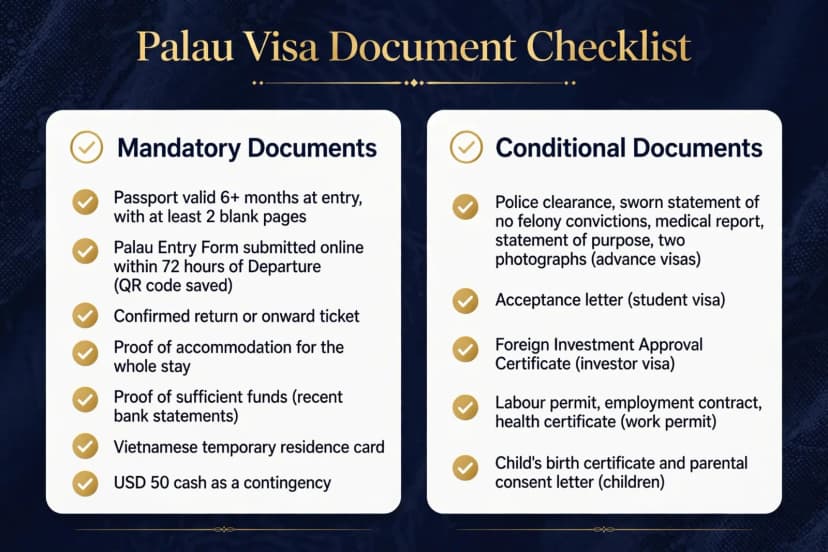
- Pakistani passport valid at least six months at entry, with at least two blank pages (FCDO) for the visa and Pledge stamps
- Palau Entry Form submitted online at palautravel.pw within 72 hours of departure, with the QR code saved on your phone and printed
- Confirmed return or onward ticket (do not sell or exchange it without the Director's written permission)
- Proof of accommodation — hotel booking for the whole stay, or the address where you will stay with friends or family
- Proof of sufficient funds — recent bank statements or a letter of credit; plan on at least USD 200 per week, the figure commercial guides report (the BCBP sets no minimum and decides case by case)
- Your Vietnamese temporary residence card, to prove your right to return to Vietnam
- USD 50 in cash as a contingency for any airport fee, and cash for the Rock Islands permit if you plan to visit them
- Reef-safe sunscreen only (zinc oxide or titanium dioxide); no e-cigarettes or heated tobacco products
Advance visas (student, resident, investor, missionary, dependent, government)
- Everything in the tourist checklist above, plus:
- Completed, signed Palau visa application form
- Police clearance from the Palau Bureau of Public Safety and your place of residence
- Sworn statement of no felony convictions
- Proof of financial responsibility
- Medical examination report on communicable diseases
- Statement of purpose of your presence in Palau
- Two recent photographs
- Anything else showing the visa is in Palau's best interest
- For a student visa: acceptance letter, class schedule, passport copy, one 2" x 2" photo
- For a resident visa: notarised lease, notarised monthly income-and-expenditure form, bank statements showing legitimate income, employer release and consent letters
- For an investor visa: Foreign Investment Approval Certificate and Board certification of at least 25% equity
- For a missionary visa: proof of affiliation with a recognised religious organisation
- For a dependent visa: sworn statement of dependency, plus marriage or birth certificate
- The fee for your class (resident USD 200; investor USD 50; missionary dependant USD 10; student, missionary, temporary: no fee)
Work permit — employer-sponsored
- Everything in the advance-visa checklist above, plus:
- Labour permit from the Bureau of Labor and Human Resources, obtained by your employer first
- Signed employment contract on the standard form
- Original police clearance in English from Pakistan
- Original health certificate in English from Pakistan, incl. TB screening
- Two references from previous employers showing 2+ years' experience
- Passport bio-data page and employer's business licence copy
- Proof of the employer's 30-day local job advertisement (the "Announcement")
Children travelling with you
- Each child needs their own passport, valid for six months, and their own visa on arrival — children are not added to a parent's visa
- Each child must be covered by the Palau Entry Form; the USD 100 environmental fee applies to children too, with the age threshold disputed (12 or 13 — see the fees section)
- Carry the child's birth certificate, and a notarised parental consent letter if a child travels with one parent only or neither — no official Palauan rule was found for this, but officers do ask for it
How to Apply: Step-by-Step
There are two sequences in this guide: the first for tourist and business trips, the second for work, study, residence and investment.
Tourist or business trip — visa on arrival, step by step
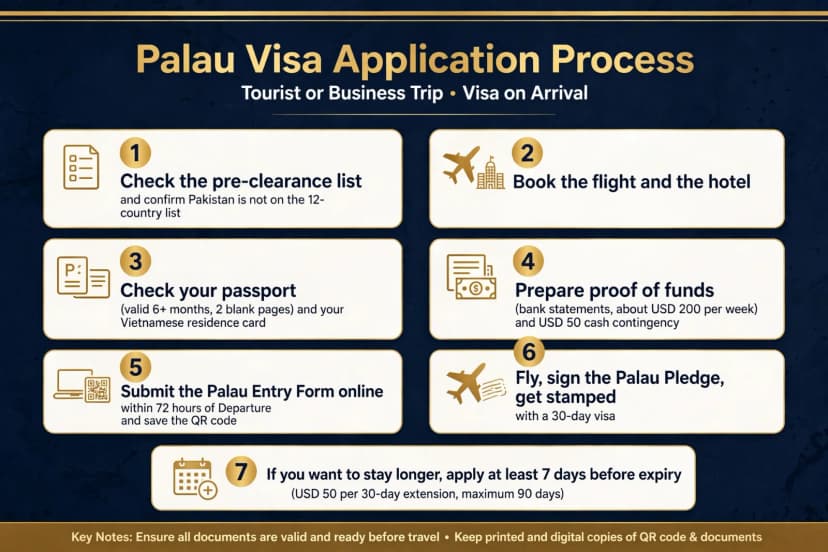
Step 1 — Check the pre-clearance list. Open bcbp.pw and confirm Pakistan is still absent from the 12-country list under Executive Order 499. This takes two minutes and it is the only eligibility check you need.
Step 2 — Book the flight and the hotel. Book a return ticket through Manila or Taipei (see the flights section) and accommodation for the whole stay. Keep both confirmations — they are part of the arrival check.
Step 3 — Check your passport and your TRC. Your passport must be valid for at least six months at entry, with at least two blank pages. Your Vietnamese temporary residence card must cover your return date. Renew either one before you travel if it is near the limit.
Step 4 — Prepare your proof of funds. Print recent bank statements that plainly cover the trip — plan on at least USD 200 per week of stay. Carry USD 50 in cash as a contingency, and cash for the Rock Islands permit.
Step 5 — Submit the Palau Entry Form. Within 72 hours of departure, complete the form at palautravel.pw and save the QR code on your phone and as a printout. Airlines check the QR code at check-in, and you risk being refused boarding without it.
Step 6 — Fly, sign the Pledge, get stamped. At check-in show the entry-form QR code. On arrival, present your passport, return ticket, hotel booking and proof of funds if asked, sign the Palau Pledge stamped into your passport, and receive your 30-day visa. Check the stamp before you walk away from the desk — it is your proof of the date you entered and the length of stay you were given.
Step 7 — If you want to stay longer, apply early. Go to the Division of Immigration, 2nd floor of the MOJ Building in downtown Koror, at least seven days before your visa expires, with your passport and USD 50 for each 30-day extension. The maximum visitor stay is 90 days.
Advance visa (student, resident, investor, work) — step by step
Step 1 — Get your sponsor in place first. For work, your employer must run the labour process (30-day local advertisement, then the labour permit application) before you can apply. For study, get the acceptance letter; for investment, the Foreign Investment Approval Certificate. Nothing else starts until the sponsor's step is done.
Step 2 — Assemble the advance-visa file. Use the checklist above: form, police clearance, sworn no-felony statement, proof of funds, medical report, statement of purpose, two photographs, and the class-specific documents.
Step 3 — Lodge the application. Submit it at the Division of Immigration Office, 2nd floor of the MOJ Building, downtown Koror, or by e-mail to immigration@bcbp.pw, and pay the fee for your class. Office hours are 8am to 5pm, Monday to Friday. These visas are not available on arrival.
Step 4 — Wait 5 to 10 working days. That is the BCBP's published time for advance visas. For work, add the labour process — plan six weeks or more in total.
Step 5 — Travel with the file. Carry the visa, return ticket, accommodation proof and proof of funds in your hand luggage, and complete the Palau Entry Form within 72 hours of departure like every other traveller.
Applying from Vietnam — the Nearest Palau Missions
For a Pakistani living in Vietnam, the good news is that you do not need a Palau mission at all for a tourist or business trip — the visa is issued on arrival. The nearest missions matter only if you need an advance visa, if something goes wrong, or if you want written confirmation of a rule before you travel. Palau has no embassy or consulate in Vietnam and none in Pakistan; its network is one of the smallest in the world: embassies in Washington DC, Tokyo, Manila and Taipei, consulates-general in Guam and Saipan, a UN mission in New York, and honorary consuls in Hawaii and the United Kingdom.
The mission that covers you is the Embassy of Palau in Manila. Wikipedia's list of Palau's diplomatic missions records that the Manila embassy, opened in 2012, is concurrently accredited to Pakistan and Vietnam among 24 countries — the post covering both your nationality and your country of residence, in the city you will transit through anyway. An older directory gives its address as Marbella Condominium II, Unit 101, Ground Floor, 2071 Roxas Boulevard, Malate, Manila, telephone +63 2 8522 1982 / 522 2849; a current listing gives +63 2 8522 2849. Treat both as older listings and verify them before you travel — Palau's Ministry of State page lists the Manila embassy among its nine posts but publishes no street address, and no published e-mail address for it was found for this guide.
The other Asian missions are less useful to you. The Embassy of Palau in Tokyo is accredited mainly to European countries plus China, South Korea and North Korea — not Pakistan or Vietnam. The Embassy of Palau in Taipei is accredited to Kazakhstan, Kyrgyzstan, Mongolia, Tajikistan, Turkmenistan and Uzbekistan — again, not Pakistan or Vietnam. If you need an advance visa and cannot reach the Manila embassy, contact the Division of Immigration in Koror at immigration@bcbp.pw, a lodgement channel the BCBP lists. Do not assume the Tokyo or Taipei embassies will accept an application from a Pakistani resident of Vietnam; ask in writing first.
Also useful from Vietnam: the Embassy of Pakistan in Hanoi is your own mission if anything goes wrong — a lost passport, an emergency, or a problem with your return. Keep its contact details with your travel documents. The Palau side needs no visa thought from Vietnam: your TRC is your return document, and the only pre-travel formality is the Palau Entry Form inside the 72-hour window.
| Mission | Detail | Note |
|---|---|---|
| Embassy of Palau, Manila (nearest to you) | Marbella Condominium II, Unit 101, G/F, 2071 Roxas Blvd, Malate, Manila; tel +63 2 8522 2849 | Accredited to Pakistan and Vietnam; address/phone from older listings — verify first |
| Embassy of Palau, Tokyo | Tokyo, Japan | Accredited to European states, China, the Koreas — not Pakistan/Vietnam |
| Embassy of Palau, Taipei | Taipei, Taiwan | Accredited to Central Asian states — not Pakistan/Vietnam |
| Division of Immigration, Koror | 2nd floor, MOJ Building, downtown Koror; tel +680 488 2498 / 2678; immigration@bcbp.pw; Mon–Fri 8am–5pm | Controlling source for advance visas and extensions |
| Embassy of Pakistan, Hanoi | Hanoi, Vietnam | Your own mission for emergencies and a lost passport |
Extending Your Stay and Overstay Rules
A 30-day visa on arrival can be extended twice, each time by 30 days, for a fee of USD 50 per extension, taking the maximum visitor stay to 90 days. The BCBP states the rule twice, identically, for the tourist visa and the business visa: "The tourist visa for Palau is valid for a period of 30 days and may be extended for two additional 30-day periods", and "You must apply at least seven days before the expiration date of your current visa at the Division of Immigration", with "The fee is $50 USD for renewal." One commercial guide reports extensions take one to three business days — not a BCBP figure, so apply at the start of the seven-day window.
Digital residents get a longer runway: holders of a Palau Digital Resident National ID Card can get up to two consecutive 90-day extensions per calendar year after their initial tourist visa expires. (The BCBP also states a USD 50-per-month fee for a Dependent Visa in this context — treat it as reported, since the official page attaches that fee line to the digital-resident section.) For everyone else, 90 days is the ceiling — after that you must leave. There is no published route to extend beyond 90 days, and no "visa run" guidance from the BCBP.
Overstay is where the sources fall apart completely, and this guide will not pretend otherwise. Four third-party figures circulate for the per-day overstay fine: about USD 8 per day (Passports and Visas); USD 20 per day with a maximum cap of USD 500 (EntryBrief, Chinese-citizens page); USD 50 per day with no cap (EntryBrief, Slovak-citizens page); and USD 50–100 per day (TrekFeed). No official BCBP figure was found for this guide, and the four figures disagree by a factor of more than ten. What is not disputed is that overstaying can lead to deportation and a future entry ban. Do not overstay, even by a day. If your departure is delayed by a cancelled flight or an emergency, go to the Division of Immigration before your visa expires, not after, and keep every document that proves the delay was outside your control.
Work, Study and Long-Stay Routes
Palau's work route is employer-led, tightly controlled and slow: the labour step comes first, the visa second, registration third. Palau gives priority to its own citizens, and a 2026 employment guide from Palau's Ministry of Human Resources, Culture, Tourism and Development with the International Labour Organization sets the sequence out exactly.
Step one — the employer proves no Palauan can do the job. Before recruiting a non-resident worker, the employer must advertise the vacancy locally through a process called the Announcement, run by the Division of Employment Services: 30 days on notice boards and in newspapers, television and other media. Only if no qualified Palauan worker is found can the file move forward. This is a real barrier: Palau has about 18,000 people and a small labour market, and most foreign workers are in hospitality, construction, diving and domestic work, often from the Philippines.
Step two — the labour permit application. After the Announcement, the employer submits an application to the Division of Employment Services with a signed employment contract, an original police clearance in English and an original health certificate in English from your home country, two references from previous employers showing at least two years of experience, the passport bio-data page, and a copy of the business licence and the Announcement form. If approved, the Division issues a Provisional Labor Visa for entry. The work-permit fees are where third-party guides disagree sharply: a 2026 guide summarised by an employers' site lists skilled workers at USD 150 for one year or USD 300 for two years, unskilled workers at USD 125 or USD 250, a temporary work permit at USD 300, an application fee of USD 25 and a change-of-status fee of USD 500; another guide puts the work permit at USD 100–200; a third puts the application fee at USD 50. The BCBP publishes no work-permit fee and directs applicants to the Bureau of Labor and Human Resources. Treat every published work-permit fee as reported, not verified, and get the figure from the Bureau first. Note that under the 2019 regulations the employer may recover up to 50% of the work-permit fee from the worker if the contract says so, with deductions of no more than 10% of gross monthly income.
Step three — arrival and registration. Within ten days of arrival the worker must get a Social Security number and a physical examination, and within 30 days report to the Division of Employment Services to receive the work permit. The permit is tied to one employer and one role: you may work only for the approved employer unless the Division approves a subcontract agreement, and changing employer requires a new permit. Employers must notify the Bureau of Immigration within 14 days if employment ends early. The national minimum wage is USD 5.00 an hour from 1 October 2025; social security is 7% each side, with 2.5% each side for the Healthcare Fund. One guide reports 15 days to a month once the file is submitted — a third-party estimate excluding the 30-day advertisement period.
What this means for you. There is no realistic route to a Palau work permit without a job offer from a Palauan employer willing to advertise the job locally for 30 days and sponsor the whole file. Do not pay any agent who promises a Palau work visa without an employer — the employer is the applicant, not you, and there is no self-sponsored work route. Do not travel on a tourist visa intending to find work and convert it: the BCBP states that the tourist visa strictly prohibits commercial, employment or business activities, and changing status requires a labour permit. A 2026 guide for Pakistani citizens describes the same pathway — arrive on the tourist visa, get a job offer, have the employer file — but it does not explain how the conversion works, and the BCBP's own rules point the other way: the provisional labour visa is the entry document for workers, issued before travel, not after arrival. If an employer offers you a job, ask them to confirm in writing that they will run the Announcement and the labour-permit application before you travel, and do not resign from your job in Vietnam or pay any fee until the provisional labour visa is in your hands.
For study, the route is simpler but still advance-only: get accepted by a school in Palau, which provides the acceptance letter and housing, and apply for the student visa (no fee, up to one year). You may not work on a student visa unless the Director exempts you in writing. Palau's main higher-education institution is Palau Community College in Koror; no scholarship route for Pakistani students was found for this guide. For residence, the resident visa (USD 200, up to two years) and the investor visa (USD 50, up to five years, at least 25% equity) are the long-stay routes — both demanding, both applied for in advance, and neither a shortcut to work without a labour permit.
Transit, Flights and Money: Practical Notes
Flights. There is no direct flight from Vietnam to Palau, and none from Pakistan either. The two realistic corridors from Ho Chi Minh City are via Manila and via Taipei. Via Manila, Philippine Airlines flies both legs on one ticket in about 8 hours including a 2 hour 25 minute connection, with return fares around €700 in November 2026 (Google Flights); United also flies Manila to Koror. Via Taipei, China Airlines flies Ho Chi Minh City to Taipei and then Taipei to Koror, but the connection is long: about 19 hours 20 minutes with a 12-hour layover, around €779 return, with Taipei–Koror operating four times a week from November 2025. A third route exists via Tokyo and Guam — United flies Tokyo Narita to Koror twice a week from 29 October 2025 — but it is long, expensive (around €2,300 return) and routes through Guam, which is US territory. Book the whole journey on one ticket where you can, and leave a generous connection time: flights to Palau run only a few times a week.
Transit through Manila — the trap to check. Manila is the best route and also the one that needs the most care for a Pakistani passport. Airside transit at Ninoy Aquino International Airport is generally visa-free for most nationalities if you stay in the international transit area with a connecting flight within 24 hours — but NAIA's four terminals are not connected airside, and any terminal change means clearing immigration, which for a Pakistani passport holder requires a Philippines visa. Philippine Airlines operates an airside transfer desk and, according to traveller reports, can transfer connecting passengers between terminals without them passing immigration — but the Philippine Bureau of Immigration has told travellers in writing that a transit visa is required, and others report being charged a USD 60 security fee and having their passports held during a Manila transit. No official Philippine government page found for this guide settles the question for a Pakistani passport on a single-ticket PAL connection. Confirm with Philippine Airlines in writing, before you book, that your exact itinerary can be completed airside without a Philippines visa — and if it cannot confirm that, apply for a Philippines 9(b) transit visa (maximum stay 72 hours) at the Philippine Embassy in Hanoi, or take the Taipei route instead.
Transit through Taipei — check before you book. Taiwan's Bureau of Consular Affairs says a traveller who does not leave the international transit area does not need an e-visa, and the National Immigration Agency's carrier guidance says a passenger with a through-checked bag and an onward boarding pass who can transfer inside the restricted airside area does not need to meet Taiwan's normal entry requirements. But Pakistani-specific guidance warns that Pakistani nationals may still require a transit visa even for an airside transit at Taoyuan, and advises confirming with the Taipei Economic and Cultural Office or the airline well in advance. The China Airlines routing also has a 12-hour layover — long enough to need a meal, a rest and a working phone, all available airside, but only if you can stay airside. Confirm with China Airlines in writing that your connection can be completed without passing immigration, and if it cannot, apply for a Taiwan transit visa (about USD 14) before you travel. Do not plan to leave the airport during a Taipei layover without a visa: the free half-day tour is only for travellers who hold a valid Taiwan visa or qualify for visa-exempt entry, and a Pakistani passport qualifies for neither.
Money. The currency is the US dollar, so there is no exchange rate to worry about. ATMs exist in Koror but are limited, and card payments are not reliably available at small counters, the airport or the Rock Islands permit desk, so carry cash in clean US dollar notes. There is no published minimum bank balance for the tourist visa: carry recent statements that plainly cover the trip. Palau is expensive by Pacific standards — a remote island nation where almost everything is imported — so budget generously and book the accommodation you will show at immigration before you apply. A 10% Goods and Services Tax applies to personal items worth more than USD 1,000, and customs may open most suitcases on arrival.
Safety, Health and Arrival Checks
Security. Palau is one of the safest destinations in the Pacific. The US State Department rates it Level 1 — Exercise Normal Precautions, its lowest level — and the FCDO's Palau travel advice carries no warning against travel to any part of the country. Crime is low, though the usual precautions apply: lock your room, do not leave valuables on the beach, and be careful on the roads, which are narrow and poorly lit at night. The main risks are natural: strong currents and rip tides, sun exposure, and tropical weather, including typhoons in the June-to-November season. Check the weather before any boat trip, dive only with a licensed operator, and follow the Palau Pledge in practice — the Rock Islands are protected, and damaging coral or removing marine life carries fines.
Health. Palau has no COVID-19 vaccination requirement — the BCBP states that from 25 April 2023 Palau no longer requires it to enter. Yellow fever is a different question: several guides state that proof of vaccination against yellow fever (and cholera) is required if you arrive from an infected area, and one says it applies to travellers arriving from, or transiting more than 12 hours through, a WHO-designated risk area. Neither Pakistan nor Vietnam is a yellow-fever risk country, and the BCBP's own page does not list yellow fever at all, so a direct routing from Vietnam should not need a certificate — but the requirement is reported, not confirmed on an official Palauan page, so if your routing transits a risk country, ask the Division of Immigration or your airline before you book. One health document does matter for Pakistanis: Pakistan requires a polio vaccination certificate (from NADRA) to leave Pakistan, so if any part of your journey starts in Pakistan, carry it. Medical facilities are basic — Belau National Hospital in Koror is the main hospital, and serious cases are evacuated to the Philippines, Taiwan or Guam — so travel insurance covering medical evacuation is strongly advisable, even though it is not a required visa document.
Arrival checks. At Roman Tmetuchl International Airport, expect to show your passport, entry-form QR code, return or onward ticket, hotel booking and proof of funds if asked. Sign the Palau Pledge stamped into your passport. Declare personal items worth more than USD 400 and cash or travellers cheques of USD 10,000 or more on the entry form. The immigration officer makes the final decision in every case. Check the stamp before you walk away from the desk — it is your proof of entry date and length of stay, and the document the Division of Immigration will ask for if you apply for an extension. If you arrive by sea, give at least 48 hours' notice so immigration formalities can be arranged, and still complete the entry form within 72 hours of arrival.
Frequently Asked Questions
1. Do Pakistani citizens need a visa for Palau?
Not in advance. A Pakistani passport holder gets a 30-day tourist visa on arrival at Roman Tmetuchl International Airport in Koror. Before 2026 only Myanmar and Bangladesh needed a visa in advance; since Executive Order 499 (effective 30 March 2026) the pre-clearance list covers 12 countries — Pakistan is not one.
2. How much does the Palau visa on arrival cost?
Most likely nothing. The BCBP publishes no fee for the 30-day visa on arrival, and two commercial guides say it is issued free of charge. Two other guides quote about USD 50, which most likely confuses the visa with the USD 50 extension fee. Carry USD 50 in cash as a contingency, and do not pay any agent in advance for a Palau visa fee.
3. What is the USD 100 fee I keep hearing about?
That is the Pristine Paradise Environmental Fee. Since 1 January 2018 it has been included in the price of every international air ticket into Palau, so you should already have paid it when you bought your ticket. Check your fare breakdown, keep your itinerary, and do not pay it again at the airport. The age threshold for children is disputed (12 or 13), so confirm it with your airline.
4. What is the Palau Entry Form, and when do I fill it in?
It is the online arrival, health and customs declaration at palautravel.pw. Submit it at most 72 hours before departure — not earlier — and show its QR code at check-in and on arrival, on your phone and as a printout. Airlines check it at check-in; without it you risk being refused boarding.
5. What is the Palau Pledge?
A conservation promise stamped into your passport on arrival, which every visitor must sign in front of the immigration officer: "Children of Palau, I take this pledge, as your guest, to preserve and protect your beautiful and unique island home. I vow to tread lightly, act kindly and explore mindfully." Palau was the first country to make such a pledge a legal condition of entry.
6. How long can I stay in Palau?
30 days on arrival, extendable twice by 30 days at USD 50 per extension, to a maximum of 90 days. Apply at the Division of Immigration in Koror at least seven days before expiry. Digital residents can get up to two further 90-day extensions per calendar year. After 90 days you must leave.
7. Does Executive Order 499 affect Pakistani passport holders?
No. The order, effective 30 March 2026, requires written pre-clearance before boarding for nationals of 12 countries: Bangladesh, Cambodia, Cameroon, Ghana, Haiti, Iran, Myanmar, Nigeria, North Korea, Saint Kitts and Nevis, Sri Lanka and Vanuatu. Pakistan is not on the list. Check the BCBP's pre-clearance page again in the week before you travel, because the list can change.
8. Is there a Palau embassy in Vietnam or Pakistan?
No. Palau has no mission in either country. The nearest mission is the Embassy of Palau in Manila, accredited to both Pakistan and Vietnam. Its address is given in older directories as Marbella Condominium II, Unit 101, Ground Floor, 2071 Roxas Boulevard, Malate, Manila, telephone +63 2 8522 2849 — verify both before you travel. For a tourist trip you do not need the embassy at all.
9. What documents do I need for Palau?
A passport valid at least six months at entry with two blank pages; the Palau Entry Form QR code; a confirmed return or onward ticket; a hotel booking or stay address; proof of sufficient funds (plan on USD 200 per week); and your Vietnamese TRC for the journey home. Full checklists are in the document section.
10. How do I fly from Ho Chi Minh City to Palau?
There is no direct flight. Best is Philippine Airlines via Manila, about 8 hours on one ticket, around €700 return. The alternative is China Airlines via Taipei, about 19 hours 20 minutes with a 12-hour layover, around €779 return. Avoid Guam unless you already hold a US visa — it is US territory.
11. Do I need a transit visa for Manila or Taipei?
It depends on your exact itinerary, and the sources conflict. At Manila, airside transit is generally visa-free, but NAIA's terminals are not connected airside, so a terminal change means clearing immigration — which needs a Philippines visa for a Pakistani passport. Confirm with Philippine Airlines in writing that your connection can be done airside. At Taipei, Taiwan's Bureau of Consular Affairs says no e-visa is needed if you stay airside, but Pakistani-specific guidance warns a transit visa may still be required. Confirm with your airline before booking either route.
12. Can I work in Palau on a tourist visa?
No. The tourist visa strictly prohibits commercial, employment or business activities. A work permit needs a Palauan employer who first advertises the job locally for 30 days, then obtains a labour permit and a provisional labour visa for your entry. The permit is tied to that employer. Never travel on a tourist visa intending to find work and convert it.
13. What happens if I overstay my Palau visa?
No official overstay fine was found for this guide. Third-party guides quote USD 8, USD 20 (capped at USD 500), USD 50 and USD 50–100 per day. What is not disputed is that overstaying can mean deportation and a future entry ban. Apply for an extension before your visa expires, or leave on time.
14. Do I need travel insurance or vaccinations for Palau?
Travel insurance is not a required visa document, but it is strongly advisable: medical facilities are basic and serious cases are evacuated to the Philippines, Taiwan or Guam, so buy a policy covering medical evacuation. No COVID-19 vaccination is required since 25 April 2023. Yellow fever vaccination is reported as required only if you arrive from an infected area — neither Pakistan nor Vietnam is one. If your journey starts in Pakistan, carry your NADRA polio certificate, which Pakistan requires to leave the country.
15. Is there a departure tax when I leave Palau?
This guide cannot settle it. One 2026 guide says a departure tax of USD 50 is payable in cash at the airport; another says Palau maintains no departure tax charged separately; a third puts it at about USD 20 plus a USD 30 environmental fee. None is an official BCBP figure. Carry USD 50 in cash for departure as a contingency.
Official Immigration Websites
Check these sources directly before you apply. The BCBP is the controlling source for eligibility, fees, extensions and pre-clearance; the FCDO for passport validity and customs; the Manila embassy for advance visas.
| Website | What it is | Link |
|---|---|---|
| BCBP — Immigration | Official immigration page: visas on arrival, other classes, fees, extensions, entry form, PPEF, pre-clearance | bcbp.pw — Immigration |
| BCBP — Pre-Clearance Notice | Official EO 499 notice: the 12 flagged countries and pre-clearance | bcbp.pw — Immigration Advisory for Flagged Countries |
| Palau Entry Form | Official arrival, health and customs declaration — submit within 72 hours for the QR code | palautravel.pw |
| UK FCDO — Palau travel advice | Entry requirements, passport validity, Pledge, entry form, customs rules | gov.uk/foreign-travel-advice/palau |
| Palau Ministry of State — Embassies | Official list of Palau's posts abroad, incl. the Manila embassy | palaugov.pw — Embassies and Consulates |
| UrduPoint — Palau Visa for Pakistanis | Pakistan-focused guide, checked 19 Nov 2026: VOA, fees, entry form, polio | urdupoint.com/travel/visa/palau |
| Island Times — EO 499 | 12 Feb 2026 report naming the 12 countries that lost VOA access | islandtimes.org — New Entry Rules |
| VisaVerge — Palau Visa Guide | 2026 guide: VOA, USD 200/week funds figure, departure tax, Green Fee | visaverge.com — Palau Visa Guide 2026 |
| EnvoyAtlas — Palau Visa Guide | 2026 guide: visa classes, EO 499, resident visa fee, extensions | envoyatlas.com — Palau Visa Guide 2026 |
| AlwaysPacked — Palau Pledge and Green Fee | Nov 2026 guide: the Pledge, USD 100 fee, entry form, arrival rules | alwayspacked.com — Palau Pledge and Green Fee |
| Wikipedia — Diplomatic missions of Palau | Manila embassy's accreditation to Pakistan and Vietnam | en.wikipedia.org/wiki/List_of_diplomatic_missions_of_Palau |
| FlightConnect — Koror to Ho Chi Minh City | Routes via Manila and Taipei, airlines, journey times | flightconnect.co — Koror to Ho Chi Minh City |
This guide was checked on 28 November 2026. Visa rules change without notice. Always confirm the live rules with the Bureau of Customs and Border Protection (bcbp.pw) and with the Embassy of Palau in Manila before paying any fee or booking a non-refundable ticket. Nothing in this guide is immigration advice; the Palauan authorities set and enforce the entry rules, and the immigration officer at Koror makes the final decision.