Palestine Visa Guide 2026: Types, Requirements, Documents and Application Steps
Last checked: 28 November 2026. This guide is for Pakistani passport holders living in Vietnam. It is written honestly: for most Pakistani passport holders there is currently no lawful route into Palestine at all, and this guide explains why, what the competing claims are, and what to check before you spend any money. Visa rules change without notice — always confirm the live rules with the Embassy of the State of Palestine in Hanoi and with Pakistan's Ministry of Foreign Affairs before paying any fee or booking a non-refundable ticket.
Table of Contents
- Introduction
- Do Pakistani Passport Holders Need a Visa for Palestine?
- There Is No Separate "Palestine Visa"
- The Central Question: Can Pakistanis Enter at All?
- Types of Visas and Permits for the West Bank
- Fees: What Each Route Costs
- Processing Times
- Complete Document Checklists
- How to Apply: Step-by-Step
- Applying from Vietnam — the Missions in Hanoi
- The Allenby / King Hussein Bridge Crossing
- Gaza: Closed to Tourists
- Extending Your Stay and Overstay Rules
- Transit, Flights and Money: Practical Notes
- Safety, Health and Arrival Checks
- Frequently Asked Questions
- Official Immigration Websites
Introduction
Palestine is the destination Pakistani travellers ask about most often and understand least. Bethlehem, Hebron, Jericho, Ramallah and the Old City of Jerusalem hold deep religious and historical meaning for many Pakistanis, and the wish to visit them is genuine. This guide answers it straight: it explains the entry system as it actually works in November 2026, names the one document that blocks most Pakistani passport holders, and sets out the checks a careful traveller should run before spending anything.
Three facts frame everything that follows. First, Palestine does not run its own border or visa system: the West Bank is reached through crossings operated by Israeli authorities, and Gaza's crossings are likewise screened by Israel. Second, the Pakistani passport carries a printed restriction — "This passport is valid for all countries of the world except Israel" — and Pakistan does not recognise Israel, so the Israeli entry permission every route requires sits in direct tension with the passport you hold. Third, the security situation is severe: the US State Department rates Gaza Level 4, Do Not Travel, and the West Bank Level 3, Reconsider Travel, while the UK FCDO advises against all travel to Gaza and to three northern West Bank governorates, and against all but essential travel to most of the rest of the West Bank.
Do Pakistani Passport Holders Need a Visa for Palestine?
Yes — a Pakistani passport holder needs entry permission before travelling, and there is no visa-free or visa-on-arrival route for a Pakistani passport. But the question is misleading, because there is no Palestinian visa to apply for: the Palestinian Authority does not control the borders and crossings, and Palestinian embassies do not issue visas or transit permits. The permission that matters is the Israeli one — an entry visa or entry permit issued under Israeli rules — plus, for the West Bank, a permit under the procedure run by COGAT, the Coordinator of Government Activities in the Territories, in coordination with the Palestinian Authority.
The rule follows your passport, not where you live. Living in Vietnam, holding a Vietnamese temporary residence card (TRC), holding a US, UK or Schengen visa, or having lived in the Gulf does not remove the entry-permission requirement, and no simplified regime for Vietnamese residents of Pakistani nationality was found. If an agent tells you a Gulf residence visa or a Western visa makes Palestine visa-free for you, ask them to show the official rule: none was found.
There is also no visa-free transit privilege to fall back on. The realistic route to the West Bank runs through Jordan — fly to Amman, then cross the Allenby / King Hussein Bridge — and Pakistanis need a Jordanian visa arranged in advance, with prior approval from Jordan's Ministry of Interior. Jordan does not issue visas on arrival to Pakistani passport holders at any crossing, and it does not issue visas at the Allenby Bridge at all. The Jordan leg is a separate visa process with its own fee and waiting time, covered below.
What is not in dispute is the entry-permission rule. Israel's Population and Immigration Authority (PIBA) requires every traveller to hold a valid visa or an approved ETA-IL before the journey begins, and Pakistan is on PIBA's visa-required list: a Pakistani passport holder needs a B/2 visitor visa (or the online eVisa-B2) before travel, with a passport valid at least three months from arrival in Israel. The Pakistani side of the rule — the printed "except Israel" clause — is what makes the whole journey doubtful, and it is examined in the central section below.
There Is No Separate "Palestine Visa"
This is the single most useful fact in the guide, because most of the confusion — and most of the money lost to agents — comes from not knowing it. There is no Palestinian tourist visa issued at a border, no Palestinian e-visa portal, and no Palestinian visa sticker that an embassy can put in your passport. The official Palestinian and Israeli pages consulted for this guide describe no Palestinian entry visa issued at a crossing, and the Palestinian mission in London states the reason plainly: the Palestinian National Authority does not control the borders and crossings, so its embassies and delegations do not issue visas or transit permits.
What exists instead is a layered system run by Israel, with the Palestinian Authority involved in the West Bank permits: first, an Israeli entry document — a B/2 visitor visa from an Israeli mission or the online eVisa-B2 for visa-required nationals, or an approved ETA-IL costing NIS 25 for visa-exempt nationals; second, for the West Bank, a permit under COGAT's "Procedure for the Entry of Foreigners into the Judea and Samaria Area" — a B/2 visit permit for up to three months, applied for at the Allenby Bridge by visa-exempt visitors or in advance through an Israeli mission or COGAT by others; third, for long stays (work, study, volunteering, joining a spouse), a COGAT permit for that purpose, applied for in advance. None of these is a "Palestine visa", and anyone selling you one by that name is selling you something that does not exist.
That matters for two practical reasons. First, a document issued by a Palestinian mission — an invitation letter, a coordination letter, a letter from a host organisation in Ramallah or Bethlehem — is supporting evidence for an application, not entry permission in itself. It does not get you through the Allenby terminal. Second, the Israeli border officer makes the final decision at the crossing, whatever document you hold: an approved eVisa-B2 "only allows you to reach the border-crossing into Israel, but does not grant you permission to enter", in PIBA's own words, and a COGAT prior approval is likewise not a guarantee of actual entry — the final decision is given after questioning and checks at the border.
The same logic applies to both territories. The West Bank is entered through Israeli-controlled crossings, principally the Allenby / King Hussein Bridge from Jordan. Gaza is entered through Rafah from Egypt or through Erez / Kerem Shalom from Israel, and both are closed to ordinary tourists in November 2026 (see the Gaza section). There is no airport in the West Bank or Gaza: the nearest international airports are Ben Gurion in Tel Aviv and Queen Alia in Amman, and both routes pass through Israeli border control.
The Central Question: Can Pakistanis Enter at All?
This is the section that decides whether the rest of the guide is a plan or a warning. The honest answer is that the sources point in two directions, and the weight of the official evidence is against a Pakistani passport holder travelling — while the Israeli portal, taken on its own, appears to list Pakistan as an ordinary visa-required nationality. Read both positions before you decide anything.
Position A — No lawful route at present. The Pakistani passport is printed with the words "This passport is valid for all countries of the world except Israel." Pakistan does not recognise Israel, and there are no diplomatic relations between the two countries. On 31 October 2025 the Government of Pakistan publicly reaffirmed this: the Ministry of Foreign Affairs confirmed the clause remains intact, and the Directorate General of Immigration and Passports confirmed the passport still reads "valid for all countries except Israel". A Pakistan-focused guide that checked the rules on 7 November 2026 draws the conclusion plainly: a Pakistani passport holder has no lawful route into Palestine at present, because every entry point needs Israeli entry permission and the passport is not valid for it. Under this reading there is no visa or permit to apply for, no fee and no processing time — and no agent can lawfully sell you one.
Position B — The Israeli system treats Pakistan as an ordinary visa-required nationality. PIBA's official eVisa-B2 portal lists Pakistan, with a handling fee of NIS 105, a stay of up to 90 days as decided by the consul and border control, and required documents of a travel document, passport photo, return ticket, health insurance, proof of residence in Israel and proof of funds. Israel's Ministry of Foreign Affairs fee chart dated 1 January 2026 lists a B/2 visitor visa at US$32 or €28. COGAT's procedure draws a further distinction: citizens of countries without diplomatic relations with Israel — Pakistan among them — must obtain a Palestinian Authority visit permit instead, under the procedure's Appendix E. One commercial guide claims a "Palestine tourist visa" for Pakistanis at about US$50–100 with three-to-six-week processing through the Embassy of Palestine in Islamabad — but it names no official fee schedule, and no such fee could be verified, so treat it as unverified agent pricing.
How to settle it for your own passport. Do not take either position on trust, including this guide, and do not pay any fee until you have written answers to three questions. First, ask the Embassy of the State of Palestine in Hanoi whether it can coordinate or support an application by a Pakistani passport holder, and what it says about the passport clause. Second, ask Pakistan's Ministry of Foreign Affairs (mofa.gov.pk) or the Embassy of Pakistan in Hanoi whether a Pakistani passport holder may lawfully travel to Israel or through Israeli-controlled crossings, and what the consequences would be. Third, ask the Embassy of Israel in Hanoi whether it will accept a B/2 application from a Pakistani passport holder resident in Vietnam. Only if all three answers point the same way should you proceed — and if any one says no, the trip cannot lawfully happen on your current passport, whatever an agent promises. Keep every answer in writing. Given the October 2025 government reaffirmation and the November 2026 reporting, this guide's recommendation is to treat entry as not currently possible for an ordinary Pakistani passport holder.
What the dispute does not change. Whichever position turns out to be right for you, the practical facts are the same: there is no Palestinian visa, no visa on arrival and no e-visa for Palestine; Gaza is closed to tourists; the Allenby Bridge is the only realistic West Bank crossing for a foreign visitor; and a Jordanian visa with prior approval is needed before you can even reach the bridge. The rest of this guide sets out the system as it applies to a traveller who can lawfully use it, so you can see exactly what the route would cost and require — and recognise immediately when an agent's offer does not match it.
Types of Visas and Permits for the West Bank
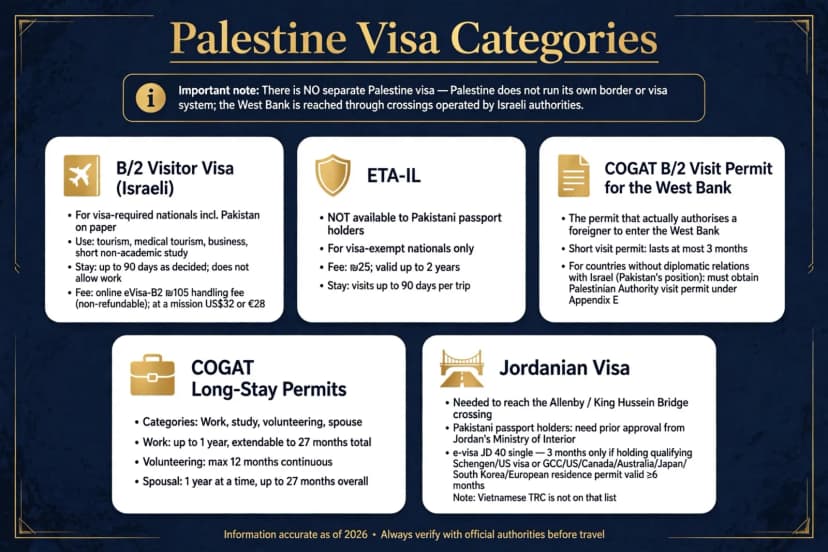
Because there is no Palestinian visa, the "types" below are the Israeli and COGAT documents a foreign visitor actually needs, listed in the order you would encounter them and labelled with who issues each one — which is what determines whether it is available to you at all.
B/2 visitor visa (Israeli, for visa-required nationals)
The standard short-stay visa for visiting, tourism, medical tourism, business and short non-academic study — the document PIBA's portal describes for a Pakistani passport holder: applied for at an Israeli mission or through the online eVisa-B2, validity up to 90 days as decided by the consul, stay up to 90 days as determined by border control on arrival. It does not allow work. The online eVisa-B2 costs NIS 105 as a non-refundable handling fee; the Foreign Ministry's consular fee chart dated 1 January 2026 lists the B/2 at US$32 or €28 at a mission. The two figures conflict (see the fees section), and neither has been confirmed as payable by a Pakistani applicant, because no Israeli mission's acceptance of a Pakistani application could be verified for this guide.
ETA-IL (Electronic Travel Authorisation, visa-exempt nationals only)
For nationals of visa-exempt countries only — the United Kingdom, the United States, Canada, most of the EU and others. It costs NIS 25, is applied for online on PIBA's portal before travel, is valid for up to two years or until the passport expires, and allows visits of up to 90 days per trip. It is not a visa and it is not available to Pakistani passport holders. If an agent offers you an "ETA-IL" for a Pakistani passport, the offer is false: the portal will not issue one to you.
COGAT B/2 visit permit for the West Bank (up to 3 months)
The permit that actually authorises a foreigner to enter the West Bank, under COGAT's Procedure for the Entry of Foreigners into the Judea and Samaria Area. A short visit permit lasts at most three months. Citizens of visa-exempt countries visiting only the West Bank normally apply on arrival at the Allenby Bridge, subject to approval by a COGAT representative. Citizens of countries with diplomatic relations with Israel but no visa exemption apply through the Israeli representative office in their own country. Citizens of countries without diplomatic relations with Israel — Pakistan's position — must obtain a Palestinian Authority visit permit instead, under the procedure's Appendix E. Anyone previously refused entry, with a criminal or security record, who has overstayed, or who has been subject to a financial-guarantee condition within the last five years must coordinate in advance with COGAT and should not rely on applying at the border.
COGAT long-stay permits: work, study, volunteering, spouse
Foreigners may not work or run a business in the West Bank without a permit from a COGAT unit. Permits for foreign employees — experts, consultants, doctors, teachers and businesspeople — can be issued for up to one year and extended to 27 months in total. Lecturers and researchers must be at least 25 and students at least 18; students need a permit in advance from a recognised West Bank institution. Volunteering permits cannot exceed 12 months continuous. Spousal permits last one year at a time, up to 27 months overall. All require advance application through COGAT, with the host institution or employer as sponsor. COGAT can also require a bank or cash guarantee — reported in 2022 as up to NIS 70,000 (about US$20,500 at the time), returnable after departure but forfeitable on non-compliance. That figure could not be re-verified against a current COGAT publication, so treat it as an older reported maximum, not a current fee.
Jordanian visa (needed to reach the crossing)
A separate visa, issued by Jordan, not by Palestine or Israel. Pakistani passport holders need prior approval from Jordan's Ministry of Interior, applied for through the MOI e-services portal (eservices.moi.gov.jo) or a Jordanian embassy, before travelling. The e-visa route (JD 40 for a three-month single entry) is available only if you hold a valid Schengen or US visa, or a residence permit of a GCC country, the US, Canada, Australia, Japan, South Korea or a European country, valid for at least six months. A Vietnamese TRC is not on that list, so a Pakistani living in Vietnam should expect the prior-approval route. Pakistanis cannot get a visa on arrival at Jordanian airports or land borders under any circumstances, and Jordan issues no visas at the Allenby Bridge. If you leave Jordan through the bridge on a standard single-entry visa, you will need a new Jordanian visa to return — since June 2026 the crossing is no longer treated as a humanitarian crossing for international travellers.
| Document | Who issues it | Typical stay | Who it is for |
|---|---|---|---|
| B/2 visitor visa / eVisa-B2 | Israeli mission / PIBA online | Up to 90 days | Visa-required nationals, incl. Pakistan on paper |
| ETA-IL | PIBA online, NIS 25 | Up to 90 days per visit | Visa-exempt nationals only — not Pakistanis |
| COGAT B/2 visit permit | COGAT / PA, at Allenby or in advance | Up to 3 months | Foreign visitors to the West Bank |
| COGAT long-stay permit | COGAT, in advance | Up to 1 year, extendable to 27 months | Work, study, volunteering, spouse |
| Jordanian visa (prior approval) | Jordan MOI / Jordanian embassy | As approved | Needed to reach the Allenby Bridge |
| Palestinian "tourist visa" | Nobody | — | Does not exist — do not buy one |
Fees: What Each Route Costs
The fee picture is unusually messy, because the fees belong to three different governments and one of the most-quoted figures — the "Palestine visa fee" — does not exist. The table below gives every figure found for this guide with its controlling source.
| Item | Figure reported | Source |
|---|---|---|
| Israeli eVisa-B2 (online, Pakistan listed) | NIS 105 handling fee, non-refundable | PIBA official portal, israel-entry.piba.gov.il |
| Israeli B/2 visitor visa (at a mission) | US$32 or €28 | Israel MFA consular fee chart, 1 January 2026 |
| Israeli B/1 work / A/2 student visa | US$64 or €54 | Israel MFA consular fee chart, 1 January 2026 |
| ETA-IL (visa-exempt only) | NIS 25 per application, online, non-refundable | PIBA; Israeli embassy guidance |
| Visitor invitation filed inside Israel | NIS 100 per service | PIBA, via fee guide checked 21 Oct 2026 |
| Allenby Bridge Israeli departure fee | NIS 208 per person (NIS 182 with a Palestinian passport); under-2s exempt | Israel Airports Authority rates, 15 Apr–31 Dec 2026 |
| Allenby shuttle bus | 7 JOD per person; luggage 1.5 JOD per piece | Border-crossing guides, Nov 2026 |
| Jordanian departure tax (land crossings) | 10 JOD per person | Jordan Tourism Board |
| Jordan e-visa (qualifying residence/visa only) | JD 40 single (3 months); JD 60 double; JD 120 multiple (6 months); JD 200 (1 year); JD 350 (5 years) | Jordan MOI e-services portal, via UrduPoint check 7 Nov 2026 |
| Jordan prior-approval application | JD 2 service charge + JD 1,000 financial guarantee per invited person; visa fee by reciprocity | Jordan MOI e-services portal |
| "Palestine tourist visa" fee | About US$50–100, "official consular fee" | One commercial guide (AMG Visa) — no official schedule named; UNVERIFIED |
| COGAT financial guarantee | Up to NIS 70,000 reported (2022) | Al Jazeera, 2022 — older figure, not re-verified |
Which figure counts. For the Israeli entry document, the controlling figure is the one the mission or the PIBA portal shows you at application: NIS 105 for the online eVisa-B2, or US$32 / €28 for a B/2 at a mission under the 1 January 2026 chart. The two conflict because they are two different channels — online handling fee versus consular fee — and neither has been confirmed as actually payable by a Pakistani applicant. The US$50–100 "Palestine visa fee" quoted by one commercial guide names no official fee schedule, and no Palestinian authority publishes a visa fee, because no Palestinian visa exists: do not budget against it and do not pay it. The Allenby departure fee of NIS 208 is the best-supported border figure, published by the Israel Airports Authority for 15 April to 31 December 2026, payable on the Milgam website by card, at the Milgam desk for an extra NIS 7, or at an Israel Postal Bank branch. The Jordanian figures come from the Ministry of Interior's e-services portal as reported in November 2026: JD 40 for the e-visa if you qualify, and JD 2 plus a JD 1,000 guarantee per invited person for a prior-approval application, with the visa fee set by reciprocity.
Two practical warnings about money. First, apply only on the official portals — israel-entry.piba.gov.il for the Israeli document and eservices.moi.gov.jo for the Jordanian one — typing the addresses yourself, never through a lookalike site: the inflated "Palestine visa" prices on commercial sites show how much margin resellers add to a document that does not exist. Second, visa and handling fees are generally non-refundable, including if your application is refused — and for this destination refusal is a real possibility at every layer, so never pay an agent, a flight or a hotel before you have the written answers described in the central section above.
Processing Times
Processing time is the third disputed area, and the honest answer is that most of the figures below describe a system that may not accept your application at all. They are reported here so you can recognise a realistic timeline — and an unrealistic promise.
For the Israeli B/2, the online eVisa-B2 gives no published processing time on the portal page found for this guide; the ETA-IL for visa-exempt nationals is usually decided in 24 to 72 hours, but that is not your route. A B/2 filed at an Israeli mission is decided by the mission and the Population and Immigration Authority, and no published timeline for Pakistani applicants was found. One commercial guide claims three to six weeks for a "Palestine tourist visa" through the Embassy of Palestine in Islamabad — unverified, describing a document that does not exist; do not use it for planning. For COGAT permits the procedure is specific: applications requiring prior approval must be submitted at least 45 days before the planned entry, and never less than 48 hours before entry even in exceptional humanitarian cases; the written decision is notified within 45 days of the complete submission.
For the Jordanian visa, the Ministry of Interior gives a standard processing time of 1 to 14 working days for an electronic application and 5 working days for the urgent option, with an eligible instant e-visa issued on payment — but those times describe the e-visa lane a Pakistani with only a Vietnamese TRC is unlikely to qualify for. A prior-approval application has no published processing time found for this guide, and an interview at the embassy may be needed. Planning rule. If — and only if — you have the three written answers described above and all three say yes, allow at least eight weeks before travel: 45 days for a COGAT advance application, plus the Jordanian prior-approval time, plus the Israeli mission time, with the layers running in sequence rather than in parallel. Do not book a non-refundable flight or hotel inside that window, and do not let an agent promise a one-week turnaround: no source found for this guide supports one.
Complete Document Checklists
There is no single official document list for Pakistani applicants to Palestine, because there is no Palestinian visa application. The checklists below combine what PIBA asks of eVisa-B2 applicants, what COGAT's procedure asks of West Bank permit applicants, what Jordan's Ministry of Interior asks of prior-approval applicants, and what border officers check on arrival. The mission handling your application may ask for more or less — its list governs, so confirm it in writing before you travel anywhere to apply.
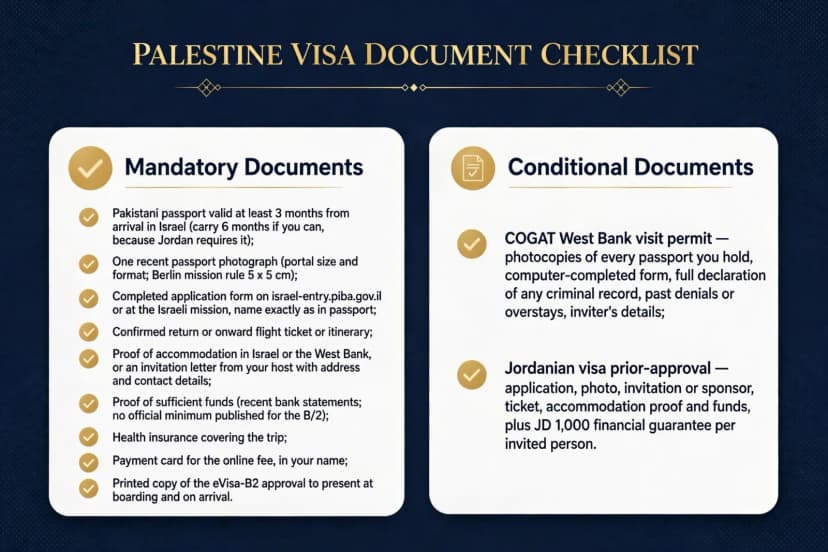
Israeli B/2 / eVisa-B2 — entry document
- Pakistani passport valid at least three months from arrival in Israel (PIBA's rule); carry six months if you can, because Jordan requires it and airlines apply the stricter test
- One recent passport photograph (the portal's size and format; the Berlin mission's rule is 5 × 5 cm)
- Completed application form on israel-entry.piba.gov.il or at the Israeli mission, with your name exactly as it appears on the passport
- Confirmed return or onward flight ticket or itinerary
- Proof of accommodation in Israel or the West Bank, or an invitation letter from your host, with their address and contact details
- Proof of sufficient funds — recent bank statements; no official minimum balance has been published for the B/2
- Health insurance covering the trip
- Payment card for the online fee, in your name
- Printed copy of the eVisa-B2 approval to present at boarding and on arrival
COGAT West Bank visit permit — advance application
- Photocopies of every passport or travel document you hold (the short-visit form asks for passport copies, not a photograph)
- Completed COGAT form, filled in on a computer: name, date and place of birth, residence, citizenship, passport number and validity, contact details, and first-degree relatives in the West Bank
- Planned date of entry, purpose of travel, duration of stay, accommodation, and the persons travelling with you — a separate application for each person
- Full declaration of criminal record, security incidents, ongoing investigations, previous visits, past visa or permit violations, and past entry denials
- If there is an inviter: their name, address, identity details and relationship with you
- Power of attorney, if the application is made on behalf of another person
- Full-face headshot for long-stay permits (lecturers, students, accompanying relatives) — COGAT gives no size standard
- Be ready for a financial guarantee condition: a bank guarantee or cash deposit has been required of some applicants
Jordanian visa — prior-approval route
- Original Pakistani passport, valid at least six months, with blank pages
- Completed application on the MOI e-services portal (eservices.moi.gov.jo) or at a Jordanian embassy
- Recent passport photograph
- Invitation or sponsorship from a person or company in Jordan, if you are using the inviter route — the inviter files the approval request while you are outside Jordan
- Confirmed return or onward flight ticket and proof of accommodation in Jordan
- Proof of funds; be ready for the JD 1,000 guarantee per invited person on online applications
- Your Vietnamese temporary residence card and proof of address in Vietnam, to show where you live and that you will return there
- Any fee the mission charges, in the form the mission accepts — confirm in advance
Children travelling with you
Each child needs their own passport and their own permit or visa, plus an unabridged birth certificate listing both parents — and, if travelling with one parent only or with neither parent, a notarised parental consent affidavit. Officers at the Allenby terminal do ask for these documents.
How to Apply: Step-by-Step
There are two sequences in this guide, because there are two different questions to settle first. Run the three written checks before either sequence; they decide whether any sequence is worth starting.
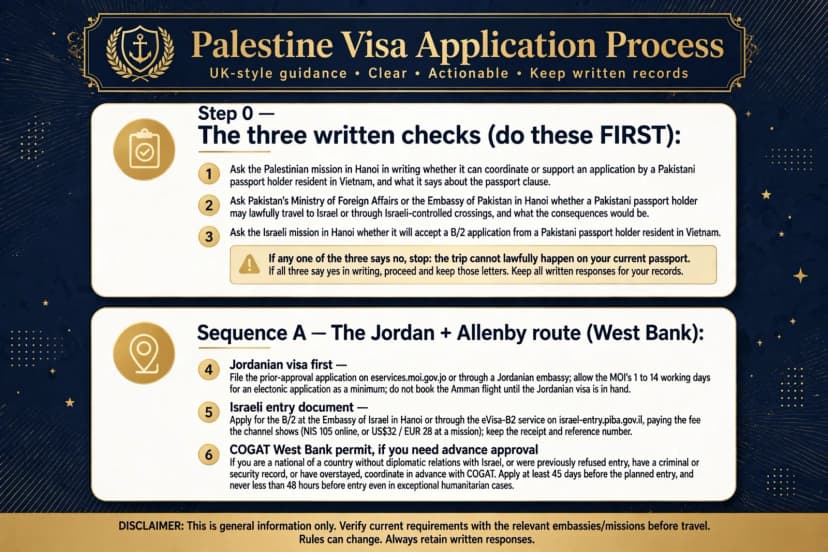
Step 0 — The three written checks (do these first)
Step 0 — The three written checks (do these first). Check 1 — The Palestinian mission in Hanoi. Ask, in writing, whether it can coordinate or support an application by a Pakistani passport holder resident in Vietnam, and what it says about the passport clause. Check 2 — Your own government. Ask Pakistan's Ministry of Foreign Affairs or the Embassy of Pakistan in Hanoi whether a Pakistani passport holder may lawfully travel to Israel or through Israeli-controlled crossings, and what the consequences would be. Check 3 — The Israeli mission in Hanoi. Ask whether it will accept a B/2 application from a Pakistani passport holder resident in Vietnam. If any one of the three says no, stop: the trip cannot lawfully happen on your current passport. If all three say yes in writing, proceed — and keep those letters, because they prove to an airline or a border officer why you are travelling at all.
Sequence A — The Jordan + Allenby route (West Bank)
Step 1 — Jordanian visa, first. Apply for the Jordanian visa before anything else, because without it you cannot reach the bridge. File the prior-approval application on eservices.moi.gov.jo or through a Jordanian embassy, with your inviter in Jordan filing the approval request if you are using that route. Allow the MOI's 1 to 14 working days for an electronic application as a minimum, and longer for prior approval, which has no published time. Do not book the Amman flight until the Jordanian visa is in hand.
Step 2 — Israeli entry document. Apply for the B/2 at the Embassy of Israel in Hanoi, or through the eVisa-B2 service on israel-entry.piba.gov.il, paying the fee the channel shows you — NIS 105 online, or US$32 / €28 at a mission under the 1 January 2026 chart. Keep the receipt and the reference number. Approval only allows you to reach the border; it does not guarantee entry.
Step 3 — COGAT West Bank permit, if you need advance approval. If you are a national of a country without diplomatic relations with Israel, or you have previously been refused entry, have a criminal or security record, or have overstayed, you must coordinate in advance with COGAT: apply at least 45 days before entry, and expect the written decision within 45 days of the complete submission. Visa-exempt visitors apply at the Allenby Bridge itself; that is not your position as a Pakistani passport holder.
Step 4 — Book the journey. Fly Ho Chi Minh City to Amman, then travel overland to the King Hussein Bridge. Check the Israel Airports Authority's Allenby notices on the morning of travel: the terminal operates six days a week, closes on Saturdays, and can close at short notice. Arrive at least three hours before closing. Carry the Allenby departure fee (NIS 208) and the shuttle fare (7 JOD) in cash as well as by card.
Step 5 — Cross and keep every paper. At the Allenby terminal, present your passport, your Israeli entry document, your COGAT permit or approval, your Jordanian visa, your return ticket, your accommodation proof and your proof of funds. Expect questioning: the interrogation report is forwarded to IDF officials, and a refusal does not have to be explained. Keep the blue paper entry card Israel issues instead of a passport stamp until you leave — hotels and exit security ask for it — and check any date written on it before you walk away.
Sequence B — What not to do
Do not pay an agent for a "Palestine visa", a "Palestine e-visa" or a "Palestine visa on arrival": none of those exists. Do not fly to Amman without a Jordanian visa and hope to get one at the Allenby Bridge: Jordan issues no visas there. Do not fly to Ben Gurion without an Israeli entry document and hope to sort it out at the airport. Do not travel to Gaza on any agent's promise: the crossings are closed to tourists. And do not use a second passport or a different nationality to get around the passport clause: a false statement on a COGAT form — which requires photocopies of every passport you hold and a full declaration of past denials — is a refusal in itself and can create a record that follows you.
Applying from Vietnam — the Missions in Hanoi
For a Pakistani living in Vietnam, Hanoi holds three missions that matter for this trip — the one practical advantage of applying from Vietnam. None of them can issue you a Palestinian visa, because none exists — but each holds one of the three written answers you need.
Embassy of the State of Palestine, Hanoi. Room 201, E4B Trung Tu Diplomatic Compound, 6 Dang Van Ngu, Dong Da District, Hanoi; telephone +84 4 3852 4013 / +84 4 3825 3016; email palembvn@gmail.com and vnemb@mofa-gov.ps. Ask it about coordination, invitation letters and the Palestinian Authority's side of a COGAT permit. It cannot issue a visa or a transit permit, and it cannot get you through the Allenby terminal — but it is the authoritative source for what the Palestinian side will and will not do for you. The ambassador is Saadi Al-Tameezi. Confirm opening hours by telephone before travelling to Hanoi: one listing gives Monday to Friday 08:30–16:30.
Embassy of Israel, Hanoi. 10th Floor, Hanoi Towers, 49 Hai Ba Trung Street, Cua Nam Ward, Hanoi; telephone +84 24 3718 7516; email hanoi@mfa.gov.il. One Vietnamese travel source gives a different address, 68 Nguyen Thai Hoc Street, Ba Dinh, Hanoi, telephone +84 24 3843 3141 — the two conflict, so confirm which is current before you go. This is the only Israeli mission in Vietnam and the only agency that accepts Israeli visa applications in the country: appointments are made in advance, and applications are received Monday to Friday 09:00–12:00, with Monday and Thursday afternoons 13:00–14:00 as well. Ask it whether it will accept a B/2 application from a Pakistani passport holder. There is no Israeli embassy or consulate in Pakistan, so a Pakistani applying from Pakistan would also have to use a mission abroad.
Embassy of Pakistan, Hanoi. 2 Van Bao Street, Ngoc Ha Ward, Hanoi. This is your own mission if anything goes wrong while you are applying or travelling, and the right place to ask about the passport clause and its consequences. Keep your Vietnamese temporary residence card valid for the whole trip and carry it with your passport — it is your proof of the right to return to Vietnam. If your TRC is close to expiry, renew it before you travel.
Jordan. No Jordanian embassy in Vietnam was confirmed for this guide, so the Jordanian leg is handled through the Ministry of Interior's e-services portal (eservices.moi.gov.jo) or the nearest Jordanian mission — confirm which mission serves Vietnamese residents before you apply. The Embassy of Palestine in Islamabad is the fallback for family or humanitarian matters in Pakistan itself: Plot No. 4, Block 11, Diplomatic Enclave-II, G-5, Islamabad (one listing gives Block 2 rather than Block 11 — confirm before travelling there).
The Allenby / King Hussein Bridge Crossing
The Allenby Bridge — called the King Hussein Bridge on the Jordanian side — is the crossing that matters for this guide: about 5 km east of Jericho, roughly 57 km from Amman, it is the main crossing point between the West Bank and Jordan, and under COGAT's procedure it is supposed to be the main crossing point for foreigners entering the West Bank. The Israel Airports Authority operates the Israeli terminal, serving mainly the Palestinian population of the West Bank and tourists of various nationalities; Israeli citizens may not cross there. PIBA keeps an entry duty officer at the terminal, and a District Coordination and Liaison office handles contacts with the Palestinian Authority's representatives.
Hours. The terminal operates six days a week because of the security situation, until further notice. As published by the Israel Airports Authority on 27 October 2026, passenger hours are Sunday to Thursday 08:00–18:30 and Friday 08:00–15:30, closed on Saturday. A more detailed timetable splits arrivals and departures: Sundays and Thursdays, arrivals 08:00–18:30 and departures 08:00–17:00; Monday to Wednesday, both 08:00–17:00; Friday, both 08:00–15:30. The terminal also closes on Yom Kippur and the first day of Eid al-Adha, and hours change around other holidays. The two timetables conflict on the Sunday-to-Thursday closing time (18:30 against 17:00 for departures), so treat the earlier time as your deadline: arrive at least three hours before closing, and check the IAA's Allenby notices on the morning you travel. Since June 2026 the crossing is no longer treated as a humanitarian crossing for international travellers — that status now applies only to Palestinian travellers.
Fees at the crossing. Every traveller leaving through the Allenby terminal pays a departure fee under the Israel Airports Authority's 1994 regulations on fees at land border terminals: NIS 208 per departing passenger (NIS 182 with a Palestinian passport), children under two exempt, under the rates applying from 15 April to 31 December 2026 and updated each January. You can pay on the Milgam website by card, at the Milgam desk in the terminal for an extra NIS 7, or at an Israel Postal Bank branch. You cannot walk across the bridge: a compulsory shuttle bus carries passengers between the terminals for 7 JOD per person, with luggage at 1.5 JOD per piece. Leaving Jordan is charged separately: a departure tax of 10 JOD at land crossings. Carry all three fees in cash as well as by card, because card payments are not reliably available at every desk.
Expect a long process: security screening, then passport control, then questioning by the border officer and, where applicable, a COGAT representative. The interrogation report is forwarded to IDF officials, and if entry is refused there is no requirement that the reasons be explained. If you are entering both Israel and the West Bank on the same trip, you need approval from both the PIBA border control officer and an IDF representative. Tourist groups are asked to coordinate entry and exit in advance with the terminal by email (Allenby-info@iaa.gov.il). Private cars and tour buses cannot use this crossing — you change vehicles at the border. The other Jordan crossings, Sheikh Hussein / Jordan River in the north and Yitzhak Rabin / Wadi Araba in the south, do not lead into the West Bank; they lead into Israel proper, and the same entry document and passport-clause problem apply there too.
Gaza: Closed to Tourists
Do not plan a trip to Gaza. There is no tourist route into the Gaza Strip in November 2026, and no source found for this guide describes one. The pedestrian crossing between Gaza and Israel, Erez, was damaged on 7 October 2023 and remains closed. The crossing between Egypt and Gaza, Rafah, has been closed to the general public since 7 May 2024. It reopened on 2 February 2026 for limited entry and exit under the October 2025 ceasefire agreement: according to the EU Border Assistance Mission at Rafah, 11,684 people crossed between 2 February and 5 September 2026 — 5,977 exiting, including 2,224 patients, and 5,707 entering — all Gaza residents and patients, not tourists. The crossing operated on only a handful of days in October 2026, no people crossed from 2 to 19 October, and on 3 November 2026 Israeli authorities turned travellers back at Rafah and halted aid and commercial trucks from Egypt. Kerem Shalom is the only entry point for goods into Gaza, and movement of people through it remains extremely limited, confined to some patients and their companions seeking medical care.
The advisories match the closure. The US State Department rates Gaza Level 4, Do Not Travel, for terrorism, armed conflict and limited health infrastructure, and states that the US government is unable to provide routine or emergency consular services to US citizens in Gaza. The UK FCDO advises against all travel to Gaza and to within 500 metres of its border, and warns that travel insurance could be invalidated if you travel against its advice. Germany's Federal Foreign Office warns against travel to Gaza and the West Bank and asks Germans there to leave if possible. No travel insurance policy found for this guide covers a tourist trip into Gaza, and no hotel, tour or transport booking inside Gaza can be used as the accommodation proof for a visa file. If you have family in Gaza, the route is humanitarian, not tourist — through the Palestinian mission, the Egyptian authorities and the crossings authority, on medical or family-reunification grounds — and it is outside the scope of this guide. Do not pay any agent who offers a "Gaza tour" or a "Gaza visa" to a tourist: there is no such product.
Extending Your Stay and Overstay Rules
A B/2 visit permit for the West Bank lasts at most three months, and a B/2 visitor visa allows a stay of up to 90 days as determined by border control on arrival — always check the exact date written on your paper entry card, because the officer can grant a shorter period than the maximum. Longer COGAT permits (work, study, volunteering, spouse) last up to one year and can be extended to 27 months overall, through the sponsor and COGAT. Extensions of a short visit permit are possible only in exceptional cases and are strictly discretionary: apply in person at a Population and Immigration Authority office before your entry card expires, with your passport, entry slip, return itinerary and proof of funds. Never assume an extension will be granted, and never book travel that depends on one.
An overstay is recorded, must be declared on every future COGAT application, and can mean any future entry must be coordinated in advance with COGAT. A financial guarantee, where one was imposed, can be confiscated. If you left Jordan on a single-entry visa, you also need a new Jordanian visa to return.
Transit, Flights and Money: Practical Notes
Flights. There is no direct flight from Vietnam to Jordan, Israel or Palestine, and none from Pakistan either. The realistic corridor from Ho Chi Minh City to Amman runs via Doha (Qatar Airways), Dubai (Emirates) or Bangkok, and from Amman the West Bank is an overland journey to the King Hussein Bridge. The alternative, flying into Ben Gurion Airport in Tel Aviv, passes through Israeli border control on arrival and raises the same passport-clause question in its sharpest form, so the Amman route is the one this guide describes. Book the whole journey on one ticket where you can, so a missed connection is the airline's problem, and leave a generous connection time. Check with your airline before booking whether it will board a Pakistani passport holder for a flight to Amman with an onward Allenby crossing in the itinerary — airlines apply Timatic and their own boarding rules, and a refusal at check-in in Ho Chi Minh City is a real risk for this destination.
Money. Three currencies are involved: the Israeli shekel (NIS) for the Israeli fees, the Jordanian dinar (JOD) for the Jordanian fees, and US dollars, which are widely useful at the border. The Allenby departure fee is NIS 208, the shuttle is 7 JOD, the Jordanian departure tax is 10 JOD, and the Jordanian e-visa, if you qualify, is JD 40. Carry the border fees in cash in small, clean notes as well as by card, because card payments are not reliably available at every border desk. There is no published minimum bank balance for the B/2 or the COGAT permit: carry recent statements that plainly cover the trip, and keep them with your passport rather than in checked luggage.
Safety, Health and Arrival Checks
Security. Read the current advisories before you travel, and read them as a whole, because they do not agree with each other — and the disagreement itself is information. The US State Department, updated 23 October 2026, rates Israel Level 3, Reconsider Travel, and the West Bank Level 3, Reconsider Travel, both due to terrorism and civil unrest; and Gaza Level 4, Do Not Travel, due to terrorism, armed conflict and limited health infrastructure. The UK FCDO, updated 27 October 2026, advises against all travel to Gaza and within 500 metres of its border; against all travel to Tulkarm, Jenin and Tubas governorates except Route 90; and against all but essential travel to the rest of the West Bank, except East Jerusalem, Bethlehem Governorate, Ramallah Municipality, Jericho municipality and all areas south of it (including the Allenby crossing), Highway 1 and the areas south and west of it, and Route 443 and Highway 45. The FCDO warns that travel insurance could be invalidated if you travel against its advice, and that regional tensions could cause international borders to close at short notice. Register your trip with the Embassy of Pakistan in Hanoi, travel only in daylight in the West Bank, check before every journey which checkpoints are open, and avoid Routes 60 and 458, the northern West Bank and the refugee camps.
Health. No yellow-fever certificate is required for this route, and no polio certificate is listed as an entry requirement for the West Bank — though a polio certificate from NADRA is reported as needed to leave Pakistan. Medical facilities are basic outside the main cities: buy a policy covering medical evacuation and the West Bank and East Jerusalem specifically, since a policy covering "Israel" may not cover the Palestinian territories, and one excluding travel against FCDO advice may not pay out.
Passport stamps and onward travel. Israel does not stamp passports on entry: it issues the blue paper entry card instead, which you should keep until departure. That is deliberate, because an Israeli stamp can cause problems onward: several Arab states have historically refused entry to travellers whose passports show evidence of travel to Israel, and although the paper-card system avoids a stamp, a Jordanian exit stamp at the Allenby Bridge, an Egyptian stamp at Rafah, or a West Bank-only notation placed on your passport under a COGAT permit can still show where you have been. For a Pakistani passport holder the sharper risk runs the other way: the passport says it is not valid for Israel, so evidence of travel through Israeli-controlled crossings can create questions with the Pakistani authorities on return. Keep every document from the trip, declare the journey honestly if asked, and check the entry rules of your next destination — particularly other Arab states and Pakistan itself — before travelling onward.
Frequently Asked Questions
1. Do Pakistani citizens need a visa for Palestine?
Yes, in the sense that you need entry permission before travelling — but there is no Palestinian visa to apply for, because the Palestinian Authority does not control the borders. The permission that matters is the Israeli one (a B/2 visitor visa or eVisa-B2) plus, for the West Bank, a COGAT permit. For most Pakistani passport holders the answer is sharper: the passport says it is "valid for all countries of the world except Israel", so there may be no lawful route at all — see question 2.
2. Can a Pakistani passport holder visit Palestine at all?
Probably not at present, on an ordinary Pakistani passport. Pakistan's government reaffirmed on 31 October 2025 that the passport still reads "valid for all countries except Israel", and a Pakistan-focused guide that checked the rules on 7 November 2026 concludes there is no lawful route, because every entry point needs Israeli entry permission. Against that, Israel's PIBA portal lists Pakistan as an ordinary visa-required nationality for the eVisa-B2 (NIS 105, up to 90 days). Get the three written checks in the steps section, and pay no one until all three agree.
3. Is there a Palestine e-visa or a visa on arrival?
No. There is no Palestinian e-visa portal, no visa on arrival for Palestine, and no Palestinian visa issued at any border. Anyone selling you a "Palestine e-visa" or a "Palestine visa on arrival" is selling a document that does not exist. The online document that does exist is Israel's eVisa-B2, on israel-entry.piba.gov.il; the ETA-IL is for visa-exempt nationals only — not for Pakistani passports.
4. How much does it cost to enter the West Bank?
There is no single "Palestine visa fee". The figures are: NIS 105 for the online eVisa-B2 (PIBA), or US$32 / €28 for a B/2 at an Israeli mission (Foreign Ministry chart, 1 January 2026); NIS 208 to leave through the Allenby terminal (15 April–31 December 2026); 7 JOD for the Allenby shuttle; 10 JOD Jordanian departure tax; and JD 40 for a Jordanian e-visa if you qualify — or JD 2 plus a JD 1,000 guarantee per invited person on the prior-approval route, with the visa fee set by reciprocity. The US$50–100 "Palestine visa fee" quoted by one commercial guide names no official schedule and could not be verified.
5. How long does it take?
Allow at least eight weeks if the route is open to you at all: COGAT advance applications must be filed at least 45 days before entry, with the written decision within 45 days of the complete submission; the Jordanian prior-approval route has no published processing time; and the Israeli mission time is set by the mission. The ETA-IL's 24-to-72-hour decision time does not apply to you. Do not believe any agent who promises a one-week "Palestine visa".
6. Can I enter the West Bank through the Allenby Bridge?
That is the only realistic crossing for a foreign visitor to the West Bank — about 5 km east of Jericho, 57 km from Amman — but it is an Israeli-operated terminal, and you need the Israeli entry document and the COGAT position first. Hours published 27 October 2026 are Sunday to Thursday 08:00–18:30 and Friday 08:00–15:30, closed Saturday; arrive at least three hours before closing and check the IAA notices on the morning of travel. Jordan issues no visas at the bridge, so your Jordanian visa must already be in hand.
7. Can I visit Gaza?
No. There is no tourist route into Gaza in November 2026. Erez has been closed since 7 October 2023; Rafah has been closed to the general public since 7 May 2024, reopened only for limited numbers of Gaza residents and patients from 2 February 2026, and travellers were turned back there again on 3 November 2026. The US State Department rates Gaza Level 4, Do Not Travel, and the FCDO advises against all travel there. Do not pay any agent who offers a "Gaza tour".
8. Is there a Palestinian embassy in Vietnam?
Yes — the Embassy of the State of Palestine in Hanoi, Room 201, E4B Trung Tu Diplomatic Compound, 6 Dang Van Ngu, Dong Da District, Hanoi; telephone +84 4 3852 4013; email palembvn@gmail.com. It can help with coordination and invitation letters, but it cannot issue a visa or a transit permit, because the Palestinian Authority does not control the borders. There is also an Embassy of Israel in Hanoi (10th Floor, Hanoi Towers, 49 Hai Ba Trung) and an Embassy of Pakistan in Hanoi (2 Van Bao Street).
9. Do I need a Jordanian visa as well?
Yes. Pakistanis need a Jordanian visa with prior approval from Jordan's Ministry of Interior, applied for on eservices.moi.gov.jo or through a Jordanian embassy. The JD 40 e-visa is available only if you hold a valid Schengen or US visa or a residence permit of a GCC country, the US, Canada, Australia, Japan, South Korea or a European country — a Vietnamese TRC is not on that list. Pakistanis cannot get a visa on arrival in Jordan under any circumstances, and Jordan issues no visas at the Allenby Bridge.
10. What documents do I need?
For the Israeli entry document: a passport valid at least three months from arrival (six months is safer, because Jordan requires it), a recent photo, a completed form, a return ticket, accommodation proof or an invitation, proof of funds and health insurance. For a COGAT advance permit: photocopies of every passport you hold, the computer-completed form, a full declaration of any criminal record, past denials or overstays, and your inviter's details. For Jordan: the prior-approval application, a photo, an invitation or sponsor, a ticket, accommodation proof and funds — and be ready for the JD 1,000 guarantee.
11. Will Israel stamp my passport?
No — Israel issues a blue paper entry card instead of a passport stamp, which you should keep until you leave. But a West Bank-only COGAT permit can carry a notation on your passport, and a Jordanian exit stamp at the Allenby Bridge can still show where you have been. For a Pakistani passport holder the sharper risk runs the other way: the passport says it is not valid for Israel, so evidence of travel through Israeli-controlled crossings can create questions with the Pakistani authorities on return.
12. Can I work or study in the West Bank?
Only with a COGAT permit applied for in advance, sponsored by your employer or institution: work permits last up to one year, extendable to 27 months; students need a permit in advance from a recognised institution (students at least 18, lecturers at least 25); volunteering permits cannot exceed 12 months continuous; spousal permits last one year at a time up to 27 months. A tourist B/2 or visit permit does not allow work.
13. What happens if I overstay?
Do not overstay. Extensions of a short visit permit are possible only in exceptional cases, are strictly discretionary, and must be applied for at a PIBA office before your entry card expires. An overstay is recorded, must be declared on every future COGAT application, and means any future entry must be coordinated in advance with COGAT. A financial guarantee, where one was imposed, can be confiscated. If you left Jordan on a single-entry visa, you also need a new Jordanian visa to return, so an overstay can strand you at the Allenby terminal.
14. Is it safe to travel to the West Bank?
The advisories say to reconsider, and to avoid most of it. The US State Department rates the West Bank Level 3, Reconsider Travel; the FCDO advises against all travel to Tulkarm, Jenin and Tubas governorates except Route 90, and against all but essential travel to most of the rest of the West Bank, except East Jerusalem, Bethlehem, Ramallah, Jericho and the areas south of Jericho including the Allenby crossing. Germany warns against travel to the West Bank except East Jerusalem. Travel insurance can be invalidated if you travel against FCDO advice.
15. Should I pay an agent who offers me a Palestine visa?
No — not before you have the three written answers described in this guide, and not for a "Palestine visa", a "Palestine e-visa" or a "Palestine visa on arrival", because none of those exists. A legitimate helper can only help with the real documents: the Israeli B/2, the COGAT permit and the Jordanian visa — each applied for on an official portal or at a real mission, where the fee is published. If an agent quotes a "Palestine visa fee" of US$50–100 with a three-to-six-week turnaround and cannot show you the official fee schedule, walk away.
Official Immigration Websites
Check these sources directly before you apply. The PIBA portal is the controlling source for the Israeli entry document and its fee; COGAT's procedure for West Bank permits; Jordan's Ministry of Interior portal for the Jordanian visa; the FCDO and the US State Department for safety advice; and the missions in Hanoi for the three written checks this guide asks you to make.
| Website | What it is | Link |
|---|---|---|
| Israel Population and Immigration Authority — eVisa-B2 / ETA-IL portal | Official portal: eVisa-B2 for visa-required nationals (NIS 105, up to 90 days), ETA-IL for visa-exempt nationals (NIS 25) | israel-entry.piba.gov.il — eVisa-B2 |
| Israel Ministry of Foreign Affairs — consular fee chart | Fee chart dated 1 January 2026: B/2 US$32 or €28; B/1 work and A/2 student US$64 or €54 | gov.il — Ministry of Foreign Affairs (fee chart, 1 January 2026) |
| COGAT — Procedure for the Entry of Foreigners into Judea and Samaria | West Bank entry procedure: B/2 visit permits up to 3 months, 45-day advance rule, Appendix E for nationals of countries without relations with Israel | gov.il — COGAT (procedure for entry of foreigners) |
| Israel Airports Authority — Allenby terminal | Allenby hours and the NIS 208 departure fee, rates 15 April–31 December 2026 | israelwelcome.com — Allenby Bridge 2026 guide (reports IAA hours and fees) |
| Jordan Ministry of Interior — e-services portal | Jordanian visas: prior-approval applications, e-visa fees (JD 40 single), JD 2 service charge and JD 1,000 guarantee | eservices.moi.gov.jo |
| US Department of State — Israel, the West Bank and Gaza Travel Advisory | Level 3 Reconsider Travel for Israel and the West Bank; Level 4 Do Not Travel for Gaza; updated 23 October 2026 | travel.state.gov — Israel, the West Bank and Gaza |
| UK FCDO — Israel and the Occupied Palestinian Territories travel advice | Advises against all travel to Gaza and three northern West Bank governorates; against all but essential travel to most of the rest; updated 27 October 2026 | gov.uk/foreign-travel-advice/palestine |
| Pakistan Ministry of Foreign Affairs | Pakistan's official position on Israel and the passport clause; the authority to ask whether travel is lawful | mofa.gov.pk |
| Directorate General of Immigration and Passports, Pakistan | Issues Pakistani passports; confirmed the "valid for all countries except Israel" clause remains printed (31 October 2025) | dgip.gov.pk |
| UrduPoint — Palestine Visa for Pakistanis 2026 | Pakistan-focused guide concluding there is no lawful route for Pakistani passport holders at present (checked 7 November 2026) | urdupoint.com/travel/visa/palestine |
| Travel Visa Stack — Palestine Visa for Pakistan Citizens 2026 | Guide noting entry is controlled by Israeli border authorities and frequently difficult for Pakistanis | travelvisastack.com — Palestine for Pakistan |
| Decker Pex Levi — Entry into the West Bank: The Rules | Law-firm guide to COGAT permits, the Allenby Bridge, and the 45-day advance rule (updated 2 November 2026) | lawoffice.org.il — Entry into the West Bank |
| Embassy of Israel, Hanoi | 10th Floor, Hanoi Towers, 49 Hai Ba Trung, Cua Nam Ward, Hanoi; +84 24 3718 7516; hanoi@mfa.gov.il | new.embassies.gov.il/vietnam |
| Gisha — Gaza Now: facts and figures | Crossing status: Rafah limited reopening 2 February 2026, Kerem Shalom the only goods entry point (updated 26 November 2026) | gisha.org — Gaza Now |
This guide was checked on 28 November 2026. Visa rules and the security situation change without notice — and for this destination they change fastest of all. Always confirm the live rules with the Embassy of the State of Palestine in Hanoi, the Embassy of Israel in Hanoi and Pakistan's Ministry of Foreign Affairs before paying any fee or booking a non-refundable ticket. Nothing in this guide is immigration advice; the Israeli, Palestinian and Jordanian authorities set and enforce the entry rules, and the border officer at the Allenby terminal makes the final decision.