

Tanzania Visa Guide 2026: Types, Requirements, Documents and Application Steps
Tanzania is one of Africa's great travel destinations. The Serengeti, Mount Kilimanjaro, the Ngorongoro Crater and the beaches of Zanzibar draw visitors from all over the world, and the country has a well-established online visa system that lets most travellers apply from home. For a Pakistani passport holder living in Vietnam, however, the process has one feature that changes everything: Pakistan is on Tanzania's referral list. That single fact decides how you apply, how early you must apply, and what you must never do at the airport.
This guide is written for Pakistani passport holders who live in Vietnam and want to visit Tanzania for tourism, family visits or business. It explains which visa to choose, what it costs, which documents to prepare, how to apply online step by step, what happens when you land, and what to do about Zanzibar, yellow fever and the new mandatory travel insurance. Every fee, stay length and processing time in this guide was checked against official Tanzanian sources on 29 November 2026. Where official sources disagree with each other, this guide says so plainly instead of picking one figure and hiding the other. The most important disagreement concerns the visa fee itself, and it is explained in full in the fees section.
The short version is this. You need a visa before you travel, applied for online at visa.immigration.go.tz. You cannot get a visa on arrival as a Pakistani passport holder without prior special permission from the Commissioner General of Immigration. The ordinary visa is listed at USD 50, but embassy websites list USD 200 for Pakistanis, so check the amount the portal shows before you pay. Apply at least two months before travel, because referral applications take longer than the standard ten days. The ordinary visa allows a stay of up to 90 days and covers both mainland Tanzania and Zanzibar.
Tanzania Visa at a Glance
If you only have two minutes, this is the whole guide in one table. Read the rest before you pay anything or book anything non-refundable, because the fee conflict and the referral rule both matter, but the table below is the correct starting point.
| Question | Answer for a Pakistani passport holder in Vietnam |
|---|---|
| Do I need a visa? | Yes. There is no visa-free entry and no visa on arrival for Pakistanis without prior special permission. |
| Where do I apply? | Online only, at the official eVisa portal visa.immigration.go.tz. |
| Which visa do most tourists need? | The ordinary single-entry visa, for tourism, leisure, holidays and family visits. |
| What is the fee? | USD 50 in the Immigration Department's general guidelines, but Tanzanian embassy websites list USD 200 for Pakistani nationals. Confirm the amount the portal shows before you pay. |
| How long can I stay? | Up to 90 days on an ordinary single-entry visa. |
| How long does it take? | Standard applications are processed within ten days, except referral cases. Pakistan is a referral nationality, so apply at least two months before travel. |
| Can I get a visa on arrival? | No, not without prior special permission from the Commissioner General of Immigration. |
| Does the visa cover Zanzibar? | Yes. One visa covers mainland Tanzania and Zanzibar. |
| Passport validity needed? | At least six months beyond your arrival date, with at least one unused visa page. |
| Is there a Tanzanian embassy in Vietnam? | No. Tanzania is accredited to Vietnam from its embassy in Beijing, China. A Hanoi embassy has been discussed but was not open as of November 2026. |
| Mandatory insurance? | Yes. Government inbound travel insurance costs USD 44 per adult, valid for up to 92 days. Buy from NIC if you enter the mainland first, or from ZIC if you enter Zanzibar first. |
| Yellow fever certificate? | Only if you arrive from, or transit for 12 hours or more through, a yellow fever risk country. |
The best-known time to visit is the dry season, roughly June to October, when wildlife viewing in the Serengeti is at its best. The short rains fall around November and December, and the long rains run from March to May. Because referral processing is slow, choose your travel dates first, then count back at least two months and apply immediately.
Do Pakistani Passport Holders Need a Visa for Tanzania?
Yes. Pakistani passport holders need a visa to enter Tanzania, and there is no visa-free entry for Pakistan. This is confirmed by the Tanzania Immigration Services Department, which publishes a list of countries whose citizens do not require a visa, and Pakistan is not on it. It is also confirmed by the eVisa portal itself, which requires every applicant to complete an online application and receive approval before travelling.
More importantly, Pakistan is on Tanzania's referral list. The Immigration Department publishes a list of countries whose citizens require approval by the Commissioner General of Immigration, and Pakistan appears on it alongside Afghanistan, Bangladesh, Iran, Iraq, Lebanon, Nigeria, Somalia, Syria, Yemen and others. The same list appears in the official guidance on visa on arrival: nationals of the listed countries cannot obtain a visa on arrival unless they have obtained special permission from the Commissioner General of Immigration. For you, this has three practical consequences.
First, you must apply online and wait for approval before you fly. The eVisa portal is the correct route. Do not book a flight to Dar es Salaam, Kilimanjaro or Zanzibar and expect to sort out the visa at the airport, because the airport cannot issue you one without that prior permission. Airlines check visas before boarding, and an airline can refuse to carry you if you cannot show an approved visa or a visa grant notice.
Second, your application is reviewed more thoroughly than a standard tourist application. Referral applications are forwarded for assessment, and the review takes longer. The official guidance does not promise a decision within ten days for referral cases; it says referral applicants should apply at least two months before travel. Some secondary sources report that referral reviews commonly take four to six weeks, but that figure is not published by the Immigration Department, so treat it as a planning guide and apply two months ahead. Some secondary sources report that referral reviews commonly take four to six weeks, but that figure is not published by the Immigration Department, so treat it as a planning guide rather than a promise, and apply two months ahead as the official guidance advises.
Third, living in Vietnam does not change your referral status. Visa rules follow your passport, not your address. Your Vietnamese temporary residence card is useful supporting evidence, and you should keep it valid for your return to Vietnam, but it does not move you off the referral list, and there is no separate queue for Pakistanis living abroad. The application form will ask for your nationality, and Pakistani nationality is what triggers the referral process. There is no separate queue for Pakistanis living abroad, and there is no Tanzanian mission in Vietnam that can fast-track the file.
There is one narrow exception worth understanding. A listed national can obtain a visa on arrival if they already hold special permission from the Commissioner General of Immigration. That permission is a prior written approval obtained before travel, not something you can request at the arrivals hall. If an agent tells you they can arrange a visa on arrival for a Pakistani passport, ask to see the written permission before you pay anything. The safe route is the eVisa, applied for early, with the grant notice printed and carried with your passport.
Children are not exempt. Every traveller needs a separate application, including infants and children travelling on their own passports. If your child is listed in your passport rather than holding a separate passport, check the portal's instructions for dependants before you apply, because the portal expects a separate application for every traveller.

Types of Tanzania Visas for Pakistani Passport Holders
Tanzania issues several visa types through the same online system. Most Pakistani visitors will need only one of them, the ordinary visa, but it helps to know the full range so you do not apply for the wrong category and lose both the fee and the time. The fee for each type is given here in brief and explained in full, including the Pakistan-specific conflict, in the next section.
The ordinary visa, also called the single-entry visa or tourist visa, is the visa for holidays, tourism, leisure, visiting family or friends, health treatment, studies and any other lawful activity recognised by Tanzanian law. It is issued for a single entry for a period not exceeding three months, which means a stay of up to 90 days. This is the visa that almost every Pakistani tourist, safari traveller and Zanzibar beach visitor needs. A single entry means that once you leave Tanzania, the visa is finished, even if days remain on it. If you plan to leave Tanzania for Kenya or Uganda in the middle of your trip and then come back, a single-entry visa will not let you back in. If you plan to leave Tanzania and come back during the same trip, think about a multiple-entry visa instead.
The multiple-entry visa is for foreigners who, because of the nature of their business or investments, need to visit Tanzania several times within the validity of the visa. Its validity ranges from three months to one year, provided that a single stay does not exceed ninety days. Applications for a multiple-entry visa are usually submitted by local contacts on behalf of the applicant. The standard fee is USD 100, but the embassy fee schedules list a Pakistan-specific fee of USD 200. Do not apply for a multiple-entry visa simply because it sounds better. If you are making one tourist trip, the ordinary visa is cheaper, simpler and faster, and a multiple-entry application invites extra questions about why you need repeated entry.
The business visa is for persons travelling to conduct business, trade, professional work or an assignment on a temporary basis. It is issued for a period not exceeding three months and it is not extendable. The published fee is USD 250. A business visa is not a work permit. It does not allow you to take up employment in Tanzania, and it does not replace the work permit and residence permit that an employee needs. For a short trip of meetings, site visits, negotiations or a conference, the business visa is the correct category, and you will need an invitation letter from the Tanzanian company you are visiting.
The transit visa is for travellers passing through Tanzania to another country. It is issued only to persons holding onward tickets, sufficient funds for the transit, and an entry visa for the destination country. The standard fee is USD 30, and it is issued for a maximum of seven days and is not extendable. Note that one official embassy page contains a printing error, saying "fourteen (7) days", and the correct figure is seven days. A transit visa is not a cheap tourist visa. If you want to spend a few days on safari or in Zanzibar on your way somewhere else, apply for the ordinary visa instead.
The student visa is for people admitted to a Tanzanian educational institution, and it requires an admission letter and supporting documents from the institution. This guide does not publish a student visa fee, because the figures in circulation conflict and the Immigration Department's published tables do not settle the amount. If you are travelling to study, ask the institution to confirm the fee and the procedure in writing.
There is also an East Africa Tourist Visa, reported as covering Tanzania, Uganda and Rwanda on a single visa. Its status for Pakistani passport holders is not confirmed in the official Tanzanian sources checked for this guide, and Pakistan's referral status makes it unlikely that a combined regional visa can be used as a shortcut around the Tanzanian referral process. Do not buy one for a Tanzania trip unless the Immigration Department confirms in writing that it is valid for your nationality. The ordinary Tanzanian eVisa is the safe choice.
| Visa type | Who it is for | Stay | Fee (published) |
|---|---|---|---|
| Ordinary (single entry) | Tourism, holidays, family visits, leisure | Up to 90 days, single entry | USD 50 (see fee conflict below) |
| Multiple entry | Frequent business or investment visits | 3 months to 1 year validity, max 90 days per stay | USD 100 (see fee conflict below) |
| Business | Meetings, trade, short assignments | Up to 90 days, not extendable | USD 250 |
| Transit | Passing through to another country | Up to 7 days, not extendable | USD 30 |
| Student | Study at a Tanzanian institution | As issued | Not published reliably, confirm in writing |
Tanzania Visa Fees for Pakistanis: The USD 50 vs USD 200 Conflict
This is the most important section in the guide, because two sets of official Tanzanian sources give different answers for the same visa, and paying the wrong amount is the most common reason a Pakistani application stalls. Read this section carefully before you pay anything.
The Tanzania Immigration Services Department publishes general visa guidelines. In those guidelines, the fee for an ordinary visa is USD 50, the fee for a multiple-entry visa is USD 100, the fee for a business visa is USD 250, and the fee for a transit visa is USD 30. These are the figures quoted by most travel guides, most safari operators and the eVisa portal's own guidance pages. The Immigration Department also warns that if you are shown an invoice for more than USD 50 for an ordinary visa, you have applied through a visa agent or an unauthorised link, which is a warning aimed at fake websites that add service charges. The official portal is visa.immigration.go.tz, and the fee is paid online by card.
At the same time, the official websites of Tanzanian embassies abroad publish a different fee schedule for Pakistani nationals. The visa pages of the Embassy of Tanzania in Maputo, the Embassy of Tanzania in Tel Aviv, the Embassy of Tanzania in Addis Ababa, the Embassy of Tanzania in Muscat and the Embassy of Tanzania in Ankara all carry the same text. They say the fee for an ordinary visa is USD 50, except for nationals with specific visa rates, and they list Pakistan at USD 200, the United States at USD 100 and Ireland at USD 100. For the multiple-entry visa, the same pages say the fee is USD 100, with the exception of Pakistan nationals, whose specific visa fee is USD 200. The Embassy of Tanzania in Abu Dhabi, which is accredited to Pakistan, carries the same Pakistan-specific fee of USD 200 in its published guidance. These are official government websites, not agents and not travel blogs, so the USD 200 figure cannot be dismissed as a scam or a mistake.
The two sets of sources therefore conflict. The Immigration Department's general guidelines say USD 50 for an ordinary visa. The embassy fee schedules say USD 200 for a Pakistani national applying for the same visa. Both cannot be the amount you will actually be charged, and this guide will not pretend the conflict does not exist. There are several possible explanations. The embassy schedule may reflect a nationality-specific rate that applies when a Pakistani applies through a mission, while the portal charges the general rate, or the portal may apply the Pakistan-specific rate at the payment step. The embassy pages may also be out of date. This guide cannot resolve the question by reading, because the answer depends on what the live portal charges a Pakistani applicant at the moment of payment, and that can only be seen by starting a real application and reaching the payment page.
Here is what to do. Start your application on the official portal and complete it up to the payment step. Read the exact amount the portal displays for your nationality and your visa type before you enter any card details. That displayed amount is the controlling figure for your application, because it is the amount the system will actually charge. If the portal shows USD 50 for the ordinary visa, pay USD 50. If it shows USD 200, pay USD 200 if you are willing to proceed, and keep a screenshot and the payment receipt. Do not pay any other website, and do not pay an agent who asks for a different amount. If the portal shows an amount that matches neither figure, stop, take a screenshot, and write to the Immigration Department and to the Tanzanian embassy in Beijing before you pay. The contact email published for eVisa follow-up is evisa@immigration.go.tz, which has been reported as the official follow-up channel, although email response times are not guaranteed.
Budget for the higher figure. If you plan your trip on the assumption that the visa costs USD 50 and the portal charges USD 200, the difference is USD 150, which is enough to matter but not enough to ruin a trip if you expected it. If you budget USD 200 and the portal charges USD 50, you have saved money. The same logic applies to the multiple-entry visa: budget USD 200 rather than USD 100. For the business visa, budget USD 250, and for the transit visa, budget USD 30, because no Pakistan-specific figure has been published for those two categories.
The fee is non-refundable. If your application is refused, or if you withdraw it, the fee is not returned. This is standard for Tanzanian visas and it is stated on the portal. It is another reason to apply carefully and completely the first time, because a second application means a second fee. There are no other mandatory government fees for a standard tourist visa beyond the visa fee itself, but the mandatory inbound travel insurance is a separate cost of USD 44 per adult, and it is explained in the health and insurance section. Do not confuse the insurance with the visa fee. They are paid on different portals to different organisations.
A final warning about fake websites. Many unofficial websites copy the look of the Tanzanian eVisa portal and charge several times the official fee for the same submission. The only official portal is visa.immigration.go.tz. Type the address yourself into your browser instead of following a link from an advertisement. Check that the website address is exactly right before you create an account or enter your passport details. If a website asks you to pay more than the official fee, or asks for payment by bank transfer to a personal account, or by cryptocurrency, leave it immediately.
How Long Can You Stay in Tanzania?
The ordinary single-entry visa allows a stay of up to 90 days. This is confirmed by the Immigration Department's guidelines, which describe the ordinary visa as granted for a period not exceeding three months for a single entry, and by the eVisa portal's guidance. Ninety days is the maximum, not a promise. The immigration officer at the airport decides how long you may stay, and the date stamped in your passport on arrival is the date that matters. Check the stamp before you leave the immigration desk. If the officer stamps a shorter period than you expected, that shorter period is your legal stay, and you must either leave by that date or apply for an extension before it expires.
The validity of the visa and the length of stay are two different things, and confusing them causes real problems. Validity is the period during which you can use the visa to enter Tanzania. Stay is how long you can remain after you enter. For the ordinary visa, both are up to 90 days, which means you should enter within the validity shown on your grant notice and then stay no longer than the period stamped on arrival, up to a maximum of 90 days. Do not assume you can enter on the last day of validity and then stay a further 90 days. Read the dates on the grant notice carefully and plan your flights inside them. If your travel dates change after the visa is issued, check whether the new dates still fall inside the visa's validity. If they do not, you will need a new visa.
The multiple-entry visa is valid for three months to one year, and each stay within that validity must not exceed ninety days. This means you can enter and leave several times during the year, but no single visit can last longer than 90 days. The exact validity is decided when the visa is issued, and it depends on the purpose of your travel and the supporting documents. If you apply for a multiple-entry visa, explain why you need more than one entry, and support it with evidence such as a business invitation or a travel itinerary showing more than one entry.
The business visa is issued for a period not exceeding three months and it is not extendable. This is stated clearly in the official guidance, and it means you cannot extend a business visa from inside Tanzania. If your business in Tanzania will take longer than three months, you need a different immigration route, and you should discuss it with the Immigration Department before you travel.
The transit visa is issued for a maximum of seven days and is not extendable. Seven days is a short window, and it is intended for travellers who are genuinely passing through. If your onward flight is delayed, keep your boarding passes and any airline notice, and speak to immigration immediately, because an expired transit visa is still an overstay even if the delay was not your fault.
If you want to stay longer than 90 days as a tourist, the lawful route is to apply for an extension at an immigration office inside Tanzania before your current stay expires. Extensions are not guaranteed, and they are not handled online. You must attend in person at an immigration office, normally in Dar es Salaam, Arusha or Zanzibar, with your passport, your visa grant notice, photographs and a letter explaining why you need more time. The extension section of this guide explains the process in more detail. The short point is that an extension is possible, it is not automatic, and you should apply at least a week before your stay expires.
Processing Time: Why Pakistanis Must Apply Two Months Early
Processing time is where the referral rule hurts most, and it is the reason this guide repeats the same advice in several places. Apply at least two months before your travel date. Do not leave it to the last two weeks, and do not book non-refundable flights or hotels until the visa is approved.
The official guidance is simple. Visa applications are processed within ten days, except for referral visa cases. Referral applicants should apply at least two months before travel. That is the whole official statement, and it is the statement this guide relies on. It means the ten-day figure does not apply to you. Your application goes through an additional review, and the Immigration Department does not publish a fixed time for that review. The two-month advice is the only official timing guidance for your category, and you should treat it as a minimum, not as a target. If you can apply three months before travel, do so, because it gives you time to answer a query, supply an extra document, or correct a mistake without losing your flights.
Secondary sources report that referral reviews commonly take four to six weeks. That figure appears in several independent guides, and it is consistent with the two-month advice, but it is not an official promise. What matters for your planning is the range, not the exact number. A referral application might be decided in three weeks, or it might take eight weeks. You cannot know in advance, and you cannot speed it up by paying extra, because there is no official express or priority service for Tanzanian eVisas.
The practical consequence is a clear timeline. Choose your travel dates. Count back two months and mark that date as your application deadline. Then apply earlier than that if you can. Do not buy non-refundable flights or pay for a safari in full before the visa is granted. Book flights that can be changed, or wait until the grant notice arrives. Safari lodges and hotels in Tanzania are used to guests whose visas are still in process, and many will hold a booking with a deposit rather than full payment. Ask about the cancellation terms before you pay, and keep the written terms.
If the portal asks for more information, respond quickly and completely. A query about a blurred passport scan or a missing hotel booking is not a refusal, but a slow or incomplete reply can turn a simple query into a long delay. If the portal asks you to attend an interview at a Tanzanian embassy or consulate, do not ignore the request. The portal's own welcome page says applicants may be required to visit the nearest Tanzanian embassy or consular office for interviews. For a Pakistani living in Vietnam, this is a genuine difficulty, because there is no Tanzanian mission in Vietnam and the accredited mission is in Beijing. If you receive an interview request, write immediately to the Immigration Department and to the embassy in Beijing, explain that you live in Vietnam, and ask whether the interview can be done by video call or at another mission. Do not assume the interview can be skipped, and do not book a flight to Beijing until you have written confirmation that an interview there is required and scheduled.
If your application is refused, the fee is not refunded, and the portal will normally give a reason. Read the reason carefully. A refusal for a missing or unclear document can be fixed with a fresh, complete application. A refusal for another reason may need a different approach, and you should consider taking advice before you reapply. Do not submit the same application again immediately with the same documents and expect a different result. Fix the problem first, then reapply, and pay the fee again.
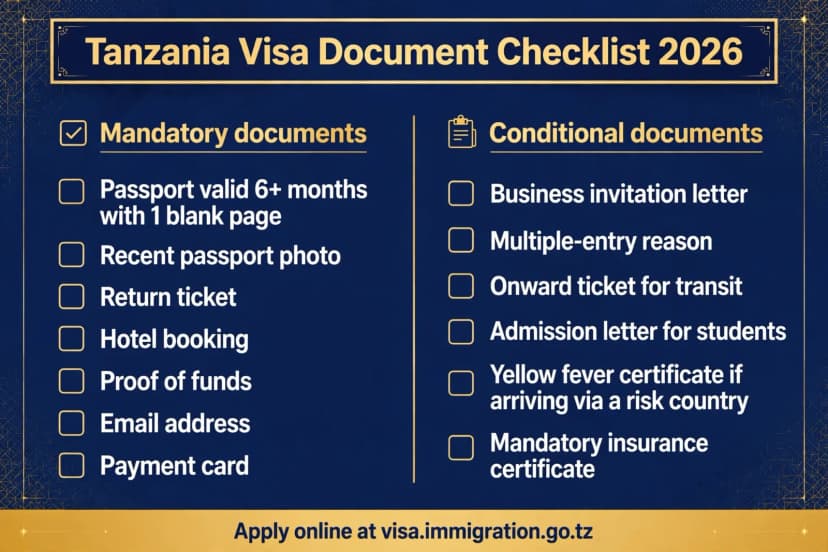
Complete Document Checklists
Tanzania does not ask for a large pile of documents, but every document it does ask for must be clear, current and consistent. A blurred passport scan, a hotel booking in a different name, or a return ticket that does not match your stated travel dates will slow your application more than a missing document that you can supply quickly. Prepare everything before you start the online form, because the portal will ask you to upload files as you go, and a half-finished application is easy to abandon and hard to resume accurately.
The mandatory documents apply to every applicant, whatever the visa type. The conditional documents apply only in certain situations, and the checklist below says which ones. Keep a folder on your computer with all of these files, named clearly, and keep the originals with you when you travel.
Mandatory documents for every applicant:
- A Pakistani passport valid for at least six months beyond your date of arrival in Tanzania, with at least one completely unused visa page. Check the expiry date now. If your passport expires in less than six months plus the length of your trip, renew it before you apply, because a visa cannot be issued on a passport that fails the validity rule. Scan the bio-data page clearly, in colour, with all four corners visible and no glare.
- A recent passport-size photograph, taken against a plain light background, with your face fully visible and no hat or dark glasses. Follow the portal's size and file-format instructions exactly. A cropped holiday photo or a selfie will be rejected.
- The completed online application form, filled in truthfully and completely. Every question must be answered. Do not leave a field blank because you think it does not apply to you. If a question genuinely does not apply, write "not applicable" if the form allows it, rather than leaving it empty.
- A return ticket, or a confirmed onward ticket to another country. The ticket must show your name as it appears in your passport, the date you leave Tanzania, and the destination. A one-way ticket is not enough for a tourist visa, and it invites the question of how and when you intend to leave.
- Proof of accommodation for your stay in Tanzania, such as hotel bookings, a safari lodge confirmation, or an invitation letter from a host. The booking must cover the dates of your stay and must show your name. If you are staying with family or friends, ask your host for a signed invitation letter giving their full name, address, telephone number and a copy of their identity document or residence permit.
- Proof that you can support yourself during your stay, such as recent bank statements or proof of employment and income. There is no published minimum amount, so the evidence must be credible for the length and style of your trip. A three-month safari and a two-week beach holiday need different levels of funds, and the officer will judge whether your money matches your plan.
- A valid email address that you check daily, because the grant notice and all notifications arrive by email.
- A payment card accepted by the portal, normally Visa or Mastercard, for the online visa fee. The fee is paid online and is non-refundable.
Conditional documents, needed only in certain situations:
- For a business visa: an invitation letter from the Tanzanian company or organisation you are visiting, on their letterhead, giving the purpose of the visit, the dates, who will meet you, and who is paying for the trip. Also carry evidence of your own business or employment, such as a letter from your employer in Vietnam or your business registration if you are self-employed.
- For a multiple-entry visa: evidence of why you need more than one entry, such as a business invitation covering repeated visits, a travel itinerary showing more than one entry into Tanzania, or proof of family or property in Tanzania. A local contact in Tanzania is normally expected to support this application.
- For a transit visa: an onward ticket out of Tanzania, an entry visa for your destination country if that country requires one, and proof of sufficient funds for the transit period.
- For a student visa: an admission letter from the Tanzanian institution, proof of fee payment or sponsorship, and evidence of accommodation arranged through or confirmed by the institution.
- For children travelling with you: a separate application for each child, the child's own passport, the child's birth certificate showing the parents' names, and a consent letter from any parent who is not travelling with the child. Carry the originals as well as the copies.
- For travellers arriving from or transiting through a yellow fever risk country: an International Certificate of Vaccination or Prophylaxis, the yellow booklet, showing yellow fever vaccination given at least ten days before arrival. See the health section for the full rule.
- For every traveller: the mandatory government inbound travel insurance certificate, bought from NIC or ZIC depending on your first point of entry, and the completed Traveller's Health Surveillance Form. Both are explained in the health section.
- For a Pakistani living in Vietnam: your Vietnamese temporary residence card or valid Vietnamese visa, so that you can show you have a lawful residence to return to, and so that the airline and the immigration officer can see your return is realistic. Keep your Vietnamese residence valid beyond your return date. If your residence card expires while you are in Tanzania, you may have difficulty re-entering Vietnam, so renew it before you travel if it is close to expiry.
Before you upload anything, check each file against this list. Open every scan and read it as if you were the officer. Is the passport number readable? Is the photograph sharp? Does the hotel booking show your name and the right dates? Does the return ticket match the dates in your application? If any answer is no, fix the file before you upload it. A clean application is decided faster than a messy one, and in a referral case, speed matters.

How to Apply: Step-by-Step
Apply on the official portal only. The address is visa.immigration.go.tz. Type it yourself into your browser. Do not use a link from an advertisement, a social media post or an agent's website. The portal is the Tanzania Immigration Services Department's eVisa system, and it covers both mainland Tanzania and Zanzibar. It works best in Mozilla Firefox or Google Chrome.
Step 1: Prepare your documents first. Gather everything in the checklist above, scan or photograph each item clearly, and save the files where you can find them. Check that your passport is valid for at least six months beyond arrival, that your return ticket matches your travel dates, and that your accommodation booking shows your name. Decide which visa type you need before you start, because choosing the wrong type wastes the fee.
Step 2: Create a new application. On the portal home page, choose New Application. Enter your personal details exactly as they appear in your passport: full name, date of birth, place of birth, nationality, passport number, date of issue and date of expiry. A single wrong letter in your name or a wrong digit in your passport number will cause problems at the airport, because the grant notice must match the passport. Check every field twice before you move on.
Step 3: Enter your travel details. Give your intended date of arrival, your point of entry, the purpose of your visit, and how long you intend to stay. Choose the airport or border post where you will actually arrive: Julius Nyerere International Airport in Dar es Salaam, Kilimanjaro International Airport, Abeid Amani Karume International Airport in Zanzibar, or a named land border. Give the address of your first night's accommodation. Make sure the dates and the length of stay match your return ticket and your hotel booking.
Step 4: Upload your documents. Upload the passport bio-data page, the passport photograph, the return ticket and the proof of accommodation, plus any conditional documents for your visa type. Check that each upload is the right file and that it is readable. If the portal rejects a file, check the file size and format against the portal's instructions, and try a clear scan instead of a photograph taken at an angle.
Step 5: Review the whole application. Read every page again before you submit. Check your name, your passport number, your dates and your email address. Check that the visa type is the one you intended. Check that the uploaded documents are the right ones. A mistake found now costs nothing. A mistake found after submission costs a new application and a new fee.
Step 6: Pay the fee online. The portal will display the fee for your nationality and visa type. Read the amount carefully. Remember the conflict explained in the fees section: the general guidelines say USD 50 for an ordinary visa, but embassy fee schedules list USD 200 for Pakistani nationals, so the amount on your screen is the amount that matters. Pay by card on the portal only. The fee is non-refundable. Keep the payment receipt and take a screenshot of the payment confirmation.
Step 7: Submit and save your application ID. After payment, submit the application and write down the application ID. You will need it to track the application and to continue it if the portal asks for more information. Save the confirmation email in a safe place.
Step 8: Track your application and wait. Check the status on the portal using your application ID, and watch your email, including the spam folder, for notifications. Do not book non-refundable travel until the decision arrives. If the portal asks for more information, reply quickly and completely. If it asks for an interview, contact the Immigration Department and the embassy in Beijing immediately, as explained in the processing time section.
Step 9: Receive the grant notice. When the visa is approved, you will be notified by email, and the grant notice will arrive as a PDF. Download it, print at least two copies, and save a copy on your phone. Check that your name, passport number and dates are correct. If anything is wrong, contact the Immigration Department before you travel.
Step 10: Travel with the grant notice. Carry the printed grant notice with your passport, your return ticket, your accommodation confirmation, your insurance certificate and, if it applies to your route, your yellow fever certificate. Show the grant notice at check-in and at immigration on arrival. The immigration officer will stamp your passport and record how long you may stay.
Applying from Vietnam: The Route from Ho Chi Minh City
There is no Tanzanian embassy or consulate in Vietnam, and you do not need one, because the eVisa is entirely online. You apply from your home in Ho Chi Minh City, you pay online, and the grant notice arrives by email. No visit to a mission is needed unless the portal specifically asks you to attend an interview, which is uncommon but possible for referral cases.
Tanzania is accredited to Vietnam from its embassy in Beijing, China. That is the mission responsible for Vietnam, and it is the mission to contact if you need consular help or if the portal asks for an interview. The Vietnamese government has publicly invited Tanzania to open an embassy in Hanoi, and Tanzania lists a future Hanoi embassy among its planned missions, but as of November 2026 no Tanzanian embassy had opened in Hanoi, and there is no Tanzanian consulate in Ho Chi Minh City or Da Nang. Do not travel to Hanoi expecting to find a Tanzanian mission there. If you need to contact the accredited mission, write to the embassy in Beijing, and keep copies of everything you send.
Your Pakistani passport is the document that matters. Your Vietnamese temporary residence card is supporting evidence, and you should keep it valid for your return. Before you leave Vietnam, check the expiry date of your temporary residence card and your Vietnamese visa. If either expires while you are in Tanzania, you may not be able to re-enter Vietnam, so renew your Vietnamese residence documents before you travel if they are close to expiry. Also keep your Pakistani passport valid for at least six months beyond your arrival in Tanzania, with at least one unused visa page.
There are no direct flights from Ho Chi Minh City to Tanzania. The usual routes go through one stop: Dubai with Emirates, Doha with Qatar Airways, Addis Ababa with Ethiopian Airlines, Istanbul with Turkish Airlines, or Bangkok and then Nairobi with Kenya Airways. The shortest journeys take around 18 hours including the stop, and most take longer. The airline you choose affects your yellow fever position. A connection through Nairobi or Addis Ababa is the point to watch, because Kenya and Ethiopia are yellow fever risk countries. A short transit of under 12 hours does not normally trigger the certificate requirement, but a long layover of 12 hours or more can.
Book your flights only after the visa is granted, or book flexible tickets that can be changed. Because referral processing takes at least two months, buy your ticket after the grant notice arrives if you possibly can. If you must book early, check the change and refund terms in writing before you pay, and make sure the return date on the ticket matches the length of stay in your visa application. Keep the ticket confirmation with your name on it, because you will upload it with your application and show it again at the airport.
Money needs a little planning too. The visa fee is paid online by card, the insurance is paid online, and you will want US dollars in cash for arrival expenses. Tanzanian shillings are the local currency, and you can withdraw them from ATMs in Dar es Salaam, Arusha and Zanzibar, but carry some US dollars in clean, undamaged notes for the first day. Tell your bank you are travelling so that your card is not blocked, and check that your card works for online payments in US dollars before you start the visa application.
Zanzibar: One Visa, Separate Insurance
Zanzibar is part of the United Republic of Tanzania, and your Tanzanian visa covers it. You do not need a separate visa for Zanzibar, and you do not need a second visa stamp when you travel between the mainland and the islands. When you apply on the eVisa portal, you select your first point of entry into Tanzania, and the same visa covers your travel between the mainland and Zanzibar. This is confirmed by the Immigration Department and by the Zanzibar authorities.
What is separate is the insurance. Zanzibar has required mandatory inbound travel insurance since 1 October 2024, and mainland Tanzania introduced its own mandatory inbound travel insurance on 1 October 2026, so both parts of the country now require it. The price is USD 44 per adult, with children aged 3 to 17 paying USD 22, and the cover runs for up to 92 days. You buy one policy only, and which insurer you buy from depends on where you first enter Tanzania. If Zanzibar is your first point of entry, buy from the Zanzibar Insurance Corporation, known as ZIC, through the official portal at inbound.visitzanzibar.go.tz. If the mainland is your first point of entry, buy from the National Insurance Corporation, known as NIC, through inbound.nicinsurance.co.tz. One valid policy covers the whole journey, so a safari on the mainland followed by a ferry to Stone Town does not trigger a second purchase. Keep the insurance certificate, with its QR code, in printed and electronic form throughout the trip, and show it when you travel between Zanzibar and the mainland.
Zanzibar's main airport is Abeid Amani Karume International Airport, and the main ferry port is in Stone Town. If you fly directly into Zanzibar from abroad, your first point of entry is Zanzibar, so you need the ZIC policy and your visa will be checked there. If you fly into Dar es Salaam or Kilimanjaro first and then travel on to Zanzibar by domestic flight or ferry, your first point of entry is the mainland, so you need the NIC policy. Buy the insurance before you travel, because the airport kiosks are slow and the queues are long, and your own comprehensive travel insurance does not count as a substitute.
Health Rules: Yellow Fever, the Health Form and Mandatory Insurance
Tanzania's health rules are simple, but they are enforced at the airport, and a missing certificate or a missing insurance policy can delay or stop your entry. There are three separate requirements, and they are often confused with each other. Keep them apart.
Yellow fever is the only vaccination that Tanzania makes a condition of entry, and it applies only to some travellers. Tanzania itself is not a yellow fever risk country, and the vaccine is generally not recommended for a trip to Tanzania on its own. The rule is about where you have come from. You need a yellow fever certificate if you are aged one year or over and you arrive from a country with yellow fever risk, or if you have transited for more than 12 hours through an airport in such a country. Kenya, Uganda, Ethiopia and Rwanda are the risk countries most likely to appear on a route from Vietnam. Flying direct from Vietnam, or connecting through Dubai, Doha or Istanbul, does not trigger the rule. The certificate becomes valid ten days after the vaccination, and since 2016 it is valid for life. If you arrive from a risk country without a certificate, officials can refuse entry, vaccinate you on arrival, or keep you under observation.
The Traveller's Health Surveillance Form is a separate requirement. Every traveller must complete the free form at afyamsafiri.moh.go.tz, before departure or on arrival, and keep the QR code or reference number to show Port Health. It is free, it takes a few minutes, and it is not a substitute for the yellow fever certificate or the insurance.
The mandatory inbound travel insurance is the third requirement, and it is the one most visitors miss. Since 1 October 2026, every foreign visitor entering mainland Tanzania must hold the government's inbound travel insurance from NIC, at USD 44 per adult for cover of up to 92 days. Since 1 October 2024, every foreign visitor entering Zanzibar must hold the equivalent policy from ZIC, at the same price. Children aged 3 to 17 pay USD 22, and children under 3 are free. One policy covers the whole trip, and you buy from the insurer for your first point of entry, as explained in the Zanzibar section. Your own travel insurance, however comprehensive, does not satisfy this requirement.
Malaria is present in Tanzania, including Zanzibar, and it is a real health risk below 1,800 metres. No certificate is required, but doctors recommend antimalarial tablets, insect repellent and mosquito nets, and you should visit a travel clinic in Ho Chi Minh City six to eight weeks before departure for personal advice.
Arriving in Tanzania: At the Airport and the Border
Land with your documents in your hand luggage, not in your checked bag. You will need your passport, your printed eVisa grant notice, your return ticket, your accommodation confirmation, your insurance certificate, your health form QR code, and your yellow fever certificate if your route requires one. Keep them together in a folder.
At the airport, you will normally pass a health desk first, where your yellow fever certificate may be checked if you arrived from a risk country, and where your health form reference may be asked for. Then comes immigration. Join the queue for pre-approved visas or eVisa holders, and present your passport and your printed grant notice. The officer will check your documents, may ask about the purpose of your visit, where you are staying, and how long you intend to stay, and will take your fingerprints and photograph. Answer briefly and truthfully, and make sure your answers match your application. The officer will stamp your passport and write the date by which you must leave. Check the stamp before you walk away.
The main airports are Julius Nyerere International Airport in Dar es Salaam, Kilimanjaro International Airport near Arusha, and Abeid Amani Karume International Airport in Zanzibar. Visa on arrival counters exist at these airports for eligible nationalities, but they are not for you. As a Pakistani passport holder without prior special permission, do not join the visa on arrival queue. Go to the eVisa or pre-approved visa queue with your grant notice.
Extending Your Stay and What Happens If You Overstay
A tourist visa can be extended inside Tanzania, but the extension is not automatic and it is not handled online. You must attend an immigration office in person before your current stay expires, normally in Dar es Salaam, Arusha or Zanzibar, and apply with your passport, your visa grant notice, passport photographs, a completed extension form and a letter explaining why you need more time. Bring proof of accommodation for the extended stay and evidence that you can support yourself. Processing normally takes several working days, so apply at least a week before your stay expires.
This guide does not state an extension fee, because the figures in circulation conflict. One secondary source reports USD 50 for an extension of up to ninety days, another reports different amounts depending on the office and the length requested, and the Immigration Department does not publish a fixed extension fee in the sources checked for this guide. Ask the fee at the immigration office before you apply, and get a receipt for anything you pay. Do not pay an unofficial fee to anyone outside the immigration office.
Overstaying is a serious matter. If you remain in Tanzania beyond the date stamped in your passport, you are in the country unlawfully, even if the overstay is only one day. The consequences can include a fine payable before departure, questioning and delay at the airport, deportation at your own expense, and difficulty obtaining visas for Tanzania or other East African countries in the future. Secondary sources disagree about the exact fine, with figures ranging from USD 50 per day to TZS 100,000 per day reported in different places, and the Immigration Department does not publish a fixed overstay fine in the sources checked. This guide therefore states no figure, and you should not rely on any figure quoted by a travel blog. The safe rule is simple: never overstay.
Common Reasons for Delay or Refusal and How to Avoid Them
Most delays are caused by the application, not by the applicant's nationality. A referral application is already slow, so a mistake that forces the officer to ask a question can add weeks. The most common problems are easy to avoid.
The first is a poor passport scan. The bio-data page must be sharp, in colour, with all four corners visible, no glare and no fingers covering any text. A photograph of a passport taken at an angle will be rejected or will generate a query. Use a flatbed scanner or a scanning application, and check the result by zooming in and reading the passport number yourself.
The second is inconsistent dates. The length of stay in your application, the dates on your return ticket and the dates on your hotel booking must all agree. If they do not, the officer cannot tell how long you really intend to stay, and the application will be queried. Fix the bookings before you apply, not after.
The third is paying on the wrong website. Fake eVisa websites are common, and they charge several times the official fee. They also collect your passport details. Only visa.immigration.go.tz is official. If you have already paid a fake website, contact your bank immediately, report the website, and start a fresh application on the real portal.
The fourth is applying too late. A referral application needs two months. An application submitted two weeks before the flight will almost certainly not be decided in time, and there is no express service to save it. Apply early, and do not book non-refundable travel before approval.
The fifth is an unclear purpose of visit. A tourist application should look like a tourist trip, with accommodation, a sensible itinerary and enough money for the trip. A business application needs a real invitation letter from a real company. An application that mixes the two, or that gives no itinerary at all, invites questions.
The sixth is a passport that fails the validity rule. Your passport must be valid for at least six months beyond arrival and must have at least one unused visa page. Check both now. Renew the passport first if it fails either test, because a visa cannot be issued on it.
The seventh is ignoring a query from the portal. If the portal asks for a clearer scan or an extra document, reply quickly and completely. A slow reply in a referral case can mean the difference between travelling and cancelling.
Official Websites
Section 16 lists the official sources used for this guide. Use these websites only. Any other website that claims to issue a Tanzanian visa is either an agent or a fake, and you should not enter your passport details or your card details there.
| Organisation | What it is for | Website |
|---|---|---|
| Tanzania Immigration Services, eVisa portal | Apply for the eVisa, track your application, check your status | https://visa.immigration.go.tz/ |
| Tanzania Immigration Services Department | Visa guidelines, visa types, fees and the referral list | https://www.immigration.go.tz/ |
| Embassy of Tanzania in Maputo | Official visa types and fee schedule, including the Pakistan-specific fee | https://www.mz.tzembassy.go.tz/services/type-of-visa |
| Embassy of Tanzania in Tel Aviv | Official visa types and fee schedule, including the Pakistan-specific fee | https://www.il.tzembassy.go.tz/index.php/services/type-of-visa |
| Embassy of Tanzania in Addis Ababa | Official visa types and fee schedule, including the Pakistan-specific fee | https://www.et.tzembassy.go.tz/services/type-of-visa |
| Embassy of Tanzania in Ankara | Official visa types and fee schedule, including the Pakistan-specific fee | https://www.tr.tzembassy.go.tz/services/type-of-visa |
| Embassy of Tanzania in Muscat | Official visa types and fee schedule, including the Pakistan-specific fee | https://www.om.tzembassy.go.tz/services/type-of-visa |
| Zanzibar Insurance Corporation | Mandatory Zanzibar inbound travel insurance, USD 44 per adult | https://inbound.visitzanzibar.go.tz/ |
| National Insurance Corporation | Mandatory mainland inbound travel insurance, USD 44 per adult | https://inbound.nicinsurance.co.tz/ |
| Tanzania Ministry of Health | Traveller's Health Surveillance Form, free, with QR code | https://afyamsafiri.moh.go.tz/ |
Frequently Asked Questions
Do Pakistani passport holders need a visa for Tanzania?
Yes. Pakistani passport holders need a visa to enter Tanzania, there is no visa-free entry, and Pakistan is on the referral list, so you must apply online through the eVisa portal and receive approval before you travel.
How much is the Tanzania visa fee for Pakistanis?
The Immigration Department's general guidelines list USD 50 for an ordinary visa, but official Tanzanian embassy websites list a Pakistan-specific fee of USD 200. The amount the portal shows you at the payment step is the amount you will actually be charged, so check it before you pay and budget USD 200.
Can Pakistanis get a visa on arrival in Tanzania?
No. Pakistanis cannot obtain a visa on arrival unless they already hold special permission from the Commissioner General of Immigration. You must apply online and wait for approval before you fly, and you should not travel hoping to buy a visa at the airport.
How long does a Tanzania eVisa take for a Pakistani applicant?
Standard applications are processed within ten days, except referral cases. Pakistan is a referral nationality, so the official advice is to apply at least two months before travel, and secondary sources report that referral reviews commonly take four to six weeks.
How long can I stay in Tanzania on a tourist visa?
The ordinary single-entry visa allows a stay of up to 90 days. The immigration officer decides the exact period on arrival, and the date stamped in your passport is the date that matters, so check the stamp before you leave the desk.
Does the Tanzania visa cover Zanzibar?
Yes. One visa covers mainland Tanzania and Zanzibar. You select your first point of entry when you apply, and the same visa covers travel between the mainland and the islands, although the mandatory insurance is bought separately for your first point of entry.
Where do I apply for a Tanzania visa from Vietnam?
You apply online from home at visa.immigration.go.tz. There is no Tanzanian embassy in Vietnam, and no mission visit is needed unless the portal asks you to attend an interview, in which case the accredited mission is the embassy in Beijing.
What documents do I need for a Tanzania eVisa?
You need a passport valid for at least six months with one unused visa page, a recent passport photograph, a return ticket, proof of accommodation, proof of funds, a valid email address and a payment card, plus the mandatory insurance certificate and any documents for your visa type, such as a business invitation letter.
Do I need a yellow fever certificate for Tanzania?
Only if you arrive from, or transit for 12 hours or more through, a yellow fever risk country such as Kenya, Uganda, Ethiopia or Rwanda. Flying from Vietnam via Dubai, Doha or Istanbul does not trigger the rule, but a long stop in Nairobi or Addis Ababa can.
How much is the mandatory travel insurance for Tanzania?
The government inbound travel insurance costs USD 44 per adult, USD 22 for children aged 3 to 17, and is free for children under 3, with cover for up to 92 days. Buy from ZIC if Zanzibar is your first entry, or from NIC if the mainland is your first entry.
Can I extend my Tanzania tourist visa?
Yes, in person at an immigration office in Dar es Salaam, Arusha or Zanzibar, before your current stay expires, with your passport, grant notice, photographs and a letter explaining why you need more time. Extensions are not guaranteed, and the fee is not published, so confirm it at the office.
What happens if I overstay my Tanzania visa?
Overstaying, even by one day, can lead to a fine payable before departure, questioning at the airport, deportation at your own expense and difficulty obtaining future visas. The exact fine is not published in official sources, so do not rely on any figure from a travel blog.
Is the Tanzania eVisa fee refundable if my application is refused?
No. The visa fee is non-refundable, whether the application is refused or withdrawn, so apply carefully and completely the first time, because a second application means paying the fee again.
Can I work in Tanzania on a business visa?
No. A business visa allows short business visits, meetings and assignments for up to 90 days, but it does not permit employment and it is not extendable. Taking up a job requires a separate work permit, arranged through the employer before you travel.
Is there a Tanzanian embassy in Hanoi?
No. Tanzania is accredited to Vietnam from its embassy in Beijing, China, and a Hanoi embassy has been discussed and is listed among planned missions, but it was not open as of November 2026. The eVisa system means you do not need a mission visit for a normal tourist application.
This guide was checked on 29 November 2026 against the official Tanzanian sources listed in Section 16. Visa rules, fees and health requirements can change without notice, so confirm the fee shown on the eVisa portal and the current insurance and health rules before you pay or travel. The immigration officer makes the final decision on entry, and this guide does not guarantee visa approval or entry.


