

Tajikistan Visa Guide 2026: Types, Requirements, Documents and Application Steps
Tajikistan is one of the easiest Central Asian countries for a Pakistani passport holder to visit, and also one of the most rewarding. The Pamir Highway, the Fann Mountains, the blue lakes of Iskanderkul and the Seven Lakes, and the old Silk Road cities of Khujand and Panjakent sit within a single, compact country that is still far less crowded than its neighbours. For most Pakistani travellers the visa is also simple: an online eVisa, applied for from home, paid by card, and sent back by email as a PDF. There is no need to post a passport anywhere, and no need to visit an embassy for a short tourist trip.
This guide is written for Pakistani passport holders who live in Vietnam. That matters, because there is no Tajikistan embassy or consulate in Vietnam, and the practical route from Ho Chi Minh City or Hanoi is different from the route a traveller in Pakistan would take. The good news is that living in Vietnam changes almost nothing about the visa itself. The eVisa is applied for online from anywhere in the world, so you apply from Vietnam in exactly the same way as you would apply from Pakistan. What changes is the backup plan: if you need a sticker visa, a work visa, a student visa, or a long-stay visa, there is no mission in Vietnam to walk into, and you will need to deal with a Tajik mission in another country, most often Beijing or Islamabad, or apply through the separate online system for standard visas.
Read this guide in order if this is your first trip. The short version is in the first section. The detail, the checklists, the step-by-step application, and the honest warnings about the points where official sources disagree are all below. Every fee, stay length, and processing note in this guide was checked against the official sources listed in Section 16 on 29 November 2026. Where two official sources say different things, this guide says so plainly and names the source that should control your decision. Do not rely on an agent, a travel website, or a social media post that quotes a fee without naming its source. Tajikistan changed its consular fees in September 2025, and many older guides still quote the old fee. That single change is the reason so many websites disagree with each other today.
At a Glance: Tajikistan Visa for Pakistanis in Vietnam
Pakistani ordinary passport holders need a visa to enter Tajikistan. There is no visa-free entry for ordinary Pakistani passports. The normal route is the eVisa, applied for online at the official portal evisa.tj, run by the Ministry of Foreign Affairs of Tajikistan. Pakistan is on the official eVisa eligibility list, and the official tourism portal of Tajikistan lists the Islamic Republic of Pakistan among the countries whose citizens can apply for an eVisa.
The eVisa costs USD 30 for a single entry and USD 50 for a multiple entry, under the consular fee table in Annex 6 to Government Resolution No. 476 of 8 September 2025, published by the Consular Department of the Ministry of Foreign Affairs on consular.tj. The GBAO permit for the Pamir region costs a further USD 20 when added to an eVisa. The eVisa is valid for 90 days, and within that period you may stay for up to 60 days. The eVisa cannot be extended inside Tajikistan. The fee is paid by card on the portal, and the approved eVisa is sent to your email as a PDF. Print it and carry it with your passport.
There is no officially published processing time for the eVisa. The Tajik portal does not state a standard number of days. The United Kingdom Foreign, Commonwealth and Development Office advises travellers to allow at least two weeks. This guide therefore tells you to apply at least two to three weeks before travel, and not to book non-refundable flights or hotels until the eVisa is in your inbox. Some applications are decided in a few working days. Others take longer, and at least one applicant in 2026 waited five weeks after being asked for extra documents. Plan for the slow case.
Your passport must be valid for at least six months beyond your intended stay, and it should have at least one blank page. Uploads to the portal must be JPEG files, each under 1 MB. The fee is non-refundable, even if the application is refused. Use only evisa.tj. Copycat websites imitate the official portal, charge several times the real fee, and in some cases deliver nothing at all.
If you enter Tajikistan on an eVisa, you do not need to register with OVIR. If you enter on any other visa and stay longer than 10 working days, you must register at OVIR in Dushanbe within 10 working days of arrival. Hotels are no longer permitted to register guests on their behalf, according to United Kingdom government travel advice, so do not assume your hotel will do it for you. Keep any registration slip with your passport until you leave.
The single most important warning in this guide is about the old fee. For years the single-entry eVisa cost USD 50 and allowed a stay of up to 45 days, and the old Ministry of Foreign Affairs page still hosted online says exactly that. The current fee table, dated September 2025, says USD 30 for a single entry and a stay of up to 60 days. The current table controls. Older guides, older agency pages, and the old ministry page are out of date on this point. Always read the total on the portal payment screen before you pay, and if the portal charges a different figure from the one in this guide, trust the portal, keep the receipt, and check the current fee table on consular.tj.
Who Needs a Visa — and Who Does Not
Every holder of an ordinary Pakistani passport needs a visa to enter Tajikistan. That rule applies whether you live in Pakistan, in Vietnam, or anywhere else. Your place of residence does not change the visa requirement. Your passport does. A Pakistani passport is not on the visa-free list, and no residence permit, work permit, or temporary residence card issued by Vietnam changes that. A Vietnamese temporary residence card proves you live in Vietnam. It does not give you visa-free entry to Tajikistan, and it does not replace a Tajik visa.
Fifty-two nationalities can enter Tajikistan without a visa for up to 30 days under Government Resolution No. 464 of 26 October 2021, in force since 1 January 2022. That list includes the United States, Canada, most of Europe, Japan, Saudi Arabia, the United Arab Emirates, Qatar, Malaysia, and Indonesia. Pakistan is not on it. Do not confuse a list that includes Malaysia or Indonesia with a list that includes Pakistan. The two are different, and the difference matters at the border.
Diplomatic passport holders are the exception. Under a 2004 agreement between Pakistan and Tajikistan, holders of diplomatic passports travel visa-free for up to 90 days. That exception does not apply to ordinary passports, official passports used for ordinary travel, or service passports unless the mission confirms otherwise in writing. If you hold a diplomatic passport, confirm the current position with the Tajik Embassy in Islamabad or the Ministry of Foreign Affairs before travel, because agreements and their practical application can change.

Types of Tajikistan Visas for Pakistani Passport Holders
Tajikistan issues several types of visa. For a Pakistani passport holder, the type that matters most is the tourist eVisa, because it covers the great majority of short visits. The other types exist for business, study, work, family, and transit, and each of them is applied for differently. Choosing the wrong type is one of the commonest reasons for delay, so read this section before you start an application.
The tourist eVisa is the standard route. It is applied for online at evisa.tj, issued by the Ministry of Foreign Affairs, and sent to you by email as a PDF. It is for tourism, and the Consular Department also describes the eVisa system as covering tourist and business visits. It is valid for 90 days and allows a stay of up to 60 days. The fee is USD 30 for a single entry and USD 50 for a multiple entry, with a further USD 20 for the GBAO permit if you add it. The eVisa cannot be extended. If you need more than 60 days, or you need to work, you need a different visa arranged in advance.
The business eVisa is the same online system used for a business purpose. Some guides describe a business eVisa with a higher fee, around USD 70, but the current official fee table prices the eVisa at USD 30 for a single entry and USD 50 for a multiple entry, without a separate business price. If your trip is genuinely for business meetings, a conference, or a short commercial visit, the eVisa route is the one the Ministry describes. If the business involves employment in Tajikistan, signing a local employment contract, or a long stay, the eVisa is not the right document, and you need a standard business or work visa from a mission, with an invitation from the Tajik host company.
The standard sticker visa, also called an ordinary visa, is issued by a Tajik embassy or consulate and placed in your passport. It covers tourist, business, private or family, student, and work purposes, and it can be issued for longer stays and for multiple entries where the eVisa cannot. The fee depends on the length of stay and the number of entries, under the general consular fee table. For a stay of up to 7 days the fee is USD 30, for up to 14 days USD 40, for up to 1 month USD 50, for up to 45 days USD 60, and for up to 2 months USD 65, with further lines for longer periods. A multiple-entry visa adds USD 40 to the fee. These are the standard visa fees, not the eVisa fees, and they are charged by the mission. A standard visa is started online through the separate portal visa.gov.tj, which the Ministry states is not the same system as evisa.tj. Do not use visa.gov.tj for an eVisa, and do not use evisa.tj for a standard visa.
The student visa is a standard visa for study at a Tajik university or college. It needs an invitation or admission letter from the Tajik institution, and the institution normally arranges the invitation through the Ministry of Foreign Affairs. You cannot get a student visa on an eVisa alone. Apply well in advance, because the invitation step takes time, and the mission will ask for proof of admission, proof of funds, and medical documents. If you are a Pakistani student living in Vietnam and you have been admitted to a Tajik university, contact the university international office first, and ask it to confirm the invitation process and the mission you should apply to.
The work visa is a standard visa for employment in Tajikistan. It needs a work permit or an invitation from the Tajik employer, arranged through the migration authorities. You cannot work on a tourist eVisa. Working on a tourist visa risks a fine, deportation, and a ban on re-entry. If a Tajik employer offers you a job, ask the employer to confirm in writing that it will arrange the work permit and the visa invitation, and do not resign from a job in Vietnam or book a one-way flight until the work visa is in your passport.
The GBAO permit is not a visa by itself. It is an additional permit that every foreign visitor needs to enter the Gorno-Badakhshan Autonomous Oblast, the Pamir region. It costs USD 20 when added to an eVisa, or USD 20 when issued with a standard visa. It is explained in full in the GBAO section below. Do not travel to the Pamirs without it.
The eVisa in Detail: Validity, Stay and Entries
The eVisa is valid for 90 days. Within that 90-day period you may stay in Tajikistan for up to 60 days. Those two numbers are different, and confusing them is a common mistake. Validity is the window in which you may enter and must leave. Stay is the number of days you may spend inside the country. You must leave before the 90-day validity ends, even if you have not used all 60 days of stay. You must also leave before you have spent 60 days inside the country, even if the 90-day validity has not yet ended. Whichever limit comes first is the one that applies to you.
There is a conflict in the sources on how the 90 days are counted, and this guide discloses it. The Consular Department states that the eVisa is valid for 90 days, and several guides read that as 90 days from the date of issue. Other sources, including the iVisa guide to the Tajik eVisa, state that the 90-day window starts from the expected entry date you give in the application. The United Kingdom Foreign, Commonwealth and Development Office states that the eVisa is valid for 60 days after approval, which is a third reading, and it warns travellers to check the validity dates carefully, noting that British nationals have been turned away with incorrect visas. The controlling source for your own visa is the visa itself. Read the dates printed on your approved eVisa PDF, and plan your entry and exit inside those printed dates. Do not rely on a general rule from any guide, including this one, when the dates on your visa say something different. If the printed dates do not cover your planned trip, do not travel on that visa. Apply for a new one with corrected dates.
The stay limit is 60 days. Older sources say 45 days, and the old Ministry of Foreign Affairs page still says the holder can stay for no more than 45 calendar days. That was the old rule. The current fee table and the current Consular Department position give a stay of up to 60 days for the eVisa. The 60-day figure controls for a new application. If you hold an older visa, or if a source you are reading still says 45 days, check the dates and the stay limit printed on your own visa.
The eVisa cannot be extended inside Tajikistan. That rule is stated consistently across official and government sources. If you want to stay longer than 60 days, you must leave Tajikistan and apply for a new visa, or enter on a different visa type that allows a longer stay. Do not overstay and hope to pay a fine at the airport. Overstaying is treated seriously. The consular fee table sets a scale for an expired visa: up to 5 days USD 50, 6 to 15 days USD 100, 16 to 30 days USD 200, and USD 100 for each further month. Separate reports state that travellers who overstay can be fined, held, and required to obtain an exit visa from the Consular Office of the Ministry of Foreign Affairs in Dushanbe before they are allowed to leave, and that the exit visa is not available at the airport. The fine scale in the fee table is the official figure. The reports of detention and exit visas are the practical consequence. Leave on time.
Entries are the second point where sources conflict, and this guide discloses that conflict too. The current consular fee table prices both a single-entry eVisa at USD 30 and a multiple-entry eVisa at USD 50. That suggests a multiple-entry eVisa exists and can be bought. However, the governing regulation and the Tajik Embassy both state that an electronic visa is issued only as a single-entry visa. One recent guide that checked the Consular Department in October 2026 reports exactly that tension: the fee schedule prices a multiple-entry eVisa, but the regulation says the eVisa is single entry only. The practical advice is simple. Apply as if the eVisa is single entry. Do not plan a trip that needs you to leave Tajikistan and re-enter on the same eVisa, for example a side trip to Uzbekistan or Kyrgyzstan in the middle of your Tajikistan visit, unless the portal itself offers you a multiple-entry option and issues a visa that is printed as multiple entry. If the portal offers only a single entry, take it, and plan any neighbouring-country trip for before you enter Tajikistan or after you leave it. If you need multiple entries, apply for a standard multiple-entry visa from a mission instead.
Fees in 2026: What You Actually Pay
The official eVisa fees are USD 30 for a single entry and USD 50 for a multiple entry, plus USD 20 for the GBAO permit if you add it. That means a single-entry eVisa with a GBAO permit costs USD 50 in total, and a multiple-entry eVisa with a GBAO permit costs USD 70 in total, if the multiple-entry option is offered to you. The fees are charged in US dollars. Tajikistan notes that you do not need a dollar account. The equivalent is taken from your card in your own currency. Visa, Mastercard, American Express, and UnionPay are accepted on the portal, according to recent guides that checked the Consular Department. There is no separate service charge on the official portal. The consular fee is the whole cost. If a website asks for a service fee on top of the consular fee, you are not on the official portal.
The fee changed in September 2025, and that change explains most of the disagreement you will see online. Before the change, the single-entry eVisa cost USD 50. After the change, under Government Resolution No. 476 of 8 September 2025, it costs USD 30. Many guides, agency pages, and travel forums still quote USD 50 for a single entry, because they were written before the change and were never updated. Some of those pages were last updated in 2023 or 2024. Some quote USD 50 to USD 70 as a range, which mixes the old single-entry fee, the new multiple-entry fee, and the GBAO add-on into one confused figure. A traveller who applied in July 2026 was charged USD 30 for a single entry and USD 50 for a multiple entry at the payment step, which confirms the new table in practice. The old Ministry page that still says USD 50 and 45 days is the clearest example of the problem. It is an official page, but it is out of date. The current fee table on consular.tj, dated September 2025, controls. When you see USD 50 quoted as the single-entry fee, check the date of the page. If it is older than September 2025, or if it does not name its source, do not rely on it.
Visa on Arrival at Dushanbe Airport: The Truth
The short answer is: do not plan to get a visa on arrival. Apply for the eVisa before you travel. The longer answer is that the sources conflict, and the conflict is worth understanding, because it is the reason some travellers say a visa on arrival is easy and others say it does not exist for Pakistanis.
Tajikistan does have a visa on arrival facility, but it is narrow. It is available only at the Consular Bureau of Dushanbe International Airport, and only after a pre-application through the separate portal visa.gov.tj. Flying in and hoping for a visa at the desk is not a plan. The Consular Department states that a visa on arrival must be pre-approved, and the United Kingdom Foreign, Commonwealth and Development Office says the same: a visa on arrival must be pre-approved, and you should allow at least two weeks. If you arrive without a pre-approval, you may be refused entry, fined, or deported. The airline may also refuse to let you board, because it is the airline that is fined if it carries a passenger who is refused entry.
Whether Pakistan is on the visa on arrival list is itself disputed. One official-style list, reproduced by travel guides, shows the eVisa eligible countries, with the countries that also have a visa on arrival option shown in bold. Pakistan appears in that list, but not in bold. That reading says Pakistan can get an eVisa, but cannot get a visa on arrival. Another source, a guide to Tajikistan visas for Pakistanis, states that Pakistan appears on the eligible list for a visa on arrival at Dushanbe airport without restriction. A third source, a visa requirements summary checked in November 2026, states that a visa on arrival for Tajikistan must be requested in advance on visa.gov.tj, then issued at Dushanbe International Airport, and that some visa types need an invitation confirmed in advance. A fourth source, a Pakistan travel guide, states plainly that there is no general visa on arrival facility for Pakistani nationals at present, and that you must arrange the visa before travel.
This guide cannot resolve that conflict in your favour, and it does not try to. The safe reading, and the one this guide recommends, is the narrow one: treat a visa on arrival as not available to you unless you hold a written pre-approval obtained through visa.gov.tj before you fly. The eVisa is cheaper, simpler, and certain in a way the visa on arrival is not. It costs USD 30, it is applied for from Vietnam, and it arrives by email. There is no reason to gamble a flight to Dushanbe on a visa on arrival when the eVisa exists.
Complete Document Checklists
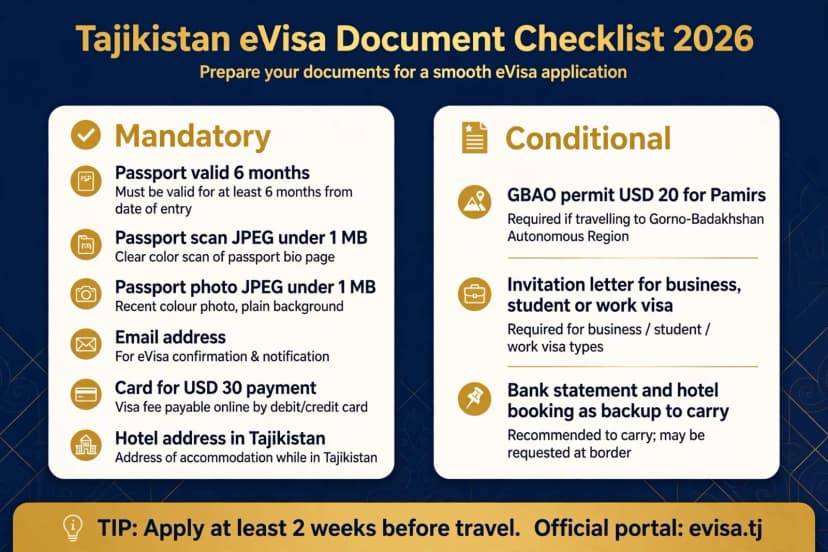
Prepare your documents before you open the portal. The eVisa application is short, but a blurry scan, a wrong file size, or a missing detail will delay it, and the portal may not tell you clearly what is wrong. Work through the checklist below, and tick each item off before you start.
For the tourist eVisa, the mandatory documents are few. You need a Pakistani passport valid for at least six months beyond your intended stay, with at least one blank page. You need a clear colour scan of the passport bio page, the page with your photo and personal details, saved as a JPEG file under 1 MB. You need a recent digital passport-style photograph of yourself, saved as a JPEG file under 1 MB, with a plain light background, your face looking at the camera, no hat, no sunglasses, and no shadow across your face. You need an email address that you can access, because the eVisa is sent to that address. You need a card that can pay online in US dollars, with international transactions enabled. You need your travel dates, including your expected entry date and your planned exit date, and the address of your first hotel or place of stay in Tajikistan. You need to know whether you will enter the GBAO region, because that decides whether you tick the GBAO permit box and pay the extra USD 20.
That is the full mandatory list for the eVisa as the portal presents it. The portal does not ask every applicant for a bank statement, a flight ticket, or a hotel booking as a mandatory upload. That does not mean you should travel without them. Carry a printed hotel confirmation for your first nights, a printed return or onward ticket, and proof that you can support yourself during the trip, because the immigration officer at Dushanbe airport may ask for them, and the officer makes the final decision on entry. A bank statement is not a portal requirement for the eVisa, but some agency guides for Pakistani applicants recommend a six-month bank statement with a closing balance of PKR 1,000,000 to PKR 2,000,000 and an account maintenance certificate. That recommendation comes from agencies, not from the official eVisa portal, and it is best read as advice for a sticker visa application, or as a sensible backup to carry, not as a rule for the eVisa. If you apply for a sticker visa, the mission may ask for a bank statement, and you should provide it. If you apply for the eVisa, prepare the statement as a backup, but do not delay your application waiting for a bank letter the portal does not ask for.
For a standard sticker visa, the checklist is longer. You need the passport, the photo, and the application form started on visa.gov.tj. You need an invitation letter where your visa type requires one: a business invitation from a Tajik company for a business visa, an admission letter from a Tajik university for a student visa, a work permit or employer invitation for a work visa, and a private invitation confirmed through the authorities for a family visa. You need proof of accommodation, a flight itinerary, proof of funds, and travel insurance. The mission may ask for a medical certificate if your stay will be longer than 90 days, including proof that you are HIV-free, or you may be asked to take a test. The mission may ask for a police clearance or other supporting documents. Confirm the exact list with the mission in writing before you submit, because missions can ask for more than the general list, and the list can differ from one mission to another.
How to Apply: Step-by-Step
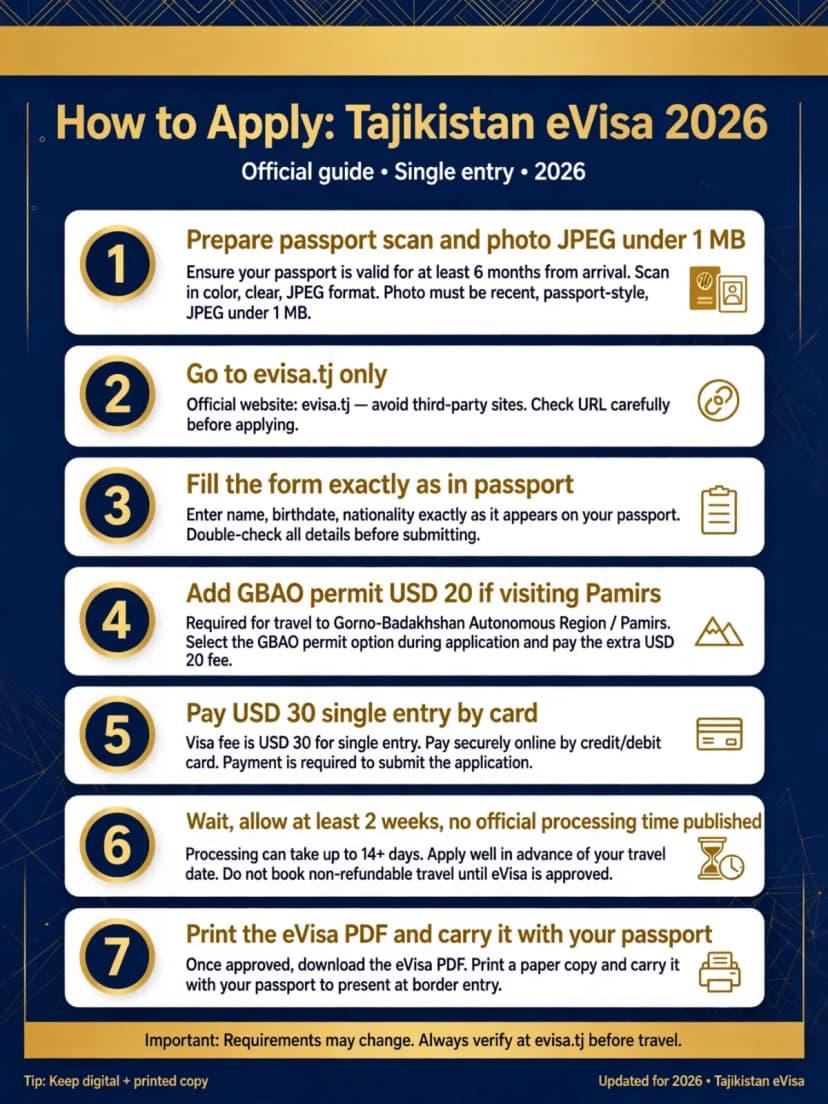
Apply for the eVisa at least two to three weeks before travel. Do not leave it to the last few days. The steps below are the full process, in order, as the official portal presents it. The portal describes the process in three words: apply, pay, get. The detail below is what those three words mean in practice.
Step 1: Prepare your documents. Scan your passport bio page as a clear colour JPEG under 1 MB. Take or prepare a recent passport-style photo as a JPEG under 1 MB. Check your passport validity. It must be valid for at least six months beyond your intended stay. Check that you have a blank page. Write down your expected entry date, your planned exit date, and the address of your first hotel in Tajikistan. Decide whether you need the GBAO permit. If you plan to travel to the Pamir region at any point, tick it. It is cheaper to add it now than to arrange it later. Make sure your email address is correct, because the visa will be sent there. Make sure your card can pay online in US dollars.
Step 2: Open the official portal. Go to evisa.tj. Check the address in your browser. It must read evisa.tj, not a similar name. Copycat sites use names that look almost the same. If the site asks for a service fee on top of the consular fee, or if the fee shown is far higher than USD 30, close the page and type evisa.tj again. Do not click on a sponsored link or an agent link to reach the portal. Type the address yourself.
Step 3: Start a new application. Create an account or start a new application as the portal directs. Enter your personal details exactly as they appear in your passport. That means your full name, your date of birth, your passport number, your passport issue date, and your passport expiry date, all copied character for character from the passport. Do not use a nickname. Do not shorten your name. Do not guess a date. A single wrong letter or digit can cause a refusal or a problem at the border, because the visa must match the passport exactly.
Step 4: Enter your trip details. Enter your expected entry date, your planned exit date, your purpose of visit, and the address of your first stay in Tajikistan. Enter the entry point you plan to use, for example Dushanbe International Airport. If the portal asks for your occupation, your address in Vietnam, and your contact details, enter them truthfully. Your address in Vietnam is your current residence. It does not change the visa rule, but it is part of your application, and it must be accurate.
Step 5: Upload your documents. Upload the passport scan and the photo as JPEG files under 1 MB each. Check that each file is clear, that the whole passport page is visible, and that the photo shows your full face. If a file is too large, reduce its size without making it blurry. If a file is blurry, scan or photograph it again. The portal may reject a file that is too large or in the wrong format, and a blurry upload is one of the commonest reasons for delay.
Step 6: Tick the GBAO permit box if you need it. If you plan to visit the Gorno-Badakhshan Autonomous Oblast, tick the box and pay the extra USD 20. If you do not plan to go there, leave it unticked. Do not tick it just in case if you are certain you will not go, because the fee is non-refundable. Do tick it if there is any real chance you will go, because arranging it later takes time.
Step 7: Review everything, then pay. Read every field again before you pay. Check the name, the passport number, the dates, and the entry date. Check the total. For a single-entry eVisa it should be USD 30, or USD 50 with the GBAO permit. For a multiple-entry eVisa, if the portal offers it, it should be USD 50, or USD 70 with the GBAO permit. If the total is different, stop and check why before you pay. Pay by card. The application is not considered until payment is made. Save the payment receipt and the application reference number. You will need the reference number to check the status of your application.
Step 8: Wait for the decision email. There is no officially published processing time. The United Kingdom Foreign, Commonwealth and Development Office advises allowing at least two weeks. Apply two to three weeks before travel, and wait. Check your email, including your spam folder, for the decision. Do not book non-refundable flights or hotels until the eVisa arrives. If the portal offers a status check, use your reference number to check it, but do not expect a daily update. Some applications are decided in a few working days. Others take longer, especially if extra documents are requested.
Step 9: Print the eVisa and check it. When the eVisa arrives by email as a PDF, print it on A4 paper. Read the dates printed on it. Check that your name, your passport number, and the validity dates are correct. Check the stay limit and the number of entries printed on it. If anything is wrong, do not travel on that visa. Contact the Consular Department or the portal support, and apply for a corrected visa if needed. Keep the printed eVisa with your passport for the whole trip, and keep a digital copy on your phone as a backup.
Applying from Vietnam: The Practical Route
Living in Vietnam makes the eVisa route the obvious choice, and for most travellers it is the only route they will ever need. You apply online from Ho Chi Minh City or Hanoi, you pay by card, and the visa arrives by email. You do not need to visit an embassy, you do not need to post your passport, and you do not need to travel to another country to get the visa. Apply from your home in Vietnam, in the same way you would apply from Pakistan.
There is no Tajikistan embassy or consulate in Vietnam. The published list of Tajikistan diplomatic missions includes embassies in Beijing, New Delhi, Kuala Lumpur, Islamabad, Kabul, Baku, Bishkek, Doha, Dubai, and other capitals, but no mission in Hanoi or Ho Chi Minh City. Tajikistan and Vietnam established diplomatic relations on 14 July 1992, but that does not mean there is a resident mission in Vietnam. No published source found for this guide states which Tajik mission is formally accredited to Vietnam. That is an open point, and it is recorded in the flags for this guide. Do not assume that the Beijing embassy covers Vietnam, or that the New Delhi embassy does, without written confirmation from the mission itself.
If you need a sticker visa, a work visa, or a student visa, the practical options are Beijing, New Delhi, Kuala Lumpur, or Islamabad. Beijing is the closest Tajik embassy to Vietnam by flight, with direct flights from Hanoi and Ho Chi Minh City to Beijing, and China Southern Airlines also flies to Dushanbe from Beijing. New Delhi is a second option, with Somon Air flying between Delhi and Dushanbe. Kuala Lumpur is a third option, with good flight links from Vietnam. Islamabad is the mission in Pakistan, and it is the natural mission for a Pakistani passport holder who is visiting Pakistan, but it is not a practical option from Vietnam unless you are already travelling to Pakistan. Whichever mission you choose, email it first. Ask whether it will accept an application from a Pakistani passport holder resident in Vietnam, what documents it needs, how the passport should be submitted, how long the process takes, and what the fee is. Get the answer in writing before you book a flight or post a passport.
Payment from Vietnam needs care. The eVisa portal charges in US dollars. Use a card with international online payments enabled. A Vietnamese bank card will normally work if international payments are enabled, and a Pakistani card will normally work if international payments are enabled, but some banks block payments to government portals in Central Asia as a fraud prevention measure. If your payment is declined, call your bank, confirm that the payment was blocked and why, ask the bank to allow it, and try again with a different card if you have one. Do not pay through an agent who offers to pay on your behalf for an extra fee. The portal is designed for you to pay yourself, and paying through a stranger gives that stranger your passport details and your card details.
The GBAO (Pamir) Permit Explained
GBAO is the Gorno-Badakhshan Autonomous Oblast, the large, mountainous region in the east of Tajikistan that includes the Pamir Highway, Khorog, Murghab, the Wakhan Valley, and the Bartang Valley. It is the region most travellers picture when they think of Tajikistan, and it is also the region with an extra rule. Every foreign visitor needs a permit to enter GBAO, including visitors who are visa-free and visitors who hold an eVisa. The permit is not optional, and it is checked at the gates to the region.
The permit costs USD 20 when added to an eVisa. Tick the box on the eVisa application and pay the extra USD 20 at the same time as the visa fee. The total for a single-entry eVisa with a GBAO permit is USD 50. The total for a multiple-entry eVisa with a GBAO permit, if a multiple-entry eVisa is offered to you, is USD 70. The permit is issued with the eVisa, and it is printed on the same document or issued as a separate permit linked to it. Check that the permit is shown on your eVisa before you travel. If it is not shown, and you plan to go to the Pamirs, contact the portal support before you fly.
If you apply for a standard visa, ask the mission to add the GBAO permit to the visa. The fee is USD 20 under the consular fee table, for issuing permission to visit border districts when a visa is issued by a mission or when an eVisa is issued. If you are already in Tajikistan and you decide to visit the Pamirs, you can apply for the permit at OVIR in Dushanbe, at 5 Mirzo Tursunzoda Street, where it is normally issued in one working day. It is simpler to add it before you travel, and you should do that if there is any chance you will go.
Most first trips to Tajikistan do not need the GBAO permit at all. Dushanbe, the Fann Mountains, Iskanderkul, the Seven Lakes, and Khujand all sit outside GBAO and need no permit. If your trip is a first visit of a week or two, and you plan to stay in Dushanbe and the Fann Mountains, you can save the USD 20 and skip the permit. If you plan to drive the Pamir Highway, visit Khorog or Murghab, or walk in the Wakhan Valley, you need it. Do not drive to the Pamirs without it, because you will be turned back at the checkpoint, and you will lose days of your trip.
Registration After Arrival (OVIR)
Registration is the rule that catches the most travellers, because it depends on how you entered Tajikistan, and the rule has changed over time. The current position, as stated by the Consular Department and by United Kingdom government travel advice, is simple. If you enter Tajikistan on an eVisa, you do not need to register with OVIR. If you enter without an eVisa, for example on a standard visa or visa-free, and you stay for longer than 10 working days, you must register with OVIR within 10 working days of arrival.
OVIR is the Office for Registration of Foreign Citizens. In Dushanbe it is at 5 Mirzo Tursunzoda Street. The registration fee for a foreign citizen, under the consular fee table, is set in the tariff of the interior ministry, and recent guides quote 178 somoni for most foreign citizens and 128 somoni for citizens of CIS countries. That fee is for registration, not for the visa, and it is paid at OVIR. Hotels are no longer permitted to register guests on their behalf, according to United Kingdom government travel advice, so do not assume your hotel will do it. If you move to a different address, you must register again at the new address. Keep the registration slip with your passport until you leave Tajikistan.
The 10-day rule is counted in working days, but recent guides advise counting calendar days to be safe, because there has been confusion about whether weekends count. The safe advice is to register well before the 10th day if you need to register at all. There have been cases of travellers being fined for not registering, and cases of travellers being held at Dushanbe airport when they tried to leave without registration. The Russian foreign ministry cites a fine of at least USD 500 for failure to register, and the United Kingdom Foreign Office reports travellers held at the airport without registration. The fine figures in those reports are higher than the registration fee, which is the point. Registering is cheap. Not registering is expensive.
Travelling with Children and Family
Children need their own passport and their own eVisa. There is no family eVisa that covers a parent and a child together. Apply for each child separately, with the child passport, the child photo, and the child travel dates. The fee for a child eVisa is the same as for an adult eVisa on the portal, unless the portal shows a different total for a minor. The general consular fee table sets a fee of USD 30 for a visa for a minor under 16, regardless of validity or number of entries, but the portal applies its own eVisa fee lines, so read the total the portal shows for the child before you pay.
If only one parent is travelling with a child, carry a consent letter from the other parent. The letter should be signed and dated, and it should name the child, the travelling parent, the destination, and the travel dates. It should state that the other parent consents to the child travelling to Tajikistan with the travelling parent. Ideally, the letter should be notarised. Carry the original and a copy. The immigration officer may not ask for it, but if the officer does ask, and you do not have it, you may be delayed or refused entry. The same applies if the child is travelling with a grandparent, a relative, or a school group. Carry a consent letter from both parents, naming the accompanying adult.
If you are travelling as a family, apply for all eVisas at the same time, with the same entry date and the same hotel address. That makes it easier to check that every visa has the same validity dates, and it avoids the situation where one family member visa is approved and another is delayed. Print every eVisa, and keep them together with the passports. Check that each visa matches the passport it belongs to. A visa with the wrong passport number is not valid for that traveller.
Money, Flights and Arrival in Dushanbe
The currency of Tajikistan is the somoni, written TJS. Cash in somoni rules the bazaars, the taxis, and the small towns. Cards are accepted in larger hotels and some restaurants in Dushanbe, but not everywhere, and not in the Pamirs. Bring US dollars in cash, in crisp new bills, and change them to somoni at a bank or an official exchange office in Dushanbe. Do not change money on the street. Keep small notes for taxis and markets. There are ATMs in Dushanbe, but they can run out of cash, and some do not accept foreign cards. Withdraw cash in Dushanbe before you travel to the mountains, because there are few ATMs outside the capital.
There is no direct flight from Ho Chi Minh City or Hanoi to Dushanbe. The normal routes from Vietnam are via Dubai, Doha, Istanbul, Tashkent, Almaty, or Beijing. Somon Air, the Tajik national carrier, flies from Dubai to Dushanbe, and from Delhi, Doha, Istanbul, Tashkent, Almaty, and Bishkek to Dushanbe. Turkish Airlines flies from Istanbul to Dushanbe daily. Flydubai and Air Arabia fly to Dubai, from where Somon Air connects to Dushanbe. China Southern Airlines flies from Beijing to Dushanbe. Uzbekistan Airways flies from Tashkent to Dushanbe. From Ho Chi Minh City, the most practical routes are via Dubai or Istanbul, or via Bangkok and then Dubai or Istanbul, or via Beijing. From Hanoi, the most practical routes are via Dubai, Istanbul, or Beijing. Check the transit visa rule for each transit country before you book. A transit through Dubai, Doha, or Istanbul on a single ticket, staying in the transit area, normally needs no transit visa, but a transit that needs you to leave the airport, collect bags, or stay overnight may need one. Confirm with the airline.
Dushanbe International Airport, code DYU, is about 5 kilometres from central Dushanbe. It is a small airport, and immigration is normally quick if you hold a printed eVisa. Present your passport and your printed eVisa. Answer questions about your trip briefly and truthfully. Show your hotel confirmation and your return ticket if asked. Collect your bags, pass through customs, and take a taxi or a hotel car to your hotel. Agree the taxi fare before you get in, or use a hotel car arranged in advance. Do not accept a lift from a stranger at the airport.
Common Reasons for Delay or Refusal
The commonest reason for delay is a bad upload. A blurry passport scan, a photo with a shadow across the face, a file larger than 1 MB, or a file in the wrong format will delay the application, and the portal may not tell you clearly what is wrong. Scan the passport on a flatbed scanner if you can, or photograph it in good light on a plain background, with the whole page visible and no glare. Take the photo against a plain light wall, looking at the camera, with no hat and no sunglasses. Check each file before you upload it, and keep the file size under 1 MB.
The second commonest reason is a mistake in the form. A name spelled differently from the passport, a passport number with a wrong digit, a date of birth in the wrong order, or an entry date that does not match the flight, will cause a problem. Copy every detail from the passport, character for character. Check the dates twice. If your name has more than one spelling, use the spelling in the passport, even if another document spells it differently. If your passport has a name that is long, enter it in full, exactly as printed.
The third reason is applying too late. There is no officially published processing time, and the United Kingdom Foreign Office advises allowing at least two weeks. Some applications take a few days. Others take weeks, especially if extra documents are requested. One applicant in 2026 was asked for extra documents three weeks after applying, and received the visa five weeks after the first application, which cancelled a planned tour. Apply two to three weeks before travel, and do not book non-refundable flights or hotels until the visa is in your inbox.
The fourth reason is using the wrong website. Copycat sites imitate evisa.tj, charge several times the real fee, and in some cases deliver nothing. If you paid a copycat site, you have lost the money, and you still need to apply on the official portal. Use only evisa.tj. Type the address yourself. Do not click on a sponsored link, an agent link, or a link in a social media post to reach the portal.
The fifth reason is a missing GBAO permit, or a missing invitation, for the trip you actually plan. If you plan to go to the Pamirs, add the permit. If you plan to work, study, or stay longer than 60 days, apply for the right visa from a mission, with the right invitation. Do not apply for a tourist eVisa and then try to use it for work or study. The immigration officer can ask about your purpose, and a mismatch between your stated purpose and your actual plans is a reason for refusal.
What to Do If Your eVisa Is Delayed or Refused
If your eVisa is delayed, first check your email, including your spam folder, for a request for extra documents. If the portal or the Consular Department has asked for extra documents, provide them promptly, in the format requested, as JPEG files under 1 MB. If you have not heard anything, and two weeks have passed since you applied, contact the portal support or the Consular Department by email, quoting your application reference number, your full name, your passport number, and your expected entry date. Be polite and brief. Do not send the same email every day. One clear email, with the reference number, is more useful than ten emails without it.
If your application is refused, the fee is not refunded. Read the refusal message carefully. If it gives a reason, fix that reason before you apply again. If it does not give a reason, check your application for the common mistakes listed above: a blurry upload, a wrong detail, a wrong entry date, or a missing document. Apply again with a corrected application, and pay the fee again. A refusal on one application does not automatically mean a refusal on the next, if the problem is fixed, but a second application with the same mistake will be refused again.
Official Websites
| Source | What it is | Link |
|---|---|---|
| Tajikistan eVisa portal | Official eVisa portal, Ministry of Foreign Affairs | https://www.evisa.tj/ |
| Consular Department, MFA Tajikistan | Consular fees, visa rules, eVisa information | https://consular.tj/en/consular-fees/ |
| Ministry of Foreign Affairs, Tajikistan | Electronic Visa Application System notice | https://mfa.tj/en/main/view/1471/electronic-visa-application-system |
| Ministry of Foreign Affairs, Tajikistan | Information on the 60-day electronic visa | https://mfa.tj/en/korea/view/5883/information-on-introduction-of-electronic-visa-of-the-republic-of-tajikistan-for-a-term-of-60-days |
| Tajikistan eVisa guide, iVisa | eVisa validity 90 days, stay 60 days | https://www.ivisa.com/visas/tajikistan/e-visa |
| Consular Department, MFA Tajikistan | Visa on arrival, pre-application via visa.gov.tj | https://visa.gov.tj/ |
| Travel Tajikistan, official tourism portal | eVisa eligible countries list, Pakistan listed | https://traveltajikistan.tj/ |
| UK Foreign, Commonwealth and Development Office | Tajikistan travel advice, entry requirements | https://www.gov.uk/foreign-travel-advice/tajikistan/entry-requirements |
| Tajikistan Embassy in Islamabad | Embassy of Tajikistan in Pakistan | https://mfa.tj/en/islamabad |
| Tajikistan Embassy in Beijing | Embassy of Tajikistan in China | https://mfa.tj/en/beijing |
| Tajikistan Embassy in New Delhi | Embassy of Tajikistan in India | https://mfa.tj/en/newdelhi |
| Tajikistan Embassy in Kuala Lumpur | Embassy of Tajikistan in Malaysia | https://mfa.tj/en/kuala-lumpur |
| List of diplomatic missions of Tajikistan | Missions in Beijing, New Delhi, Islamabad | https://en.wikipedia.org/wiki/List_of_diplomatic_missions_of_Tajikistan |
| Consular Department, MFA Tajikistan | Main consular page | https://consular.tj/ |
| Tajikistan MFA, diplomatic relations list | Diplomatic relations, Vietnam 14 July 1992 | https://mfa.tj/uploads/main/2024/10/dip-relations-english-24-10-2024.pdf |
| Dushanbe International Airport | Airport information via official travel advice | https://www.gov.uk/foreign-travel-advice/tajikistan/entry-requirements |
| Caravanistan Tajikistan visa guide | Independent visa guide, eVisa price and validity | https://caravanistan.com/visa/tajikistan/ |
| Trek Tajikistan entry requirements | eVisa and visa on arrival lists | https://trektajikistan.com/entry-requirements-tajikistan/ |
| Tajikistan visa guide for Pakistanis | Fees, steps and eligibility for Pakistanis | https://tourpointgo.com/tajikistan-visit-visa-from-pakistan/ |
| Government of Tajikistan, Resolution No. 476 | Consular fee table, 8 September 2025 | https://consular.tj/en/consular-fees/ |
Frequently Asked Questions
Do Pakistani passport holders need a visa for Tajikistan?
Yes. Holders of ordinary Pakistani passports need a visa to enter Tajikistan. Pakistan is not on the visa-free list, and no residence permit issued by Vietnam changes that. The normal route is the eVisa, applied for online at evisa.tj. Only holders of diplomatic passports travel visa-free for up to 90 days, under a 2004 agreement between the two governments.
Is the Tajikistan eVisa open to Pakistani passport holders?
Yes. Pakistan is on the official eVisa eligibility list, and the official tourism portal of Tajikistan lists the Islamic Republic of Pakistan among the countries whose citizens can apply for an eVisa. You apply online at evisa.tj, upload a passport scan and a photo as JPEG files under 1 MB each, pay by card, and receive the visa as a PDF by email.
How much is the Tajikistan eVisa fee for Pakistanis in 2026?
The official fee is USD 30 for a single-entry eVisa and USD 50 for a multiple-entry eVisa, under the consular fee table in Annex 6 to Government Resolution No. 476 of 8 September 2025, published on consular.tj. The GBAO permit for the Pamir region costs a further USD 20. Older guides quote USD 50 for a single entry, because that was the fee before September 2025. The current table controls, and you should read the total on the portal payment screen before you pay.
How long can I stay in Tajikistan on an eVisa?
You may stay for up to 60 days, within a 90-day validity period. You must leave before the 90-day validity ends, even if you have not used all 60 days, and you must leave before you have spent 60 days inside the country, even if the 90-day validity has not yet ended. The eVisa cannot be extended inside Tajikistan. Older sources say 45 days, but that was the old rule. The current rule is 60 days.
How long does the Tajikistan eVisa take to process?
There is no officially published processing time for the eVisa. The Tajik portal does not state a standard number of days. The United Kingdom Foreign, Commonwealth and Development Office advises allowing at least two weeks. This guide tells you to apply at least two to three weeks before travel, and not to book non-refundable flights or hotels until the eVisa is in your inbox. Some applications are decided in a few working days, and others take longer.
Can I get a visa on arrival at Dushanbe airport as a Pakistani?
Do not plan on it. A visa on arrival is available only at the Consular Bureau of Dushanbe International Airport, and only after a pre-application through the separate portal visa.gov.tj. Whether Pakistan is on the visa on arrival list is disputed in the sources, with some lists showing Pakistan as eVisa only and not in bold for visa on arrival. The safe route is the eVisa, applied for before you travel. Do not fly to Dushanbe hoping for a visa at the desk.
What is the official website for the Tajikistan eVisa?
The only official portal is evisa.tj, run by the Ministry of Foreign Affairs of Tajikistan. Do not use visa.gov.tj for an eVisa. That portal is the separate system for standard sticker visas, extensions, and visa on arrival pre-approval. Do not use a copycat site that imitates evisa.tj and charges several times the real fee. Type evisa.tj yourself in your browser.
Do I need a GBAO permit for the Pamir Highway?
Yes. Every foreign visitor needs a GBAO permit to enter the Gorno-Badakhshan Autonomous Oblast, the Pamir region, including the Pamir Highway, Khorog, Murghab, and the Wakhan Valley. The permit costs USD 20 when added to an eVisa. Tick the box on the eVisa application and pay the extra USD 20. Dushanbe, the Fann Mountains, Iskanderkul, the Seven Lakes, and Khujand sit outside GBAO and need no permit.
Do eVisa holders need to register with OVIR in Tajikistan?
No. If you enter Tajikistan on an eVisa, you do not need to register with OVIR. If you enter on any other visa and stay longer than 10 working days, you must register at OVIR in Dushanbe, at 5 Mirzo Tursunzoda Street, within 10 working days of arrival. Hotels are no longer permitted to register guests on their behalf, so do not assume your hotel will do it for you.
Is there a Tajikistan embassy in Vietnam?
No. There is no Tajikistan embassy or consulate in Vietnam. The nearest Tajik missions are in Beijing, New Delhi, Kuala Lumpur, and Islamabad. No published source confirms which of those missions is formally accredited to Vietnam, so confirm in writing with the mission before you travel to it. For a short tourist trip you do not need a mission at all, because the eVisa is applied for online.
How do I travel from Vietnam to Dushanbe?
There is no direct flight from Ho Chi Minh City or Hanoi to Dushanbe. The normal routes are via Dubai, Doha, Istanbul, Tashkent, Almaty, or Beijing. Somon Air flies from Dubai to Dushanbe, Turkish Airlines flies from Istanbul to Dushanbe daily, and China Southern Airlines flies from Beijing to Dushanbe. Check the transit visa rule for each transit country before you book, and confirm whether your bags are checked through on a single ticket.
Can I extend my Tajikistan eVisa inside the country?
No. The eVisa cannot be extended inside Tajikistan. That rule is stated consistently across official and government sources. If you want to stay longer than 60 days, you must leave Tajikistan and apply for a new visa, or enter on a different visa type that allows a longer stay. Do not overstay. The consular fee table sets a scale for an expired visa, from USD 50 for up to 5 days to USD 200 for 16 to 30 days, plus USD 100 for each further month, and overstaying can also lead to detention and an exit visa requirement.
What documents do I need for the Tajikistan eVisa?
You need a Pakistani passport valid for at least six months beyond your intended stay, with at least one blank page, a clear colour scan of the passport bio page as a JPEG under 1 MB, a recent passport-style photo as a JPEG under 1 MB, an email address you can access, a card that can pay online in US dollars, your travel dates, and the address of your first hotel in Tajikistan. Carry a printed hotel confirmation, a printed return ticket, and proof of funds as a backup, because the immigration officer may ask for them.
Can children travel to Tajikistan on a parent eVisa?
No. Every child needs a separate passport and a separate eVisa application, with a separate fee. Apply for each child separately, with the child passport and the child photo. If only one parent is travelling with a child, carry a signed consent letter from the other parent, ideally notarised, naming the child, the travelling parent, the destination, and the travel dates.
Is the Tajikistan eVisa fee refundable if my application is refused?
No. The eVisa fee is non-refundable, even if the application is refused, and even if you change your travel dates after the visa is issued. Check every field before you pay, and do not pay twice for the same application unless the portal tells you the first payment failed. If you are refused, fix the reason for the refusal before you apply again, and pay the fee again.
This guide was checked on 29 November 2026 against the official sources listed in Section 16, including the Tajikistan eVisa portal evisa.tj and the Consular Department fee table on consular.tj. Visa rules, fees, and processing times can change without notice, so confirm the current fee, the current stay limit, and the current application steps on evisa.tj before you apply and before you book travel. The immigration officer at the border makes the final decision on entry, and this guide does not guarantee visa approval or entry.


