


Taiwan Visa Guide 2026: Types, Requirements, Documents and Application Steps
Taiwan is one of the most rewarding places in East Asia to visit for business, study, family and medical care, with Taipei 101, night markets, mountain scenery and efficient transport. For a Pakistani passport holder living in Vietnam, however, the road to Taiwan is very different from the road taken by most other travellers. Pakistan is not on Taiwan's visa-exempt list, ordinary tourism is not an available purpose for Pakistani nationals, and there is no visa on arrival.
The single most important fact in this guide is that your purpose of travel decides everything. If you are travelling for business with a Taiwanese company, to visit a spouse, parent, child or sibling who lives legally in Taiwan, for medical treatment, on an official government invitation, to attend an international religious, sporting or cultural meeting, or to join a ship or aircraft as crew, there is a route for you. If you only want a holiday in Taipei, to see the sights and eat at night markets, there is no visitor visa route for a Pakistani passport holder at the time of writing, and no agent can create one.
At a Glance: Taiwan Visa for Pakistanis in Vietnam
A Pakistani passport holder living in Vietnam needs a visa before travelling to Taiwan. There is no visa-free entry, no visa on arrival and no landing visa for Pakistani nationals. The normal route is a visitor visa, issued as a sticker in your passport, applied for in person at the Taipei Economic and Cultural Office in Hanoi or in Ho Chi Minh City. A narrow online eVisa route exists, but only for Pakistani business travellers who are recommended by an overseas office of the Taiwan External Trade Development Council, known as TAITRA, and for people invited by a Taiwan central government agency or to an international conference or event organised, co-organised or sponsored by such an agency, where the agency applies for an eCode for the person concerned.
The visitor visa fee published in the Bureau of Consular Affairs standard fee schedule is 50 United States dollars for a single-entry visa and 100 United States dollars for a multiple-entry visa when you apply overseas, or 1,600 New Taiwan dollars and 3,200 New Taiwan dollars respectively when you apply in Taiwan. The resident visa fee is 66 United States dollars for a single entry and 132 United States dollars for a multiple entry overseas, or 2,200 and 4,400 New Taiwan dollars in Taiwan. The exact amount you pay at TECO in Vietnam, and the currency and payment method accepted there, must be confirmed with that office.
A visitor visa is generally valid for three months up to one year, and the stay granted on each entry is 14, 30, 60 or 90 days, as printed on the visa itself. The stay is counted from the day after you arrive. An eVisa, where you qualify for it, is valid for three months from the date of issue, is single entry only, and allows a maximum stay of 30 days that cannot be extended and cannot be converted to another type of visa. A resident visa is valid for three months, and the holder must apply for an Alien Resident Certificate, known as an ARC, at a National Immigration Agency service centre within 30 days starting from the day after arrival, after which you may stay as long as the ARC remains valid.
There is no published processing time for Pakistani, or designated-country, visitor visa applications. The Bureau of Consular Affairs does not publish a standard number of working days for these cases, and the time can be longer than for other nationalities because the application may need approval from Taipei. Plan on at least four to six weeks from submission to decision, keep your travel dates flexible, and ask TECO in writing for its current timing before you book non-refundable travel. Your passport must be valid for at least six months from the date you enter Taiwan, and you must complete the free online Taiwan Arrival Card before you fly.
Do Pakistani Passport Holders Need a Visa for Taiwan?
Yes. Every Pakistani passport holder needs a visa before travelling to Taiwan, whatever the purpose of the trip and however long the stay. Pakistan does not appear on Taiwan's visa-exempt entry list, which covers more than 65 countries and territories, most of them for stays of up to 90 days. Pakistani nationals are also not eligible for a landing visa at a Taiwan airport or seaport.
Your passport must be an ordinary passport valid for at least six months from the date of entry into Taiwan, with blank pages for the visa sticker and for entry and exit stamps. Emergency, temporary or other unofficial travel documents are not accepted for the eVisa, and you should not rely on them for a sticker visa either. If your passport is close to expiry, renew it first through the Pakistan mission in Vietnam or through the normal renewal route before you start the Taiwan application, because a visa cannot be issued in a passport that does not meet the six-month rule.
A visa is permission to travel to Taiwan and to ask for entry at the border. It is not a guarantee of entry. The immigration officer at the airport or seaport makes the final decision on whether you may enter and how long you may stay within the period printed on your visa. Carry the same supporting documents you used for the visa application in your hand luggage, including your invitation or guarantee letter, your accommodation details, your return or onward ticket and proof of funds, so that you can show them if the officer asks.
Why Ordinary Tourism Is Not Available to Pakistani Passport Holders
Pakistan is on the Bureau of Consular Affairs list of designated countries. The list is published on the page called Procedures for Nationals of the Designated Countries Applying for Taiwan (ROC) Visitor Visas, last updated on 17 July 2026, and it names Afghanistan, Algeria, Bangladesh, Bhutan, Cameroon, Gambia, Ghana, India for holders of an Identity Certificate, Iraq, Nepal, Niger, Nigeria, Pakistan, Senegal, Somalia, Sri Lanka, and Syria. Nationals of these countries must follow a special procedure for visitor visas, and they may apply only for the purposes that the procedure lists. Those purposes are: being invited by a Taiwan government agency on an official mission; taking part in an international meeting or activity for religious, athletic or cultural exchange, held by an organisation set up in Taiwan; visiting dependents with legal residence status in Taiwan, including a spouse, family members of lineal relationship, or siblings; conducting economic or commercial business, including an accompanying spouse and children; crew members intending to come to Taiwan to report for duty; and medical treatment.
This is the hardest fact in this guide for many readers, because most visa guides on the internet describe Taiwan as an easy tourist destination. Those guides are written for passport holders who can enter visa-free or apply for an ordinary tourist visitor visa, and they do not apply to a Pakistani passport. Some commercial websites claim that Pakistani citizens can apply for a Taiwan tourist visa, sometimes quoting a fee of around 50 to 80 United States dollars and a processing time of 7 to 10 working days, and some even claim that a United States or United Kingdom visa lets a Pakistani apply for the online Travel Authorization Certificate. Those claims conflict with the official designated-country procedure and with the official Travel Authorization Certificate nationality list, and the official sources are the controlling ones.
The designated-country rules also add extra steps that other nationalities do not face. A sponsor in Taiwan must provide a letter of guarantee, and for business travellers the sponsor may submit the relevant documents to the Bureau of Consular Affairs in Taipei first, together with a cable fee of 50 New Taiwan dollars per page, before the mission is informed. Business applicants must be interviewed by a Taiwanese consular officer.
Types of Taiwan Visas for Pakistani Passport Holders
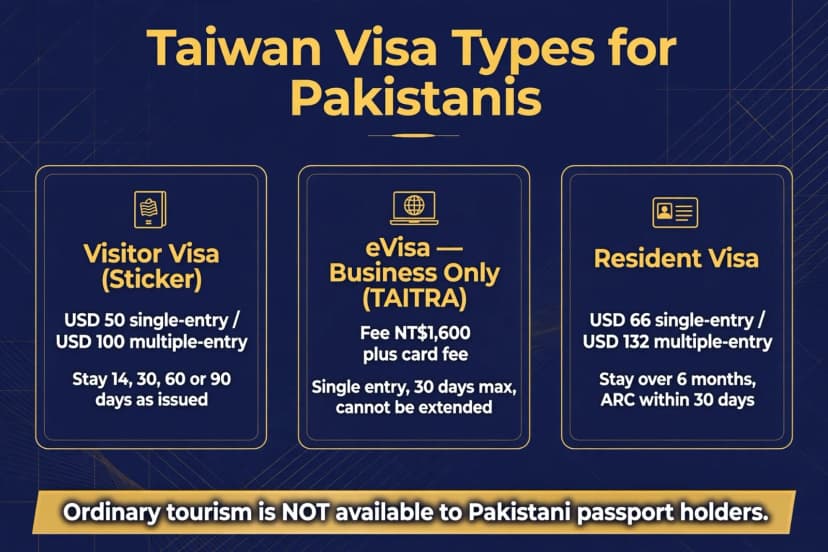
For a Pakistani passport holder, Taiwan's visa system narrows to a small number of routes, and it helps to see them side by side before you choose one. The main routes are the visitor visa, issued as a sticker in your passport; the eVisa, available online only in the narrow business and government-invitation cases described below; and the resident visa, for stays of more than six months for study, employment, joining family or other long-term purposes approved by the competent authority. There is no visa-free route, no visa on arrival, no landing visa and no Travel Authorization Certificate route for Pakistani nationals. The digital nomad visitor visa is open only to nationals of visa-exempt countries, so it is not available to a Pakistani passport holder.
The visitor visa is the route most readers of this guide will use. It covers short stays of no more than six months for the allowed purposes, including business, visiting relatives, attending international conferences, short-term study, short-term employment, short-term missionary work, transit and other activities approved by the Ministry of Foreign Affairs. For a Pakistani applicant, the purpose must still fall within the six designated-country purposes, and the standard visitor visa purposes such as a general tour do not override that limit. A visitor visa can be single entry or multiple entry.
The eVisa is a fully online visa for eligible nationalities and eligible purposes. For Pakistanis, eligibility is limited to business travel at the recommendation of an overseas office of the Taiwan External Trade Development Council, and to people invited by a Taiwan central government agency or to attend an international conference or event organised, co-organised or sponsored by such an agency, where the agency applies to the Bureau of Consular Affairs for an eCode for the individual concerned. The eVisa is valid for three months from the date of issue, is single entry only, allows a maximum stay of 30 days, and cannot be extended or converted to another type of visa. The fee is 1,600 New Taiwan dollars, about 50 United States dollars, plus an online credit-card processing fee, and only MasterCard, Visa and JCB credit cards are accepted for the online payment.
The resident visa is for stays of more than six months, for joining family, pursuing studies, undertaking employment, investing, conducting missionary work, conducting official duties, taking part in international exchange programmes, and other activities approved by the Ministry of Foreign Affairs or another competent central-government agency. The fee overseas is 66 United States dollars for a single entry and 132 United States dollars for a multiple entry, or 2,200 and 4,400 New Taiwan dollars in Taiwan. A resident visa is valid for three months, and the holder must apply for an Alien Resident Certificate and a re-entry permit at a National Immigration Agency service centre within 30 days starting from the day after arrival.
Visitor Visa (Sticker Visa) in Detail
The visitor visa is Taiwan's short-term visa for foreign nationals who hold an ordinary passport or other legal travel document and intend to stay in Taiwan for no more than six months. The Bureau of Consular Affairs page on visitor visas, updated on 7 August 2026, lists the eligible purposes as transit, tour, visiting relatives, undertaking visits, undertaking inspection tours, attending international conferences, conducting business, pursuing short-term study, undertaking short-term employment, undertaking short-term missionary work, and engaging in other activities in Taiwan as approved by the Ministry of Foreign Affairs. For a Pakistani applicant, that general list is then narrowed by the designated-country procedure to the six purposes already explained. The two pages must be read together: the general page tells you what a visitor visa is, and the designated-country page tells you which purposes a Pakistani national may actually use it for.
The standard requirements for a visitor visa are a passport valid for at least six months, a duly completed application form with two photos taken within the past six months, an outbound airline ticket or verifiable proof of purchase of a steamship ticket, documents verifying the purpose of the visit, and other relevant documents. For a designated-country applicant, the extra documents are a letter of guarantee from a sponsor in Taiwan, a no criminal record certificate, proof of financial resources and proof of accommodation in Taiwan. The guarantee form is available from the Bureau of Consular Affairs and must be authenticated by the Bureau, a Ministry of Foreign Affairs branch office or an overseas mission.
A visitor visa is generally valid for three months up to one year, except where a reciprocal visa agreement with the holder's country sets a different validity. There is no reciprocal agreement that changes the position for Pakistani passport holders, so you should expect a validity in that three-month to one-year range, as decided by the issuing office. The duration of stay printed on the visa will be 14, 30, 60 or 90 days. That number is decided by the issuing office on the facts of your application, and you cannot choose a longer stay simply by asking for it.
The fee for a visitor visa, under the Bureau of Consular Affairs standard fee schedule, is 50 United States dollars for a single entry and 100 United States dollars for a multiple entry when you apply overseas, and 1,600 and 3,200 New Taiwan dollars when you apply in Taiwan. Nationals of countries with which Taiwan has a reciprocal visa agreement are issued the visa free of charge, but that does not apply to Pakistani passport holders. An additional handling charge of 800 New Taiwan dollars applies to applications made in Taiwan by visitor visa holders applying to change or replace a visitor visa or resident visa. There is also an expedited service fee for urgent applications, set at 50 percent of the visa fee at some missions, but whether an urgent service is available for a designated-country application at TECO in Vietnam is not published, so you must ask the office directly. Visa fees are not refunded if the application is refused.
A visitor visa does not give you the right to work in Taiwan, and you must not take up employment on a visitor visa. If you enter Taiwan on a visitor visa and are subsequently legally employed, the Bureau of Consular Affairs states that you may apply inside Taiwan to change the visitor visa into a resident visa. That change is not automatic, it requires the work permit and the other resident visa documents, and an additional handling charge applies.
The eVisa Route for Pakistani Business Travellers
The eVisa is the only part of Taiwan's visa system that a Pakistani passport holder can complete entirely online, and it is open to Pakistanis only in a very narrow set of cases. The Bureau of Consular Affairs eVisa page states that nationals of Bangladesh, Bhutan, India, Iran, Nepal, Pakistan and Sri Lanka who are visiting for business purposes at the recommendation of overseas offices of the Taiwan External Trade Development Council are eligible for an eVisa. It also states that foreign nationals who are invited to visit Taiwan by a Taiwan central government agency, or to attend an international conference or event organised, co-organised or sponsored by such an agency, may apply for an eVisa, and that in those cases the agency concerned must apply to the Bureau of Consular Affairs for an eCode for the individual concerned. The page notes that, from 12 August 2026, nationals of Sri Lanka are temporarily ineligible for the eVisa. Pakistan is not affected by that Sri Lanka note, and Pakistani business travellers with a TAITRA recommendation remain eligible on the published page.
The TAITRA route works in a particular order, and you cannot skip the first step. You, or the Taiwanese company you will visit, contact the overseas office of the Taiwan External Trade Development Council that covers Vietnam, and that office considers whether to recommend you. If the recommendation is given, the Bureau of Consular Affairs issues an eCode for you, and only then can you apply online for the eVisa through the Bureau's eVisa portal. Applying on the portal without a recommendation or an eCode will not succeed for a Pakistani national.
The eVisa, when issued, is valid for three months starting from the date of issue. It is a single-entry visa, and the maximum duration of stay in Taiwan is 30 days, which cannot be extended and cannot be converted to another type of visa. That is a hard limit. If your business trip needs more than 30 days, or you need to enter Taiwan more than once, the eVisa is the wrong visa and you should apply for a sticker visitor visa instead. The eVisa is only applicable to holders of ordinary, official or diplomatic passports valid for at least six months from the date of applying. It is not applicable to holders of emergency, temporary or other unofficial passports or other travel documents. You submit your personal information online and pay the fee by credit card. Only MasterCard, Visa and JCB credit cards are accepted, and cash payments are not allowed. The Bureau states that the eVisa fee is 1,600 New Taiwan dollars, and an online credit-card processing fee is charged on top of that. Secondary sources report the total charged as 1,632 or 1,646 New Taiwan dollars, and this guide discloses that difference rather than picking one total as certain. The exact total will be shown on the payment page of the official portal before you pay.
Why the Travel Authorization Certificate Does Not Work for Pakistanis
The Travel Authorization Certificate, often shortened to TAC, causes more confusion for Pakistani travellers than any other part of Taiwan's system, so it deserves a section of its own. The TAC is an online certificate for nationals of a small group of countries who hold a qualifying visa or residence permit from another country. The certificate is valid for 90 days, allows multiple entries, and permits a stay of 14 days per entry, with a limit of six entries in a year. The qualifying visas are a valid visa, or a visa that expired less than 10 years ago, or a residence permit, issued by Australia, Canada, Japan, South Korea, New Zealand, the United Kingdom, the United States or a European Union or Schengen country, or a Taiwan visa or residence certificate from the past 10 years. The exact list of qualifying documents varies slightly by nationality: for example, Vietnamese nationals cannot qualify on the basis of a Japanese or Korean document.
The decisive point is the nationality list. The TAC is open to nationals of India, Indonesia, Vietnam, Cambodia, Laos and Myanmar. Pakistan is not on that list.
This guide discloses a direct conflict here, because several commercial visa websites state the opposite. At least two commercial guides claim that Pakistani passport holders who hold a valid or recently expired visa or permanent resident card from the United States, the United Kingdom, a Schengen country, Canada, Japan, Australia or New Zealand can apply for a free online Travel Authorization Certificate for a stay of up to 14 days. That claim is wrong for Pakistani nationals, and it appears to come from copying the TAC rules for Indian, Indonesian, Vietnamese, Cambodian, Laotian and Myanmar nationals and applying them to Pakistan without checking the nationality list. The controlling source is the official TAC eligibility list, not a commercial guide, and the official list does not include Pakistan. Do not pay any person or website for a Travel Authorization Certificate, and do not rely on a TAC to board a flight to Taiwan.
There is also a related confusion with the online arrival card. The Taiwan Arrival Card, known as TWAC, is a free online arrival form that every foreign visitor must complete, and it is not a visa and not a Travel Authorization Certificate. Completing the arrival card does not give you permission to enter Taiwan without a visa. You need both the visa and the arrival card. If you hold a strong visa from another country, it is evidence of your travel history, and a consular officer may view a clean travel history favourably, but it does not change your nationality, it does not move you off the designated-country list, and it does not open the TAC, the eVisa for tourism, or visa-free entry.
Resident Visa: Study, Work and Family
A resident visa is for a stay of more than six months, and it is the visa you need if you are going to Taiwan to study for a degree, to take up employment, to join family, to invest, to conduct missionary work, to carry out official duties, or to take part in an international exchange programme. The Bureau of Consular Affairs page on resident visas, updated on 13 August 2026, states that the eligible persons are foreign nationals who hold ordinary passports or other legal travel documents and intend to stay in Taiwan for more than six months for those purposes, and for other activities approved by the Ministry of Foreign Affairs or another competent central-government agency. The requirements are a passport valid for at least six months, a duly completed application form with two passport-size colour photos taken within six months, supporting documents or official letters of approval from the competent authority of Taiwan, other relevant documents, and a health certificate if applicable.
For study, you need an admission letter from a Taiwanese university or other recognised institution, together with the academic documents that the institution and the mission ask for, proof of funds for your study and living costs, and a health certificate in the format the mission requires. Vietnamese students are the largest group of international students in Taiwan, but the requirements for a Pakistani applicant are decided by your own documents and by the mission. Since 2026, TECO in Vietnam has required student visa applicants to hold an official high school graduation diploma, not a temporary graduation certificate. The resident visa fee for study is the standard resident visa fee: 66 United States dollars for a single entry and 132 United States dollars for a multiple entry overseas, or 2,200 and 4,400 New Taiwan dollars in Taiwan.
For employment, the order of steps is fixed and you must not reverse it. Your Taiwan employer must first apply to the Ministry of Labor, or to the competent authority for your profession, for a work permit for you, and the work permit must be approved before you apply for the resident visa. A visa alone does not authorise you to work, and a work permit alone does not let you enter Taiwan. Once the work permit is approved, you apply for a resident visa for employment purposes at a Taiwan overseas mission, or at the Bureau of Consular Affairs in Taiwan if you are already there on a qualifying visitor visa.
There is a separate point about English teaching work that must be stated clearly, because it is often confused with the visitor visa rules. Taiwan's rules for foreign English teachers, administered through the work permit system and the Ministry of Education, require the teacher to hold a passport from a country where English is an official language. That is a work permit rule about who may be employed as an English teacher in Taiwan. It is not a visitor visa rule, and it does not affect a Pakistani passport holder who applies for a visitor visa for business, family, medical or another allowed purpose. This guide was not able to verify the exact current wording of the English-teacher passport rule against an official Ministry of Education or Ministry of Labor page during the check on 29 November 2026, so that point is recorded as an open item in the package flags. Never resign from a job in Vietnam, and never pay a recruiter, on the basis of a teaching offer in Taiwan until the work permit has been approved.
For joining family, you need proof of the relationship to the family member in Taiwan and proof of that person's legal residence status, together with the other resident visa documents. A resident visa is valid for three months, and the holder must apply for an Alien Resident Certificate and a re-entry permit at a National Immigration Agency service centre within 30 days starting from the day after arrival. After that, you may stay in Taiwan as long as the Alien Resident Certificate remains valid.
Fees: What You Will Pay
The fees in this section are the fees published by the Bureau of Consular Affairs in its standard fee schedule for Taiwan visas in foreign passports. They are the government fees, and they are the figures you should use to judge whether any other charge you are asked to pay is reasonable. The visitor visa fee is 50 United States dollars for a single entry and 100 United States dollars for a multiple entry when you apply overseas, and 1,600 and 3,200 New Taiwan dollars when you apply in Taiwan.
The eVisa fee is 1,600 New Taiwan dollars, paid online by MasterCard, Visa or JCB credit card, plus an online credit-card processing fee. The Bureau of Consular Affairs states the visa fee as 1,600 New Taiwan dollars and states that a processing fee is charged, without publishing a single total in the passages checked for this guide. Secondary sources report the total as 1,632 New Taiwan dollars in one place and 1,646 New Taiwan dollars in another, a difference of 14 New Taiwan dollars. This guide discloses that difference and does not present either total as the certain official figure. The exact total will be shown on the payment page of the official eVisa portal before you confirm the payment, and you should read it there and keep the receipt.
There are also smaller charges that can apply in particular situations. An additional handling charge of 800 New Taiwan dollars, or 24 United States dollars, applies to applications made in Taiwan by visitor visa holders applying to change or replace a visitor visa or resident visa, and to applications made on arrival at ports of entry. A business sponsor in Taiwan who submits documents to the Bureau of Consular Affairs in Taipei for a designated-country business applicant pays a cable fee of 50 New Taiwan dollars per page. An expedited service fee of 50 percent of the visa fee is charged for urgent applications at some missions, but whether that service is available for a designated-country application at TECO in Vietnam is not published, and you must ask the office. The fee for extending a visitor visa inside Taiwan is reported as 300 New Taiwan dollars in secondary guidance, but that figure was not verified against an official National Immigration Agency fee page during the check for this guide, so it is recorded as an open item.
TECO in Vietnam will tell you the amount to pay in local currency, the payment method it accepts, and whether the fee is payable in cash, by bank transfer or by another method. Do not assume that the fee can be paid in United States dollars in cash at the counter, and do not assume that a card payment will be accepted, because payment practice varies by mission. Ask for the fee in writing, keep the receipt, and remember that visa fees are not refunded if the application is refused or if you withdraw it. Do not pay any fee to a third party who claims to be able to guarantee a visa, because no fee can guarantee a decision.
Processing Time: How Long to Allow
There is no published processing time for a Pakistani visitor visa application, and this guide will not invent one. The Bureau of Consular Affairs does not publish a standard number of working days for designated-country visitor visas, and the time needed can be longer than for other nationalities because the application may need to be referred to Taipei for approval. That referral is part of the normal procedure for designated countries, and it is the main reason to allow more time than the figures quoted for other applicants. Start the process at least six to eight weeks before your planned travel date, and treat four weeks as the minimum planning window even if TECO later tells you that your case was decided sooner. A visa that arrives late is no use to you if your flight has already left.
The figures you will see on other websites do not settle the question for a Pakistani applicant in Vietnam. One Taiwan mission, in Denver in the United States, states that a visitor visa normally takes two to three weeks. Another source reports that the Taipei office in Riyadh lists three working days for a single-entry visitor visa, but notes that designated-country cases may need Taipei approval and therefore take longer. Commercial guides for Pakistani applicants quote 7 to 10 working days, or 2 to 4 weeks, or 15 to 32 business days, depending on the website. Those numbers conflict with each other, none of them is published by TECO in Vietnam for Pakistani applicants, and none of them takes account of the time needed for your sponsor in Taiwan to prepare the guarantee documents, or for the mission to interview you. This guide discloses that conflict and names the controlling position: the Bureau of Consular Affairs publishes no processing time for designated-country nationals, so the only reliable figure is the one TECO in Vietnam gives you in writing for your own case. An incomplete file, a document that needs translation, a sponsor who has not yet submitted documents to Taipei, an interview that must be scheduled, and public holidays in Taiwan and Vietnam can all add days or weeks.
How Long You Can Stay and Extension Rules
A visitor visa does not give you a single fixed stay. The Bureau of Consular Affairs states that the duration of stay on a visitor visa is 14, 30, 60 or 90 days, as printed on the visa. The issuing office decides which of those numbers applies to you, based on your purpose, your sponsor, your travel plan and the documents you submit. You cannot assume that you will receive 90 days, and you should plan your trip around the number that is actually printed on your visa when you receive it. The stay is counted from the day after you arrive in Taiwan. The validity of the visa, generally three months up to one year, is a separate period: it tells you the window within which you must enter Taiwan, and it is not the same as the length of stay.
An eVisa stay is simpler and stricter. The eVisa allows a maximum stay of 30 days, it is single entry only, and the stay cannot be extended and the visa cannot be converted to another type of visa. If your business needs more than 30 days, or you need to enter Taiwan more than once on the same trip, apply for a sticker visitor visa instead of an eVisa. A resident visa holder, by contrast, must apply for an Alien Resident Certificate within 30 days starting from the day after arrival, and may then stay as long as the certificate remains valid.
Extensions inside Taiwan are possible only in a narrow set of cases. The Bureau of Consular Affairs states that visitor visa holders who are permitted to stay for 60 or 90 days, and whose visas bear no remark such as no extension, may apply at a local service centre of the National Immigration Agency for a maximum of 120 or 90 days of extensions. The National Immigration Agency guidance adds that the application can be accepted when the stay originally granted by the visa is 60 days or more and the visa is not subject to a no extension restriction, that each extension may not exceed the stay the original visa allowed, and that the total stay, original plus all extensions, may not exceed six months, or 180 days. An application for extension is made at a National Immigration Agency service centre up to 15 days before the current stay expires. A visa that granted only 14 or 30 days does not qualify for this extension route, and a visa that carries a no extension remark cannot be extended at all. Visa-free entry, landing visas and eVisas cannot be extended in the normal way. Overstaying is penalised under Taiwan's Immigration Act, and since the amendment that came into force in March 2024, the fine range for overstaying is reported as 10,000 to 50,000 New Taiwan dollars. That fine range is reported in secondary guidance and was not verified against the official National Immigration Agency text during the check for this guide, so it is recorded as an open item. Do not overstay: it can lead to a ban on re-entry and can affect future visa applications.

Complete Document Checklists
Use the checklist that matches your purpose, and treat every item as a document to prepare, not as a suggestion. The mission may ask for additional documents beyond this list, and it may ask for originals as well as photocopies, so take both to your appointment. Keep a complete copy of everything you submit, and keep the receipt for the visa fee.
The mandatory documents for a visitor visa are: a Pakistani ordinary passport valid for at least six months from the date of entry, with blank pages; a duly completed online visa application form, printed and signed, completed on the Bureau of Consular Affairs visa website; two recent colour passport-size photographs taken within the past six months, on a white background, showing your full face without a hat or dark glasses; an outbound airline ticket or verifiable proof of purchase of a steamship ticket, showing that you will leave Taiwan; documents verifying the purpose of your visit, which for a Pakistani applicant means the documents for one of the six allowed purposes; and any other relevant documents the mission asks for. The photograph size used by Taiwan missions is generally 45 millimetres by 35 millimetres, but confirm the size with TECO in Vietnam.
The extra documents for designated-country nationals, including Pakistanis, are: a letter of guarantee from a sponsor in Taiwan, on the official form, authenticated by the Bureau of Consular Affairs, a Ministry of Foreign Affairs branch office or an overseas mission; a no criminal record certificate, also called a police clearance certificate, from Pakistan or from Vietnam, as the mission directs; proof of financial resources, such as recent bank statements, normally for the past three to six months, showing that you can pay for the trip; and proof of accommodation in Taiwan, such as a hotel booking or the address and contact details of the person you will stay with. For the letter of guarantee, the guarantor must be over 18 with full legal capacity, must be a Taiwan national or a person with legal residence in Taiwan, must have an occupation or income in Taiwan shown by the most recent tax return or by proof of employment bearing the employer's seal, and must provide copies of the front and back of their Taiwan identity card, Alien Resident Certificate or other legal residence certificate.
The documents that prove your residence in Vietnam are essential for an application made in Vietnam. Take your Vietnamese temporary residence card or other residence card, your Vietnamese visa or residence stamp, and a copy of each, together with proof of your address in Vietnam and proof of your employment or study in Vietnam if you have it. A valid work permit, a labour contract, an employer's letter stating your job, your salary and your approved leave, or a student enrolment letter, all help to show your ties to Vietnam.
For a business visitor visa, add an invitation letter from the Taiwanese company, on company letterhead, stating the purpose, the dates, the business relationship and who will pay the costs; the Taiwanese company's registration documents; and the sponsor's letter of guarantee. For a family visit, add proof of the relationship, such as a marriage certificate for a spouse or a birth certificate for a parent or child; a copy of the family member's passport or identity document; and proof of the family member's legal residence status in Taiwan. For medical treatment, add a letter from the hospital or clinic in Taiwan confirming the treatment, the dates and the costs, and proof that you can pay. For an official invitation, add the invitation letter from the Taiwan government agency.
How to Apply: Step-by-Step
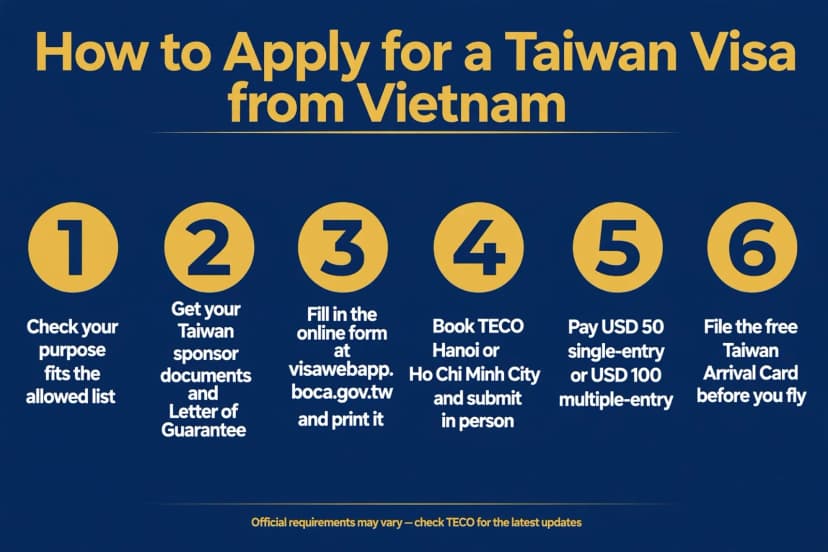
Step one is to decide your purpose and check it against the allowed list. Write your purpose in one sentence and match it to the six designated-country purposes: official government invitation, international religious, athletic or cultural meeting, visiting a dependent with legal residence in Taiwan, conducting economic or commercial business, crew duty, or medical treatment. If your purpose does not match one of those six, do not apply for a visitor visa, and do not pay anyone who promises to make it match. If your purpose is business, contact the Taiwanese company and ask them to act as your sponsor and to provide the invitation letter and the letter of guarantee.
Step two is to get your polio vaccination and your police clearance certificate started, because both can take time. The polio vaccination must be given between four weeks and one year before you submit the visa application, and you need the International Certificate of Vaccination or Prophylaxis, known as the Yellow Book, with the vaccination recorded in it. The police clearance certificate should be applied for early, and you should ask TECO whether it must come from Pakistan, from Vietnam, or from both, and whether it needs translation or authentication.
Step three is to complete the online visa application form on the Bureau of Consular Affairs visa website at visawebapp.boca.gov.tw. Fill in every field honestly, using the exact spelling of your name and the exact passport number, date of birth and other details from your passport. Print the completed form and sign it where the signature is required. Check the printed form line by line against your passport before you sign it. Keep the application serial number and a copy of the completed form.
Step four is to prepare the full document file, using the checklist in the previous section that matches your purpose, and to make one photocopy of every document, including every page of your passport that carries a stamp or a visa. Take the originals and the photocopies to the appointment. Step five is to contact TECO in Hanoi or in Ho Chi Minh City and confirm whether you need an appointment, what the opening hours for visa submissions are, what the fee is in local currency, how the fee must be paid, and whether the mission will keep your passport while the application is being decided. Guidance for designated-country applicants states that applications are not accepted by mail and must be submitted at a designated overseas mission, so plan to attend in person, and be ready for an interview. Business applicants must be interviewed by a Taiwanese consular officer. Step six is to wait for the decision and to respond promptly to any request for extra documents, checking your email every day, including the spam folder. When the visa is issued, check the sticker immediately: your name, passport number, visa type, number of entries, validity dates, duration of stay and any remarks, including a no extension remark. Step seven is to complete the free Taiwan Arrival Card online before you fly, and to pack the supporting documents for your trip in your hand luggage so that you can show them to the immigration officer if asked.
Applying from Vietnam: Hanoi and Ho Chi Minh City
Taiwan has two offices in Vietnam, and you will apply at one of them. The Taipei Economic and Cultural Office in Vietnam, in Hanoi, is at 20A, 21st Floor, PVI Tower, No. 1, Pham Van Bach Road, Cau Giay Ward, Hanoi, Vietnam, with telephone number +84-24-38335501 and email vnm@mofa.gov.tw. The Taipei Economic and Cultural Office in Ho Chi Minh City is at 336 Nguyen Tri Phuong, Phuong Vuon Lai, Ho Chi Minh City, Vietnam, with telephone numbers (84-28) 38349160 to 65 and email tecohcmc@mofa.gov.tw.
There is a small conflict in the published addresses for the Hanoi office that this guide discloses. The Ministry of Foreign Affairs page lists the Hanoi office at the PVI Tower address given above, while an older Bureau of Consular Affairs listing gives a previous address at the HITC Building, 239 Xuan Thuy Street, Cau Giay District, Hanoi. The PVI Tower address is the one shown on the current Ministry of Foreign Affairs country page for Vietnam, and it is the address you should use, but you should confirm it with the office by telephone or email before you travel.
Taiwan has no office in Pakistan. Pakistani nationals living abroad apply at the Taiwan office in their country of legal residence, and for you that is TECO in Vietnam. Do not apply at a TECO office in another country, such as Thailand, Malaysia or Singapore, without asking that office first whether it will accept an application from a person who lives in Vietnam. Living in Vietnam also gives you practical advantages: there are direct flights from Hanoi and Ho Chi Minh City to Taipei, with a flight time of around two to three hours. Book a return flight to Vietnam, not a one-way ticket, unless the mission has told you otherwise. Your Vietnamese residence card must remain valid for your return to Vietnam, so check its expiry date before you travel.
Health, Polio Vaccination and the Taiwan Arrival Card
Health requirements are a normal part of a Taiwan visa application for a Pakistani passport holder, and the polio vaccination rule is the one that most often catches people out. The Bureau of Consular Affairs announced on 4 February 2026 that, in accordance with World Health Organization recommendations, applicants for Taiwan visas must provide proof of having been given the oral polio vaccine, known as OPV, or the inactivated polio vaccine, known as IPV, from four weeks to one year before the date of their visa application submission, if they have resided in or visited a country at high risk for polio transmission for four weeks or longer within the past year. The countries named in that announcement are Afghanistan, Pakistan, the Democratic Republic of the Congo, Guinea, Algeria, Djibouti, Cameroon and Chad. Pakistan appears in every version of the list, including later announcements that add or change other countries, so a Pakistani applicant should assume that the rule applies to them.
The timing rule is strict and it is easy to get wrong. The vaccination must have been given at least four weeks before you submit the visa application, and no more than one year before you submit it. A vaccination given three weeks before you apply does not meet the rule, and a vaccination given 13 months before you apply does not meet it either. Plan the vaccination for five to six weeks before your TECO appointment, so that you are safely inside the window, and check the date recorded in the Yellow Book against the date you will submit the application. If you are living in Vietnam, ask TECO whether a vaccination and certificate obtained in Vietnam will be accepted, and which hospital or health authority in Vietnam can issue the International Certificate of Vaccination. A health certificate may also be required for a resident visa, normally issued within the past three months. Travel insurance is not a published visa requirement for a visitor visa, but it is strongly recommended, because medical care in Taiwan can be expensive for a visitor.
The Taiwan Arrival Card, known as TWAC, is the online arrival form that replaced the paper arrival card on 1 October 2025. It is free, it is filed on the official National Immigration Agency site at twac.immigration.gov.tw, and it is not a visa. Every foreign visitor without a Taiwan resident certificate must complete it, and every person needs their own card, including babies and children. Email verification is mandatory, and a confirmation email is sent once the registration succeeds.
There is a conflict in the published filing window for the arrival card, and this guide discloses it. The National Immigration Agency originally asked travellers to file the card within three days before arrival, and many guides still say three days. On 15 July 2026, the National Immigration Agency widened the window to seven days before arrival, counting the arrival day, so that a traveller arriving on 7 October can submit from 1 October, and the Bureau of Consular Affairs now gives the same seven days. The safe course is to file the card within three days before arrival, because that satisfies both the old three-day guidance and the new seven-day window. Do not pay any website for the arrival card. The official card is free, there is no official app, and the National Immigration Agency states that any site that asks for payment is not the official site. Use only twac.immigration.gov.tw, and keep the confirmation email accessible on your telephone when you travel.
Official Websites
Use only the official websites below for forms, fees and the latest rules. Any other website that asks you to pay for a visa form, an arrival card or a Travel Authorization Certificate is not the government.
| Official source | Link |
|---|---|
| Bureau of Consular Affairs: Information on Taiwan (ROC) Visitor Visas | https://www.boca.gov.tw/cp-157-4783-f6cb2-2.html |
| Bureau of Consular Affairs: Procedures for Nationals of the Designated Countries Applying for Taiwan (ROC) Visitor Visas | https://www.boca.gov.tw/fp-159-249-4162c-2.html |
| Bureau of Consular Affairs: Standard Fees for Taiwan (ROC) Visas in Foreign Passports | https://www.boca.gov.tw/fp-157-248-4f20b-2.html |
| Bureau of Consular Affairs: Information on Taiwan (ROC) Resident Visas | https://www.boca.gov.tw/cp-165-1878-1ff5e-2.html |
| Bureau of Consular Affairs: eVisa Application | https://visawebapp.boca.gov.tw/BOCA_EVISA/MRV04FORM |
| Bureau of Consular Affairs: Polio vaccination announcement, 4 February 2026 | https://www.boca.gov.tw/fp-220-8109-e25c8-2.html |
| Bureau of Consular Affairs: Polio vaccination announcement for travellers from high-risk countries | https://www.boca.gov.tw/cp-220-8033-e0792-2.html |
| Bureau of Consular Affairs: Polio vaccination announcement, 24 December 2024 | https://www.boca.gov.tw/fp-220-7712-a6838-2.html |
| Ministry of Foreign Affairs: Taipei Economic and Cultural Office in Vietnam, country page | https://en.mofa.gov.tw/CountryInfoEn.aspx?CASN=5&n=1287&sms=0&s=128 |
| Bureau of Consular Affairs: ROC Embassies and Missions Abroad, Vietnam | https://www.boca.gov.tw/sp-foof-countrycp-01-8-f4a19-2.html |
| Bureau of Consular Affairs: Online visa application portal | https://visawebapp.boca.gov.tw/ |
| National Immigration Agency: Taiwan Arrival Card (TWAC) | https://twac.immigration.gov.tw/ |
| National Immigration Agency: ROC Entry Reference for Civil Carriers | https://www.immigration.gov.tw/media/55249/immigration-reference-guide-for-civil-carriers.pdf |
| New Southbound Policy Portal: Who is eligible for an eVisa? | https://nspp.mofa.gov.tw/nsppe/news.php?post=177213&unit=377 |
| Taipei Economic and Cultural Office in Vietnam, Hanoi | https://www.taiwanembassy.org/vn/index.html |
| Taipei Economic and Cultural Office in Ho Chi Minh City | https://www.roc-taiwan.org/vnsgn/ |
| Taipei Economic and Cultural Office in Denver: Visa Information, fees and processing time | https://www.roc-taiwan.org/usden_en/post/3929.html |
| Taipei Economic and Cultural Office in Houston: General Information for Visa Application | https://www.roc-taiwan.org/ushou_en/post/1741.html |
| Overseas Community Affairs Council: Taiwan Arrival Card online system notice | https://www.ocac.gov.tw/OCAC/Eng/Pages/Detail.aspx?nodeid=329&pid=82545498 |
| Invest Taiwan: Business eVisa for South Asian business travellers | https://investtaiwan.nat.gov.tw/eBook/BravoTaiwan/2023ebook_en/eng/en_ebook/en_ebook/files/basic-html/page64.html |
Frequently Asked Questions
Do Pakistani passport holders need a visa for Taiwan?
Yes. Every Pakistani passport holder needs a visa before travelling to Taiwan, whatever the purpose and however short the stay. Pakistan is not on Taiwan's visa-exempt list, and there is no visa on arrival or landing visa for Pakistani nationals. You must apply in advance at the Taipei Economic and Cultural Office in Hanoi or Ho Chi Minh City, or online for the eVisa if you qualify as a TAITRA-recommended business traveller. A valid Vietnamese residence card does not remove the visa requirement, because the rules are decided by your passport nationality.
Can I visit Taiwan as a tourist on a Pakistani passport?
No, not under the current rules. Pakistan is a designated country under the Bureau of Consular Affairs procedure, and visitor visas for designated-country nationals are only issued for six purposes: official government invitation, an international religious, athletic or cultural meeting, visiting a dependent with legal residence in Taiwan, business, crew duty, and medical treatment. Ordinary tourism is not on that list. Do not pay an agent who promises a tourist visa, and do not describe a holiday as a business trip, because a false purpose can lead to a refusal.
Can I use the Travel Authorization Certificate if I hold a US or UK visa?
No. The Travel Authorization Certificate is open only to nationals of India, Indonesia, Vietnam, Cambodia, Laos and Myanmar who hold a qualifying visa or residence permit from countries such as the United States, the United Kingdom, a Schengen country, Canada, Japan, Australia or New Zealand. Pakistan is not on the nationality list, so a United States or United Kingdom visa does not open the certificate for a Pakistani passport holder. Several commercial websites claim otherwise, but the official nationality list is the controlling source, and this guide discloses that conflict.
Can I apply for a Taiwan eVisa as a Pakistani passport holder?
Only in narrow cases. Pakistani nationals are eligible for an eVisa when visiting for business at the recommendation of an overseas office of the Taiwan External Trade Development Council, or when invited by a Taiwan central government agency or to an international conference or event it organises, co-organises or sponsors, where the agency applies for an eCode for you. The eVisa is single entry, valid for three months, allows a maximum stay of 30 days, and cannot be extended or converted.
How much is the Taiwan visitor visa fee for Pakistanis?
The published government fee is 50 United States dollars for a single-entry visitor visa and 100 United States dollars for a multiple-entry visitor visa when you apply overseas, or 1,600 and 3,200 New Taiwan dollars when you apply in Taiwan. The resident visa fee is 66 United States dollars for a single entry and 132 United States dollars for a multiple entry overseas. The eVisa fee is 1,600 New Taiwan dollars plus an online card processing fee. Confirm the amount and the payment method with TECO in Vietnam, because missions set their local payment arrangements, and remember that visa fees are not refunded if the application is refused.
How long does a Taiwan visa take to process from Vietnam?
There is no published processing time for Pakistani visitor visa applications, and this guide does not invent one. The Bureau of Consular Affairs publishes no standard time for designated-country nationals, and the application may need approval from Taipei. Other missions quote two to three weeks for ordinary visitor visas, and commercial guides quote anything from 7 to 32 working days, but none of those figures is published by TECO in Vietnam for Pakistani applicants.
How long can I stay in Taiwan on a visitor visa?
The stay printed on a visitor visa is 14, 30, 60 or 90 days, as decided by the issuing office, and it is counted from the day after you arrive. The visa itself is generally valid for three months up to one year, which is the window within which you must enter Taiwan, not the length of your stay. An eVisa allows a maximum stay of 30 days. A resident visa holder must apply for an Alien Resident Certificate within 30 days starting from the day after arrival, and may then stay as long as the certificate remains valid.
Can I extend my Taiwan visitor visa inside Taiwan?
Only in narrow cases. A visitor visa holder whose visa grants a stay of 60 or 90 days, and whose visa does not carry a no extension remark, may apply at a National Immigration Agency service centre for an extension, up to 15 days before the current stay expires, and the total stay including extensions may not exceed six months. A visa that granted only 14 or 30 days does not qualify, a visa marked no extension cannot be extended at all, and an eVisa cannot be extended or converted. Check the remarks on your visa as soon as you receive it.
Where do I apply for a Taiwan visa in Vietnam?
At the Taipei Economic and Cultural Office in Hanoi or in Ho Chi Minh City. The Hanoi office is at 20A, 21st Floor, PVI Tower, No. 1, Pham Van Bach Road, Cau Giay Ward, Hanoi, telephone +84-24-38335501, email vnm@mofa.gov.tw. The Ho Chi Minh City office is at 336 Nguyen Tri Phuong, Ho Chi Minh City, telephone (84-28) 38349160 to 65, email tecohcmc@mofa.gov.tw. Confirm the visa counter hours and whether you need an appointment before you travel to the office, and apply in person, because designated-country applications are not accepted by mail.
Do I need a polio vaccination certificate for Taiwan?
Yes, in most cases. The Bureau of Consular Affairs announced on 4 February 2026 that visa applicants who have resided in or visited a high-risk polio country, including Pakistan, for four weeks or longer within the past year must provide proof of an oral polio vaccine or an inactivated polio vaccine given between four weeks and one year before the visa application is submitted. The proof is the International Certificate of Vaccination or Prophylaxis, known as the Yellow Book. A vaccination given less than four weeks before you apply does not meet the rule, so plan it five to six weeks before your appointment.
What is the Letter of Guarantee, and who can be my guarantor?
The Letter of Guarantee is a signed undertaking from a sponsor in Taiwan, on the official form, authenticated by the Bureau of Consular Affairs, a Ministry of Foreign Affairs branch office or an overseas mission. The guarantor must be over 18 with full legal capacity, must be a Taiwan national or a person with legal residence in Taiwan, and must have an occupation or income in Taiwan, shown by the most recent tax return or by proof of employment bearing the employer's seal. The guarantor provides copies of the front and back of their Taiwan identity card or Alien Resident Certificate. Without a sponsor and a guarantee, a designated-country application is incomplete.
Can I work in Taiwan on a visitor visa?
No. A visitor visa does not give you the right to work in Taiwan, and you must not take up employment on a visitor visa. To work legally, your Taiwan employer must first obtain a work permit for you from the Ministry of Labor or the competent authority, and you must then apply for a resident visa for employment. If you enter Taiwan on a visitor visa and are subsequently legally employed, you may apply inside Taiwan to change the visitor visa into a resident visa, with an additional handling charge of 800 New Taiwan dollars, but that change is not automatic and requires the work permit and the other resident visa documents.
Can a Pakistani English teacher get a work permit for Taiwan?
Not as an English teacher under the usual route, because Taiwan's rules for foreign English teachers require the teacher to hold a passport from a country where English is an official language, and Pakistan is not such a country. That is a work permit rule, not a visitor visa rule: it does not stop a Pakistani passport holder from applying for a visitor visa for business, family, medical or another allowed purpose, and it does not stop a Pakistani from applying for a resident visa for other kinds of employment where the employer has obtained the proper work permit.
Do children need their own Taiwan visa?
Yes. Every child needs their own visa application, their own photographs and the supporting documents for the child's purpose of travel, together with proof of the relationship to the accompanying parent or guardian. A child cannot travel on a parent's visa. If the family is travelling for business, the designated-country rules expressly allow an accompanying spouse and children, and the sponsor's invitation and guarantee documents can support the whole family, but each person still needs a separate application and a separate visa.
What is the Taiwan Arrival Card, and is it the same as a visa?
No. The Taiwan Arrival Card, known as TWAC, is a free online arrival form that replaced the paper arrival card on 1 October 2025. It is filed on the official site twac.immigration.gov.tw, it is not a visa, and completing it does not give you permission to enter Taiwan without a visa. Every foreign visitor without a Taiwan resident certificate must complete it, including children, and you need both the visa and the arrival card. The filing window was widened on 15 July 2026 from three days to seven days before arrival, and the safe course is to file it within three days before arrival.
This guide was checked on 29 November 2026 against the official pages of Taiwan's Bureau of Consular Affairs, the Ministry of Foreign Affairs, the Taipei Economic and Cultural Offices in Vietnam and the National Immigration Agency, and the fees, stay lengths, purposes and procedures above are the ones those pages published on that date. Confirm your own case in writing with TECO before you pay for travel or submit your application. The immigration officer at the border makes the final decision on entry, and this guide does not guarantee visa approval or entry.


