

By MAS Inspire | Last reviewed: 27 November 2026
Important: Swiss immigration rules depend on nationality, purpose, duration, canton and individual circumstances. Fees and procedures can change. Confirm the live checklist with the competent Swiss representation and cantonal authority before paying or booking travel. A visa does not guarantee admission at the border.
Table of contents
- Introduction
- Why visit, study or work in Switzerland
- Types of Swiss visas and permits
- Visa comparison
- Eligibility requirements
- Document checklists
- How to apply
- Fees and financial requirements
- Processing times and validity
- Applying from Pakistan or Vietnam
- Student visa guide
- Work permits and job opportunities
- Family reunification and permanent residence
- Common mistakes and refusal reasons
- Frequently asked questions
- Official websites
- Final checklist
Introduction
Switzerland is a popular destination for tourism, higher education, research, international business and skilled employment. It is part of the Schengen Area, but it is not a member of the European Union. Its immigration system distinguishes between short visits and longer residence, and between EU/EFTA citizens and nationals of other countries.
For most non-EU/EFTA nationals, the first question is whether the intended stay is up to 90 days or longer than 90 days. A Schengen Type C visa covers qualifying short stays, including tourism, family visits and many business visits. A National Type D visa is used for longer stays, such as study, employment and family residence. The D visa is an entry document; the residence permit is normally issued by the competent canton after arrival and registration.
A Pakistani passport holder generally needs a visa for both short and long stays. A Vietnamese passport holder also generally needs a visa. Holding a Vietnamese residence card does not change the nationality-based visa requirement, although it is relevant to where the person should lodge an application.
Why visit, study or work in Switzerland
Switzerland offers internationally recognised universities and research institutions, a strong financial and technology sector, advanced manufacturing, life sciences, hospitality and tourism. It has four national languages—German, French, Italian and Romansh—and the language used in daily life depends on the canton. English is common in some international workplaces and academic programmes, but it does not replace local-language requirements where these apply.
Applicants should assess living costs, accommodation, health insurance, language expectations and the specific canton before choosing a route. Admission to a university or an offer from an employer does not, by itself, guarantee a residence or work permit.

Types of Swiss visas and permits
1. Tourist and private-visit visa (Type C)
A short-stay Schengen visa may be used for tourism, visiting relatives or friends, and other permitted short visits. The maximum stay is 90 days in any rolling 180-day period across the Schengen Area, not 90 days per country. Applicants must establish the purpose and arrangements of the trip, adequate means, accommodation and intention to leave before the authorised stay ends. Employment is not permitted merely because a visitor holds a C visa.
2. Business visitor visa (Type C)
Meetings, conferences, negotiations and other qualifying short business activities may fall under a C visa. The invitation should explain the Swiss host, purpose, dates, itinerary and who pays the costs. A business visitor visa is not a work permit: productive employment or taking up a job in Switzerland requires the appropriate authorisation.
3. Student and language-study routes
A course of up to 90 days may in some cases be covered by a Type C visa. A longer course normally requires cantonal authorisation and a Type D entry visa where the student's nationality requires one. Applicants should have admission to a recognised institution, a credible study plan, sufficient funds, suitable accommodation and any required insurance. Language courses do not automatically qualify for the same status or work rights as degree study; ask the canton about the exact programme.
4. Employment and employer-sponsored permits
Third-country nationals (people who are not EU/EFTA citizens) face restrictive admission rules. In general, the applicant must be a highly qualified manager, specialist or skilled professional. The employer applies to the competent cantonal authority and normally has to show that no suitable candidate could be recruited from Switzerland or the EU/EFTA labour market. Salary and conditions must meet local and sector standards. Permits are limited by annual quotas. For 2026, the Federal Council retained 8,500 permits for third-country workers: 4,500 B permits and 4,000 L permits.
5. Job-seeking after Swiss graduation
There is no general open job-seeker visa for anyone wishing to travel to Switzerland and look for work. However, eligible third-country graduates of recognised Swiss higher-education institutions may receive up to six months after completing their studies to seek qualifying employment. The job must match their qualifications and the applicable legal conditions. This is a specific graduate provision, not a general route for overseas applicants.
6. Skilled-worker immigration
Switzerland does not operate a broad points-based skilled migration programme comparable to some other countries. Third-country admission is selective, generally requires high qualifications and experience, an employer petition, labour-market priority assessment and compliance with quotas. There is no guarantee that an occupation shortage or a foreign qualification alone will secure a permit.
7. Digital nomad visa
Switzerland has no dedicated digital nomad visa identified in the official federal visa and permit framework. A visitor visa does not authorise a person to relocate to Switzerland and work remotely as a substitute for residence permission. Anyone considering remote work while living in Switzerland should obtain written guidance from the competent canton before making plans.
8. Entrepreneur, startup and self-employment
There is no simple, stand-alone startup or investor visa that automatically grants residence. A third-country national seeking self-employment must satisfy the applicable admission criteria and demonstrate that the proposed business will have a lasting positive impact on the Swiss labour market and an overall economic interest. Evidence may include a detailed business plan, market analysis, investment and financial forecasts, expected employment and corporate documents. The canton assesses the case.
9. Family reunification and spouse residence
Family reunification is governed by the sponsor's status and the family relationship. Eligible spouses and dependent children may be able to join a Swiss citizen or a foreign resident, subject to statutory conditions. Requirements can include suitable housing, financial capacity, identity and relationship documents, and in some cases language or integration requirements. Rules differ for Swiss citizens, holders of B/C/L permits and other statuses. Submit the correct family-reunification application to the canton; do not assume that marriage alone grants an automatic right to enter or work.
10. Permanent residence (Permit C)
Permit C is a settlement permit, not a visa. Eligibility depends on the applicant's nationality, residence history, integration, language ability and legal conditions. The ordinary qualifying period is often ten years, while certain nationalities or family situations may qualify under different rules, sometimes after five years. The canton decides eligibility. A temporary permit B is not the same as permanent residence.
11. Airport transit visa
A transit passenger who remains airside and meets all transit conditions may still need an airport transit visa. Pakistani nationals are on Switzerland's airport-transit-visa-required list, subject to specified exemptions—for example, certain valid visas or residence documents. This is distinct from a Type C visa allowing entry into the Schengen Area. Check the current SEM list and airline routing before booking a connection.
12. Exchange, internship, training and young professionals
An internship involving work generally requires authorisation and normally must be an integral part of the applicant's studies. Switzerland also has a young-professional exchange scheme for nationals of a defined list of partner countries, generally for up to 18 months and in the person's trained profession. Pakistan and Vietnam are not on the published eligible-country list checked for this guide. Au-pair placements for third-country nationals aged 18–25 may be possible for up to 12 months through a recognised Swiss organisation.
13. Researchers and academics
Researchers may be admitted under the applicable employment or study framework depending on the host institution, contract, funding and activity. The Swiss host institution should coordinate with the canton and confirm whether the case is employment, study or another authorised category. There is no universal researcher visa with one fee and checklist.
14. Humanitarian protection
Asylum and other humanitarian protection procedures are separate from ordinary visa applications. They are assessed under Swiss asylum law on the facts of an individual case. A tourist, student or work visa application is not a substitute for an asylum claim, and this guide cannot assess eligibility for protection.
Visa comparison
| Purpose | Main route | Duration / status | Work rights | Fee / timing |
|---|---|---|---|---|
| Tourism / private visit | Type C | Up to 90/180 days | No ordinary employment | Adult EUR 90 Schengen fee; usually 15 days, may extend |
| Short business visit | Type C | Up to 90/180 days | Meetings etc.; not a work permit | Same C fee; additional VFS fee may apply |
| Long study | Cantonal approval + Type D if required; residence permit | Course / authorised residence | Limited, subject to approval | D fee and canton-specific charges; verify locally |
| Employment | Employer-sponsored L/B permit + entry visa if required | Permit-specific | Only as authorised | Canton/permit fees vary; quota applies |
| Family reunification | Cantonal approval + D visa if required | Residence permit | Depends on sponsor/status and permit | Varies by canton and case |
| Self-employment | Cantonal work/residence authorisation | Permit-specific | Only approved business activity | Varies; substantial business evidence required |
| Permanent residence | Permit C application | Settlement status | Subject to permit rules | Canton-specific; not a visa |
| Airport transit | Type A where required | Airport transit zone only | No | Verify representation/airline instructions |
Eligibility requirements
The exact criteria depend on the category, but applicants should expect to demonstrate:
- A valid, recognised passport or travel document. For a Schengen C visa, the document generally must have been issued within the previous ten years and remain valid for at least three months after planned departure from the Schengen Area.
- A genuine and clearly documented purpose of travel or residence.
- Sufficient funds, or a credible and documented sponsor who will cover costs where accepted.
- Accommodation and a realistic itinerary for a short visit, or an appropriate housing plan for a long stay.
- Medical/travel insurance meeting the applicable requirements. Schengen travel medical insurance must generally cover at least EUR 30,000 for emergency medical care and repatriation.
- Any required admission letter, employment contract, cantonal approval, family documents or business evidence.
- No applicable entry ban or security/public-order impediment.
For short stays, SEM guidance refers to at least CHF 100 per day for a third-country visitor paying their own expenses. This is a general entry reference, not a universal fixed bank-balance rule for every visa applicant. Students with a valid student permit are referenced at CHF 30 per day in the SEM FAQ. Cantonal student authorities may set their own evidence requirements and request a different calculation or proof.
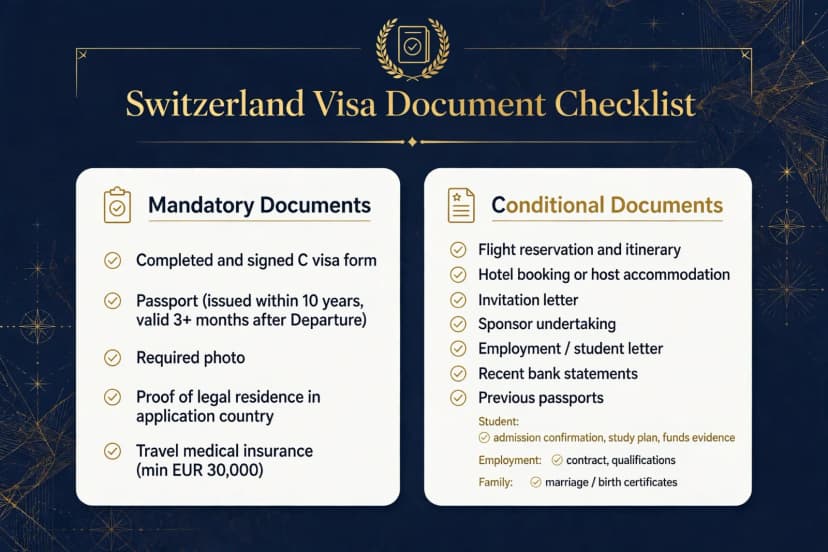
Document checklists
The following are planning checklists, not a universal official list. The representation or canton may require additional documents, translations, legalisation or originals.
Short-stay tourism / visit
| Usually required / core | Conditional or supporting evidence |
|---|---|
| Completed and signed C visa form; passport; required photo; proof of legal residence in application country; travel medical insurance | Flight reservation and itinerary; hotel booking or host accommodation; invitation letter; sponsor undertaking if requested; employment/student letter; leave approval; recent bank statements; evidence of family, work or other ties; previous passports/visas |
Business visit
| Usually required / core | Conditional or supporting evidence |
|---|---|
| C visa form; passport; photo; insurance; proof of residence; purpose and dates | Swiss company invitation; meeting/conference registration; employer letter; expense undertaking; business registration or relevant correspondence |
Long-stay student
| Usually required / core | Conditional or supporting evidence |
|---|---|
| Correct national visa application; passport and photos; admission confirmation from recognised institution; study plan; evidence of funds; accommodation and insurance arrangements | Academic certificates/transcripts; CV; language evidence if institution/canton requests; tuition payment; sponsor documents; explanation of future plans; translations/legalisation |
Employment
| Usually required / core | Conditional or supporting evidence |
|---|---|
| Employer's permit application; employment contract; passport/identity documents; qualifications and experience evidence | CV; degree certificates; professional licences; detailed job description; proof supporting labour-market priority; salary/working-condition evidence; translations |
Family reunification
| Usually required / core | Conditional or supporting evidence |
|---|---|
| Family-reunification application; passport; sponsor's Swiss status; official marriage/birth certificates | Housing evidence; income/financial documents; language evidence where required; custody/consent documents for children; certified translations/legalisation |
Never submit fabricated bank statements, employment records, invitations, accommodation bookings or relationship documents. Keep originals and copies as instructed by the responsible office.

How to apply: step-by-step
- Choose the correct route. Identify whether the purpose is a short visit, long study, employment, family residence, transit or another category.
- Check nationality and place of residence. Use SEM's nationality list and the Swiss representation responsible for the country where you legally reside. A residence permit in a third country does not waive a passport-based visa requirement.
- Read the exact local checklist. The documents and appointment channel vary by representation and visa purpose. Use the official embassy/consulate page, not an agent's generic list.
- Obtain prior approvals where required. For work, the employer normally applies to the canton. For long-term study and family residence, the canton may need to approve the stay before the D visa is issued.
- Prepare the application and evidence. Complete the correct form, gather originals/copies, translations, financial evidence, insurance and purpose-specific documents.
- Book through the official channel. In Vietnam, short-stay Schengen applications go through VFS Global. National visa applications for residents of Vietnam are submitted to the Consulate General in Ho Chi Minh City after prior document review.
- Attend biometrics or interview. For Schengen applications in Vietnam, fingerprints are generally taken from age 12 and reused for 59 months where valid and available. An interview may still be requested.
- Pay the applicable fee. The visa fee is generally non-refundable. A service-provider fee may be additional.
- Track the application through the designated channel. The Swiss Consulate in Ho Chi Minh City says it does not provide status information for short-stay applications. For long-stay applications, follow the instructions from the canton/representation.
- Check the visa and entry conditions. Verify name, dates, number of entries and territorial validity. Carry evidence supporting the trip. For a long stay, follow the canton’s registration and residence-permit instructions after arrival.
Fees and financial requirements
| Item | Published amount / position |
|---|---|
| Schengen Type C adult | EUR 90 (local currency equivalent may be collected) |
| Schengen Type C child aged 6–11 | EUR 45 |
| Children under 6 | Generally exempt from Schengen visa fee |
| VFS service charge | Additional; check current Vietnam VFS tariff |
| National Type D visa | Check the responsible representation; possible additional charges in specified cases |
| Work / residence / student permit | Cantonal fees vary; no single nationwide total for all categories |
| Short-stay self-funded visitor means | SEM FAQ reference: at least CHF 100 per day |
| Student-permit holder means | SEM FAQ reference: CHF 30 per day; canton may require its own proof |
The visa fee is due at submission and is normally not refunded if the application is withdrawn or refused. The Swiss representation may adjust local-currency collection rates due to exchange-rate changes. Do not rely on old fee screenshots or third-party websites.
Processing times and validity
For Schengen applications lodged in Vietnam, the Swiss Consulate states that a decision is generally made within 15 days, although individual cases can take longer. Some applications require consultation with other Schengen states, which may add time. Apply early; the Schengen application can generally be lodged up to six months before travel. The Swiss Vietnam guidance recommends applying as early as possible.
For national visas, processing depends on the category and canton. The Swiss Embassy in Pakistan currently gives an approximate 8–12 week period for the national visa categories described on its page, but that estimate is not a universal guarantee and should not be applied automatically to Vietnam-based applications. The relevant authority may need to approve the stay first.
A C visa's authorised stay is not necessarily the same as its validity period: a multiple-entry visa may have a longer validity but still obey the 90/180-day limit. A D visa facilitates entry for the approved long stay; the residence permit and its expiry date govern ongoing residence.
Applying from Pakistan or Vietnam
Pakistani passport holders living in Vietnam
Pakistani nationals require a visa for both short and long stays in Switzerland. For a person who genuinely and legally resides in Vietnam, the Swiss representation's country-of-residence instructions are important. Short-stay Schengen applications by Vietnam residents are lodged through VFS Global in Ho Chi Minh City or Hanoi. National visa applications by Vietnam residents are submitted to the Consulate General of Switzerland in Ho Chi Minh City, but scanned documents must first be sent for review and an appointment is confirmed after that review.
Prepare proof of lawful Vietnamese residence (for example, a valid residence card or other accepted evidence), Vietnamese address and status, and documents explaining the purpose of the Swiss trip. The Swiss authority may ask for additional documents. Do not assume that a Vietnamese work permit or temporary residence card guarantees local acceptance in every circumstance; confirm jurisdiction and required proof with the consulate before booking.
Applying from Pakistan
The Swiss representation's Pakistan instructions direct applicants to the designated visa application provider for short-stay cases and the Embassy's national-visa process for long stays. Pakistani nationals residing outside Pakistan are generally expected to apply through the Swiss representation responsible for their place of residence, with proof of legal residence there. Check the latest country-specific checklist and appointment arrangements before applying.
Important difference
The passport nationality determines whether a visa is required. The country of lawful residence generally determines which Swiss representation handles the application. These are separate questions. A Pakistani passport holder in Vietnam remains a Pakistani national for visa-requirement purposes, even if the application is lodged in Vietnam.
Student visa guide
For a course lasting more than 90 days, contact the institution and the migration authority in the canton where you will live. Confirm that the institution and programme qualify for the intended residence route. The institution may provide guidance, but it does not replace the canton's decision.
A student should prepare an admission confirmation, passport, academic history, a clear explanation of the programme, proof of funds, accommodation details and insurance arrangements. A canton may ask for a signed undertaking to leave after study, a CV, language evidence, tuition payment or other supporting material. There is no single national blocked-account figure applicable to every Swiss student case; do not import financial thresholds from Germany or another country.
Students at a university or university of applied sciences may be allowed to undertake supplementary employment no earlier than six months after the start of their course, generally up to 15 hours per week outside holiday periods. The competent authority must approve the work, the university must confirm compatibility with studies, and the employer must submit the required application. Do not begin work before authorisation.
Work permits and job opportunities
For most Pakistani and Vietnamese applicants, a Swiss job offer is only the beginning. The employer must apply to the canton and justify the recruitment under the third-country rules. The applicant should be highly qualified, and the employer must normally demonstrate that a suitable Swiss or EU/EFTA candidate was not available. Quotas and salary/working-condition rules apply.
Potential sectors include technology, engineering, pharmaceuticals, finance, research, hospitality and specialised manufacturing, but a sector's demand does not create an automatic immigration entitlement. Applicants should target genuine employers, verify the contract and never pay an unverified intermediary for a promised permit. Only start work after the necessary authorisation and local registration requirements are satisfied.
Family reunification and permanent residence
Family members may qualify to join a Swiss citizen or foreign resident, but the route depends on the sponsor's permit, the relationship and statutory conditions. Obtain the canton-specific checklist before arranging travel. Civil-status documents issued abroad may need authentication, legalisation or certified translation.
Permit C is the settlement permit. It is not automatically granted after a fixed number of years in every case. The authorities assess residence history and integration, including language and participation in working life or education. Applicants should check the current SEM guidance and the canton’s rules for their nationality and status.
Common mistakes and refusal reasons
- Applying under a tourist category when the real purpose is employment, study or residence.
- Assuming a visa or permit issued by another country automatically gives permission to work in Switzerland.
- Providing inconsistent travel dates, unexplained deposits or unreliable financial evidence.
- Omitting proof of lawful residence in the country where the application is lodged.
- Using a generic checklist rather than the correct country- and purpose-specific one.
- Treating an invitation as a guarantee of approval.
- Buying non-refundable tickets before a decision when not required.
- Starting work before the canton has authorised it.
- Submitting forged documents or false statements.
- Ignoring a previous refusal or failing to address the reasons in a new application.
A refusal may result from doubts about the purpose or conditions of the stay, insufficient means, inadequate insurance, missing documents, inconsistent information, an entry alert or failure to meet the category's legal requirements. The refusal notice explains the decision and available review/appeal route. For Vietnam-based Schengen applications, the consulate describes a 30-day appeal period. Follow the exact instructions and deadline in the decision letter.
Frequently asked questions
1. Do Pakistani citizens need a visa for Switzerland in 2026?
Yes. Pakistani passport holders generally need a visa for both short visits and stays longer than 90 days.
2. Can a Pakistani living in Vietnam apply for a Swiss visa in Vietnam?
The Swiss representation lists Vietnam as the application location for people resident there. Short-stay applications go through VFS Global; national visa applicants must first submit scanned documents for review to the Consulate General in Ho Chi Minh City. Confirm that your Vietnamese residence evidence meets the current requirements.
3. Does a Vietnam residence permit remove the Swiss visa requirement?
No. Visa requirements are principally nationality-based. A Vietnamese residence permit may establish where you apply, but does not make a Pakistani passport visa-exempt.
4. How much is a Swiss tourist visa?
The standard Schengen fee is EUR 90 for adults and EUR 45 for children aged 6–11. Local collection currency and VFS service charges may differ.
5. How long can I stay in Switzerland on a tourist visa?
A short-stay Schengen visa permits no more than 90 days in any 180-day period, subject to the visa's validity and number of entries.
6. How long does a Swiss visa take?
A Schengen decision is generally made within 15 days, but can take longer. Long-stay applications depend on the canton and category; do not assume the short-stay timeline applies.
7. Can I work in Switzerland on a tourist visa?
No. A visitor visa is not work authorisation. Employment requires the appropriate permit and, for third-country nationals, usually employer sponsorship and cantonal approval.
8. Can international students work part-time?
Potentially. For university and university-of-applied-sciences students, supplementary work may generally begin after six months and is usually limited to 15 hours weekly during term, subject to approval and university confirmation.
9. Is there a Swiss digital nomad visa?
No dedicated Swiss digital nomad visa was identified in the official framework checked for this guide. A visitor visa should not be used as a substitute for permission to reside and work remotely.
10. Is there a Swiss job seeker visa?
There is no general job-seeker visa for overseas applicants. A specific six-month job-search period may be available to eligible graduates of recognised Swiss higher-education institutions.
11. Can I get a Swiss work permit without a job offer?
For the ordinary third-country employment route, a Swiss employer generally needs to apply for the permit. Self-employment is a separate, demanding route requiring an overall economic interest and a strong business case.
12. Is there a fixed bank balance for a Swiss student visa?
There is no single universal national figure for every student case. The canton assesses financial evidence. SEM's FAQ refers to CHF 30 per day for students who already hold a valid student permit, which should not be mistaken for a universal application threshold.
13. Do Pakistani citizens need an airport transit visa in Switzerland?
Generally yes, if transiting through the international airport zone, subject to specific exemptions. Check the current SEM rules, itinerary and documents before travel.
14. How can I obtain permanent residence in Switzerland?
Eligible residents may apply for Permit C after the applicable residence period and subject to integration and other legal requirements. The qualifying period varies by circumstances and nationality.
15. Does a Swiss visa guarantee entry?
No. Border authorities may check whether entry conditions are still met, even if a visa has been issued.
Official Swiss immigration websites
- State Secretariat for Migration (SEM): Entering Switzerland
- SEM: Entry requirements by nationality
- SEM: Working in Switzerland
- SEM: Third-country workers and admission criteria
- SEM: 2026 work-permit quotas
- SEM: Entry FAQ and visa fees
- SEM: Student work FAQ
- SEM: Young professionals
- Swiss Embassy in Vietnam: Visa and residence
- Switzerland in Vietnam: Schengen application procedure
- Switzerland in Vietnam: Where to apply for a Schengen visa
- Switzerland in Vietnam: Where to apply for a national visa
- Swiss Embassy in Pakistan: National visa documents
Final checklist and conclusion
Before submitting, confirm the correct category, nationality rules, application jurisdiction, local checklist, passport validity, insurance, financial evidence, translations and fee. Obtain cantonal approval first where required, attend biometrics or interview, and retain copies of everything submitted. Do not work or remain beyond the authorised period.
Switzerland offers valuable opportunities, but its third-country immigration system is selective and canton-led for many long stays. A carefully prepared, truthful application based on the correct official checklist is the best starting point. MAS Inspire recommends checking the official pages again immediately before applying.
Disclaimer: This guide is general educational information, not legal advice or an official decision. Rules, fees, forms and local procedures may change. The competent Swiss representation and cantonal migration authority make the relevant decisions. No visa approval is guaranteed.


