


By MAS Inspire | Last reviewed: 27 November 2026 (EU Blue Card section added; key figures re-verified 27 November 2026)
Important: Immigration rules, fees and processing statistics change. This guide reflects the official pages checked on 27 November 2026. The Swedish Migration Agency (Migrationsverket), the responsible Swedish embassy and the relevant Schengen authorities make decisions. This article is not legal advice and no approval is guaranteed.
Table of contents
- Introduction
- Why visit, study or work in Sweden?
- Types of Sweden visas and permits
- Comparison table
- Eligibility and document checklists
- How to apply
- Fees and financial requirements
- Processing times and validity
- Applying from Pakistan or Vietnam
- Student residence permit
- Work permits and job opportunities
- Family immigration and permanent residence
- Common application mistakes
- Reasons for visa refusal
- Frequently asked questions
- Official websites
- Final checklist
Introduction
Sweden is part of the European Union and the Schengen area. For immigration purposes, however, “a Sweden visa” can mean several different things. A short-stay Schengen visa normally covers visits of up to 90 days in any 180-day period. A person planning to live in Sweden for study, employment or family reasons usually needs a national residence permit. Some applicants also need a work permit as part of their residence status.
The correct route depends on your nationality, intended activity, length of stay and where you legally live. Pakistani nationals generally need a visa for short visits to the Schengen area. A Pakistani passport holder legally living in Vietnam should follow the local representation arrangements described below; residence in Vietnam does not remove nationality-based visa requirements.
Why visit, study or work in Sweden?
Sweden attracts visitors for its cities, design, nature and cultural attractions. It also has internationally recognised universities and research institutions, and employment opportunities in areas such as engineering, technology, life sciences, manufacturing and research. The right immigration route is determined by the actual purpose of travel—not simply by the applicant's wish to enter Sweden.
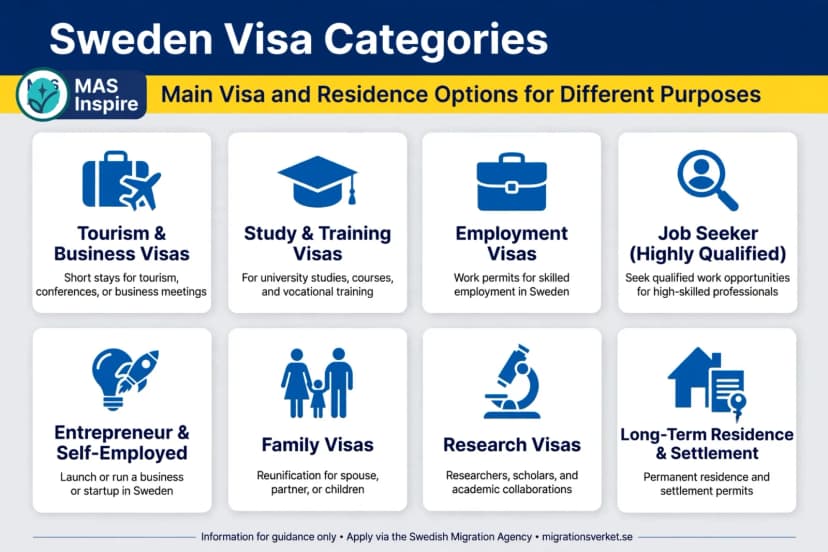
Types of Sweden visas and permits
1. Tourist and private visitor: Schengen visa (up to 90 days)
A short-stay Schengen visa is for tourism, visiting family or friends, and other permitted temporary visits. It allows a stay of up to 90 days in any rolling 180-day period across the Schengen area; it is not 90 days per country. A visa's validity dates and number of entries are distinct from the permitted stay.
Applicants must show a credible purpose, sufficient means, suitable accommodation or arrangements, travel medical insurance and an intention to leave before the authorised stay ends. The standard Schengen insurance requirement is generally at least EUR 30,000 cover, valid throughout the Schengen area. The embassy may request additional evidence.
Work is not authorised by an ordinary tourist visa. Business meetings, conferences and commercial visits may be possible within the rules for business visitors, but taking up employment is different and may require a work permit.
2. Business visitor
A business traveller may use a short-stay Schengen visa if their nationality requires one and the activities are permitted visitor activities, such as meetings or conferences. An invitation from the Swedish host, employer letter, itinerary and explanation of who pays expenses can support the application. A visit visa is not a route to take up a job in Sweden.
For exceptional business or conference visits exceeding 90 days, the Migration Agency describes a visitor's residence permit route. It is not a general substitute for a work permit.
3. Student residence permit
Non-EU/EEA nationals planning higher-education studies in Sweden for more than three months normally need a residence permit for studies. Applicants must be finally admitted to full-time studies, have paid any tuition fee required before applying, demonstrate maintenance funds and hold comprehensive health insurance when the course is shorter than one year. Distance learning alone does not qualify for this permit.
For applications made in 2026, the published maintenance amount is SEK 10,656 per month. The amount is assessed for the full permit period. Funds may come from qualifying personal bank assets, scholarship, student grant or loan, sponsor, or income from employment, subject to the Agency's evidence rules.
A student permit is not an unrestricted general work permit. The Migration Agency's student-permit guidance should be checked for current work conditions and any restrictions attached to the individual decision. Students should not assume that part-time earnings will replace the required financial evidence at application stage.
4. Employee work permit
Most non-EU/EEA citizens need a work permit before starting employment in Sweden. The applicant normally needs a genuine offer from a Swedish employer. The employer initiates the application and provides information about the employment; the applicant then completes their part.
The terms must meet Swedish standards, including applicable collective agreements or common practice, required insurance and the salary rule in force on the relevant application/decision date. From 1 June 2026, the Migration Agency states that a new salary threshold applies to relevant first-time work-permit cases: at least 90% of Sweden's median salary at the time of application, as well as a salary in line with collective agreements or common practice. The current published figure on the Agency page checked for this guide is SEK 34,470 per month, based on a median salary of SEK 38,300 from 16 June 2026. Transitional rules and exemptions apply to specified groups; check the official page before relying on the amount.
A work permit may normally be granted for up to two years, but not beyond the employment contract or passport validity. It may be extended. A permit is generally tied to the job/employer or occupation conditions specified in the decision; a change may require a new application.
5. EU Blue Card for highly qualified workers
The EU Blue Card is a separate residence and work permit for highly qualified employment, and an alternative to the ordinary employee work permit for people with a higher-education degree or long professional experience and a high salary. It is governed by chapter 6 a of the Swedish Aliens Act, and the Swedish Migration Agency (Migrationsverket) decides applications.
To qualify, the applicant must have a valid passport, higher education corresponding to at least 180 higher-education credits (about three years of full-time study) or at least five years of relevant professional experience, and an employment contract for highly qualified work lasting at least six months, signed by both the applicant and the employer. The salary must be at least SEK 53,625 per month before tax — 1.25 times the average gross salary in Sweden published by the Swedish National Mediation Office. The Migration Agency sets the threshold each year; the work-permit reform of 1 June 2026 made no change to it. Salary, insurance and other terms must also be at least on par with Swedish collective agreements or common practice in the occupation. Comprehensive health insurance is required for the whole stay.
The employer starts the application in the Migration Agency's e-service, and the applicant then completes their part online, attaches documents and pays the fee. The relevant trade union is given the opportunity to comment on the terms of employment. Since 1 June 2026, a first EU Blue Card can be granted for up to four years at a time; if the employment is shorter, the card must cover the employment period plus three months. Family members can be granted residence permits for the same period. The card also offers intra-EU mobility: a person who has held a Blue Card in another EU country for at least 12 months can move to Sweden and apply within one month of arrival. After four years of work in Sweden during the past seven years, a Blue Card holder may be able to apply for permanent residence.
6. Job-seeker permit for highly qualified applicants
Sweden has a residence-permit route for a person who has completed studies corresponding to a second-cycle qualification (for example, a qualifying master's degree) and wants to look for work or explore starting a business. This is not a general job-seeker visa open to every job applicant. The applicant must satisfy the qualification, passport, financial-maintenance and insurance requirements. The permit can be granted for a maximum of nine months. The current application fee shown by the Agency is SEK 2,200; the published statistic for complete applications is 75% decided within five months.
Separate post-study and post-research routes are available to people who have completed qualifying studies or research in Sweden. Graduates must apply before their current study permit expires and meet the relevant completion, maintenance and insurance conditions. A qualifying graduate route may allow up to one year; the doctoral/research route can have a different maximum.
7. Self-employed person / entrepreneur
A non-EU/EEA national who intends to run their own business in Sweden may apply for a residence permit for self-employed people. This is a substantive business route, not a passive investor or “golden visa.” The applicant must have relevant industry and business experience, knowledge of Swedish or English, and must run the business and own at least 51% of it. The Migration Agency also assesses the business plan, ability to support oneself and the business's prospects. Verify the exact financial and documentary requirements on the official page before applying.
8. Researcher and doctoral researcher
A researcher invited by an approved research principal may qualify for a researcher residence permit, usually supported by a hosting agreement. The researcher must meet the relevant academic and institutional conditions; the Agency states that at least 50% of working hours must be devoted to research. Doctoral candidates may qualify through the research route where the hosting-agreement conditions are met. Do not assume every PhD enrolment automatically uses the same permit category: confirm whether the university classifies the arrangement as studies or research.
9. Family reunification / moving to a partner
A person may apply to live with a spouse, registered partner, cohabiting partner or qualifying family member in Sweden. The person in Sweden generally must have the appropriate status and, in many cases, meet maintenance and housing requirements. Applicants need to prove identity and the genuine family relationship. Marriage alone does not guarantee a permit, and different rules apply depending on the sponsor's status and whether the sponsor is Swedish, an EU/EEA citizen, a worker, student or protection beneficiary.
10. Visitor's residence permit (more than 90 days)
For a genuine temporary visit of 90 days or longer, a visitor's residence permit may be relevant. It is not permission to settle or work. For a tourist visit, the Migration Agency says the total authorised visit may be limited to six months. The general financial benchmark shown for visitor applications is SEK 700 per day, and travel medical insurance is required in applicable cases. Fees shown are SEK 1,500 for adults and SEK 750 for children.
11. Permanent residence
Permanent residence is not an entry visa. It may become available after a qualifying period and satisfaction of the rules attached to the applicant's permit route. For example, a work-permit holder applying in connection with an extension may need to have held and complied with work permits and worked in Sweden for four of the past seven years, demonstrate sustainable self-support and meet other requirements. The rules differ by route and may change; time spent in Sweden on a student permit should not be assumed to count in the same way as qualifying work-permit residence.
12. Transit
A transit passenger may need an airport transit visa depending on nationality, itinerary, airport and whether they remain in the international transit area. An airport transit visa does not authorise entry into Sweden. Check the official Schengen list and the airline/airport routing requirements for the exact itinerary.
13. Exchange, internship and training
Exchange students generally apply under the study category that matches their programme. Some unpaid volunteer or internship placements may fall under a visitor's residence permit or a specific exchange/internship route. Paid internships may require a different permit. The activity, remuneration, programme structure and host organisation determine the correct category.
14. Humanitarian protection
Asylum is for people who seek international protection and must be assessed on the facts of an individual protection claim. It is not a general migration or employment route. Sweden also operates the EU Temporary Protection Directive route for eligible people displaced from Ukraine; the Migration Agency's current rules specify who qualifies. Applicants should use official protection information and obtain qualified legal support where appropriate.
15. Digital nomad visa
Sweden does not list a dedicated, general-purpose digital nomad visa in the Migration Agency's standard permit categories. Remote work for a foreign employer does not by itself create a right to reside in Sweden. A person must qualify under an existing immigration category and comply with tax and employment rules.
Comparison table
| Route | Main purpose | Typical stay / status | Work rights |
|---|---|---|---|
| Schengen visa | Tourism, private visit, permitted business visit | Up to 90 days in 180 | No ordinary employment |
| Visitor residence permit | Temporary visit over 90 days | Case-specific; tourist visit generally up to six months | No |
| Higher-education study permit | Full-time study | Based on study period | Check current student rules and permit conditions |
| Employee work permit | Employment with qualifying Swedish employer | Up to two years initially in many cases | As authorised by permit |
| EU Blue Card | Highly qualified employment, salary at least SEK 53,625/month | Up to 4 years | As authorised by permit (highly qualified role) |
| Highly qualified job-seeker | Find work / explore business after qualifying degree | Up to nine months | Not a general employment permit |
| Self-employed | Run qualifying Swedish business | Case-specific | Business activity under permit |
| Researcher | Approved research with hosting agreement | Based on research arrangement | Research activity |
| Family permit | Live with qualifying family member | Case-specific | Depends on permit category |
| Permanent residence | Long-term settlement after qualifying residence | Permanent status | Subject to status and general law |
| Asylum / temporary protection | International protection | Protection-specific | Rules depend on status |
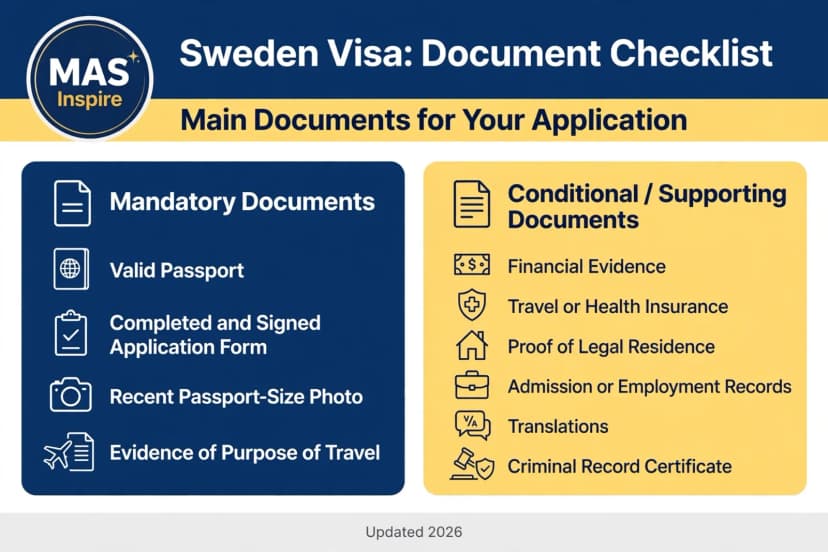
Eligibility and document checklists
The following are planning checklists, not a universal fixed document count. The official application page for the selected category controls. Documents not required in every case are marked conditional.
Short-stay Schengen visa
| Document | Status |
|---|---|
| Valid passport and copies of relevant pages | Mandatory |
| Completed application and photograph, as instructed | Mandatory |
| Travel medical insurance meeting Schengen rules | Mandatory |
| Evidence of purpose, itinerary and accommodation | Mandatory/supporting, depending on case |
| Bank statements, payslips or sponsor evidence | Financial evidence |
| Employment letter, business registration or study evidence | Conditional |
| Invitation and host details | Conditional |
| Evidence of legal residence in Vietnam, if applying there | Important for local jurisdiction |
| Previous passports/visas and travel history | Supporting |
Student residence permit
| Document | Status |
|---|---|
| Valid passport | Mandatory |
| Final admission to full-time qualifying studies | Mandatory |
| Proof tuition fee paid, where tuition is due | Mandatory before decision/application as instructed |
| Evidence of funds for the full permit period | Mandatory |
| Comprehensive health insurance for studies under one year | Mandatory where applicable |
| Scholarship, grant, loan or sponsor evidence | Conditional financial evidence |
| Family relationship and additional maintenance evidence | Conditional |
Employee work permit
| Document | Status |
|---|---|
| Valid passport | Mandatory |
| Employment offer and employer's application details | Mandatory |
| Employment terms, salary and insurance details | Mandatory |
| Evidence of qualifications/licence | Conditional on occupation |
| Professional registration or recognition | Conditional |
| Family documents | Conditional for accompanying family |
| Additional evidence requested by the Agency | Conditional |
Family residence permit
| Document | Status |
|---|---|
| Applicant's valid passport | Mandatory |
| Sponsor's identity and residence-status details | Mandatory |
| Marriage, partnership or birth certificates | As relevant |
| Evidence of relationship history / cohabitation | Where requested |
| Sponsor's income and housing evidence | Where maintenance requirement applies |
| Child custody, consent or guardianship documents | Conditional |
| Certified translations | Where documents are not in accepted language |
Documents should generally be in Swedish or English, or accompanied by a certified translation and a copy of the original. Names, dates and passport details must match across records. Do not submit altered documents or unsupported statements.

How to apply
The steps differ by route, but most applications follow this pattern:
- Choose the correct category. Decide whether the purpose is a short visit, study, employment, research, family migration or another specific route.
- Check nationality and residence rules. Determine whether your passport requires a Schengen visa and which embassy/consulate or visa centre handles applications where you legally live.
- Read the official category page. Check current eligibility, fee, funds, insurance, forms and supporting evidence.
- Prepare documents. Scan legibly; translate documents where necessary; make sure dates and personal details agree.
- Use the official e-service or form. For many residence permits the Migration Agency provides an online application. For employee permits, the employer normally starts the process.
- Pay the government fee. Follow the official payment instructions. A visa centre may charge separate service or courier fees.
- Attend biometrics or interview. Follow the instructions for passport presentation, fingerprints, photograph and any interview. Schengen visa applicants normally provide biometrics unless an exemption applies.
- Submit and retain confirmation. Keep the case number, receipt and copies of submitted material.
- Monitor the case. Use the official account or case-status instructions. Respond to requests by the stated deadline.
- After the decision. If approved, check the decision, permit card and entry requirements before travel. A visa or permit does not remove border-control checks.
Fees and financial requirements
Fees below are the government application amounts displayed on the official pages checked for this guide. They do not include tuition, translation, travel, insurance, VFS service or courier charges.
| Category | Government fee (published) | Financial requirement / note |
|---|---|---|
| Student permit, adult | SEK 1,500 | SEK 10,656/month for 2026 applications |
| Student permit, child | SEK 750 | Additional family maintenance may apply |
| Employee work permit | SEK 2,200 | Salary threshold and employment conditions apply |
| Work-permit family, adult | SEK 1,500 | Family maintenance may apply |
| Work-permit family, child | SEK 750 | Family maintenance may apply |
| Highly qualified job-seeker | SEK 2,200 | Funds for entire stay and insurance |
| EU Blue Card, main applicant | SEK 2,000 | Salary at least SEK 53,625/month; contract of at least 6 months |
| EU Blue Card family, adult | SEK 1,500 | Family maintenance may apply |
| EU Blue Card family, child | SEK 750 | Case-specific |
| Visitor residence permit, adult | SEK 1,500 | Generally SEK 700/day |
| Visitor residence permit, child | SEK 750 | Generally SEK 700/day |
| Partner/family permit, adult | SEK 2,000 | Sponsor maintenance/housing may apply |
| Partner/family permit, child | SEK 1,000 | Case-specific |
| Schengen visa | €90 adult / €45 child aged 6–11 (under 6 free) | Insurance and means of support |
Work salary rule: From 1 June 2026 the Agency states that the relevant work-permit salary threshold is 90% of the Swedish median salary at the application date, alongside collective-agreement/common-practice terms. The figure shown when checked was SEK 34,470/month. The Agency lists transitional rules and exemptions. Confirm the live figure immediately before filing.
Processing times and validity
Processing times are not guarantees. The Migration Agency publishes rolling statistics based on cases decided during the preceding 12 months; complete applications may be handled faster than cases requiring more information. At the time checked, the higher-education first-time page showed 75% of recently decided cases within three months; the complete highly qualified job-seeker applications page showed five months; and visitor residence permit applications from outside Sweden showed three months. Work-permit times vary by occupation, employer, completeness and checks, so no single reliable estimate is stated here.
| Route | Published statistic checked | Validity / duration |
|---|---|---|
| Higher-education first application | 75% within 3 months | Study period, subject to decision |
| Highly qualified job-seeker, complete cases | 75% within 5 months | Up to 9 months |
| Visitor permit over 90 days, outside Sweden | 75% within 3 months | Case-specific |
| Employee work permit | Varies; check live statistics | Up to 2 years initially in many cases |
| EU Blue Card | 75% within 1 month (complete cases) | Up to 4 years (employment + 3 months if shorter) |
| Schengen visa | Case- and season-dependent | Up to 90 days in any 180-day period |
Applying from Pakistan or Vietnam
Pakistani passport holders applying from Pakistan
The Sweden Abroad Pakistan page states that Pakistani nationals and other nationals legally residing in Pakistan may apply for a Schengen visa in Islamabad. VFS Global accepts short-stay applications on behalf of the Swedish Migration Agency; VFS does not decide the case. Follow the current VFS Pakistan instructions for appointment availability, documents and local service charges.
For national residence permits, use the Migration Agency's category-specific online process and follow its instructions about the responsible Swedish mission for passport checks, interview or biometrics. Do not assume the short-stay VFS process is the same as a residence-permit process.
Pakistani passport holders legally living or working in Vietnam
A valid Vietnamese residence card or work permit is useful evidence that you lawfully live in Vietnam, but it does not remove the Schengen visa requirement attached to a Pakistani passport and does not guarantee that an application will be accepted locally.
Two official changes are particularly important:
- Sweden's Embassy in Bangkok has handled migration matters for people legally residing in Vietnam since 1 June 2026, including long-stay visa/residence-permit matters.
- Short-stay Schengen applications for Sweden from Vietnam are handled by the Embassy of Sweden in Bangkok, with applicant-facing VFS Global services in Hanoi or Ho Chi Minh City.
For a short-stay application, use the Sweden Abroad Vietnam instructions and the VFS Vietnam site. The Embassy page checked states additional VFS charges of EUR 29 service fee and EUR 21 courier fee, in addition to the visa fee; verify current charges at booking. For residence permits, contact the Bangkok migration section as directed by Sweden Abroad. Do not travel to an embassy without an appointment.
Applying from Vietnam versus Pakistan
The substantive Swedish eligibility rules are based on the permit category and applicant circumstances, not simply on the country where the application is lodged. The practical differences are the responsible mission, application centre, appointment arrangements, local fees and evidence of lawful residence. A Pakistani applicant resident in Vietnam should provide clear proof of Vietnamese legal residence and explain their employment, study or other ties there where relevant. If the person no longer legally resides in Vietnam, the competent mission may be different.
Student residence permit
A student should first secure admission to a Swedish university or other qualifying institution. The admission must be final and full-time. If tuition is charged, pay it as instructed; the Migration Agency says an applicant is only considered finally admitted once the tuition fee has been paid. Apply early enough for the permit decision before the programme begins.
For a 2026 application, plan for at least SEK 10,656 per month for the entire requested permit period, subject to any official reduction for qualifying free food or accommodation. Keep funds accessible and documented in a form accepted by the Agency. A sponsor letter alone should not be assumed sufficient without the required evidence.
If studies last less than one year, comprehensive health insurance is required unless qualifying institutional cover applies. For studies lasting at least one year, the student should register in the Swedish Population Register as instructed. A student may be able to work while holding a study permit, but work must not undermine study progress or violate permit conditions. Check the Migration Agency's current rules and the conditions on the decision rather than relying on an assumed weekly hour limit.
After completing qualifying higher education in Sweden, a graduate may apply before the current permit expires for a permit to seek employment or explore starting a business. The programme must meet the Agency's completion and duration rules. This is a separate permit, not an automatic extension.
Work permits and job opportunities
A Swedish job offer is normally the starting point for a standard employee work permit. Applicants should be cautious of recruiters who promise a permit without a real employer, contract and compliant salary. The employer has an active role in the application and must provide accurate information about employment conditions.
The 2026 salary change is significant: the Migration Agency states a threshold of 90% of the median salary in force at application, subject to collective agreement/common practice and specified exceptions or transition rules. Check the current threshold and whether an exemption applies to you. A job title alone does not prove eligibility.
Potential sectors include technology, engineering, healthcare, manufacturing, research and skilled trades, but each regulated occupation may require Swedish recognition, registration or language competence. A residence permit to seek work is available only to applicants who meet its specific qualification conditions; it is not a general alternative to having a job offer. Highly qualified applicants with a degree or five years of relevant experience and a job offer paying at least SEK 53,625 per month should also consider the EU Blue Card route described above, which can be granted for up to four years.
Family immigration and permanent residence
Family members may sometimes apply with a worker, researcher or student, or later apply to join a qualifying sponsor in Sweden. The permitted family definition and maintenance evidence depend on the sponsor's permit. Spouses, registered partners, cohabiting partners and children under 18 are commonly covered in relevant routes, but the rules are not identical across all categories.
For partner applications, prepare identity and relationship documents and any evidence of living together. Where the maintenance requirement applies, the sponsor may need to demonstrate adequate income and suitable housing. Children may require birth certificates, custody documents or consent from a parent who is not moving.
Permanent residence is a later status, not something granted simply because a person has a Swedish visa. Work-permit holders may be eligible in connection with an extension after four years of qualifying work-permit residence within the relevant seven-year period, provided they met permit conditions and can support themselves sustainably. Other categories have their own rules. Check the route-specific permanent-residence criteria at the time of application.
Common application mistakes
- Choosing a Schengen visitor visa when the real purpose is employment, long-term study or settlement.
- Treating a residence permit and a visa as interchangeable.
- Assuming a Vietnamese residence card changes the visa requirement of a Pakistani passport.
- Applying from Vietnam without checking the Bangkok mission/VFS allocation.
- Using outdated financial thresholds or salary figures.
- Providing bank statements that do not establish access to the required funds.
- Failing to pay tuition before applying for a study permit where required.
- Submitting inconsistent names, dates, translations or passport copies.
- Assuming a visitor or tourist permit allows work.
- Buying non-refundable travel before the decision or before checking entry-card requirements.
- Relying on an agent who claims to guarantee approval.
Reasons for visa refusal
A refusal may result from insufficient or unreliable evidence, unclear travel purpose, inadequate funds, unsuitable insurance, doubts about the intention to leave after a short visit, inconsistent documents, failure to meet the permit's eligibility conditions, an employment offer that does not satisfy the rules, or failure to respond to a request. The decision letter should explain the grounds and any appeal instructions. Do not submit fabricated evidence or conceal relevant facts.
Frequently asked questions
1. Do Pakistani citizens need a visa for Sweden?
Yes, Pakistani passport holders generally need a Schengen visa for short visits to Sweden. For stays over 90 days or for work, study or family migration, the relevant residence-permit route may apply.
2. Can a Pakistani living in Vietnam apply for a Swedish visa in Vietnam?
Yes, short-stay applications are handled through the Sweden-in-Vietnam arrangements, with VFS centres in Hanoi and Ho Chi Minh City and the Embassy in Bangkok handling the applications. The applicant must check local jurisdiction and prove lawful residence in Vietnam.
3. Does a Vietnam work permit guarantee a Swedish visa?
No. It may help prove lawful residence and employment ties, but it does not guarantee approval or remove nationality-based visa requirements.
4. What is the Swedish student maintenance amount for 2026?
The Migration Agency lists SEK 10,656 per month for applications made in 2026. Check the official page for permitted evidence and any reductions.
5. How much is the Swedish student residence permit fee?
The listed fee is SEK 1,500 for an adult and SEK 750 for a child under 18, subject to exemptions.
6. Can international students work in Sweden?
Students should check the current Migration Agency rules and their permit conditions. Do not rely on an assumed fixed weekly-hour cap; study progress and compliance remain important.
7. What is the 2026 Swedish work permit salary threshold?
The Agency states that from 1 June 2026 the relevant threshold is 90% of the median salary at application. The published figure checked for this guide was SEK 34,470 per month, with exemptions and transitional provisions.
8. Can I move to Sweden without a job offer?
A limited permit exists for highly qualified applicants with a qualifying second-cycle degree to look for work or explore starting a business. It is not open to all applicants and can last up to nine months.
9. Is there a Sweden digital nomad visa?
The Migration Agency does not list a dedicated general digital-nomad permit. Remote work does not by itself grant a right to reside in Sweden.
10. How long does a Swedish student permit take?
The Agency's page showed 75% of recently decided first-time higher-education applications decided within three months when checked. This is a rolling statistic, not a guarantee.
11. Can I work on a tourist visa?
No. A short-stay tourist visa does not authorise ordinary employment in Sweden.
12. Can my spouse and children join me?
Depending on your permit category and circumstances, eligible family members may apply with you or later. Maintenance, relationship and identity evidence may be required.
13. Is permanent residence automatic after four years?
No. Certain work-permit holders may qualify after four years of qualifying work-permit residence within seven years, but must also meet conditions including sustainable self-support. Other permit categories have different rules.
14. Where do I apply for a Sweden visa in Vietnam?
For short-stay Schengen applications, the official Sweden Abroad page directs applicants to VFS Global centres in Hanoi or Ho Chi Minh City, with the Embassy in Bangkok handling applications. For migration matters/residence permits, the Bangkok Embassy is responsible for people legally residing in Vietnam from 1 June 2026.
15. Does Sweden have a job seeker visa?
There is a specific residence permit for highly qualified people with a qualifying second-cycle qualification, plus separate post-study and post-research routes for eligible people who completed studies or research. These are not general job seeker permits.
16. What is the EU Blue Card salary threshold for Sweden?
The EU Blue Card requires a salary of at least SEK 53,625 per month before tax — 1.25 times the average gross salary in Sweden. Applicants also need a degree of at least 180 higher-education credits or five years of relevant professional experience, and a contract for highly qualified work lasting at least six months. The card can be granted for up to four years, and the application fee is SEK 2,000 for the main applicant.
Official websites
- Swedish Migration Agency (Migrationsverket)
- Schengen visa: visits up to 90 days
- Visitor residence permit: more than 90 days
- Higher-education study permit
- Employee work permit
- Work-permit salary requirements
- EU Blue Card: new work-permit rules from 1 June 2026 (threshold unchanged at SEK 53,625)
- Highly qualified job-seeker permit
- Self-employed permit
- Researcher permit
- Sweden Abroad: Vietnam migration update
- Sweden Abroad: apply for a visa in Vietnam
- Sweden Abroad: Pakistan visits
- Sweden Abroad: Bangkok visa jurisdiction
Final checklist and conclusion
Before submitting, confirm that you have:
- Selected the correct visa or residence-permit category.
- Checked passport nationality, legal residence and the responsible mission.
- Read the latest official category-specific checklist.
- Prepared valid passport copies and certified translations where required.
- Met the financial, salary, tuition and insurance requirements applicable to your case.
- Paid the correct government fee and any separate service fee.
- Booked the correct appointment for biometrics or interview.
- Kept copies of the application and payment confirmation.
- Checked the decision and entry requirements before travelling.
Sweden offers several distinct routes for visitors, students, employees, researchers, entrepreneurs and family members. The safest approach is to match the purpose of travel to the correct official category and verify every threshold immediately before applying. MAS Inspire provides educational guidance only; the Swedish authorities decide each application.


