By MAS Inspire | Last reviewed: 27 November 2026 (key figures re-verified 27 November 2026)
Important: Immigration rules, fees, forms, visa channels and processing targets can change. Confirm the checklist and fee with the South African mission or official application portal responsible for your place of lawful residence before submitting.
On this page
- Introduction
- Why people visit, study and work
- Visa types
- Visa comparison
- Eligibility
- Document checklists
- Application steps
- Fees and finances
- Processing times
- Pakistan and Vietnam
- Student guide
- Work and jobs
- Family and residence
- Mistakes
- Refusals
- FAQs
- Official websites
- Final checklist
Introduction
South Africa attracts international visitors for wildlife and nature tourism, business, education, family visits, professional opportunities and retirement. Before travelling, it is essential to identify the correct immigration permission. The right route depends on nationality, purpose, length of stay, intended activities and, for some applicants, the country where they legally reside.
South Africa uses several different immigration permissions. A visitor visa is not interchangeable with a study visa or work visa. A temporary residence visa is not permanent residence. An eVisa or ETA is an electronic application or travel-permission channel, not a blanket right to work or settle.
This guide explains the main routes and the documents applicants should prepare. It is educational information, not legal advice, and no visa outcome is guaranteed.
Why People Visit, Study, and Work in South Africa
South Africa offers internationally recognised universities, diverse landscapes, major commercial centres, cultural attractions and opportunities in selected professional sectors. Cape Town, Johannesburg, Pretoria, Durban and other cities attract visitors, students, business travellers and foreign employees.
The purpose of travel determines the immigration route. A person attending meetings may qualify for a visitor permission, while someone taking up a paid position with a South African employer normally needs an appropriate work visa. A student enrolling in a qualifying programme needs a study visa. A person working remotely for an overseas employer may need to examine the prescribed remote-work visitor visa requirements rather than assume ordinary visitor status is sufficient.
Types of South Africa Visas
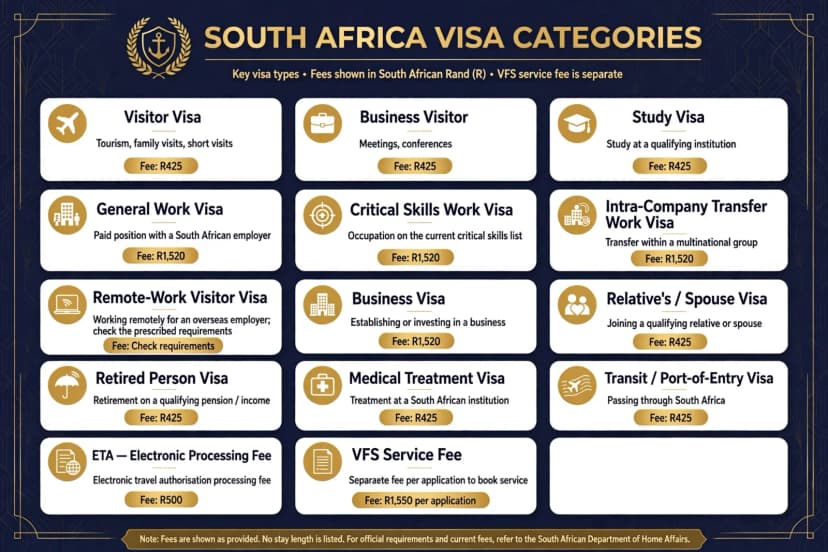
1. Visitor visa
A visitor visa is generally used for tourism, visiting friends or relatives, short business visits, conferences and other activities permitted under section 11 of the Immigration Act. The actual endorsement and permitted stay are determined by the visa and border admission. A visitor visa does not ordinarily permit employment in South Africa.
Applicants may need to show a valid passport, purpose of visit, accommodation, sufficient means, return or onward travel and any invitation or host details requested by the mission. A visitor visa is commonly issued for a stay of up to 90 days, but the actual permission granted must be checked.
2. Business visitor
A short business visit may fall under visitor-visa provisions where the activities are permitted, such as attending meetings, negotiations or a conference. It is not the same as a business visa for establishing or operating an enterprise in South Africa. Do not perform productive local employment merely because the trip is described as a business visit.
3. Study visa
A study visa under section 13 is for a foreign national accepted by a qualifying South African educational institution. Applicants generally need an official acceptance or enrolment letter, evidence of funds, appropriate medical cover, police and medical documents where required, and parental/guardian documents for minors. Study-visa holders may have limited part-time work rights subject to the applicable conditions; check the current endorsement and rules before working.
4. General work visa
A general work visa under section 19(2) is intended for a foreign national with a South African employment offer where the employer satisfies the applicable labour-market and recruitment requirements. The employer must provide prescribed evidence, and the application is assessed under the current points-based criteria. The visa is tied to its conditions and the approved employment.
5. Critical skills work visa
This route is for applicants whose occupation and qualifications meet the current critical skills framework. Applicants should verify the current gazetted critical skills list, qualification recognition or professional registration requirements, and the current points-based criteria. The DHA/VFS checklist currently warns that a critical skills work visa is not a work-seeker visa and requires an offer of employment from a verifiable employer in good standing. Do not rely on older advice that suggests the route automatically permits entry to search indefinitely for work.
6. Intra-company transfer work visa
This visa is for an employee transferred from a foreign branch, subsidiary or affiliate to a related South African entity. The application generally requires evidence of the existing foreign employment, the transfer arrangement, the receiving entity and the role in South Africa. The statutory framework provides for a maximum period of four years and the permit is not renewable under the standard route. Employers should verify the current skills-transfer and undertaking requirements.
7. Remote-work visitor visa
South Africa has a prescribed-activity visitor visa for qualifying remote work performed for a foreign employer under a contract. The prescribed minimum gross income from the foreign employer is R650,976 per year (Muse enhancement, verified 25 Nov 2026). The applicant should review the current official remote-work checklist, including contract, employer and income/tax evidence. The holder is not entitled to take up employment in South Africa. It is not a substitute for a general or critical skills work visa for a local job.
8. Business visa
A business visa under section 15 is for a foreign national intending to establish or invest in a business in South Africa. Government guidance describes a minimum investment of R5 million, with the possibility of a waiver in appropriate circumstances, and a requirement for a recommendation from the Department of Trade, Industry and Competition (dtic). The business must satisfy prescribed economic and employment criteria, including the stated South African/permanent-resident workforce requirement. Business visas may be granted for no longer than three years at a time under the published government guidance. Confirm current rules and any waiver route with DHA and dtic.
9. Relative’s visa and spouse/family routes
A relative’s visa under section 18 is for qualifying relatives of South African citizens or permanent residents. A spouse or life partner may qualify under the relevant provisions, subject to proof of a genuine relationship and supporting civil documents. A visa allowing residence does not automatically authorise employment; work rights depend on the specific endorsement and current law. Dependent children may have separate routes.
10. Retired person visa
A retired person visa under section 20 is for applicants who meet the prescribed retirement-income or financial criteria. Government and mission guidance has cited a minimum monthly income of R37,000 from a qualifying pension, annuity or retirement arrangement. Because financial thresholds can be amended and mission checklists may differ, confirm the current amount and acceptable evidence before applying.
11. Medical treatment visa
A medical treatment visitor visa under section 17 is for a person travelling to South Africa to receive medical treatment. Applicants should expect to provide a letter from the treating institution, details and expected duration of treatment, financial arrangements and any additional medical evidence requested.
12. Exchange and treaty visas
Exchange visas under section 22 and treaty visas under section 14 apply to qualifying exchange programmes or activities under international agreements. Applicants need the relevant programme or treaty documentation and should confirm the category with the institution or responsible government department.
13. Transit visa and port-of-entry permission
A transit visa may be required for a traveller passing through South Africa en route to another country, depending on nationality, route and transit arrangements. Pakistani ordinary passport holders should not assume that airside transit is visa-free: official South African notices state that Pakistani and Bangladeshi ordinary passport holders require the relevant port-of-entry or transit visa when entering or transiting South Africa. Check the airport and airline requirements before travel.
14. Permanent residence
Permanent residence is a separate status, not a long-duration visitor visa. The Immigration Act provides routes including qualifying work history, spouse or child relationships, permanent employment offers, exceptional skills, business, refugee status, retirement, financial independence and qualifying family relationships. The government states that a work-based direct residence route can apply after at least five years on a qualifying work permit, subject to the statutory conditions. Permanent residence is assessed on the applicable legal grounds and is not automatic after a temporary visa.
15. Job seeker, digital nomad and humanitarian routes
South Africa does not provide a general, unrestricted job-seeker visa in the same sense as some other countries. Critical skills and general work routes have their own eligibility and employment requirements. Remote work is addressed through a prescribed visitor-visa activity, not a general digital-nomad settlement category. Humanitarian protection is handled under refugee and asylum law, not as an ordinary visitor or employment visa.
Visa Comparison Table
| Category | Main purpose | Work rights | Typical duration / validity | Fee |
|---|---|---|---|---|
| Visitor | Tourism, family, permitted short business | No ordinary local employment | Often up to 90 days; check endorsement | Check mission / portal |
| Business visitor | Meetings and permitted business visit | No local employment | As endorsed | Check mission / portal |
| Study | Approved education | Limited part-time work may be allowed under conditions | Course-linked | Check mission / portal |
| General work | Employment with South African employer | Only approved employment | As endorsed | Check current fee schedule |
| Critical skills | Eligible critical occupation | Only under visa conditions | As endorsed | Check current fee schedule |
| Intra-company transfer | Transfer within multinational group | Only receiving related entity | Up to four years under standard route | Check current fee schedule |
| Remote work | Work for foreign employer | No South African employment | Category-specific; check current rules | Check mission / portal |
| Business | Establish/invest in enterprise | Business activity under visa | Up to three years at a time in published guidance | Check current fee schedule |
| Relative / spouse | Join qualifying family member | Only if endorsement authorises | Category-specific | May differ by relationship |
| Retired person | Retirement residence | No ordinary employment | As endorsed | Check current fee schedule |
| Medical treatment | Receive treatment | No | Treatment-linked | Check mission / portal |
| Exchange / treaty | Approved programme or treaty activity | Only as permitted | Programme / treaty-linked | Check mission / portal |
| Transit | Transit through South Africa | No | Transit-specific | Check current fee schedule |
| Permanent residence | Long-term settlement | Broad residence rights, subject to law | Indefinite, subject to law | Check current fee schedule |
| Asylum / refugee | International protection | Rights depend on permit and law | Permit / status-specific | Follow refugee process |
Eligibility Requirements
Eligibility is assessed individually. Common factors include:
- A passport accepted by South Africa and valid for the required period.
- A purpose of travel that matches the requested category.
- Compliance with nationality-specific visa or ETA requirements.
- Evidence of lawful residence if applying outside the country of nationality.
- Sufficient funds or a qualifying sponsor where required.
- No disqualifying immigration, criminal, health or security issue under the applicable law.
- Additional evidence for work, study, business, family, retirement or medical routes.
Visa-exempt nationality status is purpose- and duration-specific. A visa exemption for a short visit does not automatically authorise employment, study or residence.
Complete Document Checklists
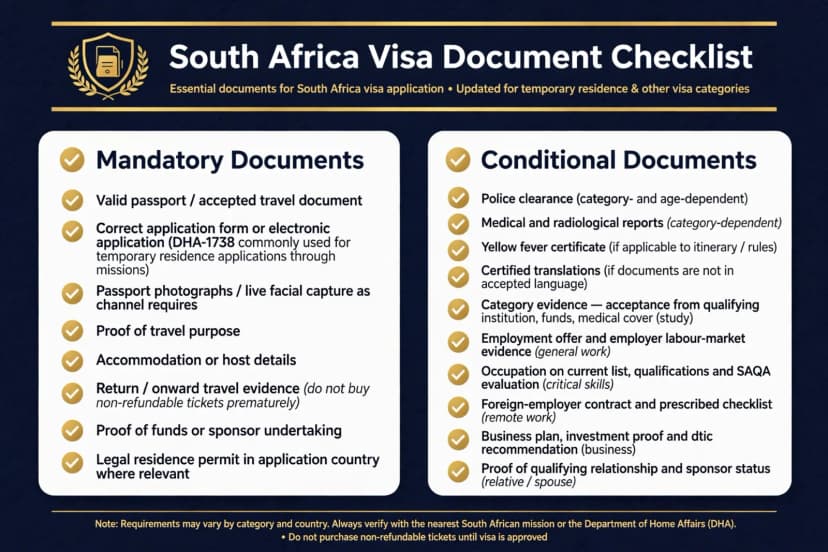
The following tables are planning checklists, not a universal fixed document count. The responsible mission can request additional evidence.
Core identity and visit documents
| Document | Status |
|---|---|
| Valid passport / accepted travel document | Normally mandatory |
| Correct application form or electronic application | Mandatory for relevant route |
| Passport photographs / live facial capture | As channel requires |
| Proof of travel purpose | Mandatory |
| Accommodation or host details | Commonly required |
| Return / onward travel evidence | Commonly required; do not buy non-refundable tickets prematurely |
| Proof of funds or sponsor undertaking | Commonly required |
| Legal residence permit in application country | Required where relevant |
| Police clearance | Category- and age-dependent |
| Medical and radiological reports | Category-dependent |
| Yellow fever certificate | If applicable to itinerary / rules |
| Certified translations | If documents are not in accepted language |
Additional documents by category
| Category | Mandatory / core category evidence | Conditional or supporting evidence |
|---|---|---|
| Visitor | Itinerary, purpose, passport, funds | Invitation, host ID, hotel booking, employer leave letter |
| Business visitor | Meeting / conference purpose | Invitation from South African entity, event registration |
| Study | Acceptance from qualifying institution, funds, medical cover | Guardian consent, birth certificate, accommodation |
| General work | Employment offer and employer labour-market evidence | Qualifications, professional registration, experience |
| Critical skills | Occupation on current list, qualifications and prescribed evidence, employment offer as required by current checklist | SAQA evaluation, professional-body registration |
| Intra-company transfer | Foreign employment and transfer letters | Group structure evidence, skills-transfer plan |
| Remote work | Foreign-employer contract and prescribed checklist | Income evidence, tax documents, employer details |
| Business | Business plan, investment proof and dtic recommendation | Company registration, workforce plan, waiver motivation |
| Relative / spouse | Proof of qualifying relationship and sponsor status | Marriage / birth records, proof of cohabitation or relationship history where applicable |
| Retired | Proof of qualifying pension / annuity / income or assets | Bank statements, actuarial or financial confirmation |
| Medical | Medical institution letter and treatment plan | Cost estimate, proof of payment / funding |
| Exchange / treaty | Programme / treaty sponsorship documents | Institution or government confirmations |
| Permanent residence | Evidence matching a statutory ground | Employment, family, business, retirement or financial evidence |
| Asylum | Personal protection claim made through the designated refugee process | Identity and supporting evidence where available |
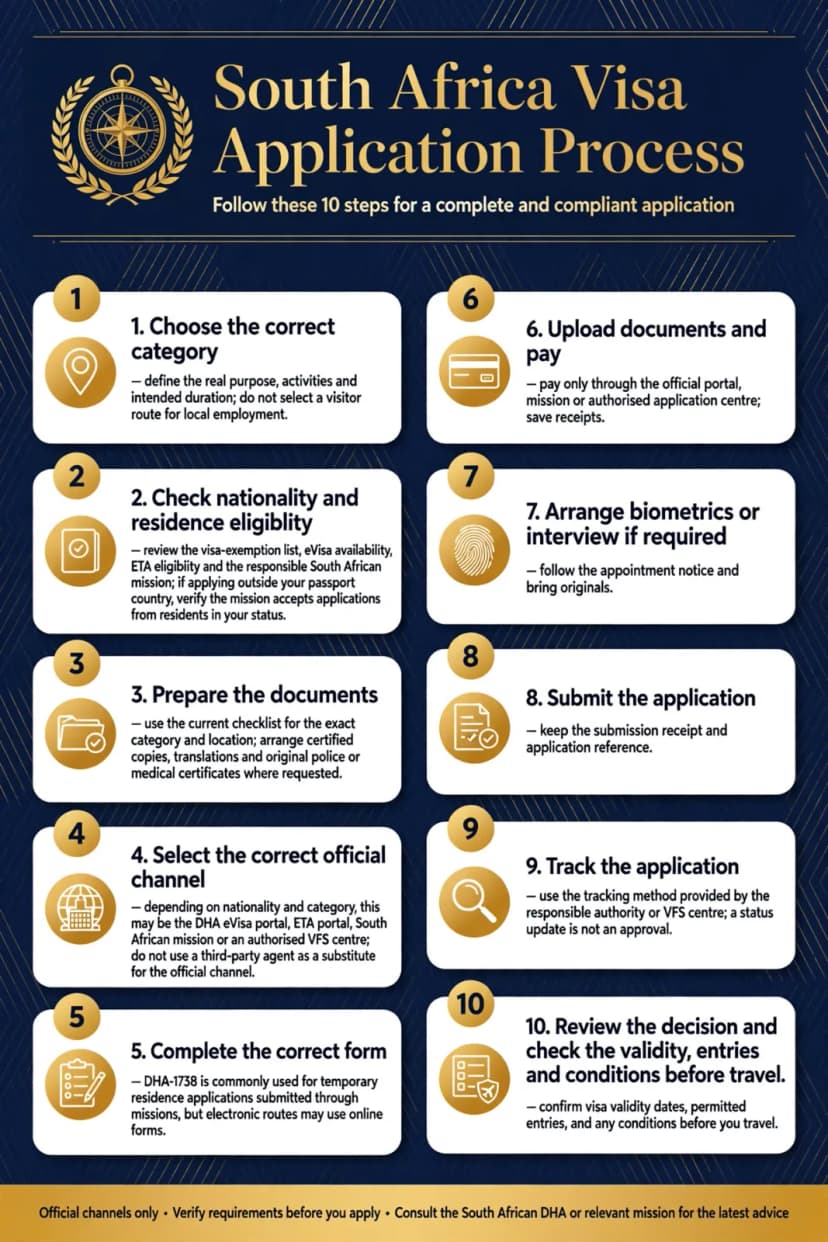
How to Apply: Step-by-Step
- Choose the correct category. Define the real purpose, activities and intended duration. Do not select a visitor route for local employment.
- Check nationality and residence eligibility. Review the visa-exemption list, eVisa availability, ETA eligibility and the responsible South African mission. If applying outside your passport country, verify that the mission accepts applications from residents in your status.
- Prepare the documents. Use the current checklist for the exact category and location. Arrange certified copies, translations and original police or medical certificates where requested.
- Select the correct official channel. Depending on nationality and category, this may be the DHA eVisa portal, ETA portal, South African mission or an authorised VFS centre. Do not use a third-party agent as a substitute for the official channel.
- Complete the correct form. DHA-1738 is commonly used for temporary residence applications submitted through missions, but electronic routes may use online forms. Follow the current instructions.
- Upload documents and pay. Pay only through the official portal, mission or authorised application centre. Save receipts.
- Arrange biometrics or interview if required. Follow the appointment notice and bring originals.
- Submit the application. Keep the submission receipt and application reference.
- Track the application. Use the tracking method provided by the responsible authority or VFS centre. A status update is not an approval.
- Review the decision and travel conditions. Check the visa label or electronic permission, validity dates, entries, permitted stay and conditions. A visa does not guarantee admission at the border.
Visa Fees and Financial Requirements
Fees can differ by visa type, application location, nationality, exchange rate, service provider and date. Do not combine the DHA application fee with a VFS service fee or a mission's local-currency consular tariff.
A published South African fee amendment in August 2026 lists the following application charges in South African rand for specified categories. These are legal schedule figures, not a guarantee that the same amount will be collected at every overseas mission or electronic channel.
| Application category | Published statutory fee (ZAR) |
|---|---|
| Port-of-entry visa / transit visa | R425 |
| Visitor visa | R425 |
| Study visa | R425 |
| Treaty visa | R425 |
| Medical treatment visa | R425 |
| Relative’s visa for specified non-spouse / non-minor-child relative | R425 |
| Retired person visa | R425 |
| Exchange visa | R425 |
| Business visa | R1,520 |
| Work visa | R1,520 |
| Corporate visa | R1,520 |
| Permanent residence permit | R1,520 |
| ETA electronic processing fee | R500 |
The VFS service fee is separate and can change. Correction (Muse, 25 Nov 2026): the file's "R1,750" figure is wrong — VFS Global's own South Africa information page lists a service fee of R1,550 for every category it covers (read 20 Nov 2026; "a minimum amount of R1550" must be prepaid to book), and no VFS or DHA source for R1,750 was found. Do not use R1,750. In Pakistan, VFS charges a USD 50 service fee per application (paid online at booking) and lists the R425 visa fee at PKR 7,000.
Financial evidence is category-specific. A student must show adequate resources for tuition and living costs and the required medical cover. Business applicants must evidence the prescribed investment and business requirements. Retired-person applicants should verify the current income threshold; government guidance has cited R37,000 per month. Do not use an informal bank-balance figure as a substitute for the official checklist.
Visa Processing Times
The DHA 2026–2027 turnaround circular gives service targets for applications submitted within South Africa. Examples include 60 days for visitor section 11(1), study, exchange and medical-treatment visas; 120 days for some relative, retired-person and treaty categories; four weeks for general work and critical skills visas; and eight weeks for business visas. The circular expressly concerns applications submitted within South Africa. It is not an overseas mission guarantee and does not promise approval.
| Category | Published DHA target for in-country applications (2026–27) |
|---|---|
| Visitor section 11(1) | 60 days |
| Study visa | 60 days |
| Exchange visa | 60 days |
| Medical treatment | 60 days |
| Relative’s visa | 120 days |
| Retired person | 120 days |
| Treaty visa | 120 days |
| General work | 4 weeks |
| Critical skills work | 4 weeks |
| Business | 8 weeks |
| Permanent residence | Category-specific; other categories may take 12–24 months at VFS |
Overseas processing times can differ. Missing documents, verification, security checks, appointment availability and requests for further information can extend the process. Apply early and avoid non-refundable travel bookings until the permission is issued.
Applying from Pakistan or Vietnam
Pakistani passport holders
Pakistani ordinary passport holders require South African entry permission. Official South African notices also state that Pakistani ordinary passport holders require a port-of-entry or transit visa when transiting South Africa. Pakistan appears on the DHA eVisa availability list, but applicants must confirm that their intended category and travel circumstances are supported by the portal.
Applicants applying in Pakistan can start with the official VFS South Africa Pakistan portal. Check the current location-specific checklist, appointment process, fee and submission arrangements. Do not rely on old fee figures or archived checklists.
ETA route (Muse enhancement, verified 25 Nov 2026): since 28 August 2026 Pakistan is live on the Electronic Travel Authorisation (eta.dha.gov.za): R500 processing fee + R425 visa fee = R925 total for visa-required nationals (fee-exempt nationalities pay R500 only). The ETA works only for arrivals at OR Tambo (Johannesburg), Cape Town, King Shaka (Durban) and Lanseria airports; it is typically valid up to 6 months with multiple entries and up to 90 days per stay, with decisions usually within 24 hours. The older eVisa portal is reported to close on 1 December 2026 — confirm on the live portal before choosing a channel. Update (27 Nov 2026): South African Tourism confirmed on 6 November 2026 that the ETA now covers 53 countries — every market previously served by the eVisa — and that the eVisa portal will be deactivated on 1 December 2026, leaving the ETA as the only digital route. Family and group applications, and applications for minors, are now supported on the ETA platform.
Pakistani nationals legally living or working in Vietnam
The South African Embassy in Hanoi lists visas and temporary/permanent permits among its consular services. Its public consular page provides the email address consular.hanoi@dirco.gov.za and states that incomplete applications will not be accepted.
A Pakistani national who legally lives or works in Vietnam should contact the Embassy before lodging an application. Ask whether it accepts the particular visa category from a Pakistani ordinary passport holder whose Vietnamese status is a work permit, temporary residence card, student status or another lawful status. Confirm whether the application must instead be made through the eVisa portal or in Pakistan.
Prepare, where relevant: - Pakistani passport and copies of previous passports. - Valid Vietnamese visa, temporary residence card or work permit. - Evidence of lawful residence and employment in Vietnam. - Employer letter and approved leave, if employed. - South African invitation, admission, employment or sponsor documents appropriate to the category. - Financial evidence, travel purpose and accommodation details. - Police certificates and medical documents if required by the category. - Certified English translations of documents not accepted in their original language.
A Vietnamese residence permit does not itself guarantee that the Embassy in Hanoi will accept the application. Applying from Vietnam may be convenient, but the responsible mission makes the jurisdictional decision. Applicants in Pakistan should follow the Pakistan VFS / High Commission route unless directed otherwise by the authority.
Student Visa Guide
International students need acceptance from a qualifying South African educational institution and a study visa appropriate to the course. The institution's letter should identify the programme and duration. Applicants generally need evidence of sufficient funds for tuition and living expenses, appropriate medical cover from a qualifying scheme, passport, forms, photographs and supporting civil documents.
Applicants aged 18 or older may need police clearances for countries where they have lived for the prescribed period. Medical and radiological reports may also be required. Minors need additional parental consent, birth and guardian documentation. Students should confirm whether their intended institution and course meet immigration requirements before paying deposits.
A study visa does not automatically authorise unrestricted employment. Any permitted part-time work is limited by the current law and visa conditions. Confirm the current work-hour limit with DHA and the institution before accepting paid work. Note (27 Nov 2026): DHA Ministerial Immigration Directive 10 of 2026 (July 2026) waived the medical report requirement for temporary residence visas, and the radiology report has been waived since April 2023 — confirm on the current category checklist whether any medical evidence is still requested.
Work Visa and Job Opportunities
South Africa's main employment routes include general work, critical skills and intra-company transfer visas. The general work route requires an eligible offer and employer evidence. Since October 2024 both general work and critical skills visas are decided on a 100-point test (Muse enhancement, verified 25 Nov 2026): a listed critical-skills occupation scores 100 points on its own; NQF 9–10 qualifications 50, NQF 7–8 30; salary above R976,194/year 50, R650,976–R976,194 20; 5–10 years' experience 20, over 10 years 30; Trusted Employer offer 30; proficiency in an official language 10. A job offer is mandatory. The current critical skills list is the one gazetted 3 October 2023. The critical skills route requires a qualifying occupation and prescribed proof of qualifications or professional standing; current DHA guidance says it is not a general job-seeker visa. The intra-company route is for qualifying transfers within a corporate group.
The employer should take responsibility for the documents required from the South African side. Applicants should not begin work until the correct visa has been issued and its conditions are understood. A visitor visa, ETA, study visa or remote-work visitor visa should not be treated as general permission to work for a South African employer.
Family Immigration and Permanent Residence
A spouse, life partner or qualifying relative of a South African citizen or permanent resident may have a temporary residence route. The applicant should gather civil-status documents and evidence of the relationship, as well as proof of the sponsor's South African citizenship or residence status. Relationship requirements differ by route; do not assume that an informal relationship automatically qualifies.
Permanent residence may be available through qualifying work history, family relationships, permanent employment, exceptional skills, business, retirement, financial independence or refugee-related grounds. Financially independent permanent residence (section 27(f)) requires a certified net worth of R12 million plus a once-off R120,000 fee on approval (Muse enhancement, verified 25 Nov 2026). Each route has separate statutory requirements. A temporary visa does not automatically convert into permanent residence after a fixed period.
Common Application Mistakes
- Selecting a visitor visa when the real purpose is employment or long-term study.
- Assuming a visa exemption or eVisa listing applies to every purpose.
- Treating a transit stop as automatically visa-free.
- Applying in Vietnam without confirming that the Hanoi mission accepts the applicant's nationality and residence status.
- Using an outdated checklist or fee schedule.
- Submitting untranslated or improperly certified civil documents.
- Omitting evidence of legal residence in the country of application.
- Booking non-refundable flights before approval.
- Providing inconsistent dates, employment information or financial evidence.
- Assuming a visa guarantees entry or that an application receipt permits travel.
Reasons for Visa Refusal
An application may be refused if the applicant does not meet the category requirements, submits incomplete or unreliable evidence, fails to demonstrate the purpose or funding of the trip, provides inconsistent information, does not meet health or police-clearance requirements, or is found inadmissible under immigration law. A work application may fail because the employer or job does not satisfy the applicable labour-market, points or sponsorship rules. A family application may fail if the qualifying relationship is not adequately established.
Never submit false documents or conceal relevant information. Read the refusal notice carefully and use the official appeal or review procedure, if available and appropriate. A new application should address the actual refusal grounds.
Frequently Asked Questions
1. Do Pakistani citizens need a visa for South Africa?
Yes. Pakistani ordinary passport holders require the appropriate entry permission. They should check the current eVisa or mission process and also obtain a transit visa when required for transit.
2. Can Pakistani citizens apply for a South African eVisa?
Pakistan is included in the DHA eVisa nationality availability list. The applicant must still confirm that the intended visa type and itinerary are supported by the live portal.
3. Can a Pakistani living in Vietnam apply in Hanoi?
The South African Embassy in Hanoi provides visa services, but its public page does not conclusively confirm acceptance for every Pakistani applicant and residence category. Contact consular.hanoi@dirco.gov.za before applying.
4. Does a Vietnam residence card guarantee local application eligibility?
No. It is evidence of lawful residence, but the South African mission determines whether it has jurisdiction to accept the application.
5. Can I work in South Africa on a visitor visa?
Ordinary visitor permission does not authorise general employment. Use the correct work route or a specifically permitted visitor activity.
6. Is there a South African job-seeker visa?
There is no general unrestricted job-seeker route described in the current main work visa framework. General and critical skills work routes have prescribed eligibility requirements.
7. Can I work remotely from South Africa?
A prescribed remote-work visitor visa exists for qualifying foreign-employer work. It does not authorise employment for a South African employer. Check the current income, tax and contract checklist.
8. How much does a South African visa cost?
The statutory schedule includes different charges by category, while mission tariffs, VFS service fees and electronic fees may differ. Confirm the amount for your application location and category.
9. How long does a South African visa take?
It depends on the category, application location and completeness. DHA's 2026–27 in-country turnaround targets vary from weeks to months and are not overseas guarantees.
10. Can I change from a visitor visa to a work visa inside South Africa?
In general, a visitor's visa cannot simply be converted to another status in-country. The law provides limited exceptions. Confirm the current rule with DHA before relying on an exception.
11. Can international students work?
Study visa holders may have limited work rights under specified conditions. Confirm the current limit and endorsement before working.
12. Can I apply for permanent residence after five years?
Some qualifying work-based applicants may apply after at least five years on a qualifying work permit, subject to statutory requirements and a qualifying permanent employment offer. It is not automatic.
13. Does a visa guarantee entry?
No. A visa permits travel to a port of entry for examination. Admission remains subject to immigration inspection and compliance.
14. Is South Africa's ETA the same as an eVisa?
No. The ETA and eVisa are distinct electronic channels with their own eligibility and conditions. Check the official portal that applies to your nationality and travel purpose.
15. Where can I check official requirements?
Start with DHA, the South African Government visa pages, the relevant South African mission and the official VFS channel where applicable.
Official Immigration Websites
- Department of Home Affairs
- South African Government — Apply for a visa
- DHA eVisa portal
- South African ETA portal
- South African Embassy in Hanoi
- VFS South Africa
- VFS Pakistan
- Permanent residence information
- Refugee and asylum seeker permits
Final Checklist and Conclusion
Before submitting: - Confirm the exact category and permitted activities. - Verify nationality and transit requirements. - Check whether the application channel accepts your nationality and residence status. - Use the current category- and location-specific checklist. - Prepare passport, forms, photos and supporting evidence. - Obtain translations, certifications, police and medical documents where required. - Verify the fee and payment method directly with the responsible authority. - Attend biometrics or interview if requested. - Keep the application reference and receipt. - Check the decision, validity, entries and conditions before travel.
South Africa offers a range of routes for visitors, students, employees, entrepreneurs, family members and retirees. The safest application is one that accurately reflects the applicant's purpose and follows the current official checklist. Always confirm the latest rules with DHA or the responsible South African mission before making travel or financial commitments.
Educational-information disclaimer: This article is general information, not legal advice or a guarantee of visa approval. Immigration law, fees, application channels and processing times may change. MAS Inspire is an independent educational information publisher and is not a South African government department, embassy or visa-issuing authority.