Senegal Visa Guide 2026: Types, Requirements, Documents and Application Steps
Last checked: 28 November 2026. This guide is for Pakistani passport holders living in Vietnam. Visa rules change without notice — always confirm the live rules with the Senegalese mission that handles your application and on the Senegal Ministry of Foreign Affairs website (diplomatie.gouv.sn) before paying any fee or booking a non-refundable ticket.
Introduction
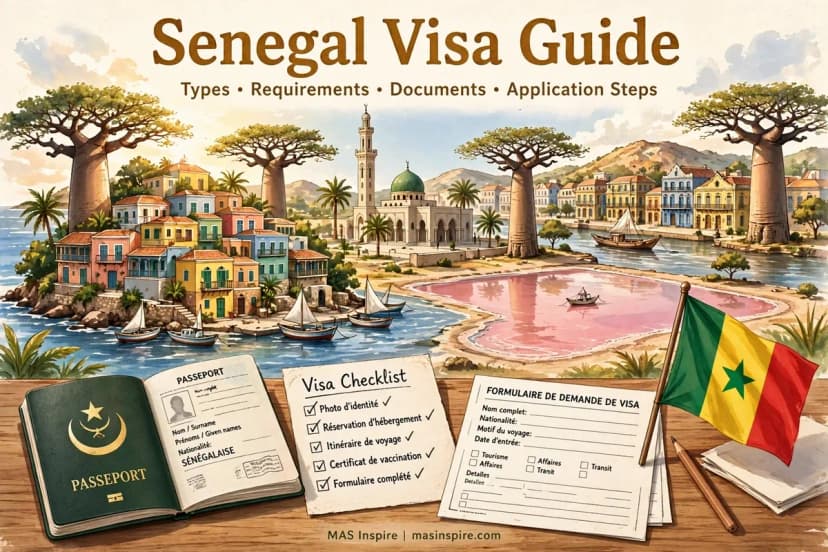
Senegal is the friendliest doorway into French-speaking West Africa: Dakar is a safe, lively Atlantic capital, the island of Gorée is a UNESCO World Heritage site, the pink waters of Lac Rose (Lake Retba) sit an hour from the city, and Saint-Louis carries the old colonial charm of the Senegal River. For a Pakistani living in Vietnam, the trip itself is straightforward — the visa is not. Senegal's rules for Pakistani passports are strict, slow, and currently contradictory in the sources that describe them, and this guide is built around that honesty rather than around a tidy answer that does not exist yet.
The one-line version is this: you need a visa in advance, you get it from a Senegalese embassy or consulate, and the embassy must first consult the Ministry of the Interior in Dakar before it can grant it — which is why you should start at least six weeks before you travel. There is no published fee, no published processing time, and no confirmed online application route for Pakistanis as of 28 November 2026, even though an electronic visa was announced with great fanfare in August 2025. Several commercial websites will tell you otherwise — that you can get a visa on arrival, or pay about USD 85 online, or pre-register on a portal. None of those claims is supported by an official Senegalese source found for this guide, and one of the websites involved has been named fraudulent by Senegal's own Foreign Ministry. This guide names the controlling source for every figure, reports the conflicts instead of hiding them, and tells you exactly which questions to put to the mission in writing before you spend anything.
Senegal sits on the far western edge of Africa, on Greenwich Mean Time, five hours behind Vietnam. French is the official language and the language of every form and every immigration officer; Wolof is the everyday language of Dakar. The currency is the West African CFA franc (XOF). There are no direct flights from Ho Chi Minh City or from Pakistan to Dakar, so your routing — most often through Addis Ababa, Doha, Dubai, Istanbul or Paris — matters to your health paperwork as well as your ticket, because transiting through Addis Ababa triggers the yellow-fever certificate rule. All of that is covered below.
Do Pakistani Passport Holders Need a Visa for Senegal?
Yes. A Pakistani passport holder needs a visa before travelling to Senegal, and there is no visa-free route for you. Senegal's Ministry of Foreign Affairs (the Ministry of African Integration and Foreign Affairs) publishes a list of nationalities that may visit for less than three months without a visa — African states including Morocco, Tunisia, Kenya and Ghana, all European Union states, and a further group including Brazil, Canada, China, India, Japan, Malaysia, Singapore, the United Kingdom and the United States. Pakistan is not on that list, and the ministry states plainly that nationals of any country not listed need a visa to enter Senegalese territory. Holders of refugee travel documents need a visa as well.
Pakistan sits in the strictest of Senegal's three visa categories. The Embassy of Senegal in London publishes the official A/B/C classification: Category A nationalities are visa-exempt; Category B nationalities can obtain a visa on arrival at Dakar's Blaise Diagne International Airport; Category C nationalities must obtain authorisation before flying. Pakistan is listed in Category C, alongside Bangladesh, Sri Lanka, Afghanistan, Iraq, Iran, Lebanon, Yemen and others. The Paris consulate explains the practical difference: for Category B the issuing post can decide on its own, but for Category C the ministry — the Ministry of the Interior in Dakar — must be consulted before the visa is granted. That consultation is the reason a Senegal visa for a Pakistani takes weeks rather than days, and it is the single most important fact in this guide.
The rule follows your passport, not where you live. Living in Vietnam, holding a Vietnamese temporary residence card (TRC), or holding a US, UK or Schengen visa does not change the Senegalese rule. Senegal publishes no exemption for holders of Western visas or residence permits, and the Foreign Ministry's list is the only list that counts. Your Vietnamese residence matters for the journey home, not for the Senegalese visa: keep your TRC valid for the whole trip and carry it with your passport, because it is your proof of the right to return to Vietnam. If your TRC is close to expiry, renew it before you travel.
The e-visa announcement — and why you should not pay online yet. On 22 August 2025, Prime Minister Ousmane Sonko announced an electronic visa system for non-African travellers, built on reciprocity: countries that demand visas from Senegalese citizens would face the same requirement in reverse, applied and paid for online in advance. The announcement, made as part of the National Economic and Social Recovery Plan adopted by the Council of Ministers on 30 July 2025, projected revenue of about 60 billion CFA francs — roughly USD 100 million a year. Pakistan requires visas from Senegalese nationals, so on the reciprocity principle Pakistani passports fall squarely on the paying side of the new door. But as of November 2026, no official platform exists. A November 2026 travel guide that checked the position against official sources reports that "no official platform exists, the Ministry of Foreign Affairs' procedure remains consular only", and a Pakistan-focused guide checked on 19 November 2026 reports that the ministry says no official paid online visa procedure is in force (April 2026). The Foreign Ministry has warned travellers about a fraudulent website, senevisa.com, and in April 2026 stated that visa applications are handled only by its embassies and consulates and that no application fees currently apply. Until a genuine government portal is announced on diplomatie.gouv.sn or by a Senegalese embassy, do not pay any website that offers a Senegal "e-visa". The old portal visasenegal.sn belongs to the 2013–2015 biometric-visa system run by the concession company SNEDAI, under which applicants pre-enrolled online, paid EUR 50, and received a pre-visa by email; that system ended when Senegal lifted visa requirements for most nationalities on 1 May 2015, and its current status could not be confirmed for this guide. A government-domain address, visasenegal.gouv.sn, is cited by one visa aggregator but could not be reached or verified on 28 November 2026 — treat it as unconfirmed and do not pay there without written confirmation from a Senegalese mission.
The "visa préalable" claim. A second conflict needs the same plain treatment. Several visa aggregator sites, drawing on Timatic data, state that Pakistani nationals can obtain a visa on arrival at Dakar airport for one month — but only if they have first received a "visa préalable" (prior visa) letter before travelling, after which the visa is stamped into the passport on arrival at Blaise Diagne airport, with a fee of USD 0. That is not the same as a visa on arrival you can simply turn up and buy: the letter is itself a prior authorisation, apparently issued through the embassy and Interior Ministry channel. The official classification table and the Foreign Ministry's own visa page say nothing about it, and the ministry's page says the visa "is delivered at the Consulate". This guide treats the embassy visa as the safe route and the "visa préalable" as an unverified alternative: if a mission offers you a prior-authorisation letter, get it in writing, carry the original, and confirm with the mission and your airline that the airline will board you on the strength of it — airlines check Timatic, and a boarding denial at Ho Chi Minh City would end the trip before it starts. Never fly to Dakar hoping to buy a visa at the airport without written authorisation in hand.
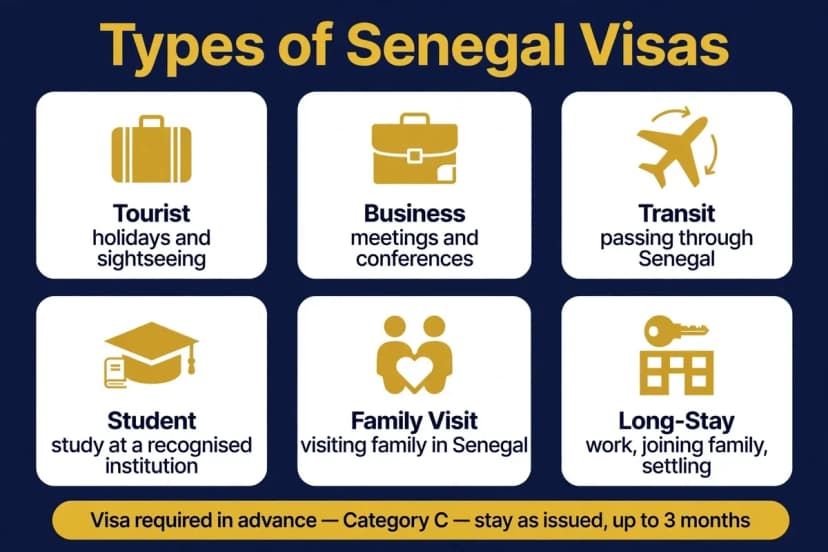
Types of Senegal Visas for Pakistani Passport Holders
Senegal does not publish a lettered visa-class schedule the way some countries do. The types below are the categories the Senegalese missions themselves use — tourist, business, transit, student, family visit and long-stay entry visas — together with what each one is for and what the mission will ask for. Because the fee and the validity are set by the issuing mission for each case, the table in the next section gives the honest position for each: "as issued" where no published figure exists.
Tourist visa (visa de tourisme)
The standard short-stay visa for holidays, sightseeing and visiting friends. It is the visa almost every reader of this guide will apply for. The old biometric-visa system issued it as a single-entry visa valid for up to three months; the current missions issue the stay as they decide, and the Foreign Ministry's visa-exempt benchmark — less than three months — is the best guide to the maximum you should expect. You will need a passport valid for at least six months, the completed application form, passport photographs, a return ticket, proof of accommodation (a hotel booking or a legalised invitation/accommodation certificate from your host), and proof of sufficient funds. Work is not allowed on a tourist visa.
Business visa (visa d'affaires)
For attending meetings, conferences, trade events or business negotiations in Senegal. Dakar is a regional conference and business hub, so this is a genuinely common route. In addition to the tourist-visa documents, you will need an invitation letter from the Senegalese company or organisation, and evidence of your own business activity. It does not allow you to take employment in Senegal.
Transit visa
For passing through Senegal to another destination. If you are only changing planes at Blaise Diagne airport and staying airside on a single ticket, you will normally not need one — but confirm this with the mission and the airline, because a transit that requires leaving the airport, collecting baggage, or an overnight stay can require a visa. Transit visas are issued for short stays and follow the same Category C authorisation rule.
Student visa
For enrolment at a recognised Senegalese educational institution, such as the Université Cheikh Anta Diop in Dakar. You will need the institution's acceptance letter and proof of financial support for the duration of your studies. The student route is covered in its own section below, because the residence formalities after arrival are different from a short visit.
Family visit visa
For visiting family resident in Senegal. The document list is the same as for a tourist visa, plus evidence of the family relationship and an invitation or accommodation certificate from your host in Senegal. If your host is a Senegalese resident, the accommodation certificate may need to be legalised — ask the mission which form it requires, because requirements differ between posts.
Long-stay / entry visa (visa d'entrée de long séjour)
For stays beyond a short visit — for example, to take up employment, join family, or settle. The entry visa gets you into Senegal; the residence formalities happen after arrival, through the Direction de la Police des Étrangers et des Titres de Voyage (DPETV) in Dakar, which issues the residence card (Carte de séjour / Carte d'étranger). Stays of more than three months require registration with the local authorities after arrival, and the residence card must then be carried as identification. Long-stay visas are always Category C and always require the Interior Ministry consultation, so allow the longest lead time for these.
Diplomatic and official passports
Holders of diplomatic and service passports are treated under separate bilateral arrangements and are outside the scope of this guide. If you travel on an official or diplomatic Pakistani passport, contact the mission directly — the Category C rule described here applies to ordinary passports.
Visa Comparison Table
The table below summarises the routes open to a Pakistani passport holder. "As issued" means the mission decides the validity and the stay for your case — no published figure exists, so do not plan around a number you saw on a commercial website.
| Visa | Purpose | Stay | Entries | Fee | Where to get it |
|---|---|---|---|---|---|
| Tourist | Holidays, sightseeing, visiting friends | As issued; up to 3 months | Single (as issued) | Not published — ask the mission | Senegalese embassy or consulate |
| Business | Meetings, conferences, trade | As issued; up to 3 months | Single (as issued) | Not published — ask the mission | Senegalese embassy or consulate |
| Transit | Passing through Senegal | Short stay, as issued | Single | Not published — ask the mission | Senegalese embassy or consulate |
| Student | Study at a recognised institution | Duration of studies; residence card after arrival | As issued | Not published — ask the mission | Senegalese embassy or consulate |
| Family visit | Visiting family resident in Senegal | As issued; up to 3 months | Single (as issued) | Not published — ask the mission | Senegalese embassy or consulate |
| Long-stay / entry | Work, joining family, settling | Over 3 months; residence card after arrival | As issued | Not published — ask the mission | Senegalese embassy or consulate |
| "Visa préalable" + stamp on arrival | Tourist entry via prior-authorisation letter | 1 month (reported) | Single, Dakar airport only (reported) | USD 0 (reported) | Unverified — see the conflict note in the visa section |
Visa Fees: What Each Route Costs
This is the section where honesty matters more than completeness: Senegal publishes no visa fee for Pakistani applicants, and this guide publishes none as fact. The Foreign Ministry stated in April 2026 that no application fees currently apply, and one 2026 guide reports that the Embassy of Senegal in Washington charges no visa fee and processes a complete file in two to three working days. That Washington report is second-hand — it could not be confirmed on an official embassy page for this guide — so treat "no fee" as the best available indication, not as a guarantee, and confirm the fee with the mission that takes your application before you pay anything.
| Item | Figure | Source |
|---|---|---|
| Tourist / business / family visit visa | No published fee — ask the mission | Senegal Foreign Ministry (April 2026, via 2026 guides): no application fees currently apply |
| Embassy of Senegal, Washington | No visa fee (reported); 2–3 working days (reported) | 2026 guide citing the Washington embassy — not confirmed on an official page |
| Biometric visa, 2013–2015 system | EUR 50 + EUR 2.50–5 card fee | ITU Dakar conference document, March 2015 — historical; system ended 1 May 2015 |
| "Visa préalable" + stamp on arrival | USD 0 (reported) | Timatic-derived aggregators — unverified against any official source |
| Visa on arrival (commercial claim) | About XOF 50,000 (about USD 85) (reported) | Travel Visa Stack — contradicts the official Category C rule; do not budget against it |
| Agency file-preparation fee | Service fee on top of any government fee | Commercial agencies — not a government fee; the ministry warns against paying third-party sites |
What to do about the missing fee. Email the mission before you apply and ask three questions in writing: what is the visa fee for a Pakistani ordinary passport, how is it paid, and is it refundable if the visa is refused? Keep the reply — it is your only evidence of the fee. If a mission tells you there is no fee, that is consistent with the April 2026 ministry statement; if it quotes a fee, pay only the mission, by the method the mission names, and keep the receipt. Never pay a visa fee to a website: the Foreign Ministry has warned about a fraudulent site, senevisa.com, and no official paid online procedure is in force. One commercial agency quotes a six-month bank statement with a closing balance of PKR 1,000,000–2,000,000 and a two-to-five-week processing time — those are agency figures, not official requirements, and this guide does not repeat them as rules. The honest funds position is simpler: the mission will want evidence you can pay for the trip, and the amount is judged against the length and cost of your stay, not against a published threshold.
What the visa does not cost. There is no separate "e-visa fee", no appointment fee, and no authorised agent fee, because there is no official online channel at all. If a website asks you to pay a service fee to "process" a Senegal e-visa, you are paying a middleman — or a fraud — for something that does not exist yet. The only official channels are Senegal's embassies and consulates.
Processing Times
Processing time is the second figure this guide cannot give you as a single number, and the reason is built into the rule itself: a Category C application must be referred to the Ministry of the Interior in Dakar before the visa can be granted, and that consultation has no published timetable.
| Route | Processing time reported | Source |
|---|---|---|
| Embassy visa, Washington (reported) | 2–3 working days for a complete file | 2026 guide citing the Washington embassy — not confirmed on an official page |
| Biometric visa, 2013–2015 system | 2–4 working days | Historical procedure guides — system ended 1 May 2015 |
| Embassy visa, commercial agency estimate | 2–5 weeks | AMG Visa, 2026 — agency figure, not an official timetable |
| Embassy visa, Category C consultation | Weeks, not days — no published figure | Foreign Ministry visa page: "les délais de traitements peuvent varier" (processing times may vary) |
| "Visa préalable" letter route | Not published | No source found — unverified |
Planning rule. Start at least six weeks before travel, and do not book a non-refundable ticket or hotel until the visa is in your passport. The Foreign Ministry itself advises applicants to check processing times with its services before buying a ticket — that warning is on its official visa page, and it is there because the timetable varies by post and by case. A complete, clean file moves fastest: the Washington report of two to three working days was for a complete file at a post that could decide quickly, while a Category C file referred to Dakar will take longer. Build your plan around the slow end of the range: apply six weeks out, expect the consultation to add weeks, and treat any faster answer as a bonus. If your travel date is fixed — a conference, a family event — say so in your covering letter and ask the mission for a realistic date, in writing, before you commit money.
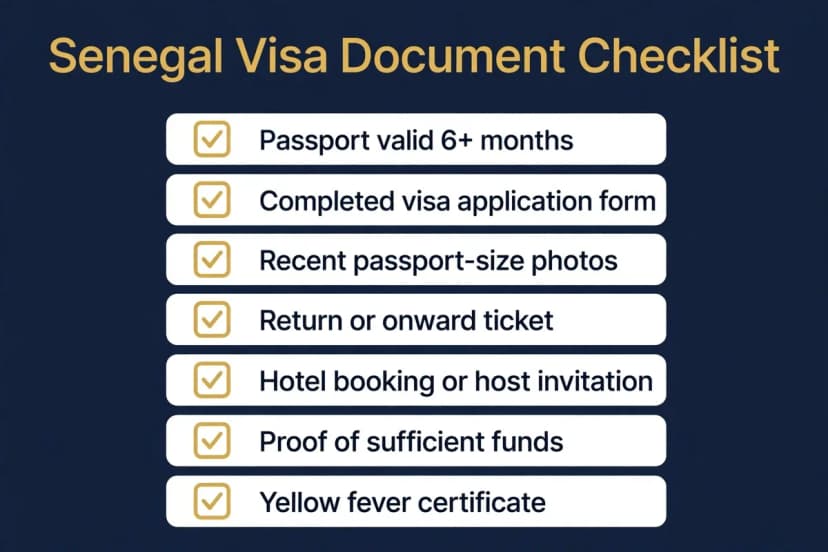
Complete Document Checklists
No single official document list for Pakistani applicants was published on a Foreign Ministry page found for this guide. The ministry's visa page lists the passport and the application form and adds that "other documents may be required depending on your case", and advises applicants to contact the consulate before travelling to the post. The checklists below combine what the ministry requires, what the missions list for each visa class, and what border officers check on arrival according to the FCDO and the US State Department. Prepare originals and clean scans; a blurry passport scan is the commonest reason an application stalls.
Tourist visa — the route most readers will use
- Pakistani passport valid for at least six months from arrival, plus a copy of the first (photo) page
- Completed Senegal visa application form, downloaded from the ministry or mission website and filled in completely
- Recent passport-size photographs (take at least four; missions commonly ask for two)
- Return or onward ticket, or a confirmed itinerary showing you will leave Senegal
- Proof of accommodation: a hotel booking covering the stay, or an invitation/accommodation certificate from your host in Senegal (ask the mission whether it must be legalised)
- Proof of sufficient funds for the stay, such as recent bank statements — the mission judges the amount against your trip, and no official minimum is published
- Yellow fever vaccination certificate (see the health note in the safety section — essential if you transit through Addis Ababa)
- Vietnamese temporary residence card (TRC) and a copy, proving your right to return to Vietnam
- A short covering letter stating your purpose, dates, and where you will stay
Business visa — add to the tourist list
- Invitation letter from the Senegalese company or organisation, on letterhead, stating the purpose and dates of the visit
- Evidence of your own business or employment, such as an employer letter or business registration
- Conference or event registration, if you are attending one
Family visit visa — add to the tourist list
- Evidence of the family relationship, such as a birth or marriage certificate
- Invitation letter from your family host in Senegal, with their address and contact details
- Your host's residence status in Senegal, if the mission asks for it
Student visa — add to the tourist list
- Acceptance or enrolment letter from the recognised Senegalese institution
- Proof of financial support for the duration of your studies
- Evidence of previous education, if the mission asks for it
- Accommodation arrangement in Senegal
Long-stay / work route — add to the tourist list
- Employment contract or job offer from a Senegalese employer, where applicable
- Evidence of qualifications relevant to the job
- Police clearance certificate, if the mission asks for it
- Proof of accommodation in Senegal for the long stay
Documents to carry on arrival
- Passport with the visa, valid for at least six months, with at least one blank page for the entry stamp
- Printed return or onward ticket and hotel booking or host invitation
- Yellow fever certificate (the yellow card), if applicable to your routing
- Proof of funds, such as a bank statement or cash in CFA francs or euros
- Your Vietnamese TRC, for the return journey
- Travel insurance documents — not a visa requirement, but strongly advisable
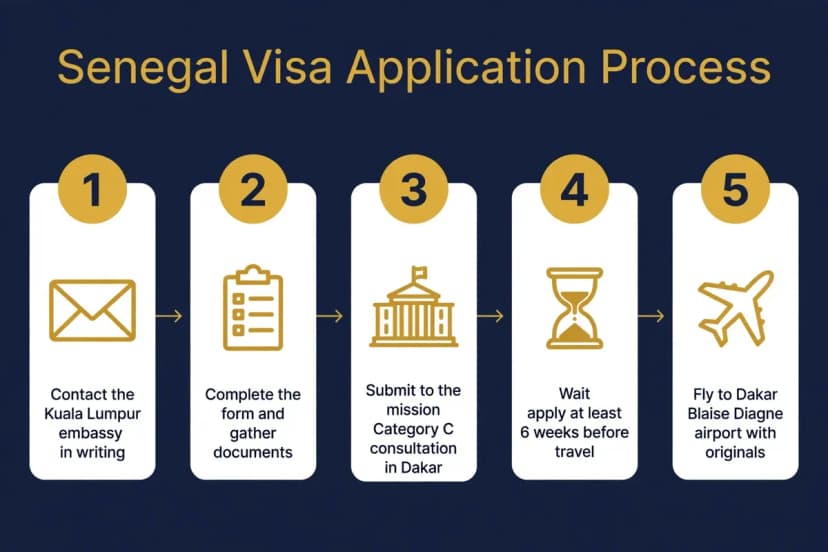
How to Apply: Step-by-Step
There is no online application for Pakistanis as of 28 November 2026. The route is consular, paper-based, and starts with an email — not with a payment.
Step 1 — Contact the mission in writing. Email the Senegalese mission that covers Vietnam (see the next section) and ask four questions: does it accept visa applications from Pakistani passport holders resident in Vietnam; what is the current document list for a tourist visa; what is the visa fee and how is it paid; and what is the realistic processing time, given the Category C consultation with Dakar? Keep the reply. If the mission directs you to a different post, follow its direction — missions decide their own caseloads, and a referral from one mission carries weight with the next.
Step 2 — Download and complete the application form. The Foreign Ministry's visa page links a visa application form (Formulaire VISA) to download and fill in. Complete every field, in French if you can; if you cannot write French, complete it in English in clear block capitals and check with the mission that this is acceptable. An incomplete form is the commonest avoidable delay. Sign and date it.
Step 3 — Assemble the file. Work through the checklist for your visa type. Make clean colour scans or copies of every document, and keep the originals. Check the passport first: six months' validity from arrival, at least one blank page, and no damage. Check the photographs: recent, passport-size, plain background. Check the accommodation: the booking must cover the whole stay and match the dates on your ticket and your form — mismatched dates are a classic refusal trigger.
Step 4 — Submit the file to the mission. Submit in person if the mission is within reach, or by post or courier if the mission accepts postal applications — ask first, because not every post does. Some missions take biometric data (fingerprints and a photograph); the old biometric system required it, and the mission will tell you whether an in-person visit is needed. Pay only the fee the mission names, by the method it names, and keep the receipt.
Step 5 — Wait for the Category C consultation. The mission refers your file to the Ministry of the Interior in Dakar. There is nothing you can do to speed this up, and there is no tracking portal. Do not book non-refundable travel while you wait. If the mission gave you a date, wait until it passes before chasing; if it did not, a polite follow-up after three weeks is reasonable.
Step 6 — Collect the visa and check it before you leave the mission. When the passport comes back, check every detail on the spot: your name spelled exactly as in the passport, the visa type, the number of entries, the validity dates, and the permitted stay. An error found at the mission is fixed in minutes; an error found at Dakar airport is a refused entry. Photograph the visa page and keep a copy separate from your passport.
Step 7 — Fly, and carry the file with you. Carry the originals of your ticket, accommodation proof, funds evidence and yellow fever certificate in your hand luggage, not in checked baggage. At Blaise Diagne airport, the immigration officer decides on entry: the visa is permission to present yourself at the border, not a guarantee of admission. Answer questions plainly, in French if you can, and show documents when asked rather than volunteering a pile of paper.
Applying from Vietnam and Pakistan
There is no Senegalese embassy or consulate in Vietnam, and there is no Senegalese embassy in Pakistan. That is the central practical problem of this guide, and it has two different answers depending on where you are.
From Vietnam — the Kuala Lumpur embassy. The Embassy of Senegal in Kuala Lumpur is accredited to Vietnam, as well as to Brunei, Indonesia, Laos, Myanmar, the Philippines and Thailand. It is therefore the mission a Pakistani resident of Vietnam should contact first. Its address is No. 1, Lorong 3, Desa Pahlawan, Off Jalan Kedondong, 50450 Kuala Lumpur, Malaysia, and its telephone is +60 3-9200 1576. Its email address could not be confirmed from an official source for this guide, so telephone first and ask for the consular email address in writing. One caution: accreditation to Vietnam is confirmed, but whether the Kuala Lumpur embassy actually accepts visa applications from Pakistani nationals resident in Vietnam has not been confirmed in writing — ask that exact question in your first contact, and if it declines, ask which mission it recommends. The alternatives from Ho Chi Minh City are the embassies in Beijing (accredited to Cambodia, Mongolia and North Korea — not Vietnam), New Delhi (accredited to Maldives and Sri Lanka), Tokyo (accredited to Australia, New Zealand, Papua New Guinea and Tonga), and the Gulf posts in Abu Dhabi, Riyadh, Doha, Kuwait City and Muscat. A short trip to Kuala Lumpur is the most practical option: it is about two hours from Ho Chi Minh City, Malaysians do not need a visa for Vietnam and vice versa for short visits is not the question — what matters is that you, as a Pakistani passport holder, can enter Malaysia for a short visit (check your Malaysia entry rule separately), submit the file, and return to Vietnam while the Category C consultation runs. Keep your Vietnamese TRC valid throughout, and do not let the Kuala Lumpur trip overlap with your TRC expiry.
From Pakistan — the Karachi honorary consulate and the Tehran embassy. Senegal's Foreign Ministry lists an Honorary Consulate of Senegal in Pakistan at 104 Al Farid Centre, Moulvi Tamizuddin Khan Road, Karachi. An honorary consulate can give guidance and may forward a file, but it is not a full embassy: ask it which embassy handles applications from Pakistan. The Embassy of Senegal in Tehran is accredited to Pakistan, and the Gulf embassies — Abu Dhabi, Riyadh, Doha, Kuwait City, Muscat — are the other posts Pakistan-focused guides name. If you are flying from Pakistan rather than Vietnam, remember the polio rule: travellers departing Pakistan must carry a polio vaccination certificate issued through NADRA, and airlines check it at departure. That is a Pakistani exit requirement, not a Senegalese entry requirement, but it will stop you at the airport in Pakistan if you do not have it.
Your own embassy in Dakar. Pakistan has an embassy in Dakar, which is your safety net once you are in Senegal. Its chancery is at Fann Résidence, No. 103, Rue Aimé Césaire, Dakar; telephone +221 33 824 6135; email parepdakar@gmail.com. Save those details in your phone before you travel. It cannot issue you a Senegalese visa — that is the Senegalese mission's job — but it can help with a lost passport, an emergency, or a problem with the Senegalese authorities.
Which mission should you actually use? Write to Kuala Lumpur first. If it accepts your file, use it — it is the accredited mission for Vietnam and the shortest journey from Ho Chi Minh City. If it declines or does not reply within two weeks, write to the Tehran embassy and to the Karachi honorary consulate in parallel, and ask each which post should take a Pakistani resident of Vietnam. Do not submit the same application to two missions at once without telling them: duplicate files can confuse the Dakar consultation. Pick one post, get its written confirmation that it will take your file, and then commit to it.
Student Visas
Senegal's universities are a genuine draw for students from across West Africa and beyond, and the best-known is the Université Cheikh Anta Diop (UCAD) in Dakar, one of the oldest and largest universities in francophone Africa. If you have an acceptance letter from a recognised Senegalese institution, the student route is open to you — but it follows the same Category C rule as every other visa for Pakistanis, so the same six-week lead time applies.
You will need the institution's acceptance or enrolment letter, proof of financial support for the duration of your studies, evidence of your previous education if the mission asks for it, and an accommodation arrangement in Senegal. The mission will want to see that the course is real, that you can pay for it, and that you have somewhere to live. A student visa gets you into Senegal; after arrival, stays of more than three months require registration with the local authorities and a residence card (Carte de séjour / Carte d'étranger) issued through the DPETV in Dakar. Your institution's international office should guide you through that registration — ask about it before you travel, because the residence card, not the entry visa, is what legalises a long stay.
Two honest caveats. First, no student-visa fee or processing time is published, so get both from the mission in writing. Second, a student visa does not carry a right to work: if you plan to support yourself by working in Senegal, you need a work route, covered next. Do not enrol, pay tuition, or book accommodation until the visa is in your passport — a refused visa after a paid enrolment is a loss the mission will not refund.
Work Visas
You cannot work in Senegal on a tourist visa, and you cannot arrive and look for work on a visitor's visa. The work route starts with a job offer from a Senegalese employer, and the employer sponsors the process. There is no published work-permit fee, no published processing time, and no published list of eligible occupations for this guide to quote — those details come from the employer and the mission, and any figure you see on a commercial website should be treated as unverified until the mission confirms it.
In practice, the sequence is: a Senegalese employer offers you a job; the employer engages with the Senegalese labour and interior authorities; you apply for a long-stay entry visa at the mission with the employment contract, evidence of your qualifications, and the employer's supporting documents; and after arrival you complete the residence formalities through the DPETV in Dakar. The Category C consultation applies here too, so allow months rather than weeks for a work route, and do not resign from your job in Vietnam, give up your accommodation, or book a one-way ticket until the entry visa is issued.
A particular warning for teachers: Senegal's schools and language centres do hire foreign English teachers, but a job offer should come with a written contract, a named employer, and a salary stated in CFA francs before you apply for any visa. An offer that arrives by message, asks you to pay a fee for the job, or cannot name the school should be treated as a scam. The same rule applies to any agent offering to "arrange" a Senegal work visa for a fee: the only official channels are the missions, and the Foreign Ministry has warned about fraudulent visa websites.
Family Visits and Permanent Residence
Family visits. If you have family resident in Senegal, apply for a family visit visa with the tourist-visa documents plus evidence of the relationship and an invitation or accommodation certificate from your host. Ask the mission whether the accommodation certificate must be legalised — requirements differ between posts, and a non-legalised certificate is a common reason for a file to be returned. The stay is as issued by the mission, up to three months on the usual benchmark.
Staying longer than three months. Whatever visa you arrive on, a stay of more than three months requires registration with the local authorities after arrival, and the issue of a residence card (Carte d'étranger), which you must then carry as identification. The FCDO states this plainly for British visitors, and the same registration duty applies to other nationalities. The registration is handled through the DPETV (Direction de la Police des Étrangers et des Titres de Voyage) in Dakar. Start it well before your visa expires — do not wait until the last week.
Permanent residence. There is no short route to permanent residence in Senegal for a Pakistani visitor. Long-term residence is built up over years of lawful stay, with residence cards renewed through the DPETV, and any claim to permanent status depends on Senegalese nationality and immigration law as applied to your individual history. No figure, fee or timetable for permanent residence could be verified for this guide, and none is published here. If an agent offers you "permanent residence" in Senegal for a fee, treat it as a scam. The honest path is: visit on the right visa, register on time, renew lawfully, and take legal advice in Dakar if you later want to settle.
Overstay. No overstay fine or penalty figure could be found in any source checked for this guide, so none is published here. Do not assume there is no penalty: an overstay can mean a fine, detention, deportation, and a ban on future entry, and it will be recorded against your passport. If your visa is about to expire and you need more time, apply for an extension or a residence card through the DPETV before it expires, and keep the receipt. If you have already overstayed, go to the DPETV or to the Pakistan Embassy in Dakar for advice before you present yourself at the airport — turning up at departure with an expired visa and no explanation is the worst option.
Common Mistakes
Paying a website for an "e-visa". The most expensive mistake in this guide. No official paid online visa procedure is in force, the Foreign Ministry has warned about a fraudulent site (senevisa.com), and the old visasenegal.sn portal belongs to a system that ended in 2015. Pay only a mission, by the method it names.
Flying to Dakar without a visa. Pakistanis are Category C: no visa on arrival without prior authorisation, and no visa-free entry. The "visa préalable" letter, if it exists for your case, is itself a prior authorisation — it is not a substitute for one. Never board a flight to Dakar without either a visa in your passport or a written prior-authorisation letter the mission and your airline have both confirmed.
Booking non-refundable travel before the visa is issued. The Foreign Ministry advises checking processing times before buying a ticket, precisely because Category C files can take weeks. A non-refundable ticket bought in week one of a six-week process is a gamble, not a plan.
Applying to the wrong mission, or to two at once. Write to Kuala Lumpur first, get written confirmation it will take your file, and commit to one post. Duplicate files confuse the Dakar consultation.
Letting the passport fall below six months. Senegal requires six months' validity from arrival. A passport with five months left will be refused at the mission or at the border, and a renewal in Vietnam takes its own time — check the passport before anything else.
Forgetting the yellow-fever rule on the Addis routing. Vietnam is not a yellow-fever risk country, so a direct routing would not trigger the certificate rule — but the most common routing from Ho Chi Minh City, Ethiopian Airlines via Addis Ababa, transits an airport in a yellow-fever risk country, and the FCDO states the certificate is required in that case, including for airport transit. Get vaccinated at least ten days before travel, whatever your routing.
Mismatched dates and blurry scans. Hotel bookings that do not cover the whole stay, tickets whose dates differ from the form, and unreadable passport scans are the commonest avoidable delays. Check every date twice and scan in clean colour.
Letting the Vietnamese TRC expire mid-trip. Your TRC is your way back into Vietnam. Renew it before you travel if it expires within a month of your return date.
Reasons for Refusal
A visa can be refused without a detailed explanation, and a refusal is not refunded. The reasons below are the ones that recur across the sources for this guide and across Category C cases generally — treat them as a checklist to defeat before you apply, not as a prediction about your case.
The Dakar consultation does not clear. For Category C, the Ministry of the Interior must be consulted before the visa is granted. If the consultation is negative or inconclusive, the visa is refused. There is no appeal route published for this, and no way to know in advance how the consultation will go — which is why the planning rule is six weeks and no non-refundable bookings.
Insufficient or unclear funds. The mission must be satisfied you can pay for the trip. A bank statement that is old, shows a sudden large deposit with no explanation, or does not match the length and cost of your stay will count against you. Use recent statements, explain any large deposit, and make the funds proportionate to the trip.
No credible accommodation or itinerary. A hotel booking that covers only part of the stay, a host invitation with no address or contact details, or an itinerary that does not match the ticket will be treated as a weak file. Make the three documents — form, ticket, accommodation — tell the same story.
Passport problems. Less than six months' validity, no blank page, a damaged passport, or a passport reported lost or stolen. Any of these ends the application.
Previous overstay or immigration history. A previous overstay in Senegal or elsewhere, a prior refusal, or a record of working on a tourist visa will be held against you. Declare previous refusals honestly if asked — a discovered omission is worse than a disclosed refusal.
Weak purpose of travel. A tourist application with no itinerary, no accommodation and no visible reason for the trip looks like a file with something to hide. A short covering letter stating what you will do, where you will stay, and when you will leave costs nothing and answers the question before it is asked.
Applying through an agent or a fraudulent site. Files submitted through unauthorised agents, or supported by documents bought online, are refused and can lead to a ban. The Foreign Ministry states there are no authorised agents and no official paid online procedure. Apply yourself, through a mission.
Frequently Asked Questions
1. Do Pakistani citizens need a visa for Senegal?
Yes. Pakistan is not on Senegal's visa-exempt list, and the Embassy of Senegal in London places Pakistan in Category C, which means a visa must be obtained in advance from a Senegalese embassy or consulate, with prior consultation of the Ministry of the Interior in Dakar. There is no visa-free route and no visa on arrival you can simply buy at the airport.
2. Is there a Senegal e-visa for Pakistanis?
Not as of 28 November 2026. An electronic visa was announced on 22 August 2025 by Prime Minister Ousmane Sonko, based on reciprocity, but multiple sources checked in November 2026 report that no official platform exists and the Foreign Ministry's procedure remains consular only. The ministry stated in April 2026 that no official paid online visa procedure is in force, and it has warned about a fraudulent website, senevisa.com. Do not pay any website for a Senegal e-visa.
3. Can I get a visa on arrival in Dakar?
Not as a standalone route. Pakistanis are Category C, and Category C requires authorisation before flying. Several aggregator sites report a "visa préalable" arrangement — a prior-authorisation letter obtained before travel, after which the visa is stamped on arrival at Blaise Diagne airport for one month, with a reported fee of USD 0 — but no official Senegalese source found for this guide confirms it. Treat the embassy visa as the safe route, and if a mission offers you a prior-authorisation letter, get it in writing and confirm with your airline that you will be boarded on it.
4. How much does a Senegal visa cost for Pakistanis?
No fee is published. The Foreign Ministry stated in April 2026 that no application fees currently apply, and one 2026 guide reports the Washington embassy charges no visa fee. The old 2013–2015 biometric system charged EUR 50, and one commercial site claims about XOF 50,000 (about USD 85) for a visa on arrival — neither figure is a current official fee. Ask the mission in writing what the fee is and how it is paid before you pay anything.
5. How long does a Senegal visa take?
There is no published processing time. The Foreign Ministry says processing times may vary and advises checking before buying a ticket. One 2026 guide reports two to three working days at the Washington embassy for a complete file; a commercial agency estimates two to five weeks. Because Category C files are referred to the Ministry of the Interior in Dakar, this guide advises starting at least six weeks before travel and not booking non-refundable travel until the visa is issued.
6. Is there a Senegalese embassy in Vietnam?
No. Senegal has no mission in Vietnam. The Embassy of Senegal in Kuala Lumpur is accredited to Vietnam — No. 1, Lorong 3, Desa Pahlawan, Off Jalan Kedondong, 50450 Kuala Lumpur, Malaysia; telephone +60 3-9200 1576. Contact it first and confirm in writing that it accepts applications from Pakistani nationals resident in Vietnam. The Tehran embassy is accredited to Pakistan, and there is an Honorary Consulate of Senegal in Karachi at 104 Al Farid Centre, Moulvi Tamizuddin Khan Road.
7. What documents do I need for a Senegal visa?
A passport valid for at least six months from arrival, plus a copy of the photo page; the completed visa application form; recent passport-size photographs; a return or onward ticket; proof of accommodation (hotel booking or a host's invitation/accommodation certificate); proof of sufficient funds; and a yellow fever certificate if your routing requires it. Business, student and family applications add an invitation letter, an acceptance letter, or evidence of the relationship. The full checklists are in the document section.
8. How long can I stay in Senegal?
The stay is as issued by the mission. Visa-exempt visitors may stay for less than three months, and the old visa system issued tourist visas valid for up to three months, so three months is the reasonable maximum to expect. For a stay of more than three months you must register with the local authorities after arrival and obtain a residence card (Carte d'étranger). The "visa préalable" arrival route, if it applies, is reported as one month.
9. Do I need a yellow fever certificate for Senegal?
It depends on your routing. The FCDO states a certificate is required if you arrive from, or transit through the airport of, a country with yellow-fever transmission risk, and babies aged nine months and under are exempt. Vietnam is not a risk country, but Ethiopia is — so the common Addis Ababa routing triggers the requirement. In March 2026 Senegal's Foreign Ministry said the vaccination card is no longer a general entry requirement, but French advice notes officials may still ask. Get vaccinated in Vietnam at least ten days before travel and carry the yellow card; the certificate is valid for life once the ten days have passed.
10. Do I need a polio certificate?
Not for Senegal, but yes if you depart from Pakistan: travellers leaving Pakistan must carry a polio vaccination certificate issued through NADRA, and airlines check it at departure. If you fly from Ho Chi Minh City, the polio rule does not apply to your departure — but keep the certificate if you have one, and carry it if any leg of your journey starts in Pakistan.
11. Can I work in Senegal on a tourist visa?
No. A tourist visa does not allow employment. The work route starts with a job offer from a Senegalese employer, who sponsors the process; you then apply for a long-stay entry visa with the contract and your qualifications, and complete residence formalities through the DPETV in Dakar after arrival. No work-permit fee or processing time is published. Never pay an agent for a job or a work visa, and never resign from your job in Vietnam until the entry visa is issued.
12. Can I study in Senegal?
Yes, with an acceptance letter from a recognised institution such as the Université Cheikh Anta Diop in Dakar, plus proof of financial support. Apply for a student visa at the mission, following the same Category C rule and six-week lead time. After arrival, register for a residence card through the DPETV for stays over three months. Do not pay tuition or book accommodation until the visa is in your passport.
13. Can I extend my stay in Senegal?
For stays beyond three months, register with the local authorities after arrival and obtain a residence card (Carte d'étranger) through the DPETV in Dakar, well before your visa expires. No extension fee or overstay fine could be verified for this guide, so none is published here — do not assume there is no penalty for overstaying. If your visa is about to expire, go to the DPETV before it expires, and keep every receipt.
14. Are there direct flights from Vietnam or Pakistan to Dakar?
No. The realistic corridors from Ho Chi Minh City are Ethiopian Airlines via Addis Ababa, Qatar Airways via Doha, Emirates via Dubai, Turkish Airlines via Istanbul, and Air France via Paris. Book on one ticket and leave a generous connection time. Remember that transiting through Addis Ababa triggers the yellow-fever certificate requirement.
15. Is Senegal safe to visit?
The US State Department rates Senegal Level 1, "Exercise Normal Precautions", the lowest advisory band, with Level 2 ("Exercise Increased Caution") for the Casamance region in the south because of crime and landmines. The FCDO issues no advice against travel to any part of Senegal but urges particular care near the Mali and Mauritania borders and in Casamance — stick to main roads, avoid driving at night, and travel in convoy where possible. Street crime, including pickpocketing and bag-snatching, is rising in Dakar, so pre-arrange transport from the airport and be careful after nightfall. Malaria is a high risk throughout the country all year, so take prophylaxis and avoid mosquito bites. Note also that on 30 March 2026 Senegal amended legislation increasing prison sentences for same-sex relations to five to ten years.
Official Immigration Websites
Check these sources directly before you apply. The Foreign Ministry is the controlling source for who needs a visa and how to apply; the London embassy for the A/B/C classification; the FCDO and the US State Department for passport validity, health and safety advice. Where a figure in this guide could not be traced to an official source, the guide says so — and so do the flags in the package file.
| Website | What it is | Link |
|---|---|---|
| Senegal Ministry of Foreign Affairs — Demande de visa | Official visa page: visa-exempt list (Pakistan not on it), passport 6 months, form download, processing times vary, ask before buying a ticket | diplomatie.gouv.sn — Demande de visa |
| Embassy of Senegal in the UK — Visa Nationals & categories | Official A/B/C classification: Pakistan in Category C; Vietnam in Category C | senegal-embassy.uk — Visa Nationals & categories |
| UK Foreign, Commonwealth and Development Office — Senegal travel advice | Entry requirements, passport validity (6 months), yellow fever certificate rule, Casamance and border safety advice, 30 March 2026 legislation | gov.uk/foreign-travel-advice/senegal |
| US Department of State — Senegal Travel Advisory | Level 1 overall, Level 2 Casamance (crime and landmines), US Embassy Dakar contact | travel.state.gov — Senegal Travel Advisory |
| Wikipedia — Visa policy of Senegal | Summary of visa exemption, visa on arrival and visa-required lists; Pakistan in the visa-required-in-advance list | en.wikipedia.org/wiki/Visa_policy_of_Senegal |
| Wikipedia — List of diplomatic missions of Senegal | Kuala Lumpur embassy accredited to Vietnam; Tehran embassy accredited to Pakistan; Beijing, New Delhi and Tokyo accreditations | en.wikipedia.org/wiki/List_of_diplomatic_missions_of_Senegal |
| Wikipedia — List of diplomatic missions in Kuala Lumpur | Embassy of Senegal, Kuala Lumpur: Ambassador H.E. Abdoulaye Barro; Jalan Kedondong, Ampang | en.wikipedia.org/wiki/List_of_diplomatic_missions_in_Kuala_Lumpur |
| Pakistan Ministry of Foreign Affairs — Dakar Contact Us | Embassy of Pakistan in Dakar: Fann Résidence, No. 103, Rue Aimé Césaire; +221 33 824 6135; parepdakar@gmail.com | mofa.gov.pk — Dakar Contact Us |
| UrduPoint — Senegal Visa for Pakistanis 2026 | Pakistan-focused guide, checked 19 Nov 2026: embassy visa, no official paid online procedure (April 2026), Karachi honorary consulate address | urdupoint.com/travel/visa/senegal |
| HTG — Senegal Visa Guide for Pakistanis: The Reciprocity Turn | Pakistan-focused guide: e-visa announced 22 Aug 2025, reciprocity, fee schedule still being published, embassy channel as fallback | htg.com.pk — Senegal Visa Guide for Pakistanis |
| VisaFreely — Pakistan Passport to Senegal | Category C (mandatory prior consultation with the Ministry of the Interior), no visa on arrival, no official e-visa portal; last checked 29 Oct 2026 | visafreely.com — Pakistan Passport to Senegal |
| Diplomatic Watch — Senegal Introduces Mandatory Online E-visa Payments | Report of the 22 Aug 2025 e-visa announcement by PM Sonko, reciprocity, 60 billion CFA revenue projection | diplomaticwatch.com — Senegal e-visa announcement |
| Travel and Tour World — Senegal to Generate 60B CFA from New E-Visa Fees | Report of the e-visa announcement, National Economic and Social Recovery Plan, Senegal 2050 vision | travelandtourworld.com — Senegal e-visa fees |
| Anemoia — Senegal Travel Advice | Checked November 2026: no official e-visa portal confirmed; MFA April 2026 statement (consular only, no fees, senevisa.com fraud warning); March 2026 vaccination-card decision | anemoialuxurytravel.com — Senegal Travel Advice |
| Senegal Rent — Visa, Passport, and Entry Requirements for Senegal | No official e-visa platform; ministry procedure remains consular; vaccination certificate no longer mandatory since 9 March 2026 | senegal-rent.com — Visa and entry requirements |
| VisaRequirements.info — Senegal Visa Requirements for Pakistani citizens | "Visa préalable" claim: visa on arrival at Dakar airport for Pakistanis holding a prior-authorisation letter, 1 month, fee USD 0; checked 1 Nov 2026 | visarequirements.info — Senegal Visa Requirements for Pakistanis |
| Visarun — Senegal: Visa Requirements 2026 | Category B/C explanation, Washington embassy no fee and 2–3 working days (reported), Paris consulate Category C consultation | visarun.ai — Senegal Visa Requirements 2026 |
| ITU — Dakar, March 2015 (practical information) | Historical 2013 biometric-visa procedure: visasenegal.sn pre-enrolment, EUR 50 + EUR 2.50–5, pre-visa by email, SNEDAI concession | itu.int — Dakar March 2015 practical information |
| Travel Visa Stack — Senegal Visa for Pakistan Citizens 2026 | Conflicting commercial claim: visa on arrival, XOF 50,000 (about USD 85), visasenegal.sn pre-registration — not supported by official sources | travelvisastack.com — Senegal Visa for Pakistan Citizens |
| AMG Visa — Senegal Visa from Pakistan 2026 | Agency figures: 2–5 weeks processing, PKR 1,000,000–2,000,000 bank balance — agency figures, not official requirements | amgvisa.com — Senegal Visa from Pakistan |
Final Checklist and Conclusion
Senegal rewards the traveller who does the paperwork properly: Dakar, Gorée, Lac Rose and Saint-Louis are worth the effort, and the country is one of the safest destinations in West Africa. But for a Pakistani passport holder the visa is a consular process with a Dakar consultation in the middle of it, not a formality you buy at the airport — and the loudest claims on the internet about e-visas and visas on arrival are, as of 28 November 2026, unsupported by any official Senegalese source.
Run through this checklist before you spend anything:
- Passport valid for at least six months from arrival, with at least one blank page, undamaged
- Vietnamese TRC valid for the whole trip, including the return date
- Written confirmation from the Kuala Lumpur embassy (or the mission it directs you to) that it accepts your application, with its document list, fee and processing time
- Application form completed, photographs ready, return ticket and accommodation booked to matching dates
- Proof of funds: recent bank statements, proportionate to the trip
- Yellow fever vaccination done at least ten days before travel, yellow card carried — essential via Addis Ababa
- Malaria prophylaxis arranged and travel insurance bought
- Application submitted at least six weeks before travel; no non-refundable bookings until the visa is in your passport
- Visa checked on collection: name, type, entries, dates, permitted stay
- Pakistan Embassy in Dakar saved in your phone: Fann Résidence, No. 103, Rue Aimé Césaire, Dakar; +221 33 824 6135; parepdakar@gmail.com
If the mission's reply changes anything in this guide — a fee appears, a portal opens, the Kuala Lumpur embassy declines your file — treat the mission's written word as the controlling source and this guide as out of date from that moment. That is the only safe way to read a visa guide for a country whose rules are actively changing.
This guide was checked on 28 November 2026. Visa rules change without notice. Always confirm the live rules with the Senegalese mission that handles your application and on diplomatie.gouv.sn before paying any fee or booking a non-refundable ticket. Nothing in this guide is immigration advice; the Senegalese authorities set and enforce the entry rules, and the immigration officer at Blaise Diagne airport makes the final decision. This guide is educational information only, prepared for Pakistani passport holders living in Vietnam.