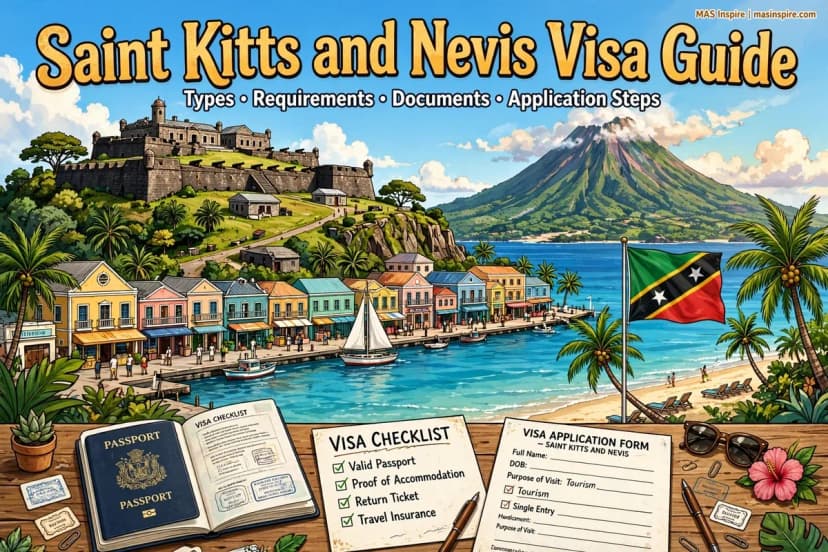
Saint Kitts and Nevis Visa Guide 2026: Types, Requirements, Documents and Application Steps
Last checked: 28 November 2026. This guide is for Pakistani passport holders living in Vietnam. Visa rules change without notice — always confirm the live rules on the Saint Kitts and Nevis Ministry of Foreign Affairs website (mofa.gov.kn) and the official eVisa portal before paying any fee or booking a non-refundable ticket.
Introduction
Saint Kitts and Nevis is the smallest sovereign state in the Americas — a twin-island federation in the Eastern Caribbean, about 261 square kilometres, roughly 50,000 people. The capital is Basseterre, on Saint Kitts. The islands are known for Brimstone Hill Fortress, a UNESCO World Heritage Site; Mount Liamuiga, a dormant volcano you can hike; black-sand and white-sand beaches; and the scenic railway that circles Saint Kitts. The country is also famous for something that has nothing to do with beaches: it runs the world's oldest Citizenship by Investment programme, founded in 1984. . A Pakistani visitor does not need a fortune and does not need citizenship — but does need a visa in advance, applied for online, before boarding the plane.
There is no visa on arrival for Pakistani passport holders and no visa-free entry. The route is the eVisa: apply online, pay USD 100, wait about two weeks, and the visa is emailed to you. On arrival the immigration officer decides how long you may stay — initially up to one month. A second step applies to every traveller: the online Immigration and Customs ED form at knatravelform.kn, completed before travel. .
One warning belongs in the first minute. The figures for this country conflict more than for almost any other in this series: the visa fee is quoted as USD 50, USD 70 and USD 100 by different 2026 guides; processing as three working days, two weeks, or four to eight weeks; the stay as 30 days or 90 days; and the work-permit fee anywhere from XCD 500 to USD 1,600.
Do Pakistani Passport Holders Need a Visa for Saint Kitts and Nevis?
Yes. Pakistanis need a visa in advance, obtained online before travel. The Ministry of Foreign Affairs lists 67 countries and territories whose nationals require a visa for entry, and Pakistan is on it. The Ministry's page says: "If your country or territory is listed below, you can apply for a visa online before you travel." Pakistan is not on the visa-exemption list, and being a Commonwealth country does not help here — unlike Rwanda, Saint Kitts and Nevis gives Pakistanis no Commonwealth fee waiver and no visa on arrival. Airlines check the visa at check-in, because the rule is in Timatic, the database airlines use. Do not book a non-refundable ticket before the visa is approved.
There is no visa on arrival for a Pakistani passport holder. The system for visa-required nationals is the eVisa: you apply online, the visa is emailed to you, and you present the printed approval on arrival, where an immigration officer issues the visa. Wikipedia's visa-policy summary, citing Timatic, puts it this way: with a printed approval, a visa is issued on arrival by an immigration officer for USD 100, and the maximum stay is 30 days. The Embassy in Washington states the same fee, that the process takes about two weeks, and that no passport needs to be sent — "the visa will be emailed to you".
The eTA, the eVisa and the ED form — three different things
Saint Kitts and Nevis launched an Electronic Border Management System on 26 May 2025, and it now has three separate entry documents. Confusing them is the single most common mistake in this guide, so here they are, separated.
The eVisa is what you need. It is the visa for nationals of the 67 visa-required countries, Pakistan among them. Apply on the official eVisa portal, pay USD 100, wait about two weeks. The Ministry of Foreign Affairs links the portal from its own site at evisa.stkittsnevisonline.com; the Embassy in Washington links a second address, www.evisa.gov.kn. Both addresses appear on official government pages, which is itself a problem — see the flags — but either way, start from mofa.gov.kn and follow its link, never from a search advertisement.
The eTA is not for you. The Electronic Travel Authorisation is for nationals of visa-exempt countries — the United States, the United Kingdom, Canada, the European Union, India, China and the rest of the long list published on the visa-policy page. A single-entry eTA costs USD 17 and is valid for 90 days. Pakistan is not on the eTA country list. Some commercial summaries claim every foreign visitor, including Pakistanis, must also buy a USD 17 eTA on top of the eVisa. No official source found for this guide says that: the eTA is the entry document for people who do not need a visa. This guide treats the eTA as not applicable to a Pakistani eVisa holder and flags the claim as unresolved — if the portal itself asks you for an eTA as well, follow the portal and keep the receipt.
The ED form is for everyone. The online Immigration and Customs ED form at knatravelform.kn must be completed before travel by every traveller, including citizens, residents and OECS nationals, who are exempt from the eTA but still file the ED form. The government's June 2025 warning names knatravelform.kn as the sole source for ED forms and eTAs, alongside the free official "e-Border – St. Kitts & Nevis" app. Complete the ED form within a few days of your flight — the University of Medicine and Health Sciences tells its students to complete it 24 hours before arrival — and carry the confirmation with your passport.
Does a US, UK, Canadian or Schengen visa help? No official source found for this guide says holding one of those visas exempts a Pakistani from the Saint Kitts and Nevis visa. One Pakistan-focused guide states this directly: it could not confirm such a rule on an official site, so plan to apply even if you hold one. The same applies to your Vietnamese temporary residence card: it proves your right to return to Vietnam, but it changes nothing about the Saint Kitts and Nevis rule.
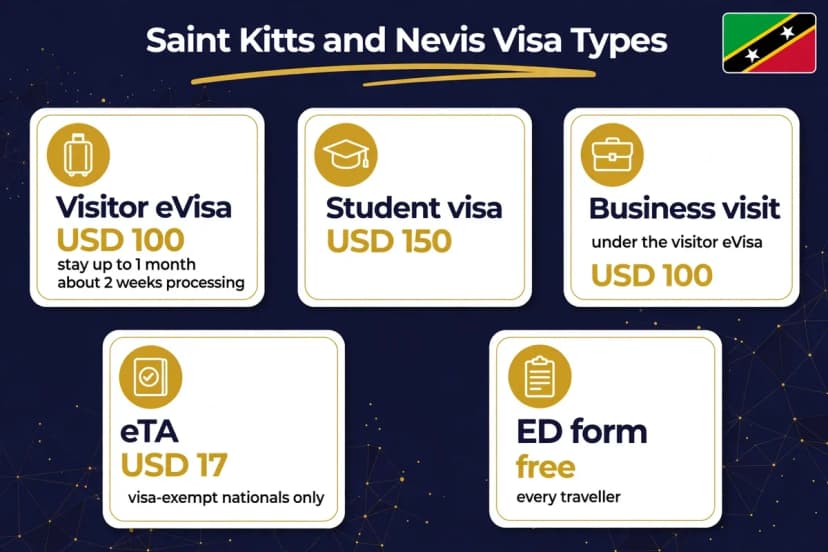
Types of Saint Kitts and Nevis Visas for Pakistani Passport Holders
Fees quoted are the official figures — USD 100 for the visitor eVisa, USD 150 for the student visa — unless flagged otherwise. No published official fee schedule covers every class, so where the only figures come from commercial guides, this guide says so.
Visitor eVisa — tourism, family visits and short business trips
The single visa class that covers almost every short visit: tourism, visiting family or friends, and short business trips such as meetings. Applied for online on the official eVisa portal. Fee USD 100. The stay is decided by the immigration officer on arrival and is initially up to one month (30 days). Work, study and self-employment are not allowed on it — the High Commission in London states: "Applicants are not permitted to work in St. Kitts and Nevis, or have access to public funds, study or become self-employed." A cruise-ship passenger who stays ashore for less than 24 hours needs no visa at all.
Business visit
Short business trips are handled under the same visitor eVisa — no separate business-visa class appears on the official pages found for this guide. Commercial guides disagree on the fee: one lists a business eVisa at USD 150, another at USD 100. No official source confirms a separate business fee, so budget USD 100 and confirm the figure on the portal before paying. You will need an invitation letter from the company you are visiting, on top of the standard visitor documents.
Transit
No separate transit-visa class appears on the official pages found for this guide. One commercial guide lists a transit visa at USD 50 — unverified, treat it as reported, not confirmed. In practice, most Pakistani travellers from Vietnam will not transit Saint Kitts and Nevis at all: the realistic routings to Basseterre go through Miami, New York, Toronto, London or a Caribbean hub, and the transit question that matters is the visa for the hub country. If your itinerary does route through Saint Kitts and Nevis to a third country, ask the Ministry of Foreign Affairs or the High Commission in London in writing first.
Student visa
For study at a recognised institution — in practice, one of the offshore medical schools (University of Medicine and Health Sciences, Windsor University School of Medicine, Medical University of the Americas) or Ross University School of Veterinary Medicine. Fee USD 150, per the Embassy in Washington. A student visa cannot be applied for while you are in the country on a visitor's visa: "you have to leave the Federation and apply for a student visa through the university of your interest." The university sponsors and guides the application, which is made online through the eVisa portal. The full student route is covered in its own section below.
Work permit — employer-sponsored, not a visa you apply for alone
There is no "work visa" you can apply for by yourself. Any non-national who intends to work for pay must hold a work permit, issued to the employer for a specific job, applied for through the Department of Labour and the Ministry of National Security. You need a genuine job offer first, the employer must show it advertised the job locally and found no qualified national, and the permit must be approved before you travel. The fees are the most disputed figures in this guide; they are covered in the work section below.
Residence permits
For stays beyond a visit, Saint Kitts and Nevis uses residence permits rather than long-stay visas — student, work and dependant permits. A student residence permit is typically valid for one year (August to July) and is renewed for the duration of the course. No published "retirement visa" or "digital nomad visa" was found for this guide, and no published permanent-residence route for an ordinary visitor. The one established route to permanent status that is not a visa at all is Citizenship by Investment, covered next.
Citizenship by Investment (CBI) — not a visa, and winding down
Saint Kitts and Nevis runs the world's oldest Citizenship by Investment programme, founded in 1984 and administered by the Citizenship by Investment Unit (CIU). It grants full citizenship — not residence, not a visa — to a person who makes a qualifying investment and passes government due-diligence checks, including a mandatory interview. In 2026 the minimum is USD 250,000 through the Sustainable Island State Contribution (SISC) or the Public Benefit Option, for a main applicant and a family of up to four; approved real estate costs from USD 325,000 for a condominium or development share, or USD 600,000 for a private home, with a seven-year holding period. Due-diligence fees are USD 10,000 for the main applicant and USD 7,500 for each dependant aged 16 or over, on top of the investment.
The programme is winding down. On 13 November 2026 the government announced it will wind down the programme on a timeline being negotiated with the European Union, which asked all five Eastern Caribbean programmes to phase out by 1 June 2028. The CIU stated on 16 November 2026 that the programme remains open and accepts new applications until it announces a final date, that no final date had been announced by 24 November 2026, and that existing citizens keep their status. Do not treat it as closed, and do not treat it as permanent either. A CBI application is made only through a government-authorised agent, never through a visa portal — it is not a shortcut around the USD 100 visitor eVisa, and anyone selling it as one is misleading you.
| Visa / permit | Stay | Entries | Fee | Where to get it |
|---|---|---|---|---|
| Visitor eVisa (tourism, family, short business) | Up to 1 month, set by the officer on arrival | As issued | USD 100 | Online eVisa portal |
| Business visit (under visitor eVisa) | Up to 1 month | As issued | USD 100 (one guide: USD 150) | Online eVisa portal |
| Transit | Under 24 hours ashore (cruise) needs no visa | — | USD 50 (one guide — unverified) | Ask MOFA or the London High Commission first |
| Student visa | Duration of the course, renewed yearly | As issued | USD 150 | Online via the university |
| Work permit (employer-sponsored) | 1–2 years, tied to one employer and job | Multiple | Disputed: XCD 1,600–2,500/yr, or USD 1,600 | Employer applies to the Department of Labour |
| eTA (visa-exempt nationals only — not Pakistanis) | Up to 90 days | Single entry | USD 17 | knatravelform.kn |
| ED form (every traveller) | — | — | Free | knatravelform.kn |
| Citizenship by Investment (SISC) | Permanent citizenship | — | USD 250,000 + due diligence | Authorised agent → CIU |
Visa Comparison Table
Only two figures are confirmed on official pages — the visitor eVisa at USD 100 and the student visa at USD 150. Everything else is a claim from a commercial guide or a disputed figure, and the table says so.
| Route | Who it is for | Stay | Fee | Processing | Work allowed? |
|---|---|---|---|---|---|
| Visitor eVisa | Tourist, family, short business | Initially up to 1 month (30 days) | USD 100 | About 2 weeks | No |
| Business visit (visitor eVisa) | Meetings, conferences | Initially up to 1 month | USD 100; USD 150 claimed by one guide | About 2 weeks | No — meetings only |
| Student visa | Enrolled student | Course duration, renewed yearly | USD 150 | Up to 2 weeks | No — a work permit is needed to work |
| Work permit | Employee with a job offer | 1–2 years | Disputed (see work section) | 30 working days target; 2–6 weeks claimed | Yes — for the sponsoring employer only |
| eTA | Visa-exempt nationals only | Up to 90 days | USD 17 | Usually within 24 hours | No |
Visa Fees: What Each Route Costs
Two figures are confirmed on official pages: the visitor eVisa at USD 100 and the student visa at USD 150. The rest are reported figures, and the conflicts are set out underneath the table rather than smoothed over.
| Item | Figure | Source |
|---|---|---|
| Visitor eVisa (tourism, family, short business) | USD 100 | Embassy, Washington; High Commission, London; Wikipedia (Timatic) |
| Student visa | USD 150 | Embassy, Washington (FAQs) |
| Business eVisa | USD 150 (one commercial guide); USD 100 (another) | Jeewa vs TravelVisaStack — no official figure; disputed |
| Transit visa | USD 50 | Jeewa Consulting — single commercial source; unverified |
| eTA (visa-exempt nationals only) | USD 17, single entry, valid 90 days | Wikipedia; FCDO (for British citizens) |
| ED form (every traveller) | Free | knatravelform.kn (government portal) |
| Work permit (1 year) | Disputed: XCD 1,600/yr, or XCD 500 application + XCD 2,000 issuance, or USD 1,600 | See work section — no official fee confirmed |
| Citizenship by Investment | SISC USD 250,000; real estate USD 325,000/600,000; due diligence USD 10,000 + USD 7,500 | CIU via multiple 2026 guides |
The fee conflict, in full. The USD 100 visitor fee is the best-verified figure in this guide: it appears on the Washington Embassy's official FAQ page, on the London High Commission's visa page (USD 100, payable by money order on the mission route), and in the visa-policy summary's Timatic citation. Against it stand two commercial guides: one lists the tourist eVisa at USD 50, another at USD 70. Neither traces its figure to an official source. This guide treats USD 100 as the fee and the other two figures as outdated or wrong — but confirm the amount the portal itself shows before you pay, because the portal is the final authority.
How to pay. On the online eVisa portal you pay by credit or debit card at the time of application. The London High Commission's older mission page describes payment by certified check or money order for mission applications — that is the mission channel, not the online portal, and the page is undated, so do not send a money order unless the mission itself tells you to. Fees are not refunded if an application is refused. The currency is the Eastern Caribbean dollar (XCD), fixed at EC$2.70 to USD 1, but visa fees are charged in US dollars.
What the visa does not cost. There is no separate "eVisa service fee" charged by the government, no appointment fee, and no authorised agent fee for a visitor visa. One commercial guide lists a "consultancy fee" of USD 500 on top of the visa fee — that is an agency's charge, not a government fee, and you do not need an agent: the portal is designed for applicants to use directly. The government's June 2025 warning is blunt: unauthorised websites and agents charging for "eTA processing", "e-Visas" or "expedited services" are fraudulent. Use only the official portal linked from mofa.gov.kn and the official knatravelform.kn site.
Bank balance. There is no published minimum bank balance for the visitor eVisa. One agency guide claims a closing balance of PKR 1,000,000–2,000,000 is required — no official source found for this guide supports that figure. What the official pages do require is bank statements for the past three months (London High Commission) showing sufficient funds for the trip. Carry statements that plainly cover flights, accommodation and living costs, with a comfortable margin — a thin balance is one of the commonest reasons for refusal.
Processing Times
| Route | Processing time reported | Source |
|---|---|---|
| Visitor eVisa (online) | About 2 weeks | Embassy of Saint Kitts and Nevis, Washington (FAQs); High Commission, London |
| Visitor eVisa (online) | Usually 2 weeks; 1 week if an expedited fee is paid | Ministry of Foreign Affairs (FAQs) |
| Visitor eVisa (online) | A few days to several weeks | Ministry of Foreign Affairs (via UrduPoint) |
| Visitor eVisa (online) | 3–5 working days | TravelVisaStack (2026 guide) |
| Visitor eVisa (online) | 5–7 working days | Apricot Tours (2026 guide) |
| Visitor eVisa (online) | 4–8 weeks | AMG Visa (2026 guide) — outlier; likely includes agency handling |
| Student visa | Up to 2 weeks | University of Medicine and Health Sciences |
| Work permit | 30 working days target (up to 90 days allowed) | Immicor, citing the Immigration Act |
Planning rule. The controlling official figure is about two weeks, so apply at least one month before travel: that covers the two-week official figure, the Ministry's "few days to several weeks" range, and a week to spare for a correction. Do not rely on the three-to-five-day figures from commercial guides — they are not traced to an official source. Do not book a non-refundable ticket before the visa is emailed to you. For a student visa, allow the same month; for a work permit, allow two to three months, because the employer's labour-market test and the permit filing both take time.
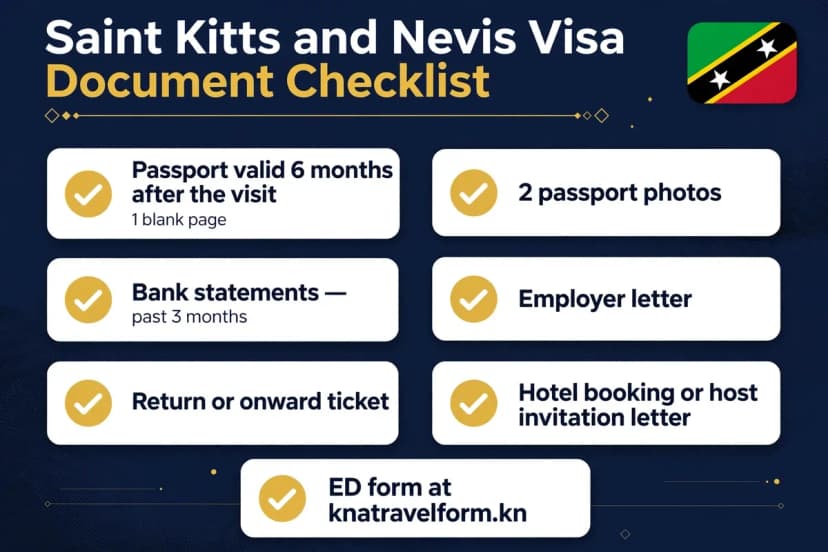
Complete Document Checklists
No single official document list for Pakistani applicants was published on a Ministry page found for this guide, so the checklists below combine what the High Commission in London lists, what the eVisa portal asks of online applicants, what the University of Medicine and Health Sciences lists for student visas, and what the FCDO says border officers check on arrival. Prepare originals and clean scans; a blurry passport scan is the commonest reason an online application stalls.
Visitor eVisa — the route most readers will use
- Pakistani passport valid for at least six months after the end of your visit, with at least one blank page (London High Commission; FCDO states six months after arrival)
- Completed online eVisa application form, with details exactly as they appear on your passport
- Two recent colour passport-size photographs (digital format for the portal; the London High Commission lists two photos for the mission route)
- Bank statements for the past three months showing sufficient funds for the trip
- Letter from your employer in Vietnam, confirming your job, salary and approved leave — and that you are expected back
- Confirmed return or onward flight ticket, or a confirmed itinerary showing you will leave
- Proof of accommodation — hotel booking for the whole stay, or an invitation letter from your host in Saint Kitts and Nevis with their address and contact details
- Your Vietnamese temporary residence card, for the journey home — it must stay valid for the whole trip
- Online Immigration and Customs ED form, completed at knatravelform.kn before travel, confirmation saved or printed
Business visit (under the visitor eVisa)
- Everything in the visitor eVisa checklist above, plus:
- Invitation letter from the company or organisation in Saint Kitts and Nevis, with the purpose, dates and venue of the meetings
- Your own covering letter explaining the business purpose of the trip
- Evidence of your business background or employment, and proof of funds that covers a business trip, not just a holiday
Student visa
- Everything in the visitor checklist above, plus the documents the University of Medicine and Health Sciences lists for its students:
- Acceptance or enrolment letter from the recognised institution
- Birth certificate
- Immunisation record
- Bank statement showing funds for tuition and living costs
- Police record (police clearance certificate)
- VDRL/RPR test result and Mantoux/PPD tuberculosis test result
- Return ticket
- Digital passport-compliant photograph; documents as PDFs, each under 450 KB, no more than 12 attachments (portal limits per UMHS)
Work permit — employer-sponsored
- Everything in the visitor checklist above, plus:
- A genuine job offer and signed employment contract from a registered, tax-compliant employer
- The employer's application on your behalf to the Department of Labour — the employer sponsors the permit, not you alone
- Academic and professional certificates, and a detailed CV
- Police certificate of good conduct from your country of residence, issued within the last six months
- Medical certificate from a registered medical practitioner; an HIV test is reported as required by one 2026 guide — confirm with the employer
- Proof of accommodation in Saint Kitts and Nevis
Children travelling with you
- Each child needs their own passport, valid six months, with a blank page, and their own eVisa approval
- Birth certificate showing the parents' names
- Each child needs their own ED form, completed by the parents
- If a child travels with one parent only, or with neither parent, carry a notarised parental consent letter — officers do ask for it
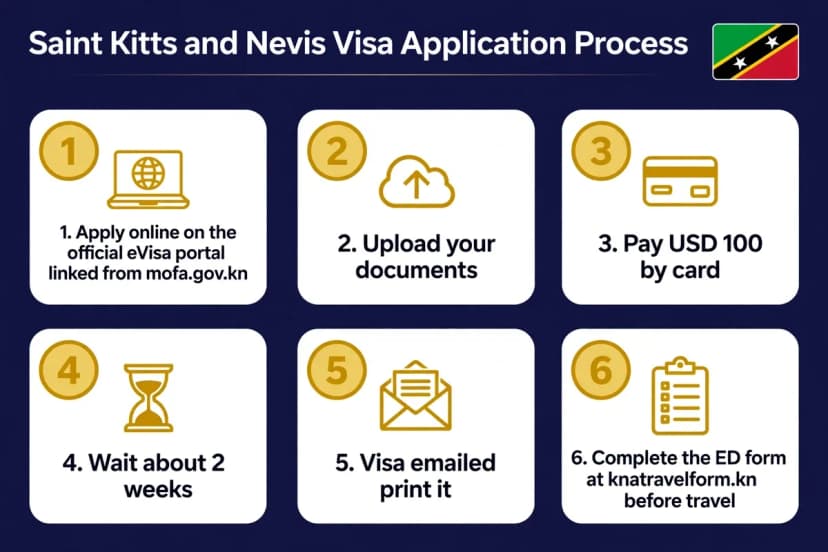
How to Apply: Step-by-Step
The mission route exists only as a fallback, and the arrival sequence is the same for everyone.
Visitor eVisa — step by step
Step 1 — Check your passport and your residence card. Your Pakistani passport must be valid for at least six months after the end of your visit, with at least one blank page. Your Vietnamese temporary residence card must stay valid for the whole trip — it is your proof of the right to return to Vietnam.
Step 2 — Open the official portal yourself. Go to mofa.gov.kn and follow its link to the eVisa portal (evisa.stkittsnevisonline.com). The Embassy in Washington also links www.evisa.gov.kn — two official-looking addresses for the same system. Start from the Ministry's site and follow its link; never reach the portal through a search advertisement or an agent's website.
Step 3 — Create an account and complete the form. Fill in your personal details exactly as they appear on your passport, plus your travel dates, your accommodation address in Saint Kitts and Nevis, and your contact details in Vietnam. A name mismatch between the form and the passport is one of the commonest reasons for delay.
Step 4 — Upload your documents. Upload the passport bio-page scan, your photograph, your return ticket or itinerary, your accommodation proof or invitation, your three months of bank statements and your employer's letter. Check each scan is legible before you submit.
Step 5 — Pay the USD 100 fee. Pay online by credit or debit card. Keep the payment receipt and the application reference number. Fees are not refunded if the application is refused or withdrawn.
Step 6 — Wait for the decision. The official figure is about two weeks; the Ministry says a few days to several weeks, and one week if an expedited fee is paid. Plan on a month. The visa is emailed to you — no passport needs to be sent anywhere. Print the approval and carry it with your passport.
Step 7 — Complete the ED form. Within a few days of your flight — and no later than 24 hours before arrival — complete the online Immigration and Customs ED form at knatravelform.kn. Save or print the confirmation. This is separate from the visa and mandatory for every traveller.
Step 8 — Travel with the file. Carry the printed visa approval, the ED-form confirmation, your return ticket, your hotel booking or invitation, your proof of funds and your employer's letter in your hand luggage. Airlines check the visa at boarding, and immigration officers at Basseterre may ask for the supporting documents again.
Applying through a mission — step by step
Use this route only if the online portal cannot handle your case, or if a mission specifically asks you to. Contact the mission first — the Embassy in Taipei is the nearest full mission to Vietnam, and the High Commission in London handles visa queries — confirm that it accepts applications from Pakistani nationals resident in Vietnam, and ask for its current form, fee and document list, whether you need an appointment, and whether you must apply in person. The London mission route asks for a signed original application form, two photos, three months of bank statements, an employer's letter and a USD 100 fee by money order. Keep a copy of everything you submit and a receipt for everything you pay.
On arrival at Robert L. Bradshaw International Airport
Robert L. Bradshaw International Airport (SKB), just outside Basseterre, is the main gateway and where almost every Pakistani traveller from Vietnam will arrive. Vance W. Amory International Airport on Nevis handles regional flights. At the immigration desk, present your passport, the printed eVisa approval and the ED-form confirmation, and be ready to show your return ticket, hotel booking or invitation, and proof of funds. The immigration officer makes the final decision in every case and sets how long you may stay — initially up to one month. Check the entry stamp before you walk away: it is your proof of the date you entered and the length of stay you were given.
Extending your stay
If you need more time, apply to the Immigration Department in Basseterre before your permitted stay expires. One third-party guide puts the extension fee at about EC$250 (about USD 93) for up to 90 additional days, but that figure is unverified and no official extension fee was found for this guide. Bring your passport with the entry stamp, proof of funds, proof of accommodation and your onward ticket, and expect a discretionary, case-by-case decision. Do not overstay while waiting: no official overstay fine was found for this guide, and one commercial site's claim of about USD 8 a day is unverified. A serious overstay can mean deportation and an entry ban.
Applying from Vietnam or Pakistan — No Mission in Either Country
For a Pakistani living in Vietnam, the important fact is that Saint Kitts and Nevis has no embassy or high commission in Vietnam, and none in Pakistan either. For a short visit it barely matters, because the eVisa portal covers the whole application online and no mission visit is needed. You only need a mission if your case cannot be handled online, or if you need consular help while you are there.
The nearest full mission to Vietnam is the Embassy in Taipei. Saint Kitts and Nevis recognises the Republic of China (Taiwan), not the People's Republic of China, so there is no mission in Beijing — do not go looking for one. The Embassy of Saint Christopher and Nevis in Taipei is at 5F, No. 9-1, Lane 62, Tianmu West Road, Taipei City 111047, Taiwan; +886 2 2873 3252; embskn.tw@mofa.gov.kn. It is a short flight from Ho Chi Minh City and the mission most likely to be useful in practice — but do not assume it will accept a visa application from a Vietnamese resident without asking first.
A Hanoi listing exists but is unverified. One foreign-service directory lists an Honorary Consulate in Hanoi, Vietnam. No address, telephone or consul's name was confirmed for this guide, and it does not appear on the official mission lists found here. Do not plan around it until the Ministry confirms it in writing.
Other missions worth knowing. The High Commission in London — 10 Kensington Court, London W8 5DL; +44 20 7937 9718; consular@sknhc.co.uk — handles visa queries and publishes the USD 100 fee and the two-week processing time. The Consulate-General in Toronto publishes the same USD 100 fee, and the Embassy in Washington, D.C. publishes the FAQ page this guide relies on. Ottawa, New Delhi, Abu Dhabi and Dubai complete the network. The Ministry of Foreign Affairs itself is at Building 15, Suites 201–202, Port Zante, Basseterre; foreignaffairs@mofa.gov.kn; +1 869 467 1161. For an application's status, the Ministry's FAQ page directs you to the Ministry of National Security on +1 869 467 1209.
Your own mission. Pakistan and Saint Kitts and Nevis established diplomatic relations only in January 2024. Pakistan's first envoy, High Commissioner Muhammad Saleem, presented his credentials in Basseterre in July 2025. He is based in Ottawa, Canada, and is concurrently accredited as Pakistan's non-resident High Commissioner to Saint Kitts and Nevis. The High Commission of Pakistan in Ottawa is at 10 Range Road, Ottawa. There is no resident Pakistani mission in Basseterre, so in an emergency your first call is to Ottawa — save its contact details, and the Ministry of Foreign Affairs' details, with your passport before you travel.
Two Pakistan-side notes. First, a polio vaccination certificate from NADRA is needed to leave Pakistan — a Pakistani exit requirement, not a Saint Kitts and Nevis one — so carry it if you fly out of Pakistan rather than Vietnam. Second, keep your temporary residence card valid for the whole trip and carry it with your passport.
| Mission | Address | Contact | Note |
|---|---|---|---|
| Embassy of Saint Kitts and Nevis, Taipei (nearest full mission to Vietnam) | 5F, No. 9-1, Lane 62, Tianmu West Rd., Taipei City 111047, Taiwan | +886 2 2873 3252; embskn.tw@mofa.gov.kn | Ask in writing first whether it accepts applications from Vietnamese residents |
| Honorary Consulate, Hanoi | Hanoi, Vietnam | Not confirmed | Listed in one directory only; no address or phone confirmed — do not rely on it |
| High Commission, London | 10 Kensington Court, London W8 5DL, UK | +44 20 7937 9718; consular@sknhc.co.uk | Publishes the USD 100 fee and 2-week processing; handles visa queries |
| Embassy, Washington, D.C. | Washington, D.C., USA | embassydc.gov.kn | FAQ page: USD 100, ~2 weeks, 1-month stay, student visa USD 150 |
| Ministry of Foreign Affairs, Basseterre | Building 15, Suites 201–202, Port Zante, Basseterre | +1 869 467 1161; foreignaffairs@mofa.gov.kn | The controlling source for visa questions |
| High Commission of Pakistan, Ottawa (your own mission) | 10 Range Road, Ottawa, Canada | Confirm before travel | High Commissioner Muhammad Saleem, concurrently accredited since July 2025; no resident mission in Basseterre |
Student Visas: Studying in Saint Kitts and Nevis
Saint Kitts and Nevis is a small but real study destination, almost entirely because of its offshore medical schools. The University of Medicine and Health Sciences (UMHS), Windsor University School of Medicine and the Medical University of the Americas all run MD programmes on Saint Kitts, and Ross University School of Veterinary Medicine runs its DVM programme there. There are about five medical universities on an island of 50,000 people. If you are considering one of them, the visa route is straightforward but has one hard rule: you cannot switch into it from inside the country.
The hard rule. The Embassy in Washington states: "Can I apply for a Students' visa while I am in SKN on a visitors' visa? No, you have to leave the Federation and apply for a student visa through the university of your interest. The fee is $150.00 (USD)." Do not fly to Basseterre on a visitor eVisa intending to enrol and convert it — you will have to leave and apply from outside.
How it works. First, secure admission to a recognised institution — the university issues an official letter of acceptance, which is essential. The university then sponsors and guides the application: UMHS says students can now apply and submit documents themselves online through the eVisa portal, with the university's help if preferred, and that approval can take up to two weeks. The student visa is issued after classes start — UMHS says the visa "will be issued to you after you start classes" — and your passport must then be stamped by the Ministry, with the university's visa liaison assisting. Any stay of more than 30 days requires a visa, so a student cannot simply live on visitor entries. The student residence permit is typically valid for one year (August to July) and is renewed for the duration of the course.
Documents. The UMHS list is the most detailed list found for this guide: passport; birth certificate; immunisation record; bank statement; police record; VDRL/RPR test; Mantoux/PPD tuberculosis test; school enrolment letter; return ticket. Add medical insurance covering treatment costs, and proof of funds for tuition and living costs. Documents go in as PDFs under 450 KB each, no more than 12 attachments, and the photograph must be passport-compliant. The ED form must also be completed online 24 hours before arrival.
Family and work while studying. Your spouse and relatives can visit on a visitor eVisa, but to work they need a work permit through the normal process; a student visa carries no right to work. Before choosing a medical school, check its accreditation and where its graduates can practise — a bigger decision than the visa, and outside this guide.
Work Visas and Work Permits
There is no work visa you can apply for on your own. Saint Kitts and Nevis runs an employer-sponsored work-permit system, and the permit belongs to the employer and the job, not to you. The rules below are the ones the 2026 guides agree on; the fees are the ones they do not agree on, and this section says so openly rather than presenting one guide's numbers as fact.
The process. A foreign national who intends to work for pay must obtain a work permit before starting work, under the Immigration Act. The employer applies on your behalf to the Department of Labour, acting through the Ministry of National Security. The employer must first advertise the job locally — one guide says for at least one month, another says at least three weeks — and demonstrate that no qualified national or permanent resident is available. Certain occupations are reserved for nationals, published in the Government Gazette. The application is made while you are outside the Federation, and the permit must be approved before you travel. A change of employer requires a new permit. OECS nationals have freedom of movement and do not need a permit; CARICOM graduates, nurses and teachers can use a skills certificate instead.
Documents. The employer files the application form with a copy of your passport (minimum six months' validity), two passport photographs, a police certificate of good conduct from your country of residence issued within the last six months, and a medical certificate from a registered medical practitioner — one 2026 guide also reports an HIV test requirement. The employer must submit a certified copy of its business registration, a tax clearance certificate, proof of Social Security registration and a valid Business and Occupations Licence, plus a letter justifying why this foreign national is required.
The fee conflict. Four different figures circulate for the work permit, and no official fee page found for this guide settles it. One guide, citing the Immigration Regulations (SRO No. 12 of 2018), lists an application fee of XCD 500 (about USD 185) plus an issuance fee of XCD 2,000 (about USD 740) for a one-year permit, or XCD 4,000 (about USD 1,480) for a two-year permit for senior management. A second guide, claiming to be checked against official sources, lists USD 1,600 for a calendar year, or USD 250 for one month or less, paid by the employer. A third lists XCD 1,600 a year (about USD 595), also paid by the employer and not deductible from your pay. A fourth gives XCD 500–1,500 for one year and XCD 1,500–2,500 for two years. Processing is equally unsettled: 30 working days as a target, with up to 90 days allowed, in one account; two to four weeks in another; four to six weeks in a third. This guide reports all of the figures and treats none of them as verified. Get the fee and the timeline from the employer and the Department of Labour in writing before you resign from anything or book anything. Never travel on a visitor eVisa intending to start work: working without a permit can lead to fines, detention and deportation.
Teaching English in Saint Kitts and Nevis. Readers of this guide are often English teachers, so this deserves a direct answer. English is the official language, and there is demand for teachers in private and international schools — but there is no special English-teacher visa, and teaching does not skip the labour-market test. You need a job offer first, then the employer-sponsored work permit, exactly as above. Do not fly to Basseterre on a visitor eVisa and expect to be hired on arrival: the permit must come first, and the employer is the sponsor. Saint Kitts and Nevis levies no personal income tax, which is part of why the work route attracts interest — but it does not make a permit any easier to get.
Family Visits and Permanent Residence
Visiting family. There is no separate published family-visit visa class: family visits are made on the ordinary visitor eVisa, at USD 100, with the same documents plus an invitation letter from your host giving their address and contact details, and evidence of the family relationship. Your host's invitation should state where you will stay and that they will host you for the whole visit.
Permanent residence. No published permanent-residence route for an ordinary visitor was found for this guide. Residence is built from permits — student, work, dependant — renewed year by year. If you are planning a permanent move, the two realistic routes are a long-term work permit through an employer, or Citizenship by Investment (USD 250,000 and up, covered above), which grants citizenship rather than residence. Do not pay anyone who promises to "arrange" permanent residence for a fee: there is no published programme of that kind. For a definitive answer about long-term residence, ask the Ministry of National Security or the Immigration Department in Basseterre in writing before you make plans.
Common Mistakes to Avoid
Using an unofficial website. The government's warning of 12 June 2025 is the single most important document in this guide after the fee pages: unauthorised third-party websites and apps falsely advertise Electronic Travel Authorisations and e-Visas and charge fees for them. Use only knatravelform.kn and the official "e-Border – St. Kitts & Nevis" app for ED forms and eTAs, and the eVisa portal linked from mofa.gov.kn for visas. Check that "Government of Saint Kitts and Nevis" is listed as the app developer before downloading anything.
Confusing the eTA with the eVisa. The USD 17 eTA is for visa-exempt nationals. You are not one of them. Buying an eTA does not replace the eVisa, and it does not get you on the plane. What every traveller needs, in addition to the visa, is the free ED form at knatravelform.kn.
Assuming a US, UK, Canadian or Schengen visa exempts you. No official source found for this guide confirms this. Apply for the Saint Kitts and Nevis eVisa even if you hold one of those visas, or ask the Ministry of Foreign Affairs in writing first. The same applies to Commonwealth membership: Pakistan is a Commonwealth member and still needs a visa in advance, at the full USD 100 fee.
Booking before the visa is approved. The official processing time is about two weeks and the Ministry says it can be several weeks. A non-refundable ticket bought the day you apply is a gamble. Apply first, wait for the emailed approval, then book.
Forgetting the ED form, or letting a document run short. The ED form at knatravelform.kn is mandatory for every traveller and must be completed before travel. Your passport must be valid for at least six months after the end of your visit, with a blank page, and your Vietnamese temporary residence card must stay valid for the whole trip, or you may not be able to return to Vietnam.
Working, studying or overstaying on a visitor eVisa. The visitor eVisa allows none of these. Working without a permit, enrolling in a course on a visitor visa, or overstaying the month the officer gives you can each lead to fines, detention, deportation and a record against future applications. A visitor eVisa needs no agent either: the portal is designed for applicants, the fee is USD 100, and the visa is emailed to you — an agent charging USD 500 in "consultancy" on top is selling a service you do not need.
Reasons for Refusal
No official list of refusal reasons is published for Saint Kitts and Nevis, so this section draws on the document requirements, the London High Commission's visa page, and the patterns common to visitor-visa refusals. A refusal is not the end of the road — but a second application with the same weak file will usually get the same answer, so fix the cause first.
Weak or unclear finances. Bank statements that do not plainly cover the trip, a balance topped up the week before the application, or statements that do not match the employer's letter. Three months of genuine statements, with a balance that comfortably covers flights, hotels and living costs, is the standard the London High Commission sets.
No clear purpose, or a purpose that does not match the visa. A tourist application with no itinerary, no hotel booking and no invitation; a business trip with no invitation letter; or an application that looks like a job search or a study plan dressed up as tourism. The visitor eVisa is for a visit — if your real purpose is work or study, apply for the right route.
No return ticket or no ties to home. No confirmed return or onward ticket, no employer's letter confirming your job and leave, and nothing showing you will leave at the end of the month. For a Pakistani living in Vietnam, the employer's letter and the valid residence card are your strongest evidence of ties.
Passport, photograph or false-document problems. A passport valid for less than six months after the visit, no blank page, a blurry bio-page scan, or a photograph that does not meet the portal's specification. Worse, a forged bank statement or an invitation letter from a host who does not exist: false documents can lead to a ban, not just a refusal, and a refusal must be disclosed on future visa forms that ask about it.
Previous immigration problems. A prior overstay, a deportation, or a refusal from another country that you did not disclose. Overstays are recorded against future applications. If you are refused, ask for the reason in writing, fix that specific problem, and reapply with a stronger file — and do not pay an agent who promises to "guarantee" the next application.
Frequently Asked Questions
1. Do Pakistani citizens need a visa for Saint Kitts and Nevis?
Yes. Pakistan is on the Ministry of Foreign Affairs' list of 67 countries whose nationals require a visa for entry. You must obtain an eVisa online before travel — there is no visa on arrival and no visa-free entry for a Pakistani passport holder, and Commonwealth membership does not change that.
2. How much is the Saint Kitts and Nevis visa fee?
USD 100 for the visitor eVisa, confirmed by the Embassy in Washington, the High Commission in London and the Timatic-based visa-policy summary. Two commercial guides list USD 50 or USD 70 instead; neither traces its figure to an official source. The student visa is USD 150.
3. How long does the Saint Kitts and Nevis eVisa take?
About two weeks, according to the Embassy in Washington, the High Commission in London and the Ministry of Foreign Affairs. The Ministry adds it can be one week if an expedited fee is paid, and that the range is a few days to several weeks. Apply at least one month before travel.
4. How long can I stay in Saint Kitts and Nevis?
The immigration officer decides on arrival, and the maximum stay is initially one month (30 days). One commercial guide claims a tourist eVisa allows up to 90 days — not confirmed on an official page, so this guide follows the Embassy's one-month figure. Check the entry stamp before you leave the desk.
5. Can I get a visa on arrival in Saint Kitts and Nevis?
No, not as a Pakistani passport holder. You need the eVisa approved and emailed to you before you travel, and you present the printed approval on arrival. Only nationals of visa-exempt countries enter without a visa, and cruise passengers staying ashore for less than 24 hours need no visa.
6. What is the difference between the eTA, the eVisa and the ED form?
The eVisa (USD 100) is the visa for nationals of visa-required countries, Pakistan included. The eTA (USD 17) is for nationals of visa-exempt countries only and does not apply to you. The ED form is the free online Immigration and Customs form at knatravelform.kn that every traveller must complete before travel.
7. Is there a Saint Kitts and Nevis embassy in Vietnam or Pakistan?
No, in neither country. The nearest full mission to Vietnam is the Embassy in Taipei, Taiwan — 5F, No. 9-1, Lane 62, Tianmu West Road, Taipei; +886 2 2873 3252; embskn.tw@mofa.gov.kn. A Hanoi honorary consulate is listed in one directory but its address and phone were not confirmed for this guide. In practice you will rarely need a mission: the eVisa is entirely online.
8. What documents do I need for the Saint Kitts and Nevis eVisa?
A passport valid at least six months after the end of your visit with a blank page; two recent colour passport photos; bank statements for the past three months; an employer's letter; a confirmed return or onward ticket; hotel booking or a host's invitation letter; and the completed ED form. The full checklists are in the document section.
9. Do I need a US, UK, Canadian or Schengen visa to enter Saint Kitts and Nevis?
No — you need the Saint Kitts and Nevis eVisa itself, and no official source found for this guide says that holding one of those visas exempts you from it. Apply for the eVisa even if you hold a US, UK, Canadian or Schengen visa, or ask the Ministry of Foreign Affairs in writing first.
10. Can I work in Saint Kitts and Nevis on a visitor eVisa?
No. The visitor eVisa does not allow work, study or self-employment. You need a job offer from a registered employer first, then an employer-sponsored work permit approved before you travel. Working without a permit can lead to fines, detention and deportation.
11. Can I study in Saint Kitts and Nevis on a visitor visa?
No. You cannot apply for a student visa while you are in the country on a visitor's visa — you must leave and apply through the university of your choice. The student visa fee is USD 150, processing takes up to two weeks, and the university sponsors and guides the application.
12. Can I extend my stay in Saint Kitts and Nevis?
Apply to the Immigration Department in Basseterre before your permitted stay expires, with your passport, proof of funds, proof of accommodation and your onward ticket. One third-party guide puts the extension fee at about EC$250 (about USD 93), but that figure is unverified. Do not overstay: a serious overstay can mean deportation and an entry ban.
13. What is Citizenship by Investment, and is it still open?
It is the world's oldest citizenship-by-investment programme (since 1984), granting full citizenship for a qualifying investment — USD 250,000 through the Sustainable Island State Contribution, or from USD 325,000 in approved real estate — plus due-diligence fees. On 13 November 2026 the government announced it will wind the programme down on a timeline negotiated with the EU, but the Citizenship by Investment Unit says it remains open until a final closing date is announced. It is not a visa and not a shortcut around the USD 100 eVisa.
14. Are there direct flights from Vietnam or Pakistan to Saint Kitts and Nevis?
No. The realistic routings from Ho Chi Minh City are via Miami (American Airlines, the most frequent service), New York JFK (JetBlue year-round, American and Delta seasonal), Toronto (Air Canada, seasonal), London Gatwick (British Airways, twice a week via Antigua), or a Caribbean hub such as Antigua, Barbados, San Juan or Sint Maarten. Transiting the United States, the United Kingdom or Canada needs that country's own transit visa or entry permission.
15. Is Saint Kitts and Nevis safe to visit?
The US State Department rates Saint Kitts and Nevis Level 1, "Exercise Normal Precautions", reissued 7 July 2026 with no change to the level — its lowest tier — and calls it generally safe for travellers. Petty crime and occasional violent crime do occur, and the underlying homicide rate is high, so take normal precautions and avoid isolated areas at night. The hurricane season runs from June to November: check forecasts and insurance cover if you travel then.
Official Immigration Websites
The Ministry of Foreign Affairs is the controlling source for who needs a visa; the Embassy in Washington for the fee, processing time and maximum stay; the High Commission in London for the document list; and knatravelform.kn for the ED form.
| Website | What it is | Link |
|---|---|---|
| MOFA — Visa-Required Countries for Entry | List of 67 visa-required countries, including Pakistan; links to the eVisa portal | mofa.gov.kn |
| MOFA — Requirements for Various Certificates | Page linking the eVisa portal at evisa.stkittsnevisonline.com | mofa.gov.kn |
| MOFA — FAQs | Processing usually 2 weeks, 1 week with an expedited fee; status enquiries to National Security on +1 869 467 1209 | mofa.gov.kn |
| Embassy to the USA — FAQs | Apply online at evisa.gov.kn, USD 100, about 2 weeks, visa emailed, maximum stay initially 1 month, student visa USD 150, cruise under 24 hours no visa | embassydc.gov.kn |
| High Commission, London — Visa & Immigration | USD 100 fee by money order, 2-week processing, 6-month passport, 3 months of bank statements, employer's letter; no work, study or self-employment | stkittsnevishcuk.gov.kn |
| SKNIS — Government warns against unofficial travel authorisation sites | Warning, 12 June 2025: only knatravelform.kn and the official "e-Border" app are authorised; sites charging for eTAs or e-Visas are fraudulent | sknis.gov.kn |
| Wikipedia — Visa policy of Saint Kitts and Nevis | The eTA system (from 26 May 2025), the eTA country list, and the eVisa: printed approval, USD 100, maximum stay 30 days | en.wikipedia.org/wiki/Visa_policy_of_Saint_Kitts_and_Nevis |
| Wikipedia — Diplomatic missions of Saint Kitts and Nevis | Taipei embassy, London and Ottawa High Commissions, Toronto Consulate-General, Washington Embassy, New Delhi, Abu Dhabi, Dubai | en.wikipedia.org/wiki/List_of_diplomatic_missions_of_Saint_Kitts_and_Nevis |
| UK FCDO — St Kitts and Nevis travel advice | Passport 6 months after arrival, eTA for British citizens, yellow-fever certificate if arriving from a risk country, hurricanes June–November | gov.uk/foreign-travel-advice/st-kitts-and-nevis |
| US State Department — Saint Kitts and Nevis travel information | Level 1 "Exercise Normal Precautions", reissued 7 July 2026 (direct fetch access-denied; level confirmed via reporting of the reissue) | travel.state.gov |
| UMHS — St. Kitts Student Visa | Student-visa process and documents: apply online via the eVisa portal, approval up to 2 weeks, ED form 24 hours before arrival, PDF limits, medical tests | accepted.umhs-sk.org |
| UrduPoint — Saint Kitts and Nevis Visa for Pakistanis 2026 | Pakistan-focused guide, checked 7 Nov 2026: USD 100 fee (London and Toronto), about 2 weeks, MOFA contacts, no US/UK-visa exemption confirmed | urdupoint.com/travel/visa/saint-kitts-and-nevis |
| Taiwan MOFA — Embassy of Saint Christopher and Nevis | Listing: Taipei embassy address, +886 2 2873 3252, embskn.tw@mofa.gov.kn, Ambassador Donya Lynex Francis | en.mofa.gov.tw |
| UrduPoint — Pakistan's first envoy to St. Kitts | High Commissioner Muhammad Saleem, Ottawa, concurrently accredited to Saint Kitts and Nevis; credentials July 2025; relations established January 2024 | urdupoint.com |
| ImmigrationWorld — St Kitts CBI: Costs and the Wind-Down | SISC USD 250,000, real estate USD 325,000/600,000, due diligence USD 10,000 + USD 7,500; wind-down announced 13 Nov 2026, open until a final date is set | immigrationworld.com |
| Wikipedia — Robert L. Bradshaw International Airport | American (Miami), JetBlue (New York JFK), British Airways (London Gatwick), Air Canada (Toronto), Delta, United, Winair, InterCaribbean | en.wikipedia.org/wiki/Robert_L._Bradshaw_International_Airport |
| TravelVisaStack — Saint Kitts and Nevis Visa for Pakistanis 2026 | 2026 guide: tourist eVisa USD 70, business USD 100, 3–5 working days, stay up to 90 days — conflicts with official USD 100 / 2 weeks / 30 days | travelvisastack.com |
| VisaFromPakistan — Saint Kitts and Nevis Tourist Visa for Pakistanis | 2026 guide: tourist eVisa USD 50, 3–7 business days, stay up to 30 days — conflicts with official USD 100 | visafrompakistan.com |
| Jeewa Consulting — St. Kitts & Nevis Visa Price From Pakistan | 2026 guide: tourist USD 100, business USD 150, transit USD 50, 4 weeks, PKR 1,000,000–2,000,000 balance claim | jeewaconsulting.com |
| SettleAnywhere — Saint Kitts and Nevis Work permit | Work-permit guide checked against official sources 11 Oct 2026: USD 1,600 per year or USD 250 for one month or less, employer applies, job advertised locally for at least one month | settleanywhere.com |
Final Checklist and Conclusion
Saint Kitts and Nevis is a small, beautiful and genuinely welcoming destination — and, for a Pakistani passport holder, a country that requires paperwork before pleasure. The whole trip turns on one online application. Work through the checklist in order.
- Passport valid at least six months after the end of your visit, with a blank page
- Vietnamese temporary residence card valid for the whole trip
- Two recent colour passport photographs, digital format
- Bank statements for the past three months showing funds that cover the trip
- Employer's letter confirming your job, salary and leave
- Confirmed return or onward ticket
- Hotel booking for the whole stay, or a host's invitation letter
- Apply on the official eVisa portal linked from mofa.gov.kn — never through an agent's link or a search ad
- Pay the USD 100 fee by card; keep the receipt and reference number
- Apply at least one month before travel; wait for the emailed approval before booking
- Complete the ED form at knatravelform.kn within a few days of the flight, no later than 24 hours before arrival
- Print the visa approval and the ED-form confirmation; carry them with your passport, return ticket, hotel booking and proof of funds
- Check the entry stamp at Basseterre before you walk away — it sets your permitted stay
- Do not work, study or overstay on a visitor eVisa; apply for an extension in Basseterre before your stay expires
- Save the emergency contacts before you fly: Ministry of Foreign Affairs +1 869 467 1161, foreignaffairs@mofa.gov.kn; High Commission of Pakistan in Ottawa (concurrently accredited since July 2025)
Saint Kitts and Nevis rewards the traveller who does the paperwork properly: a USD 100 eVisa, about two weeks of waiting, and a free ED form stand between you and Brimstone Hill Fortress, Mount Liamuiga and the beaches of two small islands. The visa is the easy part. The hard parts are the ones this guide keeps returning to: using only the official portal, budgeting the official fee rather than a commercial guide's cheaper figure, and remembering that the immigration officer — not the approval email — sets how long you may stay. Do those three things, and the rest of the trip is yours to enjoy.
This guide was checked on 28 November 2026. Visa rules change without notice. Always confirm the live rules on mofa.gov.kn and the official eVisa portal before paying any fee or booking a non-refundable ticket. Nothing in this guide is immigration advice; the Saint Kitts and Nevis authorities set and enforce the entry rules, and the immigration officer at Basseterre makes the final decision. The Citizenship by Investment figures are for information only, not an offer or a recommendation; the programme is winding down and its terms may change.