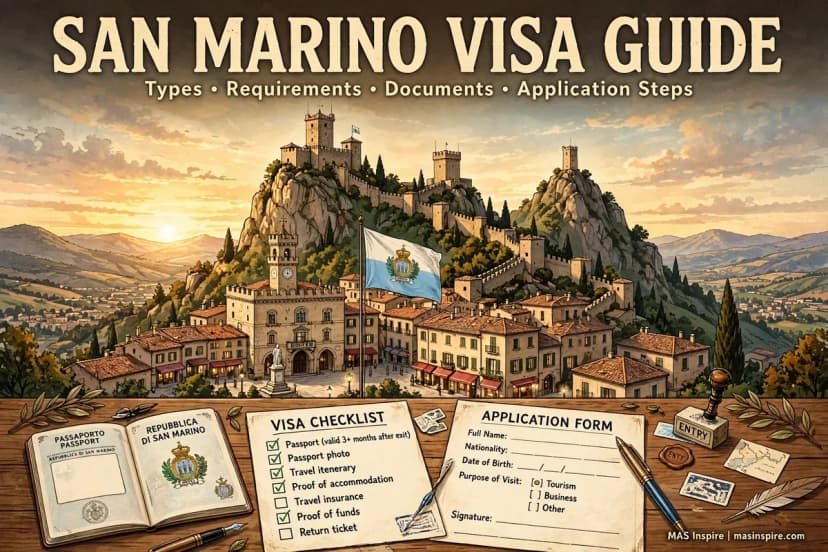
San Marino Visa Guide 2026: Types, Requirements, Documents and Application Steps
Last checked: 28 November 2026. This guide is for Pakistani passport holders living in Vietnam. There is no separate "San Marino visa": San Marino issues no entry visas of its own, and you enter it on an Italian Schengen visa. Visa rules change without notice — always confirm the live rules with the San Marino Department of Foreign Affairs (esteri.sm), the Italian Consulate General in Ho Chi Minh City, and VFS Global before paying any fee or booking a non-refundable ticket.
Introduction
San Marino is the most unusual visa case in this whole series, because the visa you need does not exist. The Republic of San Marino — the world's oldest republic, a 61-square-kilometre enclave perched on Mount Titano and completely surrounded by Italy — issues no entry visas of its own and runs no passport checks at its border with Italy. Its Department of Foreign Affairs states the position plainly: to reach San Marino it is necessary to transit through the Schengen area, so visitors from states outside the Schengen area must hold the necessary authorisations for entry into and transit through the Schengen area before departure. For a Pakistani passport holder, that means one thing: an Italian Schengen visa.
That single fact shapes everything in this guide. There is no San Marino embassy form to fill in, no San Marino e-visa portal, and no "San Marino visa fee". You apply for a Schengen short-stay visa (Type C) through Italy, you are interviewed and fingerprinted at a VFS Global centre in Vietnam, your passport is checked when you land in Italy — and then you simply drive or take the bus up the mountain from Rimini, with no further border control. The same fact also creates the two traps this guide exists to warn you about. First, your days in San Marino count inside your 90-days-in-any-180-days Schengen allowance, and crossing from Italy never resets the clock. Second, San Marino has its own local rule on top of Schengen: stays longer than 30 days need a stay permit from the Gendarmerie's Foreigners' Office, applied for in person inside San Marino — and the sources disagree about whether that threshold is 20, 30 or 90 days. This guide names the conflict and tells you which source to follow.
San Marino itself is worth the paperwork. The historic centre and the Three Towers of San Marino — Guaita, Cesta and Montale — are a UNESCO World Heritage site, the views run from the Apennines to the Adriatic, and the whole country can be walked in a day. It is also tiny, expensive to reach, and easy to get wrong: a single-entry Schengen visa used up on the way in, a stay that drifts past 30 days, or a "San Marino visa" sold by an agent are the three ways a short trip turns into a problem. Read the guide in order, apply through Italy, and keep your Schengen clock in view at all times.
Do Pakistani Passport Holders Need a Visa for San Marino?
Yes — but not a San Marino visa, because no such visa exists. Pakistan is one of the 105 nationalities that the San Marino Department of Foreign Affairs lists as visa-required, and the visa required is a Schengen visa obtained through Italy (or another Schengen state). Pakistan is not on the EU's visa-free list, so an ordinary Pakistani passport holder cannot enter the Schengen area without a visa, and since San Marino can only be reached through Italy, you cannot reach San Marino without one either.
The rule follows your passport, not where you live. Living in Vietnam on a temporary residence card (TRC), holding a Vietnamese visa, or holding a valid visa for another country does not change it. What your Vietnamese residence does change is where you apply: as a legal resident of Vietnam, you apply for the Italian Schengen visa in Vietnam, at the VFS Global centre in Ho Chi Minh City, under the jurisdiction of the Consulate General of Italy there — not in Pakistan. Keep your TRC valid for the whole trip and carry it with your passport, because it is your proof of the right to return to Vietnam, and the consulate will want to see it as evidence of your legal residence.
Your passport must meet the Schengen validity rules: issued within the last 10 years, and valid for at least three months after the day you plan to leave the Schengen area. The UK Foreign Office's San Marino advice states both conditions, and adds a detail that catches people out: you must have a passport containing a valid entry stamp from a Schengen area country, because there is no passport control at the San Marino border itself. Since the EU Entry/Exit System (EES) became fully operational on 10 April 2026, that entry record is now created biometrically — a facial image and fingerprints at your first Schengen entry — rather than by an ink stamp, but the principle is the same: your legal entry into Schengen is recorded in Italy, not in San Marino. If you arrive in San Marino with no valid Schengen entry record, you are in San Marino unlawfully, even though nobody checked your passport on the road from Rimini.
The visa you need is a short-stay Schengen visa (Type C) for stays of up to 90 days in any 180-day period. It covers tourism, family visits, business meetings and short events, and it is valid across all 29 Schengen countries — so the same visa that takes you to San Marino also covers your days in Italy before and after. It does not allow you to work, and it does not cover stays longer than 90 days. For anything longer, you need a national long-stay visa (Type D) from Italy, or a San Marino stay permit obtained inside San Marino — both covered in their own sections below.
The one thing to never pay for. Any website or agent offering to sell you a "San Marino visa", a "San Marino e-visa" or a "San Marino visa on arrival" is selling something that does not exist. San Marino has no visa system, no e-visa portal and no visa on arrival. The only genuine documents are the Italian Schengen visa in your passport and, for longer stays, a San Marino stay permit issued in person by the Gendarmerie. Do not pay any third party for a San Marino visa, and do not trust any site that lists a "San Marino visa fee" as if the republic charged one.
Types of Visas for Pakistani Passport Holders
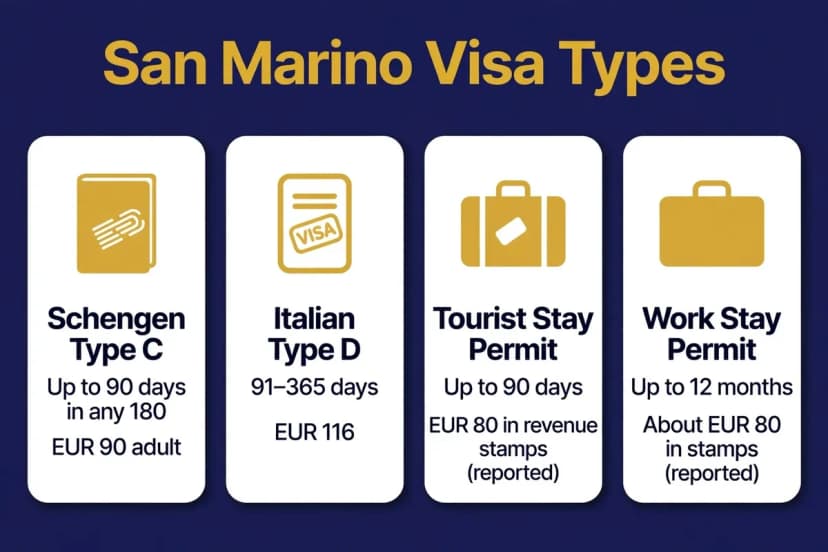
Because San Marino issues no visas, the "types" in this guide are really two families: the Italian Schengen and national visas that get you into the country, and the San Marino stay permits and residence categories that govern you once you are there. Do not confuse the two — a Schengen visa gets you in, but it does not by itself authorise a stay in San Marino beyond 30 days, and a San Marino stay permit does not by itself authorise entry into the Schengen area.
Schengen short-stay visa — Type C (tourism, family visit, business)
The visa almost every reader of this guide will use. Issued by Italy through VFS Global in Vietnam. Valid for up to 90 days in any 180-day period, single or multiple entry, across all 29 Schengen countries. Covers tourism, visiting family or friends, business meetings, conferences and short events. No work allowed. Fee EUR 90 for adults and children aged 12 and over, EUR 45 for children aged 6 to under 12, free for children under 6. Ask for multiple entry if your itinerary leaves and re-enters the Schengen area — for example, flying home via a non-Schengen hub after San Marino — because a single-entry visa used up on arrival cannot get you back in.
Schengen transit — Type A (airport transit)
For passing through the international transit area of an airport in a Schengen state without entering Schengen territory. Pakistani passport holders need an airport transit visa for some Schengen states. You will not normally need a Type A visa for a San Marino trip, because you enter Schengen territory in Italy rather than transiting it — but if your routing involves a transit stop in another Schengen airport on a separate ticket, check whether that state requires one. Fee EUR 90 where it applies.
Italian national long-stay visa — Type D (work, study, family, self-employment)
For stays in Italy longer than 90 days. Issued by the Italian Consulate General in Ho Chi Minh City in person, by appointment — not through VFS. Fee EUR 116 for most categories, EUR 50 for study. A Type D visa is an Italian national visa, not a San Marino document: it lets you live in Italy, and from Italy you may visit San Marino, but it does not by itself give you San Marino residence. If your real plan is to live in San Marino, read the work and residence sections below before choosing this route.
San Marino tourist stay permit — Permesso di Soggiorno Turistico
The local permit for a visit to San Marino lasting more than 30 days. You apply in person at the Gendarmerie's Foreigners' Office (Ufficio Stranieri) inside San Marino, within your first 30 days. According to 2026 specialist guides, it is valid for up to 90 days, capped at 90 days from your Schengen entry stamp, and costs EUR 80 in revenue stamps (EUR 50 at filing, EUR 30 at collection), with a passport, four ICAO photographs, a hospitality declaration signed at the Foreigners' Office, proof of means and health insurance of at least EUR 30,000. That fee and document list come from specialist guides, not from an official page found for this guide — treat them as reported, and confirm them with the Foreigners' Office before you travel. This permit is not an entry visa and does not replace your Schengen visa or extend your 90-in-180 Schengen allowance.
San Marino stay permits for work, study, family and other purposes
San Marino's Law No. 118 of 28 June 2010 provides temporary stay permits (permesso di soggiorno) for work, family reunification, cohabitation, study, sport, medical treatment, assistance, religious activity, humanitarian reasons, international volunteering and working-holiday programmes. These are generally valid for three months to one year, with a maximum validity of 12 months and the possibility of renewal. They are administered by the Gendarmerie Foreigners' Office, and work permits additionally need a clearance (nulla osta) from the Labour Office. They are covered in detail in the student, work and family sections below.
San Marino residence — residenza
For a stable, long-term move rather than a temporary stay. The main forms are registered residence (residenza anagrafica), reached after years of lawful presence; elective residence, linked to a property purchase of at least EUR 500,000 or a EUR 600,000 interest-free deposit in San Marino state securities, capped at 50 grants a year; and atypical residence, including a tax-favoured route for people whose income is earned abroad and a route for qualifying pensioners. These are high-cost, slow routes with their own committees and conditions — see the family and permanent residence section. None of them is a visa, and none of them can be applied for from Vietnam: they are filed inside San Marino.
Visa Comparison Table
The table below puts the two families side by side so the distinction is visible at a glance. The controlling document for entry is always the Schengen visa; the San Marino permits only govern how long and on what basis you may remain inside the republic once you are there.
| Route | What it is | Stay | Fee | Where to get it |
|---|---|---|---|---|
| Schengen Type C (tourism / family / business) | Italian short-stay visa; the entry document for San Marino | Up to 90 days in any 180 | EUR 90 adult; EUR 45 child 6–11; free under 6 | VFS Global, Ho Chi Minh City |
| Schengen Type A (airport transit) | Transit only; no entry to Schengen territory | Transit stop only | EUR 90 | VFS Global, Ho Chi Minh City |
| Italian Type D national visa | Long stay in Italy over 90 days | 91–365 days | EUR 116; EUR 50 study | Italian Consulate General, Ho Chi Minh City, in person |
| San Marino tourist stay permit | Local permit for San Marino stays over 30 days | Up to 90 days (reported) | EUR 80 in revenue stamps (reported) | Gendarmerie Foreigners' Office, in San Marino |
| San Marino work stay permit | Live and work in San Marino on a local job | Up to 12 months, renewable to 48 months (reported) | About EUR 80 in stamps (reported) | Gendarmerie Foreigners' Office; Labour Office clearance first |
| San Marino study stay permit | Study at a San Marino institution | Up to 12 months, renewable (reported) | Not confirmed — ask the Foreigners' Office | Gendarmerie Foreigners' Office, in San Marino |
| San Marino elective residence | Long-term residence by investment | Long-term; full residence after 10 years (reported) | EUR 1,000 filing (reported) plus EUR 500,000 property or EUR 600,000 deposit | Filed in San Marino; capped at 50 grants a year (reported) |
Visa Fees: What Each Route Costs
The fee picture is simple for entry and uncertain for everything after it. The Schengen fee is set by EU law and is the same whichever Schengen country you apply to; the San Marino permit figures below come from specialist 2026 guides, not from an official fee page found for this guide, and are labelled reported wherever that is the case. All visa fees are non-refundable if the visa is refused.
| Item | Figure | Source |
|---|---|---|
| Schengen Type C visa, adult (12 and over) | EUR 90 | EU Visa Code Art. 16, Regulation (EU) 2024/1415; in force 11 June 2024 |
| Schengen Type C visa, child aged 6 to under 12 | EUR 45 | EU Visa Code Art. 16 |
| Schengen Type C visa, child under 6 | Free | EU Visa Code Art. 16 |
| VFS Global service fee, Vietnam | Charged on top of EUR 90; exact VND amount not confirmed — reported about VND 303,000 per file in a 2026 post | VFS Global; amount unverified, confirm at booking |
| Italian national visa Type D (work, family, self-employment) | EUR 116 | Italian consular fee table, Q4 2026 |
| Italian national visa Type D (study) | EUR 50 | Italian consular fee table, Q4 2026 |
| San Marino tourist stay permit | EUR 80 in revenue stamps — EUR 50 at filing, EUR 30 at collection (reported) | Specialist 2026 guides; not confirmed on an official page |
| San Marino work stay permit | About EUR 80 in revenue stamps (reported) | Specialist 2026 guides; not confirmed on an official page |
| San Marino elective residence filing | EUR 1,000 (reported), plus EUR 500,000 property or EUR 600,000 deposit | Specialist 2026 guides; not confirmed on an official page |
| Travel medical insurance (not a fee, but mandatory) | Minimum cover EUR 30,000, valid across Schengen | EU Visa Code; San Marino stay-permit checklist |
| Souvenir passport stamp, San Marino tourism office | EUR 5 (reported) | 2026 travel guides; optional, has no legal effect |
How to pay. The EUR 90 Schengen fee is paid at the VFS Global centre in Ho Chi Minh City, in Vietnamese dong at the consulate's exchange rate, plus the VFS service fee. National (Type D) visa fees are paid at the Consulate General itself. San Marino stay-permit charges are paid in revenue stamps (marche da bollo) bought in San Marino before you attend the Foreigners' Office — the counter does not sell them, so buy them first. Keep every receipt: no fee is refunded if an application is refused or withdrawn.
Proof of funds is not a fee. The consulate will also ask you to show you can support yourself. Italy's official means-of-subsistence table sets EUR 269.60 for a solo traveller on a trip of one to five days, and EUR 212.81 per person where two or more people travel together, with higher amounts for longer trips. That money stays in your bank account — it is evidence, not a payment — but a thin bank statement is one of the commonest reasons for refusal. Show a stable balance, a salary record from your teaching job in Vietnam, and a card that works in Italy.
Processing Times
Schengen processing times are set by the EU Visa Code, so they are the most predictable figures in this guide. San Marino's own permit times are not published on any official page found for this guide and are flagged as unverified.
| Route | Processing time | Source |
|---|---|---|
| Schengen Type C visa, standard decision | 15 calendar days from lodging | EU Visa Code |
| Schengen Type C visa, extended examination | Up to 45 calendar days in exceptional cases | EU Visa Code |
| Schengen Type C visa, earliest / latest to apply | No earlier than 6 months and at least 15 days before travel | EU Visa Code |
| Italian national visa Type D (employment) | About 30 days after the nulla osta is issued | Italian consulate guidance, 2026 |
| Italian national visa Type D (family reunification) | About 30 days after the nulla osta (which can itself take up to 150 days) | Italian consulate guidance, 2026 |
| San Marino stay permit (tourist, work, study) | Not published — ask the Gendarmerie Foreigners' Office before you travel | Unverified |
Planning rule. Apply at least six weeks before travel: the 15-day standard decision can stretch to 45 days, and VFS appointment slots in Ho Chi Minh City can be booked out. Do not apply absurdly early either — no earlier than six months before travel — and remember that a visa's validity may run from its date of issue rather than your travel date, so a very early application can waste days of a short-validity visa. For a trip that includes a stay in San Marino beyond 30 days, allow extra time after arrival for the in-person permit application; you cannot file it from Vietnam.
Complete Document Checklists
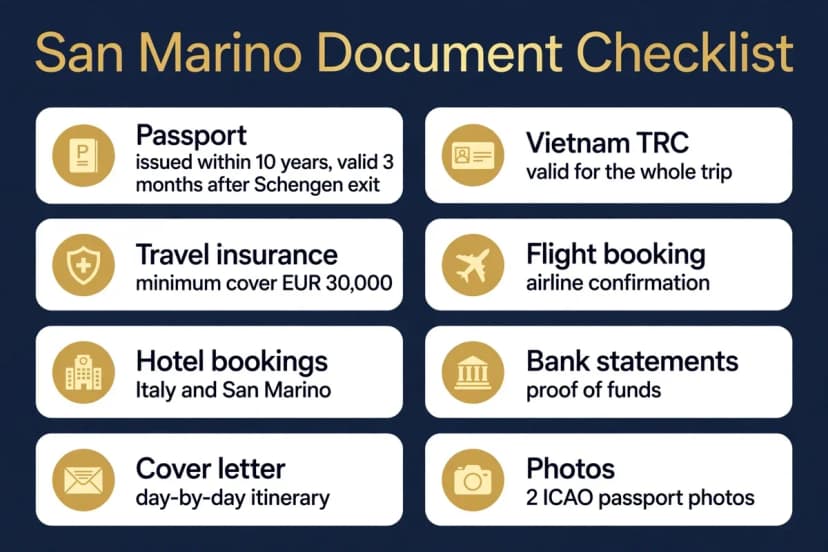
No single official document list for Pakistani applicants to San Marino was published on a page found for this guide, because the application is an Italian Schengen application. The checklists below combine the standard Schengen requirements, the Italian Consulate General's practice in Vietnam, and the San Marino stay-permit checklist as reported by 2026 specialist guides. Prepare originals and clean scans; a blurry passport scan or a mismatched itinerary is the commonest reason a file stalls.
Short visit — Italian Schengen Type C visa (the route most readers will use)
- Pakistani passport issued within the last 10 years, valid at least three months after your planned Schengen exit, with at least two blank pages
- Completed and signed Schengen visa application form (form V1 from the Consulate General of Italy in Ho Chi Minh City)
- Two recent ICAO passport photographs, white background, Schengen specification
- Vietnamese temporary residence card (TRC) — original and copy — proving legal residence in Vietnam, valid for the whole trip
- Travel medical insurance covering at least EUR 30,000, valid across all Schengen states for the whole trip, including emergency medical care, hospitalisation and repatriation
- Flight reservation: the Italian consulate asks for an airline booking confirmation sent directly by the airline, with its contacts and logo — confirm with VFS Ho Chi Minh City what it will accept before you pay for a ticket
- Accommodation proof for every night: hotel bookings in Italy and San Marino, or a formal invitation (dichiarazione di ospitalità / lettera di invito) from your host
- Proof of sufficient funds: bank statements for the last three to six months, salary slips from your teaching job in Vietnam, and evidence of regular income — Italy's reference figure is EUR 269.60 for a solo traveller on a one-to-five-day trip
- Employment proof: employment contract or letter from your school or employer in Vietnam, stating your position, salary and approved leave dates
- Cover letter explaining the trip in your own words: why San Marino, the day-by-day itinerary, where you will stay, and that you will return to Vietnam before your visa and TRC expire
- Travel itinerary showing dates, cities and transport between Italy and San Marino, consistent with the flight and hotel bookings
- Previous Schengen visas and entry stamps, if any, and any previous refusals declared honestly
- For children: birth certificate, both parents' passports, and a notarised parental consent letter if the child travels with one parent only or with neither parent
- Polio vaccination certificate — some Pakistan-focused guides report that Italian consulates ask Pakistani nationals for one; whether the Ho Chi Minh City consulate requires it from a resident of Vietnam is unconfirmed, so ask VFS before your appointment
Long stay — Italian national visa Type D
- Everything in the Type C list above, plus the purpose-specific documents for your category
- Work: the employer's nulla osta (work authorisation) issued under the annual quota decree, plus the signed employment contract or binding job offer
- Study: letter of acceptance from the Italian institution, proof of accommodation and funds, and the reduced EUR 50 fee
- Family reunification: the family member's nulla osta, proof of the family relationship (marriage or birth certificate, legalised and translated into Italian), and proof of the sponsor's income and housing in Italy
- National visa application form (form V2/V3 from the consulate), submitted in person at the Consulate General by appointment
San Marino tourist stay permit — applied for inside San Marino
- Valid passport with your Schengen entry record (EES registration or entry stamp from Italy)
- Four ICAO-format identity photographs
- Hospitality declaration (dichiarazione di ospitalità) signed at the Foreigners' Office, or proof of hotel accommodation
- Proof of means of support, or a host's invitation letter — one 2026 guide reports a EUR 50 invitation letter figure, which is unverified
- Health insurance of at least EUR 30,000 a year, or cover recognised by the San Marino Social Security Institute (ISS)
- Revenue stamps (marche da bollo) bought in advance — reported EUR 50 at filing and EUR 30 at collection
- Apply in person at the Gendarmerie Foreigners' Office within your first 30 days in San Marino
San Marino work stay permit — applied for inside San Marino
- Job offer from a San Marino employer, with the Labour Office clearance (nulla osta) obtained by the employer first
- Certified employer guarantee declaration
- Criminal record certificates from Pakistan and from Vietnam (your country of last residence), apostilled and translated into Italian, none older than six months — per 2026 specialist guides
- Passport, photographs, accommodation proof and health insurance, as for the tourist permit
- Revenue stamps bought in advance
How to Apply: Step-by-Step
Step 1 — Decide the real purpose and the right visa. A short visit to San Marino is a Schengen Type C tourist visa through Italy. If you will stay in San Marino more than 30 days, plan the in-person stay-permit application as well. If you intend to work or study, do not start with a tourist visa and hope to convert it — a Schengen visa does not allow work, and conversion inside San Marino is not a published route.
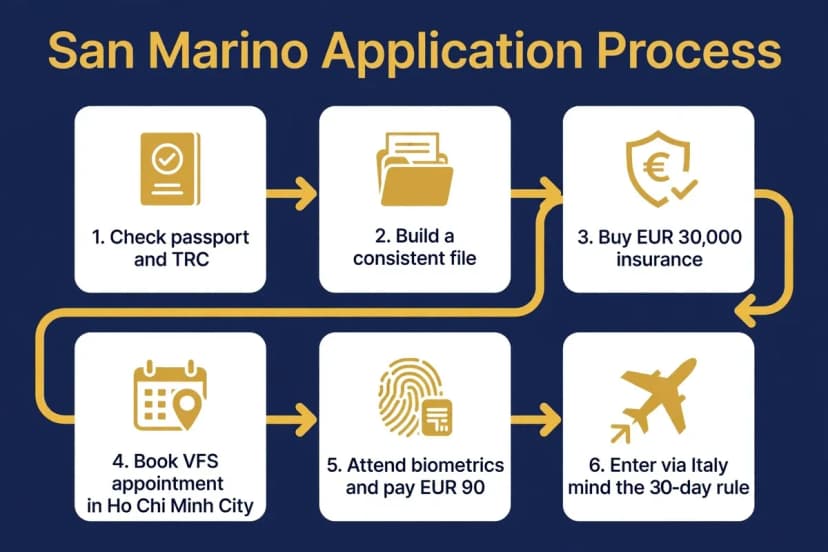
Step 2 — Check your passport and TRC. Passport issued within the last 10 years, valid three months beyond your planned Schengen exit, two blank pages. Vietnamese TRC valid for the whole trip. Renew either one before you start if it is close to expiry.
Step 3 — Build a consistent file. Dates, destinations, accommodation and funds must tell the same story across every document. Your itinerary must show San Marino inside an Italy trip — for example, fly to Bologna or Rimini, two nights in San Marino, the rest in Italy — because a file that mentions only San Marino looks incoherent to an Italian consulate that has never seen a "San Marino visa". Book refundable or holdable flights and hotels until the visa is issued.
Step 4 — Buy compliant travel insurance. Minimum EUR 30,000 cover, valid across all Schengen states, covering emergency care, hospitalisation and repatriation. Note that the European Health Insurance Card (EHIC) and the UK Global Health Insurance Card (GHIC) are not accepted in San Marino, so insurance is not optional in practice.
Step 5 — Book a VFS Global appointment. Short-stay applications for Italy in southern Vietnam go through VFS Global in Ho Chi Minh City — book at visa.vfsglobal.com/vnm/en/ita. National (Type D) visas are different: they are lodged in person at the Consulate General itself, by appointment, on Tuesdays 09:00–12:00 and Thursdays 14:00–16:00.
Step 6 — Attend the appointment and give biometrics. Submit the file, pay the EUR 90 fee plus the VFS service fee, and give fingerprints and a photograph. Biometrics are stored in the Schengen Visa Information System and are normally reusable for 59 months, but first-time applicants must attend in person.
Step 7 — Wait for the decision. The standard decision time is 15 calendar days, extendable to 45 days in exceptional cases. Track the file through VFS. Do not book non-refundable travel until the visa is in your passport.
Step 8 — Check the visa sticker before you travel. Read the validity dates, the number of entries (single or multiple), and the duration of stay printed on it. A single-entry visa is spent the moment you first enter Schengen — if your return routing leaves Schengen and re-enters, you will be refused re-entry. Confirm the dates cover your whole trip, including the San Marino days.
Step 9 — Enter Schengen through Italy. Fly to Bologna, Rimini or Ancona. Your passport and biometrics are checked there under the Entry/Exit System, and your entry is recorded. Keep your boarding pass and hotel confirmations: they prove your entry date if the 90-day count is ever questioned.
Step 10 — Travel to San Marino and mind the 30-day rule. Take the bus or drive from Rimini — there is no border check, no stamp and no fee. If your stay in San Marino will pass 30 days, go to the Gendarmerie Foreigners' Office in person within your first 30 days and apply for the stay permit. Keep your Schengen visa valid for the return journey through Italy.
Applying from Vietnam — and from Pakistan
From Vietnam (your case). As a legal resident of Vietnam, Italy is the Schengen state you apply to, because Italy is your main destination — San Marino is reached through Italy, and your itinerary will show more nights in Italy than anywhere else. Short-stay applications are lodged at the VFS Global Visa Application Centre in Ho Chi Minh City. The Italian Embassy in Hanoi announced in October 2025 that the Ho Chi Minh City centre is at 11th Floor, President Place Tower, 93 Nguyen Du, Ben Nghe, District 1; an older consulate page lists the Resco Building at 94–96 Nguyen Du Street, also in District 1. The President Place address is the more recent official notice, so use it — and confirm the current address on the VFS booking page before you go, because the centres have moved before. The centre in Da Nang serves central Vietnam. The deciding authority is the Consulate General of Italy in Ho Chi Minh City: 10th Floor, President Place, 93 Nguyen Du, Ben Nghe, District 1, Ho Chi Minh City; telephone +84 28 3827 5445/6/7; visa email hochiminh.visti@esteri.it.
Jurisdiction matters. The Ho Chi Minh City consulate handles residents of 22 southern and central provinces, from Thua Thien-Hue and Da Nang down to Ca Mau, including Ho Chi Minh City, Binh Duong, Dong Nai and Long An. Residents of some provinces — including, per a 2026 HCMC consulate guide, Lam Dong, Tay Ninh, An Giang and Kien Giang — are assigned to the Embassy of Italy in Hanoi instead. That province list comes from a secondary guide, so confirm your own jurisdiction with VFS when you book: filing at the wrong consulate is a refusal risk.
From Pakistan. If you apply from Pakistan instead — for example during a visit home — you apply through the Italian Embassy in Islamabad via its visa centre (Gerry's Visa), with the same EUR 90 fee and the same document logic, but with the added practical points that Pakistan-based guides report: proof of a recent polio vaccination is commonly requested from Pakistani nationals, and the file is assessed on your ties to Pakistan rather than to Vietnam. Applying from Vietnam is normally the stronger file for you, because your job, salary, TRC and bank history are all in Vietnam.
Getting there. There are no direct flights from Vietnam to Italy's Adriatic airports and no scheduled commercial flights to San Marino at all. The realistic routing is Ho Chi Minh City to Rome, Milan or Bologna with one stop — via Doha, Dubai, Istanbul, Singapore or Bangkok — then a domestic hop or train to Bologna or Rimini, and a bus up to San Marino. San Marino's own Torraccia airfield handles only small charter and private aircraft, according to Wikipedia, so do not plan around it. Rimini's Federico Fellini Airport is the closest, roughly 25 km away, and Bologna's Guglielmo Marconi Airport is the best-connected alternative.
Consular help while you are there. Pakistan has no mission in San Marino. The nearest Pakistani mission is the Embassy of Pakistan in Rome; whether it is formally accredited to San Marino is unconfirmed in the sources found for this guide, so write to it before you travel if you may need consular help, and carry its contact details with you. In an emergency, the EU's 112 number works in both Italy and San Marino.
Student Route
San Marino has a small university — the University of the Republic of San Marino (Università degli Studi della Repubblica di San Marino) — but it is a niche destination for study, not a mainstream one: a handful of departments, small intakes, and courses mostly in Italian. If your aim is a European degree, Italy's universities are the realistic target, and the student route runs through the Italian national study visa (Type D, EUR 50) rather than through San Marino.
If you do secure a place at the University of San Marino, the stay is governed by San Marino's own rules, not by the Italian student visa. Study is one of the purposes listed in Law No. 118 of 28 June 2010 for a temporary stay permit (permesso di soggiorno), which is generally valid for three months to one year and renewable. You would apply in person at the Gendarmerie Foreigners' Office, with the university's acceptance letter, proof of accommodation and funds, health insurance, and the standard photographs and stamps. No official fee or document list for the study permit was found for this guide — confirm both with the Foreigners' Office and the university before you commit to anything, and do not pay any agent who claims to sell a "San Marino student visa".
The honest assessment for a Pakistani teacher in Vietnam: San Marino is not a study destination to plan a move around. Its university is small, its courses are mostly in Italian, and there is no published post-study work route in San Marino comparable to Italy's. If study abroad is the goal, the stronger play is an Italian university on a Type D study visa, with San Marino as a weekend trip once you are in Italy.
Work Route
Working in San Marino is possible but narrow, and it is the route most likely to be mis-sold to you. The facts, as far as they can be verified: a tourist or Schengen visa does not allow work anywhere, including San Marino. To work legally in San Marino you need a job offer from a San Marino employer first, and the employer must obtain a clearance (nulla osta) from the Labour Office (Ufficio del Lavoro) before you can apply for a work stay permit at the Gendarmerie Foreigners' Office. Employment is prioritised for Sammarinese citizens and residents, and there is no published general work-visa route you can apply for without an employer.
According to 2026 specialist guides, the work stay permit runs for up to 12 months, is renewable, and is capped at 48 months in total — after three consecutive renewals the permit is interrupted by law and a fresh application can only be filed after a return home and a 30-day wait. The same guides put the total stamp fees at about EUR 80. Neither the 12-month term, the 48-month cap nor the fee was confirmed on an official page found for this guide: treat them as reported, and get the terms from the Labour Office or the employer before you make plans. The permit is a stay permit, not residence — it does not build towards registered residence, and it grants no rights in Italy or the rest of Schengen.
There are two smaller doors. San Marino has working-holiday agreements with a handful of countries — Australia, the United Kingdom and Canada are named in the Foreign Affairs Department's pages — but Pakistan is not among them, so the working-holiday permit is not open to you. And since the San Marino–Switzerland agreement of 19 May 2025 (in force 8 November 2025), young Swiss professionals can work in San Marino under a quota of 20 a year — again, not open to Pakistani nationals. If an agent offers you a "San Marino work visa" without a named employer and a Labour Office clearance, it is not a real route.
The realistic work path for you runs through Italy, not San Marino: an Italian employer obtains a nulla osta under the annual quota decree (decreto flussi), you apply for an Italian Type D employment visa (EUR 116) at the Consulate General in Ho Chi Minh City, and you apply for an Italian residence permit within eight working days of arrival. San Marino then remains a place you can visit, not a place you can work in, unless a San Marino employer later hires you through its own Labour Office process.
Family and Permanent Residence
San Marino's long-term routes are real but slow, expensive and decided inside San Marino — none of them can be started from Vietnam, and none of them is a visa. Family reunification is a recognised purpose for a temporary stay permit under Law No. 118 of 28 June 2010: a foreigner with a lawful stay can seek a permit for a spouse or dependent family member, filed at the Gendarmerie Foreigners' Office with proof of the relationship, accommodation and means. The detailed requirements and fees were not confirmed on an official page found for this guide — confirm them with the Foreigners' Office before relying on them.
Registered residence (residenza anagrafica) is the stable status that stay permits can turn into. According to 2026 specialist guides, family permit holders can apply after five continuous years, humanitarian permit holders after two, and holders of conditional residence (business, elective, atypical or economic) after ten years from registration. Those periods were not confirmed on an official page found for this guide. Citizenship is a further step beyond residence and is governed by separate law — Law 27/2026 now allows multiple citizenship — but it is not a realistic planning horizon for a first trip, and this guide does not present it as one.
Elective residence is the capital route: a residential property purchase of at least EUR 500,000 for your own or your family's use, or an interest-free deposit of at least EUR 600,000 locked for ten years in San Marino state securities, with a EUR 1,000 filing fee, private health insurance, and a clean criminal record (certificates from your country of last residence, apostilled and translated into Italian, none older than six months). Grants are capped at 50 a year, and the residence converts into full registered residence ten years after registration. Every figure in this paragraph comes from 2026 specialist guides, not from an official page found for this guide — the structure of the route is consistent across sources, but the exact fees and thresholds should be confirmed with the Department of Foreign Affairs before any money moves. Atypical residence, for people whose income is earned abroad, and a route for qualifying pensioners also exist on the same terms: filed in San Marino, decided by committee, and slow.
The 30-day rule is the practical residence issue for most visitors. It is also the most confused. The San Marino Department of Foreign Affairs' own visitor page, and the UK Foreign Office, both say the same thing: foreigners intending to stay more than 30 days must personally apply for a stay permit at the Gendarmerie Foreigners' Office within that 30-day period. But the consolidated text of Law No. 118 of 28 June 2010, Article 6, as published by the Great and General Council, says a stay permit or residence is needed for a stay "exceeding twenty days". And Wikipedia's visa-policy summary says foreign visitors staying more than 90 days must obtain a permit. Three sources, three thresholds: 20, 30 and 90 days. This guide follows the Department of Foreign Affairs' 30-day rule, because it is the government's own visitor guidance and it is corroborated by the Foreign Office — but you should plan conservatively: if your stay in San Marino will pass 20 days, contact the Foreigners' Office early and ask which threshold applies to you, rather than discovering the answer after the fact.
Common Mistakes
Paying for a "San Marino visa". It does not exist. The only entry document is the Italian Schengen visa. Any agent, website or "visa service" charging you for a San Marino visa, e-visa or visa on arrival is charging for nothing.
Applying to the wrong Schengen state. You apply to Italy because Italy is your main destination and your only route in. Applying to another Schengen state with a San Marino-only itinerary invites a refusal for a poorly justified main destination, and a visa issued by another state with no Italian leg can cause problems at the Italian border.
Taking a single-entry visa on a multi-entry trip. If your return routing leaves the Schengen area and re-enters it — or if you plan a side trip to a non-Schengen country mid-holiday — a single-entry visa is spent on first entry. Ask for multiple entry and show the routing that needs it.
Counting only the San Marino days. Your 90-in-180 allowance covers every Schengen day, including Italy, and every day in the previous 180 days counts. A week in Italy before San Marino and a week after it are 14 days of your allowance, not zero. Use the European Commission's short-stay calculator before you book.
Drifting past 30 days in San Marino without a permit. There is no border check to remind you. The 30-day clock is yours to watch, and the permit application must be made in person at the Foreigners' Office inside the first 30 days. Set a reminder for day 20 and go early — the law text itself mentions 20 days, so do not cut it fine.
Booking non-refundable travel before the visa arrives. The standard decision is 15 days but can extend to 45. Book refundable fares and hotels, or hold reservations, until the sticker is in your passport.
Submitting a file that contradicts itself. Flight dates that do not match hotel dates, an itinerary that shows San Marino but no Italy, a bank balance that does not cover the trip, a cover letter that says tourism while the bookings say something else — any one of these is a standard refusal reason. Read the whole file once as a stranger would.
Treating the souvenir stamp as a visa. The San Marino tourism office offers an optional souvenir passport stamp for a reported EUR 5. It is a keepsake with no legal effect, and some border authorities dislike unofficial stamps in passports — ask for it on a separate card if you want one, not in your passport.
Reasons for Refusal
Schengen refusals use standard codes, and the Italian consulate applies the same ones as every other Schengen state. The commonest for a Pakistani applicant in Vietnam are: insufficient proof of funds or an unstable bank balance; no clear travel purpose, or an itinerary that does not justify Italy as the main destination; weak ties to Vietnam — no TRC, no job letter, no evidence you will return; travel insurance that does not meet the EUR 30,000 Schengen minimum or does not cover the whole trip; and a passport that fails the 10-year or three-month validity rules. Previous Schengen overstays, undeclared refusals, or a Schengen Information System alert are harder refusals that need honest disclosure, not concealment — an undeclared refusal found in the system is worse than the refusal itself.
Two San Marino-specific refusal risks deserve emphasis. First, a file that presents San Marino as the main destination: Italy decides the visa, and a file with no Italian nights and no Italian logic can be refused for an unjustified purpose of stay. Always show a real Italy leg. Second, the "intention to leave" test: a single man with a short employment history in Vietnam, a thin bank record and no return ticket is the profile consulates scrutinise most. Your teaching contract, salary slips, TRC, a return ticket and a leave letter from your school are your best answers to it.
If you are refused, you will receive a standard refusal form with the reason codes marked. You can appeal under Italian law or reapply with a corrected file — reapplying is usually faster than appealing, but only if you actually fix the reason given. A refusal does not ban you, but a second identical application will be refused again. There is no appeal against a San Marino stay-permit decision that you can file from Vietnam, because the permit is decided inside San Marino by the Gendarmerie.
Frequently Asked Questions
1. Do Pakistani citizens need a visa for San Marino?
Yes — a Schengen visa, obtained through Italy. San Marino issues no visas of its own and has no border control with Italy, so your entry document is an Italian Schengen Type C visa. Pakistan is listed by the San Marino Department of Foreign Affairs among the 105 visa-required nationalities.
2. Is there really no "San Marino visa"?
Correct. San Marino has no visa system, no e-visa portal and no visa on arrival. Its Department of Foreign Affairs states that visitors from outside the Schengen area must hold the necessary Schengen authorisations before departure. Anyone selling a "San Marino visa" is selling something that does not exist.
3. How much does the visa cost?
The Schengen Type C fee is EUR 90 for adults and children aged 12 and over, EUR 45 for children aged 6 to under 12, and free for children under 6, in force since 11 June 2024. A VFS Global service fee is charged on top in Vietnam; the exact dong amount was not confirmed for this guide, so check it when you book. San Marino itself charges no entry fee.
4. How long can I stay in San Marino?
Up to 90 days in any 180-day period on a Schengen visa, counting all your Schengen days together — Italy included. Separately, San Marino requires a stay permit from the Gendarmerie Foreigners' Office for stays longer than 30 days, applied for in person within the first 30 days. Note the conflict: the text of Law 118/2010 mentions 20 days, and Wikipedia mentions 90 days — this guide follows the Foreign Affairs Department's 30-day rule.
5. Where do I apply from Vietnam?
At the VFS Global Visa Application Centre in Ho Chi Minh City, under the Consulate General of Italy there. The October 2025 embassy notice gives the centre's address as 11th Floor, President Place Tower, 93 Nguyen Du, Ben Nghe, District 1. Book at visa.vfsglobal.com/vnm/en/ita. National (Type D) visas are lodged in person at the consulate itself, by appointment.
6. How long does the visa take?
The standard Schengen decision time is 15 calendar days, extendable to 45 days in exceptional cases. Apply no earlier than six months and at least 15 days before travel; in practice, allow six weeks including the VFS appointment wait.
7. Do I need a visa if I only visit San Marino for a day trip from Italy?
Yes, if your passport needs one — there is no day-trip exception. You enter the Schengen area in Italy on the same visa whether you stay an hour or a month, and San Marino has no separate border where a day visitor could be waved through.
8. Can I work in San Marino on a tourist visa?
No. A Schengen tourist visa does not allow work in Italy or in San Marino. Working in San Marino needs a job offer from a San Marino employer, a Labour Office clearance, and a work stay permit from the Gendarmerie Foreigners' Office — and Pakistan has no working-holiday agreement with San Marino.
9. Is there an airport in San Marino?
No airport with scheduled commercial flights. San Marino's Torraccia airfield handles only small charter and private aircraft, according to Wikipedia. Fly to Rimini (about 25 km away) or Bologna, then take a bus or drive up to San Marino.
10. Do I need travel insurance?
Yes — Schengen travel medical insurance of at least EUR 30,000, valid across all Schengen states, is a mandatory visa document. It matters more than usual here: the EHIC and GHIC are not accepted in San Marino, so without insurance you have no health cover at all.
11. What is the Entry/Exit System, and does it affect me?
The EU Entry/Exit System (EES) has been fully operational since 10 April 2026. At your first Schengen entry — in Italy — your facial image and fingerprints are recorded instead of an ink stamp. That record is your proof of legal entry, which matters because San Marino itself stamps nothing. ETIAS, the planned pre-travel authorisation for visa-free visitors, is not in operation and has no start date — and it would not apply to you anyway, since you travel on a visa.
12. Can I extend my stay in San Marino?
Within the 90-in-180 Schengen limit, a longer San Marino stay needs a local stay permit from the Gendarmerie Foreigners' Office, applied for in person within your first 30 days — a tourist stay permit is reported to cost EUR 80 in revenue stamps and to run up to 90 days. Your Schengen visa itself cannot be extended from inside San Marino; a Schengen extension, if one is possible at all, is an Italian matter.
13. Can my family join me in San Marino?
For a short visit, each family member needs their own Schengen visa, and children need their own passport, birth certificate and, where applicable, a notarised parental consent letter. For a longer stay, family reunification is a recognised purpose for a San Marino stay permit under Law 118/2010, filed at the Foreigners' Office — the detailed requirements were not confirmed on an official page found for this guide.
14. Is San Marino safe?
Street crime is very rare, according to the UK Foreign Office, and San Marino is one of the safest places in Europe by that measure. The US State Department rates Italy, San Marino and Vatican City together at Level 2, "Exercise increased caution", because of the terrorism risk that applies across Western Europe — the same rating as Italy itself. Take normal precautions and keep your passport and cash secure.
15. Can I live in San Marino permanently?
Only through San Marino's own residence routes, which are slow and, for the investment route, expensive: elective residence needs a EUR 500,000 property purchase or a EUR 600,000 ten-year deposit, with grants capped at 50 a year, and registered residence generally needs years of lawful stay first. There is no shortcut, no golden visa you can buy from Vietnam, and no route that starts with a tourist visa.
Official Immigration Websites
Check these sources directly before you apply. The San Marino Department of Foreign Affairs is the controlling source for the no-visa rule and the 30-day stay-permit threshold; the Italian consulate and VFS Global are the controlling sources for the Schengen application in Vietnam; the EU Visa Code sets the fee and the processing times.
| Website | What it is | Link |
|---|---|---|
| San Marino Department of Foreign Affairs — Information for those who visit San Marino | Official visitor page: no San Marino entry visa; Schengen authorisation required before departure; stay permit needed for stays over 30 days, applied for in person at the Gendarmerie Foreigners' Office | esteri.sm — information for those who visit San Marino |
| Law No. 118 of 28 June 2010 — Law on the Entry and Stay of Foreigners (consolidated text) | San Marino's immigration law: Art. 5 requires a valid Schengen visa where required; Art. 6 says a stay permit or residence is needed for stays exceeding twenty days — the source of the 20-day conflict | consigliograndeegenerale.sm — Law 118/2010 |
| UK Foreign, Commonwealth and Development Office — San Marino travel advice | Entry through Italy; passport issued under 10 years ago and valid 3 months after leaving Schengen; valid Schengen entry stamp; Gendarmerie permit for stays over 30 days or work; EHIC/GHIC not accepted | gov.uk — San Marino travel advice |
| US Department of State — Italy Travel Advisory (covers San Marino) | San Marino is an independent republic with an open border agreement with Italy and no passport control at its border; Level 2 "Exercise increased caution" for Italy, San Marino and Vatican City, due to terrorism | travel.state.gov — Italy travel advisory |
| Wikipedia — Visa policy of San Marino | Summary: San Marino not in the EU or EEA, open border with Italy, Schengen rules apply de facto; foreign visitors staying more than 90 days must obtain a permit; souvenir stamp at the tourism office | en.wikipedia.org/wiki/Visa_policy_of_San_Marino |
| VFS Global — Italy visa application centre, Vietnam | Official booking portal for Italian Schengen visa appointments in Vietnam | visa.vfsglobal.com/vnm/en/ita |
| Consulate General of Italy in Ho Chi Minh City | Deciding authority for southern Vietnam; visa forms V1 (Schengen) and V2/V3 (national); national visas lodged in person by appointment; 10th Floor, President Place, 93 Nguyen Du, District 1; hochiminh.visti@esteri.it | conshochiminh.esteri.it |
| Embassy of Italy in Hanoi — closure of VFS centres, 1 October 2025 | Official notice giving the Ho Chi Minh City VFS centre as 11th Floor, President Place Tower, 93 Nguyen Du, Ben Nghe, District 1, and the Da Nang centre at 8th Floor, Bach Dang Complex, 50 Bach Dang | ambhanoi.esteri.it — VFS centre closures |
| UrduPoint — Schengen Visa for Pakistanis 2026 | Pakistan-focused guide, checked 19 November 2026: EUR 90 adult fee, EUR 45 for children 6–11, free under 6; 15-day standard processing; EES fully operational since 10 April 2026 | urdupoint.com/travel/visa/schengen |
| Europe Entry Tools — Schengen Visa Fee 2026 | Fee schedule from Visa Code Art. 16 as amended by Regulation (EU) 2024/1415: EUR 90 / EUR 45 / free, in force 11 June 2024; apply 6 months to 15 days before travel | europeentrytools.com — Schengen visa fee 2026 |
| Backpack.travel — San Marino Visa 2026: Rules and Fees | 2026 guide: no separate San Marino visa; days in San Marino count inside the 90-in-180 allowance; stay permit after 30 days from the Gendarmerie Foreigners' Office; souvenir stamp EUR 5 | backpack.travel — San Marino visa 2026 |
| PassportReports — San Marino Visa Requirements | Entry rules checked 26 November 2026: Schengen visa required for Pakistan; passport valid 3 months after exit and issued within 10 years; Italy means of subsistence EUR 269.60 (1–5 days, solo); insurance EUR 30,000; stay permit over 30 days; ETIAS not in effect as of 12 July 2026 | passportreports.com — San Marino visa requirements |
| VisaAlmanac — San Marino visa requirements (2026) | Checked 15 November 2026 against the San Marino Department of Foreign Affairs: 93 visa-free nationalities, 105 visa-required including Pakistan; Schengen visa needed as San Marino issues no visa of its own | visaalmanac.com — San Marino visa requirements |
| ConsilioJus — San Marino Residence Permit 2026 | Residence framework: temporary stay permit (permesso di soggiorno) vs residence (residenza); permits for work, family, study and other purposes, 3–12 months; Law 118/2010 as amended, Delegated Decree No. 150 of 5 October 2026 | consiliojus.com — San Marino residence permit |
| LoopholeDB — San Marino Elective Residence | Elective residence under Law 118/2010 art. 16-bis: EUR 500,000 property or EUR 600,000 deposit, EUR 1,000 filing fee, 50 grants a year, full residence after 10 years | loopholedb.com — San Marino elective residence |
| LoopholeDB — San Marino Work Stay Permit | Work stay permit under Law 118/2010 art. 10(2)(b): up to 12 months, renewable to a 48-month cap, Labour Office nulla osta, about EUR 80 in stamps | loopholedb.com — San Marino work stay permit |
| LoopholeDB — San Marino Travel Visas | Tourist stay permit: up to 30 days permit-free, 31–90 days with a Gendarmerie Tourist Stay Permit, EUR 80 in revenue stamps (EUR 50 filing, EUR 30 collection) | loopholedb.com — San Marino travel visas |
| HelloSafe — Italy visa fee 2026 | Italy Schengen visa EUR 90 plus a VFS/TLS service fee of EUR 15–35 in many countries; apply in the country of residence | hellosafe.com — Italy visa fee 2026 |
| ImmigrationWorld — ETIAS Explained | ETIAS not in operation as of November 2026, no start date, EU dropped the late-2026 target in July 2026; fee will be EUR 20; EES fully operational since 10 April 2026 | immigrationworld.com — ETIAS explained |
| DummyTicketPrice — Dummy Ticket for Visa in Ho Chi Minh City | HCMC consulate guide, October 2026: Italian Consulate General covers 22 southern and central provinces; Italy wants an airline-issued booking confirmation; VFS centres in District 1 and District 4 | dummyticketprice.com — HCMC consulates guide |
Final Checklist and Conclusion
Before you apply, run through this list. Passport issued within the last 10 years and valid three months beyond your Schengen exit. Vietnamese TRC valid for the whole trip. Travel insurance of at least EUR 30,000 covering all Schengen states. A day-by-day itinerary showing a real Italy leg around the San Marino days. Refundable flight and hotel bookings, consistent with the itinerary. Bank statements and salary slips showing stable funds. A cover letter that says, in plain words, that you are visiting San Marino on an Italian Schengen visa. VFS appointment booked at the Ho Chi Minh City centre. EUR 90 plus the VFS service fee ready in dong. If your San Marino stay will pass 30 days, a plan to visit the Gendarmerie Foreigners' Office in person within your first 30 days — and, given the 20-day figure in the law text, to go by day 20.
San Marino rewards the traveller who understands what it is: a sovereign republic you enter on somebody else's visa, through somebody else's border, under two overlapping clocks — the Schengen 90-in-180 and San Marino's own 30 days. Get the Italian Schengen visa right, keep both clocks in view, and the rest is a short bus ride up a mountain to one of the oldest republics on earth. Get it wrong — pay an agent for a visa that does not exist, take a single-entry visa on a multi-entry trip, or drift past 30 days without a permit — and a small country becomes a large problem. The rules in this guide were checked on 28 November 2026 against the San Marino Department of Foreign Affairs, the text of Law No. 118 of 28 June 2010, the UK Foreign Office, the US State Department, the EU Visa Code and the Italian consulate in Ho Chi Minh City. Where those sources disagree, this guide says so and names the controlling one. Confirm the live rules before you pay or book — and then enjoy the Three Towers.
This guide was checked on 28 November 2026. Visa rules change without notice. Always confirm the live rules with the San Marino Department of Foreign Affairs (esteri.sm), the Consulate General of Italy in Ho Chi Minh City and VFS Global before paying any fee or booking a non-refundable ticket. Nothing in this guide is immigration advice; the Italian and San Marino authorities set and enforce the entry rules, and the immigration officer at your Schengen point of entry makes the final decision.