Sao Tome and Principe Visa Guide 2026: Types, Requirements, Documents and Application Steps
Last checked: 28 November 2026. This guide is for Pakistani passport holders living in Vietnam. Visa rules change without notice — always confirm the live rules on the official e-Visa portal of the Serviço de Migração e Fronteiras (SMF) at smf.st/evisa before paying any fee or booking a non-refundable ticket.
Introduction
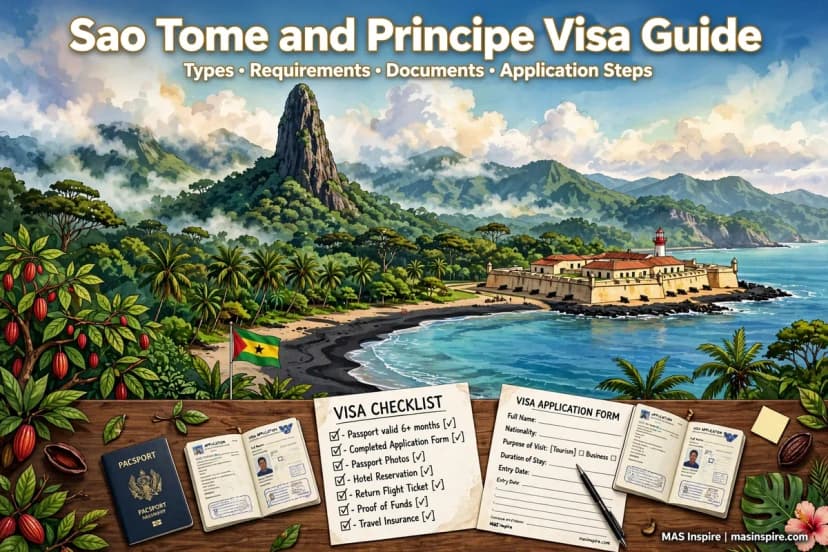
Sao Tome and Principe is Africa's second-smallest country — two volcanic islands in the Gulf of Guinea, off the west coast of Central Africa, with about 230,000 people, cocoa plantations, rainforest, black-sand beaches and the needle-shaped peak of Pico Cão Grande rising out of the jungle. It is also one of the least-visited countries in Africa, and its visa system matches that scale: small, online, and run by a single authority, the Serviço de Migração e Fronteiras (SMF), the Migration and Borders Service. For a Pakistani living in Vietnam, the good news is that you can apply for the whole thing from your laptop in Ho Chi Minh City. The bad news is that the most important number in the process — the fee — is not published on the official portal at all, and the guides that quote it disagree by a factor of two.
Do Pakistani Passport Holders Need a Visa for Sao Tome and Principe?
Yes. Pakistan is not on Sao Tome and Principe's visa-exemption list, so an ordinary Pakistani passport holder must hold a visa before travel. The exemption list is generous — all European Union citizens, plus Andorra, Angola, Brazil, Canada, Cape Verde, Equatorial Guinea, Gabon, Guinea-Bissau, Iceland, Japan, Kuwait, Liechtenstein, Monaco, Morocco, Mozambique, Norway, Qatar, Russia, Rwanda, San Marino, South Korea, Switzerland, Timor-Leste, Turkey, the United Arab Emirates, the United Kingdom, the United States and Vatican City, with Togo at 90 days — but Pakistan is not on it, and no visa-exemption agreement with Pakistan has been signed.
What you need is the e-Visa, applied for online through the SMF's eVisaST system at smf.st/evisa. The SMF states that a person living abroad where there is no Sao Tomean consulate cannot get a visa on arrival at the border and needs an entry authorisation requested through eVisaST and presented on arrival. There is no visa on arrival for Pakistani passport holders: the only visa on arrival in the system is a 15-day one for ordinary passport holders of China, Hong Kong and Macao. Do not fly without the e-Visa approval — airlines may deny boarding without it, and the SMF's own guidance is that the entry authorisation must be presented at the border.
There is one exception worth knowing, because it may apply to you. Holders of a valid visa or residence permit issued by any Schengen area member state or by the United States may enter Sao Tome and Principe without a visa for up to 15 days. This is the "substitute visa" rule, recorded in Wikipedia's visa-policy summary and in the Pakistan-focused guides. It does not help most readers of this guide — a Vietnamese temporary residence card (TRC) is not a Schengen or US visa or residence permit, and a Vietnamese visa does not count either — but if you happen to hold a valid Schengen or US visa in your Pakistani passport, you can enter visa-free for up to 15 days. If you plan to stay longer than 15 days, you need the e-Visa regardless of what other visas you hold.
The rule follows your passport, not where you live. Living in Vietnam, holding a Vietnamese TRC, or holding a visa for another country does not change the Sao Tomean rule for a Pakistani passport — except through the substitute-visa exception above. Your Vietnamese residence matters for the journey home: keep your TRC valid for the whole trip and carry it with your passport, because it is your proof of the right to return to Vietnam. If your TRC is close to expiry, renew it before you travel.
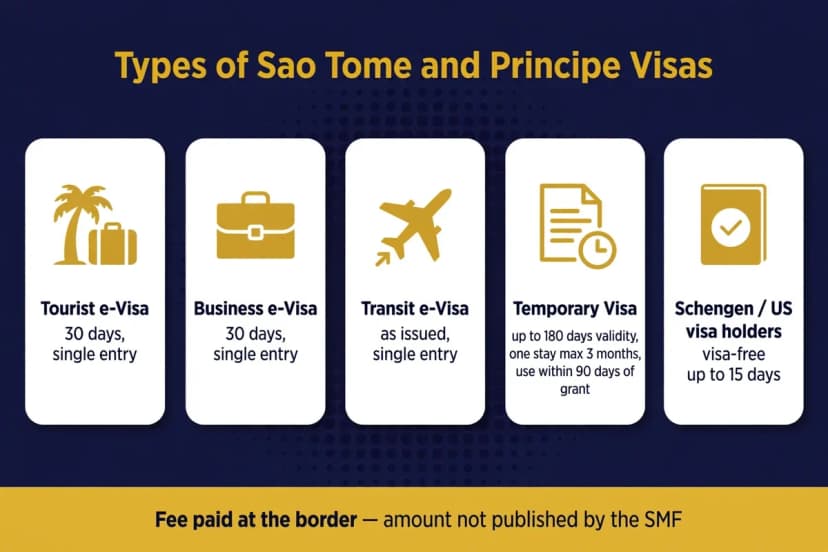
Types of Visas for Pakistani Passport Holders
Tourist e-Visa
The standard short-stay visa for holidays, sightseeing and visiting friends. Applied for online at smf.st/evisa, valid for 30 days, single entry. The fee is paid at the border on arrival, not online — the SMF portal states this plainly: "O pagamento será feito na fronteira!" (Payment will be made at the border). The amount is not published on the portal, which is the central problem of this guide and is dealt with in full in the fees section. You must attach a return ticket to the application, and you must be able to show proof of means of EUR 100 per day at the border.
Business e-Visa
The short-stay visa for business visits — meetings, negotiations, due diligence, exploring a commercial opportunity. Same online process, same 30-day validity, same border payment. The difference is the supporting evidence: a business e-Visa expects an invitation or contact details for the company or person you are visiting in Sao Tome and Principe. The portal asks every applicant for a contact in the country, and says that if you have no personal contact, your accommodation — for example your hotel — will be your contact. A business e-Visa does not allow you to take up employment or to run a business in the country.
Transit e-Visa
For passing through Sao Tome and Principe to a third country. The SMF portal requires transit applicants to attach proof that they can enter their destination country, citing point 1 of Article 30 of Law 5/2008. In practice few Pakistani travellers from Vietnam will transit through Sao Tome and Principe — the realistic routings to the islands pass through Lisbon, Luanda, Addis Ababa or Istanbul, not through Sao Tome itself — but if your itinerary does route through São Tomé International Airport to another destination, apply for the transit e-Visa with your onward ticket and your destination-country visa attached.
Temporary visa (Visto Temporário)
The longer short-stay visa under Law 5/2008, for cultural, tourism or other non-commercial purposes approved by the authorities. It is valid for up to 180 days with one or multiple entries, but a single uninterrupted stay cannot exceed three months, and the visa must be used within 90 days of being granted. Holders are barred from profit-making activities except cultural ones. For a Pakistani tourist who wants more than 30 days, this is the correct visa rather than trying to stretch an e-Visa. It is applied for through the eVisaST process as well, with the same supporting documents and an emphasis on proof of accommodation and funds.
Residence visa (Visto de Residência)
The long-stay visa that leads to a residence permit. It is issued by category of purpose — subordinate professional activity (employment), independent professional activity (self-employment or investment), research or highly qualified positions, and study, exchange, internship or volunteering — and it must be applied for at a Sao Tomean embassy or consulate abroad, not online. Processing takes up to 30 days. On arrival, the holder applies to the SMF for a temporary residence permit (Autorização de Residência Temporária). This is the route for work, study and family settlement, and it is covered in its own sections below.
Other routes
Sao Tome and Principe launched a citizenship-by-investment programme in August 2025, which offers a fast track to residency and citizenship. This guide does not cover it in detail: it is a paid investment route, its terms are new and were still being clarified at the time of writing, and it is not a visa. If it interests you, take advice from a licensed adviser and confirm the current terms with the authorities before paying anything. There is also a reported digital nomad visa — one 2026 relocation guide lists a "Residency Visa for the exercise of a professional activity done remotely" as the main work visa and states that Sao Tome and Principe offers a digital nomad visa. No official SMF source found for this guide confirms a digital nomad category, so treat it as unverified and ask the SMF or the Lisbon embassy before planning around it.
Visa Comparison Table
| Visa | Stay | Entries | Fee | Where to get it |
|---|---|---|---|---|
| Tourist e-Visa | 30 days | Single | Paid at the border; amount not published by the SMF (see fees section) | Online at smf.st/evisa |
| Business e-Visa | 30 days | Single | Paid at the border; amount not published by the SMF | Online at smf.st/evisa |
| Transit e-Visa | As issued | Single | Paid at the border; amount not published by the SMF | Online at smf.st/evisa |
| Temporary visa | Up to 180 days validity; one stay max 3 months; use within 90 days of grant | Single or multiple | Paid at the border; amount not published by the SMF | eVisaST process |
| Substitute visa (Schengen / US visa or residence permit holders) | Up to 15 days, visa-free | As issued | No visa fee; the EUR 20 entry fee reported by the FCDO may still apply — unconfirmed for this route | No application; present the Schengen or US visa at the border |
| Residence visa — work | Typically 1 year, renewable | Multiple | Not published; confirm with the embassy | Sao Tomean embassy or consulate abroad |
| Residence visa — study | Duration of the course, renewable | Multiple | Not published; confirm with the embassy | Sao Tomean embassy or consulate abroad |
| Residence visa — family | Duration of the sponsor's permit | Multiple | Not published; confirm with the embassy | Sao Tomean embassy or consulate abroad |
Visa Fees: What Each Route Costs
This is the least certain section in the guide, and it is honest about that. The official SMF e-Visa portal states that payment is made at the border, and it does not show the amount anywhere on the application pages. The Pakistan-focused guide UrduPoint, checked 19 November 2026, says the same: the e-Visa site says payment is made at the border but does not show the amount, so check the amount at the time you apply. Every figure below therefore comes from a non-official source, and the sources disagree with each other. Do not budget against any single one of them; carry enough cash in euros to cover the highest figure, and confirm the amount with the SMF before you travel.
| Item | Figure | Source |
|---|---|---|
| Tourist e-Visa (30 days) | EUR 20 (about USD 22) | IWESS e-Visa guide, updated March 2026; matches the FCDO's EUR 20 entry fee (see below) |
| Business e-Visa (30 days) | EUR 30 (about USD 33) | IWESS e-Visa guide, updated March 2026 |
| Multiple-entry e-Visa (up to 90 days) | EUR 60 (about USD 65) | IWESS e-Visa guide, updated March 2026 |
| Tourist visa | USD 40 | Apricot Tours Pakistan guide (conflicts with IWESS EUR 20) |
| Business visa | USD 50 | Apricot Tours Pakistan guide (conflicts with IWESS EUR 30) |
| Transit visa | USD 15 | Apricot Tours Pakistan guide |
| Tourist e-Visa | USD 50 | VisaFromPakistan.com (conflicts with IWESS EUR 20 and Apricot USD 40) |
| Tourist e-Visa | About USD 30–50 | Travel Visa Stack, updated October 2026 |
| Business e-Visa | About USD 60–80 | Travel Visa Stack, updated October 2026 (conflicts with IWESS EUR 30 and Apricot USD 50) |
| Entry fee on arrival | EUR 20, payable in euros, US dollars or dobras | UK FCDO travel advice for Sao Tome and Principe |
| Visa on arrival (cruise passengers, non-exempt nationalities) | USD 50 per person | Cruise Club UK visa information, current as of 11 August 2026 — likely a cruise-line figure, not the SMF fee |
| Standard visa application fee | About USD 100 per person | Flootloop relocation guide, 2026 — the highest figure found; no source given |
| Proof of means at the border | EUR 100 per day of stay | SMF e-Visa portal (official) — this is a funds requirement, not a fee |
How to read this table. The best-sourced figure is EUR 20 for the tourist e-Visa, because two independent sources agree on it: the IWESS guide's EUR 20 tourist fee and the FCDO's EUR 20 entry fee on arrival. The FCDO figure is written for British visitors, who are visa-exempt for 15 days, so it is strictly an entry fee rather than a visa fee — but the match with the IWESS tourist figure is the closest thing to corroboration this guide found. The business and multiple-entry figures (EUR 30 and EUR 60) come from the same IWESS guide and are the only published figures for those categories. The USD 40 / USD 50 / USD 15 figures from Apricot Tours and the USD 50 from VisaFromPakistan conflict with IWESS and with each other, and Travel Visa Stack's USD 30–50 and USD 60–80 ranges are wide enough to cover almost all of them. None of these figures is confirmed by the SMF, and the SMF is the only authority that can settle it.
How to pay. Payment is made at the border, in cash, when you land at São Tomé International Airport. Bring euros in small notes: the FCDO says the EUR 20 entry fee can also be paid in US dollars or local currency, and the IWESS guide recommends cash in euros or US dollars in small bills because card payments are not always available at the airport. Sao Tome and Principe is a cash economy — credit cards are not widely accepted and there are few ATMs — so do not land relying on a card. Keep the receipt for everything you pay at the border. There is no published rule on refunds, and no official source found for this guide states that the fee is refunded if an application is refused.
What the visa does not cost. There is no online payment step, no appointment fee, and no authorised agent fee in the official process. The SMF portal is free to use; you pay at the border. If a website asks you to pay a service fee online to "process" a Sao Tome and Principe e-Visa, you are paying a middleman for something the SMF issues itself — and the SMF's own portal warns that none of the information in an application can be changed once it is submitted, which is exactly the kind of detail a middleman gets wrong.
Processing Times
| Route | Processing time reported | Source |
|---|---|---|
| e-Visa (tourist, business, transit) | Reply within 7 working days | SMF e-Visa portal, citing Article 20(2) of Decree-Law 11/2009 |
| e-Visa | 5 to 7 working days | Apricot Tours Pakistan guide |
| e-Visa | 2 to 5 business days | VisaFromPakistan.com |
| e-Visa | 3 to 5 working days | Travel Visa Stack, updated October 2026 |
| Residence visa (work, study, family) | Up to 30 days | Sao Tome Expert guide, 2025 |
| Consular visa at an embassy | 10 to 15 working days | Apricot Tours Pakistan guide |
Planning rule. The controlling figure is the SMF's own: a reply within 7 working days. The shorter figures — two to five days, three to five days — come from commercial guides and may reflect straightforward cases, but they are not the official commitment. Apply at least three weeks before travel: that covers the official seven working days with a week to spare for a correction or a request for more documents, and it leaves room for the fact that the portal gives you no way to change an application once it is submitted — a mistake means starting again. For a residence visa through an embassy, allow six weeks, and start earlier still, because the embassy route also needs the labour ministry's opinion for work cases. Do not apply absurdly early either: a temporary visa must be used within 90 days of being granted, and one e-Visa guide reports the e-Visa as valid for 30 days from the date of issue, so an approval obtained months before travel may expire before you fly — see the flags in the refusal section.
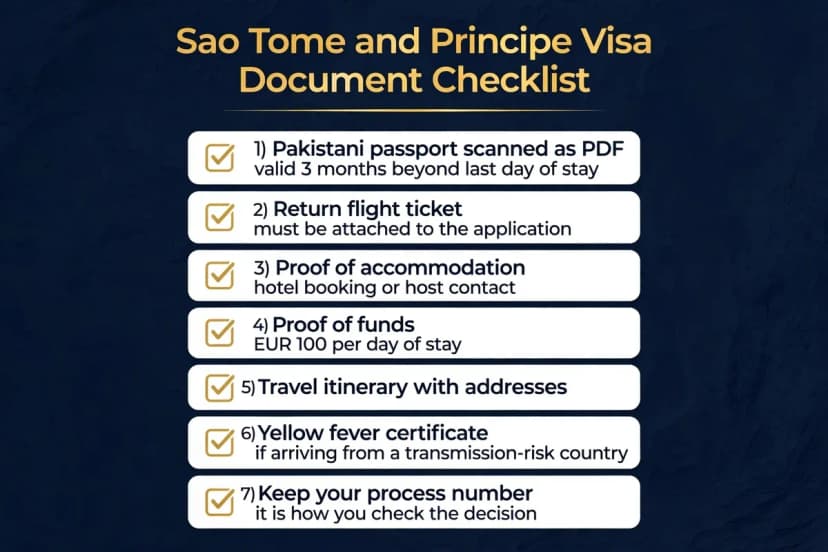
Complete Document Checklists
Tourist e-Visa — the route most readers will use
- Pakistani passport scanned as a PDF, valid for at least three months beyond the last day of stay shown on your visa — the SMF portal's own rule, citing Article 13(1)(c) of Decree-Law 11/2009. Several 2026 guides and the US State Department say six months; see the conflict note below
- Return flight ticket — required, and it must be attached to the application, not just shown at the border
- Proof of accommodation — hotel booking for the whole stay, or the name and contact details of your host in Sao Tome and Principe. The portal says your accommodation will be your contact in the country if you have no personal contact there
- Proof of means of subsistence of EUR 100 per day of stay, to be shown at the border — the SMF portal's own figure. Carry bank statements that plainly cover the trip at that rate, plus cash in euros
- Travel itinerary with addresses — the portal asks you to have your itinerary and addresses ready before you start, and says the application takes about five minutes
- Yellow fever vaccination certificate, if you are arriving from a country listed as a transmission risk (see the health note in the refusal section) — and carry it regardless if your routing passes through one
- Your Vietnamese temporary residence card, for the journey home
- The process number generated when you submit — the SMF warns it is very important to keep it, because it is how you check the decision on the portal
Business e-Visa
- Everything in the tourist e-Visa checklist above, plus:
- An invitation letter or the contact details of the company or person you are visiting in Sao Tome and Principe, with their address and telephone number
- Your own covering letter explaining the purpose of the visit, the meetings planned, and the dates
- Proof of funds that covers a business trip, not just a holiday
Transit e-Visa
- Everything in the tourist e-Visa checklist above, plus:
- Proof that you can enter your destination country — the onward ticket and the destination-country visa or entry authorisation, scanned and attached, as required by Article 30(1) of Law 5/2008
Temporary visa (longer stay, up to 3 months in one stay)
- Everything in the tourist e-Visa checklist above, plus:
- Proof of accommodation and funds for the full stay, with an emphasis on bank statements — one guide reports a funds benchmark of at least EUR 50 per day for this visa, against the SMF's EUR 100 per day at the border, so budget to the higher figure
- Evidence of the purpose of the longer stay, such as a cultural programme or an extended itinerary
Residence visa — work (employer-sponsored)
- Everything in the short-visit checklist above, plus:
- A genuine job offer and a written employment contract drafted in Portuguese, from a registered Sao Tomean employer — verbal contracts with foreign workers are null and void under the Labour Code (Law 6/2019)
- A favourable opinion from the Ministry of Labour on the employment, issued within 20 days, confirming the contractual terms and that no suitable local candidate was available — the employer obtains this, not you alone
- Police clearance certificate (criminal record check)
- Proof of secured local accommodation and proof of sufficient means of subsistence
- Health certificate and vaccination records, including proof of yellow fever vaccination
- A passport with validity well beyond the intended stay — one guide recommends at least one year remaining
Residence visa — study
- Everything in the short-visit checklist above, plus:
- Acceptance or enrolment letter from a recognised educational institution in Sao Tome and Principe
- Proof of funds for tuition and living costs; academic certificates and transcripts
- Police clearance certificate and medical certificate, if the embassy asks for them
Children travelling with you
- Each child needs their own passport and their own e-Visa or entry authorisation
- For a minor, the SMF portal requires a scanned birth certificate (Assento de Nascimento) and a scanned declaration from the legal guardians
- Birth certificate showing the parents' names, carried in original
- If a child travels with one parent only, or with neither parent, carry a notarised parental consent letter — officers do ask for it
- Yellow fever vaccination applies to children over one year old as well, where the certificate is required
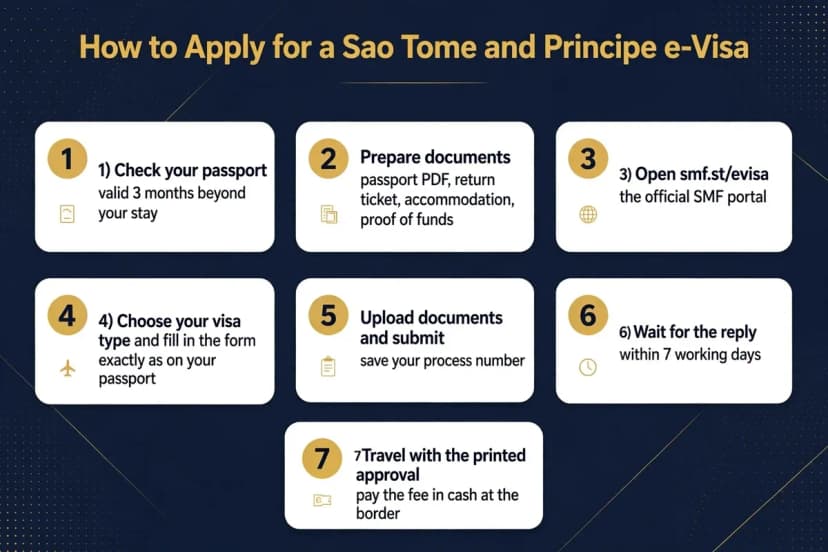
How to Apply: Step-by-Step
e-Visa — step by step
Step 1 — Check your passport. Make sure it is valid for at least three months beyond the last day of stay shown on your visa — the SMF's own rule. Because several guides and the US State Department say six months, the safe course is to hold six months' validity if you can; if your passport is anywhere near either limit, renew it before you apply, because the portal gives you no way to change an application once it is submitted.
Step 2 — Prepare your documents. Scan your passport bio-data page as a PDF. Book your return flight and your accommodation, and have the booking references, the itinerary and the addresses ready. Prepare proof of funds that covers EUR 100 per day of stay. The portal says to have all of this ready before you start, and that the application takes about five minutes.
Step 3 — Open the official portal. Go to smf.st/evisa yourself by typing the address — never through a link in an email or an advertisement. The site is mostly in Portuguese; use your browser's translator. The portal presents the process as three steps: select the visa type, fill in the form, and review the summary and conclude.
Step 4 — Choose the visa type and complete the form. Select the type that matches your purpose — tourist, business or transit. Fill in your personal details exactly as they appear on your passport, enter your travel dates, your accommodation address and your contact details in Vietnam. A name mismatch between the form and the passport is one of the commonest reasons for delay. Check every field before you submit: the portal warns that none of the information can be changed once submitted, and that the details must match the passport exactly.
Step 5 — Upload your documents and submit. Upload the passport PDF, attach the return ticket, and add the supporting documents for your visa type — the invitation for a business visit, the destination-country proof for a transit. Submit, and write down the process number (número de processo) generated at the end. The SMF warns in capital letters that it is very important to keep this number: it is the only way to look up the decision later.
Step 6 — Wait for the reply. The SMF states you will have a reply within seven working days. Do not pay anything online — there is no online payment step. Check the decision on the SMF site through the "Autorização de Entrada" menu and the "Consulta de visto de entrada" submenu, searching by your reference or process number. The approval is made available on the SMF site itself, and the approval is also sent by email: print it and carry it with your passport.
Step 7 — Travel with the file. Carry the printed approval, your return ticket, your hotel booking or invitation, and your proof of funds in your hand luggage. Airlines check the approval at boarding — the IWESS guide warns that airlines may deny boarding without it — and immigration officers at São Tomé International Airport will ask for the supporting documents again. Pay the fee in cash at the border, in euros in small notes, and keep the receipt.
Residence visa through an embassy — step by step
Use this route only for a long stay: work, study or family settlement. Contact the mission first — Lisbon is the main embassy, Brussels the other European one — confirm that it accepts applications from Pakistani nationals resident in Vietnam, and ask for its current form, fee and document list, whether you need an appointment, and whether you must apply in person. For a work visa, your employer must first obtain the favourable opinion from the Ministry of Labour; you cannot apply before that exists. Keep a copy of everything you submit and a receipt for everything you pay, and check the name, passport number, dates and entries on the visa before you leave the mission. On arrival in Sao Tome and Principe, apply to the SMF for your temporary residence permit — the residence visa alone does not complete the process.
Applying from Vietnam and from Pakistan
For a Pakistani living in Vietnam, the important fact is that Sao Tome and Principe has no embassy or consulate in Vietnam, and none in Pakistan either. That would be a problem in most countries in this series; here it barely matters for a short visit, because the e-Visa needs no embassy at all. You apply online from Ho Chi Minh City, the SMF replies within seven working days, and you pay at the border. You only need a mission for a residence visa — and that is where the geography starts to hurt.
The missions that matter to you are the Embassy of Sao Tome and Principe in Lisbon, Portugal — telephone +351 21 846 1917 — and the Embassy in Brussels, Belgium — Square Montgomery, 175 Avenue de Tervuren, BE-1150 Brussels; telephone +32 2 734 8966; email embaixada.bruxelas@mne.gov.st. Lisbon is the main embassy and the one accredited to the Community of Portuguese Language Countries; Brussels is accredited to Austria, France and Germany and to the European Union. There is also an embassy in Beijing, China, which is the closest Sao Tomean mission to Vietnam geographically — but no address or telephone number for it was confirmed for this guide, and whether it accepts applications from Pakistani nationals resident in Vietnam is unconfirmed, so write to it before travelling to Beijing. Other embassies are in Luanda (Angola), Libreville (Gabon), Praia (Cape Verde) and Malabo (Equatorial Guinea), and there is a consulate in Atlanta in the United States. Do not assume any of them will accept your application without asking first — accreditation is about diplomatic relations, not a promise to process your visa.
Applying from Pakistan itself is the same online process: the e-Visa is applied for at smf.st/evisa from anywhere, and the Pakistan-focused guides confirm that Pakistani passport holders apply online with no need to visit an embassy. No Sao Tomean mission in Pakistan, or accredited to Pakistan, could be confirmed for this guide — UrduPoint, checked 7 November 2026, states the same. If you are in Pakistan and need a residence visa, the Lisbon or Brussels embassy is the realistic contact, and you should write to it before travelling anywhere.
Your own mission in the region is the High Commission of Pakistan in Abuja, Nigeria — the nearest Pakistani mission to Sao Tome and Principe, about 972 km away. Its address is Plot No. 1805, Samora Machel Street, Asokoro, Abuja; telephone +234 9 314 1650; email pahicabuja@yahoo.com; website mofa.gov.pk/abuja-nigeria. Note the caution: its published concurrent accreditation covers Benin, Cameroon, Equatorial Guinea and Gabon — Sao Tome and Principe is not listed among them — so confirm with the High Commission itself whether it can assist a Pakistani in Sao Tome and Principe before you rely on it. The next nearest is the Honorary Consulate of Pakistan in Kinshasa, in the Democratic Republic of the Congo, about 1,086 km away. There is no Pakistani embassy or consulate in Sao Tome and Principe itself. Save the Abuja contact details in your phone before you travel, and keep your passport, your e-Visa approval and your return ticket in your hand luggage throughout.
| Mission | Address | Contact | Note |
|---|---|---|---|
| Embassy of Sao Tome and Principe, Lisbon | Lisbon, Portugal | +351 21 846 1917 | Main embassy; ask in writing first whether it accepts applications from Pakistani nationals resident in Vietnam |
| Embassy of Sao Tome and Principe, Brussels | Square Montgomery, 175 Av. de Tervuren, BE-1150 Brussels, Belgium | +32 2 734 8966; embaixada.bruxelas@mne.gov.st | Accredited to Austria, France, Germany and the EU |
| Embassy of Sao Tome and Principe, Beijing | Beijing, China | Confirm before travel | Closest mission to Vietnam; no address or phone confirmed for this guide |
| Embassy of Sao Tome and Principe, Luanda | Luanda, Angola | Confirm before travel | Also accredited to Mozambique |
| High Commission of Pakistan, Abuja | Plot No. 1805, Samora Machel Street, Asokoro, Abuja, Nigeria | +234 9 314 1650; pahicabuja@yahoo.com | Nearest Pakistani mission (about 972 km); Sao Tome and Principe not listed in its published accreditation — confirm first |
| Honorary Consulate of Pakistan, Kinshasa | Kinshasa, DR Congo | Confirm before travel | About 1,086 km away; honorary consulate, limited services |
| SMF e-Visa portal (direct contact) | smf.st/evisa | Check decisions via "Autorização de Entrada" then "Consulta de visto de entrada" | The controlling source for e-Visa questions; site in Portuguese |
Student Visas
There is no separate student e-Visa. Study in Sao Tome and Principe is handled through the residence visa system: you apply for a residence visa for study, exchange, internship or volunteering at a Sao Tomean embassy or consulate abroad, and on arrival you apply to the SMF for a temporary residence permit. Processing of the residence visa takes up to 30 days, so start at least six weeks before your course begins — and earlier if your documents need translation into Portuguese or legalisation.
Apply with the institution's acceptance or enrolment letter, proof of funds for tuition and living costs, and your academic certificates and transcripts, plus a police clearance certificate and a medical certificate if the embassy asks for them. The institution will usually guide the filing, and it should be your first contact: ask it which embassy it works with and what its past international students were asked for. Be realistic about the scale. Sao Tome and Principe has one public university, the University of Sao Tome and Principe, and a small number of private institutes; courses are taught in Portuguese, and there is no published English-taught degree programme this guide could confirm. Unless you speak Portuguese, a study stay is a difficult proposition, and no scholarship route for Pakistani students in Sao Tome and Principe was found for this guide. Do not travel on a tourist e-Visa intending to enrol and switch status inside the country: the e-Visa is for a visit, and the residence visa must be obtained before you travel.
Work Visas and Residence Permits
The route. A foreign national who wants to work for a Sao Tomean employer must first obtain a residence visa for subordinate professional activity (Visto de Residência), applied for at a Sao Tomean embassy or consulate abroad, and then, on arrival, a temporary residence permit (Autorização de Residência Temporária) from the SMF. The employer must be registered with the tax authority and must demonstrate that the role cannot be filled by a local national, because the principle of priority for local workers applies. The employer must submit an explanation to the Ministry of Labour giving the reasons for hiring a foreign national, the job duties and the salary terms, and obtain a favourable opinion — issued within 20 days — confirming the contractual terms and that no suitable local candidate was available. The employment contract must be in writing and drafted in Portuguese; verbal contracts with foreign workers are null and void under the Labour Code (Law 6/2019). Fixed-term contracts may run for a maximum cumulative duration of three years, including renewals. The employer must also show there is no wage discrimination compared with Sao Tomean nationals doing equivalent work.
Self-employment and investment. A residence visa for independent professional activity is available for a person who can prove foreign investment or sufficient funds for self-employment, plus qualifications where the activity needs them. The citizenship-by-investment programme launched in August 2025 is a separate, paid route to residency and citizenship; its terms were still being clarified at the time of writing, and this guide does not recommend it without licensed advice and confirmation from the authorities.
What is not verified. No official SMF source found for this guide publishes a work-visa fee, a processing time beyond the 30 days for the residence visa, or a minimum salary. One 2026 relocation guide states that a work visa is typically processed in about one week and that the standard visa application fee is about USD 100 per person; another states that the main work visa is a remote-work "digital nomad" residence visa. Neither claim is confirmed by an official source found for this guide, and the one-week figure conflicts with the 30-day residence-visa processing time. Treat both as unverified, and get the fee, the timeline and the document list from the embassy and from your employer's filing before you resign from anything or book anything. Never travel on a tourist visa intending to start work: working without authorisation can lead to fines, detention and deportation.
Family and Permanent Residence
Family settlement in Sao Tome and Principe follows the same residence-visa system as work and study. A family member of a person lawfully resident in the country applies for a residence visa at a Sao Tomean embassy or consulate abroad, and on arrival applies to the SMF for a temporary residence permit. The temporary residence permit is typically issued for one year and can be renewed depending on the holder's circumstances — employment, study, family or investment. No official source found for this guide publishes the fee for a family residence visa or for the temporary residence permit, the processing time beyond the 30 days for the residence visa, or the precise document list for a spouse or child, so ask the embassy for its current list before you apply and treat any figure from a commercial guide as unconfirmed.
For a longer stay, the practical route is the temporary visa rather than the e-Visa: it is valid for up to 180 days with one or multiple entries, a single stay cannot exceed three months, and it must be used within 90 days of being granted. It does not allow profit-making activity except cultural activity, so it suits an extended family visit, not a move. Permanent residence is a further step beyond the temporary permit and is governed by Law 5/2008; no fee, timeline or document list for it was confirmed for this guide. If permanent settlement is your aim, take advice from the SMF or the Lisbon embassy before you commit to anything, and do not assume that years spent on successive temporary visas convert automatically into permanent residence.
Common Mistakes to Avoid
Applying for a visa on arrival. There is no visa on arrival for Pakistani passport holders. The only visa on arrival in the system is a 15-day one for ordinary passport holders of China, Hong Kong and Macao. Apply for the e-Visa online before you fly, and carry the printed approval: airlines may deny boarding without it.
Assuming the fee is paid online. The SMF portal has no online payment step. The fee is paid in cash at the border. Travellers who arrive expecting to have paid already, or who arrive with only a card, are the ones who queue longest at São Tomé International Airport. Bring euros in small notes.
Submitting the form with an error in it. The portal warns that none of the information in an application can be changed once it is submitted, and that the details must match the passport exactly. A wrong passport number, a misspelled name or a wrong date of birth means starting again — and the seven-working-day clock restarts. Check every field against the passport before you press submit.
Losing the process number. The SMF warns in capital letters that it is very important to keep the process number generated at the end of the application. It is the only way to look up the decision on the portal. Screenshot it, email it to yourself, and write it down.
Using a passport that is too short. The SMF requires validity of three months beyond the last day of stay shown on the visa. Several guides and the US State Department say six months. If your passport has less than six months left, renew it before you apply rather than arguing the three-month rule with an airline check-in agent in Ho Chi Minh City.
Forgetting the EUR 100 per day. The SMF lists proof of means of EUR 100 per day as additional information required at the border. For a 30-day stay that is EUR 3,000 of demonstrable funds. Carry bank statements that plainly cover the trip at that rate, plus cash — and remember this is a funds requirement, not a fee, so the money stays yours.
Booking a non-refundable ticket before the approval arrives. The SMF's reply comes within seven working days, but that is a maximum, not a promise, and a request for more documents restarts the wait. Book a changeable ticket, or wait for the approval before you pay for the flight.
Routing through a yellow-fever country without a certificate. The realistic routings from Ho Chi Minh City pass through Addis Ababa (Ethiopia) or Luanda (Angola), both yellow-fever transmission-risk countries. Whether an airside transit counts is not answered on the official sources found for this guide — see the refusal section. If in doubt, get vaccinated in Vietnam at least ten days before travel and carry the yellow card.
Assuming the Vietnamese TRC exempts you. A Vietnamese temporary residence card is not a Schengen or US visa or residence permit, so the 15-day substitute-visa exemption does not apply to it. The TRC matters for the journey home, not for entry to Sao Tome and Principe.
Using an agent or a lookalike site. The only official portal is smf.st/evisa. There is no authorised agent in the official process. Any site that charges you online to "process" the e-Visa is a middleman, and any fee it charges is on top of the border fee you will still have to pay.
Reasons for Refusal
No e-Visa approval. The commonest reason a Pakistani traveller is refused boarding or entry is simply not having the e-Visa approval. The SMF states that a person living abroad where there is no Sao Tomean consulate needs an entry authorisation requested through eVisaST and presented on arrival. Without it, the airline may deny boarding in Ho Chi Minh City, and the border officer will refuse entry in São Tomé.
An error in the application. The portal warns that the details must match the passport exactly and cannot be changed once submitted. A mismatch between the application and the passport — name, number, dates — is a ground for the SMF to refuse the authorisation, and for the border officer to refuse entry even if an approval was issued.
Insufficient funds at the border. The SMF lists proof of means of EUR 100 per day as a border requirement. A traveller who cannot show funds at that rate can be refused entry, whatever the approval says. Carry bank statements and cash that plainly cover the stay.
No return ticket. A return ticket must be attached to the e-Visa application, and the border officer will ask for it again. Arriving with a one-way ticket and no evidence of onward travel is a standard ground for refusal.
Yellow fever. This is the one health rule where the sources conflict, and the conflict matters. The FCDO says a yellow fever certificate is required if you are coming from a country listed as a transmission risk — and neither Pakistan nor Vietnam is on that list, but Angola and Ethiopia are, and both are likely transit points from Ho Chi Minh City. The US State Department's summary, as reported by a 2026 travel guide, says US citizens must show proof of yellow fever vaccination to enter, without the conditional wording. A cruise-line notice goes further still, stating that all guests over one year old must carry a valid yellow fever certificate or an approved medical waiver. No official Sao Tomean source found for this guide states a blanket requirement for all arrivals. The safe course is to carry the certificate: get vaccinated in Vietnam at least ten days before travel, because the certificate is not valid until ten days after vaccination, and carry the yellow card with your passport rather than in checked luggage.
Overstay. Under Law 5/2008, a foreigner who exceeds the authorised period of stay is fined: dobras 2,000,000 to 4,000,000 for an overstay of up to 30 days, dobras 5,000,000 to 8,000,000 for 31 to 90 days, dobras 9,000,000 to 12,000,000 for 91 to 180 days, and dobras 13,000,000 to 19,000,000 for more than 180 days, plus unpaid fees — applied on detection, including at departure. The dobra is pegged to the euro at about 24.5 dobras to EUR 1, so the lowest band is roughly EUR 80 to EUR 165, but the fine is levied in dobras and the range is wide because the amount within each band is at the authorities' discretion. Do not overstay, even by a day: the fine is applied at departure, when you have no room to negotiate.
Working on a visit visa. The e-Visa and the temporary visa are for visits. Taking up employment, or running a business, on either of them is prohibited and can lead to fines, detention and deportation. The work route — residence visa, then temporary residence permit — must be completed before you travel.
Passport validity. The SMF requires three months' validity beyond the last day of stay shown on the visa; several 2026 guides and the US State Department say six months from entry. A passport that fails either reading can be refused at check-in or at the border. Renew early.
Frequently Asked Questions
1. Do Pakistani citizens need a visa for Sao Tome and Principe?
Yes. Pakistan is not on the visa-exemption list, so you need a visa before travel. The route is the e-Visa, applied for online at smf.st/evisa through the SMF's eVisaST system. There is no visa on arrival for Pakistani passport holders.
2. How do I apply for the Sao Tome and Principe e-Visa?
Go to smf.st/evisa yourself, select the visa type, fill in the form, upload your passport as a PDF and attach your return ticket, then submit. The site is in Portuguese, so use your browser's translator. Keep the process number generated at the end — it is how you check the decision. The SMF replies within seven working days, and the fee is paid in cash at the border, not online.
3. How much does the e-Visa cost?
The official SMF portal does not publish the amount — it only states that payment is made at the border. The best-sourced figure is EUR 20 for a tourist e-Visa, because the IWESS guide's EUR 20 and the FCDO's EUR 20 entry fee agree; the same guide lists EUR 30 for business and EUR 60 for multiple entry. Other guides quote USD 40 or USD 50 for a tourist visa, USD 50 for business, and USD 15 for transit. Carry enough euros in cash to cover the highest figure, and confirm the amount with the SMF before you travel.
4. How long does the e-Visa take?
The SMF states a reply within seven working days. Commercial guides report shorter times — two to five, three to five, or five to seven working days — but the official figure is seven working days, so apply at least three weeks before travel.
5. How long can I stay on an e-Visa?
Thirty days, single entry. If you want longer, the temporary visa under Law 5/2008 is valid for up to 180 days with one or multiple entries, but a single uninterrupted stay cannot exceed three months, and the visa must be used within 90 days of being granted.
6. Can I get a visa on arrival in Sao Tome and Principe?
No, not on a Pakistani passport. The only visa on arrival in the system is a 15-day one for ordinary passport holders of China, Hong Kong and Macao. The SMF states that a person living abroad where there is no Sao Tomean consulate needs an entry authorisation requested through eVisaST and presented on arrival.
7. Is there a Sao Tome and Principe embassy in Vietnam or Pakistan?
No, in neither country, and no mission accredited to Pakistan could be confirmed. The main embassy is in Lisbon (+351 21 846 1917), with another in Brussels (Square Montgomery, 175 Av. de Tervuren, BE-1150; +32 2 734 8966; embaixada.bruxelas@mne.gov.st). There is also an embassy in Beijing, the closest to Vietnam, but no address or phone for it was confirmed. For a short visit you will not need any of them — the e-Visa is entirely online.
8. I hold a valid Schengen or US visa. Does that help?
Yes. Holders of a valid visa or residence permit issued by any Schengen area member state or by the United States may enter Sao Tome and Principe without a visa for up to 15 days. A Vietnamese visa or temporary residence card does not count for this exemption. If you plan to stay longer than 15 days, you need the e-Visa regardless.
9. What documents do I need for the e-Visa?
A Pakistani passport scanned as a PDF, valid at least three months beyond the last day of stay shown on your visa; a return flight ticket attached to the application; proof of accommodation or a host's contact details; proof of means of EUR 100 per day to show at the border; and your travel itinerary with addresses. For a minor, add a scanned birth certificate and a declaration from the legal guardians. The full checklists are in the document section.
10. Do I need a yellow fever certificate?
It depends on where you are coming from, and the sources conflict. The FCDO says a certificate is required if you are coming from a country listed as a transmission risk; neither Pakistan nor Vietnam is on that list, but Angola and Ethiopia are, and both are likely transit points from Ho Chi Minh City. The US State Department's summary is reported as requiring proof of vaccination to enter, without the conditional wording. The safe course is to get vaccinated in Vietnam at least ten days before travel and carry the yellow card with your passport.
11. Can I work in Sao Tome and Principe on a tourist e-Visa?
No. The e-Visa and the temporary visa are for visits; taking up employment on either is prohibited. You need a job offer first, then a residence visa for subordinate professional activity from a Sao Tomean embassy, with a favourable opinion from the Ministry of Labour and a written employment contract in Portuguese, and then a temporary residence permit from the SMF on arrival.
12. Can I extend my stay in Sao Tome and Principe?
The e-Visa itself is a 30-day single-entry authorisation, and no official extension procedure for it was confirmed for this guide. The correct route for a longer stay is the temporary visa, valid for up to 180 days with a single stay of no more than three months. Do not overstay: fines run from dobras 2,000,000 to 4,000,000 for up to 30 days over, rising to dobras 13,000,000 to 19,000,000 for more than 180 days, plus unpaid fees, applied on detection including at departure.
13. Are there direct flights from Vietnam or Pakistan to Sao Tome?
No. The realistic corridors from Ho Chi Minh City are TAP Air Portugal via Lisbon — Lisbon has the direct flight to São Tomé — TAAG Angola Airlines via Luanda, Ethiopian Airlines via Addis Ababa, and Turkish Airlines via Istanbul and Lisbon. Book on one ticket where you can and leave a generous connection time. The e-Visa is valid only for entry by air at São Tomé International Airport.
14. How much money should I carry?
Budget to the SMF's own figure: proof of means of EUR 100 per day of stay, so EUR 3,000 for a 30-day trip, in bank statements plus cash. Sao Tome and Principe is a cash economy — credit cards are not widely accepted and there are few ATMs — and the visa fee itself is paid in cash at the border, so bring euros in small notes. The dobra is pegged to the euro at about 24.5 dobras to EUR 1.
15. Is Sao Tome and Principe safe to visit?
The FCDO does not advise against travel to any part of Sao Tome and Principe (page updated 10 December 2025) and describes crime as generally low. The US State Department rates the country Level 2, "Exercise Increased Caution" (issued 4 September 2026), due to health risks and limited medical services, with no do-not-travel areas. Malaria is present on both islands, medical facilities are basic, and medical evacuation is expensive — buy travel insurance that covers medical evacuation before you travel.
Official Immigration Websites
Check these sources directly before you apply. The SMF e-Visa portal is the controlling source for e-Visa eligibility, the seven-working-day reply, the EUR 100 per day proof of means and the border payment rule; the FCDO and the US State Department for passport validity, health and safety advice.
| Website | What it is | Link |
|---|---|---|
| SMF e-Visa portal (eVisaST) | Official e-Visa application site: three-step process, reply within 7 working days (Decree-Law 11/2009 Art. 20), passport PDF valid 3 months beyond stay (Art. 13), proof of means EUR 100 per day, payment at the border, keep the process number | smf.st/evisa — e-Visa STP |
| Serviço de Migração e Fronteiras (SMF) | Sao Tome and Principe's migration and borders service — the immigration authority; decisions checked via "Autorização de Entrada" then "Consulta de visto de entrada" | smf.st |
| Wikipedia — Visa policy of São Tomé and Príncipe | Summary of the visa-exemption list, the 15-day visa on arrival for China/Hong Kong/Macao, the substitute-visa rule for Schengen and US visa holders, and the 7-working-day e-Visa | en.wikipedia.org/wiki/Visa_policy_of_São_Tomé_and_Príncipe |
| Wikipedia — List of diplomatic missions of São Tomé and Príncipe | Embassies in Lisbon, Brussels, Beijing, Luanda, Libreville, Praia and Malabo; consulate in Atlanta; UN mission in New York | en.wikipedia.org/wiki/List_of_diplomatic_missions_of_São_Tomé_and_Príncipe |
| UK Foreign, Commonwealth and Development Office — São Tomé and Principe travel advice | Entry requirements: 15 days visa-free for British visitors, EUR 20 entry fee on arrival, passport valid for the duration of stay, yellow fever certificate if coming from a transmission-risk country; no advice against travel (updated 10 December 2025) | gov.uk/foreign-travel-advice/sao-tome-and-principe |
| US Department of State — São Tomé and Príncipe International Travel Information | Visa rules, Level 2 advisory (4 September 2026), passport validity and health guidance | travel.state.gov — São Tomé and Príncipe |
| UrduPoint — São Tomé and Príncipe Visa for Pakistanis 2026 | Pakistan-focused guide, checked 19 November 2026: e-Visa on smf.st/evisa, reply within 7 working days, fee paid at the border with the amount not shown on the official page, temporary-visa 3-month stay limit (Law 5/2008) | urdupoint.com/travel/visa/sao-tome-and-principe |
| One Time Livin — São Tomé and Príncipe visa rules for Pakistan passport holders | Pakistan-focused summary checked 1 November 2026: e-Visa required, Schengen/US substitute-visa 15 days, 7 working days, passport 3 months beyond stay, return ticket, EUR 100 per day | onetimelivin.com — São Tomé and Príncipe visa rules |
| Travel Requirements — São Tomé and Príncipe Visa and Entry Requirements 2026 | Verified October 2026: e-Visa fee not published, extension stay 30 days per entry, overstay fines in dobras, yellow-fever rule conditional on transmission-risk countries | travelrequirements.info — São Tomé and Príncipe |
| IWESS — São Tomé and Príncipe eVisa Guide | e-Visa guide updated March 2026: fee paid at the border, EUR 20 tourist / EUR 30 business / EUR 60 multiple entry, 7 working days, air entry only at São Tomé International Airport | iwess.org — São Tomé and Príncipe eVisa guide |
| VisaVerge — São Tomé and Príncipe: Updated 2026 Visa Rules and E-Visas | 2026 guide refreshed January 2026: visa-free 15 days for 50+ nationalities, e-Visa 30 days single entry approved within about 7 days, fees EUR 20–30 | visaverge.com — São Tomé and Príncipe visa rules |
| Discover Travel Tours — Sao Tome and Principe Visa | Visa types: tourist and business e-Visas of 30 days, study/work/resident visas at an embassy for up to 90 days, fee paid at the border | discovertraveltours.com — Sao Tome and Principe visa |
| Sao Tome Expert — Visa and Residency for Foreigners in São Tomé and Príncipe | Residence-visa categories and documents, temporary visa 180 days / 3-month single stay / use within 90 days, residence visa processing up to 30 days, labour ministry opinion within 20 days | saotomeexpert.pt — Visa and residency |
| Remote People — Sao Tome and Principe Work Visa | Work-visa route: Visto de Trabalho at a mission abroad, then residence permit from the immigration authority; employer registration and local-priority rules | remotepeople.com — Sao Tome and Principe work visa |
| Flootloop — Moving to São Tomé and Príncipe: Visa, Costs, Jobs and Living | 2026 relocation guide: overstay fine bands in dobras, residence via SMF, digital nomad visa claim, USD 100 standard fee claim — both fee claims unverified | flootloop.com — Moving to São Tomé and Príncipe |
| Wikipedia — List of diplomatic missions of Pakistan | High Commission of Pakistan in Abuja accredited to Benin, Cameroon, Equatorial Guinea and Gabon; no Sao Tome and Principe accreditation listed | en.wikipedia.org/wiki/List_of_diplomatic_missions_of_Pakistan |
| Embassy of São Tomé and Príncipe, Brussels — Finland MFA listing | Brussels embassy address, phone and email: Square Montgomery, 175 Av. de Tervuren, BE-1150 Brussels; +32 2 734 8966; embaixada.bruxelas@mne.gov.st | um.fi — Embassy of São Tomé and Príncipe, Brussels |
| Travel Visa Stack — Sao Tome and Principe Visa for Pakistan Citizens 2026 | Pakistan-focused guide updated October 2026: tourist e-Visa about USD 30–50, business about USD 60–80, 3–5 working days, 30-day stay | travelvisastack.com — Sao Tome and Principe visa for Pakistanis |
| Visa From Pakistan — São Tomé and Príncipe Tourist Visa for Pakistanis | Pakistan-focused guide: USD 50 fee, 2–5 business days, 30-day stay, no Pakistani embassy in Sao Tome and Principe | visafrompakistan.com — São Tomé and Príncipe tourist visa |
| Apricot Tours — São Tomé and Príncipe Visit Visa from Pakistan | Pakistan-focused guide: tourist USD 40, business USD 50, transit USD 15, 5–7 working days, e-Visa with payment on arrival | apricottours.pk — São Tomé and Príncipe visit visa |
Final Checklist and Conclusion
Before you apply: passport valid at least six months if you can manage it, and at least three months beyond the last day of stay in any case; return flight booked or at least priced; accommodation booked; bank statements showing EUR 100 per day of stay; yellow fever vaccination done at least ten days before travel if your routing passes through Angola or Ethiopia; Vietnamese TRC valid for the whole trip.
When you apply: go to smf.st/evisa yourself; use the browser translator; choose the visa type that matches your purpose; fill in every field exactly as it appears on the passport; upload the passport as a PDF and attach the return ticket; check everything twice, because nothing can be changed after submission; submit, and save the process number in three places.
While you wait: check the decision on the SMF site through "Autorização de Entrada" and "Consulta de visto de entrada" using your process number; expect a reply within seven working days; do not pay anything online; do not book a non-refundable ticket until the approval is in your hands.
When you travel: carry the printed approval, your passport, your return ticket, your hotel booking, your proof of funds and your yellow fever card in your hand luggage; carry euros in small notes for the border fee; keep your TRC with your passport for the journey home; check the entry stamp before you walk away from the immigration desk.
While you are there: leave before your 30 days end, or apply for the longer temporary visa before you travel; keep your receipts; keep the Abuja High Commission's number in your phone; and remember that the dobra is pegged to the euro, that cards are rarely accepted, and that malaria prophylaxis and a mosquito net are worth more than any document in this guide.
*This guide is educational information, not immigration advice. It was checked on 28 November 2026 against the sources listed above. Visa rules change without notice. Always confirm the live rules on the SMF e-Visa portal at smf.st/evisa before paying any fee or booking a non-refundable ticket. Nothing in this guide guarantees a visa: the SMF decides the application, and the immigration officer at São Tomé International Airport makes the final decision on entry.