

By MAS Inspire | Last reviewed: 27 November 2026 (key figures re-verified 27 November 2026)
Educational information: MAS Inspire is an independent publisher, not Qatar’s immigration authority. Requirements can change, and permission depends on individual assessment. This guide does not guarantee a visa, entry, employment or permanent residence. Follow the authority’s current instructions and your issued permit.
Introduction
The right Qatar immigration route depends on your passport, purpose, residence and sponsor. A tourist visiting Doha, a university student and an employee joining a Qatar company follow different processes. Start with the official visa checker for visits; use your university, employer or eligible family sponsor for residence arrangements.
Understand four separate concepts: an entry visa or electronic entry permit supports travel for its approved purpose; permitted stay controls how long you may remain after entry; a residence permit and Qatar ID (QID) document residence; and a work permit authorises qualifying employment. Permanent residence has a separate legal test. An entry deadline is not an entitlement to stay until that date. MOI visitor guidance and residence regulations govern these distinctions.
Pakistani passport alert: Qatar restored free 30-day visa on arrival for Pakistani passport holders in late October 2026, after suspending it on 31 March 2026. Conditions apply: a Discover Qatar hotel booking for the whole stay, a confirmed return ticket, a passport valid at least six months, approved health insurance (QAR 50) and proof of QAR 5,000 funds or a credit-card equivalent; travellers arriving directly from Pakistan need a polio vaccination certificate. The stay can be extended once by 30 days. The rule changed twice in 2026, so confirm the current position with MOI/Hayya and your carrier before travel. Vietnam residence does not settle this nationality issue.
On this page
- Why people visit, study and work
- Visa types
- Visa comparison
- Eligibility
- Document checklists
- Application steps
- Fees and finances
- Processing times
- Pakistan and Vietnam
- Student guide
- Work and jobs
- Family and residence
- Mistakes
- Refusals
- FAQs
- Official websites
- Final checklist
Why People Visit, Study and Work in Qatar
Qatar offers cultural visits, international events and university study, alongside employer recruitment and investment opportunities. These purposes explain why its immigration system includes visitor permissions, education residence, work residence and specialist investment routes. A university place, job offer or business idea still needs the corresponding immigration approval. Explore the official visitor information, Qatar University’s international admissions guidance and Invest Qatar’s residence announcement according to your purpose.

Types of Qatar Visas and Residence Permission
Tourist visas, Hayya and nationality-based entry
Hayya A1 is the standard online tourist route. A2 serves qualifying GCC residents; A3 is the electronic travel authorisation route for holders of qualifying visas or residence permissions from the US, UK, Canada, Schengen area, Australia or New Zealand. A4 covers qualifying companions travelling with a GCC-citizen sponsor. These are different eligibility routes, not interchangeable names. Vietnam residence alone qualifies for neither A2 nor A3. Apply through Hayya and its category guidance.
Hayya’s A2 guidance requires GCC residence valid for at least three months from arrival and travel from the GCC country of residence. For A3, the qualifying permission must be valid at application and e-visa issuance. Category conditions.
GCC citizens have visa-exempt visitor access. Other passports may qualify for nationality-based arrival permission, subject to the specific conditions. Many routes are free, but the US F1 route charges QAR 76 at first entry and permits multiple visits of up to 90 days, over two years or until passport expiry, whichever comes first. Use the MOI US rules, not the route’s “visa-free” name, to determine cost.
The dated A2 update, effective 30 November 2025, allows up to two months and multiple entries. Older Hayya FAQ wording still says 30 days/single entry; confirm the issued permit. Qatar–Oman joint tourism also exists for specified nationalities; check the current official eligibility list rather than assuming every Qatar visitor qualifies.
Business, conferences and official visits
A Qatar company accredited for the purpose can arrange a business visa: QAR 200 per month, initially 30 days, with extensions up to a further 60 days. The company submits through MOI. Confirm permission for the exact proposed activity; business entry must not be assumed to authorise ordinary employment or every paid assignment.
Authorised organisers can arrange Hayya conference/event permissions; the published FAQ describes these as free and linked to the event. Government and semi-government invitations use their applicable official route. Follow the organiser’s instructions: the 2026 ITU conference guidance illustrates a specific invitation/voucher process, not a general public entitlement. Hayya business and event guidance controls the relevant service.
Student, language, exchange and training routes
Education residence supports approved study through an institution. Arabic-language students can use the institution’s student arrangements; no separate universally available “language-study visa” was verified. Exchange students should obtain admission and immigration instructions from their host, as UDST’s exchange programme explains. An internship may require work permission; attending an approved training course is not the same as taking employment. See the education and visit provisions and the student section below.
Work, skilled professionals and job searching
The ordinary route is employer-arranged work entry followed by residence and applicable labour permission. Skilled professionals commonly use this route; no general points-based skilled-migration programme was verified. A broadly available overseas job-seeker visa was also not verified. However, eligible recent graduates of Qatar institutions have a specific Jusour residence extension. This exception matters: “Qatar has no job-search route” would be inaccurate.
Employer-arranged temporary work entry also exists for assignments up to six months, with prescribed contract, establishment and screening evidence. It is not tourist permission; its current fee and overall decision time were not verified. Temporary-work regulations.
Entrepreneur and executive residence
Announced in February 2026, these are five-year renewable residence programmes. Entrepreneurs require recognised Qatar-incubator endorsement and financial evidence. Executive applicants must already hold Qatar residence, receive employer nomination and meet seniority, salary and employer criteria. Employment still requires the appropriate work permit. Fees and a numerical decision standard were not officially published in the programme material reviewed. See Invest Qatar, criteria and documents and the official programme FAQ.
Do not confuse this with Mustaqel, the separate self-sponsored residence programme launched in 2024 and run by Jusour: Talent track QAR 4,000 and Entrepreneur track QAR 5,000 (refundable if rejected), five-year renewable residence. The entrepreneur track requires an incubator-approved business plan and a minimum investment of QAR 250,000; the talent track requires endorsement plus either QAR 36,500 in funds or a job offer. These figures come from programme guidance, not an official fee schedule — confirm them on Jusour before relying on them.
Investment, family, permanent residence and specialist routes
Business investment and qualifying property can support residence under distinct rules. Family visits differ from family residence; permanent residence requires separate approval. Details follow below.
The executive regulations also recognise talented persons/temporary projects and researchers funded by national institutions for research benefiting Qatar. The relevant authority or research host must establish the correct route. Public individual application procedures, standard fees and national turnaround times for these specialist permissions were not independently confirmed.
Digital nomads: No standalone digital-nomad or overseas-remote-worker visa was verified. The June 2026 labour reforms introduced part-time/freelance provisions under regulatory frameworks; that announcement does not create a tourist-entry work entitlement.
Transit and protection
Passengers remaining airside while connecting at the same airport do not need a Qatar entry visa. Civil Aviation entry rules. Leaving airside needs appropriate entry permission. The current Discover Qatar transit service costs QAR 100 and permits up to four days/three nights, without extension. A separate consular transit service lists two days. Do not assume a universally free 96-hour visa.
Political asylum exists under Law 11 of 2018. It is an individual protection procedure, not an economic migration programme. MOI’s Human Rights Department publishes the application form. Evidence, translations and individual examination apply; no overall decision time or fee was confirmed in the reviewed material.
Visa Comparison Table
| Purpose | Permission and applicant | Work position |
|---|---|---|
| Holiday or short visit | Hayya/eligible nationality route | Tourist entry does not authorise employment |
| Business activity | Approved company or mission route | Sponsor must confirm activity permission |
| University or language study | Institution-arranged education residence | Only authorised work arrangements |
| Employment | Employer work entry, residence and labour approval | Within approved employment |
| Graduate job search | Eligible Qatar graduate extension | Employment needs separate authorisation |
| Startup | Endorsed entrepreneur residence | Work permit and business rules still apply |
| Senior executive | Existing QID holder, employer nomination | Work permit still required |
| Family | Visit or eligible dependent residence | Residence alone is not work permission |
| Investment/property | Approved qualifying investment | Additional work permission may apply |
| Research/talent | Relevant institution/authority route | Approved activity only |
| Settlement | Selective permanent residence | Check applicable work-permit requirements |
Sources: Hayya, MOI work entry, Jusour, programme FAQ, MOL special work permits and MOI regulations.
Eligibility Requirements
Choose the route before collecting documents. Confirm passport nationality, genuine purpose, entry conditions, sponsor eligibility and the appropriate application channel. Passport validity is route-specific: current MOI visitor guidance specifies at least three months, Hanoi’s consular service uses six months, and Qatar University requests one year for its visa file. These requirements must not be collapsed into one national rule.
Check insurance for the exact visit. MOI requires approved visitor coverage, while Visit Qatar specifically describes mandatory insurance for stays exceeding 30 days. Do not assume a shorter trip is exempt from a condition imposed by your route. The published basic visitor premium is QAR 50 per 30 days, when required; confirm acceptance of existing international coverage. MOPH announcement.
Complete Document Checklists
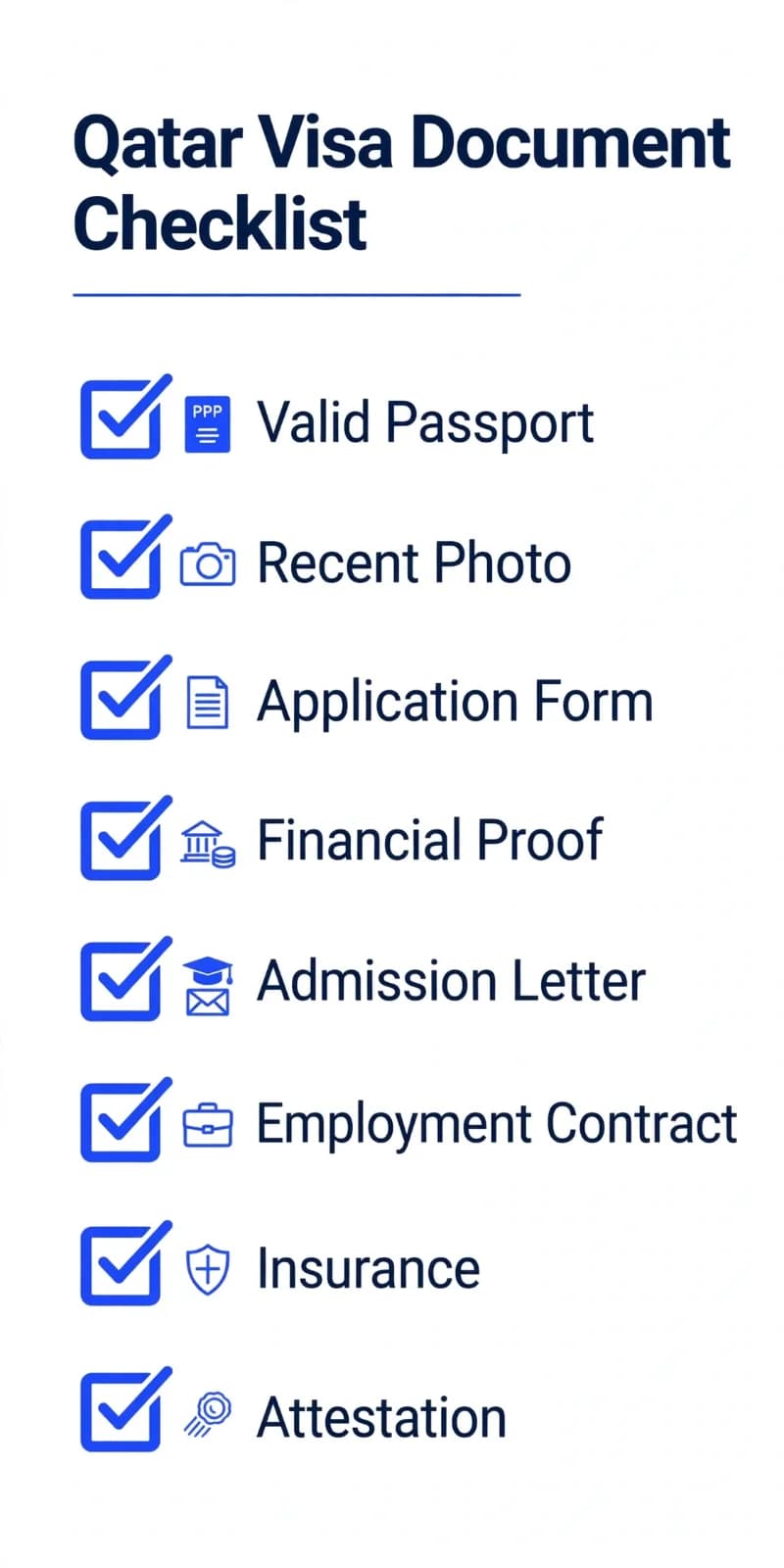
Required means required for the identified route. Conditional applies only when that category or your circumstances trigger it. Recommended means helpful preparation, not a legal requirement. The live authority checklist can request additional evidence; there is no universal document count.
Visitor and business files
| Document | Status and scope |
|---|---|
| Passport and correct application details | Required for visa applications; validity depends on route |
| Photo | Required when the chosen online/mission checklist requests it |
| Accommodation or accepted host evidence | Required for applicable visitor routes; Discover Qatar booking where specifically required |
| Return/onward ticket | Required for applicable entry routes |
| Approved health insurance | Required when imposed by visa/entry conditions |
| GCC permit or qualifying third-country visa/residence | Required for A2/A3 eligibility respectively |
| Company invitation, establishment ID and profession evidence | Required according to business sponsor/mission procedure |
| Bank records, Vietnam status or additional host evidence | Conditional; do not invent a universal financial minimum |
| Copies of permit, booking and contact details | Recommended travel preparation |
Official checklists: Hayya, MOI visitor conditions, business form and Hanoi consular services.
Study, work and family files
| Route | Required route evidence | Conditional/additional evidence |
|---|---|---|
| QU self-funded student | Visa request, admission summary, passport; third-party sponsor declaration/ID and financial evidence; student declaration; required health and good-conduct records | Undergraduate parental consent; additional university requests |
| Employer work entry | Passport/application; contract; attested qualifications or profession evidence; good-conduct certificate; approved medical process | Professional licence, employer approvals, QVC appointment/checks where assigned |
| First company residence | Sponsor application, passport, attested contract, establishment ID, photo, blood-group evidence | Medical/fingerprint completion as instructed |
| Family visit | Sponsor status; passport valid at least six months; relationship, employment/income and housing evidence; health insurance | Medical examination for extension beyond one month; additional sponsor records |
| Family residence | Sponsor’s valid residence; passport; attested relationship and employment evidence; adult good-conduct certificate; housing, insurance and prescribed medical process | Education evidence for children aged 6–18; salary-bank statements and other MOI-requested records |
Sources: QU checklist and forms, MOI work entry, first residence permit, family visit and family residence entry.
Specialist residence files
| Route | Required evidence for that route |
|---|---|
| Overseas entrepreneur | Passport valid at least six months, photo, CV, incubator endorsement, attested three-month bank statement and police clearance |
| Resident entrepreneur | Passport/QID, photo, CV, stamped three-month statement, endorsement, establishment card |
| Executive | Passport; QID valid more than three months; photo, CV, attested degrees/experience, bank statements, insurance; nomination, contract and corporate papers |
| Graduate extension | Passport, valid QID, photo, graduation/expected-graduation evidence and university NOC |
| Property residence | Identity, title/ownership confirmation, qualifying value; required good-conduct and medical evidence |
| Business investor | Relevant authority form/letter identifying investment activity, passport and good-conduct evidence; authority-requested records |
| Research/talent | Relevant authority application, project/grant or talent evidence, travel document and prescribed good-conduct evidence |
| Permanent residence | Identity, residence history, finances and other committee-requested evidence; no fixed universal file count |
Sources: entrepreneur/executive checklist, graduate service, MOJ approval service, MOI property entry, specialist regulations and permanent residence. Follow each source’s attestation requirements; a translation alone does not necessarily authenticate a document.
How to Apply: Step-by-Step
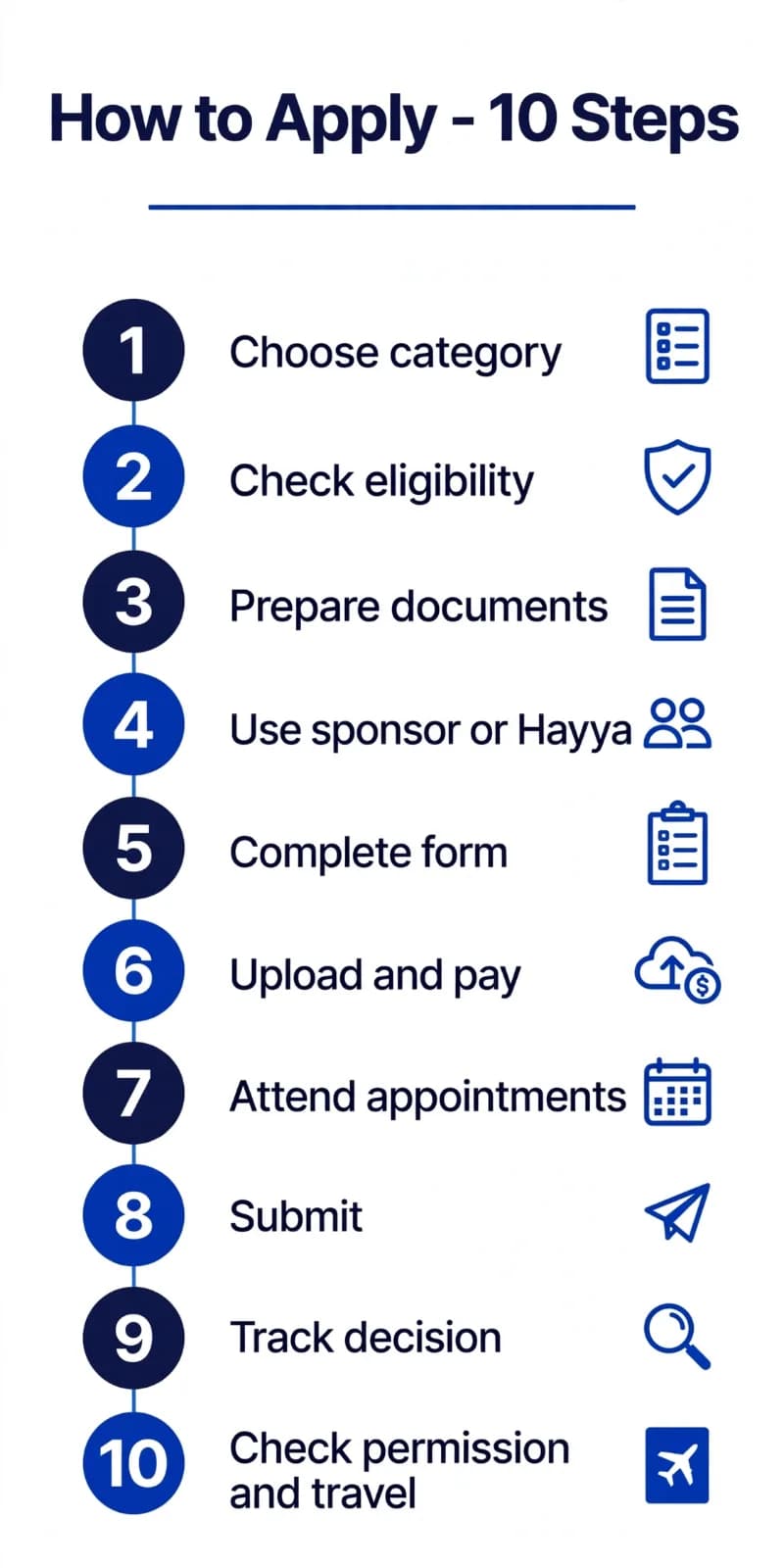
Use these ten checkpoints as a planning guide. Their order changes between online tourism, sponsored residence and specialist programmes.
- Choose the actual category. Match your activity to tourism, business, education, employment, family or another documented route. Do not use a tourist application to conceal intended work.
- Check nationality and residence. Complete the official visitor checker accurately. For residence, have the sponsor confirm eligibility; for consular filing, confirm that the mission accepts your case.
- Prepare the correct file. Use the tables above and the live official checklist. Check names, expiry dates, translations, attestations and route-specific financial evidence.
- Use the correct account or sponsor. Hayya visitors create their own account. An employer, institution or family sponsor handles its applicable MOI process. Entrepreneur/executive applications follow nomination and an invitation link.
- Complete the correct form. Use Hayya’s guides, QU’s forms page or your sponsor’s prescribed service. Read every declaration before submission.
- Upload and pay when instructed. Some systems review the file and accommodation before requesting payment. Pay through the official service and retain the receipt; payment is not approval.
- Attend required appointments. QVC medicals/biometrics or an interview apply only when assigned. Hayya tourist applications do not have a universally published predeparture embassy interview requirement.
- Submit and answer requests. Follow dashboard or sponsor notifications. A request for correction is not necessarily a refusal. Do not submit invented evidence to resolve a missing document.
- Track the decision. Use the Hayya account, institution or programme portal. MOI Visa Services provides approval tracking, visa inquiry/printing and QVC tracking links. Keep the application or visa number.
- Check the issued permission and travel conditions. Confirm identity, entry deadline, permitted stay and entries. Carry required evidence. For a mission application, follow its passport-return instructions; an electronic permit does not imply passport submission. Residence entrants complete the required medical/fingerprint and QID process after arrival unless their approved procedure handles steps earlier.
The Hayya workflow, QU arrival procedure, QVC guidance and Jusour nomination process explain the route-specific sequence. Border admission remains subject to the authorities’ assessment.
| Route | Typical sequence | Tracking |
|---|---|---|
| Hayya visitor | Eligibility → account/form → review/accommodation/payment → permit | Hayya account |
| Sponsored residence | Sponsor approval/file → assigned checks → entry → residence/QID | Sponsor and MOI |
| Entrepreneur/executive | Endorsement/nomination → invitation → file → approval/QID | Jusour application |
| QU student | Admission/visa procedure → university review → entry → residence | University |
Visa Fees and Financial Requirements
Amounts below are Qatari riyals (QAR) unless stated otherwise. Different stages have separate charges; these are not all-inclusive packages. Confirm the current payable amount and any exemptions in the official service.
| Service | Published charge | Official basis |
|---|---|---|
| Hayya A1–A4 where payable | 100 | Hayya FAQ |
| US F1 | 76 on first entry | MOI |
| Company business visa | 200/month | MOI business route |
| Hanoi consular visit visa | 200 | Mission service |
| Discover Qatar transit | 100 | Official operator |
| QU international student application service | No service fee listed | Government service; other costs remain |
| Work entry visa | 300 | MOI work entry |
| Company residence | 1,000/year; separate ID/card charges may apply | MOI first RP |
| Labour work permit | 100/year | Decision 32/2025, including eligible family-sponsored workers |
| Family visit | 200; extension 200/month | MOI service |
| Family residence entry / family RP renewal | 200 / 500 respectively | Entry service; renewal service |
| Property approval / property entry visa | No MOJ approval fee / 200 MOI entry fee | MOJ; MOI |
| Permanent residence application / card issue | 3,000 / 3,000 | MOI permanent-residence FAQ |
| Graduate extension | Free under published scheme | Jusour |
| Entrepreneur, executive, general investor, researcher/talent | Not officially published in reviewed programme material | Programme; regulations |
| Mustaqel Talent (2024 programme, Jusour) | 4,000 | Programme guidance; refundable if rejected — confirm on Jusour |
| Mustaqel Entrepreneur (2024 programme, Jusour) | 5,000 | Programme guidance; refundable if rejected; min investment QAR 250,000 — confirm on Jusour |
Medical screening, attestation, insurance and institution-specific charges can be additional. The Medical Commission service lists QAR 100; the basic visitor policy, when required, is QAR 50/30 days. Old references to QAR 500 for the family-sponsored work permit are superseded by the 2025 fee decision.
Financial thresholds also belong to particular routes:
| Route | Published financial condition |
|---|---|
| Entrepreneur | QAR 36,500 equivalent over the preceding three months; overseas checklist specifies USD 10,000 programme |
| Executive | QAR 50,000/month for Chairman/CEO/CFO/CTO/COO; QAR 80,000 for other Executive Director titles criteria |
| Family visit | Sponsor salary at least QAR 5,000, with approved housing and other conditions MOI |
| Family residence | Salary/housing test described below MOI update |
| QU student | Sponsor-dependent financial evidence described below QU |
| Property | Qualifying value thresholds described below MOJ |
No universal tourist bank balance or ordinary work-visa savings minimum was established. Do not confuse a residence salary threshold with money every visitor must carry.
Visa Processing Times and Validity
| Route | Published timing or limitation | Stay/validity |
|---|---|---|
| Hayya A1/A3/A4 | No fixed general decision time verified | Check the actual permit; do not infer stay from application date |
| A2 GCC resident | No fixed decision time verified | Updated route: up to two months/multiple entry; confirm grant |
| Company business | Overall time not officially published | 30 days initially; eligible extensions up to 60 more |
| Discover Qatar transit | Minimum three working days, excluding weekends/holidays; no guarantee | Up to four days/three nights; nonextendable |
| Student | No national entry-visa deadline verified; UDST cites 2–8 weeks for its post-arrival RP stage | Institution/issued permission controls |
| Work | Legacy government guidance suggests 2–4 weeks, sometimes longer, for work-RP conversion only | Granted RP term; eligible renewals may cover 1–3 years |
| Entrepreneur/executive | No numerical standard verified | Five years, renewable if eligible |
| Family, investor, research, PR | No universal end-to-end decision time verified | Category and issued card/permit control |
Sources: Hayya, A2 update, business, transit, UDST, work-RP guidance, renewals and programme FAQ. None of these estimates guarantees approval or timely travel.
The emergency automatic entry-visa extensions ended on 7 June 2026. The MOI announcement reported by QNA restored normal validity and fee rules. An old extension notice is not permission to overstay in November.
Applying from Pakistan or Vietnam
Pakistani passport holders legally living or working in Vietnam
Enter Pakistan as nationality and Vietnam as residence. A Vietnamese temporary/permanent residence card or work permit does not change passport eligibility, create GCC residence, or qualify you for A3 by itself. Hayya A1 may be the relevant online visitor route, subject to the actual eligibility assessment. Hayya route guidance.
Qatar restored free 30-day visa on arrival for Pakistani passport holders in late October 2026, after suspending it on 31 March 2026 — reported 1–2 November 2026 citing MOI, which lists Pakistan for arrival access again. Conditions: a Discover Qatar hotel booking for the whole stay, a confirmed return ticket, a passport valid at least six months, approved health insurance (QAR 50) and QAR 5,000 funds or a credit-card equivalent; travellers arriving directly from Pakistan need a polio vaccination certificate. The stay can be extended once by 30 days. Because the rule changed twice in 2026, confirm the current position with MOI/Hayya and your carrier before buying non-refundable accommodation tied to an arrival-visa scheme. Karachi's consular notice still showed the March suspension when last checked (4 November 2026); treat the MOI listing as the operative source and recheck close to travel.
For embassy procedures, the verified local mission is the Qatar Embassy in Hanoi. Its published services do not expressly guarantee acceptance of every visa category from Pakistani residents of Vietnam. Confirm jurisdiction, appointment arrangements, document legalisation and payment directly with the mission: hanoi@mofa.gov.qa, +84 24 3943 0222, through its official contact page. No additional Qatar visa centre in Vietnam was independently verified.
Hanoi’s traditional consular visitor service publishes a QAR 200 fee, a six-month passport requirement, two photos and three months of statements showing QAR 5,000, with a stated exemption for financially capable applicants known to the mission. It describes a three-month entry-use window and one-month stay. This is not a universal Hayya requirement. Its “24 hours after automated data entry” wording is not an end-to-end appointment or approval promise. Hanoi services.
If requested, prepare Vietnamese residence/visa evidence, relevant work permission, employer confirmation, local finances and evidence of your ability to return. These are conditional supporting documents; local legal residence alone does not guarantee consular acceptance.
What differs when applying from Pakistan?
QVC employment processing in Pakistan includes contract, medical and biometric steps; Pakistan’s Doha mission FAQ identifies Islamabad and Karachi. QVC is not the routine tourist-Hayya application route. The official MOPH country list does not establish a Vietnam QVC alternative. A Pakistani worker living in Vietnam should have the Qatar employer obtain instructions on required attendance or an approved alternative; no Vietnam-residence exemption was confirmed.
Departure country can affect health-document checks. Do not automatically apply Pakistan-origin vaccination instructions to every Pakistani living abroad, or assume they are waived. Check your itinerary with the relevant authority and carrier.
Student Visa Guide
Apply through your institution within its admissions and visa deadlines. At Qatar University, graduate and self-funded undergraduate/Arabic-programme applicants follow the applicable visa application route. Undergraduate applicants depending solely on a QU scholarship have their visa arranged after the award under the university’s procedure. Admission and immigration approval remain separate. QU guidance.
QU’s self-funded checklist requires a third-party financial sponsor. A sponsor living in Qatar supplies a QAR 20,000 local bank guarantee; an overseas sponsor supplies the preceding six months of bank statements in English or Arabic, demonstrating capacity. These are QU requirements, not a national minimum for every institution. QU checklist.
After arrival, follow the university’s medical, fingerprint and residence instructions. QU requires the entry-to-residence process within one month; that does not mean a one-month visa decision guarantee. Its student sponsorship does not itself allow the student to sponsor family. QU arrival services; QU FAQ.
Student work and staying after graduation
The authorised Sahem scheme permits eligible enrolled students to work through its approved arrangements: up to 20 hours weekly during the academic year and 40 during breaks, with one employer. Exchange students are excluded. Registration, university/programme conditions and the approved contract matter; these hours are not automatic rights attached to every student visa. Jusour FAQ.
Eligible recent graduates can seek a free, one-year, nonrenewable residence extension under university sponsorship. Published conditions include age above 18 through 28, applying within six months of graduation, a valid QID and applying before leaving Qatar. A university NOC is required. Employment still needs appropriate authorisation. Graduate FAQ; official NOC; application services.
Work Visas and Job Opportunities
Secure a genuine employer and written contract. Confirm the job, occupation classification, qualifications, salary, accommodation and recruitment arrangements before travel. The employer obtains the required approvals and arranges the work-entry/residence process. Licensed professions may require additional recognition. A tourist entry or an advertisement is not a work permit. MOI work-visa requirements.
Use employers’ own recruitment channels and verify who is offering the job. The removal of the former general employer NOC requirement does not remove the obligation to complete official employer-change procedures. Government labour-reform guidance.
For entrepreneur residence, applicants must be at least 18 and obtain recognised incubator support before nomination. Executive residence requires at least five years of senior-management experience, an eligible local employment contract and employer nomination; it is for current Qatar residents. Listed employers include Qatar Stock Exchange companies, appropriately licensed financial institutions/insurers and qualifying consultancies serving government or semi-government entities. Jusour assesses company eligibility individually. Residence does not substitute for a business licence or work permit. Jusour criteria; programme FAQ.
Family Immigration and Permanent Residence
Family visit and dependent residence
A family visit is initially one month; qualifying first-degree relatives may receive extensions totalling a further five months, subject to approval. Medical examination is required for extension beyond a month. MOI family guidance.
For family residence, the dated MOI update requires government/semi-government employees to have employer-provided family housing or at least QAR 10,000 monthly salary. Private-sector applicants need an eligible technical/specialist profession and QAR 10,000, or QAR 6,000 plus contractual family housing. An older MOI page still says QAR 7,000 with housing: disclose this conflict and confirm current eligibility through MOI/Metrash.
The update states children should not exceed 25 and daughters must be unmarried. Children aged 6–18 need Qatar school enrollment or evidence of education abroad through the prescribed platform. Insurance covers the stay from entry. Confirm exceptions with MOI. Family residence alone does not permit employment; eligible employers can request a special work permit. Dated rules; MOL service.
Investment and property residence
Business investors require approval and evidence of the qualifying activity; no universal investment minimum was verified for every ordinary investor category. Investor/property permissions can be granted for renewable terms of one to five years, according to the applicable regulations. MOI regulations.
MOJ describes qualifying property of at least QAR 730,000 for residence without a sponsor, and QAR 3.65 million for residence with specified healthcare, education and investment privileges associated with permanent-residence cards. The owner must spend at least 90 days annually in Qatar. Eligible ownership areas and valuation matter; the service page’s “exceed” wording differs from the guidance’s “at least,” so confirm a purchase exactly at the threshold. This is not automatic permanent residence or citizenship. MOJ rules; approval service.
Permanent residence
The usual statutory residence test is 20 years if born abroad, or 10 years if born in Qatar, with continuity rules, sufficient income, good character and Arabic knowledge. Exceptions exist, but approval is selective. Permanent-residence law.
Published income rules specify QAR 20,000 monthly basic salary for government employees or QAR 30,000 total monthly salary for private employees, subject to exceptions. Investor applicants face a separate QAR 1 million actual-investment condition; it does not replace the remaining tests. Cabinet Decision 7/2019.
Apply through the MOI permanent-residence service and provide committee-requested evidence. The ordinary statutory ceiling is 100 people annually, capable of increase; the physical card has a five-year validity and needs renewal. Permanent residence is distinct from nationality. Law, Article 4; card rules.
Common Application Mistakes
- Using nationality rules for Vietnamese citizens when holding a Pakistani passport.
- Confusing the visa’s entry deadline with the permitted stay.
- Submitting a generic checklist instead of the selected route’s requirements.
- Treating an invitation, admission offer or payment receipt as immigration approval.
- Assuming family, student or entrepreneur residence automatically authorises work.
- Copying outdated emergency extensions, fees or arrival-visa claims.
- Paying for travel before resolving a known eligibility conflict.
These are practical precautions drawn from the distinctions above, not a published statistical ranking of refusal causes.
Reasons for Visa Refusal
Applications can fail because the required eligibility, sponsor, identity, accommodation, funding or purpose evidence is missing or inconsistent, or because the authority does not approve the case. A returned file may invite correction; a rejection may not provide a detailed explanation. Hayya’s FAQ describes dashboard outcomes, while Jusour’s FAQ distinguishes incomplete and declined applications.
Read the decision and contact the relevant service or sponsor about the permitted next step. No universal Qatar appeal deadline or automatic reapplication waiting period was verified. Never change facts or fabricate documents to avoid a refusal.
Frequently Asked Questions
1. Do all visitors need a visa before travelling?
No. GCC citizens and eligible passport holders have exemption or arrival routes, while others need advance permission. Check the exact nationality and conditions in the official checker.
2. Can Pakistani nationals rely on visa on arrival?
Yes, with conditions. Qatar restored free 30-day visa on arrival for Pakistani passport holders in late October 2026, after a suspension from 31 March 2026. You need a Discover Qatar hotel booking, a confirmed return ticket, a passport valid at least six months, approved health insurance (QAR 50) and QAR 5,000 funds or a credit-card equivalent; a polio certificate is required if you arrive directly from Pakistan. The stay can be extended once by 30 days. The rule changed twice in 2026, so confirm it with MOI and your carrier before travel.
3. Does Vietnamese residence make a Pakistani passport eligible for A2 or A3?
No. A2 requires qualifying GCC residence; A3 requires a qualifying third-country visa/residence. Vietnam residence alone does not satisfy either. Hayya.
4. Is QAR 5,000 compulsory for every tourist?
No universal rule was verified. Hanoi publishes that balance for its particular consular visitor service, with stated exceptions. Do not apply it to every Hayya applicant. Hanoi.
5. Can I work on a Hayya tourist visa?
No. Hayya tourist permission does not authorise employment. Obtain the appropriate work arrangement before starting. Hayya FAQ.
6. Is a student visa free?
QU’s government-listed application service has no service fee, but tuition, residence and other charges may apply. Confirm the full cost with the sponsoring institution. QU service.
7. Can international students work part time?
Eligible students can use authorised arrangements such as Sahem, subject to programme rules. The published 20/40-hour limits are not universal student-visa rights. Jusour.
8. Can I stay after graduating in Qatar?
Eligible recent graduates can apply for the one-year university-sponsored extension. Timing, age, valid-QID and university-NOC requirements apply. Graduate service.
9. Does Qatar have a digital-nomad visa?
No standalone route was verified in the official material reviewed. Labour-law provisions for freelance work do not by themselves establish visitor immigration permission. 2026 labour announcement.
10. Are the new entrepreneur and executive permits ten years long?
The official announcement and programme FAQ reviewed describe five-year renewable residence. Check the actual grant rather than relying on a headline. Official FAQ.
11. Does buying property guarantee permanent residence?
No. Qualifying property supports a particular residence route and, at the higher threshold, specified PR-card benefits. Separate permanent-residence law still matters. MOJ.
12. Is a Qatar transit visa always free?
No. The current Discover Qatar application lists QAR 100. Remaining airside and entering Qatar are different situations. Transit service; Civil Aviation rules.
Official Immigration Websites
Use MOI visas and tracking, Hayya applications, Visit Qatar’s checker, MOL, Qatar University, Jusour programmes, MOJ property guidance and Qatar Embassy Hanoi. Links beside individual claims lead to the relevant rules rather than an unofficial agency.
For further MAS Inspire reading, visit News & Study Abroad or the verified Japan visa guide and Norway visa guide. Their national rules are separate from Qatar’s.
Final Checklist and Conclusion
Before applying, verify your category, nationality, sponsor, document checklist, financial conditions and official channel. Before travel, confirm the decision, passport details, entry deadline, permitted stay, accommodation, insurance and onward arrangements. If you are entering for residence, know which sponsor completes your QID and any work permission.
A reliable application starts with the correct route and truthful evidence. Recheck the linked authority pages close to application and departure, especially where this guide identifies conflicting official information.


