By MAS Inspire | Last reviewed: 27 November 2026 (key figures re-verified 27 November 2026)
On this page
- Introduction
- Why visit, study and work
- Visa types
- Visa comparison
- Eligibility
- Document checklists
- Application steps
- Fees and finances
- Processing times
- Pakistan and Vietnam
- Student guide
- Work and jobs
- Family and residence
- Other routes
- Mistakes
- Refusals
- FAQs
- Official websites
- Final checklist
Introduction
Afghanistan has several visa categories for foreign nationals travelling for tourism, family visits, business, employment, study, official service, transit and other defined purposes. The category you need depends on why you are travelling, who is inviting or sponsoring you, your passport nationality and the Afghan mission that has jurisdiction over your application.
The Afghan MFA's current public information describes a central online registration process, but it does not mean every applicant can complete the whole process remotely. Its E-Consulate instructions require applicants to print the completed form and attend a political or consular representation with the original documents. Some missions also require appointments, interviews or additional approvals.
Before making plans, consider the serious travel warnings issued by foreign governments. The UK advises against all travel, while the US advisory identifies risks including terrorism, kidnapping, crime, health and wrongful detention. Conditions can change quickly, including airport and border operations. Check your own government's advice immediately before any decision.
Why People Visit, Study, and Work in Afghanistan
Travel purposes reflected in the official visa categories include tourism and pilgrimage; visiting relatives and friends; business and commercial activity; employment with an Afghan organisation; study at a recognised Afghan university; official or government service; aviation crew duties; and transit. Research, conferences, media, cultural and sports activities may be handled through an entry, visit, business or other authorised category depending on the invitation and mission's instructions.
A visa only authorises the travel purpose and stay specified by the issuing authority. It does not itself grant an unrestricted right to work, settle permanently, or undertake activities outside the approved purpose. Applicants should not rely on informal assurances from an intermediary.
Types of Afghanistan Visas
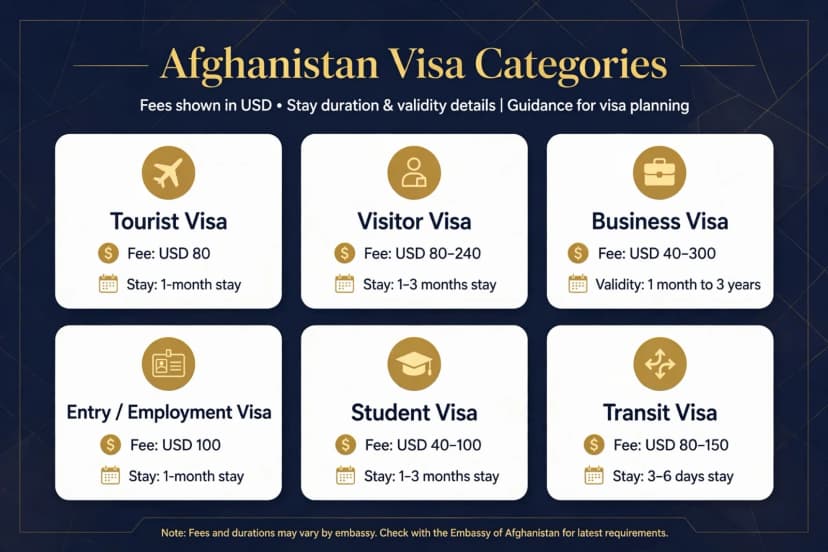
The MFA's category index includes the following routes. The details below reflect central MFA pages where available; mission-specific rules can differ.
Tourist visa
For leisure, sightseeing and pilgrimage. The central MFA states three months' visa validity, a one-month stay and a fee of USD 80. A valid passport and hotel booking are specifically mentioned; an Afghan embassy may additionally request itinerary details, invitation/reference, proof of accommodation, return/onward travel and financial evidence. Tourism does not authorise employment.
Visitor visa
For visiting relatives or friends, and for activities such as sports competitions or exhibitions. The central page states three months' validity, a permitted stay of one to three months, and a displayed fee range of USD 80–240. Because the page does not explain how the exact fee is selected, ask the mission for the amount in writing. Expect host details, invitation/reference, relationship evidence where relevant, purpose letter and financial support evidence if requested.
Business visa
For genuine commercial visits. The MFA describes a validity range of one month to three years and a fee range of USD 40–300. It names a valid business licence, passport copy and supporting bank statements. The mission may request a letter from the applicant's employer, Afghan counterpart invitation, company registration, itinerary and an MFA authorisation/reference. Business permission should not be treated as a blanket employment permit.
Entry / employment visa
The MFA describes an entry visa for people invited by licensed companies or institutions operating in Afghanistan. The invitation must be supported by an official letter from the relevant institution and approved by the MFA through an Afghan political or consular mission. The published validity is three months with a one-month stay; the fee is USD 100. Applicants travelling for employment should obtain written confirmation of the exact work authorisation and any separate registration/residence requirements before travelling.
Student visa
Issued based on an agreement with a recognised Afghan university and valid educational documents. The central MFA lists three months' validity, one to three months' stay and a USD 40–100 fee range. The public page does not publish a universal language-course category, standard financial minimum, or detailed processing time. Obtain a formal admission/acceptance and sponsorship or institutional confirmation, then ask the university and mission whether a residence visa is required for the full course.
Residence visa
The MFA says this visa is for foreign nationals continuing their stay after holding specified underlying visas, including service, business, entry, student and crew visas. It lists one month to one year and USD 50 per month. This is a time-limited residence permission, not permanent residence. Confirm eligibility, sponsor, extension route and the start date of the residence period with the competent authority.
Transit visa
For a traveller passing through Afghanistan who holds valid visa or travel documents for the destination country. The MFA lists one-month visa validity, a stay of three to six days, and a fee of USD 80–150. Do not assume airport transit is visa-free. Confirm the applicable mode of travel, entry point, route and exact permitted transit period.
Arrival visa
The central MFA describes a tightly limited arrival visa, issued only on an official letter from a domestic organisation or an official invitation from an international organisation operating in Afghanistan, with MFA approval at Kabul International Airport. The published validity and stay are one month; fee USD 200. This is not a general visa-on-arrival option for ordinary tourists. Obtain approval before boarding and do not travel based on an expectation that the airport will issue a visa at discretion.
Service, diplomatic and official visas
The service visa is for holders of service passports and requires an official note from the host country's foreign ministry plus MFA approval. The central MFA lists one month to one year and a fee exemption. Diplomatic and official arrangements are governed by official channels and any applicable reciprocal agreements; ordinary passport holders should not select these categories.
Crew visa
For foreign pilots, engineers, cabin crew and aviation technicians travelling for work within an aircraft. The MFA lists six months and USD 600. The employing airline/operator should coordinate the supporting documents and confirm whether the fee applies to the applicant's exact role and itinerary.
Exit visa and re-entry arrangements
An exit visa is an exceptional permission for foreign nationals who, for reasons such as imprisonment, a judicial/legal travel restriction or other justified circumstances, could not extend their visa. The MFA lists six days and USD 50. It is not a routine substitute for extending an expired visa. Some overseas mission pages also describe re-entry visas for foreign nationals already resident in Afghanistan; confirm whether that category remains available and applicable before relying on it.
E-permit and other special categories
The MFA category index lists an e-permit, but a clear public fee, eligibility description and application procedure could not be independently verified in the material reviewed. Ask the relevant mission or MFA for written instructions. No general digital-nomad, job-seeker, startup, skilled-migration or points-based permanent immigration visa was identified in the official category list.
Visa Comparison Table
| Category | Main purpose | Published validity / stay | Central published fee | Key condition |
|---|---|---|---|---|
| Tourist | Leisure, sightseeing, pilgrimage | 3 months / 1 month | USD 80 | Passport, travel purpose; hotel booking |
| Visitor | Family/friends, sports, exhibitions | 3 months / 1–3 months | USD 80–240 | Host/reference or event invitation |
| Business | Commercial activity | 1 month–3 years | USD 40–300 | Valid business licence; bank evidence |
| Entry / employment | Invitation by licensed company/institution | 3 months / 1 month | USD 100 | Official invitation and MFA approval |
| Student | Study at recognised university | 3 months / 1–3 months | USD 40–100 | University agreement and education records |
| Residence | Continue stay after eligible visa | 1 month–1 year | USD 50/month | Qualifying underlying status |
| Transit | Pass through Afghanistan | 1 month / 3–6 days | USD 80–150 | Destination-country documents |
| Arrival | Approved official/international invitation | 1 month / 1 month | USD 200 | Prior MFA approval; Kabul airport |
| Service | Service-passport official duties | 1 month–1 year | Exempt | Official note and MFA approval |
| Crew | Aviation crew/technical work | 6 months / 6 months | USD 600 | Qualifying aircraft role |
| Exit | Exceptional departure permission | 6 days | USD 50 | Specific justified circumstances |
Fees are central MFA published figures, not a guaranteed amount at every overseas mission. Local schedules, nationality-based arrangements, payment currencies and expedited charges may differ. Check the issuing mission before paying.
Eligibility Requirements
Eligibility depends on the visa purpose, passport nationality, supporting invitation and the mission's jurisdiction. The central E-Consulate instructions identify a nationality certificate, completed online form, two standard 5×4 cm photographs with a white background taken within six months, a visa product delivery receipt and attendance at a political/consular representation. Applicants under 18 require a written request from a parent/legal guardian or court permission. Business applicants must provide a valid written licence from the relevant trade or other government department.
The Islamabad mission additionally states that the passport should have at least six months' validity and blank pages. It requires employer/organisation evidence and an MFA authorisation reference for employment or business travel. Because this is a mission page, treat those details as requirements at that mission and verify whether the same rules apply at your application post.
Complete Document Checklists
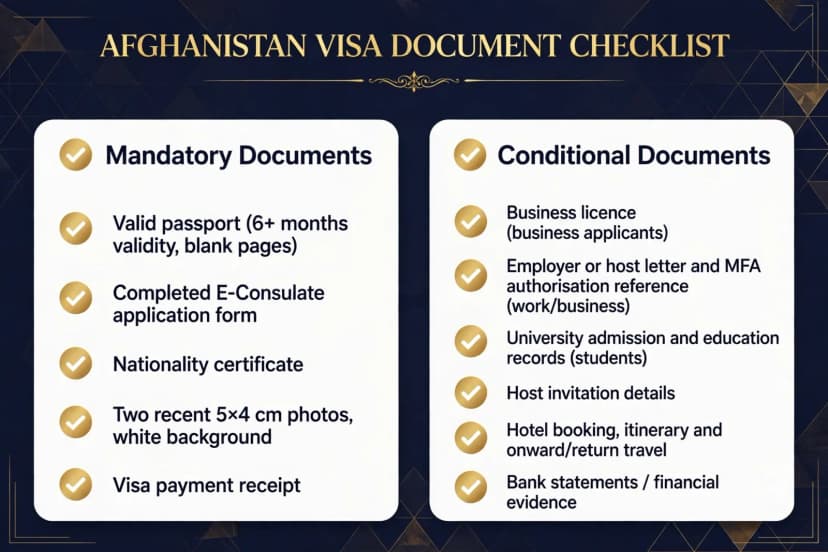
The following tables distinguish documents expressly identified in official instructions from supporting evidence that a mission may request. The mission's current checklist takes precedence.
| Document | Status | Notes |
|---|---|---|
| Valid passport and copy | Core / mission-specific mandatory | Islamabad mission specifies at least six months' validity and blank pages. |
| Completed Afghan visa application | Core | Start at the official E-Consulate instructions; print if directed. |
| Nationality certificate | Listed by E-Consulate | Ask what form of certificate is accepted for your nationality. |
| Two recent 5×4 cm photos | Listed by E-Consulate | White background; no more than six months old. |
| Visa payment receipt | Listed by E-Consulate | Pay only using the method confirmed by the mission. |
| Business licence | Conditional, business | Required by E-Consulate instructions for business applicants. |
| Employer/host letter and MFA reference | Conditional, work/business | Islamabad mission specifies employer/organisation evidence and MFA authorisation reference. |
| University admission/education records | Conditional, student | Student category is based on recognised-university agreement and valid education documents. |
| Afghan host/invitation details | Conditional, visitor/tourist/business | Requirements vary by mission and purpose. |
| Hotel booking, itinerary, onward/return travel | Supporting / may be requested | Tourist mission pages may require these; not a universal central list. |
| Bank statements / financial evidence | Conditional | Business visa page names supporting bank statements; other missions may request financial evidence. No universal minimum balance published. |
| Residence permit in country of application | Conditional, overseas applicant | Proves lawful residence; does not guarantee that mission accepts jurisdiction. |
| Marriage/birth/relationship records | Conditional, family | Submit only if relevant and as directed by the mission. |
| Translations/legalisation | Conditional | Ask the mission which languages, certification and legalisation are accepted. |
How to Apply: Step-by-Step
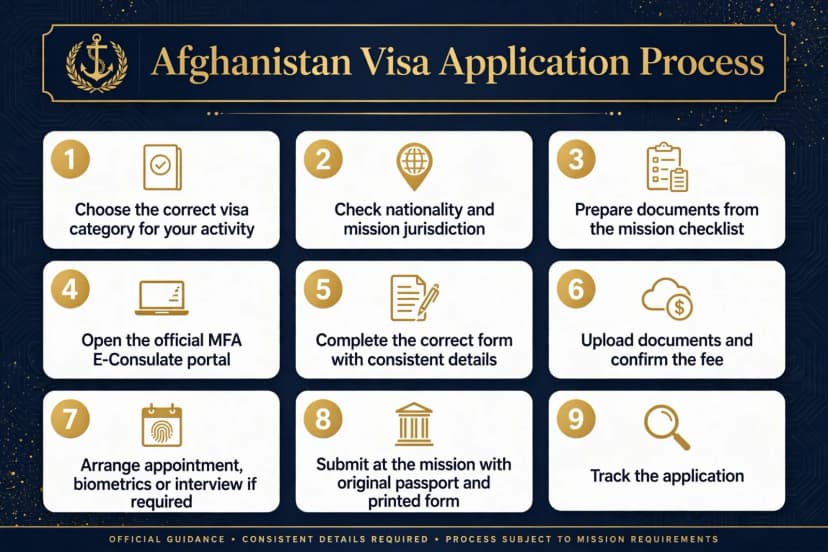
- Choose the correct category. Match the actual activity to tourist, visitor, business, entry/employment, student, transit or another defined category. Do not use a tourist visa to work.
- Check nationality and jurisdiction. Ask the Afghan mission responsible for your country of legal residence whether it accepts your passport nationality and residence status. Confirm any restrictions or temporary suspension.
- Prepare documents. Use the checklist from the specific mission, not a generic online list. Ensure passport validity, photographs, invitation and translations meet its requirements.
- Open the official registration portal. Use the MFA E-Consulate only after confirming that your application post accepts online registration.
- Complete the correct form. Enter consistent passport, travel, host and purpose information. Save a copy and print the application if instructed.
- Upload documents and confirm the fee. The E-Consulate instructions refer to a payment receipt and attendance at the mission. Do not assume the portal's online form means online-only submission or payment.
- Arrange appointment/biometrics/interview if required. The central guidance confirms in-person attendance; individual missions may require an appointment or interview. No universal biometric rule or appointment system was verified.
- Submit the application. Attend the authorised mission with original passport, printed form, photographs, supporting records and confirmed payment evidence.
- Track the application. Use the tracking method supplied by the receiving mission. The public E-Consulate site offers consular services and visa verification, but a universal applicant tracking timeline was not confirmed.
- Check the decision and entry conditions. Verify the visa sticker/e-visa, name, passport number, category, number of entries, validity and permitted stay. Recheck border/airport operations and travel advice before departure.
Not every application follows all ten steps. Some special categories require a sponsoring organisation or MFA authorisation before an application is lodged; arrival visas require prior approval and should not be treated as an airport walk-up process.
Visa Fees and Financial Requirements
| Fee item | Officially published amount | Important qualification |
|---|---|---|
| Tourist | USD 80 | Central MFA figure; Abu Dhabi mission publishes a local schedule. |
| Visitor | USD 80–240 | Central page gives a range; exact amount not explained. |
| Business | USD 40–300 | Depends on validity/mission; central range. |
| Entry / employment | USD 100 | MFA approval and licensed invitation required. |
| Student | USD 40–100 | Confirm applicable fee with mission. |
| Residence | USD 50 per month | Central MFA page. |
| Transit | USD 80–150 | Confirm route and fee. |
| Arrival | USD 200 | Only with prior official invitation and MFA approval. |
| Service | Free | Eligible service-passport holders only. |
| Crew | USD 600 | Central MFA figure. |
| Exit | USD 50 | Exceptional cases only. |
No universal minimum bank balance or standard proof-of-funds formula was found on the central MFA visa pages. A mission may request bank statements or other evidence. Do not rely on a travel agent's claimed minimum unless the competent mission confirms it.
Visa Processing Times
The central MFA category pages reviewed do not publish a reliable, universal processing-time commitment. Processing can depend on the visa category, MFA approval, sponsor documentation, the location of the application and the mission's operating status. Some overseas embassy pages publish local processing estimates, but those estimates cannot safely be transferred to another country or mission. Do not purchase non-refundable travel until the visa is issued and travel arrangements are confirmed.
Applying from Pakistan or Vietnam
Pakistani passport holders
The Afghan Embassy in Islamabad states that it issues visas to Pakistani nationals as well as people residing in and applying from Pakistan. Its published process uses the online form at the Afghan E-Consulate, followed by printing and attending the Embassy with the passport and supporting documents. The mission specifies at least six months' passport validity and blank pages, two recent photographs, and employer/organisation documentation plus an MFA authorisation reference for business or employment cases.
The central MFA's current tourist fee page lists USD 80, while older third-party or archived material may show different nationality-specific concessions. The current Islamabad visa page should be checked for the exact fee applicable to a Pakistani passport holder; do not assume a historical fee exemption remains in force. Confirm whether a Pakistani citizen's application requires any additional security clearance, invitation or category-specific approval. Muse note (25 Nov 2026): Pakistani applicants should also carry a NADRA polio vaccination certificate. Note that Pakistan–Afghanistan land crossings have been largely closed to ordinary passengers since 12 October 2025 — check the current border status before planning overland travel. Muse note (27 Nov 2026): reports in 2026 indicated Torkham reopened in March 2026 only for Afghans returning home, and an August 2026 decision to reopen all crossings was reported but passenger travel was not confirmed — check the latest position before travelling by road. A separate tourist e-Visa portal (eafghans.com) has operated since March 2026 (about USD 131.71 in total: USD 8 application + USD 120 visa + USD 3.71 processing; entry only via Kabul airport), but citizens of Pakistan, Iran, Tajikistan, Turkmenistan and Uzbekistan are NOT eligible for it — use the embassy route. The portal is not on a .gov.af domain and MFA pages do not cross-link it, so treat it with caution.
Pakistani citizens legally resident or working in Vietnam
A Vietnamese temporary residence card, work permit or other lawful residence document can help demonstrate that the applicant is legally based in Vietnam, but it does not automatically establish that an Afghan mission in Vietnam will accept the application. No official Afghan embassy/consulate in Vietnam or Vietnam-specific Afghan visa intake arrangement was independently confirmed in the sources reviewed as of 25 November 2026.
Before applying, contact the Afghan MFA through its official consular portal and E-Consulate and ask in writing:
- Which Afghan embassy/consulate currently has jurisdiction over Vietnam?
- Does it accept Pakistani passport holders who hold Vietnamese residence/work status?
- Must the application be submitted in person in a third country, and which mission will accept it?
- Is a Vietnamese residence card/work permit sufficient proof of local residence, and what validity period is required?
- Are there nationality-specific restrictions, security clearances, additional invitation documents or special fees?
- Can the passport be mailed, or must it be presented and collected in person?
If the competent mission directs the applicant to Islamabad, the applicant should confirm whether it accepts a non-resident application from someone ordinarily living in Vietnam. If it directs the applicant to another mission, confirm that mission's jurisdiction and appointment availability. Applying from Pakistan may be administratively more straightforward for a Pakistani citizen because Islamabad explicitly serves Pakistani nationals, but the applicant should not assume they must return to Pakistan or that an application from Vietnam will be accepted.
Do not send an original passport or pay a third party until the mission confirms its authority to process the case and provides official payment instructions.
Student Visa Guide
The MFA student visa is linked to an agreement with a recognised university in Afghanistan and valid educational documents. Applicants should obtain a formal admission letter, programme dates, evidence of tuition/scholarship arrangements where relevant, prior academic records and identity documents. The published central fee is USD 40–100; the listed validity is three months with a stay of one to three months. That initial period may not cover a full academic programme. Ask the university and Afghan authorities how to obtain the appropriate residence permission and whether extensions are possible. No separate language-study visa or digital student application workflow was verified.
Work Visa and Job Opportunities
The central MFA describes an entry visa for foreign nationals invited by licensed companies or institutions. The official invitation and MFA approval are essential elements. The Islamabad mission also asks applicants travelling for employment to provide documentation from a current or prospective employer/organisation and an MFA authorisation reference number. A business visa should not be confused with permission to take up employment. Obtain written confirmation of the correct work category, permitted employer, duration, local registration and any separate work authorisation before travel. No general job-seeker or skilled-worker points route was identified in the official category list.
Family Immigration and Permanent Residence
Visitor visas cover visits to relatives and friends. Some Afghan mission pages describe family/entry arrangements and re-entry permissions, but exact eligibility and documentation vary. A foreign national's family relationship to an Afghan citizen or resident does not, by itself, establish an automatic right to settle. The central visa list reviewed does not publish a general spouse/family reunification permanent residence route, indefinite leave category, or points-based settlement system for foreign nationals. Applicants should request an individual written assessment from the MFA or competent mission.
Afghan-origin people holding foreign passports may have separate entry-permit or travel-document arrangements. The MFA's entry-permit page states that some people of Afghan origin can enter without a visa if Afghanistan is recorded as place of birth on the foreign passport or if they hold specified Afghan identity evidence. It also says former Afghan citizens who renounced citizenship are treated as foreign nationals for visa issuance. See the official entry-permit guidance.
Other Immigration Routes: What Is Not Established
The official visa index does not identify a digital-nomad visa, job-seeker visa, startup visa, investor residence programme, points-based skilled migration route, or ordinary permanent-residence pathway. Business visas exist, but a business visit is not equivalent to an investor residence permit. Student and work-related entry categories exist, but they are not evidence of a general immigration-to-settlement system. Humanitarian protection, refugee status and resettlement are separate protection processes, usually handled by the relevant host country or international agencies; they should not be treated as an Afghan visitor visa category.
Common Application Mistakes
- Selecting tourist or visitor status for paid employment.
- Treating visa validity as the permitted number of days in Afghanistan.
- Relying on a general online form without confirming the responsible mission.
- Assuming a Vietnamese residence card guarantees Afghan consular jurisdiction.
- Using outdated fee tables or assuming a nationality-based exemption remains active.
- Applying for an arrival visa without prior official invitation and MFA approval.
- Submitting inconsistent names, passport details, dates or host information.
- Failing to provide the business licence, institutional invitation or MFA reference where required.
- Booking non-refundable travel before visa issuance and checking security advisories.
- Sending an original passport or payment to an unverified intermediary.
Reasons for Visa Refusal
The reviewed central pages do not provide a complete public refusal-code list. Applications may be refused or delayed where the purpose is unclear, the selected category does not match the activity, documents are incomplete or inconsistent, an invitation or required approval is absent, the applicant does not meet mission jurisdiction requirements, or the competent authority has security or admissibility concerns. A criminal record may also be relevant under some mission instructions. Never conceal prior refusals, criminal history or material facts where asked. Request written clarification of any refusal and whether reapplication is permitted.
Frequently Asked Questions
1. Do foreign nationals need a visa to visit Afghanistan?
In general, foreign visitors should obtain the appropriate Afghan visa or a specifically confirmed entry permission before travel. The MFA lists multiple visa categories and limited exceptions for people of Afghan origin.
2. How much is an Afghanistan tourist visa?
The central MFA currently publishes USD 80 for a tourist visa, valid for three months with a one-month stay. The issuing mission may apply a different local schedule or concession; confirm before paying.
3. Can I get an Afghanistan visa online?
The MFA E-Consulate provides online visa registration instructions. The central instructions also require printing the form and attending a political or consular mission with documents. Do not assume the process is fully online. A separate tourist e-Visa portal (eafghans.com) has operated since March 2026, but Pakistani citizens are not eligible for it — use the embassy route.
4. Is there a general visa on arrival?
No general walk-up facility was verified. The MFA describes an arrival visa only for applicants with an official domestic-organisation or international-organisation invitation and prior MFA approval at Kabul International Airport.
5. Can I work in Afghanistan on a tourist visa?
No. The tourist category is for leisure/sightseeing/pilgrimage and does not authorise work. Employment requires the appropriate invitation/entry authorisation and any other applicable permissions.
6. Is there an Afghanistan student visa?
Yes. The MFA publishes a student visa based on recognised university arrangements and valid education documents. Its stated fee is USD 40–100 and validity is three months, with a one-to-three-month stay.
7. What is the business visa fee?
The central MFA publishes a range of USD 40–300 and validity from one month to three years. Confirm the precise fee and entry conditions with the mission.
8. Is there a minimum bank balance?
No universal minimum was identified on the central MFA pages. Some visa categories or missions request bank statements. Ask the receiving mission what evidence it expects.
9. Can a Pakistani citizen apply in Afghanistan's embassy in Vietnam?
No Vietnam-based Afghan visa intake arrangement was confirmed in the research. The applicant must first obtain written confirmation of which mission has jurisdiction and whether it accepts Pakistani citizens resident in Vietnam.
10. Does a Vietnamese residence permit guarantee local application eligibility?
No. It proves lawful residence in Vietnam but does not itself determine the Afghan mission's consular jurisdiction or whether it accepts the applicant's nationality.
11. How long does an Afghanistan visa take?
The central MFA does not publish a universal processing time. The mission may require additional approvals or an interview. Ask for a current estimate before making plans.
12. Can I extend my Afghanistan visa?
The MFA publishes a residence visa and other extension-related services, but eligibility depends on the original visa and competent authority approval. Contact the relevant Afghan immigration/consular authority before the current stay expires.
13. Is there a digital nomad or job-seeker visa?
No such category was identified in the current official MFA visa list reviewed for this guide.
14. Is permanent residence available to foreign workers or students?
A general permanent-residence route was not identified in the official public visa categories reviewed. Do not assume that a work, student or residence visa leads to settlement.
15. Is it safe to travel to Afghanistan after receiving a visa?
A visa does not remove security risks. Several foreign governments advise against all travel because of terrorism, kidnapping, arbitrary detention and armed conflict. Check your government's current advisory and obtain independent security advice.
Official Immigration Websites
- Afghanistan Ministry of Foreign Affairs — Visa categories
- MFA E-Consulate — Visa registration and instructions
- MFA Consular Services portal / mission locator
- Afghan Embassy in Islamabad — Visa information
- Afghan Embassy in Abu Dhabi — Visa services
- UK FCDO — Afghanistan travel advice
- US Department of State — Afghanistan travel advisory
Final Checklist and Conclusion
Before proceeding, confirm the exact category and purpose; check the current security advice; identify the mission with jurisdiction over your residence; verify nationality-based restrictions; obtain the mission's latest checklist and fee in writing; prepare a valid passport, application, photographs and category-specific evidence; secure any required invitation, business licence or MFA reference; attend the required appointment; and verify the issued visa's entries, validity and permitted stay. Pakistani citizens legally resident in Vietnam should obtain written confirmation of the competent mission and acceptance of their Vietnam residence documents before submitting anything.
Afghanistan's official visa categories and published fees provide a starting point, not a universal guarantee of eligibility or processing. Rules and consular services may change without notice. Always rely on the current MFA and receiving mission instructions, and do not travel solely because an application has been submitted or a visa has been approved.
Disclaimer: This article is general educational information, not legal, immigration, security or travel advice. MAS Inspire is an independent educational publisher and is not an Afghan government authority, embassy or visa agent. Government rules, security conditions, fees and consular operations can change. Verify all material details directly with the competent authorities before acting.