

MAS INSPIRE
Independent visa & immigration education · masinspire.com
Official information checked: 18 November 2026. Not an official immigration website. See links to UDI and Norwegian embassies.
Norway Visa Guide 2026: Types, Fees, Documents and How to Apply
By MAS Inspire Editorial Team Official information checked: 18 November 2026 Audience: International applicants, including Pakistani passport holders lawfully living in Vietnam Editorial status: Published

Independent educational guide: MAS Inspire (masinspire.com) is not Norway's Directorate of Immigration (UDI), a Norwegian embassy, VFS Global, or a licensed immigration adviser. Your nationality, residence, purpose of travel and particular circumstances determine eligibility. Rules, application fees and processing times can change. Follow the personalized checklist generated by UDI and the official embassy/VFS instructions. Neither a visa nor a residence permit is guaranteed.
Contents
- Introduction
- Why people visit, study and work in Norway
- Visa, residence permit and permanent residence: key differences
- Types of Norway visas and residence permits
- Visa and residence permit comparison table
- Eligibility requirements
- Complete document checklists
- How to apply for a Norway visa step by step
- Official fees and financial requirements
- Processing times and length of stay
- Pakistani passport holders applying from Vietnam
- Study in Norway: international students
- Working in Norway: jobs and qualifications
- Family immigration and permanent residence
- Common mistakes and reasons for refusal
- Frequently asked questions
- Official government links and final checklist
Introduction
Norway is known for its striking fjords, northern lights, universities, research opportunities and developed labour market. International applicants travel to Norway for short holidays, family visits, business meetings, full-time education and paid employment. Some later become eligible for family-based or work-based long-term residence. But these objectives do not all use the same immigration document.
Norway participates in the Schengen Area, which is important for a short visit. A Schengen visitor visa normally allows a visa-required traveller to stay for up to 90 days within any 180-day period, subject to the visa, past Schengen travel and border conditions. By contrast, an applicant normally requires a Norwegian residence permit for long-term study, work or family immigration. Norway is not a member of the European Union but is part of the European Economic Area (EEA), so EU/EEA citizens have different residence rules from most other nationals.
The authoritative starting point is UDI's “Want to apply” page, which personalizes the procedure by citizenship and purpose. The official Norway in Vietnam page explains where people applying from Vietnam submit documents.
Why people visit, study and work in Norway
Tourists may visit Oslo, Bergen, Tromsø and the Lofoten Islands or explore Norway's nature. Business visitors attend legitimate short-term meetings and events. International students apply to eligible universities, university colleges and other qualifying institutions. Professionals look for employers with positions that require their documented skills. Families seek reunification with eligible residents or citizens. In each case, the important first decision is whether the purpose is a short Schengen visit or a stay requiring residence permission.
A visa sticker does not promise admission, and an invitation letter does not replace eligibility. Norway's immigration authorities assess the real travel purpose and supporting evidence; applicants should not book non-refundable travel arrangements before checking the embassy's instructions.
Visa, residence permit and permanent residence: key differences
| Document / status | What it means | Work permission |
|---|---|---|
| Schengen visitor visa (C visa) | Short visit, normally up to 90 days in any 180-day period across Schengen | No general right to take employment in Norway |
| Airport transit requirement | Certain passport holders need appropriate authorization even for airside transit at Oslo Airport | None |
| Study residence permit | Permission for a qualifying course of study lasting more than three months | Often up to 20 hours weekly during term and full-time in holidays, subject to conditions |
| Skilled-worker residence permit | Work-based residence tied to approved qualifications and employment | Work according to permit conditions |
| Job-seeker residence permit | Restricted route for certain qualifying graduates/researchers already holding specified Norwegian permits | Conditions on the specific permit; not a general overseas visa |
| Family immigration permit | Residence through a qualifying family relationship and other requirements | Depends on granted permit |
| Permanent residence permit | Indefinite permission to live and work after qualifying residence and other conditions | Generally yes |
Norway's visitor visa is not a “work visa,” and an approved student permit does not automatically qualify its holder for permanent residence. Each category has its own renewal and employment rules. Official: UDI application categories, permanent residence.
Types of Norway visas and residence permits
1. Tourist / short-stay Schengen visitor visa
Most visa-required tourists apply for a Schengen visitor visa, often called a C visa, where Norway is the correct main destination under Schengen rules. For an ordinary Pakistani passport, a visa is normally required. An eligible traveller can visit Norway and potentially other Schengen countries, within the visa's conditions and the overall 90/180-day calculation. An issued multiple-entry visa does not mean 90 days on each entry without regard to past stays.
The usual government application fee is EUR 90 for adults; EUR 45 for children aged 6–11; and no fee for children under 6, with additional exemptions in particular cases. A VFS Global service charge may be added. Applications are evaluated on passport validity, adequate funds, travel medical insurance, purpose, itinerary, accommodation, the intention to leave before expiry and other relevant requirements. UDI states the passport should be issued within the previous ten years and remain valid for at least three months after the intended visit.
UDI currently gives financial guidelines, not a universally identical bank balance: around NOK 300 per day where staying with friends/family or where accommodation is prepaid, and around NOK 1,300 per day without proof of prepaid accommodation for the whole visit; shared-travel circumstances have additional guidance. Sufficient funds are assessed individually, and eligible sponsorship is an alternative where appropriate. Travel health insurance must cover at least EUR 30,000 across Schengen for the trip. Official: UDI visitor visa, travel insurance, sponsorship for visitors.
2. Business visitor visa and conferences
A short business trip for a meeting, negotiations, a conference or an event generally uses the visitor visa category, not a separate unlimited employment visa. Visa-required applicants must demonstrate the real meeting or conference purpose; an invitation from the Norwegian organization, employer confirmation, travel itinerary, accommodation and funding can be important. Taking a local job or performing ordinary work in Norway may require a work residence permit even if a person holds a Schengen visa. Official: UDI visitor visa — select Business.
3. Visiting friends, family or a partner
Family or private visits generally use the visitor visa for short stays. A Norwegian host's invitation, relationship evidence and sponsorship form may be relevant. UDI assesses the applicant's likelihood of returning to the home country or legal country of residence, including employment, family responsibilities and other ties. Visiting a partner or family member is not the same as family immigration, which is a long-term residence category. Official: Visitor visa requirements and sponsor guidance.
4. Study residence permit: university, college and approved education
A foreign national who plans to study in Norway for more than three months normally needs a study residence permit. For a standard university or university-college application, UDI requires admission to an approved institution, full-time study, accommodation and financial support. For 2026–2027, the stated living-expense requirement for university/college study is NOK 170,368 for the academic year (or NOK 15,488 a month as expressed by UDI); tuition must be covered separately when applicable. Specific other school types and one-semester arrangements can have different requirements.
The adult study-permit fee is NOK 5,400. A qualifying study permit normally permits work of up to 20 hours a week while studying and full-time during holidays; students cannot simply use it to run a business. The permit time for ordinary studies does not count toward the residence period for permanent residence. Official: Study permit, tuition and costs, official fees.
5. Skilled-worker residence permit
Most non-EU/EEA applicants who want a regular qualified job must first have a concrete job offer from a Norwegian employer. UDI assesses the applicant's education or vocational training, whether the job requires those skills, the work percentage, and salary and working conditions. Relevant experience alone does not guarantee qualification, and some roles require professional recognition or Norwegian-language proficiency. Employers or clients may need to confirm the offer electronically before an overseas applicant proceeds.
The government fee for an adult work residence permit is NOK 6,300. The salary should meet the applicable collective agreement or local occupational norm. Where there is no collective agreement and the job requires a bachelor's degree, UDI currently states NOK 545,400 per year before tax; for jobs requiring a master's degree, NOK 624,700 per year before tax, unless a properly evidenced exception applies. These are job-requirement benchmarks, not a universal salary for every worker. Official: Skilled workers, pay requirements.
6. Seasonal-worker residence permit
Certain genuine seasonal jobs can support a dedicated residence permit. The employer and position must meet UDI's specific rules, which can include full-time work, appropriate pay and an identifiable seasonal need. The route is not interchangeable with a general skilled-worker permit. UDI explains that after holding a seasonal permit for six months, a worker generally needs six months outside Norway before a new seasonal permit. Periods on seasonal permits do not normally build a permanent-residence entitlement. Official: Seasonal workers.
7. Job-seeker residence permit: available only in limited cases
Norway has a job-seeker residence route, but it is not a general open visa for applicants overseas. UDI describes exceptions for certain graduates who have completed eligible education in Norway and apply before their current qualifying permit expires, for people who finished additional qualifying education, and certain researchers already holding the relevant Norwegian permission. For the specified job-seeker route, UDI publishes a support requirement of NOK 28,448 per month, or NOK 341,373 per year (with special exceptions). A qualifying permit may last up to one year and does not count toward permanent residence. Applicants outside Norway who have never held an eligible Norwegian permit should generally first look for an actual employer or another route. Official: UDI job seekers.
8. Self-employment, entrepreneurs and investment
Norway has specific residence routes for qualifying skilled self-employed people, including some whose business operates in Norway or abroad. The applicant's skills, genuine business and particular conditions matter; simply registering a company or promising to invest money does not create a general “golden visa.” There is no safe basis to advertise an unrestricted investor or startup visa that automatically grants residence. Check the relevant self-employed category inside UDI's skilled-worker information and work immigration options.
9. Digital nomads and remote work
Norway does not offer a standard, standalone federal-style “digital nomad visa” open to anyone working online. Remote work carried out while physically in Norway can raise immigration and employment questions. A short-stay Schengen visa must not be presented as unlimited authorization to take Norwegian work or run a Norwegian business. The legality depends on the exact activities, payer, physical location and applicable permit/exemption. Review UDI's work immigration rules for your case before relying on an online claim.
10. Family immigration / spouse and children
A person with a qualifying relative in Norway may seek family immigration, usually for a spouse, cohabiting partner or child, depending on the sponsor's status and the applicable category. The family relationship must be authentic and documented. A Norwegian reference person may have to satisfy a current and previous income requirement; there are exceptions and differences by status and family category. For many recent cases, UDI publishes NOK 436,957 per year before tax as a future-income benchmark, but the exact calculation must be verified against the personalized family immigration rules, including the previous year's income and any exceptions.
The first-time adult family immigration fee is normally NOK 11,900; the first-time child fee normally NOK 5,950, with special rates or exemptions for certain categories. A family visitor visa is not a substitute for a residence permit to live together permanently. Official: Family immigration, income rules, fees.
11. Permanent residence
Permanent residence allows a qualified resident to live and work in Norway indefinitely, subject to law. UDI generally requires three or five years of continuous qualifying residence, depending on the route, with permits that actually count toward permanent residence. An applicant may need to satisfy language and social-studies rules, including an A2 oral Norwegian test unless exempt, as well as other requirements. Study permits and limited job-seeker permits do not automatically count toward the necessary residence period. The adult government application fee is NOK 4,000. Official: Permanent residence permit and residence-period rules.
12. Airport transit: special warning for Pakistanis
Pakistani ordinary-passport holders should not assume they can change planes at Oslo Airport without an entry document. UDI explicitly identifies Pakistan among nationalities affected by the airport transit visa requirement, including some airside connections from one non-Schengen country to another. Its current instruction says travellers from the specified countries without a valid Schengen visa must apply for a visitor visa before transit, and should document the onward ticket and destination permission. Exemptions may apply under the detailed rules; review the exact case and itinerary. Official: Airport transit visa and Pakistan-specific visits page.
13. Internships, research and academic visits
A short academic conference may fit visitor conditions, while undertaking research as an employee, a work placement, a paid internship or a longer study program can require a different authorization. UDI has a separate researcher with own funds residence category with its own requirements and fees, and certain researchers may later qualify for restricted job-seeker permits. Do not assume that every exchange or internship uses the same student authorization. Official: Studies, work immigration, job seekers.
14. Humanitarian protection and asylum
Asylum is a protection process for people who face relevant risks; it is not a tourist, study, employment or job-search visa. UDI states that an application for protection generally must be made in Norway or at the Norwegian border. A protection claim requires truthful information and is governed by distinct eligibility rules. Anyone facing serious protection concerns should consult official channels or a qualified legal adviser. Official: Protection (asylum).

Visa and residence permit comparison table
| Your purpose | Main route | Basic government fee | Typical length / outcome | Work permitted? |
|---|---|---|---|---|
| Tourism or private visit | Schengen visitor visa | EUR 90 adult | Up to 90 days in 180 days | Not general Norwegian employment |
| Short business meetings | Schengen visitor visa | EUR 90 adult | Short stay | Limited permitted visitor activities |
| Full-time approved study | Study residence permit | NOK 5,400 adult | Program-related, renewable if eligible | Up to 20 hours/week in term, subject to conditions |
| Qualified employed role | Skilled-worker permit | NOK 6,300 adult | Work-permit conditions | Yes, according to permit |
| Genuine seasonal job | Seasonal-worker permit | NOK 6,300 adult | Seasonal and limited | Yes, within approved job |
| Qualifying Norwegian graduate or researcher | Restricted job-seeker permit | Verify work-route fee | Up to 1 year, if qualified | Specific permit conditions |
| Join qualifying family | Family immigration | NOK 11,900 first-time adult | Residence permit | Depends on the granted status |
| Long-term settlement | Permanent residence | NOK 4,000 adult | Indefinite residence after approval | Generally yes |
| Oslo Airport connection, Pakistani passport | Check UDI transit / visitor visa rules | Verify requested visa | Transit only | No |
| Digital nomad / general investor | No universal dedicated visa | Not applicable | Must qualify for another lawful route | Only as permitted |
Fees may be subject to individual exemptions, VFS service charges and later increases. Official: UDI fees.
Eligibility requirements
Your application should match the real reason for travel. For visitor visas, expect scrutiny of passport validity, medical insurance, ability to pay for the visit, accommodation, itinerary, previous Schengen stays, immigration compliance and convincing reasons to leave. For study, obtain genuine admission and document living and tuition funds, housing and eligible course status. For work, have a real employer and a role consistent with your qualifications and required pay. For family immigration, show a genuine eligible relationship and meet sponsor requirements where applicable. For permanent residence, establish enough qualifying years, current lawful status and other legal requirements.
There is no universal exact number of required documents. UDI and the receiving visa office supply a personalized checklist after the applicant chooses citizenship, destination, residence and category. A letter from a travel agency does not override the official checklist. Official: UDI application selector.
Complete document checklists
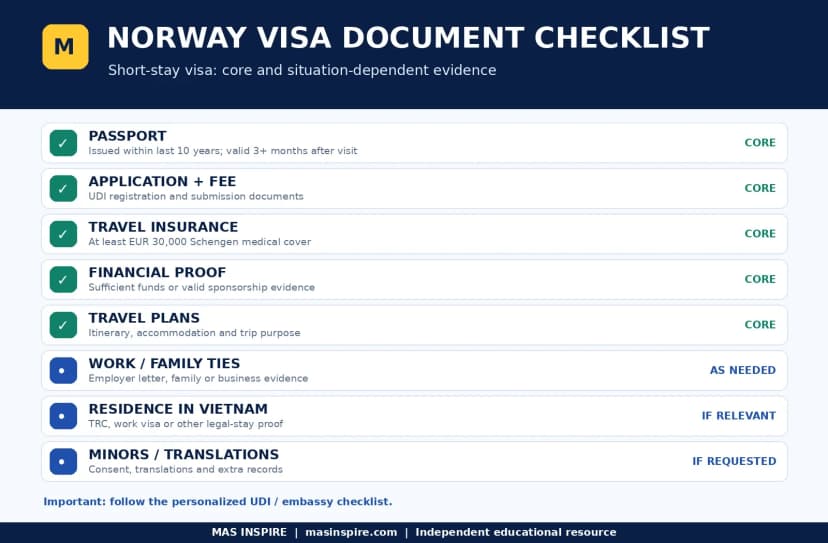
Tourist or family visitor visa
| Document | Status | Practical note |
|---|---|---|
| Valid passport, identity copies and photo | Core | Usually issued within past 10 years; valid at least 3 months after visit |
| Completed UDI application/cover letter and fee receipt | Core | Register through the official channel |
| Travel medical insurance | Core | At least EUR 30,000 for relevant Schengen territory and dates |
| Travel purpose, itinerary and transport plans | Core or requested | Consistent, truthful dates and destination |
| Accommodation booking or host invitation | Usually required | Addresses, dates and host information |
| Financial evidence or official sponsor document | Core when applicable | Funds assessed case by case; not one global bank amount |
| Employer leave letter, payslips, business records | Helpful or requested | Documents ties to home or residence country |
| Vietnam residence card / valid visa | For applicants residing in Vietnam | Proves lawful local stay if relevant |
| Minor's parental consent and civil records | If applicable | Depends on custody and travel circumstances |
| Certified translations / extra records | If requested | Follow checklist and visa-office guidance |
| Biometrics (fingerprints) | Usually, subject to exemptions | Given at approved application centre |
Official: Visitor visa, official visa procedure.
Study residence permit
| Document | Status | Practical note |
|---|---|---|
| Passport and official application | Core | Identity and application record |
| Admission letter | Core | From eligible institution and course |
| Full-time enrollment / program details | Core for most long programs | Aligns with requested study authorization |
| NOK 170,368 living funds for full 2026–27 academic year | Main university/college benchmark | Different course/semester categories may use different amounts |
| Tuition payment or ability to pay | If tuition applies | On top of living expenses |
| Housing confirmation | Core | Show somewhere to live in Norway |
| Previous academic records and study explanation | As requested | Explains suitability and progression |
| English / Norwegian competence evidence | If admission or checklist requires | Depends on institution and course |
| Fee confirmation, translations and other documents | As required | Use personalized instructions |
Official: Study permit requirements, Study in Norway.
Skilled-worker residence permit
| Document | Status | Practical note |
|---|---|---|
| Valid passport / residence documentation | Core | Identity and local application details |
| Specific genuine employment offer and contract | Core | Job duties, hours, salary, employer details |
| Employer-confirmed offer where UDI requires it | Category-dependent | Process may be electronic |
| Degree, vocational certificate or detailed proof of special qualifications | Core as applicable | Qualification must fit the job |
| Work experience references, CV | As applicable | Verify actual duties and dates |
| Salary and employment-condition documents | Core | Collective agreement or Norwegian norms |
| Professional recognition / license | If regulated | Particularly important for certain teaching and healthcare roles |
| Fee receipt and embassy/VFS checklist documents | Core | Use correct work route |
Official: Skilled-worker permit, employment conditions.
Family immigration and permanent residence
| Document | When relevant | Purpose |
|---|---|---|
| Applicant and sponsor passports / residence cards | Core | Identity and sponsor status |
| Marriage, birth, cohabitation or custody records | Relationship-dependent | Legal and genuine family ties |
| Sponsor income evidence and tax documentation | Where required | Minimum income rules |
| Accommodation and household arrangements | Where required | Housing / living arrangement |
| Application fee and translated civil records | Core as applicable | Correct documentation |
| For PR: past permits and continuous-residence evidence | PR applications | Shows qualifying period |
| For PR: Norwegian language / social studies evidence | If required | Satisfies integration rules |
Official: Family immigration, permanent residence.
How to apply for a Norway visa step by step
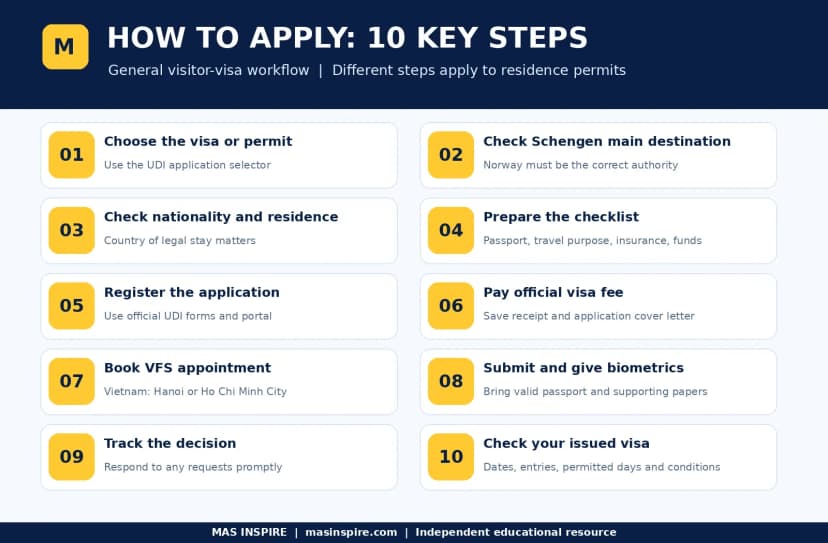
This general sequence is useful for a visitor visa submitted outside Norway. Residence permits have different rules; use the relevant UDI guide for your category.
- Choose the correct purpose. Start at UDI Want to apply. Select your citizenship and category, such as tourist, business, student, worker or family.
- Confirm that Norway is the correct Schengen destination. Apply through Norway when it is the relevant main destination under Schengen rules; if another state is the real main destination, do not use Norway merely for convenience.
- Check your current country of legal residence. The receiving visa center and document list may depend on your lawful residence, not just your nationality.
- Download the personalized checklist. Confirm passport validity, purpose evidence, finances, insurance, invitation, translations and any category-specific documents.
- Complete the application online using the official UDI route. Use truthful identity, travel, employment, family and immigration history; do not conceal refusals or overstay history.
- Pay the published government fee. Save the registration confirmation and payment receipt; check additional VFS charges separately.
- Book the correct appointment. In Vietnam, Norway applications are submitted through designated VFS Global centers in Hanoi or Ho Chi Minh City with mandatory appointment booking. Confirm the VFS page linked from the official embassy notice.
- Attend the appointment and submit documents/biometrics. Bring the original passport, printed confirmations and the documents requested by the receiving center. Fingerprints and a photo may be collected under Schengen rules.
- Track the application and respond to requests. Use UDI and the receiving centre's official status instructions; additional verification can lengthen processing.
- Read the decision carefully. If approved, check name, passport number, entries, territorial validity and the stay duration; carry insurance, itinerary and evidence of funds when travelling. If refused, use the decision's official appeal or reapplication instructions rather than false documents.
For a study or work residence permit: First secure actual university admission or eligible work documentation, follow the work/study UDI form and checklist, and wait for the correct residence decision and entry instructions. Do not assume a visitor visa converts into work rights. Official: UDI application pages, booking appointments.
Official fees and financial requirements
The following are the government fees displayed by UDI when checked on 18 November 2026. They may later change, and some applicants qualify for exemptions or different fees.
| Application or expense | Amount | Notes |
|---|---|---|
| Schengen visitor visa, age 12+ | EUR 90 | UDI has exemptions for certain groups |
| Visitor visa, age 6–11 | EUR 45 | Category and age rules apply |
| Visitor visa, under 6 | No government fee | Extra service charges may differ |
| Work residence permit (adult) | NOK 6,300 | First-time and renewal general adult fee |
| Study residence permit (adult) | NOK 5,400 | Different fees for under 18 |
| Family immigration, first-time adult | NOK 11,900 | Different fees/exemptions for special categories |
| Family immigration, first-time child under 18 | NOK 5,950 | Special categories can differ |
| Permanent residence, adult | NOK 4,000 | PR conditions still apply |
| Permanent residence, child under 18 | NOK 2,000 | As listed by UDI |
| Travel medical insurance | Varies | At least EUR 30,000 medical cover for visitor visas |
| VFS processing/courier service | Varies | Additional to government fee where applicable |
Visitor funds: UDI's current visitor guidance describes NOK 300/day where staying with friends/family or in prepaid accommodation, and NOK 1,300/day where accommodation has not been documented as prepaid (different shared-travel guideline may apply). These are case-assessment guidelines, not a universal visa approval formula. A genuine sponsor form may be appropriate when the visitor has insufficient personal funds.
Study funds: For typical university/college residence permits in the 2026–27 academic year, UDI lists NOK 170,368 in living costs, plus tuition where payable. One-semester figures are NOK 77,440 for autumn or NOK 92,928 for spring under the cited UDI student category. The precise approved sources and storage of funds matter, including a Norwegian bank account or institutional deposit account where required.
Work salary: For degree-requiring roles without a collective agreement, UDI currently publishes NOK 545,400/year before tax for bachelor's-degree positions and NOK 624,700/year before tax for master's-degree positions, subject to justified exceptions and occupational norms.
Restricted job-seeker funds: UDI cites NOK 341,373/year for a particular category of eligible Norwegian graduates/researchers; it is not a pathway open to every applicant abroad.
Sources: UDI fee schedule, visitor money guidance, student funds, salary rules, job seekers.
Processing times and length of stay
Norway's UDI publishes a regularly updated waiting-time tool and separate visitor visa guidance. On the visitor visa page last updated 29 October 2026, the published figures were 15 days for processing by an embassy in the applicant's country of residence, 15–29 days for an embassy in another country, and 45 days for applications handled by UDI. These are published estimates, not personal guarantees; administrative movement between countries, incomplete documents or security checks can lead to different outcomes.
Schengen visas may be single or multiple entry; their printed validity and permitted duration are different. The 90 days in 180 days rule applies to cumulative Schengen stays, not automatically to each destination or each visit. Residence permit durations depend on the category, study or employment period and conditions of approval. Applicants should verify current timelines immediately before applying rather than relying on an old blog screenshot.
Official: UDI visitor waiting time and all waiting times.
Pakistani passport holders applying from Vietnam
If you hold an ordinary Pakistani passport and are legally working or living in Vietnam, you may be able to lodge a Norwegian application from Vietnam under the receiving mission's residence rules. Your Vietnamese temporary residence card, work permit, employment and lawful stay are evidence of residence, not substitutes for a Schengen visa or Norwegian residence permit. You should not assume that a tourist stay in Vietnam automatically makes it the appropriate place to apply.
For applications submitted in Vietnam, the official Norway in Vietnam notice states that the Norwegian Embassy in Bangkok handles visa applications, while VFS Global centers in Hanoi and Ho Chi Minh City accept submissions. An appointment is mandatory. This differs from an application submitted in Pakistan, where the Norwegian official Pakistan notice explains that the visa hub in Abu Dhabi and UDI are responsible for handling cases submitted from Pakistan. On 24 March 2026, Norway announced visa services had resumed at VFS/Gerry's in Islamabad, Lahore and Karachi after a temporary interruption; current booking availability still needs confirmation.
For applicants in Vietnam, a practical supporting pack may include a Pakistani passport, Vietnam TRC/work visa or other lawful residence evidence, employment contract, salary slips, recent bank records, authorized leave, itinerary, travel insurance and hotel or host details. The exact final checklist depends on the application category and VFS/UDI instructions. Avoid submitting a false employment letter, fabricated flight reservation or unverifiable bank statement.
Transit alert: UDI names Pakistan on its Oslo Airport transit requirement page and instructs certain affected travellers without an existing valid Schengen visa to apply for a visitor visa before transit. Even a flight connection without leaving the airport must be checked carefully, including exceptions and destination-document rules. A Vietnamese residence card alone should not be assumed to solve this requirement.
Pakistan vs. Vietnam: Your Pakistani nationality remains relevant to the visa requirement, while your actual country of lawful residence affects where you present the application and which local evidence is expected. Always use the embassy's current official instructions rather than a travel agency's nationality shortcut.
Sources: Norway in Vietnam, Bangkok regional mission, Norway in Pakistan, Pakistan visa resumption.
Study in Norway: international students
Norway's higher education system includes public and private institutions. Non-EU/EEA/Swiss degree students generally must pay tuition fees at many institutions unless they qualify for a listed exemption. Check the exact program, the tuition price for your intake, admission criteria and whether it is approved. The official Study in Norway service explains that Norway does not offer a general individual government scholarship for all degree students; program-specific and other scholarships may still exist.
A sound study-permit application begins with admission rather than an agent's general promise. Confirm that the institution can provide any required confirmation of tuition funds, deposit account and residence arrangements. Document finances covering the appropriate UDI 2026–27 living-cost benchmark as well as tuition. UDI's page gives bank/deposit and part-time-work details; do not assume that part-time income will fully replace the required financial proof.
A regular study residence permit generally includes permission to work 20 hours a week during studies and full-time during holidays, and the student cannot ordinarily use it to be self-employed. This temporary period typically does not count towards permanent-residence residence requirements. Applicants who plan to remain after graduation must separately assess a qualifying job offer or the restricted job-seeker graduate route, rather than claiming that graduation grants PR.
Official: Study in Norway — costs, tuition exceptions, scholarships, UDI study permits.
Working in Norway: jobs and qualifications
The most practical route for many qualified applicants overseas is to identify a genuine employer and determine whether the offered role supports a skilled-worker permit. Norway does not authorize all visitors to work. Check that the job description genuinely requires the education or professional competence you possess and that the salary and working conditions comply with UDI's rules.
If you have a foreign teaching qualification, be aware that Norwegian school teaching may be a regulated role. The Norwegian Directorate for Higher Education and Skills (HK-dir) says foreign teaching qualifications ordinarily need recognition to obtain permanent teaching employment in Norwegian primary and secondary schools. Recognition of a degree in general is not necessarily recognition as a schoolteacher. Look at language requirements, education levels and local job duties before paying for documents.
Useful official starting points are UDI skilled workers, HK-dir teacher qualifications and HK-dir foreign higher education. The EURES employment portal can help research vacancies; it does not grant a permit. Do not pay someone who promises a guaranteed Norwegian sponsorship letter or residence approval.
Family immigration and permanent residence
Family immigration is intended to support real family relationships, not to avoid the standard visit or employment rules. UDI treats applications differently according to whether the reference person is a Norwegian/Nordic citizen, an EU/EEA national or another foreign national living in Norway. Check which family members qualify, which civil documents must be authenticated or translated, and whether the sponsor must meet income requirements. Some decisions involve interviews or additional checks.
Permanent residence is a later status, not a document obtained just by buying a house or staying as a tourist. The applicant normally needs three or five years of continuous qualifying residence and must meet current legal requirements including Norwegian-language and social-studies rules, where applicable. The exact history of permits matters: a study residence period and limited job-seeker permit do not necessarily count. Read the details before treating a short-term program as a permanent immigration route.
Official: Family immigration, income requirement, permanent residence.
Common mistakes and reasons for refusal
Common problems include selecting Norway when another Schengen country is truly the main destination, inadequate travel insurance, missing evidence of funds, inconsistent dates, unclear accommodation, hiding previous refusals, submitting weak or fabricated proof of employment, and assuming a relative's invitation guarantees approval. For residence permits, a job may not meet the skilled-worker definition; the employer may not have correctly confirmed the offer; studies may not be full time or properly funded; or relationship and sponsor requirements may not be met.
UDI specifically considers the applicant's likelihood of leaving Schengen at the end of a short stay. A refusal is not automatically permanent, but neither is it harmless to reapply with identical weak evidence. Read the official decision for appeal rules, deadlines and required corrections. Never buy a fake bank statement, job contract, marriage certificate or language result. Official: UDI visitor guidance, UDI application and decision information.
Frequently asked questions
1. Do Pakistani citizens need a Norway tourist visa?
Ordinary Pakistani passport holders generally need a Schengen visitor visa to visit Norway. Lawful residence in Vietnam does not automatically provide visa-free entry. Check the UDI nationality selector for exceptions.
2. Can a Pakistani passport holder apply from Vietnam?
A person lawfully resident in Vietnam can generally use the designated Norwegian application arrangements there, subject to eligibility and documentation. The receiving centers are in Hanoi and Ho Chi Minh City, and the regional embassy in Bangkok handles the applications.
3. What is the Norway Schengen tourist visa fee in 2026?
UDI lists EUR 90 for most adults and people aged 12 or older, EUR 45 for children aged 6–11, and no fee for children under six. Exemptions and VFS service costs can apply.
4. How long can I stay with a Norwegian Schengen visitor visa?
Generally up to 90 days in any 180-day period across the Schengen Area, subject to the visa's printed conditions and your previous Schengen stays.
5. How much bank balance is needed for Norway tourism?
There is no universal account-balance figure for every traveller. UDI's current daily funding guidance distinguishes prepaid or hosted stays (around NOK 300/day) from stays without complete prepaid accommodation (around NOK 1,300/day), with individual assessment and sponsorship rules.
6. Do I need travel medical insurance?
Yes, for a normal visitor visa application. UDI requires insurance including emergency medical treatment and repatriation, covering at least EUR 30,000 for the relevant Schengen stay.
7. Can I work with a tourist visa?
A Schengen visitor visa does not grant a general right to work for a Norwegian employer. Business visits and narrow legal exceptions have distinct conditions; seek the correct work authorization before beginning employment.
8. Is there a Norway job-seeker visa?
Norway has limited job-seeker residence permit routes for certain qualifying graduates and researchers, usually already holding specific Norwegian permits. It is not a general arrival-and-find-work visa for all applicants overseas.
9. What is the study residence permit fee?
The standard adult UDI study-permit application fee checked for 2026 is NOK 5,400. Tuition, support funds and VFS charges are separate.
10. How much financial proof must a university student show in 2026–27?
UDI lists NOK 170,368 for the full academic year for a typical university/college student, plus tuition where applicable. One-semester and other school types have different figures.
11. Can international students work while studying?
Qualifying study-permit holders usually may work up to 20 hours a week during term and full-time in holidays. Specific conditions and restrictions, including on self-employment, still apply.
12. Can I get a Norwegian work residence permit without a job offer?
Most overseas skilled-worker applicants need a concrete eligible job offer. A limited graduate/researcher job-seeker exception exists, but it is not open to all foreign applicants.
13. Do I need a Norway visa to transit through Oslo Airport with a Pakistani passport?
UDI lists Pakistan among nationalities subject to airport transit requirements. Its current instructions say certain affected travellers without a valid Schengen visa need to apply for a visitor visa before the transit. Check your exact onward itinerary and possible exemptions.
14. Does a study permit lead directly to permanent residence?
No. Ordinary study-permit time generally does not count toward permanent residence in Norway. You must separately satisfy qualifying residence-permit and other PR criteria.
15. How long does Norway visa processing take?
UDI's visitor waiting-time page, last updated 29 October 2026, listed 15 days, 15–29 days or 45 days, depending on which authority processes the application. Actual timelines vary; check the live UDI waiting-time tool.
Official government links and final checklist
| Official topic | Government / authoritative website |
|---|---|
| Norwegian Directorate of Immigration | UDI |
| Personalized visa and permit selector | UDI — Want to apply |
| Schengen visitor visa | UDI visitor visa |
| Pakistan-specific visit and transit entry | UDI for Pakistan citizens |
| Government application fees | UDI fees |
| Visitor travel insurance rules | UDI insurance |
| Study permits | UDI study permits |
| Work permits / skilled workers | UDI skilled workers |
| Exceptional job-seeker permits | UDI job seekers |
| Family immigration | UDI family immigration |
| Permanent residence | UDI permanent residence |
| Processing times | UDI waiting time |
| Norway application from Vietnam | Norway in Vietnam |
| Regional visa processing in Bangkok | Norway in Thailand |
| Norway application from Pakistan | Norway in Pakistan |
| Study costs and tuition | Study in Norway |
| Recognition for school teaching | HK-dir teacher qualifications |
Final checklist before applying or publishing: Verify the correct visa route; confirm your nationality and lawful application country; check whether Norway is truly the main Schengen destination; follow your personalized checklist; confirm your passport, insurance, invitation, finances, fees and document translation rules; use the correct embassy/VFS appointment route; check current processing estimates; verify work rights separately from visitor rights; and obtain administrator approval before putting this guide online.
MAS Inspire editorial notice: Information checked 18 November 2026 against UDI, Norway's Ministry of Foreign Affairs/embassy pages and other official Norwegian resources. Prices, financial limits, transit rules, regional submission arrangements and visa processing can change. For this draft, no automatic publication, immigration approval guarantee, or claim of government affiliation is made.

