

◆ MAS INSPIRE · masinspire.com
Japan Visa Guide 2026
Types • Requirements • Documents • Fees • Application Steps
Last researched: 24 November 2026. Verify the latest instructions with the relevant Japanese mission before applying.
Japan Visa Guide 2026: Types, Fees, Requirements, Documents and How to Apply
By MAS Inspire Editorial Team Last researched: 24 November 2026 Audience: International applicants, including Pakistani ordinary-passport holders legally residing in Vietnam Publication status: Published

Independent educational information: MAS Inspire (https://masinspire.com) is not an agency of the Japanese government, an embassy or a licensed immigration representative. Procedures and consular fees may change. The relevant Japanese Embassy/Consulate-General and Immigration Services Agency decide applications. This guide does not guarantee issuance of a visa or admission to Japan.
Contents
- Introduction
- Why visit, study or work in Japan?
- Understand visas, status of residence and COE
- Japan visa categories and residence pathways
- Japan visa comparison table
- Eligibility requirements
- Complete document checklists
- How to apply: step by step
- Official visa fees and financial requirements
- Visa processing times and validity
- Pakistani passport holders applying from Vietnam
- Student visa guide
- Work visas and job opportunities
- Family, permanent residence and citizenship
- Common mistakes and visa refusals
- Frequently asked questions
- Official Japanese government websites
- Final application checklist
Introduction
Japan attracts travellers for its cities, temples, nature and food; students for universities and Japanese-language education; and workers for professional, technical and other authorized employment. The correct immigration route depends on nationality, purpose, duration, educational or employment arrangement and current place of residence. Japan's immigration terminology differs from Canada's and the Schengen Area's: a consular visa generally helps you travel to Japan and request landing, while the status of residence granted on entry determines permitted activities and the period of stay.
Japan's Ministry of Foreign Affairs (MOFA) explains visa eligibility and consular procedures at its official visa portal. The Immigration Services Agency of Japan (ISA) administers residence status and Certificates of Eligibility (COEs): ISA website. Always check the government pages for your exact circumstances.
Why visit, study or work in Japan?
A holiday or family visit may qualify for Temporary Visitor, while enrolled students normally require Student status. Foreign professionals and certain skilled workers need an activity-specific working status. Qualified spouses and children may be eligible for family-related categories. Long-term settlement does not occur automatically because a person has lived in Japan for years; permanent residence requires an independent application and eligibility assessment.
Japan also offers specialized options such as Specified Skilled Worker (SSW), Highly Skilled Professional, Business Manager, Designated Activities for digital nomads, and a narrow J-Find scheme for graduates of qualifying overseas universities. These routes must not be promoted as universally available to all passport holders.
Understand visas, status of residence and COE
| Term | Meaning | Important limitation |
|---|---|---|
| Entry visa | Consular document permitting travel to seek entry for an approved purpose | A visa does not guarantee landing permission |
| Temporary Visitor | Status for qualifying tourism, business meetings, family visits and similar short stays | Does not generally permit paid work in Japan |
| Status of residence | Immigration classification tied to permitted activities or personal status | Work, study and family categories have distinct rules |
| Certificate of Eligibility (COE) | Advance immigration assessment, generally arranged in Japan for work/study/family entry | COE is not itself a visa or guarantee of visa approval |
| Residence card | Identity and immigration-status card for qualifying medium/long-term residents | Not a substitute for an entry visa where one is required |
| Permanent Resident | Long-term immigration status granted after separate examination | Not an automatic conversion of a work or student visa |
MOFA confirms that long-term applications normally proceed more smoothly with a COE issued by Japanese immigration authorities. Japan also accepts qualifying electronic COEs, or a printout of an electronic COE, during visa applications. The exact status is set at landing and may have additional conditions. Sources: MOFA visa FAQ, working visa, and Study in Japan immigration guide.
Japan visa categories and residence pathways
1. Tourist visa (Temporary Visitor)
Travellers whose passports require a visa must apply before travelling to Japan for tourism. Typical evidence includes a valid passport, visa application and photograph, a daily itinerary, intended accommodation, travel plans and credible funding. Japan does not set a single universally applicable visitor bank-balance minimum. A traveller paying their own expenses may be asked for bank records or income evidence. Short stays may be granted for 15, 30 or 90 days, depending on nationality and the decision; the approved period is not identical to the visa validity. A Temporary Visitor is not entitled to take normal paid work in Japan.
Official: MOFA short-stay instructions for other nationalities, visa FAQ.
2. Business visitor visa
Short business activities may include meetings, negotiations, market research, conferences and other qualifying commercial visits without joining Japan's labour force. A traveller needing a visa should choose the appropriate Temporary Visitor purpose and provide invitation/meeting details and evidence of their current occupation and financing, as instructed. Consulting or performing paid operational work in Japan may require an appropriate working status rather than business-visitor entry.
Official: MOFA short-term visas.
3. Visiting relatives or friends
Visiting friends, family or acquaintances is a short-stay purpose but can have different supporting-document requirements from tourism. A host or guarantor in Japan may need to provide a letter of invitation, relationship explanation, itinerary and proof of funds where the host will pay. A Japanese relative's invitation does not automatically result in a visa. Applicants should follow the specific consular checklist for their nationality and residence.
Official: MOFA short-term documents and visa FAQ.
4. JAPAN eVISA
The JAPAN eVISA is an electronic application channel for single-entry tourism, not a separate work or study status. Access depends on current residence and, in certain locations, nationality and the use of designated agencies. According to MOFA's May 2026 list, applications from Vietnam under the applicable agency route are for Vietnamese nationals residing in Vietnam who participate in a designated packaged tour. That is not a general eVISA application route for Pakistani passport holders living in Vietnam.
For qualifying electronic visas, the applicant must display the official online Visa Issuance Notice when travelling; a screenshot or printed PDF is not sufficient. If your purpose is study, work, business or family visit, follow the appropriate consular application route rather than assuming online tourist eVISA applies.
Official: MOFA eVISA eligibility and official eVISA site.
5. Student visa, universities and language schools
A student accepted by an eligible Japanese university, technical college, vocational institution or language school will normally enter with Student residence status. The institution typically helps arrange a COE through the Immigration Services Agency. After the COE is issued, the student applies for a visa at the Japanese mission in the home country or country of residence. Financial sponsors may be asked for evidence such as bank certificates, income documents and the source of money. There is no single worldwide student-bank-balance amount stated for every institution and program. Plan for tuition, housing, living costs, insurance and travel.
Students cannot automatically work: permission to engage in activity outside the residence status is needed, and a general part-time limit of 28 hours per week applies when that permission is granted; special vacation arrangements differ. Working beyond authorized limits can create immigration problems.
Official: Study in Japan immigration and student visas, living costs, academic fees, permission for outside activities.
6. Working visa: Engineer / Specialist in Humanities / International Services and other occupations
Japan offers working categories for eligible professional or specialist duties. A foreign employee generally first needs a genuine hiring organization with a job that matches the relevant residence category and its education, experience and salary requirements. The employer or representative commonly applies for the COE in Japan. The applicant then seeks the corresponding visa abroad. Engineer/Specialist in Humanities/International Services is important for certain technology, commercial, language and international-service positions; however, no qualification automatically guarantees eligibility. Japan also has distinct classifications for instructors, professors, researchers, highly skilled professionals, skilled labour and other occupations.
Official: MOFA working visa, all long-stay routes.
7. Specified Skilled Worker (SSW I and II)
The SSW pathway is for sectors approved under Japan's specified skilled worker system. SSW (i) usually requires both an occupation-specific skills examination and a Japanese-language qualification such as JFT-Basic or JLPT N4 or higher, although sector requirements and exemptions can vary. Applicants need a suitable accepting employer and must follow the residence and COE procedure. SSW (ii) has different work and family rules and should not be treated as the same category. Recruiting promises should be checked carefully and contracts read before signing.
Official: SSW official introduction, steps to working in Japan, MOFA SSW visa.
8. Highly Skilled Professional (HSP)
The HSP pathway applies to applicants meeting specific highly-skilled eligibility conditions related to categories of work, professional credentials, salary, achievements and/or Japan's published scoring arrangements. Certain eligible applicants may benefit from immigration treatment that differs from ordinary work statuses. Neither a degree nor a general IELTS certificate alone establishes qualification. Use the official government classification and confirm whether the proposed work is covered.
Official: MOFA Highly Skilled Professional visa.
9. Job-seeking routes: J-Find and post-graduation activities
Japan does not offer a universal job-search visa to anyone wishing to enter and look for jobs. However, the J-Find (Future Creation Individual) route can allow qualifying recent graduates of designated top-ranked overseas universities to seek employment or prepare to start a business in Japan for up to two years under a special Designated Activities framework. The published qualifications include graduating from a university among the top 100 in at least two of three specified global university rankings, together with other timing, age and financial criteria. Separately, qualifying foreign graduates of Japanese institutions may apply for Designated Activities to continue job-hunting after graduation. These are narrow categories, not general tourist-to-worker programs.
Official: ISA J-Find, ISA continued job-seeking for graduates.
10. Digital nomad (Designated Activities)
Japan does have a digital-nomad status for qualifying international remote workers, unlike countries without a designated route. The permitted stay is up to six months, and extension is generally unavailable. Applicants must meet nationality eligibility (including designated visa-waiver and tax-treaty country conditions), have annual income of at least JPY 10 million, and meet insurance and documentary requirements. This is not an unrestricted Japan employment permit. Pakistani citizenship is not on the required visa-waiver-country basis, so Pakistani ordinary-passport holders should not assume eligibility simply because they live in Vietnam or earn income online.
Official: ISA Digital Nomad, MOFA digital-nomad visa, visa exemption countries.
11. Business Manager and start-up arrangements
Japan's Business Manager residence status is designed for genuine business management or administration, not simply purchasing a generic 'business visa'. Importantly, the rules were tightened from 16 October 2025; the revised criteria include an increased capital/investment threshold of JPY 30 million and a general requirement involving at least one qualifying full-time employee, among other office, language and business-plan requirements. Transitional and applicant-specific rules matter. An entrepreneur should not pay an agent based on an old claim that only JPY 5 million is sufficient. Some locally supported start-up preparation schemes operate under separate eligibility rules.
Official: ISA Business Manager status, ISA revised criteria.
12. Family and spouse visas
Japan has immigration categories for an eligible spouse or child of a Japanese national, spouse of a permanent resident, and certain dependents of qualifying foreign residents. Each involves different conditions and evidence, including civil-status records, genuine relationship documentation, sponsor status, financial support and often a COE. Being related to someone in Japan does not automatically establish work rights. The available work permission depends on the actual category granted.
Official: MOFA long-stay and family categories, MOFA visa FAQ.
13. Permanent residence
Japan's Permanent Resident status is granted by the Immigration Services Agency, not as an ordinary overseas tourist visa. Under the general approach, permanent-residence applications often involve at least ten years' continuous residence, with specific requirements for years under qualifying working/residence categories and payment of taxes, pensions and other public obligations. Special exceptions exist, including for certain highly skilled people and family categories. Guidelines were updated in October 2026, so an article should link to the currently applicable rules rather than promise a fixed timeline or automatic PR.
Official: ISA permanent-residence procedure, October 2026 guideline information.
14. Transit
Whether a Japanese transit visa is necessary depends on the passport, airline routing, whether the traveller clears immigration, airport/terminal changes and transit duration. Some direct airside transfers may not involve entering Japan; other connections or overnight arrangements require formal entry and an appropriate visa. Do not assume that a Pakistani passport holder can enter Japan during any transit. Ask the carrier and Japanese mission about the exact itinerary. The post-July-2026 fee for any transit-visa category should be checked directly with the mission rather than copied from a superseded fee table.
Official: MOFA visa guidance, post-July 2026 fees.
15. Working holiday, research, exchange and training
Japan has bilateral Working Holiday agreements for eligible nationalities, age groups and circumstances. The 2026 participating-country list does not make a Pakistani passport eligible. Academic research, formal exchange, internships and training may qualify for other statuses, depending on the host, the exact activity and any pay. These are not universally interchangeable with tourist status. The international student's host organization or employer should verify the appropriate classification before the applicant submits anything.
Official: MOFA Working Holiday partner list, work and long-term stay categories.
16. Refugee and humanitarian protection
Refugee recognition and complementary-protection mechanisms are not ordinary visa routes and should not be treated as work-visa substitutes. Eligibility is based on the relevant protection law and individual circumstances. People who need protection should rely on the Immigration Services Agency's formal information and qualified support. No person should invent or exaggerate a protection claim. Official: Immigration Services Agency.

Japan visa comparison table
| Purpose | Main visa / status | Sponsor, admission or special eligibility | Work permitted? | Typical limit or outcome |
|---|---|---|---|---|
| Tourism | Temporary Visitor | Itinerary and sufficient travel resources | No ordinary paid work | Consular/landing decision, often 15/30/90 days |
| Business meetings | Temporary Visitor | Business purpose and invitation where applicable | Not local employment | Short stay |
| University/language study | Student | School acceptance, usually COE and finances | Only if separately permitted | Approved course-linked status |
| Professional job | Matching work status | Employer, job and usually COE | Yes, within status | Specific status/period |
| Approved skilled sectors | Specified Skilled Worker | Employer, sector tests and language rules | Yes, under SSW rules | Status-specific |
| Highly skilled employment | Highly Skilled Professional | Meet advanced eligibility criteria | Under approved category | Status-specific |
| Recent top-university graduate seeking work | J-Find Designated Activities | Restricted academic, timing and funds criteria | Check activity limits | Up to 2 years under scheme |
| Remote overseas work | Digital Nomad Designated Activities | Eligible nationality, JPY 10m annual income, insurance | Eligible foreign remote work | Up to 6 months, non-renewable |
| Business operation | Business Manager | Substantial capital, staff and business conditions | Approved business activities | Residence status |
| Spouse or dependent | Applicable family category | Qualifying relationship/sponsor | Status-dependent | Residence status |
| Settlement | Permanent Resident | Independent ISA examination | Generally broad work rights if granted | Indefinite residence status |
| Qualifying working holiday | Working Holiday | Partner-country nationality and age requirements | Limited/conditioned | Program-specific |
Never infer eligibility from a program name alone. Consult the source linked within each category and the personal application checklist.
Eligibility requirements
For a short stay, applicants need a legitimate purpose, valid travel document, financial capacity and any purpose-specific proof. An invitation letter may help but does not guarantee a visa. A residence permit issued by Vietnam is proof of Vietnamese legal residence where relevant, not Japanese immigration permission. The Japanese authorities may require an interview or additional documents.
For study, education admission and funds are key, and a COE is normally obtained first. For work, the role, qualifications, sponsoring organization and lawful employment category must fit. For business or highly skilled categories, the published quantitative and qualitative rules may be strict. For families, accurate civil records and a qualifying sponsor are crucial. For permanent residence, the history of residence, conduct and public obligations are examined. Official source: MOFA general visa FAQ.
Complete document checklists
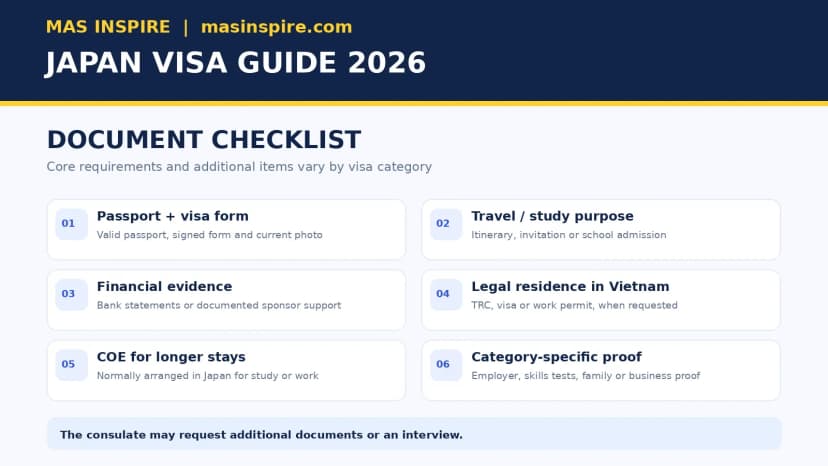
No single fixed number of documents applies to all Japan visa applicants. Below, Core means commonly required for that visa type; Conditional means specific circumstances or the mission's personal checklist determine whether it is needed. Applicants should follow their consular mission's latest instructions.
Tourist and business short-stay checklist
| Document | Status | Notes |
|---|---|---|
| Valid passport | Core | Must meet applicable validity/blank-page instructions |
| Completed visa form and photograph | Core | Use current mission instructions |
| Day-by-day visit itinerary | Common core | Dates, purpose, cities and accommodation |
| Evidence of available finances | Common core | Bank/income evidence; no universal minimum |
| Travel and hotel reservations | As requested | Check whether provisional booking is acceptable |
| Employer letter / approved leave / business registration | Conditional | Shows current circumstances and purpose |
| Invitation, host or company documents | Conditional | Especially friend/family/business visits |
| Vietnam residence card, visa and work authorization | For residents where requested | Demonstrates lawful place of application |
| Civil documents, translations, other proof | Conditional | Follow personal checklist and consular rules |
Official: MOFA short-stay instructions.
Student visa and COE checklist
| Document | Status | Notes |
|---|---|---|
| Acceptance/admission from institution | Core for school/COE process | The school may require tuition deposit and admission records |
| COE or accepted electronic COE | Usually core for consular application | School often applies in Japan |
| Passport, form, photos | Core | Consular submission |
| Tuition and living-expense funding | Core for underlying eligibility | Sponsor bank/income/source evidence |
| Academic records and purpose statement | As requested | Supports genuine study plan |
| Vietnam legal-residence proof | Conditional by mission | Important for third-country applicants |
| Additional translations or verification | Conditional | Follow instructions exactly |
Official: Study in Japan: student immigration.
Work visa / SSW checklist
| Document | Status | Notes |
|---|---|---|
| Employer offer and contract | Usually core | Must match lawful residence status |
| COE or approved alternative | Usually core | Commonly arranged by employer in Japan |
| Passport, form, photos | Core | Consular requirements |
| Degree, experience and work references | Category-dependent | May be necessary for professional status |
| SSW language and skills-test evidence | For SSW applicants when required | Check sector and exemptions |
| Licences, professional registration or certifications | Occupation-dependent | Especially regulated/specialized duties |
| Vietnam legal-residence proof | Conditional | Check relevant consular jurisdiction |
Official: MOFA working visa, SSW steps.
Family, business and permanent-residence evidence
| Route | Main evidence | Additional checks |
|---|---|---|
| Spouse / family status | Marriage, birth, sponsor status, COE and support | Authenticity, financial ability and eligibility |
| Business Manager | Company plans and registration, business premises, funds, staff and language proof | New 2025 regulations, transition rules and local guidance |
| Digital Nomad | Eligible nationality, annual income and medical insurance documents | Not open to all foreign passports |
| Permanent Resident | Residence history, taxes, pension/insurance, employment/family evidence | Application made to ISA in Japan and current eligibility rules |
How to apply: step by step
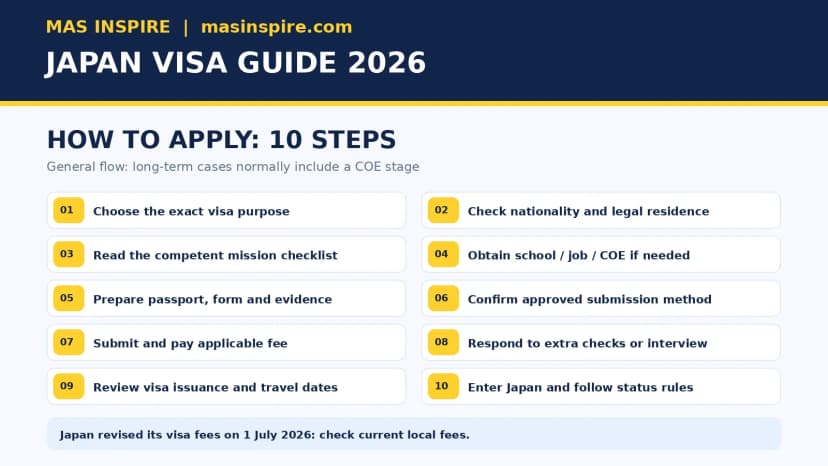
- Define your actual purpose. Tourism, business meetings, longer education, employment and family residence require distinct documents and statuses.
- Check nationality and residence. Use MOFA's visa-exemption list; check the competent mission in Hanoi, Ho Chi Minh City or Da Nang if you legally live in Vietnam.
- Read your category's official checklist. Pakistani applicants should not substitute the Vietnamese-national short-stay checklist for one designed for foreign passport holders.
- Obtain admission, employer support and/or COE where applicable. Most long-term work or student applications require this advance stage through ISA in Japan.
- Prepare verified documents. Passport, prescribed form and photo, purpose, finances, Vietnamese residence evidence and any translations or host documents.
- Confirm the approved submission channel. Depending on location, application may be taken by the mission, authorized centre or accredited agency; eVISA is limited to specific applicants and purposes.
- Submit the application. Follow the appointment or agency instructions and pay applicable local consular or handling fees under official rules.
- Respond to additional checks. Interview, extra documents and further verification may be required; not everyone has biometrics or an interview step.
- Collect the decision. Confirm your identity, visa details, expected date of travel and conditions. A COE and a visa never guarantee entry.
- Travel and comply. Present required documents to immigration. Longer-term residents must comply with residence-card, address registration and work/study conditions.
Official: MOFA visa FAQ and application methods; visa application procedures; student COE and entry.
Official visa fees and financial requirements
Very important 2026 fee change: The Ministry of Foreign Affairs amended general visa-issuance fees effective 1 July 2026. Older figures of JPY 3,000 (single) and JPY 6,000 (multiple) relate to applications received on or before 30 June 2026; they should not be displayed as current late-2026 standard rates.
| Fee type | Current official figure or rule | Source / important note |
|---|---|---|
| General single-entry visa | Approximately JPY 15,000 | Applications accepted on or after 1 July 2026 |
| General multiple-entry visa | Approximately JPY 30,000 | Nationality and category exemptions may apply |
| Ordinary single-entry visa application in Vietnam | VND 2,590,000 | Embassy schedule for 1 July 2026–31 March 2027 |
| Ordinary double/multiple-entry in Vietnam | VND 5,170,000 | Same embassy schedule |
| Agency handling or service fee | Varies | Extra if submitted through an approved agency |
| Transit visa issuance fee | Confirm with mission | Do not rely on older superseded national fee table |
| COE preparation, school tuition, travel and insurance | Separate from visa-issuance fee | Depends on category/provider |
MOFA advises fees are generally collected in the currency of the issuing country/region; fees can differ or be waived for certain passports and purposes. MOFA says no visa-issuance fee is charged if a visa is not issued, although authorized service costs may still apply. Sources: MOFA fees since July 2026 and Japanese Embassy Vietnam 2026 fee table.
Money and bank statements: No single official universal yen balance applies to every tourist or student. Tourist applicants should be able to pay for their itinerary; a university or school may require financial documentation for tuition and living costs before the COE; business and digital-nomad categories have their own qualifying funds or investment figures. Do not copy minimum amounts from unrelated visa types. Sources: JASSO student financial proof, MOFA short stay, digital nomad.
Visa processing times and validity
MOFA describes the standard consular examination period as five working days after application acceptance when no issue arises. Additional verification, a request for more documents, a high volume of cases or a long-stay application without a COE may extend this to weeks or months. Five working days is not a guarantee, and time needed to obtain a COE is a separate stage. Applicants should not buy irreversible travel arrangements merely because they expect a decision in five days.
A normal single-entry visa is basically valid for three months from issuance for entry; permitted time in Japan and conditions of stay are separate from that entry validity. Different visa/status categories have different periods. Check the actual issued visa and landing permission. Official: MOFA FAQ, processing and validity and processing time.
Pakistani passport holders applying from Vietnam
A person holding an ordinary Pakistani passport is generally required to obtain a Japanese visa for a short tourist visit. Vietnamese residence or a Vietnam temporary residence card does not make the traveller visa-exempt. For most visa purposes, MOFA says a person may apply in their country of nationality or country of residence, not simply while visiting an unrelated third country. Check the consular district that covers your actual lawful residence.
A Pakistani who legally lives in Vietnam should:
- Check their Vietnam residence status, its validity and whether the Japanese mission requires a TRC, work permit, Vietnam visa or other lawful-residence proof.
- Check the relevant Japanese mission: Embassy of Japan in Vietnam, Hanoi, Consulate General in Ho Chi Minh City, or Consulate General in Da Nang. Their jurisdictions and current acceptance rules determine the correct submission point.
- Use the non-Vietnamese-national instructions linked by the embassy or the MOFA short-stay application guidance, rather than assuming every requirement for Vietnamese citizens is identical.
- For tourism, prepare genuine financial records, passport, form, photo, itinerary, appropriate reservations and evidence of ties to the country of residence when requested. A signed employer leave letter and salary records may help where relevant but are not universally mandatory.
- For study or work, obtain school admission or employer arrangements and, in typical cases, a COE before a consular visa submission.
- Do not rely on the eVISA packaged-tour arrangement for Vietnam: that specific route described by MOFA covers Vietnamese nationals residing in Vietnam who meet its tour rules, not every foreign resident of Vietnam.
- Pay the applicable Vietnam-local fee and any properly disclosed approved service fee. Check the official 2026–27 fee schedule before attending.
Difference between Pakistan and Vietnam: Pakistani nationality drives the visa requirement; your legal country of residence and consular jurisdiction determine which Japanese overseas establishment normally accepts the application, and whether local evidence must be provided. A visa application submitted in Vietnam is not automatically assessed under the rules for Vietnamese passport holders. No local application guarantees approval.
Official: MOFA visa FAQ: where to apply, Embassy visa guidance in Vietnam, eVISA limitations, local fees.
Student visa guide
Step 1: Choose a credible institution and program. Compare university admission, vocational education and recognized Japanese-language study. Check whether the qualification relates realistically to your educational plan and career.
Step 2: Confirm school requirements and costs. Admission dates, language evidence and tuition vary. Use Study in Japan official academic fees and living-cost information to budget.
Step 3: Prepare financial support. You may need original or official sponsor bank and income records, documented source of funds and a credible explanation of how your study will be funded. The institution may request extra information for COE application.
Step 4: Obtain COE through school or other authorized proxy. The school usually applies to Japanese immigration. A COE is not a visa but ordinarily assists the next application stage.
Step 5: Apply for the correct visa. Prepare passport, visa form, photo, COE or approved electronic equivalent and any Vietnam-local documents.
Step 6: Observe work restrictions and resident obligations after entry. Part-time work needs the appropriate authorization. The standard limit is generally 28 hours weekly during normal study periods. Students should not fund a full-time study plan solely by assuming they can work full-time.
For scholarships, check the official Study in Japan scholarship directory and Japanese mission announcements about MEXT, JASSO and other grants; each has its own eligibility and application calendar.
Work visas and job opportunities
For professional work, begin with the job description, the employer and the specific residence status. A relevant degree, proven experience and an offer meeting Japanese immigration requirements may support certain professional categories, but eligibility varies by duties and employer. Foreign-trained teachers should investigate the distinction between school-based Instructor roles and private-language-teaching positions that may fall under Engineer/Specialist in Humanities/International Services. The correct classification is determined from the actual employment details, not merely the word "teacher".
For SSW, identify a field that accepts foreign workers, review official skills/language test rules and secure a legitimate employer. For highly skilled routes, use published category and criteria rather than advertising automatic acceptance. J-Find is restricted to eligible graduates from selected institutions and is not a general substitute for obtaining an employer.
Employment precautions: never pay anyone for a fake COE; verify the employer and contract; confirm whether placement fees are permitted and disclosed; read the pay, housing, deductions, leave and working conditions; and avoid entering as a tourist with the intention of unlawfully working. Official: MOFA working visas, SSW portal, ISA categories.
Family, permanent residence and citizenship
Qualifying spouses, children and dependents may have immigration paths based on a family member's Japanese nationality or residence status. Different categories allow different activities and work rights. A family applicant typically needs genuine relationship and sponsor documents, not merely an invitation. For longer-term family entry, a COE is commonly used.
Permanent residence is handled by Japanese immigration authorities for applicants who meet the applicable long-term or exception-based requirements. Japan's ISA updated guidance during 2026; public payments, residence history, conduct, livelihood and compliance may matter. A residence card, a five-year work status or marriage is not an automatic grant of PR. Citizenship/naturalization is a separate legal process with different authorities and conditions; this visa overview does not claim automatic citizenship after any number of years.
Official: MOFA long-stay categories, ISA permanent residence, 2026 ISA guideline update.
Common mistakes and visa refusals
Problems include submitting the wrong short-stay purpose, claiming eVISA eligibility in an ineligible country, incomplete forms, falsified financial evidence, inconsistent itineraries, unexplained sponsorship, unclear education or employment intentions, using old visa fees, and confusing a COE with a visa. A long-term applicant should not omit material information or assume their sponsor can guarantee approval.
MOFA notes that when an applicant is refused a visa for a specific purpose, an application for the same purpose is usually not accepted within six months, subject to limited exceptions for materially changed circumstances or humanitarian necessity. MOFA generally does not provide individual detailed refusal reasons. Always use truthful documents, read the specific decision instructions and ask the competent mission before reapplying. Official: MOFA FAQ on refusals and reapplications.
Frequently asked questions
1. Do Pakistani passport holders need a visa for Japan?
Generally yes for ordinary passports and short tourism. Legal residence in Vietnam is not Japanese visa-free status. Check the current MOFA passport-specific exemption list before travel.
2. Can a Pakistani citizen apply from Vietnam?
Generally yes when genuinely living there legally, subject to the competent mission's requirements. MOFA normally directs applications to the applicant's nationality or residence country.
3. Can I apply for JAPAN eVISA as a Pakistani resident in Vietnam?
Do not assume so. MOFA's Vietnam eVISA agency pathway specifically describes Vietnamese citizens resident in Vietnam on designated packaged tours; other residence-country routes have their own rules.
4. What is the Japan tourist visa fee in November 2026?
Japan revised general fees on 1 July 2026. The general single-entry fee is approximately JPY 15,000. The Japanese Embassy in Vietnam lists VND 2,590,000 for an ordinary single-entry visa, subject to exemptions and service charges.
5. Is Japan's visa fee still JPY 3,000?
That is an older standard amount linked to pre-July-2026 applications, not the general new fee. Use MOFA's updated fee announcement.
6. How much bank balance is mandatory for a tourist visa?
Japan does not publish one fixed amount for every visitor worldwide. Financial evidence should reasonably cover the actual trip; the local mission can request additional records.
7. How long does it take to get a Japan visa?
MOFA describes five working days as a standard straightforward consular examination time after acceptance; other cases can take weeks or months. Obtaining a COE is separate.
8. Can I work with a Japan tourist visa?
Ordinary paid employment in Japan is not authorized under Temporary Visitor status. Work requires a matching authorized residence category or another applicable lawful permission.
9. Does Japan have a job-seeker visa?
Not a general one. J-Find permits some eligible overseas graduates to seek work or plan a business, while qualifying Japanese-institution graduates may have a separate continued-job-search status.
10. Is Japan's digital nomad visa available to Pakistani citizens?
The program has nationality restrictions tied to eligible countries, plus a JPY 10 million annual income and insurance requirements. An ordinary Pakistani passport does not qualify through the required visa-exemption-country condition.
11. What is a COE?
A Certificate of Eligibility is an immigration assessment usually arranged in Japan before certain longer-stay visa applications. It is not itself the final entry visa and does not guarantee entry.
12. Can international students work part time?
Yes, if they first obtain the applicable permission. The typical limit is 28 hours a week during the term; separate vacation rules apply and violations can affect immigration status.
13. What is the language requirement for Specified Skilled Worker?
SSW (i) usually requires an accepted Japanese language test such as JFT-Basic or JLPT N4 or above, plus a qualifying occupational test. Check sector-specific rules and exemptions.
14. Can I get Japanese permanent residence after working there?
It may be possible if you meet the current ISA rules. The general route often requires long-term residence and good compliance, with various exceptions. It is never automatic.
15. What happens if Japan refuses my visa?
MOFA usually will not accept a new application for the same purpose within six months after a refusal, except in limited circumstances. Do not reapply with misleading or false evidence.
Official Japanese government websites
| Topic | Official website |
|---|---|
| Japan visa portal | Ministry of Foreign Affairs (MOFA) |
| Visa application FAQ, eligibility and timing | MOFA visa FAQ |
| Current fees from 1 July 2026 | MOFA fee revision |
| Visa-exempt countries | MOFA short-stay exemptions |
| Short-stay applications | MOFA foreign-nationals guidance |
| Electronic tourist visas | MOFA eVISA rules |
| Work and long-stay categories | MOFA long stay |
| Immigration agency and residence | Immigration Services Agency |
| Specified Skilled Worker | Official SSW support |
| Student visa and COE | JASSO Study in Japan |
| Japanese Embassy in Vietnam | Hanoi embassy visa information |
| Japan Consulate-General in HCMC | Ho Chi Minh City consular visa page |
| Japan Consulate-General in Da Nang | Da Nang consular visa page |
| Vietnam consular fee table, July 2026–March 2027 | Japanese Embassy in Vietnam |
| Job-seeking program | ISA J-Find |
| Digital nomads | ISA Digital Nomad |
| Permanent residence | ISA PR procedure |
Final application checklist
- Choose a visa or residence category matching the true purpose of your visit.
- Check the latest Japanese visa rules against the passport you actually hold.
- Confirm which overseas Japanese mission can accept your application based on lawful residence.
- Prepare the relevant form, passport, photos, finances and specific supporting documents.
- Obtain admission, an employer/host and a COE before applying when your category requires them.
- Use only the approved embassy, consulate or accredited submission channel.
- Check the post-1 July 2026 visa fee and any authorized handling charges.
- Allow for extra examination time; avoid nonrefundable arrangements before approval.
- Read your visa/landing permission; do not assume a visitor may work or that a COE guarantees entry.
- Recheck all links and rules immediately before filing or publication.
MAS Inspire editorial note: Researched 24 November 2026. This document remains unpublished pending administrator review. Fees, working programs, immigration policy and local instructions must be checked with official authorities before the article is published or relied upon. © MAS Inspire — https://masinspire.com.