


Peru Visa Guide 2026: Types, Requirements, Documents and Application Steps
Last checked: 28 November 2026. This guide is for Pakistani passport holders living in Vietnam. Visa rules change without notice — always confirm the live rules on the Peruvian Foreign Ministry's gob.pe procedure page and with the Embassy of Peru in Hanoi before paying any fee or booking a non-refundable ticket.
Introduction
Peru is the country that makes a long-haul trip from Vietnam feel worth every hour in the air. Lima is a Pacific city of cliff-top parks, ceviche counters and world-ranked restaurants; an hour's flight inland sits Cusco at 3,400 metres, the old Inca capital and gateway to Machu Picchu; and beyond the Andes lies the Amazon around Iquitos and Puerto Maldonado. For a Pakistani living in Ho Chi Minh City, Peru is also a practical destination: it is one of the few South American countries with a resident embassy in Hanoi, it runs a modern online filing system, and its tourist visa is one of the cheapest in the world at thirty US dollars. The catch is that the visa is not optional, not obtainable on arrival, and not something you can sort out at the airport. You need it in your passport before you leave Vietnam.
Three facts shape the whole guide. First, two institutions run Peru's immigration system with different jobs: the Ministry of Foreign Affairs publishes the visa rules and runs the consulates abroad, while the Superintendencia Nacional de Migraciones — Migraciones — controls entry at the border and every procedure once you are inside Peru. A visa gets you to the border; Migraciones decides how many days you actually get. Second, Peru changed its system in 2026: on 24 August 2026 the Foreign Ministry launched e-SAMI, the Integrated Migration Administration System, with an electronic visa — but the first phase covered diplomatic, official and consular categories, not ordinary tourists, and the tourist procedure on gob.pe is an online pre-filing that still ends at a consulate. Third, the fee is small but the consequences of getting the route wrong are not: the official tourist-visa fee is US$30, the payment is non-refundable even if you are refused, and since August 2026 the Hanoi embassy has required the fee to be paid before an application is even submitted.
Do Pakistani Passport Holders Need a Visa for Peru?
Yes. Every holder of an ordinary Pakistani passport needs a visa before travelling to Peru. Pakistan is not on Peru's visa-free list. The Foreign Ministry's official table of visa requirements and exemptions lists 104 countries and territories whose citizens can visit Peru without a visa, most for up to 90 days, and 94 nationalities that need a visa. Pakistan is in the second group, alongside India, China and Nigeria. The Wikipedia summary of Peru's visa policy says the same in one line: visitors must obtain a visa from a Peruvian diplomatic mission unless they are citizens of a visa-exempt country. There is no visa on arrival for Peru at all — not for Pakistanis, and not for anyone. If a travel agent offers you a Peruvian visa on arrival, walk away: the product does not exist.
The rule follows your passport, not where you live. Living in Vietnam, holding a Vietnamese temporary residence card (TRC), holding a US, UK or Schengen visa, or having lived in the Gulf does not remove the visa requirement. Peru does grant a visa exemption to some nationals who would otherwise need a visa if they hold a visa or permanent residence from the United States, Canada, the United Kingdom, Australia or a Schengen state — but that concession applies only to Chinese and Indian nationals, under Supreme Decrees 069-2016-RE and 006-2017-RE. It does not apply to Pakistanis. The one exemption that does cover Pakistanis is permanent residence in Chile, Colombia or Mexico, under the Pacific Alliance's Supreme Decree 061-2016-RE. Unless you hold that status, you need a consular tourist visa, applied for before travel.
The Foreign Ministry's gob.pe procedure page states the rule plainly: if you require a visa based on your country of origin, you must apply for a tourist visa at the Peruvian consular offices in the country where you are located. For you, that means the Embassy of Peru in Hanoi, with the Beijing question examined in the Vietnam section below. The passport rule is not in dispute. The FCDO states that to enter Peru your passport must have an expiry date at least six months after the date you arrive, and that you will be denied entry without a valid travel document. The US State Department says the same, and adds that Migraciones may require evidence of return or onward travel. The State Department asks for one blank page for the entry stamp; several Pakistan-focused guides ask for two. Treat the difference as a safety margin: renew your passport before you apply if it is anywhere near the six-month limit or short of blank pages.
e-SAMI and the Electronic Visa: What Changed in August 2026
On 24 August 2026, at the Torre Tagle Palace in Lima, Peru's Foreign Minister launched e-SAMI — the Sistema de Administración Migratoria Integral, or Integrated Migration Administration System — together with a new electronic visa and an emergency passport for Peruvians abroad. The platform was built with support from the Inter-American Development Bank and is designed to replace the old SAM system across Peru's whole consular network, region by region. You need to understand exactly what it does for a tourist, because the launch announcements are easy to misread in both directions: it is neither a full tourist e-visa you can buy online in an afternoon, nor a press release with no practical effect.
What e-SAMI is. It is the Foreign Ministry's unified online platform for consular migration procedures. The tourist-visa procedure published on gob.pe is now an online procedure through e-SAMI, at aplicaciones.rree.gob.pe. The steps are: pay the US$30 application fee; register as a user on e-SAMI and verify your email with the code the platform sends you; log in with the username and temporary password the platform issues, change the password, and log in again; select "New Application" and complete every section of the form, uploading the required documents including an image of the proof of payment; save and submit; and wait for the consular office to review the file and send its decision to your registered email address. The Embassy of Peru in Vietnam posted the Foreign Ministry's e-SAMI user manual on its Facebook page on 26 August 2026.
What e-SAMI is not — yet. The electronic visa launched in August 2026 is not the same thing as e-SAMI, and the distinction matters. At the July 2026 presentation, the Foreign Ministry said the first phase would allow electronic visas for the diplomatic, official and consular categories, in temporary or resident status. As of 25 August 2026, no official source announced a general opening of the electronic visa to ordinary tourists, and no timetable was published. Several consulates have already started directing tourist and business applicants to create e-SAMI accounts and file digitally — so you will almost certainly file through e-SAMI — but a fully electronic tourist visa, issued without any in-person step, is not confirmed for your category. The gob.pe page is explicit that the consul may request a personal interview or additional documentation.
Two practical consequences follow. First, the fee is paid before the application is submitted, not after approval: the gob.pe procedure lists payment as a step that precedes registration of the application, and requires an image of the proof of payment to be uploaded with the file. The Embassy of Peru in Vietnam made the same point in its own notice of 14 August 2026: all visa applications must include prior payment of the corresponding consular fee as a mandatory requirement for submission, payment does not guarantee approval, and it is non-refundable if denied. Second, filing online does not guarantee approval: each application is individually assessed by the Peruvian consul. Do not book a non-refundable ticket before the visa is in your hand.

Types of Peru Visas for Pakistani Passport Holders
Peru organises every stay around a named calidad migratoria — an immigration status — and the consulate issues the visa that matches the status you are asking for. Tourist, business and transit visas are applied for at the consulate abroad; work, study and other residence categories are applied for at the consulate and then regularised with Migraciones after arrival.
Tourist visa (Visa de Turista)
The standard short-stay visa for recreation, sightseeing, visiting family and friends, and health or similar tourist purposes. It allows multiple entries and a stay of up to 183 calendar days in total, in a single continuous visit or across several consecutive visits, within 12 months from the date the visa is issued. The exact stay authorised on each entry is decided by the Migraciones officer at the border; in practice visitors are usually granted up to 90 days per entry — the 183 days is a legal ceiling, not an entitlement. A tourist visa does not permit work or any paid activity, and it cannot be extended for most nationalities.
Business visa (Visa de Negocios)
For meetings, negotiations, conferences, prospecting and contacts with Peruvian companies. The business visa is a separate category from the tourist visa in the Foreign Ministry's table: several nationalities that are visa-exempt for tourism still need a visa for business. For a Pakistani applicant the practical difference is documentation — a business application needs an invitation letter from the Peruvian company — and the fee is reported as the same 30 soles consulares as the tourist visa. A business visa does not allow employment in Peru.
Transit visa
For passing through Peru to a third country. The transit visa exists as a consular category, and one 2026 guide reports its fee as US$25 or the equivalent — a reported figure, not one confirmed on an official Peruvian page found for this guide. Whether you need a transit visa for a straightforward airside connection through Lima is not settled by any official source found for this guide; ask the airline and the Hanoi embassy before you book.
Temporary and resident visas
Peru's longer-stay system splits into temporary statuses (up to 3, 6 or 12 months) and resident statuses. The resident statuses confirmed by Migraciones include trabajador (worker), familiar de residente (family of a resident), formación (education), investigación (research), inversionista (investor), rentista (income or retirement), religioso (religious worker), designado (designated) and permanente (permanent resident). Temporary statuses include trabajador temporal, formación temporal, investigación temporal, artística o deportiva, turismo and acuerdos internacionales.
Student visa (Formación)
For studies at a Peruvian institution, under the formación resident status or the formación temporal temporary status for short courses, internships and exchanges. The institution sponsors the application, built around the acceptance letter, proof of funds and academic records. Apply at the consulate before travel; after arrival you regularise the status with Migraciones and receive a Carné de Extranjería, the foreign-resident identity card.
| Visa type | Typical stay | Entries | Where to apply | Can it be extended? |
|---|---|---|---|---|
| Tourist visa | Up to 183 days/12 months; usually 90/entry | Multiple | e-SAMI + Hanoi embassy | No, for most nationalities |
| Business visa | As authorised | As issued | e-SAMI + Hanoi embassy | No |
| Transit visa | Short transit | As issued | Consulate before travel | No |
| Temporary worker | Up to 183 days in 365 | As issued | Consulate, then Migraciones | Through Migraciones |
| Resident worker (Trabajador) | 365 days, renewable | Multiple | Consulate, then Migraciones | Renewable annually |
| Student (Formación) | Set by course and status | As issued | Consulate + institution | Through the institution |
| Rentista (income/retirement) | Resident status, renewable | Multiple | Consulate, then Migraciones | Renewable |
| Permanent resident | Open-ended | Multiple | After 3 years as a legal resident | Not applicable |
Visa Fees: The Official Figure and the Conflicting Ones
| Item | Figure reported | Source |
|---|---|---|
| Tourist visa | US$30.00 | Foreign Ministry, gob.pe procedure (official) |
| Tourist visa | 30 soles consulares, about US$30 | Beijing/Phoenix consular tariffs (Visarun; Nostos); Varioline |
| Tourist visa | About US$80 | VisaCross, Pakistan-to-Peru page, Jun 2026 |
| Tourist visa | US$50 (PKR 15,250) | VisaFromPakistan, Peru tourist visa page |
| Tourist visa, Hanoi | US$120 package fee | VietnamChrisTravel (Hanoi agency) — agency fee, not government fee |
| Business visa | 30 soles consulares | Reported by Passport Reports and Nostos |
| Transit visa | US$25 or equivalent | Passport Reports (2026) — reported, unconfirmed |
| Andean tourist-stay extension | S/17.70 (about US$5) | Migraciones TUPA fee (via Expat.com) — Andean nationals only |
| Overstay fine | S/5.50 per day (0.1% of one UIT) | Migration regulation; UIT S/5,500 for 2026 (DS 301-2025-EF) |
| Change of immigration status | Up to S/163.00 | Expat Focus (2025) — reported, unconfirmed |
| Rentista residence | S/58.80 from abroad / S/161.40 in-country | Migraciones TUPA fees (via Nostos) — reported |
| Lima international-connection TUUA | US$11.86 including VAT | Lima Airport Partners fee page, Sep 2026 (via WhyGoToPeru) |
| Lima international-connection TUUA | US$12.67 | Announced Oct 2025 (Layover Index; Fertur Travel) |
The controlling figure is US$30. The Foreign Ministry's gob.pe procedure page states the fee as "Pay the US$30.00 application fee, according to the applicable Consular Fee Schedule", and the same figure appears as 30 soles consulares on consular tariff pages in Beijing, Phoenix, Buenos Aires, Dallas and Switzerland. One consular sol is approximately one US dollar; the consulate will tell you what currency it collects and when. The US$80 figure on VisaCross is presented without a named official source and is best treated as an estimate that bundles the government fee with service margins; the US$50 figure on VisaFromPakistan is likewise an estimate, and the US$120 quoted on the Hanoi agency page is explicitly a package fee for an agency's service, not the fee the embassy charges. Budget US$30 for the visa itself — and confirm the bank account, the amount in dong if it collects in dong, and the payment reference with the consulate by email before you transfer anything.
Two warnings about money. First, the fee is non-refundable even if the visa is denied. The gob.pe page states it plainly — "Payment gives you the right to submit an application and does not guarantee its approval. The payment is non-refundable, even if the visa application is denied" — and the Hanoi embassy's notice says the same. Settle the eligibility question and the document list with the embassy before you pay, rather than after. Second, apply only through e-SAMI at aplicaciones.rree.gob.pe and the Hanoi embassy, never through a lookalike site: Peru has no separate tourist e-visa website.
The other figures in the table are real costs, but they are not visa fees. The overstay fine of S/5.50 per day is set by the migration regulation at 0.1% of the UIT, Peru's annually reset tax unit, which is S/5,500 for 2026 under Decreto Supremo 301-2025-EF — so a month of overstay costs S/165, about US$48, and the fine must be settled before you can board a flight out. The Andean extension fee of S/17.70 is real, but it is available only to citizens of Bolivia, Colombia and Ecuador. The Lima connection TUUA of US$11.86 including VAT is the airport operator's current listed fee for international-to-international connections at Jorge Chávez airport, in force since 7 December 2025; the US$12.67 figure is the amount announced when the fee was introduced — the airport operator's own page is the controlling source. The change-of-status and rentista figures are reported, not confirmed on a Migraciones page found for this guide.
Processing Times
Processing time is the one figure where the official sources are honest about not giving a deadline — and where the commercial sources disagree most. The gob.pe procedure does not state a decision deadline for a tourist visa at all. What it does state is a filing rule: apply at the Peruvian consular offices in the country where you are located, and the procedure pages summarised by Varioline and Passport Reports state that the application must be initiated at least 15 calendar days before the planned travel. That is a floor, not a promise.
The sources report: about 7 calendar days for a tourist visa after the interview, at the Phoenix consulate (Nostos); 7 to 10 working days after the personal interview, at the New Delhi embassy — but that is the timetable for Indian applicants, and Visarun warns explicitly that a Pakistani applicant should not use it to plan passport collection in Beijing, let alone in Hanoi; 14 to 30 business days (VisaCross); about 5 working days (Travel Visa Stack); and 10 to 20 business days (VisaFromPakistan). A Hanoi agency page reports processing of 15 days and longer. No single figure is authoritative; the range in circulation is roughly one week to six weeks, and the interview is the step that moves the timeline most.
Planning rule. Start at least six weeks before travel, and aim to have the e-SAMI file submitted a full month before your flight. That gives the consulate time to review the file, to call you for an interview, and to ask for a corrected document without the trip collapsing. The visa, once issued, allows stays of up to 183 days within 12 months from the date of issue, so applying early does not waste the visa. For work, study or residence categories, allow months rather than weeks.
Complete Document Checklists
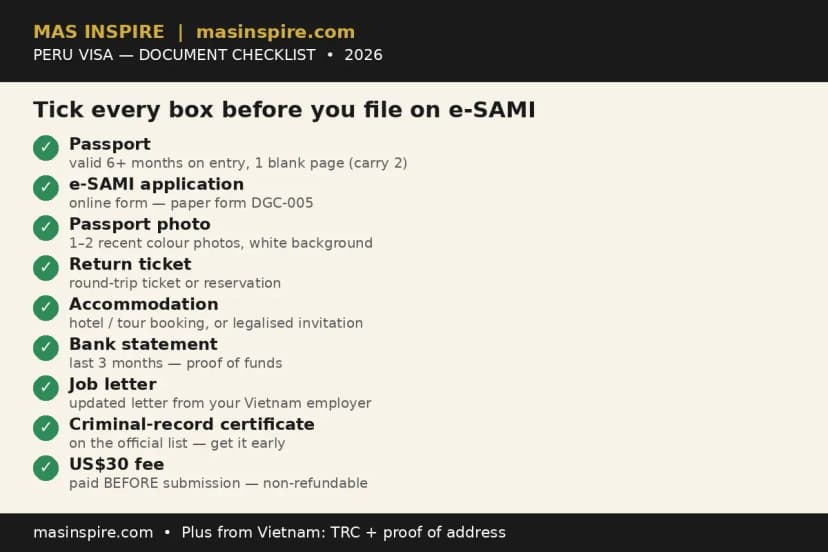
The list below follows the Foreign Ministry's gob.pe tourist-visa procedure, the controlling official list, supplemented by what individual consulates publish and by what the FCDO and the US State Department say border officers check on arrival. Individual consulates may ask for more, so the Hanoi embassy's list is the one that governs your application — confirm it by email before you travel to Hanoi.
Tourist visa — the official list (gob.pe)
- Valid passport — at least six months' validity on entry, in good condition, with at least one blank page (carry two to be safe: several Pakistan-focused guides ask for two)
- Completed visa application form — filed through e-SAMI; the paper form is Form DGC-005, completed and signed, with your name exactly as it appears on the passport
- One passport-size colour photograph — gob.pe lists one; several consulate pages ask for two, so bring two (white background, front-facing, no glasses)
- Round-trip ticket to Peru — ticket, electronic ticket or reservation
- Proof of accommodation — a hotel booking, a tour package booking, or an invitation letter legalised by the Peruvian Foreign Ministry
- Proof of financial solvency — a recent bank statement for the last 3 months; some consulates also ask for payslips or an employment contract
- Updated job letter — from your employer in Vietnam, confirming your job, your leave dates and your return to work
- Criminal / police record certificate — this is on the official gob.pe list and surprises many applicants, so obtain it early; a Pakistani police clearance may need time, and the consulate may ask for it to be legalised or apostilled
- Payment of the corresponding consular fee — US$30, paid before submission, with an image of the proof of payment uploaded to e-SAMI
Tourist visa — what to add from Vietnam
- Your Vietnamese temporary residence card (TRC) and proof of address in Vietnam — to show where you live and that you have a right to return
- Your Vietnamese work permit or employment contract, and recent payslips
- A covering note explaining your itinerary in plain language — Lima, Cusco, Machu Picchu, the Amazon if you are going — with dates, and a copy of everything you submit, kept for yourself
- Travel insurance for the trip — not listed as a required visa document, but strongly advisable given altitude, jungle travel and the cost of medical evacuation
- Yellow fever vaccination certificate (the yellow card) if you are visiting the Amazon — not required for entry to Peru, but recommended for jungle areas below 2,300 metres, and a certificate may be requested at some jungle entry points (see the health section)
Business visa
- Everything in the tourist checklist above, plus:
- An invitation letter from the Peruvian company, legalised by the Peruvian Foreign Ministry where required — the company will usually be asked for its business registration and tax details as well
- A letter from your own employer or business in Vietnam explaining the purpose of the trip and the meetings planned
Work visa — resident worker (Trabajador)
- Everything in the tourist checklist above, plus:
- A written, fixed-term employment contract with a Peruvian employer, registered with the Ministry of Labour under Legislative Decree 689 — the employer must stay inside the foreign-worker quotas (20% of headcount, 30% of the wage bill) and the contract must include an undertaking to train Peruvian staff
- The employer's prior registration of the worker in the state's SIVICE system before the migration filing
- Apostilled criminal-record certificate, plus an INTERPOL check done in Peru
- Academic and professional certificates, translated by a sworn translator where required
- Proof of accommodation in Peru
Student visa — education (Formación)
- Everything in the tourist checklist above, plus:
- Acceptance or enrolment letter from the Peruvian institution
- Proof of funds for tuition and living costs for the course
- Academic certificates and transcripts for your previous studies
- Police clearance certificate and medical certificate if the mission asks for them
Children travelling with you
- Each child needs their own passport, valid six months, with a blank page, and their own visa
- Birth certificate listing both parents
- If a child travels with one parent only, or with neither parent, carry a notarised parental consent letter — Peruvian immigration procedures for minors are strict, and the US State Department warns that they are complex for children travelling without one or both parents or legal guardians; officers may ask tourist families for the same documents in circumstances they consider suspicious
How to Apply: Step-by-Step
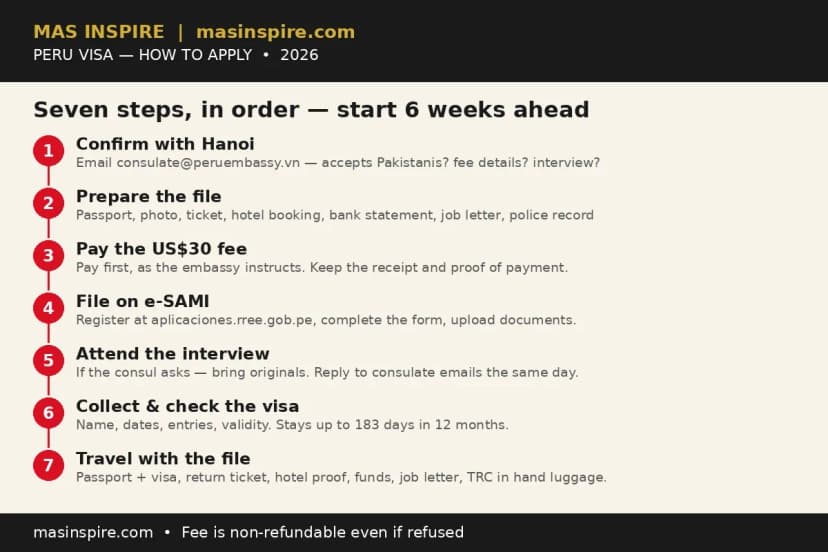
Step 1 — Confirm the office and the payment details with Hanoi. Email the Consular Section at consulate@peruembassy.vn (copy hanoi@peruembassy.vn) and confirm, in writing: that the mission accepts tourist-visa applications from Pakistani nationals resident in Vietnam; whether to file through e-SAMI, in person, or both; the bank account, amount and payment reference for the US$30 fee; whether an interview is required; and whether you need an appointment. Do not travel to Hanoi until you have this confirmation.
Step 2 — Prepare the file. Assemble the tourist checklist above, with originals and photocopies. Get your criminal-record certificate early — it is the document most likely to delay you, because it may need to be obtained from Pakistan and legalised. Ask your hotel or tour operator in Peru for the booking confirmation, and your employer in Vietnam for the updated job letter, while there is still time to correct them.
Step 3 — Pay the fee and keep the proof. Pay the US$30 fee exactly as the embassy instructed, and keep the receipt and a clear image of the proof of payment. You will need to upload that image to e-SAMI, and the consulate may ask for it again at the interview. Do not pay any agent a higher fee for a "Peruvian e-visa": the government fee is US$30, and Peru has no separate tourist e-visa website.
Step 4 — Register on e-SAMI and file the application. Go to aplicaciones.rree.gob.pe, select "Registrar usuario" (Register User), and verify your email with the code the platform sends you. Log in with the username and temporary password you receive, change the password, and log in again. Select "New Application", complete every section — personal data, travel information, contact in Peru, documents, payment methods — and upload the required documents, including the image of the proof of payment. When everything is complete, select "Save Application": the status changes to "Submitted" and the file goes to the Consular Office. If anything is missing, the application stays in "Draft".
Step 5 — Attend the interview if the consul asks for one. The consulate will review the file and send its decision and next-step instructions to your registered email address. The consul may request a personal interview or additional documentation. If an interview is called, attend the embassy in Hanoi with your original passport and every original document.
Step 6 — Collect the visa and check it. Check the name, passport number, dates, number of entries and validity on the visa before you leave the embassy. The visa allows stays of up to 183 days within 12 months from the date of issue, with the actual stay decided at the border.
Step 7 — Travel with the file. Carry the passport with the visa, your return ticket, your hotel booking or invitation, your proof of funds, your job letter and your TRC in your hand luggage for the arrival check at Lima. Airlines check the visa at boarding, and Migraciones officers at Jorge Chávez may ask for the supporting documents again.
Applying from Vietnam — the Embassy in Hanoi, and the Beijing Question
For a Pakistani living in Vietnam, the most useful fact in this guide is that Peru has a resident embassy in Hanoi — and the most confusing fact is that Pakistan is listed as part of the Beijing embassy's concurrent accreditation. Both facts are true, and they point in different directions.
The Hanoi embassy. Peru's embassy in Vietnam is at Suite 1402, 14th Floor, Cornerstone Building, 16 Phan Chu Trinh, Hoan Kiem District, Hanoi, telephone +84 24 3936 3082, fax +84 24 3936 3081, emails hanoi@peruembassy.vn and consulate@peruembassy.vn. That address is confirmed by multiple independent listings, by the embassy's own Facebook page (Embajada del Perú en Vietnam), and by Vietnamese guides that describe it as the only official agency that receives and processes visa applications for applicants in Vietnam. In August 2026 the embassy was actively posting the Foreign Ministry's e-SAMI user manual and a notice that all visa applications must include prior payment of the consular fee.
The Beijing question. The list of diplomatic missions of Peru records the Embassy of Peru in Beijing as concurrently accredited to Mongolia and Pakistan, and the list of Peruvian ambassadors records the ambassador in Beijing as concurrently accredited to Mongolia, Pakistan and North Korea. On that reading, Pakistan is in the Beijing embassy's consular district, and at least one 2026 guide (Visarun) says so explicitly. But the Foreign Ministry's own gob.pe procedure states the opposite rule for residence: you must apply at the Peruvian consular offices in the country where you are located. You are located in Vietnam, and Vietnam has a Peruvian embassy with a consular section. This guide's recommendation is to apply through Hanoi, and to put the question to the Hanoi embassy in writing in your first email: "I am a Pakistani passport holder legally resident in Vietnam. Does your consular section accept my tourist-visa application, or must I apply through Beijing?" A written answer from Hanoi settles the question.
Three cautions belong here. First, no published fee list or opening-hours page for the Hanoi embassy was found for this guide, and the embassy's website (peruembassy.vn) could not be verified as current — telephone and email the mission and confirm everything before you travel to Hanoi. Second, one older agency page (from around 2024) reported that the Hanoi embassy had temporarily suspended tourist-visa applications and was accepting business applications only. That report is old and comes from a commercial agency rather than the embassy, and the embassy's own August 2026 posts about visa applications and e-SAMI suggest applications are being taken — but it has not been possible to confirm from an official source that tourist applications from third-country nationals are currently accepted in Hanoi, so the question belongs in your first email, in writing. Third, do not rely on listings that show a Peruvian consulate in Ho Chi Minh City: one directory lists one at 30 Le Ngoc Han Street, Hai Ba Trung District, with a hotmail address — but Hai Ba Trung is a district of Hanoi, not of Ho Chi Minh City. No verified Peruvian consulate in Ho Chi Minh City was found for this guide.
Also useful from Vietnam: the Embassy of Pakistan in Hanoi is your own mission if anything goes wrong while you are applying or travelling. Keep your Vietnamese temporary residence card valid for the whole trip and carry it with your passport — it is your proof of the right to return to Vietnam.
| Mission | Address | Contact | Note |
|---|---|---|---|
| Embassy of Peru, Hanoi (nearest to you) | Suite 1402, 14th Floor, Cornerstone Building, 16 Phan Chu Trinh, Hoan Kiem District, Hanoi | Tel +84 24 3936 3082; fax +84 24 3936 3081; consulate@peruembassy.vn; hanoi@peruembassy.vn | Confirm it accepts tourist applications from Pakistani residents of Vietnam, and its fee payment details, before travelling to Hanoi |
| Embassy of Peru, Beijing | Sanlitun Diplomatic Compound 1-91, Beijing | Tel +86 10 6532 2976 | Concurrently accredited to Pakistan; use only if Hanoi directs you there |
| Embassy of Pakistan, Hanoi (your own mission) | Hanoi, Vietnam | Confirm before travel | Your mission if anything goes wrong while applying or travelling |
Exemptions, the Pacific Alliance and the Andean Community
Peru's visa system has three exemption routes that matter to this guide, and only one of them can help a Pakistani passport holder.
The Pacific Alliance exemption. Under Supreme Decree 061-2016-RE, part of the Pacific Alliance framework agreement between Chile, Colombia, Mexico and Peru, Peru exempts from the tourist-visa requirement the citizens of third countries that would otherwise need a visa, provided they can prove permanent residence in Chile, Colombia or Mexico. The exemption covers any visa-required nationality, expressly including Pakistani citizens. The qualifying status is permanent residence, not a visitor visa, an entry stamp, a temporary residence permit or a work visa. If you hold only temporary residence in one of those countries, or residence in any other country — including Vietnam — the exemption does not apply. Have the Peruvian consulate confirm that your nationality and residence document meet the conditions before departure.
The United States, Canada, United Kingdom, Australia and Schengen exemption. Peru exempts Chinese and Indian nationals from the tourist-visa (and business-visa) requirement if they hold a visa valid for at least six months from the United States, Canada, the United Kingdom, Australia or a Schengen state, or if they hold permanent residence in one of those countries. That concession is set out in Supreme Decrees 069-2016-RE (China) and 006-2017-RE (India), and the Foreign Ministry's exemption table lists China and India — and only China and India — in that category, with a stay of up to 180 days in 365. It does not extend to Pakistani nationals. A valid US visa, a UK visa, a Schengen visa or a US Green Card in a Pakistani passport does not exempt you from the Peruvian tourist visa. Morocco has a similar, narrower concession — a Schengen or US visa exempts Moroccan nationals — which is further proof that the concession is nationality-specific, not general.
The Andean Community and Mercosur — identity cards, not visas. Peru is a member of the Andean Community (Comunidad Andina) with Bolivia, Colombia and Ecuador, and is associated with Mercosur. Citizens of the Andean Community countries and of the Mercosur states can enter Peru with their national identity card instead of a passport, and the Andean Community nationals can also extend a tourist stay inside Peru, which other nationalities cannot. None of this applies to a Pakistani passport holder: you need a passport and a visa, and you cannot extend a tourist stay. The Andean angle matters to you in only one way: it explains why you will read that "tourist stays can be extended in Peru" — that is true, but only for Andean Community nationals.
Extending Your Stay and Overstay Rules
The general rule: a tourist stay cannot be extended. Peru's migration law, Legislative Decree 1350 as amended by Legislative Decree 1582 (2023), describes the tourist immigration status precisely: it allows only tourist, leisure, health or similar activities; it does not permit working or any paid activity; it allows multiple entries; and the stay period is 183 days, accumulable over a period of 365 days, and not extendable — no es prorrogable. The Foreign Ministry's gob.pe tourist-visa page says the same: the maximum period of stay is up to 183 calendar days, "without the possibility of extension", whether in a single continuous visit or multiple consecutive visits within 12 months from the date of issuance.
The apparent contradiction. The same gob.pe page adds, in the next line, that "you may request an extension of this period from the National Superintendence of Migration in Peru before the initial period expires." And several guides describe an extension procedure: citizens of the Andean Community (Bolivia, Colombia and Ecuador) may request an extension of their authorised stay online through Migraciones' Agencia Digital, of up to 90 additional days, provided the total stay does not exceed 180 days in the same year, for a fee of S/17.70 (about US$5). The reconciliation is that the extension procedure exists, but it is available only to Andean Community nationals. For a Pakistani passport holder, the governing rule is the one in the migration law: the tourist status is not extendable.
The cleanest way to stay longer is to use the full 183 days properly. If you know you want a long stay, say so in the application and in the interview, and ask the officer at the border for the full period you need — officers commonly grant 90 days per entry. You can also leave and re-enter, since the tourist visa allows multiple entries, but the days accumulate against the same 183-day budget in 365 days, so a second entry does not reset the clock. If you need to remain in Peru beyond the tourist period for work, study or another purpose, the route is a change of immigration status (cambio de calidad migratoria) through Migraciones' Agencia Digital, applied for while you are still in regular status.
Overstay. If you remain in Peru after your authorised stay expires without an active immigration procedure protecting your status, you incur a fine of 0.1% of the Unidad Impositiva Tributaria (UIT) for each day of excess stay, payable before departure — you cannot board a flight out until it is settled. The UIT is S/5,500 for 2026, fixed by Decreto Supremo 301-2025-EF, so the fine is S/5.50 (about US$1.60) per day: S/55 for ten days, S/165 (about US$48) for a month, S/495 for ninety days. The fine itself is small; the record is not. The FCDO warns that if you overstay you will get a fine and you could be detained, and the migration regulation gives a person whose temporary stay has expired 30 calendar days to regularise their status — after which the consequences escalate to detention, deportation and difficulty with every future visa application. Do not overstay, even by a day. Check your authorised stay on Migraciones' free consultation page, cel.migraciones.gob.pe: your TAM Virtual is generated automatically at the airport, and passports are no longer stamped on international flights.
Work and Study Routes
Step one — the labour contract. Your Peruvian employer must offer you a written, fixed-term employment contract, registered with the Ministry of Labour and Employment Promotion under Legislative Decree 689. The employer must stay inside the foreign-worker quotas: foreign staff may be no more than 20% of total headcount and no more than 30% of the total wage bill. The contract must include an undertaking to train Peruvian staff in the same occupation, and the employer must register you in the state's SIVICE system before the migration filing. There are exemptions from the quotas, including for foreign nationals married to a Peruvian or with Peruvian children or parents, and for specialised professional and management roles under an exoneration granted by the labour authority. The step is frequently the most time-intensive part of the whole process, so allow months for it.
Step two — the resident worker status. With the contract in place, you apply for the trabajador resident status — the resident work visa — through the consulate abroad, and then regularise it with Migraciones after arrival, receiving a Carné de Extranjería, the foreign-resident identity card. The status lasts 365 days and is renewed annually through Migraciones' Agencia Virtual; the underlying labour contract may run up to three years and be renewed for equal periods. A temporary worker status (trabajador temporal) also exists for shorter engagements, allowing foreign nationals to work in Peru for up to 183 days within a 365-day period. After three years as a legal resident you may apply to change to the permanente status, which is open-ended and carries a Carné de Extranjería valid for five years — provided that in those three years you were not outside Peru for three continuous months, or six alternating months in any one year. Change-of-status fees are reported at up to S/163.00 — confirm on the Migraciones TUPA schedule.
Study. The route is simpler but still status-based: get accepted by a Peruvian institution, which sponsors the formación resident status (or formación temporal for short courses, internships and exchanges). Apply at the consulate in Hanoi with the acceptance letter, proof of funds for tuition and living costs, and your academic records. There is no published student-visa fee for this guide to quote — the consulate's fee is the one that counts. Foreign documents must carry an apostille or be legalised; any document in a language other than Spanish must be translated by an official sworn translator (traductor juramentado).
Other residence routes, and one that does not exist yet. The rentista status is for people with a permanent income from abroad: the income threshold reported for it is approximately US$1,000 per month, and the Migraciones TUPA fees reported for it are S/58.80 when requested from abroad or S/161.40 as a change of status inside Peru — both reported figures, to be confirmed on the TUPA schedule. The inversionista status is for investors, familiar de residente for the family of a resident, and investigación for researchers. Peru also legislated a digital-nomad status in Legislative Decree 1582 (November 2023), allowing up to 365 days of remote work for a foreign-domiciled employer — but it has not been brought into operation: the implementing procedure and TUPA entry had still not been published as of mid-2026, so there is no procedure to apply under.
Transit, Flights and Money: Practical Notes
Flights. There is no direct flight from Vietnam to Peru, and none from Pakistan either. The realistic corridors from Ho Chi Minh City are via Doha (Qatar Airways), Dubai (Emirates) or Istanbul (Turkish Airlines), connecting onward through a South American or European hub — commonly São Paulo, Bogotá or Madrid — to Lima's Jorge Chávez International Airport (LIM). Book the whole journey on one ticket where you can, and leave a generous connection time. Avoid routings through the United States unless you already hold a US visa: a Pakistani passport holder transiting the United States needs a US transit visa even for an airside connection.
Transit through Lima. If Lima is only a connection point on your way to a third country, two things apply. First, the transit visa: Peru has a transit-visa category, reported at a fee of US$25 or the equivalent, but no official source found for this guide states whether a Pakistani passport holder needs a transit visa for a straightforward airside connection through Lima. Ask the airline and the Hanoi embassy before you book, and get the answer in writing. Second, the airport fee: since 7 December 2025, passengers connecting internationally through Lima pay an international-connection TUUA (Tarifa Única por Uso de Aeropuerto) of US$11.86 including VAT, listed on Lima Airport Partners' fee page and checked in September 2026. The FCDO notes that the fee is not currently included in airline tickets and encourages travellers to pay in advance via the Lima Airport online platform (pagotuua.lima-airport.com) or at on-site payment points. The US$12.67 figure in older coverage is the amount announced when the fee was introduced; the airport operator's current page lists US$11.86. If you connect from an international flight to a domestic flight — for example Lima to Cusco — you collect your bags, clear immigration and customs, and check in again, so allow at least three hours.
Money. The currency is the Peruvian sol (PEN), at roughly 3.4 to 3.5 soles to the US dollar in late 2026 — the rate that turns the S/5.50 overstay fine into about US$1.60. US dollars in cash are widely useful in Lima and Cusco, and the consular fee is priced in dollars, but carry soles for taxis, markets and smaller towns. There is no published minimum bank balance for the tourist visa: the consulate asks for a recent bank statement for the last three months, and several Pakistan-focused guides suggest showing funds of roughly US$50 to US$100 per day of stay — a reported benchmark, not an official minimum. Cash declarations matter at the border: the US State Department states that more than US$10,000 in cash or negotiable instruments must be declared on entry and on exit, and that carrying more than US$30,000 is prohibited. ATMs outside the main tourist towns can be unreliable, so do not land with no cash.
Safety, Health and Arrival Checks
Security. The US State Department rated Peru at Level 2 ("Exercise Increased Caution") as of September 2026, and the FCDO advises against all but essential travel to two remote areas: the VRAEM — the valleys of the Apurímac, Ene and Mantaro rivers, a remote jungle area in central-southern Peru — and a strip within 20 kilometres south of the Putumayo River on the Colombian border in Loreto, with exceptions for the Amazon River itself and the triple-border area from Caballococha to Santa Rosa de Yavari. There are no areas of Peru where the FCDO advises against all travel. Crime is common in Peru, according to the State Department: petty theft, carjackings, muggings and assaults happen even in daylight, express kidnappings occur, though rarely, and the risk of crime increases at night. The FCDO warns specifically about fake taxi drivers and advises using licensed app or phone taxis, asking your hotel to book one, and never hailing a taxi on the street, especially at night. Demonstrations occur regularly and can shut down roads, trains and highways without warning, including routes to the airport and to Machu Picchu — read the current FCDO and State Department pages before you travel.
Health — altitude first. The most likely health problem on a Peru trip is not a tropical disease but altitude. Cusco sits at 3,400 metres, Lake Titicaca near 3,800 metres, and Machu Picchu at 2,430 metres. Altitude sickness (soroche) is a serious risk: ascend gradually, rest on the first day, drink water, eat lightly, avoid alcohol, and consider spending a night in the Sacred Valley (around 2,800 metres) before going up to Cusco. Coca tea is offered everywhere as a remedy, but the US State Department warns that US travellers should not consume coca products, which are a controlled substance — and you should not carry coca leaves or coca tea out of Peru, which is illegal. Travel insurance is not listed as a required visa document, but medical facilities outside Lima are basic and medical evacuation is expensive — buy a policy that covers medical evacuation before you travel.
Health — yellow fever and the Amazon. Peru does not require a yellow fever vaccination certificate for entry. The US CDC and the World Health Organization both list no yellow-fever certificate requirement for entry to Peru, and the FCDO directs travellers to TravelHealthPro for the detail. But the CDC recommends the vaccine for travellers aged nine months and older visiting areas below 2,300 metres (7,550 feet) in the regions of Amazonas, Cusco (jungle areas), Huánuco, Junín, Loreto, Madre de Dios, Pasco, Puno (jungle areas), San Martín and Ucayali — which covers Iquitos, Puerto Maldonado, Tambopata and Manu National Park. It does not recommend the vaccine for Lima, Cusco city, the Inca Trail, Machu Picchu or areas above 2,300 metres. If you are going to the Amazon, get the vaccine at least ten days before you enter the risk area — that is when the International Certificate of Vaccination (the yellow card) becomes valid — and carry the certificate with your passport, because a certificate may be requested at some entry points to jungle areas. Malaria prophylaxis is recommended by the CDC for areas below 2,500 metres east of the Andes, including Iquitos and Puerto Maldonado; dengue cases in Peru in 2026 were more than double those in 2025, so pack strong insect repellent.
Arrival checks. At Jorge Chávez International Airport in Lima, your entry is registered digitally through the Tarjeta Andina de Migración (TAM), the virtual immigration control document — there is no paper form and passports are no longer stamped on international flights. Expect to show your passport with the visa, your return or onward ticket, your hotel booking or invitation letter, and your proof of funds. The Migraciones officer makes the final decision in every case, whatever document you hold, and decides how many days you are authorised to stay — normally up to 90 days, with a maximum of 183 days in a 365-day period. Check the stay you were granted on Migraciones' consultation page, cel.migraciones.gob.pe, before you leave the airport: that number, not the 183-day maximum, is the number you are bound by. If you enter Peru by land from a neighbouring country, make sure you get a passport entry stamp at the immigration checkpoint — you cannot leave Peru without one. Declare cash over US$10,000, and remember the customs rules: you can bring one laptop and two mobile phones duty-free, and it is illegal to take archaeological artefacts, or souvenirs made from wild animal parts including condor feathers, out of Peru.
Frequently Asked Questions
1. Do Pakistani citizens need a visa for Peru?
Yes. Ordinary Pakistani passports need a visa before travel. Pakistan is not on Peru's visa-free list — the Foreign Ministry's table lists 104 visa-exempt countries and 94 nationalities that need a visa, and Pakistan is in the second group. There is no visa on arrival for Peru at all. The rule follows your passport, not where you live.
2. Where do I apply for a Peru visa if I live in Vietnam?
At the Embassy of Peru in Hanoi — Suite 1402, 14th Floor, Cornerstone Building, 16 Phan Chu Trinh, Hoan Kiem District, Hanoi, telephone +84 24 3936 3082, emails consulate@peruembassy.vn and hanoi@peruembassy.vn — filing through the e-SAMI online platform. The Foreign Ministry's rule is to apply at the consular office in the country where you are located. Pakistan is listed under the Beijing embassy's concurrent accreditation, so confirm with Hanoi in writing that it accepts your application.
3. How much does a Peru tourist visa cost?
US$30. That is the fee stated on the Foreign Ministry's own gob.pe procedure page, and the same figure appears as 30 soles consulares (about US$30) on consular tariff pages in Beijing, Phoenix, Buenos Aires, Dallas and Switzerland. Other figures circulate — about US$80 on VisaCross, US$50 on VisaFromPakistan, and a US$120 agency package fee in Hanoi — but those are estimates or agency charges, not the government fee. The fee is paid before submission and is non-refundable even if you are refused.
4. Can I apply for a Peru visa online through e-SAMI?
Partly. Peru launched e-SAMI, the Integrated Migration Administration System, on 24 August 2026, and the gob.pe tourist-visa procedure is an online procedure through e-SAMI at aplicaciones.rree.gob.pe: register, verify your email, complete the form, upload your documents including proof of payment, and submit. But the electronic visa itself was launched first for diplomatic, official and consular categories; a fully electronic tourist visa has not been confirmed for tourists. Plan on filing online and a possible interview.
5. How long does the Peru visa take?
No official decision deadline is published. The official rule is to start at least 15 calendar days before travel. Reported times range from about 7 calendar days after the interview (Phoenix consulate) to 14–30 business days (VisaCross) and 15 days or longer in Hanoi. Start at least six weeks before travel.
6. How long can I stay in Peru on a tourist visa?
Up to 183 calendar days in total, in a single visit or across several visits, within 12 months from the date the visa is issued — but the Migraciones officer at the border decides how many days you actually get, and in practice visitors are usually granted up to 90 days per entry. The 183 days is a rolling annual budget, and the tourist stay cannot be extended for most nationalities.
7. Can I extend my tourist stay inside Peru?
No, not as a Pakistani passport holder. The migration law states the tourist status is not extendable. The extension procedure you will read about — up to 90 extra days for S/17.70 through the Agencia Digital — is available only to citizens of the Andean Community (Bolivia, Colombia and Ecuador). If you need to stay longer, the route is a change of immigration status through Migraciones while you are still in regular status.
8. What happens if I overstay my Peru visa?
You will be fined 0.1% of the UIT for each day of overstay — S/5.50 per day in 2026, since the UIT is S/5,500 — payable before departure, and you cannot board a flight out until it is settled. The FCDO warns you could also be detained. A long overstay can mean detention, deportation and difficulty with every future visa application. Check your authorised stay at cel.migraciones.gob.pe and leave on time.
9. Do I need a visa if I hold a US, UK or Schengen visa?
Yes. The concession that lets some visa-required nationals enter Peru with a US, Canadian, UK, Australian or Schengen visa, or permanent residence in one of those countries, applies only to Chinese and Indian nationals. The one exemption that does cover Pakistanis is permanent residence in Chile, Colombia or Mexico, under the Pacific Alliance's Supreme Decree 061-2016-RE.
10. What documents do I need for a Peru tourist visa?
A passport valid at least six months on entry with a blank page; the application filed through e-SAMI (paper form DGC-005); one or two recent passport-size colour photographs; a round-trip ticket or reservation; a hotel booking, tour booking or invitation letter legalised by the Peruvian Foreign Ministry; a bank statement for the last three months; an updated job letter; and a criminal-record certificate — which is on the official gob.pe list and is the document most likely to delay you, so obtain it early. From Vietnam, add your TRC and proof of address.
11. Is there a Peruvian consulate in Ho Chi Minh City?
No verified one was found for this guide. Some directories list a Peruvian consulate in Ho Chi Minh City at an address in Hai Ba Trung District — but Hai Ba Trung is a district of Hanoi, not Ho Chi Minh City, and the same address appears elsewhere as the Hanoi embassy, so those listings appear to conflate or repeat an outdated entry. Use the Embassy of Peru in Hanoi.
12. Do I need a yellow fever certificate for Peru?
No certificate is required for entry to Peru — the CDC and the WHO both list no yellow-fever certificate requirement. But the CDC recommends the vaccine for travellers aged nine months and older visiting areas below 2,300 metres in the Amazon regions, including Iquitos, Puerto Maldonado, Tambopata and Manu. It is not recommended for Lima, Cusco city, the Inca Trail or Machu Picchu. If you are going to the Amazon, get vaccinated at least ten days before entering the risk area.
13. Can I work in Peru on a tourist or business visa?
No. A tourist or business visa does not give the right to work. A work visa needs a written, fixed-term contract with a Peruvian employer, registered with the Ministry of Labour under Legislative Decree 689 and inside the foreign-worker quotas (20% of headcount, 30% of the wage bill), then the trabajador resident status through the consulate and Migraciones, valid 365 days and renewable annually. The whole process takes months.
14. Do I need a transit visa to connect through Lima airport?
Not settled. Peru has a transit-visa category, reported at a fee of about US$25, but no official source found for this guide states whether a Pakistani passport holder needs one for a straightforward airside connection through Lima. Ask the airline and the Hanoi embassy before you book, and get the answer in writing. Settled: international-to-international connections through Lima pay a TUUA of US$11.86 including VAT, in force since 7 December 2025.
15. Are there direct flights from Vietnam to Peru?
No. The realistic corridors from Ho Chi Minh City are via Doha (Qatar Airways), Dubai (Emirates) or Istanbul (Turkish Airlines), connecting through São Paulo, Bogotá or Madrid to Lima's Jorge Chávez International Airport. Avoid routings through the United States unless you already hold a US visa, because a Pakistani passport holder needs a US transit visa even for an airside connection.
Official Immigration Websites
Check these sources directly before you apply. The gob.pe page controls the fee, documents and e-SAMI filing; the exemption table controls who needs a visa; the FCDO and the State Department control passport, health and safety advice; the Hanoi embassy controls the embassy route.
| Website | What it is | Link |
|---|---|---|
| Foreign Ministry — tourist visa (gob.pe) | Official procedure: US$30 fee, e-SAMI filing, 183-day stay, documents | gob.pe — tourist visa procedure |
| UK FCDO — Peru travel advice | Entry requirements, passport validity, TUUA fee, safety advice | gov.uk/foreign-travel-advice/peru |
| US State Department — Peru travel information | Visa rules, passport validity, minors, cash declaration, safety | travel.state.gov — Peru |
| Migraciones (Superintendencia Nacional) | Immigration authority — TAM Virtual, Agencia Digital, change of status | migraciones.gob.pe |
| Foreign Ministry — visa requirements (consulado.pe) | Official table of visa requirements and exemptions, incl. Pacific Alliance exemption (DS 061-2016-RE) | consulado.pe — Visa Requirements for Foreign Nationals |
| Embassy of Peru in Hanoi — notice (Facebook) | Notice of 14 Aug 2026: prior payment of the fee is mandatory; non-refundable if denied | Embajada del Perú en Vietnam — consular notice |
| Wikipedia — Visa policy of Peru | Visa exemption, 183-day rule, substitute-visa concessions (China, India) | en.wikipedia.org/wiki/Visa_policy_of_Peru |
| Travel Visa Stack — Peru Visa for Pakistan Citizens 2026 | Pakistan guide: consular visa, about US$30, about 5 working days | travelvisastack.com — Peru Visa for Pakistan Citizens |
| Visarun — Peru Visa Requirements 2026 | Beijing consular district for Pakistan; 30-sol tariff; Pacific Alliance exemption | visarun.ai — Peru Visa Requirements |
| VisaCross — Pakistan to Peru Tourist Visa | Quotes about US$80 and 14–30 business days — the conflicting figures | visacross.com — Pakistan to Peru Tourist Visa |
| Varioline Traveller — Peru Visa for Pakistanis | 30 soles consulares; apply 15+ days ahead; Form DGC-005; interview | variolinetraveller.com — Peru Visa |
| VisaFromPakistan — Peru Tourist Visa for Pakistanis | Quotes US$50 and 10–20 business days — the conflicting fee figure | visafrompakistan.com — Peru Tourist Visa |
| InfoTourisme — Peru e-SAMI launch | 24 Aug 2026 e-SAMI launch; tourist e-visa not yet generally open | infostourisme.com — Peru e-SAMI launch |
| Nostos — Peru tourist stay 2026 | Exemption table; Phoenix 7-day processing;
This guide was checked on 28 November 2026. Visa rules change without notice. Always confirm the live rules on the Peruvian Foreign Ministry's gob.pe procedure page and with the Embassy of Peru in Hanoi before paying any fee or booking a non-refundable ticket. Nothing in this guide is immigration advice; the Peruvian authorities set and enforce the entry rules, and the Migraciones officer at Lima makes the final decision.


