Nepal Visa Guide 2026: Types, Requirements, Documents and Application Steps
Last checked: 27 November 2026. This guide is for Pakistani passport holders living in Vietnam. Visa rules change without notice — always confirm the live rules on the Nepal Department of Immigration website (immigration.gov.np) and its NepaliPort portal before paying any fee or booking a non-refundable ticket.
Table of Contents
- Introduction
- Do Pakistani Passport Holders Need a Visa for Nepal?
- The New E-Visa / ETA and the Online Pre-Registration Form
- Types of Nepal Visas for Pakistani Passport Holders
- Visa Fees and Financial Requirements
- Processing Times
- Complete Document Checklists
- How to Apply: Step-by-Step
- Applying from Vietnam — No Embassy in Hanoi, Bangkok Is Accredited
- Entry Points and Visa on Arrival at Kathmandu Airport
- Extending Your Stay and Overstay Rules
- Work, Study, Business and Long-Stay Routes
- Transit, Flights, Trekking Permits and Money: Practical Notes
- Safety, Health and Arrival Checks
- Frequently Asked Questions
- Official Immigration Websites
Introduction
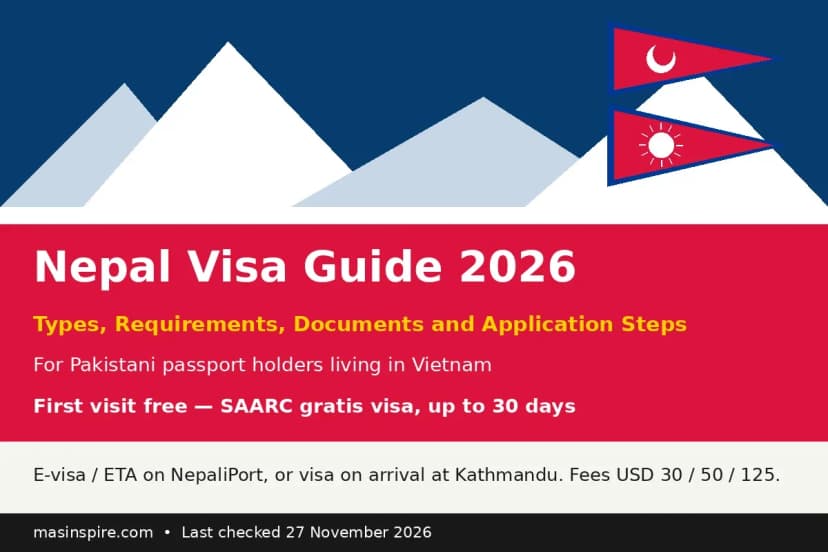
Nepal is the most visa-friendly country in this entire guide series for a Pakistani passport holder — and that is not a small claim. Kathmandu sits at the foot of the Himalayas, an hour's flight from the roof of the world: Everest Base Camp, the Annapurna Circuit, Pokhara's lakeside calm, the rhinos of Chitwan, the birthplace of the Buddha at Lumbini, and a trekking culture that draws visitors from every continent. For a Pakistani living in Vietnam, it is also one of the cheapest and simplest trips in Asia to arrange: no embassy appointment is needed for most travellers, the visa can be obtained on arrival at Kathmandu airport, and — the fact that surprises almost everyone — your first visit of the year is free.
That free visit is real, and it is official. Nepal's Department of Immigration grants a gratis (free) tourist visa of up to 30 days to citizens of SAARC countries other than Afghanistan on their first visit in a given visa year, and Pakistan is a SAARC member. The same official page lists the twelve nationalities that must obtain a visa before arrival — Nigeria, Ghana, Zimbabwe, Swaziland, Cameroon, Somalia, Liberia, Ethiopia, Iraq, Palestine, Afghanistan and Syria — and Pakistan is not on that list. One commercial trekking page does list Pakistan among the nationalities required to apply in advance, and this guide flags that directly in the next section, because it is the one source that disagrees with the Department of Immigration itself. The controlling source is the Department, and its list is unambiguous.
Nepal also changed its system in 2026. On 17 August 2026 the Department of Immigration rolled out a full electronic visa (called an ETA in some places and an eVisa in others) on its NepaliPort portal. It is optional — visa on arrival still works — but it is now the best route for a traveller who wants the visa approved before leaving Vietnam. This guide explains all three routes, the exact fees, the extension and overstay rules, the long-stay categories converted inside Nepal, and the practical reality that there is no Embassy of Nepal in Vietnam at all: the mission accredited to Vietnam is in Bangkok, and for most travellers it is not needed in the first place.
Do Pakistani Passport Holders Need a Visa for Nepal?
Yes — but for most first-time visitors the visa costs nothing. Every foreigner except Indian nationals needs a visa to enter Nepal, and Pakistani passport holders are no exception. What is exceptional is the price: as a citizen of a SAARC country (other than Afghanistan), you receive a gratis tourist visa for up to 30 days on your first visit in a given visa year, which runs with the calendar year from January to December. A second visit in the same calendar year is charged at the normal rates: USD 30 for 15 days, USD 50 for 30 days or USD 125 for 90 days. If you visit in December and again in January, both visits can be free, because they fall in different visa years; if you visit twice between January and December, only the first is free.
The one conflicting source. A Nepal trekking company's visa page lists Pakistan among ten nationalities required to acquire a visa before arrival (Afghanistan, Cameroon, Ghana, Iraq, Liberia, Nigeria, Pakistan, Somalia, Syria and Zimbabwe). That list conflicts with the Department of Immigration's own tourist-visa page, which names twelve countries and does not include Pakistan; with the Embassy of Nepal in Bangkok's visa page, which repeats the same twelve-country list; with the visa-policy summary on Wikipedia, which names thirteen countries required to apply in advance (adding Eswatini, Ethiopia, Iran and Palestine to a similar list) and still does not include Pakistan; and with every Pakistan-focused guide checked for this article, all of which say Pakistanis can use visa on arrival and the free SAARC visa. The Department of Immigration is the issuing authority, so its list controls. But the existence of that one dissenting page is exactly why this guide's advice is to apply for the e-visa/ETA online before you fly: an approval in your inbox settles the question before you reach the airport, and it costs the same as the visa on arrival (nothing, on a first visit).
The passport rule. All visitors must hold a passport valid for at least six months from the date of arrival, and you may stay in Nepal for a maximum of 150 days within one calendar year, counting the initial visa and all extensions together. Children under 10 (except US citizens) also receive a gratis visa. A visa obtained from a Nepalese mission abroad must be used within six months of its issue; the stay itself counts from the day you enter Nepal. Your Vietnamese temporary residence card (TRC) does not change any of this: the visa rule follows your passport, not where you live, and no source found for this guide offers any simplified regime for Vietnamese residents of Pakistani nationality. Keep your TRC valid for the whole trip, because it is your proof of the right to return to Vietnam.
What the free visa does not cover. The gratis visa is a tourist visa. It does not allow paid work of any kind, and it cannot be used as a shortcut into a job, a business or a course of study. Every non-tourist category is handled by conversion inside Nepal (see the work and study section). The free visa also does not exempt you from the documents an officer may ask for at the desk: passport, photograph, return ticket and proof of accommodation are still expected, even when the fee is zero.
The New E-Visa / ETA and the Online Pre-Registration Form
Nepal now has three online-adjacent routes, and they are easy to confuse because the Department of Immigration uses overlapping names. This section separates them.
Route 1 — The e-visa / ETA (new, August 2026). The Department of Immigration announced through its spokesperson Tikaram Dhakal on 3 August 2026 that a full e-visa would roll out on 17 August 2026. The launch passed without a large official announcement, but the system was running by early September 2026, and the Department's own ETA/eVisa page, updated 25 October 2026, now walks applicants through the process. You apply on the official NepaliPort portal, upload a passport scan and a recent photograph, pay by card, and receive the approved visa by email (in one independent test the approval document was not attached to the email and had to be downloaded from the tracking page with "Print ETA" — check both). The Department calls the online visa an Electronic Travel Authorisation (ETA) in some places and an eVisa in others; for a tourist they lead to the same visa. The fees are identical to the visa on arrival: USD 30 for 15 days, USD 50 for 30 days, USD 125 for 90 days, plus a card convenience fee of about 3.5% (at least the rupee equivalent of USD 1). The visa must be used within six months of issue, and the permitted stay counts from the date of entry. For a Pakistani on a first visit in the visa year, no fee is charged when the application is submitted — but the form must still be completed.
Route 2 — Online pre-registration (the older form). Before the e-visa, the standard advice was to fill in the online tourist-visa form on the Department's website before flying (or at the self-service kiosks in the arrivals hall at Tribhuvan International Airport) and print the submission receipt with its barcode. That form does not issue a visa and does not guarantee entry: you still hand over your passport, pay at the bank counter and collect the visa from an officer. Its receipt is valid for 15 days, after which you fill the form again. The pre-registration form remains useful if the e-visa portal is full or slow, because it shortens the airport queue, but it is not a substitute for the e-visa if you want approval before you travel.
Route 3 — Visa on arrival. Fill in the arrival card (handed out on the plane), complete the online form at a kiosk or beforehand, pay the fee at the bank counter in the arrivals hall, and take the receipt and your passport to the immigration desk. The visa on arrival is the only entry visa issued at the airport, and every visa issued there is a tourist visa. If you are visiting for a purpose other than tourism, you still enter on a tourist visa and change the category at the Department of Immigration in Kathmandu afterwards.
Which route should you choose? For a Pakistani living in Vietnam, the e-visa/ETA is the best default: it is the only route that gives you an approval before you board, it costs the same as the visa on arrival (free on a first visit), and it removes any doubt created by the one dissenting source that lists Pakistan as a prior-visa nationality. Apply at least a week before you fly. The portal is reported to stop accepting new applications once its daily limit is reached, so if it refuses your submission, try again the next day rather than assuming you are ineligible. Use only official .gov.np addresses — nepaliport.immigration.gov.np (and the newer nepaliport-new.immigration.gov.np) and immigration.gov.np. The Department warned in June 2026 about fraudulent websites collecting visa fees, and government payments are not refunded, so never pay on a lookalike site or through an agent's payment link.
Types of Nepal Visas for Pakistani Passport Holders
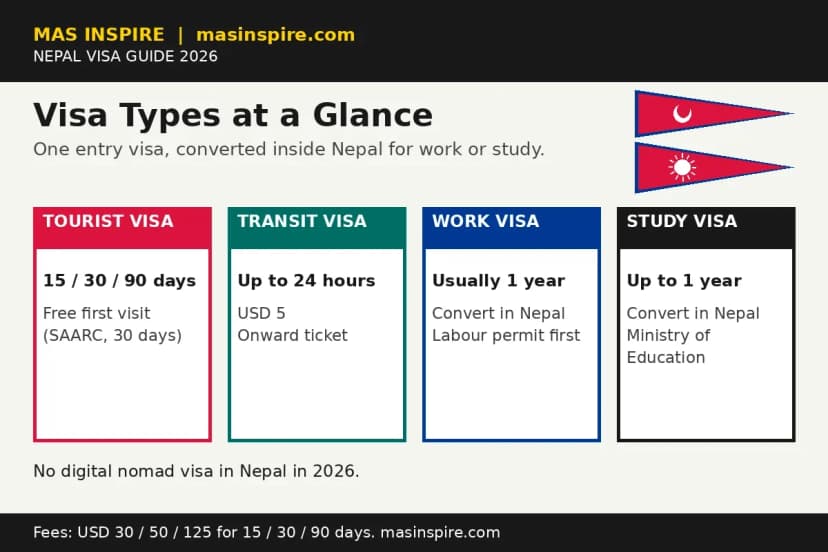
Nepal's visa system has one feature that surprises first-time visitors: almost everything except the tourist visa is issued inside the country, not at the border. The table below is followed by the detail for each category. There is no digital nomad visa in Nepal in 2026 — remote work has no dedicated category, and working on a tourist visa is not permitted.
Tourist visa
The standard entry visa for sightseeing, trekking, mountaineering, visiting friends and family, and holidays. Issued on arrival or online for 15, 30 or 90 days, multiple entry, and extendable inside Nepal up to a total of 150 days in a visa year. Free for up to 30 days on a first visit in the visa year for SAARC citizens other than Afghanistan. This is the visa almost every reader of this guide will use, and it is the only visa issued at the airport.
Transit visa
For travellers passing through Nepal to another destination. Valid for up to 24 hours on presentation of an onward air ticket, for a fee of USD 5. Passengers arriving because of an emergency or forced landing can obtain a tourist visa instead if they wish to leave the airport and visit the country. In practice, few readers will need this: flights from Vietnam to Kathmandu transit through Bangkok, Kuala Lumpur or Singapore, not through Nepal itself.
Business visa
For foreign investors and managers of a company established in Nepal, issued on the recommendation of the Department of Industry after foreign-investment approval, for one month to five years depending on the investment. Reported minimum investment is NPR 20 million, with exemptions reported for some IT businesses; the fee is reported as USD 35 per month, USD 400 per year, or USD 1,000 for five years for investments of NPR 100 million or less. Both figures vary between guides — treat them as indicative and confirm with the Department of Industry before committing funds.
Working (non-tourist) visa
The only visa that allows work in Nepal. It covers foreigners employed by private companies, NGOs and INGOs, staff of donor-funded projects, and volunteers of organisations with an agreement with the state. You enter on a tourist visa and convert it at the Department of Immigration in Kathmandu with a recommendation from the relevant ministry, a Department of Labour work permit and Ministry of Home Affairs approval; for NGOs, a general agreement with the Social Welfare Council is also needed. The fee is reported as USD 30 to USD 75 per month depending on the employer (USD 75 for private companies, USD 50 for donor-funded project staff, USD 30 for staff of offices directly affiliated with the Government of Nepal). Duration is usually one year, renewable. Volunteering counts as work: do not volunteer on a tourist visa.
Study visa
For degree students, non-degree students (language, Buddhist studies, music), researchers and teachers. Conversion is inside Nepal with a recommendation from the Ministry of Education; teaching also needs Ministry of Home Affairs and Department of Labour involvement. Reported fees are USD 30 per month for degree students and dependants, USD 75 per month for non-degree students, and USD 50 per month for teaching and research. Reported funds guidance is USD 3,000 per person per year plus USD 2,000 per dependant, but that figure comes from a single secondary guide and could not be verified against a Department of Immigration page for this article — confirm it with the institution and the Ministry of Education. Duration is at most one year at a time, renewable with a progress report. Only teachers may work.
Non-tourist (relation, marriage, press) visas
The non-tourist family groups cover the spouse and dependants of a visa holder (relation visa), a foreigner married to a Nepali citizen (marriage visa), and journalists and their dependants (press visa, reported at USD 15 per month). All are converted inside Nepal with a ministry recommendation and the documents proving the relationship or the press assignment. A marriage visa is not automatic on marriage alone: the file goes through the Department of Immigration with the supporting documents, and the marriage must be registered under Nepali law.
Residential and Non-Resident Nepali (NRN) visas
The residential visa is for long-term investors, retirees and distinguished contributors. The retirement route is reported to require age 60 or proof of retirement, a USD 20,000 bank balance and USD 20,000 yearly income, with a fee of USD 700 a year — figures reported by secondary guides, not verified against a Department of Immigration page for this article. The NRN visa is for holders of a Non-Resident Nepali card issued by the Ministry of Foreign Affairs or a Nepalese mission abroad, and is not relevant to a Pakistani passport holder without Nepali origin. Neither category is issued on arrival.
Diplomatic and official visas
For holders of diplomatic and official passports on government business, issued free on the recommendation of the mission concerned. Holders of diplomatic or official passports of a number of countries — including Vietnam (up to 90 days), Thailand, Russia, China (30 days) and Brazil — are exempt from an entry visa under reciprocal agreements. That exemption applies only to diplomatic and official passports, not to an ordinary Pakistani passport, and not to an ordinary Vietnamese passport either.
| Visa type | Typical stay | Entries | Where to apply | Can it be extended? |
|---|---|---|---|---|
| Tourist visa | 15, 30 or 90 days | Multiple | Online (e-visa/ETA), on arrival, or at a mission | Yes — up to 150 days per visa year |
| Transit visa | Up to 24 hours | Single transit | At Tribhuvan airport on arrival | No |
| Business visa | 1 month to 5 years | Multiple re-entry included | Convert inside Nepal; Dept. of Industry recommendation | Yes, renewable |
| Working (non-tourist) visa | Usually 1 year | As issued | Convert inside Nepal; Labour permit + ministry approval | Yes, renewable |
| Study visa | Up to 1 year at a time | As issued | Convert inside Nepal; Ministry of Education recommendation | Yes, with progress report |
| Relation / marriage / press visa | As issued | As issued | Convert inside Nepal with ministry recommendation | With the main holder's status |
| Residential visa | Long-term | As issued | Convert inside Nepal | Yes, renewable |
| Diplomatic / official visa | As issued (free) | As issued | Mission / Dept. of Consular Services | Through the mission |
Visa Fees and Financial Requirements
The tourist-visa fees are the most stable figures in this guide: they have not changed since 17 July 2019, and every current source checked for this article agrees on them. The table below gives the official fees, the gratis rules, and the figures that conflict.
| Item | Figure | Source |
|---|---|---|
| Tourist visa, 15 days (multiple entry) | USD 30 | Department of Immigration, tourist-visa page |
| Tourist visa, 30 days (multiple entry) | USD 50 | Department of Immigration, tourist-visa page |
| Tourist visa, 90 days (multiple entry) | USD 125 | Department of Immigration, tourist-visa page |
| Tourist visa, up to 30 days, first visit in the visa year (SAARC citizen except Afghanistan) | Free | Department of Immigration, gratis-visa list |
| Tourist visa, children under 10 (except US citizens) | Free | Department of Immigration, gratis-visa list |
| Transit visa, up to 24 hours | USD 5 | Department of Immigration; multiple 2026 guides |
| Extension, minimum 15 days | USD 45 (USD 3 per day) | Department of Immigration, tourist-visa page |
| Extension, additional days beyond 15 | USD 3 per day | Department of Immigration, tourist-visa page |
| Extension with multiple-entry facility | Extension fee + USD 25 | Secondary guides; confirm at the office |
| Late fine (overstay) | USD 5 per day on top of the extension fee | Department of Immigration, tourist-visa page |
| E-visa / ETA card payment | About 3.5% convenience fee, minimum the rupee equivalent of USD 1 | 2026 e-visa guides; portal checkout controls |
| Embassy of Nepal, Bangkok — 15 / 30 / 90 days | THB 950 / 1,600 / 4,000 (from 1 January 2026) | Embassy of Nepal, Bangkok, revised-fee notice |
| Embassy of Nepal, Islamabad — 15 / 30 / 90 days | PKR 8,700 / 14,500 / 36,250 | Pakistan-focused guides, reported 2026; confirm with the embassy |
Stale fees to ignore. The Nepal Tourism Board's visa page still lists USD 25, USD 40 and USD 100 for the same three tiers, and several older trekking and tour pages repeat those figures — some also quote the old extension rates of USD 30 for the first 15 days and USD 2 per day thereafter. Treat all of those as stale: the Department of Immigration is the issuing authority, its own pages agree with each other on USD 30, USD 50 and USD 125, and the current extension rate is USD 3 per day with a USD 45 minimum. If a tour operator or an agent quotes you USD 25 / 40 / 100, they are working from pre-2019 material.
How payment works. At the airport, the fee is paid at the bank counter in the arrivals hall before the immigration desk, in US dollars or another convertible currency; local payment methods are also accepted at the counter, and the Department advises carrying some cash to be safe. For the e-visa/ETA, payment is by card on the official portal, with the 3.5% convenience fee. At the Bangkok embassy, the fee is paid by bank transfer to the embassy's Bangkok Bank account and the payment slip is emailed with the application form. Government payments are not refunded — do not pay twice for the same submission, and do not pay on any third-party site.
Financial requirements. No official minimum bank balance is published for the tourist visa, and no source found for this guide states one — beware of any agent who quotes a figure such as PKR 400,000 to PKR 1,000,000 as an official requirement, because no Department of Immigration page supports it. What the officer at the desk may ask for is evidence that you can fund the trip: recent bank statements, a return ticket and a hotel booking are the practical proof. For study visas, one secondary guide reports a funds expectation of USD 3,000 per person per year plus USD 2,000 per dependant; that figure is unverified against an official page, so confirm it with the institution. For the retirement route, the reported figures are a USD 20,000 bank balance and USD 20,000 yearly income. Carry your statements in your hand luggage, not in checked baggage.
Processing Times
Processing time depends entirely on which route you choose, and the honest answer is a short range rather than a single number.
E-visa / ETA: the Department's e-visa FAQ is reported to quote 2–3 business days for most applications, and immigration officials were quoted at about 72 hours. In the one full independent test published in 2026, verification took about an hour, the payment voucher followed two minutes later, and the approval arrived about three days after payment. Apply at least a week before you fly, and remember that Nepali government offices are closed on Saturday (and the Department's tourist-visa counter runs limited Saturday hours), so a Friday submission can easily stretch into the following week. The portal's daily application cap is a further reason to apply early: if it stops accepting applications, try again the next day.
Visa on arrival: issued at the desk the same day, in minutes once you reach the immigration officer — but the queue is the variable. Expect long queues in the peak trekking seasons (October–November and March–April). The online pre-registration form shortens the wait; the e-visa removes it almost entirely, because you go straight to the immigration desk with the approval.
Mission visas: the Embassy of Nepal in Islamabad is reported to respond usually within four working days for a tourist visa; the Bangkok embassy says visas are usually issued the same day once the online form and payment slip are received by email, and no visit to the embassy is needed. Both figures are reported, not published on the Department's own pages, so confirm the current turnaround with the mission when you apply. A visa issued by a mission must be used within six months of issue.
Extensions and conversions: a tourist-visa extension is handled at the Department of Immigration in Kathmandu or the immigration office in Pokhara (the Department's hours are 10:00 am to 4:00 pm Sunday to Thursday, 10:00 am to 3:00 pm Friday, and 11:00 am to 1:00 pm for tourist visas on Saturday and public holidays). Apply before the current visa expires. A conversion to a non-tourist visa takes longer — the ministry recommendation alone can take days or weeks — so start while the tourist visa still has ample validity left.
Complete Document Checklists
No single official document list for Pakistani applicants is published on a page found for this guide, so the checklists below combine what the Department of Immigration's pages state, what the NepaliPort portal asks for, and what immigration officers check at the desk. The mission or the Department may ask for more — its list governs your application, so confirm it before you travel.
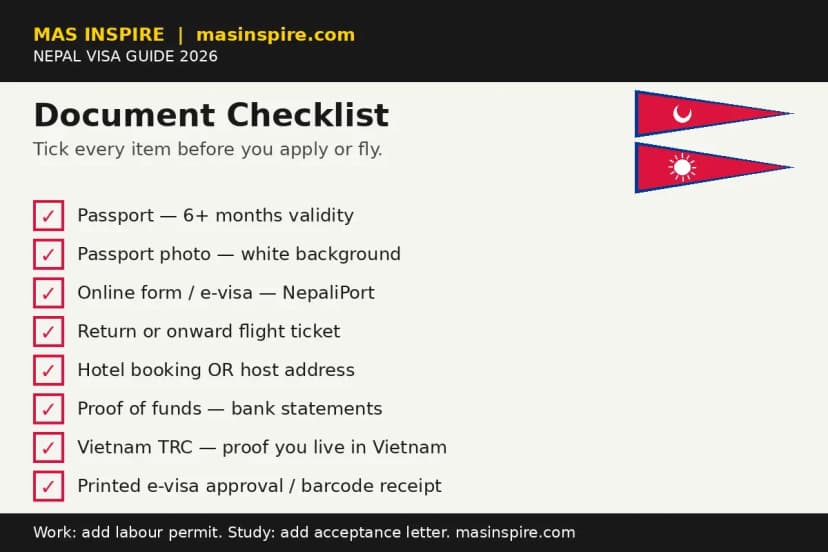
Tourist visa — e-visa / ETA route
- Pakistani passport valid at least six months from the date of arrival; a clear scan of the bio-data page (uploads up to 2 MB each on the portal)
- One recent passport photograph on a plain white background (up to 2 MB on the portal)
- Completed online application on NepaliPort (Electronic Travel Authorisation / eVisa), with your name exactly as it appears on the passport
- Email address you can access, for the verification code and the approval
- Return or onward flight ticket or itinerary
- Proof of accommodation — hotel booking for the stay, or the address and contact details of your host
- Payment card in your name for the fee (no fee is charged for a first-visit SAARC gratis application)
- Printed copy of the e-visa / ETA approval to present at boarding and on arrival
Tourist visa — visa on arrival route
- Pakistani passport valid at least six months from arrival, with blank pages for the visa
- Arrival card, completed on the plane
- Online tourist-visa form completed before flying or at the airport kiosks, with the barcode receipt printed or saved on your phone (valid 15 days)
- One recent passport-sized photograph (light background)
- Return or onward ticket
- Hotel booking or host invitation with address and contact details
- Proof of funds — recent bank statements; no official minimum is published
- Cash in US dollars for the fee (USD 30 / 50 / 125), or a card accepted at the bank counter; no fee on a first-visit SAARC gratis visa
Tourist visa — mission route (Bangkok or Islamabad)
- Original Pakistani passport, valid at least six months, with blank visa pages
- Completed online visa form on NepaliPort, choosing "Visa from Nepali Missions" and the mission concerned
- Recent passport photograph
- Return or onward ticket and proof of accommodation
- Proof of funds (bank statements) and your Vietnamese temporary residence card, to show where you live and that you will return there
- Payment slip for the mission's fee (Bangkok: bank transfer; Islamabad: confirm the payment method with the embassy)
- A covering note explaining your itinerary in plain language, and a copy of everything you submit
Work visa — conversion inside Nepal (employer-sponsored)
- Everything in the tourist-visa checklist above, plus:
- Recommendation letter from the relevant ministry, obtained by your Nepali employer
- Department of Labour work permit and Ministry of Home Affairs approval
- Signed employment contract or work agreement with the Nepali employer
- For NGO/INGO staff: the organisation's general agreement with the Social Welfare Council
- Academic and professional certificates, translated if required
- Police clearance and medical certificate if the Department asks for them
Study visa — conversion inside Nepal
- Everything in the tourist-visa checklist above, plus:
- Acceptance or enrolment letter from the Nepali institution
- Recommendation from the Ministry of Education
- Proof of funds for tuition and living costs (reported guidance: USD 3,000 per person per year — unverified, confirm with the institution)
- Academic certificates and transcripts for previous studies
- Progress report for each renewal
Children travelling with you
- Each child needs their own passport, valid six months, and their own visa; children under 10 (except US citizens) receive a gratis visa
- Birth certificate showing the parents' names
- If a child travels with one parent only or with neither parent, carry a notarised parental consent letter — officers do ask for it, even though no Department page found for this guide publishes the exact wording
How to Apply: Step-by-Step
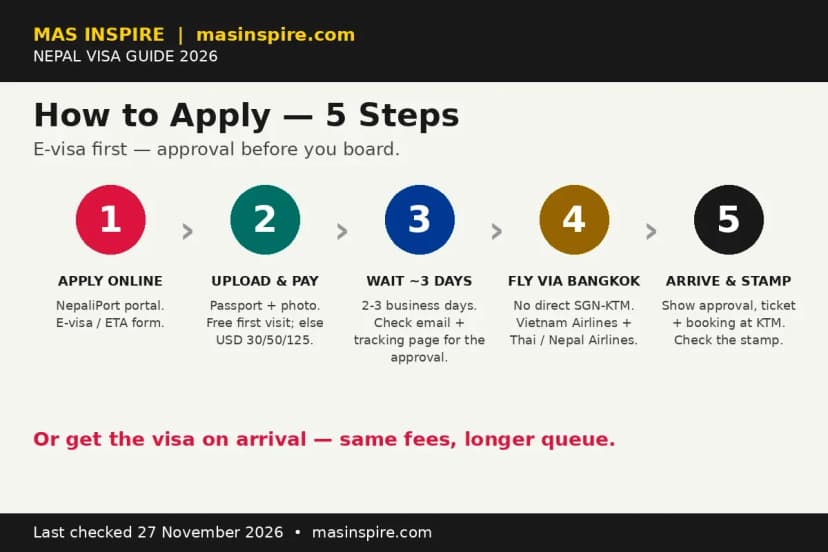
There are three sequences in this guide, because there are three routes. The e-visa/ETA is the recommended default for a Pakistani living in Vietnam.
E-visa / ETA — step by step
Step 1 — Open the official portal. Go to nepaliport.immigration.gov.np (or nepaliport-new.immigration.gov.np) through immigration.gov.np and choose Electronic Travel Authorisation / eVisa, then New Application. Verify your email with the one-time code the portal sends.
Step 2 — Fill in the form. Enter your personal details exactly as they appear on your passport, including the passport number, dates and place of birth, your travel dates, your accommodation address in Nepal and your contact details in Vietnam. Select tourism and the duration — 15, 30 or 90 days. If this is your first visit in the visa year, the SAARC gratis rule should mean no fee is charged; check the fee shown before you confirm.
Step 3 — Upload your documents. Upload the passport bio-page scan and your photograph (plain white background, up to 2 MB each). Check each scan is legible before you submit.
Step 4 — Pay if a fee is due. Pay by card on the portal if the checkout shows a fee (USD 30 / 50 / 125, plus about 3.5% convenience fee). Save the Submission ID and the payment receipt.
Step 5 — Wait for the decision. Plan on 2–3 business days; one published test took about three days from payment to approval. Check your email and the portal's tracking page — in the published test, the approval document had to be downloaded from the tracking page rather than arriving as an attachment.
Step 6 — Print everything and travel. Print the e-visa / ETA approval, your return ticket, your hotel booking and your proof of funds, and carry them in your hand luggage. The visa must be used within six months of issue; the stay counts from the day you enter Nepal.
Visa on arrival — step by step
Step 1 — Pre-register online before you fly. Complete the online tourist-visa form on the Department's website and save or print the barcode receipt (valid 15 days). This is optional but shortens the airport queue considerably.
Step 2 — Fill in the arrival card on the plane. Keep your passport, photograph and hotel address to hand.
Step 3 — Pay at the bank counter. In the arrivals hall at Tribhuvan International Airport, pay the fee at the bank counter (USD 30 / 50 / 125, or nothing on a first-visit SAARC gratis visa) and keep the receipt. Carry cash in US dollars to be safe.
Step 4 — Go to the immigration desk. Hand over your passport, the online form receipt, the payment receipt and your documents. The officer issues the visa — a multiple-entry tourist visa — on satisfaction. Check the stamp and the dates before you walk away from the desk.
Mission visa — step by step (Bangkok or Islamabad)
Step 1 — Submit the online form. On NepaliPort, choose "Visa from Nepali Missions", select the Embassy of Nepal in Bangkok (for a resident of Vietnam) or Islamabad (for an applicant in Pakistan), and complete the form.
Step 2 — Pay the mission fee and email the slip. For Bangkok, transfer the fee to the embassy's Bangkok Bank account and email the payment slip and the application form to nepalvisabkk@gmail.com. For Islamabad, confirm the payment method and the fee in rupees with the embassy first.
Step 3 — Receive the electronic visa slip by email. The Bangkok embassy says the electronic visa slip is sent to the applicant's email once approved, and no visit to the embassy is needed. Check the name, passport number, dates and duration on the slip before you travel, and remember the six-month use window.
Applying from Vietnam — No Embassy in Hanoi, Bangkok Is Accredited
There is no Embassy of Nepal in Vietnam. That is the first fact to establish, because it changes the shape of the whole application: unlike the Mozambique guide in this series, where a Hanoi embassy is the fallback, the Nepal fallback is a mission in another country — and, for most travellers, no mission at all, because the e-visa and the visa on arrival make a mission unnecessary.
The accredited mission is Bangkok. The Embassy of Nepal in Bangkok is concurrently accredited to Cambodia, Laos, Singapore and Vietnam, according to the list of diplomatic missions of Nepal. Its address is 4/1, Soi 27, Sukhumvit 71 Road, Khlong Ton, Watthana, Bangkok 10110, Thailand (older listings give 189 Soi 71, Sukhumvit Road, Prakanong, Bangkok 10110 — the same road; use the current 4/1 Soi 27 address from the embassy's own pages and confirm before travelling). Telephone +66 2 390 2280 or +66 2 391 7240 (extension 106 for visas), fax +66 2 381 2406, email nepalvisabkk@gmail.com for visa matters and eonbangkok@mofa.gov.np for other official matters. The embassy's visa service is online-only: applications are submitted on NepaliPort, the fee is paid by bank transfer, the slip is emailed, and no visit to the embassy is needed. Its revised tourist-visa fees from 1 January 2026 are THB 950 for 15 days, THB 1,600 for 30 days and THB 4,000 for 90 days.
The Islamabad mission. The Embassy of Nepal in Islamabad is the mission for applicants in Pakistan: House No. 6, Gomal Road, Sector E-7, Islamabad, telephone +92 51 261 0317. Pakistan-focused guides report its fees as PKR 8,700 for 15 days, PKR 14,500 for 30 days and PKR 36,250 for 90 days, with a response usually within four working days and in-person applications Monday to Friday, 9:30 am to 12:30 pm. Those rupee figures and hours are reported by secondary guides and could not be verified against the embassy's own published page for this article — confirm them with the embassy before you travel to Islamabad. A Pakistani living in Vietnam has no reason to use Islamabad when Bangkok and the online routes exist, but it is the mission your family in Pakistan would use.
Vietnam's own presence in Nepal. Vietnam has an Honorary Consulate in Kathmandu. It is not a Nepalese mission and cannot issue a Nepal visa, but it is a useful contact if you need consular help from your country of residence while you are in Nepal. Your own mission as a Pakistani is the Embassy of Pakistan in Kathmandu — register your trip with it if you are trekking in remote areas.
What a Vietnamese TRC does and does not do. Your Vietnamese temporary residence card proves your right to live in Vietnam and to return there after the trip, and you should carry it with your passport. It does not change the Nepal visa rule, which follows your passport; it does not make you eligible for any Vietnamese-national treatment; and no source found for this guide says a Nepalese mission will refuse you for applying from Vietnam rather than Pakistan. If your TRC is close to expiry, renew it before you travel: a lapsed residence permit is a known weak point at the return leg, when airlines and Vietnamese immigration check your right to re-enter.
| Mission | Address | Telephone / email | Note |
|---|---|---|---|
| Embassy of Nepal, Bangkok (accredited to Vietnam) | 4/1, Soi 27, Sukhumvit 71 Road, Khlong Ton, Watthana, Bangkok 10110, Thailand | +66 2 390 2280 / 391 7240; nepalvisabkk@gmail.com (visas) | Online-only visa service; fees THB 950 / 1,600 / 4,000; no visit needed |
| Embassy of Nepal, Islamabad | House No. 6, Gomal Road, Sector E-7, Islamabad, Pakistan | +92 51 261 0317 | For applicants in Pakistan; rupee fees reported, confirm first |
| Department of Immigration, Kathmandu | Kalikasthan, Kathmandu, Nepal | +977 1 4529659 / 4429660; inquiry@immigration.gov.np | Extensions and conversions; tourist counter also open limited Saturday hours |
| Honorary Consulate of Vietnam, Kathmandu | Kathmandu, Nepal | Confirm before travel | Vietnam's representation in Nepal; cannot issue Nepal visas |
Entry Points and Visa on Arrival at Kathmandu Airport
Tribhuvan International Airport (KTM) in Kathmandu is the main gateway, and it is where almost every Pakistani traveller from Vietnam will arrive. Visa on arrival is also available at the other international airports — Pokhara and Bhairahawa (Gautam Buddha International Airport) — and at the land border crossings with India (Birganj, Bheemdatta, Dhangadhi, Nepalgunj, Kakarbhitta and Siddharthanagar) and with China at Kodari. Which land posts issue visas on a given day can change, so confirm your border post with the Department of Immigration first if you are entering overland, and note that a land entry from India raises its own question: a Pakistani passport holder needs an Indian visa to transit India by land, so the air route into Kathmandu is the practical choice from Vietnam.
The airport process is the same whether or not you pre-registered: arrival card, online form (at a kiosk if you did not do it beforehand), bank counter, immigration desk. The visa issued at the airport is a multiple-entry tourist visa, so you can leave Nepal and re-enter within its validity. The immigration officer makes the final decision in every case, whatever document you hold. Keep your hotel booking, return ticket and proof of funds with you at the desk and answer questions plainly. Check the stamp in your passport before you walk away: the stamp is your proof of the date you entered and the length of stay you were given, and it is the document the Department will ask for if you apply for an extension.
One warning about the free visa at the desk: the gratis SAARC visa is free only on the first visit in the visa year. The Department's system records your entries, so do not expect the officer to waive the fee on a second visit in the same calendar year because you did not know the rule. If it is your second visit, pay the USD 30 / 50 / 125 fee for the duration you want — or, better, apply for the e-visa online first, where the fee (or the lack of one) is shown before you pay anything.
Extending Your Stay and Overstay Rules
A tourist visa can be extended inside Nepal, but the extension has a hard ceiling and a clear fee structure, and both are worth knowing before you book a long trek.
Extension. Apply at the Department of Immigration in Kalikasthan, Kathmandu, or at the immigration office in Pokhara. The fee is USD 3 per day with a minimum extension of 15 days, so the first extension block costs USD 45; each additional day beyond 15 costs USD 3. Adding a multiple-entry facility to an extension costs a further USD 25, according to secondary guides — confirm that figure at the office. The total stay, counting the initial visa and all extensions together, cannot exceed 150 days in a visa year (January to December). Non-tourist visa extensions can be done only at the Department of Immigration in Kathmandu, for a maximum of one year at a time (except business visas). Apply before the current visa expires: the extension fee is charged from the day after the current visa ends, and applying late adds the fine below.
Overstay. The Department's own page states the late fine plainly: in the case of delay of less than 150 days, an additional USD 5 per day as late fine, on top of the USD 3-per-day extension fee — USD 8 per day in total while you regularise. A law-firm guide adds that overstaying beyond the 150-day annual limit attracts the normal extension fee plus USD 5 per day plus a fine of up to NPR 50,000; that additional fine is reported, not verified against a Department page, so treat it as a warning rather than a figure to budget against. A long or unpaid overstay is a breach of the Immigration Act: it can lead to detention, deportation and a ban on returning, and you must clear your dues at the Department before being granted an exit permit. Older guides quote different overstay figures (USD 5 per day for the first 30 days, then USD 10 per day) and the old extension rates (USD 30 for 15 days, USD 2 per day) — those are stale and conflict with the Department's current page, which controls.
The cleanest way to stay longer is to avoid needing an extension at all: if you know you want 90 days, buy the 90-day visa (USD 125) before you travel or on arrival, rather than a 30-day visa plus extensions. That also avoids the risk that an extension is refused and you have to leave anyway. Plan a long stay inside a single calendar year, and confirm the counting with the Department if your trip crosses 31 December.
Work, Study, Business and Long-Stay Routes
Nepal's long-stay system is the opposite of the tourist system: nothing is issued at the border, everything is converted inside the country, and every conversion needs a sponsor and a ministry recommendation. Do not arrive on a tourist visa with a job offer and assume the paperwork will sort itself out at the airport — it will not.
Work. The working (non-tourist) visa is the only visa that allows work, and volunteering counts as work. The sequence is: enter on a tourist visa; your employer obtains a recommendation from the relevant ministry and a work permit from the Department of Labour, with Ministry of Home Affairs approval; you apply for conversion at the Department of Immigration in Kathmandu; the tourist visa is cancelled once the new visa is granted. The fee is USD 30 to USD 75 per month depending on the employer type. Duration is usually one year, renewable. No published processing time for the conversion was found — allow weeks, and keep the tourist visa valid throughout.
Study. Get accepted by a Nepali institution, which obtains the Ministry of Education recommendation; apply for conversion at the Department of Immigration with the acceptance letter, proof of funds and your academic records. Fees are USD 30 per month for degree students, USD 75 per month for non-degree students and USD 50 per month for teaching and research. Duration is at most one year at a time, renewable with a progress report. Only teachers may work, and only with the additional Labour involvement described above. There is no published student-visa fee list on the Department's pages found for this guide — the figures here come from secondary legal and expatriate guides that cite the Department's fee schedule, and the institution should confirm the current figure before you commit to a course.
Business and investment. A business visa needs foreign-investment approval and a Department of Industry recommendation. The reported minimum investment is NPR 20 million, with exemptions reported for some IT businesses; the reported fee is USD 35 per month, USD 400 per year or USD 1,000 for five years for investments of NPR 100 million or less. A bill reported in September 2026 would expand Nepal from 9 to 17 visa types — it has not been passed, so the rules above remain in force, but check the Department's pages again before a large investment decision.
Family and retirement. A foreigner married to a Nepali citizen, or the spouse and dependants of a visa holder, converts to a relation or marriage visa inside Nepal with the marriage or birth certificates that prove the relationship. Retirement is reported to need age 60 or proof of retirement, a USD 20,000 bank balance and USD 20,000 yearly income, at USD 700 a year — again, reported by secondary guides and unverified against a Department page. There is no digital nomad visa, no job-seeker visa and no skilled-worker points system in Nepal in 2026; the realistic long-stay routes are work (with a Nepali employer), study (with a Nepali institution), business (with an approved investment) or family.
Transit, Flights, Trekking Permits and Money: Practical Notes
Flights. There is no non-stop flight from Ho Chi Minh City (or Hanoi) to Kathmandu. The clean corridors from Ho Chi Minh City are via Bangkok (Vietnam Airlines to Bangkok, then Thai Airways or Nepal Airlines to Kathmandu — the shortest one-stop routing, about 7 hours 50 minutes in total) or via Kuala Lumpur (Vietnam Airlines or Malaysia Airlines, then Nepal Airlines), with Singapore and Guangzhou as alternatives. Fares vary widely with the season; recent round-trip listings cluster around USD 540–640, but treat any fare as a snapshot, not a price. Book the whole journey on one ticket where you can, and leave a generous connection time. Avoid routing through New Delhi unless you have confirmed the transit position for a Pakistani passport: India is the most common one-stop hub on booking sites for this route, and a Pakistani national transiting India generally needs an Indian visa even airside — check with the airline and the Indian mission before booking a Delhi connection, or choose Bangkok or Kuala Lumpur instead. Vietnam is 1 hour 15 minutes ahead of Nepal.
Trekking permits. Your entry visa is the foundation of your trekking paperwork, not a substitute for it. For the popular treks you need a TIMS (Trekkers' Information Management System) card and the relevant national-park or conservation-area permit (Sagarmatha, Langtang, Chitwan, Annapurna Conservation Area and others), obtained in Kathmandu or Pokhara through a registered trekking agency; the authorities verify your passport and entry visa when issuing them. Restricted areas are open only to group trekkers with a permit obtained through a registered agency, accompanied by a licensed guide — individual trekkers cannot apply alone. Permit fees change and are quoted in Nepali rupees; no current official fee table was verified for this article — confirm the current fees with the Nepal Tourism Board or your trekking agency before you budget. Make 4 to 6 photocopies of your passport bio page in Kathmandu: they are required at conservation-area and municipality checkpoints.
Money. The currency is the Nepali rupee (NPR). US dollars in cash are the most useful thing to carry for the visa fee itself, and the bank counter at the airport accepts convertible currency. Card payments are not reliably available at the counter, so carry the fee in cash even if you have pre-registered online. ATMs in Kathmandu and Pokhara work with international cards; outside the main towns they are unreliable, so carry enough rupees for the trek before you leave the city. There is no published minimum bank balance for the tourist visa. Keep your bank statements and your return ticket in your hand luggage.
Where to stay and what it costs. Kathmandu and Pokhara have hotels and guesthouses at every level, and trekking lodges (teahouses) along the main trails are priced for international trekkers — budget accordingly and book the accommodation you will show at immigration before you apply, because the booking is part of the visa file. A local SIM is easy to arrange at the airport; buy one on arrival so you can contact your hotel and your trekking agency if anything goes wrong.
Safety, Health and Arrival Checks
Security. Nepal is generally safe for tourists, and the main risks are environmental rather than criminal: earthquakes, landslides and monsoon flooding, and the mountain hazards of altitude, weather and trail conditions. Register your trip with the Embassy of Pakistan in Kathmandu if you are trekking in remote areas, tell your hotel or agency your itinerary, and do not trek alone in restricted areas — a licensed guide is required there in any case. Check the weather and trail conditions in Kathmandu before setting out: a trek that is safe in October can be dangerous in the monsoon.
Health. No vaccination certificate is required for entry to Nepal on any Department of Immigration page found for this guide, and Nepal is not a yellow-fever risk country — but that is not the same as needing no health preparation. Altitude sickness is the real medical risk: Everest Base Camp sits above 5,300 metres, and the Annapurna Circuit crosses the Thorong La pass at 5,416 metres. Ascend gradually and follow your guide's acclimatisation schedule. Drink bottled or treated water, and buy travel insurance that covers medical evacuation by helicopter before you travel — a helicopter evacuation from the mountains is expensive, and medical facilities outside Kathmandu and Pokhara are basic.
Arrival checks. At Tribhuvan airport, expect to show your passport with the visa, your return or onward ticket, your hotel booking or invitation letter, and your proof of funds. The immigration officer makes the final decision, whatever document you hold. Check the stamp in your passport before you walk away from the desk — the stamp is your proof of the date you entered and the length of stay you were given, and it is the document the Department will ask for if you apply for an extension.
Frequently Asked Questions
1. Do Pakistani citizens need a visa for Nepal?
Yes. Every foreigner except Indian nationals needs a visa. But as a SAARC citizen (other than Afghanistan), you receive a gratis tourist visa for up to 30 days on your first visit in a given calendar year. A second visit in the same year is charged at USD 30 for 15 days, USD 50 for 30 days or USD 125 for 90 days.
2. Is the Nepal visa really free for Pakistanis?
Yes, once a year. The Department of Immigration grants a free tourist visa of up to 30 days to SAARC citizens other than Afghanistan on their first visit in a visa year (January to December). Pakistan is a SAARC member. The free visa covers a single stay of up to 30 days; extensions beyond 30 days are charged at the normal extension rate, and a second visit in the same year is charged in full.
3. Can Pakistanis get a visa on arrival in Nepal?
Yes, according to the Department of Immigration itself. Its tourist-visa page lists twelve nationalities that must obtain a visa before arrival — Nigeria, Ghana, Zimbabwe, Swaziland, Cameroon, Somalia, Liberia, Ethiopia, Iraq, Palestine, Afghanistan and Syria — and Pakistan is not on that list. One trekking-company page does list Pakistan as a prior-visa nationality; that page conflicts with the Department, the Bangkok embassy and every Pakistan-focused guide checked, so the Department's list controls. Applying for the e-visa/ETA online first removes any doubt.
4. What is the Nepal e-visa / ETA, and how long does it take?
It is the Department of Immigration's online tourist visa, launched 17 August 2026 on the NepaliPort portal. You apply online, upload a passport scan and a photo, pay by card if a fee is due, and receive the approved visa by email. The Department's FAQ is reported to quote 2–3 business days; one published test took about three days from payment to approval. Apply at least a week before you fly, and use the visa within six months of issue.
5. How much does a Nepal tourist visa cost?
USD 30 for 15 days, USD 50 for 30 days or USD 125 for 90 days, all multiple entry — free for up to 30 days on a first visit in the visa year for SAARC citizens. The e-visa adds a card fee of about 3.5%. Ignore the older USD 25 / 40 / 100 figures still shown on the Nepal Tourism Board's page and some tour sites: they are stale, pre-2019 prices.
6. Is there an Embassy of Nepal in Vietnam?
No. There is no Embassy of Nepal in Vietnam. The mission accredited to Vietnam is the Embassy of Nepal in Bangkok (4/1, Soi 27, Sukhumvit 71 Road, Bangkok 10110; +66 2 390 2280; nepalvisabkk@gmail.com for visas), which runs an online-only visa service. For most travellers no mission is needed at all, because the e-visa and the visa on arrival cover the trip.
7. How long can I stay in Nepal on a tourist visa?
A tourist visa is issued for 15, 30 or 90 days and can be extended inside Nepal at USD 3 per day (minimum 15 days, USD 45) up to a total of 150 days in a visa year. The 150-day cap counts the initial visa and all extensions together, and runs with the calendar year.
8. What documents do I need for a Nepal visa?
A passport valid at least six months from arrival; a recent passport photograph on a light background; the completed online form (or the e-visa application); a return or onward ticket; proof of accommodation; and proof of funds. No official minimum bank balance is published for the tourist visa. Business, work and study routes add a ministry recommendation and sponsor documents — see the checklists above.
9. Can I work in Nepal on a tourist visa?
No. A tourist visa does not give the right to work, and volunteering counts as work. The working (non-tourist) visa is the only visa that allows work: your Nepali employer obtains a Labour work permit and a ministry recommendation, and you convert the tourist visa at the Department of Immigration in Kathmandu. The fee is USD 30 to USD 75 per month depending on the employer.
10. Can I study in Nepal, and what does it cost?
Yes, through the study visa, converted inside Nepal with a Ministry of Education recommendation and an acceptance letter from the institution. Reported fees are USD 30 per month for degree students, USD 75 per month for non-degree students and USD 50 per month for teaching and research. Reported funds guidance is USD 3,000 per person per year — unverified against an official page, so confirm it with the institution.
11. What happens if I overstay my Nepal visa?
You pay a late fine of USD 5 per day on top of the USD 3-per-day extension fee — USD 8 per day in total — while you regularise at the Department of Immigration. A long or unpaid overstay can mean detention, deportation and a ban, and you must clear your dues before being granted an exit permit. Apply for an extension before the visa expires.
12. Do I need a transit visa for Nepal?
Only if you are passing through Nepal itself to another destination: a transit visa covers up to 24 hours for USD 5 on presentation of an onward ticket. Flights from Vietnam to Kathmandu transit through Bangkok, Kuala Lumpur or Singapore, not through Nepal, so most readers will not need one. Avoid routing through New Delhi without confirming the Indian transit position for Pakistani passports.
13. Are there direct flights from Vietnam to Kathmandu?
No. There is no non-stop flight from Ho Chi Minh City or Hanoi to Kathmandu. The cleanest routings are via Bangkok (Vietnam Airlines, then Thai Airways or Nepal Airlines — the shortest one-stop option) or via Kuala Lumpur, with Singapore and Guangzhou as alternatives. Allow a generous connection time and book on one ticket where you can.
14. Do I need trekking permits as well as a visa?
Yes, for the main treks. You need a TIMS card and the relevant national-park or conservation-area permit, obtained in Kathmandu or Pokhara through a registered trekking agency, which verifies your passport and entry visa. Restricted areas are open only to group trekkers with a permit and a licensed guide. Permit fees were not verified against a current official table for this guide — confirm them with the Nepal Tourism Board or your agency.
15. Can children travel with me to Nepal?
Yes, with their own passport and visa; children under 10 (except US citizens) receive a gratis visa. Carry the child's birth certificate, and if a child travels with one parent only or with neither parent, carry a notarised parental consent letter — officers do ask for it.
Official Immigration Websites
Check these sources directly before you apply. The Department of Immigration is the controlling source for eligibility, fees and extensions; the Bangkok embassy is the controlling source for the mission route; the NepaliPort portal is the only place to apply online.
| Website | What it is | Link |
|---|---|---|
| Department of Immigration, Nepal — Tourist Visa | Official tourist-visa page: fees USD 30 / 50 / 125, the 12-country prior-visa list, gratis SAARC visa, extension and overstay rules | immigration.gov.np — Tourist Visa |
| Department of Immigration, Nepal — home | Official home page and gateway to all visa pages, forms and the NepaliPort portal | immigration.gov.np |
| NepaliPort — official online visa portal | Online tourist-visa form, e-visa / ETA applications and mission-visa applications; the only official application channel | nepaliport.immigration.gov.np |
| Embassy of Nepal, Bangkok — Visa Service Information | Official mission page: online-only applications, Bangkok fees THB 950 / 1,600 / 4,000, bank details, the 12-country list | th.nepalembassy.gov.np — Visa Service |
| Consulate General of Nepal, Dallas — Visa Services (ETA) | Nepalese mission page confirming the ETA / e-visa process, fees USD 30 / 50 / 125 and 2–3 business days' processing | dls.nepalconsulate.gov.np — Visa Services |
| Wikipedia — Visa policy of Nepal | Summary of visa on arrival, the free SAARC visa, the advance-visa country list and passport validity | en.wikipedia.org/wiki/Visa_policy_of_Nepal |
| Wikipedia — List of diplomatic missions of Nepal | Confirms the Bangkok embassy is concurrently accredited to Vietnam (with Cambodia, Laos and Singapore) | en.wikipedia.org/wiki/List_of_diplomatic_missions_of_Nepal |
| UrduPoint — Nepal Visa for Pakistanis 2026 | Pakistan-focused guide confirming visa on arrival and the free 30-day SAARC visa, checked 19 November 2026 | urdupoint.com/travel/visa/nepal |
| PakEra — Nepal Visa for Pakistanis: Free 30 Days | Pakistan-focused guide reading the Department's pages directly, 8 October and 8 November 2026 | pakera.pk — Nepal Visa for Pakistanis |
| AlwaysPacked — Nepal Visa Online vs On Arrival | November 2026 guide verifying fees against the Department of Immigration on 14 November 2026 | alwayspacked.com — Nepal Visa Online vs On Arrival |
| VisasNews — Nepal ETA test | Independent full test of the new ETA process, September 2026: approval about three days after payment | visasnews.com — Nepal ETA test |
| Swotah Travel — Nepal e-Visa 2026 | Guide to the e-visa rollout of 17 August 2026, fees, card fee and processing | swotahtravel.com — Nepal e-Visa 2026 |
This guide was checked on 27 November 2026. Visa rules change without notice. Always confirm the live rules on immigration.gov.np and the NepaliPort portal, and with the Embassy of Nepal in Bangkok if you are applying through a mission, before paying any fee or booking a non-refundable ticket. Nothing in this guide is immigration advice; the Nepalese authorities set and enforce the entry rules, and the immigration officer at Kathmandu makes the final decision.