Mongolia Visa Guide 2026: Types, Requirements, Documents and Application Steps
Last checked: 27 November 2026. This guide is for Pakistani passport holders living in Vietnam. Visa rules change without notice — always confirm the live rules on the official e-visa portal (evisa.mn) and with the Embassy of Mongolia in Hanoi before paying any fee or booking a non-refundable ticket.
Table of Contents
- Introduction
- Do Pakistani Passport Holders Need a Visa for Mongolia?
- Types of Mongolia Visas for Pakistani Passport Holders
- The E-Visa Question: Can Pakistanis Apply Online at evisa.mn?
- Mongolia Visa Fees
- Processing Times
- Complete Document Checklists
- How to Apply: Step-by-Step
- Applying from Vietnam — and from Pakistan
- After Arrival: Registration, Extension and Staying Longer
- Work and Study Routes
- Transit, Overstay and Refusals
- Travel, Flights and Money: Practical Notes
- Common Mistakes and Rejection Reasons
- Frequently Asked Questions
- Official Immigration Websites
Introduction
Mongolia is the land of the eternal blue sky: the Gobi Desert in the south, the green steppe rolling to the horizon, Lake Khovsgol in the north, and Ulaanbaatar, one of the coldest capitals on earth, where half the country lives. For a Pakistani traveller based in Ho Chi Minh City, it is also one of the more awkward visas in Asia to pin down — not because the rules are harsh, but because the sources disagree about the most basic question of all: can you apply online, or must you go to an embassy?
This guide answers that question honestly, with the disagreement stated up front rather than hidden. The official e-visa portal, evisa.mn, lists Pakistan among the country names on its own homepage when it was checked live on 27 November 2026, and at least two 2026 guides for Pakistanis say Pakistan is on the portal's eligibility list. But other careful sources — including a Pakistan-focused visa guide checked on 7 November 2026 and the compiled e-visa lists on Wikipedia and on Mongolian tour-operator sites — say Pakistan is not on the e-visa list at all, and that Pakistanis must apply at a Mongolian embassy. Both positions cannot be right, and this guide does not pretend the matter is settled. What follows gives you both routes in full: try the portal first, because it costs nothing to check, and if the portal does not offer you the K2 tourist category, use the Embassy of Mongolia in Hanoi, which is the practical mission for anyone living in Vietnam.
Mongolia does have an embassy in Hanoi — in the Van Phuc Diplomatic Quarter in Ba Dinh — and there is also a Mongolian Honorary Consulate in Ho Chi Minh City. That matters, because there is no Mongolian embassy in Pakistan at all; the nearest help for applicants still in Pakistan is an honorary consul in Karachi. Living in Vietnam therefore puts you in a better position than applying from Pakistan, provided you start early and confirm the fee in writing before you pay anything.
This guide covers every visa type open to Pakistanis, the fees as they are actually published (and the one figure that could not be verified at all), processing times, full document checklists, the step-by-step application process for both routes, registration and extension after arrival, work and study routes, transit and overstay rules, and practical travel notes from Vietnam. Where sources conflict, the conflict is stated openly and the controlling source is named.
Do Pakistani Passport Holders Need a Visa for Mongolia?
Yes. Every holder of an ordinary Pakistani passport needs a visa before travelling to Mongolia. Pakistan is not on Mongolia's visa-free list, and there is no visa on arrival for ordinary Pakistani tourists at Chinggis Khaan International Airport in Ulaanbaatar. Do not book a flight expecting to sort the visa out on landing.
Mongolia's visa-free arrangements cover about 60 countries, including the United States (90 days), Vietnam, Japan, South Korea, Singapore, Malaysia, Thailand, Turkey, Kazakhstan and, under a temporary exemption running until 1 January 2027, the European Union member states, the United Kingdom, Australia, New Zealand, Norway, Iceland, Switzerland and Monaco, for tourist stays of up to 30 days. Pakistan is on none of these lists. The rule follows your passport, not where you live: holding a Vietnamese temporary residence card (TRC), a US, UK or Schengen visa, or a Gulf residence visa does not remove the visa requirement for a Pakistani passport. If a travel agent tells you that a Western visa makes Mongolia visa-free for you, ask them to show the official rule — none was found.
Children are not exempt either: each traveller, including infants and children, needs a separate visa, even if a child is included in a parent's passport. Diplomatic and official passport holders are a separate case and should check with the embassy, because the rules in this guide are for ordinary passports. Your passport must be valid for at least six months beyond your intended travel for an embassy visa, and the e-visa portal requires at least 180 days of validity at the time of application — in practice the same six-month rule, so renew your passport first if it is anywhere near expiry.
| Question | Answer for a Pakistani ordinary passport |
|---|---|
| Visa required? | Yes — before travel, in every case |
| Visa-free entry? | No — Pakistan is not on the visa-free list |
| Visa on arrival? | No — not available for ordinary Pakistani passports |
| E-visa? | Disputed — see the e-visa section; the portal lists Pakistan, compiled lists do not |
| Embassy route? | Yes — Embassy of Mongolia in Hanoi is the practical mission from Vietnam |
| Usual tourist stay | Up to 30 days, single entry |
| Passport validity | At least 6 months (180 days for the e-visa) |

Types of Mongolia Visas for Pakistani Passport Holders
Pakistani passport holders realistically use the tourist visa for holidays, the business visa for meetings and conferences, the transit visa for passing through Mongolia to a third country, and the student and work routes described later in this guide. The e-visa system, where it applies, covers only three categories: K2 for tourists, K4 for participants in sports or cultural and arts events and for people creating films and content, and K6 for transit. Everything else — business, employment, study, family and long stays — is an invitation-based consular visa that starts with visa permission from the Immigration Agency of Mongolia, applied for by your inviter in Mongolia before you can apply at all.
| Visa type | Purpose | Where it is issued | Stay and validity | Key requirement |
|---|---|---|---|---|
| Tourist visa (K2) | Holiday, sightseeing, visiting friends, Naadam and the Gobi | Online via evisa.mn if eligible; otherwise the Hanoi embassy | Up to 30 days, single entry | Passport, photo, trip details; invitation only if the portal or embassy asks for one |
| Transit visa (K6) | Passing through Mongolia to a third country | Online via evisa.mn if eligible; otherwise the embassy or a border point | Up to 10 days | Onward ticket and onward visa if one is needed |
| Cultural / sports / film visa (K4) | Sports or cultural events, creating films and content | Online via evisa.mn if eligible; otherwise the embassy | Up to 30 days | Event invitation or production details |
| Business visa | Meetings, trade, conferences | Embassy, after visa permission | Up to 30 days per visit; longer and multiple-entry versions exist with approval | Invitation / visa permission applied for by the Mongolian inviting company |
| Student visa | Study at a Mongolian university or language school | Embassy, after visa permission | As issued, usually for the study period | University invitation and admission letter, via visa permission |
| Work visa | Employment in Mongolia | Embassy, after visa permission | As issued, for the employment period | Employer sponsorship and visa permission; a job offer alone is not enough |
| Family / private visit visa | Visiting family or a private host in Mongolia | Embassy, after visa permission | As issued | Invitation from the host, via visa permission |
Two points in this table deserve emphasis. First, the K2 tourist visa is the only category most readers will ever need, and it is the category at the centre of the eligibility dispute in the next section. Second, a tourist or business visa does not give the right to work or earn income in Mongolia. Working on a tourist visa is a separate offence, and employment needs the work route in the work and study section below. The e-visa, where it is issued, is valid for 150 days from the date of issue, which is the window in which you must enter; the 30 days is the length of stay counted from your arrival date, not from the issue date. Do not confuse the two.
The E-Visa Question: Can Pakistanis Apply Online at evisa.mn?
This is the most important section in this guide, and the one where honesty matters most. The short answer is: probably, but it could not be settled beyond doubt from published sources on 27 November 2026, so check the portal yourself before you commit to either route.
What points towards yes. The official portal at evisa.mn was opened and read live on 27 November 2026. Its homepage lists the countries it serves, and Pakistan appears in that list. A 2026 guide written specifically for Pakistanis states that Pakistan is on the eligibility list of the official portal, verified live, and that Pakistani ordinary passports can apply online for the K2 tourist e-visa: single entry, stay up to 30 days, processing advertised at around three working days (72 hours), passport valid at least 180 days, a digital photograph and basic trip details, with the fee displayed at the payment step. A visa-information database updated on 27 November 2026 also lists Pakistan (PK) among the nationalities eligible for an e-visa. The official consular service, consul.mn, states that the Government of Mongolia issues e-visas to citizens of 98 countries, for three categories — K2 tourist, K4 sports/culture/film, and K6 transit up to 10 days — and that e-visa applicants receive the visa by email within 72 hours and no longer need to submit their passport and original documents to a diplomatic mission in person.
What points towards no. A Pakistan-focused visa guide checked on 7 November 2026 states flatly that Pakistan is not among the 99 countries whose citizens can get Mongolia's e-visa, and that citizens of countries not on the e-visa list must apply at the nearest Embassy of Mongolia. A research database for Pakistani travellers updated on 4 September 2026 says the same thing in plainer terms: Pakistan is not listed on the current Mongolia Immigration e-visa eligible-country list, and travellers should not assume K2 tourist e-visa eligibility. The compiled e-visa country list on Wikipedia, which reproduces the Immigration Agency's list, does not include Pakistan. The 98-country list republished by Mongolian tour operators from the consular service also does not show Pakistan in the portion that could be read — although that list was truncated in the sources available, so its silence is weaker evidence than the other two.
Conflict disclosed — Pakistani e-visa eligibility is unresolved. The portal's own homepage names Pakistan; the compiled official lists and two Pakistan-focused guides say it does not qualify. One possible explanation is that the portal's homepage list is a general country list for all of its services, including invitation-based applications, and not a pure e-visa eligibility list. Another is that the compiled lists are out of date and Pakistan was added. Neither explanation could be verified from a published official page on 27 November 2026, and this guide will not guess which one is right.
What to do, in order. First, open evisa.mn yourself, select Pakistan as the nationality of your travel document, and see whether the portal offers you the K2 tourist category and lets you proceed to the payment step. That check costs nothing and asks for no payment until the final step, and the portal's own behaviour for your passport is the controlling source — it overrides every guide, including this one. Second, if the portal does offer K2, apply there and keep a screenshot of the fee shown before you pay. Third, if the portal does not offer K2 for a Pakistani passport, or it rejects your nationality at the first step, stop and use the embassy route in the step-by-step section below: the Embassy of Mongolia in Hanoi, with your passport, form, photo, proof of funds, flight itinerary and hotel booking or invitation. Do not pay any agent who promises to "unlock" the e-visa for you; in a system where the traveller applies online and the document arrives as a PDF by email, there is nothing an agent can legitimately do faster than the portal itself. Do not book a non-refundable flight until you hold the visa in your hand — or in your inbox.
One further note: even the sources that say Pakistanis cannot use the e-visa agree on the substance of the tourist visa itself — up to 30 days, single entry, extendable once by a further 30 days inside Mongolia — so the dispute is about the channel, not about whether you can visit. The embassy route is slower and involves posting or carrying your passport, but it is a real route, and for a traveller living in Vietnam it runs through Hanoi, not through Islamabad or Karachi.
Mongolia Visa Fees
This is the section where most guides on the internet get it wrong, so here is the position exactly as it stood on 27 November 2026. There is no single published official fee for a Pakistani tourist visa that could be verified, because the fee depends on the channel and the nationality, and the portal shows the exact total only at checkout. The one figure this guide will not give you is USD 52.50: that number is commonly repeated for a Mongolia e-visa, but no official or reliable source found in this research states USD 52.50 as the fee for a Pakistani passport, and it is not presented here as a fact. Budget using the ranges below, and treat the figure the portal or the embassy shows you as the only one that matters.
| Route and category | Fee reported (USD) | Source and status |
|---|---|---|
| E-visa, tourist K2 (general) | About 50 | Most commonly reported figure; consular summaries put the tourist e-visa at USD 50 and transit at USD 25 |
| E-visa, all categories by nationality | 5.50 to 51.50 | Portal's nationality-based schedule as reported by independent guides; the fee for your passport is shown only at checkout |
| E-visa, tourist (general range) | 50 to 70 | General guides; the top of the range is not tied to any nationality |
| Embassy single-entry tourist visa | 50 to 55 | Pakistan-focused guides; confirm with the Hanoi embassy before paying |
| Embassy single-entry visa, Beijing mission | 50 standard / 95 expedited | Embassy of Mongolia in Beijing fee list as reported by a research database |
| Transit visa (K6) | About 25 | Consistently reported across guides |
| Tourist visa, Pakistan-focused agent guide | About 53 | Single agent figure; not verified against the portal or an embassy |
Conflict disclosed — the e-visa fee. The figures above span USD 5.50 to USD 70 for what is described as the same tourist visa, because the fee is set by nationality and category and different sources quote different nationalities, different years, or an agent's marked-up price. The most useful planning figure is about USD 50 for a K2 tourist e-visa and about USD 25 for a K6 transit e-visa, with the portal's own schedule producing totals from about USD 5.50 to USD 51.50 across nationalities. The fee is non-refundable, including if the visa is refused, so check the total on screen before you confirm payment and keep the payment receipt. There is no official service fee when you apply directly through the government portal; any extra charge comes from an agent you choose to use.
Conflict disclosed — the embassy fee. The Hanoi embassy does not publish its visa fee on a public page that could be found on 27 November 2026, and Pakistan-focused guides disagree: one says to ask the embassy because no central fee is published, another quotes USD 50–55 for a single-entry tourist visa, and a third quotes PKR 15,000–25,000 for a tourist visa through the New Delhi mission. Email the Hanoi embassy at hanoi@mfa.gov.mn and ask for the current fee in writing, in US dollars, before you travel there. The Beijing mission's published USD 50 standard and USD 95 expedited single-entry fees are the closest thing to an official embassy price list found in this research, but Beijing is not your mission — Hanoi is — so treat those numbers as a guide to the order of magnitude, not as Hanoi's price.
On top of the visa fee, budget for travel insurance, the cost of getting to Hanoi if you use the embassy route, and — if you apply through an embassy instead of online — the cost of posting or carrying your passport. A realistic total budget for the visa alone, from Vietnam, is USD 50–60 for the e-visa route if it is open to you, and USD 50–95 plus travel to Hanoi for the embassy route.
Processing Times
Plan on the longer figure wherever two official sources disagree. The official consular service states that the normal processing time for a visa application is 3 working days, with an option for an expedited service at an additional surcharge, provided you have sufficient supporting documents — and that, depending on the documents submitted, some applications may require up to 5–10 working days. The e-visa is described as arriving by email within 72 hours. Independent guides put standard e-visa processing at 3–5 working days, and embassy processing at 7–15 working days once the file is with the mission.
| Stage | Time | Notes |
|---|---|---|
| E-visa decision (consul.mn) | Within 72 hours | Delivered by email as a PDF; carry a printed copy |
| Embassy visa, normal (consul.mn) | 3 working days | Provided you have sufficient supporting documents |
| Embassy visa, slower cases (consul.mn) | 5–10 working days | Depends on the documents submitted; the embassy advises asking about times before confirming travel |
| E-visa, independent guides | 3–5 working days | Consistent with the official 72-hour figure plus a margin |
| Embassy route, Pakistan-focused guides | 7–15 working days | Includes courier and mission handling; one agent guide quotes 2–4 weeks end to end |
| Visa permission (business / work / study) | Not published | Your inviter applies first; allow extra weeks before the 3-day visa clock even starts |
Apply at least three weeks before travel, and four weeks if you are using the embassy route from Ho Chi Minh City, because you may need to travel to Hanoi or post your passport. The 3 working days are working days, not calendar days, and Mongolian public holidays — including the week around the Naadam festival in July, when embassies close — can add days without warning. There is no verified express service on the e-visa portal itself; expedited service exists at embassies for an additional surcharge, but the surcharge amount was not published for Hanoi, so ask for it in writing. If the portal or the embassy asks you to correct a document, the clock restarts, so submit a complete file the first time.
Complete Document Checklists
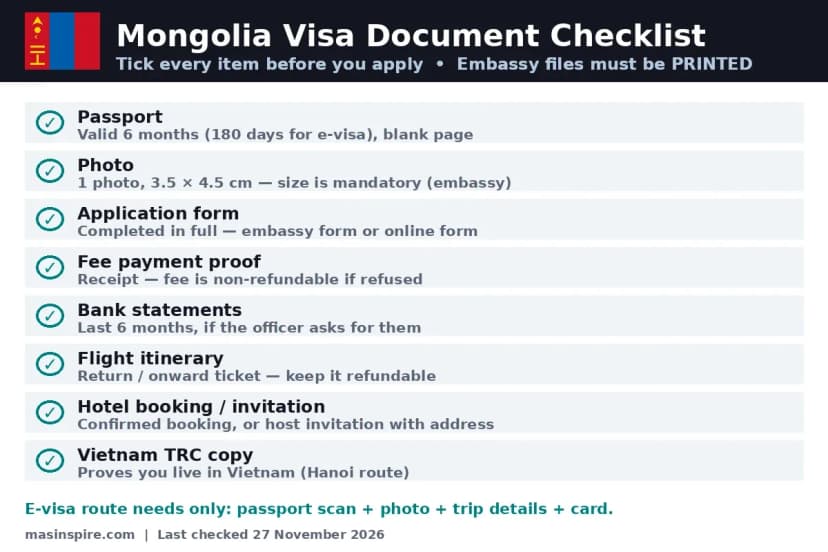
Gather these before you open the application, so you are not hunting for scans halfway through. The embassy tourist list below comes from the official consular service; the e-visa list is shorter, because the portal asks only for a passport scan, a photograph and trip details. Where a document is required by one source but not confirmed on the portal, that is noted.
Tourist e-visa (K2) — if the portal offers it for your passport
| Document | Requirement |
|---|---|
| Passport | Valid for at least 180 days at the time of application, with a blank page; a clear scan of the bio-data page |
| Photograph | Recent digital passport-style photo, plain background, as the portal asks for it |
| Trip details | Your travel dates, planned itinerary and accommodation details, as the application form asks for them; ger camps count as accommodation if the booking is real |
| Payment card | International Visa or MasterCard credit or debit card that works for online payments in US dollars; check with your bank before you apply, as many Pakistani debit cards need international transactions enabled first |
| Printed e-visa | Print the PDF the portal emails you and carry it with your passport; border officers expect it, and airlines ask for it before boarding |
| Invitation | Only if the portal asks for one in your application — see the e-visa conflict above; have a hotel booking or a licensed tour operator ready |
Tourist visa at the Hanoi embassy
| Document | Requirement |
|---|---|
| Passport in original | Valid for a minimum of six months before your intended travel, with a blank visa page; the embassy keeps it while the visa is processed |
| Completed application form | The embassy's form, filled in completely; download it in advance from consul.mn if the Hanoi embassy directs you there |
| Photograph | One 3.5 x 4.5 cm photo — the consular service states this size is mandatory |
| Proof of visa fee payment | Receipt as the embassy instructs; the fee is non-refundable |
| Proof of sufficient funds | Bank statements for the recent six months, if the visa officer asks for them; the consular service lists these as required "if necessary" |
| Flight itinerary | Return or onward ticket, or a verifiable flight reservation; keep bookings refundable until the visa is approved |
| Hotel booking or invitation | Confirmed hotel booking, or an invitation letter from a host in Mongolia with a full address |
| Travel itinerary | A day-by-day plan covering the places you intend to visit |
| Vietnam residence proof | Your Vietnamese temporary residence card (TRC) and a copy, to show you live in Vietnam and are applying at the Hanoi mission |
| Travel insurance | Not listed as a required document by the consular service, but strongly advisable for Mongolia, where medical evacuation is expensive |
All documents for the embassy must be hard copies, printed out. The consular service states this plainly: the embassy will not accept soft copies. The visa officer may require additional documents to prove the purpose of your visit, so bring more than the minimum — salary slips or business records if you are employed or self-employed, and your CNIC copy if you have one with you. Agent guides for Pakistanis quote a bank closing balance of PKR 1,000,000–2,000,000 and six-month statements with an account maintenance certificate; no official minimum-funds figure is published for Mongolia, so treat those numbers as an agent's rule of thumb, not a requirement, and let a healthy, active statement speak for itself.
Business visa
| Document | Requirement |
|---|---|
| Passport in original | Valid for a minimum of six months, with a blank visa page |
| Completed application form | The embassy's form, filled in completely |
| Photograph | One 3.5 x 4.5 cm photo (mandatory size) |
| Visa permission | Applied for by the Mongolian inviting company or organisation through the Immigration Agency before you apply; you apply only after the permission is issued and notified to the mission |
| Proof of visa fee payment | Receipt as the embassy instructs; non-refundable |
| Business purpose evidence | Invitation letter, conference or meeting details, and your company's letter stating your role and the purpose of the trip |
Student and work visas
| Document | Requirement |
|---|---|
| Passport in original | Valid for a minimum of six months, with a blank visa page |
| Completed application form | The embassy's form, filled in completely |
| Photograph | One 3.5 x 4.5 cm photo (mandatory size) |
| Visa permission | Applied for by the inviting university or employer through the Immigration Agency before you apply |
| Admission or employment proof | University admission letter for students; employment contract for workers |
| Proof of visa fee payment | Receipt as the embassy instructs; non-refundable |
How to Apply: Step-by-Step
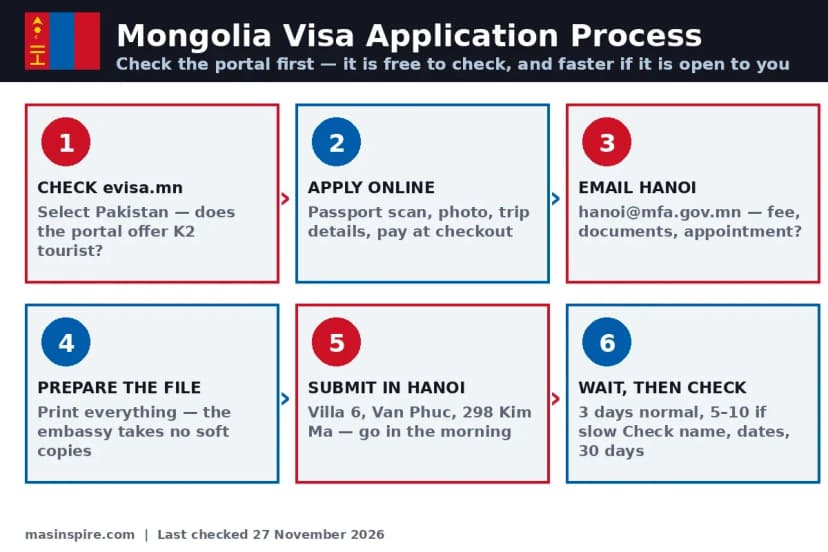
There are two routes, and the order matters: check the portal first, because it is free to check and it is the faster route if it is open to you. Only fall back to the embassy if the portal does not offer you the K2 category.
Route A — the e-visa, if the portal offers K2 for a Pakistani passport
| Step | What to do |
|---|---|
| 1. Check eligibility | Open evisa.mn yourself — type the address, do not follow an agent's link. Select Pakistan as the nationality of your travel document and see whether the K2 tourist category is offered. |
| 2. Prepare your scans | Scan your passport bio-data page and prepare a recent digital photograph on a plain background. Check your passport has at least 180 days of validity. |
| 3. Fill in the form | Complete the online application with your personal details, travel dates, itinerary and accommodation. Answer truthfully and completely; an error can restart the processing clock. |
| 4. Check the fee, then pay | Read the exact fee shown on the payment screen before you pay — that figure is the controlling one. Pay by international card. The fee is non-refundable, even if the visa is refused. |
| 5. Wait for the email | The e-visa arrives by email, normally within 72 hours and usually within 3–5 working days. Check your spam folder as well as your inbox. |
| 6. Print it | Print the e-visa PDF and carry it with your passport. The portal itself tells travellers to carry the printout, and airlines and border officers expect it. |
| 7. Travel | Fly within the 150-day validity window. Your 30-day stay is counted from your arrival date, not from the issue date. |
Route B — the Embassy of Mongolia in Hanoi
| Step | What to do |
|---|---|
| 1. Email first | Write to hanoi@mfa.gov.mn before you travel to Hanoi. Confirm that the embassy accepts visa applications from a Pakistani passport holder resident in Vietnam, ask for the current fee in US dollars, the exact document list, and whether an appointment is needed. |
| 2. Prepare the file | Assemble the embassy tourist checklist above — original passport, form, 3.5 x 4.5 cm photo, six-month bank statements, flight itinerary, hotel booking or invitation, day-by-day itinerary, TRC copy. Print everything: the embassy does not accept soft copies. |
| 3. Go in the morning | Go to Villa 6, Van Phuc Diplomatic Quarter, 298 Kim Ma, Ba Dinh, Hanoi, in the morning, Monday to Friday. Older traveller reports say the embassy takes a long lunch break from around noon and that the bank used for visa payment closes at 4 pm — hours could not be verified on an official page, so confirm them by email first. |
| 4. Submit and pay | Submit the file and pay the fee exactly as the embassy instructs. Keep the receipt and the collection slip. |
| 5. Wait | Normal processing is 3 working days, but some applications take 5–10 working days. Do not book a non-refundable onward flight until the visa is in your passport. |
| 6. Collect and check | Collect your passport and check the visa at the counter: your name, the dates, single entry, and the 30-day stay. Report any error before you leave. |
If the portal does not offer you K2 and you are still in Pakistan rather than Vietnam, the embassy route runs through the nearest Mongolian mission covering Pakistan — commonly New Delhi or Beijing — or through the Honorary Consul of Mongolia in Karachi, who can advise where to apply. From Vietnam, Hanoi is the mission to use, and you should not travel to Beijing or New Delhi for a visa without first confirming in writing that the mission there will accept your application.
Applying from Vietnam — and from Pakistan
Living in Vietnam changes the practicalities, not the rules. The visa requirement follows your Pakistani passport, and no source found in this research gives Pakistani holders of a Vietnamese residence permit any simplified or facilitated Mongolia route — unlike some other countries, where a Vietnamese residence permit does simplify the application. Do not assume your TRC helps with the visa itself; it helps in a different way, by giving you a real mission to apply at.
From Ho Chi Minh City, you have three practical options. The first is the e-visa, if the portal offers it — entirely online, no travel, no passport posting. The second is the Embassy of Mongolia in Hanoi: a domestic flight or an overnight train to Hanoi, a morning at the embassy, and a wait of 3–10 working days, which may mean a second trip to collect your passport or a courier arrangement agreed with the embassy in advance. The third is the Mongolian Honorary Consulate in Ho Chi Minh City, which can advise on the process and may be able to point you to the right channel, but which is an honorary post — confirm by phone ((+84) 28-3997 0691, as listed by secondary sources) whether it accepts visa applications at all before you go there with your passport.
From Pakistan, the position is harder: there is no Mongolian embassy in Pakistan, only an Honorary Consul in Karachi (93/II, Street 17, Khayaban-e-Rahat, Phase VI, DHA, Karachi; +92 21 35856210). Applications are typically routed through the nearest Mongolian mission covering Pakistan, commonly New Delhi or Beijing, which adds courier time and cost — one agent guide quotes 2–4 weeks end to end. If you are already living in Vietnam, apply from Vietnam; do not send your passport back to Pakistan to apply from there.
One document deserves a warning. Pakistan requires a polio vaccination certificate for departures from Pakistan to some destinations, and some guides list a NADRA polio certificate among the documents for a Mongolia visa from Pakistan. Whether that certificate is required when you depart from Vietnam, on a flight that never touches Pakistan, could not be verified — no official Mongolian source lists it, and it is a Pakistani exit requirement, not a Mongolian entry requirement. Ask the Hanoi embassy or your airline before you travel, and carry your vaccination record if you have one.
After Arrival: Registration, Extension and Staying Longer
Getting the visa is only half the job. Mongolia registers foreign nationals after arrival, and the duty falls on your host, not on you — but you are the one who suffers if it is not done, so check that it has been done.
Registration within 48 hours. The consular service states that individuals or hotels providing accommodation must register foreign nationals online through the Immigration Agency within 48 hours of arrival. Your hotel, ger camp or host does this on the Immigration Agency's system (eimmigration.mn) or through its app. When you check in, ask the receptionist directly whether your registration has been submitted, and keep the confirmation if one is given. This applies even for stays shorter than 30 days.
Registration for longer stays. If your stay goes beyond 30 days, a separate immigration registration applies within 7 working days of arrival, according to independent guides. The distinction matters if you extend: the 48-hour host registration and the longer-stay registration are two different obligations, and your host or the Immigration Agency can confirm which applies to you.
Extension — one further 30 days. The consular service states that a regular tourist visa allows a stay of up to 30 days, and that it may be extended for a further 30 days at the Immigration Agency of Mongolia if you apply for an extension not less than 4 days before your visa expires. Other guides say the application must be filed at least 5 working days before the stay ends. Plan on the stricter figure: file at least 5 working days before expiry, at the Immigration Agency in Ulaanbaatar (Service Hall 1882, Buyant-Ukhaa, 10th Khoroo, Khan-Uul District), or online through immigration.gov.mn, and bring your passport, a photo and a written reason for the extension with your accommodation address.
Conflict disclosed — is the e-visa extendable? The consular service's extension rule is written for a regular tourist visa. The e-visa portal's own terms, as reported by independent guides, describe the e-visa as non-extendable and non-convertible. Those two statements sit uneasily together, and no official page found in this research resolves them for a K2 e-visa holder. The safe reading is to treat an e-visa stay as 30 days only, and to plan your trip inside that window; if you need longer, ask the Immigration Agency in Ulaanbaatar in person before your 30 days run out, and do not assume an extension will be granted. Extensions are discretionary — the agency may refuse.
Extension fees (reported, not verified on an official page). Independent guides that reproduce the Immigration Agency's fee list quote 40,000 MNT for an extension of 1–7 days and 168,800 MNT for 30 days, rising by 5,600 MNT per day from day 8. Those figures were not found on an official English-language page on 27 November 2026, so confirm the current fee at the Immigration Agency before you pay, and pay in tugrik.
Work and Study Routes
Neither the tourist visa nor the business visa gives the right to work in Mongolia, and neither is a route to residence. If you want to work or study, the process starts in Mongolia, not at the embassy: your inviting employer or university applies for visa permission from the Immigration Agency of Mongolia, and you apply for the visa only after that permission is issued and notified to the mission where you will submit your application.
| Route | How it works | Stay | Key requirement |
|---|---|---|---|
| Business visa | Mongolian company applies for visa permission; you collect the visa at the embassy | Up to 30 days per visit; longer and multiple-entry versions with approval | Invitation and visa permission; no inviter-free short-term business visa exists |
| Student visa | University applies for visa permission; you apply at the embassy with the admission letter | As issued, for the study period | Admission letter and visa permission |
| Work visa | Employer applies for visa permission and a work permit; you apply at the embassy | As issued, for the employment period | Employment contract and visa permission; employer sponsorship is essential |
| Family / private visit | Host in Mongolia applies for visa permission; you apply at the embassy | As issued | Host invitation and visa permission |
Since 20 September 2024, the inviting entity applies for visa permission electronically through the Immigration Agency's system, for all invitation-based categories. There is no officially documented short-term business visa that can be obtained without an inviting entity; the only inviter-free short-stay option is the K6 transit visa, which is for transit and not for business activity. Be very cautious of anyone offering a Mongolian work visa without a named Mongolian employer and a visa permission: the permission is the visa, in practice, and without it there is nothing for the embassy to issue. Teaching English in Mongolia is a real market — Ulaanbaatar has international schools and language centres — but it is a small one, and a job offer should be verified with the school and with the embassy before you resign from anything in Vietnam.
Transit, Overstay and Refusals
Transit (K6). The K6 transit e-visa allows a stay of up to 10 days for travellers passing through Mongolia to a third country. You need an onward flight or train ticket and, if the country you are travelling to after Mongolia requires one, a visa for that country. The transit fee is consistently reported at about USD 25. Transit visas can also be applied for at Mongolian borders if you hold an onward ticket, according to the consular service, but do not rely on a border application as a Pakistani passport holder — apply before you travel.
Overstay. Do not overstay. Independent guides report a fine of 10,000 MNT per day of overstay (10 units of 1,000 MNT each), payable on departure — but that figure comes from secondary sources and was not verified on an official page, so treat it as indicative. What is certain is that an overstay is recorded, that it can lead to detention, a fine and a future entry ban, and that leaving Mongolia after an overstay may require an exit visa from the Immigration Agency. If your 30 days are running out and no extension has been granted, leave before the last day.
Refusals. The visa fee is non-refundable, including if the visa is refused, so a refusal costs you the fee and the trip. The most common reasons for refusal or delay are an incomplete file, an inconsistent itinerary (hotel dates that do not match flight dates, or a host address that cannot be verified), insufficient proof of funds, a passport with less than six months of validity, and a photograph that does not meet the 3.5 x 4.5 cm requirement for embassy applications. If your application is refused, ask the embassy for the reason in writing before you reapply; reapplying with the same file unchanged is the fastest way to be refused twice. There is no verified appeal process published for tourist visa refusals — a fresh, corrected application is the usual route.
Biometrics and entry. Foreign nationals are required to provide biometric details at border control when entering Mongolia, according to the consular service. A visa does not guarantee entry: the border officer makes the final decision, and you should carry the same documents you applied with — the printed e-visa or the visa in your passport, your return ticket, your hotel booking or invitation, and proof of funds — in your hand luggage, not in checked baggage.
Travel, Flights and Money: Practical Notes
Flights. There is no direct flight from Vietnam or from Pakistan to Ulaanbaatar. The usual routings from Ho Chi Minh City run through Beijing, Seoul, or Istanbul, and from Pakistan through Beijing, Dubai or Istanbul, with onward flights into Chinggis Khaan International Airport (UBN). No direct Vietnam–Mongolia or Pakistan–Mongolia service was found in this research, and flight schedules on this route are thin and seasonal, so check the routing and the transit visa rules for your stopover country as well — a transit through China, for example, has its own visa rules for Pakistani passport holders. Book refundable flights until the visa is approved.
When to go. The Naadam festival in mid-July is the peak of the tourist year, and the week around it is when Mongolian embassies close for about a week — apply well before July if you are travelling for Naadam, and book ger camps and domestic transport months ahead. Winter in Ulaanbaatar is brutally cold, regularly below minus 20 degrees Celsius, and many ger camps close; late May to September is the practical window for a first trip, with June to August the warmest and busiest.
Money. The currency is the Mongolian tugrik (MNT). Cash is still king outside Ulaanbaatar, and ger camps and rural guesthouses may not take cards at all, so carry enough tugrik for the countryside and keep your card for the city. Your Pakistani debit card may need international transactions enabled before it works abroad, and the same applies to paying the e-visa fee online — enable it and test it before the day you apply. Travel insurance is strongly advisable: medical facilities outside Ulaanbaatar are basic, and evacuation to Beijing or Seoul is expensive.
Staying connected and safe. Buy a local SIM card at the airport or in Ulaanbaatar for maps and translation, because English is limited outside the capital and almost non-existent in the countryside. Mongolia is generally safe for travellers, but the steppe is vast and unforgiving: never travel into the Gobi or the mountains without a local driver or guide, a charged phone, water and a plan for where you will sleep. Tell your hotel or host where you are going each day.
Common Mistakes and Rejection Reasons
| Mistake | Why it hurts you | Do this instead |
|---|---|---|
| Assuming the e-visa is open to you | Sources conflict on Pakistani eligibility; an agent may take your money for an application the portal will not accept | Check evisa.mn yourself for your passport before paying anyone |
| Paying the USD 52.50 figure as a fact | No source verifies USD 52.50 for a Pakistani passport; you may budget wrong or be overcharged by an agent | Budget about USD 50 and let the portal checkout or the embassy set the price |
| Booking non-refundable flights first | A refused or delayed visa turns a cheap flight into a lost fare | Hold the visa, then book; keep everything refundable until then |
| Passport under 6 months | The e-visa needs 180 days and the embassy needs 6 months; a short passport is refused outright | Renew your Pakistani passport first if it is near expiry |
| Wrong photo size | The embassy photo size of 3.5 x 4.5 cm is stated as mandatory | Get the photo taken to that exact size, on a plain background |
| Soft copies at the embassy | The consular service states the embassy will not accept soft copies | Print every document before you go to Hanoi |
| Forgetting the 48-hour registration | Your host must register you within 48 hours; an unregistered stay can cause trouble on departure | Ask your hotel or host on arrival whether registration is done |
| Planning a 31-day trip on a 30-day visa | The e-visa may be non-extendable even though a regular tourist visa can be extended | Plan inside 30 days, or file for an extension at least 5 working days early |
| Using an agent's link to apply | Third-party sites add service charges for the same government form | Type evisa.mn yourself and pay only on the official portal |
Frequently Asked Questions
1. Do Pakistani passport holders need a visa for Mongolia?
Yes. Every holder of an ordinary Pakistani passport needs a visa before travelling to Mongolia. Pakistan is not on the visa-free list, and there is no visa on arrival for ordinary Pakistani tourists.
2. Can Pakistanis apply for the Mongolia e-visa online?
This could not be settled beyond doubt on 27 November 2026. The official portal evisa.mn lists Pakistan among the country names on its homepage, and 2026 guides for Pakistanis say Pakistan is eligible for the K2 tourist e-visa — but other careful sources, including a Pakistan-focused guide checked on 7 November 2026 and the compiled e-visa lists, say Pakistan is not on the e-visa list and that Pakistanis must apply at an embassy. Check the portal yourself for your passport: if it offers you the K2 category, apply there; if it does not, use the Embassy of Mongolia in Hanoi.
3. How much is the Mongolia e-visa fee for a Pakistani passport?
There is no verified fee for a Pakistani passport. The most commonly reported figure is about USD 50 for a K2 tourist e-visa and about USD 25 for a K6 transit e-visa, with the portal's nationality-based schedule producing totals from about USD 5.50 to USD 51.50. The commonly repeated figure of USD 52.50 was not verified in any source found in this research and is not presented as a fact here. The exact fee is shown on the portal at checkout, and that figure is the controlling one. The fee is non-refundable.
4. How long does a Mongolia visa take to process?
The consular service states a normal processing time of 3 working days, with some applications taking 5–10 working days, and the e-visa arriving by email within 72 hours. Independent guides put e-visa processing at 3–5 working days and embassy processing at 7–15 working days including courier time. Apply at least three weeks before travel.
5. How long can I stay in Mongolia on a tourist visa?
Up to 30 days on a single entry. A regular tourist visa may be extended for a further 30 days at the Immigration Agency if you apply at least 4 days before expiry — other guides say at least 5 working days, so plan on 5 working days. Whether a K2 e-visa can be extended is disputed: the portal's terms describe the e-visa as non-extendable, so plan your trip inside 30 days.
6. How long is the e-visa valid for?
The e-visa is valid for 150 days from the date of issue, which is the window in which you must enter Mongolia. The 30-day stay is counted from your arrival date, not from the issue date.
7. Is there a Mongolian embassy in Vietnam?
Yes. The Embassy of Mongolia in Hanoi is at Villa 6, Van Phuc Diplomatic Quarter, 298 Kim Ma, Ba Dinh, Hanoi (also given as 44 Van Bao Street in the same quarter), telephone +84 24 3845 3009, email hanoi@mfa.gov.mn. There is also a Mongolian Honorary Consulate in Ho Chi Minh City. Opening hours could not be verified on an official page, so confirm them by email before you go.
8. Is there a Mongolian embassy in Pakistan?
No. There is no Mongolian embassy in Pakistan. There is an Honorary Consul in Karachi (93/II, Street 17, Khayaban-e-Rahat, Phase VI, DHA, Karachi; +92 21 35856210), and applications from Pakistan are typically routed through the nearest Mongolian mission covering Pakistan, commonly New Delhi or Beijing. If you live in Vietnam, apply from Vietnam through Hanoi.
9. Do I need an invitation letter to visit Mongolia as a tourist?
Not necessarily. For the K2 tourist e-visa, the portal asks for a passport, a photograph and trip details, and an invitation is required only if the portal asks for one in your application. For an embassy tourist visa, a confirmed hotel booking is usually enough, and an invitation letter is needed only if you are staying with a host. For business, work, study and family visas, an invitation and visa permission from the Mongolian inviter are always required.
10. What documents do I need for a Mongolia tourist visa?
For the e-visa: a passport valid at least 180 days, a digital photograph, trip and accommodation details, and an international payment card. For the embassy: your original passport valid at least six months, a completed form, one 3.5 x 4.5 cm photo, proof of fee payment, six-month bank statements if asked for, a flight itinerary, a hotel booking or invitation, and a day-by-day itinerary. All embassy documents must be printed — soft copies are not accepted.
11. How much money do I need to show in my bank account?
No official minimum-funds figure is published for Mongolia. The consular service lists bank statements for the recent six months as required "if necessary". Agent guides for Pakistanis quote a closing balance of PKR 1,000,000–2,000,000, but that is an agent's rule of thumb, not an official requirement. A healthy, active six-month statement is the practical standard.
12. Can I work in Mongolia on a tourist visa?
No. A tourist visa — and a business visa — does not give the right to work or earn income in Mongolia. Employment needs a work visa, which starts with your Mongolian employer applying for visa permission from the Immigration Agency before you apply at the embassy.
13. Do I need to register after I arrive in Mongolia?
Your host must register you. Whoever provides your accommodation — hotel, ger camp or private host — must register you online with the Immigration Agency within 48 hours of arrival. Ask on check-in whether it has been done. If your stay goes beyond 30 days, a separate immigration registration applies within 7 working days of arrival.
14. Can I travel from Vietnam to Mongolia without a transit visa for my stopover?
That depends on your stopover country, not on Mongolia. There is no direct flight from Vietnam to Ulaanbaatar; the usual routings go through Beijing, Seoul or Istanbul, and each stopover country has its own transit rules for Pakistani passport holders. Check the transit rules for your stopover before you book, and keep your Mongolia visa and onward ticket in your hand luggage.
15. What happens if I overstay my Mongolia visa?
Do not overstay. Secondary sources report a fine of 10,000 MNT per day, but that figure was not verified on an official page. What is certain is that an overstay is recorded, can lead to a fine, detention and a future entry ban, and may require an exit visa from the Immigration Agency before you can leave. If your 30 days are running out, apply for an extension at least 5 working days early, or leave before the last day.
Official Immigration Websites
Always confirm the live rules on the official sources below before paying any fee or booking a non-refundable ticket. Where an official page and a third-party guide disagree, the official page — and, for the fee, the portal's own checkout screen — is the controlling source.
| Website | What it is | Use it for |
|---|---|---|
| evisa.mn — Mongolia Electronic Visa Application System | Official e-visa portal, run by the Immigration Agency of Mongolia | Checking K2 eligibility for a Pakistani passport, applying online, paying the fee, receiving the e-visa by email |
| en.consul.mn — Consular Service of Mongolia, visa requirements | Official consular service visa page | E-visa categories (K2, K4, K6), processing times, embassy document lists, extension and registration rules |
| immigration.gov.mn — Immigration Agency of Mongolia | Official Immigration Agency site | Visa permission, visa extension, foreigner registration, and the agency's fee lists |
| mfa.gov.mn — Ministry of Foreign Affairs of Mongolia | Official Ministry of Foreign Affairs site | Diplomatic missions, consular information, and the Hanoi embassy's contact details |
| hanoi.mfa.gov.mn — Embassy of Mongolia in Hanoi | Official website of the Embassy of Mongolia in Hanoi | Embassy address, hours, and the visa procedure for applicants living in Vietnam |
| gov.uk — UK FCDO travel advice for Mongolia | UK government travel advice (independent official source) | Entry requirements and practical travel advice, as a cross-check on the Mongolian sources |
Editorial note: This guide was last checked on 27 November 2026. The single most important unresolved question in it — whether a Pakistani passport holder can use the K2 e-visa — is stated as unresolved, with the evidence on both sides, because no published official page settled it on that date. The Embassy of Mongolia in Hanoi (hanoi@mfa.gov.mn, +84 24 3845 3009) is the authority that can settle it for your own case. This guide is not legal advice and is not issued by any government.