

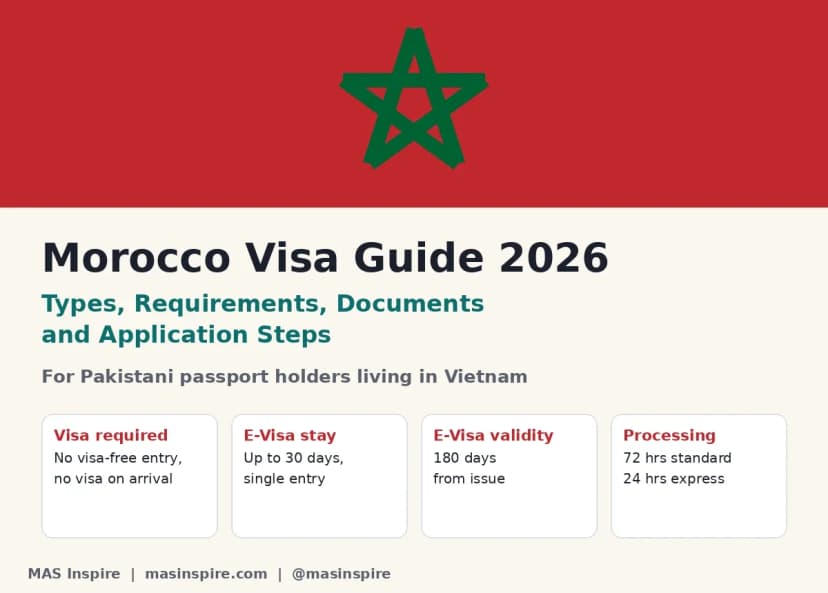
Morocco Visa Guide 2026: Types, Requirements, Documents and Application Steps
Last checked: 27 November 2026. This guide is for Pakistani passport holders living in Vietnam. Visa rules change without notice — always confirm the live rules on the official e-visa portal (acces-maroc.ma) and with the Embassy of Morocco in Hanoi before paying any fee or booking a non-refundable ticket.
Table of Contents
- Introduction
- Do Pakistani Passport Holders Need a Visa for Morocco?
- Types of Morocco Visas for Pakistani Passport Holders
- The Morocco E-Visa: Who Qualifies and Who Does Not
- Morocco Visa Fees
- Processing Times
- Complete Document Checklists
- How to Apply: Step-by-Step
- Applying from Vietnam — and from Pakistan
- Entry Rules and What to Show at the Border
- Work and Study Routes
- Transit, Overstay and Extensions
- Travel, Flights and Money: Practical Notes
- Common Mistakes and Scams to Avoid
- Frequently Asked Questions
- Official Immigration Websites
Introduction
Morocco is the North African destination most Pakistani travellers in Vietnam have on a wish list and almost never plan properly, because the visa looks simple from a distance and turns out to be conditional up close. Marrakech's Jemaa el-Fnaa square, the blue streets of Chefchaouen, the dunes of Merzouga, the imperial cities of Fez and Meknes, and the Atlantic coast at Essaouira are all real and all reachable — but the route to them depends on one question that has to be answered before anything else: do you already hold a qualifying visa or residence permit from another country? For a Pakistani passport holder, that single question decides whether you apply online in three days or file a paper application at an embassy.
This guide gives the route exactly as the official sources state it on 27 November 2026. The controlling document is the official e-visa briefing note published on Morocco's own portal, acces-maroc.ma, which this guide quotes directly. Where the official sources are silent — and on embassy fees and embassy processing times they are — this guide says so plainly and shows you the range of figures circulating instead of dressing one of them up as fact. There are three honest complications, and it is better to meet them here than at a payment page or at a check-in desk. First, the official e-visa briefing note does not publish any fee at all: the widely quoted figure of 770 Moroccan dirhams (MAD) comes from third-party reports of the portal's checkout, and one aggregator reports something very different, so no fee figure in this guide is presented as the official e-visa fee. Second, the "90 days" you will see quoted everywhere for Morocco is the stay allowed to visa-exempt nationalities, not to you: the official e-visa allows a stay of at most 30 days. Third, living in Vietnam does not by itself open the e-visa for a Pakistani passport holder, even though Vietnamese citizens can apply for the e-visa on their passport alone — the e-visa categories turn on nationality and on residence in a listed country, and Vietnam is on the nationality list but not on the residence list. That distinction is the single most misunderstood fact in this whole subject, and it is explained in full in the e-visa section below.
Living in Vietnam still gives you a practical advantage: Morocco has a resident embassy in Hanoi, at 9 Chu Van An in Ba Dinh district, so if the e-visa is closed to you, the embassy route does not require a trip back to Pakistan. You can prepare the file from Ho Chi Minh City, contact the Hanoi mission, and file there. What follows is what the portal shows, what the Ministry of Foreign Affairs publishes, what the embassies list, and what you must check yourself before you pay.
Do Pakistani Passport Holders Need a Visa for Morocco?
Yes. Every ordinary Pakistani passport holder needs a visa before travelling to Morocco, whatever the purpose and whatever the length of the visit. Pakistan is not on Morocco's visa-exemption list, and Morocco offers no visa on arrival to Pakistani citizens. You must hold either an e-visa issued through the official Accès Maroc portal or a consular visa stamped in your passport by a Moroccan embassy before you board your flight. Airlines flying to Casablanca or Marrakech will check for it at check-in, and you will be refused boarding without it.
The visa-exemption list published by Morocco's Ministry of Foreign Affairs covers around ninety nationalities, including the United States, the United Kingdom, most of Europe, the Gulf states, Saudi Arabia, Turkey, Indonesia and Malaysia. Pakistan is not on it. Pakistan does appear on one Moroccan waiver list, but only for diplomatic, service and special passports; ordinary passports are expressly not covered, so that waiver does not help an ordinary traveller. A small number of visa-exempt nationalities must additionally obtain an electronic travel authorisation (AEVM) before travel — as of late 2026 that applied to nationals of the Republic of the Congo, Ecuador, Ghana and Guinea — but that is a different document from the e-visa, and it does not apply to Pakistanis either.
That leaves two doors, and only two. Door one is the e-visa at acces-maroc.ma, open to Pakistanis only if they qualify under Category B (residence in a listed country) or Category C (a qualifying multiple-entry visa from a listed country), both explained in the e-visa section. Door two is the consular visa at a Moroccan embassy — for a resident of Vietnam, the Embassy of Morocco in Hanoi; for someone in Pakistan, the Embassy of Morocco in Islamabad. There is no third door. No agent, website or social-media advert can sell you a Morocco visa on arrival, a visa-free entry, or an e-visa for a Pakistani passport with no supporting document. The only official application site is www.acces-maroc.ma, run by Morocco's Ministry of Foreign Affairs, African Cooperation and Moroccan Expatriates.
| Question | Answer for ordinary Pakistani passports |
|---|---|
| Visa required? | Yes, always — before travel |
| Visa-free entry? | No — Pakistan is not on the exemption list |
| Visa on arrival? | No |
| E-visa on passport alone? | No — only under Category B (listed residence) or Category C (qualifying multiple-entry visa) |
| Embassy route | Embassy of Morocco in Hanoi (if resident in Vietnam) or Islamabad (if in Pakistan) |
| Official e-visa portal | www.acces-maroc.ma |
| E-visa stay | Up to 30 days, single entry, visa valid up to 180 days from issue |

Types of Morocco Visas for Pakistani Passport Holders
Morocco's visa system has two families: the electronic visa, issued online for short tourism or business visits, and the consular visa, issued as a sticker by an embassy for tourism, business, study, work, family visits and transit. The e-visa is the faster and cheaper route when you qualify for it, but it is narrow — tourism or business only, a single entry, and a stay of at most 30 days. The consular visa is slower and its fee and processing time are confirmed only at the mission, but it covers every purpose of visit, including the long stays the e-visa cannot.
| Visa type | Where to apply | Purpose | Entries | Stay |
|---|---|---|---|---|
| E-visa (tourism) | acces-maroc.ma | Tourism, sightseeing, visiting friends and family | Single entry | Up to 30 days; visa valid up to 180 days from issue |
| E-visa (business) | acces-maroc.ma | Business meetings, fairs, exhibitions, procurement | Single entry | Up to 30 days; visa valid up to 180 days from issue |
| Consular tourist visa | Embassy in Hanoi or Islamabad | Tourism and short visits | Single or double entry | Up to 90 days according to most secondary sources; the sticker itself states the stay — see the fee and conflict notes below |
| Consular business visa | Embassy in Hanoi or Islamabad | Business meetings and commercial activity | Single or double entry | As stated on the sticker; invitation from a Moroccan company or chamber required |
| Student visa (entry visa "Étude") | Embassy in Hanoi or Islamabad | Full-time study at a Moroccan institution | Single entry | Entry visa, then a student residence card in Morocco |
| Work visa | Embassy in Hanoi or Islamabad | Paid employment in Morocco | As issued | As issued; employment contract validated by the Moroccan Ministry of Employment required |
| Family visit visa | Embassy in Hanoi or Islamabad | Visiting family resident in Morocco | Single or double entry | As stated on the sticker; legalised invitation from the family member required |
| Transit visa | Embassy in Hanoi or Islamabad | Passing through Morocco to a third country | Single entry | Up to 72 hours (reported consular tariff) |
A note on the consular tourist visa stay, because this is where guides disagree most. Several secondary sources state that a consular tourist visa allows a stay of up to 90 days, matching the standard consular tariff's "under 3 months" wording, while at least one Pakistan-focused agency guide says the sticker typically returns a 30-day stay. Both cannot be the rule for every applicant, and no official source that could be loaded for this guide states the stay granted to a Pakistani tourist at the counter. Treat the sticker as the truth: whatever stay is printed on your visa is your stay, and plan your flights inside it. The e-visa figure, by contrast, is not in doubt at all — the official briefing note caps the e-visa stay at 30 days, and that is the number to plan on if you travel on an e-visa.
The e-visa cannot be used for study, salaried employment, religious missions or long-term settlement, and its holder may not under any circumstances apply for residency in Morocco on the strength of it. If your purpose is study or work, you need the consular route even if you qualify for the e-visa. A visa type also cannot be changed after entry, according to the Ministry's consular guidance, so choosing the right type before you travel matters more than it does in countries that allow in-country changes of status.
The Morocco E-Visa: Who Qualifies and Who Does Not
Morocco launched its e-visa on 10 July 2022. It is a one-person authorisation, issued online, allowing access and an uninterrupted stay of limited duration on Moroccan territory. The official briefing note on acces-maroc.ma divides applicants into three categories, and the whole eligibility question for a Pakistani passport holder is which of the three, if any, applies to you.
Category A — by nationality. Citizens of eleven countries qualify on their ordinary passport alone, provided the passport is valid for at least 90 days from the date of the e-visa application: Azerbaijan, Benin, Brunei Darussalam, Cambodia, Guatemala, India, Jordan, Laos, Israel, Thailand and Vietnam. Pakistan is not on this list. This is why so much of the advice circulating in South Asia does not transfer: India is on the list and Pakistan is not, so a guide written for Indian travellers will tell you the e-visa is open, and for your passport it is not open on this ground.
Category B — by residence. You qualify if you legally live in one of these places — the European Union, the United States of America, Australia, Canada, the United Kingdom, Japan, Norway, New Zealand, the United Arab Emirates or Switzerland — and you hold an ordinary passport valid for at least 90 days from the date of application plus a residence card or residence permit valid for at least 180 days on the date of the e-visa application. The residence card must be attached double-sided in colour; a receipt for a residence-card application, renewal or extension, a work permit, a circulation document or any other substitute is expressly not accepted. Vietnam is not on this list. That is the decisive fact for the reader of this guide: a Vietnamese temporary residence card (TRC) or work permit, however long its validity, does not make a Pakistani passport holder eligible for the e-visa under Category B. The large number of Pakistanis who do qualify under Category B are those living in the UAE, the UK, Europe and North America — a UAE residence visa, for example, opens the e-visa even though the passport is Pakistani, because the UAE is on the list and Vietnam is not.
Category C — by a visa you already hold. You qualify if you hold a multiple-entry, non-electronic visa from one of these places — Schengen, the United States of America, Australia, the United Kingdom, Ireland, Japan, Canada, Norway or New Zealand — on a regular passport valid for at least 90 days from the date of the e-visa application, and the visa itself must be multiple-entry and valid for at least 90 days starting from the date of the e-visa application. Three conditions, all of them strict: it must be multiple-entry (a single-entry Schengen visa does not count), it must be a physical sticker visa rather than an electronic authorisation (an e-visa or ETA from one of those countries does not count), and it must still have at least 90 days of validity left when you apply — measured from the application date, not your travel date. A valid US B1/B2 visa or a multiple-entry Schengen visa is the most common way a Pakistani traveller in Vietnam qualifies, if either is in the passport with enough validity left.
| Category | Who qualifies | Key conditions | Applies to a Pakistani in Vietnam? |
|---|---|---|---|
| A — nationality | Citizens of 11 listed countries (incl. India, Thailand, Vietnam) | Ordinary passport valid at least 90 days from application | No — Pakistan is not listed |
| B — residence | Residents of EU, USA, Australia, Canada, UK, Japan, Norway, New Zealand, UAE, Switzerland | Residence card/permit valid at least 180 days on application date; receipts and work permits not accepted | No — a Vietnamese TRC is not on the list; UAE residence would qualify |
| C — qualifying visa | Holders of a multiple-entry visa from Schengen, USA, Australia, UK, Ireland, Japan, Canada, Norway, New Zealand | Multiple-entry, non-electronic (sticker) visa, valid at least 90 days from application date | Yes, if you hold such a visa — e.g. a valid US B1/B2 or multiple-entry Schengen visa |
If none of the three categories applies to you — and for a Pakistani passport holder living in Vietnam with no qualifying third-country visa, none does — the official instruction is to apply for your visa at the Embassy or Consulate General of Morocco near your place of residence. For you, that is the Embassy of Morocco in Hanoi. Do not pay any website that promises a Morocco e-visa for a Pakistani passport with no other document; the portal's own eligibility checker will return the consular route for exactly that profile, and money paid to a look-alike site is money lost.
One more clarification, because a 2025 news report still causes confusion: in August 2025, Dawn quoted Morocco's ambassador in Pakistan as saying the e-visa had been extended to Pakistani citizens. Read with the briefing note, that means access through Categories B and C — the conditional routes described above — not an e-visa on passport alone. Several guides misread the report as a general opening, and it is not one.
The e-visa itself, once issued, is valid for a maximum of 180 days from the date of issue, for a single entry, with a stay not exceeding 30 days. The 180 days is the window in which you must make your one entry; the 30 days is how long you may remain once you enter. Leave Morocco — even briefly, for example for a day trip to Ceuta or Melilla — and the e-visa is used up; a new application is needed to return. Several e-visas cannot be stacked to cumulate stays: the briefing note states that the holder of several electronic visas may in no case cumulate the duration of stays granted, and must leave Moroccan territory at the end of the stay conferred by the first visa before benefiting from a new stay. Minors under 18 holding an e-visa may enter Morocco only with one of their parents or a legal representative. Only ordinary passports are accepted for the e-visa; holders of diplomatic, service, special passports or refugee travel documents must apply at an embassy. And an e-visa does not confer an irrevocable right of entry: border control may refuse entry to anyone who does not meet the conditions or the required evidence.
Morocco Visa Fees
Fees are the least certain part of this guide, and this section is written to show you exactly where each figure comes from rather than to pretend the picture is cleaner than it is. The official e-visa briefing note — the document that settles eligibility, validity, stay and processing time — publishes no fee at all. The fee is shown on the portal when you apply, and it is the portal checkout, not any guide, that is the controlling source for what you will actually pay.
| Fee | Figure | Source and status |
|---|---|---|
| E-visa, standard | MAD 770 (about USD 75–77) | Commonly reported by third-party guides as the portal's standard fee at launch; not published in the official briefing note — verify at checkout |
| E-visa, express | MAD 1,100 (reported) | Reported at launch as the express fee; not published in the official briefing note — verify at checkout |
| E-visa, alternative report | About USD 30 | One aggregator reports the e-visa fee at about USD 30 and notes the official terms page does not publish it — conflicts with the MAD 770 report; see conflict note below |
| Consular tourist visa, single entry (under 3 months) | MAD 220 (about USD 22–23) | Standard consular tariff reported consistently across secondary sources as the consulat.ma figure; not confirmed on a loadable primary government page — confirm at the mission |
| Consular tourist visa, double entry (under 3 months) | MAD 330 (about USD 33–34) | Same status as the single-entry tariff above |
| Consular transit visa (up to 72 hours) | MAD 170 (about USD 17–18) | Same status as the tariff above |
| Student entry visa | MAD 220 single / MAD 330 double (reported) | Reported as the consular student-visa tariff; waived for AMCI scholars according to one secondary source |
| Student residence card (in Morocco) | MAD 100 duty (reported) | Reported from the Idarati.ma procedure sheet; secondary source only |
Against that tariff, Pakistan-focused agencies quote very different embassy figures: around USD 100 per applicant in one current guide, PKR 20,000–30,000 in another, and roughly USD 20–30 in a third. Those figures cannot all be the government fee, and at least some of them plainly include service charges, courier costs or the agency's own margin. If an embassy or agent quotes you a figure far above MAD 220 for a single-entry tourist visa, ask in writing what the government fee is and what the rest of the charge covers before you pay. The e-visa fee, once validated and paid, cannot be cancelled or refunded under any circumstances, according to the official briefing note — so run the eligibility checker and check every field before you pay, because a refused or mistaken application does not get its money back.
There is no published official minimum bank balance for a Morocco visa. Agencies quote PKR 500,000 or more with six months of history in one guide, and PKR 800,000–1,800,000 (USD 3,000–6,000) in another. Neither figure is an official requirement, and neither should be treated as one. What the official briefing note does require at the border is proof of livelihoods: an international bank card or the equivalent of more than 70 euros, in cash, per person per day during the stay. For a 10-day trip that is more than 700 euros per person, and your bank statement should comfortably support the trip you describe — that is the practical test, not any published threshold.
Processing Times
The e-visa processing times are official and precise. The standard e-visa is issued within 72 hours, and the express e-visa within 24 hours — in both cases counted in Moroccan working days, not calendar days. A standard application filed before a weekend or a Moroccan public holiday can therefore take the better part of a calendar week, and the deadline does not apply to incomplete applications or applications containing false information. Track your application by logging in to your account on the portal and clicking "follow my eVisa request": the statuses are In Process, Waiting to be completed (complete the application as indicated), and Application Refused.
| Route | Processing time | Status |
|---|---|---|
| E-visa, standard | 72 Moroccan working hours | Official — acces-maroc.ma briefing note |
| E-visa, express | 24 Moroccan working hours | Official — acces-maroc.ma briefing note |
| Consular visa (embassy) | 7–15 working days (most agency guides); 10–15 working days (some guides); 13–26 business days (one aggregator); 15 days (one Vietnam-focused directory) | Not published officially — see conflict note; apply at least 2 weeks ahead, and 6 weeks ahead if the Hanoi mission advises it |
For the embassy route, plan conservatively. One Vietnam-focused directory advises applying at least six weeks before travel for a tourist visa filed at the Hanoi mission; Pakistan-focused agencies generally say to submit at least two weeks before travel and to expect 7–15 working days after acceptance. Because no official processing time for the embassy route could be verified for this guide, the safe plan is to file at least four to six weeks before departure, keep your flights changeable until the visa is in your passport, and never pay for a non-refundable ticket before the visa is issued.

Complete Document Checklists
Checklists differ by route, and the e-visa checklist is the one that is officially published in full. The embassy checklist below is assembled from agency guides and the Hanoi mission's published requirements, because no official Islamabad or Hanoi checklist with a fee and appointment process could be found for this guide — confirm the exact list with the mission before you travel to file.
E-Visa (acces-maroc.ma) — official checklist
- Ordinary Pakistani passport valid for at least 90 days from the date of the e-visa application (diplomatic, service, special passports and refugee travel documents are not accepted for the e-visa).
- Colour photograph, 35 x 45 mm, of good quality, taken within the last 6 months, showing the facial features clearly, in accordance with ICAO standards.
- Clear colour copy of the valid ordinary passport (the pages indicating identity and validity).
- Category B only: clear colour copy of both sides of the residence card or residence permit, valid for at least 180 days on the date of the application. Receipts of application, renewal or extension, special certificates, work permits and circulation documents are not accepted.
- Category C only: clear colour copy of the multiple-entry, non-electronic visa, valid for at least 90 days from the date of the application.
- Business e-visa only: a document justifying the purpose of the trip — a recommendation from the responsible ministry for public procurement, a written recommendation from the professional chambers for private procurement, an invitation from the organiser for fairs and exhibitions, an invitation from an industrial, commercial or service operator, or any other proof.
- Scans in jpg, jpeg or pdf format, each not exceeding 1 MB.
- Payment method for the online fee (card payment on the portal).
- For a family or group travelling together, group the applications into a single file so that all are processed together.
Embassy consular visa (Hanoi or Islamabad) — assemble and confirm with the mission
- Original passport valid at least 6 months beyond entry, with at least 2 blank visa pages.
- Completed and signed visa application form (from the embassy).
- Recent passport-sized photographs — agency guides disagree on the background: one specifies three 35 x 45 mm photographs on a blue background for the embassy route, others say white background; the Hanoi directory lists two identical photographs, 40 mm x 30 mm, on a white background. Confirm the background and size with the mission before you print them.
- CNIC copy (for applicants filing in Pakistan; carry it if filing in Hanoi as well, since the file is assessed on a Pakistani passport).
- Bank statement for the last 3–6 months showing financial stability, plus an account maintenance certificate where the mission asks for one.
- Proof of employment, or business registration if self-employed.
- Proof of accommodation in Morocco (hotel booking or host invitation).
- Return or onward flight itinerary.
- Travel and health insurance covering the stay, including hospital and sanitary repatriation cover.
- Cover letter stating the purpose of visit and a day-wise itinerary.
- Invitation letter where applicable — from a Moroccan host for a family visit (duly legalised and attested), or from a Moroccan company or chamber for business.
- Visa fee payment receipt, as instructed by the mission.
- For minors: birth certificate and, if not travelling with both parents, an authorisation letter from the absent parent, certified by a notary.
Student visa — additional documents
- Certificate of enrolment and/or scholarship from the Moroccan Agency for International Co-operation (AMCI) for a public university or a private higher education institute.
- Prior approval of the Ministry of Foreign Affairs, except for students enrolled at major Moroccan schools approved by the proper authority.
- A duly signed and legalised guarantor's promissory note from a close relative or a person resident in Morocco, who guarantees accommodation and financial expenses and commits to cover repatriation costs if the student is expelled.
- Proof of sufficient means of subsistence for the period of the course.
- A document reflecting the commitment to leave Moroccan territory as soon as the residence permit expires.
Work visa — additional documents
- Employment contract duly validated by the Moroccan Ministry of Employment (and approved by the Ministry of Employment and Social Affairs).
- Invitation letter from the hiring company including the applicant's full name and passport number.
- Residence permit or document showing a proper address.
How to Apply: Step-by-Step
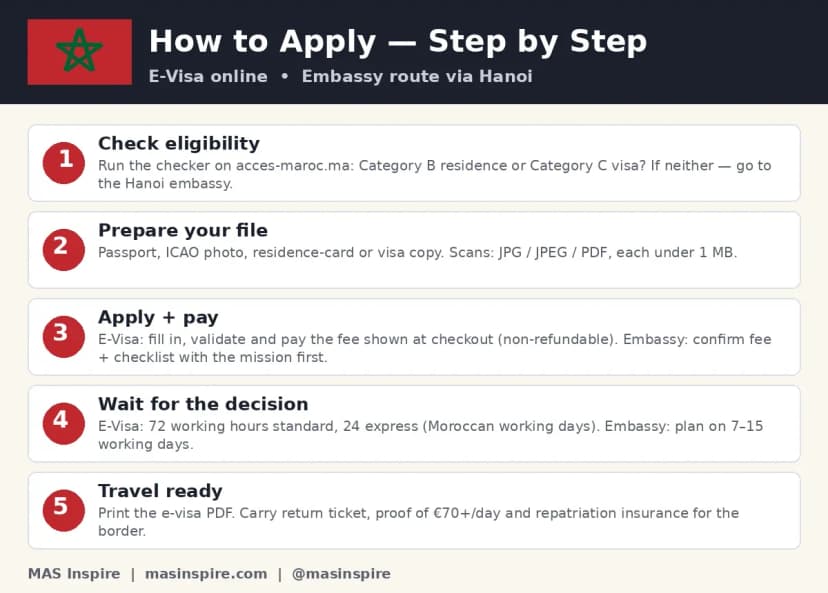
Step 1 — Decide which door is yours. Run the eligibility checker on acces-maroc.ma with your passport, your country of residence (Vietnam), and any visa you hold. If you hold a multiple-entry Schengen, US, UK, Irish, Canadian, Australian, Japanese, Norwegian or New Zealand sticker visa with at least 90 days left, or a residence permit from a listed country (EU, USA, Australia, Canada, UK, Japan, Norway, New Zealand, UAE or Switzerland) with at least 180 days left, the e-visa is your route. If neither applies, your route is the embassy in Hanoi. Do not start paying for anything until this question is settled.
Step 2 (e-visa) — Create your account and fill in the application. On acces-maroc.ma, enter the application carefully, transcribing the data on your passport, residence card or visa exactly as printed — surname, given names, date of birth, nationality, and the number and validity of each document. A single mistyped digit is enough to have the file refused, and a paid file cannot be refunded.
Step 3 (e-visa) — Attach the documents. Upload the ICAO photograph (35 x 45 mm, under 6 months old), the colour copy of the passport identity and validity pages, and — for Category B — both sides of the residence card, or — for Category C — the colour copy of the qualifying visa. Scans must be jpg, jpeg or pdf and no larger than 1 MB each. For a business e-visa, attach the document justifying the trip. If travelling as a family or group, group the applications into a single file.
Step 4 (e-visa) — Validate and pay. Make a final check that every field is filled and every document is properly scanned and attached, then validate the file and pay the fee shown on the portal. The fee is the amount the portal shows at checkout — that is the controlling figure, whatever any guide (including this one) reports. Once validated and paid, the application cannot be cancelled or refunded.
Step 5 (e-visa) — Track and receive. Log in to the portal and follow the request. Standard issue is 72 Moroccan working hours, express 24. The issued e-visa arrives as a PDF by email; print it and carry it with your passport, and present it at boarding, at the border, and during your stay if asked.
Step 2 (embassy) — Contact the mission first. For the Hanoi route, contact the Embassy of Morocco in Hanoi (9 Chu Van An, Ba Dinh, Hanoi; telephone +84 24 3734 5586 / 5587) to confirm the current checklist, the fee and how it is paid, the photo specification, whether an appointment is needed, and the current processing time. The embassy route has no published official checklist or fee for this guide to quote, so this call or email is part of the application, not an optional extra. If you are filing from Pakistan instead, the mission is the Embassy of the Kingdom of Morocco in Islamabad, Plot 52, Street 7, G-5/4, Diplomatic Enclave.
Step 3 (embassy) — Assemble the file. Work through the embassy checklist above, with the bank statement, accommodation proof, return itinerary, insurance and cover letter. Keep originals and copies separate, and keep a full copy of the file for yourself.
Step 4 (embassy) — Submit and wait. Submit in person (or through an authorised agent where the mission allows it) and pay the fee as instructed. Plan on 7–15 working days as the most commonly reported window, but file four to six weeks before departure, because no official processing time could be verified and the window varies by season and category.
Step 5 (embassy) — Check the sticker before you leave the counter. Confirm the validity dates, the number of entries and the permitted stay printed on the visa match your travel dates. If anything is wrong, raise it at once — it is far easier to correct at the mission than at the border.
Applying from Vietnam — and from Pakistan
Your residence in Vietnam changes the logistics of the application, but — and this is the point that catches people out — it does not change your eligibility for the e-visa. A Vietnamese temporary residence card is not a Category B residence permit, because Vietnam is not on the Category B residence list, and a Vietnamese visa in your passport is not a Category C visa, because Vietnam is not on the Category C visa list either. Vietnam appears in the e-visa rules only in Category A, as a nationality: Vietnamese citizens can apply on their passport alone. Your passport is Pakistani, so Category A does not apply to you, and your Vietnamese residence does not move you into Category B. Run the portal's checker with "Pakistan" as nationality and "Vietnam" as country of residence and no qualifying third-country visa, and it will return the consular route. That is the correct answer for that profile.
What Vietnam does give you is a nearby mission. Morocco has an embassy in Hanoi — the Embassy of the Kingdom of Morocco, 9 Chu Van An, Ba Dinh District, Hanoi; telephone (+84) 24 3734 5586 / 5587; website moroccoembassy.vn — and Morocco–Vietnam diplomatic relations date to 27 March 1961. The directory hours for the mission are Monday to Friday, 09:00 to 16:00, but those hours come from a secondary directory, not from the embassy's own published page, so confirm them before travelling to Hanoi from Ho Chi Minh City; the flight is about two hours each way, and a wasted trip is an expensive one. The Hanoi mission handles consular questions that the e-visa form does not cover, and it is the mission for a Pakistani resident of Vietnam who needs a consular visa. There is no Moroccan consulate in Ho Chi Minh City, so Hanoi is the only mission in Vietnam.
If you are in Pakistan instead, the route is the Embassy of the Kingdom of Morocco in Islamabad, Plot 52, Street 7, G-5/4, Diplomatic Enclave, open Monday to Friday 09:00 to 16:00 according to agency guides. There is no Moroccan consulate in Karachi. One practical consequence for residents of Vietnam: if you hold a qualifying Category C visa (for example a valid US B1/B2), you can apply for the e-visa entirely online from Ho Chi Minh City and never need to visit Hanoi at all. If you do not, budget for at least one trip to Hanoi — or confirm with the mission whether submission by post or through an authorised agent is accepted, because that is not published anywhere this guide could verify.
One more Vietnam-specific point: departing from Vietnam, you will pass through Vietnamese exit control with your Pakistani passport and your Vietnamese TRC. Carry the TRC and your re-entry arrangements for Vietnam, so that your return to Ho Chi Minh City is as smooth as your departure. And if your Vietnamese residence is close to expiry, renew it before you travel — a TRC that expires while you are in Morocco would complicate your return, and it does not help your Morocco application either way.
Entry Rules and What to Show at the Border
An e-visa, or a visa sticker, is permission to present yourself at the border — not a guarantee of entry. The official briefing note is explicit: possession of an e-visa does not confer an irrevocable right of entry, and border control may refuse entry to anyone who does not meet the conditions or the required evidence. The same is true of a consular visa. Carry the documents, in paper, and keep them together in your hand luggage.
On arrival at a Moroccan border post, the briefing note says you must be ready to present, in addition to your passport and e-visa: the residence card submitted at the time of the application (Category B) or the visa supporting your application (Category C); a return ticket; proof of livelihoods — an international bank card or the equivalent of more than 70 euros in cash per person per day during the stay; and insurance covering hospital and sanitary repatriation for the period of the stay. For a consular-visa arrival, the same categories of proof apply in practice: return ticket, accommodation proof, funds and insurance. Keep the e-visa PDF printed as well as on your phone, because a dead battery at a border post is a real way to lose an hour or a flight.
Main international gateways are Casablanca Mohammed V Airport (CMN), Marrakech Menara Airport (RAK) and Rabat–Salé Airport (RBA). There are no direct flights from Vietnam to Morocco; the usual routings from Ho Chi Minh City run through Dubai, Doha, Istanbul, Kuala Lumpur or a European hub, with total travel times typically in the range of 16–24 hours depending on the connection. If your routing transits a third country, check whether that transit needs its own visa — a Schengen transit, for example, has its own rules, and a long layover can require a transit visa of its own.
Currency is the Moroccan dirham (MAD). International bank cards work in the larger cities and hotels, but smaller shops, street vendors and taxis in the medinas are cash businesses, so carry dirhams for daily spending. Keep your passport and visa safe: a lost passport in Morocco means a trip to the Embassy of Pakistan — Pakistan's mission network covers Morocco from Rabat, and you should note its contact details before you travel — and a replacement travel document takes days, not hours.
Work and Study Routes
The e-visa covers tourism and business only. It does not cover study, salaried employment, religious missions or settlement, and it cannot be converted into a residence permit. If your purpose is study or work, you need a consular visa, and the application is a different file with different sponsors.
For study, the entry visa bears the mention "Étude" and is applied for at the embassy before travel. The core document is a certificate of enrolment and/or a scholarship from the Moroccan Agency for International Co-operation (AMCI) for a public university or a private higher education institute, and the request must generally have the prior approval of the Ministry of Foreign Affairs — except for students enrolled at major Moroccan schools approved by the proper authority. You must also justify sufficient means of subsistence for the period of the course, provide a duly signed and legalised guarantor's promissory note from a close relative or a person resident in Morocco (who guarantees accommodation and financial expenses and commits to cover repatriation costs if you are expelled), and sign a commitment to leave Moroccan territory when the residence permit expires. After entry, a student registers for a renewable student residence card (carte d'immatriculation) with the General Directorate of National Security; the procedure sheet reports MAD 100 in registration and stamp duty and a 30-day service standard. The student entry visa fee is reported at MAD 220 (single entry) or MAD 330 (double entry), waived for AMCI scholars according to one secondary source. All of these figures are secondary-source reports, not verified on a loadable official page — confirm them with the mission and with AMCI before relying on them.
For work, the employer in Morocco does most of the work before you apply: you need an employment contract duly validated by the Moroccan Ministry of Employment, an invitation letter from the hiring company including your full name and passport number, and a residence permit or document showing a proper address. Apply for the work visa at the embassy with that file; do not travel on a tourist e-visa and look for work, because the e-visa expressly forbids it and the visa type cannot be changed after entry. Trainees need an original internship agreement signed by the host organisation, and researchers need a hosting agreement signed with an approved Moroccan research organisation. None of these routes is quick, and none of them should be started on the basis of an unverified job offer — verify the employer, the contract and the ministry validation through the embassy before paying any fee to anyone.
Transit, Overstay and Extensions
If you are only passing through Morocco to a third country, a transit visa is reported in the consular tariff at MAD 170 for up to 72 hours. Check with the mission whether your transit — especially an overnight transit or a change of airport — needs one, because a transit that leaves the airport is not the same as an airside connection. The e-visa is not a transit document: it is a single-entry short-stay visa, and using it for a transit wastes a full application.
Do not overstay. The e-visa stay is capped at 30 days, and the briefing note states that the holder of several e-visas may not cumulate stays — you must leave at the end of the stay conferred by the first visa before benefiting from a new stay. Overstaying a Moroccan visa can mean a fine, detention, deportation and a future entry ban, and it will be visible to every embassy you apply to afterwards. If you are on a consular visa, the permitted stay is the one printed on the sticker, not the 90 days you may have read about — and the 90-day figure belongs to visa-exempt nationals in any case.
If you need to stay longer than your visa allows, the published procedure is to request an extension of stay at the nearest police precinct to your place of residence in Morocco before the visa expires. Visitors who intend to stay for more than 90 days in total must request permission to extend. Do not rely on being able to extend an e-visa stay: the e-visa is designed as a single uninterrupted stay of at most 30 days, and an extension is a matter for the Moroccan authorities, not a right. Apply early, in person, with your passport, proof of funds, accommodation and a reason, and do not book onward travel that assumes an extension will be granted.
Keep every document from the trip: boarding passes, hotel receipts, the e-visa PDF and the entry stamp. If a future application asks for travel history, that paper trail is your evidence, and if anything goes wrong at the border, it is the record you will need.
Travel, Flights and Money: Practical Notes
Morocco rewards travellers who plan the money and the map before they land. The dirham (MAD) is a closed currency in practice — you buy it on arrival or withdraw it from ATMs — and the border proof of more than 70 euros per person per day is a useful budgeting floor, not just a formality: for two people on a 10-day trip, that is more than 1,400 euros of demonstrable funds. Mid-range hotels in Marrakech and Fez, desert transport to Merzouga, and guided day trips add up quickly, so build the budget from the itinerary, not from the minimum.
The best times to visit are spring (mid-March to May), when the country is green and the Atlas hiking is at its best, and autumn (September to October), when temperatures are pleasant. Summer in Marrakech and the desert is very hot, and winter nights in the Atlas and the desert are cold — pack for the region, not just the season. Dress is relaxed by Moroccan standards in the tourist cities, but women are advised to dress conservatively outside resort areas, and covering wrists and ankles is expected when visiting mosques; a shawl or scarf is useful. Non-Muslim visitors do not generally enter mosques except for the Hassan II Mosque in Casablanca, which runs guided visits.
Flights from Ho Chi Minh City to Casablanca or Marrakech have no direct service. The practical routings run through Dubai (Emirates), Doha (Qatar Airways), Istanbul (Turkish Airlines) or a European hub, and the total journey is typically 16–24 hours including the connection. Book the routing first and the visa second only in the sense that you should never pay for a non-refundable ticket before the visa is issued — hold a refundable fare or a reservation while the application is in process. Travel insurance is not optional in practice: the border may ask for hospital and sanitary repatriation cover, and Moroccan private hospitals expect payment or a guarantee before treatment. Make sure the policy covers Morocco, the full stay, and repatriation to Vietnam or Pakistan.
Health preparation is straightforward: routine vaccinations should be up to date, and food and water precautions are the usual ones for North Africa. There is no yellow-fever requirement for travellers arriving directly from Vietnam. Carry any prescription medicine in its original packaging with the prescription, and keep a copy of the prescription separate from the medicine itself.
Common Mistakes and Scams to Avoid
Most Morocco visa problems for Pakistani travellers come from five avoidable mistakes. First, applying for the e-visa on passport alone and paying, without noticing that Pakistan is not in Category A — the fee is non-refundable, and the application will be refused. Run the checker before you pay, not after. Second, assuming a Vietnamese TRC opens the e-visa: it does not, because Vietnam is not on the Category B residence list, and a well-meaning friend who is a Vietnamese citizen will correctly tell you the e-visa is open to them — and wrongly imply it is open to you. Third, reading "90 days" as your stay: that is the visa-free rule for exempt nationalities, and the e-visa stay is 30 days; planning a 60-day trip on an e-visa is an overstay planned in advance. Fourth, using a single-entry Schengen visa, an electronic visa, or a visa with less than 90 days left as the Category C key: all three fail the test, and the test is measured from the application date. Fifth, booking non-refundable flights and hotels before the visa is issued — on either route.
Scams cluster around the same confusion. Look-alike websites copy the Accès Maroc branding and charge several times the official fee, or take the money and issue nothing; the only official application site is www.acces-maroc.ma. No agent can obtain an e-visa for a Pakistani passport with no supporting document, and no agent can obtain a visa on arrival. Anyone who asks you to pay by cryptocurrency, gift card or an untraceable transfer for a visa is not selling a visa. Anyone who promises a guaranteed approval, a 90-day e-visa stay, or a work permit on a tourist visa is selling a story. Check every fee against the portal checkout (e-visa) or in writing from the mission (embassy), keep every receipt, and never send your original passport to an agent you have not verified through the embassy.
Frequently Asked Questions
Do Pakistani passport holders need a visa for Morocco?
Yes. Every ordinary Pakistani passport holder needs a visa before travelling — either an e-visa through acces-maroc.ma if they qualify, or a consular visa from a Moroccan embassy. There is no visa-free entry and no visa on arrival for Pakistani citizens.
Can a Pakistani passport holder get a Morocco e-visa on the passport alone?
No. Pakistan is not in Category A, the list of eleven nationalities that qualify on passport alone. A Pakistani qualifies only under Category B (residence in a listed country, with a permit valid at least 180 days) or Category C (a multiple-entry sticker visa from a listed country, valid at least 90 days).
Does living in Vietnam make me eligible for the Morocco e-visa?
No. Vietnam is on the Category A nationality list, which helps Vietnamese citizens, not Pakistani residents of Vietnam. Vietnam is not on the Category B residence list, so a Vietnamese temporary residence card does not open the e-visa for a Pakistani passport holder.
Does a valid Schengen, US or UK visa let me apply for the Morocco e-visa?
Yes, if it meets all three Category C conditions: it must be multiple-entry, it must be a physical sticker visa (not an electronic visa or ETA), and it must be valid for at least 90 days from the date of your e-visa application. A single-entry Schengen visa does not qualify.
How long can I stay in Morocco on an e-visa?
Up to 30 days, on a single entry. The e-visa itself is valid for up to 180 days from the date of issue — that is the window in which you must enter, not the length of your stay. The 90 days often quoted for Morocco is the visa-free stay for exempt nationalities and does not apply to e-visa holders.
How much does the Morocco e-visa cost?
The official briefing note publishes no fee, so no figure in this guide is the confirmed official fee. Third-party guides commonly report MAD 770 for standard processing and MAD 1,100 for express, while one aggregator reports about USD 30. The amount shown on the portal at checkout is the controlling figure — check it there before you pay, and remember the fee is non-refundable once paid.
How long does the Morocco e-visa take?
72 Moroccan working hours for standard processing and 24 Moroccan working hours for express, according to the official briefing note. Working days means the clock pauses over Moroccan weekends and public holidays, so a standard application can take the better part of a calendar week.
Where do I apply if I do not qualify for the e-visa?
At the Embassy of Morocco in Hanoi if you live in Vietnam (9 Chu Van An, Ba Dinh, Hanoi; +84 24 3734 5586 / 5587), or at the Embassy of Morocco in Islamabad if you are in Pakistan (Plot 52, Street 7, G-5/4, Diplomatic Enclave). There is no Moroccan consulate in Ho Chi Minh City or Karachi.
What is the embassy visa fee and processing time?
Neither is published on a verifiable official page. The standard consular tariff is consistently reported as MAD 220 for a single-entry visa under 3 months, MAD 330 for double entry and MAD 170 for transit, but agency guides quote anything from USD 20–30 to around USD 100 and PKR 20,000–30,000 for the embassy route, and processing at 7–15 working days (with other reports up to 26 business days). Confirm the fee, the payment method and the current processing time with the mission in writing before you file.
What documents do I need for the Morocco e-visa?
An ordinary passport valid at least 90 days from application, an ICAO colour photograph (35 x 45 mm, under 6 months old), a clear colour copy of the passport identity and validity pages, and — for Category B — both sides of the residence permit, or — for Category C — a copy of the qualifying visa. Business e-visas also need a document justifying the trip. Scans must be jpg, jpeg or pdf and no larger than 1 MB each.
Can I work or study in Morocco on an e-visa?
No. The e-visa is for tourism or business only, and its holder may not apply for residency in Morocco. Study needs a consular entry visa marked "Étude" (usually with AMCI enrolment or scholarship), and work needs a contract validated by the Moroccan Ministry of Employment.
What must I show at the Moroccan border?
Your passport and e-visa (or visa sticker), the residence card or visa that supported your e-visa application, a return ticket, proof of funds of more than 70 euros per person per day (an international bank card or the equivalent in cash), and insurance covering hospital and sanitary repatriation for your stay. Border control may still refuse entry if the conditions are not met.
Can I extend my stay in Morocco?
Visitors who need to stay longer should request an extension at the nearest police precinct to their place of residence before the visa expires; stays over 90 days in total need permission to extend. Do not count on extending an e-visa stay — it is a single uninterrupted stay of at most 30 days — and never overstay: the briefing note forbids cumulating stays from several e-visas.
Is there a visa on arrival in Morocco for Pakistanis?
No. Morocco offers no visa on arrival to Pakistani citizens. You must hold the e-visa or the consular visa before you board your flight, and the airline will check for it at check-in.
What is the official website for the Morocco e-visa?
www.acces-maroc.ma — run by Morocco's Ministry of Foreign Affairs, African Cooperation and Moroccan Expatriates. Any other site offering a Morocco e-visa, especially one asking for payment by an unusual method or promising approval without a qualifying document, is not official.
Official Immigration Websites
Check the live rules on the official sources below before you apply. Where an official page does not publish a figure, this guide says so rather than filling the gap with an agent's number — and the portal checkout and the mission's written confirmation are the controlling sources for fees.
| Website | What it is | Use it for |
|---|---|---|
| www.acces-maroc.ma | Official Morocco e-visa portal (Accès Maroc), Ministry of Foreign Affairs | Eligibility checker, e-visa application, tracking, and the official briefing note — the controlling source for e-visa eligibility, validity, stay and processing times |
| www.acces-maroc.ma/assets/docs/Conditions utilisation eVisa - An.pdf | Official e-visa briefing note (General Information) | The full Category A/B/C rules, document list, border requirements and non-refundability rule quoted in this guide |
| www.diplomatie.ma | Ministry of Foreign Affairs, African Cooperation and Moroccan Expatriates | Ministry announcements, the visa-exemption list and consular guidance |
| www.consulat.ma | Ministry consular services portal | Consular visa categories and the consular tariff (single entry under 3 months MAD 220, double entry MAD 330, transit MAD 170 — as reported in secondary sources) |
| moroccoembassy.vn | Embassy of the Kingdom of Morocco in Hanoi | Consular contact for residents of Vietnam; confirm checklist, fee, photo specification and hours before travelling to Hanoi |
| vn.diplomatie.ma | Morocco diplomacy portal — Vietnam page | Official mission listing for the Hanoi embassy |
| www.gov.uk/foreign-travel-advice/morocco/entry-requirements | UK Foreign, Commonwealth and Development Office travel advice | Independent check on Morocco entry requirements and safety advice |
| www.amci.ma | Moroccan Agency for International Co-operation (AMCI) | Student enrolment and scholarship procedures for the student visa route |
Editorial note: this guide was verified on 27 November 2026 against the official e-visa briefing note on acces-maroc.ma, the Hanoi embassy listings, and the secondary sources cited in the text. Fees and processing times that no official source publishes are labelled as reported or unverified, and the conflicts between sources are disclosed in the article rather than resolved by picking a favourite figure. Visa rules change without notice — confirm the live rules before you pay or travel.


