Montenegro Visa Guide 2026: Types, Requirements, Documents and Application Steps
Contents
- Introduction
- Why People Visit Montenegro
- Do Pakistanis Need a Visa for Montenegro?
- Types of Montenegro Visas
- Montenegro Visa Comparison Table
- Eligibility Requirements
- Complete Document Checklists
- How to Apply: Step-by-Step
- Montenegro Visa Fees and Financial Requirements
- Visa Processing Times
- Applying from Pakistan or Vietnam
- Student, Work and Long-Stay Routes
- Family, Residence and Staying Longer
- Common Application Mistakes and Reasons for Refusal
- Frequently Asked Questions
- Official Immigration Websites
- Final Checklist and Conclusion
Introduction
Montenegro is a small Adriatic country between Croatia, Bosnia and Herzegovina, Serbia, Kosovo and Albania, with its capital at Podgorica and its best-known places including the Bay of Kotor, the old town of Budva and the mountain town of Žabljak. It uses the euro, but it is not a member of the European Union and it is not part of the Schengen Area, so it has its own visa rules, its own visa-free list and its own residence permits. Days spent in Montenegro do not count towards the Schengen 90/180 limit, and days spent in Schengen do not count towards Montenegro's limit.
This guide is written for Pakistani passport holders living in Vietnam. As a Pakistani citizen you need a Montenegrin visa before you travel, with one important exception: if you already hold a valid Schengen, United States, United Kingdom or Irish visa — or a residence permit from one of those countries — you can enter Montenegro without a Montenegrin visa for up to 30 days. That single rule changes the whole trip for many readers, so it is explained in full below before the visa application steps.
Montenegro changed its visa policy on 1 November 2026. On 23 July 2026 the Government adopted amendments to the Decree on the Visa Regime that fully aligned Montenegro's visa policy with the European Union's. From 1 November 2026, citizens of Belarus, China, Russia, Saudi Arabia and Türkiye need a visa to enter Montenegro. Pakistan was already a visa-required nationality before that change, so the November change does not alter the basic answer for Pakistani passport holders — but it did change the application network, because Montenegro now also accepts applications through VFS Global visa application centres in several countries. There is still no e-Visa and no visa on arrival for ordinary Pakistani passports. Every figure in this guide was checked against official and corroborating sources on 27 November 2026, and every place where sources disagree is disclosed openly rather than smoothed over.
Why People Visit Montenegro
Most Pakistani visitors come to Montenegro for a short holiday: the Bay of Kotor, the beaches around Budva and Ulcinj, the old towns of Kotor and Herceg Novi, Lake Skadar and Durmitor National Park. The country is compact — you can drive from the coast to the mountains in a few hours — which makes a one- or two-week trip practical on a single short-stay visa.
Beyond tourism, Montenegro attracts business visitors, conference and event attendees, people visiting family or friends, and travellers combining it with Croatia or Albania. A smaller number come for longer stays: study, research, medical treatment, work, running a business, digital nomad residence or family reunification. Those longer stays need a long-stay visa (D) or a temporary residence permit, covered later in this guide. A Montenegrin visa does not by itself give you the right to work in Montenegro. Anyone intending to work must obtain a temporary residence permit for employment or seasonal work, on the basis of a previously issued work permit, as the Government of Montenegro states on its official visas page.
For a Pakistani resident in Vietnam, Montenegro is also a realistic add-on to a European trip: if you already hold a valid Schengen visa for a trip to Croatia, France or another Schengen state, that same visa may let you spend up to 30 days in Montenegro without a separate Montenegrin application. That is often the cheapest and simplest route, and it is the first thing to check before you start a visa application.
Do Pakistanis Need a Visa for Montenegro?
Yes. Pakistani passport holders need a visa to enter Montenegro. Pakistan is not on Montenegro's visa-free list in the Decree on the Visa Regime, and there is no visa on arrival and no general electronic visa system for ordinary Pakistani passports. You must arrange the visa in advance, through a Montenegrin embassy or consulate or through an authorised VFS Global visa application centre.
There is one major exception, and it is the most useful rule in this guide. Under Article 5 of the Decree on the Visa Regime (as amended by Decree 158/2026, in force from 1 November 2026), a holder of a valid foreign travel document who also holds a valid Schengen visa, or a valid visa of the United States, the United Kingdom or Ireland, may enter, transit and stay in Montenegro for up to 30 days — and not longer than the expiry of that visa, if the visa has less than 30 days of validity left. The same 30-day entry applies to holders of a residence permit issued by a Schengen state or by one of those countries.
Two points about that exception need care. First, the list of qualifying visas is wider in several current secondary readings than in the older official decree text published on gov.me, which names only Schengen, United States, United Kingdom and Ireland visas. Current guides that track the 2026 decree, including eVisitor and the RonaLegal reading of Decree 158/2026, list eight qualifying visas: Schengen, Australia, Japan, Canada, New Zealand, Ireland, the United States and the United Kingdom, plus residence permits from the same countries. This guide follows the wider 2026 reading, because it is the reading that matches the decree now in force, but the older gov.me decree text still in circulation names only four — so if your qualifying visa is Australian, Canadian, Japanese or New Zealand, confirm it in writing with a Montenegrin mission before you book non-refundable travel.
Second, several travel guides say a Schengen visa used for this route must generally be multiple-entry, or already used at least once, and that a single-entry Schengen visa that has already been used may not qualify. That condition does not appear in the text of Article 5 itself, which requires only that the visa be valid. It is reported practice rather than a rule stated in the decree, and no official Montenegrin source found for this guide confirms or denies it. The safe approach is to travel on a valid multiple-entry Schengen, US, UK or Irish visa with enough validity left to cover your whole Montenegro stay, and to confirm your exact document with a Montenegrin mission before booking. Do not rely on an unused single-entry Schengen visa for this route without that confirmation.
A further conflict concerns the APEC Business Travel Card. eVisitor still lists it as a qualifying document for the 30-day entry. RonaLegal's reading of the 2026 decree text (Decree 158/2026, Article 5) states that the APEC Business Travel Card has dropped out of the new text, which names residence permits only. This guide treats the APEC card as not qualifying under the decree now in force, and you should not rely on it.
| Your situation | Montenegrin visa needed? | Maximum stay |
|---|---|---|
| Pakistani passport only, no qualifying foreign visa or permit | Yes — apply for a Type C visa in advance | Up to 90 days in any 180 days |
| Pakistani passport + valid Schengen, US, UK or Irish visa | No | Up to 30 days, and not beyond that visa's expiry |
| Pakistani passport + valid Schengen, US, UK or Irish residence permit | No | Up to 30 days, and not beyond that permit's expiry |
| Pakistani passport + valid Australian, Canadian, Japanese or New Zealand visa or permit | No, on the 2026 reading — confirm with a mission first | Up to 30 days, and not beyond that document's expiry |
| Pakistani passport + APEC Business Travel Card only | Yes — do not rely on the card under the 2026 decree | Up to 90 days in any 180 days on a Type C visa |
| Pakistani passport + single-entry Schengen visa, unused | Uncertain — confirm with a mission first | 30 days at most if accepted |
Your Vietnamese residence permit (temporary residence card) does not by itself exempt you from the Montenegrin visa requirement. Vietnam is not among the countries whose visas or residence permits qualify for the 30-day entry, and no official source found for this guide lists it. What your Vietnamese residence does affect is where you can apply from: missions generally accept applications from people legally resident in their consular district, so keep your Vietnamese temporary residence card and proof of address in Vietnam ready, and expect the accepting mission to ask for them.

Types of Montenegro Visas
The Law on Foreigners prescribes four types of visa. In practice, Pakistani applicants will deal with three of them. A visa does not guarantee entry: the border police check your documents on arrival and can refuse entry or shorten the validity of your visa, for example if you do not have enough money or you have already stayed 90 days in the 180-day period.
Airport Transit Visa (A)
An airport transit visa (A) is for one or several transits through the international transit area of an airport, between international flights, without entering the territory of Montenegro, with a validity period of up to 3 months. As a general rule, a foreigner who does not leave the international transit area between flights does not need a visa, but the Government may require an airport-transit visa for nationals of certain countries for reasons of national security and legal order. Most Pakistani travellers transiting through Podgorica or Tivat airport without leaving the transit area will not need this visa, but confirm with your airline and the mission if your itinerary involves changing airports or leaving the transit area.
Transit Visa (B)
A transit visa (B) may be issued for one, two or exceptionally several transits through the territory of Montenegro, with a validity period of up to 6 months. On the basis of a transit visa, a foreigner may stay in Montenegro for up to 5 days on each journey. A transit visa may be issued if you have secured entry into the state to which you are travelling. This is the visa for a genuine overland or short transit — for example, driving from Croatia to Albania through Montenegro — rather than for a holiday.
Short-Stay Visa (C)
The short-stay visa (C) is the visa almost every Pakistani visitor needs. It may be issued for one, two or multiple entries for tourist, business, personal or other purposes. Continuous stay, or the total duration of consecutive stays, may not exceed 90 days in the period of 6 months, counting from the date of first entry. The validity period of a multiple-entry C visa is up to one year, and exceptionally it may be issued for a longer period, but no longer than five years. A short-stay visa may also be issued to a group of foreigners as a collective visa; the validity period of a collective visa cannot exceed 30 days. Tourism, visiting family or friends, business trips, conferences, short courses and medical treatment all fall under the C visa. It does not allow you to work.
Long-Stay Visa (D)
A long-stay visa (D) may be issued for one, two or multiple entries to a foreigner intending to stay in Montenegro for over 90 days, but no longer than 6 months in the period of one year, counting from the date of first entry. On the Government's visas page it is granted for business or other activities, advisory expert activities under business and technical cooperation agreements, long-term production cooperation, transfer of technologies and foreign investment, and for members of foreign diplomatic and consular missions and international organisations accredited to Montenegro and their families. Current secondary guidance also lists study, research, medical treatment, use of your own property, religious service, volunteering and digital nomads under the D visa. In many long-stay cases a temporary residence permit is the real instrument, and the permit itself may be treated as a long-stay visa. If you plan to stay longer than 90 days, read the long-stay section of this guide and contact the mission before choosing between a D visa and a residence permit.
Montenegro Visa Comparison Table
| Visa | Purpose | Maximum stay | Entries | Fee |
|---|---|---|---|---|
| Airport transit (A) | Transit through the airport international transit area only | Transit area only; validity up to 3 months | One or several transits | EUR 35 (see fee conflict note) |
| Transit (B) | Transit through Montenegro to a third country | Up to 5 days per journey; validity up to 6 months | One, two or exceptionally several | EUR 35 (see fee conflict note) |
| Short stay (C) | Tourism, business, family or friends, conferences, short courses, medical treatment | Up to 90 days in any 180 days | One, two or multiple; multiple-entry validity up to 1 year, exceptionally up to 5 years | EUR 35 (see fee conflict note) |
| Long stay (D) | Stay over 90 days: business, study, research, medical treatment, property, digital nomads and similar | Over 90 days, up to 6 months in one year | One, two or multiple | EUR 35 (see fee conflict note) |
| 30-day substitute entry (no Montenegrin visa) | Tourism, transit or short visit on a qualifying foreign visa or residence permit | Up to 30 days, not beyond the qualifying document's expiry | As the qualifying visa allows | No Montenegrin fee |
| Temporary residence permit | Work, business, study, family reunification, property, digital nomad stay over 90 days | As granted; apply before the 90 days end | As granted | Set by the Ministry of Interior procedure — confirm with the mission |
Eligibility Requirements
The eligibility rules come from the Government of Montenegro's official visas page and the Rulebook on Visas and Visa Forms. A short-stay visa (C) can be issued if you hold a letter of guarantee from a physical person or a letter of invitation from a legal entity, a state authority in Montenegro or the organiser of an international conference or event, and you have ensured accommodation, ensured means of sustenance and health insurance.
Your passport must be valid for at least three months beyond the validity of the visa you are applying for. That is the official rule on the gov.me visas page, and eVisitor states it as validity at least three months after your planned departure from Montenegro. Some secondary guides say six months. The three-month rule is the controlling official figure, but a passport with at least six months of validity remaining is the safer choice in practice, because airlines and missions sometimes apply the stricter standard, and a passport close to expiry can cause problems at the border. Do not travel on a passport that will expire within six months of your trip if you can renew it first.
You must show the purpose of your stay, ensured accommodation, enough money for the stay and the return journey, a return or onward ticket, and health insurance. The Rulebook on Visas (Article 13) treats you as having enough money if you have at least EUR 50 for each day of the requested stay. For a 14-day trip that is EUR 700; for a 30-day trip it is EUR 1,500. Show this through bank statements, cash, traveller's cheques or credit cards. The border police may shorten your visa if they find you do not have sufficient funds, even after the visa has been issued.
You must apply from outside Montenegro. Applications cannot be made from inside Montenegro, and a visa cannot be obtained on arrival. You must also not have already stayed 90 days in Montenegro without 180 days having passed from the date of first entry — that is itself a ground for refusing a new visa.
The 90/180 rule in Montenegro is counted from your first entry, not on the Schengen rolling-window basis. Under Article 34 of the Law on Foreigners, you may stay up to 90 days in a period of 180 days counted from the date of first entry; once that 180-day period has ended, a new period begins. This is different from Schengen, where the 180 days are looked back from each day of stay. Do not use a Schengen 90/180 calculator for Montenegro — the two can give different answers for the same travel dates.

Complete Document Checklists
Assemble your documents before you contact the mission. The list below follows the Government of Montenegro's official visas page and the eVisitor summary of the C-visa documents. The mission can ask for other documents about your purpose and your accommodation, so treat this as the core list, not an exhaustive one.
Short-Stay Visa (C) — core checklist
- Completed and signed visa application form ("Zahtjev za vizu", Obrazac 1) — fill it in fully and sign it; an incomplete form is a common reason for delay.
- Valid passport — valid at least three months beyond the visa (six months recommended in practice), with blank pages for the visa sticker.
- One colour photograph, 35 x 45 mm, recent and meeting standard passport-photo rules.
- Proof of purpose — a letter of guarantee from a physical person in Montenegro, or a letter of invitation from a legal entity, a Montenegrin state authority, or the organiser of an international conference or event. As a rule the letter is submitted in the original, and a guarantee letter must be certified by a competent authority or a public notary.
- Proof of ensured accommodation — a receipt for a tourist arrangement, or a paid hotel or other accommodation reservation. The official wording asks for a reservation that has been paid, so a fully unpaid hold may not be enough; confirm with the mission before you pay for non-refundable bookings.
- Proof of means of sustenance — at least EUR 50 per day of the requested stay, shown through bank statements, cash, traveller's cheques or credit cards, plus means for the return journey.
- Proof of travel and intention to return — a return aeroplane or other transport ticket, or a driving licence where relevant.
- Proof of health insurance — travel health insurance covering costs that may arise from return to your country of origin for health reasons, emergency medical help, emergency hospital treatment or death during your stay.
- Proof that the consular fee has been paid.
- Proof of legal residence in Vietnam — your Vietnamese temporary residence card and proof of address in Vietnam, since you are applying as a resident of Vietnam rather than from Pakistan.
- Employment or study evidence from Vietnam — an employment letter, salary slips or student enrolment, to support your ties to Vietnam and your intention to return.
30-day substitute entry (no Montenegrin visa) — what to carry
- Valid Pakistani passport, valid at least three months beyond your planned departure from Montenegro.
- The qualifying visa or residence permit itself — valid Schengen, US, UK, Irish, Australian, Canadian, Japanese or New Zealand visa or residence permit — valid for the whole Montenegro stay. Prefer a multiple-entry visa; see the disclosure in the visa-requirement section.
- Return or onward ticket and proof of accommodation in Montenegro.
- Proof of funds of at least EUR 50 per day, and travel health insurance that covers Montenegro — check that a policy bought for a Schengen application actually covers Montenegro, because it does not do so automatically.
- Evidence of legal residence in Vietnam, if asked, and your Vietnam return arrangements.
Long-Stay Visa (D) and temporary residence — additional documents
- Everything on the C-visa list, plus documents for the specific purpose: enrolment letter for study, research invitation, medical treatment plan, property ownership documents, business registration, or digital nomad evidence of remote work and income.
- For work: a previously issued work permit and the temporary residence permit application — a D visa alone does not authorise work.
- Police clearance, medical certificates and proof of accommodation for the longer stay, as the mission or the Ministry of Interior requires.
Children and family applicants
- For a minor, the visa application is filed by a parent or legal representative.
- Children under 14 with their own passport pay half the consular fee, according to eVisitor's summary of the fee law; see the fee conflict note below, where another source gives a different child figure.
- When the mission takes biometrics, it takes a photograph, the fingerprints of ten fingers and a digitised signature. It does not take fingerprints and the signature from children under 12.
How to Apply: Step-by-Step
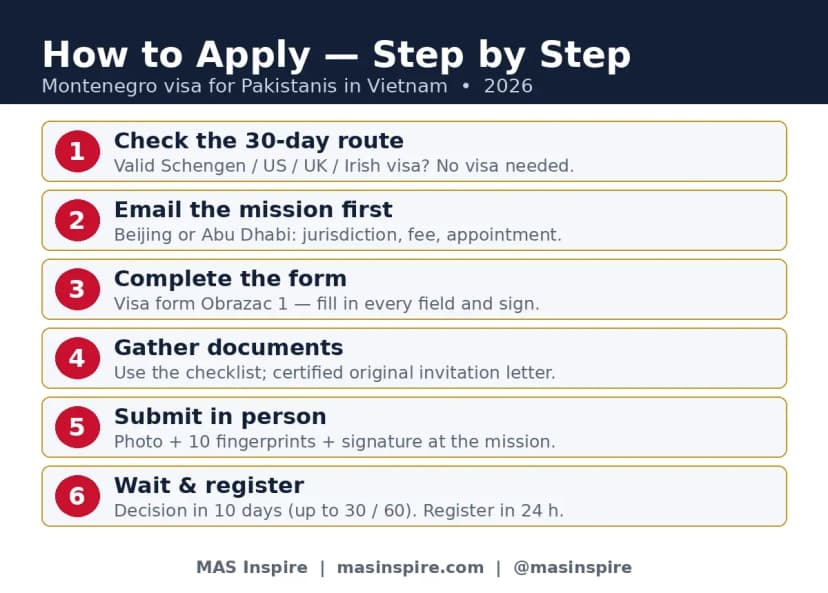
There is no online application and no e-Visa for Montenegro yet. The Ministry of Foreign Affairs is building a new Visa Information System, interoperable with the information systems of the European Union, whose ultimate objective is an e-Visa system for online applications. Until that system launches, you apply in person at a Montenegrin embassy or consulate, or through a VFS Global visa application centre where one is open for Montenegrin visas.
Step 1 — Check the 30-day substitute route first. If you hold a valid Schengen, US, UK, Irish, Australian, Canadian, Japanese or New Zealand visa or residence permit, you may not need a Montenegrin visa at all for a stay of up to 30 days. Check the validity carefully: the qualifying document must remain valid for your whole Montenegro stay, and your stay cannot run beyond its expiry. If the route applies, skip to the arrival steps below.
Step 2 — Find the accepting mission. Montenegro has no embassy or consulate in Vietnam and no embassy in Pakistan. The nearest Montenegrin embassies are in Beijing (3-1-12 San Li Tun Diplomatic Compound, Beijing) and Abu Dhabi, and VFS Global centres accept Montenegrin applications in India, Bangladesh, Kyrgyzstan, Azerbaijan, Türkiye, the United Arab Emirates and Russia. A VFS centre in Pakistan has been announced by the Ministry of Foreign Affairs, but no opening date has been published, so do not plan around it. No published source found for this guide confirms which mission is formally accredited to Vietnam, or whether the Beijing embassy accepts applications from residents of Vietnam — email the mission before you travel anywhere. Where Montenegro has no mission, secondary sources report that Serbia or Bulgaria process applications on its behalf; that arrangement is not confirmed for Vietnam or for the Serbian Embassy in Hanoi, so treat it as a question to ask, not as a route you can rely on.
Step 3 — Email the mission before booking anything. Write to the accepting mission and ask four things in one message: whether it accepts applications from Pakistani citizens legally resident in Vietnam; the appointment procedure; the exact fee and how to pay it; and how your passport will be returned to you. Keep the reply — it is your controlling instruction if it differs from any guide, including this one.
Step 4 — Complete the application form. Complete and sign the prescribed visa application form ("Zahtjev za vizu", Obrazac 1). Answer every question; a blank field is treated as an incomplete application.
Step 5 — Gather the documents and the invitation or guarantee letter. Work through the checklist above. The invitation or guarantee letter is the document applicants most often get wrong: a private guarantee letter must be certified by a competent authority or a public notary, and as a rule it is submitted in the original, not as a photocopy or a scan.
Step 6 — Book the appointment and submit in person. As a general rule you submit the visa application personally. In exceptional, justified cases you do not have to apply in person, but you must appear at the diplomatic or consular office once the visa is issued. At submission the mission takes your photograph, the fingerprints of ten fingers and a digitised signature.
Step 7 — Pay the fee and keep the receipt. Proof of payment of the consular fee is part of the application file. Keep the receipt until you have the visa in your passport.
Step 8 — Wait for the decision. The mission decides within 10 days of the application, extendable to 30 days where further consideration is needed, and exceptionally to 60 days where additional documents are required. Apply at least 15 days before travel, and in practice much earlier — at least four to six weeks — because you may also need to travel to the mission and wait for your passport to be returned.
Step 9 — Check the visa sticker before you travel. Check the name, passport number, validity dates, number of entries and the 90-day limit on the sticker. Errors can be corrected by the police at border control, but it is far easier to have the mission fix them before you leave.
Step 10 — Register your stay within 24 hours of arrival. Every foreigner must be registered with the police within 24 hours of arrival at the place of stay, and again in every place where they stay longer than 24 hours. In practice your hotel or host normally does the registration for you — confirm at check-in that it has been done, and keep the registration slip. Tourist tax is normally collected through your accommodation.
Montenegro Visa Fees and Financial Requirements
The consular fee is EUR 35 for an A, C or D visa, according to eVisitor's summary of the Law on Administrative Fees (tariff 126), which also states that the application itself is free — you pay for the issued visa — and that children under 14 with their own passport pay half, which is EUR 17.50. The same EUR 35 figure is given in the Ministry of Foreign Affairs notice of 31 October 2026 as reported by SimpleVisa and by Pegasus Airlines, which also confirm that VFS Global adds a separate service fee and postage where it handles applications, without giving an amount.
That EUR 35 figure is not the only figure in circulation, and the differences are large enough to matter, so they are disclosed here. One secondary source (Oakleaf Residences) reports EUR 35 for a single-entry C visa but EUR 62 for a multiple-entry C visa, with EUR 32 for children under 14. Another (SchengenProtect) reports a single-entry visa at roughly EUR 50. A third (VisaCross) reports a fee of about USD 65 for a Pakistani tourist visa. None of those three sources cites the fee law. This guide treats EUR 35 as the controlling figure, because it is the only one tied to the Law on Administrative Fees and to the Ministry of Foreign Affairs notice, but you must confirm the exact fee — including any multiple-entry supplement and the VFS service fee — with the accepting mission before you pay, and budget for the possibility that a multiple-entry visa costs more than EUR 35.
| Item | Figure used in this guide | Source and status |
|---|---|---|
| Consular fee, A / C / D visa | EUR 35 | Law on Administrative Fees, tariff 126, via eVisitor; MFA notice 31 Oct 2026 via SimpleVisa and Pegasus — controlling figure |
| Child under 14 with own passport | EUR 17.50 (half fee) | eVisitor, citing the fee law — conflicts with EUR 32 in one secondary source; confirm with the mission |
| Multiple-entry C visa | EUR 35 in the controlling source; EUR 62 in one secondary source | Conflict disclosed — confirm with the mission before paying |
| VFS Global service fee and postage | Not published | MFA notice confirms a service fee exists but gives no amount — confirm with the centre |
| Group (collective) visa | EUR 6 per person in one secondary source | Not confirmed in the official material reviewed — confirm with the mission |
| Proof of funds | At least EUR 50 per day of stay | Rulebook on Visas, Article 13, via eVisitor — verified |
| 14-day trip, funds | EUR 700 | EUR 50 x 14 days |
| 30-day trip, funds | EUR 1,500 | EUR 50 x 30 days |
Budget beyond the fee: travel to the accepting mission (very likely outside Vietnam), courier or return postage for your passport, travel health insurance, certified or notarised invitation or guarantee letters, and the EUR 50-per-day funds requirement, which is a real cash-flow requirement, not a fee. A visa refusal does not automatically mean a fee refund — ask the mission about its refund practice when you apply.
Visa Processing Times
The mission decides within 10 days of the application. When the application needs more checks, the time can be extended up to 30 days, and exceptionally up to 60 days when additional documents are required. The Ministry of Foreign Affairs notice of 31 October 2026 gives the same figures and adds that you should apply at least 15 days before travel.
One secondary source (VisaCross) reports 15 to 32 business days for a Pakistani tourist visa. That conflicts with the official 10-day standard, and 15 to 32 business days is roughly three to six and a half calendar weeks, which is far longer than the official figure. This guide treats the 10 / 30 / 60-day figures as controlling, because they come from the Government's own procedure, but the conflict is a practical warning: plan for the long end of the range. Submit at least four to six weeks before travel, keep your passport-return arrangements confirmed in writing, and do not book non-refundable flights or hotels until the visa is in your passport.
| Stage | Time |
|---|---|
| Standard decision | Within 10 days of application |
| Extended consideration | Up to 30 days |
| Additional documents required | Up to 60 days |
| Earliest you should apply | At least 15 days before travel (official minimum); four to six weeks recommended in practice |
| Temporary residence permit decision (inside Montenegro) | Within 40 days of a complete application |
Applying from Pakistan or Vietnam
Your nationality decides whether you need a visa; your residence decides where you can conveniently apply. Living in Vietnam does not remove the visa requirement, and holding a Vietnamese temporary residence card does not qualify you for the 30-day substitute entry. What it does give you is a place of legal residence from which a mission may accept your application — but which mission, and on what terms, is not published.
Montenegro has no embassy or consulate in Vietnam. The practical options, in the order to try them, are: first, email the Embassy of Montenegro in Beijing and the Embassy of Montenegro in Abu Dhabi and ask whether either accepts applications from Pakistani citizens legally resident in Vietnam, including the appointment, fee, personal-attendance and passport-return arrangements. Second, ask the VFS Global centres in the United Arab Emirates, India or Türkiye whether they accept Montenegrin applications from a Pakistani resident of Vietnam. Third, ask the Embassy of Serbia in Hanoi whether it processes Montenegrin visa applications — secondary sources report that Serbia and Bulgaria process applications where Montenegro has no mission, but that is not confirmed for Hanoi, and an honorary consul (Montenegro lists an honorary consulate in Bangkok, Thailand) does not normally issue visas.
If you are in Pakistan rather than Vietnam, the same problem applies in a different form: Montenegro has no resident mission in Pakistan, and the VFS centre in Pakistan announced by the Ministry of Foreign Affairs has no published opening date. The realistic routes from Pakistan are the same ones — a Montenegrin embassy abroad, or an open VFS centre in a third country — and the same email-first approach applies. Do not pay any agent who promises a Montenegro visa on arrival, an e-Visa, or a guaranteed approval: there is no visa on arrival, no e-Visa yet, and no agent can guarantee a decision that belongs to the mission.
Flights from Vietnam to Montenegro are not direct. The usual routes run through Istanbul, Dubai, Doha, Vienna or Belgrade, then on to Podgorica or Tivat. If your transit goes through a Schengen airport and you need to leave the international transit area, you may need a Schengen visa for the transit itself, separate from any Montenegrin visa. Check the transit rules for each airport on your itinerary before you book.
Student, Work and Long-Stay Routes
A C visa covers short stays only. If your plan is longer than 90 days, you need a different route, and the choice between a D visa and a temporary residence permit should be made with the mission, not assumed from this guide.
Study. Secondary education, studies, student exchange programmes and other youth programmes are listed as grounds for temporary residence, and study is also listed among D-visa purposes. You will need an enrolment letter from the Montenegrin institution, proof of funds, accommodation and health insurance, and you should expect the permit process to run through the Ministry of Interior once you are in Montenegro.
Work. A visa does not give the right to work. For work you need a residence and work permit: a work permit first, then a temporary residence permit for employment or seasonal work. Your employer in Montenegro is normally involved in the work-permit step. Do not travel to Montenegro to look for work on a tourist visa and expect to convert it into a work permit on arrival — that is not how the procedure is described in the official material.
Business and digital nomads. Business activity, economic activity and digital nomad status are listed as grounds for a D visa or a temporary residence permit. Digital nomad residence is a newer route and its exact documentary requirements are set by the Ministry of Interior procedure, so confirm the current list with the mission before you apply.
Temporary residence. A temporary residence permit may be considered a long-stay visa in certain cases. It is granted for employment and work, seasonal work, secondary education and studies, student exchange, specialisation or professional training, scientific research, medical treatment, family reunification, humanitarian reasons and other justified reasons specified by law or international agreement. The decision is made within 40 days of a complete application, and a complete application submitted before your 90 days end allows you to remain in Montenegro until the decision.
Family, Residence and Staying Longer
Family reunification is a recognised ground for temporary residence. The sponsor in Montenegro and the family relationship must meet the conditions in the Law on Foreigners, and the application is made through the Ministry of Interior procedure. Family members travelling with you on a short visit apply for their own C visas, with a parent or legal representative filing for any minor.
If you are already in Montenegro and your 90 days are running out, you cannot simply extend a C visa by staying. Apply for temporary residence before the 90 days end. Overstaying is a ground for refusing entry in future, and staying longer than 90 days without a permit can lead to a fine or removal. The 180-day period is counted from your first entry, so after using 90 days you can enter and stay again only after that 180-day period has ended.
Registration is a separate duty from the visa. Every foreigner must be registered with the police within 24 hours of arrival at the place of stay, and again in every place where they stay longer than 24 hours. Hotels normally register their guests; if you stay in a private apartment or with friends, make sure the host registers you, and keep the proof of registration.
Common Application Mistakes and Reasons for Refusal
- Assuming a Schengen visa is not enough, or assuming it is. Both errors happen. A valid Schengen, US, UK or Irish visa can replace the Montenegrin visa for up to 30 days — but only if it is valid for your whole stay, and the multiple-entry question is unresolved in the sources. Check before you book.
- Booking non-refundable travel before the visa is issued. Decisions can take 10 days, or 30, or 60. Book flexible tickets and accommodation until the visa is in your passport.
- Submitting an uncertified or copied guarantee letter. A private guarantee letter must be certified by a competent authority or a public notary, and as a rule it is submitted in the original.
- Showing unpaid accommodation only. The official requirement is proof of ensured accommodation, described as a receipt for a tourist arrangement or a paid reservation. Confirm with the mission whether an unpaid booking hold is accepted.
- Showing less than EUR 50 per day. Bank statements must cover the whole stay plus the return journey. A single low balance on one day is not enough.
- Using a health insurance policy that does not cover Montenegro. A policy bought for a Schengen application does not automatically cover Montenegro, which is not in Schengen. Check the country list on your policy.
- Applying from inside Montenegro or on arrival. There is no visa on arrival and no application from inside Montenegro. Arrange the visa before you travel.
- Forgetting the 24-hour registration. Registration is a legal duty on every stay, and it is easy to overlook when moving between towns. Confirm it at every check-in.
- Counting Montenegro days as Schengen days. Montenegro runs its own 90/180 clock, counted from first entry. It does not count towards Schengen, and Schengen days do not count towards it.
- Paying an agent for a guaranteed visa or an e-Visa. There is no e-Visa yet and no guaranteed approval. The decision belongs to the mission.
The Government's official visas page lists the reasons a visa shall not be issued: a general legal obstacle to issuing the visa; failure to appear in person when the mission requires it; failure to submit the documents proving the purpose and conditions for the visa; failure to submit proof of health and travel insurance; and having stayed in Montenegro for 90 days without 180 days having passed from the date of first entry. The foreigner is advised verbally of the reasons why the visa was not issued.
Exceptionally, a visa may be issued, or entry approved, where humanitarian reasons, the interests of Montenegro or internationally accepted commitments require it. In those cases the foreigner may be allowed to enter only at a specified border crossing point.
If your application is refused, ask the mission for the specific reason in writing, fix the exact gap — usually a missing document, an uncertified letter, insufficient funds or an unclear purpose of travel — and reapply with a complete file. There is no fee for the application itself, only for the issued visa, according to eVisitor's summary of the fee law, but confirm the mission's practice on reapplication fees when you reapply. A refusal of a Montenegrin visa does not cancel a valid Schengen or US visa, and it does not by itself prevent you from using the 30-day substitute entry if you hold a qualifying visa — but a refusal is a fact you should disclose honestly if a later application asks about previous refusals.
Frequently Asked Questions
1. Do Pakistani passport holders need a visa for Montenegro?
Yes. Pakistani citizens need a Montenegrin visa before travelling, unless they hold a valid qualifying foreign visa or residence permit that allows the 30-day entry described in this guide. There is no visa on arrival and no e-Visa for ordinary Pakistani passports.
2. Can I enter Montenegro with a valid Schengen visa instead of a Montenegrin visa?
Yes, for up to 30 days, and not longer than the Schengen visa's remaining validity. The same applies to a valid US, UK or Irish visa, and on the 2026 reading to Australian, Canadian, Japanese and New Zealand visas. Several guides say the Schengen visa should generally be multiple-entry or already used; that condition is not in the decree text, so confirm your exact document with a Montenegrin mission before booking.
3. Does my Vietnamese residence permit exempt me from the Montenegro visa?
No. A Vietnamese temporary residence card is not among the qualifying documents for the 30-day entry. It is useful as proof of legal residence in Vietnam when you apply, but it does not remove the visa requirement.
4. How much does a Montenegro visa cost?
The controlling figure is EUR 35 for an A, C or D visa, under the Law on Administrative Fees (tariff 126), with children under 14 paying half (EUR 17.50). Other sources report EUR 62 for a multiple-entry C visa, about EUR 50 for a single-entry visa and about USD 65 for a Pakistani tourist visa — those figures conflict with the fee law, so confirm the exact fee with the accepting mission before you pay. VFS Global adds a separate service fee where it handles applications.
5. How long does a Montenegro visa take?
The mission decides within 10 days, extendable to 30 days for further consideration and exceptionally to 60 days if additional documents are required. Apply at least 15 days before travel, and in practice four to six weeks before, because you may also need to travel to the mission and wait for your passport to be returned.
6. How long can I stay in Montenegro on a C visa?
Up to 90 days in any 180 days, counted from the date of first entry. The 180-day period is fixed from first entry under Montenegrin law, not the Schengen rolling window.
7. Is there a Montenegro e-Visa?
Not yet. The Ministry of Foreign Affairs is building a new Visa Information System whose ultimate objective is an e-Visa system, but no e-Visa was available when this guide was checked on 27 November 2026. Apply in person at a mission or through an open VFS Global centre.
8. Where do I apply if I live in Vietnam?
Montenegro has no embassy in Vietnam. Email the Embassy of Montenegro in Beijing or in Abu Dhabi first and ask whether it accepts applications from Pakistani citizens legally resident in Vietnam, or ask an open VFS Global centre in the UAE, India or Türkiye. No published source confirms which mission is accredited to Vietnam, so get the answer in writing before you travel to any mission.
9. Is there a VFS Global centre for Montenegro in Pakistan?
Not yet. The Ministry of Foreign Affairs has announced that a centre will open in Pakistan, but no opening date has been published. Centres are currently open in India, Bangladesh, Kyrgyzstan, Azerbaijan, Türkiye, the United Arab Emirates and Russia.
10. How much money do I need to show?
At least EUR 50 for each day of the requested stay, under the Rulebook on Visas (Article 13). That is EUR 700 for 14 days and EUR 1,500 for 30 days, plus means for the return journey.
11. How long must my passport be valid?
Officially at least three months beyond the validity of the visa, or three months after your planned departure. Some guides say six months; the three-month rule is the official one, but travelling with at least six months of validity is the safer choice.
12. Do I need to register after arriving in Montenegro?
Yes. Every foreigner must be registered with the police within 24 hours of arrival at the place of stay, and again in every place where they stay longer than 24 hours. Hotels normally do this for their guests — confirm at check-in.
13. Can I work in Montenegro on a tourist visa?
No. A visa does not give the right to work. You need a work permit first and then a temporary residence permit for employment or seasonal work.
14. Can I stay longer than 90 days?
Only with a long-stay visa (D) or a temporary residence permit, for example for study, work, business, medical treatment, property or family reunification. Apply for temporary residence before your 90 days end; a complete application submitted in time allows you to remain until the decision.
15. Is Montenegro in the Schengen Area or the EU?
No. Montenegro is an EU candidate country that uses the euro, but it is not an EU member and not in the Schengen Area. A Schengen visa does not give a general right to enter Montenegro — only the 30-day substitute entry described in this guide — and days in Montenegro do not count towards your Schengen 90/180 limit.
Official Immigration Websites
| Source | Website |
|---|---|
| Government of Montenegro — Visas and visa regime (official procedure, visa types, documents) | www.gov.me — Visas and visa regime |
| Government of Montenegro — Montenegro fully aligns its visa policy with the EU (1 November 2026 change and VFS centres) | www.gov.me — Visa policy alignment announcement |
| Government of Montenegro — Embassies of Montenegro (mission list, including Beijing) | www.gov.me — Embassies of Montenegro |
| Government of Montenegro — Montenegro in China (Beijing embassy and VFS centres in China) | www.gov.me — China, embassies and VFS centres |
| Government of Montenegro — Decree on Visa Regime (official text) | wapi.gov.me — Decree on Visa Regime |
| eVisitor — Montenegro visa for citizens of Pakistan | evisitor.me — Visa for citizens of Pakistan |
| eVisitor — Montenegro visa types, documents and how to apply | evisitor.me — Visa types and documents |
| SimpleVisa — Montenegro Visa Requirements by Nationality (MFA notice 31 Oct 2026, EUR 35, 10/30/60 days) | SimpleVisa — Montenegro visa requirements |
| Pegasus Airlines — Montenegro Visa Information | flypgs.com — Montenegro visa guide |
| RonaLegal — Can I Enter Montenegro With a US or Schengen Visa? (Decree 158/2026, Article 5) | ronalegal.com — US or Schengen visa entry |
| RonaLegal — Montenegro 90/180 Stay Calculator (Law on Foreigners, Article 34) | ronalegal.com — 90/180 stay calculator |
| Montenegro.com — Montenegro Entry Requirements 2026 | montenegro.com — Entry requirements 2026 |
| Travel to Montenegro — Visas for Montenegro 2026 | traveltomontenegro.com — Visas and entry |
| Wego — Montenegro Visa-Free Countries 2026 | blog.wego.com — Visa-free countries 2026 |
| CE Report — Montenegro introduces visas for five countries | cereport.eu — Visas for five countries |
| VisaCross — Pakistan to Montenegro Tourist Visa (conflicting fee and processing figures) | visacross.com — Pakistan to Montenegro tourist visa |
| Wikipedia — Visa policy of Montenegro | en.wikipedia.org — Visa policy of Montenegro |
| UrduPoint — Montenegro Visa for Pakistanis 2026 | urdupoint.com — Montenegro visa for Pakistanis |
Final Checklist and Conclusion
Before you book anything, work through this final checklist. First, check whether you already hold a valid Schengen, US, UK or Irish visa or residence permit — if you do, a trip of up to 30 days may need no Montenegrin visa at all, and that is the simplest route. Second, if you do need a visa, email the Embassy of Montenegro in Beijing or Abu Dhabi (or an open VFS Global centre) and get written confirmation that it accepts applications from Pakistani citizens resident in Vietnam, with the appointment procedure, the exact fee and the passport-return arrangement. Third, gather the documents on the C-visa checklist, with a certified original guarantee or invitation letter, paid accommodation, at least EUR 50 per day in funds and health insurance that covers Montenegro. Fourth, submit in person at least four to six weeks before travel, and do not book non-refundable travel until the visa is in your passport. Fifth, register your stay within 24 hours of arrival, and respect the 90 days in 180 days limit counted from your first entry.
Montenegro rewards the traveller who plans ahead: a short Adriatic trip is straightforward once the visa question is settled, and for many Pakistani residents of Vietnam the answer is already in their passport in the form of a valid Schengen, US or UK visa. Where this guide could not verify a figure — the multiple-entry fee, the VFS service fee, the multiple-entry condition on the 30-day route, and which mission covers Vietnam — it says so plainly, because a guessed figure at the application stage costs far more than a careful email to the mission. Confirm the open questions with the accepting mission, then travel.
Editorial note: This guide was fact-checked on 27 November 2026 against the Government of Montenegro's official visas page, the Decree on the Visa Regime, the Ministry of Foreign Affairs announcement of 23 July 2026 and the sources listed in the official-websites table. Visa rules change without much notice; confirm the current requirements with the accepting Montenegrin mission before you travel. This guide is general information, not legal or immigration advice.