Mozambique Visa Guide 2026: Types, Requirements, Documents and Application Steps
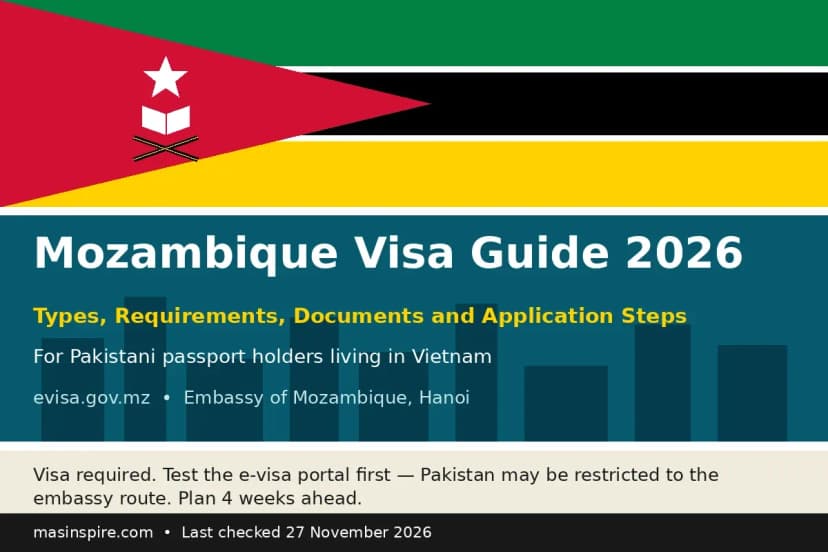
Last checked: 27 November 2026. This guide is for Pakistani passport holders living in Vietnam. Visa rules change without notice — always confirm the live rules on the official e-visa portal (evisa.gov.mz) and with the Embassy of Mozambique in Hanoi before paying any fee or booking a non-refundable ticket.
Table of Contents
- Introduction
- Do Pakistani Passport Holders Need a Visa for Mozambique?
- The Big Question: Can Pakistanis Use the E-Visa Portal?
- Types of Mozambique Visas for Pakistani Passport Holders
- The E-Visa, the eTA and the Fees the Portal Publishes
- Processing Times
- Complete Document Checklists
- How to Apply: Step-by-Step
- Applying from Vietnam — the Embassy in Hanoi
- Entry Points and Visa on Arrival at Maputo Airport
- Extending Your Stay and Overstay Rules
- Work and Study Routes
- Transit, Flights and Money: Practical Notes
- Safety, Health and Arrival Checks
- Frequently Asked Questions
- Official Immigration Websites
Introduction
Mozambique is the long, Indian Ocean coastline of south-eastern Africa that most Pakistani travellers have never seriously considered — and that is a shame, because it is one of the most rewarding countries on the continent. The country is also a serious business destination: the Rovuma Basin gas projects around Palma and Afungi have made northern Mozambique one of the largest energy frontiers in the world, and that is why this guide covers work and business routes as carefully as the tourist ones.
There is one honest complication. Whether a Pakistani passport holder can use Mozambique's online e-visa portal at all is genuinely disputed between sources. Several commercial visa guides written in 2026 say Pakistanis can apply for an e-visa online for about USD 50, or buy a visa on arrival at Maputo airport for the same amount. But a careful check of the official portal's own nationality rules, reported in November 2026, puts Pakistan in a small restricted group of six countries — Bangladesh, Ethiopia, Nepal, Nigeria, Pakistan and Somalia — whose nationals cannot use the e-visa or eTA portal and must apply at a Mozambican embassy instead. The US State Department's travel information and the Timatic database used by airlines point the same way for visa on arrival. Mozambique replaced its whole entry system on 11 February 2026. The single official platform is evisa.gov.mz, run by the National Migration Service (SENAMI) with VFS Global support. It sorts travellers into three lanes: a small group of African nationalities who need no formality at all; nationals of 29 visa-exempt countries who must obtain an Electronic Travel Authorisation (eTA) before travel; and everyone else, who applies for an e-visa in 30, 60 or 90-day versions. Pakistan is not in the first two lanes. The question is whether it is in the third — or outside the platform entirely. Where a figure could not be verified at all, this guide says so plainly instead of inventing one.
Do Pakistani Passport Holders Need a Visa for Mozambique?
Yes. Every holder of an ordinary Pakistani passport needs a visa before travelling to Mozambique. Pakistan is not on Mozambique's visa-free list, and it is not one of the 29 countries whose nationals can enter on an eTA alone. The 29 visa-exempt countries are Belgium, Canada, China, Côte d'Ivoire, Denmark, Finland, France, Germany, Ghana, Indonesia, Ireland, Israel, Italy, Japan, the Netherlands, Norway, Portugal, Russia, Saudi Arabia, Senegal, Singapore, South Korea, Spain, Sweden, Switzerland, Ukraine, the United Arab Emirates, the United Kingdom and the United States. A smaller group of African nationalities — Botswana, Kenya, Rwanda and Tanzania for up to 90 days, and Angola, Cape Verde, Eswatini, Lesotho, Malawi, Mauritius, Namibia, São Tomé and Príncipe, Seychelles, South Africa, Uganda, Zambia and Zimbabwe for up to 30 days — enter with no formality at all. Pakistan is in neither group, and no source found for this guide suggests otherwise.
The rule follows your passport, not where you live. Living in Vietnam, holding a Vietnamese temporary residence card (TRC), holding a US, UK or Schengen visa, or having lived in the Gulf does not remove the visa requirement, and no simplified regime for Vietnamese residents of Pakistani nationality was found for Mozambique — unlike some other countries in this series, where a Vietnamese residence permit can simplify the application.
There is also no visa-free transit privilege to fall back on. If your journey to Maputo routes through Johannesburg, be aware of a separate trap reported by a Pakistani travel desk in 2026: Pakistani passport holders are reported to need a South African transit visa even for an airside connection at OR Tambo. That claim comes from a single commercial source and could not be verified against a South African government page for this guide, so treat it as a warning to check with the South African mission or your airline before booking a Johannesburg connection — and prefer the Addis Ababa or Nairobi routings discussed in the flights section, where no second visa is reported to be needed for a straightforward airside transit.
What is not in dispute is the passport rule. The UK Foreign, Commonwealth and Development Office (FCDO) states that to enter Mozambique your passport must have an expiry date at least six months after the date you arrive, and you need at least two blank pages for entry stamps. The US State Department says the same: a passport with at least six months' validity after arrival and at least two clean, unstamped visa pages each time entry is sought.l.
The Big Question: Can Pakistanis Use the E-Visa Portal?
Position A — Pakistanis can use the e-visa portal. Several commercial guides updated in 2026 say Pakistani citizens can apply for a Mozambique e-visa online through evisa.gov.mz, with a fee of approximately USD 50 for a 30-day single-entry tourist e-visa and processing of 3 to 5 working days, or 5 to 7 working days on another page. One Pakistani travel desk describes the February 2026 platform as covering 183 nationalities, Pakistan among them, at about USD 50 for a 30-day single entry, with processing quoted between one and ten business days. A visa-comparison site reviewed in June 2026 lists a Pakistan-to-Mozambique tourist e-visa as available, with a fee near USD 51 and processing of 3 to 7 business days. These guides also generally say a visa on arrival is available at Maputo airport for USD 50 for up to 30 days. Note the pattern: the fee figures in this group cluster around USD 50 to USD 51, which is suspiciously close to the old pre-2026 border-visa price, and none of them quotes the portal's published metical fee schedule described below.
Position B — Pakistanis cannot use the portal and must apply at an embassy. A Pakistan-focused visa guide that says it checked the official portal on 7 November 2026 states that the portal of SENAMI, evisa.gov.mz, puts Pakistan in a restricted group, together with a few other countries, whose travellers cannot apply through the e-visa portal and must request a visa at the nearest Mozambican embassy instead — and warns explicitly not to fly on the hope of getting a visa at the airport. Two independent 2026 guides name the same six restricted countries: Bangladesh, Ethiopia, Nepal, Nigeria, Pakistan and Somalia. One of them adds that these six are not eligible for the ETA, the e-visa or visa on arrival, and must apply in person at their nearest Mozambican embassy or consulate, allowing at least four weeks. The visa-policy summary on Wikipedia, citing Timatic — the database airlines use at check-in — lists a slightly different group for whom visa on arrival is not available (Bangladesh, Eritrea, India, Pakistan, Somalia and Sri Lanka), but agrees on the central point for Pakistan: no visa on arrival, with the narrow exception of travellers holding a printed SENAMI pre-approval for the Rovuma Basin Project. The US State Department's Mozambique page adds weight to the embassy route in a different way: it states that diplomatic, courtesy, official, transit, student, work, temporary residency and residential visas must be obtained from the nearest embassy or consulate before arriving at Mozambican borders, and it warns that, due to technical issues on the Mozambican e-visa website, US travellers were being advised to follow separate guidance — a reminder that the portal itself has had reliability problems in 2026.
How to settle it for your own passport. Do not take either position on trust, including this guide. The controlling source is the portal itself, and the test takes five minutes: open evisa.gov.mz, select Pakistan as your nationality and tourism as your purpose, and see whether the system offers you an e-visa application or directs you to an embassy. If the portal accepts a Pakistani nationality and shows you a fee in meticais at checkout, Position A is right for you and the fee on that checkout screen is the only fee that counts. If the portal refuses Pakistan or routes you to an embassy, Position B is right and the embassy route in this guide is your route. Do this test before you pay anything, before you book any flight, and before you believe any agent who quotes you a fee — and if you are refused by the portal, keep a screenshot of the refusal, because it is the document that proves to an agent or an airline why you hold an embassy visa instead of an e-visa. This guide's recommendation, given the weight of the November 2026 reporting, is to plan on the embassy route and treat a successful portal application as a pleasant surprise — not the other way round.
What the dispute does not change. Whichever route applies to you, the underlying requirements are the same shape: a passport valid for six months with two blank pages, a return or onward ticket, proof of accommodation or an invitation, proof of sufficient funds, and a completed application with a photograph. The dispute is about where you file and what you pay, not about whether you need a visa at all. And one further point is agreed by every source: never travel to Mozambique without any visa document at all and hope to sort it out at the border. That is the one plan every source, on both sides of this dispute, agrees is not a plan.
Types of Mozambique Visas for Pakistani Passport Holders
Mozambique's immigration law, Law 23/2022 of 29 December, in force since 28 January 2023, sets out the visa categories.
Tourist visa
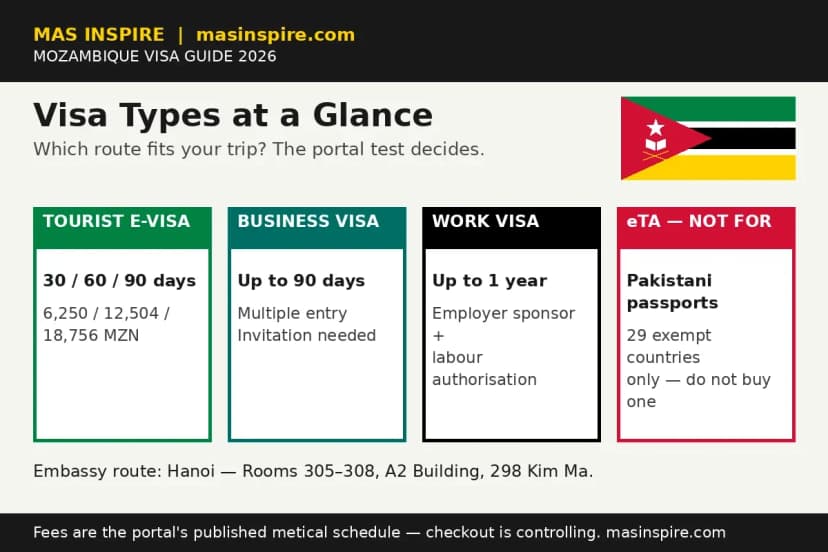
The standard short-stay visa for sightseeing, visiting friends and family, and holidays. On the e-visa platform it is offered for 30, 60 or 90 days; the published portal fees are 6,250 meticais for 30 days, 12,504 meticais for 60 days and 18,756 meticais for 90 days. A tourist e-visa must be used within two months of issue, according to a November 2026 guide that cites the portal's own tourist-visa page, and the US State Department states the same 60-day use-it-or-lose-it rule for visas generally. A tourist visa does not allow paid work of any kind. If you are staying with family or friends in Mozambique rather than in a hotel, note the US State Department's warning that its own citizens in that position are required to obtain a visitor visa applied for before travel — the same logic is likely to apply to you, so declare your host properly and carry the invitation letter.
Business visa
For prospecting, meetings, conferences, general assemblies and contacts with Mozambican companies. Under Law 23/2022 (Article 25) the business visa allows multiple entries for up to 90 days from the first entry and is not extendable. It does not allow employment or residence: it is the right tool for a prospecting trip and the wrong tool for taking up a job, and using it to start work can create serious problems with SENAMI later. A business application needs an invitation letter from the Mozambican company, and the inviting company will usually be asked for its business licence and tax details as well.
Border visa (visa on arrival)
The old border visa — bought at the airport or land border for about USD 50 for up to 30 days — is the category at the centre of the dispute in this guide. It is described in older material as a cheaper, double-entry version of the tourist visa. Since the February 2026 platform relaunch, the government's stated direction is pre-departure filing, and multiple 2026 sources say the border-visa era is over for most visitors. Whether it survives at all for Pakistani passports is disputed (see the visa-on-arrival section below); do not build a trip around it.
Work visa
For a foreigner entering to work temporarily for the employer that requested the visa. Under Law 23/2022 (Article 27) it allows multiple entries for up to one year, extendable for an equal period in line with the contract, and it ties you to that employer — any change of employer must be notified by the employer to SENAMI. The work visa is only the entry document: the employer must first obtain labour authorisation from the Ministry of Labour, and after arrival you must register with SENAMI and obtain a DIRE residence permit. The full sequence is set out in the work section below. Never travel on a tourist or business visa intending to convert it into a work visa on arrival.
Student visa
For studies at a Mozambican institution, under Article 26 of Law 23/2022. The institution sponsors the application and is obliged to report changes to SENAMI within 90 days. Student visas are issued through the embassy, not the tourist e-visa lane, and you will need the institution's acceptance letter and proof of funds for the course.
Residence visa
For a foreigner who intends to take up residence in Mozambique. Under Article 21 it is a single-entry visa valid for 30 days, extendable to 60 days, whose purpose is to let you enter and then obtain the residence authorisation (DIRE) inside the country. It is not a long-stay visa in itself.
Temporary stay visa
For the spouse and minor or incapacitated children of a work or investment visa holder, and for medical treatment, under Article 29. If you are travelling as a dependant, your application rides on the main holder's work or investment visa — file together and carry the marriage or birth certificates that prove the relationship.
Transit visa
For passing through Mozambique to a third country. Transit visas must be obtained from the nearest embassy or consulate before arriving at Mozambican borders, according to the US State Department. In practice, most Pakistani travellers will not need a Mozambican transit visa at all, because the realistic routings from Vietnam to Maputo transit through Addis Ababa, Nairobi, Doha or Dubai rather than through Mozambique itself — but if your itinerary does route you through Maputo to somewhere else, get the transit visa in Hanoi first.
| Visa type | Typical stay | Entries | Where to apply | Can it be extended? |
|---|---|---|---|---|
| Tourist e-visa | 30, 60 or 90 days | Multiple (on the portal) | evisa.gov.mz — if the portal accepts Pakistanis; otherwise Hanoi embassy | Yes — see the extension section |
| Business visa | Up to 90 days from first entry | Multiple | Portal or embassy | No |
| Border visa / visa on arrival | Up to 30 days | Double (older description) | At the border — disputed for Pakistanis | Yes, at SENAMI — disputed for Pakistanis |
| Work visa | Up to 1 year | Multiple | Embassy, after labour authorisation | Yes, for an equal period |
| Student visa | Set by law and regulation | As issued | Embassy, with institution sponsorship | Through the institution |
| Residence visa | 30 days, extendable to 60 | Single | Embassy | To 60 days, then DIRE |
| Temporary stay visa | As issued | As issued | Embassy, with the main holder | With the main holder's status |
| Transit visa | Short transit | As issued | Embassy before travel | No |
The E-Visa, the eTA and the Fees the Portal Publishes
The fee picture is the second area where sources disagree.
| Item | Figure reported | Source |
|---|---|---|
| Tourist e-visa, 30 days | 6,250 MZN (about USD 98) | Portal fee schedule as reported by two November 2026 guides citing evisa.gov.mz |
| Tourist e-visa, 60 days | 12,504 MZN (about USD 196) | Same portal fee schedule |
| Tourist e-visa, 90 days | 18,756 MZN (about USD 294) | Same portal fee schedule |
| Tourist e-visa, 30 days | About USD 50 | Pakistani travel desk, October 2026 guide, and a second 2026 guide |
| Tourist e-visa, 30 days | About USD 51 | Visa-comparison site, reviewed June 2026 |
| Tourist e-visa, 60 / 90 days | About USD 545 / USD 749 | Commercial e-visa site (Pakistan page) — far above every other figure |
| eTA (29 exempt countries only) | About USD 47 (USD 37 fee + 650 MZN) | UK FCDO, updated 20 August 2026 |
| eTA (29 exempt countries only) | About USD 48 | Commercial e-visa site |
| eTA entry tax | 650 MZN (about USD 10) | Multiple guides; also the FCDO's 650 MZN processing-fee component |
| Visa on arrival, 30 days | USD 50 | Most 2026 guides and the pre-2026 border-visa price |
| Visa on arrival | USD 160 | Commercial e-visa fees page, citing an October 2024 increase |
| Work visa (embassy) | USD 220 normal / USD 280 expedited | Embassy of Mozambique in Washington DC, as reported by a visa-comparison site |
The controlling figure is the one the portal shows you at checkout. The 6,250 / 12,504 / 18,756 metical schedule is the best-supported published figure for the tourist e-visa: it appears identically in two independent November 2026 guides that both say they are reporting the portal's own published prices, and it is consistent with the older FlyerTalk walkthrough of the same portal, which quoted 6,252 / 12,504 / 18,756 meticais (about USD 100 / 200 / 300). The USD equivalent moves with the exchange rate — about 63 to 64 meticais to the dollar in 2026, so 6,250 MZN is roughly USD 98, not USD 50. The USD 50 figure quoted by the Pakistani guides is best understood as the old border-visa price carried forward into the new system, and the USD 545 / USD 749 figures on one commercial Pakistan page are far above every other figure and look like reseller pricing with a large service margin added; do not budget against them, and do not pay them. The MZN 6,500 figure that sometimes circulates for this route could not be verified against any source found for this guide: the closest verified figures are 6,250 MZN for a 30-day tourist e-visa and 650 MZN for the eTA entry tax that applies only to exempt nationalities. If a site or an agent quotes you MZN 6,500, ask them to show you where the portal publishes it — no source in this guide does.
The eTA is not your route, but you need to understand it so nobody sells it to you. The Electronic Travel Authorisation is for nationals of the 29 visa-exempt countries only — the United Kingdom, the United States, Canada, most of the EU, China, Japan, Singapore and the rest of that list. It is not a visa, it covers tourism or business stays of up to 30 days, and it must be obtained before travel: the portal says at least 48 hours before departure, while the FCDO advises at least five working days, so allow five. The FCDO puts its cost at about USD 47, made up of a USD 37 fee plus 650 meticais, paid online when applying — it cannot be paid on arrival. Other guides quote about USD 48, or about USD 10 plus a 650 MZN entry tax, and those figures conflict with each other as well; but since the eTA is closed to Pakistani passports, the conflict does not affect your budget. What matters is the warning one Pakistani guide states plainly: the platform also carries a much cheaper eTA lane of around USD 10, but that belongs to visa-exempt nationalities, which does not cover Pakistani passports, so do not build a plan around it — and do not pay any agent who offers you an "eTA" for a Pakistani passport, because the portal will not issue one to you.
Embassy fees are set by the mission. If you apply through the embassy in Hanoi, the fee is whatever that mission charges for your visa type on the day you apply, and no published Hanoi fee list was found for this guide. One Pakistani guide states the same rule in general terms: the fee is set by the Mozambican embassy where you apply, so ask the embassy. The only published embassy fee figures found are the Washington DC mission's work-visa fees of USD 220 normal and USD 280 expedited, reported second-hand — they tell you the order of magnitude for a work visa at one mission, not what Hanoi will charge you for a tourist visa. Get Hanoi's fee in writing (by phone or in person) before you travel there, and carry the fee in cash as well as by card, because payment methods at small missions are not always what you expect.
Two practical warnings about money. First, apply only on evisa.gov.mz, typing the address yourself, and never through a lookalike site: the portal is the only official route, and the inflated figures on commercial sites show how much margin resellers add. Second, visa fees are generally non-refundable, including if your application is refused — another reason to run the nationality test on the portal and to confirm the embassy fee before you pay, rather than after.
Processing Times
The sources report: about five working days for a tourist e-visa (a November 2026 guide citing the portal's tourist-visa page, and the FlyerTalk walkthrough, whose author reports that in practice it has always been quicker than five working days); five to ten working days (a commercial e-visa site); three to seven business days (a visa-comparison site, June 2026); and one to ten business days (a Pakistani travel desk). For the eTA the portal's floor is 48 hours before departure and the FCDO's advice is five working days.
One Pakistani guide reports that the embassy needs pre-approval from immigration in Mozambique, taking one to two weeks at one embassy, before it can process the visa itself. A visa-comparison site reports about ten business days at the embassy after pre-approval for a work visa, or three business days expedited, with a further one to two weeks beforehand for SENAMI pre-approval from Maputo. Its headline work-visa figure of 40 to 121 business days is a third-party estimate for the whole employer-sponsored process and is not an official figure — but it correctly signals that a work visa is a matter of weeks or months, not days.
Planning rule. For a tourist e-visa, plan on five working days and apply at least two to three weeks before travel, so a rejected scan or a name mismatch can be corrected without losing the trip. For the embassy route, apply at least four weeks before travel — the figure recommended by the guide that reports the restricted-nationality rule — and longer if your trip involves work, study or a 60 or 90-day stay, because those are real visa decisions, not registrations. Remember also that a visa must be used within 60 days of issue (the US State Department states this generally, and one Mozambican embassy states the same), so do not apply absurdly early either: apply in the window where the visa will still be valid on your travel date.
Complete Document Checklists
No single official document list for Pakistani applicants was published on a page found for this guide, so the checklists below combine what the portal asks of e-visa applicants generally, what Mozambican embassies ask for, and what the FCDO and the US State Department say border officers check on arrival. Prepare originals and clean scans; a blurry passport scan is the commonest reason an online application stalls.
Tourist visa — e-visa route (if the portal accepts your nationality)
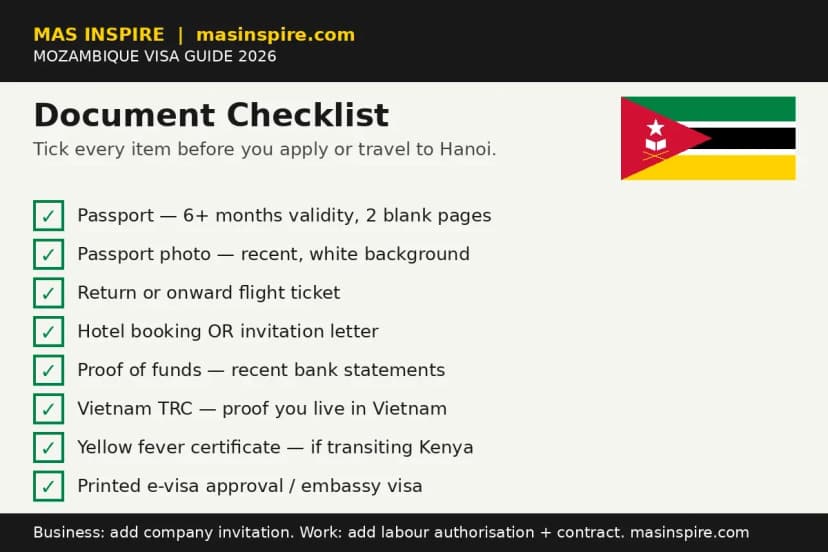
- Pakistani passport valid at least six months after your arrival date, with at least two blank pages; a clear scan of the bio-data page
- One recent digital passport photograph (white background, the portal's size and format as specified on the upload page)
- Completed online application form on evisa.gov.mz, with your name exactly as it appears on the passport
- Confirmed return or onward flight ticket or itinerary
- Proof of accommodation — hotel booking for the whole stay, or an invitation letter from your host in Mozambique with their address and contact details
- Proof of sufficient funds — recent bank statements or evidence of cash; no official minimum balance has been published for the e-visa, so carry statements that plainly cover the trip
- Yellow fever vaccination certificate, if you are arriving from or transiting a country listed as a transmission risk (see the health section)
- Payment card for the online fee, in your name
- Printed copy of the e-visa approval to present at boarding and on arrival
Tourist or business visa — embassy route (Hanoi)
- Original Pakistani passport, valid at least six months from the date you enter Mozambique, with blank visa pages
- Completed embassy visa application form (the mission's own form)
- Two recent passport-sized colour photographs (white background)
- Confirmed return or onward flight ticket or itinerary
- Proof of accommodation — hotel booking, or an invitation letter from your host in Mozambique
- For business: an invitation letter from the Mozambican company, and be ready to provide the company's business licence and tax details
- Proof of sufficient funds — bank statements, and your Vietnamese temporary residence card and proof of address in Vietnam, to show where you live and that you will return there
- Yellow fever vaccination certificate if applicable (see the health section)
- Any fee the mission charges, in the form the mission accepts — confirm in advance
- A covering note explaining your itinerary in plain language, and a copy of everything you submit, kept for yourself
Work visa — embassy route (employer-sponsored)
- Everything in the embassy checklist above, plus:
- Labour authorisation (autorização de trabalho) from the Ministry of Labour, obtained by your Mozambican employer before you apply
- Signed employment contract with the Mozambican employer, and the employer's letter requesting the visa
- Employer's business licence (alvará), tax identification, and a copy of the employer representative's Mozambican identity document
- Police clearance / criminal record certificate, authenticated, no older than three months
- Medical certificate / clean bill of health, no older than three months
- Proof of accommodation in Mozambique and a repatriation guarantee
- Academic and professional certificates, translated if required, with a certificate of equivalence where the employer asks for one
Student visa — embassy route
- Everything in the embassy checklist above, plus:
- Acceptance or enrolment letter from the Mozambican institution
- Proof of funds for tuition and living costs for the course
- Academic certificates and transcripts for your previous studies
- Police clearance certificate and medical certificate if the mission asks for them
Children travelling with you
- Each child needs their own passport, valid six months, with two blank pages, and their own visa
- Unabridged birth certificate listing both parents
- If a child travels with one parent only, or with neither parent, a notarised parental consent affidavit no more than three months old — this is the FCDO's advice, and Mozambican officers do ask for it
How to Apply: Step-by-Step
E-visa — step by step
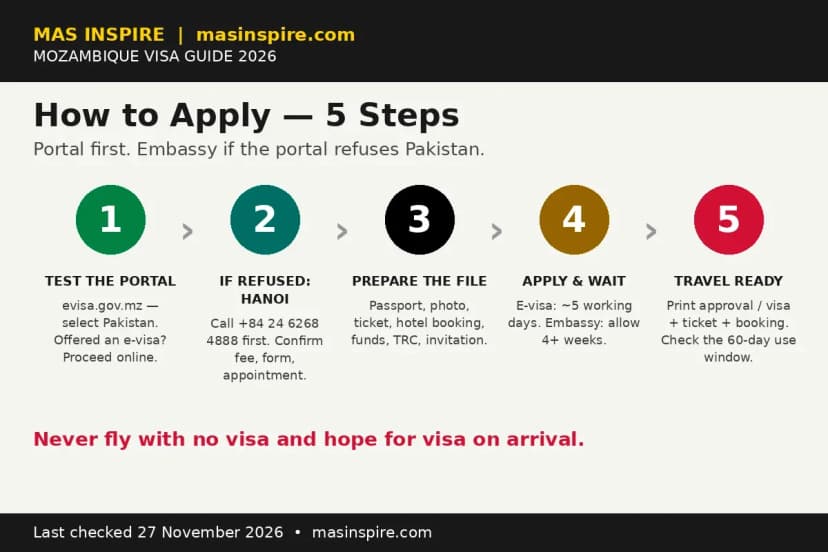
Step 1 — Test your nationality on the portal. Open evisa.gov.mz and create an account, or use the nationality checker if one is offered. Select Pakistan as your nationality and tourism as your purpose. If the system offers you a tourist e-visa application, proceed. If it refuses Pakistan or directs you to an embassy, stop here and follow the embassy sequence below — do not try to force the application through with a different nationality or a different purpose.
Step 2 — Choose the visa type and duration. Select tourism (or business, with your invitation letter ready) and the duration — 30, 60 or 90 days. Remember that a longer stay is a bigger decision and a bigger fee: 6,250 MZN for 30 days, 12,504 MZN for 60 days, 18,756 MZN for 90 days, as published on the portal's fee schedule.
Step 3 — Complete the form. Fill in your personal details exactly as they appear on your passport, including the passport number, dates and place of birth. Enter your travel dates, your accommodation address in Mozambique and your contact details in Vietnam. A name mismatch between the form and the passport is one of the commonest reasons for delay.
Step 4 — Upload your documents. Upload the passport bio-page scan, your photograph, your return ticket or itinerary, your accommodation proof or invitation, and your proof of funds. Check each scan is legible before you submit; the portal will return an illegible document and the clock restarts.
Step 5 — Pay the fee online. Pay the amount the portal shows at checkout — that figure, not any figure in this guide or on any other website, is the fee you owe. Keep the payment receipt and the application reference number.
Step 6 — Wait for the decision. Plan on about five working days. The approval arrives by email and in your portal account as a printable document. If the portal asks for a correction, make it immediately and note that the review clock may restart from the corrected submission.
Step 7 — Print everything and travel. Print the e-visa approval, your return ticket, your hotel booking or invitation, and your proof of funds, and carry them in your hand luggage. Airlines check the approval at boarding, and immigration officers at Maputo may ask for the supporting documents again.
Embassy sticker visa — step by step
Step 1 — Contact the Embassy of Mozambique in Hanoi. Telephone +84 24 6268 4888 and confirm, in writing if you can, that the mission accepts visa applications from Pakistani nationals resident in Vietnam, what its current form, fee and document list are, whether you need an appointment, and whether you must apply in person. Do not travel to Hanoi until you have this confirmation — the mission's fee and requirements are the ones that govern your application.
Step 2 — Prepare the file. Assemble the embassy checklist above, with originals and photocopies. Get your police clearance and medical certificate, if required, while they are still within their three-month validity. Ask your host or employer in Mozambique for the invitation or sponsorship letter early, because a slow letter is the usual delay.
Step 3 — Submit at the embassy. Attend the embassy in Hanoi with your file and the fee in the form the mission accepts. Keep a copy of everything you submit and a receipt for everything you pay.
Step 4 — Wait for pre-approval. The embassy may need pre-approval from immigration (SENAMI) in Maputo, which one guide reports takes one to two weeks. Allow at least four weeks in total before travel.
Step 5 — Collect the visa and check it. When the visa is issued, check the name, passport number, dates, number of entries and validity on the sticker before you leave the embassy. Remember the visa must be used within 60 days of issue, so confirm your travel date still falls inside that window.
Step 6 — Travel with the file. Carry the passport with the visa, your return ticket, your accommodation proof or invitation, and your proof of funds in your hand luggage for the arrival check at Maputo.
Applying from Vietnam — the Embassy in Hanoi
For a Pakistani living in Vietnam, the most useful fact in this guide is that Mozambique has a resident embassy in Hanoi. Multiple sources confirm it, including the list of diplomatic missions of Mozambique, the list of diplomatic missions in Vietnam, and a Hanoi university's record of a 2018 visit by the Mozambican ambassador to Vietnam — and a 2026 embassy listing gives its address as Rooms 305–308, A2 Building, Van Phuc Diplomatic Compound, 298 Kim Ma, Ngoc Ha Ward, Ba Dinh District, Hanoi, with telephone +84 24 6268 4888 and fax +84 24 6269 4999.
Three cautions belong here. First, no published email address for the Hanoi embassy was found for this guide, and no published fee list or opening-hours page was found either — telephone the mission and confirm everything in person or in writing before you travel to Hanoi. Second, the embassy's ability to issue a tourist visa to a Pakistani national resident in Vietnam, as opposed to a Vietnamese national, is the exact question to put to the mission: it is the mission that decides, and a written confirmation from it is worth more than any statement in this guide. Third, if the Hanoi mission cannot help you — for example if it directs tourist applications to the portal — then the fallback missions are the Embassy of Mozambique in Beijing (1-7-2, Ta Yuan Diplomatic Office Building, No. 14 Liang Ma He Nan Lu, Chaoyang District, Beijing 100600; telephone +86 10 6532 3664 / 3578 / 3482; email embamoc@embmoz.org) and the High Commission in New Delhi. No source found for this guide states that the Beijing embassy is accredited to Vietnam, so do not assume it will accept an application from a Vietnamese resident; ask it in writing first. There is no Mozambican embassy or high commission in Pakistan — a Pakistan-focused guide states that it could not confirm one — so a Pakistani applying from Pakistan itself would also have to use a mission abroad.
Also useful from Vietnam: the Embassy of Pakistan in Hanoi is your own mission if anything goes wrong while you are applying or travelling. Keep your Vietnamese temporary residence card valid for the whole trip and carry it with your passport, because it is your proof of the right to return to Vietnam, and airlines and immigration officers on the way home will ask for it. If your TRC is close to expiry, renew it before you travel.
| Mission | Address | Telephone | Note |
|---|---|---|---|
| Embassy of Mozambique, Hanoi (nearest to you) | Rooms 305–308, A2 Building, Van Phuc Diplomatic Compound, 298 Kim Ma, Ba Dinh District, Hanoi | +84 24 6268 4888 (fax +84 24 6269 4999) | No published email found; confirm fee, form and appointment by phone first |
| Embassy of Mozambique, Beijing | 1-7-2, Ta Yuan Diplomatic Office Building, No. 14 Liang Ma He Nan Lu, Chaoyang District, Beijing 100600 | +86 10 6532 3664 / 3578 / 3482 | embamoc@embmoz.org; no source confirms it is accredited to Vietnam |
| High Commission of Mozambique, New Delhi | New Delhi, India | Confirm before travel | Fallback mission for South Asia; confirm it accepts applications from Vietnamese residents first |
Entry Points and Visa on Arrival at Maputo Airport
Maputo International Airport (MPM) is the main gateway to Mozambique. The other international airports that process visas and entries are Beira (BEW), Nampula (APL), Pemba (POL), Tete (TET) and Vilankulo (VNX). Land borders with South Africa, Zimbabwe, Zambia, Malawi and Tanzania also have immigration posts, but the smaller and less-frequented crossings may not process visa applications at all.
Visa on arrival is where the sources split hardest. The general rule, as stated in the visa-policy summary and in most 2026 guides, is that nationals of most non-exempt countries can obtain a visa on arrival at the six airports for a maximum stay of 30 days, on presentation of a passport valid for six months, a return or onward ticket, proof of sufficient funds and proof of the purpose of the visit, for a fee of USD 50. One guide adds that a visa on arrival is no longer available to citizens of countries that host an embassy of Mozambique — which, if applied strictly, would itself complicate the position for a Pakistani resident of Vietnam, since Mozambique has an embassy in Hanoi.
For Pakistani passports specifically, the position is disputed. One commercial Pakistan page says Pakistani nationals can obtain a visa on arrival at major international airports and many land border crossings for USD 50 in cash, and a visa-requirements database lists Pakistan as visa-on-arrival with a maximum stay of 30 days. Against that, the Timatic-based summary says visa on arrival is not available to citizens of Pakistan (with Bangladesh, Eritrea, India, Somalia and Sri Lanka), and the November 2026 guides that report the restricted-nationality rule say Pakistanis are not eligible for the e-visa, the eTA or visa on arrival at all. The US State Department adds a further practical point: its page says visa-related fees are assessed and paid only at embassies or consulates, local immigration offices once in Mozambique, and ports of entry — which confirms that a payment counter exists at ports of entry, but does not confirm that it serves Pakistani passports.
The safe course is to treat visa on arrival as unavailable to you. Get your visa — e-visa or embassy sticker — before you leave Vietnam, carry the printed approval or the sticker, and carry USD 50 in cash anyway as a contingency, because if a border officer does offer you a visa on arrival, the fee is payable in cash and card payments are rarely accepted at border posts. Do not fly to Maputo with no visa document and a plan to buy one at the airport: that is exactly the plan the November 2026 reporting warns against, and an airline applying Timatic at check-in in Ho Chi Minh City may refuse to board you without a visa in the first place. The immigration officer at Maputo makes the final decision in every case, whatever document you hold, so keep your hotel booking, return ticket and invitation letter with you at the desk and answer questions plainly.
Extending Your Stay and Overstay Rules
A 30-day stay can be extended inside Mozambique, but the extension is discretionary, it must be applied for before the initial stay expires, and the figures for it conflict between sourcer. One 2026 entry guide puts a tourist-visa extension at up to 30 additional days (60 days total), costing approximately MZN 1,500–2,500 (about USD 25–40), granted at the discretion of the provincial immigration office, requiring your passport, photographs, and proof of funds and accommodation. Another reports a 30-day extension at 1,000 MZN (about USD 16) per 30 days, with extensions possible up to 90 days in total. A third source, the US State Department, says trips spanning more than 30 days will likely require an approval-to-remain extension from the provincial migration office closest to you, with administrative fees, and that US tourist and business travellers may stay no more than 90 days (consecutive or interrupted) in a year. The 90-day figure also appears in the general visa-policy summary, which describes extension of stay as possible up to a maximum of 90 days for a fee. Plan on the strictest reading: one extension of up to 30 days, applied for well before expiry at the SENAMI office in Maputo (Av. 25 de Setembro, or the provincial delegation; one guide gives Av. 24 de Julho, nº 3820 — confirm the current address locally, because the two guides disagree even about the street), with your passport, photographs, proof of funds and accommodation, and the fee in cash.
The cleanest way to stay longer is to avoid needing an extension at all: if you know you want 60 or 90 days, apply for the 60 or 90-day e-visa (12,504 or 18,756 MZN) before you travel, rather than a 30-day visa plus an extension.
Overstay is taken seriously. Travellers not in possession of a valid visa will be fined for each day they illegally reside in Mozambique, according to the US State Department. The per-day figure reported by third-party entry guides is approximately MZN 500 (about USD 8) per day, with one guide reporting MZN 500–1,000 per day and another a maximum cap of 10,000 MZN — none of these figures comes from an official SENAMI publication found for this guide, so they are reported, not verified, and the real consequence can be worse than a fine: escalating fines, detention and deportation for long overstays, and trouble with every future visa application. Do not overstay, even by a day. If your departure is delayed by a cancelled flight or an emergency, go to the SENAMI office before your visa expires, not after, and keep every document that proves the delay was outside your control.
Work and Study Routes
Mozambique's work route is employer-led, quota-based and slow, and it has three separate steps that must happen in the right order.
Step one — labour authorisation. Your Mozambican employer must obtain authorisation to hire you from the Ministry of Labour (MITESS), under a foreign-worker quota: 5% of staff for large companies (over 100 employees), 8% for medium companies (10–100 employees) and 10% for small companies (under 10). The employer must also prove it is compliant with tax and social-security (INSS) obligations. Without the labour authorisation there is no work visa, and the consulate will ask for the labour notification or authorisation as part of the file. The process can take 4 to 12 weeks depending on the completeness of the file and the sector.
Step two — the work visa. With the labour authorisation and a signed employment contract, you apply for a work visa (Visto de Trabalho) at a Mozambican embassy or consulate abroad — the e-visa portal lists tourist, business, investment and sports/culture categories, and work-visa applicants are directed to the embassy. The visa itself is an entry document: under Law 23/2022 (Article 27) it allows multiple entries for up to one year, extendable for an equal period in line with the contract, and it ties you to the employer that requested it. One visa-comparison site reports that the work visa must be used within about 60 days of issuance and is typically valid for about 30 days after entry, serving only to enter and then convert to residence — treat those as reported, not official, figures, but the shape is right: the work visa gets you in, it is not the permission to live and work long-term.
Step three — the DIRE residence permit. After arrival you must register with SENAMI and obtain a DIRE (Documento de Identificação e Residência para Estrangeiros), the residence permit that legally allows you to live and work. The employer sponsors this step too. Working without it, or working for a different employer than the one on your visa, can lead to fines, deportation and a ban.
For study, the route is simpler but still embassy-based: get accepted by a Mozambican institution, which sponsors the student visa under Article 26 of Law 23/2022 and reports changes to SENAMI within 90 days. Apply at the embassy in Hanoi with the acceptance letter, proof of funds for the course, and your academic records. There is no published student-visa fee for this guide to quote — the embassy's fee is the one that counts — and you should confirm with the institution whether it handles the SENAMI side of the file for you.
A final warning that applies to every route: a tourist or business visa does not give the right to work, and a business visa is for prospecting, meetings and conferences — not for taking up a job. The gas and construction projects in the Rovuma Basin have their own special route under Decree-Law 2/2014, and the narrow Timatic exception for visa on arrival with a printed SENAMI pre-approval applies to travel for the Rovuma Basin Project specifically — if you are travelling for one of those projects, your employer and SENAMI, not this guide, are your sources for what document you need.
Transit, Flights and Money: Practical Notes
Flights. There is no direct flight from Vietnam to Mozambique, and none from Pakistan either. The two clean corridors from Ho Chi Minh City are Ethiopian Airlines via Addis Ababa and Kenya Airways via Nairobi, both of which connect onward to Maputo; routings via Doha (Qatar Airways) and Dubai (Emirates) are also practical. The Johannesburg routing that the map suggests is the one to check twice: a Pakistani travel desk reports that Pakistani passports need a South African transit visa even for an airside connection at OR Tambo, and that claim could not be verified against a South African government page for this guide — so either confirm it with the South African mission or your airline, or avoid Johannesburg and use Addis Ababa or Nairobi, where no second visa is reported to be needed for a straightforward airside transit. Book Maputo is a long way from Ho Chi Minh City, and a tight connection in Addis Ababa or Nairobi is the commonest way a Mozambique trip starts badly.
Money. The currency is the Mozambican metical (MZN), at about 63 to 64 meticais to the US dollar in 2026 — the rate that turns the 6,250 MZN e-visa fee into roughly USD 98. US dollard payments are not reliably available at border posts, and ATMs outside Maputo can be unreliable, so do not land with no cash. Declare cash of MZN 10,000 or more on arrival, as the FCDO advises, and note the separate foreign-cash declaration threshold of USD 10,000 reported in customs guidance. There is no published minimum bank balance for the tourist visa: carry recent statements that plainly cover the trip, and keep them with your passport rather than in checked luggage.
Where to stay and what it costs. Maputo has hotels at every level, from backpacker guesthouses to the business hotels used by the gas industry, and the Bazaruto and Quirimbas islands are priced for international tourism — budget accordingly and book the accommodation you will show at immigration before you apply, because the booking is part of the visa file. Mobile data and a local SIM are easy to arrange in Maputo; buy the SIM at the airport if you can, so you can contact your hotel and the embassy if anything goes wrong on arrival.
Safety, Health and Arrival Checks
Security. The FCDO advises against all travel to Cabo Delgado Province, except for Palma town and the area around Pemba and Afungi. That advice reflects the insurgency in the north, and it is the reason the Rovuma Basin projects have their own security and visa arrangements. Most tourist travel — Maputo, Bazaruto, Vilankulo, Gorongosa, Ilha de Moçambique — is not covered by that advice, but read the current FCDO page before you travel and register your trip with the Embassy of Pakistan in Hanoi. Do not travel to Cabo Delgado without a specific, current reason and a sponsor who can vouch for the security arrangements.
Health. The FCDO states that to enter Mozambique you must have a certificate proving a yellow fever vaccination if you are coming from a country listed as a transmission risk, and a polio vaccine in certain circumstances. Mozambique's Ministry of Foreign Affairs is reported to require a yellow fever certificate from anyone who lives in or has passed through 43 listed countries, including Kenya, Tanzania, Uganda and Rwanda — which matters directly for this trip, because the Nairobi routing transits Kenya. Whether a transit through Nairobi airport counts as "passing through" a risk country is the question to put to the Hanoi embassy or your airline before you book: if there is any doubt, get the yellow fever vaccination in Vietnam before you travel and carry the certificate (the yellow card) with your passport. Neither Pakistan nor Vietnam is on the yellow-fever risk list itself, so a direct routing that avoids a risk country should not need the certificate — but the Nairobi transit makes this a live question for the most likely itinerary, and this guide does not answer it definitively because no source found for it does. Malaria is present throughout Mozambique: take prophylaxis as your doctor in Ho Chi Minh City advises, use repellent and a net, and drink bottled water. Travel insurance is not listed as a required visa document, but medical facilities outside Maputo are basic and evacuation is expensive — buy a policy that covers medical evacuation before you travel.
Arrival checks. At Maputo airport, expect to show your passport with the visa, your return or onward ticket, your hotel booking or invitation letter, and your proof of funds. The immigration officer makes the final decision, whatever document you hold. Keep your hotel booking, return ticket and invitation letter with you at the desk, declare cash of MZN 10,000 or more, and check the stamp in your passport before you walk away from the desk — the stamp is your proof of the date you entered and the length of stay you were given, and it is the document SENAMI will ask for if you apply for an extension.
Frequently Asked Questions
1. Do Pakistani citizens need a visa for Mozambique?
Yes. Ordinary Pakistani passports need a visa before travel. Pakistan is not on Mozambique's visa-free list and is not one of the 29 countries whose nationals can enter on an eTA alone. The rule follows your passport, not where you live, so holding a Vietnamese residence card does not remove it.
2. Can Pakistanis apply for a Mozambique e-visa online?
This is disputed, and it is the most important question in this guide. Several commercial guides say yes, for about USD 50. But a Pakistan-focused guide that says it checked the official portal on 7 November 2026, and two independent 2026 guides, say Pakistan is one of six restricted nationalities (Bangladesh, Ethiopia, Nepal, Nigeria, Pakistan and Somalia) that cannot use the e-visa or eTA portal and must apply at an embassy. Settle it on the portal itself: select Pakistan as your nationality on evisa.gov.mz and see whether it offers you an application or directs you to an embassy — and plan on the embassy route until the portal proves otherwise.
3. How much does a Mozambique tourist e-visa cost?
The portal's published fee schedule, as reported by two November 2026 guides, is 6,250 MZN for 30 days, 12,504 MZN for 60 days and 18,756 MZN for 90 days — about USD 98, USD 196 and USD 294 at roughly 63 to 64 MZN to the dollar. Other guides quote about USD 50 or USD 51, and one commercial page quotes USD 545 and USD 749. The figure the portal shows you at checkout is the only one that counts. The MZN 6,500 figure sometimes quoted for this route could not be verified against any source found for this guide.
4. How long does the Mozambique e-visa take?
Sources report about five working days, five to ten working days, three to seven business days, and one to ten business days. Plan on five working days and apply at least two to three weeks before travel. The embassy route takes longer — one to two weeks for pre-approval from Maputo alone — so apply at least four weeks ahead if you are going through Hanoi.
5. How long can I stay in Mozambique on a tourist visa?
A tourist e-visa is offered for 30, 60 or 90 days. A 30-day stay can be extended inside the country at a SENAMI office, with one extension of up to 30 days reported, and a total stay of up to 90 days reported — but the extension fee and the maximum total are disputed between sources, so the cleanest way to stay longer is to buy the 60 or 90-day e-visa before you travel.
6. Can Pakistanis get a visa on arrival at Maputo airport?
Do not count on it. The general rule is a visa on arrival for USD 50 for up to 30 days at Maputo, Beira, Nampula, Pemba, Tete and Vilankulo airports, but the Timatic database used by airlines says visa on arrival is not available to Pakistani citizens, and the guides that report the restricted-nationality rule say the same. Get your visa before you leave Vietnam.
7. Is there an embassy of Mozambique in Vietnam?
Yes — and it is the nearest mission for a Pakistani living in Vietnam. The Embassy of Mozambique in Hanoi is at Rooms 305–308, A2 Building, Van Phuc Diplomatic Compound, 298 Kim Ma, Ba Dinh District, Hanoi, telephone +84 24 6268 4888, fax +84 24 6269 4999. No published email address was found. Telephone the mission first to confirm that it accepts applications from Pakistani nationals resident in Vietnam, and its current fee, form and appointment rules.
8. What documents do I need for a Mozambique visa?
A passport valid at least six months after arrival with at least two blank pages; a recent passport photograph; a completed application form; a confirmed return or onward ticket; proof of accommodation or an invitation letter; and proof of sufficient funds. Business applications add an invitation from the Mozambican company; work applications add labour authorisation, a contract and police and medical certificates. The full checklists are in the document section above.
9. Do I need a yellow fever certificate for Mozambique?
Only if you are coming from or transiting a country listed as a transmission risk — and the list is reported to include Kenya, Tanzania, Uganda and Rwanda among 43 countries. That matters because the Nairobi routing transits Kenya. Ask the Hanoi embassy or your airline whether an airside transit through Nairobi counts, and if there is any doubt, get vaccinated in Vietnam before you travel and carry the yellow card with your passport.
10. Can I work in Mozambique on a tourist or business visa?
No. A tourist or business visa does not give the right to work. A work visa needs labour authorisation from the Ministry of Labour first, obtained by your Mozambican employer under the foreign-worker quota, then a work visa from the embassy, then a DIRE residence permit from SENAMI after arrival. The whole process takes weeks or months — never travel on a tourist visa intending to start work.
11. What happens if I overstay my Mozambique visa?
You will be fined for each day you overstay, and a long overstay can mean detention and deportation. Third-party guides report a fine of about MZN 500 per day, with other figures of MZN 500–1,000 per day and a cap of 10,000 MZN — none of them from an official SENAMI publication, so they are reported, not verified. Apply for an extension at SENAMI before your visa expires, or leave on time.
12. Are there direct flights from Vietnam or Pakistan to Maputo?
No. The clean corridors from Ho Chi Minh City are Ethiopian Airlines via Addis Ababa and Kenya Airways via Nairobi, with Doha and Dubai as alternatives. Avoid routing through Johannesburg unless you have confirmed the transit-visa position for Pakistani passports at OR Tambo, which one Pakistani travel desk says is required even airside — that claim could not be verified against a South African government page for this guide.
13. Do I need travel insurance for Mozambique?
It is not listed as a required visa document, but it is strongly advisable. Medical facilities outside Maputo are basic, malaria is present throughout the country, and medical evacuation is expensive. Buy a policy that covers medical evacuation before you travel.
14. Can children travel with me to Mozambique?
Yes, with their own passport and visa, an unabridged birth certificate listing both parents, and — if a child travels with one parent only or with neither parent — a notarised parental consent affidavit no more than three months old. Those are the FCDO's stated requirements, and Mozambican officers do ask for the documents.
15. What is the eTA, and can I use it instead of a visa?
No. The Electronic Travel Authorisation is for nationals of 29 visa-exempt countries only, it is not a visa, and it covers tourism or business stays of up to 30 days. It costs about USD 47 according to the FCDO (a USD 37 fee plus 650 MZN), must be obtained at least 48 hours before departure — the FCDO advises five working days — and cannot be paid on arrival. Pakistani passports are not eligible for it, so do not pay any agent who offers you an "eTA" for a Pakistani passport.
Official Immigration Websites
Check these sources directly before you apply. The portal is the controlling source for e-visa eligibility and fees; the FCDO and the US State Department are the controlling sources for passport validity, health and safety advice; the Hanoi embassy is the controlling source for the embassy route.
| Website | What it is | Link |
|---|---|---|
| Mozambique e-Visa portal (SENAMI) | Official e-visa and eTA platform, relaunched 11 February 2026 — eligibility checker, applications, fee at checkout | evisa.gov.mz |
| UK Foreign, Commonwealth and Development Office — Mozambique travel advice | Entry requirements, passport validity, eTA fee, yellow fever and polio, safety advice including Cabo Delgado | gov.uk/foreign-travel-advice/mozambique |
| US Department of State — Mozambique International Travel Information | Visa rules, 60-day use window, extension rules, overstay fines, embassy contact | travel.state.gov — Mozambique |
| Embassy of Mozambique, Hanoi | Nearest mission for residents of Vietnam — telephone +84 24 6268 4888; no published website or email found | Rooms 305–308, A2 Building, Van Phuc Diplomatic Compound, 298 Kim Ma, Hanoi |
| Embassy of Mozambique, Beijing | Fallback mission — telephone +86 10 6532 3664; email embamoc@embmoz.org | travelchinaguide.com — Mozambique Embassy, Beijing |
| UrduPoint — Mozambique Visa for Pakistanis 2026 | Pakistan-focused guide reporting the restricted-nationality rule from a portal check on 7 November 2026 | urdupoint.com/travel/visa/mozambique |
| AlwaysPacked — Mozambique eVisa and eTA Guide | November 2026 guide reporting the portal's published metical fee schedule and the restricted list | alwayspacked.com — Mozambique eVisa and eTA Guide |
| Famous Africa — Mozambique visa and entry requirements | November 2026 guide citing the e-visa portal, its tourist-visa page and its FAQs | famous-africa.com/visas/mozambique |
| The Legalist — Mozambique Visa Requirements 2026 | Guide reporting the six restricted nationalities and the embassy-only route | thelegalist.net — Mozambique Visa Requirements |
| Wikipedia — Visa policy of Mozambique | Summary of visa exemption, eTA, visa on arrival and the Timatic restricted list | en.wikipedia.org/wiki/Visa_policy_of_Mozambique |
| dBA — Mozambique Work Visa and DIRE | Maputo law-firm guide to Law 23/2022, labour authorisation, work visas and residence permits | dba.co.mz — Mozambique Work Visa and DIRE |
| VOV — Mozambique grants e-visa to Vietnamese travelers | Vietnamese state media report on the February 2026 platform launch covering 183 countries | english.vov.vn — Mozambique grants e-visa |
This guide was checked on 27 November 2026. Visa rules change without notice. Always confirm the live rul