Myanmar Visa Guide 2026: Types, Requirements, Documents and Application Steps
Last checked: 27 November 2026. This guide is for Pakistani passport holders living in Vietnam. Visa rules change without notice — always confirm the live rules on the official e-visa portal (evisa.moip.gov.mm) and with the Embassy of Myanmar in Hanoi before paying any fee or booking a non-refundable ticket.
Table of Contents
- Introduction
- Do Pakistani Passport Holders Need a Visa for Myanmar?
- The Tourist E-Visa: Pakistan Is on the Eligible List
- Types of Myanmar Visas for Pakistani Passport Holders
- Visa Fees and Financial Requirements
- Processing Times
- Complete Document Checklists
- How to Apply: Step-by-Step
- Applying from Vietnam — the Embassy in Hanoi
- Entry Points and Visa on Arrival
- Extending Your Stay, eStay and Overstay Rules
- Work, Study and Family Routes
- Transit, Flights and Money: Practical Notes
- Safety, Health and Arrival Checks
- Frequently Asked Questions
- Official Immigration Websites
Introduction
Myanmar — the country the US State Department still calls Burma — is the large, temple-covered neighbour to the west of Thailand and Laos, and one of the most rewarding and most complicated destinations in South-East Asia. Yangon holds the gold-covered Shwedagon Pagoda; Bagan's plain is scattered with more than 2,000 ancient temples; Inle Lake's fishermen row with one leg; and the beaches of Ngapali are among the best in the region. For a Pakistani living in Vietnam, Myanmar is also unusually close: a direct flight from Ho Chi Minh City to Yangon takes about two and a half hours, and the visa for a short tourist trip is one of the simplest in this whole guide series — a USD 50 e-visa, applied for online, with Pakistan named on the official eligible-nationality list.
That simple headline needs two honest qualifications. First, Myanmar is in a civil war that followed the February 2021 military coup, and the United States rates it Level 4: Do Not Travel (issued 8 May 2026), while the United Kingdom advises against all travel to large parts of the country. Yangon itself is not on the UK's no-travel list, and tourists do still visit the Yangon–Bagan–Mandalay circuit, but this is not a trip to book casually: read the safety section, read your own government's advisory in full, and decide with your eyes open. Second, the visa system has sharp edges the USD 50 headline hides: the business e-visa is open to only 54 nationalities and Pakistan is not on the published list, so a business trip needs the embassy route; the tourist e-visa cannot be extended online; its entry points are limited to four; and there is no visa on arrival for Pakistani passports. Every figure in this guide is labelled with where it came from, and where sources disagree — the business e-visa, the extension, the overstay fine, the visa on arrival — this guide says so plainly instead of picking the convenient number.
Myanmar's entry system is run by the Ministry of Immigration and Population (MOIP). Its single official platform is evisa.moip.gov.mm, which issues two visas online — tourist and business — and nothing else. Every other visa (social, employment, education, religious, transit, official, journalist, crew) is issued by a Myanmar embassy or consulate. For a Pakistani living in Vietnam, the two filing points that matter are the portal itself and the Embassy of Myanmar in Hanoi, at 298A Kim Ma Street. This guide covers both, and the Islamabad embassy too, for readers applying from Pakistan.
Do Pakistani Passport Holders Need a Visa for Myanmar?
Yes. Every holder of an ordinary Pakistani passport needs a visa before travelling to Myanmar. Pakistan is not on Myanmar's visa-free list, which covers only eight South-East Asian nationalities — Brunei, Cambodia, Indonesia, Laos, Malaysia, Philippines, Thailand and Vietnam (14 days, or 30 days for Singapore and Vietnam) — and Pakistan is not on any visa-on-arrival list either. The Pakistan Foreign Office's own travel information says the same thing in plain language: Pakistani nationals desirous to visit Myanmar can apply for an online visa, and the e-visa facility is available for tourists only.
The rule follows your passport, not where you live. Living in Vietnam, holding a Vietnamese temporary residence card (TRC), holding a US, UK or Schengen visa, or having lived in the Gulf does not remove the visa requirement, and no simplified regime for Vietnamese residents of Pakistani nationality was found for Myanmar. If a travel agent tells you that a Gulf residence visa or a Western visa makes Myanmar visa-free for you, ask them to show the official rule: none was found.
What is not in dispute is the passport rule. The UK Foreign, Commonwealth and Development Office (FCDO) states that to enter Myanmar your passport must have an expiry date at least six months after the day you arrive. The portal's own tourist notice says the same — passport validity of at least six months — and the Pakistan Foreign Office repeats it as the first requirement for the online visa. Apply that rule to the whole trip, not just the arrival date, and renew your passport in Vietnam or Pakistan before you apply if it is anywhere near the limit: a visa cannot be issued into a passport that will fail the six-month test on arrival, and at least one blank page is needed for the visa stamp.
The Tourist E-Visa: Pakistan Is on the Eligible List
This is the good news, and it is unusually clear for this guide series. Pakistan is named on the official tourist e-visa eligibility list: the portal's own tourist notice lists 100 eligible countries and territories, and Pakistan appears at number 72, between Norway and Panama. The Pakistan Foreign Office confirms that Pakistanis can apply for the online tourist visa, and a November 2026 Pakistan-focused guide that checked the portal reports the same. Independent visa-policy summaries (Wikipedia, Travelfish, Wise) all list Pakistan as e-visa eligible. There is no restricted-nationality dispute about the tourist e-visa for Myanmar — the dispute here is about the business e-visa, covered below.
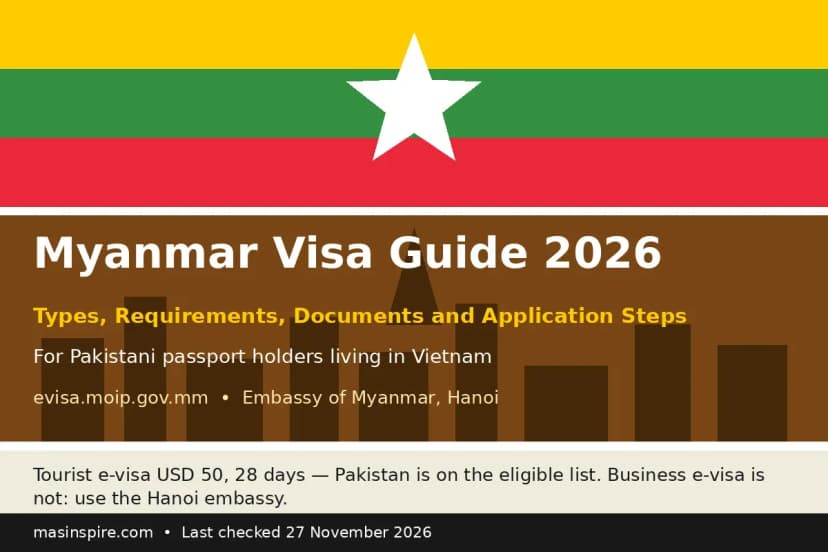
The tourist e-visa is simple in shape. It costs USD 50, paid online by card, and the fee is non-refundable even if the application is refused. It is a single-entry visa: one entry, one stay of 28 days counted from the day you arrive. The approval letter is valid for 90 days from the date it is issued, so you must enter Myanmar within that 90-day window. Processing takes a minimum of three working days in Myanmar time, excluding weekends and Myanmar public holidays, and the clock starts when your acknowledgement email is sent — the portal says that arrives within one hour of a successful payment, so an unpaid application never starts the clock. Apply at least two weeks before travel: approvals can stretch to two or three weeks around public holidays or when extra checks are needed.
Two cautions. First, the portal carried an April 2025 notice suspending tourist applications after the March 2025 earthquake, and no dated notice of resumption was found on the portal for this guide — yet multiple guides checked in October and November 2026 describe the tourist e-visa as open and operating, and the portal's own tourist notice still publishes the USD 50 fee and the 28-day stay. Treat the e-visa as open but verify on the portal itself that tourist applications are being accepted before you book a flight. Second, use only evisa.moip.gov.mm, typing the address yourself: look-alike agency sites charge two or three times the fee for the same visa, and the portal's fee page shows USD 50 and USD 70 and mentions no other charge — a site asking for more is not the portal.
The tourist e-visa is for tourism only. You must stay in registered hotels, motels, inns, guest houses or resorts during your stay, according to the Pakistan Foreign Office's summary of the portal's requirements — a private-home stay is not the arrangement the tourist e-visa contemplates, and one 2026 guide warns that staying with friends or colleagues is not accepted and that hotel proof is checked on arrival. It does not allow paid work of any kind, and it cannot be converted into a business or work visa inside Myanmar. If your purpose is business, study or work, use the right category from the start.
Types of Myanmar Visas for Pakistani Passport Holders
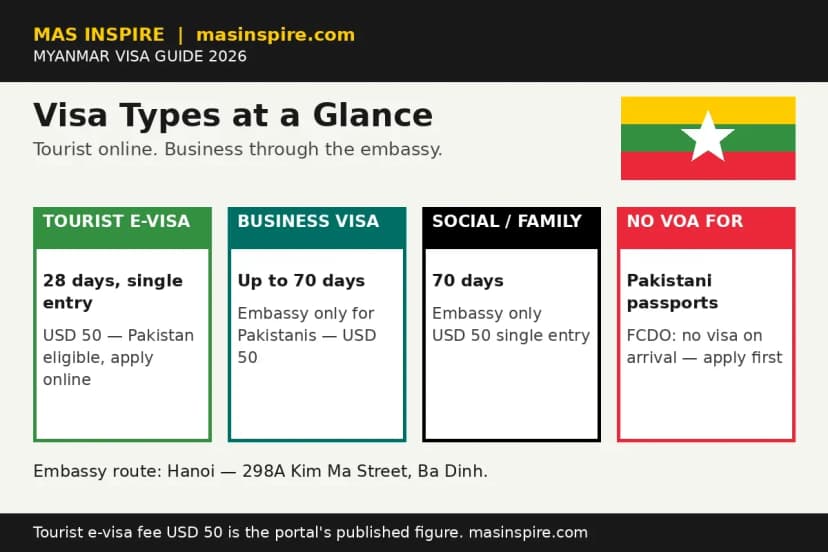
Myanmar issues twelve visa types through its embassies, but only two online. The categories below are the ones a Pakistani passport holder living in Vietnam is realistically likely to use, with the honest limits of each. Where a category does not exist for you, this guide says so rather than inventing one.
Tourist visa (e-visa or embassy)
The standard short-stay visa for sightseeing and holidays. Online it is USD 50, single entry, 28 days from arrival, approval valid 90 days from issue. At an embassy it is the same 28-day stay; the Islamabad embassy charges USD 40 in cash. A tourist visa does not allow paid work. Children under seven are reported exempt from the e-visa fee by one 2026 guide — but a Vietnam-based visa service reports that children under twelve are visa-free for embassy-issued visas, which is a different rule from a different source, so confirm the child rule for your route before you rely on it (see the flags in the FAQ section).
Business visa (embassy route for Pakistanis)
For meetings, conferences, negotiations, training and commercial visits. The business e-visa costs USD 70, allows a 70-day stay from arrival, is single entry with the approval valid 90 days. But it is open to only 54 nationalities, and Pakistan is not on the published list: the list reproduced from the portal names Australia, Austria, Belgium, Brazil, Brunei, Cambodia, Canada, China, France, Germany, India, Indonesia, Italy, Japan, the Netherlands, the United Kingdom, the United States, Vietnam and others — but not Pakistan. A November 2026 Pakistan-focused guide states this explicitly: Pakistani passport holders are not on the published 54-country business e-visa list and should seek a business visa from a Myanmar embassy or consulate. The embassy business visa is a single entry for up to 70 days (USD 50 at Islamabad; USD 50 for a single-entry three-month visa at Hanoi), with multiple-entry versions at Hanoi for USD 200 (three months) and USD 400 (six months). Business visas can be extended inside Myanmar through the eStay system, unlike tourist visas. A business visa does not allow taking up local employment: long-term work needs the stay-permit route described in the work section. The business e-visa needs an invitation letter from a company registered in Myanmar plus the company's registration evidence.
Social visa
Myanmar's category for visiting family or friends. It is issued by an embassy only — there is no social e-visa. The single-entry social visa costs USD 50 and allows a 70-day stay, extendable under the rules; multiple-entry versions (three months, six months, one year) are reported at USD 150, USD 300 and USD 450 on a 2016 embassy fee schedule that has not been confirmed as current, so treat the multiple-entry prices as unverified and ask the mission. If you are staying with family rather than in a hotel, this is the correct category — do not use a tourist e-visa for a private-home stay without checking with the embassy first.
Employment visa
For a foreigner taking up a job with a Myanmar employer. It is issued by an embassy, not online, and it is only the entry document: the real permission to live and work comes from the stay permit and re-entry visa obtained inside Myanmar through the eStay system, sponsored by your DICA-registered employer. The initial employment-visa stay is reported as 70 days, extendable under the rules. No published embassy fee for the employment visa was found — ask the Hanoi or Islamabad mission. Never travel on a tourist or business visa intending to start work.
Education visa
For students at a Myanmar institution, issued by an embassy only. The reported fees are USD 50 for a single-entry 90-day visa and USD 160 for a multiple-entry one-year visa, from the same 2016 schedule — unverified as current, so confirm with the mission. The institution sponsors the application.
Religious visa
For meditation retreats and religious study, issued by an embassy: single entry USD 50 for 70 days, with multiple-entry versions reported at USD 150, USD 300 and USD 450 on the 2016 schedule (unverified as current). Do not use a tourist visa for a long retreat without asking the embassy.
Transit visa
For passing through Myanmar to a third country. Reported at USD 20 for a stay of 24 hours, issued by an embassy. In practice most Pakistani travellers will not need one, because the realistic routings from Vietnam to Yangon are direct or via Bangkok, Singapore or Kuala Lumpur rather than through Myanmar itself — but if your itinerary routes you through Yangon to somewhere else with a stop longer than 24 hours, get the transit visa first. One older source reports transit through Yangon airport is visa-free for up to 24 hours if you stay airside; that could not be verified against an official page, so do not rely on it without confirmation from the airline.
Other embassy visas
Diplomatic and official courtesy visas are free and last for the duration of the assignment. Official, journalist and crew visas are also issued by embassies, with fees set by the mission. There is no digital nomad visa, no retirement visa, no job-seeker visa and no investment visa programme in Myanmar: long-term residence runs through the business visa plus eStay stay permit, or through the permanent-residence scheme described in the work section.
| Visa type | Typical stay | Entries | Where to apply | Can it be extended? |
|---|---|---|---|---|
| Tourist e-visa | 28 days from arrival | Single | evisa.moip.gov.mm — Pakistan eligible | No — see the extension section |
| Tourist visa (embassy) | 28 days | Single (multiple reported) | Hanoi or Islamabad embassy | 14 days reported, disputed |
| Business e-visa | 70 days from arrival | Single | Online — Pakistan NOT on the 54-country list | Yes, via eStay |
| Business visa (embassy) | Up to 70 days | Single or multiple | Hanoi or Islamabad embassy | Yes, via eStay |
| Social visa | 70 days | Single or multiple | Embassy | Yes, under the rules |
| Employment visa | 70 days initially | As issued | Embassy, with employer sponsorship | Yes, via eStay stay permit |
| Education visa | 90 days (single) / 1 year (multiple) | Single or multiple | Embassy, with institution sponsorship | Through the institution |
| Religious visa | 70 days | Single or multiple | Embassy | Under the rules |
| Transit visa | 24 hours | As issued | Embassy before travel | No |
Visa Fees and Financial Requirements
The fee picture for Myanmar is unusually clean for the two e-visas and murky for everything else, because the embassy fee schedule most often quoted dates from 1 December 2016 and has not been confirmed as current. The table below gives the figures as reported, with the source of each, and the text underneath explains which figure controls.
| Item | Figure reported | Source |
|---|---|---|
| Tourist e-visa | USD 50, non-refundable | Official portal fee page, as reported by several November 2026 guides |
| Business e-visa | USD 70, non-refundable | Official portal fee page, as reported by several November 2026 guides |
| Tourist visa, Islamabad embassy | USD 40, exact cash | Pakistan-focused guide, checked 7 November 2026 |
| Business visa (single entry), Islamabad embassy | USD 50, exact cash | Pakistan-focused guide, checked 7 November 2026 |
| Business visa, Hanoi embassy — single, 3 months | USD 50 | Vietnam visa service, June 2025 |
| Business visa, Hanoi embassy — multiple, 3 months | USD 200 | Vietnam visa service, June 2025 |
| Business visa, Hanoi embassy — multiple, 6 months | USD 400 | Vietnam visa service, June 2025 |
| Social visa, single entry | USD 50 | 2016 embassy fee schedule, via two 2026 guides |
| Education visa | USD 50 single (90 days) / USD 160 multiple (1 year) | 2016 embassy fee schedule, via a 2026 guide |
| Transit visa | USD 20, 24 hours | Ministry of Foreign Affairs schedule, via a 2026 guide |
| eStay stay permit (business visas only) | USD 62 (3 months) / USD 114 (6 months) / USD 217 (1 year) | MOIP announcement, September 2025 |
| eStay re-entry visa | USD 72 single / USD 217 multiple | MOIP announcement, September 2025 |
| Tourist extension (if granted) | USD 3 per day, plus a USD 3 administration fee | Older travel guides; disputed by 2026 guides |
| Overstay fine | USD 3 per day, then USD 5 per day | Third-party guides; the day threshold is disputed |
The controlling figure is the one the portal or the mission shows you. For the tourist e-visa, USD 50 is the best-supported figure in this guide: it is the portal's published fee, confirmed by the Pakistan Foreign Office's summary, by the portal's own tourist notice quoted in November 2026, and by every 2026 guide that checked it. The business e-visa's USD 70 is equally well supported. For embassy visas, the fee is whatever the mission charges on the day you apply: the Islamabad figures (USD 40 tourist, USD 50 business, exact cash) come from a single Pakistan-focused guide checked on 7 November 2026, and the Hanoi business figures (USD 50 / 200 / 400) come from a single Vietnam visa service dated June 2025 — neither is an official fee list, so get the fee in writing from the mission before you travel there, and carry it in cash as well as by card.
Financial requirements. No official minimum bank balance has been published for the Myanmar tourist e-visa: the portal asks for a return ticket and a hotel booking, not a bank statement. For embassy applications, the picture is different and the figures are agent claims, not official rules. One Pakistani visa agency states that tourist applicants need a certified six-month bank statement with a closing balance of PKR 1,000,000 to PKR 2,000,000 and an Account Maintenance Certificate, yet quotes a minimum of PKR 400,000 to PKR 1,000,000 elsewhere on the same page — the two figures disagree, and neither is attributed to an official source. Treat any bank-balance figure as unverified: carry recent statements that plainly cover the trip, and ask the mission what it actually requires. There is no published minimum for the e-visa, so do not let an agent sell you a "required" balance.
Two practical warnings about money. First, visa fees are generally non-refundable, including if your application is refused — another reason to confirm eligibility and the fee before you pay, rather than after. Second, apply only on evisa.moip.gov.mm, typing the address yourself, and never through a lookalike site: the portal's fee page shows USD 50 and USD 70 and mentions no other charge, so a site asking for more is not the portal.
Processing Times
Processing time is the one figure in this guide that is consistent across sources — for the e-visa. The portal's own tourist notice states a minimum of three working days in Myanmar time, and every 2026 guide that checked it repeats the same number, excluding weekends and Myanmar public holidays. Some guides quote three to five working days in practice, and one reports approvals stretching to two or three weeks depending on demand and nationality checks. Apply at least two weeks before travel, and do not book a non-refundable flight until the approval letter is in your inbox. The approval letter arrives by email as a PDF: print it, because the visa is stamped into your passport on arrival and airlines check the letter at check-in.
For the embassy route, the timeline is longer and less published. The Hanoi business-visa service reports seven to ten working days from the date the embassy receives the complete application. Islamabad publishes no fixed time: the Pakistan-focused guide says only to allow sufficient time, and one Pakistani agency quotes two to four weeks for a tourist visa from Pakistan — an agency estimate, not an official figure. For the eStay stay-permit extension inside Myanmar, the published time is up to five working days from acknowledgement. Remember that an e-visa approval letter is valid for 90 days from issue and an embassy tourist visa is generally valid for three months from issue, so do not apply absurdly early either.
Complete Document Checklists
No single official document list for Pakistani applicants was published on one page found for this guide, so the checklists below combine what the portal asks of e-visa applicants, what the Pakistan Foreign Office lists, what the Islamabad and Hanoi embassies ask for, and what border officers check on arrival. The mission's list governs an embassy application, so confirm it before you travel there. Prepare originals and clean scans; a blurry passport scan is the commonest reason an online application stalls.
Tourist e-visa — online (the main route for Pakistanis)
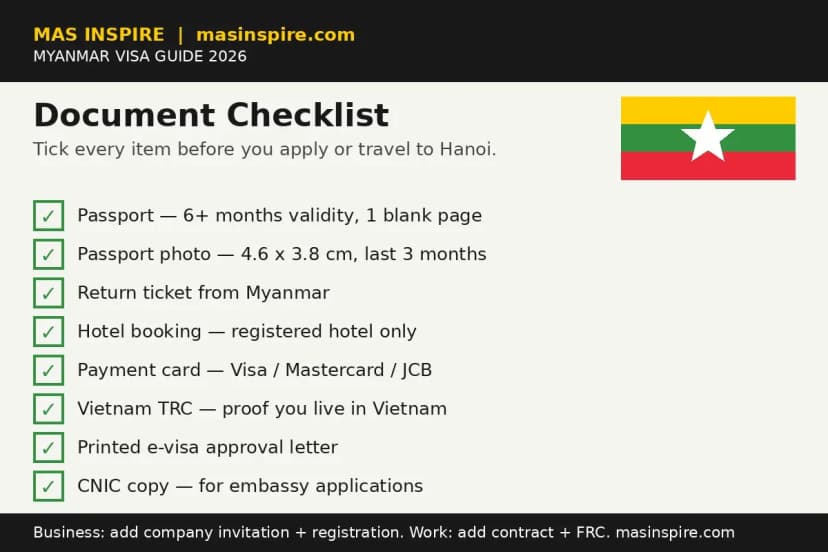
- Pakistani passport valid at least six months from arrival, with at least one blank page; a clear scan of the bio-data page
- One recent colour photograph (4.6 cm x 3.8 cm), taken within the last three months
- Completed online application form on evisa.moip.gov.mm, with your name exactly as it appears on the passport
- Proof of a return ticket from Myanmar, attached to the application
- Proof of a hotel booking in a registered hotel, motel, inn, guest house or resort, attached to the application
- Your departure date from Vietnam and your dates of entry into and exit from Myanmar, in writing
- Visa, Mastercard or JCB credit card for the USD 50 online payment (American Express and Alipay are also reported as accepted)
- Printed copy of the e-visa approval letter to present at boarding and on arrival
Tourist or business visa — embassy route (Hanoi or Islamabad)
- Original Pakistani passport, valid at least six months from the date you enter Myanmar, with blank visa pages
- Completed embassy visa application form (the mission's own form)
- Two or three recent passport-sized colour photographs, white background (Islamabad: three, 45 mm x 35 mm)
- A copy of your CNIC (Islamabad requirement)
- Confirmed return or onward flight ticket or itinerary
- Proof of accommodation — hotel booking, or an invitation letter from your host in Myanmar
- Proof of sufficient funds — recent bank statements; your Vietnamese temporary residence card and proof of address in Vietnam
- For business: an invitation letter from the Myanmar company, the company's registration papers, and a request letter from your own company
- The exact fee in cash, in the form the mission accepts — confirm the amount in advance
- A prepaid return envelope or courier pouch, if the mission returns the passport by post (Islamabad)
Business visa from Vietnam — Hanoi extras
- Everything in the embassy checklist above, plus:
- Valid Vietnamese work permit and temporary residence card or long-term visa — a Vietnam-based visa service states these are required for foreigners legally residing in Vietnam who apply for a business visa at the Hanoi embassy
- Proof of business purpose, such as an invitation letter from a Myanmar company or business partner
- Two recent passport-size photos (4 cm x 6 cm), white background, as specified by the Hanoi service
Work visa — embassy route (employer-sponsored)
- Everything in the embassy checklist above, plus:
- Employment contract with the Myanmar employer and the employer's letter requesting the visa
- Employer's company registration and DICA extract, and proof of a valid annual return
- Foreigner Registration Certificate (FRC) arrangements for the stay-permit stage — your employer handles this
- Police clearance and medical certificates if the mission asks for them
Student visa — embassy route
- Everything in the embassy checklist above, plus:
- Acceptance or enrolment letter from the Myanmar institution
- Proof of funds for tuition and living costs for the course
- Academic certificates and transcripts for your previous studies
Children travelling with you
- Each child needs their own passport, valid six months, and their own visa or e-visa
- One 2026 guide reports children under seven are exempt from the e-visa fee; a Vietnam visa service reports children under twelve are visa-free for embassy-issued visas — the two rules conflict and come from different sources, so confirm the child rule for your route with the portal or the mission before you rely on it
- Carry the child's birth certificate and, if a child travels with one parent only, a consent letter from the other parent
How to Apply: Step-by-Step
There are two sequences in this guide, because there are two possible routes. The tourist e-visa is the route for most readers; the embassy sequence is for business, work, study, social and religious visas — and for any tourist who prefers a sticker visa or whose e-visa application fails.
Tourist e-visa — step by step
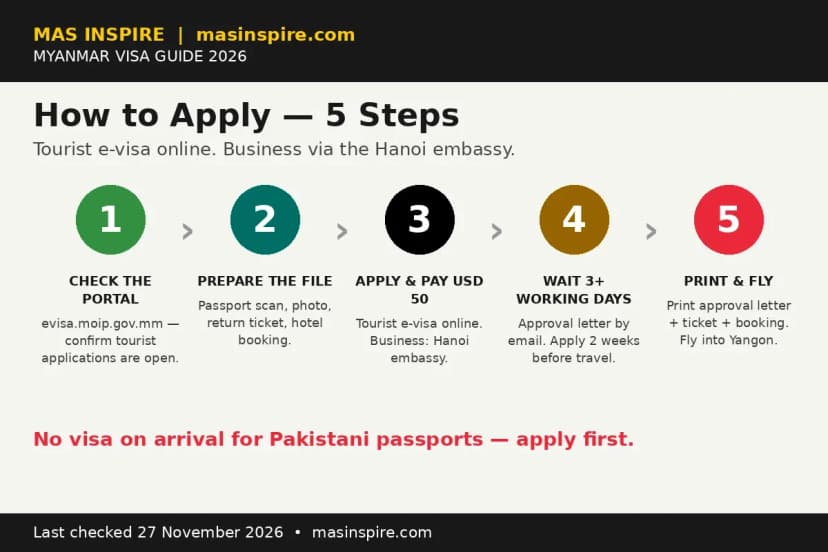
Step 1 — Check the portal is taking tourist applications. Open evisa.moip.gov.mm and read the tourist notice. Confirm that tourist applications are open and that Pakistan is still on the eligible list. Do this before you pay anything or book any flight.
Step 2 — Prepare the file. Assemble the e-visa checklist above: passport scan, the 4.6 cm x 3.8 cm photograph, return ticket, hotel booking. Check each scan is legible before you submit; the portal will return an illegible document and the clock restarts.
Step 3 — Create an account and complete the form. Register on the portal, select Tourist Visa, and fill in your personal details exactly as they appear on your passport. Enter your travel dates, your accommodation address in Myanmar and your contact details in Vietnam. A name mismatch between the form and the passport is one of the commonest reasons for delay.
Step 4 — Upload documents and pay USD 50. Upload the passport bio-page scan, your photograph, your return ticket and your hotel booking, then pay the USD 50 fee by card on the portal. Keep the payment receipt and the application reference number. The fee is non-refundable.
Step 5 — Wait for the approval letter. Plan on a minimum of three working days in Myanmar time, and apply at least two weeks before travel so a rejected scan or a holiday delay does not cost you the trip. The acknowledgement email should arrive within one hour of a successful payment; the approval letter arrives by email as a PDF.
Step 6 — Print everything and travel. Print the approval letter, your return ticket and your hotel booking, and carry them in your hand luggage. Airlines check the approval letter at boarding, and immigration officers in Yangon stamp the visa into your passport on arrival. Check the stamp before you walk away from the desk.
Embassy sticker visa — step by step
Step 1 — Contact the mission. Telephone the Embassy of Myanmar in Hanoi (+84 24 3845 3369) or Islamabad (+92 51 283 2232) and confirm that it accepts your visa type from a Pakistani national resident in Vietnam, what its current form, fee and document list are, whether you need an appointment, and whether you must apply in person. Do not travel to Hanoi until you have this confirmation.
Step 2 — Prepare the file. Assemble the embassy checklist above, with originals and photocopies. For business, ask your host company in Myanmar for the invitation and registration papers early — a slow letter is the usual delay.
Step 3 — Submit at the embassy. Attend the mission with your file and the exact fee in cash. At Hanoi, submission hours are reported as 08:00 to 12:00, Monday to Friday, except public holidays, and another person may submit on your behalf without an authorisation letter. Keep a copy of everything you submit and a receipt for everything you pay.
Step 4 — Wait for the decision. Allow seven to ten working days for a Hanoi business visa, and longer — two to four weeks is the agency estimate — for Islamabad. The embassy may ask for an interview or extra documents.
Step 5 — Collect the visa and check it. When the visa is issued, check the name, passport number, dates, number of entries and validity on the sticker before you leave the embassy. An embassy tourist visa is generally valid for three months from issue, so confirm your travel date still falls inside that window.
Step 6 — Travel with the file. Carry the passport with the visa, your return ticket, your accommodation proof or invitation, and your proof of funds in your hand luggage for the arrival check in Yangon.
Common application mistakes
The mistakes that cost Pakistani applicants their trip are small and avoidable: applying for a business e-visa when Pakistan is not on the 54-country business list; using a tourist e-visa for a business trip, a retreat or a job, then being unable to extend or convert it; booking a hotel that is not a registered hotel, or a private-home stay, when the tourist e-visa requires registered accommodation; entering through a land border that does not accept e-visas; applying on a look-alike agency site and paying two or three times the USD 50 fee; and a passport with less than six months' validity, or a name on the form that does not match the passport exactly.
Applying from Vietnam — the Embassy in Hanoi
For a Pakistani living in Vietnam, the most useful fact in this guide is that Myanmar has a resident embassy in Hanoi — and that a direct flight from Ho Chi Minh City to Yangon takes about two and a half hours, so the whole trip can be planned from Vietnam without going back to Pakistan. The Embassy of the Republic of the Union of Myanmar in Hanoi is at 298A Kim Ma Street, Ba Dinh District, Hanoi, in the Van Phuc Diplomatic Compound. Its telephone numbers are +84 24 3845 3369 and +84 24 3823 2056, and the email listed for it by Vietnam's Ministry of Foreign Affairs protocol department is hanoi-embassy@mofa.gov.mm. Office hours are Monday to Friday, 09:00 to 12:00 and 13:00 to 17:00, and a Vietnam visa service reports visa submission hours of 08:00 to 12:00, Monday to Friday, except public holidays.
Three cautions belong here. First, two different email addresses circulate for the Hanoi embassy: the protocol list gives hanoi-embassy@mofa.gov.mm, while a Vietnam visa service gives lanhsu.mehanoi@gmail.com. No source confirms which inbox the mission monitors, so telephone first and treat email as a backup. Second, the embassy's business-visa fees (USD 50 / 200 / 400) and its seven-to-ten-working-day processing time come from a single Vietnam visa service dated June 2025, not from an official fee list — get the fee in writing before you travel to Hanoi. Third, whether the mission will issue a tourist visa to a Pakistani resident of Vietnam is the exact question to put to it: a Vietnam-based service states that foreigners legally residing in Vietnam may apply for a business visa at the Hanoi embassy if they hold a valid passport, a Vietnamese work permit and a temporary residence card or long-term visa, plus proof of business purpose. Whether the same residence test applies to a tourist visa was not confirmed by any source, so ask the mission directly and keep its written answer.
There is also an Honorary Consulate of Myanmar in Ho Chi Minh City, at 50 Sam Son Street, Tan Binh District, telephone (028) 5449 0805, open Monday to Friday 08:00–11:30 and 13:00–17:00 and Saturday 08:00–11:30. Whether an honorary consulate issues visas at all could not be confirmed — honorary consulates often do not — so telephone the Hanoi embassy first and treat the Ho Chi Minh City office as a place to ask, not a place to file. If Hanoi cannot help you, the fallback for a Pakistani is the Embassy of Myanmar in Islamabad (see the table below): tourist visas USD 40, single-entry business visas USD 50, exact cash — but that means a trip to Pakistan, so exhaust the Hanoi route first.
Also useful from Vietnam: the Embassy of Pakistan in Hanoi is your own mission if anything goes wrong while you are applying or travelling. Keep your Vietnamese temporary residence card valid for the whole trip and carry it with your passport, because it is your proof of the right to return to Vietnam, and airlines and immigration officers on the way home will ask for it. If your TRC is close to expiry, renew it before you travel.
| Mission | Address | Telephone | Note |
|---|---|---|---|
| Embassy of Myanmar, Hanoi (nearest to you) | 298A Kim Ma Street, Van Phuc Diplomatic Compound, Ba Dinh District, Hanoi | +84 24 3845 3369 / +84 24 3823 2056 | Email hanoi-embassy@mofa.gov.mm (protocol list); a second address circulates — telephone first |
| Honorary Consulate of Myanmar, Ho Chi Minh City | 50 Sam Son Street, Tan Binh District, Ho Chi Minh City | (028) 5449 0805 | Whether it issues visas is unconfirmed — ask Hanoi first |
| Embassy of Myanmar, Islamabad (fallback for Pakistanis) | Plot No. 99–101, Street No. 5, Sector G-5, Diplomatic Enclave, Islamabad | +92 51 283 2232 | Tourist USD 40, business single USD 50, exact cash; visa section 09:30–15:30, Mon–Fri |
Entry Points and Visa on Arrival
An e-visa is only valid at four entry points: Yangon, Mandalay and Nay Pyi Taw international airports, and the Kawthaung land border checkpoint with Thailand. That is the portal's current list, confirmed by several November 2026 guides. Older sources list more land crossings — Tachileik (Mae Sai), Myawaddy (Mae Sot) and the India–Myanmar crossings at Moreh/Tamu and Zokhawtar/Rikhawdar — but those do not appear on the portal's current e-visa entry list, and the UK advises against all travel to the towns opposite Tachileik and Myawaddy in any case. Do not plan a land-border entry on an e-visa unless the portal lists that crossing: fly into Yangon, Mandalay or Nay Pyi Taw instead. For a Pakistani living in Vietnam, Yangon is the natural gateway, with a direct flight from Ho Chi Minh City.
Visa on arrival is where the sources split. The UK FCDO is plain: "You must have a visa to enter Myanmar. You cannot obtain a visa on arrival." Against that, the visa-policy summary reports a time-limited visa-on-arrival trial for a small group of nationalities — China, Hong Kong, India, Japan, Macau and South Korea — for USD 50 and a maximum stay of 30 days, with trial windows running to dates in 2026 and 2027 (Hong Kong, for example, 11 March 2026 to 10 March 2027, confirmed by a June 2026 announcement from the Hanoi embassy itself). Pakistan is not on any version of that list. Older travel guides describe a general visa on arrival at the three international airports, but those descriptions predate the current trial system and do not name Pakistan as eligible.
The safe course is to treat visa on arrival as unavailable to you. Get your visa — e-visa or embassy sticker — before you leave Vietnam, carry the printed approval letter or the sticker, and do not fly to Yangon with no visa document and a plan to buy one at the airport. An airline applying the entry rules at check-in in Ho Chi Minh City may refuse to board you without a visa in the first place. The immigration officer at Yangon makes the final decision in every case, whatever document you hold, so keep your hotel booking, return ticket and invitation letter with you at the desk and answer questions plainly.
Extending Your Stay, eStay and Overstay Rules
Whether a tourist stay can be extended is genuinely disputed. Older travel guides state that a tourist visa can be extended by a further 14 days at USD 3 per day plus a one-off USD 3 administration fee, applied for in person at an immigration office in Yangon or Naypyidaw. Against that, several 2026 guides state that a tourist e-visa cannot be extended and that if you want longer than 28 days you should leave and apply for another e-visa — while a third source, updated 19 November 2026, says a two-week extension was possible in the past and it is unsure whether it still is. No official MOIP page settles the question for tourist visas. Plan on the strictest reading: the tourist e-visa gives you 28 days, and if you need longer, use a different visa category before you travel or leave and re-apply.
For business visas, the position is clear and much better. On 29 August 2025 the Ministry of Immigration and Population announced that from 1 September 2025, holders of embassy-issued business visas, business visas on arrival and business e-visas may apply online again for one extension of their visa for three, six or twelve months, through the eStay system (estay.moip.gov.mm). The published fees are USD 62 for three months, USD 114 for six months and USD 217 for one year, plus USD 72 for a single re-entry visa or USD 217 for a multiple re-entry visa, paid online by Visa, Mastercard or JCB card within ten days of the payment notification. Processing takes up to five working days. Only one extension is possible this way; later extensions need a DICA or MIC recommendation letter. The application needs the sponsoring company's documents, a letter signed by a registered director, your Form C report of arrival and your Foreigner Registration Certificate. You must stay inside Myanmar from application until the stickers are affixed at the Stay Extension Section, No. 122 Pansodan Street, Yangon — leaving during processing voids the application. Overstaying by more than ten days, or having previously converted from a tourist visa to a business visa, disqualifies you from the online eStay route.
Overstay is taken seriously, and the fine figures conflict about the threshold. One 2026 guide reports USD 3 per day for the first 30 days, rising to USD 5 per day after that; another reports USD 3 per day up to 90 days, then USD 5 per day. Both agree on the USD 3 starting rate and the USD 5 higher rate; they disagree on where the step-up falls. The FCDO adds that if you overstay you will be liable to pay a fine and could face detention. Overstaying by more than 90 days is reported to risk detention, a blacklist and deportation at your own expense, and hotels will not accept a guest whose visa has expired. Do not overstay, even by a day. If your departure is delayed by a cancelled flight or an emergency, go to the immigration office before your visa expires, not after, and keep every document that proves the delay was outside your control.
Work, Study and Family Routes
Myanmar's work route is employer-led and runs through the business visa, not through a standalone work visa. There is no separate long-term work-visa system, and there is no job-seeker visa: you cannot arrive on a tourist visa and look for work, and you cannot convert a tourist visa into a business visa inside Myanmar. The sequence is: a job offer from a company registered in Myanmar; entry on a business visa (embassy business visa for Pakistanis, since the business e-visa list does not include Pakistan); then, inside Myanmar, your employer applies through the eStay system for a stay permit of three, six or twelve months and a re-entry visa, and arranges your Foreigner Registration Certificate. The stay permit is tied to the sponsoring company: if the employment ends, the permit ends with it.
Who hires foreigners in Myanmar in 2026 is a narrower question than it was five years ago. Most expatriates enter on business visas sponsored by their employer — international schools, NGOs and companies are the usual sponsors — and the work-permit process typically takes four to eight weeks through the Directorate of Investment and Company Administration (DICA). English teaching is a small market compared with Vietnam or Thailand, and the security situation has shrunk it further: do not resign from a job in Vietnam, or pay any agent a placement fee, on the promise of a Myanmar teaching job until the employer, the contract and the business visa are all in writing. Working without authorisation can result in deportation, and foreigners have been investigated over online posts critical of the regime, so keep your public profile quiet while you are in the country.
For study, the route is the education visa through the embassy, sponsored by the institution, with reported fees of USD 50 for a single-entry 90-day visa and USD 160 for a multiple-entry one-year visa (2016 schedule, unverified as current). Myanmar is not a study-abroad destination for most Pakistani students — there is no published scholarship route for Pakistanis, and the security advisories apply to students as much as to tourists. If an institution offers you a place, confirm its registration, get the acceptance letter in writing, and apply at the embassy in Hanoi with proof of funds for tuition and living costs.
For family, the social visa is the category for visiting relatives, and dependants of a business-visa holder apply separately for a dependent family visa tied to the main holder's status — there is no dependent category attached to the business e-visa itself. Myanmar also operates a Permanent Residence of Foreigners scheme, enacted in 2015 — but no verified current criteria, fee or application route was found for this guide, and there is no system granting permanent residence on the basis of financial investment alone. Do not pay anyone who offers to sell you Myanmar permanent residence: ask the MOIP or a Myanmar embassy for the current criteria first.
Transit, Flights and Money: Practical Notes
Flights. This is one of the easiest legs in the whole guide series. Myanmar Airways International flies direct from Ho Chi Minh City (SGN) to Yangon (RGN) three times a week — Tuesday, Thursday and Saturday — departing 20:30 and arriving 22:30, about two and a half hours, with fares from about USD 146 to USD 160 one way in late 2026. The same airline flies Hanoi to Yangon and Da Nang to Yangon. Vietnam Airlines is also listed on the Ho Chi Minh City to Yangon route, and one-stop routings via Bangkok, Singapore or Kuala Lumpur are plentiful if the direct days do not suit you. There is no direct flight from Pakistan to Myanmar: from Pakistan, route via Bangkok, Singapore, Kuala Lumpur or Dubai. Book the whole journey on one ticket where you can.
Money. The currency is the kyat (MMK). Myanmar is largely a cash-based society: the FCDO warns that many ATMs do not accept UK or international bank cards, that there is significant disruption to banking services, and that electronic payments mostly work but many commercial outlets only accept cash. Bring enough US dollars in cash for the whole trip, in new, clean, undamaged notes — torn or marked notes are rejected at exchange counters — and change only what you need at banks or licensed counters. Visa is more widely accepted than Mastercard where cards work at all. Declare foreign currency above USD 10,000 on arrival, as the FCDO advises. Travellers' cheques are never accepted. Budget guides put a day on the main Yangon–Bagan–Mandalay circuit at roughly USD 30 to USD 60 including a local guide, but treat that as an estimate: check current prices before you travel, and do not land with no cash.
Phones and internet. Foreign SIM cards do not work reliably, so most visitors buy a local SIM on arrival. The FCDO notes that visitors' phones get a 30-day grace period on local networks, after which the handset must be registered on the official device register or it will be blocked. Facebook and X (Twitter) are banned in Myanmar; VPN use is legal, but police have sought bribes from people using a VPN to access social media, so install a VPN before you arrive and use it discreetly. Carry your passport with your visa at all times: you are likely to pass checkpoints, and hotels verify visas at check-in.
Safety, Health and Arrival Checks
Security — read this before you book. Myanmar is in a civil war that followed the February 2021 military coup, and the situation can change quickly and without warning. The US State Department rates Burma Level 4: Do Not Travel (issued 8 May 2026), citing armed conflict, civil unrest, arbitrary enforcement of local laws, poor health infrastructure, land mines and unexploded ordnance, crime, and wrongful detention. The UK FCDO advises against all travel to Chin, Kachin, Kayah, Kayin, Mon and Rakhine states, to Sagaing and Magway regions, and to northern Shan State, and against all but essential travel to Mandalay Region, Shan State South and East, and the rest of Bago Region. Yangon Region is not on either list, and the Yangon–Bagan–Mandalay circuit is open to visitors, but the FCDO describes the conflict as increasingly volatile. Canada advises against all travel, and Australia's advice is at a similar level. Check your own government's advisory in full before you book, check that your travel insurance stays valid if you travel against official advice — the FCDO warns it may not — and have an emergency departure plan that does not rely on the authorities. Register your trip with the Embassy of Pakistan in Hanoi. Avoid demonstrations and crowds, stay on well-used roads, and never touch unknown metal objects: land mines and unexploded ordnance exist throughout the country and their locations are often unmarked. Foreigners have been detained for online posts critical of the regime — keep your public profile quiet.
Health. The FCDO states that to enter Myanmar you must have a certificate proving a yellow fever vaccination if you are coming from a country listed as a transmission risk. Neither Pakistan nor Vietnam is on that list, so a direct flight from Ho Chi Minh City should not need the certificate — but confirm it with the airline if your routing transits a risk country. A separate vaccination point matters for Pakistanis: a Pakistan-focused guide states that a polio vaccination certificate from NADRA is needed to leave Pakistan. Whether that requirement applies when you depart from Vietnam rather than Pakistan could not be verified for this guide — ask the Hanoi embassy or your airline, and carry the certificate if you have one. Malaria is present throughout Myanmar: take prophylaxis as your doctor in Ho Chi Minh City advises, use repellent and a net, and drink bottled water. Healthcare and emergency medical resources are limited and inadequate, according to the US State Department, so buy travel insurance that covers medical evacuation before you travel, and confirm in writing that it covers Myanmar despite the Level 4 advisory. Malaria is present throughout Myanmar: take prophylaxis as your doctor in Ho Chi Minh City advises, use repellent and a net, and drink bottled water.
Arrival checks. At Yangon airport, expect to show your passport with the visa or the printed e-visa approval letter, your return or onward ticket, and your hotel booking — Canadian government advice notes that hotel proof is checked on arrival and that staying with friends is not accepted. Declare foreign currency above USD 10,000. The immigration officer makes the final decision, whatever document you hold. Check the stamp in your passport before you walk away from the desk: it is your proof of the date you entered and the length of stay you were given, and it is the document the immigration office will ask for if you apply for an extension.
Frequently Asked Questions
1. Do Pakistani citizens need a visa for Myanmar?
Yes. Ordinary Pakistani passports need a visa before travel. Pakistan is not on Myanmar's visa-free list and is not on any visa-on-arrival list. The Pakistan Foreign Office's own travel information says Pakistanis can apply for the online tourist visa. Living in Vietnam or holding a Vietnamese residence card does not remove the requirement.
2. Can Pakistanis apply for a Myanmar e-visa online?
Yes, for tourism. Pakistan is named at number 72 on the portal's own 100-country tourist e-visa eligibility list, and the Pakistan Foreign Office confirms that Pakistanis can apply for the online tourist visa. Apply on evisa.moip.gov.mm, pay USD 50, and allow a minimum of three working days. The business e-visa is a different matter — see question 4.
3. How much does a Myanmar tourist e-visa cost, and how long is it valid?
USD 50, paid online by card, non-refundable. It is a single-entry visa allowing a stay of 28 days from the day you arrive, and the approval letter is valid for 90 days from the date it is issued, so you must enter within that window. At the Islamabad embassy the tourist visa costs USD 40 in cash.
4. Can Pakistanis use the Myanmar business e-visa?
Probably not — and this is the main trap in this guide. The business e-visa is open to only 54 nationalities, and Pakistan is not on the published list reproduced from the portal. A November 2026 Pakistan-focused guide states this explicitly and advises Pakistanis to seek a business visa from a Myanmar embassy instead. Some commercial sites do list Pakistan as business-e-visa eligible, which conflicts with the published list. Until the portal itself offers you a business e-visa as a Pakistani, use the embassy route: Hanoi charges USD 50 for a single-entry three-month business visa.
5. How long does the Myanmar e-visa take?
A minimum of three working days in Myanmar time, excluding weekends and Myanmar public holidays, starting when your acknowledgement email is sent (within one hour of a successful payment). Apply at least two weeks before travel: approvals can stretch to two or three weeks around holidays or when extra checks are needed. A Hanoi business visa takes seven to ten working days; Islamabad publishes no fixed time.
6. Where can I enter Myanmar on an e-visa?
Only four entry points: Yangon, Mandalay and Nay Pyi Taw international airports, and the Kawthaung land border with Thailand. Older lists add Tachileik and Myawaddy, but those are not on the portal's current e-visa list, and the UK advises against travel to the towns opposite them. Fly into Yangon — there is a direct flight from Ho Chi Minh City.
7. Can Pakistanis get a visa on arrival in Myanmar?
No — do not count on it. The UK FCDO states plainly that you cannot obtain a visa on arrival. A time-limited visa-on-arrival trial exists for a small group of nationalities (China, Hong Kong, India, Japan, Macau and South Korea) for USD 50 and 30 days; Pakistan is not on it. Get your visa before you leave Vietnam.
8. Is there an embassy of Myanmar in Vietnam?
Yes. The Embassy of Myanmar in Hanoi is at 298A Kim Ma Street, Van Phuc Diplomatic Compound, Ba Dinh District, Hanoi, telephone +84 24 3845 3369 or +84 24 3823 2056, email hanoi-embassy@mofa.gov.mm. It issues business and other embassy visas; telephone first to confirm it accepts your visa type from a Pakistani resident of Vietnam. There is also an honorary consulate in Ho Chi Minh City, but whether it issues visas is unconfirmed.
9. What documents do I need for a Myanmar tourist e-visa?
A passport valid at least six months with a blank page; one recent colour photo (4.6 cm x 3.8 cm) taken in the last three months; the passport bio-data page scan; proof of a return ticket; proof of a hotel booking in a registered hotel; and a Visa, Mastercard or JCB card for the USD 50 payment. Print the approval letter and carry it with your passport.
10. Can I extend my Myanmar tourist visa?
Probably not — and you should not plan on it. Older guides describe a 14-day extension at USD 3 per day plus a USD 3 administration fee, but several 2026 guides state that a tourist e-visa cannot be extended, and no official page settles the question. If you need longer than 28 days, use a different visa category before you travel, or leave and re-apply. Business visas can be extended through the eStay system for three, six or twelve months.
11. What happens if I overstay my Myanmar visa?
You will be fined, and you could face detention. Guides report USD 3 per day, rising to USD 5 per day — but they disagree on whether the step-up falls after 30 days or after 90 days. Overstaying by more than 90 days is reported to risk detention, a blacklist and deportation at your own expense, and hotels will not accept a guest whose visa has expired. Leave on time, or visit the immigration office before your visa expires.
12. Can I work in Myanmar on a tourist or business visa?
No. Neither visa gives the right to work. The route is: a job offer from a DICA-registered Myanmar company, entry on a business visa, then a stay permit and re-entry visa through the eStay system sponsored by your employer, plus a Foreigner Registration Certificate. There is no job-seeker visa and no digital nomad visa, and you cannot convert a tourist visa into a business visa inside Myanmar.
13. Are there direct flights from Vietnam to Yangon?
Yes. Myanmar Airways International flies Ho Chi Minh City to Yangon direct three times a week (Tuesday, Thursday, Saturday), about two and a half hours, with fares from about USD 146 to USD 160 one way in late 2026. It also flies Hanoi to Yangon and Da Nang to Yangon. There is no direct flight from Pakistan — route via Bangkok, Singapore, Kuala Lumpur or Dubai.
14. Is it safe to travel to Myanmar in 2026?
That is a decision to make with your eyes open, not a yes-or-no answer. The US rates Burma Level 4: Do Not Travel (8 May 2026) for armed conflict, wrongful detention, land mines and poor healthcare. The UK advises against all travel to Chin, Kachin, Kayah, Kayin, Mon and Rakhine states, Sagaing and Magway, and northern Shan State, and against all but essential travel to Mandalay and parts of Bago and Shan. Yangon Region is not on either list and the Yangon–Bagan–Mandalay circuit is open, but the situation is volatile, insurance may not cover travel against official advice, and you should have an emergency departure plan.
15. Do children need a visa for Myanmar, and is there a fee?
Yes, each child needs their own passport and their own visa or e-visa. The fee rule is disputed: one 2026 guide reports children under seven are exempt from the e-visa fee, while a Vietnam visa service reports children under twelve are visa-free for embassy-issued visas. Confirm the child rule for your route with the portal or the mission before you rely on either figure, and carry the child's birth certificate.
Official Immigration Websites
Check these sources directly before you apply. The portal is the controlling source for e-visa eligibility and fees; the FCDO and the US State Department are the controlling sources for passport validity, health and safety advice; the Hanoi embassy is the controlling source for the embassy route.
| Website | What it is | Link |
|---|---|---|
| Myanmar e-Visa portal (MOIP) | Official e-visa platform — eligibility lists, applications, fee at checkout | evisa.moip.gov.mm |
| Myanmar e-Visa — tourist notice | Portal's own tourist rules: USD 50, 28 days, 3 working days, 100-country list including Pakistan | evisa.moip.gov.mm/notice/tourist |
| Myanmar e-Visa — visa process notice | Portal's fee and process page: tourist USD 50, business USD 70 | evisa.moip.gov.mm/notice/visa-process |
| Myanmar eStay portal (MOIP) | Online stay-permit extension and re-entry visas for business-visa holders | estay.moip.gov.mm |
| UK Foreign, Commonwealth and Development Office — Myanmar travel advice | Entry requirements, passport validity, no visa on arrival, yellow fever, safety zones | gov.uk/foreign-travel-advice/myanmar |
| US State Department — Burma travel advisory (Level 4) | Level 4: Do Not Travel, issued 8 May 2026 — armed conflict, wrongful detention, land mines | osac.gov — Burma travel advisory |
| Pakistan Ministry of Foreign Affairs — travel information (Myanmar) | Pakistan government's own guidance: online tourist visa, photo, return ticket, hotel booking | mofa.gov.pk — Myanmar travel information |
| Embassy of Myanmar, Hanoi | Nearest mission for residents of Vietnam — telephone +84 24 3845 3369; no published website found | 298A Kim Ma Street, Ba Dinh District, Hanoi |
| Embassy of Myanmar, Islamabad | Fallback mission for Pakistanis — tourist USD 40, business single USD 50, exact cash | myanmarimmigration.org — Myanmar Embassy, Islamabad |
| Wikipedia — Visa policy of Myanmar | Summary of visa exemption, e-visa, visa-on-arrival trials and the 100-country list | en.wikipedia.org/wiki/Visa_policy_of_Myanmar |
| UrduPoint — Myanmar Visa for Pakistanis 2026 | Pakistan-focused guide checked 7 November 2026: e-visa eligibility, Islamabad fees, polio certificate | urdupoint.com/travel/visa/myanmar |
| Visa5s — Myanmar Business Visa for Foreigners Living in Vietnam | Hanoi embassy business-visa fees, processing time, submission hours and residence requirements | visa5s.com — Myanmar Business Visa in Vietnam |
This guide was checked on 27 November 2026. Visa rules change without notice. Always confirm the live rules on evisa.moip.gov.mm and with the Embassy of Myanmar in Hanoi before paying any fee or booking a non-refundable ticket. Nothing in this guide is immigration advice; the Myanmar authorities set and enforce the entry rules, and the immigration officer at Yangon makes the final decision. Read your own government's travel advisory in full before you travel to Myanmar.