Moldova Visa Guide 2026: Types, Requirements, Documents and Application Steps
Last checked: 27 November 2026. This guide is for Pakistani passport holders living in Vietnam. Visa rules change without notice — always confirm the live rules on the official e-visa portal (evisa.gov.md) and the Ministry of Foreign Affairs visa pages (mfa.gov.md) before paying any fee or booking a non-refundable ticket.
Table of Contents
- Introduction
- Do Pakistani Passport Holders Need a Visa for Moldova?
- The Schengen Question: Does a Schengen, US, UK or Canada Visa Help?
- Types of Moldova Visas for Pakistani Passport Holders
- The Moldova E-Visa: What It Is and Who Can Use It
- Moldova Visa Fees
- Processing Times
- The Official Invitation: The Step Most Applications Fail On
- Complete Document Checklists
- How to Apply: Step-by-Step
- Applying from Vietnam — and from Pakistan
- At the Border: Entry, Registration and Transnistria
- Work, Study and Long Stays
- Transit, Overstay, Refusals and Practical Travel Notes
- Frequently Asked Questions
- Official Immigration Websites
Introduction
Moldova is the quiet corner of Eastern Europe that most Pakistani travellers have never considered — and that is exactly why it rewards a visit. Chișinău, the capital, is a low-rise, leafy city of parks, Soviet-era boulevards and wine cellars; the countryside holds Orheiul Vechi, a cave monastery carved into a limestone cliff above the Răut river, and Cricova and Mileștii Mici, two of the largest wine cellars in the world. It is also one of the cheapest countries in Europe once you are there, and the visa process is genuinely online: the short-stay visa for Pakistanis is applied for through the government's own e-visa portal, with no embassy appointment and no paper file for the standard tourist route.
This guide gives the route as the official sources state it on 27 November 2026, and it is honest about the two places where the sources disagree. First, the visa fee: the Ministry of Foreign Affairs' own visa page lists EUR 40 for a short-stay (Type C) visa, but the Iași consulate page lists EUR 70 and the Beijing embassy page lists EUR 60 for the same visa. The fee you actually pay is the one the e-visa portal shows at checkout — screenshot it before you pay, and do not trust any third-party fee table, including this guide, over the portal. Second, several travel blogs claim that a valid Schengen visa lets a Pakistani passport holder enter Moldova visa-free. That is wrong for Pakistanis: the substitute-visa exemption explicitly excludes Pakistan, so a Schengen visa saves you from the invitation step but not from the Moldovan visa itself. Both conflicts are set out in full below, with the controlling source named in each case.
Moldova is not a member of the European Union and not a member of the Schengen Area — it is an EU candidate country. A Moldovan visa therefore does not let you enter Romania, the Schengen states or any other EU country, and a Schengen visa does not, on its own, let you enter Moldova on a Pakistani passport. Keep the two systems separate in your planning.
Do Pakistani Passport Holders Need a Visa for Moldova?
Yes. The Ministry of Foreign Affairs of the Republic of Moldova lists the Islamic Republic of Pakistan on all three of its restrictive lists: states whose citizens need a visa to enter, exit and transit Moldova; states whose citizens need an airport transit visa; and states whose citizens need an official invitation before a visa can be issued. There is no visa on arrival for Pakistani passport holders, and there is no visa-free entry for Pakistani ordinary passports — not even for a short tourist trip, and not even if you are only changing planes at Chișinău International Airport (KIV).
Your residence in Vietnam does not change this. Moldova's visa rules depend on your passport, not on where you live: a Pakistani passport holder living in Ho Chi Minh City faces the same visa requirement, the same invitation requirement and the same e-visa route as a Pakistani passport holder living in Lahore. Your Vietnamese temporary residence card (TRC) is useful as supporting evidence of your residence and your return to Vietnam, but it does not exempt you from any Moldovan requirement, and no Moldovan source gives Vietnamese residents any simplified procedure.
| Your situation | Visa needed? | Invitation needed? | Route |
|---|---|---|---|
| Pakistani passport only | Yes — Type C short-stay visa | Yes, from the General Inspectorate for Migration | Online at evisa.gov.md |
| Pakistani passport + valid EU / Schengen / UK / US / Canada visa or residence permit (not a transit visa) | Yes — Type C short-stay visa still required | No — the strong visa or permit replaces the invitation | Online at evisa.gov.md |
| Pakistani diplomatic or service passport | Check the bilateral position before travel | Check before travel | Ask the nearest Moldovan mission in writing |
| Transit through Chișinău airport without leaving the international zone | Yes — Type A airport transit visa | No | Online at evisa.gov.md or at a mission |
The stay a Type C visa allows is up to 90 days within any 180-day period. The visa itself is issued for the period you applied for — a tourist visa is not automatically a 90-day visa — so the dates on your invitation, your bookings and your application must all agree, and you must not plan a stay longer than the visa you are actually granted.
The Schengen Question: Does a Schengen, US, UK or Canada Visa Help?
This is the most misunderstood part of the Moldova rules, and several travel blogs get it wrong for Pakistanis, so it deserves a section of its own. Moldova does have a "substitute visa" rule: holders of a valid visa or residence permit issued by a Schengen state, the United Kingdom, the United States or Canada may enter Moldova without a Moldovan visa for up to 90 days within any 180-day period. But that rule does not apply to citizens of a defined list of countries — and Pakistan is explicitly on that excluded list, alongside Afghanistan, Bangladesh, Iran, Iraq, Nepal, the Philippines, Sri Lanka, Syria, Vietnam and Yemen, among others. The exclusion is stated in the visa policy of Moldova as published with citations to the Ministry of Foreign Affairs, and it is confirmed by UrduPoint's Pakistan-specific guide, checked on 27 November 2026, which states plainly that Pakistan is not one of the nationalities marked for the visa-free concession.
What a valid Schengen, EU, UK, US or Canada visa or residence permit does give a Pakistani passport holder is narrower but still valuable: it exempts you from the official invitation procedure. The Ministry's own Type C requirements say the applicant must present "the invitation issued by the General Inspectorate for Migration, if required, or the residence permit or valid visa (except a transit visa) issued by a member state of the European Union or by a state party to the Schengen Agreement, by the United Kingdom, by the United States of America or by Canada". In other words, the strong visa replaces the invitation — it does not replace the Moldovan visa. You still file for a Type C visa, you still pay the fee, and you still wait for the decision.
Be careful with blogs that describe Moldova as running "two doors" for Pakistanis, with a Schengen visa as a visa-free door. That description is correct for some nationalities and wrong for Pakistan. If you hold a used, valid multiple-entry Schengen visa and you are planning a trip that also covers Romania or a Schengen state, the Moldovan leg still needs its own Moldovan visa. A UAE or other Gulf residence permit does not remove the invitation or the visa either — only a visa or residence permit from the EU, a Schengen state, the UK, the US or Canada counts, and only for the invitation step.

Types of Moldova Visas for Pakistani Passport Holders
Moldova issues four visa types, set out on the Ministry of Foreign Affairs visa page. The e-visa portal covers short-stay and transit applications; long-stay (Type D) visas are handled through a mission.
| Visa type | What it is for | Maximum stay | Fee (main MFA page) |
|---|---|---|---|
| Type A — airport transit | Passing through the international transit zone of Chișinău airport without entering Moldova | The stopover only | EUR 20 |
| Type B — transit | Crossing Moldovan territory on the way to a third country | Up to 5 days | EUR 40 |
| Type C — short stay | Tourism (C/T), private visit (C/V), business (C/A), official mission (C/MI), transport (C/TS), sport (C/S), cultural, scientific and humanitarian activities (C/AD) | Up to 90 days in any 180 days | EUR 40 |
| Type D — long stay | Employment (D/AM), study (D/AS), family reunification (D/VF), entrepreneurial activity (D/AI), religious and humanitarian activities (D/RU), medical treatment (D/TR), diplomatic and service activities (D/DS) | Up to 12 months, stay up to 90 days in 6 months from first entry | EUR 40 |
For almost every Pakistani traveller reading this guide, the relevant visa is the Type C tourist visa (C/T) or the Type C private-visit visa (C/V). The tourist visa is for sightseeing and holidays; the visit visa is for staying with a Moldovan citizen or a foreigner holding a Moldovan residence permit, and it needs a copy of the inviting person's identity document or residence permit plus their own free-form invitation letter. Business travellers use C/A, which needs an invitation from a Moldovan company, non-governmental organisation or public authority to attend meetings, conferences or exhibitions. All Type C categories carry the same EUR 40 fee on the Ministry's main visa page, the same EUR 30-per-day funds rule and the same EUR 30,000 insurance rule.
The Type D long-stay visa is a different process: it is issued for up to 12 months, it requires a criminal record from Pakistan translated into Romanian or English and legalised or apostilled, and for work it requires a decision granting the right of temporary residence for work purposes, while for study it requires confirmation of acceptance from the educational institution. A Type D visa cannot be obtained through the e-visa portal alone — plan on dealing with a Moldovan mission, which for a resident of Vietnam means the Embassy in Beijing (see the section on applying from Vietnam).
The Moldova E-Visa: What It Is and Who Can Use It
The e-visa is the electronic version of the short-stay Type C visa, issued by the Directorate for Consular Affairs of the Ministry of Foreign Affairs through the official portal at evisa.gov.md, which the Ministry says is available 24 hours a day, 7 days a week. You complete the form online, attach scanned documents and pay by card. The approved e-visa is sent to you by email as a PDF: it is not a sticker in your passport, so you must print it and carry it with your passport, and you must show both at the border. The portal's own first promise is that the e-visa exists so the applicant does not need to appear in person at an embassy — which matters for a Pakistani in Vietnam, because Moldova has no mission in Vietnam at all.
Pakistani nationals can obtain an e-visa. The visa policy of Moldova states that citizens of other countries may obtain an e-visa, and the Pakistani-specific guidance confirms the online route at evisa.gov.md. Two things do not change online: the invitation requirement still applies to Pakistanis who do not hold a qualifying EU, Schengen, UK, US or Canada visa or residence permit, and the fee is still charged — the portal takes payment by card inside the application. There is no separate "e-visa fee" published on the portal's public pages that this guide could verify; the amount is shown at the payment step, which is why the fee conflict in the next section matters and why you should screenshot the checkout screen before you pay.
One practical warning from a commercial visa service: the government portal is reported to run a daily application limit and to turn applicants away once it is reached, telling them to come back the next day. That limit could not be verified against any official source, so treat it as unconfirmed — but if the portal refuses your submission, try again the next day before assuming your application was rejected.
Moldova Visa Fees
The fee is the one figure in this guide where official Moldovan sources disagree with each other, so read this section carefully and treat the portal checkout as the controlling source.
| Source | Type A | Type B | Type C | Type D |
|---|---|---|---|---|
| Ministry of Foreign Affairs, main visa page (mfa.gov.md) | EUR 20 | EUR 40 | EUR 40 | EUR 40 |
| General Consulate in Iași (iasi.mfa.gov.md) | EUR 30 | EUR 60 | EUR 70 | — |
| Embassy in Beijing, visa page (china.mfa.gov.md) | EUR 20 | EUR 40 | EUR 60 | EUR 80 |
| Embassy in Beijing, consular-fees table (china.mfa.gov.md) | EUR 20 | EUR 40 | EUR 40 | EUR 40 |
The main Ministry page — the central, current visa-requirements page — lists EUR 40 for the Type C short-stay visa, "plus additional fees, if applicable", and the same EUR 40 for Types B and D and EUR 20 for Type A. That is the figure this guide uses, and it is also the figure in the most recent Pakistan-specific guides checked on 27 November 2026. But the Iași consulate's copy of the same requirements lists EUR 70 for Type C, EUR 60 for Type B and EUR 30 for Type A, and the Beijing embassy's visa page lists EUR 60 for Type C and EUR 80 for Type D — while the Beijing embassy's own consular-fees table lists EUR 40 for Type C and Type D. Third-party guides add further figures: EUR 50 and EUR 60 are both quoted for the e-visa, and one agency table quotes EUR 60 as the standard tourist fee. No single figure can be presented as settled, because the disagreement is between official Moldovan publications themselves. The practical rule is simple: the amount the e-visa portal asks you to pay by card at checkout is the fee for your application. Screenshot it, keep the payment receipt, and budget EUR 70 as your worst case so a higher figure at checkout does not strand your application. Fees are not refunded if the visa is refused.
There are also fee exemptions on the official lists — for example, holders of diplomatic passports and persons of Moldovan origin are issued visas free of charge at missions — but none of them applies to an ordinary Pakistani tourist application, so do not plan on one.
Processing Times
Plan on 10 calendar days from a complete application, and allow up to 20. The e-visa examination period most often reported from official guidance is up to 10 calendar days, extendable to 20 calendar days where necessary, and the Embassy of Moldova in India gives the same 10-calendar-day standard with extension to 20 days. The Embassy of Moldova in the UAE, by contrast, states 10 business days from the day a complete application is submitted. Other sources quote shorter times — 3 to 5 working days and 5 business days appear in third-party guides — and one commercial service quotes up to 14 business days. None of the shorter figures comes from an official Moldovan publication that this guide could verify, and the 10-calendar-day figure is the one that recurs across the official-leaning sources, so this guide plans on it.
| Figure | Source | Status |
|---|---|---|
| Up to 10 calendar days, extendable to 20 | E-visa guidance; Embassy in India | Use this for planning |
| 10 business days from a complete application | Embassy of Moldova in the UAE | Embassy route; longer than 10 calendar days in practice |
| 3–5 working days | Third-party guide | Not verified against any official source |
| 5 business days | Third-party guide | Not verified against any official source |
| Up to 14 business days | Commercial visa service | Not verified against any official source |
The invitation is a separate clock that runs before the visa clock starts. The Ministry itself does not publish a processing time for the official invitation, so no official invitation time can be given in this guide. A Moldovan tour operator writing about the General Inspectorate for Migration's e-services platform reports a standard invitation processing time of up to 10 working days. Treat that as a secondary-source figure, not an official one, and build your timeline as: invitation first (allow at least two weeks), then the visa application (allow 10 to 20 calendar days), then travel. In practice, start at least 6 weeks before your intended departure, and do not book a non-refundable ticket until the e-visa PDF is in your inbox. Incomplete applications are denied or delayed, so a refused or returned file costs you the whole cycle, not just a few days.
The Official Invitation: The Step Most Applications Fail On
For a Pakistani passport holder, the official invitation is usually the hardest part of the whole process — harder than the form, harder than the fee. Pakistan is on the Ministry's list of states whose nationals require an invitation to obtain a Moldovan entry visa, and the invitation must be issued by the General Inspectorate for Migration (IGM) of the Ministry of Internal Affairs. A hotel booking alone does not satisfy it, and a letter you write yourself does not satisfy it.
The invitation is requested by the inviting side in Moldova, not by you. Your host — a Moldovan citizen, a resident, or a registered company or licensed tour operator — applies through the IGM's e-services platform, uploads the documents in digital form, pays the fee through MPay, and receives the approved invitation by email as a printable document. You then attach that invitation to your e-visa application. If you are travelling as a tourist with no personal host, the realistic route is a licensed Moldovan tour operator or travel agency that arranges the invitation as part of a tour package; expect to pay for that service, and verify the operator independently before sending money — an invitation sold by a stranger online is a common scam pattern, and a fake invitation will get your application refused and may get you flagged.
You do not need the IGM invitation if you hold a valid residence permit or a valid visa (other than a transit visa) issued by an EU member state, a Schengen state, the United Kingdom, the United States or Canada. That is the exemption the Ministry's Type C requirements state, and it is the only exemption that matters for most readers of this guide. Note what it does not do: it does not exempt you from the visa, and it does not exempt you from the funds, insurance and ticket requirements. If you hold such a visa, attach a clear scan of it instead of the invitation, and make sure it is valid for the whole of your planned Moldovan stay.

Complete Document Checklists
The checklists below follow the Ministry of Foreign Affairs Type C requirements page, read on 27 November 2026. Scan everything clearly; the e-visa portal takes scans, and a blurred bio page is one of the commonest reasons for delay.
Tourist visa (C/T) — the standard checklist
- Pakistani passport issued in the last 10 years, valid for at least 3 months beyond the date you plan to leave Moldova, with at least one free page; a clear scan of the bio page.
- One recent matt, colour photo, 35 mm x 45 mm, on a plain background.
- The official invitation issued by the General Inspectorate for Migration — unless you hold a valid EU, Schengen, UK, US or Canada visa or residence permit (not a transit visa), in which case attach that document instead.
- Reservation at a tourist accommodation unit, or a signed commitment of maintenance and accommodation from a person in Moldova. Exception: travellers who obtain their visa on the basis of the IGM invitation do not need a separate accommodation reservation.
- Reservation of a round-trip ticket to your destination, or, if travelling by car, your driving licence, green-card insurance and the vehicle's registration documents.
- Proof of means of subsistence: a bank statement issued no longer than 10 days before you submit, showing at least EUR 30 per day of stay, and not less than EUR 300 for a stay shorter than 10 days — or a signed commitment of maintenance and accommodation from a person in Moldova.
- Travel medical insurance valid throughout Moldova, covering the whole stay and all expenses for repatriation for medical reasons, emergency medical treatment, emergency hospitalisation or death, for not less than EUR 30,000.
- Consular fee payment — EUR 40 on the Ministry's main page (see the fee conflict above; the portal checkout is controlling), paid by card in the portal.
Private-visit visa (C/V) — extra items
- Everything in the tourist checklist, plus a copy of the identity document or valid residence permit of the inviting person in Moldova, and a free-form invitation from that person confirming the purpose of your trip (not needed if you hold the IGM invitation).
Business visa (C/A) — extra items
- Everything in the tourist checklist, plus an invitation from a natural person, company, non-governmental organisation or public authority to attend business or industrial meetings, conferences, exhibitions or congresses related to trade or industry.
Airport transit (A) and transit (B)
- Passport and photo as above; a visa or residence permit for the third country you are travelling to (unless you do not need a visa for that state); your air ticket for the destination country; for Type B, proof of means of EUR 30 per day of transit (minimum EUR 300 for under 10 days) and travel medical insurance of at least EUR 30,000; fees EUR 20 (A) and EUR 40 (B) on the Ministry's main page.
Long-stay visa (D) — extra items
- Everything in the short-stay checklist, plus a criminal record from Pakistan, translated into Romanian or English and legalised or apostilled; for employment, the decision granting the right of temporary residence for work purposes; for study, confirmation of acceptance from the educational institution and proof of means to pay for studies and maintenance; for family reunification, proof of family ties (marriage or birth certificates) and acceptance from the competent authority for foreigners.
Applying from Vietnam — add these
- Your Vietnamese temporary residence card (TRC) or valid Vietnamese visa, and proof of your address in Vietnam — to show where you live and that you will return there after the trip.
- Your Vietnam entry stamp and residence history, if the portal asks for your residence status.
- Bank statements from your Vietnamese bank, or from a Pakistani bank if that is where your funds are — the statement must still be no more than 10 days old when you submit, and it must show the EUR 30-per-day minimum in a currency the officer can read.
- Your return ticket to Vietnam (Ho Chi Minh City or Hanoi), not just to Pakistan — your return destination is where you live.
- A polio vaccination certificate from NADRA is listed in Pakistan-specific guidance for departures from Pakistan. Whether it is required when you depart from Vietnam could not be verified — confirm with the mission or your airline before you travel, and carry it if you have one.
How to Apply: Step-by-Step
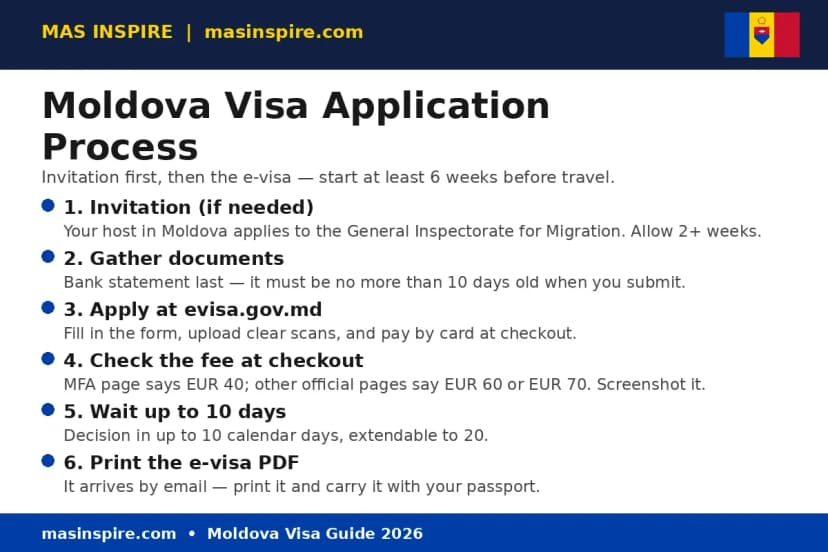
- Decide which door you are using. If you hold a valid EU, Schengen, UK, US or Canada visa or residence permit, you skip the invitation. If you do not, you need an official invitation first — do not open the e-visa portal until the invitation is in hand.
- Get the invitation (if needed). Your host in Moldova applies to the General Inspectorate for Migration through its e-services platform. If you have no host, contact a licensed Moldovan tour operator and arrange the invitation as part of a tour. Allow at least two weeks; the Ministry publishes no invitation processing time.
- Gather the documents. Work through the checklist for your visa category above. Get your bank statement last — it must be no more than 10 days old when you submit — and buy travel insurance covering at least EUR 30,000 for the whole stay.
- Open the e-visa portal. Go to evisa.gov.md, the official portal run for the Directorate for Consular Affairs. Use only that address; copycat "Moldova visa" sites charge large service fees for the same form.
- Complete the online form. Enter your passport details exactly as printed, your travel dates, your accommodation address in Moldova and the purpose of your trip. Upload clear scans of every document, including the invitation or the qualifying strong visa.
- Pay by card. The portal takes payment by card inside the application. The amount shown at checkout is the fee for your application — screenshot it before you pay, and keep the receipt. Budget EUR 70 as your worst case because official sources disagree between EUR 40, EUR 60 and EUR 70 for a Type C visa.
- Wait for the decision. Plan on up to 10 calendar days, extendable to 20. Do not book a non-refundable ticket while you wait, and do not re-apply while an application is pending.
- Print the e-visa. The approved e-visa arrives by email as a PDF. Print it and carry it with your passport — it is not a sticker, and the border officer needs to see both. Keep a second copy in your luggage and a photo of it on your phone.
- Check the details before you fly. Your name, passport number, dates and number of entries must match your passport and your bookings. A mistake in the dates is the commonest reason travellers are stopped at Chișinău airport.
Applying from Vietnam — and from Pakistan
Moldova has no embassy or consulate in Vietnam, and none in Pakistan either. That is why the e-visa matters: for a short-stay visa you should never need to visit a mission at all. If you do need a mission — for a long-stay Type D visa, for a problem with your e-visa, or for advice in writing — the mission accredited to Vietnam is the Embassy of the Republic of Moldova in Beijing. The list of Moldovan diplomatic missions records the Beijing embassy's concurrent accreditation as Vietnam, and its details are: Ta Yuan Diplomatic Office Building 2-9-1, No. 14 Liang Ma He Nan Lu, Chaoyang District, Beijing 100600, China; telephone +86 10 6532 5494; email beijing@mfa.md. Visits are strictly by appointment, and you would need a Chinese visa to travel there, so email first and do not travel to Beijing on the assumption that you can walk in and apply.
One Pakistan-specific guide names the Embassy in Abu Dhabi as the nearest mission, giving its address as Al Mushrif Area, 20 Al Thikra Street, P.O. Box 31705, Abu Dhabi, with appointments through econsulat.gov.md and 10-business-day processing. That is a genuine alternative in-person route, particularly if you are already travelling through the Gulf, but for a resident of Vietnam the accredited mission is Beijing, not Abu Dhabi. This guide presents both and names the conflict: the "nearest" mission depends on whether you measure by geography, by accreditation, or by flight connections, and the e-visa makes the question academic for most tourist applications. Moldova is also reported to have an honorary consul resident in Karachi; that could not be verified against an official source, so do not rely on it — use the e-visa portal and, if you need a mission, Beijing.
From Pakistan itself the route is the same online one: there is no Moldovan embassy in Pakistan, so Pakistani applicants apply through evisa.gov.md or through a Moldovan embassy in a third country. The invitation requirement, the fee and the processing time are the same. The only practical difference for someone applying from Pakistan rather than from Vietnam is the polio vaccination certificate from NADRA, which Pakistan-specific guidance lists for departures from Pakistan; whether it is needed when departing from Vietnam could not be verified.
At the Border: Entry, Registration and Transnistria
A visa does not guarantee entry. At Chișinău International Airport or at a land border with Romania, the border police may ask for the same documents you filed: your passport, the printed e-visa, your invitation or qualifying visa, your accommodation booking, your return ticket, your insurance and proof of funds. Carry the file, not just the e-visa — travellers who file carefully and then travel with nothing but a passport are the ones who get delayed.
Visitors to Moldova are normally registered automatically on arrival at Chișinău airport or at a land border with Romania or Ukraine. The exception is Transnistria, and it is an important one. Transnistria is a breakaway region on Moldova's eastern border that is not under the control of the government in Chișinău; it is internationally recognised as part of Moldova. The United Kingdom advises against all travel to Transnistria, and the crossings between Ukraine and Transnistria are closed. If you enter Transnistria, its own checkpoint issues you a slip with a time limit written on it, you must leave through the same checkpoint, and you must register with the local authorities within 24 hours of arrival there. If you enter Moldova through Transnistria, you are not automatically registered, and you must register yourself within three days of arrival in government-controlled Moldova, at the registration office in central Chișinău or at the Bureau of Migration and Asylum. The clean advice is simple: enter Moldova through Chișinău airport or a Romanian crossing, not through Transnistria or via Odesa, so that your Moldovan entry stamp and registration are in order when you leave. A missing Moldovan stamp is a real problem at departure. Do not plan a day trip to Tiraspol without understanding these rules, and check the current UK or US travel advice before you decide.
Your passport must be valid for at least 3 months beyond your intended departure from Moldova, and it must have been issued within the last 10 years. Count your stay carefully: a short-stay visa allows up to 90 days within any 180-day period, and overstaying that window can lead to a fine, a removal order and difficulty getting any European visa in future.
Work, Study and Long Stays
A tourist visa is not a work visa, and you cannot convert a Type C visa into a work permit by finding a job after you arrive. Work in Moldova needs a Type D employment visa (D/AM), which requires a decision granting the right of temporary residence for work purposes — a decision your Moldovan employer obtains before you apply — plus a criminal record from Pakistan translated into Romanian or English and legalised or apostilled. Seasonal workers, seconded employees, posted workers and sportspeople working for Moldovan clubs are covered by the same category. There is no Moldovan work route you can start on your own from Vietnam without a Moldovan employer, and no official source publishes a salary threshold or a shortage list that a Pakistani applicant could use to plan a speculative application.
Study needs a Type D study visa (D/AS): confirmation of acceptance from an accredited Moldovan educational institution, proof of means to pay for studies and maintenance, and the same criminal record and insurance requirements. Moldova's universities teach mainly in Romanian and Russian, with a limited number of programmes in English, so check the language of instruction before you apply. Family reunification (D/VF) is for the spouse, minor children, parents or persons under guardianship of a Moldovan citizen or resident, and needs proof of family ties plus acceptance from the competent authority for foreigners. All Type D visas are issued for up to 12 months, with a stay of up to 90 days in 6 months from first entry, and the fee on the Ministry's main page is EUR 40 — although the Beijing embassy's visa page lists EUR 80 for Type D, which is one more figure to confirm at the mission before you pay.
Transit, Overstay, Refusals and Practical Travel Notes
If you are only changing planes at Chișinău and not leaving the international transit zone, you still need a Type A airport transit visa on a Pakistani passport — Pakistan is on the airport-transit list. The exemptions from the airport transit visa (flight crew, diplomatic passport holders, holders of EU or US residence permits or visas) do not cover an ordinary Pakistani traveller. If your journey takes you across Moldovan territory by road or rail to a third country, you need a Type B transit visa, valid for up to 5 days, with a visa for your destination country and proof of funds of EUR 30 per day.
A short-stay visa granted for less than 90 days can be extended through the General Inspectorate for Migration for the same purpose it was granted, provided the total stay does not exceed 90 days in the 180-day window, and the extension application must be filed at least three working days before the granted term expires. Tourist visas are, as a rule, not extended beyond that framework — do not plan on extending a holiday by applying in Chișinău. If you overstay, expect a fine and an exit procedure, and expect the overstay to be visible to every European visa officer who looks at your passport afterwards.
If your visa is refused, the fee is not refunded. The commonest reasons are a missing or invalid invitation, a bank statement older than 10 days, insurance below EUR 30,000 or not covering the whole stay, and travel dates that do not match the invitation and bookings. There is no point re-applying with the same file: fix the reason, get a fresh invitation if that was the problem, and apply again. Keep every email from the portal and every receipt; if you need to ask the mission about a refusal, you will need the application reference.
Getting there from Vietnam takes two or three flights: there are no direct flights from Ho Chi Minh City or Hanoi to Chișinău. The usual routings run through Istanbul, Dubai, Doha, Warsaw, Bucharest or Vienna, and from Bucharest there is a short hop to Chișinău as well as buses and a train. Book the routing only after the e-visa is approved, and leave a generous connection in your transit city — a missed connection that strands you in a country where you have no visa is a problem no travel insurance will fully fix. Moldova's currency is the Moldovan leu (MDL); carry euros in cash for arrival and a card that works internationally, and remember that cards do not work in Transnistria, where the local rouble is cash-only and cannot be spent anywhere else. Romanian is the official language and Russian is widely spoken; English is understood in Chișinău hotels and among younger people, but not everywhere.
Frequently Asked Questions
Do Pakistani passport holders need a visa for Moldova?
Yes. Pakistan is on the Ministry of Foreign Affairs' visa-required list, the airport-transit list and the invitation-required list. You need a Type C short-stay visa before you travel, applied for online at evisa.gov.md. There is no visa on arrival and no visa-free entry for ordinary Pakistani passports.
Can I get a Moldova visa on arrival at Chișinău airport?
No. Pakistani passport holders must hold a visa before travel. Arriving without one means being refused entry and returned on the next available flight, at your own cost.
How much is the Moldova visa fee for Pakistanis?
The Ministry's main visa page lists EUR 40 for a Type C short-stay visa, plus additional fees if applicable. But the Iași consulate page lists EUR 70 and the Beijing embassy page lists EUR 60 for the same visa, so the figure is genuinely disputed between official sources. The amount the e-visa portal shows at checkout is the fee for your application — screenshot it before you pay and budget EUR 70 as your worst case.
How long does a Moldova e-visa take?
Plan on up to 10 calendar days from a complete application, extendable to 20 calendar days where necessary. The Embassy in the UAE states 10 business days for the embassy route. Shorter figures of 3 to 5 working days appear in third-party guides but could not be verified against any official source, so do not plan on them.
Does a valid Schengen visa let a Pakistani enter Moldova visa-free?
No. Moldova's substitute-visa rule — valid Schengen, EU, UK, US or Canada visa or residence permit in place of a Moldovan visa — explicitly excludes Pakistani nationals. Some travel blogs claim otherwise; that claim is wrong for Pakistanis. What the strong visa does is exempt you from the official invitation procedure. You still need a Moldovan visa.
Do I need an invitation to visit Moldova?
Usually, yes. Pakistanis need an official invitation issued by the General Inspectorate for Migration, requested by your host in Moldova. You do not need it if you hold a valid visa or residence permit (not a transit visa) from an EU member state, a Schengen state, the UK, the US or Canada.
How do I get the official invitation?
Your host in Moldova applies to the General Inspectorate for Migration through its e-services platform, uploads the documents and pays through MPay; the approved invitation arrives by email. If you have no host, a licensed Moldovan tour operator can arrange one as part of a tour. A hotel booking alone does not count as an invitation.
How long can I stay in Moldova on a tourist visa?
A Type C visa allows a stay of up to 90 days within any 180-day period, but your visa is issued for the period you applied for — it is not automatically 90 days. The dates on your visa, your invitation and your bookings must all agree.
Is Moldova in the Schengen Area or the European Union?
No. Moldova is not an EU member and not a Schengen member; it is an EU candidate country. A Moldovan visa does not let you enter Schengen states or Romania, and a Schengen visa does not let a Pakistani enter Moldova visa-free.
Where do I apply from Vietnam?
Online, at evisa.gov.md — no embassy visit is needed for a short-stay visa. If you need a mission, the Embassy of the Republic of Moldova in Beijing is concurrently accredited to Vietnam. There is no Moldovan mission in Vietnam or in Pakistan.
What funds do I need to show?
At least EUR 30 per day of stay, and not less than EUR 300 for a stay shorter than 10 days, shown on a bank statement issued no more than 10 days before you submit. Alternatively, a signed commitment of maintenance and accommodation from a person in Moldova can replace the bank statement.
How much travel insurance do I need?
At least EUR 30,000 of cover, valid throughout Moldova for the whole stay, including repatriation for medical reasons, emergency medical treatment, emergency hospitalisation and death.
Can I visit Transnistria on a Moldova visa?
Transnistria is a breakaway region not under the control of the government in Chișinău, and the UK advises against all travel there. Its checkpoint issues a slip with a time limit, you must leave through the same checkpoint, and you must register locally within 24 hours. Enter Moldova through Chișinău airport or a Romanian crossing instead, so your entry stamp and registration are in order.
Can I work in Moldova on a tourist visa?
No. Work needs a Type D employment visa, which requires a Moldovan employer and a decision granting the right of temporary residence for work purposes, obtained before you apply. You cannot convert a tourist visa into a work permit after arrival.
What should I do if my Moldova visa is refused?
The fee is not refunded. Find the reason — most often a missing or invalid invitation, a bank statement older than 10 days, or insurance below EUR 30,000 — fix it, get a fresh invitation if that was the problem, and apply again with a corrected file. Do not re-apply with the same documents and expect a different answer.
Official Immigration Websites
| Website | What it is for |
|---|---|
| evisa.gov.md | Official e-visa portal — apply online for a short-stay Type C visa, upload documents and pay by card |
| mfa.gov.md — Types of visas / requirements | Ministry of Foreign Affairs visa requirements and fees for Types A, B, C and D |
| mfa.gov.md — Visa regime for foreigners | Ministry lists of visa-required, visa-exempt, airport-transit and invitation-required nationalities |
| china.mfa.gov.md — Visas | Embassy of Moldova in Beijing (accredited to Vietnam) — visa types and fees |
| china.mfa.gov.md — Consular fees | Embassy of Moldova in Beijing — consular fees and additional fees table |
| iasi.mfa.gov.md — Types of visas / requirements | General Consulate in Iași — visa requirements and fees (note: its Type C fee differs from the main MFA page) |
Editorial note: this guide was checked against the official sources above on 27 November 2026. The fee for a Type C visa is disputed between official Moldovan publications (EUR 40 on the main MFA page, EUR 70 on the Iași consulate page, EUR 60 on the Beijing embassy visa page), and the substitute-visa exemption claimed by some blogs does not apply to Pakistani nationals. Where sources conflict, this guide names the conflict and the controlling source — the e-visa portal checkout for the fee, and the Ministry's own lists for the exemption. Always confirm the live rules before you pay or travel.