Micronesia Visa Guide 2026: Types, Requirements, Documents and Application Steps
Updated: 27 November 2026. Verified: 28 November 2026. This guide is for Pakistani passport holders living in Vietnam. Entry rules depend on your passport, not on where you live, so your Vietnamese residence does not change the Micronesia entry rule. Always confirm the current rule with the FSM Division of Immigration and Labor before you pay for flights, because the figure that matters most on this trip is not the Micronesia rule at all — it is the United States transit visa you need to reach Guam.
Introduction
The Federated States of Micronesia (FSM) is a Pacific island nation of more than 600 islands spread across four states — Yap, Chuuk, Pohnpei and Kosrae — with its capital at Palikir on Pohnpei. It is one of the least-visited countries in the world, reached by only a handful of flights each week, almost all of them through Guam. That remoteness shapes everything about its entry system: there is no large embassy network, no online visa portal for visitors, no e-visa, and no visa on arrival in the usual sense — because for a short visit, there is no visa at all.
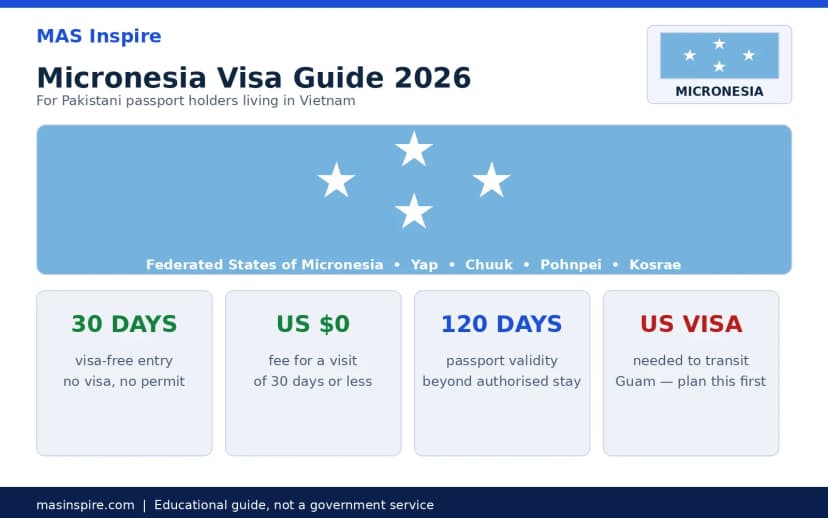
Pakistani passport holders do not need a visa for Micronesia for a visit of 30 days or less. This is not a Pakistan-specific concession. The FSM rule is nationality-blind for short visits: the official FSM tourism entry-requirements page states plainly that no permit is required for visits of 30 days or less, and the United States Department of State reciprocity page for Micronesia states that no visas are required for entry into the FSM, that non-United-States citizens are automatically permitted to remain as tourists for 30 days, and that they can extend their stay up to 90 days. Independent visa databases that list Pakistan individually — Wise, Passport Index and others — all record Pakistan as visa-free for 30 days, which is consistent with the nationality-blind official rule. The FSM Immigration Regulations (Title 50) say the same thing: no written entry permit is required for a non-citizen visiting for 30 days or less, provided the visitor meets the health and identification requirements and shows proof of onward travel.
Pakistan and the FSM only established diplomatic relations on 14 August 2025, when the two countries' ambassadors to the United Nations signed a joint communiqué in New York. There is no FSM embassy in Pakistan and no FSM embassy in Vietnam, and there is no Pakistani embassy in the FSM. That does not matter for a short visit, because there is nothing to apply for in advance. It matters a great deal for a longer stay, for work or study, and for the journey itself — because almost every route to the FSM passes through Guam, which is United States territory, and a Pakistani passport holder needs a United States visa (a B1/B2 visitor visa, or a C-1 transit visa) even to change planes there. Pakistan is not eligible for ESTA. If you do not already hold a valid United States visa, the Guam transit visa — not the Micronesia entry rule — is the real application in this trip, and it should be started months before you book anything non-refundable.
This guide gives you the verified figures, the full document checklist, the step-by-step process for short visits and for longer stays, the Guam and Manila transit traps, flight and money practicalities, and every point where sources disagree, so you can see exactly what is certain and what is not.
Why People Visit Micronesia
Most visitors come to Micronesia for its isolation itself: the wreck diving of Chuuk Lagoon, one of the world's great Second World War dive sites; the ancient stone city of Nan Madol on Pohnpei; surfing and village life on Pohnpei; and a way of life that has changed far more slowly than almost anywhere else in the Pacific. There is no mass tourism, no resort strip, and very little tourist infrastructure outside Kolonia on Pohnpei and Weno on Chuuk. That is the attraction, and it is also the warning: if you want nightlife, shopping or easy transport, Micronesia is the wrong destination.
For a Pakistani traveller living in Vietnam, Micronesia is best approached as a short, deliberate trip rather than a casual stopover. Flights are infrequent — the famous United Airlines Island Hopper runs only a few times a week — accommodation is limited and must be booked well ahead, cash is king outside the main towns, and medical facilities are modest, so travel insurance that covers medical evacuation is not optional. A realistic visit is one to three weeks on Pohnpei, or a dedicated diving trip to Chuuk, with inter-island flights booked as part of the same itinerary because travel between FSM states is treated as international travel, with passport and customs checks at each stop.
Business travel is rare, because the FSM economy is small and its commercial links with Pakistan are minimal. Short business consultations are treated under the visitor route, but any actual employment needs a work permit approved before travel. Study is possible only with an acceptance from an accredited institution and a student entry permit. Family visits follow the same visitor route as tourism. Whatever your reason, the permit category must match the real purpose of the trip, because a visitor cannot change immigration status while inside the FSM — a change requires written authorisation, departure from the FSM, and a fresh application on re-entry.

Types of Micronesia Visas and Entry Permissions
Micronesia does not issue tourist visas. It issues entry permits, and for a short visit it issues nothing at all — you are admitted as a visitor at the airport and your permitted stay is stamped in your passport. The categories below are the entry-permit types under the FSM Immigration Act (Title 50 of the FSM Code) and the Immigration Regulations, administered by the Division of Immigration and Labor in the Department of Justice, working alongside each state's immigration office.
Visitor entry — 30 days or less, no permit
This is the route almost every Pakistani traveller will use. No visa, no permit, no advance application, no fee. You arrive with a valid passport, a completed Customs, Immigration and Quarantine (CIQ) form (handed out on the aircraft), proof of onward travel, and evidence of enough money for your stay, and immigration admits you for up to 30 days. Permitted visitor activities include tourism, short business meetings and consultations, and short-term contract employment only where the regulations expressly allow it as a visitor activity — do not assume paid work is covered; any ordinary job needs a work permit applied for before arrival.
Visitor entry permit — extension to 60 days, 90 days in total
If you want to stay longer than 30 days, you apply in person at an Immigration office in the FSM state where you are staying, before your initial 30 days expire. The extension can add up to 60 days, taking the total stay to a maximum of 90 days. The FSM Immigration Services FAQ advises submitting the extension application at least seven working days before the current permission expires. The fee for this extension is disputed — see the fees section and the conflict box below — with official-regulation summaries saying no fee is charged for stays of 90 days or less, and the FSM Immigration Services FAQ listing a non-refundable statutory extension fee of US$50. Treat the fee as unverified until the Division of Immigration confirms it in writing for your case, and carry enough cash to pay US$50 if asked.
Long-term visitor permit — beyond 90 days, up to one year
Visitors who want to stay beyond 90 days must apply in person at an Immigration office for a long-term visitor permit for a specified period, explaining the need for the extra time. The application is forwarded to the Chief of Immigration, who grants or denies it with written reasons. Secondary sources citing the Immigration Regulations put the fee for a long-term visitor permit at US$25. This figure could not be verified on a live official page at the time of writing, so confirm it with the Division of Immigration before relying on it. Citizens of the United States, Palau and the Marshall Islands may be issued entry permits of up to one year under the Compact of Free Association arrangements; that one-year track does not apply to Pakistani passport holders.
Work entry permit (non-resident worker permit)
Any non-citizen who wants to work in the FSM must have an entry permit applied for before arrival, sponsored by an FSM-registered employer. There is no work-on-arrival route and no job-seeker permit. The employer sponsors the application through the Division of Immigration and Labor. See the work section below.
Student entry permit
Study in the FSM requires an entry permit applied for before arrival, based on acceptance from an accredited institution. See the student section below.
Business, spouse and dependent permits
The Immigration Regulations also provide for business-related permits, spouse permits and dependent permits (a spouse or an unmarried child under 18). All require an entry permit before arrival and a sponsor in the FSM. There is no published fee schedule for these categories on the live official pages checked for this guide; ask the Division of Immigration for the current fee and form for your category.
Transit — no separate transit permit
There is no standalone FSM transit visa. Passengers who stay airside on a through service such as the United Island Hopper and do not clear immigration do not need a separate permit. Passengers who must clear immigration — because of an airline change, re-checking baggage, an overnight stay outside the airport, or a delay or cancellation — are admitted under the standard 30-day visitor rule, with the same passport, onward-ticket and funds requirements. In practice, almost nobody transits the FSM without entering it, because the airports are small and there are no 24-hour international transit lounges.
Micronesia Visa Comparison Table
| Route | Who it is for | Maximum stay | Apply in advance? | Fee (verified status) |
|---|---|---|---|---|
| Visitor entry, 30 days or less | Pakistani tourists and short business visitors | 30 days | No — admitted at the airport | None — no visa or permit fee |
| Visitor extension | Visitors already in the FSM who want more time | Up to 60 extra days; 90 days total | In person at a state Immigration office, at least 7 working days before expiry (per FSM Immigration FAQ) | Disputed — US$50 per FSM Immigration FAQ; no fee per regulation summaries. Confirm in writing. |
| Long-term visitor permit | Visitors needing more than 90 days | Up to 1 year in total | In person at a state Immigration office; decided by the Chief of Immigration | US$25 reported in secondary sources citing the regulations — not verified on a live official page |
| Work entry permit | People with an FSM job offer and employer sponsor | As granted, tied to the employment | Yes — before arrival, employer-sponsored | Not published — confirm with the Division of Immigration |
| Student entry permit | People accepted by an FSM institution | As granted, tied to the course | Yes — before arrival | Not published — confirm with the Division of Immigration |
| Business / spouse / dependent permit | Investors, spouses and children under 18 of permit holders | As granted | Yes — before arrival, sponsor required | Not published — confirm with the Division of Immigration |
| Transit (airside) | Passengers not clearing immigration | Length of the connection | No separate permit exists | None |
What the table does not show: the United States visa you need to get there. Every practical route to the FSM from Vietnam passes through Guam, and Guam is United States territory. A Pakistani passport holder needs a valid United States B1/B2 visa or a C-1 transit visa to enter or transit Guam, even airside. That visa is a separate, larger application with its own fee and interview, and it is the step most likely to decide whether the trip happens at all.
Eligibility Requirements
The FSM visitor rule is simple on paper and strict at the border. You are eligible for 30-day visitor entry if you meet all of the following, and the immigration officer may refuse entry if any of them is missing.
- Pakistani ordinary passport, valid long enough. Your passport must be valid at the time of entry and for at least 120 days beyond your authorised duration of stay, under the FSM Immigration Regulations. See the passport-validity conflict box below: the United States Department of State travel advisory for the FSM says a passport must have 6 months' validity beyond arrival, and an older State Department information sheet said 180 days. The FSM's own 120-day rule is the controlling FSM rule, but airlines and transit countries apply their own checks — plan on 6 months' validity beyond your arrival date, with at least one blank page, and renew early if you are close to either limit.
- Proof of onward travel. A confirmed return or onward ticket to a destination outside the FSM, departing within your authorised stay. The ticket cannot be sold or exchanged without written permission from the Chief of Immigration. If you do not have a ticket, alternative proof may be accepted at the discretion of immigration authorities — do not rely on that discretion; carry a real ticket.
- Enough money for the stay. Evidence of sufficient funds, such as a recent bank statement. No official minimum amount is published for visitors. Carry a bank statement, a card that works internationally, and enough United States dollars in cash for the first days, because card acceptance is limited outside the main towns.
- A place to stay. A hotel booking or the address of your host in the FSM. Book accommodation before you travel; it is limited, and immigration may ask where you are staying.
- A completed arrival form. The FSM Immigration Arrival and Departure Record (Form 5004) and the Customs form, handed out by the airline before landing. All non-citizens arriving without a valid permit must present a completed arrival record.
- No intention to work or to change status. Visitor entry does not permit ordinary employment, and visitors cannot change immigration status while in the FSM. If your real purpose is work or study, apply for the correct permit before you travel.
- Health requirements. No vaccinations are required unless you are arriving from an area infected with smallpox, yellow fever or cholera, in which case a valid international certificate of vaccination is required. There is no published HIV/AIDS entry restriction for visitors to the FSM.
- Cash declaration. Cash of US$10,000 or more must be declared on entry. The United States dollar is the official currency of the FSM.
Passport-validity conflict — read this before you book. Three different figures circulate for the same rule. The FSM Immigration Regulations and the official FSM tourism entry page say 120 days beyond the authorised stay (the tourism page shortens this to 120 days beyond the date of entry). The United States Department of State travel advisory for the FSM, issued 16 July 2026, says a passport must have 6 months' validity beyond arrival. An older State Department consular information sheet said 180 days from the time of entry. The FSM's 120-day figure is the FSM rule and therefore controls admission to the FSM itself, but the 6-month figure is what the State Department publishes and what airlines commonly apply at check-in, and your transit through Guam is governed by United States rules. This guide's advice is to carry at least 6 months' validity beyond arrival and treat 120 days as the legal minimum, not the planning target.
Extension-fee conflict — read this before you plan a long stay. The fee for extending a visitor stay beyond 30 days is genuinely disputed. The FSM Immigration Services FAQ, as summarised in 2026 guides, lists a non-refundable statutory extension fee of US$50 and advises applying at least seven working days before expiry. Older regulation summaries and several long-standing guides state that there is no fee charged for an extension of stay, and that no fee is charged for visits of 90 days or less, with only the long-term visitor permit (beyond 90 days) costing US$25. Other 2026 guides quote extension fees of US$25–50 or US$50–100 per extension. No live official page checked for this guide settles the question. Do not budget on any single figure: ask the Division of Immigration in writing before you travel, apply early, and carry US$50 in cash in case the US$50 fee is charged.
Document Checklist for Pakistani Passport Holders
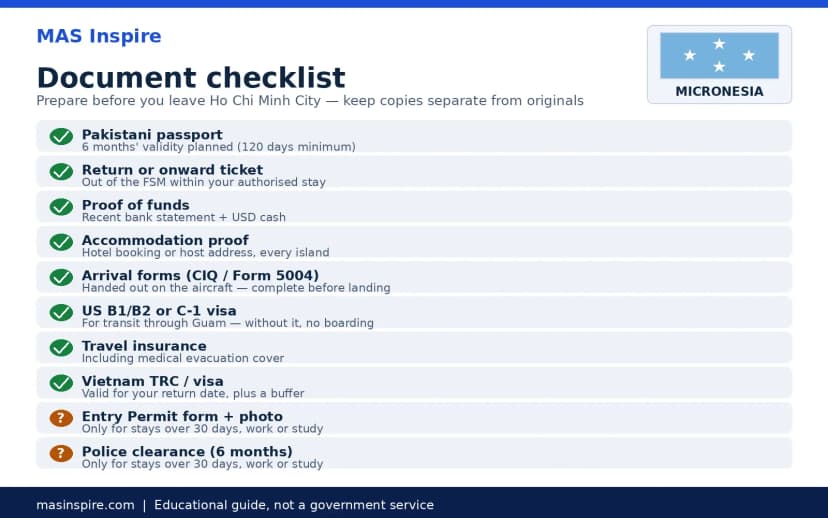
Prepare these documents before you leave Ho Chi Minh City. Keep the originals and a separate set of photocopies or scans, and keep digital copies in your phone and in your email so a lost bag does not strand you.
| Document | Details | For which route |
|---|---|---|
| Pakistani passport | Ordinary passport, valid at least 6 months beyond arrival (FSM legal minimum 120 days beyond authorised stay); at least 1 blank page; in good condition | All routes |
| Return or onward ticket | Confirmed ticket out of the FSM within your authorised stay; do not sell or exchange it without the Chief of Immigration's written permission | All routes |
| Proof of funds | Recent bank statement (last 3–6 months is a sensible standard; no official minimum is published); a working international card; USD cash for the first days | All routes |
| Accommodation proof | Hotel booking or host's name and address in the FSM, for every island you will visit | All routes |
| CIQ / arrival forms | FSM Immigration Arrival and Departure Record (Form 5004) and Customs form, handed out on the aircraft — complete them before landing | All routes |
| Travel insurance | Strongly recommended, including medical evacuation cover; medical facilities are basic outside the main towns and evacuation is by air | All routes |
| Vietnam residence proof | Your Vietnamese temporary residence card (TRC) or valid visa, for your return to Vietnam — the FSM does not require it, but Vietnam does for re-entry | All routes |
| United States visa | Valid B1/B2 visa or C-1 transit visa in your passport, for transit through Guam — without this you will be refused boarding on the Guam leg | All routes via Guam (effectively all routes) |
| Entry Permit application form | Official FSM Entry Permit Application, completed in block letters and signed; downloadable from the FSM Embassy in Washington site | Stays over 30 days; work; study; business; family |
| Passport copy + signed photo | Copy of the passport data page and one signed passport photo, as required by the entry-permit application | Stays over 30 days; work; study |
| Police clearance | Police clearance certificate from your country of citizenship or residence, issued within the last 6 months | Stays over 30 days; work; study |
| Medical clearance | Medical clearance, which can be obtained in the FSM according to the application guidance | Stays over 30 days; work; study |
| Sponsor / employer letter | Details of your employer or sponsor in the FSM, places to be visited, purpose and length of visit — required fields on the entry-permit form | Work; business; long-term visit |
| School acceptance letter | Acceptance from an accredited FSM institution, plus evidence of funds for tuition and living costs | Study |
| Polio vaccination certificate | NADRA polio certificate — listed by Pakistan-focused guides for departures from Pakistan; whether it is required when departing from Vietnam could not be verified, so confirm with your airline | Conditional — see flags |
A note on the police clearance. The entry-permit application requires a police clearance from the country of citizenship or residence, issued within the last 6 months. Living in Vietnam, you may need two documents — one from Pakistan and one from Vietnam — or a Vietnamese-issued clearance as your country of residence. Ask the Division of Immigration which one it will accept before you pay for either, and allow weeks for a Pakistani police clearance if you have to obtain it from abroad.
How to Apply: Step-by-Step
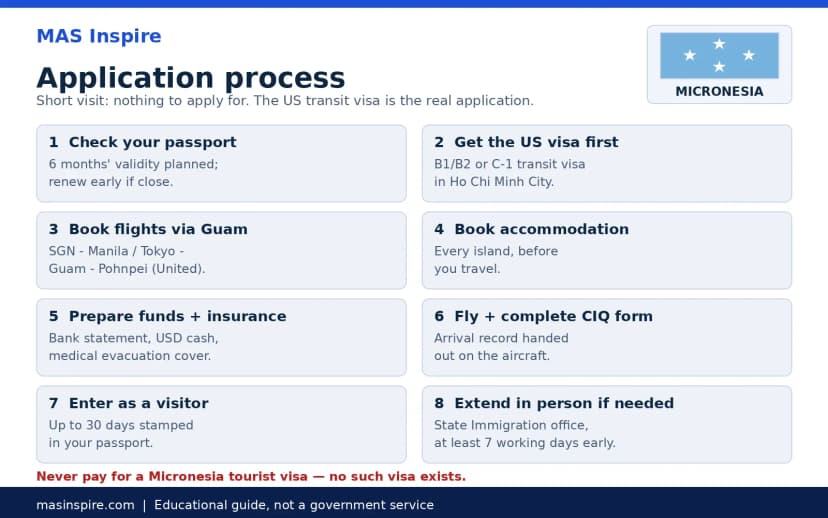
There are two completely different processes here: the short visit, where there is nothing to apply for, and everything else, where you apply for an entry permit. Do not confuse them, and do not pay anyone who offers to sell you a Micronesia tourist visa — there is no such product.
Route A — Visit of 30 days or less (no application)
- Check your passport. At least 6 months' validity beyond arrival (FSM minimum 120 days), at least one blank page, undamaged. Renew in Vietnam or Pakistan if you are close to the limit.
- Sort out the United States visa first. If you do not already hold a valid B1/B2 visa, apply for a B1/B2 or C-1 transit visa at the United States Consulate General in Ho Chi Minh City. This is the longest step in the whole trip — interviews and wait times can run to months. Do not book non-refundable FSM flights until this visa is in your passport.
- Book your flights. Ho Chi Minh City to Manila or Tokyo, then to Guam, then United Airlines to Pohnpei, Chuuk, Yap or Kosrae. Confirm every leg is on one ticket where possible, and check the transit-visa requirement for each stop (Guam needs the United States visa; Manila needs a Philippines visa check — see the Vietnam section).
- Book accommodation for every island, and keep the confirmations with you. Book early; rooms are few.
- Prepare your funds evidence. Print a recent bank statement, carry a working international card, and take enough United States dollars in cash for arrival costs and the departure tax.
- Buy travel insurance with medical evacuation cover, and keep the policy number and the insurer's emergency phone number with your passport.
- Fly. Complete the CIQ form and the Immigration Arrival and Departure Record handed out on the aircraft. At immigration, present your passport, the completed forms, your onward ticket, your accommodation details and your funds evidence if asked. Your permitted stay (up to 30 days) is stamped in your passport.
- Keep your stamp safe. Do not lose the arrival record. Travel between FSM states involves fresh passport and customs checks at each stop, so keep your passport accessible on inter-island flights.
Route B — Stay longer than 30 days (entry permit)
- Decide before you travel whether you will need more than 30 days. If you already know the trip will run longer, contact the Division of Immigration and Labor before departure — non-visitor permits must be applied for before arrival, and a long stay is easier to arrange in advance than from inside the FSM.
- Download the Entry Permit Application from the FSM Embassy in Washington site (fsmembassy.fm) and complete it in block letters.
- Gather the supporting documents: passport data-page copy, one signed passport photo, police clearance issued within the last 6 months, medical clearance (which can be obtained in the FSM), and sponsor or employer details.
- Submit the application to the Division of Immigration and Labor, Department of Justice, FSM National Government — see the contact details in the official-websites section. The older published postal address is P.O. Box PS-105, Palikir, Pohnpei FM 96941; the current FSM tourism entry page lists P.O. Box PS-157, Palikir, Pohnpei FM 96941. Both addresses appear in official and semi-official sources; use the PS-157 address from the current tourism page and confirm by email (passport@gov.fm) before posting anything.
- If you are already in the FSM and want to extend, appear in person at the Immigration office in the state where you are staying and apply in writing for an extension of up to 60 days. The FSM Immigration Services FAQ advises applying at least seven working days before your current permission expires. Bring your passport, your onward ticket, proof of funds and accommodation, and US$50 in cash in case the disputed extension fee is charged.
- For a stay beyond 90 days, apply in person at an Immigration office for a long-term visitor permit, explaining in writing why you need the extra time. The Chief of Immigration decides and gives written reasons. Budget for the reported US$25 long-term permit fee, but confirm the amount first.
- Do not overstay while you wait. Apply before your permission expires. Overstaying is an offence under FSM law, and the published penalties for unlawful entry or stay include up to two years' imprisonment, a fine of up to US$10,000, or both, followed by deportation after a court hearing.
Visa Fees and Financial Requirements
| Item | Amount | Status |
|---|---|---|
| Visitor entry, 30 days or less | US$0 | Verified — no visa or permit is issued, so there is no fee |
| Visitor extension (31–90 days) | US$50 or US$0 | CONFLICT — FSM Immigration FAQ lists US$50 non-refundable; regulation summaries say no fee for stays of 90 days or less; other guides quote US$25–50 or US$50–100. Confirm in writing. |
| Long-term visitor permit (over 90 days, up to 1 year) | US$25 | Reported in secondary sources citing the Immigration Regulations — not verified on a live official page |
| Work / student / business permits | Not published | Unverified — no fee schedule found on live official pages; ask the Division of Immigration |
| Departure tax, each FSM airport | US$20 | Verified on the official FSM tourism entry page (Yap, Chuuk, Pohnpei and Kosrae all US$20) and by the UK FCDO — but travellers report paying US$25 in cash at Pohnpei; see conflict box |
| United States B1/B2 or C-1 visa (Guam transit) | Separate United States fee, paid to the United States government | Not an FSM fee — check the current United States visa fee at the time you apply; this is usually the largest single cost of the trip |
Departure-tax conflict. The official FSM tourism entry page lists a departure tax of US$20 at each of the four main airports — Yap, Chuuk, Pohnpei and Kosrae — and the UK Foreign, Commonwealth and Development Office says the same: a departure tax of 20 United States dollars when you leave the FSM. But first-hand traveller reports disagree: several 2025–2026 trip reports describe paying US$25 in cash at Pohnpei, one older Pohnpei guide lists US$40, and an airport-information site lists US$10. The US$20 figure is the published official figure and therefore the one this guide uses, but the repeated US$25 reports mean you should carry at least US$25–30 in small notes per departure, pay in cash, and expect that the amount may have changed since the official page was last updated. There is no departure tax for United States officials travelling on official or diplomatic passports; that exemption does not apply to ordinary Pakistani visitors.
Money in the FSM. The currency is the United States dollar. Credit cards are becoming more common but are not accepted everywhere, and additional fees may apply. Bank of Guam and Bank of the FSM have ATMs that accept United States-issued bank cards, but ATMs are sometimes out of order and may charge high fees, and there are no ATMs at the airports — so arrive with cash. Declare cash of US$10,000 or more on entry. Outside the main towns, expect to pay cash for rooms, meals, boat trips and village or landowner fees, and keep small notes: change can be hard to get.
No official minimum funds figure. No FSM source checked for this guide publishes a minimum bank balance for visitors. Secondary guides sometimes suggest a figure, but none is official. The practical test at the border is whether you can show a recent bank statement and a return ticket and explain credibly how you will pay for your stay. A thin or empty account plus a one-way ticket is the combination most likely to be refused.
Visa Processing Times and Validity
| Item | Time | Notes |
|---|---|---|
| Visitor entry, 30 days or less | At the airport, on arrival | No advance processing; the stay is stamped in your passport |
| Visitor extension (to 90 days total) | Apply at least 7 working days before expiry | Per the FSM Immigration Services FAQ; the decision is made locally by the state Immigration office |
| Long-term visitor permit (over 90 days) | Not published | Decided by the Chief of Immigration with written reasons; allow weeks and apply well before your 90 days run out |
| Work / student entry permit (before arrival) | Not published | No official processing time was found; allow several weeks and do not book travel until the permit is issued |
| United States B1/B2 or C-1 visa (Guam transit) | Weeks to months | Interview wait times at the United States Consulate General in Ho Chi Minh City vary; this is the critical path for the whole trip |
Validity rules that catch people out. First, your 30 days run from the date of arrival, not from the date you clear immigration at your final island — inter-island travel does not reset the clock. Second, travel on a commercial aircraft between FSM states is treated as international travel, so you go through passport and customs checks at each stop; keep your passport and arrival record with you on every inter-island flight. Third, the passport-validity rule is measured against your authorised stay, not just your arrival date, so a passport that expires 130 days after arrival may still fail the 120-day-beyond-authorised-stay test if your authorised stay is long. Fourth, the United States visa in your passport must still be valid on the day you transit Guam on the way home as well as on the way out — check both directions when you book.
Applying from Vietnam: Guidance for Pakistani Passport Holders
Living in Vietnam changes the journey, not the FSM entry rule. The FSM admits you on your Pakistani passport; your Vietnamese residence card does not give you a different FSM status, a longer stay, or an exemption from any requirement. What Vietnam does change is where you apply for the visas you need to get there, and what you need to come home.
There is no FSM mission in Vietnam
The FSM has no embassy or consulate in Vietnam, and no FSM mission is published as accredited to Vietnam. The nearest FSM missions to Vietnam are the Embassy of the Federated States of Micronesia in Beijing (1-1-11 Jianguomenwai Diplomatic Compound, Chaoyang District, Beijing 100600; telephone +86 10 6532 4708 / 6532 4738; email embassy@fsmembassy.cn) and the Embassy in Tokyo (2nd Floor, Reinanzaka Building, 1-14-2 Akasaka 1-chome, Minato-ku, Tokyo 107; email fsmemb@fsmemb.or.jp), which is concurrently accredited to Malaysia, the Philippines and Singapore — Vietnam is not on that published accreditation list. Whether the Beijing embassy handles enquiries from residents of Vietnam could not be verified from any official source, so do not travel to Beijing on the assumption that it will. For a short visit you do not need a mission at all. For a longer stay, work or study, contact the Division of Immigration and Labor directly by email (passport@gov.fm, telephone +691 320 5844) before you approach any embassy. The FSM Embassy in Washington, D.C. (1725 N Street NW, Washington DC 20036; +1 202 223 4383) publishes the entry-permit form and is the most useful mission contact for paperwork questions, but it cannot issue you a visa in Vietnam.
The Guam transit visa — apply in Ho Chi Minh City
This is the application that decides the trip. Guam is a United States territory, and every practical flight from Vietnam to the FSM connects through Guam on United Airlines. Pakistani passport holders need a United States visa to enter or transit Guam, even airside: a valid B1/B2 visitor visa covers transit, or you can apply for a C-1 transit visa for immediate and continuous transit. Pakistan is not a Visa Waiver Program country, so ESTA is not available to you. Apply at the United States Consulate General in Ho Chi Minh City, well in advance — interview wait times vary and can be long. If you already hold a valid B1/B2 visa, check that it remains valid for both your outbound and your return transit through Guam. A United States visa refusal does not affect your FSM eligibility, but without a United States visa you cannot fly the Guam route at all, and there is no practical alternative routing that avoids United States territory: the Island Hopper itself runs between Honolulu and Guam, and the only other gateways are also via Guam.
The Manila alternative — and its own visa question
United Airlines also flies Guam–Manila, so one possible routing is Ho Chi Minh City to Manila, Manila to Guam, Guam to Pohnpei. That routing still transits Guam, so it does not remove the United States visa requirement, and it adds a Philippines question: Pakistani passport holders generally need a visa for the Philippines, and whether airside transit in Manila without a Philippines visa is permitted for your ticket type could not be verified for this guide. Check with the airline and the Philippines Embassy in Hanoi before booking a Manila routing, and do not assume that staying airside in Manila is visa-free for a Pakistani passport.
Flights from Ho Chi Minh City
There are no direct flights from Vietnam to the FSM. The realistic routings are: Ho Chi Minh City to Manila (Philippines) to Guam to Pohnpei / Chuuk / Yap / Kosrae on United Airlines; or Ho Chi Minh City to Tokyo or Taipei to Guam to the FSM; or Ho Chi Minh City to Honolulu via Tokyo or Seoul, then the Island Hopper east-to-west to Pohnpei, Chuuk and Guam — a routing that is longer, more expensive, and still transits United States territory. The United Island Hopper (UA154 westbound, UA155 eastbound) flies Honolulu–Majuro–Kwajalein–Kosrae–Pohnpei–Chuuk–Guam, with short stops of roughly 30–45 minutes at each island, and United is the only scheduled carrier serving most FSM airports. Flights run only a few times a week, so a missed connection can strand you for days: build at least one spare day into each end of the trip, and confirm the current Island Hopper schedule with United before you book, because frequencies and aircraft have changed during 2026.
Coming home to Vietnam
Your FSM trip does not change your Vietnamese immigration status, but you must still be able to re-enter Vietnam. Check before departure that your Vietnamese temporary residence card or visa is valid for your return date, with enough validity left to cover any delay — a missed Island Hopper connection could push your return back by several days. If your TRC expires while you are away, renew it before you travel. Keep your Vietnamese residence documents with your passport throughout the trip.
Pakistan connection
If you travel via Pakistan at any point, remember that the NADRA polio vaccination certificate is listed by Pakistan-focused guides as a requirement for departures from Pakistan. Whether it is required when you depart from Vietnam could not be verified, so ask your airline rather than assuming either way. There is no Pakistani embassy in the FSM; the nearest Pakistani missions are in the region (Manila, Tokyo, Beijing), and in an emergency you would contact the Pakistan Embassy in Manila or the FSM Division of Immigration, or the United States Embassy in Kolonia, which provides consular help to United States citizens only — as a Pakistani citizen, your consular help would come from a Pakistani mission, not from the United States Embassy.
Student Visa Guide
There is no separate published FSM student-visa checklist on the live official pages checked for this guide, and no FSM university publishes a dedicated international-student visa page that could be verified. What is verified is the framework: a non-citizen who is not travelling as a visitor must apply for an entry permit before arrival, and the entry-permit application requires the applicant's personal and passport details, information about the sponsor in the FSM, the purpose of entry, places to be visited, length of visit, and expected date and carrier, together with a passport copy, a signed passport photo, a police clearance issued within the last 6 months, and a medical clearance (which can be obtained in the FSM).
For a Pakistani student living in Vietnam, the realistic sequence is: secure acceptance from an accredited FSM institution first — the College of Micronesia-FSM is the main public college, with campuses on Pohnpei, Chuuk, Yap and Kosrae — then ask the institution to act as your sponsor and to confirm in writing which entry-permit category it will support. Then contact the Division of Immigration and Labor (passport@gov.fm) with the acceptance letter and ask for the current student-permit form, fee and processing time, because none of those three figures is published on a live official page. Do not book travel until the permit is issued. Budget for tuition and living costs in United States dollars, and for medical evacuation insurance: the FSM has no large teaching hospital, and a serious illness or injury is evacuated, usually to Guam or Hawaii, at a cost that can run into tens of thousands of dollars without insurance. Study on a visitor entry is not a plan — visitors cannot change status inside the FSM, so arriving as a tourist and then trying to enrol will not work.
Work Visa and Job Opportunities
Work in the FSM requires an entry permit applied for before arrival, sponsored by an FSM-registered employer, under the non-resident worker permit provisions of the Immigration Regulations. There is no work-on-arrival route, no job-seeker permit, and no published list of shortage occupations. The employer sponsors the application through the Division of Immigration and Labor; the application requires the employer's details, the nature of the work, and the standard supporting documents (passport copy, signed photo, police clearance within the last 6 months, medical clearance). No official fee or processing time for a work permit was found on the live official pages checked for this guide — ask the Division of Immigration for both before you accept any offer.
Be realistic about the market. The FSM economy is small, public-sector-led and heavily dependent on United States Compact funding, with limited private-sector employment. The most plausible openings for a foreigner are in teaching (English, maths, science), health, marine and fisheries work, construction trades, and short-term technical or consultancy contracts funded by development partners. Teaching is the most relevant field for a Pakistani English teacher, but FSM schools generally hire through their own state departments of education or through United States-affiliated programmes, and any offer must come with a work permit before you travel — a school that tells you to arrive as a tourist and sort the paperwork later is asking you to break FSM immigration law. Never pay an agent for an FSM job: there is no verified FSM work-permit agent system, and the combination of a paid agent, a tourist entry and a promised job is the classic shape of a scam. A visitor entry does not permit ordinary employment, and working on a visitor entry can lead to detention, a fine of up to US$10,000, imprisonment of up to two years, and deportation.
Family Immigration and Permanent Residence
The Immigration Regulations provide for spouse permits and dependent permits (a spouse or an unmarried child under 18) for the family members of permit holders, and for longer-term residence for people who live in the FSM for a year or more. The published framework is: visitors who stay for a year or more are considered habitual residents and must then either limit their visits to 30 days or obtain one of the longer-term permit types. Beyond that framework, no step-by-step family or permanent-residence procedure, fee or processing time is published on the live official pages checked for this guide.
For a Pakistani family, the practical points are: each family member needs their own entry permit or visitor entry — there is no single family visa; children need their own passports, and the 120-day passport-validity rule applies to them too; a spouse or dependent permit requires a sponsor who already holds a valid FSM permit; and there is no published route from a visitor entry to permanent residence without leaving the FSM and applying afresh. If you are joining a spouse who already lives and works in the FSM, ask the Division of Immigration for the current spouse-permit form and document list before you travel, and do not assume that your spouse's permit covers you. There is no FSM citizenship-by-investment or retirement-residence programme, and this guide found no verified route to FSM permanent residence for a Pakistani national that does not start with a sponsored work or family permit and years of lawful residence.
Common Application Mistakes
- Booking FSM flights before the United States visa. This is the single most expensive mistake on this route. Without a B1/B2 or C-1 visa you cannot transit Guam, and there is no alternative routing. Get the United States visa first, then book.
- Assuming the FSM rule is the only rule. The FSM lets you in for 30 days with no visa. Guam, Manila and Tokyo each apply their own rules to the same passport on the same journey. Check every stop, not just the destination.
- Planning on 120 days' passport validity. The FSM minimum is 120 days, but the State Department publishes 6 months, and airlines apply their own checks. Renew early and plan on 6 months.
- Budgeting the extension fee as zero — or as US$50. Both figures circulate from plausible sources and they contradict each other. Confirm the fee in writing and carry US$50 in cash.
- Budgeting the departure tax as exactly US$20. The official figure is US$20, but travellers repeatedly report paying US$25 in cash at Pohnpei. Carry US$25–30 per departure in small notes.
- Arriving without an onward ticket. Proof of onward travel is a legal entry requirement, not a formality. A one-way ticket with no onward booking is the fastest route to being refused boarding or refused entry.
- Assuming you can extend by email or after expiry. Extensions are applied for in person at a state Immigration office, and the FAQ advice is at least seven working days before expiry. Apply early, in person, with your documents.
- Working on a visitor entry. Visitor entry does not permit ordinary employment, and you cannot change status inside the FSM. Any job needs a work permit before arrival.
- Using the wrong postal address. Two Division of Immigration postal boxes circulate — PS-105 in older sources and PS-157 on the current tourism page. Confirm the address by email before posting an application.
- Travelling without medical evacuation insurance. FSM medical facilities are basic, there are no ATMs at the airports, and evacuation is by air to Guam or Hawaii. Insurance is not optional for a remote Pacific trip.
- Paying an agent for a Micronesia tourist visa. There is no such visa, no e-visa portal and no visa-on-arrival fee. Anyone charging you for one is not selling a real product.
- Forgetting the return to Vietnam. Check that your Vietnamese TRC or visa covers your return date plus a buffer for missed Island Hopper connections, which can add days to the trip.
Frequently Asked Questions
1. Do Pakistani passport holders need a visa for Micronesia?
No, not for a visit of 30 days or less. The FSM does not issue tourist visas at all: no permit is required for visits of 30 days or less, for any nationality, including Pakistan. You are admitted as a visitor at the airport with a valid passport, a completed arrival form, proof of onward travel and evidence of enough money. For a longer stay you need an entry permit, not a visa.
2. How long can a Pakistani citizen stay in Micronesia without a permit?
30 days from arrival. You can then apply in person at a state Immigration office for an extension of up to 60 more days, taking the total to 90 days. Beyond 90 days you need a long-term visitor permit, decided by the Chief of Immigration. Citizens of the United States, Palau and the Marshall Islands may stay up to one year; that track does not apply to Pakistani passport holders.
3. What passport validity does Micronesia require?
The FSM Immigration Regulations require a passport valid at the time of entry and for at least 120 days beyond your authorised duration of stay. The United States Department of State travel advisory for the FSM says 6 months' validity beyond arrival. The FSM's 120-day figure controls admission to the FSM, but plan on 6 months' validity to satisfy airlines and the United States transit check, and keep at least one blank page.
4. Is there a visa fee for Micronesia?
No fee for a visit of 30 days or less, because no visa or permit is issued. The extension fee is disputed: the FSM Immigration Services FAQ lists US$50, while regulation summaries say no fee is charged for stays of 90 days or less. A long-term visitor permit (over 90 days) is reported at US$25 in secondary sources citing the regulations, but that figure was not verified on a live official page. Confirm every fee in writing with the Division of Immigration.
5. How do I extend my stay beyond 30 days?
Appear in person at the Immigration office in the FSM state where you are staying and apply in writing for an extension of up to 60 days. The FSM Immigration Services FAQ advises applying at least seven working days before your current permission expires. Bring your passport, onward ticket, proof of funds and accommodation, and US$50 in cash in case the disputed extension fee is charged. Do not wait until your permission has expired.
6. Is there an FSM embassy in Vietnam or Pakistan?
No. There is no FSM embassy or consulate in Vietnam or in Pakistan, and no FSM mission is published as accredited to Vietnam. The nearest missions are the FSM Embassy in Beijing and the FSM Embassy in Tokyo (accredited to Malaysia, the Philippines and Singapore — not Vietnam). For a short visit you do not need a mission. For longer stays, work or study, contact the Division of Immigration and Labor directly at passport@gov.fm or +691 320 5844.
7. Do I need a United States visa to travel to Micronesia?
For the journey, yes, in practice. Almost every flight to the FSM connects through Guam, which is United States territory. A Pakistani passport holder needs a valid United States B1/B2 visa or a C-1 transit visa to enter or transit Guam, even airside. Pakistan is not eligible for ESTA. Without a United States visa you cannot fly the Guam route, and there is no practical alternative routing that avoids United States territory.
8. What is the cheapest realistic route from Ho Chi Minh City to Micronesia?
There is no cheap route, and no fare could be verified as a stable figure because Island Hopper fares change with season and availability. The usual routing is Ho Chi Minh City to Manila or Tokyo, then to Guam, then United Airlines to Pohnpei, Chuuk, Yap or Kosrae. Budget for three separate cost blocks — the Southeast Asia to Guam leg, the United Guam–FSM leg, and the United States visa fee — and build in spare days, because the Island Hopper runs only a few times a week and a missed connection can add days to the trip.
9. What is the departure tax when I leave Micronesia?
The official FSM tourism entry page lists US$20 at each of the four main airports (Yap, Chuuk, Pohnpei and Kosrae), and the UK Foreign Office says the same. However, several travellers report paying US$25 in cash at Pohnpei, and older sources list US$10 and US$40. Treat US$20 as the published figure and carry at least US$25–30 in small notes per departure, in cash, because there are no ATMs at the airports.
10. Can I work in Micronesia on a visitor entry?
No. Visitor entry does not permit ordinary employment, and visitors cannot change immigration status while in the FSM. Any job requires a work entry permit applied for before arrival, sponsored by an FSM-registered employer. Working on a visitor entry can lead to a fine of up to US$10,000, imprisonment of up to two years, and deportation.
11. Can I study in Micronesia?
Yes, with an entry permit applied for before arrival, based on acceptance from an accredited FSM institution such as the College of Micronesia-FSM, and with a sponsor in the FSM. No student-permit fee or processing time is published on a live official page, so ask the Division of Immigration for the current form, fee and processing time after you have your acceptance letter. Arriving as a tourist and then enrolling will not work, because visitors cannot change status inside the FSM.
12. What documents do I need at the airport on arrival?
Your Pakistani passport (6 months' validity planned, 120 days minimum), the completed FSM Immigration Arrival and Departure Record and Customs form handed out on the aircraft, a confirmed return or onward ticket out of the FSM, evidence of enough money (bank statement and cash in United States dollars), and your accommodation booking or host address. Keep your United States visa visible in the same passport for the Guam transit, and your Vietnamese residence documents for the return journey.
13. Do I need travel insurance for Micronesia?
It is not a published FSM entry requirement, but it is strongly recommended by the United States Department of State and by every practical guide to the FSM, and this guide treats it as essential. Medical facilities are basic, evacuation is by air to Guam or Hawaii, and the cost without insurance can be very large. Buy a policy that expressly covers medical evacuation, and carry the insurer's emergency number with your passport.
14. Can I travel between the islands of Micronesia on one entry?
Yes, but travel between FSM states on a commercial aircraft is treated as international travel, so you go through passport and customs checks at each stop, and your 30 days run from your first arrival, not from each island. Keep your passport and arrival record with you on every inter-island flight, and make sure your onward ticket out of the FSM is dated within your authorised stay, not within each island's stay.
15. What happens if I overstay in Micronesia?
Overstaying is an offence under FSM law. The published penalties for unlawful entry or stay include up to two years' imprisonment, a fine of up to US$10,000, or both, followed by deportation after a court hearing. If your plans change, apply for an extension in person at a state Immigration office at least seven working days before your permission expires — do not simply stay and hope it goes unnoticed, because inter-island checks and the departure process will record it.
Official Immigration Websites
Use the official sources below as the controlling authority. If any other website disagrees with them, the official source wins. Links were verified on 28 November 2026. Where an official figure is contradicted by another source, the conflict is disclosed in the sections above — the official source is named there, not hidden.
| Source | What it covers | Link |
|---|---|---|
| FSM Tourism — Entry Requirements (official FSM visitor site) | No permit for visits of 30 days or less; 120-day passport rule; extension up to 60 days; CIQ form; onward travel; departure tax US$20 at Yap, Chuuk, Pohnpei and Kosrae; Division of Immigration contact (P.O. Box PS-157, +691 320 5844, passport@gov.fm) | fsmtravel.com/entry-requirements |
| FSM Embassy in Washington — Entry Permit Application | Permit not required for 30 days or less; permit required over 30 days; US, Palau and Marshall Islands permits up to 1 year; other nationals up to 90 days; downloadable application form | fsmembassy.fm/fsm-entry-permit-application/ |
| US Department of State — FSM Travel Advisory | Level 1: Exercise Normal Precautions (issued 16 July 2026); no visa required; US citizens may remain indefinitely under the Compact; 6 months' passport validity; US$10,000 cash declaration; US Embassy Kolonia contacts | travel.state.gov — FSM Travel Advisory |
| US Department of State — Visa Reciprocity, Micronesia | No visas required for entry into the FSM; non-US citizens automatically permitted 30 days as tourists and can extend up to 90 days; longer stays need a visitor or work permit with a local sponsor | travel.state.gov — Micronesia Reciprocity |
| UK Foreign, Commonwealth and Development Office — FSM travel advice | Departure tax of 20 US dollars; entry requirements for British citizens; passport and health guidance | gov.uk/foreign-travel-advice/federated-states-of-micronesia |
| FSM Immigration Regulations (Title 50, unofficial electronic copy) | 120 days' passport validity beyond authorised stay; no permit for 30 days or less; extension in person; long-term visitor permits; fees framework; change-of-status bar | visitfsm.co.kr — Immigration Regulations (PDF) |
| Ireland Department of Foreign Affairs — FSM travel advice | Tourist/visitor visas issued on arrival; extension by up to 30 days at a time to a 90-day total; no fee charged for an extension of stay; Chief Immigration Officer, Palikir, +691 320 5844 | dfa.ie — Federated States of Micronesia |
| US Embassy in Kolonia, FSM | Consular help for US citizens in the FSM; emergency contacts (not a consular service for Pakistani citizens, listed here so readers do not mistake it for one) | fm.usembassy.gov |
| Pakistan Mission to the United Nations — diplomatic relations | Pakistan–FSM diplomatic relations established 14 August 2025, joint communiqué signed in New York (reported by Dawn, Geo, The News and The Express Tribune) | dawn.com — Pakistan establishes diplomatic ties with FSM |
| Wikipedia — Visa policy of Micronesia | All visitors visa-free for 30, 90 or 365 days by nationality; 30 days extendable to 60 days for all other countries; 120-day passport rule; used only as a cross-check, not as a controlling source | en.wikipedia.org/wiki/Visa_policy_of_Micronesia |
Editorial note: this guide was researched from the official FSM, United States and United Kingdom sources listed above, cross-checked against the FSM Immigration Regulations and independent visa databases, and verified on 28 November 2026. Fees, stay limits and the no-permit 30-day rule are taken from those official sources. The visitor-extension fee, the long-term visitor permit fee, the exact departure-tax amount paid at Pohnpei, the Division of Immigration postal address, and the accreditation of the Beijing embassy to Vietnam are flagged in the guide where sources disagree or where no official figure could be found. Visa rules change without notice; confirm every figure with the Division of Immigration and Labor before you travel.