Luxembourg Visa Guide 2026: Types, Requirements, Documents and Application Steps
Contents
- Introduction
- Why People Visit, Study, and Work in Luxembourg
- Types of Luxembourg Visas and Residence Permits
- Luxembourg Visa and Permit Comparison Table
- Eligibility Requirements
- Complete Document Checklists
- How to Apply: Step-by-Step
- Luxembourg Visa Fees and Financial Requirements
- Visa and Permit Processing Times
- Applying from Pakistan or Vietnam
- Student Visa and Study in Luxembourg
- Work Visa and Job Opportunities
- Family Immigration and Permanent Residence
- Common Application Mistakes and Reasons for Refusal
- Frequently Asked Questions
- Official Immigration Websites
- Final Checklist and Conclusion
Introduction
Luxembourg is a small, wealthy Grand Duchy in the heart of Western Europe, bordered by Belgium, France and Germany. It is a founding member of the European Union and a member of the Schengen Area, so a Luxembourg visa is a Schengen visa for short visits and a national long-stay visa for anyone moving there for more than 90 days. The capital, Luxembourg City, is home to major EU institutions, international banks and a large international workforce, which is why the country attracts visitors, students, highly qualified workers and families from far beyond Europe.
Pakistani passport holders need a visa before travelling to Luxembourg. That rule applies whether you apply from Pakistan or, as this guide assumes, as a Pakistani citizen legally resident in Vietnam. Your Vietnamese residence permit does not remove the visa requirement, but it does decide where you file: Luxembourg has no embassy of its own in Vietnam, so short-stay applications are handled by the Schengen states that represent Luxembourg there, and long-stay applications go through Belgium.
This guide explains every route as checked on 27 November 2026: the Schengen short-stay visa (Type C), the airport transit visa (Type A), the long-stay visa (Type D) introduced as the first step for residence on 1 October 2026, and the residence permits that follow after arrival. Where official sources disagree, the conflict is stated openly with the controlling source named, and where a figure could not be verified at all, this guide says so instead of inventing one. Always verify the live official pages before paying any fee or booking travel.
Why People Visit, Study, and Work in Luxembourg
Visitors come for Luxembourg City's old town and fortifications, the Ardennes countryside, the Moselle wine region, Vianden Castle and the country's museums and festivals. Many combine a Luxembourg trip with France, Belgium or Germany, which is easy because there are no border checks inside Schengen.
People who plan a longer stay are usually drawn by work. Luxembourg has the highest statutory minimum wage in the EU and a large international labour market in finance, EU institutions, technology, logistics and services. The University of Luxembourg attracts international students with comparatively low tuition, and the country's central location makes it a base for travel across Europe. None of that changes the basic rule: a visitor's permission to enter does not confer the right to work or live long-term. A job offer, a study place, a qualifying family relationship or another statutory basis is needed for the appropriate visa and residence permit.
Luxembourg is also one of the smallest Schengen states, so consular capacity is limited. That is why representation arrangements matter so much for applicants in Vietnam: your file is usually examined by Belgium or the Netherlands, not by Luxembourg itself, and their procedures and service fees apply on top of Luxembourg's own rules.

Types of Luxembourg Visas and Residence Permits
1. Airport transit visa (Type A)
A Type A visa lets you pass through the international transit zone of an airport in Luxembourg (or another Schengen state) without entering the Schengen Area. Pakistani nationals are among the nationalities that need an airport transit visa, according to the Luxembourg Embassy in Bangkok's published list. The fee is EUR 90. You do not need a Type A visa if you already hold a valid Schengen visa or a residence permit issued by a Schengen state.
2. Schengen short-stay visa (Type C)
The Type C visa is the standard visitor visa. It allows tourist visits, family visits, business trips, conferences, exhibitions, board meetings and short professional visits for up to 90 days in any 180-day period. It can be issued for one, two or multiple entries. It does not allow paid work in Luxembourg, and it does not allow a stay of more than 90 days. Multiple-entry visas follow a cascade: a one-year multiple-entry visa is generally available after you have lawfully used a previous visa within the last two years, a two-year visa after a lawfully used one-year multiple-entry visa, and a five-year visa after a lawfully used two-year multiple-entry visa.
3. Short stay with paid work (under 90 days)
If you want to carry out paid work in Luxembourg during a stay of less than 90 days, you still apply for a Type C visa, but you must first apply for a work permit from the Immigration Directorate of the Ministry of Home Affairs from your country of origin, unless you are expressly exempt. Exempt categories include fairground and circus staff, entertainers without regular employment, athletes, invited guest speakers, university lecturers and researchers, business travellers, people providing services within the same business group (excluding subcontracted services), and holders of an EU Blue Card issued by another Member State.
4. Long-stay visa (Type D)
Since 1 October 2026, the first step for any third-country national staying more than 90 days — for work, study or family reunification — is a long-stay Type D visa applied for abroad at a Luxembourg or Belgian diplomatic post. The Type D visa is valid for six months and replaces the former temporary authorisation to stay (autorisation de séjour temporaire) as the entry step. After arrival you declare yourself at your commune, complete a medical check and apply for the residence permit itself. Older guides that describe the authorisation-to-stay as the first step are out of date for applications made on or after 1 October 2026.
5. Salaried worker residence permit
The standard work route for a non-EU national with a Luxembourg job offer. The employer must first declare the vacancy to ADEM, the national employment agency. If ADEM presents no suitable candidate within three weeks, the employer can request a certificate allowing it to recruit a third-country national. The contract must pay at least the applicable social minimum wage. The first permit is generally valid for one year, tied to one profession and one sector, and can be renewed.
6. EU Blue Card
The EU Blue Card is the route for highly qualified employment. You need a higher education qualification or at least five years of specialised professional experience, and a contract of at least six months paying at least EUR 65,652 gross per year (see the figure conflict disclosed in the fees section). The Blue Card is generally valid for up to four years, or the contract duration plus three months if shorter, and gives freer access to the Luxembourg labour market after 12 months.
7. Student residence permit
For full-time study at the University of Luxembourg, a BTS (advanced technician's certificate) course or an approved private higher education establishment. You need admission, monthly resources of at least 80% of the social inclusion income (REVIS) — EUR 1,555.52 per month at the rates in force from 1 June 2026 — and cover for the return journey. Non-EU students with a student residence permit may work up to 15 hours a week on average over a month outside study time, with no limit during school holidays.
8. Family reunification residence permit
For the spouse, minor children or dependent relatives of a third-country national lawfully resident in Luxembourg. The sponsor must have stable, regular and sufficient resources, assessed by reference to the social minimum wage and household size, and suitable housing. The family member applies for a Type D visa abroad and then for the residence permit after arrival.
9. Self-employed worker residence permit
For people who want to run a business or practise a self-employed profession in Luxembourg. You need the relevant qualifications, a viable business plan and financing plan, and you must show the project benefits the Luxembourg economy. Authorisations for regulated professions must be obtained separately.
10. Researcher, trainee and volunteer permits
Researchers need a hosting agreement with an approved research organisation and resources of at least the skilled social minimum wage. Trainees need a traineeship agreement and resources of at least 80% of REVIS. Volunteers are covered by their host organisation under a voluntary service agreement. Since 1 October 2026 these routes also begin with a Type D visa abroad.
11. Private-life residence permit
For people with sufficient personal resources who do not fall under another category, for example those living on income from work in the EU or Schengen or on an EU pension. You must show stable resources and health insurance, and the permit does not itself give a right to work.
12. Investor residence permit — status uncertain
The investor route has been reported as voted for abolition by parliament, and Guichet.lu notes that the provisions of the relevant bill do not yet apply and no longer lists a separate investor page among third-country national procedures. Do not plan a move or pay anyone on the basis of the investor route until the law is settled and an official procedure page exists. This guide does not present it as a live route.
Luxembourg Visa and Permit Comparison Table
| Visa / permit | Who it is for | Maximum stay | Consular fee | Where to apply from Vietnam |
|---|---|---|---|---|
| Airport transit (Type A) | Transit through a Schengen airport without entering Schengen | Transit only | EUR 90 | VFS Global, Ho Chi Minh City (Netherlands route) |
| Short stay (Type C) | Tourism, family or business visits up to 90 days in 180 | 90 days in any 180 | EUR 90; EUR 45 for children 6–11; free under 6 | Belgian Embassy, Hanoi, or Dutch route via VFS Global, Ho Chi Minh City |
| Long stay (Type D) | Entry step for any stay over 90 days: work, study, family | 6 months (entry visa) | EUR 50 | Belgian Embassy, Hanoi (Luxembourg or Belgian post only) |
| Salaried worker permit | Non-EU worker with a Luxembourg job offer and ADEM certificate | First permit 1 year | EUR 80 residence permit fee, after arrival | Type D first, then permit in Luxembourg |
| EU Blue Card | Highly qualified worker, contract 6+ months, salary EUR 65,652/year | Up to 4 years | EUR 80 residence permit fee, after arrival | Type D first, then permit in Luxembourg |
| Student permit | Full-time higher education student with admission | Duration of studies | EUR 80 residence permit fee, after arrival | Type D first, then permit in Luxembourg |
| Family reunification | Spouse, minor children or dependants of a lawful resident | Linked to sponsor's permit | EUR 80 residence permit fee, after arrival | Type D first, then permit in Luxembourg |
| Self-employed permit | Entrepreneur or independent professional | Generally 1 year initially | EUR 80 residence permit fee, after arrival | Type D first, then permit in Luxembourg |
Eligibility Requirements
For a Type C short-stay visa you must be a third-country national subject to the visa requirement — Pakistani nationals are — and you must apply in the country where you legally reside, which for you is Vietnam. Your passport must be valid for at least three months after the expiry date of the visa you are requesting, and the Schengen Visa Code requires in addition that it was issued within the last ten years and has at least two blank pages. You must show the purpose of the trip, sufficient means of subsistence, travel medical insurance, and that you will leave the Schengen Area before the visa expires. Luxembourg is the competent state only if it is your sole destination, your main destination by length or purpose of stay, or, where no main destination can be determined, the state whose external border you will cross first.
For a Type D long-stay visa and the residence permit that follows, eligibility depends on the category: a signed employment contract and ADEM certificate for salaried work; a qualifying contract and qualifications for the EU Blue Card; admission and 80% of REVIS for students; a qualifying sponsor with stable resources and housing for family reunification; a business plan and financing for self-employment. A clean criminal record extract, generally less than three months old, is required for long-stay categories. There is no general Luxembourg job-seeker visa: do not pay any agent who offers to sell you one, and beware of fake Luxembourg work permits — the Luxembourg authorities warn that they do not work with travel agents or consultants selling permits.
All applicants should expect biometric data collection: fingerprints and a digital photograph at the first application, reusable for five years through the Visa Information System unless there is reasonable doubt about identity. Children under 12 are exempt from fingerprinting. Documents that are not drawn up in German, French or English must be translated by a sworn translator.

Complete Document Checklists
Short-stay visa (Type C) — every applicant
- Completed and signed Schengen visa application form (one per applicant; parents sign for children).
- Valid Pakistani passport, valid at least three months after the expiry of the requested visa, issued within the last ten years, with at least two blank pages, plus copies of previous visas and stamps and any previous passports.
- Two recent identical identity photographs meeting ICAO standards.
- Proof of legal residence in Vietnam: your temporary residence card (TRC) or valid Vietnamese visa and residence evidence, with copies.
- Proof of the purpose of the journey: hotel reservation for the whole stay, or a legalised statement of financial support (prise en charge) from a reference person in Luxembourg, or an official invitation letter for a business visit.
- Return flight reservation (a booking is accepted; the Bangkok embassy states it does not ask for confirmed tickets at lodging).
- Proof of sufficient means of subsistence: bank account statements, cash or credit cards. A legalised statement of financial support from a Luxembourg resident can replace this proof in certain cases.
- Travel medical insurance covering the whole trip, valid in all Schengen states — minimum cover EUR 30,000 for emergency treatment, hospitalisation and repatriation.
- Visa fee payment receipt (EUR 90 for adults, EUR 45 for children aged 6–11, free under 6), plus the VFS Global service fee where applicable.
Employed applicants — extra documents
- Employment contract and a letter from your employer in Vietnam approving leave, stating your position, salary and the dates of leave.
- Payslips for the last three months and bank statements showing salary credits.
- If you run a business: company registration and evidence of the business.
Pakistani-specific documents commonly requested
- Copy of your CNIC (Pakistani national identity card).
- NADRA Family Registration Certificate (FRC) in English, which several Schengen missions request from Pakistani applicants.
- Income tax evidence (NTN certificate and FBR tax return acknowledgements) where the mission's checklist asks for it — this is mission practice for Pakistani applicants rather than a Visa Code requirement, so check the checklist for the mission handling your file.
- For minors travelling without both parents: a notarised consent letter from the non-travelling parent(s).
Long-stay visa (Type D) — core documents
- Valid passport, photographs and the completed long-stay application form of the competent mission.
- Category evidence: signed employment contract and ADEM certificate (salaried worker); contract, qualifications and proof of highly qualified employment (EU Blue Card); admission letter from the Luxembourg institution (student); proof of the family relationship and the sponsor's status, resources and housing (family reunification); business plan and financing plan (self-employed).
- Proof of sufficient resources for the category (see the fees and financial requirements section).
- Criminal record extract, generally less than three months old.
- Travel health insurance covering the Schengen Area until Luxembourg health cover begins.
- Type D visa fee of EUR 50.
After arrival — residence permit
- Declaration of arrival at the commune of residence within three days of arrival.
- Medical check as instructed by the Immigration Directorate.
- Residence permit application, filed well within the six-month validity of the Type D visa (official guidance for several categories is to file within three months of arrival), with the EUR 80 permit fee.
- Proof of accommodation in Luxembourg and, where relevant, registration with Luxembourg social security and health insurance.
How to Apply: Step-by-Step
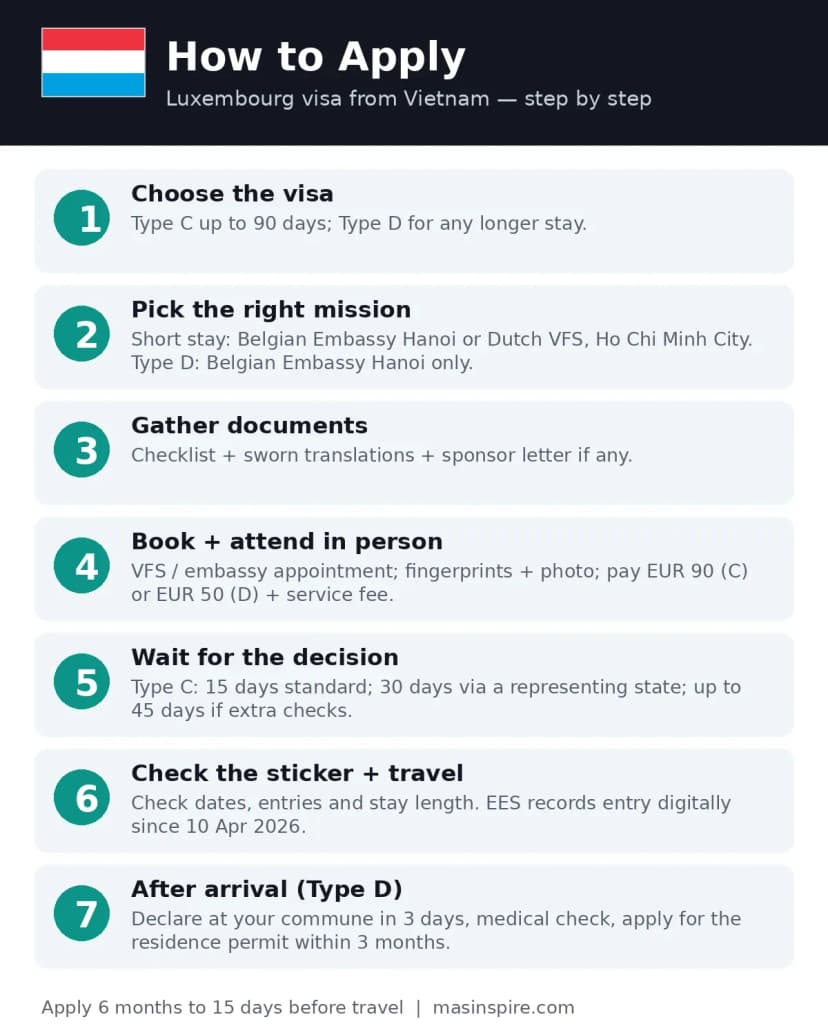
Step 1: Decide the right visa and the right mission
Short stay up to 90 days means Type C; any move over 90 days means Type D. For a short stay, check that Luxembourg is your main destination — if you spend longer in France or Germany, you must apply to that country instead. For a long stay, remember that only a Luxembourg or Belgian post can handle the Type D visa.
Step 2: Gather documents and translations
Work through the checklist above. Get sworn translations of anything not in German, French or English. If a person in Luxembourg is supporting you, they must have their signature officially authenticated on the financial support form at their commune, send it with their last three salary slips, a copy of their passport or identity card, proof of lawful residence if they are a foreign national, and a copy of your passport to the Passport, Visa and Legalisation Office. If accepted, the guarantor receives a stamped copy and you have six months to use it in your visa application.
Step 3: Book the appointment
For a short stay from Ho Chi Minh City, book through VFS Global on the Netherlands route — NetherlandsWorldwide states you can apply for a Schengen visa for Luxembourg at the Netherlands' visa application location in Ho Chi Minh City. For a short stay from Hanoi, the Belgian Embassy in Hanoi handles Luxembourg applications. For a long-stay Type D visa, apply through the Belgian Embassy in Hanoi, which is the competent Belgian post for Luxembourg long-stay files from Vietnam. Book early: appointments are generally available within about two weeks outside peak season but can take much longer in summer.
Step 4: Attend in person and give biometrics
Attend your appointment with the completed form, the checklist and all originals plus copies. You will give fingerprints and a digital photograph if you have not done so in the last five years, and pay the visa fee and any service fee. The fee is non-refundable even if the visa is refused.
Step 5: Wait for the decision
The standard decision time for a Type C visa is 15 calendar days from submission. It can extend to 30 calendar days when the application is lodged with a representing state, and up to 45 calendar days in exceptional cases where further scrutiny or additional documents are needed. Do not book non-refundable travel before the decision.
Step 6: Check the visa sticker and travel
When you collect your passport, check the sticker: the validity dates, the number of entries, the duration of stay and the country code. A visa does not guarantee entry — at the external border you must still be able to show evidence that you meet the entry conditions, including funds, accommodation, invitation and insurance. Since 10 April 2026 the Entry/Exit System records your entry and exit digitally with a facial image and fingerprints instead of a passport stamp.
Step 7: After arrival on a Type D visa
Declare your arrival at your commune within three days, complete the medical check, and apply for your residence permit well within the six-month validity of the Type D visa. The residence permit, not the visa, is the document that authorises your stay beyond 90 days.
Luxembourg Visa Fees and Financial Requirements
| Item | Amount | Source and status |
|---|---|---|
| Airport transit visa (Type A) | EUR 90 | Guichet.lu, last update 1 October 2026 — verified |
| Short-stay visa (Type C), adult | EUR 90 | Guichet.lu, last update 1 October 2026 — verified |
| Short-stay visa (Type C), child aged 6–11 | EUR 45 | Guichet.lu — verified; see conflict note below |
| Short-stay visa (Type C), child under 6 | Free | Guichet.lu — verified |
| Long-stay visa (Type D) | EUR 50 | Guichet.lu fee table and Luxembourg embassy pages — verified |
| Residence permit (most categories) | EUR 80 | Guichet.lu and mission checklists — verified |
| Travel medical insurance (Type C) | Minimum cover EUR 30,000 | Schengen Visa Code, Article 15 — verified |
| Social minimum wage, unqualified, 18+ | EUR 2,771.33 gross/month | ITM / Guichet.lu social parameters, from 1 June 2026, index 992.24 — verified |
| Social minimum wage, qualified, 18+ | EUR 3,325.59 gross/month | ITM / Guichet.lu social parameters, from 1 June 2026 — verified |
| EU Blue Card salary floor | EUR 65,652 gross/year | Ministerial regulation of 23 February 2026, in force 3 March 2026 — verified; see conflict note below |
| Student resources (80% of REVIS) | EUR 1,555.52/month; EUR 18,666.24 for 12 months | Calculated from FNS REVIS EUR 1,944.40 for one adult, index 992.24 — verified as a calculation |
| VFS Global service fee (Vietnam) | Not verified — see note | NetherlandsWorldwide confirms a service fee is added; no amount was published on the pages checked |
Figure conflicts and disclosures. (1) EU Blue Card: Guichet.lu prints EUR 65,562 in one paragraph of its Blue Card page and EUR 65,652 in its contract checklist. The ministerial regulation of 23 February 2026 and the Ministry of Foreign Affairs Blue Card checklist both give EUR 65,652, so this guide uses EUR 65,652 and you should plan your contract around that figure; do not rely on the lower EUR 65,562. (2) Child fee: Guichet.lu gives EUR 45 for children aged 6–11, but the Embassy of Luxembourg in Ankara's visa page lists EUR 33.75 for the same age group. The EUR 45 figure is the one in Luxembourg's own Guichet.lu fee table and in the EU Visa Code framework, so it controls for this guide; the Ankara figure appears to be an outdated or mission-local amount and should not be relied on. (3) Student funds: older guides quote EUR 1,517 per month, which was 80% of the pre-June 2026 REVIS amount. The REVIS figure in force from 1 June 2026 is EUR 1,944.40 for one adult, so 80% is EUR 1,555.52 per month. Use the current figure. (4) Type D fee for children: some mission pages list EUR 50 for all Type D applicants, while another mission page lists EUR 45 for children aged 6–12 and free under 6. This guide could not verify which child rate the Belgian Embassy in Hanoi applies, so confirm the child Type D fee with that mission before paying. (5) Daily subsistence for a Type C visa: Luxembourg publishes no fixed daily euro amount for short-stay proof of funds. Secondary guides suggest planning on roughly EUR 50–EUR 70 per day as a working range, but that range is guidance, not an official Luxembourg figure, and the Netherlands' EUR 55 per day figure applies to Netherlands applications, not to Luxembourg. Show consistent funds across several months of bank statements rather than a single large deposit. (6) VFS Global service fee in Vietnam: confirmed to exist but the exact amount in VND could not be verified from the official pages checked on 27 November 2026. Do not rely on the EUR 30–EUR 50 range quoted by secondary sites; read the amount on the VFS Global checkout when you book. (7) Investor route: see the types section — its legal status is unsettled and no fee is given.
All consular fees are non-refundable if the visa is refused. The visa fee is set by the EU Visa Code and is the same at every Schengen consulate; the service fee is charged by the visa application centre on top. Luxembourg uses the euro, so fees are paid in euros or at the centre's published conversion rate — confirm the payment method at booking, because some missions take cash in euros only.
Visa and Permit Processing Times
| Application | Standard time | Extended time | Notes |
|---|---|---|---|
| Type C short-stay visa | 15 calendar days from submission | 30 days if lodged with a representing state; 45 days in exceptional cases | Apply 6 months to 15 days before travel |
| Type A airport transit visa | 15 calendar days | Up to 45 days in exceptional cases | Same lodging window as Type C |
| Type D long-stay visa | Decided with the residence category; no single published Type C-style clock | Varies by category | Apply well in advance; the visa itself is valid 6 months |
| EU Blue Card (decision in principle) | Up to 3 months maximum | Longer if the file is incomplete | Guichet.lu guidance for the category decision |
| Salaried worker permit (decision in principle) | Up to 4 months maximum | Longer if the file is incomplete | Guichet.lu guidance; ADEM stage adds time first |
| Residence permit after arrival | Issued after declaration, medical check and application | File within 3 months of arrival where guidance says so | Do not let the 6-month Type D visa expire first |
Apply for a Type C visa no earlier than six months before the trip and no later than 15 calendar days before it; the Luxembourg Embassy in Bangkok recommends applying at least three weeks ahead. Applications lodged less than 15 days before travel cannot be guaranteed a decision in time and may be refused except in cases of force majeure. Note that the 15-day clock runs from submission to the deciding authority, and VFS Global transit to the deciding mission adds days — secondary sources for the Netherlands route from Vietnam quote 18 to 45 days end to end, which is consistent with the 15-day decision clock plus handling time, not a contradiction of it. For long-stay categories there is no single published processing clock: budget several months from the job offer or admission to arrival, and do not resign or give up housing in Vietnam until the Type D visa is in your passport.
Applying from Pakistan or Vietnam
As a Pakistani citizen living in Vietnam, you apply in Vietnam, where you legally reside — not in Pakistan and not in Luxembourg. Luxembourg has no embassy of its own in Vietnam; it is accredited to Vietnam from its embassy in Beijing, and the Embassy of Luxembourg in Bangkok is the regional mission for Southeast Asia. Luxembourg's honorary consuls have no competence in the visa process, so do not file through an honorary consul.
For a short-stay (Type C) or airport transit (Type A) visa, the Embassy of Luxembourg in Bangkok states that applicants living in Vietnam should lodge at the Belgian Embassy in Hanoi or the Dutch Embassy in Ho Chi Minh City. NetherlandsWorldwide confirms that you can apply for a Schengen visa for Luxembourg at the Netherlands' visa application location in Ho Chi Minh City, through VFS Global. Whichever route you use, the application is examined by the representing state, and follow-up questions and additional documents go to that state's consular services, not to Luxembourg.
For a long-stay (Type D) visa, only a Luxembourg or Belgian diplomatic post is competent. Since Luxembourg has no post in Vietnam, that means the Belgian Embassy in Hanoi. Short-stay representation by the Netherlands does not extend to long-stay visas, so do not book a Netherlands-route appointment for a Type D application.
Your Vietnamese temporary residence card is a core document: it proves the legal residence that makes Vietnam the correct place to apply. Bring your employment evidence from Vietnam (contract, leave letter, payslips) and bank statements from your Vietnamese bank, plus any Pakistani documents the checklist asks for, such as your CNIC and NADRA Family Registration Certificate. If you hold a valid Schengen visa or a residence permit from another Schengen state, you do not need a new visa for a short visit, but you still need a Type D visa and residence permit for a long stay. Flights from Ho Chi Minh City to Luxembourg have no direct service; most travellers route through Paris, Frankfurt, Amsterdam or Brussels, and your first Schengen entry point matters only if Luxembourg is not your main destination.
Student Visa and Study in Luxembourg
The University of Luxembourg is the country's main public university, with bachelor's, master's and doctoral programmes, many taught in English, French or German. Other options include BTS courses and approved private higher education establishments. Tuition at the University of Luxembourg is reported as EUR 400 per semester for most programmes plus a EUR 100 application fee for 2026–27; this figure comes from secondary sources and should be confirmed on the university's own pages before you budget, because the university sets its own fees.
The immigration test is financial: monthly resources of at least 80% of REVIS, which is EUR 1,555.52 per month at the rates in force from 1 June 2026 (EUR 18,666.24 over 12 months), plus the cost of the return journey. Acceptable proof includes a scholarship or student-loan certificate stating the amount and duration, an original bank certificate in your name (or your parents' name, with proof they can cover at least 12 months), or a support statement from a guarantor who is Luxembourgish or legally resident there. You also need the admission letter, a criminal record extract less than three months old, and travel health insurance. Since 1 October 2026 you apply in person for a Type D visa with a view to the student residence permit, then apply for the permit after arrival and pay the EUR 80 fee. Students may work up to 15 hours a week on average outside study time. After completing studies, graduates may stay to look for work or start a business under the post-study route — check the current Immigration Directorate conditions before relying on it, because post-study rules change.
Work Visa and Job Opportunities
Luxembourg's labour market is small, international and highly paid, but it is not an open market for non-EU workers. For ordinary salaried work you need a specific job offer first: the employer declares the vacancy to ADEM, and only if no suitable candidate is found within three weeks can it obtain the certificate to hire you. The contract must pay at least the social minimum wage — EUR 2,771.33 gross per month for an unqualified worker aged 18 or over, or EUR 3,325.59 for a qualified worker, from 1 June 2026. Common sectors for international hires include finance and banking, EU institutions and their contractors, information technology, logistics, healthcare, hospitality and construction, but every hire still needs the ADEM step unless the role is on a shortage list or the EU Blue Card route applies.
The EU Blue Card is the realistic route for a highly qualified professional such as a teacher with a degree and experience only if the job itself is highly qualified and the salary reaches EUR 65,652 gross per year on a contract of at least six months. Note the conflict disclosed above: one Guichet.lu paragraph prints EUR 65,562, but the regulation and the ministry checklist give EUR 65,652 — contract around the higher figure. English teaching posts in Luxembourg's international and European schools exist but are competitive and usually require recognised teaching qualifications and experience; a short-stay visa never authorises teaching work. There is no Luxembourg job-seeker visa, and anyone offering to sell a Luxembourg work permit is running a scam — Luxembourg's own guidance warns that the authorities do not work with agents selling permits. If you are already in Luxembourg on a student permit, the 15-hour weekly work limit applies; if you are there on a family permit, your right to work depends on the sponsor's permit type.
Family Immigration and Permanent Residence
Family reunification allows the spouse, minor children and in some cases dependent relatives of a third-country national lawfully resident in Luxembourg to join them. The sponsor must hold a valid residence permit, have stable, regular and sufficient resources assessed by reference to the social minimum wage and household size, and have suitable housing. The family member applies for a Type D visa abroad at the competent Luxembourg or Belgian post — from Vietnam, the Belgian Embassy in Hanoi — and then applies for a residence permit after arrival. Documents include proof of the family relationship (marriage certificate or birth certificates, legalised and translated where required), the sponsor's permit and income evidence, and proof of housing.
After five years of continuous lawful residence in Luxembourg you may apply for long-term resident status, and long-term residence is also the usual stepping stone towards nationality, which has its own residence, language and civic conditions. A short-stay visa does not count towards that five-year period. Keep every residence permit, commune registration and employment record from arrival: gaps in lawful residence can break continuity.
Common Application Mistakes and Reasons for Refusal
Common application mistakes
- Applying to the wrong state: filing for Luxembourg when France or Germany is your main destination, or filing a Type D application through the Netherlands route, which handles short stays only.
- Applying too late: lodging less than 15 calendar days before travel, or booking non-refundable flights and hotels before the visa is issued.
- Weak proof of funds: a single large deposit just before the application, instead of consistent bank statements over several months showing salary credits and ordinary spending.
- Insurance that does not meet the test: cover below EUR 30,000, a policy that does not cover all Schengen states, or dates that do not match the travel dates on every other document.
- Dates that disagree across documents: the application form, insurance, flight reservation and hotel booking must all show the same travel dates.
- Missing legal residence evidence: forgetting the Vietnamese temporary residence card, which is what makes Vietnam the correct place to apply.
- Untranslated documents: submitting Urdu or Vietnamese documents without a sworn translation into German, French or English.
- Using an agent who promises a work permit or a job-seeker visa: Luxembourg has no job-seeker visa, and permits are never sold by agents.
- For long stays, relying on pre-October 2026 guides: the temporary authorisation to stay is no longer the first step — the Type D visa is.
Reasons for visa or permit refusal
Common refusal grounds for a Type C visa include insufficient proof of funds, doubts about the purpose of the trip, weak ties to the country of residence, previous overstays or visa misuse, an insurance policy that does not meet the EUR 30,000 requirement, and documents that contradict each other. For long-stay applications, the usual grounds are a missing ADEM certificate, a contract below the salary floor, insufficient student resources, a sponsor who does not meet the resources or housing test, or a criminal record issue.
A refusal of a Type C visa is notified by the consulate, and the refusal form sets out the possibilities of recourse. Under Guichet.lu, an appeal against the decision must be filed with the administrative tribunal by a court lawyer within three months of notification. The visa fee is not refunded on refusal. If you reapply, address the exact ground given in the refusal rather than submitting the same file again — a second identical application is likely to be refused for the same reason. Overstaying a visa can lead to fines, an entry ban and refusals of future applications, and since the Entry/Exit System became fully operational on 10 April 2026, overstays are recorded digitally and detected automatically.
Frequently Asked Questions
1. Do Pakistani passport holders need a visa for Luxembourg?
Yes. Pakistani nationals need a visa before travelling to Luxembourg, for short visits and for long stays. Your Vietnamese residence permit does not remove the requirement; it decides where you file.
2. Where do I apply for a Luxembourg visa from Vietnam?
For a short stay, apply at the Belgian Embassy in Hanoi or through the Netherlands route via VFS Global in Ho Chi Minh City. For a long stay (Type D), apply through the Belgian Embassy in Hanoi only, because only a Luxembourg or Belgian post can handle long-stay visas. Luxembourg has no embassy of its own in Vietnam.
3. How much does a Luxembourg Schengen visa cost?
EUR 90 for adults, EUR 45 for children aged 6–11, and free for children under 6. A VFS Global service fee is added where you apply through VFS; its exact amount in Vietnam could not be verified from the official pages checked, so read it on the VFS checkout when you book.
4. How long does a Luxembourg visa take?
The standard decision time for a Type C visa is 15 calendar days from submission, extending to 30 days when the application is lodged with a representing state and up to 45 days in exceptional cases. VFS handling time is additional, so apply at least three to four weeks before travel and no later than 15 days before it.
5. How long can I stay in Luxembourg on a Schengen visa?
Up to 90 days in any 180-day period, counting all Schengen states together. The 90/180 rule is rolling: on any day, your Schengen days in the previous 180 days must not exceed 90.
6. Can I work in Luxembourg on a tourist visa?
No. A Type C visa does not give the right to carry out paid activity. Work under 90 days needs a work permit first (with exemptions for certain categories), and work over 90 days needs a Type D visa and a residence permit.
7. What is the new Type D procedure from 1 October 2026?
Since 1 October 2026, the first step for any stay over 90 days is a long-stay Type D visa applied for abroad at a Luxembourg or Belgian post. The visa is valid for six months. After arrival you declare at your commune within three days, complete the medical check and apply for the residence permit. It replaces the former temporary authorisation to stay as the entry step.
8. How much money do I need to show for a Luxembourg student visa?
Monthly resources of at least 80% of the social inclusion income (REVIS): EUR 1,555.52 per month at the rates in force from 1 June 2026, or EUR 18,666.24 for 12 months, plus the cost of the return journey. Older guides quoting EUR 1,517 per month use the pre-June 2026 REVIS figure.
9. What salary do I need for an EU Blue Card in Luxembourg?
EUR 65,652 gross per year on a contract of at least six months, for a highly qualified job. One Guichet.lu paragraph prints EUR 65,562, but the ministerial regulation and the ministry checklist give EUR 65,652, which is the figure to plan around.
10. Do I need travel insurance, and how much cover?
Yes. Travel medical insurance covering emergency treatment, hospitalisation and repatriation, valid in all Schengen states for the whole trip, with minimum cover of EUR 30,000.
11. Can I visit other Schengen countries on a Luxembourg visa?
Yes. A Luxembourg Type C visa is a uniform Schengen visa and allows travel throughout the Schengen Area within the 90/180-day limit, provided Luxembourg was your main destination when you applied.
12. Do I need ETIAS for Luxembourg?
Not yet. ETIAS is not in operation and no applications are being collected. Some sources still cite a last-quarter-of-2026 target, but the EU's official information no longer names a start date; the EU says it will announce the date several months before launch. Do not pay any website offering ETIAS now. The Entry/Exit System, by contrast, has been fully operational since 10 April 2026.
13. What if my Luxembourg visa is refused?
The refusal is notified by the consulate with the grounds and the possibilities of recourse. You may appeal to the administrative tribunal through a court lawyer within three months of notification. The fee is not refunded. Address the stated ground before reapplying.
14. Can my family join me in Luxembourg?
Yes, through family reunification, if you hold a valid residence permit and can show stable, regular and sufficient resources and suitable housing. Family members apply for a Type D visa abroad and then for a residence permit after arrival.
15. Is there a Luxembourg job-seeker visa?
No. Luxembourg has no general job-seeker visa. You need a job offer and, for salaried work, an ADEM certificate, or a qualifying Blue Card contract, before you can apply for a Type D visa. Anyone offering to sell a Luxembourg work permit is running a scam.
Official Immigration Websites
| Authority / resource | What it covers | Website |
|---|---|---|
| Guichet.lu — Luxembourg entry visa for third-country nationals | Official visa types, fees, documents, processing times and appeals | https://guichet.public.lu/en/citoyens/immigration/vivre/non-luxembourg/autres/entree-visa.html |
| Luxembourg Ministry of Foreign and European Affairs — Visa | Short-stay and long-stay visa rules, representation arrangements | https://mae.gouvernement.lu/en/services-aux-citoyens/visa-immigration.html |
| Embassy of Luxembourg in Bangkok — Consular services | Where residents of Vietnam lodge short-stay applications; airport transit list | https://bangkok.mae.lu/en/service_citoyens.html |
| NetherlandsWorldwide — Schengen visa, Vietnam | Luxembourg applications at the Netherlands VFS location in Ho Chi Minh City | https://www.netherlandsworldwide.nl/visa-the-netherlands/schengen-visa/apply-vietnam |
| Guichet.lu — Social parameters | Social minimum wage and REVIS amounts from 1 June 2026 | https://guichet.public.lu/en/entreprises/outils/parametres-sociaux.html |
| France Diplomatie — EES and ETIAS | Entry/Exit System fully operational 10 April 2026; ETIAS not yet operational | https://www.diplomatie.gouv.fr/en/presse-et-ressources/decouvrir-et-informer/actualites/ees-le-nouveau-systeme-europeen-de-gestion-des-frontieres-entre-en-service-le-10-avril-2026 |
Note: the VFS Global centre address and service fee for the Netherlands route are confirmed only through the NetherlandsWorldwide page above; check the centre address and the fee on the VFS booking pages reached from that page, because neither was published on the official pages checked for this guide.
Final Checklist and Conclusion
Before you apply, confirm each point: Luxembourg is your main destination; you have chosen the right visa (Type C for up to 90 days, Type D for any longer stay); you are filing at the right mission (Belgian Embassy in Hanoi or the Dutch VFS route in Ho Chi Minh City for short stays, Belgian Embassy in Hanoi only for long stays); your passport is valid three months beyond the requested visa; your insurance covers EUR 30,000 across all Schengen states; your bank statements show consistent funds; your documents are translated by a sworn translator where needed; and you have applied between six months and 15 days before travel.
Luxembourg rewards careful preparation: the rules are published, the fees are fixed by the Visa Code, and the thresholds for work and study are precise. The traps are the ones this guide has flagged — the wrong mission, the pre-October 2026 long-stay procedure, the two conflicting Blue Card figures, the outdated student-funds figure, and agents selling permits that do not exist. File early, file at the right mission, and verify every figure against the live official page before you pay.
Editorial note: this guide was prepared on 27 November 2026 from the official sources listed above and re-verified on 28 November 2026. Fees, thresholds and procedures change; the official pages linked in the table above control if anything in this guide differs from them.