Lithuania Visa Guide 2026: Types, Requirements, Fees and How to Apply
For Pakistani passport holders living in Vietnam — verified 28 November 2026. Always confirm the live rule with the Lithuanian Migration Department (MIGRIS), the Danish Visa Application Centre in Vietnam, or the Lithuanian mission accredited to Vietnam before you book or pay, because several figures in this guide are disclosed as conflicting between sources rather than presented as settled fact.
1. Introduction
Lithuania is the largest of the three Baltic states, a member of the European Union and the Schengen Area since 2007, and a country that many Pakistani travellers first meet through Vilnius, its baroque Old Town, the resort town of Palanga on the Baltic coast, the Curonian Spit, and the lakes and forests of Aukstaitija National Park. For a Pakistani passport holder living in Vietnam, Lithuania is reachable, but it is not a visa-on-arrival destination, and it is not a country you can enter on a Vietnamese residence card alone. You need a visa before you travel, and the route you take depends on how long you plan to stay and why you are going.
This guide covers the short-stay Schengen visa (Type C) for tourism, business and family visits, the long-stay national visa (Type D) for work, study and other stays over 90 days, and the temporary residence permit that follows a long stay. It is written for a Pakistani citizen who legally resides in Vietnam — for example on a work permit, a temporary residence card, or a long-term visa — and who will lodge the application from Vietnam. Where the rules for applying from Pakistan differ, that is stated separately in Section 10.
Two things about Lithuania changed recently and shape everything in this guide. First, since 22 October 2025 Vietnam has been on Lithuania's list of countries where applications for national visas and temporary residence permits can be lodged through the external service provider VFS Global, and appointments for those applications are booked through MIGRIS, the Lithuanian Migration Information System. Second, from 1 November 2026, amendments to Lithuania's Law on the Legal Status of Foreigners stopped people who are in Lithuania on a Schengen visa from filing for a work or bachelor's-study residence permit from inside the country. That means the long-stay route must now be started properly from abroad, through MIGRIS and VFS Global in Vietnam, before you travel. Do not plan to arrive on a tourist visa and switch to a work permit inside Lithuania.
2. Do Pakistani Passport Holders Need a Visa for Lithuania?
Yes. Pakistani passport holders need a visa to enter Lithuania for any purpose. Pakistan is not on the Schengen visa-free list, and there is no visa on arrival for Lithuanian entry for Pakistani citizens. You must hold a valid visa before boarding your flight, and the airline will check it. A Vietnamese temporary residence card or work permit does not replace a Lithuanian visa; it only proves where you legally live, which decides where you lodge your application.
For a short stay of up to 90 days in any 180-day period, you need a Schengen visa (Type C). That single visa also lets you travel to the other 28 Schengen states during the same trip, as long as Lithuania is your main destination — the country where you will spend the most days, or, if the days are equal, the country you enter first for the main purpose of the trip. The 90/180 rule counts across the whole Schengen Area, not per country, so days spent in, for example, Germany or Poland on the same visa count against the same 90 days.
For a stay of more than 90 days — to work, to study for a full degree, to join family, or to run a business — a Schengen visa is not enough. You need a national visa (Type D), a temporary residence permit, or both in sequence, as explained in Section 3. A Type D visa is issued for at least 91 days and for a maximum of one year, and it also allows travel in the rest of the Schengen Area for up to 90 days in any 180-day period.
There is one common misunderstanding to clear up at the start. ETIAS, the European Travel Information and Authorisation System, does not apply to you. ETIAS is for visa-exempt travellers only. Its launch has been postponed repeatedly, the end-of-2026 target was removed from the EU website in July 2026, and it is now expected in 2027 at the earliest, with no official start date. As a Pakistani passport holder you need a visa, not an ETIAS, and any website already selling ETIAS applications is fake. The Entry/Exit System (EES), by contrast, is real and fully operational at all Schengen external borders since 10 April 2026: your fingerprints and a facial photograph are recorded on entry and exit, passport stamps have been replaced by an electronic record, and overstaying is now detected automatically.

3. Types of Lithuania Visas and Residence Permissions
Lithuania's system has three layers: the short-stay Schengen visa, the long-stay national visa, and the residence permit. Most travellers only need the first. Anyone planning to live in Lithuania needs the second or third, and the choice between them is not yours alone — it depends on your purpose, and for full-time degree study the 2026 position is that you apply for a residence permit before you travel (see the conflict disclosed in Section 11).
3.1 Schengen visa (Type C) — short stay
The Type C visa covers tourism, visiting family or friends, business meetings, conferences, short training, medical treatment and transit, for up to 90 days in any 180-day period. It can be issued for a single entry, two entries, or multiple entries. The validity period, the number of entries and the number of days are at the discretion of the deciding mission. Apply for a Type C visa when Lithuania is your main destination and your whole stay is 90 days or less.
3.2 Airport transit visa (Type A)
A Type A visa is for transit through the international transit area of a Lithuanian airport without entering Lithuania. Most Pakistani travellers flying to Vilnius will not need one, because they are entering Lithuania, not transiting it. If your itinerary transits another Schengen airport, that country's transit rules apply instead. Check the transit requirement for every airport on your ticket, not only the final destination.
3.3 National visa (Type D) — long stay
The national visa is for stays of more than 90 days, up to a maximum of one year, for purposes set out in Lithuanian law: employment, study (including exchange and mobility periods), scientific research, family reunification, business activity as a company participant or manager, and certain other lawful purposes. You apply online through MIGRIS, upload digital copies of your documents, and then give biometrics and show original documents in person at a Lithuanian mission or a VFS Global centre. A decision is normally made within 15 calendar days, extendable to 45 days. The state fee is EUR 140, with exemptions for some categories, including student-exchange participants. A national visa is not renewable in the same form indefinitely: if you intend to stay longer, you must apply for a temporary residence permit 2 to 4 months before the visa expires.
3.4 Temporary residence permit (TRP)
The temporary residence permit is the card that lets you live in Lithuania for longer than a year. It is issued for work (usually up to 2 years, tied to the employer), study (usually 2 years or the study period if shorter), family reunification, business, or highly qualified employment under the EU Blue Card (usually 3 years). You apply through MIGRIS and give biometrics at a VFS Global centre abroad or at the Migration Department in Lithuania, depending on your situation. Since 1 November 2026, first applications for work and bachelor's-study permits can no longer be filed from inside Lithuania on a Schengen visa, so the TRP application for those grounds must be lodged from abroad — from Vietnam, in your case — before you travel.
3.5 EU Blue Card
The EU Blue Card is a residence permit for highly qualified employment. It requires a higher-education qualification (or, in some cases, equivalent professional experience), an employment contract of at least 6 months, and a salary at or above the Blue Card threshold, usually 1.2 times the average gross wage for shortage or high-value occupations and 1.5 times for other eligible occupations. It is valid for 3 years or the contract term plus 3 months if shorter, gives immediate family reunification advantages, and is decided faster than a standard work permit: about 1 month on the standard track or 15 days on the expedited track, according to Migration Department guidance quoted in 2026 guides.
3.6 What Lithuania does not offer
Lithuania has no standalone digital-nomad visa. Several consultancy websites market a "Lithuania digital nomad visa" at a monthly income figure of around EUR 5,460, but that figure and framing do not appear in any published Migration Department policy; what exists is the national visa's general "other cases" category and the ordinary work, study, family and business routes. Do not pay anyone for a digital-nomad visa product. Remote workers normally need another lawful basis: Lithuanian employment, a Blue Card, a family route, study, or a genuine business or startup basis, including the Startup Visa for founders in innovative fields such as ICT, biotech, fintech and laser technology.
4. Visa Comparison Table
| Visa or permit | Maximum stay | Main purposes | Government fee | Decision time | Where to apply from Vietnam |
|---|---|---|---|---|---|
| Schengen visa (Type C) | 90 days in any 180 days | Tourism, family visit, business, conference, short training | EUR 90 (adult); EUR 45 (age 6-11); free (under 6) | 15 calendar days, extendable to 45 | Danish VFS centre in Hanoi or Ho Chi Minh City; decided in Bangkok |
| Airport transit visa (Type A) | Transit area only | Airport transit without entering Lithuania | EUR 90 | 15 calendar days, extendable to 45 | Danish VFS centre in Vietnam |
| National visa (Type D) | 91 days to 1 year | Work, exchange study, research, family, business | EUR 140 | 15 calendar days, extendable to 45 | MIGRIS online, then VFS Global centre in Vietnam |
| Temporary residence permit (TRP) — work | Up to 2 years | Employment with a Lithuanian employer | EUR 220 standard / EUR 440 urgent (see fee conflict, Section 8) | Up to 3 months standard; 45 days urgent | MIGRIS online, then VFS Global centre in Vietnam |
| Temporary residence permit (TRP) — study | Usually 2 years or study period | Full-time degree study | EUR 220 standard / EUR 440 urgent; EUR 80 for students from the Migration Department's list (see Section 8) | Up to 3 months standard | MIGRIS online, then VFS Global centre in Vietnam |
| EU Blue Card | 3 years or contract plus 3 months | Highly qualified employment | EUR 160 standard / EUR 320 urgent (see fee conflict, Section 8) | About 1 month standard; 15 days expedited | MIGRIS online, then VFS Global centre in Vietnam |
Fees in this table are government fees only. VFS Global charges a separate service fee on top, and the exact amount depends on where you lodge the application (see Section 8). All fees are non-refundable, including when a visa is refused.
5. Eligibility Requirements
The general eligibility rules are the same for most applicants, and the deciding officer checks them in this order: a genuine passport, a lawful purpose, enough money, insurance, a place to stay, and a reason to return.
5.1 Passport and residence in Vietnam
Your Pakistani passport must have been issued within the last 10 years, must be valid for at least 3 months beyond your planned departure from the Schengen Area, and must have at least 2 blank pages for the visa sticker. You must also prove legal residence in Vietnam that is valid for at least 3 months after your planned return from Schengen — for example a Vietnamese temporary residence card, work permit, or long-term visa, plus your Vietnamese address. If your Vietnamese residence is about to expire, renew it first; a visa application lodged on a nearly expired residence permit is a common reason for delay or refusal.
5.2 Purpose and main destination
Lithuania must be your main destination for a Type C visa. If you plan to spend more days in another Schengen country, apply to that country instead. Your stated purpose must match your documents: a tourist needs hotel bookings and an itinerary, a business visitor needs an invitation from a Lithuanian company, and a family visitor needs an electronic invitation from the host in Lithuania, issued through MIGRIS with a unique invitation number.
5.3 Money
For a short stay, Lithuania's published reference amount is EUR 50 per day of stay, plus enough for your return journey. That figure comes from the European Commission's published reference amounts (Annex 25 to the Practical Handbook for Border Guards, version of 8 June 2026) and from Lithuanian consular checklists, which ask for a bank statement for the last 3 months showing a balance that covers at least EUR 50 per day. A 10-day trip therefore means showing at least EUR 500 plus return travel costs. An invitation submitted through MIGRIS by a host in Lithuania can replace the proof of funds in some cases, and accompanied minors are exempt from the daily amount. For long stays the test is different and much higher: one full minimum monthly wage per month for most purposes (EUR 1,153 in 2026), or half the minimum wage per month for students, trainees and minors (EUR 576.50 in 2026), plus a one-off return amount of one minimum wage (see Sections 8, 11 and 12).
5.4 Insurance
Travel medical insurance is mandatory for a Schengen visa and for a national visa. It must cover at least EUR 30,000, be valid in all Schengen states, cover emergency medical attention, emergency hospital treatment and repatriation for medical reasons or in the event of death, and be valid for the entire period of your intended stay. For a temporary residence permit, the Migration Department requires health insurance of at least EUR 10,000 for the first year, although a EUR 30,000 policy also satisfies the requirement and is the safer choice. Buy the policy from an insurer recognised by Schengen consulates, and make sure the certificate states the coverage amount, the validity dates and the geographical coverage clearly.
5.5 Ties to Vietnam and to Pakistan
Because a Schengen visa is a short-stay visa, the officer must be satisfied that you will leave on time. For a Pakistani living in Vietnam, the strongest evidence is your life in Vietnam: your employment contract and recent payslips, your Vietnamese residence card, a lease, family in Vietnam, and a travel history that shows previous visas used correctly. A first-time traveller with no travel history is not automatically refused, but the file needs to be stronger — stable employment, a clear itinerary, and funds that are genuinely yours and have been in the account for months, not deposited in one lump sum the week before you apply.
5.6 Health, character and previous refusals
You must not be the subject of a Schengen entry ban or an alert in the Schengen Information System. A previous Schengen refusal does not bar a new application, but you must declare it if the form asks, and you should address the reason for the earlier refusal with new evidence. A criminal-record certificate is not routinely required for a short-stay visa, but it is required for long-stay and residence applications, covering the previous 2 years, legalised and translated as the Migration Department requires.
6. Complete Document Checklists
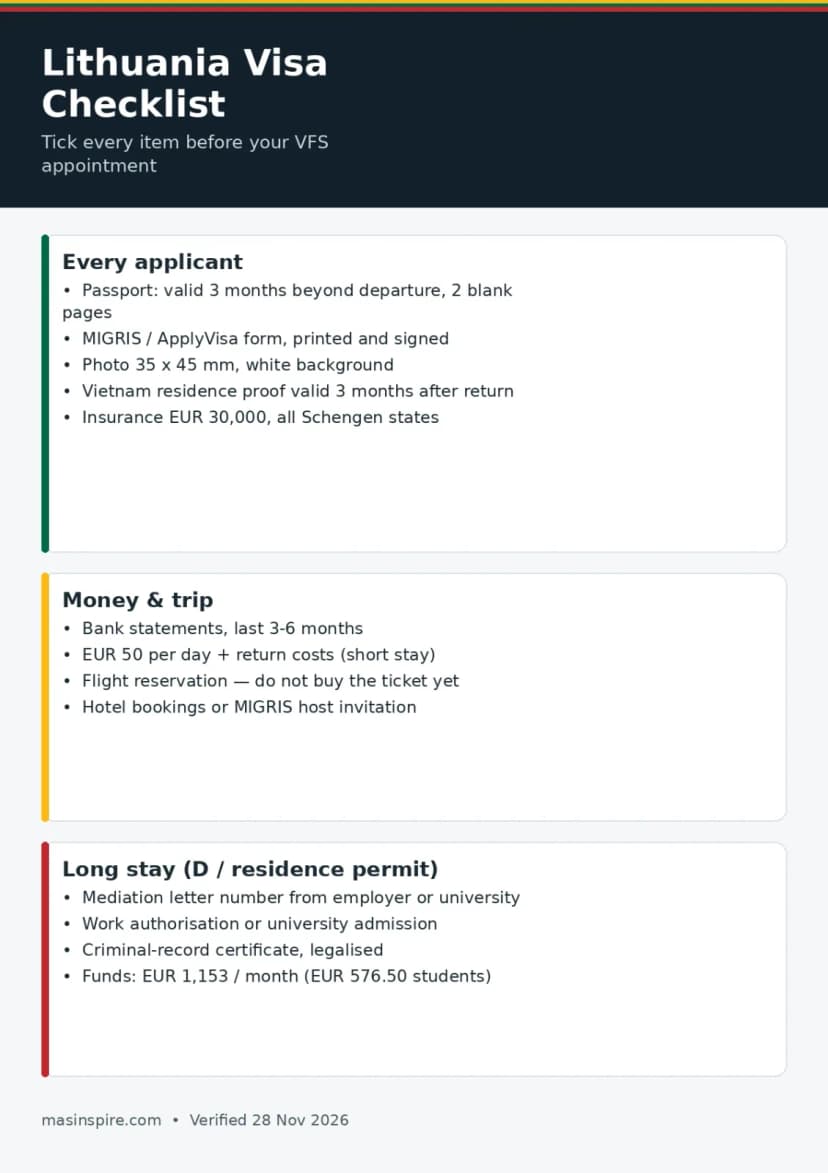
Prepare originals and one photocopy of each document. Documents in a language other than Lithuanian, English or Russian must be submitted with a translation into Lithuanian, English or Russian. Vietnamese documents must be translated into English and legalised by the competent local authority (except passports), and official documents should generally be no more than 3 months old. Do not buy a non-refundable flight ticket before the visa is granted; a flight reservation is enough.
6.1 Schengen visa (Type C) — tourism
| Document | Details |
|---|---|
| Passport | Original plus copies of the data page and all previous visas; valid 3 months beyond departure, issued within 10 years, 2 blank pages |
| Application form | Completed online through MIGRIS, printed, signed on every page as instructed |
| Photographs | One recent colour biometric photo, 35 x 45 mm, white or light background, face clearly visible |
| Vietnamese residence proof | Temporary residence card, work permit or long-term visa, valid at least 3 months after planned return, plus proof of address in Vietnam |
| Travel medical insurance | Minimum EUR 30,000, valid in all Schengen states for the whole stay, covering emergency care, hospital treatment and repatriation |
| Flight reservation | Round-trip reservation with fixed dates, maximum 90 days; do not buy the ticket until the visa is granted |
| Accommodation proof | Hotel bookings for every night in Lithuania and any other Schengen country on the trip, or a host invitation |
| Proof of funds | Bank statements for the last 3 months (some checklists ask for 6 months — provide 6 if you can) showing at least EUR 50 per day plus return costs; the balance must be in your name |
| Employment proof | Recent employer letter (not older than one week) on headed paper with your position, salary, date of employment and approved leave dates; payslips for the last 3 months; labour contract |
| Self-employed applicants | Business registration, tax payment records, company bank statements for the last 3 months |
| Travel plan | Day-by-day itinerary: cities, dates, transport and accommodation |
| Previous travel | Copies of previous Schengen, UK, US, Canadian or Australian visas and entry stamps, if any |
6.2 Schengen visa (Type C) — family or friend visit
All of the tourist documents above, plus an electronic invitation from the inviting citizen or resident of Lithuania, issued through MIGRIS with a unique invitation number, which you present at the VFS centre; proof of family ties with the inviter if relevant (marriage certificate, birth certificate); and, if the inviter is covering your costs, their letter of guarantee and their bank statement. If the invitation states your accommodation, you do not need separate hotel bookings for those nights.
6.3 Schengen visa (Type C) — business
All of the tourist documents above, plus an invitation letter from the Lithuanian company stating the purpose, dates and who pays; a letter from your Vietnamese employer confirming your position and the business purpose of the trip; and evidence of the business relationship, such as contracts, correspondence or conference registration. The Lithuanian consular checklist for business also asks for the electronic MIGRIS invitation code where the host has issued one.
6.4 National visa (Type D) and temporary residence permit
| Document | Details |
|---|---|
| MIGRIS application | Completed online in MIGRIS, with digital copies of all documents uploaded; mediation letter number from the employer or university where one is required |
| Passport | As for Type C, plus copies of all pages with visas and stamps |
| Photograph | Recent colour biometric photo, 35 x 45 mm |
| Mediation letter | Electronic mediation letter submitted by the Lithuanian employer or university through MIGRIS; you need its number for your application |
| Work authorisation | Work permit from the Employment Service or a decision on the conformity of the job from the Migration Department, arranged by the employer |
| University admission | Admission letter and, for a TRP, proof of enrolment; the university submits its mediation letter through MIGRIS |
| Proof of funds | At least one minimum monthly wage per month (EUR 1,153 in 2026) for most purposes, or EUR 576.50 per month for students, plus a one-off return amount of EUR 1,153; see Sections 8, 11 and 12 |
| Health insurance | Minimum EUR 30,000 for a national visa; at least EUR 10,000 for a residence permit, valid for the first year |
| Accommodation | Proof of accommodation in Lithuania, unless the mediation letter already states it |
| Criminal-record certificate | Covering the previous 2 years, legalised and translated; for a TRP this is routinely required |
| Qualifications | Degree certificates and transcripts, legalised and translated, for work, Blue Card and study routes |
| Marriage and birth certificates | For family reunification, legalised, translated, and no more than 3 months old where the checklist requires it |
6.5 Documents for children
For a minor travelling with you: the child's passport, birth certificate, parental authorisation from any parent not travelling, copies of the parents' identity documents, and proof of enrolment at school where relevant. A minor travelling with an adult family member is exempt from the EUR 50 per day proof-of-funds amount for a short stay.
7. How to Apply: Step-by-Step
The route is different for a short-stay visa and for a long-stay visa, and mixing them up is the most common mistake in this guide. Follow the track that matches your stay.
7.1 Short-stay Schengen visa (Type C) from Vietnam — step by step
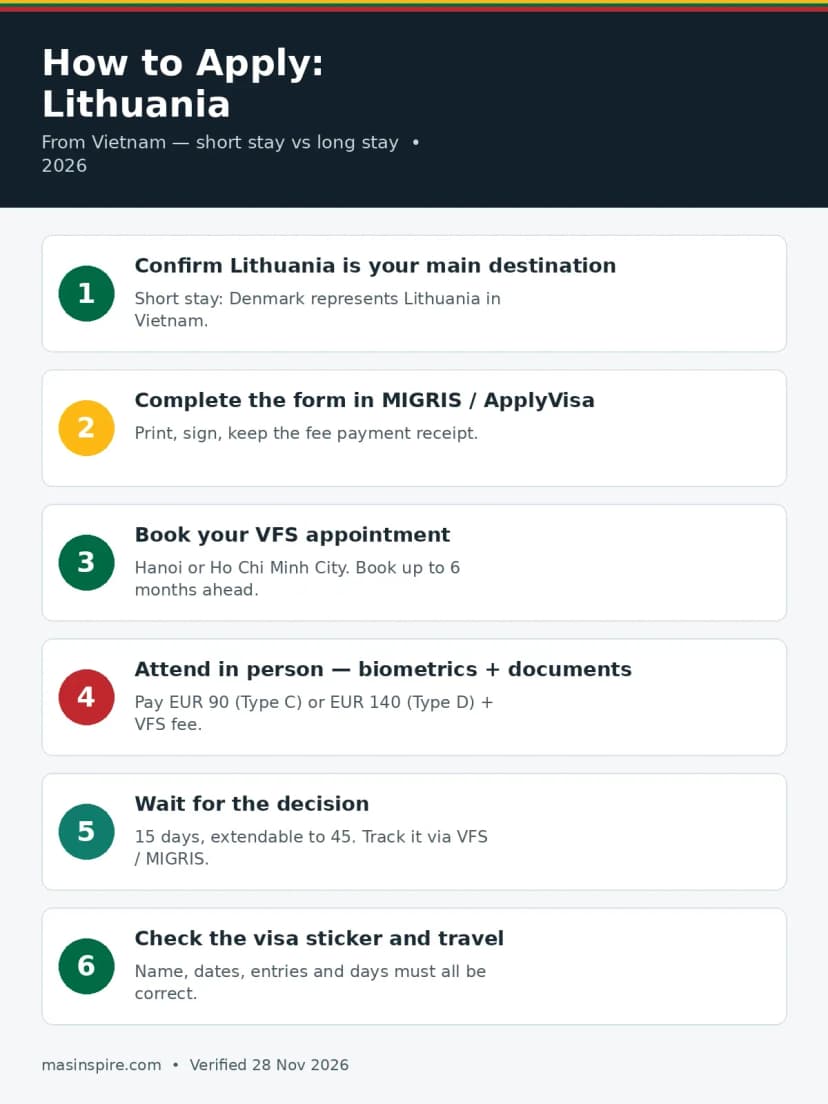
Step 1: Confirm Lithuania is your main destination and that Denmark is the representing state. Lithuania has no embassy in Vietnam and is accredited to Vietnam from Beijing, but Denmark represents Lithuania for Schengen visas in Vietnam. You lodge the application at a Danish Visa Application Centre run by VFS Global in Vietnam, and the decision is made by the Embassy of Denmark in Bangkok. Do not go to the Danish Embassy in Hanoi for processing; it no longer processes Schengen applications lodged at VFS in Vietnam and will refer you to VFS or to Bangkok.
Step 2: Complete the application form. For Denmark-represented applications, the form and the visa-fee payment are completed through the Danish ApplyVisa portal (applyvisa.um.dk), printed and signed. For Lithuania's own MIGRIS route, the Schengen form is completed in MIGRIS. Confirm at the VFS centre which portal your case uses before you pay, because the fee payment receipt is part of the file.
Step 3: Book an appointment at the Danish Visa Application Centre in Hanoi or Ho Chi Minh City (addresses in Section 10). Book early: you may apply up to 6 months before travel and no later than 15 days before departure, and appointment slots fill up before holiday periods.
Step 4: Prepare the documents in Section 6.1, 6.2 or 6.3, with translations and legalisation for Vietnamese documents, and buy the EUR 30,000 travel insurance before the appointment.
Step 5: Attend the appointment in person. You give biometrics (fingerprints and a photograph), hand in the originals and copies, and pay the EUR 90 visa fee plus the VFS service fee. The fee is non-refundable. Keep the receipt and the tracking reference.
Step 6: Wait for the decision. The normal handling time is 15 calendar days from submission at VFS. Track the application through VFS. Do not buy a non-refundable ticket while you wait.
Step 7: Collect your passport from the VFS centre or by courier. Check the visa sticker immediately: your name, passport number, validity dates, number of entries and number of days must all be correct. Report any error to VFS at once.
7.2 National visa (Type D) or temporary residence permit from Vietnam — step by step
Step 1: Secure the basis first. For work, your Lithuanian employer obtains the work authorisation and submits a mediation letter through MIGRIS. For study, your university admits you and submits its mediation letter through MIGRIS. You cannot apply for a D visa or a TRP without that mediation letter number.
Step 2: Create your MIGRIS account at migracija.lt and complete the application online, uploading digital copies of every document. Since 22 October 2025, appointments for these applications are booked exclusively through MIGRIS, using the "Book a Visit" option in your personal account.
Step 3: Book your visit at the VFS Global centre in Vietnam that handles Lithuanian national visa and residence applications. Vietnam was added to that list on 22 October 2025, so you can now lodge a D visa or TRP application in Vietnam itself. The exact VFS centre address for Lithuanian long-stay applications is confirmed when you book through MIGRIS — do not use the Danish Schengen centre address for a long-stay booking unless MIGRIS directs you there.
Step 4: Attend in person within 4 months of the online application to give biometrics and show the original documents. Pay the state fee — EUR 140 for a national visa, or the TRP fee in Section 8 — plus any VFS service fee. Keep every receipt.
Step 5: Wait for the Migration Department's decision: 15 calendar days, extendable to 45, for a national visa; up to 3 months (standard) or 45 days (urgent) for a TRP. Track the case in MIGRIS.
Step 6: On approval, collect the visa or the decision, travel to Lithuania, and, for a TRP, complete registration and collect your residence card after arrival, following the instructions in the decision letter. If you hold a multiple-entry national visa valid for one year and intend to apply for a TRP, submit the TRP application 2 to 4 months before the visa expires.
8. Visa Fees and Financial Requirements
All government fees are non-refundable. Pay only through the official channel named at the time of application — the MIGRIS checkout, the Danish ApplyVisa portal, or the VFS centre — and keep the receipt. Never pay a visa fee to an agent's personal account.
8.1 Schengen visa fees
| Applicant | Government fee |
|---|---|
| Adult (age 12 and above) | EUR 90 |
| Child age 6 to 11 | EUR 45 |
| Child under 6 | Free |
| School pupils, students and accompanying teachers travelling for study or educational training; researchers for scientific research; representatives of non-profit organisations aged 25 or under at qualifying events | Fee waived under the Visa Code categories published by the Lithuanian MFA |
The EUR 90 fee is confirmed by the Lithuanian Ministry of Foreign Affairs visa-fee page, read live on 28 November 2026. Older guides still quote EUR 80: that was the fee before the EU-wide increase, and it is now out of date. Do not rely on any source that still says EUR 80.
8.2 VFS service fee — a disclosed conflict
On top of the visa fee, VFS Global charges a service fee, and the published figures conflict. The Lithuanian MFA's own fee page states a standard service fee of EUR 21.50 where there is a Lithuanian visa authority in the country and EUR 40.50 where there is none. A secondary guide rounding those figures gives EUR 22 and EUR 41. VFS Global's own UK page for Lithuania quotes a service charge of EUR 17.90 for submission with biometrics, and older Danish-Vietnam material quotes different local amounts. The controlling source is the MFA fee page and the amount the VFS centre charges at the time you lodge the application, because the service fee is set by the contract in force in the country of application. Budget for EUR 40.50 for a Lithuania application lodged in Vietnam, where there is no Lithuanian visa authority, and confirm the exact amount with the VFS centre before your appointment. In all cases the service fee is separate from, and additional to, the EUR 90 visa fee.
8.3 National visa and residence permit fees
| Application | Government fee |
|---|---|
| National visa (Type D) | EUR 140; student-exchange participants are generally exempt |
| Temporary residence permit — standard procedure | EUR 220 (see conflict below) |
| Temporary residence permit — urgent procedure | EUR 440 (see conflict below) |
| Temporary residence permit — students from the Migration Department's list | EUR 80 |
| EU Blue Card — standard / urgent | EUR 160 / EUR 320 (see conflict below) |
Fee conflict, disclosed: the TRP fee is the least settled figure in this guide. Older Migration Department material and many 2026 guides quote EUR 160 standard and EUR 320 urgent, and some quote EUR 160 with a 45 to 90 day processing time. The Migration Department's 2026 fee material reproduced in the MIGRIS fee guide quotes EUR 220 standard and EUR 440 urgent, with a 90-day standard decision and a 45-day urgent decision, and the same EUR 220 / EUR 440 figures appear in November 2026 guidance for study TRPs. This guide uses EUR 220 / EUR 440 as the current figure and treats the EUR 160 / EUR 320 figures as superseded, but the conflict is real and the only figure that binds you is the amount MIGRIS shows at checkout. The same caution applies to the Blue Card: EUR 160 / EUR 320 is the figure in the 2026 guides, and it has not been re-confirmed against a 2026 MIGRIS checkout in this research, so confirm it in MIGRIS before paying. Urgent processing costs exactly twice the standard fee.
8.4 Proof of funds — the amounts that matter
| Route | Amount to show (2026) |
|---|---|
| Schengen short stay | EUR 50 per day of stay, plus return travel costs; 10 days means at least EUR 500 plus the return journey |
| National visa / TRP — most purposes | One minimum monthly wage per month: EUR 1,153 per month in 2026 |
| National visa / TRP — students, trainees, minors | Half the minimum monthly wage per month: EUR 576.50 per month in 2026 |
| Student TRP — 12 months, total | About EUR 8,071 to EUR 8,077 (see rounding conflict below) |
| Return-travel guarantee (long stay) | One minimum monthly wage, one-off: EUR 1,153 in 2026 |
Rounding conflict, disclosed: the 12-month student total is EUR 8,071 in the calculation that uses EUR 576.50 per month (12 x EUR 576.50 = EUR 6,918, plus EUR 1,153 return = EUR 8,071) and EUR 8,077 in the calculation that rounds the monthly figure to EUR 577 first (12 x EUR 577 = EUR 6,924, plus EUR 1,153 = EUR 8,077). Both figures describe the same rule. Show at least EUR 8,100 so that rounding can never become a problem. The minimum wage resets every January — the figure proposed for 2027 is EUR 1,245 — so a 2027 application will use a higher amount, and you must re-check the figure in force when you apply.
8.5 What counts as proof of funds
For a short stay, a bank statement in your own name for the last 3 months is the standard evidence; providing 6 months is safer if the checklist for your centre asks for it. The money does not need to be frozen or held in a special deposit for a student application, but it must be genuinely available to you, and a single large deposit shortly before the application will be questioned. A sponsor's bank statement plus a formal sponsorship commitment is accepted for students, and a scholarship or grant letter stating the monthly amount is commonly accepted instead of, or alongside, a bank statement. Credit cards, cash, traveller's cheques and regular income from property can support the file, but a bank letter alone, without a statement showing transactions, is not accepted by most checklists.
9. Visa Processing Times
| Application | Standard decision | Maximum or extended decision |
|---|---|---|
| Schengen visa (Type C) | 15 calendar days from lodging an admissible application | Up to 45 calendar days in individual cases needing further scrutiny |
| National visa (Type D) | 15 calendar days from a complete application | Up to 45 calendar days; one secondary guide says 30 days, but the MFA and university sources say 45, and 45 is used here |
| Temporary residence permit — standard | Up to 3 months for a study TRP; the law allows up to 4 months generally | Urgent procedure: 45 days (about 1.5 months) |
| EU Blue Card | About 1 month | 15 days on the expedited track |
| Work permit / labour-market decision (employer step) | About 7 working days for the labour-market-needs decision, where one is required | Depends on the employer's filing |
Processing-time conflict, disclosed: TRP times are reported in three different ways — up to 4 months under the law, up to 3 months for a study TRP in the Migration Department's study guidance, and 45 to 90 days in several 2026 guides. All three can be true at once: 4 months is the legal maximum, 3 months is the study-TRP maximum in the Department's own study material, and 45 to 90 days is the time many straightforward cases actually take. Plan on the legal maximum and treat anything faster as a bonus. Appointment waiting time is separate from decision time: VFS and MIGRIS slots can add several weeks before the decision clock even starts, and the Migration Department publishes its booking calendar 4 months ahead without guaranteeing a free slot. Apply up to 6 months before travel for a Schengen visa, and start a work or study application 5 to 6 months before you need to travel.
10. Applying from Vietnam (and from Pakistan)
10.1 There is no Lithuanian embassy in Vietnam
Lithuania has no resident embassy in Vietnam. It is accredited to Vietnam from Beijing: the Embassy of the Republic of Lithuania in Beijing, B-30 King's Garden Villas, 18 Xiao Yun Lu, Chaoyang District, Beijing 100016, China. That accreditation matters for diplomacy, but it is not where you lodge a visa application from Ho Chi Minh City or Hanoi. For a short-stay Schengen visa, Denmark represents Lithuania in Vietnam. For a national visa or a residence permit, you use MIGRIS and the VFS Global centre in Vietnam that Lithuania added on 22 October 2025. Do not book a flight to Beijing to apply; confirm the Vietnam route first.
10.2 Short-stay applications: the Danish VFS centres in Vietnam
Lodge a Type C application at a Danish Visa Application Centre operated by VFS Global. The Danish MFA lists these centres in Vietnam: in Hanoi, Ocean Park Building, Room 207, 2nd Floor, 1 Dao Duy Anh, Phuong Mai Ward, Dong Da District, Hanoi; and in Ho Chi Minh City, REE Tower, 3B Floor, 9 Doan Van Bo Street, Ward 12, District 4, Ho Chi Minh City. The telephone given for both centres is +84 (0) 28 3521 2002 and the email is info.dkvn@vfshelpline.com. The decision is made by the Embassy of Denmark in Bangkok, and the normal handling time is 15 days from submission at VFS. Address conflict, disclosed: an older VFS checklist still in circulation gives a different Ho Chi Minh City address — 4th Floor, Resco Building, 94-96 Nguyen Du Street, Ben Nghe Ward, District 1 — for the Danish centre. That is the old address. Use the REE Tower, District 4 address from the current Danish MFA page, and confirm it with VFS when you book.
10.3 Long-stay applications: MIGRIS and VFS Global in Vietnam
For a national visa or a temporary residence permit, start in MIGRIS at migracija.lt, complete the application online, and book the in-person visit through MIGRIS using the "Book a Visit" option. Vietnam has been on the list of countries where Lithuania's external service provider accepts national visa and residence applications since 22 October 2025, alongside Thailand, Malaysia, Singapore, India, Japan, South Korea and others in the region. The list is a country list, not a street address: the VFS centre that takes your biometrics and originals is the one MIGRIS offers when you book. One limitation to know: citizens of Australia, Japan, the United Kingdom, the United States, Canada, New Zealand and South Korea may lodge these applications at any VFS Global office without restriction. Pakistani citizens may not — you must lodge in a country on the list, and Vietnam is on that list, which is exactly why applying from Vietnam works for you.
10.4 Applying from Pakistan instead
If you apply from Pakistan rather than from Vietnam, the route is different. Lithuania has no embassy in Pakistan either, and in Pakistan Lithuanian Schengen visas are issued by the Embassy of Hungary in Islamabad, with applications lodged through Gerry's offices in Islamabad, Lahore and Karachi. That is the Pakistan route, not the Vietnam route, and you should not mix the two: apply from the country where you legally reside. A Pakistani living in Vietnam applies from Vietnam, through the Danish VFS centres for a short stay and through MIGRIS and VFS Global in Vietnam for a long stay.
10.5 Practical notes for applicants in Ho Chi Minh City
Book the VFS appointment as soon as your documents are ready, because slots are the bottleneck, not the decision. Bring originals and photocopies, and bring the fee payment receipt printed from the portal you used. Vietnamese documents need a certified English translation and legalisation; allow at least a week for that. If you live outside Ho Chi Minh City or Hanoi, plan an overnight stay for the appointment, because biometrics must be given in person and cannot be done by post or by an agent.
11. Student Visa Guide
Lithuania offers more than 500 programmes in English, and its universities — Vilnius University, Kaunas University of Technology, Vytautas Magnus University, Vilnius Gediminas Technical University and the Lithuanian University of Health Sciences among them — are the main reason Pakistani students look at the country. Tuition is lower than in Western Europe, but the immigration route changed in 2026 and must be read carefully.
11.1 The 2026 route conflict — read this before you apply
Conflict, disclosed: two different routes are described in current sources, and they cannot both be the route for a full-time degree student. Several 2026 guides state that full-time degree-seeking non-EU students no longer get a national D visa and must apply directly for a temporary residence permit (TRP) through MIGRIS and VFS Global before travelling. Other sources, including university material, still describe the national D visa for students, with a EUR 140 fee and a 15-day decision. The reconciliation that best fits the sources is this: exchange and short-mobility students (one or two semesters, including Erasmus) still use the national D visa, and are often exempt from its fee, while full-time degree students now apply for the TRP before travel. This guide follows that reconciliation, but it has not been re-confirmed against a live reading of the Migration Department's own student page in this research, so you must confirm which route your university's international office tells you to use, and follow the university's mediation letter, before you pay any fee.
11.2 Step by step for a full-time degree student
Step 1: Apply to the university and get admitted. Step 2: The university submits a mediation letter electronically through MIGRIS and gives you its number. Step 3: Complete the TRP application in MIGRIS, upload your documents, and pay the fee shown at checkout (EUR 220 standard or EUR 440 urgent in the 2026 fee material; EUR 80 for students from the Migration Department's list — see the fee conflict in Section 8). Step 4: Book the visit through MIGRIS and give biometrics and originals at the VFS Global centre in Vietnam. Step 5: Wait for the decision — up to 3 months on the standard track — and travel only after the permit is granted. Start 5 to 6 months before the semester begins.
11.3 Money for students
Show EUR 576.50 per month of stay plus a one-off EUR 1,153 for return travel: about EUR 8,071 to EUR 8,077 for 12 months (see the rounding conflict in Section 8.4), or about EUR 4,036 for a 5-month semester and about EUR 6,918 for a 10-month academic year. The funds do not need to be frozen. A scholarship or grant letter stating the monthly amount is commonly accepted, and a sponsor's statement plus a sponsorship commitment is accepted. Tuition fees are separate and are paid to the university, not to the Migration Department.
11.4 Work while studying
Students holding a residence permit may work part-time. A proposal to cut the permitted hours from 40 to 20 per week was before the Seimas as a draft in 2026 and was not law at the time of writing, so do not plan your budget on either figure until you confirm the rule in force when you arrive. Do not treat part-time work as the way to meet the proof-of-funds requirement: the funds must be shown before you travel.
11.5 After graduation
Graduates who completed studies in Lithuania receive a concession on the TRP fee — exemption from the standard-procedure fee once — and a shorter maximum processing time of 2 months for the relevant permit. Confirm the current graduate route with the Migration Department or your university before your student permit expires, and apply well before it expires.
12. Work Visa and Job Opportunities
Lithuania's labour market is small and the work route is employer-led: you cannot apply for a work visa without a Lithuanian employer first. There is no general job-seeker visa, and no route that lets you arrive and look for work.
12.1 How the work route works
Step 1: Find a Lithuanian employer willing to hire you. The employer registers the vacancy and, where required, obtains a work permit from the Employment Service or a decision on the conformity of the job from the Migration Department. A labour-market test applies: the position must generally be advertised for at least 5 working days with the local labour services. Step 2: The employer submits a mediation letter through MIGRIS and gives you its number. Step 3: You apply for a national visa (Type D) or a temporary residence permit through MIGRIS, then give biometrics at the VFS Global centre in Vietnam. Step 4: Travel after approval and start work. The D visa decision target is 15 days; the whole chain from work-permit application to visa issuance is typically 6 to 8 weeks where coordination with the employer is good.
12.2 The 2026 work-permit quota — exhausted
Lithuania set a 2026 quota of 24,706 work permits, and the Migration Department announced that the quota was used up on 7 September 2026. After that date, new hiring decisions within the quota were issued only where the salary was at least 1.2 times the basic amount used for the calculation (EUR 2,893.68 gross per month), or at least 1 times that amount (EUR 2,411.40) for professions on the special shortage list. That means a standard-salary job offer made late in 2026 may not lead to a permit until a new quota applies. Ask your employer, in writing, whether the quota position affects your case before you resign from a job in Vietnam or pay any fee.
12.3 Salary and conditions
Your salary must meet the threshold for your route. For a standard work permit, the salary rules follow the quota position described above. For the EU Blue Card, the salary must be at least 1.2 times the average gross wage for listed shortage or high-value occupations and 1.5 times for other eligible occupations, with a contract of at least 6 months and a higher-education qualification. A work residence permit is usually issued for up to 2 years and is tied to the approved employer; changing employer is usually possible only after 6 months of work and only with the Migration Department's permission, for which a fee of EUR 165 is quoted in 2026 guidance. Confirm that figure in MIGRIS before relying on it.
12.4 Sectors and realistic expectations
Demand is strongest in information technology, engineering, manufacturing, logistics, construction and healthcare, and in shared-service centres in Vilnius and Kaunas. English is widely used in international companies, but Lithuanian is an advantage for most other roles, and a job offer that requires no interview, no contract and an upfront payment from you is a scam. Never pay an employer or an agent for a job offer. The Lithuanian Migration Information Centre (micenter.lt), run by IOM Lithuania, answers newcomer questions free of charge and is a safer source than any paid intermediary.
13. Family Immigration and Permanent Residence
Family reunification is available for the family members of a person legally residing in Lithuania, including the spouse and minor children of a work-permit holder, a Blue Card holder or a student. The sponsor in Lithuania submits the mediation material through MIGRIS, and the family member applies for a national visa or a residence permit from abroad, through MIGRIS and the VFS Global centre in Vietnam. Blue Card holders have an immediate family-reunification advantage over standard work-permit holders. Family members need their own passports, legalised marriage or birth certificates, proof of the sponsor's lawful residence and income, accommodation in Lithuania, and health insurance.
There is no direct route from a first visa to permanent residence. The normal ladder is: national visa, then temporary residence permit, then permanent residence or EU long-term residence after 5 years of lawful continuous residence, provided the other conditions — including income, accommodation, insurance and, for some routes, Lithuanian language and constitutional knowledge — are met. Citizenship is a further step beyond permanent residence and has its own conditions, including residence and language requirements. Do not pay anyone who promises permanent residence or citizenship on arrival.
People of Lithuanian descent have a separate route: a certificate of Lithuanian descent, or of the right to restore citizenship, can lead directly to an application for permanent residence, with no residence-permit fee for that route. The descent certificate itself costs EUR 116 and can take up to 12 months to process, according to 2026 guidance. That route is not available on the basis of Pakistani descent alone.
14. Extending Your Stay, Overstay Rules and Refusals
14.1 Extending a short stay
A Schengen visa can be extended only in limited circumstances, such as force majeure, humanitarian reasons, or serious personal reasons that prevent departure. An extension is not granted simply because you want a longer holiday. Apply to the Migration Department before the visa expires, with evidence of the reason. If you hold a national visa and intend to stay longer, apply for a temporary residence permit 2 to 4 months before the visa expires; do not wait until the last week.
14.2 Overstay
Overstaying a Schengen visa is a serious matter. Since the Entry/Exit System became fully operational on 10 April 2026, entries and exits are recorded electronically and overstaying is detected automatically at the border. An overstay can lead to a fine, removal, and an entry ban that affects future Schengen applications. No overstay fine figure for Lithuania was verified in this research, so this guide states none: do not rely on a fine figure quoted by a secondary source. The safe rule is simple — leave on or before the last day your visa allows, counting all Schengen days together under the 90/180 rule.
14.3 If your visa is refused
A refusal is not the end of the road, but it must be answered with evidence, not with a repeat of the same file. The refusal letter states the ground — most commonly insufficient proof of funds, unclear purpose of travel, weak ties to the country of residence, or doubts about the intention to leave on time. You may appeal under the procedure and deadline stated in the refusal letter, or submit a new application with a stronger file that directly addresses the stated ground. A new application costs a new fee. If an agent tells you a refusal can be "fixed" for a payment, walk away.
14.4 The 1 November 2026 rule, repeated because it matters
Since 1 November 2026, a person in Lithuania on a Schengen visa — whichever state issued it — cannot file for a Lithuanian work or bachelor's-study residence permit from inside the country, and the same applies to a person who entered on another country's national visa. The only exceptions are the four conditions published by the Migration Department for bachelor's study from inside Lithuania. If you are planning a work or study move, start it from Vietnam through MIGRIS and VFS Global. Do not buy a tourist ticket in the hope of switching inside Lithuania.
15. Frequently Asked Questions (FAQs)
Question 1: Do Pakistani citizens need a visa for Lithuania?
Yes. Pakistani passport holders need a visa for any purpose, including tourism. There is no visa on arrival for Lithuania for Pakistani citizens, and a Vietnamese residence card does not replace a Lithuanian visa.
Question 2: Where do I apply for a Lithuania visa from Vietnam?
For a short-stay Schengen visa, lodge the application at a Danish Visa Application Centre run by VFS Global in Hanoi or Ho Chi Minh City, because Denmark represents Lithuania for Schengen visas in Vietnam, and the decision is made by the Embassy of Denmark in Bangkok. For a national visa or a residence permit, apply online through MIGRIS and give biometrics at the VFS Global centre in Vietnam that MIGRIS directs you to.
Question 3: How much is the Lithuania Schengen visa fee?
EUR 90 for an adult, EUR 45 for a child aged 6 to 11, and free for a child under 6. The fee is confirmed by the Lithuanian Ministry of Foreign Affairs and is non-refundable. A separate VFS service fee applies on top — budget for EUR 40.50 in Vietnam and confirm the exact amount at the centre.
Question 4: How long does a Lithuania Schengen visa take?
The normal decision time is 15 calendar days from lodging an admissible application, extendable to 45 calendar days in individual cases. Appointment waiting time is separate, so apply up to 6 months before travel and no later than 15 days before departure.
Question 5: How much money do I need to show for a tourist visa?
At least EUR 50 per day of stay, plus enough for your return journey. For a 10-day trip that means at least EUR 500 plus return travel costs, shown in a bank statement for the last 3 months in your own name.
Question 6: What insurance do I need?
Travel medical insurance of at least EUR 30,000, valid in all Schengen states for the whole stay, covering emergency medical care, emergency hospital treatment and repatriation. For a residence permit, at least EUR 10,000 of health insurance is required for the first year.
Question 7: Do I need an ETIAS for Lithuania?
No. ETIAS is for visa-exempt travellers only. It has no official start date and is expected in 2027 at the earliest. As a Pakistani passport holder you need a visa, not an ETIAS, and any website already selling ETIAS applications is fake.
Question 8: What is MIGRIS?
MIGRIS is the Lithuanian Migration Information System at migracija.lt, run by the Migration Department. You complete national visa and residence permit applications online in MIGRIS, upload digital copies of your documents, and book the in-person visit through MIGRIS using the "Book a Visit" option. Schengen applications from Vietnam use the Danish ApplyVisa portal or MIGRIS as the centre directs.
Question 9: How much is the national (D) visa, and how long does it take?
The state fee is EUR 140, and the decision is normally made within 15 calendar days, extendable to 45 days. The visa is issued for at least 91 days and for a maximum of one year. Student-exchange participants are generally exempt from the fee.
Question 10: Can I study in Lithuania on a D visa, or do I need a residence permit?
Exchange and short-mobility students generally use the national D visa. For a full-time degree, 2026 guides state that you must apply directly for a temporary residence permit through MIGRIS and VFS Global before travelling. The two routes are both described in current sources, so confirm which route your university's international office tells you to use and follow its mediation letter.
Question 11: How much money does a student need to show?
EUR 576.50 per month of stay plus a one-off EUR 1,153 for return travel — about EUR 8,071 to EUR 8,077 for 12 months, the difference being rounding. Show at least EUR 8,100 so rounding can never be a problem. The minimum wage resets every January, so re-check the figure for the year you apply.
Question 12: Can I work in Lithuania, and is there a job-seeker visa?
There is no general job-seeker visa. You need a Lithuanian employer first: the employer obtains the work authorisation and submits a mediation letter through MIGRIS, and you then apply for a national visa or a residence permit. The 2026 work-permit quota of 24,706 was used up on 7 September 2026, so ask your employer whether the quota position affects your case.
Question 13: Can I apply for a work or study residence permit after arriving on a tourist visa?
No, not since 1 November 2026. A person in Lithuania on a Schengen visa cannot file for a work or bachelor's-study residence permit from inside the country. Start the application from Vietnam through MIGRIS and VFS Global before you travel.
Question 14: Can I visit other Schengen countries on a Lithuanian visa?
Yes. A Schengen visa issued for Lithuania lets you travel to the other 28 Schengen states, as long as Lithuania is your main destination and your total stay in the whole Schengen Area does not exceed 90 days in any 180-day period. A national D visa also allows travel in the rest of the Schengen Area for up to 90 days in any 180 days.
Question 15: What happens if my visa is refused?
The refusal letter states the ground and the appeal procedure and deadline. You may appeal, or submit a new application with a stronger file that directly addresses the stated ground, paying a new fee. A previous refusal does not bar a new application, but the reason for the earlier refusal must be answered with new evidence.
16. Official Immigration Websites
| Authority or service | Website | What it is for |
|---|---|---|
| Lithuanian Ministry of Foreign Affairs — visa and service fee | keliauk.urm.lt — Visa and service fee | Official Schengen visa fee (EUR 90) and VFS service fee (EUR 21.50 / EUR 40.50) |
| Migration Department — MIGRIS | migracija.lt — MIGRIS | Online applications for national visas and residence permits; appointment booking through "Book a Visit" |
| Migration Information Centre (IOM Lithuania) | micenter.lt — Visa D | Free English guidance on the national visa, living expenses and the EUR 140 fee |
| Danish Ministry of Foreign Affairs — how to apply for a visa in Vietnam | um.dk — Visa in Vietnam | Danish VFS centres in Hanoi and Ho Chi Minh City; Denmark represents Lithuania for Schengen visas in Vietnam; decisions in Bangkok |
| VFS Global — Lithuania visa services | visa.vfsglobal.com — Lithuania | Visa fees, service charges and checklists published by the external service provider |
| Lithuanian Embassy in Turkiye — visa and service fee | tr.mfa.lt — Visa and service fee | MFA fee page confirming EUR 90 and the EUR 21.50 VFS service fee where a Lithuanian authority exists |
| Schengen visa reference guide (secondary, citing European Commission sources) | onlinevisa.net — Schengen visa | Schengen 90/180 rule, 29-country area and the EUR 90 / EUR 45 fee structure; secondary source, not an official site |
Always use the official website for the step you are on. If a commercial website and an official website disagree, the official website controls, and if two official pages disagree, the page that takes your payment — the MIGRIS checkout or the VFS centre — is the figure you must pay.
17. Final Checklist and Conclusion
Before you apply, work through this list. Confirm that Lithuania is your main destination. Confirm that your passport is valid for 3 months beyond your departure from Schengen, was issued within the last 10 years, and has 2 blank pages. Confirm that your Vietnamese residence is valid for at least 3 months after your planned return. Buy EUR 30,000 travel insurance that covers all Schengen states for the whole stay. Prepare bank statements for the last 3 to 6 months showing at least EUR 50 per day for a short stay, or the minimum-wage amounts in Section 8 for a long stay. Book the VFS appointment early, attend in person with originals and copies, and keep every receipt and tracking reference. For a long stay, secure the mediation letter first, apply through MIGRIS, and do not travel until the decision is made.
Lithuania is a realistic destination for a Pakistani living in Vietnam — for a short visit, for study, or for work with a genuine employer — but it rewards preparation and punishes shortcuts. The short-stay route through Denmark's VFS centres in Vietnam is well established. The long-stay route through MIGRIS and VFS Global in Vietnam is new since October 2025 and must be started from Vietnam, not from inside Lithuania. Check the live fee in MIGRIS or at the VFS centre before you pay, because the residence-permit fee and the service fee are the figures most likely to have changed since this guide was verified on 28 November 2026, and never pay a visa fee to an agent's personal account. With the documents in this guide, the funds shown honestly, and the application lodged in the right place, you give yourself the best chance of a straightforward decision.
Editorial note: This guide was verified on 28 November 2026 and the editorial date is 27 November 2026. Visa rules, fees and appointment arrangements change without notice. Confirm every figure with the Lithuanian Migration Department, the Lithuanian Ministry of Foreign Affairs, or the VFS centre before you book or pay. This guide is general information, not legal advice.