Liechtenstein Visa Guide 2026: Types, Requirements, Documents and Application Steps
Written for Pakistani passport holders living in Vietnam. Figures checked against official sources on 27 November 2026. Liechtenstein has no visa of its own and no embassy of its own: short visits are made on a Schengen visa applied for through the Swiss representation, and the decision is shared between the Swiss authorities and Liechtenstein's Migration and Passport Office.
Contents
- 1. Introduction
- 2. Why People Visit, Study, and Work in Liechtenstein
- 3. Do Pakistani Passport Holders Need a Visa for Liechtenstein?
- 4. Types of Liechtenstein Visas and Authorisations
- 5. Liechtenstein Visa and Permit Comparison Table
- 6. Eligibility Requirements
- 7. Complete Document Checklists
- 8. How to Apply: Step-by-Step
- 9. Liechtenstein Visa Fees and Financial Requirements
- 10. Visa and Permit Processing Times
- 11. Applying from Vietnam
- 12. Student Visa and Study Routes
- 13. Work Visa and Job Opportunities
- 14. Family Immigration and Residence
- 15. Common Application Mistakes and Reasons for Refusal
- 16. Frequently Asked Questions
- 17. Official Immigration Websites
Introduction
Liechtenstein is a 160-square-kilometre Alpine principality between Switzerland and Austria, with a population of about 40,000 and Vaduz as its capital. It is not a member of the European Union, but it is a member of the Schengen Area and the European Economic Area (EEA), and it shares a customs and currency union with Switzerland. The currency is the Swiss franc (CHF).
For a Pakistani passport holder, the single most important fact about visiting Liechtenstein is that there is no separate Liechtenstein tourist visa to apply for. Liechtenstein's Migration and Passport Office (Ausländer- und Passamt, APA) states on its official visa page that Switzerland and Liechtenstein generally have the same entry regulations, and that a person who needs a visa applies to the Swiss representation at their place of residence abroad. The decision on the application lies partly with the Swiss authorities and partly with the Migration and Passport Office. In practice, you apply for a Schengen short-stay visa (Type C) through the Swiss system, and that visa covers Liechtenstein as well as the other Schengen states.
This guide explains that route step by step from Vietnam, where applications go through VFS Global on behalf of the Consulate General of Switzerland in Ho Chi Minh City. It also covers the honest limits of the longer routes: Liechtenstein runs one of the most restrictive residence systems in Europe, and a Pakistani national cannot simply move there for work or study the way they might move to a larger country. Where a figure could not be verified from an official source, this guide says so plainly instead of presenting a guess as fact.
Why People Visit, Study, and Work in Liechtenstein
Most visitors come to Liechtenstein for a day or two as part of a longer Swiss or Austrian trip. Vaduz has a compact old town, the Städtle, with the Kunstmuseum Liechtenstein, the Liechtenstein National Museum and the Treasure Chamber, and Vaduz Castle looks down over the town from the hillside. The mountain village of Malbun offers hiking in summer and skiing in winter, and the Rhine valley towns of Schaan, Balzers and Triesenberg are a short bus ride away. Because the country is so small, many travellers treat it as a half-day or full-day stop between Zurich and Innsbruck rather than a standalone destination.
Business visitors come for a different reason. Despite its size, Liechtenstein has a strong financial services sector, precision manufacturing, dental and medical technology, and a large number of holding companies. Meetings, conferences and short business trips are the usual reason a Pakistani professional would need this visa.
Study and work are a different matter. The University of Liechtenstein in Vaduz is a small institution with a limited range of programmes, mainly in business, architecture and law, and it does not operate anything like the large international-student intake of Swiss or German universities. Work is even more restricted: residence permits are rationed by strict annual quotas, and the permit lottery is reserved for EEA nationals. Sections 12, 13 and 14 explain these routes honestly so that no reader wastes a visa fee chasing a route that does not exist for them.
Do Pakistani Passport Holders Need a Visa for Liechtenstein?
Yes. Pakistani passport holders need a Schengen short-stay visa (Type C) to enter Liechtenstein for a visit of up to 90 days. Pakistan is not on the Schengen visa-exempt list, and your Vietnamese residence does not change that: the visa requirement follows your passport, not where you live. Your Vietnamese temporary residence card or work permit matters for a different reason, which is that it proves you are legally resident in Vietnam and can therefore apply from Vietnam instead of from Pakistan.
The visa you receive is a uniform Schengen visa. It allows travel throughout the Schengen Area, including Switzerland and Austria, for up to 90 days in any 180-day period. Days spent in Liechtenstein count towards the same 90-day allowance as days spent in Switzerland or any other Schengen state, because there are no internal border checks between them.
Two border systems affect your trip. The EU Entry/Exit System (EES), which records fingerprints and a photograph at the Schengen external border instead of stamping your passport, has been fully operational since 10 April 2026. ETIAS, the pre-travel authorisation for visa-exempt nationals, is not yet in operation and does not apply to you as a visa-required traveller in any case. There is a published disagreement about the ETIAS launch date: some secondary sources still describe a last-quarter-of-2026 target, while other sources checked in October 2026 report that the target was removed from the official ETIAS website in July 2026 and no launch date is currently set. The controlling position is the official EU position: ETIAS is not in operation, no applications are being taken, and the start date will be announced months in advance.
One practical warning: a Schengen visa for Liechtenstein must be applied for through the correct country. Under the main-destination rule, you apply to the country where you will spend the longest time. If Liechtenstein is your main destination, you apply through the Swiss representation. If you will spend more nights in Switzerland than in Liechtenstein, Switzerland is your main destination and you apply for a Swiss Schengen visa instead. Either way the application goes through the same Swiss system in Vietnam, but the stated main destination on your itinerary must match the country you name.

Types of Liechtenstein Visas and Authorisations
There is no visa category issued by Liechtenstein itself for short visits. Every short-stay route below is a Schengen visa issued through the Swiss representation, with Liechtenstein as the destination or one of the destinations. Long stays are not visas at all: they are residence authorisations issued by the Migration and Passport Office in Vaduz.
Schengen short-stay visa (Type C) — tourism
The standard visitor visa for holidays, sightseeing and short private trips. It allows a stay of up to 90 days in any 180-day period, for single or multiple entries as the consulate decides. This is the visa almost every reader of this guide will apply for.
Schengen short-stay visa (Type C) — visiting family or friends
The same Type C visa, but supported by an invitation from a relative or friend legally resident in Switzerland or Liechtenstein. The inviting person sends the invitation directly to the Consulate General in Ho Chi Minh City by email, and the applicant shows proof of the relationship and of accommodation.
Schengen short-stay visa (Type C) — business
For meetings, conferences, trade fairs and other short business purposes. It does not allow you to take up employment in Liechtenstein or Switzerland. A business invitation letter from the company you are visiting is required, and the trip must be genuinely short-term.
Schengen short-stay visa (Type C) — transit
For passing through the Schengen Area on the way to a destination outside it. In practice, a Pakistani traveller flying to Zurich and continuing by land to Liechtenstein needs the ordinary tourist or business Type C visa, not a separate transit visa, because Liechtenstein itself is inside Schengen and has no airport.
National visa (Type D) and residence authorisation — long stays over 90 days
Any stay longer than 90 days, for work, study or family reunion, needs a residence authorisation from the Migration and Passport Office, and a national (Type D) visa to enter for that purpose. These are not granted on the same basis as a tourist visa: a work authorisation needs a Liechtenstein employer and a permit allocation, a study authorisation needs admission and proof of means, and family reunion needs a sponsor already legally resident. Sections 12 to 14 cover each of these.
What does not exist
Liechtenstein has no visa on arrival, no e-visa, no tourist visa issued at the border, no digital-nomad visa and no residence- or citizenship-by-investment programme. Anyone offering to sell you a Liechtenstein visa online, or promising a work permit for a fee, is not selling a real product. The only lawful short-stay route is the Schengen visa through the Swiss representation, and the only lawful long-stay route is a permit from the Migration and Passport Office.
Liechtenstein Visa and Permit Comparison Table
| Visa / authorisation | Stay allowed | Where to apply | Fee (adult) | Decision-maker |
|---|---|---|---|---|
| Schengen Type C — tourism | Up to 90 days in any 180 days | VFS Global (Hanoi or Ho Chi Minh City) for the Swiss Consulate General | EUR 90 | Swiss authorities with the Migration and Passport Office |
| Schengen Type C — family / friends visit | Up to 90 days in any 180 days | VFS Global (Hanoi or Ho Chi Minh City) for the Swiss Consulate General | EUR 90 | Swiss authorities with the Migration and Passport Office |
| Schengen Type C — business | Up to 90 days in any 180 days | VFS Global (Hanoi or Ho Chi Minh City) for the Swiss Consulate General | EUR 90 | Swiss authorities with the Migration and Passport Office |
| Schengen Type C — child aged 6 to under 12 | Up to 90 days in any 180 days | VFS Global (Hanoi or Ho Chi Minh City) for the Swiss Consulate General | EUR 45 | Swiss authorities with the Migration and Passport Office |
| Schengen Type C — child under 6 | Up to 90 days in any 180 days | VFS Global (Hanoi or Ho Chi Minh City) for the Swiss Consulate General | Free | Swiss authorities with the Migration and Passport Office |
| National visa Type D + residence authorisation — work | Over 90 days, as granted | Swiss Consulate General in Ho Chi Minh City, after a Liechtenstein employer secures a permit | Set by the Swiss representation; no Liechtenstein-specific work-visa fee was published | Migration and Passport Office, Vaduz |
| National visa Type D + residence authorisation — study | Over 90 days, as granted | Swiss Consulate General in Ho Chi Minh City, after admission and APA authorisation | Set by the Swiss representation; no Liechtenstein-specific student-visa fee was published | Migration and Passport Office, Vaduz |
| Residence authorisation — family reunion | Over 90 days, as granted | Through the Swiss representation, after APA approval | Set by the Swiss representation; no published fee found | Migration and Passport Office, Vaduz |
Fees for long-stay routes are not published on a Liechtenstein-specific fee page. The Swiss Consulate General in Ho Chi Minh City states that the amounts are payable in the currency determined by the Swiss representation and may be adapted at any time for exchange-rate movements. Confirm the exact amount at the consulate or VFS centre before you pay anything.
Eligibility Requirements
To qualify for a Schengen short-stay visa for Liechtenstein, you must meet all of the following conditions. Failing any one of them is a common reason for refusal.
- Pakistani passport, valid and in order: your passport must have been issued within the last 10 years, must remain valid for at least 3 months after the date you plan to leave the Schengen Area, and must have at least 2 blank pages. A passport that is damaged, or that expires too soon, will be refused.
- Legal residence in Vietnam: the Swiss Consulate General's checklists are written for Vietnamese citizens and for foreigners living in Vietnam with a valid residence or work permit. As a Pakistani living in Vietnam, bring your temporary residence card (TRC) or valid visa and work permit, with copies. If your Vietnamese residence has expired, apply from Pakistan instead.
- Main destination is Liechtenstein (or Switzerland, if you stay longer there): your itinerary must show Liechtenstein as the country of longest stay. A one-day visit to Vaduz inside a two-week Swiss holiday makes Switzerland your main destination, and your application should say so.
- Sufficient funds: you must show about CHF 100 per day for the stay, or about CHF 30 per day if you are a student with a valid student card. These are the reference amounts published by the European Commission for Liechtenstein and Switzerland. For a 10-day trip, that means roughly CHF 1,000 of available funds, plus the cost of flights and accommodation if those are not already paid.
- Travel medical insurance: compulsory insurance valid in all Schengen countries, covering at least EUR 30,000, for the whole stay plus 15 days after your intended exit date. The Swiss Consulate General's tourist checklist states this requirement explicitly.
- Accommodation and travel plan: hotel bookings or a host invitation covering the full stay, and a flight reservation showing your return. Do not buy a non-refundable ticket before the visa is granted; a reservation is enough.
- Intention to return: you must show ties to Vietnam or Pakistan that make it credible you will leave on time: your employment in Vietnam, your TRC, family ties, property or ongoing commitments. A weak return case is the most common refusal reason for first-time applicants.
- No threat to public order or security: a clean record and no previous Schengen overstay or deception. Previous refusals must be declared honestly; a hidden refusal that is discovered is worse than a declared one.
For long stays, the eligibility test is different and much stricter. Work requires a Liechtenstein employer and a permit allocation under the quota system; study requires admission to a recognised institution and proof of means; family reunion requires a sponsor with legal residence in Liechtenstein. None of these is available simply by applying.
Complete Document Checklists
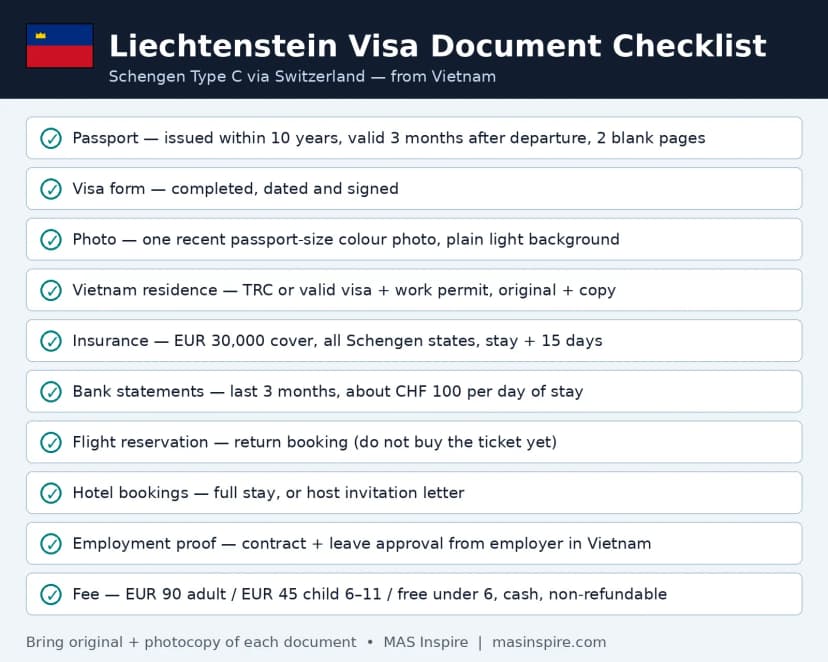
The checklists below follow the Consulate General of Switzerland in Ho Chi Minh City's published tourist and visitor leaflets (May 2026 editions). Present the original of each document plus a photocopy, with translations into English, French, German or Italian where the original is in another language. Translations must not be older than six months.
Tourist visa (Type C) checklist
| Document | Details |
|---|---|
| Visa application form | One form, fully completed, dated and signed by the applicant |
| Photograph | One recent passport-size colour photograph with a plain light background |
| Passport | Original plus copy; issued within 10 years, valid 3 months beyond the visa expiry, with 2 blank pages |
| Vietnam residence proof | Temporary residence card or valid visa and work permit, original plus copy |
| Travel itinerary | Day-by-day plan showing Liechtenstein as the main destination, with dates and places |
| Flight reservation | Return reservation; do not purchase the ticket before the visa is issued |
| Accommodation proof | Hotel bookings for the full stay, or a host invitation with the host's address |
| Travel medical insurance | Valid in all Schengen states, minimum EUR 30,000 cover, for the stay plus 15 days after exit |
| Proof of funds | Original bank statements for the last 3 months; about CHF 100 per day of stay |
| Employment proof | Employment contract and leave approval from your employer in Vietnam; salary slips if available |
| Visa fee | EUR 90 for adults, EUR 45 for children aged 6 to under 12, free under 6; payable in cash in the currency set by the Swiss representation; non-refundable |
Visiting family or friends checklist (additional documents)
- Invitation letter sent directly by email to the Consulate General (hochiminhcity.visa@eda.admin.ch) by the inviting person legally resident in Switzerland or Liechtenstein, stating the purpose, dates, address and relationship.
- Proof of the relationship to the inviting person.
- Copy of the inviting person's passport or residence permit.
- Proof of the inviting person's address and, where they host you, their accommodation.
- The same passport, photograph, insurance, funds and fee documents as the tourist checklist.
Business visa checklist (additional documents)
- Invitation letter from the Liechtenstein or Swiss company, on company letterhead, stating the purpose, dates and who pays the costs.
- Letter from your employer in Vietnam confirming your position, the purpose of the trip and that leave is approved.
- Evidence of the business relationship, such as contracts, correspondence or trade-fair registration.
- The same passport, photograph, insurance, funds and fee documents as the tourist checklist.
Documents for children
- Birth certificate showing the parents' names, with a translation if needed.
- Written consent from both parents or legal guardians if the child travels with only one parent or alone.
- Copies of both parents' passports.
- Proof of school enrolment where applicable.
Long-stay (Type D) applications
Long-stay applications are submitted in person at the Consulate General of Switzerland in Ho Chi Minh City, not through VFS Global. They require the residence authorisation or assurance of a permit from the Migration and Passport Office first, plus the admission letter or employment contract, proof of means and insurance. Do not book a Type D appointment until the Liechtenstein authorisation is in hand.
How to Apply: Step-by-Step
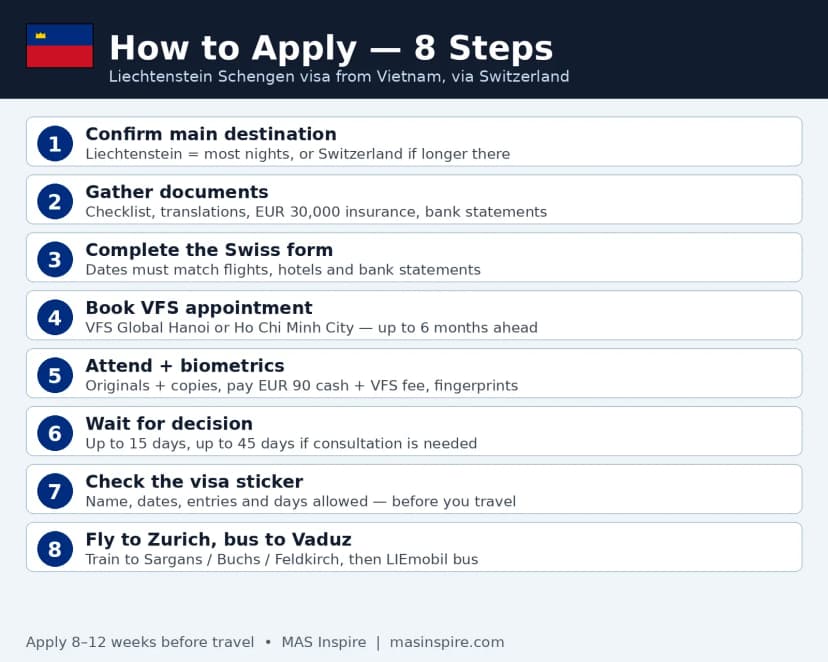
Follow these steps in order. The whole process, from booking the appointment to receiving the decision, normally takes several weeks, so start at least 6 to 8 weeks before travel.
Step 1: Confirm Liechtenstein is your main destination
Write out your itinerary first. Count the nights in each country. If Liechtenstein has the most nights, it is your main destination and you apply through the Swiss representation. If Switzerland has more nights, Switzerland is your main destination. Getting this wrong is a common reason for an application to be returned without examination.
Step 2: Gather documents and translations
Work through the checklist in Section 7. Get bank statements stamped by your bank, arrange translations of any document not in English or a Swiss official language, and buy travel medical insurance with at least EUR 30,000 of cover. Check that your passport meets the 10-year and 3-month rules before you spend money on anything else.
Step 3: Complete the Swiss Schengen visa application form
Fill in the Swiss Schengen visa form completely and sign it. Every answer must match your supporting documents: dates must match your flight reservation, your hotel bookings must match your itinerary, and your stated funds must match your bank statements. Inconsistencies between the form and the documents are a frequent refusal trigger.
Step 4: Book a VFS Global appointment
The Consulate General of Switzerland in Ho Chi Minh City authorises VFS Global to receive all Schengen visa applications at its offices in Hanoi and in Ho Chi Minh City. Book the appointment on the VFS Global Switzerland Vietnam website (www.vfsglobal.ch/Switzerland/Vietnam). Appointments are required, and slots can be scarce in peak travel season, so book as early as you can. You may apply no earlier than 6 months before your trip and no later than 15 days before it.
Step 5: Attend the appointment and give biometrics
Attend in person with the originals and photocopies of every document. You will pay the visa fee in cash and the VFS service fee, and you will give fingerprints and a photograph. Fingerprints taken for a Schengen visa in the last 59 months may be reused in some cases, but expect to give them again if the centre asks. Keep the receipt and the tracking reference.
Step 6: Wait for the decision
Processing normally takes up to 15 calendar days, but it can take longer in individual cases, and up to 45 days where a consultation with Liechtenstein's Migration and Passport Office or another Schengen state is needed. The Consulate General states that it treats applications as fast as possible, but warns that anyone who applies late risks not receiving the visa in time. Do not book non-refundable travel until the visa is in your passport.
Step 7: Collect your passport and check the visa
When the passport is returned, check the visa sticker immediately: your name and passport number, the validity dates, the number of entries, and the number of days allowed. A visa that says it is valid for fewer days than your trip, or that is single-entry when you need to re-enter Schengen, must be queried at once. Keep a copy of the visa and your insurance with you when you travel.
Step 8: Travel to Liechtenstein
Fly to Zurich Airport in Switzerland, then take the train to Sargans or Buchs in Switzerland, or to Feldkirch in Austria, and continue by LIEmobil bus to Vaduz. There is no airport and no mainline railway station in Liechtenstein, and there are no routine border checks on the road from Switzerland, but carry your passport and visa: the EES records your entry at the Schengen external border in Zurich, and spot checks are possible.
Liechtenstein Visa Fees and Financial Requirements
| Item | Amount | Notes |
|---|---|---|
| Schengen Type C visa — adult (12 and over) | EUR 90 | Fixed by the EU Visa Code, in force since 11 June 2024; non-refundable |
| Schengen Type C visa — child aged 6 to under 12 | EUR 45 | Fixed by the EU Visa Code; non-refundable |
| Schengen Type C visa — child under 6 | Free | No fee |
| Schengen Type C visa — family member of an EU / EFTA citizen | Free | Per the Swiss representation's fee page |
| VFS Global service fee (Vietnam) | Not verified for Switzerland in Vietnam | See disclosure below; do not rely on a quoted figure until VFS confirms it at booking |
| Travel medical insurance | Typically EUR 10 to EUR 40 for a short stay | Price varies by provider, age and length of stay; minimum cover EUR 30,000 |
| Proof of funds — self-funded stay | About CHF 100 per day | European Commission reference amount for Liechtenstein and Switzerland |
| Proof of funds — student with valid student card | About CHF 30 per day | European Commission reference amount |
Disclosure — the dong amount of the visa fee. The Swiss Consulate General's fee page (published 30 March 2026) confirms that the fee is payable in the currency determined by the Swiss representation and that the representation may adapt the amount at any time for exchange-rate movements. The exact dong figure is in a linked fee PDF dated 23 October 2026, which could not be read as text during verification for this guide. A secondary Vietnamese source lists VND 2,500,000 for an adult and VND 1,250,000 for a child aged 6 to under 12, while another general Schengen guide quotes about VND 2,400,000 for an adult. These two secondary figures disagree, and neither is the official source, so treat the dong amount as unverified: the figure that counts is the one shown at the VFS payment desk or on the consulate's fee PDF on the day you apply. The euro figure, EUR 90, is fixed by EU law and is not in doubt.
Disclosure — the VFS service fee in Vietnam. The Swiss Consulate General confirms that VFS charges a service fee in addition to the visa fee, but it does not publish the amount on the pages checked. A general Vietnam Schengen guide quotes around VND 700,000 to VND 900,000 for visa-centre service fees, but that is a general figure for Schengen centres in Vietnam, not a confirmed Switzerland-specific figure. This guide therefore does not state a VFS fee for Switzerland in Vietnam. Confirm it on the VFS Global Switzerland Vietnam website when you book, and budget for it on top of the EUR 90 visa fee.
Financial requirements in practice. Liechtenstein is one of the most expensive countries in Europe. Hotels in Vaduz commonly cost CHF 120 to CHF 250 per night, and meals and transport add to that. The CHF 100-per-day reference amount is a minimum for the visa decision, not a realistic travel budget. Show bank statements for the last 3 months with a stable balance and regular salary credits, not a single large deposit made days before the appointment. A sudden lump-sum deposit with no explanation is a well-known refusal trigger.
Visa and Permit Processing Times
| Application | Normal processing time | Longest expected time |
|---|---|---|
| Schengen Type C visa (tourism, visit, business) | Up to 15 calendar days | Up to 45 calendar days where consultation is needed |
| Schengen Type C visa where the Migration and Passport Office must be consulted | 15 to 30 calendar days | Up to 45 calendar days |
| National visa Type D (work or study, after APA authorisation) | Several weeks to months | Several months; depends on the permit decision in Vaduz |
| Residence authorisation (work, study, family) | Several weeks to months | Several months; quota availability can add long waits |
| EEA residence-permit lottery | Two draws per year | Not applicable to Pakistani nationals |
Apply no earlier than 6 months and no later than 15 days before travel. In practice, apply 8 to 12 weeks before departure: early enough to absorb a 45-day consultation, and recent enough that your bank statements are still fresh. The Consulate General warns explicitly that late applicants risk not receiving the visa in time for their travel date. There is no published premium or fast-track service for a Liechtenstein Schengen visa from Vietnam, and any agent offering one is not offering a real service.
Applying from Vietnam
As a Pakistani passport holder living in Vietnam, you apply in Vietnam, not in Pakistan. The Swiss Consulate General's checklists are addressed to Vietnamese citizens and to foreigners living in Vietnam with a valid residence or work permit, which is exactly your situation if you hold a temporary residence card or a valid work permit.
Short-stay applications go through VFS Global, which the Consulate General authorises to receive all Schengen visa applications at its offices in Hanoi and in Ho Chi Minh City. Book the appointment on the VFS Global Switzerland Vietnam website. Long-stay national visa (Type D) applications are different: those must be submitted in person at the Consulate General of Switzerland in Ho Chi Minh City, not through VFS.
Your Vietnamese documents matter as much as your Pakistani passport. Bring your temporary residence card, your work permit and your employment contract, each with a photocopy. If your residence card expires soon, renew it before applying: a visa cannot be issued on the basis of residence that ends before your trip. If you are in Vietnam on a short tourist visa rather than as a resident, you will normally be told to apply in Pakistan, where Liechtenstein applications go through the Swiss representation's visa centres in Islamabad, Lahore and Karachi.
All documents must be presented in original and photocopy, with translations not older than six months into English or one of the Swiss official languages (French, German or Italian). The visa fee is paid in cash at the appointment and is not refunded if the visa is refused or the application is withdrawn.
Getting to Liechtenstein from Vietnam means flying to Zurich, the nearest major airport, about 110 to 115 kilometres from Vaduz by road. Sources differ slightly on the exact road distance, quoting 110 km in some guides and 115 km in others; either way, allow 1 hour 40 minutes to 2 hours by public transport. From Zurich Airport, take the train to Sargans or Buchs, then a LIEmobil bus to Vaduz; from Austria, the route is by train to Feldkirch and then bus 11. Liechtenstein has no airport, no motorway of its own and no mainline railway station, and there is no passport control on the road from Switzerland, but your passport and visa must be with you. If you drive, remember that Swiss and Austrian motorways need their own vignettes, and that Liechtenstein uses the Swiss Type J plug, not the standard European Type F plug.
Student Visa and Study Routes
Study in Liechtenstein is a narrow route, and this guide is honest about that. The University of Liechtenstein in Vaduz is a small university with a limited range of programmes, mainly in business administration, architecture and law, and a small international intake. It does not offer the broad English-taught bachelor's and master's programmes that Pakistani students usually look for in Germany, Switzerland or the Netherlands, and it does not operate a large scholarship scheme for non-EEA students.
If you do secure admission, the route is a residence authorisation from the Migration and Passport Office, followed by a national visa (Type D) applied for in person at the Consulate General of Switzerland in Ho Chi Minh City. You will need the admission letter, proof of sufficient funds for the full period of study, comprehensive health insurance, accommodation in Liechtenstein and a clean record. The Swiss reference amount of about CHF 30 per day applies to students with a valid student card for short stays; for a long stay, the Migration and Passport Office assesses whether your funds cover the real cost of living in one of Europe's most expensive countries, which is far higher than CHF 30 a day in practice.
No Liechtenstein-specific student-visa fee was found on any official page checked for this guide. Do not rely on a fee quoted by an agent; confirm the amount with the Consulate General before you pay. A short-stay Schengen visa does not allow you to study for more than 90 days, and it cannot be converted into a student residence permit from inside Liechtenstein.
For most Pakistani students in Vietnam, the realistic advice is to treat Liechtenstein as a place to visit, and to apply for study in Switzerland or Germany, where the universities, the student-visa routes and the part-time work rules are established and published. A Liechtenstein admission is worth pursuing only if the specific programme matches your field and you can fund it without relying on part-time work in Liechtenstein itself.
Work Visa and Job Opportunities
Liechtenstein has one of the most restrictive immigration systems in Europe, and a Pakistani national should understand the scale of the restriction before spending time or money on it. The country has about 40,000 residents, and residence permits for newcomers are rationed by fixed annual quotas agreed under its special EEA arrangement.
For EEA nationals, the minimum is about 72 residence permits a year: 56 for employment and 16 for residence without employment, with about half of each group allocated by a twice-yearly lottery and the rest by government decision. Swiss nationals have a separate small quota of at least 17 permits a year. These figures are consistent across the 2026 sources checked once the two halves are added together: one source quotes 28 employment and 8 non-employment permits, which is the lottery half only, while other sources quote the full 56 and 16. The total is the same in both framings, and the point that matters for you is unchanged.
For non-EEA nationals, including Pakistanis, there is no lottery and no quota to apply for. A residence permit can only be granted by discretion of the government, for a person of particular interest to Liechtenstein, typically a senior manager or a specialist in a role that no EEA worker could fill, with a Liechtenstein employer making a substantive case. Routine specialist employment does not qualify. Low single-digit numbers of such permits are granted each year. There is no general work visa, no shortage-occupation list, no points system and no route for a Pakistani teacher, driver, warehouse worker or general labourer to move to Liechtenstein for work.
Cross-border commuting is a separate, less restricted regime: thousands of people live in Switzerland, Austria or Germany and commute to work in Liechtenstein on a cross-border (Grenzgänger) permit, which is not subject to the residence quota. That route only helps if you already have the right to live in one of those neighbouring countries. It is not a way to move from Vietnam to Liechtenstein.
If a Liechtenstein employer does offer you a qualifying senior or specialist role, the employer applies to the Migration and Passport Office for the permit, and only after the authorisation is granted do you apply for a national visa (Type D) in person at the Consulate General of Switzerland in Ho Chi Minh City. Never pay an agent who promises a Liechtenstein work permit for a fee: the permit decision is made by the government in Vaduz, not by any agent, and no payment to a third party can influence it.
Family Immigration and Residence
Family reunion in Liechtenstein follows the same restrictive logic as work. A person legally resident in Liechtenstein may in principle sponsor a spouse and minor children, but the sponsor must hold a valid residence permit, must have suitable accommodation, and must show sufficient income and health insurance for the whole family. The application is made through the Swiss representation and decided by the Migration and Passport Office, and processing takes several weeks to months.
There is no published Liechtenstein-specific fee for a family-reunion application, and no published processing-time commitment beyond the general statement that long-stay decisions take several weeks to months. Confirm both with the Consulate General before applying.
Permanent residence and citizenship are long-term matters. Settlement generally requires many years of continuous legal residence, and Liechtenstein does not offer accelerated residence for investment. Because the annual intake of new residents is so small, family reunion should be treated as a route for people who already have a genuine, established life in Liechtenstein, not as a way to move there.
For short family visits, the ordinary Schengen Type C visitor visa in Section 7 applies. A spouse, parent or child visiting for a few weeks needs the visitor visa, not a residence authorisation, and the inviting person sends the invitation directly to the Consulate General by email.
Common Application Mistakes and Reasons for Refusal
- Applying through the wrong main destination: naming Liechtenstein when you will spend most nights in Switzerland, or the reverse. Count the nights and name the country with the most.
- A passport that fails the validity rules: issued more than 10 years ago, valid for less than 3 months after departure, or without 2 blank pages. Check this before paying for anything else.
- A single large deposit before the appointment: a lump sum appearing in your bank statements days before you apply, with no explanation, looks like borrowed money. Show 3 months of genuine salary credits and a stable balance.
- Insurance that does not cover the full period: the policy must cover the whole stay plus 15 days after your intended exit, in all Schengen states, for at least EUR 30,000. A policy that ends on your departure date fails the requirement.
- Booking a non-refundable flight before the visa: a reservation is enough. A paid ticket does not improve your chances, and you lose the money if the visa is refused.
- Applying too late: the 15-day minimum is a legal floor, not a safe plan. A consultation with the Migration and Passport Office can extend processing to 45 days.
- Weak evidence of return: no employment letter, no leave approval, no residence card, no family or property ties. For a Pakistani living in Vietnam, your job and your TRC are your strongest return evidence.
- Inconsistencies between the form and the documents: dates, hotel names and fund figures that do not match each other. Read the form against the documents before you submit it.
- Using an agent who invents documents: a forged bank statement, employment letter or hotel booking will be detected, and the result is a refusal and a record that harms every future Schengen application.
- Assuming a work permit is available: paying an agent for a Liechtenstein job or work permit that does not exist under the quota system. There is no general work route for non-EEA nationals.
If your visa is refused, the refusal letter states the legal ground. You may appeal within the deadline stated in the letter, or reapply with the weakness fixed and new evidence. A reapplication that changes nothing and adds nothing will be refused again.
Frequently Asked Questions
1. Do Pakistani passport holders need a visa for Liechtenstein?
Yes. Pakistani passport holders need a Schengen short-stay visa (Type C) for any visit to Liechtenstein of up to 90 days. There is no separate Liechtenstein visa: you apply through the Swiss representation, and the decision is shared between the Swiss authorities and Liechtenstein's Migration and Passport Office.
2. Where do I apply for a Liechtenstein visa from Vietnam?
Through VFS Global, which the Consulate General of Switzerland in Ho Chi Minh City authorises to receive all Schengen visa applications at its offices in Hanoi and in Ho Chi Minh City. Book the appointment on the VFS Global Switzerland Vietnam website. Long-stay national visas are the exception: those are submitted in person at the Consulate General itself.
3. How much does a Liechtenstein Schengen visa cost?
EUR 90 for adults and children aged 12 and over, EUR 45 for children aged 6 to under 12, and free for children under 6. The fee is fixed by the EU Visa Code and has applied since 11 June 2024. It is non-refundable. The VFS service fee is charged on top, and the dong amount of the visa fee is set by the Swiss representation and can move with the exchange rate, so confirm the exact figure at the payment desk.
4. How long does the visa take to process?
Normally up to 15 calendar days. It can take up to 45 calendar days where a consultation with the Migration and Passport Office or another Schengen state is needed. Apply 8 to 12 weeks before travel and no later than 15 days before departure.
5. How long can I stay in Liechtenstein on a Schengen visa?
Up to 90 days in any 180-day period, across the whole Schengen Area. Days in Liechtenstein count towards the same 90 days as days in Switzerland, Austria or any other Schengen state.
6. Can I apply for the visa in Vietnam if I am Pakistani?
Yes, if you are legally resident in Vietnam with a valid temporary residence card or work permit. The Swiss checklists are written for foreigners living in Vietnam with a valid residence or work permit. If your Vietnamese residence has expired, you will normally need to apply from Pakistan.
7. Does Liechtenstein have an airport I can fly into?
No. Liechtenstein has no airport and no mainline railway station. Fly to Zurich Airport, about 110 to 115 kilometres away, then take the train to Sargans or Buchs in Switzerland or Feldkirch in Austria, and continue by LIEmobil bus to Vaduz. The journey from Zurich takes about 1 hour 40 minutes to 2 hours by public transport.
8. Is there passport control between Switzerland and Liechtenstein?
No routine border checks: the border is open and the two countries share a customs area. Your entry into the Schengen Area is recorded by the Entry/Exit System at the external border, normally Zurich Airport, and you must still carry your passport and visa.
9. How much money do I need to show for the visa?
About CHF 100 per day of stay, or about CHF 30 per day if you are a student with a valid student card. These are the European Commission's reference amounts for Liechtenstein and Switzerland. Show 3 months of bank statements with regular salary credits and a stable balance.
10. What travel insurance do I need?
Compulsory travel medical insurance valid in all Schengen countries, covering at least EUR 30,000, for the whole stay plus 15 days after your intended exit date. A policy that ends on your departure date does not meet the requirement.
11. Do I need ETIAS for Liechtenstein?
No, not at present. ETIAS is not yet in operation and no applications are being taken. It is also designed for visa-exempt nationals; as a Pakistani passport holder you need a visa, not ETIAS. The EES, which records your fingerprints and photograph at the border, has been fully operational since 10 April 2026.
12. Can I work in Liechtenstein on a Schengen tourist visa?
No. A Type C visa does not allow any employment. Working in Liechtenstein needs a residence authorisation from the Migration and Passport Office, and for a non-EEA national that is only granted by discretion for a person of particular interest to Liechtenstein, usually a senior manager or specialist. There is no general work visa for Pakistani nationals.
13. Can I study in Liechtenstein?
Only in a limited way. The University of Liechtenstein is small, with a narrow range of programmes, and admission is the first hurdle. If admitted, you need a residence authorisation from the Migration and Passport Office and a national visa (Type D) from the Consulate General in Ho Chi Minh City. A tourist visa cannot be converted into a student permit inside Liechtenstein.
14. What happens if my visa is refused?
The refusal letter states the legal ground. You can appeal within the deadline in the letter, or reapply with the weakness fixed and new evidence. The visa fee is not refunded. A reapplication that changes nothing will be refused again, so fix the actual problem first.
15. Is there a Liechtenstein embassy in Vietnam or Pakistan?
No. Liechtenstein has no embassy in either country, and it has no visa section of its own anywhere. Switzerland represents Liechtenstein for visas under a long-standing agreement, which is why your application goes through the Swiss Consulate General in Ho Chi Minh City and VFS Global. For questions about a Liechtenstein visa specifically, the Migration and Passport Office can be contacted at visa.apa@llv.li or on +423 236 61 41.
Last checked: 27 November 2026. Visa rules, fees and processing times change. Confirm every figure with the Consulate General of Switzerland in Ho Chi Minh City, VFS Global or the Migration and Passport Office before you apply or pay. This guide is general information, not legal advice.
Official Immigration Websites
| Organisation | What it is for | Website |
|---|---|---|
| Migration and Passport Office, Liechtenstein (Ausländer- und Passamt) | Official Liechtenstein visa page: Swiss representation rule, decision shared with the APA, contact visa.apa@llv.li, +423 236 61 41 | https://www.llv.li/en/national-administration/migration-and-passport-office/visa |
| Liechtenstein National Administration (llv.li) | Consular matters, residence and permit information | https://www.llv.li/en |
| Swiss State Secretariat for Migration (SEM) | Visa-requirement lookup named by the Migration and Passport Office | https://www.sem.admin.ch |
| Consulate General of Switzerland in Ho Chi Minh City | Schengen visa checklists, VFS authorisation, processing-time and fee pages for applicants in Vietnam | https://www.schweiz-vietnam.eda.admin.ch/en/schengen-visa |
| Consulate General of Switzerland in Ho Chi Minh City — Schengen visa fees | Official fee page and fee PDF (23 October 2026); confirms local-currency payment and non-refundable fees | https://www.schweiz-vietnam.eda.admin.ch/en/schengen-visa-fees |
| VFS Global — Switzerland, Vietnam | Appointment booking and application submission in Hanoi and Ho Chi Minh City | https://www.vfsglobal.ch/Switzerland/Vietnam |
| European Commission — Schengen visas | EU Visa Code, EUR 90 fee in force since 11 June 2024, 90/180-day rule | https://home-affairs.ec.europa.eu/policies/schengen/schengen-visas_en |
| European Commission — EES and ETIAS | Official status of the Entry/Exit System and ETIAS | https://travel-europe.europa.eu/ees/en |
| UK Foreign, Commonwealth and Development Office — Liechtenstein travel advice | Entry requirements, safety and practical travel advice | https://www.gov.uk/foreign-travel-advice/liechtenstein |
| US Department of State — Liechtenstein travel information | Entry, exit and safety information for travellers | https://travel.state.gov/content/travel/en/international-travel/International-Travel-Country-Information-Pages/Liechtenstein.html |