Kenya Visa Guide 2026: eTA Types, Requirements, Documents and Application Steps
Editorial date: 27 November 2026. Verified: 28 November 2026. This guide is written for Pakistani passport holders living in Vietnam who want to visit Kenya for tourism, business, family, study or work. Kenya no longer issues traditional visas or visas on arrival. Since 1 January 2024 every visitor who is not exempt must hold an approved Electronic Travel Authorisation (eTA) before the journey starts, applied for online through the official portal etakenya.go.ke. Pakistan is not on any of Kenya’s eTA exemption lists, so a Pakistani ordinary passport holder needs an eTA even for a short holiday. There is no visa on arrival at Nairobi airport, and airlines will not board you without an approved eTA.
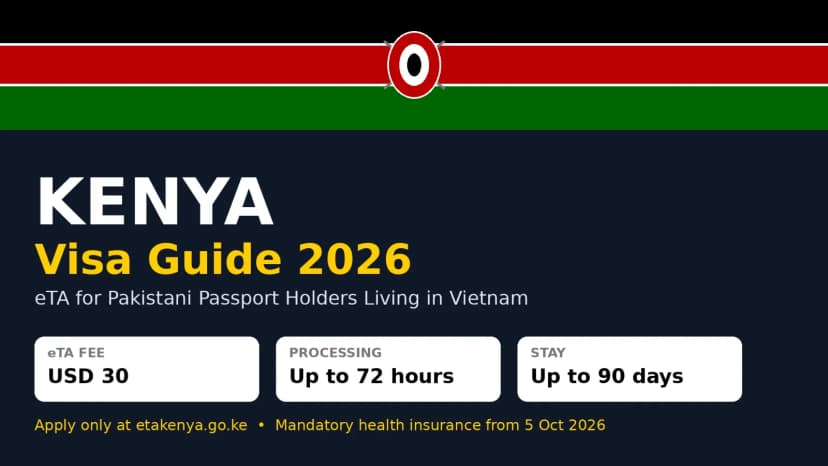
Read this first — the two figures most guides get wrong. First, the eTA fee changed. Older pages still quote USD 32.50 plus a USD 1.59 bank fee (USD 34.09 in total). The official portal’s fee page, checked on 21 October 2026 and corroborated by several November 2026 guides that read the portal, now lists the standard single-entry eTA at USD 30. The portal checkout is the controlling source: the fee you see when you pay is the fee. Some travellers still report about USD 34 leaving their card once bank and card charges are added, so budget USD 30 for the eTA itself and a few dollars for charges. Second, since 5 October 2026 most foreign visitors must also buy Kenyan Government inbound travel health insurance, premium up to USD 44 per person, as part of the eTA process. Your own travel insurance does not replace it. Budget roughly USD 75–85 per person in total for a standard eTA plus the mandatory insurance, and confirm both amounts on the portal on the day you apply.
Table of contents
- Introduction
- Why People Visit, Study and Work in Kenya
- Types of Kenya eTAs
- eTA Comparison Table
- Eligibility Requirements
- Complete Document Checklists
- How to Apply: Step-by-Step
- eTA Fees and Financial Requirements
- Processing Times
- Applying from Pakistan or Vietnam
- Student, Work and Family Routes
- Extending Your Stay and Overstay Rules
- Common Application Mistakes
- Reasons for Refusal and What to Do Next
- Frequently Asked Questions
- Official Immigration Websites
Introduction
Kenya abolished visas for all foreign visitors on 1 January 2024 and replaced them with the Electronic Travel Authorisation (eTA), a fully online pre-travel permit run by the Directorate of Immigration Services under the Ministry of Interior and National Administration. You apply at etakenya.go.ke or through the official Kenya Travel Authorisation mobile app, pay by card, and receive the approval by email as a PDF. The eTA is linked electronically to your passport; there is no sticker and nothing is stamped into your passport when the eTA is issued. At the airport in Nairobi or Mombasa an immigration officer checks the eTA in the system, verifies your passport and documents, and issues a visitor’s pass. That pass, not the eTA, governs how long you may stay.
That distinction matters more than any other fact in this guide. The eTA is valid for travel within 90 days of the date it is issued. That 90-day period is the window in which you must travel; it is not a guaranteed 90-day stay. Once you arrive, the immigration officer decides whether you are admitted and how long you may stay, and records it on your visitor’s pass. The usual outcome for a genuine tourist is a stay of up to 90 days, but do not book a 90-day trip on the assumption that the eTA alone entitles you to 90 days. An eTA is permission to travel to Kenya; it is not a guarantee of entry.
Every traveller needs their own eTA, including infants and children. A family of four needs four eTAs and pays four fees. The application can be submitted up to 90 days before travel and must be submitted at least 3 days before departure. The portal recommends applying at least 2 weeks before you fly, and that is the advice this guide repeats: the standard process is fast when it works, but a request for extra documents or a failed payment can eat days.
Two warnings before you start. First, use only etakenya.go.ke. Look-alike websites copy the portal’s design, charge far more than the official fee, and add nothing. The Directorate’s portal is the only official channel, and the Kenya Embassy in Washington and other missions link to it directly. Second, fees and rules have changed several times in 2026 — the fee itself, and the new mandatory insurance rule from October 2026. Where sources disagree in this guide, the disagreement is stated openly and the controlling source is named, so you can check it yourself before you pay.
Why People Visit, Study and Work in Kenya
Most Pakistani visitors come to Kenya for a safari, and Kenya is built for exactly that trip. The Maasai Mara is the country’s best-known destination, famous for the Great Migration of wildebeest and zebra, usually from July to October, and for lions, elephants, leopards and rhinos year-round. Amboseli, at the foot of Mount Kilimanjaro, is the classic elephant park. Tsavo East and Tsavo West together form one of the largest protected areas in Africa. Lake Nakuru is known for flamingos and rhinos, and the Rift Valley lakes, Hell’s Gate and Mount Kenya offer walking, climbing and scenery that suit a second week after the Mara.
Nairobi itself is worth two or three days rather than a single overnight. The Nairobi National Park is a real safari park against the city skyline. The Giraffe Centre, the David Sheldrick Elephant Nursery and the Karen Blixen Museum are close together in Karen. The city is also the practical base for the whole trip: Jomo Kenyatta International Airport (NBO) is the main gateway, banks and mobile money work well, and English is an official language, so a Pakistani visitor who teaches or works in English will have no language barrier. Swahili is the other official language; a few words — jambo (hello), asante (thank you), karibu (welcome) — go a long way.
Beyond tourism, Kenya draws business visitors, conference delegates, medical travellers and family visitors, all of whom use the same standard eTA. Nairobi is East Africa’s business hub, home to regional offices, tech companies and United Nations agencies, and Mombasa is the coast’s trading port and beach destination, with Diani Beach the best-known resort strip. Students come for short courses and exchange programmes, and some for full degrees at Kenyan universities; they enter on an eTA and then need a student pass inside Kenya. Workers cannot work on an eTA at all — a work permit or pass must be arranged separately, and that route is covered later in this guide. Volunteers and mission visitors should check their exact status before applying, because the eTA categories are specific and volunteering can fall under a different permit.
For a first trip from Vietnam, a sensible shape is 10 to 14 days: two or three nights in Nairobi, three or four nights in the Maasai Mara, and three or four nights in Amboseli or on the coast at Diani. A one-week trip works if you fly straight to the Mara, but the internal flights and road transfers eat a day at each end. The dry seasons, roughly January to March and June to October, are the best safari months; the long rains in April and May make some roads difficult and some camps close.
Types of Kenya eTAs
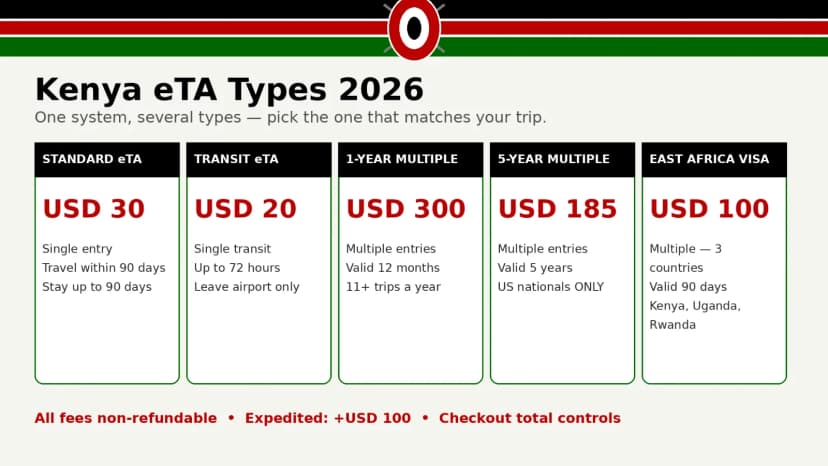
Kenya does not issue tourist visas, business visas or transit visas any more. There is one system, the eTA, with several types inside it. Choose the type that matches your trip when you start the form; the wrong type is one of the commonest reasons for delay.
Standard eTA (single entry)
The standard eTA is the one almost every Pakistani tourist, family visitor, business visitor, medical traveller and conference delegate needs. It costs USD 30 on the official portal, is valid for travel within 90 days of issue, allows a single entry, and the stay granted on arrival is usually up to 90 days, decided by the immigration officer. It covers tourism, visiting family or friends, business meetings, medical treatment and conferences. It does not allow you to work, study long-term or live in Kenya.
A single-entry eTA has one useful exception. If you visit Burundi, the Democratic Republic of Congo, Rwanda, South Sudan, Tanzania or Uganda immediately after Kenya, visit no other country before returning, and your Kenyan eTA is still valid when you return, you may re-enter Kenya on the same eTA. Do not rely on this without confirming it on the portal for your exact itinerary, because the exception is narrow and border officers apply it strictly.
Transit eTA
The transit eTA costs USD 20 and allows a stay of up to 72 hours. It is for travellers connecting through a Kenyan airport who need to leave the airport terminal or pass through immigration before an onward flight to a third country. If you stay inside the international transit area and do not pass through immigration, you do not need an eTA at all. If your layover is longer than 72 hours, or you want to spend a few days in Nairobi on the way through, apply for a standard eTA instead.
One-year multiple-entry eTA
The one-year multiple-entry eTA costs USD 300 and allows multiple entries over 12 months. It suits frequent business visitors and people who cross between Kenya and neighbouring countries several times a year. It is only worth the money if you will enter Kenya more than ten times in the year, since ten standard eTAs at USD 30 cost the same USD 300. For one or two trips a year, the standard eTA is cheaper.
Five-year multiple-entry eTA (US nationals only)
A five-year multiple-entry eTA costs USD 185 and is available only to United States passport holders, under a bilateral arrangement. It is not available to Pakistani passport holders, whatever your residence. Do not select it, and do not pay any agent who offers it to you.
Expedited processing
Expedited processing costs an extra USD 100 on top of the eTA fee, so a standard eTA with expedited processing costs USD 130 in fees. The portal says expedited applications are processed immediately. It is useful for a genuinely last-minute trip, but it is not a shortcut around missing documents or a weak application, and the fee is not refunded if the eTA is refused.
East Africa Tourist Visa (EATV)
The East Africa Tourist Visa is a separate joint visa for Kenya, Uganda and Rwanda. It costs USD 100, is valid for 90 days from issue, and allows multiple entries between the three countries only. You apply through the country you will enter first, and you must enter that country first. If you leave the three countries altogether, for example by flying to Tanzania or Ethiopia, the visa ends even if days remain. It is for tourism only and cannot be extended.
There is an important caution for travellers starting in Kenya. The official Kenya eTA portal listed the East African Tourist eTA as “coming soon”, with no fee shown, when its fee page was checked on 21 October 2026. That means a Pakistani traveller whose first stop is Kenya cannot be sure of obtaining an EATV through the Kenyan portal. If your trip starts in Uganda or Rwanda, apply for the EATV through that country’s portal instead — Uganda at visas.immigration.go.ug or Rwanda through Irembo — and enter that country first. If your trip starts in Kenya, the safe choice is a standard Kenyan eTA, plus separate Ugandan and Rwandan authorisations if you go on to those countries. Do not pay anyone for a Kenyan-issued EATV until the portal actually offers it.
eTA Comparison Table
| eTA or visa type | Fee (USD) | Entries | Travel validity | Stay per visit | Best for |
|---|---|---|---|---|---|
| Standard eTA | 30 | Single | Travel within 90 days of issue | Decided at entry, usually up to 90 days | One holiday, family or business trip |
| Transit eTA | 20 | Single transit | Up to 72 hours | Up to 72 hours | Leaving the airport on a layover |
| One-year multiple-entry eTA | 300 | Multiple | 12 months | Decided at each entry, usually up to 90 days | Frequent visitors (11+ trips a year) |
| Five-year multiple-entry eTA | 185 | Multiple | 5 years | Decided at each entry | US nationals only — not for Pakistanis |
| Expedited processing | 100 extra | As per eTA type | As per eTA type | As per eTA type | Last-minute travel; processed immediately |
| East Africa Tourist Visa | 100 | Multiple (Kenya, Uganda, Rwanda only) | 90 days from issue | 90 days total across the three countries | Regional safari across the three countries |
All eTA fees are non-refundable, even if the application is refused. A new application to correct a mistake charges the fee again. The table’s fees are the portal’s listed fees as checked in October and November 2026; the amount that leaves your card may be a few dollars higher once bank and card charges are added, and the mandatory health insurance premium is separate.
Eligibility Requirements
The rule goes by passport, not by where you live. A Pakistani passport holder living in Vietnam needs an eTA because Pakistan is not on any exemption list. A Vietnamese residence card, a Vietnamese work permit and a long stay in Ho Chi Minh City do not change that, and they do not exempt you. The same rule applies in reverse: an Egyptian or Nigerian passport holder living in Vietnam would not need an eTA for a stay of up to 60 days, because those nationalities are on Kenya’s 60-day African exemption list.
Kenya’s exemptions come from the Kenya Citizenship and Immigration (Amendment) Rules, 2025, which expanded the list on 30 May 2025. Citizens of the six East African Partner States — Burundi, the Democratic Republic of Congo, Rwanda, South Sudan, Tanzania and Uganda — are exempt for stays of up to 180 days. A published group of about 43 countries, including South Africa, Ethiopia, Ghana, Zambia, Zimbabwe, Mauritius, Malaysia, Singapore, Jamaica and Trinidad and Tobago, is exempt for up to 90 days. A separate group of 28 African countries, including Algeria, Egypt, Morocco, Nigeria, Senegal, Sudan and Tunisia, is exempt for up to 60 days. Pakistan appears on none of those lists. Holders of a valid Kenyan residence permit, work permit or re-entry pass are also exempt, as are airside transit passengers who do not leave the airport and certain diplomatic and official passport holders travelling on duty.
Your passport must be valid for at least 6 months after your planned arrival date in Kenya. The portal asks for at least one blank page; the UK Foreign Office advises at least two blank pages. Carry a passport with two spare pages to satisfy both. A passport reported lost or stolen, or a passport with less than 6 months’ validity, will get you denied entry even with an approved eTA. Children need their own passport and their own eTA; a child on a parent’s passport is not accepted. Children aged 17 and under also need a letter of authority if they travel out of Kenya without their parent or legal guardian.
You must also be able to show, if asked, a return or onward ticket, proof of accommodation for your first night, and evidence of enough money for your trip. Immigration officers do not ask every traveller for these, but they may ask any traveller, and “I did not bring it” is not an answer that gets you admitted. Carry printed copies as well as the files on your phone, because phone batteries and airport Wi-Fi fail at the worst moments.
Complete Document Checklists
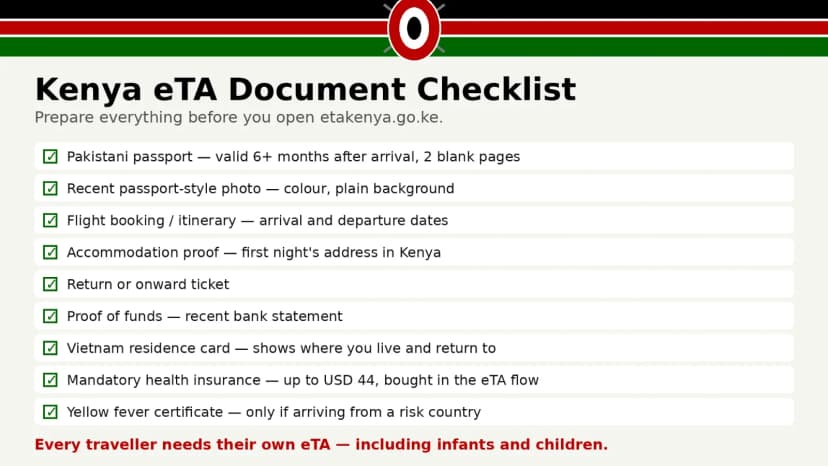
Prepare everything before you open the portal. A clean application takes about 15 to 20 minutes; a half-prepared one stalls, and the portal session can time out. Scan or photograph documents clearly, in colour, with all four corners visible, and keep each file under the portal’s size limit.
Tourist eTA checklist
| Document | What it must show |
|---|---|
| Pakistani passport | Valid at least 6 months after arrival; at least one blank page (carry two); bio-data page scan |
| Recent passport-style photo | Colour, plain background, face forward, no glasses or hat; digital file, not a photo of a printed photo |
| Flight booking or itinerary | Arrival and departure dates, flight numbers; a booking confirmation is enough, a paid ticket is not required to apply |
| Accommodation proof | Hotel booking, safari lodge confirmation or host address for your first night in Kenya |
| Return or onward ticket | Proof you will leave Kenya before your permitted stay ends |
| Proof of funds | Recent bank statement or card; enough to cover the trip if an officer asks |
| Vietnam residence proof | Temporary residence card or visa stamp showing you live in Vietnam; helps explain why you apply from Vietnam |
| Mandatory health insurance | Kenyan Government inbound policy, bought during the eTA application or on eCitizen; premium up to USD 44 |
| Yellow fever certificate | Only if arriving from, or transiting more than 12 hours through, a yellow-fever risk country; see the health section |
Business eTA checklist
| Document | What it must show |
|---|---|
| All tourist eTA documents above | Passport, photo, flights, accommodation, funds, insurance |
| Invitation letter | From the Kenyan company or conference organiser, on letterhead, stating purpose, dates and who pays |
| Employer letter (from Vietnam) | Your job, salary, approved leave dates and confirmation you will return to Vietnam |
| Conference registration | Booking or invitation for the event, if that is the purpose |
Family visit eTA checklist
| Document | What it must show |
|---|---|
| All tourist eTA documents above | Passport, photo, flights, accommodation, funds, insurance |
| Invitation letter from host | Host’s full name, address in Kenya, relationship to you, dates of your stay |
| Host’s ID | Copy of the host’s Kenyan national ID or passport bio-data page |
| Proof of relationship | Family documents or correspondence showing the connection, if the officer asks |
Transit eTA checklist
| Document | What it must show |
|---|---|
| Pakistani passport | Valid at least 6 months after arrival; blank page |
| Recent passport-style photo | Colour, plain background |
| Onward flight ticket | Confirmed flight to a third country within 72 hours |
| Visa for final destination | If that country requires one, proof you hold it or are exempt |
How to Apply: Step-by-Step
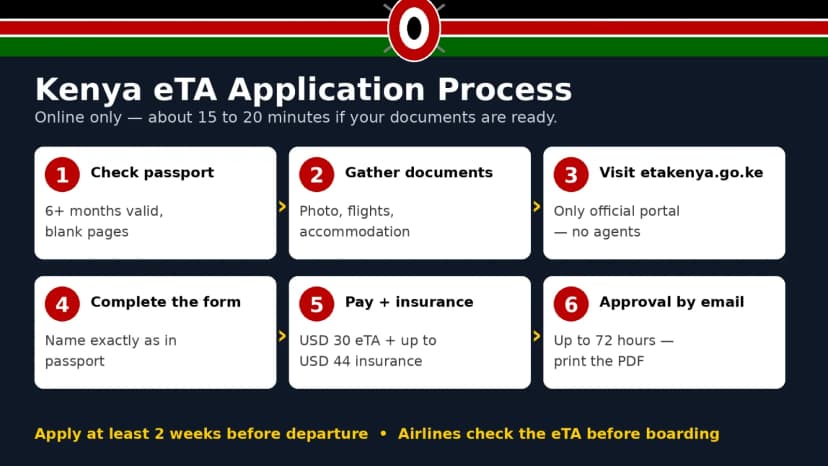
Apply only on etakenya.go.ke or the official Kenya Travel Authorisation app. The whole process is online; there is no embassy visit, no paper form and no visa sticker for a standard eTA.
- Check your passport. It must be valid for at least 6 months after arrival, with blank pages. Renew it first if it is short; an eTA linked to a passport you then replace is useless.
- Gather your documents. Use the checklist above. Have your flight details, first night’s accommodation address and a passport-style photo ready before you start.
- Go to etakenya.go.ke and choose Apply Now. Check the address bar says exactly etakenya.go.ke. Create an account or continue as a guest if the portal offers it, and select your travel purpose and eTA type.
- Complete the form in one sitting. Enter your full legal name exactly as it appears in your passport, your passport number, nationality (Pakistani), date of birth, travel dates, point of entry (usually Jomo Kenyatta International Airport, Nairobi) and your first night’s address in Kenya. One mistake in a name or passport number can mean a refusal and a second fee.
- Upload your documents. Passport bio-data page, photo, flight itinerary and accommodation proof. Check each upload is readable before you move on.
- Buy the mandatory health insurance. Since 5 October 2026 the eTA application prompts you to buy the Kenyan Government inbound travel health insurance. The premium is up to USD 44 per person. If you already hold an approved eTA issued before that date, buy the policy separately on the eCitizen insurance portal (insurance.ecitizen.go.ke) before you fly.
- Pay the eTA fee by card. Visa, Mastercard and American Express are accepted. The standard fee is USD 30; expedited processing adds USD 100. Check the total on the checkout screen before you confirm — that total is the controlling figure for your application, and it may include small bank or card charges on top of the listed fee. Keep the payment receipt and the application reference number.
- Wait for the decision by email. Standard processing takes up to 72 hours (3 working days). Check your inbox and spam folder. Do not book non-refundable safari lodges or internal flights until the approval arrives.
- Download and print the approval. The approved eTA arrives by email as a PDF. Print it and keep a copy on your phone. Airlines check it before boarding, and immigration officers check it on arrival.
- At the airport in Kenya. Present your passport, printed eTA, return ticket, accommodation proof and yellow fever certificate if it applies to you. Expect fingerprints and a photograph at the immigration desk. The officer issues your visitor’s pass and stamps your permitted stay; check the date written on it before you leave the desk.
If the portal asks for more information, reply quickly and exactly with what was asked. If your application is refused, the fee is not refunded. Read the refusal reason, fix the problem — usually a document, a photo or a detail mismatch — and apply again with a new fee. Do not submit three identical applications in a row; fix the cause first.
eTA Fees and Financial Requirements
| Item | Cost (USD) | Notes |
|---|---|---|
| Standard single-entry eTA | 30 | Portal fee, checked 21 October 2026; the controlling figure is the checkout total |
| Transit eTA | 20 | Up to 72 hours; only if you leave the airport |
| One-year multiple-entry eTA | 300 | Multiple entries over 12 months |
| Five-year multiple-entry eTA | 185 | US nationals only; not available to Pakistanis |
| Expedited processing | 100 extra | Processed immediately; added to the eTA fee |
| Mandatory inbound health insurance | 44 premium | Up to USD 44 including levies; test purchases in October 2026 came to about USD 48–52 with portal and card fees |
| Typical total, standard trip | About 75–85 | USD 30 eTA + about USD 44–52 insurance; confirm on the portal on the day |
| Visitor’s pass extension | 51 reported | One extension inside Kenya; older reports say USD 50 or about KES 5,000 — see the conflict note below |
| East Africa Tourist Visa | 100 | Kenya, Uganda and Rwanda; 90 days; apply via first country |
Fee conflict, disclosed. Many websites, some updated as recently as mid-2025, still quote the standard eTA at USD 32.50 plus a USD 1.59 bank fee, USD 34.09 in total. The portal’s own fee page, checked on 21 October 2026, lists USD 30, and several independent guides that read the portal in October and November 2026 corroborate USD 30, USD 20 for transit, USD 300 for one-year multiple entry and USD 185 for the five-year US-only eTA. The most likely explanation is that the fee was reduced from USD 32.50 to USD 30 during 2026, while older pages were never updated. This guide follows the portal: USD 30 is the listed fee, the checkout total is controlling, and a few dollars of bank or card charges may still bring the amount actually charged to about USD 34. Never pay a third-party site that quotes USD 80 or more for the same document; that is a service markup, not a government fee.
There is no published minimum bank balance for a tourist eTA, and no fixed daily amount. The practical rule is to show enough money for the trip you describe: flights, accommodation, safari costs and daily spending, in a recent bank statement in your name. A statement from a Vietnamese bank is fine; a Pakistani bank statement is fine too. Carry a card that works internationally, and tell your bank you are travelling so it does not block the eTA payment or your spending in Kenya. Cash in Kenya is the Kenyan shilling (KES); US dollars are widely accepted by hotels and safari companies, but small shops and taxis work in shillings, and mobile money (M-Pesa) is everywhere. Do not change large sums at the airport; use a bank ATM in Nairobi.
Processing Times
| Application type | Processing time | When to apply |
|---|---|---|
| Standard eTA | Up to 72 hours (3 working days); many approvals arrive in 24–48 hours | At least 2 weeks before departure; no later than 3 days before |
| Expedited eTA | Immediately, per the portal, for the extra USD 100 | Last-minute travel only |
| Transit eTA | Up to 72 hours | At least 3 days before travel |
| East Africa Tourist Visa | 3–14 business days reported (Uganda portal) | Several weeks before departure; longer in July–September peak season |
| Visitor’s pass extension | 1–7 working days reported | Well before your current stay expires |
The portal says most applications are processed within 72 hours, and its how-to-apply page says three working days. Those are the same thing in practice, but weekends and Kenyan public holidays do not count as working days, so an application submitted on a Friday can easily take until the following Wednesday. During peak safari season, July to September and December to January, processing can stretch longer; one guide reports waits of up to seven business days in peak season. Apply at least two weeks before you fly, and do not leave it to the three-day minimum unless you have no choice. If the portal requests extra documents, the clock effectively restarts when you reply.
Children and infants take the same time as adults, and each needs a separate application. Group applications are possible on the portal, but each traveller is still decided individually; one family member’s approval does not guarantee the others’. If one person’s eTA is delayed, do not assume it is refused — check the status on the portal’s Validate eTA page and your email before applying again.
Applying from Pakistan or Vietnam
Apply from wherever you are; the eTA system is fully online and does not depend on your country of residence. A Pakistani passport holder living in Ho Chi Minh City applies on etakenya.go.ke exactly as a Pakistani passport holder living in Lahore would, and the fee, documents and processing time are the same. Your Vietnamese temporary residence card is useful supporting evidence — it explains where you live, where you will return to, and why your bank statement may be Vietnamese — but it is not a substitute for any eTA requirement and it does not exempt you from anything.
There is no direct flight from Ho Chi Minh City to Nairobi. The usual routes are one-stop, via Doha (Qatar Airways), Dubai (Emirates), Abu Dhabi (Etihad) or Istanbul (Turkish Airlines), with a total travel time of roughly 16 to 20 hours depending on the connection; the shortest one-stop itineraries are about 16.5 hours via Doha. Fares vary widely by season, but recent fare searches put typical round-trip prices at about USD 874 to USD 1,095. There are no direct scheduled flights from Pakistan to Nairobi either; the usual routes from Lahore or Karachi are also one-stop via Dubai, Doha, Abu Dhabi or Istanbul, taking roughly 9 to 13 hours.
Nearest Kenyan mission — an honest gap. We could not verify any Kenyan diplomatic mission in Vietnam, and no mission’s published accreditation list names Vietnam. The nearest Kenyan missions by geography are the High Commission in Kuala Lumpur (No. 8 Jalan Taman U-Thant, 55000 Kuala Lumpur, Malaysia; telephone +603-2146 1163; email kualalumpur@mfa.go.ke), which is accredited to Indonesia, the Philippines and Brunei — not Vietnam — and the Embassy in Beijing (No. 4 Xi Liu Jie, San Li Tun, Beijing; telephone +86-10-6532 3381), which is accredited to Thailand and the Philippines. The High Commission in New Delhi is accredited to Bangladesh, Sri Lanka and Singapore. For Pakistan-side matters, the Kenya High Commission in Islamabad is at Plot No. 1-2-3, Street No. 27, Ramna 5, Diplomatic Enclave, Islamabad. In practice you will almost never need a mission, because the eTA is entirely online and the portal’s helpdesk (telephone +254 717 436 070, shown on the portal) handles application problems. If you do need consular help, email the Kuala Lumpur High Commission first and ask whether it can assist a Pakistani resident of Vietnam; do not travel to Kuala Lumpur or Beijing assuming it can. This guide states the gap plainly rather than inventing an accreditation that no source confirms.
If you are in Pakistan when you apply, the same online process applies, and the Islamabad High Commission is the mission to contact for anything the portal cannot solve. Pakistani applicants should also note that the eTA fee in rupees is about PKR 8,300 at November 2026 rates, based on USD 30; your bank’s exchange rate and any foreign-transaction charge will move that figure slightly.
Student, Work and Family Routes
An eTA is a short-stay authorisation. It does not let you work in Kenya, enrol in a long course, or live there. Each of those needs a separate pass or permit, applied for inside Kenya through the Electronic Foreign Nationals Services portal (eFNS, fns.immigration.go.ke) or the Directorate of Immigration Services.
Studying in Kenya
If you plan to study, apply for an eTA before you travel and tell the portal your purpose is study or a short course. Once in Kenya you will also need a student pass, issued on the strength of an admission letter from a recognised Kenyan institution. Short courses of a few weeks can sometimes be completed inside a visitor’s stay, but a full degree or diploma needs the student pass, and you should confirm the exact requirement with the institution before you travel. Bring your admission letter, proof of fees paid or funding, and your academic certificates.
Working in Kenya
You cannot work on an eTA, and working without a permit is an immigration offence. A Kenyan employer must normally sponsor a work permit, and permits are issued for specific jobs where the employer can show the role cannot readily be filled locally. The common classes cover employment, business and professional practice. If you are offered a job in Kenya, do not resign from your job in Vietnam, do not buy a ticket and do not travel until the permit is approved and in hand. A job offer letter alone is not permission to work, and an eTA obtained for “business meetings” does not become a work permit because you start working.
Family and long stays
Family visits use the standard eTA, with the host’s invitation letter and ID as supporting documents. If you marry a Kenyan citizen or have Kenyan family, a dependant’s pass may be available inside Kenya, but that is a separate application with its own evidence requirements. Anyone staying in Kenya for longer than 90 days must register their residency and apply for a Foreign National Certificate, commonly called an Alien Card, under Kenyan rules. Short-term visitors do not need one.
Health: yellow fever and the new insurance rule
Kenya requires a yellow fever certificate only from travellers aged one year and over who arrive from a country with a risk of yellow fever transmission, or who have transited such a country for more than 12 hours. Pakistan and Vietnam are not yellow-fever risk countries, and a direct routing via the Gulf (Dubai, Doha, Abu Dhabi) does not trigger the rule. A short airside transit through Addis Ababa, typically two to six hours, does not trigger it either; a layover over 12 hours, or leaving the airport during transit, does. The vaccine must be given at least 10 days before arrival for the certificate to be valid, and since 2016 a single dose counts for life — no booster is needed. Carry the original yellow card, the International Certificate of Vaccination or Prophylaxis, with your passport; a photograph on your phone is not accepted. Separately, health authorities recommend yellow fever vaccination for most of Kenya outside Nairobi and the coast, and recommend malaria prevention, hepatitis A and typhoid vaccination for travellers; talk to a travel clinic in Ho Chi Minh City at least three weeks before departure.
The mandatory inbound travel health insurance is a separate, newer requirement. From 5 October 2026 most foreign visitors must hold a Kenyan Government inbound policy. The premium is up to USD 44 per person, including statutory levies and stamp duty, and the policy is valid for 90 days with multiple entries while it is valid, with a total benefit limit of up to USD 50,000 per person (medical expenses USD 20,000, emergency evacuation USD 25,000, repatriation of remains USD 5,000, plus smaller mental-health and medicines limits). Conflict, disclosed: the UK Foreign Office says the insurance is required for visits of less than 12 months, while the eCitizen insurance portal says it is required for visits of less than three months. The two sources describe the same scheme with different stay thresholds, and we could not reconcile them from official sources. The safe course is to buy the policy for any visit under 12 months, which is what the eTA application will prompt you to do in any case. A foreign travel insurance policy does not replace it, although you can and should keep your own comprehensive policy as well, because the government policy is basic entry cover, not full travel insurance. Test purchases in October 2026 found one adult paying USD 48 and another about USD 52 in total once portal access and card fees were added, and one report found a child charged USD 25; your own checkout total is the figure that counts.
Extending Your Stay and Overstay Rules
If your plans change once you are in Kenya, you can apply for one extension of your visitor’s pass. The extension is not an extension of the eTA itself; the eTA got you into the country, and the visitor’s pass is the document that controls how long you may remain. Apply online through the eFNS portal (fns.immigration.go.ke) before your current permitted stay expires, then attend an immigration office in person — normally Nyayo House on Kenyatta Avenue in Nairobi — with your printed application, original passport, proof of accommodation, evidence of sufficient funds and a clear reason for staying longer. Extensions are granted at the immigration officer’s discretion and are not guaranteed. The total stay after extension is generally capped at six months from the date of entry, and the extension is typically granted for an additional period rather than an open-ended stay; recent reports say extensions are often granted for an additional 30 days at a time within that six-month ceiling.
Extension fee conflict, disclosed. Recent sources report a fixed extension fee of USD 51, while a March 2024 source reported USD 50 and another guide reports about KES 5,000. The USD 51 figure is the most recent and the most widely repeated in 2026, so this guide uses it as the planning figure, but the amount is not confirmed on a live official fee page and you should confirm it at the immigration office before you pay. Do not treat any of the three figures as certain.
Overstay fines conflict, disclosed. Sources disagree sharply on overstay penalties, and no single figure can be presented as fact. Recent 2026 guides report a fixed overstay fine of USD 200 plus the mandatory USD 51 extension fee, with a two-week grace period to leave once the extension is approved. An older guide reports about USD 2 per day. The Kenya Citizenship and Immigration Act 2011, as summarised by legal sources, allows a fine of up to KES 50,000 (roughly USD 385) for an overstay of ten days or fewer if admitted on the spot, and criminal charges — a fine of up to KES 500,000, imprisonment for up to three years, or both — for longer overstays. The Directorate of Immigration Services itself confirms only that overstaying without approval is a violation that can result in fines, detention or deportation, without publishing a fixed amount. The honest summary is: overstaying is expensive, it is enforced at the airport when you try to leave, officers can hold you until you pay, and a serious overstay can mean detention, deportation and a ban on re-entering Kenya. Apply for the extension before your stay expires, keep the receipt, and never rely on the lowest reported figure.
Common Application Mistakes
- Using a look-alike website. Only etakenya.go.ke is official. Third-party sites charge large service fees for the same document and sometimes enter your details wrongly. If a site’s price is USD 80 or more for a standard eTA, close it.
- Confusing the 90-day travel window with a 90-day stay. The eTA must be used for travel within 90 days of issue. Your stay is decided at the border and written on your visitor’s pass. Check that date before you leave the immigration desk.
- Applying too late. The three-day minimum is not a target. Apply at least two weeks ahead, and remember weekends and Kenyan holidays do not count as working days.
- A name or passport number that does not match. Enter your name exactly as in your passport, including the order of names. A mismatch can mean refusal and a second fee.
- A bad photo. A selfie, a photo of a printed photo, sunglasses, a hat or a dark background are all common refusal reasons. Use a plain light background, face the camera, and upload a clean digital file.
- Forgetting the insurance. Since October 2026 the eTA application includes the mandatory health insurance step. If you applied before that date, buy the policy separately on eCitizen before you fly; airlines and immigration can check it.
- No proof of where you will sleep or when you leave. Have your first night’s accommodation and a return or onward ticket ready to show, printed as well as on your phone.
- Booking a 90-day trip on a single-entry eTA and then leaving Kenya. A single-entry eTA is spent once you leave, except for the narrow East African re-entry exception described above. A side trip to Tanzania ends it; you would need a new eTA to come back.
- Assuming the East Africa Tourist Visa can be bought from Kenya. The Kenyan portal listed it as “coming soon” in October 2026. Start a regional trip in Uganda or Rwanda if you want the EATV, or buy separate authorisations.
- Working on an eTA. Business meetings are allowed; employment is not. Do not start work on a visitor’s pass.
Reasons for Refusal and What to Do Next
Kenya does not publish refusal statistics for eTAs, and this guide does not invent any. The refusal reasons below are the ones that recur across official guidance and 2026 applicant reports.
- Incomplete or unreadable documents. A blurred passport scan, a missing accommodation proof or a photo that does not meet the standard. Fix the document and reapply.
- Details that do not match. A name, date of birth or passport number that differs from the passport, or travel dates that contradict the flight booking.
- No clear purpose or no ties to home. A vague itinerary, no accommodation, no return ticket and no evidence of a life to return to in Vietnam can all count against you. A job letter, residence card and return ticket help.
- A previous overstay or immigration offence. In Kenya or elsewhere, this is taken seriously and can lead to refusal or a re-entry ban.
- False information. Never use a false document, a false invitation or a borrowed bank statement. A refusal for deception is far worse than a refusal for a missing paper, and it can affect future applications to Kenya and to other countries.
If your eTA is refused, the fee is not refunded. Read the reason given, correct the specific problem, and submit a fresh application with a new fee. If no reason is given, check that every document is readable, every date is consistent and your photo meets the standard, then reapply. If you believe the refusal was a system error, contact the eTA helpdesk on +254 717 436 070 or through the portal’s contact channels before paying again. Do not pay an agent who promises a guaranteed approval; no agent can guarantee one, and the decision belongs to the Directorate of Immigration Services alone.
Frequently Asked Questions
1. Do Pakistani passport holders need a visa for Kenya?
No visa, but yes to an eTA. Kenya abolished visas on 1 January 2024 and replaced them with the Electronic Travel Authorisation. Pakistan is not on any exemption list, so every Pakistani ordinary passport holder, including children, needs an approved eTA before travelling. There is no visa on arrival.
2. How much does the Kenya eTA cost for Pakistanis?
USD 30 for a standard single-entry eTA on the official portal, plus the mandatory inbound health insurance premium of up to USD 44. Budget about USD 75 to USD 85 per person in total, and confirm the checkout total on the portal on the day you apply, because bank and card charges can add a few dollars. Older pages quoting USD 32.50 plus a USD 1.59 bank fee describe an earlier fee; the portal’s current listed fee is USD 30.
3. How long does the Kenya eTA take to process?
Up to 72 hours, or three working days, for a standard application. Many approvals arrive within 24 to 48 hours. Expedited processing costs an extra USD 100 and the portal says it is processed immediately. Apply at least two weeks before departure and no later than three days before.
4. How long is the Kenya eTA valid, and how long can I stay?
The eTA is valid for travel within 90 days of the date it is issued. That is the window in which you must travel, not a guaranteed stay. Your permitted stay is decided by the immigration officer when you arrive and written on your visitor’s pass; it is usually up to 90 days. Do not assume 90 days until you see it on the pass.
5. Is the Kenya eTA single entry or multiple entry?
The standard eTA is single entry. A one-year multiple-entry eTA costs USD 300, and a five-year multiple-entry eTA at USD 185 is for US nationals only. There is a narrow exception allowing re-entry from Burundi, DR Congo, Rwanda, South Sudan, Tanzania or Uganda if you visit no other country in between and the eTA is still valid.
6. Can I apply for the Kenya eTA from Vietnam?
Yes. The application is entirely online at etakenya.go.ke, and your country of residence does not change the fee, the documents or the processing time. Your Vietnamese residence card is useful supporting evidence, but it does not exempt you from the eTA, because the rule is based on your Pakistani passport.
7. Is there a Kenyan embassy in Vietnam?
No Kenyan mission in Vietnam could be verified, and no mission’s published accreditation list names Vietnam. The nearest missions are the High Commission in Kuala Lumpur (accredited to Indonesia, the Philippines and Brunei) and the Embassy in Beijing (accredited to Thailand and the Philippines). In practice you will rarely need a mission, because the eTA is online; contact the Kuala Lumpur High Commission by email first if you need consular help.
8. Do I need a yellow fever certificate for Kenya?
Only if you arrive from, or transit for more than 12 hours through, a country with a risk of yellow fever transmission. Pakistan and Vietnam are not risk countries, and a routing via the Gulf does not trigger the rule. A short airside transit through Addis Ababa does not trigger it either. The certificate becomes valid 10 days after vaccination and a single dose counts for life. You will need the certificate if you travel onward to Tanzania or Uganda.
9. What is the mandatory travel health insurance, and how much is it?
Since 5 October 2026 most foreign visitors must hold a Kenyan Government inbound travel health insurance policy, bought during the eTA application or on the eCitizen insurance portal. The premium is up to USD 44 per person, the policy is valid for 90 days, and the total benefit limit is up to USD 50,000. Your own foreign travel insurance does not replace it. Test purchases in October 2026 came to about USD 48 to USD 52 including portal and card fees.
10. Can I get an East Africa Tourist Visa if I start my trip in Kenya?
Probably not through Kenya yet. The East Africa Tourist Visa costs USD 100, covers Kenya, Uganda and Rwanda for 90 days with multiple entries, and is applied for through the country you enter first. But the Kenyan eTA portal listed the East African Tourist eTA as “coming soon” in October 2026. If your trip starts in Uganda or Rwanda, apply for it there. If it starts in Kenya, use a standard Kenyan eTA and separate authorisations for the other countries.
11. Do I need a transit eTA if I only change planes in Nairobi?
No, if you stay inside the international transit area and do not pass through immigration. Yes, if you leave the airport or need to pass through immigration during your layover. The transit eTA costs USD 20 and allows up to 72 hours. If your stay will be longer than 72 hours, apply for a standard eTA.
12. Can I extend my stay in Kenya?
Yes, once, by applying for a visitor’s pass extension through the eFNS portal before your current stay expires, then attending an immigration office in Nairobi in person. The total stay is generally capped at six months from entry, and extensions are at the officer’s discretion. Recent sources report the extension fee as USD 51, but older sources say USD 50 or about KES 5,000, so confirm the amount at the office.
13. What happens if I overstay in Kenya?
Overstaying is an immigration offence and is enforced at the airport when you leave. Reported penalties conflict: recent guides say a fixed USD 200 fine plus the USD 51 extension fee, an older guide says about USD 2 per day, and the governing Act allows fines of up to KES 50,000 for short overstays and criminal charges for longer ones. The Directorate confirms fines, detention or deportation without publishing a fixed amount. Do not overstay; apply for an extension before your stay expires.
14. Can I work in Kenya on an eTA?
No. An eTA covers tourism, family visits, business meetings, medical treatment and conferences. Employment needs a separate work permit, normally sponsored by a Kenyan employer, and you must not start work until it is approved. A job offer letter alone is not permission to work.
15. What should I do if my eTA application is refused?
The fee is not refunded. Read the reason, fix the specific problem — most often a document, a photo or a detail that does not match your passport — and submit a fresh application with a new fee. If you think it was a system error, contact the eTA helpdesk on +254 717 436 070 before paying again. Never pay an agent who promises a guaranteed approval.
Sources checked 28 November 2026: Kenya eTA portal (etakenya.go.ke); UK Foreign, Commonwealth and Development Office travel advice for Kenya and Living in Kenya; Kenya Directorate of Immigration Services, Travellers’ Obligations; Kenya eTA fee and insurance reporting checked October–November 2026; East Africa Tourist Visa guides, 2026. Fees, processing times and rules change without notice. The portal checkout total is the controlling figure for your application, and the portal and the Directorate of Immigration Services are the final authority on every figure in this guide. This guide is general information, not immigration advice; for a complicated case, contact the Directorate or a qualified immigration adviser.
Official Immigration Websites
| Website | What it is for | Address |
|---|---|---|
| Kenya eTA portal | Apply for the eTA, check fees, validate an approved eTA, contact the helpdesk (+254 717 436 070) | etakenya.go.ke |
| Directorate of Immigration Services | Kenya’s immigration authority; traveller obligations, passes and permits | immigration.go.ke |
| Electronic Foreign Nationals Services (eFNS) | Visitor’s pass extensions, student passes and permits inside Kenya | fns.immigration.go.ke |
| eCitizen inbound travel health insurance | Buy the mandatory Kenyan Government inbound health insurance separately if you already hold an eTA | insurance.ecitizen.go.ke |
| UK Foreign Office travel advice for Kenya | Entry requirements, mandatory insurance, yellow fever and safety advice | gov.uk/foreign-travel-advice/kenya |
| Uganda e-visa portal | Uganda single-entry visa and East Africa Tourist Visa if Uganda is your first country | visas.immigration.go.ug |
| Kenya Ministry of Foreign Affairs | Directory of Kenyan missions abroad | mfa.go.ke |
Use only the addresses in this table. Any other website that calls itself the Kenya visa portal, charges a different fee or asks you to pay by an unusual method is not official. If a link in this table stops working, go to the Directorate of Immigration Services or the eTA portal home page and follow its links rather than trusting a search result.