Guatemala Visa Guide 2026: Types, Requirements, Fees and Application Steps
Editorial date: 27 November 2026. Figures verified 28 November 2026. Written for Pakistani passport holders living in Vietnam. Visa rules change without notice: confirm every figure with the Instituto Guatemalteco de Migración (IGM) or the Embassy of Guatemala in Bangkok before you pay or book.
Contents
- Introduction
- Do Pakistani Passport Holders Need a Visa for Guatemala?
- Guatemala Visa Categories: A, B and C Explained
- Types of Guatemala Visas
- Visa Comparison Table
- The CA-4 Agreement and the Shared 90-Day Rule
- The US, Canadian, Mexican and Schengen Visa Question
- Guatemala Visa Fees and Processing Times
- Complete Document Checklists
- How to Apply: Step-by-Step
- Applying from Vietnam: The Bangkok Route
- Student, Work and Family Routes
- Extending Your Stay, Overstay and Exit
- Frequently Asked Questions
- Official Immigration Websites
- Final Checklist and Conclusion
Introduction
Guatemala is the most-visited country in Central America for good reason: the Maya ruins of Tikal, the colonial streets of Antigua, Lake Atitlán, highland markets and a Pacific coast are all within a compact, Spanish-speaking country. For a Pakistani passport holder living in Vietnam, however, Guatemala is also one of the harder countries in the region to enter. It is not a visa-on-arrival destination, it has no eVisa, and there is no Guatemalan embassy in Vietnam.
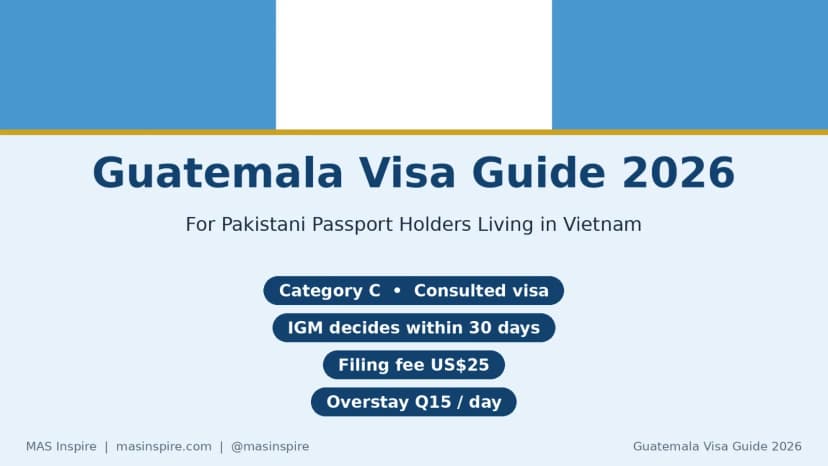
The single most important fact in this guide is that Pakistan sits in Guatemala's strictest visa group, Category C. A visa for a Pakistani passport holder is a "consulted visa" (visa consultada): it must be approved by the Instituto Guatemalteco de Migración (IGM) in Guatemala City, and the application must be filed there in person by a Guatemalan guarantor (garante) who is registered with IGM. No consulate can issue this visa on its own authority, and no online form replaces the guarantor.
This guide explains the three visa categories, every visa type, the fees as published by two different official sources (which disagree, and the disagreement is disclosed in full), the documents, the step-by-step application route from Vietnam, the CA-4 shared 90-day rule, extensions, overstay fines and entry tips. Where a figure could not be verified on an official source, this guide says so plainly instead of guessing.
Do Pakistani Passport Holders Need a Visa for Guatemala?
Yes. Pakistani passport holders need a visa to enter Guatemala. Pakistan is listed by IGM as "Pakistán, República Islámica de" in Category C, the consulted-visa group, under the Guatemalan visa regulation, Acuerdo IGM-015-2025 (Reglamento de Visas Guatemaltecas). That classification was read from IGM's published country lists on 29 September 2026 and remains the controlling classification for this guide.
There is no visa on arrival for Pakistani passport holders and no eVisa. You must hold the visa before you travel. Airlines flying to La Aurora International Airport in Guatemala City (GUA) will check for it, and a traveller who arrives without the required visa can be refused boarding or refused entry.
Your Vietnamese residence does not change this. A Vietnamese temporary residence card (TRC) or work permit proves where you live; it does not change your nationality, and Guatemala's visa requirement is decided by the passport you hold. Likewise, living in Vietnam does not give you access to a Guatemalan mission in Vietnam, because there is none: the Embassy of Guatemala in Bangkok is accredited to Vietnam.
| Question | Answer for Pakistani passport holders |
|---|---|
| Visa required? | Yes, a Category C consulted visa (visa consultada) |
| Visa on arrival? | No |
| eVisa? | No, Guatemala has no eVisa |
| Who approves the visa? | IGM, Subdirección de Extranjería, Guatemala City |
| Who files the application? | A Guatemalan guarantor (garante) registered with IGM, in person |
| Who issues the visa after approval? | The designated Guatemalan embassy or consulate |
| Nearest mission to Vietnam | Embassy of Guatemala in Bangkok (accredited to Vietnam) |
| Passport validity needed | At least 6 months |
Guatemala Visa Categories: A, B and C Explained
IGM sorts every nationality into one of three categories under Article 9 of Acuerdo IGM-015-2025. The category decides everything: whether you need a visa at all, where you apply, and whether IGM must be consulted first. The three lists together carry about 89 entries in Category A, 63 printed entries in Category B and 45 in Category C, as read from IGM's published lists on 29 September 2026.
| Category | IGM heading | What it means | Where you apply |
|---|---|---|---|
| Category A | Exento de visa (visa-exempt) | Enter on a valid passport alone, no visa | No application; passport only |
| Category B | Visa Consular (consular visa) | Visa issued by a Guatemalan embassy or consulate abroad | A Guatemalan embassy or consulate |
| Category C | Visa Consultada (consulted visa) | IGM must authorise the visa in Guatemala first; the mission then issues it | IGM Subdirección de Extranjería, via a registered Guatemalan guarantor |
Category A covers the United States, Canada, the United Kingdom, all European Union member states, Australia, New Zealand, Japan, South Korea, Mexico and most of Latin America. Category B includes countries such as Jamaica and India. Category C includes Pakistan, Bangladesh, China, Nigeria, Kenya, Ethiopia and Haiti, among others.
For Category C, Article 11 of the regulation states that nationals "deberán gestionar su solicitud ante el Instituto Guatemalteco de Migración, a través de la Subdirección de Extranjería" — the application must be handled before IGM through the Sub-directorate for Foreign Nationals. Seven requirements apply, including the registered Guatemalan guarantor (Articles 11 and 28). IGM must decide within 30 days under Article 4.
Do not rely on general travel websites that describe Guatemala as "visa-free for 90 days" without naming a nationality. That statement is true for Category A passports and false for a Pakistani passport. Always check the category for your own passport.
Types of Guatemala Visas
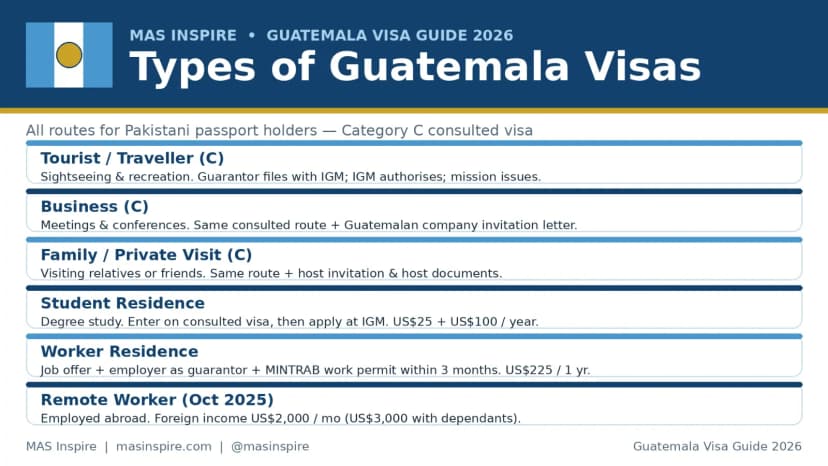
Guatemala does not publish a long menu of separate visa stickers the way some countries do. For a Pakistani applicant, the practical routes are the consulted visa for a stated purpose (tourism, business, family visit), followed by in-country residence categories if you intend to stay long term. The routes below are the ones that matter for this guide.
1. Tourist or traveller visa, Category C (Visa de Turista o Viajero, Categoría C)
The standard route for sightseeing, visiting Antigua, Lake Atitlán, Tikal and the highlands. It is a consulted visa: your Guatemalan guarantor files it with IGM, IGM authorises it, and a Guatemalan mission issues it. The IGM tariff lists the tourist or traveller visa at US$25 (see the fees section for the conflicting MINEX figure). The length of stay granted on a Category C tourist visa is not stated on the official IGM form, so this guide does not state a number: confirm the stay written on your visa. Do not assume the 90-day Category A ceiling applies to you.
2. Business visa, Category C (Visa de Negocios)
For meetings, conferences, trade visits and exploring commercial opportunities. It follows the same Category C consulted-visa route, with the same guarantor requirement. Add an invitation letter from the Guatemalan company or institution, describing the purpose, dates and who bears the costs. A business visa does not authorise paid employment in Guatemala: taking a Guatemalan job needs a work residence and a work permit (see the student, work and family routes section).
3. Family or private-visit visa, Category C
For visiting relatives or friends in Guatemala. The route is the same consulted visa, and the guarantor is often the host family member or a Guatemalan contact. Add an invitation letter from your host, their identity document and proof of their address and means. For a child travelling, add an apostilled birth certificate, copies of the parents' identity documents and written permission for the guarantor.
4. Student route (Residencia Temporal para Estudiantes)
There is no simple short student visa for a degree course. A student enters on a consulted visa and then applies in Guatemala for temporary residence for students at IGM's Subdirección de Extranjería. The IGM requirements include the application form, passport with a full copy legalised by a notary showing the last entry stamp, a criminal record certificate no more than 6 months old, a certificate of your migration record showing your last entry, a signed and stamped enrolment letter from the Guatemalan institution with timetable or study plan, and proof of financial means. The application costs US$25 and student residence costs US$100 for each year granted under the IGM tariff (Acuerdo IGM-039-2025). Students may not work without separate permission.
5. Work route (Residencia Temporal para Trabajadores Migrantes)
Work in Guatemala needs a job offer from a Guatemalan employer, temporary residence for migrant workers, and a work permit from the Ministerio de Trabajo y Previsión Social (MINTRAB). The employer acts as guarantor. Within three months of the residence grant, the worker must present a valid work permit, or the residence can be revoked. IGM fees for a one-year temporary residence for workers are about US$225 in total (US$25 application fee plus US$200 residence fee). The employer must also meet Guatemalan labour quotas, including at least 90 percent Guatemalan staff and at least 85 percent of payroll to Guatemalans under Article 13 of the Labour Code, which makes employer sponsorship genuinely selective.
6. Remote worker route (new, October 2025)
Guatemala introduced a remote worker visa in October 2025 for people employed by a company outside Guatemala. IGM lists bank statements showing foreign remuneration of at least US$2,000 per month received during the last year, or US$3,000 per month when accompanied by dependants; alternatively, a certification from a public accountant with legalised or apostilled signatures. Workers whose foreign employer is an international non-governmental organisation or international organisation are exempt from the income figure and instead present an employment certificate or contract and evidence of medical insurance. This route is new and its application for Category C nationals has not been confirmed in detail: ask IGM whether a Pakistani applicant must still complete the consulted-visa step first.
7. Transit
No separate transit visa for Category C nationals was found on an official source. Do not assume you can transit Guatemala without a visa, and do not book a flight that connects through Guatemala City unless IGM or the Bangkok embassy has confirmed in writing that your transit is covered. The same caution applies to every stop on your itinerary from Vietnam: most routings pass through the United States, Mexico or Europe, and each of those has its own transit-visa rules for Pakistani passport holders.
8. The CA-4 visa (Visa Única Centroamericana)
The CA-4 is not a separate visa you apply for. It is the shared entry arrangement between Guatemala, Honduras, El Salvador and Nicaragua: one entry into any of the four gives a single shared stay across all four. For a Pakistani passport holder, the CA-4 does not remove the visa requirement: you still need the Guatemalan consulted visa first, and once admitted, your stay is counted across the whole CA-4 zone. See the CA-4 section below.
Visa Comparison Table
| Route | Who it is for | How it is obtained | IGM fee | Work allowed? |
|---|---|---|---|---|
| Tourist / traveller, Category C | Sightseeing, recreation | Consulted visa via Guatemalan guarantor; IGM authorises, mission issues | US$25 filing + US$25 single-entry visa per IGM tariff (see fee conflict) | No |
| Business, Category C | Meetings, conferences, trade visits | Same consulted-visa route + Guatemalan company invitation | US$25 filing + US$25 single-entry visa per IGM tariff (see fee conflict) | No paid Guatemalan employment |
| Family / private visit, Category C | Visiting relatives or friends | Same consulted-visa route + host invitation | US$25 filing + US$25 single-entry visa per IGM tariff (see fee conflict) | No |
| Student residence | Degree or long study in Guatemala | Enter on consulted visa, then apply at IGM in Guatemala | US$25 application + US$100 per year of residence | No, without separate permission |
| Worker residence | Salaried job with a Guatemalan employer | Job offer + employer as guarantor + MINTRAB work permit within 3 months | US$25 application + US$200 residence (US$225 total, 1 year) | Yes, for that employer |
| Remote worker | Employed by a company outside Guatemala | Apply at IGM; foreign-employer income evidence required | Not confirmed on an official source; ask IGM | Only for the foreign employer |
| Investor residence | Investors in Guatemala | Apply at IGM with proof of investment | US$25 application + US$200 residence; minimum investment US$100,000 | Yes |
| Permanent residence | After 5 years of temporary residence; 1 year of marriage to a Guatemalan; 1 year for Central Americans; pensioners and rentiers | Apply at IGM | US$25 application + US$700 standard (US$500 Central Americans; US$400 pensioners/rentiers) + US$40 annual foreigner fee | Depends on category |
Figures in this table come from the IGM tariff (Acuerdo IGM-029-2023, as reformed by Acuerdo IGM-039-2025) and the IGM residency regulation (Acuerdo IGM-016-2025), as reported by secondary sources that quote them. The one figure that is not settled is the total cash cost of the Category C tourist visa itself, because MINEX publishes a different schedule: see the fees section, which discloses the conflict in full.
The CA-4 Agreement and the Shared 90-Day Rule
Guatemala, Honduras, El Salvador and Nicaragua share a single entry area under the Central America-4 (CA-4) Border Control Agreement. The rule that catches almost every first-time visitor is that the 90 days are shared, not per country.
- Your 90 days are shared across all four countries. The clock starts when you enter any CA-4 country.
- Travelling from Guatemala to Honduras does not reset your clock. If you spend 30 days in Guatemala and 30 days in Honduras, you have 30 days left in total.
- Crossing into another CA-4 country for a weekend and coming back gives you no fresh days.
- To reset the 90 days, you must exit the CA-4 region entirely. The usual exits are Mexico, Belize, Costa Rica or Panama.
- One 90-day extension is available, taking the maximum stay to 180 days (see the extensions section).
For a Pakistani passport holder, two cautions apply. First, the 90-day figure is the ceiling for visa-exempt Category A tourists; the stay actually granted on a Category C visa is not stated on the official IGM form, so do not plan a 90-day trip on the assumption that your visa grants 90 days. Second, your CA-4 stay is still counted across all four countries once you are admitted, so a side trip to Honduras or El Salvador eats the same days as a day in Guatemala. Keep your entry stamp: the UK Foreign, Commonwealth and Development Office advises travellers to make sure their passport is stamped on arrival, and your stamp is the evidence of when your CA-4 clock started.
Note also that the CA-4 is not perfectly uniform. Since 31 October 2026, the UK Foreign Office has said British citizens can visit Honduras for up to 90 days without a visa, and earlier reporting noted that the CA-4 visa did not apply to Honduras for UK citizens from 2024. That is a nationality-specific exception and does not change the rule for Pakistani passport holders.
The US, Canadian, Mexican and Schengen Visa Question
This is the most commonly misunderstood point about Guatemala, and it matters directly for Pakistani passport holders living in Vietnam, many of whom hold or have held a US, UK or Schengen visa. The short answer is: a valid US, Canadian, Mexican or Schengen visa does not make a Pakistani passport holder visa-exempt for Guatemala.
Here is why, with the controlling source named. Acuerdo IGM-015-2025, Article 29, numeral 2, provides that a valid US, Mexican, Canadian or Schengen visa moves a Category B national to Category A (visa-exempt), but moves a Category C national only to Category B. A Category C national who holds such a visa still needs a visa: the difference is that the visa becomes a consular visa (Category B route) rather than a consulted visa (Category C route). That is the rule as published in the regulation.
General statements elsewhere say the opposite. Wikipedia's visa-policy page states that citizens of other countries who would normally require visas may enter without a visa for up to 90 days if they hold a valid visa issued by a Schengen state, Canada, Mexico or the United States, and several travel databases repeat that a US or Schengen visa gives visa-free entry. Those general statements do not mention the Category C exception in Article 29, and they do not override the regulation. Do not travel on the basis of a US or Schengen visa alone without written confirmation from IGM or a Guatemalan consulate that the exception applies to a Pakistani passport holder.
There is a related but different rule for residence permits: holders of a residence permit issued by a visa-exempt country may enter without a visa for up to 90 days, provided they have resided for 3 consecutive years in the country that issued the permit. Whether that helps a Pakistani resident of Vietnam depends on the permit, and Vietnam is not a visa-exempt country for Guatemala, so a Vietnamese TRC does not trigger it. If you hold a US Green Card or a long residence permit from a visa-exempt country, ask IGM or the Bangkok embassy in writing before relying on it.
Guatemala Visa Fees and Processing Times
Guatemala's fees are published in US dollars but paid in quetzales (GTQ) at the official Banco de Guatemala (Banguat) reference rate on the day of payment. Always confirm the rate and the exact total with IGM or the Bangkok embassy before you pay, because the two official sources below disagree on the tourist visa total.
Fees table
| Item | Fee | Source |
|---|---|---|
| Visa application filed in Guatemalan territory (tariff 2.1) | US$25 | IGM tariff, Acuerdo IGM-029-2023 as reformed by IGM-039-2025 |
| Single-entry visa, "Visa simple" (tariff 2.3) | US$25 | IGM tariff, Acuerdo IGM-029-2023 as reformed by IGM-039-2025 |
| Multiple-entry visa, "Visa múltiple" (tariff 2.4) | US$100 | IGM tariff, Acuerdo IGM-029-2023 as reformed by IGM-039-2025 |
| Tourist visa extension (prórroga de visa de turista o viajero) | US$25 | IGM tariff |
| Visa while a residence application is pending, single entry | US$25 | IGM tariff |
| Visa while a residence application is pending, multiple entry | US$100 | IGM tariff |
| Student residence, per year granted | US$100 | IGM tariff, Acuerdo IGM-039-2025 |
| Temporary residence, 1 year (workers, investors, remote workers) | US$200 + US$25 application = US$225 | IGM tariff and residency regulation |
| Permanent residence grant | US$700 standard; US$500 Central Americans; US$400 pensioners/rentiers | IGM tariff, Acuerdo IGM-039-2025 |
| Annual foreigner fee (cuota anual de extranjería, permanent residents) | US$40 per year | IGM tariff, numeral 4.1.3 |
Fee conflict disclosed: IGM tariff versus MINEX consular schedule
Readers must be warned about a real conflict. The IGM tariff lists US$25 for the single-entry visa and US$100 for the multiple-entry visa. The foreign ministry (MINEX) publishes a different consular schedule for tourist visas: US$50 single-entry and US$150 multiple-entry. Secondary sources that add the two schedules together report a total of US$50 for a single-entry Category C visa (US$25 filing in Guatemala plus US$25 for the visa itself) and US$150 for a multiple-entry visa, with a separate US$25 filing charge.
This guide does not resolve the conflict by picking one number, because no official source found states the combined total for a Category C applicant in one place. The controlling source for the in-Guatemala filing is the IGM tariff (US$25 + US$25), and the controlling source for the consular issuance charge is MINEX (US$50 / US$150). Before you pay, ask the Bangkok embassy and your guarantor to confirm in writing which charges apply to your case and the total in quetzales. Budget for the higher figure (US$50 single-entry, US$150 multiple-entry) so a higher charge is not a surprise.
Two other figures found in secondary sources are not adopted here. One travel site states a fee of "around US$30" with 10 to 15 working days' processing; that figure matches neither the IGM tariff nor the MINEX schedule and is not sourced from either, so it is disclosed and not used. Another general travel page states that single-entry 90-day visas cost US$25 and multiple-entry 90-day visas cost US$50: the US$50 multiple-entry figure conflicts with both the IGM tariff (US$100) and MINEX (US$150) and is not used. A separate warning: the tariff's US$100 multiple-entry line is for a person with a residence application pending and for the multiple-entry visa itself; do not transfer it to repeat tourism without confirmation.
Processing times table
| Step | Time | Source and status |
|---|---|---|
| IGM decision on a Category C consulted visa | Within 30 days | Acuerdo IGM-015-2025, Article 4 (verified) |
| Consular issuance after IGM authorisation | Not published | No official figure found; ask the issuing mission |
| Tourist extension at IGM | Not published; apply before expiry | No official processing time found |
| Temporary residence decision | Not published by IGM | No official figure found |
Plan on the 30-day IGM decision as your minimum, and add time for document legalisation in Pakistan and Vietnam, courier time to your guarantor in Guatemala, and the mission's own issuance step after authorisation. A realistic planning window is 6 to 8 weeks from a complete file to a visa in hand, and longer if IGM asks for further documents. Do not book non-refundable flights or hotels until the visa is issued.
Complete Document Checklists
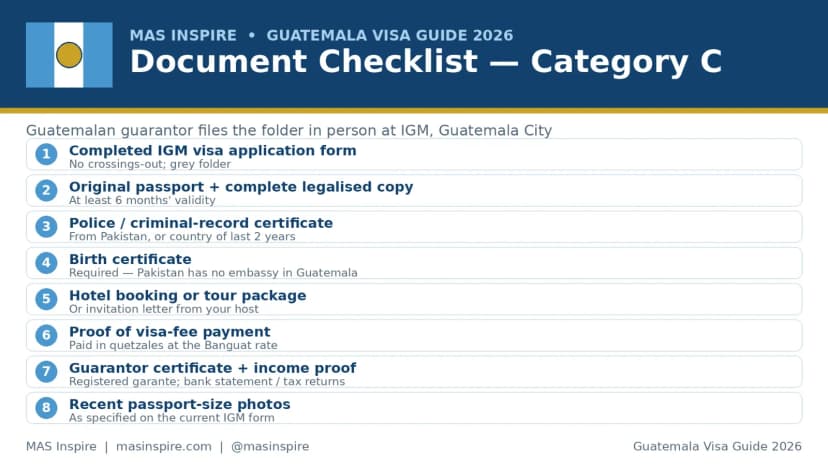
The Category C file is assembled by your guarantor in Guatemala and submitted in person at IGM in a grey folder with no crossings-out, as IGM asks. Foreign documents generally need legalisation or apostille and a Spanish translation. Pakistan is not a party to the Hague Apostille Convention in the usual sense for these purposes, so documents from Pakistan typically need consular legalisation: confirm the exact chain (Pakistan authority, then the Guatemalan mission that legalises it) with IGM or the Bangkok embassy before you start, because an incorrectly legalised document is the most common cause of delay.
Tourist or business visa, Category C: core checklist
| Document | Notes |
|---|---|
| Completed IGM visa application form | The Category C form; complete it fully, with no crossings-out |
| Original valid passport | At least 6 months' validity; at least one blank page for the stamp |
| Complete legalised copy of the passport | Every page, legalised; a certified and legalised copy may be accepted — confirm with IGM |
| Original police or criminal-record certificate | From Pakistan, or from the country where you lived for the last two years (so your Vietnamese police clearance may also be needed) |
| Birth certificate | Required if your country has no embassy in Guatemala; Pakistan has no embassy in Guatemala, so expect this to be asked for |
| Proof of purpose: hotel booking or tour package | Or an invitation letter if you are visiting someone |
| Proof of payment of the visa fee | Paid in quetzales at the official rate; keep the receipt |
| Guarantor's documents (see below) | Updated guarantor certificate, proof of income, last month's bank statement (or tax returns for a company) |
| Recent passport-size photographs | As specified on the current IGM form; confirm size and number with IGM |
| Polio vaccination certificate from NADRA | Reported as needed to leave Pakistan; this is a Pakistan exit requirement, not an IGM requirement, and was not verified on an official Guatemalan source |
Guarantor (garante) checklist
| Document | Notes |
|---|---|
| Updated guarantor certificate | Issued by IGM; the guarantor must be registered with IGM |
| Proof of income | Sufficient to support the visitor |
| Last month's bank statement | Or tax returns where the guarantor is a company |
| Identity document of the guarantor | Guatemalan DPI or equivalent |
One guarantor cannot back more than three tourist visa applications at once, unless the applicants are one family. Choose a guarantor with enough income and a clean record: the guarantor takes responsibility for you, and IGM checks the guarantor as closely as it checks the applicant.
Business visa: additional documents
| Document | Notes |
|---|---|
| Invitation letter from the Guatemalan company | Purpose, dates, meetings, and who bears the costs |
| Company registration or details of the inviting company | As requested by IGM |
| Your employment letter or business registration in Vietnam | Shows your own ties and the reason for the trip |
Family visit: additional documents
| Document | Notes |
|---|---|
| Invitation letter from your host in Guatemala | Relationship, address, dates, and support offered |
| Host's identity document and proof of address | As requested by IGM |
| For a child: apostilled birth certificate | Plus copies of the parents' identity documents and written permission for the guarantor |
Student residence: additional documents
| Document | Notes |
|---|---|
| Enrolment letter from the Guatemalan institution | Signed and stamped, with timetable or study plan |
| Certificate of migration record | Showing your last entry into Guatemala |
| Criminal record certificate, no more than 6 months old | From your home country or country of residence for the last 2 years |
| Proof of financial means | Your own funds or a sponsor's |
Worker residence: additional documents
| Document | Notes |
|---|---|
| Original job offer letter (carta-oferta) | Position, schedule, term, pay, start date and workplace |
| Employer as guarantor | The employer must show income of at least 3 minimum wages per month |
| MINTRAB work permit | Present within 3 months of the residence grant; the employer must meet the 90 percent Guatemalan staff and 85 percent Guatemalan payroll quotas |
How to Apply: Step-by-Step
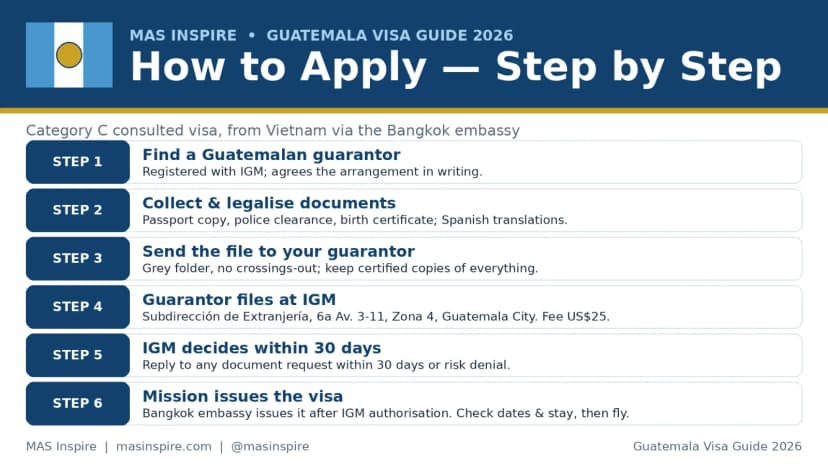
The Category C route is unusual because most of the work happens in Guatemala, not in Vietnam. Follow the steps in order; skipping the guarantor step is the reason most applications fail before they start.
- Find a Guatemalan guarantor. This is a Guatemalan person or company with enough income, registered with IGM as a guarantor. For tourists this is usually a tour operator, a hotel or travel company, or a personal contact in Guatemala. For business, it is the inviting company. Agree in writing what the guarantor will do and what it will cost: guarantor services are private arrangements and their fees are not published.
- Collect and legalise your documents in Pakistan and Vietnam. Get your passport copy legalised, your police clearance from Pakistan (and a Vietnamese police clearance if you have lived in Vietnam for the last two years), and your birth certificate. Have documents translated into Spanish by a sworn translator where IGM requires it. Allow weeks for this step: it is the slowest part of the whole process.
- Send the file to your guarantor. Put the documents together in a grey folder with no crossings-out, as IGM asks, and courier the originals your guarantor needs. Keep certified copies of everything you send.
- Your guarantor pays the fee and files in person at IGM. The guarantor submits the file at the Subdirección de Extranjería, 6a Avenida 3-11, Zona 4, Guatemala City (2nd floor), telephone +502 2411-2411, extensions 171 or 172, Monday to Friday, 7:00 to 15:00. The filing fee of US$25 is paid in quetzales at the Banco de Guatemala official rate.
- IGM decides within 30 days. If IGM asks for a missing document, respond within 30 days: under Article 35 of the visa regulation, failure to cure a missing requirement within 30 days can lead to a fine for overstaying the authorised period and is a ground for denial under Article 36, numeral 3.
- After authorisation, the designated mission issues the visa. IGM notifies the mission; you (or your guarantor, as the mission directs) present your passport to the designated Guatemalan embassy or consulate for the visa to be placed in it. Confirm with the Bangkok embassy whether you must attend in person in Bangkok or whether the passport can be sent by courier.
- Check the visa before you travel. Check the name spelling, the number of entries, the validity dates and the stay granted. The stay granted is written on the visa: that is the stay you must respect, not the 90-day figure quoted for other nationalities.
- Complete the online immigration declaration before entry. Travellers to Guatemala fill in an online immigration declaration form before arrival. Carry the confirmation with you.
- On arrival, get your passport stamped. Make sure the entry stamp is in your passport before you leave the immigration desk at La Aurora International Airport. Check the date on the stamp the same day.
Applying from Vietnam: The Bangkok Route
There is no Guatemalan embassy or consulate in Vietnam. The Embassy of Guatemala in Bangkok is the mission accredited to Vietnam, and it also covers Thailand, Laos and Cambodia. The embassy reopened in 2019. Its ambassador, as named in the foreign ministry's directory updated 29 May 2026, is Shirley Dennise Aguilar Barrera.
| Detail | Information |
|---|---|
| Mission | Embassy of Guatemala in Bangkok, Thailand |
| Accredited to | Vietnam, Thailand, Laos, Cambodia |
| Address | Unit 193/150, 8th floor, Lake Rajada Office Complex, Rachadapisek Road, Klongtoey, Bangkok 10110, Thailand |
| embatailandia@minex.gob.gt | |
| Telephone | +66 2 259 2762 (MINEX directory; see conflict note below) |
| Your role from Vietnam | Email first; the Category C file is filed in Guatemala City by your guarantor, and the mission issues the visa after IGM authorisation |
Telephone conflict disclosed: the Guatemalan foreign ministry's directory gives +66 2 259 2762 (an automatic operator line), while an embassy directory lists +66 2 627 9545 for the same embassy. This guide uses the MINEX directory number as controlling and discloses the other number rather than silently choosing one. Email is the safer first contact: write in English or Spanish, state that you are a Pakistani passport holder resident in Vietnam, and ask (a) whether Bangkok is the correct issuing mission for your case, (b) whether you must attend in person, and (c) which total fee applies.
Outdated advice disclosed: some older travel guides tell Pakistani applicants to apply through the Guatemalan embassy in Abu Dhabi or in Beijing. That advice is outdated and, for Beijing, wrong: Guatemala maintains its embassy in Taipei, not Beijing, and has no mission in Beijing. The Bangkok embassy is the mission accredited to Vietnam. Do not send documents to Abu Dhabi or Beijing on the basis of those older guides without first asking Bangkok whether it will accept your case.
Other missions that may be relevant. Guatemala also has embassies in New Delhi (accredited to Nepal and Sri Lanka), Jakarta (accredited to Brunei, Singapore and Timor-Leste, and to ASEAN), Tokyo (accredited to Malaysia and the Philippines) and Seoul (accredited to Cambodia). These are farther from Vietnam than Bangkok and are not accredited to Vietnam, so they are fallbacks only if Bangkok directs you elsewhere. Your Vietnamese residence permit does not oblige any mission to accept your application: ask in writing and keep the reply.
Flights from Vietnam. There are no direct flights from Ho Chi Minh City or Hanoi to Guatemala City. Typical routings pass through the United States, Mexico, Turkey or Europe. Each transit country has its own transit-visa rules for Pakistani passport holders: a US transit needs a US visa, and a Schengen transit may need an airport transit visa depending on the airport and your ticket. Check every stop before you book, and allow a generous connection time at La Aurora, where immigration queues can be long.
Student, Work and Family Routes
Short visits use the consulted visa. Longer stays use residence categories granted by IGM in Guatemala. The categories below are the ones a Pakistani applicant is most likely to meet; all are applied for at IGM's Subdirección de Extranjería in Guatemala City, and all need apostilled or legalised documents with Spanish translations.
Studying in Guatemala
Guatemala's universities include the public Universidad de San Carlos de Guatemala (USAC) and private universities such as Universidad Rafael Landívar, Universidad del Valle and Universidad Francisco Marroquín. Admission tests and immigration forms are in Spanish, and a degree needs the student residence described above (US$25 application plus US$100 per year). While your residence application is in process, a visa for a pending residence file lets you leave and re-enter: US$25 for a single exit and re-entry, or US$100 for multiple. There is no published post-study work route: to stay and work after study, you need another residence category, such as the migrant-worker category.
Working in Guatemala
Foreigners need prior authorisation from the Ministerio de Trabajo y Previsión Social to work, whether employed or self-employed. The route is a job offer, temporary residence for migrant workers (1 to 5 years, renewable), and a MINTRAB work permit presented within three months of the residence grant. The employer acts as guarantor and must show income of at least 3 minimum wages per month, and must meet the quotas of at least 90 percent Guatemalan staff and at least 85 percent of payroll to Guatemalans. Teaching English is possible in private language schools, but the sponsorship burden means schools rarely sponsor a work permit for a foreign teacher unless they genuinely cannot fill the post locally. Do not resign from a job in Vietnam or pay any agent for a Guatemalan job offer until the work permit and residence are in hand.
Remote work
The October 2025 remote worker route is designed for people employed by a foreign company, with the US$2,000 per month income evidence (US$3,000 with dependants) described in the visa types section. It is a residence route, not a tourist visa, and it does not authorise work for a Guatemalan employer. Because the route is new and its interaction with the Category C consulted visa has not been confirmed for Pakistani applicants, get IGM's answer in writing before relying on it.
Family, marriage and permanent residence
Permanent residence is available after 5 years of temporary residence; after 1 year of marriage or civil union with a Guatemalan citizen; after 1 year of temporary residence for a person born in another Central American country; or directly for pensioners and rentiers with qualifying foreign income. Rentista and pensionado residence grants permanent residence from approval, with no temporary ladder and no local guarantor, for people with US$1,250 a month of verifiable foreign income plus US$300 a month per dependant. The permanent residence grant fee is US$700 standard, US$500 for Central Americans and US$400 for pensioners and rentiers, plus the US$40 annual foreigner fee. Investment residence needs a minimum investment of US$100,000.
Extending Your Stay, Overstay and Exit
Extending your stay
A tourist stay may be extended once, for a further period equal to the one originally granted, with a 180-day ceiling from entry, under Article 74 of the Migration Code (Decreto 44-2016) and Article 14 of Acuerdo IGM-015-2025. The IGM tariff lists the extension fee at US$25, paid at a local bank, with the receipt brought to your appointment. Apply at IGM in Guatemala City before your authorised stay expires. Bring the completed application form (available from igm.gob.gt), your passport with the entry stamp, the bank-stamped payment receipt, and one of: an onward or return airline ticket, an international credit card or bank statement showing funds, or a letter from a Guatemalan guarantor or employer. Queues at IGM are long: arrive early and allow a full day.
Overstay
Staying past your authorised date with no extension or residency application pending is an administrative offence. The fine is Q15 per day of excess stay under Article 194, numeral 2, of the Migration Code, about US$2 a day at recent rates. The fine may be paid in US dollars at the Banco de Guatemala reference rate on the day you pay. You cannot leave Guatemala until the fine is paid: it is settled in cash at La Aurora airport or at border posts, or at the exit migration check, and the exit is conditioned on the receipt. Worked examples: 30 days of overstay is Q450 (about US$59); 90 days is Q1,350; 365 days is Q5,475. The fine does not apply while an extension or residency application is pending: the statute fines only a person staying longer than authorised "sin tener pendiente gestión de ampliación", without a pending extension application. If IGM notifies you of a missing requirement and you do not cure it within 30 days, Article 35 provides that you incur a fine for staying longer than authorised, and it becomes a ground for denial under Article 36, numeral 3.
Exit
There is no exit fee when leaving Guatemala by land. Leaving by air carries a departure tax reported at US$30, which is often included in the airline ticket: check your ticket before paying anything at the airport, and keep the receipt if you do pay. The overstay fine described above is separate from any departure tax and is owed only if you overstayed. Keep your entry stamp, your visa, your extension receipt if any, and your fine receipt if any, until you have cleared exit immigration.
Border runs do not work inside CA-4
After 180 days (90 days plus the one extension), or 90 days without an extension, you must leave the entire CA-4 zone to reset the clock. The Migration Code sets no minimum time outside the country, and re-entry is at the officer's discretion. Expat practice is to spend at least 24 hours outside CA-4, and commonly 72 hours, before re-entering. A fresh entry is never guaranteed: the officer may grant a shorter stay or refuse entry, so a border run is a risk, not a right. For a stay beyond a year, residence is the stable path.
Frequently Asked Questions
1. Do Pakistani passport holders need a visa for Guatemala?
Yes. Pakistan is in Category C under Acuerdo IGM-015-2025, so you need a consulted visa (visa consultada) approved by IGM before travel. There is no visa on arrival and no eVisa for this route.
2. What is a Category C consulted visa (visa consultada)?
It is a visa that IGM must authorise in Guatemala City before a Guatemalan embassy or consulate can issue it. The file is submitted in person in Guatemala by a registered Guatemalan guarantor (garante), and IGM must decide within 30 days under Article 4 of Acuerdo IGM-015-2025.
3. Can I apply for a Guatemala visa without a Guatemalan guarantor?
No, not on the Category C route. A Guatemalan guarantor registered with IGM is a formal requirement (Articles 11 and 28 of Acuerdo IGM-015-2025). One guarantor may back no more than three tourist visa applications at once, unless the applicants are one family.
4. How much does a Guatemala visa cost for Pakistani passport holders?
The IGM tariff lists US$25 to file the application in Guatemala and US$25 for a single-entry visa, or US$100 for a multiple-entry visa. The foreign ministry (MINEX) publishes a different consular schedule of US$50 single-entry and US$150 multiple-entry. Ask the Bangkok embassy and IGM which total applies to your case before paying, and pay in quetzales at the official Banco de Guatemala rate. Budget for the higher figure so a higher charge is not a surprise.
5. How long does the IGM take to decide a Category C visa?
IGM must decide within 30 days under Article 4 of Acuerdo IGM-015-2025. A secondary source claims 10 to 15 working days, but that figure is not sourced from IGM and conflicts with the 30-day rule, so plan on 30 days and apply well ahead of travel.
6. How long can I stay in Guatemala on a Category C visa?
The length of stay granted on a Category C visa is not stated on the official IGM form, so it cannot be confirmed here. The well-known 90-day stay is the ceiling for visa-exempt (Category A) tourists under the CA-4 agreement, not a confirmed grant for Category C visa holders. Confirm the stay written on your visa with IGM or the issuing mission.
7. Does a valid US, Schengen, UK or Canadian visa let me enter Guatemala visa-free?
No, not for Pakistani passport holders. Under Acuerdo IGM-015-2025, a valid US, Mexican, Canadian or Schengen visa moves a Category B national to visa-exempt, but moves a Category C national only to Category B, so a visa is still required. General statements that any US or Schengen visa holder enters visa-free do not override this rule for Category C nationals.
8. What is the CA-4 90-day rule?
Guatemala, Honduras, El Salvador and Nicaragua share one 90-day entry period under the Central America-4 (CA-4) agreement. The 90 days are shared across all four countries, start at your first entry into any of them, and are not reset by crossing between them. To reset the clock you must leave the whole CA-4 zone, for example to Mexico, Belize, Costa Rica or Panama.
9. Can I extend my stay in Guatemala?
Yes, a tourist stay may be extended once, for a further period equal to the one originally granted, up to a 180-day ceiling from entry, under Article 74 of the Migration Code (Decreto 44-2016) and Article 14 of Acuerdo IGM-015-2025. The IGM tariff lists the extension fee at US$25. Apply at IGM before your authorised stay expires.
10. What happens if I overstay in Guatemala?
Overstaying with no extension or residency application pending is fined at Q15 per day under Article 194, numeral 2, of the Migration Code (Decreto 44-2016), about US$2 a day. The fine must be paid before you can leave Guatemala. Thirty days of overstay is Q450.
11. Where do I apply for a Guatemala visa from Vietnam?
There is no Guatemalan embassy in Vietnam. The Embassy of Guatemala in Bangkok is accredited to Vietnam (as well as Thailand, Laos and Cambodia). Contact it first at embatailandia@minex.gob.gt, and note that the Category C file itself is submitted in Guatemala City by your guarantor, after which the designated mission issues the visa.
12. Can I work or study in Guatemala on a tourist visa?
No. A tourist visa does not authorise work or study. Degree study needs a temporary residence for students (Residencia Temporal para Estudiantes, US$100 per year plus a US$25 application fee), and work needs a temporary residence for migrant workers plus a work permit from the Ministry of Labour (Ministerio de Trabajo y Previsión Social).
13. Is there a Guatemala eVisa or visa on arrival for Pakistanis?
No. Guatemala has no eVisa and no visa on arrival for Category C nationals. A Pakistani passport holder must hold the consulted visa, authorised by IGM and issued by a Guatemalan mission, before travelling.
14. Do I need a visa just to transit through Guatemala, and what about flights via the United States?
No separate transit-visa route for Category C nationals was found on an official source, so assume a consulted visa is needed even to transit and confirm this with IGM or the Bangkok embassy before booking. Most flight routings from Vietnam pass through the United States, Mexico or Europe, and each stop has its own transit-visa rules, so check the transit requirements of every country on your itinerary.
15. Can my family apply together, and can children travel with me?
Yes, a family may apply together, and one guarantor may back more than three applications when the applicants are one family. For a child, the Category C file also needs an apostilled birth certificate, copies of the parents' identity documents and written permission for the guarantor. Confirm the current list with IGM before filing.
Official Immigration Websites
| Authority | Website | What it is for |
|---|---|---|
| Instituto Guatemalteco de Migración (IGM) | igm.gob.gt | Visa categories, visa and residence requirements, forms, fee tariff and extensions; the authority that authorises Category C visas |
| IGM Extranjería (Subdirección de Extranjería) | extranjeria.igm.gob.gt | Foreign-nationals services: consulted-visa filing, residence applications and extensions in Guatemala City |
| Ministerio de Relaciones Exteriores de Guatemala (MINEX) | minex.gob.gt | Foreign ministry: consular visa schedule, embassy directory and the Bangkok mission's accreditation |
| Guatemalan Institute of Tourism (INGUAT) — Visit Guatemala | visitguatemala.gt | Official entry requirements and visa-exempt nationality lists for tourists; tourist assistance hotline 1500 |
| Embassy of Guatemala in Bangkok (MINEX directory) | minex.gob.gt | Mission accredited to Vietnam; contact by email at embatailandia@minex.gob.gt before applying |
Final Checklist and Conclusion
Guatemala rewards the traveller who plans properly, and it punishes the traveller who assumes the rules for other nationalities apply to a Pakistani passport. Your route is longer than a visa-free trip, but it is a defined legal route: a guarantor, an IGM authorisation within 30 days, and a visa issued by a Guatemalan mission. Start at least 6 to 8 weeks before travel, and do not book anything non-refundable until the visa is in your passport.
- Confirm your Category C status and the current form with IGM before you start.
- Find a registered Guatemalan guarantor and agree the arrangement in writing.
- Legalise your passport copy, police clearance and birth certificate, with Spanish translations.
- Ask the Bangkok embassy in writing which total fee applies: the IGM tariff (US$25 filing plus US$25 single-entry) or the MINEX schedule (US$50 single-entry / US$150 multiple-entry).
- Budget for the higher fee figure and for 30 days of IGM decision time.
- Check the stay, entries and dates written on your visa before you travel.
- Complete the online immigration declaration before arrival and make sure your passport is stamped on entry.
- Count your CA-4 days from your first entry into any CA-4 country, and extend at IGM before your stay expires if you need more time.
- Never overstay: the fine is Q15 per day and you cannot leave until it is paid.
- Do not work or study on a tourist visa; apply for the residence category that matches your purpose.
Guatemala is worth the paperwork. Tikal at sunrise, Antigua's ruined churches, the villages around Lake Atitlán and the highland markets are among the best experiences in the Americas, and a correctly prepared Category C application is the way a Pakistani passport holder gets there legally. Verify every figure in this guide with IGM or the Bangkok embassy before you act, keep every receipt and every written reply, and travel with the visa, the stamp and the rules in your favour.