Guinea Visa Guide 2026: Types, Requirements, Fees and How to Apply
By MAS Inspire | Editorial draft: 27 November 2026 (fees and rules re-verified 28 November 2026)
Introduction
Guinea — the Republic of Guinea, often called Guinea-Conakry to distinguish it from Guinea-Bissau and Equatorial Guinea — is a French-speaking West African country of Atlantic beaches, the Fouta Djallon highlands, the source of the Niger River, and one of the world's largest bauxite industries. It is not a mass-tourism destination: infrastructure is basic outside Conakry, French is the working language, and every visitor needs to plan carefully. The visa, however, is now straightforward. Guinea runs an online e-visa system, and most travellers never need to visit an embassy at all.
Pakistani passport holders need a visa for Guinea, applied for online before travel. There is no visa on arrival for Pakistanis and no visa-free entry. The online application produces an Entry Visa Letter; the visa itself is issued at the airport in Conakry, where your photo and fingerprints are taken. This guide explains the e-visa route, the fees — including one important conflict between the official portal and older secondary websites, which is disclosed honestly below — the documents, the work, study and family routes, extensions and overstay, and the practical points for a Pakistani citizen living in Vietnam.
Table of contents
- Why choose Guinea?
- Guinea visa categories
- Visa comparison
- Eligibility
- Documents
- Application procedure
- Fees
- Processing times
- Vietnam and Pakistan
- Student visa
- Work visas
- Family, extensions, overstay and entry tips
- Mistakes
- Refusals
- FAQs
- Official websites
1. Why people visit, study and work in Guinea
- Conakry — the capital on the Atlantic coast, with the Kaloum peninsula, markets, live music and the islands of Loos just offshore.
- Fouta Djallon — highland scenery, waterfalls such as Kinkon and Ditinn, and hiking around Dalaba and Pita.
- The Niger River — which rises in the Guinea highlands before flowing across West Africa.
- Mount Nimba — a UNESCO-listed nature reserve on the border with Liberia and Côte d'Ivoire, home to rare wildlife.
- Business and mining — Guinea holds some of the world's largest bauxite reserves, plus gold, iron ore and agriculture, which bring engineers, traders and project staff from abroad.
- Study and humanitarian work — Guinean universities in Conakry, and international NGOs working in health, education and development.
Guinea rewards travellers who prepare well and punishes those who do not. French is the official language and the language of the visa portal, hotels and officials, so at least basic French — or a reliable host or guide — makes a real difference. Roads outside Conakry can be slow, especially in the rainy season from May to October, and the dry season from November to April is the most comfortable time to travel.
2. Types of Guinea visas
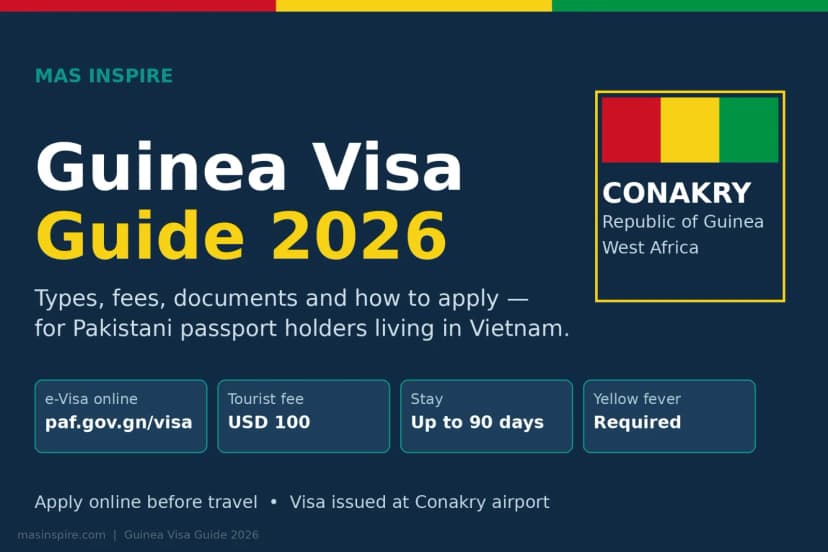
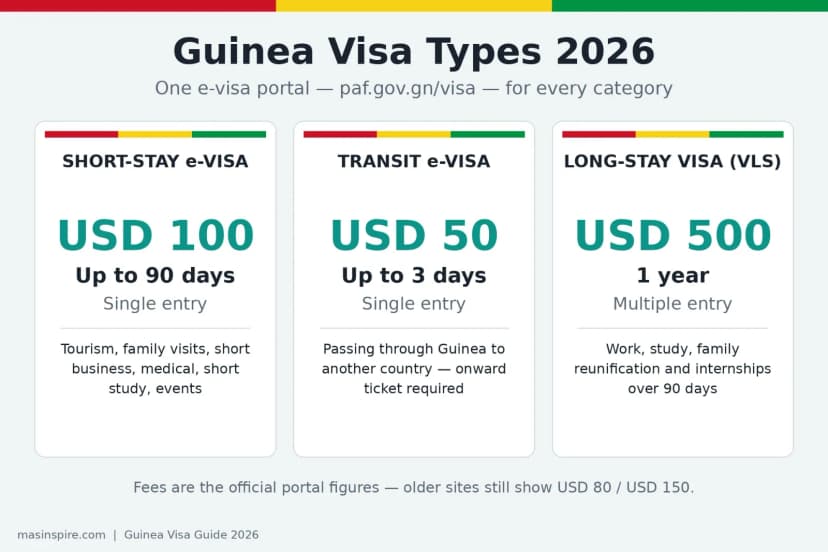
Guinea's e-visa system is run by the Central Directorate of the Border Police (Direction Centrale de la Police de l'Air et des Frontières, DCPAF), also called the Air and Border Police (PAF). The portal offers five main categories. Note an important point about how the system works: the online approval is not the visa itself. You receive an Entry Visa Letter by email, and the actual visa sticker is issued at the visa counter at Ahmed Sékou Touré International Airport in Conakry, after your photo and fingerprints are taken.
Short-stay e-visa (tourist, business, family and visits)
The short-stay e-visa is by far the most commonly used category. It covers tourism, visiting relatives, short business trips, medical treatment, short studies, humanitarian work and events such as weddings or cultural and sporting events. It allows a stay of up to 90 days, is valid for 90 days from the date of issue, and is for a single entry. The fee shown on the official portal is USD 100. Business visitors use this same short-stay category — there is no separate business e-visa product with a different fee on the portal, although some secondary websites list a separate business visa figure (see the fee conflict disclosed in section 7).
Transit e-visa
The transit e-visa is for travellers passing through Guinea without staying: a long layover that requires leaving the international transit zone of Conakry airport, or an overland crossing towards a neighbouring country. It is valid for a maximum of 3 days (72 hours), for a single entry, and you must show an onward ticket to your final destination. The fee shown on the official portal is USD 50. If you stay airside in Conakry without passing through immigration, you do not need a transit visa — but confirm this with your airline, because a missed connection that forces you landside would leave you without the right document.
Long-stay visa (VLS) — work, study, family and internships
The long-stay visa (visa de long séjour, VLS) is the single route for stays beyond 90 days. It is valid for 1 year from the date of issue, allows multiple entries, and costs USD 500 on the official portal. It covers salaried work (with an employment contract approved by the authorities), self-employment or a liberal profession, study (with an enrolment certificate from a Guinean institution), family reunification (with proof of marriage or of a parent-child relationship), and internships (with an internship agreement). There is no separate work visa, student visa or family visa product: all of these use the VLS, and the purpose-specific document is what changes. A residence permit and, for workers, a work authorisation are separate steps after arrival (see sections 11 and 12).
Diplomatic, service and courtesy visas
The portal also lists diplomatic, service and courtesy visas for officials, diplomats and their dependants, and for guests of the Guinean government. These are arranged through official channels and are not relevant to ordinary travellers. This guide does not cover them in detail.
Visa on arrival and visa exemptions
Guinea technically offers a visa on arrival, but it is restricted almost exclusively to UAE nationals. Pakistani passport holders cannot rely on it and must obtain the e-visa approval before travel — airlines can refuse boarding without it. Citizens of ECOWAS member states may enter Guinea without a visa for stays of up to 90 days. Pakistan is not an ECOWAS member and is not on any visa-waiver list found during this review, so no exemption applies to Pakistani passport holders.
3. Guinea visa comparison table
| Visa type | Purpose | Validity | Maximum stay | Entries | Fee (USD) |
|---|---|---|---|---|---|
| Short-stay e-visa | Tourism, family visits, short business, medical, short study, humanitarian work, events | 90 days from issue | Up to 90 days | Single | 100 |
| Transit e-visa | Passing through Guinea to another country | Up to 3 days | 3 days (72 hours) | Single | 50 |
| Long-stay visa (VLS) | Work, study, family reunification, internship, stays over 90 days | 1 year from issue | Up to 1 year | Multiple | 500 |
| Diplomatic / service / courtesy | Officials and government guests | As issued | As issued | As issued | Not published |
Fees in this table are the figures shown on the official e-visa portal, as quoted from the live portal on 29 August 2026. Older secondary websites still show USD 80 for the tourist visa and USD 150 for the long-term visa. The portal figure is the controlling one because it is what you actually pay at checkout — but because the portal's own public guidelines page was returning an error at the time of this review, re-check the fee on the portal itself before you pay. The full conflict is disclosed in section 7.
4. Guinea visa eligibility requirements
- Nationality: Pakistani passport holders need a visa. There is no exemption for holders of a US, UK, Schengen or Gulf visa or residence permit — Guinea publishes no such waiver, and you must apply for the e-visa in the normal way.
- Passport: valid for more than 6 months beyond your intended arrival date, with at least one blank page for the visa sticker and stamps. The portal asks for a scan of the passport data page.
- Purpose: your stated purpose must match the visa category — tourism, business, family, transit, study, work or internship — and your supporting documents must support it.
- Yellow fever: a valid yellow fever vaccination certificate is required. It must be uploaded with the online application and the original carried for inspection on arrival. This applies to all travellers aged 9 months and over, not only to those arriving from yellow-fever countries. See section 5 for details.
- Return or onward travel: a return or onward ticket is required for the short-stay and transit categories and is requested for the long-stay visa as well.
- Accommodation and funds: proof of accommodation (hotel booking or an invitation letter from a host in Guinea) and sufficient funds for your stay are required, and officers at Conakry airport may ask to see them.
- Repatriation guarantee: the portal lists a repatriation guarantee among the conditions for all visa types. In practice this is the return ticket and evidence that you can fund your stay and your journey home; the portal does not publish a fixed cash amount.
- Clean record and honest application: previous overstays or false information can lead to refusal. Fees are non-refundable even if the application is refused.
5. Complete Guinea visa document checklists
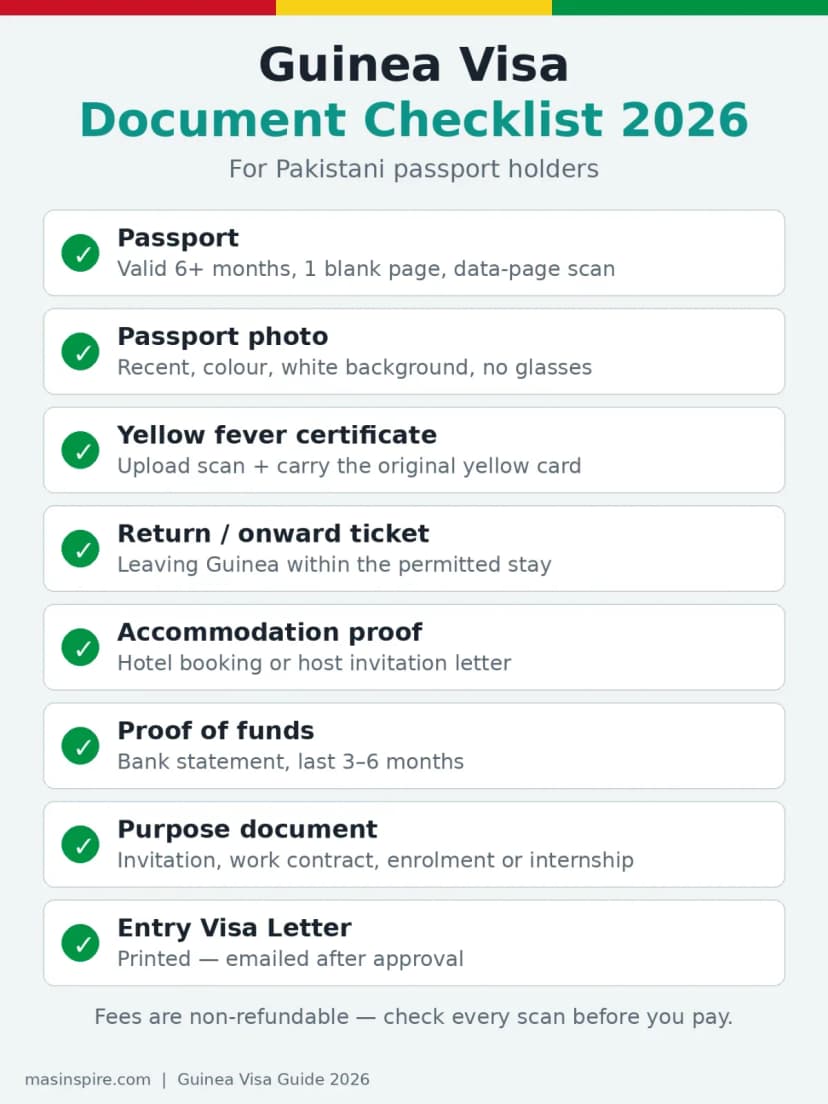
Prepare clear colour scans. Blurry photos and missing yellow fever certificates are among the most common reasons applications are delayed or refused. The portal is primarily in French, so keep a translation of document names handy if your French is limited.
Documents for all applicants
| Document | Details |
|---|---|
| Pakistani passport | Valid for more than 6 months beyond arrival; at least one blank page; clear scan of the data page for upload |
| Passport-style photograph | Recent, colour, white background, face forward, no glasses, no head covering except for religious reasons |
| Yellow fever vaccination certificate | International Certificate of Vaccination (the yellow card); upload a scan and carry the original |
| Return or onward ticket | Confirmed booking showing departure from Guinea within the permitted stay |
| Proof of accommodation | Hotel booking confirmation or an invitation letter from your host in Guinea, with the host's address and contact details |
| Proof of sufficient funds | Bank statement (last 3 to 6 months is the usual expectation) or other evidence you can fund the trip |
| Printed Entry Visa Letter | Sent by email after approval; print it and carry it with your passport — it is checked at departure and on arrival |
| CNIC copy | Pakistani national identity card copy; commonly requested by Pakistani-side agents and useful as supporting ID |
Extra documents for a short-stay business trip
- Invitation letter from the Guinean company or organisation, stating the purpose, dates and who covers the costs.
- A letter from your employer in Vietnam or Pakistan confirming your job, the purpose of the trip and your return to work.
- Company registration or business documents of the Guinean host, if the portal or the embassy asks for them.
Extra documents for a family visit
- Invitation letter from your host in Guinea with their address, phone number and a copy of their identity document or residence permit.
- Proof of the family relationship, if you are visiting close family.
Extra documents for a long-stay visa (VLS)
- For salaried work: an employment contract approved by the Guinean authorities.
- For self-employment or a liberal profession: the authorisation to practise that activity, where one is required.
- For a spouse: a document proving the marriage; for a minor child: proof of the parent-child relationship.
- For study: a certificate of enrolment or re-enrolment from the Guinean educational institution.
- For an internship: the internship agreement.
- A scan of your previous Guinea visa, if you are applying for an extension or renewal (the portal lists this as a condition for the VLS).
Extra documents for a transit visa
- Onward ticket to your final destination and, if needed, the visa for that destination country.
- Proof of accommodation in Guinea only if your layover requires an overnight stay outside the airport.
Health documents: yellow fever and polio
Yellow fever is the one health document that decides whether you enter Guinea. Guinea is listed by the World Health Organization as a country with a risk of yellow fever transmission, and the US Centers for Disease Control and Prevention lists Guinea among the countries that require proof of yellow fever vaccination from all arriving travellers. The Guinean e-visa portal requires the certificate to be uploaded during the application itself, and travellers report being asked for it again at checkpoints inside the country. The certificate applies from 9 months of age, and the vaccination must be given at least 10 days before arrival to be valid. If you do not have proof, you may be vaccinated on site, quarantined, or returned to your previous location.
Malaria is present throughout Guinea, so anti-malarial precautions and mosquito protection are strongly recommended, and hepatitis A, hepatitis B, typhoid and tetanus vaccinations are commonly recommended for travellers — but none of these is an entry requirement the way yellow fever is.
One document is about leaving Pakistan, not entering Guinea: Pakistan requires a polio vaccination certificate for travellers departing Pakistan, normally obtained through NADRA. If you are flying out of Pakistan, carry it. If you are flying out of Vietnam, it is not a Guinean requirement, but keep it with your travel documents in case your routing passes through Pakistan.
6. How to apply for a Guinea visa: step-by-step
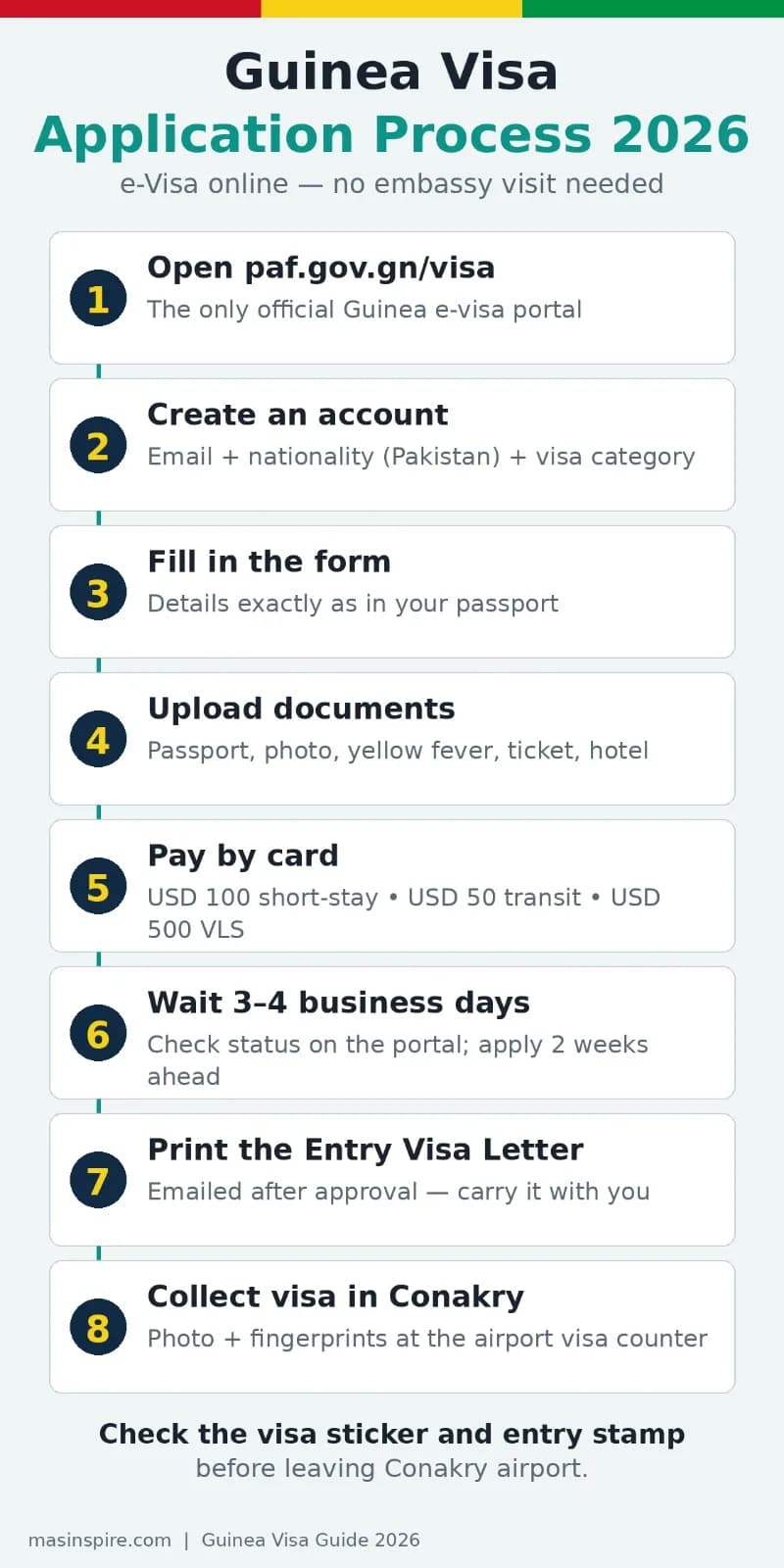
The whole application is online. There is no need to visit an embassy for a standard short-stay or long-stay e-visa, which is good news if you live in Vietnam, where Guinea has no embassy. Allow 15 to 20 minutes for the form itself, and apply at least two weeks before travel.
- Open the official portal at paf.gov.gn/visa. This is the only official Guinea e-visa website. Do not apply through lookalike third-party sites, which charge extra service fees and are not government websites.
- Create an account with a valid email address you can access while travelling, and select your nationality (Pakistan) and the visa category that matches your purpose.
- Complete the online form in French with your personal details, passport details, travel dates, flight information and accommodation or host details in Guinea. Double-check every name and number against your passport — the Entry Visa Letter must match it exactly.
- Upload your documents: the passport data-page scan, the passport-style photo, the yellow fever certificate, the return or onward ticket, proof of accommodation, and any purpose-specific document (invitation letter, employment contract, enrolment certificate or internship agreement).
- Pay the fee online by credit or debit card. The amount shown at checkout is the amount that applies — for a short-stay visa that was USD 100 when the portal was last quoted, for transit USD 50, and for a long-stay visa USD 500. The fee is non-refundable even if the visa is refused, so do not pay until the form and uploads are correct.
- Wait for processing. The standard time is 3 to 4 business days for a complete application. You can check the status by logging back into the portal.
- When approved, you receive the Entry Visa Letter by email. Print it. The letter is your authorisation to travel; without it, the airline may refuse boarding.
- Fly to Conakry. At Ahmed Sékou Touré International Airport, go to the border police (DCPAF/PAF) visa counter with your passport, the printed Entry Visa Letter, your yellow fever certificate, your return ticket and proof of accommodation and funds. Your photo and fingerprints are taken there, and the visa sticker is placed in your passport.
- Before leaving the immigration hall, check the visa sticker and the entry stamp: the number of entries and the exact expiry date. Those dates govern your permitted stay — not the dates you assumed when you applied.
Guinea's public service information notes that the processing time is not fixed and depends on your file and the number of pending applications, so an early application is the only safe approach. The embassy may also request an interview before the authorisation is issued, although this is not routine for a straightforward tourist application.
7. Guinea visa fees and financial requirements in 2026
| Visa type | Fee (USD) | Validity | Maximum stay | Payment |
|---|---|---|---|---|
| Short-stay e-visa (tourist, business, family, short study) | 100 | 90 days from issue | Up to 90 days | Card online at application |
| Transit e-visa | 50 | Up to 3 days | 3 days (72 hours) | Card online at application |
| Long-stay visa (VLS) | 500 | 1 year from issue | Up to 1 year | Card online at application |
Fee conflict — read this before you pay
The fees above are the figures quoted directly from the live official portal on 29 August 2026, and they are consistent with a Guinean embassy statement reported in the press that the entry visa fee rose to USD 100 from 1 August 2026. They are the figures this guide uses, because the portal checkout is the controlling source: it is the amount you will actually be asked to pay.
However, several secondary websites still show older figures, and this guide discloses them rather than hiding them. The most widely copied secondary guide lists USD 80 for the tourist e-visa, USD 50 for transit and USD 150 for the long-term visa. One Pakistan-focused guide lists about USD 51 for a single-entry e-visa. For business visas, secondary sources disagree with each other, showing USD 80 in one table and USD 100 in another. The USD 80 and USD 150 figures appear to predate the August 2026 fee change; the USD 51 figure could not be traced to any official page and should not be relied on.
Practical advice: treat the portal checkout figure as final, budget USD 100 for a short-stay visa, USD 50 for transit and USD 500 for a long-stay visa, and do not book non-refundable travel on the assumption of a lower fee. All fees are charged in US dollars and paid by card online. There is no separate consular fee at the airport for the visa itself, but carry some cash in US dollars or euros for airport costs, transport and emergencies.
Financial requirements
Guinea publishes no fixed minimum bank balance for visitors. You must be able to show sufficient funds for your stay — in practice a recent bank statement, a credit or debit card, and cash. Officers at Conakry airport may ask how you will fund your stay, so carry the same evidence you uploaded. For a long-stay visa, the funds evidence should cover a longer period and match the purpose (salary, savings, sponsorship or a scholarship). Keep your Vietnamese residence documents with you as well: your passport is Pakistani, but you live in Vietnam, and your return ticket to Vietnam and your Vietnamese temporary residence card help show where you are based and where you will return to.
8. Guinea visa processing times
| Visa type | Standard processing | Notes |
|---|---|---|
| Short-stay e-visa | 3 to 4 business days | For a complete application; allow 3 to 5 working days as a safe range |
| Transit e-visa | 3 to 4 business days | Same e-visa system; apply well before departure |
| Long-stay visa (VLS) | 3 to 4 business days for the e-visa decision | Purpose documents (approved contract, enrolment) take longer to arrange; the work authorisation is a separate, slower process |
| Work authorisation (labour side) | About 4 to 6 weeks | Employer-led process through the Ministry of Labour; figure from a secondary employer guide, not officially confirmed |
Processing time conflict: the portal-linked guides report 3 to 4 business days, another guide compiled from the live portal reports 3 to 5 working days, and Guinea's public service information says the time is not fixed and depends on the file and the queue. These are the same window expressed differently, so this guide gives 3 to 4 business days as standard and 3 to 5 working days as the safe planning range. Peak travel in the dry season (November to April) can add days. There is no officially published express or urgent service for Pakistani applicants — one secondary agent guide mentions urgent processing of 1 to 3 working days, but no official page confirms it, so do not rely on it.
One processing change does not affect Pakistani applicants but is worth knowing about: since 1 August 2026, applications from European Union nationals can take up to 45 days. That rule is nationality-specific and has not been reported for Pakistani nationals. Apply at least two weeks before travel in any case, and at least four weeks before if your trip is tied to fixed dates such as a conference or a job start.
9. Applying for a Guinea visa from Vietnam or Pakistan
From Vietnam
If you live in Vietnam, the e-visa is the route. Guinea has no embassy or consulate in Vietnam, so there is no in-person option in Ho Chi Minh City or Hanoi. The nearest Guinean mission is the Embassy of the Republic of Guinea in Beijing, China — 2 Xi Liu Jie, Sanlitun, Chaoyang District, Beijing 100600, telephone +86 10 6532 3649 — which is the mission accredited for Vietnam (as well as Cambodia, Laos and North Korea). In practice you should not need it: the e-visa is completed entirely online from Vietnam, and the visa is issued on arrival in Conakry.
Practical points for a Pakistani resident in Vietnam: apply from Vietnam using your Pakistani passport; keep your Vietnamese temporary residence card and your return ticket to Vietnam with your travel documents, since they show your base and your onward journey; pay the fee with an international card that works for online USD payments (Vietnamese bank cards with international payment enabled usually work, but confirm with your bank before the day you apply); and get the yellow fever vaccination in Vietnam before you apply, because the certificate must be uploaded with the form. Yellow fever vaccination is available at international travel clinics and major hospitals in Ho Chi Minh City and Hanoi — book at least two weeks before you intend to apply, because the vaccine must be given at least 10 days before arrival in Guinea. There are no direct flights from Vietnam to Conakry; routings typically go through a major hub such as Istanbul, Paris, Addis Ababa or Casablanca, so check your transit visa requirements for the hub country as well as for Guinea.
From Pakistan
If you are applying from Pakistan, the route is the same online e-visa. No Guinean embassy in Pakistan could be confirmed during this review, so do not plan a trip to an embassy that may not exist — apply online and contact the Beijing embassy or the portal's support channel if you need help. Carry the polio vaccination certificate required for departure from Pakistan, and allow extra time for the yellow fever certificate if you are vaccinated in Pakistan. The same fees and processing times apply regardless of whether you apply from Pakistan or Vietnam: the official fee is identical for all nationalities.
10. Guinea student visa guide 2026
There is no separate student visa product. Students use the long-stay visa (VLS), valid for 1 year and costing USD 500 on the portal, with a certificate of enrolment or re-enrolment from a Guinean educational institution as the key purpose document. Apply online through the same portal, uploading the enrolment certificate alongside the standard documents (passport, photo, yellow fever certificate, return ticket, proof of accommodation and funds, repatriation guarantee).
After arrival, a student should register with the immigration authorities and arrange the residence permit for the duration of the course — the VLS is the entry visa, and the residence position inside Guinea is a separate step. No official English-language guidance on the student residence permit, its fee or its processing time could be verified during this review, so confirm the details with your institution in Guinea before you travel; a university admissions office is the most reliable source for this. Budget for tuition, the USD 500 visa fee, the residence permit, document legalisation and translation (documents in English or Urdu will usually need a French translation), medical checks and travel insurance. The VLS does not automatically authorise paid work — check with the institution and the immigration authorities before taking any job.
11. Guinea work visas and job opportunities
Guinea has no separate work visa. A foreign worker needs two things that run together: the long-stay visa (VLS, USD 500, 1 year, multiple entry) and a work authorisation from the labour authorities. The employer in Guinea leads the labour side. According to employer guidance, the employer or its local representative must be registered with the employment authorities, the employment contract must be approved by the authorities, and the application must show that the role could not be filled locally, with a plan for transferring the role to a Guinean employee over time. The work permit process typically takes about 4 to 6 weeks, though delays are common.
Work authorisation fees are not reliably published. One employer guide reports that the fee was historically USD 300 and was raised to USD 1,000 under rules adopted in 2012, and flags that the current figure needs confirming with the Ministry of Labour. Another guide quotes GNF 2,000,000 (about USD 200) for a long-term work visa. This guide does not present any of these as fact: confirm the current fee with the employer and the Ministry of Labour and Civil Service before signing a contract. Work is limited to the sponsoring employer and the approved role, and the authorisation is tied to the employment contract, which is capped at 4 years in total including renewals.
Job opportunities for foreigners are concentrated in mining and related engineering, construction, logistics, health, education, agriculture and NGO work. A short-stay visa does not authorise paid work: do not work on a tourist or business e-visa, and do not start work until both the VLS and the work authorisation are in place. Guinea has no digital nomad visa, and a tourist visa does not authorise remote work from inside Guinea.
12. Family visits, extensions, overstay and entry tips
Family visits
Family visits use the short-stay e-visa (USD 100, up to 90 days) with an invitation letter from your host in Guinea. For a longer family stay, the long-stay visa (VLS) is used with proof of the relationship: a document proving the marriage for a spouse, or proof of the parent-child relationship for a minor child. There is no separate family visa product and no published family visa fee beyond the VLS fee of USD 500. Ask the Guinean immigration authorities or the nearest Guinean embassy about residence arrangements for family members staying beyond the visa validity.
Extending your stay
Extensions must be requested before your authorised stay expires, from the Central Directorate of Border Police (DCPAF) or the immigration authorities in Conakry — the Direction Nationale de l'Immigration et de l'Emigration on Avenue de la République is the main office for extensions and permits. Bring your passport, your current visa, an extension application form, proof of accommodation for the extended period and a letter explaining the reason for the extension. Extensions are discretionary and depend on administrative review, so apply at least 7 to 10 days before expiry and do not assume approval will be quick or automatic. The extension fee is not officially published: secondary sources quote roughly USD 50 per 30 days in one guide and USD 100 to 150 in another. This guide does not present either figure as fact — confirm the fee at the immigration office in Conakry. Note that one secondary guide states the e-visa itself is not extendable and that you must leave and reapply; the weight of the other sources is that an extension can be requested in Conakry before expiry, so treat an extension as possible but not guaranteed, and plan your travel so that you do not need one.
Overstay
Do not overstay. A fine is charged for exceeding the term of your visa and is paid on departure, but there is no single published scale for it, and the secondary sources conflict sharply: one quotes USD 10 per day up to a maximum of USD 500, another quotes USD 50 to 100 per day, and a third quotes about 50,000 Guinean francs per day (roughly USD 5). None of these could be verified against an official source, so this guide does not present any of them as the rate — the honest position is that the fine is worked out when you leave, cash is essential, and the amount is not predictable in advance. A serious overstay can mean detention and deportation at your own expense, and Guinean law (Act No. L/94/019/CTRN on the conditions of entry and residence of foreign nationals) provides for fines and imprisonment for staying without a valid permit, as well as a possible ban on future entry. An overstay can also make future visas for other countries harder to obtain. If you realise you will overstay, contact the immigration office in Conakry immediately and apply for an extension before the visa expires.
Entry tips for Conakry airport
- Arrive with the printed Entry Visa Letter, your passport, the original yellow fever certificate, your return ticket and proof of accommodation in one folder. Officers routinely ask for the return ticket and the yellow fever certificate.
- Have passport photos available: the visa counter takes your photo and fingerprints, but a spare photo is useful if a form needs one.
- Carry some cash in US dollars or euros. The Guinean franc (GNF) is the local currency; cards are not widely accepted outside major hotels in Conakry.
- French is the language of the airport and the officials. Keep the French names of your hotel and host, and your host's phone number, written down.
- Keep your yellow fever certificate with you during the trip, not only at the airport — travellers report being asked for it at checkpoints inside the country.
- Check current travel advice from your government before departure, and register your trip with your embassy if that service is available. Guinea's regions differ sharply in safety, and conditions can change.
13. Common Guinea visa application mistakes
- Applying through a third-party lookalike site instead of the official portal at paf.gov.gn/visa, and paying extra service fees for the same application.
- Confusing Guinea with Guinea-Bissau or Equatorial Guinea. They are three different countries with three different visa systems. This guide is for the Republic of Guinea (Conakry) only.
- Budgeting the old USD 80 tourist fee from an outdated guide and then finding USD 100 at checkout.
- Applying without a yellow fever certificate, or uploading an unreadable scan of it. The certificate is required at the application stage, not only on arrival.
- Uploading a blurry passport scan or a photo with glasses. Blurry photos and missing yellow fever certificates are among the most common reasons for delay or refusal.
- Entering a name that does not match the passport exactly, or a passport number with a typo. The Entry Visa Letter must match the passport.
- Booking non-refundable travel before the Entry Visa Letter arrives. The fee is non-refundable and the application can be refused.
- Assuming a visa on arrival is available. It is not, for Pakistani passport holders — only the e-visa approval before travel works.
- Assuming a US, UK, Schengen or Gulf visa exempts you. Guinea publishes no such waiver.
- Planning to work on a short-stay visa. Paid work needs the long-stay visa and a work authorisation.
14. Reasons for a Guinea visa refusal
- Incomplete or unreadable documents, especially the passport scan, the photo or the yellow fever certificate.
- Purpose and documents that do not match — for example, a business invitation for what is really a job, or no invitation at all for a business trip.
- Insufficient funds, or no credible evidence of how the trip is funded.
- No return or onward ticket, or no proof of accommodation in Guinea.
- Previous overstay in Guinea or another country, or false information in the application.
- A passport with less than 6 months of validity, or no blank page.
- Failure to attend an interview if the embassy requests one.
If your application is refused, the fee is not refunded. Read the refusal reason, correct the specific problem, and apply again with a complete file. Do not reapply with the same unchanged file and expect a different result, and do not travel to Guinea hoping to fix the problem at the airport — without the Entry Visa Letter, the airline may not let you board.
15. Frequently asked questions
Do Pakistani citizens need a visa for Guinea?
Yes. Pakistani passport holders must obtain an e-visa before travel through the official portal at paf.gov.gn/visa. There is no visa-free entry and no visa on arrival for Pakistanis.
How much is a Guinea visa?
The fee shown on the official portal is USD 100 for a short-stay e-visa (up to 90 days), USD 50 for a transit e-visa (up to 3 days) and USD 500 for a long-stay visa (1 year). Older secondary websites still show USD 80 and USD 150; the portal checkout figure is the controlling one, so budget the portal figures.
How long does a Guinea e-visa take?
The standard processing time is 3 to 4 business days for a complete application, with 3 to 5 working days as the safe planning range. Apply at least two weeks before travel.
How long can I stay in Guinea as a tourist?
Up to 90 days on a short-stay e-visa, which is valid for 90 days from the date of issue and is for a single entry. The exact stay is printed on your visa sticker and entry stamp — check both at Conakry airport.
Where do Pakistanis apply for a Guinea visa?
Online, through the official e-visa portal at paf.gov.gn/visa. No embassy visit is needed for a standard e-visa. No Guinean embassy in Pakistan could be confirmed during this review.
Can a Pakistani living in Vietnam apply for a Guinea visa?
Yes, through the same online portal, using your Pakistani passport. Guinea has no embassy in Vietnam; the nearest Guinean mission is the embassy in Beijing, which is accredited for Vietnam, but you should not need it for a standard e-visa.
Do I need a yellow fever certificate for Guinea?
Yes. A valid yellow fever vaccination certificate is required for all travellers aged 9 months and over. It must be uploaded with the online application and the original carried for inspection on arrival. The vaccination must be given at least 10 days before arrival.
Can I get a visa on arrival in Guinea?
Not as a Pakistani passport holder. Visa on arrival is restricted almost exclusively to UAE nationals. You must have the Entry Visa Letter before you travel.
Can I work in Guinea on a tourist visa?
No. Paid work needs the long-stay visa (VLS) and a work authorisation arranged by your Guinean employer through the Ministry of Labour. A short-stay visa does not authorise any paid work.
What documents do I need for a Guinea visa?
A passport valid for more than 6 months with a blank page, a recent passport-style photo, a yellow fever certificate, a return or onward ticket, proof of accommodation, proof of sufficient funds, and the purpose-specific document (invitation letter, employment contract, enrolment certificate or internship agreement).
Can my family join me in Guinea?
For a short visit, family members apply for their own short-stay e-visas with an invitation letter. For a longer stay, the long-stay visa (VLS) is used with proof of the marriage or parent-child relationship.
Is there a Guinea digital nomad visa?
No. Guinea has no digital nomad visa, and a tourist visa does not authorise remote work from inside Guinea.
Can I extend my Guinea visa?
Extensions can be requested before your stay expires from the immigration authorities (DCPAF) in Conakry, with your passport, current visa, an extension form, proof of accommodation and a reason letter. Extensions are discretionary and not guaranteed, and the extension fee is not officially published — confirm it at the immigration office.
What happens if I overstay in Guinea?
A fine is charged and paid on departure, but no official fine scale is published and secondary sources conflict (USD 10 per day up to USD 500, USD 50 to 100 per day, or about 50,000 Guinean francs per day). A serious overstay can mean detention, deportation at your own expense and a future entry ban. Do not overstay.
What is the Guinea e-visa portal?
The official portal at paf.gov.gn/visa, run by the Central Directorate of the Border Police (DCPAF). You apply online, pay by card, and receive an Entry Visa Letter by email; the visa sticker itself is issued at the visa counter at Conakry airport after photo and fingerprint capture.
16. Official Guinea immigration websites
| Resource | Purpose |
|---|---|
| Guinea e-Visa Portal (PAF / DCPAF) | Official e-visa applications, fee payment, status checks and Entry Visa Letters — the only official application site |
| Guinea visa requirements guide (quoting the live portal) | Fee schedule quoted from the live portal on 29 August 2026 (tourist USD 100, transit USD 50, long-term USD 500) and portal requirements |
| US CDC Yellow Book — Yellow Fever | Lists Guinea among countries requiring proof of yellow fever vaccination from all arriving travellers |
| WHO — Countries with risk of yellow fever transmission and vaccination requirements | Confirms Guinea requires yellow fever vaccination for travellers aged 9 months and over |
| List of diplomatic missions of Guinea | Confirms the Embassy of Guinea in Beijing is accredited for Vietnam, Cambodia, Laos and North Korea |
| UrduPoint — Guinea Visa for Pakistanis 2026 | Pakistan-specific guidance: e-visa route, USD 100 fee from 1 August 2026, polio certificate for departure from Pakistan |
| Playroll — Guinea work permits and visas | Employer-side work authorisation process, 4 to 6 week timeline, and the unverified USD 300 to USD 1,000 fee history |
| Backpack.travel — Guinea Visa 2026 | Extension procedure through the DCPAF in Conakry and the unpublished overstay fine scale |
Guinea's e-visa system makes the visa itself simple: apply online, pay USD 100 for a short stay, carry your yellow fever certificate, and collect the visa at Conakry airport. The complications are the ones this guide has flagged honestly — the fee figures on older websites, the unpublished extension and overstay charges, and the separate work authorisation. Check the portal fee at checkout, apply at least two weeks before travel, and keep the printed Entry Visa Letter with your passport from departure to arrival.